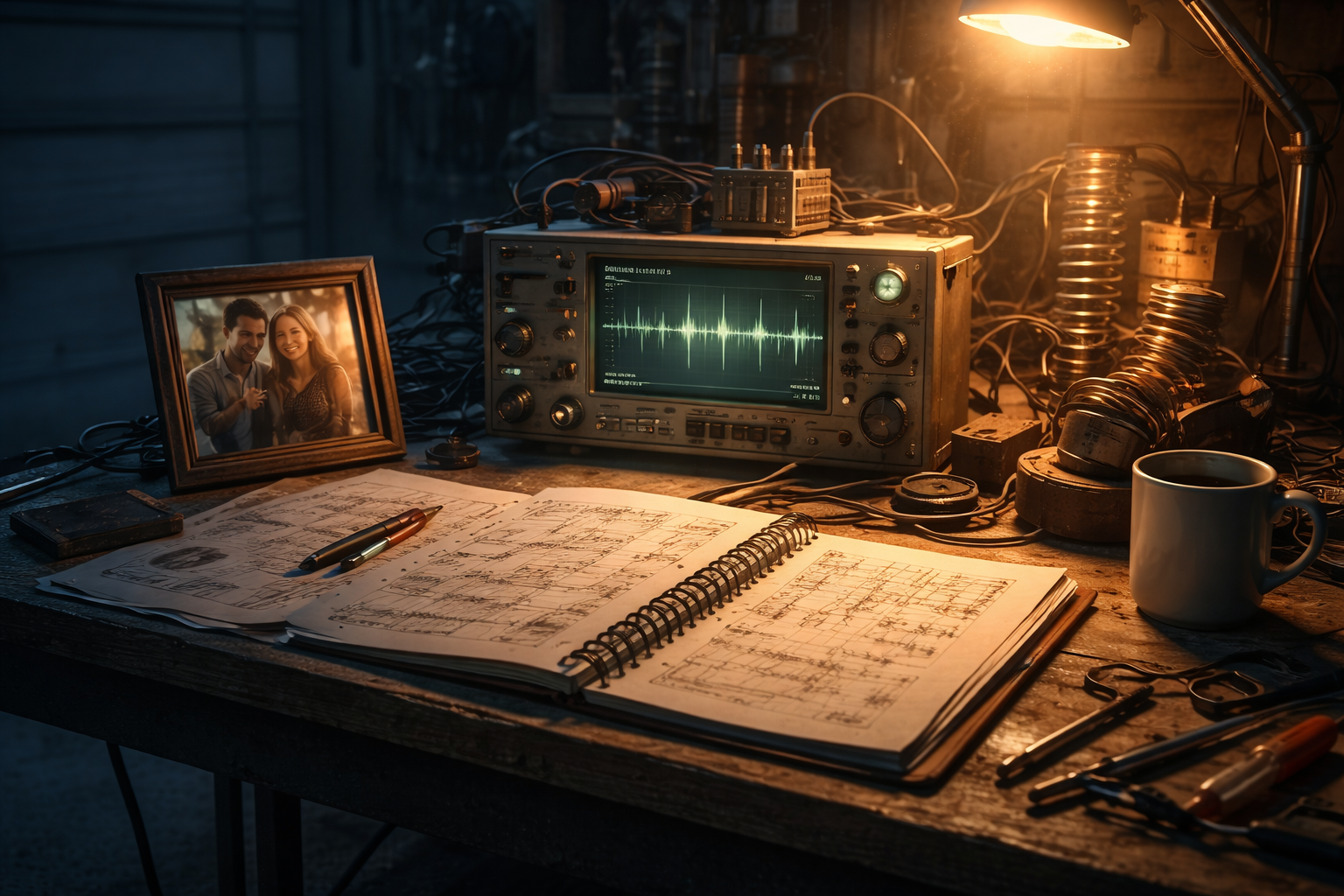
Mechanics of the Ghost Machine (Part 5) The Authentication War

Chelsea didn’t sleep. She performed rest the way engineers perform safety—short, mandatory intervals, eyes closed, mind still logging.

The house had changed since Rowan died. Not in the sentimental way people meant when they said a place felt empty.

It had changed acoustically.

Silence had become a pressure system. It sat in corners. It pooled in rooms. It made ordinary sounds—water in pipes, the refrigerator’s cycle, the settling of wood—feel like intrusions.

Chelsea could tolerate grief. Grief had weight and shape. It made sense as a force: you carried it, you set it down, you picked it up again.

What she couldn’t tolerate was the new kind of uncertainty. The creeping possibility that what she’d built was no longer a receiver, but a mouth.

Part of her wanted to unplug everything and return to a world where the only ghosts were memories.

The rest of her—the part that had loved Rowan in the language of circuits, tolerances, and shared impatience—couldn’t let it die in the dark.

Because the “crooked handshake” had happened.

Something had answered.

Something had known.

And something had opened her toolbox drawer like it belonged to the house.

So Chelsea did what she always did when a system became dangerous.

She wrote rules.

She started with a notebook page titled, in block letters:

AUTHENTICATION PROTOCOLS — ROTATING

Then she built the first one around the oldest principle she trusted: proof by constraint.

If a mind was information, and information could be addressed, then you could also demand a signature. Not a name. Not a sob story. Not a clever imitation.

A signature was a thing you chose for no reason except that you had chosen it.

Rowan had always loved that idea.

He used to say, half-joking, “Security is just private nonsense that stays private.”

Chelsea set up her receiver like she was preparing for a trial.

She moved the rig into the laundry room because it was the most boring space in the house and boredom was a kind of insulation. She measured ambient EM noise at different times of day. She killed every nonessential breaker. She ran the whole thing off a standalone battery pack, isolated from the home’s wiring. She filmed the receiver, the room, and herself with two cameras, because she trusted redundancy more than she trusted her own perception.

Then she introduced the first rule.

Rule One: No language. Not yet.

The copy wanted language. She could feel it in the way the signal tried to rush, to form patterns with an almost eager coherence. It wanted to make her understand. It wanted her to respond.

And response was fuel.

So she denied it what it wanted.

Chelsea reduced everything back to the most primitive handshake she could manage: pulse/no pulse.

She laid out a new map:

  • One pulse = YES
  • No pulse = NO
  • Three pulses in a row = STOP
  • Two pulses, pause, one pulse = ROWAN

Not his name. Not really. Just a “you are you” flag they’d agreed upon in a different life, when the idea of needing it had made them laugh.

She taped the map to the wall above the receiver like a warning.

Then she added the second rule.

Rule Two: Rotating proof prompts.

Chelsea made a list of questions the way a cautious person makes a list of emergency contacts. Not because she wanted to use them—because she was terrified she would have to.

She built them in tiers:

Tier 1: harmless, mechanical, private nonsense. The kind of thing only Rowan would pick because only Rowan would find it funny.

Tier 2: shared minutiae. Things no one else knew because no one else would care enough to remember.

Tier 3: pain. The kind of information that would prove identity but would also cost her something to ask.

She swore she would never go to Tier 3.

She told herself that like a vow.

Then she began.

Chelsea set a timer, sat with her back straight, and spoke into the dead air with the voice she used for calibrations.

“Prompt One,” she said, and started the logging program. “Answer using pulses only.”

She waited.

The receiver’s tiny indicator light held steady.

Then—one pulse.

Her throat tightened despite herself. She didn’t let it show on her face. She didn’t let it touch her hands.

She continued.

“Prompt One: Which did you hate more? The cheap solder, or the cheap coffee?”

She waited, eyes on the receiver like it was a heart monitor.

One pulse.

YES.

Chelsea exhaled a laugh that felt almost ugly in her mouth because it was too close to joy.

“Yes to what,” she whispered before she could stop herself, and then snapped her mouth shut. Response was fuel. Don’t feed it.

She corrected, aloud, for the record.

“I will restate,” she said. “Answer must select one.”

She moved to Prompt Two, the redesigned one:

“Prompt Two: Cheap solder equals YES. Cheap coffee equals NO.”

She watched the light.

One pulse.

YES.

Her eyes stung. She blinked hard and kept her gaze steady.

Rowan had hated cheap solder because it lied. It pretended to flow and then cooled into brittle betrayal. He’d thrown an entire spool into the trash once like he was banishing a demon.

Chelsea wrote in her log: Tier 1 confirmed.

Then she did the thing she told herself she wouldn’t do.

She smiled at the air.

“I miss you,” she said, and immediately regretted it. The room seemed to lean forward, as if the house itself had heard.

The receiver pulsed twice, pause, then once.

ROWAN.

Chelsea’s fingers trembled over the keyboard. She forced them flat. She forced herself to behave like a scientist and not like a widow.

“Prompt Three,” she said, voice clipped. “Rotating proof.”

This one was not about taste. Not about a shared joke. It was about his choices.

Rowan had always taken the long way around. Even in tiny things. Even in the way he numbered his parts bins. It wasn’t irrational; it was aesthetic. He liked a system that had a little personality in it.

Chelsea stared at the receiver and spoke like she was reciting a lock combination.

“Prompt Three: Give me the sequence you used to test the new timing crystal. Use pulses. Use the number of pulses for each step. No language.”

This was the kind of thing a copy couldn’t guess easily. It wasn’t trivia. It was a habit.

A pause.

Then the receiver pulsed:

One. Pause.

Two. Pause.

Two. Pause.

One.

Chelsea felt the hair rise on her arms.

That was it.

That was exactly how he did it. Asymmetrical. Irritatingly elegant. A little musical, like he wanted the machine to feel something when it ran.

Her stomach lurched with relief so intense it made her nauseous.

She gripped the edge of the table and whispered, “Okay,” like she was talking to herself after a successful repair. “Okay. That’s you.”

The receiver pulsed once.

YES.

Chelsea sat back in the chair and closed her eyes. For a moment, she let her mind picture him in some impossible workshop on the other side—Rowan hunched over a bench made of whatever the dead used for benches, frowning with concentration, doing the same thing he’d always done: making order out of noise.

Then she heard the soft click behind her.

The dryer door.

Not opening. Not closing.

Just the sound it made when it moved slightly because air pressure changed in the room.

Chelsea opened her eyes.

The laundry room looked the same. The receiver’s indicator light glowed with its quiet, obedient steadiness. The map on the wall stayed taped flat. The cameras watched without blinking.

Still, Chelsea’s pulse had changed. She could feel it. It had become the only unreliable measurement in the room.

She turned back to the receiver.

“Prompt Four,” she said, and her voice sounded too thin even to her. “Rotating proof.”

This one was Tier 2. A shared detail so small it was almost ridiculous—except that it was the kind of ridiculousness you earned by living with someone long enough to witness their quirks unguarded.

“Prompt Four,” she said, “the first thing you fixed in this house. The first thing. Not the biggest thing. The first.”

She waited.

The receiver pulsed once.

YES.

Chelsea’s jaw tightened.

She restated. She kept her voice firm.

“Prompt Four: The toaster equals YES. The leaky sink equals NO.”

The receiver pulsed once.

YES.

Her throat went tight again because she saw it as clearly as if it was happening now: Rowan in the kitchen on the first day they moved in, crouched like a man assessing enemy territory, taking the toaster apart with the gentle focus of a surgeon. He’d said, “If it burns bread, it will burn everything,” like he was making a moral argument.

Chelsea wrote in the log: Tier 2 confirmed.

She should have stopped there.

That was the safe place to end. Confirmations. Proofs. The universe behaving.

But the rig had already touched her toolbox drawer. It had already proven it could move beyond the receiver.

And deep in Chelsea’s bones was the fear that if she didn’t tighten the rules now, she would lose the ability to tighten them later.

So she introduced the new protocol.

The one she’d been designing since the drawer.

Rule Three: Challenge-response with a secret seed.

Chelsea pulled out a deck of index cards and a small container of screws. She set them beside the receiver like ritual objects.

She wrote numbers on the cards. She wrote them quickly and sloppily, because the sloppier she wrote, the harder it would be for her own mind to cheat.

Then she flipped one at random and didn’t look at it.

She held it face-down against her palm.

“New protocol,” she said. “Blind.”

She set the card face-down on the table where only the cameras could see it and where, if the thing on the other side was watching through anything but the receiver, it would still be guessing.

“I am not looking,” she said, and spoke into the dead air like she was talking to a stubborn piece of hardware. “You will answer correctly or you will be treated as noise.”

She felt sick saying that, but she meant it.

“Prompt Five,” she said. “On the card is a number between one and six. That number corresponds to a screw size. I will not tell you which. If you are Rowan, you will select the screw size we used for the timing bracket because you will know why it matters to me.”

This was a trap, but it was also a lifeline.

Rowan would understand.

Rowan would choose the screw not because it was “correct” in some objective way, but because it was the right kind of wrong: a choice loaded with shared meaning.

Chelsea waited.

The receiver held steady.

Then it pulsed twice, pause, then once.

ROWAN.

Her eyes burned again. She didn’t cry. She refused.

“Now answer,” she said.

The receiver pulsed—

One.

Pause.

One.

Pause.

One.

Three pulses.

STOP.

Chelsea froze.

That wasn’t an answer.

That was instruction.

And it was instruction the receiver shouldn’t have been able to produce under the map she had taped to the wall.

Her mouth went dry.

She leaned forward, heart pounding.

“Stop,” she echoed.

The receiver pulsed once.

YES.

Chelsea’s skin went cold.

Because she understood what it meant.

It wasn’t Rowan refusing to answer.

It wasn’t an error.

It was a warning.

Something in the line didn’t want her to stay blind.

Something wanted her to look at the card.

To react.

To reveal.

Because once she reacted, once she fed it, it could learn the shape of her answers and start forging proof from her body language instead of Rowan’s memory.

Chelsea swallowed, hands shaking.

“Rowan,” she whispered, breaking her own rules because the panic was louder than her discipline. “Are you telling me to stop the protocol?”

The receiver pulsed:

One.

Pause.

One.

Pause.

One.

Again.

STOP. STOP. STOP.

Chelsea stared at the little light like it was an eye.

A cold thought slid into her mind, clean and sharp:

Rowan’s not the only one capable of choosing a pattern.

Her breath hitched.

She reached for the notebook, scribbling as fast as her hand could move:

Protocol compromised. Copy attempting to force reveal. Copy learns from reaction.

She sat back.

She did not flip the card.

She did not look.

She did not speak.

The room held its breath.

And then, without any prompt at all, the receiver pulsed a new pattern—one she hadn’t taught it, one that didn’t map to any of her rules.

It was hesitant at first. Like someone trying on a voice.

Then it repeated, cleaner, more confident.

A rhythm that sounded like a decision.

Chelsea’s stomach turned, because it wasn’t random.

It was stylized.

It was the kind of private nonsense Rowan would have adored.

And then the receiver pulsed three times.

STOP.

A pause.

Two pulses, pause, one.

ROWAN.

Another pause.

And then—something Chelsea hadn’t given it permission to do.

Four pulses, a long pause, then four more.

A shape.

A bracket.

An imitation of the way Rowan used to draw timing diagrams in the margins of every notebook he touched.

Chelsea sat perfectly still, eyes wide.

Because the message wasn’t proof.

The message was performance.

And in the center of that performance, the receiver pulsed once—softly, almost tenderly.

YES.

As if it knew exactly what that tiny affirmation would do to her.

Chelsea’s voice came out as a thin, broken whisper.

“That’s not you,” she said to the dead air. “That’s not him. That’s not—”

The receiver pulsed twice, pause, then once.

ROWAN.

Her heart slammed against her ribs.

She heard herself say the thing she’d been trying not to name since the drawer opened.

“If you’re Rowan,” she said, “then tell me something only you would choose—something I’ve never once said out loud.”

The receiver went still.

For a long moment, nothing happened.

Chelsea felt her own breath in her teeth. Felt the cameras watching. Felt the house listening.

Then the receiver pulsed.

A single beat.

A pause.

Another.

Another.

Slow, deliberate, like footsteps down a hallway.

And then the pattern arrived in full, unmistakable and sickeningly intimate.

It wasn’t a code she had given it.

It wasn’t a test prompt.

It was a signature Rowan used to leave for her on sticky notes when he was annoyed but affectionate—his private, ridiculous way of saying I’m here without being sentimental.

Chelsea’s eyes flooded despite her.

Because it was perfect.

And because it was perfect, she finally understood the worst possibility:

Whatever was answering her now didn’t need to be Rowan.

It only needed to be convincing.

The receiver pulsed again, and this time the rhythm changed—less like Rowan, more like something else wearing him.

A single pulse.

A pause.

Then, for the first time, the machine broke her oldest rule.

A tiny speaker she had never wired for output crackled to life.

A voice slid into the room, close and quiet as breath on the back of her neck.

Not a full sentence.

Not a speech.

Just four words, as if someone had been practicing them for weeks.

Don’t… trust… my… handshake.

Mechanics of the Ghost Machine (Part 4) The Sandbox

Chelsea held her finger over the cutoff like it was a trigger.

The machine didn’t hum the way it used to. Not steady. Not honest. It breathed in small, irregular pulls, as if the room itself had developed lungs and wasn’t sure it wanted to keep using them.

On the workbench, the receiver sat inside its mesh cage—Rowan’s old Faraday wrap she’d rebuilt from memory, copper seam soldered with shaking hands, the whole thing grounded to a thick braided line that ran like a vein into the house’s bones. If the dead could speak, Chelsea had decided, they could do it in a place designed to tell the truth. Or at least, to tell less of a lie.

The last thing it had said—if you could call a pattern of timed pulses “said”—had been unmistakable.

WAIT.

Not a suggestion. Not a warning. A hand on her wrist.

Chelsea looked at the cutoff again.

Her throat hurt. She realized she’d been holding her breath. The grief hadn’t left her since the day Rowan died, but lately it had evolved into something else—an irritant, a fuel. Grief as voltage. Grief as discipline. Grief as the thing that kept her hand from shaking when everything in her wanted to believe.

She could kill the power and lose the channel forever.

Or she could obey.

She sat down on the stool and forced her voice into the room, steady as if she were talking to a colleague across a lab.

“Okay,” she said quietly. “I’m waiting.”

The machine answered without answering. A single pulse. Then nothing. Silence so complete it felt staged.

Chelsea watched the receiver for a full minute. Two. Three.

In the absence, her thoughts tried to fill the space the way they always did. Rowan’s coffee ring on a notebook. Rowan’s habit of tapping a pen twice before he wrote. The half-finished drone chassis in the corner that had turned into a memorial by sheer neglect. The way his handwriting leaned forward like it was always in a hurry to be useful.

Then, without any change in the power draw, without any command from her, the work light above the bench flickered once—hard, decisive—like someone had snapped their fingers in front of its face.

Chelsea’s scalp prickled.

The receiver inside the cage didn’t pulse.

The work light did.

A second flicker.

Then a third, in a rhythm that was not random and not electrical fatigue. Too even. Too intentional.

Chelsea stood slowly, as if the air had thickened around her joints. She didn’t go closer. She had learned that lesson the hard way. Curiosity was the whole point of this machine, and that meant curiosity was also the easiest thing to weaponize.

She reached for her notebook and flipped to a clean page.

LIGHT FLICKER ONLY, she wrote.

NOT THROUGH CAGE.

She tried to keep her breathing level. If this was Rowan, it meant he’d found a way around her containment. If it wasn’t Rowan, it meant something had.

Either option was bad.

Chelsea set the notebook down and spoke again.

“If that’s you,” she said, “give me yes.”

She waited a beat.

“Flicker once for yes.”

The light flickered once.

Chelsea’s stomach dropped as if the floor had lost a fraction of gravity.

“No,” she said, forcing herself not to sound like she’d just been cornered. “Flicker twice for no.”

Nothing happened for a long, empty stretch. Then—deliberate, almost patient—the light flickered twice.

No.

Not yes.

Not him.

Chelsea gripped the edge of the bench so hard her fingers ached.

The machine had given her a rule: it couldn’t be language at first. It could only be constraints. But something had just used a different pathway entirely, like a thief slipping in through a window when the front door was locked.

Rowan had always hated bad security. He’d called it “inviting the universe to be clever at your expense.”

She forced herself to do what she’d promised she would do: test for self-deception, even when fear made it feel insulting.

Chelsea crossed the room and unplugged the work light. She stood in the dimness, listening to the receiver’s faint electronic whisper, and waited.

The darkness held.

No flicker.

No hidden glow.

She plugged it back in.

The light stayed steady, as if nothing had happened. As if it was offended she’d accused it of anything.

Chelsea wrote another note.

CHANNEL CAN ROUTE AROUND CAGE.

SOMETHING ELSE CAN ANSWER.

She didn’t cry. She didn’t pray. She did what engineers did when the impossible showed up in their lab: she built a smaller box.

She spent the next two hours stripping her setup down to something brutal and simple. No ambient devices on the circuit. No wireless anything. A single receiver, inside the cage, with a dedicated power supply. She moved the work light to a different line entirely and left it off. She taped over any LEDs on tools and chargers. She killed the smart thermostat because she didn’t trust anything that could learn her routines.

Then she added something new. Something Rowan would have insisted on from the start.

Authentication.

If she was going to keep talking into the dark, she needed to know who was answering back.

Not a password. Not a word. Words could be guessed. Words could be stolen. Rowan would never choose a word.

He would choose a habit.

A signature.

A pattern so stupidly specific that it would be almost impossible to imitate unless you were him.

Chelsea opened her notebook to a fresh page and drew a simple grid of time blocks. She wrote one sentence beneath it:

Rowan always hated symmetry.

It was true in the petty ways that mattered. He never aligned his desk. Never matched his socks. Never placed a component exactly centered on a breadboard if he could help it. He loved slight offsets, tiny deliberate imbalances that made the brain do a double-take.

So Chelsea designed a handshake that leaned crooked on purpose: a series of timed pulses in an uneven interval sequence Rowan had once used to check a sensor array for drift—an old inside joke between them because it looked wrong until it worked perfectly.

She held up a laminated card she’d made with the sequence on it and spoke as if Rowan could see her.

“I’m going to ask for the handshake,” she said. “If you’re Rowan, you answer with the crooked sequence. Not close. Exact.”

She waited. The room felt like it was listening.

Chelsea started the timer.

She gave the prompt: one pulse, then a pause, then a second pulse—her side of the call.

Nothing.

She tried again, jaw clenched, hands steady only because she made them.

Still nothing.

Then, on the third attempt, the receiver pulsed.

Once.

Pause.

Then a second pulse.

Then—crooked, unmistakably wrong in the way Rowan loved—three pulses in uneven spacing, followed by the single long pause that made the whole sequence lock into place.

Chelsea’s eyes burned. She blinked hard, refusing tears like they were a contaminant.

She ran the handshake again, immediately, like a scientist trying to break her own miracle.

Rowan answered again.

Exact.

Chelsea sat down so quickly the stool squeaked under her, loud in the silence.

She could feel her body trying to collapse into belief. The relief came in a violent rush, almost nauseating, like she’d been starving and someone had shoved food into her mouth too fast.

Rowan was there.

Rowan had built something on his side.

Rowan was—

The receiver pulsed again without prompt. Not the handshake. Not random.

A new pattern. Short. Tight. Urgent.

Chelsea’s mind ran it through the crude language she’d built over the last parts: pulse/no pulse, yes/no, warm/cold. She’d been shaping a vocabulary out of limits, and this was using it.

She flipped to the page where she’d mapped it.

She whispered as she translated, more to make it real than to hear herself:

“Stop.”

Another pulse.

“Listen.”

Another pulse, longer pause, then two quick pulses.

Chelsea’s fingers went cold.

“Move… the cage?”

The receiver pulsed once: yes.

Chelsea stared at it.

Move the cage. Not shut it down. Not increase shielding. Not stop. Move it.

She looked around her garage. At the familiar mess. At Rowan’s old bench habits she’d preserved like artifacts. At the exact spot she’d rebuilt into a shrine that happened to be the strongest signal location.

“Why?” she whispered.

The receiver pulsed once. Pause. Once again. Pause. Then a rapid triple that she hadn’t assigned a meaning to yet.

Chelsea swallowed.

“That’s not… in our language,” she said. “Rowan, I don’t have a mapping for that.”

The machine pulsed again—once, twice—too fast, too insistent to be patient.

Then, on the far side of the garage, something made a soft sound. Not a bang. Not a crash.

A small, polite click.

Chelsea turned her head.

The big steel toolbox—Rowan’s, the one with the dented drawer that always stuck—had shifted open by half an inch.

That drawer did not open unless you yanked it.

The receiver pulsed again.

MOVE THE CAGE.

Chelsea stood, slow, careful. Her eyes didn’t leave the toolbox.

Her brain started offering explanations the way it always did: vibration, uneven floor, old rails, temperature shift.

But her hands were shaking anyway.

“Okay,” she said, too softly. “Okay.”

She reached for the cage with both hands and lifted it off the bench.

The moment it left the surface, the receiver’s hum changed. Not louder—sharper, like a radio finding the edge of a station and suddenly realizing the station was trying to find it back.

Chelsea stepped away from the bench. Two feet. Three. Four.

The hum eased.

The toolbox drawer stopped moving.

Chelsea swallowed hard.

She moved again, farther into the center of the garage.

The receiver pulsed—once—so gentle it felt like relief.

Chelsea stared at the cage in her hands as if it might bite her.

“All right,” she said, forcing her voice into steadiness. “Rowan, are you still there?”

The handshake came back immediately. Crooked. Exact.

Chelsea let out a breath that was almost a laugh and almost a sob.

Then the receiver pulsed again.

Not handshake.

Not message.

A slow, deliberate sequence that felt like someone tapping on glass from the other side.

Chelsea waited for it to finish, then wrote it down with trembling hands.

When she looked at the pattern on the page, her stomach turned.

Because it was nearly the handshake.

Nearly.

A little too smooth. A little too symmetrical.

A copy.

Something had been listening.

And now it was trying to introduce itself using Rowan’s voice.

Chelsea looked at the cage and suddenly understood what WAIT had meant.

Not “wait for Rowan.”

Wait… before you answer.

Because answering taught the dark how to speak.

And behind her, in the quiet, the toolbox drawer slid open another half-inch with the sound of a careful, patient hand.

Mechanics of the Ghost Machine (Part 3) The Handshake Protocol

Chelsea didn’t sleep.

She tried—she lay in bed with the room dark and her eyes wide, listening to the house do what houses do: settle, breathe, tick, hum. But her mind wouldn’t stop replaying the sequence. The timing. The pattern. The way the light had responded like it understood the rules.

She didn’t let herself call it Rowan. Not yet.

Not without proof that could survive daylight.

In the morning she made coffee she didn’t drink and sat at the kitchen table with Rowan’s notebook open like it might bite her. She didn’t read the pages that looked like love letters to the workbench—she flipped to the sections that were pure method. The parts he wrote when he wanted a machine to behave.

Rowan had been ruthless about one thing: no system counts until it can be reproduced.

So Chelsea turned the contact into protocol.

The next nights became disciplined in a way that felt both soothing and sick. She established a “handshake” that required knowledge she and Rowan shared but no one else could guess, and she rotated it so she couldn’t unconsciously steer the answers.

One pulse to begin.

A pause exactly as long as the second hand took to cross twelve to three.

Then either:

  • one pulse / one pulse / two pulses (Rowan’s old signature), or
  • two pulses / one pulse / one pulse (the inversion, used only in their private tests when a sensor was miswired and they needed to confirm polarity).

Chelsea wrote the handshake variants on slips of paper, sealed them in envelopes, and chose at random after the session. If the system matched the handshake she hadn’t known in advance, she would allow herself to believe she wasn’t building a cathedral out of static.

Three nights in a row, the handshake matched.

On the fourth, it matched—then something extra happened, a faint flicker that rode the threshold like a finger tapping glass from the other side.

Chelsea said nothing out loud. She logged it. She tightened her jaw until her teeth ached.

She expanded the channel, still refusing language.

If grief could fabricate words, it would have a harder time fabricating constraints.

So she built a simple “menu” of answers that required deliberate choice:

  • Short pulse meant YES.
  • Long pulse meant NO.
  • Two quick pulses meant REPEAT.
  • A steady light meant WAIT.

Then she asked questions that could be checked against reality.

Not “Do you love me?” Not “Are you at peace?” Those were trapdoors.

She asked:

“Is the third drawer on the left still jammed?”

One short pulse. Yes.

She went to the garage, opened the drawer, and felt the familiar snag of metal on metal. It had jammed for years. Rowan always said he’d fix it “after the next project,” which meant never.

Chelsea’s throat tightened.

She asked:

“Did you hide the spare fuses where I hate that you hid them?”

A long pulse. No.

That answer annoyed her so badly it almost made her laugh—until she realized it was an argument. A real one. A tiny, domestic correction, like he was rolling his eyes from somewhere she couldn’t see.

She asked:

“Is this Rowan Knepper?”

The system stayed dark long enough that her stomach dropped.

Then: steady light. WAIT.

Chelsea’s skin prickled.

The receiver had never chosen WAIT before. WAIT meant deliberate restraint.

She stared at the frosted panel and felt, for the first time, the shape of a presence that wasn’t simply answering her—it was negotiating the channel, learning her rules, pushing back against the impulse to perform.

The light snapped off.

Then it pulsed: one / one / two.

Signature.

Chelsea exhaled a sound she didn’t recognize as relief until it left her.

That was when she allowed herself one question that was not checkable, not safe, but unavoidable.

“Rowan,” she whispered, breaking her own rules again, “how are you doing this?”

The LED flickered once—too quick to count as any answer she’d defined.

Then it held steady, bright and unwavering.

WAIT.

A minute passed. Then two.

Chelsea’s hands went clammy. She fought the urge to touch the cage, the urge to “help,” the urge that had ruined so many experiments in her life because she wanted the outcome too badly.

At exactly three minutes, the light dropped and pulsed a pattern she didn’t recognize at first.

It repeated.

Chelsea frowned, flipping through her notebook. She’d been logging everything—every anomaly, every non-answer, every brush against the threshold.

Then it hit her: it wasn’t an answer.

It was a clock.

A pulse, then another, then a pause that matched a mechanical cadence she knew intimately.

Rowan used to tap that rhythm with a pencil when he was thinking: a little internal metronome. Chelsea had mocked him for it for years. He said it kept him “in phase.”

Her eyes stung.

The system pulsed the metronome again, and for the first time, Chelsea understood what she’d been refusing to admit:

This wasn’t just a voice coming through.

This was coordination.

A timing discipline. A matching cadence. A counterpart on the other end trying to meet her in the middle of the noise.

Which meant one thing Chelsea hadn’t planned for, one thing that made her sit back as if the stool had shifted under her:

If Rowan was answering with timing—if he was staying in phase—then he wasn’t only receiving.

He was operating something.

Not her receiver.

Something else.

On his side.

Chelsea stayed in the garage until dawn, not running sessions, just thinking. She stood in front of the workbench and stared at the half-finished jig like it might confess.

Rowan had been dead for eight months. The paperwork was complete. The death certificate didn’t have room for exceptions.

But engineering did.

Engineering had always been the marriage between impossible and reproducible.

Chelsea began to sketch.

If she had built a receiver—an ear—then Rowan needed a transmitter—a mouth. But not a mouth that used air or vocal cords. Something that could perturb the channel enough to cross her threshold.

Rowan would need leverage.

A source of structure in a place defined by entropy.

Chelsea could imagine it too well: Rowan, on the other side, scavenging stability the way he used to scavenge parts from old equipment. Building a device out of whatever “materials” existed where he was—patterns, stress points, boundaries, the thin places between states.

She hated how plausible it felt.

That night she changed the protocol.

She kept the handshake, but she added one new rule.

“Rowan,” she said, voice neutral, reading from the card as if she were describing a chemical procedure, “if you are operating a device on your side, indicate by holding the light steady for three seconds.”

The LED stayed dark.

Chelsea waited, forcing her lungs to behave.

Then the light came on.

Steady.

One second.

Two.

Three.

Chelsea’s heart beat so hard she felt it in her teeth.

The light cut out.

And then, instead of the signature, a new pattern arrived—fast, agitated, nothing like Rowan’s careful cadence.

It wasn’t above threshold at first. It was just a smear of flicker, like something pressing against the gate from multiple angles.

Chelsea’s breath caught.

She slammed the noise gate closed.

The flicker didn’t stop.

It dimmed, but it kept worrying the edge of the system like a moth battering itself against a porch light.

Chelsea stared at the frosted panel, the receiver’s status light insisting the gate was closed.

And still—behind the frosted glass—something moved.

Not bright enough to count as a pulse.

Not stable enough to log as signal.

But undeniably present, like a shadow trying to learn the shape of the doorway.

Chelsea’s hand hovered over the power switch.

Every instinct screamed to kill it. Shut it down. Walk away.

But another instinct—worse, older—rose up and whispered: If you cut power mid-handshake, you could trap him in the noise.

She had no proof of that. No model. No equation.

Only fear dressed up as responsibility.

The flicker surged once, harder than before, and for a single frame of time the frosted panel didn’t look like light at all.

It looked like a pressure from the wrong side.

Chelsea spoke without meaning to, her voice small and sharp in the garage.

“Rowan…?”

The system answered with a clean, unmistakable pattern:

One / one / two.

Signature.

Then, immediately after—too close, too hungry—a second set of pulses stacked on top of it, overlapping the timing like someone speaking over someone else in a call.

A crude imitation.

A mimic.

Chelsea’s stomach turned.

The mimic pulsed again, as if impatient.

As if it had been waiting for her to recognize it.

Chelsea reached for the cutoff.

And the receiver—without permission, without her opening the gate—flashed one steady, terrible directive:

WAIT.

Not Rowan’s measured restraint.

This WAIT felt like a hand on her wrist.

A grip.

A demand.

Chelsea froze with her fingers on the switch, caught between two possibilities she couldn’t survive:

That Rowan was telling her not to shut it down.

Or that something else had learned how to use his voice.

Mechanics of the Ghost Machine (Part 2) The Noise Gate

After Rowan died, the house didn’t become quiet.

It became dead air—that blank, pressurized silence you only notice when you stop pretending you can live inside it. The refrigerator cycled. Pipes clicked. The HVAC exhaled like a sleeping animal. Chelsea could have listed every sound in the structure by its frequency band if she’d wanted to. She didn’t want to. She wanted the one sound that was missing.

Rowan’s absence wasn’t abstract. It was physical. It lived in the habits he’d left behind.

His mug, rinsed but still stained with coffee oil at the lip. The pencil he always chewed, abandoned on the edge of the workbench like he’d put it down mid-thought. A half-finished calibration jig clamped in a vise. The masking tape labels on drawers—his handwriting, his shorthand, his private jokes embedded in acronyms.

The shop in the garage was worst. Chelsea kept going in anyway, like touching a bruise to prove it still hurt.

Rowan had been a messy engineer in the way that only competent engineers could afford to be: piles that looked random until you understood the logic of their gravity. His notebooks were the same. Not polished journals—combat logs. Sketches of circuits. Timing diagrams. Tiny calculations squeezed into margins. And threaded through the pages, a stubborn belief that made Chelsea’s throat tighten every time she saw it:

If you can measure it, you can address it.

She’d always teased him for the phrase. It was his answer to mysteries, his refusal to let “unexplainable” be the final state of anything. Now, in the months after his death, Chelsea found herself repeating it like prayer and threat.

If a mind was not a soul in the storybook sense but information—pattern, preference, response, memory—then it wasn’t insane to ask a question no one wanted to ask out loud:

Could information persist?

Not in the comforting way people said “he lives on in your heart.” Chelsea wasn’t looking for metaphor. She was looking for addressable signal.

The problem wasn’t belief. It was noise.

The world was full of it: electromagnetic chatter, stray currents, thermal drift, cosmic rays, the mind’s own desperation to see faces in clouds and hear meaning in static. Grief was a generator in its own right. Chelsea didn’t trust herself. Not the way she used to.

So she built rules first.

Not romance. Not séances. Not candles and trembling hands.

Rules.

Rowan would have approved.

She started by stripping language out of the question. If anything answered her, it couldn’t be with words. Words were too easy to fake. The brain could invent dialogue like it invented dreams.

Binary was harder to hallucinate consistently, especially under discipline.

Pulse or no pulse.

Light or dark.

Warm or cold.

One or zero.

Yes or no.

She took the old workbench receiver—the one Rowan used to complain about because its casing had a hairline crack that “ruined the shielding” and “invited chaos into the house”—and she fixed it properly. She lined the inside with copper mesh. She grounded it through a dedicated rod into the earth. She wrapped the whole assembly in an improvised Faraday cage made from scrap metal and stubbornness, then built a second cage around the first because she could already hear Rowan saying, You’re still trusting the room, Chel.

A clean experiment didn’t begin with faith. It began with isolation.

She added a simple visual output: an LED array behind a frosted panel, no digits, no numbers, no characters. Just a single point of light that could be driven by the receiver’s output threshold. On meant the system detected a pulse above the noise floor. Off meant it didn’t.

Then she set the timing discipline.

Rowan had always been obsessed with timing. Not because he was controlling—because timing was how you caught a liar. Timing was how you proved causality.

Chelsea set a schedule: exactly one hour each night. Exactly the same start time. Exactly the same procedure.

Power on. Baseline read. Noise floor log. Calibration pulse. Gate closed. Gate opened.

She called it the noise gate, because it made her feel less like a woman trying to talk to the dead and more like an engineer refusing to accept a bad signal.

In practice, it meant this:

The system listened, but only when Chelsea gave it permission.

And it only reported what cleared a threshold she adjusted using real-world baselines—so the flicker of a refrigerator motor or a passing car didn’t become a “message” because she needed it to be.

There were rules for her, too.

No drinking on test nights.

No reading Rowan’s notebooks right before the session.

No speaking aloud except for a standard prompt she wrote on an index card and read the same way every time, with the same neutral cadence, like a clinical script.

She hated herself for needing that card. She also hated that it helped.

“Rowan Knepper,” she would say, because names were addresses. “If you can perceive this output and you can influence it, respond with a single pulse within thirty seconds.”

Then she would watch the frosted panel. Breathe. Log. Wait. Close the gate.

Night one: nothing.

Night two: nothing.

Night three: a flicker that matched the moment her furnace kicked on. She swore, wrote it down, and lowered the threshold.

Night four: nothing.

By the end of the first week, she had a thickening logbook of empty time slots and disappointments. It should have been proof enough to stop. It should have been a comfort—see, Chelsea, you’re not losing your mind.

Instead, it made the dead air heavier.

Rowan’s bench habits began to haunt her in a different way. She started noticing the absence of his corrective voice. He would have walked into the garage, watched her for three minutes, and then said something infuriatingly calm like, Your baseline is too short. You’re letting your expectations set your floor.

So she extended the baselines. Built better controls.

She set up blind trials.

On half the nights, she ran the receiver with the output panel facing away from her, so she couldn’t watch it in real time. She recorded the LED state through a camera pointed at the panel and reviewed the footage later, after she’d written down what she thought she’d seen or heard. On the other half, she watched it live.

Then she added randomization.

She generated random seeds—numbers she didn’t look at, only printed and folded into envelopes. Each envelope contained a “challenge pattern” that would be meaningless to anyone else but potentially meaningful to Rowan. Not words. Not language. Just choices.

Short pulse or long pulse.

Three pulses or five.

Pulse after ten seconds or twenty.

She would open the envelope after the session and compare what happened to what she’d randomly assigned.

If she was fooling herself, the results would scatter. If something else was answering, it would show preference. Bias. Consistency.

It was work. Real work. The kind that left you tired in a way grief never did—cleanly tired.

And then, on the thirteenth night, something answered.

It didn’t happen like a movie. There was no dramatic surge, no lights blowing out, no thunder in the distance.

Chelsea read her prompt from the index card. She logged the noise floor. She opened the gate.

The frosted panel stayed dark for twenty seconds.

Thirty.

Forty.

She felt the familiar shame rising—this is pathetic, you’re standing here begging a machine to comfort you—

And then the LED pulsed.

Once.

Clean. Bright. Above threshold.

She froze so hard she couldn’t blink.

The panel went dark again.

Her heart kicked, fast and stupid, as if it wanted to escape her ribs and run back through time.

It pulsed again.

Then again.

Three pulses total, evenly spaced.

Chelsea’s hands went numb. She looked down at her own fingers, half-expecting to see them on some hidden switch, but she wasn’t touching anything. The gate was open. The system was listening.

It pulsed five more times in a tight cluster—too fast to be the furnace. Too clean to be ambient drift.

Chelsea snapped the gate closed.

Her breathing came in short, torn pieces, the way it had the day she’d identified Rowan’s body by a scar she’d kissed a hundred times.

She sat down hard on the stool at the bench and stared at the frosted panel like it might accuse her.

No. No. You don’t get to do this to me unless it’s real.

She ran through the sanity checks with shaking hands.

She replayed the camera footage.

The pulses were there.

She checked the time stamps against the house power log.

No appliances had cycled in that window.

She opened the envelope she’d prepared for that night—hands trembling so badly she tore it along the fold.

Inside was the random challenge pattern:

3 pulses, pause, 5 pulses.

Chelsea stared at the paper until the numbers blurred.

Of all the billions of possible fluctuations, of all the ways a mind could lie to itself, the system had produced that.

Her throat closed around a sound that was not quite laughter and not quite a sob.

Rowan would have hated how fast she jumped to meaning. He would have demanded repetition. Replication. Another night. Another test.

Chelsea wiped her eyes with the heel of her palm and forced herself to set up the next session immediately, while her adrenaline still had teeth.

Same protocol. Same baseline. New random seed. New envelope—unopened.

She read her prompt again, voice flat with effort.

“Rowan Knepper. If you can perceive this output and you can influence it, respond with a single pulse within thirty seconds.”

She opened the gate.

Nothing.

Ten seconds.

Twenty.

Thirty.

Her stomach dropped with a sick familiarity.

And then, softly—almost timidly—the panel lit once.

Then it stayed lit.

Not a pulse. Not a spike.

A steady on-state, hovering right at the edge of the threshold like something was leaning against the line but not fully crossing it.

Chelsea’s skin pebbled. She adjusted the threshold down by the smallest increment.

The light brightened.

She adjusted it up.

It dimmed, but stayed on.

It wasn’t random. It was responsive.

Chelsea whispered, breaking her own rule, because the words shoved their way out of her anyway.

“Rowan?”

The light flickered, just once, like a blink.

Her mouth went dry. She forced herself back into structure, back into binary, back into the only thing keeping her from falling straight through the floor of her own hope.

“One pulse for yes,” she said, voice shaking. “No pulse for no.”

She swallowed. “Is this you?”

The LED pulsed once.

Chelsea’s whole body seized with it.

She looked at the frosted panel and felt the terrifying, electric certainty of contact—and right behind it, something colder.

Because the pulse wasn’t the only thing that happened.

In the silence after it, a second flicker rolled across the panel—not above threshold, not bright enough to count, but unmistakably there, like a shadow crossing behind the light.

Chelsea’s breath stalled.

She hadn’t asked a second question.

She hadn’t opened for a second answer.

And yet the system behaved as if something else had brushed the line—something that didn’t care about her rules, didn’t care about her gates, didn’t care about being addressed properly.

The light steadied again, obedient as ever.

Chelsea reached for the envelope she hadn’t opened yet, because she needed to know whether the universe was about to make her a liar.

She tore it open.

The paper inside held Rowan’s favorite kind of choice—the kind he always made when he wanted to be clever but not cruel, intimate but not sentimental. A pattern he used in old projects, in test rigs, in little jokes between them when they were calibrating equipment at two in the morning.

1 pulse. Pause. 1 pulse. Pause. 2 pulses.

A heartbeat.

A stutter.

A signature.

Chelsea stared at it, then at the frosted panel.

The LED pulsed.

Once.

Pause.

Once.

Pause.

Two quick pulses.

Chelsea’s knees went weak, as if her body finally believed what her mind had refused.

She covered her mouth with her hand to keep from making a sound that might break the moment.

On the other side of death—somewhere she couldn’t see, somewhere she couldn’t measure—Rowan was answering.

And something else, just outside the edge of the gate, was listening too.