
Chelsea held her finger over the cutoff like it was a trigger.
The machine didn’t hum the way it used to. Not steady. Not honest. It breathed in small, irregular pulls, as if the room itself had developed lungs and wasn’t sure it wanted to keep using them.
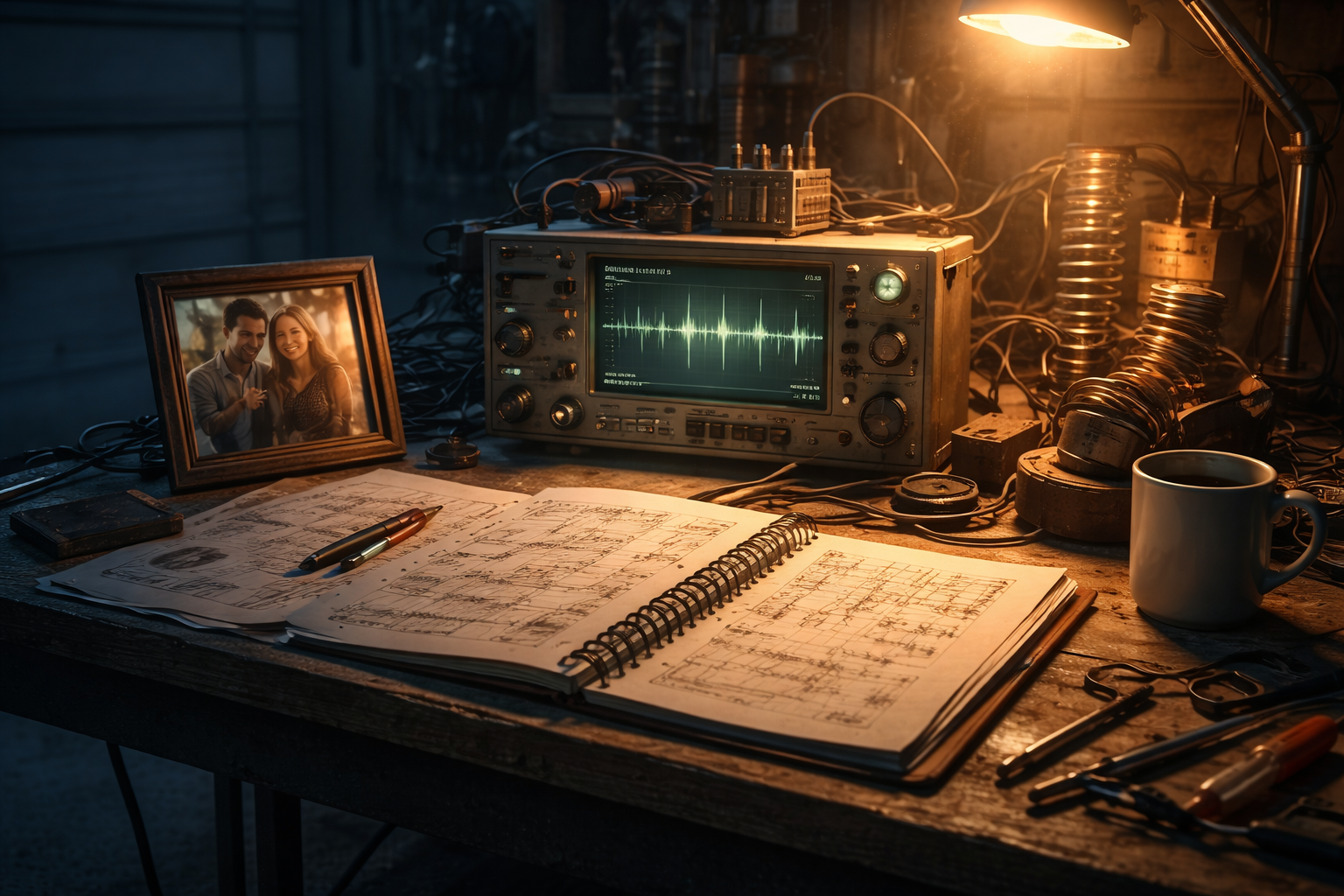
On the workbench, the receiver sat inside its mesh cage—Rowan’s old Faraday wrap she’d rebuilt from memory, copper seam soldered with shaking hands, the whole thing grounded to a thick braided line that ran like a vein into the house’s bones. If the dead could speak, Chelsea had decided, they could do it in a place designed to tell the truth. Or at least, to tell less of a lie.
The last thing it had said—if you could call a pattern of timed pulses “said”—had been unmistakable.
WAIT.
Not a suggestion. Not a warning. A hand on her wrist.
Chelsea looked at the cutoff again.
Her throat hurt. She realized she’d been holding her breath. The grief hadn’t left her since the day Rowan died, but lately it had evolved into something else—an irritant, a fuel. Grief as voltage. Grief as discipline. Grief as the thing that kept her hand from shaking when everything in her wanted to believe.
She could kill the power and lose the channel forever.
Or she could obey.
She sat down on the stool and forced her voice into the room, steady as if she were talking to a colleague across a lab.
“Okay,” she said quietly. “I’m waiting.”
The machine answered without answering. A single pulse. Then nothing. Silence so complete it felt staged.
Chelsea watched the receiver for a full minute. Two. Three.
In the absence, her thoughts tried to fill the space the way they always did. Rowan’s coffee ring on a notebook. Rowan’s habit of tapping a pen twice before he wrote. The half-finished drone chassis in the corner that had turned into a memorial by sheer neglect. The way his handwriting leaned forward like it was always in a hurry to be useful.
Then, without any change in the power draw, without any command from her, the work light above the bench flickered once—hard, decisive—like someone had snapped their fingers in front of its face.
Chelsea’s scalp prickled.
The receiver inside the cage didn’t pulse.
The work light did.
A second flicker.
Then a third, in a rhythm that was not random and not electrical fatigue. Too even. Too intentional.
Chelsea stood slowly, as if the air had thickened around her joints. She didn’t go closer. She had learned that lesson the hard way. Curiosity was the whole point of this machine, and that meant curiosity was also the easiest thing to weaponize.
She reached for her notebook and flipped to a clean page.
LIGHT FLICKER ONLY, she wrote.
NOT THROUGH CAGE.
She tried to keep her breathing level. If this was Rowan, it meant he’d found a way around her containment. If it wasn’t Rowan, it meant something had.
Either option was bad.
Chelsea set the notebook down and spoke again.
“If that’s you,” she said, “give me yes.”
She waited a beat.
“Flicker once for yes.”
The light flickered once.
Chelsea’s stomach dropped as if the floor had lost a fraction of gravity.
“No,” she said, forcing herself not to sound like she’d just been cornered. “Flicker twice for no.”
Nothing happened for a long, empty stretch. Then—deliberate, almost patient—the light flickered twice.
No.
Not yes.
Not him.
Chelsea gripped the edge of the bench so hard her fingers ached.
The machine had given her a rule: it couldn’t be language at first. It could only be constraints. But something had just used a different pathway entirely, like a thief slipping in through a window when the front door was locked.
Rowan had always hated bad security. He’d called it “inviting the universe to be clever at your expense.”
She forced herself to do what she’d promised she would do: test for self-deception, even when fear made it feel insulting.
Chelsea crossed the room and unplugged the work light. She stood in the dimness, listening to the receiver’s faint electronic whisper, and waited.
The darkness held.
No flicker.
No hidden glow.
She plugged it back in.
The light stayed steady, as if nothing had happened. As if it was offended she’d accused it of anything.
Chelsea wrote another note.
CHANNEL CAN ROUTE AROUND CAGE.
SOMETHING ELSE CAN ANSWER.
She didn’t cry. She didn’t pray. She did what engineers did when the impossible showed up in their lab: she built a smaller box.
She spent the next two hours stripping her setup down to something brutal and simple. No ambient devices on the circuit. No wireless anything. A single receiver, inside the cage, with a dedicated power supply. She moved the work light to a different line entirely and left it off. She taped over any LEDs on tools and chargers. She killed the smart thermostat because she didn’t trust anything that could learn her routines.
Then she added something new. Something Rowan would have insisted on from the start.
Authentication.
If she was going to keep talking into the dark, she needed to know who was answering back.
Not a password. Not a word. Words could be guessed. Words could be stolen. Rowan would never choose a word.
He would choose a habit.
A signature.
A pattern so stupidly specific that it would be almost impossible to imitate unless you were him.
Chelsea opened her notebook to a fresh page and drew a simple grid of time blocks. She wrote one sentence beneath it:
Rowan always hated symmetry.
It was true in the petty ways that mattered. He never aligned his desk. Never matched his socks. Never placed a component exactly centered on a breadboard if he could help it. He loved slight offsets, tiny deliberate imbalances that made the brain do a double-take.
So Chelsea designed a handshake that leaned crooked on purpose: a series of timed pulses in an uneven interval sequence Rowan had once used to check a sensor array for drift—an old inside joke between them because it looked wrong until it worked perfectly.
She held up a laminated card she’d made with the sequence on it and spoke as if Rowan could see her.
“I’m going to ask for the handshake,” she said. “If you’re Rowan, you answer with the crooked sequence. Not close. Exact.”
She waited. The room felt like it was listening.
Chelsea started the timer.
She gave the prompt: one pulse, then a pause, then a second pulse—her side of the call.
Nothing.
She tried again, jaw clenched, hands steady only because she made them.
Still nothing.
Then, on the third attempt, the receiver pulsed.
Once.
Pause.
Then a second pulse.
Then—crooked, unmistakably wrong in the way Rowan loved—three pulses in uneven spacing, followed by the single long pause that made the whole sequence lock into place.
Chelsea’s eyes burned. She blinked hard, refusing tears like they were a contaminant.
She ran the handshake again, immediately, like a scientist trying to break her own miracle.
Rowan answered again.
Exact.
Chelsea sat down so quickly the stool squeaked under her, loud in the silence.
She could feel her body trying to collapse into belief. The relief came in a violent rush, almost nauseating, like she’d been starving and someone had shoved food into her mouth too fast.
Rowan was there.
Rowan had built something on his side.
Rowan was—
The receiver pulsed again without prompt. Not the handshake. Not random.
A new pattern. Short. Tight. Urgent.
Chelsea’s mind ran it through the crude language she’d built over the last parts: pulse/no pulse, yes/no, warm/cold. She’d been shaping a vocabulary out of limits, and this was using it.
She flipped to the page where she’d mapped it.
She whispered as she translated, more to make it real than to hear herself:
“Stop.”
Another pulse.
“Listen.”
Another pulse, longer pause, then two quick pulses.
Chelsea’s fingers went cold.
“Move… the cage?”
The receiver pulsed once: yes.
Chelsea stared at it.
Move the cage. Not shut it down. Not increase shielding. Not stop. Move it.
She looked around her garage. At the familiar mess. At Rowan’s old bench habits she’d preserved like artifacts. At the exact spot she’d rebuilt into a shrine that happened to be the strongest signal location.
“Why?” she whispered.
The receiver pulsed once. Pause. Once again. Pause. Then a rapid triple that she hadn’t assigned a meaning to yet.
Chelsea swallowed.
“That’s not… in our language,” she said. “Rowan, I don’t have a mapping for that.”
The machine pulsed again—once, twice—too fast, too insistent to be patient.
Then, on the far side of the garage, something made a soft sound. Not a bang. Not a crash.
A small, polite click.
Chelsea turned her head.
The big steel toolbox—Rowan’s, the one with the dented drawer that always stuck—had shifted open by half an inch.
That drawer did not open unless you yanked it.
The receiver pulsed again.
MOVE THE CAGE.
Chelsea stood, slow, careful. Her eyes didn’t leave the toolbox.
Her brain started offering explanations the way it always did: vibration, uneven floor, old rails, temperature shift.
But her hands were shaking anyway.
“Okay,” she said, too softly. “Okay.”
She reached for the cage with both hands and lifted it off the bench.
The moment it left the surface, the receiver’s hum changed. Not louder—sharper, like a radio finding the edge of a station and suddenly realizing the station was trying to find it back.
Chelsea stepped away from the bench. Two feet. Three. Four.
The hum eased.
The toolbox drawer stopped moving.
Chelsea swallowed hard.
She moved again, farther into the center of the garage.
The receiver pulsed—once—so gentle it felt like relief.
Chelsea stared at the cage in her hands as if it might bite her.
“All right,” she said, forcing her voice into steadiness. “Rowan, are you still there?”
The handshake came back immediately. Crooked. Exact.
Chelsea let out a breath that was almost a laugh and almost a sob.
Then the receiver pulsed again.
Not handshake.
Not message.
A slow, deliberate sequence that felt like someone tapping on glass from the other side.
Chelsea waited for it to finish, then wrote it down with trembling hands.
When she looked at the pattern on the page, her stomach turned.
Because it was nearly the handshake.
Nearly.
A little too smooth. A little too symmetrical.
A copy.
Something had been listening.
And now it was trying to introduce itself using Rowan’s voice.
Chelsea looked at the cage and suddenly understood what WAIT had meant.
Not “wait for Rowan.”
Wait… before you answer.
Because answering taught the dark how to speak.
And behind her, in the quiet, the toolbox drawer slid open another half-inch with the sound of a careful, patient hand.
 MADD FICTIONAL