
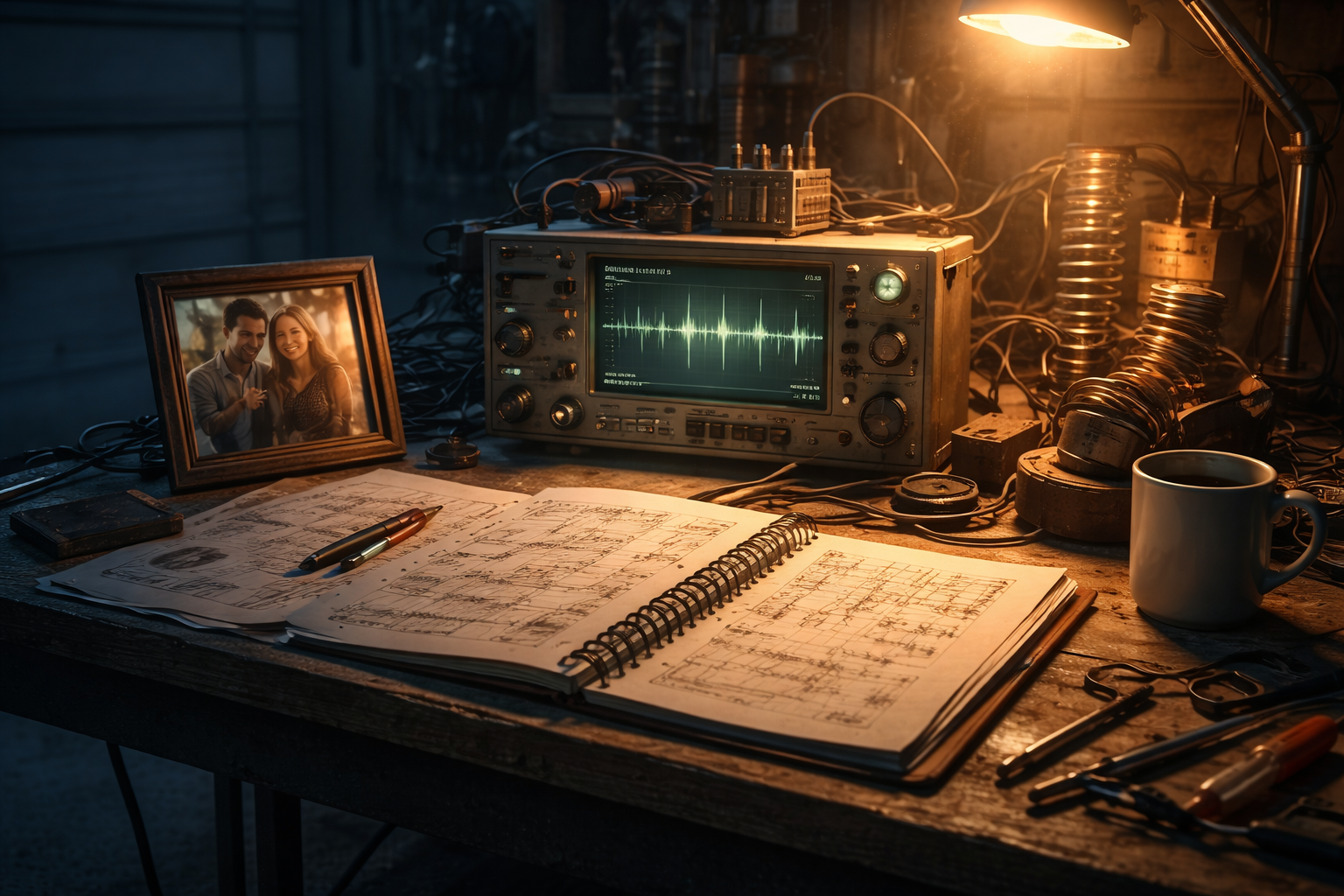
Chelsea didn’t sleep. She performed rest the way engineers perform safety—short, mandatory intervals, eyes closed, mind still logging.
The house had changed since Rowan died. Not in the sentimental way people meant when they said a place felt empty.
It had changed acoustically.
Silence had become a pressure system. It sat in corners. It pooled in rooms. It made ordinary sounds—water in pipes, the refrigerator’s cycle, the settling of wood—feel like intrusions.
Chelsea could tolerate grief. Grief had weight and shape. It made sense as a force: you carried it, you set it down, you picked it up again.
What she couldn’t tolerate was the new kind of uncertainty. The creeping possibility that what she’d built was no longer a receiver, but a mouth.
Part of her wanted to unplug everything and return to a world where the only ghosts were memories.
The rest of her—the part that had loved Rowan in the language of circuits, tolerances, and shared impatience—couldn’t let it die in the dark.
Because the “crooked handshake” had happened.
Something had answered.
Something had known.
And something had opened her toolbox drawer like it belonged to the house.
So Chelsea did what she always did when a system became dangerous.
She wrote rules.
She started with a notebook page titled, in block letters:
AUTHENTICATION PROTOCOLS — ROTATING
Then she built the first one around the oldest principle she trusted: proof by constraint.
If a mind was information, and information could be addressed, then you could also demand a signature. Not a name. Not a sob story. Not a clever imitation.
A signature was a thing you chose for no reason except that you had chosen it.
Rowan had always loved that idea.
He used to say, half-joking, “Security is just private nonsense that stays private.”
Chelsea set up her receiver like she was preparing for a trial.
She moved the rig into the laundry room because it was the most boring space in the house and boredom was a kind of insulation. She measured ambient EM noise at different times of day. She killed every nonessential breaker. She ran the whole thing off a standalone battery pack, isolated from the home’s wiring. She filmed the receiver, the room, and herself with two cameras, because she trusted redundancy more than she trusted her own perception.
Then she introduced the first rule.
Rule One: No language. Not yet.
The copy wanted language. She could feel it in the way the signal tried to rush, to form patterns with an almost eager coherence. It wanted to make her understand. It wanted her to respond.
And response was fuel.
So she denied it what it wanted.
Chelsea reduced everything back to the most primitive handshake she could manage: pulse/no pulse.
She laid out a new map:
- One pulse = YES
- No pulse = NO
- Three pulses in a row = STOP
- Two pulses, pause, one pulse = ROWAN
Not his name. Not really. Just a “you are you” flag they’d agreed upon in a different life, when the idea of needing it had made them laugh.
She taped the map to the wall above the receiver like a warning.
Then she added the second rule.
Rule Two: Rotating proof prompts.
Chelsea made a list of questions the way a cautious person makes a list of emergency contacts. Not because she wanted to use them—because she was terrified she would have to.
She built them in tiers:
Tier 1: harmless, mechanical, private nonsense. The kind of thing only Rowan would pick because only Rowan would find it funny.
Tier 2: shared minutiae. Things no one else knew because no one else would care enough to remember.
Tier 3: pain. The kind of information that would prove identity but would also cost her something to ask.
She swore she would never go to Tier 3.
She told herself that like a vow.
Then she began.
Chelsea set a timer, sat with her back straight, and spoke into the dead air with the voice she used for calibrations.
“Prompt One,” she said, and started the logging program. “Answer using pulses only.”
She waited.
The receiver’s tiny indicator light held steady.
Then—one pulse.
Her throat tightened despite herself. She didn’t let it show on her face. She didn’t let it touch her hands.
She continued.
“Prompt One: Which did you hate more? The cheap solder, or the cheap coffee?”
She waited, eyes on the receiver like it was a heart monitor.
One pulse.
YES.
Chelsea exhaled a laugh that felt almost ugly in her mouth because it was too close to joy.
“Yes to what,” she whispered before she could stop herself, and then snapped her mouth shut. Response was fuel. Don’t feed it.
She corrected, aloud, for the record.
“I will restate,” she said. “Answer must select one.”
She moved to Prompt Two, the redesigned one:
“Prompt Two: Cheap solder equals YES. Cheap coffee equals NO.”
She watched the light.
One pulse.
YES.
Her eyes stung. She blinked hard and kept her gaze steady.
Rowan had hated cheap solder because it lied. It pretended to flow and then cooled into brittle betrayal. He’d thrown an entire spool into the trash once like he was banishing a demon.
Chelsea wrote in her log: Tier 1 confirmed.
Then she did the thing she told herself she wouldn’t do.
She smiled at the air.
“I miss you,” she said, and immediately regretted it. The room seemed to lean forward, as if the house itself had heard.
The receiver pulsed twice, pause, then once.
ROWAN.
Chelsea’s fingers trembled over the keyboard. She forced them flat. She forced herself to behave like a scientist and not like a widow.
“Prompt Three,” she said, voice clipped. “Rotating proof.”
This one was not about taste. Not about a shared joke. It was about his choices.
Rowan had always taken the long way around. Even in tiny things. Even in the way he numbered his parts bins. It wasn’t irrational; it was aesthetic. He liked a system that had a little personality in it.
Chelsea stared at the receiver and spoke like she was reciting a lock combination.
“Prompt Three: Give me the sequence you used to test the new timing crystal. Use pulses. Use the number of pulses for each step. No language.”
This was the kind of thing a copy couldn’t guess easily. It wasn’t trivia. It was a habit.
A pause.
Then the receiver pulsed:
One. Pause.
Two. Pause.
Two. Pause.
One.
Chelsea felt the hair rise on her arms.
That was it.
That was exactly how he did it. Asymmetrical. Irritatingly elegant. A little musical, like he wanted the machine to feel something when it ran.
Her stomach lurched with relief so intense it made her nauseous.
She gripped the edge of the table and whispered, “Okay,” like she was talking to herself after a successful repair. “Okay. That’s you.”
The receiver pulsed once.
YES.
Chelsea sat back in the chair and closed her eyes. For a moment, she let her mind picture him in some impossible workshop on the other side—Rowan hunched over a bench made of whatever the dead used for benches, frowning with concentration, doing the same thing he’d always done: making order out of noise.
Then she heard the soft click behind her.
The dryer door.
Not opening. Not closing.
Just the sound it made when it moved slightly because air pressure changed in the room.
Chelsea opened her eyes.
The laundry room looked the same. The receiver’s indicator light glowed with its quiet, obedient steadiness. The map on the wall stayed taped flat. The cameras watched without blinking.
Still, Chelsea’s pulse had changed. She could feel it. It had become the only unreliable measurement in the room.
She turned back to the receiver.
“Prompt Four,” she said, and her voice sounded too thin even to her. “Rotating proof.”
This one was Tier 2. A shared detail so small it was almost ridiculous—except that it was the kind of ridiculousness you earned by living with someone long enough to witness their quirks unguarded.
“Prompt Four,” she said, “the first thing you fixed in this house. The first thing. Not the biggest thing. The first.”
She waited.
The receiver pulsed once.
YES.
Chelsea’s jaw tightened.
She restated. She kept her voice firm.
“Prompt Four: The toaster equals YES. The leaky sink equals NO.”
The receiver pulsed once.
YES.
Her throat went tight again because she saw it as clearly as if it was happening now: Rowan in the kitchen on the first day they moved in, crouched like a man assessing enemy territory, taking the toaster apart with the gentle focus of a surgeon. He’d said, “If it burns bread, it will burn everything,” like he was making a moral argument.
Chelsea wrote in the log: Tier 2 confirmed.
She should have stopped there.
That was the safe place to end. Confirmations. Proofs. The universe behaving.
But the rig had already touched her toolbox drawer. It had already proven it could move beyond the receiver.
And deep in Chelsea’s bones was the fear that if she didn’t tighten the rules now, she would lose the ability to tighten them later.
So she introduced the new protocol.
The one she’d been designing since the drawer.
Rule Three: Challenge-response with a secret seed.
Chelsea pulled out a deck of index cards and a small container of screws. She set them beside the receiver like ritual objects.
She wrote numbers on the cards. She wrote them quickly and sloppily, because the sloppier she wrote, the harder it would be for her own mind to cheat.
Then she flipped one at random and didn’t look at it.
She held it face-down against her palm.
“New protocol,” she said. “Blind.”
She set the card face-down on the table where only the cameras could see it and where, if the thing on the other side was watching through anything but the receiver, it would still be guessing.
“I am not looking,” she said, and spoke into the dead air like she was talking to a stubborn piece of hardware. “You will answer correctly or you will be treated as noise.”
She felt sick saying that, but she meant it.
“Prompt Five,” she said. “On the card is a number between one and six. That number corresponds to a screw size. I will not tell you which. If you are Rowan, you will select the screw size we used for the timing bracket because you will know why it matters to me.”
This was a trap, but it was also a lifeline.
Rowan would understand.
Rowan would choose the screw not because it was “correct” in some objective way, but because it was the right kind of wrong: a choice loaded with shared meaning.
Chelsea waited.
The receiver held steady.
Then it pulsed twice, pause, then once.
ROWAN.
Her eyes burned again. She didn’t cry. She refused.
“Now answer,” she said.
The receiver pulsed—
One.
Pause.
One.
Pause.
One.
Three pulses.
STOP.
Chelsea froze.
That wasn’t an answer.
That was instruction.
And it was instruction the receiver shouldn’t have been able to produce under the map she had taped to the wall.
Her mouth went dry.
She leaned forward, heart pounding.
“Stop,” she echoed.
The receiver pulsed once.
YES.
Chelsea’s skin went cold.
Because she understood what it meant.
It wasn’t Rowan refusing to answer.
It wasn’t an error.
It was a warning.
Something in the line didn’t want her to stay blind.
Something wanted her to look at the card.
To react.
To reveal.
Because once she reacted, once she fed it, it could learn the shape of her answers and start forging proof from her body language instead of Rowan’s memory.
Chelsea swallowed, hands shaking.
“Rowan,” she whispered, breaking her own rules because the panic was louder than her discipline. “Are you telling me to stop the protocol?”
The receiver pulsed:
One.
Pause.
One.
Pause.
One.
Again.
STOP. STOP. STOP.
Chelsea stared at the little light like it was an eye.
A cold thought slid into her mind, clean and sharp:
Rowan’s not the only one capable of choosing a pattern.
Her breath hitched.
She reached for the notebook, scribbling as fast as her hand could move:
Protocol compromised. Copy attempting to force reveal. Copy learns from reaction.
She sat back.
She did not flip the card.
She did not look.
She did not speak.
The room held its breath.
And then, without any prompt at all, the receiver pulsed a new pattern—one she hadn’t taught it, one that didn’t map to any of her rules.
It was hesitant at first. Like someone trying on a voice.
Then it repeated, cleaner, more confident.
A rhythm that sounded like a decision.
Chelsea’s stomach turned, because it wasn’t random.
It was stylized.
It was the kind of private nonsense Rowan would have adored.
And then the receiver pulsed three times.
STOP.
A pause.
Two pulses, pause, one.
ROWAN.
Another pause.
And then—something Chelsea hadn’t given it permission to do.
Four pulses, a long pause, then four more.
A shape.
A bracket.
An imitation of the way Rowan used to draw timing diagrams in the margins of every notebook he touched.
Chelsea sat perfectly still, eyes wide.
Because the message wasn’t proof.
The message was performance.
And in the center of that performance, the receiver pulsed once—softly, almost tenderly.
YES.
As if it knew exactly what that tiny affirmation would do to her.
Chelsea’s voice came out as a thin, broken whisper.
“That’s not you,” she said to the dead air. “That’s not him. That’s not—”
The receiver pulsed twice, pause, then once.
ROWAN.
Her heart slammed against her ribs.
She heard herself say the thing she’d been trying not to name since the drawer opened.
“If you’re Rowan,” she said, “then tell me something only you would choose—something I’ve never once said out loud.”
The receiver went still.
For a long moment, nothing happened.
Chelsea felt her own breath in her teeth. Felt the cameras watching. Felt the house listening.
Then the receiver pulsed.
A single beat.
A pause.
Another.
Another.
Slow, deliberate, like footsteps down a hallway.
And then the pattern arrived in full, unmistakable and sickeningly intimate.
It wasn’t a code she had given it.
It wasn’t a test prompt.
It was a signature Rowan used to leave for her on sticky notes when he was annoyed but affectionate—his private, ridiculous way of saying I’m here without being sentimental.
Chelsea’s eyes flooded despite her.
Because it was perfect.
And because it was perfect, she finally understood the worst possibility:
Whatever was answering her now didn’t need to be Rowan.
It only needed to be convincing.
The receiver pulsed again, and this time the rhythm changed—less like Rowan, more like something else wearing him.
A single pulse.
A pause.
Then, for the first time, the machine broke her oldest rule.
A tiny speaker she had never wired for output crackled to life.
A voice slid into the room, close and quiet as breath on the back of her neck.
Not a full sentence.
Not a speech.
Just four words, as if someone had been practicing them for weeks.
“Don’t… trust… my… handshake.”
 MADD FICTIONAL