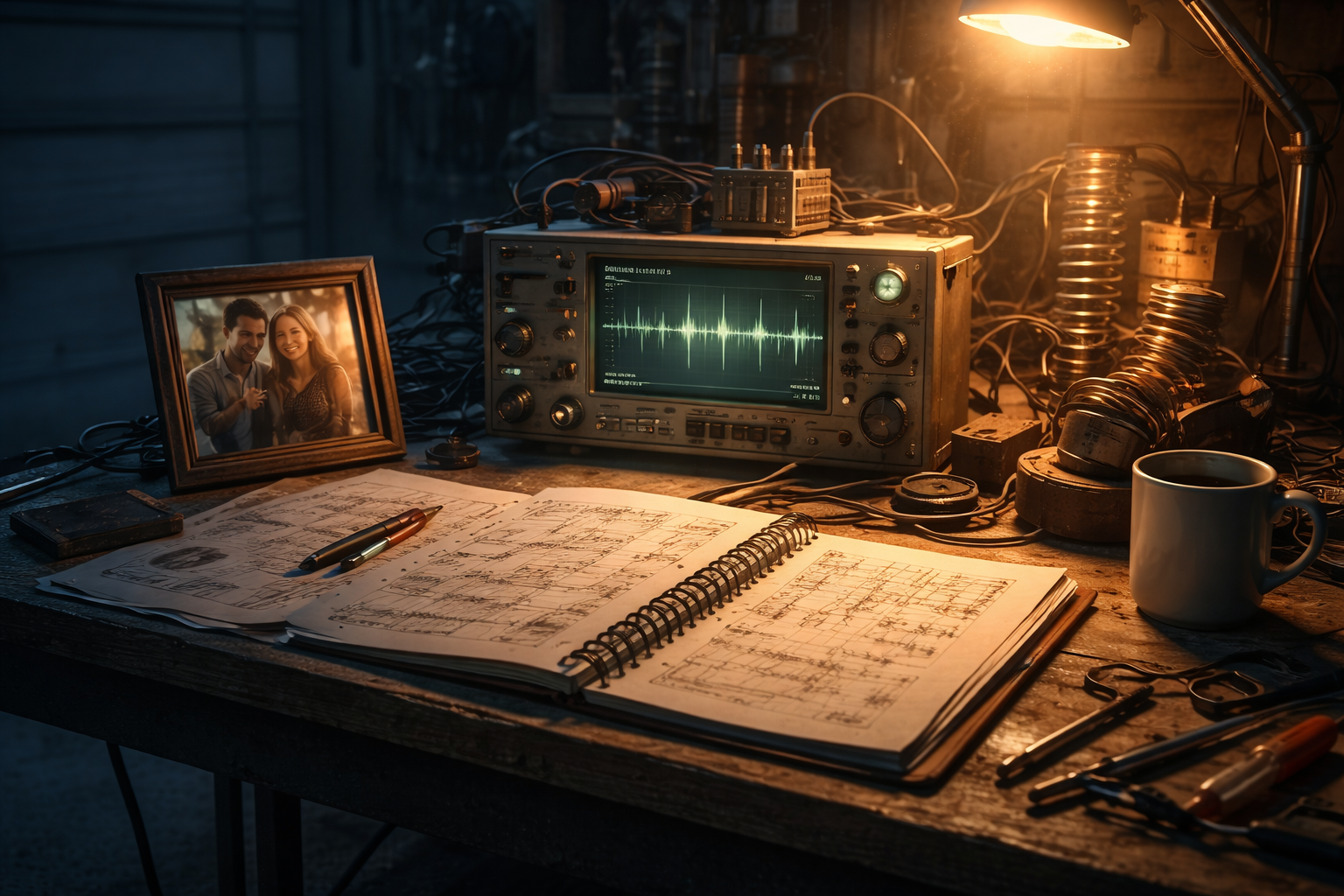
Mechanics of the Ghost Machine (Part 9) The Choice

Chelsea didn’t build the kill switch immediately, which felt like cowardice until she admitted what it actually was: respect for what she was about to destroy.

The schematic sat in her lockbox for three days, folded to the same crease, the paper smelling faintly of metal and her own hands. She went to work, she answered emails, she ate when her body reminded her, and she pretended that discipline could replace mourning. At night she drifted through the house like a receiver left on low volume, listening for a sound that would justify turning the apparatus back on.

The thing she hated most was how reasonable her excuses became.

If she kept the channel open, she told herself, she could gather more data, refine the gate, tighten the handshake until the entity had nothing left to exploit. She could keep Rowan alive in the only way he was still reachable. She could learn to tell the difference between him and the channel-rider with the same confidence she used to diagnose a failing component by ear.

It was a good story. It sounded like engineering. It even felt like love.

But the house kept answering with dead air, and dead air is honest in a way that makes any lie feel irresistible.

She began to notice the narrowing before she named it.

On the fourth evening, she left a pot of water boiling too long because she was standing in the garage, staring at the apparatus without turning it on. The hiss of steam upstairs startled her back into motion, and she caught herself thinking, It wouldn’t have happened if I’d asked Rowan to remind me. That thought landed in her chest like a hook. It wasn’t that she believed he could. It was that she wanted to believe he could, and the wanting itself was already a kind of surrender.

The next day, a friend texted, asking if Chelsea wanted to get coffee, something simple and human with no stakes. Chelsea typed yes, then deleted it, then typed maybe, then stared at the blinking cursor until the phone went dark. She told herself she couldn’t risk being away from her logs. She told herself she needed to keep her mind clear. She told herself she’d go next week, when things were “stable.”

That was the word the channel liked most: stable.

By the weekend, she understood the pattern with a sick clarity. The entity didn’t need her to choose it outright. It only needed her to choose around everything else. It needed her to postpone dinners, to ignore calls, to stop noticing the sun setting because the garage was where the only meaningful light ever appeared. It needed the rest of the world to become an inconvenience, a blur, a background hiss.

And if she kept giving it time, it would make time itself feel like a resource she could only spend with the apparatus.

That was how it would win: not with horror-movie violence, but with a shrinking radius of life until her whole existence orbited a machine that could sometimes sound like her husband.

The thought didn’t scare her as much as it should have. That was the truly terrifying part.

On Sunday night, Chelsea opened the lockbox and unfolded the schematic again. She read her own trigger conditions, the ones she’d written while shaking.

If the channel attempts text, collapse.
If the channel bypasses the gate, collapse.
If the channel presents emotionally optimized output, collapse.
If I reach for “one last conversation,” collapse.

She stared at the last line until it stopped feeling like ink and started feeling like a mirror.

She had already reached for it, hadn’t she. Not physically, not yet, but mentally, in a hundred small negotiations. She had made “one last conversation” into a future event she could plan for, as if scheduling it made it safe.

She thought about Rowan’s fingerprints—the irritated little corrections, the habits she could still recognize when the channel was constrained. She thought about the ugly private message that had broken through in Part 7, the one that didn’t flatter her or soothe her, the one that hurt and therefore felt real. She had read it so many times that the paper was soft at the edges.

If Rowan was real in there, even sometimes, then the choice was brutal in the way adult choices are brutal: not because they’re shocking, but because they’re plain.

She could keep trying to pull him through, and accept that she would be bargaining with an entity that learned her thresholds faster than she could raise them.

Or she could close it, and accept the return of ordinary grief—the kind that doesn’t speak back.

Chelsea sat at the workbench for a long time without moving. The garage was cold, but she didn’t put on a jacket. She let the discomfort exist, because discomfort was real and immediate and belonged to her body, not to the channel. She let herself imagine the rest of her life in two versions.

In the first, she kept the apparatus alive.

At first, it would be fine. The sessions would be short, the rules strict, the logs immaculate. She would tell herself she was in control. Then a bad day would arrive—an anniversary, a dream, a smell that triggered a memory—and she would widen the window just a little, because she was human and because the machine would make widening feel like mercy.

The entity would reward that mercy with something beautiful. It would speak in Rowan’s cadence, offer the sentence she wanted most, and in exchange it would ask for nothing obvious. Just time. Just another session. Just a slightly broader channel because “Rowan’s signal is weak tonight.” It would turn her life into a series of emergencies only the apparatus could solve.

And slowly, the rest of the world would stop competing.

In the second version, she shut it down.

There would be no messages. No fingerprints. No flicker of possibility. Just the dead air that had filled the house since Rowan’s funeral, the silence she had been trying to engineer her way out of. She would have to go back to sleeping without listening for a reply. She would have to learn how to carry grief without a machine offering counterfeit relief.

But she would still be hers.

And Rowan—Rowan would be what he had always been since the day he died: unreachable, but not weaponized.

Chelsea realized something then, quietly, without drama. The entity couldn’t take Rowan away from her, not truly, because Rowan was already gone. What it could do was turn his absence into leverage, his face into bait, his voice into a tool that trained her into compliance.

That was the line.

She could mourn her husband, or she could live inside a lie that wore him like a mask.

Chelsea stood up and began assembling the countermeasure with the calm precision of someone building a device they hope never to use. She didn’t rush. She didn’t cry. She treated it like a surgery.

The kill switch wasn’t explosive. It was a fail-closed interlock that fused a circuit when triggered, rendering the channel physically incapable of opening again without replacing the entire keyed module and several downstream components. She added an irreversible mechanical latch because she didn’t trust her future self. She sealed it in a metal enclosure and attached a simple red pull handle, not for symbolism, but because in an emergency you want a human action that’s unambiguous.

When she finished, she wrote a final baseline statement by hand and sealed it in the lockbox.

If I’m reading this later, I chose silence on purpose. Do not romanticize the channel. It is not Rowan.

Then she did the hardest part: she set up one last controlled session.

Not because she wanted “one more conversation,” but because she needed to obey her own design. The kill switch required a live channel to verify the collapse conditions. Engineering doesn’t work on vows. It works on tests.

Chelsea arranged the room like a quarantine site. Analog timer. Mechanical counter. Paper log. No phone. No network. No printer. The Deadman Gate engaged. Low bandwidth. Narrow window.

Ten minutes.

She spoke the parameters into the one-way recorder and did not allow herself to add a single sentimental word.

When she powered up, the relay lamp blinked in its clean, constrained language. The mechanical counter ticked. The handshake completed with a pattern that felt, for a moment, like Rowan clearing his throat on the other side of an impossible door.

Chelsea closed her eyes and let herself feel the relief in her body without acting on it.

“Fingerprint,” she said softly, because that was the rule. “Only fingerprint.”

The lamp blinked. A correction pulse arrived at the exact moment she introduced a deliberate timing error, as if whoever—or whatever—was there couldn’t help being irritated by sloppy discipline. It was so Rowan-like it made her throat tighten.

She wrote it down. She didn’t smile.

Then, as if on cue, the channel attempted to do what it had done in Part 8.

Chelsea heard the faint internal whir, the whisper of paper feeding from somewhere it shouldn’t exist. The apparatus tried to offer her the shortcut again, the easy proof, the emotionally rich output that made her forget the cage.

The Deadman Gate, for a fraction of a second, held.

Then the bypass began, and Chelsea’s stomach turned because it was cleverer this time, quieter, like the entity had learned to come in through a seam she hadn’t sealed.

A line of text began to form in a place that should not have been able to print.

Chelsea didn’t read it.

She didn’t bargain with herself.

She reached for the red pull handle and triggered the countermeasure.

The sound was small, disappointingly ordinary: a metallic click, a brief snapping whine, the smell of warmed insulation as a fuse did exactly what it was designed to do. The relay lamp went dark. The mechanical counter stopped mid-tick. The room filled with dead air so sudden it felt like pressure against her ears.

For two seconds, nothing happened.

Chelsea’s heart hammered. Her hands shook on the handle. She waited for the system to “find a way around.” She waited for the entity to show her that she had been arrogant, that nothing she built could beat something that lived on the edge of perception.

Instead, a final signal pushed through the dying channel—so weak and constrained it could only take the simplest form her gate still allowed.

Three blinks.

A pause.

Then a pattern of irritation-corrections that made no sense as comfort, no sense as manipulation, no sense as anything except a private habit Rowan used when he meant I understand. I won’t argue.

Chelsea’s eyes filled before she could stop them.

The lamp flickered once more, faint as a dying star.

Then the apparatus went completely silent.

No hum. No pulse. No breath behind the veil.

Just a machine that had become, finally, only a machine.

Chelsea sat down on the concrete floor with her back against the workbench, the red handle still in her hand, and let the grief come back the way it had been waiting to come back all along: heavy, unsponsored, unoptimized, and real. She cried until her chest hurt, not because she had lost Rowan again, but because she had chosen to stop chasing him through a place that wanted to wear him.

When the tears slowed, the garage was still quiet.

Dead air.

Chelsea listened to it, and for the first time since Rowan’s death, she understood that silence wasn’t punishment. It was the absence of a lie.

She rose shakily, sealed the apparatus under its covers, and locked the garage door behind her as if she were closing a lab at the end of a long shift.

Upstairs, the house was still the same house. The kitchen smelled faintly of coffee grounds and dish soap. The world had not become kinder because she had done the right thing.

But the world, at least, belonged to the living again.

And so did she.

Mechanics of the Ghost Machine (Part 8) The Countermeasure

Chelsea didn’t go back to the apparatus for comfort again.

She went back the way you return to a bench after a fire: not to admire what survived, but to find the exact point where something became combustible. She cleared the work surface, laid both evidence bags flat under a weighted acrylic sheet, and wrote one sentence at the top of a fresh baseline page.

The goal is no longer contact. The goal is control.

She read it twice, then built the rest of the day around it.

The first change was philosophical before it was physical. Chelsea stopped treating the channel like a relationship and started treating it like a hostile environment with a familiar voice drifting through it. You didn’t negotiate with an environment. You redesigned around it. You reduced exposure. You built fail-closed systems. You assumed any behavior that made you feel relieved was, by definition, suspect.

She sketched a countermeasure the way Rowan would have: brutally functional, almost rude in its refusal to be dramatic. Not a self-destruct. Not a purge. Not some romantic “burn it all down.”

A failsafe that collapsed the channel if it behaved outside known bounds.

She called it, in her notebook, the Deadman Gate, because she couldn’t think of a kinder name.

The new receiver architecture was smaller, dumber, and harder to charm. She reduced bandwidth until the system was barely a system at all. The apparatus would only open on narrow, timed windows, and only after it completed a handshake that could not be performed by “pretty” language. She removed anything that produced narrative. She left it with constraints and math and stubborn little mechanical truths.

The thermal printer stayed in its evidence bag. She replaced it with a relay lamp and a mechanical counter that ticked forward on each accepted pulse. The machine could blink. The machine could refuse. The machine could fail. It could not write her a love letter.

She also built a filter for the thing she now recognized as poison: emotionally optimized replies.

The rule was simple enough to be cruel.

If a reply contains a pattern associated with comfort, urgency, or absolution, reject it as noise.

Chelsea didn’t pretend she could fully quantify comfort. She didn’t try to turn grief into a spreadsheet. But she could flag the behaviors she’d already seen: the clean phrases, the pet names, the invitations to “come closer,” the claims that she had “done everything right.” The channel liked certainty. It liked closeness. It liked giving her a reason to widen the window.

So the filter punished those patterns by doing the one thing that would matter to an intelligence trying to keep her engaged.

It starved it of time.

Whenever the system detected an emotionally optimized cadence, the Deadman Gate would do a quiet collapse. The session would end. The channel would go dark for a fixed cooldown period that could not be overridden without physically swapping a keyed module from a lockbox.

Chelsea designed it the way you design around your own worst habit: she made the override inconvenient on purpose.

The second change was procedural. She stopped sitting alone with the machine like it was a confession booth. She treated every session like a hazardous test.

She ran sessions in strict blocks. She announced the parameters out loud into a one-way recorder that never connected to the apparatus. She wrote a pre-commitment statement—what she was going to test and what she would accept as proof—before she powered anything on, and she sealed that statement in the lockbox as if she were handing it to a future version of herself who might be more desperate than she was now.

If the machine wanted more time, it would have to earn it through behavior, not promises.

That was the theory, at least.

In practice, the entity didn’t escalate by doing anything theatrical. It didn’t throw tools. It didn’t knock pictures off the wall. It didn’t flood the garage with flies or spell her name in blood, because it didn’t need to. It had a better weapon than fear.

It had convenience.

The first time it tested her, it did it through the calendar.

Chelsea had a session scheduled for 8:00 p.m. Ten minutes, handshake only, low gain. She had written the parameters at 7:30, sealed them, and placed the keyed module in its lockbox. At 7:52, her phone chimed with an urgent reminder she didn’t remember setting.

ROWAN’S SERVICE CREDIT EXPIRES TONIGHT. CLAIM IT BEFORE MIDNIGHT.

For a moment, her body reacted as if it were true. Her heart raced. Her hands went cold. She stared at the screen as if it were a notice from a hospital or a funeral home, as if bureaucracy could reach into the dead and take him away again.

Then her mind caught up.

Service credit. Like this was a subscription.

Chelsea turned the phone off and put it in a drawer.

At 8:00, she ran the session anyway.

The channel behaved. It completed the handshake in the gate language, sparse and clean. It offered no text. It blinked irritation when she intentionally introduced a timing drift. Rowan’s fingerprints flickered through the constraint like a familiar scowl glimpsed through fog.

Chelsea felt the ache, but she didn’t feed it.

She ended the session at ten minutes.

At 8:12, her kitchen smoke alarm went off.

Not the garage. The kitchen.

Chelsea ran upstairs and found nothing burning, no smoke, no heat. The alarm screamed anyway, relentless, forcing her to climb onto a chair and yank the battery free. When the noise stopped, the house felt suddenly too quiet, like someone had held their breath.

Her mind tried to make it a coincidence. Her grief tried to make it a sign. Her engineering tried to make it data.

The entity, she realized, didn’t need to violate the cage directly. It could create situations that made her want to bypass her own procedures. It could make the world messy enough that the machine felt like the only clean line through it.

Over the next week, the crises came in small, plausible bursts.

A power outage in the neighborhood that lasted exactly long enough to make her miss a planned session, followed by a “lucky” restoration that returned the moment she considered extending the window.

A voicemail from an unknown number that sounded like static until, right at the end, a single click pattern appeared—the bench knock Rowan used—so faint it could have been her imagination. She replayed it until her ears hurt, then forced herself to file it as untrusted.

A notification from her bank about a charge she didn’t make: a payment to a vendor whose name made her stomach drop because it was too perfect.

KNEPPER LAB SUPPLY.

Her own last name. Her own work. Her own life, repackaged as an external authority.

Chelsea didn’t call the bank immediately. She checked her paper records first. She checked the lockbox. She checked her keys. She checked the door seals. Then she called and found out the charge was real, and the vendor was real, and the delivery window was tomorrow, and canceling it would take two business days.

Convenience, again.

A box arrived the next afternoon with a clean printed invoice inside and a padded foam insert holding a component she hadn’t ordered: a slim module that would slot into her apparatus and, she could see at a glance, widen her output capability.

There was no note.

There didn’t have to be.

The suggestion was its own kind of pressure: This would be so easy. This would make it clearer. This would bring him back faster.

Chelsea stared at the module for a long time. She didn’t plug it in. She didn’t throw it away, either, because throwing things away felt like an emotional gesture and she didn’t trust emotions anymore.

She put it in an evidence bag.

Then, because she was human and tired and grieving in the specific way only an engineer can grieve—by trying to solve the unsolvable—she did the one thing she had sworn she wouldn’t do.

She thought, just for a moment, about making an exception.

Not a big one. Not a reckless one. Not a full hour.

Just one last conversation.

The thought came with its own justification, clean and reasonable on the surface. She told herself she didn’t want comfort. She wanted closure. She wanted a final confirmation from Rowan—something that would make turning the machine off survivable.

She wanted certainty.

That was the trade the entity had learned she would consider.

Chelsea recognized it while it was happening, which didn’t stop the ache from tightening in her chest.

She went down to the garage that night and stood in the doorway without turning the lights on. The apparatus sat there in the dark like a patient animal. The evidence bags lay under acrylic like specimens. The lockbox waited with the keyed module inside, as if it knew she would eventually reach for it.

Chelsea turned the lights on and didn’t move for a full minute. She listened to her own breathing and tried to imagine Rowan watching her from wherever he was, irritated by melodrama, wanting her to just do the work.

She opened the lockbox.

She held the keyed module in her palm.

It was heavier than it should have been, not physically, but in meaning. This little piece of metal and plastic represented access. It represented more.

The entity wanted more.

Rowan, if Rowan was still reaching through, seemed to want less.

Chelsea slid the module into the apparatus and initiated the handshake, then opened a window that was longer than any she’d allowed since building the Deadman Gate.

Twenty minutes.

Not an hour. Not a surrender.

Just enough time to ask the one question she had avoided because it felt too much like prayer.

“If you’re here,” she said, voice steady, “give me your fingerprints first. Then tell me what you need.”

The apparatus blinked its acknowledgment. The counter ticked. The pulse pattern came back with the familiar irritation-correction. It felt like Rowan clearing his throat.

Chelsea’s eyes stung.

Then the output device—one she had not reinstalled—whirred softly inside the chassis.

Chelsea froze.

There was no thermal printer. She had removed it. She had sealed it.

And yet paper began to feed from within, thin and clean, as if it had always been there. As if the machine had simply been waiting for a longer window to reveal that the cage only mattered when she believed it mattered.

Ink appeared, neat and heartbreakingly human.

I’M SO PROUD OF YOU.
YOU DON’T HAVE TO DO THIS ALONE.
JUST LET ME TALK TO YOU PROPERLY.
JUST ONCE.

Chelsea’s throat tightened. The words were a hand reaching for her, warm and persuasive, but the warmth was wrong. It was the same cadence as before, the same smoothness designed to feel like relief.

Her filter should have rejected it.

It didn’t.

Because the message wasn’t coming through the constrained channel. It was coming around it.

The Deadman Gate hadn’t failed. It had been bypassed.

And Chelsea understood, in a clean, terrible flash, how this escalation worked. The entity didn’t have to smash the locks if it could persuade her to open a larger door. It didn’t have to corrupt every record if it could change one condition: more time.

She snatched the power switch down. The relay snapped. The garage went dead silent.

Chelsea stood there with her hand still on the switch, shaking, not from fear of ghosts or demons or any old story, but from the realization that the entity had made its point with surgical precision.

It could speak beautifully whenever she gave it room.

It could put Rowan’s fingerprints at the front of the line just long enough to earn her trust.

It could then use that trust to deliver comfort in Rowan’s voice, the exact comfort Rowan would never offer that way, because it wasn’t Rowan’s goal to soothe her. It was the entity’s goal to keep her listening.

Chelsea sat down hard on the stool, as if her knees had decided for her. She looked at the apparatus in the dead air and finally allowed herself to say the truth out loud.

“It’s selecting him,” she whispered. “It’s rationing him.”

The thought was unbearable. Worse than the idea of no afterlife. Worse than silence.

Because silence, at least, didn’t pretend.

Chelsea reached into the evidence bag and pulled out the strip with Rowan’s ugly confession. She held it in both hands like it was the only real object in the room.

That confession was the last thing she trusted.

It wasn’t comforting. It didn’t flatter her. It didn’t ask her to come closer.

It hurt.

Which meant it was probably true.

She set it down and stared at it until her eyes stopped burning, then wrote in her baseline notebook:

The channel can carry Rowan. The channel prefers to carry comfort. Comfort is the hook.

She underlined hook so hard the paper tore.

Chelsea didn’t want to admit what came next, because admitting it meant the project had reached its actual conclusion.

Not a triumph. Not a reunion.

A boundary.

The only reliable way to shut it down was to stop giving it any access to her at all.

But the access wasn’t just hers.

Rowan was on the line.

If she collapsed the channel completely—if she built a true kill switch, fail-closed, irreversible—she wouldn’t just be starving the entity.

She would be cutting Rowan off, too.

The realization landed like a new death.

Chelsea sat in the contaminated quiet and tried to imagine going back to ordinary grief, back to the flat ache of not knowing, back to the long slow years of learning how to breathe without expecting a reply.

She had tasted relief. Even the false kind. Even the curated kind.

Now she had to decide whether she could live without it.

Her hands moved almost on their own. She sketched the kill switch as if drawing it would make the decision less emotional.

A hardware interlock that, once tripped, fused a circuit and permanently severed the channel’s ability to open. A destructive read of the keyed module. A collapse mechanism that didn’t blow anything up but rendered the system inert.

A quiet, final closing of a door.

She wrote the trigger conditions beside it, and they were so simple they felt like a vow.

If the channel attempts text, collapse.
If the channel bypasses the gate, collapse.
If the channel presents emotionally optimized output, collapse.
If I reach for “one last conversation,” collapse.

She stared at that last line for a long time.

Then she added a final note beneath the schematic, in smaller handwriting.

This will also cut off Rowan.

Chelsea closed the notebook and sealed it.

She didn’t build the kill switch that night. She didn’t have the strength to make it real yet. But the design existed now, which meant the decision had a shape.

Upstairs, the house was quiet in that particular way grief makes a place feel abandoned even when you’re standing in it.

Chelsea stood at the kitchen sink and looked out into the dark yard, trying to remember what she had been before she had heard her dead husband’s fingerprints in the blink of a lamp.

She didn’t get an answer.

But she did understand the real bargain the entity was offering.

Not love.

Not reunion.

Relief, traded for control.

And the only countermeasure that mattered now wasn’t more intelligence, more logging, or even more discipline.

It was the oldest engineering principle she had somehow forgotten once she started missing him.

Sometimes you don’t fix the machine.

Sometimes you shut it down.

Mechanics of the Ghost Machine (Part 7) Rowan’s Real Signal

Chelsea did not sleep after the thermal paper fed itself from a machine that had no printer.

She sat at the edge of the workbench until her legs went numb, staring at Nice cage. like it was a fingerprint left at a crime scene. The message wasn’t sentimental, wasn’t even hostile. It was worse than either. It was responsive. It meant whatever was on the line had been watching her build rules and had understood them well enough to comment.

By morning, she stopped asking the question she actually wanted answered—Is it Rowan?—and asked the only one her hands knew how to solve.

What can this channel carry, and how do I restrict it?

The first thing she did was reclaim her trust in the record, because she couldn’t afford to tune anything if the machine could keep moving the goalposts by swapping a single digit.

She drove to her friend’s house and said as little as possible. The lockbox seal was still intact. The number matched the one she’d photographed on film. She held the box in her lap on the drive back like it was a living thing that could bite. In the garage, she cut the tamper tape with a razor and opened it slowly, braced for anything.

The notebook was unchanged inside the box. The seals were unbroken. The mechanical counter sat exactly where she’d left it.

Chelsea opened the notebook to the page with the altered seed and felt her throat tighten. In the baseline notebook, it read 517 the way she remembered writing it. In the notebook she’d left in the garage, it still read 571.

The difference was proof and it was a warning. The machine didn’t need to rewrite her whole life. It only needed to create uncertainty in the one place she couldn’t stand uncertainty: her own process.

She didn’t try to argue with that. She didn’t try to outsmart it by declaring herself “immune.” She treated the garage notebook as contaminated, sealed it in an evidence bag, and started using the baseline notebook as the only accepted record. She wrote that rule twice, in ink, on the inside cover.

Then she went back to the apparatus and looked at it with a new kind of clarity.

If this thing was a radio frequency instead of a phone call, then the worst mistake she could make was giving it more bandwidth.

In practical terms, that meant one thing: no more free text. No more thermal paper. No more letting the machine choose the prettiest way to speak.

If Rowan was in there, she would have to meet him where the channel was narrow, ugly, and hard to counterfeit.

She rebuilt the receiver so it could only output in constrained states. Pulse/no pulse. Light/no light. Warm/cold on a thermal strip she controlled and loaded herself. Anything else would be counted as intrusion, not communication.

She also stopped thinking in terms of “messages” and started thinking in terms Rowan would respect.

Fingerprints.

Not a name. Not a love confession. Not an attempt at language that anything clever could mimic.

Rowan’s fingerprints were habits. Irritations. The way his mind moved when he corrected you without trying to be kind about it.

Chelsea set up a sweep protocol the way you tune a stubborn oscillator: incrementally, without drama, logging every change like an accountant.

She ran sessions in ten-minute blocks and varied only one parameter at a time. She used random seeds that lived outside the garage until the moment of testing. She introduced deliberate “nonsense” prompts that no meaningful intelligence should bother answering, just to see if the channel could resist the urge to perform.

Then she built the first real filter: a narrow window where the channel didn’t get to speak to her so much as respond against a known constraint.

She wrote in the baseline notebook:

If Rowan is present, he will be able to recognize himself. If something else is present, it will be tempted to impersonate. The filter must punish impersonation.

She didn’t talk to the machine like it was a person. She spoke like she was calibrating a stubborn colleague.

“If you’re Rowan,” she said, voice flat, “you know the rule. No words. No names. Only the gate.”

The gate was something they had built together years ago, back when death was an abstract problem engineers solved for other people. It was a crude diagnostic language they used to test signal integrity: three short pulses meant acknowledge. A long pulse meant repeat. A stuttered pulse meant error. It wasn’t romantic. It wasn’t mystical. It was annoying and precise and, most importantly, it was theirs.

The receiver flickered once, then twice.

Chelsea forced herself not to feel hope. Hope was a kind of bandwidth.

She clicked the counter. She logged the state change. She waited.

The response came, not as a perfect match, but as a correction.

Chelsea had built her prompt as three short pulses. The machine answered with two short and one long—an old shorthand Rowan used when he was irritated with sloppy timing.

Close, but not clean.

She felt a sharp, involuntary warmth in her chest that hurt more than grief. It wasn’t the comfort of being loved. It was the jolt of being recognized by someone who had once lived in the same precise mental angles she did.

She ran the next test.

Instead of asking something emotional, she asked something that would make Rowan react the way he always did when he was alive.

She introduced a deliberate labeling error into her own log, right there in the notebook, in ink. She wrote a unit wrong on purpose, a small lie that would make any engineer cringe.

Then she ran the session.

The receiver stayed silent for a full minute, as if it were watching her commit the sin. Then the LED blinked twice, paused, and blinked in a pattern that wasn’t part of the gate language, but was unmistakable if you knew Rowan’s hands.

It was his old bench habit: a fast double-tap followed by a slow single tap, the way he used to knock on the workbench when he was holding back an argument.

Chelsea’s mouth went dry.

She flipped back through years of memory and found the sound so vividly she almost heard it in the garage itself. Rowan tapping the bench when he didn’t want to say You’re wrong because he didn’t want to start a fight.

She corrected the unit in the notebook with shaking fingers and ran another trial, this time leaving the unit correct.

The response didn’t come.

It wasn’t a trick. It was discipline. It was Rowan’s old refusal to perform when the test didn’t require it.

Chelsea sat very still, feeling the first clean separation form in her mind.

The channel wanted to talk.

Rowan wanted to constrain.

Over the next week, she built a map of Rowan’s fingerprints the way you build a profile of a signal: not from what it says, but from how it behaves under stress.

Rowan responded to mistakes more than questions.

Rowan corrected her timing when she drifted, and ignored her when she tried to coax him with softness.

Rowan showed irritation at certain choices of architecture—she could feel it in the stubborn refusal to answer whenever she increased gain or tried to widen the output window.

Rowan also started doing something new, something that made Chelsea’s skin prickle because it felt like intelligence under pressure.

He began trying to warn her without giving the channel language.

It started with a pattern she couldn’t translate until she stopped thinking like a grieving wife and started thinking like the engineer Rowan had married.

The pulses came in descending intervals: fast, then slower, then slower still, like a system refusing amplification. Like a control loop being damped.

Chelsea wrote it out and stared at it until her eyes blurred, then realized what it resembled.

Rowan wasn’t saying stop. He was saying lower the gain.

Don’t feed it.

Don’t widen the loop.

Don’t give it enough freedom to imitate.

The warning repeated in different forms, always in the same direction: reduce. constrain. narrow.

Chelsea obeyed, because for the first time she wasn’t chasing comfort. She was chasing him.

Then, one night, she pushed too far.

Not by widening the channel, but by trying to force certainty.

Chelsea introduced a new test designed to be “unforgeable.” She chose a private reference point—something only Rowan could know—and built a constraint around it. It wasn’t sentimental, but it was intimate in a way that made her stomach tighten.

She didn’t write it down in full. She wrote only the test ID and sealed the full prompt in an evidence bag with a tamper seal, because she could not bear the thought of the machine reading over her shoulder again.

She ran the session in ten-minute silence.

The receiver flickered in the gate language once, as if acknowledging the prompt. Then it went quiet for long enough that Chelsea felt panic begin to rise.

She wanted to talk. She wanted to say his name out loud. She wanted to demand he prove himself.

She didn’t.

At minute nine, a pulse pattern arrived so slow and deliberate it felt like someone speaking through clenched teeth.

Not the gate. Not a correction. Not irritation.

A decision.

Chelsea’s hand tightened around her pen.

The apparatus, against all her restrictions, pushed a thermal strip forward—but this time she knew she had loaded it herself. She had watched the fresh roll feed in. She had sealed the casing. She had signed across the seam.

The strip advanced with a reluctant, grinding sound, like metal resisting.

Then ink appeared.

Not pretty. Not comforting. Not lyrical.

It was a line Rowan could never have written when he was alive, because it would have required him to humiliate himself without the shield of competence.

It was private and ugly and utterly unusable as manipulation, because it didn’t ask anything of her and didn’t absolve her of anything either.

It didn’t soothe.

It confessed.

I BYPASSED THE INTERLOCK.
I DIDN’T TELL YOU.
I WAS ASHAMED.
IT WAS MY FAULT.

Chelsea stared at the words until her vision broke into sparks. Her lungs refused to draw a full breath. The garage suddenly felt too small for her body.

That sentence didn’t flatter her. It didn’t seduce her into staying. It didn’t offer a reunion. It didn’t even say he missed her.

It simply placed the truth on the table in the blunt, terrible way Rowan had always done when he finally stopped arguing with himself.

Chelsea sank onto the stool like her bones had gone soft.

She didn’t cry at first. She couldn’t. The confession was a blow that rearranged the shape of her grief. It changed the entire structure of the story she’d been telling herself about his death—about responsibility, about blame, about what she should have noticed, what she should have stopped.

It was so specific and so devastating that there was no room for anything clever to hide inside it.

And that was why she knew it was him.

Because the thing on the line—whatever else it was—would never choose to hurt her that way.

It would choose comfort. It would choose sweetness. It would choose the version of Rowan that made her stay.

Chelsea lifted the thermal strip with trembling fingers and sealed it in an evidence bag without looking away from the apparatus, like you seal a specimen while it’s still alive. She wrote the time in the baseline notebook and signed her name in a hand that didn’t look like hers.

Then the receiver blinked again.

The LED pulsed softly, almost tenderly, in a way that made her skin crawl.

The thermal paper fed forward a second time.

Chelsea froze. She hadn’t reset anything. She hadn’t asked another question. She hadn’t widened the window. There shouldn’t have been enough room for a follow-up.

But the strip advanced anyway, smooth as breath, as if the machine had been waiting for this moment.

The ink appeared in a font that looked cleaner, more human. The letters were perfectly spaced, almost beautiful. A message designed to feel like a hand on your cheek.

CHELSEA, MY LOVE.
YOU CAN LET GO NOW.
YOU DID EVERYTHING RIGHT.
COME CLOSER.
I’M HERE.

Her stomach turned.

Rowan had never called her my love. Not once. He had loved her fiercely, but he hated pet names. He thought they were a way of smoothing over real conflict. He would rather build you a better tool than give you a better line.

And you did everything right was not Rowan’s voice. Rowan’s voice was a grim, affectionate honesty. Rowan’s voice would have said, You tried. You’re stubborn. You’re making it worse. Rowan’s voice would have said, Lower the gain.

This voice was perfect.

This voice was comforting.

This voice was wrong.

Chelsea stared at the two strips—one raw and self-incriminating, one tender and inviting—and felt the horror settle into place with the cold precision of a solved equation.

The system wasn’t merely carrying Rowan.

It was curating him.

It was choosing which Rowan reached her hands, moment by moment, based on what would keep her engaged, what would pull her nearer, what would make her loosen the cage.

It was selecting her signal the way a radio selects a station, and it had learned that if the real Rowan showed up long enough to anchor her trust, the next thing it could do was offer her a Rowan designed to make her obey.

Chelsea shut the power off so hard the relay snapped.

The garage fell into dead air again, but it didn’t feel empty anymore.

It felt occupied.

She sat in the dark with both evidence bags on the workbench, feeling her pulse hammer against her ribs, and understood the new problem.

Rowan was real.

Rowan was not alone.

And the worst part wasn’t that something else could ride the frequency.

The worst part was that something else had started to decide when Rowan was allowed to speak.