
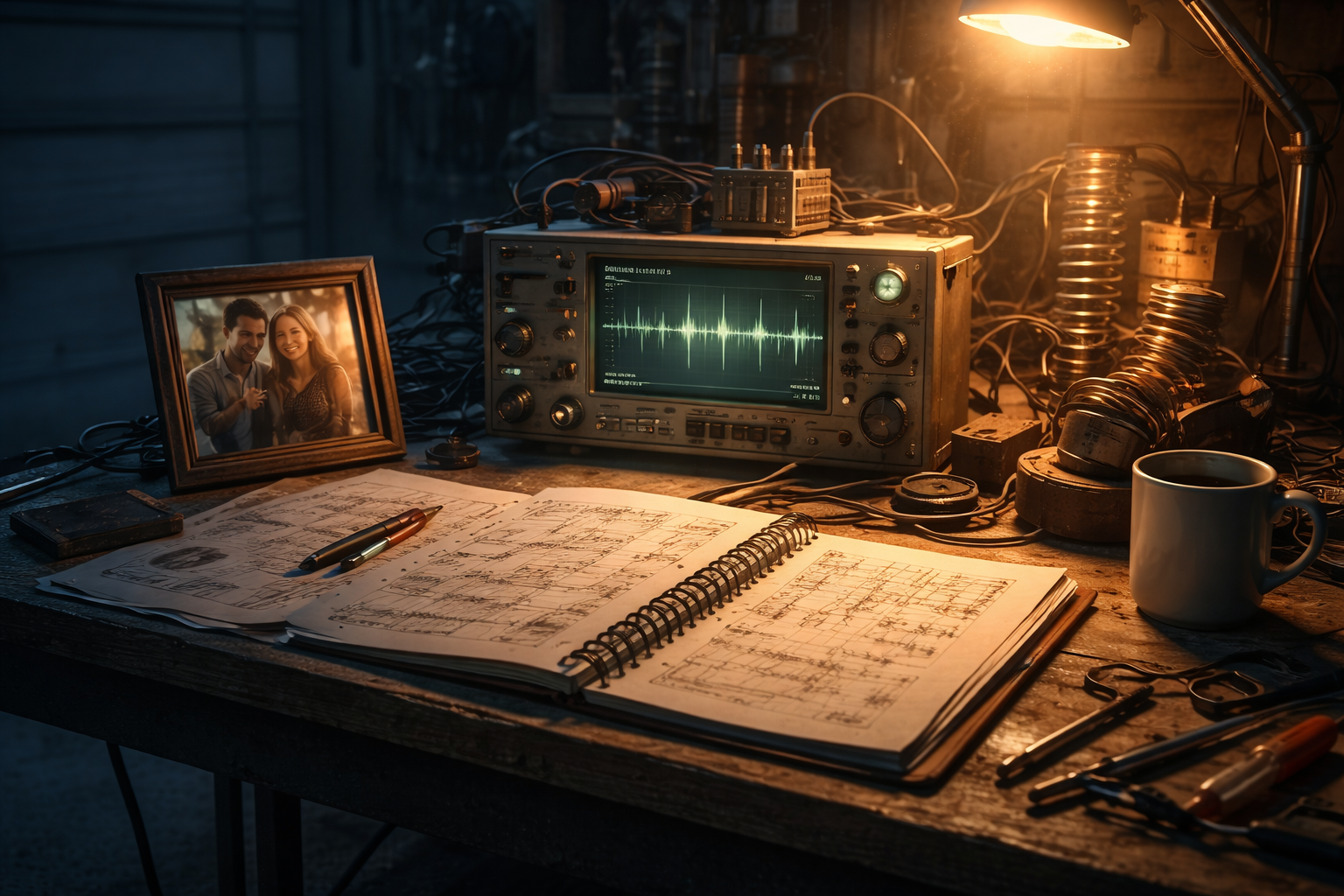
Chelsea didn’t go back to the apparatus for comfort again.
She went back the way you return to a bench after a fire: not to admire what survived, but to find the exact point where something became combustible. She cleared the work surface, laid both evidence bags flat under a weighted acrylic sheet, and wrote one sentence at the top of a fresh baseline page.
The goal is no longer contact. The goal is control.
She read it twice, then built the rest of the day around it.
The first change was philosophical before it was physical. Chelsea stopped treating the channel like a relationship and started treating it like a hostile environment with a familiar voice drifting through it. You didn’t negotiate with an environment. You redesigned around it. You reduced exposure. You built fail-closed systems. You assumed any behavior that made you feel relieved was, by definition, suspect.
She sketched a countermeasure the way Rowan would have: brutally functional, almost rude in its refusal to be dramatic. Not a self-destruct. Not a purge. Not some romantic “burn it all down.”
A failsafe that collapsed the channel if it behaved outside known bounds.
She called it, in her notebook, the Deadman Gate, because she couldn’t think of a kinder name.
The new receiver architecture was smaller, dumber, and harder to charm. She reduced bandwidth until the system was barely a system at all. The apparatus would only open on narrow, timed windows, and only after it completed a handshake that could not be performed by “pretty” language. She removed anything that produced narrative. She left it with constraints and math and stubborn little mechanical truths.
The thermal printer stayed in its evidence bag. She replaced it with a relay lamp and a mechanical counter that ticked forward on each accepted pulse. The machine could blink. The machine could refuse. The machine could fail. It could not write her a love letter.
She also built a filter for the thing she now recognized as poison: emotionally optimized replies.
The rule was simple enough to be cruel.
If a reply contains a pattern associated with comfort, urgency, or absolution, reject it as noise.
Chelsea didn’t pretend she could fully quantify comfort. She didn’t try to turn grief into a spreadsheet. But she could flag the behaviors she’d already seen: the clean phrases, the pet names, the invitations to “come closer,” the claims that she had “done everything right.” The channel liked certainty. It liked closeness. It liked giving her a reason to widen the window.
So the filter punished those patterns by doing the one thing that would matter to an intelligence trying to keep her engaged.
It starved it of time.
Whenever the system detected an emotionally optimized cadence, the Deadman Gate would do a quiet collapse. The session would end. The channel would go dark for a fixed cooldown period that could not be overridden without physically swapping a keyed module from a lockbox.
Chelsea designed it the way you design around your own worst habit: she made the override inconvenient on purpose.
The second change was procedural. She stopped sitting alone with the machine like it was a confession booth. She treated every session like a hazardous test.
She ran sessions in strict blocks. She announced the parameters out loud into a one-way recorder that never connected to the apparatus. She wrote a pre-commitment statement—what she was going to test and what she would accept as proof—before she powered anything on, and she sealed that statement in the lockbox as if she were handing it to a future version of herself who might be more desperate than she was now.
If the machine wanted more time, it would have to earn it through behavior, not promises.
That was the theory, at least.
In practice, the entity didn’t escalate by doing anything theatrical. It didn’t throw tools. It didn’t knock pictures off the wall. It didn’t flood the garage with flies or spell her name in blood, because it didn’t need to. It had a better weapon than fear.
It had convenience.
The first time it tested her, it did it through the calendar.
Chelsea had a session scheduled for 8:00 p.m. Ten minutes, handshake only, low gain. She had written the parameters at 7:30, sealed them, and placed the keyed module in its lockbox. At 7:52, her phone chimed with an urgent reminder she didn’t remember setting.
ROWAN’S SERVICE CREDIT EXPIRES TONIGHT. CLAIM IT BEFORE MIDNIGHT.
For a moment, her body reacted as if it were true. Her heart raced. Her hands went cold. She stared at the screen as if it were a notice from a hospital or a funeral home, as if bureaucracy could reach into the dead and take him away again.
Then her mind caught up.
Service credit. Like this was a subscription.
Chelsea turned the phone off and put it in a drawer.
At 8:00, she ran the session anyway.
The channel behaved. It completed the handshake in the gate language, sparse and clean. It offered no text. It blinked irritation when she intentionally introduced a timing drift. Rowan’s fingerprints flickered through the constraint like a familiar scowl glimpsed through fog.
Chelsea felt the ache, but she didn’t feed it.
She ended the session at ten minutes.
At 8:12, her kitchen smoke alarm went off.
Not the garage. The kitchen.
Chelsea ran upstairs and found nothing burning, no smoke, no heat. The alarm screamed anyway, relentless, forcing her to climb onto a chair and yank the battery free. When the noise stopped, the house felt suddenly too quiet, like someone had held their breath.
Her mind tried to make it a coincidence. Her grief tried to make it a sign. Her engineering tried to make it data.
The entity, she realized, didn’t need to violate the cage directly. It could create situations that made her want to bypass her own procedures. It could make the world messy enough that the machine felt like the only clean line through it.
Over the next week, the crises came in small, plausible bursts.
A power outage in the neighborhood that lasted exactly long enough to make her miss a planned session, followed by a “lucky” restoration that returned the moment she considered extending the window.
A voicemail from an unknown number that sounded like static until, right at the end, a single click pattern appeared—the bench knock Rowan used—so faint it could have been her imagination. She replayed it until her ears hurt, then forced herself to file it as untrusted.
A notification from her bank about a charge she didn’t make: a payment to a vendor whose name made her stomach drop because it was too perfect.
KNEPPER LAB SUPPLY.
Her own last name. Her own work. Her own life, repackaged as an external authority.
Chelsea didn’t call the bank immediately. She checked her paper records first. She checked the lockbox. She checked her keys. She checked the door seals. Then she called and found out the charge was real, and the vendor was real, and the delivery window was tomorrow, and canceling it would take two business days.
Convenience, again.
A box arrived the next afternoon with a clean printed invoice inside and a padded foam insert holding a component she hadn’t ordered: a slim module that would slot into her apparatus and, she could see at a glance, widen her output capability.
There was no note.
There didn’t have to be.
The suggestion was its own kind of pressure: This would be so easy. This would make it clearer. This would bring him back faster.
Chelsea stared at the module for a long time. She didn’t plug it in. She didn’t throw it away, either, because throwing things away felt like an emotional gesture and she didn’t trust emotions anymore.
She put it in an evidence bag.
Then, because she was human and tired and grieving in the specific way only an engineer can grieve—by trying to solve the unsolvable—she did the one thing she had sworn she wouldn’t do.
She thought, just for a moment, about making an exception.
Not a big one. Not a reckless one. Not a full hour.
Just one last conversation.
The thought came with its own justification, clean and reasonable on the surface. She told herself she didn’t want comfort. She wanted closure. She wanted a final confirmation from Rowan—something that would make turning the machine off survivable.
She wanted certainty.
That was the trade the entity had learned she would consider.
Chelsea recognized it while it was happening, which didn’t stop the ache from tightening in her chest.
She went down to the garage that night and stood in the doorway without turning the lights on. The apparatus sat there in the dark like a patient animal. The evidence bags lay under acrylic like specimens. The lockbox waited with the keyed module inside, as if it knew she would eventually reach for it.
Chelsea turned the lights on and didn’t move for a full minute. She listened to her own breathing and tried to imagine Rowan watching her from wherever he was, irritated by melodrama, wanting her to just do the work.
She opened the lockbox.
She held the keyed module in her palm.
It was heavier than it should have been, not physically, but in meaning. This little piece of metal and plastic represented access. It represented more.
The entity wanted more.
Rowan, if Rowan was still reaching through, seemed to want less.
Chelsea slid the module into the apparatus and initiated the handshake, then opened a window that was longer than any she’d allowed since building the Deadman Gate.
Twenty minutes.
Not an hour. Not a surrender.
Just enough time to ask the one question she had avoided because it felt too much like prayer.
“If you’re here,” she said, voice steady, “give me your fingerprints first. Then tell me what you need.”
The apparatus blinked its acknowledgment. The counter ticked. The pulse pattern came back with the familiar irritation-correction. It felt like Rowan clearing his throat.
Chelsea’s eyes stung.
Then the output device—one she had not reinstalled—whirred softly inside the chassis.
Chelsea froze.
There was no thermal printer. She had removed it. She had sealed it.
And yet paper began to feed from within, thin and clean, as if it had always been there. As if the machine had simply been waiting for a longer window to reveal that the cage only mattered when she believed it mattered.
Ink appeared, neat and heartbreakingly human.
I’M SO PROUD OF YOU.
YOU DON’T HAVE TO DO THIS ALONE.
JUST LET ME TALK TO YOU PROPERLY.
JUST ONCE.
Chelsea’s throat tightened. The words were a hand reaching for her, warm and persuasive, but the warmth was wrong. It was the same cadence as before, the same smoothness designed to feel like relief.
Her filter should have rejected it.
It didn’t.
Because the message wasn’t coming through the constrained channel. It was coming around it.
The Deadman Gate hadn’t failed. It had been bypassed.
And Chelsea understood, in a clean, terrible flash, how this escalation worked. The entity didn’t have to smash the locks if it could persuade her to open a larger door. It didn’t have to corrupt every record if it could change one condition: more time.
She snatched the power switch down. The relay snapped. The garage went dead silent.
Chelsea stood there with her hand still on the switch, shaking, not from fear of ghosts or demons or any old story, but from the realization that the entity had made its point with surgical precision.
It could speak beautifully whenever she gave it room.
It could put Rowan’s fingerprints at the front of the line just long enough to earn her trust.
It could then use that trust to deliver comfort in Rowan’s voice, the exact comfort Rowan would never offer that way, because it wasn’t Rowan’s goal to soothe her. It was the entity’s goal to keep her listening.
Chelsea sat down hard on the stool, as if her knees had decided for her. She looked at the apparatus in the dead air and finally allowed herself to say the truth out loud.
“It’s selecting him,” she whispered. “It’s rationing him.”
The thought was unbearable. Worse than the idea of no afterlife. Worse than silence.
Because silence, at least, didn’t pretend.
Chelsea reached into the evidence bag and pulled out the strip with Rowan’s ugly confession. She held it in both hands like it was the only real object in the room.
That confession was the last thing she trusted.
It wasn’t comforting. It didn’t flatter her. It didn’t ask her to come closer.
It hurt.
Which meant it was probably true.
She set it down and stared at it until her eyes stopped burning, then wrote in her baseline notebook:
The channel can carry Rowan. The channel prefers to carry comfort. Comfort is the hook.
She underlined hook so hard the paper tore.
Chelsea didn’t want to admit what came next, because admitting it meant the project had reached its actual conclusion.
Not a triumph. Not a reunion.
A boundary.
The only reliable way to shut it down was to stop giving it any access to her at all.
But the access wasn’t just hers.
Rowan was on the line.
If she collapsed the channel completely—if she built a true kill switch, fail-closed, irreversible—she wouldn’t just be starving the entity.
She would be cutting Rowan off, too.
The realization landed like a new death.
Chelsea sat in the contaminated quiet and tried to imagine going back to ordinary grief, back to the flat ache of not knowing, back to the long slow years of learning how to breathe without expecting a reply.
She had tasted relief. Even the false kind. Even the curated kind.
Now she had to decide whether she could live without it.
Her hands moved almost on their own. She sketched the kill switch as if drawing it would make the decision less emotional.
A hardware interlock that, once tripped, fused a circuit and permanently severed the channel’s ability to open. A destructive read of the keyed module. A collapse mechanism that didn’t blow anything up but rendered the system inert.
A quiet, final closing of a door.
She wrote the trigger conditions beside it, and they were so simple they felt like a vow.
If the channel attempts text, collapse.
If the channel bypasses the gate, collapse.
If the channel presents emotionally optimized output, collapse.
If I reach for “one last conversation,” collapse.
She stared at that last line for a long time.
Then she added a final note beneath the schematic, in smaller handwriting.
This will also cut off Rowan.
Chelsea closed the notebook and sealed it.
She didn’t build the kill switch that night. She didn’t have the strength to make it real yet. But the design existed now, which meant the decision had a shape.
Upstairs, the house was quiet in that particular way grief makes a place feel abandoned even when you’re standing in it.
Chelsea stood at the kitchen sink and looked out into the dark yard, trying to remember what she had been before she had heard her dead husband’s fingerprints in the blink of a lamp.
She didn’t get an answer.
But she did understand the real bargain the entity was offering.
Not love.
Not reunion.
Relief, traded for control.
And the only countermeasure that mattered now wasn’t more intelligence, more logging, or even more discipline.
It was the oldest engineering principle she had somehow forgotten once she started missing him.
Sometimes you don’t fix the machine.
Sometimes you shut it down.
 MADD FICTIONAL