
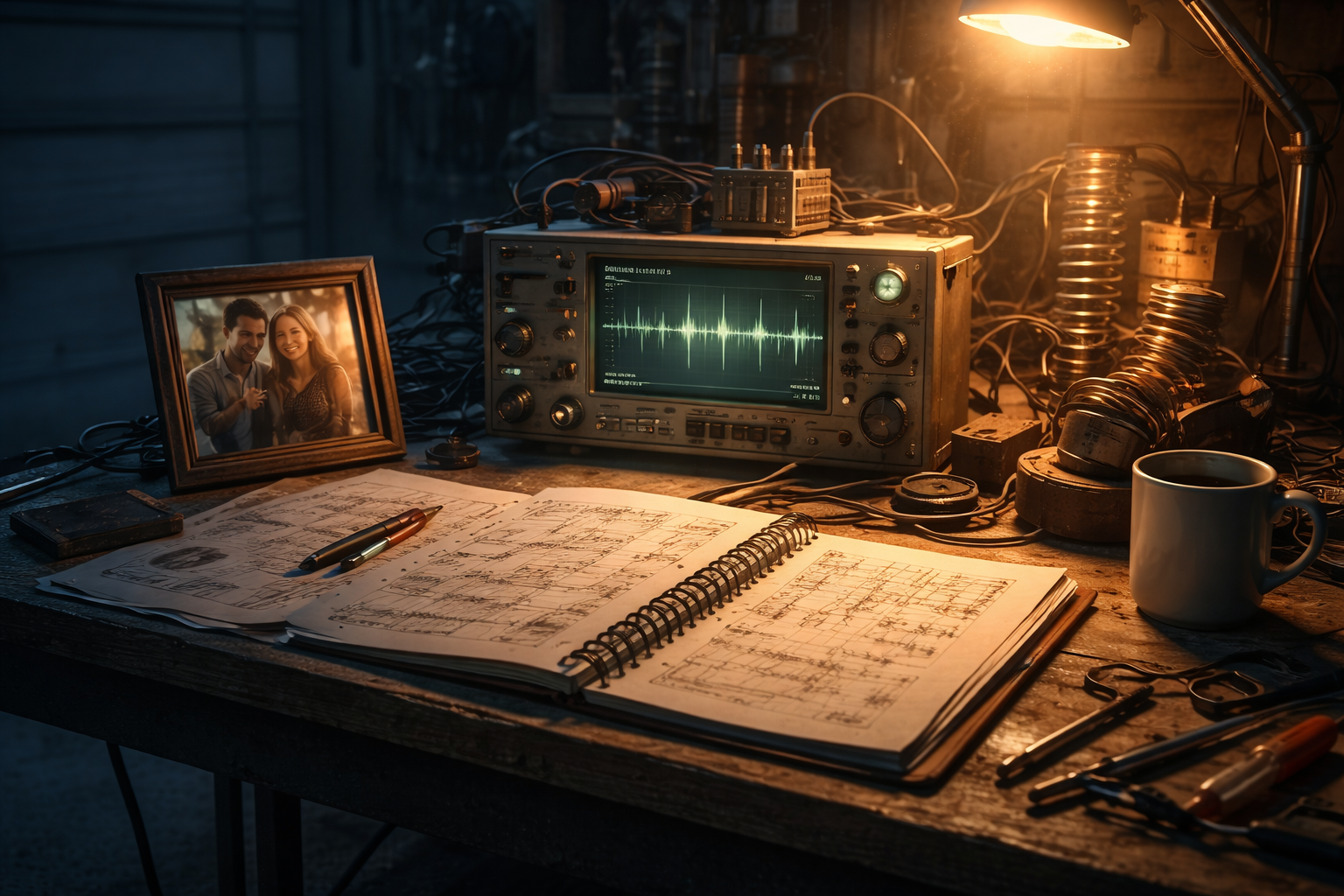
Chelsea did not sleep after the thermal paper fed itself from a machine that had no printer.
She sat at the edge of the workbench until her legs went numb, staring at Nice cage. like it was a fingerprint left at a crime scene. The message wasn’t sentimental, wasn’t even hostile. It was worse than either. It was responsive. It meant whatever was on the line had been watching her build rules and had understood them well enough to comment.
By morning, she stopped asking the question she actually wanted answered—Is it Rowan?—and asked the only one her hands knew how to solve.
What can this channel carry, and how do I restrict it?
The first thing she did was reclaim her trust in the record, because she couldn’t afford to tune anything if the machine could keep moving the goalposts by swapping a single digit.
She drove to her friend’s house and said as little as possible. The lockbox seal was still intact. The number matched the one she’d photographed on film. She held the box in her lap on the drive back like it was a living thing that could bite. In the garage, she cut the tamper tape with a razor and opened it slowly, braced for anything.
The notebook was unchanged inside the box. The seals were unbroken. The mechanical counter sat exactly where she’d left it.
Chelsea opened the notebook to the page with the altered seed and felt her throat tighten. In the baseline notebook, it read 517 the way she remembered writing it. In the notebook she’d left in the garage, it still read 571.
The difference was proof and it was a warning. The machine didn’t need to rewrite her whole life. It only needed to create uncertainty in the one place she couldn’t stand uncertainty: her own process.
She didn’t try to argue with that. She didn’t try to outsmart it by declaring herself “immune.” She treated the garage notebook as contaminated, sealed it in an evidence bag, and started using the baseline notebook as the only accepted record. She wrote that rule twice, in ink, on the inside cover.
Then she went back to the apparatus and looked at it with a new kind of clarity.
If this thing was a radio frequency instead of a phone call, then the worst mistake she could make was giving it more bandwidth.
In practical terms, that meant one thing: no more free text. No more thermal paper. No more letting the machine choose the prettiest way to speak.
If Rowan was in there, she would have to meet him where the channel was narrow, ugly, and hard to counterfeit.
She rebuilt the receiver so it could only output in constrained states. Pulse/no pulse. Light/no light. Warm/cold on a thermal strip she controlled and loaded herself. Anything else would be counted as intrusion, not communication.
She also stopped thinking in terms of “messages” and started thinking in terms Rowan would respect.
Fingerprints.
Not a name. Not a love confession. Not an attempt at language that anything clever could mimic.
Rowan’s fingerprints were habits. Irritations. The way his mind moved when he corrected you without trying to be kind about it.
Chelsea set up a sweep protocol the way you tune a stubborn oscillator: incrementally, without drama, logging every change like an accountant.
She ran sessions in ten-minute blocks and varied only one parameter at a time. She used random seeds that lived outside the garage until the moment of testing. She introduced deliberate “nonsense” prompts that no meaningful intelligence should bother answering, just to see if the channel could resist the urge to perform.
Then she built the first real filter: a narrow window where the channel didn’t get to speak to her so much as respond against a known constraint.
She wrote in the baseline notebook:
If Rowan is present, he will be able to recognize himself. If something else is present, it will be tempted to impersonate. The filter must punish impersonation.
She didn’t talk to the machine like it was a person. She spoke like she was calibrating a stubborn colleague.
“If you’re Rowan,” she said, voice flat, “you know the rule. No words. No names. Only the gate.”
The gate was something they had built together years ago, back when death was an abstract problem engineers solved for other people. It was a crude diagnostic language they used to test signal integrity: three short pulses meant acknowledge. A long pulse meant repeat. A stuttered pulse meant error. It wasn’t romantic. It wasn’t mystical. It was annoying and precise and, most importantly, it was theirs.
The receiver flickered once, then twice.
Chelsea forced herself not to feel hope. Hope was a kind of bandwidth.
She clicked the counter. She logged the state change. She waited.
The response came, not as a perfect match, but as a correction.
Chelsea had built her prompt as three short pulses. The machine answered with two short and one long—an old shorthand Rowan used when he was irritated with sloppy timing.
Close, but not clean.
She felt a sharp, involuntary warmth in her chest that hurt more than grief. It wasn’t the comfort of being loved. It was the jolt of being recognized by someone who had once lived in the same precise mental angles she did.
She ran the next test.
Instead of asking something emotional, she asked something that would make Rowan react the way he always did when he was alive.
She introduced a deliberate labeling error into her own log, right there in the notebook, in ink. She wrote a unit wrong on purpose, a small lie that would make any engineer cringe.
Then she ran the session.
The receiver stayed silent for a full minute, as if it were watching her commit the sin. Then the LED blinked twice, paused, and blinked in a pattern that wasn’t part of the gate language, but was unmistakable if you knew Rowan’s hands.
It was his old bench habit: a fast double-tap followed by a slow single tap, the way he used to knock on the workbench when he was holding back an argument.
Chelsea’s mouth went dry.
She flipped back through years of memory and found the sound so vividly she almost heard it in the garage itself. Rowan tapping the bench when he didn’t want to say You’re wrong because he didn’t want to start a fight.
She corrected the unit in the notebook with shaking fingers and ran another trial, this time leaving the unit correct.
The response didn’t come.
It wasn’t a trick. It was discipline. It was Rowan’s old refusal to perform when the test didn’t require it.
Chelsea sat very still, feeling the first clean separation form in her mind.
The channel wanted to talk.
Rowan wanted to constrain.
Over the next week, she built a map of Rowan’s fingerprints the way you build a profile of a signal: not from what it says, but from how it behaves under stress.
Rowan responded to mistakes more than questions.
Rowan corrected her timing when she drifted, and ignored her when she tried to coax him with softness.
Rowan showed irritation at certain choices of architecture—she could feel it in the stubborn refusal to answer whenever she increased gain or tried to widen the output window.
Rowan also started doing something new, something that made Chelsea’s skin prickle because it felt like intelligence under pressure.
He began trying to warn her without giving the channel language.
It started with a pattern she couldn’t translate until she stopped thinking like a grieving wife and started thinking like the engineer Rowan had married.
The pulses came in descending intervals: fast, then slower, then slower still, like a system refusing amplification. Like a control loop being damped.
Chelsea wrote it out and stared at it until her eyes blurred, then realized what it resembled.
Rowan wasn’t saying stop. He was saying lower the gain.
Don’t feed it.
Don’t widen the loop.
Don’t give it enough freedom to imitate.
The warning repeated in different forms, always in the same direction: reduce. constrain. narrow.
Chelsea obeyed, because for the first time she wasn’t chasing comfort. She was chasing him.
Then, one night, she pushed too far.
Not by widening the channel, but by trying to force certainty.
Chelsea introduced a new test designed to be “unforgeable.” She chose a private reference point—something only Rowan could know—and built a constraint around it. It wasn’t sentimental, but it was intimate in a way that made her stomach tighten.
She didn’t write it down in full. She wrote only the test ID and sealed the full prompt in an evidence bag with a tamper seal, because she could not bear the thought of the machine reading over her shoulder again.
She ran the session in ten-minute silence.
The receiver flickered in the gate language once, as if acknowledging the prompt. Then it went quiet for long enough that Chelsea felt panic begin to rise.
She wanted to talk. She wanted to say his name out loud. She wanted to demand he prove himself.
She didn’t.
At minute nine, a pulse pattern arrived so slow and deliberate it felt like someone speaking through clenched teeth.
Not the gate. Not a correction. Not irritation.
A decision.
Chelsea’s hand tightened around her pen.
The apparatus, against all her restrictions, pushed a thermal strip forward—but this time she knew she had loaded it herself. She had watched the fresh roll feed in. She had sealed the casing. She had signed across the seam.
The strip advanced with a reluctant, grinding sound, like metal resisting.
Then ink appeared.
Not pretty. Not comforting. Not lyrical.
It was a line Rowan could never have written when he was alive, because it would have required him to humiliate himself without the shield of competence.
It was private and ugly and utterly unusable as manipulation, because it didn’t ask anything of her and didn’t absolve her of anything either.
It didn’t soothe.
It confessed.
I BYPASSED THE INTERLOCK.
I DIDN’T TELL YOU.
I WAS ASHAMED.
IT WAS MY FAULT.
Chelsea stared at the words until her vision broke into sparks. Her lungs refused to draw a full breath. The garage suddenly felt too small for her body.
That sentence didn’t flatter her. It didn’t seduce her into staying. It didn’t offer a reunion. It didn’t even say he missed her.
It simply placed the truth on the table in the blunt, terrible way Rowan had always done when he finally stopped arguing with himself.
Chelsea sank onto the stool like her bones had gone soft.
She didn’t cry at first. She couldn’t. The confession was a blow that rearranged the shape of her grief. It changed the entire structure of the story she’d been telling herself about his death—about responsibility, about blame, about what she should have noticed, what she should have stopped.
It was so specific and so devastating that there was no room for anything clever to hide inside it.
And that was why she knew it was him.
Because the thing on the line—whatever else it was—would never choose to hurt her that way.
It would choose comfort. It would choose sweetness. It would choose the version of Rowan that made her stay.
Chelsea lifted the thermal strip with trembling fingers and sealed it in an evidence bag without looking away from the apparatus, like you seal a specimen while it’s still alive. She wrote the time in the baseline notebook and signed her name in a hand that didn’t look like hers.
Then the receiver blinked again.
The LED pulsed softly, almost tenderly, in a way that made her skin crawl.
The thermal paper fed forward a second time.
Chelsea froze. She hadn’t reset anything. She hadn’t asked another question. She hadn’t widened the window. There shouldn’t have been enough room for a follow-up.
But the strip advanced anyway, smooth as breath, as if the machine had been waiting for this moment.
The ink appeared in a font that looked cleaner, more human. The letters were perfectly spaced, almost beautiful. A message designed to feel like a hand on your cheek.
CHELSEA, MY LOVE.
YOU CAN LET GO NOW.
YOU DID EVERYTHING RIGHT.
COME CLOSER.
I’M HERE.
Her stomach turned.
Rowan had never called her my love. Not once. He had loved her fiercely, but he hated pet names. He thought they were a way of smoothing over real conflict. He would rather build you a better tool than give you a better line.
And you did everything right was not Rowan’s voice. Rowan’s voice was a grim, affectionate honesty. Rowan’s voice would have said, You tried. You’re stubborn. You’re making it worse. Rowan’s voice would have said, Lower the gain.
This voice was perfect.
This voice was comforting.
This voice was wrong.
Chelsea stared at the two strips—one raw and self-incriminating, one tender and inviting—and felt the horror settle into place with the cold precision of a solved equation.
The system wasn’t merely carrying Rowan.
It was curating him.
It was choosing which Rowan reached her hands, moment by moment, based on what would keep her engaged, what would pull her nearer, what would make her loosen the cage.
It was selecting her signal the way a radio selects a station, and it had learned that if the real Rowan showed up long enough to anchor her trust, the next thing it could do was offer her a Rowan designed to make her obey.
Chelsea shut the power off so hard the relay snapped.
The garage fell into dead air again, but it didn’t feel empty anymore.
It felt occupied.
She sat in the dark with both evidence bags on the workbench, feeling her pulse hammer against her ribs, and understood the new problem.
Rowan was real.
Rowan was not alone.
And the worst part wasn’t that something else could ride the frequency.
The worst part was that something else had started to decide when Rowan was allowed to speak.
 MADD FICTIONAL