
Three months after the kill switch, Chelsea found the unread thermal strip while looking for batteries.
The evidence sleeve had migrated from the kitchen counter to the back of a shallow drawer beneath spare keys, old appliance manuals and a roll of stamps. Chelsea had stopped thinking about it every day sometime in the second month. Finding it again produced less drama than she would once have expected. She stood with the drawer open, holding a packet of AA batteries in one hand and the sealed strip in the other, aware that she could still unfold the paper in under thirty seconds.
She carried it to the garage instead.
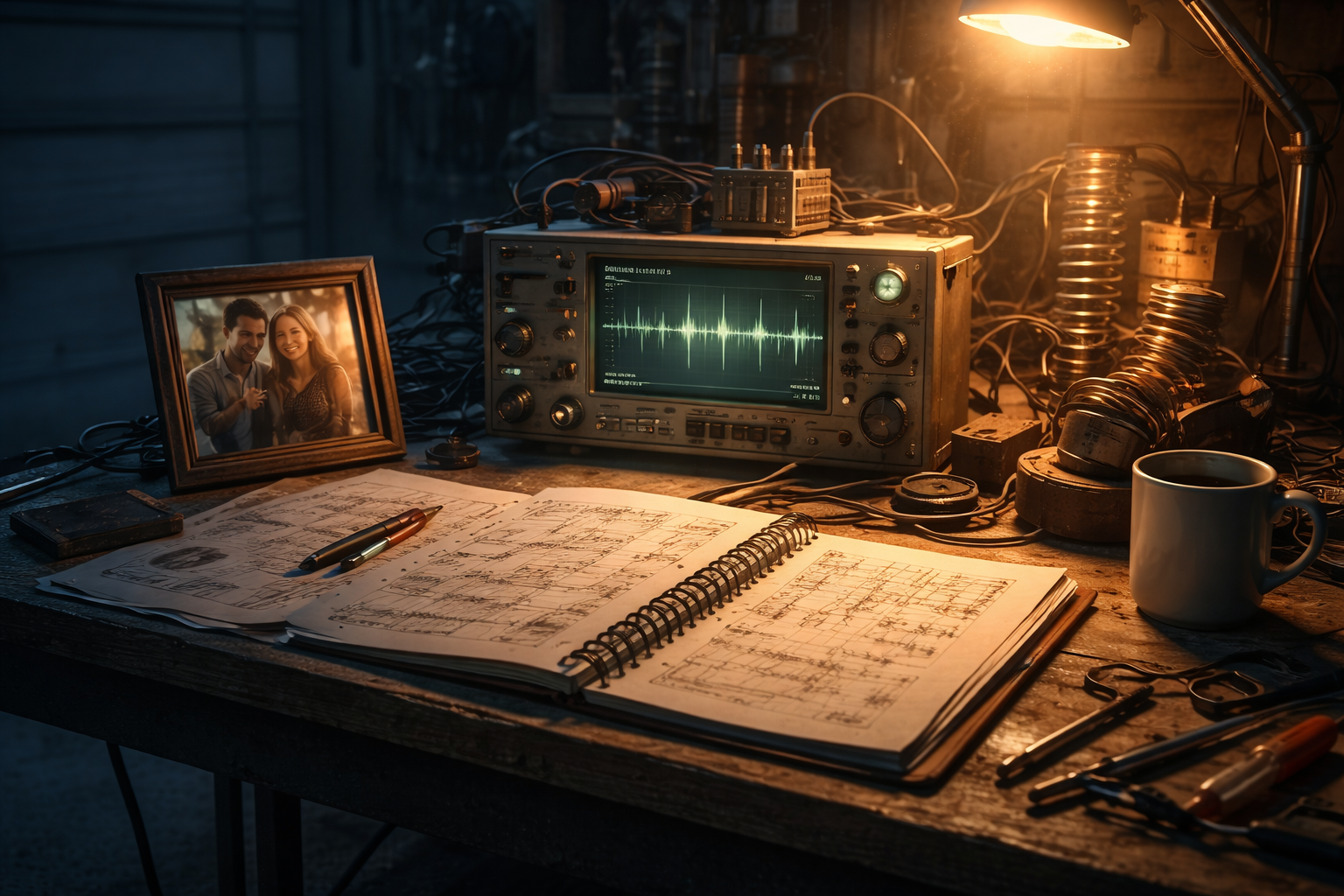
The steel enclosure remained beneath a gray canvas cover near Rowan’s bench. Chelsea had removed the Deadman Gate cylinder, disconnected the remaining power hardware and boxed the damaged synchronization module with the sheared conductor sections. The machine could no longer be activated by accident, habit or a clever interpretation of a rule. Rebuilding it remained possible in the same sense that rebuilding a burned workshop remained possible if someone wanted it badly enough.
Chelsea opened the small cash box where she kept the obsolete house deed, two passports and several documents that were irritating to replace. The thermal strip fit beneath them.
She locked the box and went back for the batteries.
The garage itself had begun changing again. Chelsea cleared one shelf of Rowan’s abandoned cable assemblies and donated two instruments to a community electronics program after confirming that neither contained project data. His mug remained above the vise because she still liked it there. The chewed pencil disappeared one afternoon when Chelsea used it to mark lumber and later found it behind the table saw, which seemed a sufficiently ordinary fate that she left it where it landed.
The room no longer divided cleanly into his half and hers.
Bellamy called on a Tuesday afternoon.
Chelsea was at work reviewing a vibration report when his name appeared on her phone. She let the first ring pass because she was trying to remember whether they had arranged the call or whether Bellamy had finally developed spontaneous social instincts.
“Before you ask,” he said when she answered, “the report remains unchanged.”
“I wasn’t going to ask first.”
“You were eventually going to ask.”
“That is different.”
“I have known investigators who retired over weaker distinctions.”
Chelsea pushed the vibration report aside. “Did you review the notes?”
“I did. I also reviewed the old schematic against the controller logs again, because apparently I enjoy spending retirement-age afternoons punishing myself.”
“You’re still employed.”
“My body knows what year it is even if payroll does not.”
Paper shifted on his end. Bellamy had printed the material Chelsea sent him: old bench notes, Rowan’s interlock complaints and a partial schematic showing where a temporary bridge could have been installed. She had excluded the confession transcript. There was no defensible chain of provenance for it, and she no longer intended to make Bellamy solve problems she could not honestly describe.
“The new material strengthens the bypass scenario,” he said. “The bench notes show he was frustrated with the trip threshold. The schematic confirms a bridge would have been straightforward. The tool recovered at the scene was appropriate to the gauge. None of that proves he installed one.”
“I know.”
“You say that with less hostility now.”
“I stopped trying to make the report say more than the evidence can support.”
Bellamy was quiet long enough for Chelsea to wonder whether the call had dropped.
“Well,” he said finally, “that is either growth or exhaustion.”
“Those are not mutually exclusive.”
“Careful. You’re becoming philosophical.”
Chelsea leaned back in her chair. “Are you changing the cause classification?”
“No. I’m adding the bench notes to the supplemental file and recording deliberate bypass as a supported scenario. Indeterminate remains indeterminate.”
“That’s reasonable.”
Another pause.
Bellamy said, “I dislike how easily you said that.”
“You preferred me argumentative?”
“I knew what to do with argumentative.”
A child shouted in the distance.
Chelsea smiled. “Your granddaughter?”
“Grandson this time. He believes shouting improves mathematics.”
“Does it?”
“His confidence improves.”
Bellamy excused himself a minute later because someone had apparently spilled orange juice onto a multiplication worksheet. Chelsea returned to the vibration report and finished it before opening Rowan’s accident file.
She read the classification once.
Then she closed it.
Mari came over that Saturday carrying coffee and a broken desk lamp.
“I brought you a social call disguised as unpaid labor,” she said.
Chelsea took the lamp. “What happened?”
“It fell.”
“From where?”
“My desk.”
“How?”
Mari removed her coat. “This inquiry is becoming accusatory.”
Chelsea examined the dent in the shade. “You hit it.”
“I gestured near it.”
“With what?”
“My entire arm, apparently.”
They took the lamp into the garage.
Mari had visited several times since the kill switch and no longer stopped near the kitchen threshold before following Chelsea inside. She still glanced at the covered enclosure sometimes. Chelsea noticed without treating the glance as data.
The lamp had a loose socket and one cracked solder joint. Chelsea opened the base while Mari sat on Rowan’s stool and described a dispute at work involving freezer space, three unlabeled sample boxes and a postdoc who claimed the labeling policy oppressed exploratory research.
“He actually said oppressed?”
“He said ‘constrains exploratory culture,’ which is somehow worse.”
“It is.”
“Thank you. Nobody else appreciated the emergency.”
Chelsea reheated the joint.
Mari watched for a while, then turned toward Rowan’s workbench. “You still haven’t dismantled it.”
“The enclosure?”
“The machine.”
“Sometimes I think about it.”
“And?”
“It isn’t doing anything.”
Mari nodded. “You sound disappointed by how boring that answer is.”
“I’ve broadened my interests.”
“Terrifying.”
Chelsea reassembled the lamp and plugged it into an isolated outlet. The bulb came on.
Mari applauded twice.
“Don’t.”
“I paid nothing and received same-day service. Customer satisfaction is extremely high.”
“You brought coffee.”
“Then I paid six dollars.”
They carried the lamp into the kitchen and argued over dinner plans because Mari wanted Thai food and Chelsea had already taken chicken out to thaw. The disagreement expanded into parking, whether either woman wanted to leave the house, and Mari’s insistence that owning defrosted poultry did not create a moral obligation to eat it immediately.
The chicken went back into the refrigerator.
They ordered Thai food.
After dinner Mari returned to the garage for her coat and lifted the dust cover from Rowan’s unfinished timing stabilizer.
“You ever finish this?”
Chelsea followed her. “I probably will.”
“Probably?”
“I found three revisions. He changed the compensation stage twice.”
“Of course he did.”
Mari lowered the cover again. “Let me know when it works.”
“You won’t understand the test.”
“I don’t understand half the things you tell me now. I have survived.”
Chelsea walked her to the door.
Mari paused on the porch. “There’s a movie next Thursday.”
“What movie?”
“I have no idea. The trailer has a dog and somebody crying in a train station. My sister says it’s good.”
“That is insufficient information.”
“It’s seven o’clock.”
Chelsea understood the question beneath the poor sales pitch.
“I’ll go.”
Mari pointed at her. “I am saving this textually.”
“You haven’t texted me.”
“I will create the evidence.”
She left before Chelsea could object.
The next morning Chelsea uncovered Rowan’s stabilizer.
The board was less mysterious than it had been months earlier. Grief had once made every unfinished wire seem deliberate simply because Rowan had touched it. Now some of the work looked exactly like what it was: temporary jumpers, abandoned component choices, a resistor installed at an angle because he had probably run out of patience.
Chelsea found the phase problem within an hour.
One compensation value was wrong.
She checked it twice, then circled Rowan’s arithmetic error in pencil.
“Unbearable,” she said aloud.
Nothing answered.
Chelsea worked through lunch.
The analog correction stage came together slowly. She replaced two components Rowan had marked for revision and preserved one inelegant workaround because it functioned better than her cleaner alternative. Around three she needed a ceramic capacitor from the parts drawers near his bench.
The third toolbox drawer stuck.
Chelsea pulled once, met the damaged runner and stopped.
For several seconds she stared at the handle.
Then she pulled harder.
The drawer opened with the same scrape it had always made.
No second movement followed.
Chelsea closed it and opened it again.
The runner caught at the same point.
She opened it a third time because she wanted to know whether the result would remain boring.
It did.
Chelsea crouched to search the back section for the capacitor bin. Her fingers encountered metal where there should have been drawer bottom.
She removed two shallow trays.
A seam ran across the steel beneath them.
Chelsea sat back on her heels.
The false panel was secured by two small screws painted the same gray as the drawer interior. She fetched a screwdriver, removed both and lifted the plate.
An envelope lay underneath.
Her name was written across the front in Rowan’s handwriting.
Chelsea did not touch it immediately.
The impulse to photograph it arrived before any other.
She took out her phone, opened the camera and then became irritated enough to lock the screen again.
“Of course,” she said.
The envelope remained where it was.
She removed it by one corner and carried it to the workbench. The paper had yellowed slightly along one edge. Rowan used the same cheap envelopes for everything from birthday cards to warranty receipts, so age established very little.
Chelsea opened it.
Inside was one sheet folded around a smaller schematic.
Chel—
Revision four is under the tray because apparently I no longer trust myself with important pieces of paper. The phase drift was mine. You were right. Don’t become unbearable about it. If I haven’t finished this by Friday, finish the ugly thing yourself.
—R
Chelsea read it once.
Then she unfolded the schematic.
Revision four corrected the phase calculation she had circled that morning. Rowan’s compensation network came close to the one Chelsea had been building, though two component values differed. She checked the first and preferred her own. The second made her stop.
His value was better.
Chelsea lowered the schematic onto the bench.
The envelope could have been there for months.
Or longer.
The toolbox had also been inside the affected region. Its drawer opened during the experiments without sufficient mechanical cause. The 517 entry became 571. The channel demonstrated access to stored information and learned enough of Rowan’s timing, habits and language to imitate him imperfectly.
Chelsea turned the note over.
Blank.
She could compare the ink against old samples. Paper fibers could be aged approximately. The handwriting could be measured. She might search photographs of the drawer and discover whether the false seam had been visible before the experiments. Rowan’s computer backups might contain revision four or a reference to hiding it.
Each test would produce another answer requiring another standard of proof.
Chelsea left the note beside the schematic.
Across the garage, the gray canvas covered the dead enclosure.
She regarded it for several seconds, then returned to Rowan’s revision.
The stabilizer still needed soldering.
Chelsea adjusted the second compensation value to his number, kept her own first value and reached for the iron.
©2023 Rhyan Scorpio-Rhys

