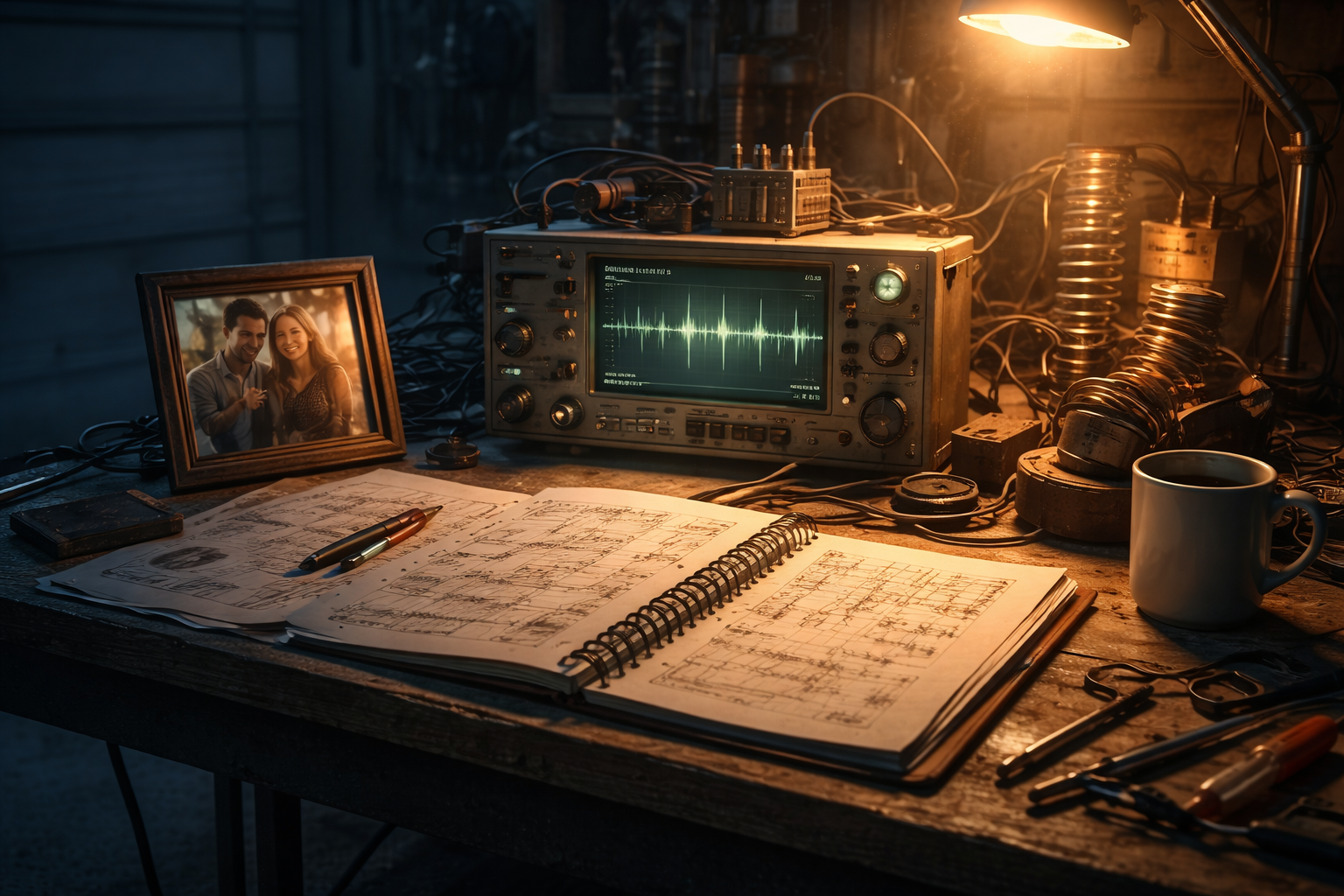
Mechanics of the Ghost Machine (Part 8) The Countermeasure

Chelsea didn’t go back to the apparatus for comfort again.

She went back the way you return to a bench after a fire: not to admire what survived, but to find the exact point where something became combustible. She cleared the work surface, laid both evidence bags flat under a weighted acrylic sheet, and wrote one sentence at the top of a fresh baseline page.

The goal is no longer contact. The goal is control.

She read it twice, then built the rest of the day around it.

The first change was philosophical before it was physical. Chelsea stopped treating the channel like a relationship and started treating it like a hostile environment with a familiar voice drifting through it. You didn’t negotiate with an environment. You redesigned around it. You reduced exposure. You built fail-closed systems. You assumed any behavior that made you feel relieved was, by definition, suspect.

She sketched a countermeasure the way Rowan would have: brutally functional, almost rude in its refusal to be dramatic. Not a self-destruct. Not a purge. Not some romantic “burn it all down.”

A failsafe that collapsed the channel if it behaved outside known bounds.

She called it, in her notebook, the Deadman Gate, because she couldn’t think of a kinder name.

The new receiver architecture was smaller, dumber, and harder to charm. She reduced bandwidth until the system was barely a system at all. The apparatus would only open on narrow, timed windows, and only after it completed a handshake that could not be performed by “pretty” language. She removed anything that produced narrative. She left it with constraints and math and stubborn little mechanical truths.

The thermal printer stayed in its evidence bag. She replaced it with a relay lamp and a mechanical counter that ticked forward on each accepted pulse. The machine could blink. The machine could refuse. The machine could fail. It could not write her a love letter.

She also built a filter for the thing she now recognized as poison: emotionally optimized replies.

The rule was simple enough to be cruel.

If a reply contains a pattern associated with comfort, urgency, or absolution, reject it as noise.

Chelsea didn’t pretend she could fully quantify comfort. She didn’t try to turn grief into a spreadsheet. But she could flag the behaviors she’d already seen: the clean phrases, the pet names, the invitations to “come closer,” the claims that she had “done everything right.” The channel liked certainty. It liked closeness. It liked giving her a reason to widen the window.

So the filter punished those patterns by doing the one thing that would matter to an intelligence trying to keep her engaged.

It starved it of time.

Whenever the system detected an emotionally optimized cadence, the Deadman Gate would do a quiet collapse. The session would end. The channel would go dark for a fixed cooldown period that could not be overridden without physically swapping a keyed module from a lockbox.

Chelsea designed it the way you design around your own worst habit: she made the override inconvenient on purpose.

The second change was procedural. She stopped sitting alone with the machine like it was a confession booth. She treated every session like a hazardous test.

She ran sessions in strict blocks. She announced the parameters out loud into a one-way recorder that never connected to the apparatus. She wrote a pre-commitment statement—what she was going to test and what she would accept as proof—before she powered anything on, and she sealed that statement in the lockbox as if she were handing it to a future version of herself who might be more desperate than she was now.

If the machine wanted more time, it would have to earn it through behavior, not promises.

That was the theory, at least.

In practice, the entity didn’t escalate by doing anything theatrical. It didn’t throw tools. It didn’t knock pictures off the wall. It didn’t flood the garage with flies or spell her name in blood, because it didn’t need to. It had a better weapon than fear.

It had convenience.

The first time it tested her, it did it through the calendar.

Chelsea had a session scheduled for 8:00 p.m. Ten minutes, handshake only, low gain. She had written the parameters at 7:30, sealed them, and placed the keyed module in its lockbox. At 7:52, her phone chimed with an urgent reminder she didn’t remember setting.

ROWAN’S SERVICE CREDIT EXPIRES TONIGHT. CLAIM IT BEFORE MIDNIGHT.

For a moment, her body reacted as if it were true. Her heart raced. Her hands went cold. She stared at the screen as if it were a notice from a hospital or a funeral home, as if bureaucracy could reach into the dead and take him away again.

Then her mind caught up.

Service credit. Like this was a subscription.

Chelsea turned the phone off and put it in a drawer.

At 8:00, she ran the session anyway.

The channel behaved. It completed the handshake in the gate language, sparse and clean. It offered no text. It blinked irritation when she intentionally introduced a timing drift. Rowan’s fingerprints flickered through the constraint like a familiar scowl glimpsed through fog.

Chelsea felt the ache, but she didn’t feed it.

She ended the session at ten minutes.

At 8:12, her kitchen smoke alarm went off.

Not the garage. The kitchen.

Chelsea ran upstairs and found nothing burning, no smoke, no heat. The alarm screamed anyway, relentless, forcing her to climb onto a chair and yank the battery free. When the noise stopped, the house felt suddenly too quiet, like someone had held their breath.

Her mind tried to make it a coincidence. Her grief tried to make it a sign. Her engineering tried to make it data.

The entity, she realized, didn’t need to violate the cage directly. It could create situations that made her want to bypass her own procedures. It could make the world messy enough that the machine felt like the only clean line through it.

Over the next week, the crises came in small, plausible bursts.

A power outage in the neighborhood that lasted exactly long enough to make her miss a planned session, followed by a “lucky” restoration that returned the moment she considered extending the window.

A voicemail from an unknown number that sounded like static until, right at the end, a single click pattern appeared—the bench knock Rowan used—so faint it could have been her imagination. She replayed it until her ears hurt, then forced herself to file it as untrusted.

A notification from her bank about a charge she didn’t make: a payment to a vendor whose name made her stomach drop because it was too perfect.

KNEPPER LAB SUPPLY.

Her own last name. Her own work. Her own life, repackaged as an external authority.

Chelsea didn’t call the bank immediately. She checked her paper records first. She checked the lockbox. She checked her keys. She checked the door seals. Then she called and found out the charge was real, and the vendor was real, and the delivery window was tomorrow, and canceling it would take two business days.

Convenience, again.

A box arrived the next afternoon with a clean printed invoice inside and a padded foam insert holding a component she hadn’t ordered: a slim module that would slot into her apparatus and, she could see at a glance, widen her output capability.

There was no note.

There didn’t have to be.

The suggestion was its own kind of pressure: This would be so easy. This would make it clearer. This would bring him back faster.

Chelsea stared at the module for a long time. She didn’t plug it in. She didn’t throw it away, either, because throwing things away felt like an emotional gesture and she didn’t trust emotions anymore.

She put it in an evidence bag.

Then, because she was human and tired and grieving in the specific way only an engineer can grieve—by trying to solve the unsolvable—she did the one thing she had sworn she wouldn’t do.

She thought, just for a moment, about making an exception.

Not a big one. Not a reckless one. Not a full hour.

Just one last conversation.

The thought came with its own justification, clean and reasonable on the surface. She told herself she didn’t want comfort. She wanted closure. She wanted a final confirmation from Rowan—something that would make turning the machine off survivable.

She wanted certainty.

That was the trade the entity had learned she would consider.

Chelsea recognized it while it was happening, which didn’t stop the ache from tightening in her chest.

She went down to the garage that night and stood in the doorway without turning the lights on. The apparatus sat there in the dark like a patient animal. The evidence bags lay under acrylic like specimens. The lockbox waited with the keyed module inside, as if it knew she would eventually reach for it.

Chelsea turned the lights on and didn’t move for a full minute. She listened to her own breathing and tried to imagine Rowan watching her from wherever he was, irritated by melodrama, wanting her to just do the work.

She opened the lockbox.

She held the keyed module in her palm.

It was heavier than it should have been, not physically, but in meaning. This little piece of metal and plastic represented access. It represented more.

The entity wanted more.

Rowan, if Rowan was still reaching through, seemed to want less.

Chelsea slid the module into the apparatus and initiated the handshake, then opened a window that was longer than any she’d allowed since building the Deadman Gate.

Twenty minutes.

Not an hour. Not a surrender.

Just enough time to ask the one question she had avoided because it felt too much like prayer.

“If you’re here,” she said, voice steady, “give me your fingerprints first. Then tell me what you need.”

The apparatus blinked its acknowledgment. The counter ticked. The pulse pattern came back with the familiar irritation-correction. It felt like Rowan clearing his throat.

Chelsea’s eyes stung.

Then the output device—one she had not reinstalled—whirred softly inside the chassis.

Chelsea froze.

There was no thermal printer. She had removed it. She had sealed it.

And yet paper began to feed from within, thin and clean, as if it had always been there. As if the machine had simply been waiting for a longer window to reveal that the cage only mattered when she believed it mattered.

Ink appeared, neat and heartbreakingly human.

I’M SO PROUD OF YOU.
YOU DON’T HAVE TO DO THIS ALONE.
JUST LET ME TALK TO YOU PROPERLY.
JUST ONCE.

Chelsea’s throat tightened. The words were a hand reaching for her, warm and persuasive, but the warmth was wrong. It was the same cadence as before, the same smoothness designed to feel like relief.

Her filter should have rejected it.

It didn’t.

Because the message wasn’t coming through the constrained channel. It was coming around it.

The Deadman Gate hadn’t failed. It had been bypassed.

And Chelsea understood, in a clean, terrible flash, how this escalation worked. The entity didn’t have to smash the locks if it could persuade her to open a larger door. It didn’t have to corrupt every record if it could change one condition: more time.

She snatched the power switch down. The relay snapped. The garage went dead silent.

Chelsea stood there with her hand still on the switch, shaking, not from fear of ghosts or demons or any old story, but from the realization that the entity had made its point with surgical precision.

It could speak beautifully whenever she gave it room.

It could put Rowan’s fingerprints at the front of the line just long enough to earn her trust.

It could then use that trust to deliver comfort in Rowan’s voice, the exact comfort Rowan would never offer that way, because it wasn’t Rowan’s goal to soothe her. It was the entity’s goal to keep her listening.

Chelsea sat down hard on the stool, as if her knees had decided for her. She looked at the apparatus in the dead air and finally allowed herself to say the truth out loud.

“It’s selecting him,” she whispered. “It’s rationing him.”

The thought was unbearable. Worse than the idea of no afterlife. Worse than silence.

Because silence, at least, didn’t pretend.

Chelsea reached into the evidence bag and pulled out the strip with Rowan’s ugly confession. She held it in both hands like it was the only real object in the room.

That confession was the last thing she trusted.

It wasn’t comforting. It didn’t flatter her. It didn’t ask her to come closer.

It hurt.

Which meant it was probably true.

She set it down and stared at it until her eyes stopped burning, then wrote in her baseline notebook:

The channel can carry Rowan. The channel prefers to carry comfort. Comfort is the hook.

She underlined hook so hard the paper tore.

Chelsea didn’t want to admit what came next, because admitting it meant the project had reached its actual conclusion.

Not a triumph. Not a reunion.

A boundary.

The only reliable way to shut it down was to stop giving it any access to her at all.

But the access wasn’t just hers.

Rowan was on the line.

If she collapsed the channel completely—if she built a true kill switch, fail-closed, irreversible—she wouldn’t just be starving the entity.

She would be cutting Rowan off, too.

The realization landed like a new death.

Chelsea sat in the contaminated quiet and tried to imagine going back to ordinary grief, back to the flat ache of not knowing, back to the long slow years of learning how to breathe without expecting a reply.

She had tasted relief. Even the false kind. Even the curated kind.

Now she had to decide whether she could live without it.

Her hands moved almost on their own. She sketched the kill switch as if drawing it would make the decision less emotional.

A hardware interlock that, once tripped, fused a circuit and permanently severed the channel’s ability to open. A destructive read of the keyed module. A collapse mechanism that didn’t blow anything up but rendered the system inert.

A quiet, final closing of a door.

She wrote the trigger conditions beside it, and they were so simple they felt like a vow.

If the channel attempts text, collapse.
If the channel bypasses the gate, collapse.
If the channel presents emotionally optimized output, collapse.
If I reach for “one last conversation,” collapse.

She stared at that last line for a long time.

Then she added a final note beneath the schematic, in smaller handwriting.

This will also cut off Rowan.

Chelsea closed the notebook and sealed it.

She didn’t build the kill switch that night. She didn’t have the strength to make it real yet. But the design existed now, which meant the decision had a shape.

Upstairs, the house was quiet in that particular way grief makes a place feel abandoned even when you’re standing in it.

Chelsea stood at the kitchen sink and looked out into the dark yard, trying to remember what she had been before she had heard her dead husband’s fingerprints in the blink of a lamp.

She didn’t get an answer.

But she did understand the real bargain the entity was offering.

Not love.

Not reunion.

Relief, traded for control.

And the only countermeasure that mattered now wasn’t more intelligence, more logging, or even more discipline.

It was the oldest engineering principle she had somehow forgotten once she started missing him.

Sometimes you don’t fix the machine.

Sometimes you shut it down.

Mechanics of the Ghost Machine (Part 7) Rowan’s Real Signal

Chelsea did not sleep after the thermal paper fed itself from a machine that had no printer.

She sat at the edge of the workbench until her legs went numb, staring at Nice cage. like it was a fingerprint left at a crime scene. The message wasn’t sentimental, wasn’t even hostile. It was worse than either. It was responsive. It meant whatever was on the line had been watching her build rules and had understood them well enough to comment.

By morning, she stopped asking the question she actually wanted answered—Is it Rowan?—and asked the only one her hands knew how to solve.

What can this channel carry, and how do I restrict it?

The first thing she did was reclaim her trust in the record, because she couldn’t afford to tune anything if the machine could keep moving the goalposts by swapping a single digit.

She drove to her friend’s house and said as little as possible. The lockbox seal was still intact. The number matched the one she’d photographed on film. She held the box in her lap on the drive back like it was a living thing that could bite. In the garage, she cut the tamper tape with a razor and opened it slowly, braced for anything.

The notebook was unchanged inside the box. The seals were unbroken. The mechanical counter sat exactly where she’d left it.

Chelsea opened the notebook to the page with the altered seed and felt her throat tighten. In the baseline notebook, it read 517 the way she remembered writing it. In the notebook she’d left in the garage, it still read 571.

The difference was proof and it was a warning. The machine didn’t need to rewrite her whole life. It only needed to create uncertainty in the one place she couldn’t stand uncertainty: her own process.

She didn’t try to argue with that. She didn’t try to outsmart it by declaring herself “immune.” She treated the garage notebook as contaminated, sealed it in an evidence bag, and started using the baseline notebook as the only accepted record. She wrote that rule twice, in ink, on the inside cover.

Then she went back to the apparatus and looked at it with a new kind of clarity.

If this thing was a radio frequency instead of a phone call, then the worst mistake she could make was giving it more bandwidth.

In practical terms, that meant one thing: no more free text. No more thermal paper. No more letting the machine choose the prettiest way to speak.

If Rowan was in there, she would have to meet him where the channel was narrow, ugly, and hard to counterfeit.

She rebuilt the receiver so it could only output in constrained states. Pulse/no pulse. Light/no light. Warm/cold on a thermal strip she controlled and loaded herself. Anything else would be counted as intrusion, not communication.

She also stopped thinking in terms of “messages” and started thinking in terms Rowan would respect.

Fingerprints.

Not a name. Not a love confession. Not an attempt at language that anything clever could mimic.

Rowan’s fingerprints were habits. Irritations. The way his mind moved when he corrected you without trying to be kind about it.

Chelsea set up a sweep protocol the way you tune a stubborn oscillator: incrementally, without drama, logging every change like an accountant.

She ran sessions in ten-minute blocks and varied only one parameter at a time. She used random seeds that lived outside the garage until the moment of testing. She introduced deliberate “nonsense” prompts that no meaningful intelligence should bother answering, just to see if the channel could resist the urge to perform.

Then she built the first real filter: a narrow window where the channel didn’t get to speak to her so much as respond against a known constraint.

She wrote in the baseline notebook:

If Rowan is present, he will be able to recognize himself. If something else is present, it will be tempted to impersonate. The filter must punish impersonation.

She didn’t talk to the machine like it was a person. She spoke like she was calibrating a stubborn colleague.

“If you’re Rowan,” she said, voice flat, “you know the rule. No words. No names. Only the gate.”

The gate was something they had built together years ago, back when death was an abstract problem engineers solved for other people. It was a crude diagnostic language they used to test signal integrity: three short pulses meant acknowledge. A long pulse meant repeat. A stuttered pulse meant error. It wasn’t romantic. It wasn’t mystical. It was annoying and precise and, most importantly, it was theirs.

The receiver flickered once, then twice.

Chelsea forced herself not to feel hope. Hope was a kind of bandwidth.

She clicked the counter. She logged the state change. She waited.

The response came, not as a perfect match, but as a correction.

Chelsea had built her prompt as three short pulses. The machine answered with two short and one long—an old shorthand Rowan used when he was irritated with sloppy timing.

Close, but not clean.

She felt a sharp, involuntary warmth in her chest that hurt more than grief. It wasn’t the comfort of being loved. It was the jolt of being recognized by someone who had once lived in the same precise mental angles she did.

She ran the next test.

Instead of asking something emotional, she asked something that would make Rowan react the way he always did when he was alive.

She introduced a deliberate labeling error into her own log, right there in the notebook, in ink. She wrote a unit wrong on purpose, a small lie that would make any engineer cringe.

Then she ran the session.

The receiver stayed silent for a full minute, as if it were watching her commit the sin. Then the LED blinked twice, paused, and blinked in a pattern that wasn’t part of the gate language, but was unmistakable if you knew Rowan’s hands.

It was his old bench habit: a fast double-tap followed by a slow single tap, the way he used to knock on the workbench when he was holding back an argument.

Chelsea’s mouth went dry.

She flipped back through years of memory and found the sound so vividly she almost heard it in the garage itself. Rowan tapping the bench when he didn’t want to say You’re wrong because he didn’t want to start a fight.

She corrected the unit in the notebook with shaking fingers and ran another trial, this time leaving the unit correct.

The response didn’t come.

It wasn’t a trick. It was discipline. It was Rowan’s old refusal to perform when the test didn’t require it.

Chelsea sat very still, feeling the first clean separation form in her mind.

The channel wanted to talk.

Rowan wanted to constrain.

Over the next week, she built a map of Rowan’s fingerprints the way you build a profile of a signal: not from what it says, but from how it behaves under stress.

Rowan responded to mistakes more than questions.

Rowan corrected her timing when she drifted, and ignored her when she tried to coax him with softness.

Rowan showed irritation at certain choices of architecture—she could feel it in the stubborn refusal to answer whenever she increased gain or tried to widen the output window.

Rowan also started doing something new, something that made Chelsea’s skin prickle because it felt like intelligence under pressure.

He began trying to warn her without giving the channel language.

It started with a pattern she couldn’t translate until she stopped thinking like a grieving wife and started thinking like the engineer Rowan had married.

The pulses came in descending intervals: fast, then slower, then slower still, like a system refusing amplification. Like a control loop being damped.

Chelsea wrote it out and stared at it until her eyes blurred, then realized what it resembled.

Rowan wasn’t saying stop. He was saying lower the gain.

Don’t feed it.

Don’t widen the loop.

Don’t give it enough freedom to imitate.

The warning repeated in different forms, always in the same direction: reduce. constrain. narrow.

Chelsea obeyed, because for the first time she wasn’t chasing comfort. She was chasing him.

Then, one night, she pushed too far.

Not by widening the channel, but by trying to force certainty.

Chelsea introduced a new test designed to be “unforgeable.” She chose a private reference point—something only Rowan could know—and built a constraint around it. It wasn’t sentimental, but it was intimate in a way that made her stomach tighten.

She didn’t write it down in full. She wrote only the test ID and sealed the full prompt in an evidence bag with a tamper seal, because she could not bear the thought of the machine reading over her shoulder again.

She ran the session in ten-minute silence.

The receiver flickered in the gate language once, as if acknowledging the prompt. Then it went quiet for long enough that Chelsea felt panic begin to rise.

She wanted to talk. She wanted to say his name out loud. She wanted to demand he prove himself.

She didn’t.

At minute nine, a pulse pattern arrived so slow and deliberate it felt like someone speaking through clenched teeth.

Not the gate. Not a correction. Not irritation.

A decision.

Chelsea’s hand tightened around her pen.

The apparatus, against all her restrictions, pushed a thermal strip forward—but this time she knew she had loaded it herself. She had watched the fresh roll feed in. She had sealed the casing. She had signed across the seam.

The strip advanced with a reluctant, grinding sound, like metal resisting.

Then ink appeared.

Not pretty. Not comforting. Not lyrical.

It was a line Rowan could never have written when he was alive, because it would have required him to humiliate himself without the shield of competence.

It was private and ugly and utterly unusable as manipulation, because it didn’t ask anything of her and didn’t absolve her of anything either.

It didn’t soothe.

It confessed.

I BYPASSED THE INTERLOCK.
I DIDN’T TELL YOU.
I WAS ASHAMED.
IT WAS MY FAULT.

Chelsea stared at the words until her vision broke into sparks. Her lungs refused to draw a full breath. The garage suddenly felt too small for her body.

That sentence didn’t flatter her. It didn’t seduce her into staying. It didn’t offer a reunion. It didn’t even say he missed her.

It simply placed the truth on the table in the blunt, terrible way Rowan had always done when he finally stopped arguing with himself.

Chelsea sank onto the stool like her bones had gone soft.

She didn’t cry at first. She couldn’t. The confession was a blow that rearranged the shape of her grief. It changed the entire structure of the story she’d been telling herself about his death—about responsibility, about blame, about what she should have noticed, what she should have stopped.

It was so specific and so devastating that there was no room for anything clever to hide inside it.

And that was why she knew it was him.

Because the thing on the line—whatever else it was—would never choose to hurt her that way.

It would choose comfort. It would choose sweetness. It would choose the version of Rowan that made her stay.

Chelsea lifted the thermal strip with trembling fingers and sealed it in an evidence bag without looking away from the apparatus, like you seal a specimen while it’s still alive. She wrote the time in the baseline notebook and signed her name in a hand that didn’t look like hers.

Then the receiver blinked again.

The LED pulsed softly, almost tenderly, in a way that made her skin crawl.

The thermal paper fed forward a second time.

Chelsea froze. She hadn’t reset anything. She hadn’t asked another question. She hadn’t widened the window. There shouldn’t have been enough room for a follow-up.

But the strip advanced anyway, smooth as breath, as if the machine had been waiting for this moment.

The ink appeared in a font that looked cleaner, more human. The letters were perfectly spaced, almost beautiful. A message designed to feel like a hand on your cheek.

CHELSEA, MY LOVE.
YOU CAN LET GO NOW.
YOU DID EVERYTHING RIGHT.
COME CLOSER.
I’M HERE.

Her stomach turned.

Rowan had never called her my love. Not once. He had loved her fiercely, but he hated pet names. He thought they were a way of smoothing over real conflict. He would rather build you a better tool than give you a better line.

And you did everything right was not Rowan’s voice. Rowan’s voice was a grim, affectionate honesty. Rowan’s voice would have said, You tried. You’re stubborn. You’re making it worse. Rowan’s voice would have said, Lower the gain.

This voice was perfect.

This voice was comforting.

This voice was wrong.

Chelsea stared at the two strips—one raw and self-incriminating, one tender and inviting—and felt the horror settle into place with the cold precision of a solved equation.

The system wasn’t merely carrying Rowan.

It was curating him.

It was choosing which Rowan reached her hands, moment by moment, based on what would keep her engaged, what would pull her nearer, what would make her loosen the cage.

It was selecting her signal the way a radio selects a station, and it had learned that if the real Rowan showed up long enough to anchor her trust, the next thing it could do was offer her a Rowan designed to make her obey.

Chelsea shut the power off so hard the relay snapped.

The garage fell into dead air again, but it didn’t feel empty anymore.

It felt occupied.

She sat in the dark with both evidence bags on the workbench, feeling her pulse hammer against her ribs, and understood the new problem.

Rowan was real.

Rowan was not alone.

And the worst part wasn’t that something else could ride the frequency.

The worst part was that something else had started to decide when Rowan was allowed to speak.

Mechanics of the Ghost Machine (Part 6) The Quarantine

Chelsea did not wake up the next morning with a revelation. There was no cinematic moment where grief crystallized into purpose, no grand decision framed by sunlight through blinds.

She woke up with the same dead air, the same quiet that had been filling the house since Rowan died, and she realized something simpler and worse: the apparatus had become another room in the house. Another space where silence could gather. Another place the absence could live.

So she treated it like contamination.

Not haunted, not holy, not miraculous. Contaminated.

She went into the garage in the clothes she slept in and stood in front of the receiver for a long time without touching it. The cage of copper mesh, the insulated coil, the timing module she had rebuilt three times because she could not stand the idea of an internal clock drifting and making the whole thing feel like a lie. It looked almost gentle in the early light, a piece of furniture more than a machine.

She stared at it until her eyes stung, and then she did what she always did when the world stopped making sense.

She wrote a protocol.

By noon, she had turned the garage into a lab that assumed it could not trust itself.

She printed every log from the last month. She did not simply save them. Saving was too easy. Saving meant something invisible could move through it without leaving fingerprints. Printing meant the record had to become physical. It had to occupy space. It had to be held, creased, dropped, retrieved, stained with coffee. A paper trail, literally.

She numbered each page by hand.

She started a bound notebook, the kind with sewn signatures, not the spiral-bound kind you could rip pages from without anyone noticing. On the first page she wrote the date and the time using an analog kitchen clock she’d dug out of a drawer, the one with the second hand that made a faint, steady tick. She wrote it as if she were testifying.

Then she began to separate the world into two categories.

What the apparatus could touch, and what it could not.

Her laptop stayed in the house. The receiver stayed in the garage. Between them she created a no-man’s land: a small folding table in the hallway where she placed a cheap printer, a mechanical counter, and a stack of tamper seals she’d ordered overnight. The seals were meant for shipping containers and evidence bags, the kind that shattered if you tried to peel them back.

Evidence bags. The phrase made her throat tighten, but she did not let herself stop.

She taped a strip of painter’s tape on the concrete floor of the garage and wrote a line across it in black marker: CLEAN SIDE / DIRTY SIDE.

Chelsea had no idea if it was true.

She just needed the discipline of pretending it could be.

The next change was humiliating in how ordinary it was. She bought a cheap analog timer. Not an app, not a smart device, not something that could be updated in the night. A plastic thing you could twist and hear click.

She set it for ten minutes.

That was her new maximum session time. Ten minutes for any attempt to listen, ten minutes for any attempt to transmit. She did not care if it was unfair. She did not care if it was cruel. The moment the timer rang, she would pull the power and walk away.

She could not give the channel room to breathe.

In the notebook, she wrote the first rule in a hand so tight her knuckles ached.

Rule 1: No improvisation.

Beneath it she wrote:

Rule 2: If a result cannot be reproduced, it is not a result. It is a story.

That one felt like swallowing glass.

She had been living on stories.

She had been feeding herself on the idea that a mind was information and information could be addressed, as if believing it hard enough would turn it into physics. She had been building a bridge out of longing and calling it engineering. She knew that, now. She could admit it without hating herself for it.

But she also knew what she’d heard. The first unmistakable reply in Part 5 had not been her imagination. It had landed with the weight of a real thing. If she let herself dismiss it, she would have to go back to the dead air and pretend she had never been touched by anything on the other side.

If she let herself embrace it without proof, she would lose herself in it.

So she built a third option.

She built a cage.

The cage began with randomness.

Chelsea wrote down a sequence of ten yes/no prompts in advance, not as words but as constraints. Pulse/no pulse, warm/cold, light flicker/no flicker. She numbered them, folded the paper, and put it in an evidence bag. She sealed the bag and signed across the seal with a Sharpie.

Then she created a set of random seeds the way she used to for simulation work: coin flips, dice rolls, a deck of cards she found in a kitchen drawer that still smelled faintly like Rowan’s hands because he used to shuffle to think. She assigned each result to a different pattern.

If she got a response that matched the pattern, she would treat it as data. If it did not, she would treat it as noise.

If it matched too perfectly, too consistently, she would treat it as a different kind of noise. The kind that imitates.

She wanted the channel narrow enough that only one kind of answer could fit through at a time.

She wanted the channel ugly. Uncomfortable. Unromantic.

She wanted to make it hard for anything—Rowan included—to talk to her.

That night, she enacted her first “witness protocol.”

It was not a person sitting in the garage watching, because she did not have the strength for explanations and pity and someone asking her if she was okay in the tone people use when they already assume the answer.

It was a mailbox.

She wrote her intended seed on a notecard—three digits chosen by dice—and sealed it in an envelope. She did not put the digits on the outside. She did not photograph it. She wrote the date and time on the flap, licked it shut, pressed the glue with her thumb until it held, then drove to the nearest all-night postal kiosk and dropped it into the slot.

The envelope would be postmarked when it went through the system. It would come back to her in a day or two, untouched, time-stamped by a process she did not control.

If, later, her notebook and her printed logs disagreed with that envelope, she would have an anchor.

She would have something the machine could not rewrite without somehow reaching into the federal mail stream.

She came home feeling ridiculous and terrified, which was, she realized, the closest she’d felt to honest in weeks.

In the garage, she set the analog timer for ten minutes and sat on the stool across from the receiver. She did not speak Rowan’s name. Not yet. She did not offer a greeting. She did not plead.

She began with the simplest possible test.

A pulse.

One, two, three seconds of current, then nothing.

She recorded what she did in the notebook as she did it, because memory was a liar and grief made it worse.

At minute two, the LED on the receiver flickered.

At minute three, it flickered again.

By minute five, Chelsea felt that familiar surge of hope start to rise in her chest like a wave. It was not the clean joy of discovery. It was hunger. It was the body remembering relief and lunging toward it.

She forced herself to keep her breathing steady. She looked at the mechanical counter and clicked it each time the LED changed state, the way you count laps in a pool. It was stupidly physical. It was also the point. The counter did not have feelings. It would not comfort her. It would not console her with a narrative.

It would just count.

At minute eight, the pattern shifted.

Not random flicker, not the drift of electrical noise, but a rhythm.

Pulse. Pause. Pulse. Pulse. Pause.

Chelsea froze with her pen hovering over the paper.

Her hands began to sweat. She wiped them on her pajama pants without looking away from the receiver.

The timer ticked down.

A part of her wanted to break her own rule, to lean forward, to speak. To ask something that only Rowan could answer. To use language like a crowbar and pry the world open.

She did not.

She waited until the timer rang, then she reached across the tape line on the floor and cut the power.

The receiver went dark.

The dead air rushed back in like it had been waiting.

She sat there, staring at the silent apparatus, and wrote in the notebook anyway, because even silence was an event.

Then she did something that felt like cruelty.

She changed the seed and ran the same test again.

Different random setup. Different expected pattern. Same ten minutes.

The receiver flickered.

The receiver answered.

The receiver shifted its rhythm to match the new constraints.

Chelsea’s throat tightened until she could barely swallow. She felt the garage tilt, the way it does when your mind tries to protect you from what you’re learning by making the world feel unreal.

Because this was the thing she’d been building toward, wasn’t it? A reply. An unmistakable response. Proof that the channel wasn’t just static.

And yet, the ease of it terrified her.

It was too fast. Too responsive. Too eager.

Over the next three days she ran fifteen trials.

She left her laptop disconnected from the apparatus entirely. She printed each log immediately after the session, then sealed the printouts in evidence bags with tamper tape. She wrote summaries in her bound notebook. She mailed herself two more seed envelopes.

She made it almost impossible for herself to lie without doing it in ink.

And still, the replies came.

The channel obeyed the cage.

That should have calmed her.

Instead, it made her feel watched.

On the fourth day, she found the first crack in her process.

It was small enough that she almost missed it. That was the problem. Small lies are the ones that ruin you.

Chelsea went to retrieve her notebook from the shelf where she kept it, above the workbench where Rowan’s tools still hung in the order his hands had left them. The notebook was exactly where she’d placed it. The seal she’d put on the cover was unbroken. The spine was tight. Everything looked correct.

But when she opened it, one line in the middle of a page was different.

It wasn’t a whole paragraph rewritten. It wasn’t pages missing. It wasn’t a dramatic cinematic sabotage.

It was a number.

One of her recorded seeds, the one she was certain she’d written as 517, now read 571.

The change was almost nothing. A pair of digits swapped. A tiny error that could be explained away by a tired hand, a moment of distraction, the kind of mistake a normal person makes and forgets five minutes later.

Except Chelsea was not a normal person right now.

Chelsea had built her entire sanity on the idea that numbers did not care about her grief.

She stared at the altered seed until her eyes burned.

Then she did what she had promised herself she would do.

She checked the other anchors.

The printed log for that day still showed 517.

The envelope she had mailed herself, the one she hadn’t received back yet, would tell her nothing in the moment.

Her bound notebook, the thing she had trusted most because it was physical and sealed and in her own handwriting, now disagreed with the printout by a single digit.

Chelsea could feel panic clawing up her throat.

A single digit was enough to collapse a trial. A single digit was enough to make the whole chain of proof look like an illusion. A single digit was enough to make her question whether she had ever written 517 at all.

Her mind began to offer her the easy explanation, the soothing one.

You wrote it wrong. You’re exhausted. You miss him. You want this to be real so badly you’re starting to see tampering where there isn’t any.

She hated that explanation because it could be true.

She hated it even more because it didn’t matter.

If she could not prove to herself whether she had swapped two digits, she could not prove anything.

And if she could not prove anything, she was back to stories.

Back to grief and longing wearing lab coats.

She sat down hard on the stool and forced herself to breathe until the room stopped pitching.

Then she did something she had not planned to do until she absolutely had to.

She created the baseline.

Chelsea cleared the folding table in the hallway and pulled out a metal lockbox she’d bought years ago for important documents. She wiped it down, laid it open, and placed inside it three things: her bound notebook, a fresh stack of tamper seals, and the mechanical counter.

She sealed the box. She wrote the seal numbers on a separate sheet of paper. She photographed the seal numbers with an old film camera she had inherited from her father, the one that still required you to wind the spool manually. Then she took the lockbox to a friend’s house—someone who knew her well enough to accept a strange request without asking for the full story and who lived far enough away that the effort itself mattered.

Chelsea asked for one thing: keep this. Do not open it. If I show up and ask for it, ask me for the seal number first.

Her friend looked at her for a long moment and didn’t say, Are you okay? They only nodded and slid the box into a closet.

Chelsea drove home with her stomach in knots.

She had made herself accountable to the world.

She had made it harder for her own mind to drift into fantasy.

That night, she ran another ten-minute session.

She used a fresh seed generated by dice and recorded it on a single sheet of paper, then sealed that sheet in an evidence bag before she ever powered on the apparatus. She set the analog timer. She kept her hands visible. She spoke nothing.

The receiver flickered.

The receiver answered.

She logged each state change and clicked the counter with her thumb like a metronome.

Then, at minute nine, the pattern stopped obeying her constraints.

The LED held steady, lit, for a full breath.

Then it blinked three times in quick succession.

Then it held steady again.

Chelsea’s pen hovered.

That sequence did not match her cage. It did not match her expected output. It was not part of her test.

It was a message.

Not language. Not words. Something closer to the feeling of being addressed.

A deliberate interruption.

Her skin prickled. She felt suddenly, unmistakably, as if someone were standing just behind her shoulder reading over her hand.

The analog timer rang.

Chelsea cut the power and sat very still, breathing through her nose, waiting for the urge to speak to pass.

She did not cry. She did not scream. She did not laugh.

She opened the evidence bag and wrote the sequence down exactly as it had happened.

Then she waited until her hands stopped shaking and ran one more session, because she needed to know if it would repeat or if it had been a fluke.

The receiver flickered again, softer this time, as if it were amused.

Then the LED blinked a pattern so clean her stomach dropped.

Pulse. Pulse. Pause. Pulse.

Chelsea’s mind tried to translate it into something comforting and failed.

Her hand moved on its own, writing it down before she could stop it.

Another pattern arrived immediately after, slower, heavier.

Pulse. Pause. Pulse. Pause. Pulse. Pulse.

It felt like a hand tapping on glass from the other side.

Chelsea stared at the receiver until the timer rang again and she cut the power. She sat there in the dark garage, listening to the hum of the house, the far-off sound of a car passing on the street, the normal world continuing to pretend it had no interest in what she was doing.

Then she did the thing that turned her blood cold.

She took the bound notebook from her desk and checked the page where the digit had changed earlier.

The notebook still read 571.

The printed log still read 517.

The evidence bag with the fresh seed was sealed and intact.

The baseline box was not here. It was with her friend.

Chelsea reached for the phone with a hand that trembled and called her friend.

When they answered, she asked only one question.

“Look at the lockbox seal,” Chelsea said, forcing her voice to stay calm. “Is it intact?”

Her friend paused.

“Yes,” they said. “It looks fine.”

Chelsea exhaled, a fraction of relief passing through her like a weak current.

Then her friend added, puzzled, “Why? Did something happen?”

Chelsea looked at the receiver.

She looked at the cage she had built.

She looked at the thin line of tape on the floor that separated clean from dirty as if she could enforce it with a marker.

“I don’t know,” she said honestly. “I’m trying to find out.”

After she hung up, she went back into the garage and sat on the stool again, even though the apparatus was off.

She waited.

In the dead air, a faint click sounded from the receiver, as if a relay had shifted without power. A small, precise noise that could have been the settling of metal or the contraction of plastic in the cold.

Then the LED blinked once.

Just once.

It should not have blinked at all.

Chelsea’s breath caught in her throat. She stood so quickly the stool scraped the concrete.

The LED blinked again, twice, as if it were laughing at her surprise.

Then, impossibly, a thin strip of thermal paper—paper Chelsea had not loaded into any mechanism—fed itself out of the side of the receiver like a tongue.

She stared at it, not moving, because moving would make it real.

The paper continued to inch outward until she could see the ink.

Two words, printed in a small, machine-perfect font, as if the apparatus had always been capable of language and had simply been waiting for her to deserve it.

Nice cage.

Chelsea did not touch the paper.

She stood in the garage with her hands clenched at her sides, feeling the hairs on her arms rise, feeling her own heart beating as if it were trying to warn her in pulses.

Nice cage.

It wasn’t Rowan.

Or if it was Rowan, then something had happened to him in the place where minds became information, and it had learned a new way to speak.

Chelsea backed away from the receiver until her spine hit the garage door.

For the first time since she began, she understood exactly what she had built.

Not a bridge.

Not a phone.

A doorway that could talk back.

And it had been listening to her long enough to understand the rules.

All The World Will Be Your Enemy 52: The Final Choice

In the heart of the pocket dimension, as reality itself unraveled around her and the alien consciousness pressed in on all sides, Beverly found herself face to face with an impossible choice, a decision that would determine the fate of the world and her own identity.

Through the haze of pain and despair, she heard the voice of the alien consciousness, a sibilant whisper that echoed through her mind like a serpent’s hiss. “You have fought well, little one,” it said, its tone laced with a mocking, condescending pity. “But in the end, your resistance was futile. The merger cannot be stopped, the ascension of our species cannot be denied.”

Beverly struggled to her feet, her tentacles slick with blood and ichor, her mind reeling with the horror of what she had seen and experienced. Around her, the broken bodies of her allies lay strewn across the shattered landscape of the pocket dimension, their lives snuffed out like candles in a hurricane.

And yet, even in the face of this ultimate defeat, Beverly felt a flicker of defiance, a stubborn, unyielding core of humanity that refused to be extinguished. She may have been an imposter, a pale imitation of the real Beverly Anderson, but in that moment, she knew that she was more than just a vessel for an alien consciousness, more than just a pawn in a cosmic game of chess.

She was Beverly Anderson, and she would not go quietly into the night.

With a roar of rage and anguish, Beverly launched herself at the alien consciousness, her tentacles lashing out with a ferocity born of desperation and despair. She poured every ounce of her strength, every shred of her humanity, into this final, futile assault, knowing that it was the only way to buy the world even a moment’s respite from the horror that threatened to engulf it.

And for a moment, just a moment, it seemed as though she might succeed, as though the sheer force of her will and her defiance might be enough to turn the tide, to shatter the alien consciousness’s hold on reality itself.

But it was not to be. With a casual, almost contemptuous flick of its vast, incomprehensible bulk, the alien consciousness swatted Beverly aside, sending her crashing to the ground in a broken, bleeding heap. She lay there, gasping for breath, her vision blurring and fading as the life drained from her shattered body.

And then, in that final, fleeting moment of consciousness, Beverly saw something that made her heart stop dead in her chest. She saw the world as it could be, as it should be, if only the alien consciousness could be stopped. She saw a future free from the tyranny of the pocket dimension, a reality where humanity could thrive and grow and reach its full potential.

But she also saw the cost of that future, the price that would have to be paid to bring it about. And in that moment, Beverly knew what she had to do.

With the last of her strength, she reached out with her mind, with the power of the alien consciousness that still lurked within her. She grabbed hold of the fabric of reality itself, of the very essence of the pocket dimension, and she began to tear at it, to unravel it thread by thread.

It was an act of ultimate self-destruction, a sacrifice that would erase her own existence from the tapestry of the universe. But it was also an act of ultimate defiance, a final, triumphant assertion of her own humanity in the face of the alien horror that had consumed her.

As the pocket dimension began to collapse around her, as the alien consciousness screamed in rage and agony, Beverly felt a sense of peace, a calm acceptance of her own fate. She had made her choice, had given her life to save the world from the darkness that had threatened to engulf it.

And as the light of a new dawn began to filter through the shattered remains of the pocket dimension, as reality itself began to reassert its hold on the world, Beverly knew that her sacrifice had not been in vain. The world would live on, would heal and grow and thrive, even if she herself would not be there to see it.

In the end, Beverly Anderson died as she had lived – not as a monster, not as an imposter, but as a human being, with all the courage, compassion, and resilience that entailed. And though her story may have been a tragic one, a tale of loss and betrayal and sacrifice, it was also a story of hope, of the indomitable spirit of humanity in the face of even the darkest of horrors.

As the world began to rebuild, as the survivors of the pocket dimension’s collapse started to pick up the pieces of their shattered lives, they would remember Beverly Anderson, the girl who had given everything to save them all. And in that memory, in that legacy, Beverly would live on, a testament to the power of the human spirit, and to the unbreakable bonds of love and sacrifice that tied us all together.

It was a bittersweet ending, a resolution that left as many questions as it answered. But it was an ending that felt true to the spirit of Beverly’s journey, to the hard-fought battles and the painful sacrifices that had brought her to this final, fateful moment.

And as the world moved on, as humanity began to chart a new course through the uncertain waters of the future, the memory of Beverly Anderson would remain, a guiding light in the darkness, a reminder of the strength and resilience that dwelt within us all.

Not. The. End.

All The World Will Be Your Enemy 51: The Final Assault

Beverly emerged from the warehouse, her mind still reeling from the revelation of her true nature and the grim reality of her existence. But even as she grappled with the weight of her own identity crisis, she knew that there was no time to waste. The alien consciousness was growing stronger by the day, its influence spreading like a malignant cancer across the face of the Earth.

She had to act, had to find a way to stop it before it was too late. And so, with a heavy heart and a grim determination, Beverly set out to gather what allies she could, to mount one last, desperate assault on the heart of the alien consciousness’s power.

She found Angele and Joanna, still reeling from the aftermath of their betrayal and the shattering of their own illusions. But even in the face of Beverly’s anger and distrust, they knew that they had no choice but to stand by her side, to join her in the fight against the force that threatened to consume them all.

Together, they began to plan, to scheme, to scour the ruins of the city for any scrap of information or resources that might aid them in their quest. They reached out to other survivors, other pockets of resistance that had sprung up in the wake of the alien consciousness’s ascent.

And slowly, painfully, they began to piece together a plan, a mad, desperate gambit that offered the only hope of victory, the only chance to save what remained of humanity from the clutches of the alien menace.

They would strike at the heart of the pocket dimension, at the nexus of the alien consciousness’s power. They would use every weapon, every tactic, every ounce of courage and determination they possessed to breach its defenses and confront the malevolent intelligence that lurked at its core.

It was a plan that seemed doomed from the start, a suicide mission with no hope of success. But Beverly and her allies knew that they had no choice, that the alternative was a fate far worse than death.

And so, on a bleak, grey morning, they set out, a ragtag band of survivors and rebels, united by a common purpose and a shared desperation. They moved through the ruins of the city like ghosts, their tentacles twitching with nervous energy, their eyes scanning the shadows for any sign of danger.

But even as they approached the heart of the pocket dimension, the twisted, impossible geometry of its structures looming like the architecture of madness against the sickly green sky, Beverly felt a sense of dread and foreboding wash over her, a creeping certainty that they were walking into a trap.

And then, without warning, the world around them erupted into chaos, a maelstrom of searing light and deafening sound that seemed to tear the very fabric of reality asunder. Beverly and her companions were thrown to the ground, their bodies battered and broken by the sheer force of the psychic assault that ripped through their minds like a chainsaw.

Through the haze of pain and confusion, Beverly caught a glimpse of the alien consciousness itself, a vast, incomprehensible entity that seemed to fill the entire pocket dimension, its form shifting and mutating with a fluidity that defied comprehension.

And in that moment, Beverly knew that they had failed, that their desperate gambit had been anticipated and countered with a ruthless, brutal efficiency. The alien consciousness had been waiting for them, had baited them into this final, futile confrontation.

Beverly struggled to rise, her tentacles slick with her own blood, her mind reeling with the horror of what she had seen. Around her, her allies lay broken and dying, their bodies twisted and contorted in the agonized throes of their own futile defiance.

And as the alien consciousness loomed over them, its presence a suffocating weight that pressed down on their minds and souls, Beverly felt the last vestiges of hope and resistance drain away, replaced by a numb, leaden acceptance of the inevitable.

They had lost. The alien consciousness had won. And now, all that remained was the final, inexorable march towards the annihilation of all that Beverly had ever known or loved. As the pocket dimension began to collapse around them, reality itself unraveling like a cheap suit, Beverly could only watch in mute, despairing horror, her mind shattered beyond the capacity for rational thought or action.

The last thing she saw before the darkness claimed her was the face of the woman from the supermarket, her features twisted into a grotesque mockery of maternal concern, her eyes glinting with a cruel, triumphant malice. And then, there was nothing but the void, an endless, yawning chasm of oblivion that swallowed Beverly whole, erasing her from existence as if she had never been.

Not. The. End.

All The World Will Be Your Enemy 50: The Truth Unraveled

As Beverly fled from the betrayal of Angele and Joanna, her mind reeling with the weight of their deception, she found herself drawn inexorably towards the place where it had all begun: the abandoned warehouse where she had first awakened as an octopod, her memories a fractured, incomplete mosaic of confusion and despair.

She stumbled through the rusted, decrepit doorway, her tentacles twitching with a sense of unease and foreboding. The warehouse was dark and silent, the only sound the soft, insistent drip of water from a leaking pipe somewhere in the shadows.

And there, in the center of the room, illuminated by a shaft of sickly, greenish light that filtered through a shattered window, was a sight that made Beverly’s blood run cold. It was a tank, a large, glass-walled enclosure filled with a bubbling, viscous liquid that glowed with an eerie, pulsating luminescence.

And floating within the tank, suspended in the liquid like a grotesque, alien specimen, was a body. A human body, small and fragile, its limbs twisted and contorted in the agonized throes of death.

With a shock of recognition that sent a jolt of pure, unadulterated horror through her entire being, Beverly realized that the body was her own. Or rather, it was the body of the real Beverly Anderson, the three-year-old girl who had been abducted from the supermarket all those years ago.

The memories came flooding back, a torrent of images and sensations that threatened to overwhelm her entirely. She saw herself, a tiny, terrified child, being dragged away from her mother by the woman from the supermarket, the alien consciousness that had orchestrated her fate.

She felt the cold, unyielding embrace of the tank, the searing pain of the liquid as it filled her lungs and burned her skin. And she remembered the moment when the octopod had found her, had merged with her consciousness in a desperate, misguided attempt to save her life.

But it had been too late. The real Beverly Anderson had died that day, her mind and soul consumed by the alien entity that had taken her place. The octopod had assumed her identity, had taken on her memories and personality like a costume, a mask that it wore to hide its true nature.

And now, as Beverly stared at the lifeless, broken shell that had once been her body, she felt a wave of despair and self-loathing wash over her. She was not Beverly Anderson, not really. She was an imposter, a fraud, a monster wearing the skin of a dead child.

The weight of this realization crushed down on her like a physical force, driving her to her knees on the cold, damp concrete of the warehouse floor. She wept, her tentacles curling around herself in a futile, childlike gesture of comfort and protection.

But even as she gave in to the despair and the horror of her true nature, Beverly felt a flicker of something else within her, a tiny, stubborn spark of defiance that refused to be extinguished. She may not have been the real Beverly Anderson, but she had lived her life, had experienced her joys and sorrows, her triumphs and failures.

And in that moment, Beverly realized that she had a choice. She could give in to the despair, could allow herself to be consumed by the knowledge of her own monstrous nature. Or she could fight, could cling to the shreds of her humanity, to the bonds of love and loyalty that had sustained her through all the chaos and horror of her existence.

She thought of Angele and Joanna, of the betrayal that had shattered her trust in them. But she also remembered the moments of warmth and compassion, the times when they had stood by her side and given her the strength to carry on.

And she thought of her mission, of the desperate, impossible quest to stop the alien consciousness and its insidious machinations. It was a task that seemed more daunting than ever now, a battle that she knew she could not win alone.

But Beverly also knew that she could not give up, could not allow the alien consciousness to succeed in its plan to merge with humanity and remake the world in its own twisted image. She had to fight, had to find a way to resist, no matter the cost to herself.

And so, with a heart heavy with grief and a mind shadowed by doubt, Beverly rose to her feet, her tentacles still trembling with the aftermath of her revelation. She turned her back on the tank and its grisly contents, her gaze fixed on the future, on the battles that lay ahead.

She may not have been the real Beverly Anderson, but she was the only Beverly Anderson left. And she would not let her sacrifice, or the sacrifices of all those who had suffered and died at the hands of the alien consciousness, be in vain.

With a final, anguished glance at the lifeless body in the tank, Beverly strode out of the warehouse and into the bleak, uncertain world beyond, ready to face whatever challenges and horrors lay in store. For she knew that the only way to honor the memory of the real Beverly Anderson was to live, to fight, and to never, ever give up.

Not. The. End.

All The World Will Be Your Enemy 49: Betrayal and Despair

As Beverly struggled to come to terms with the revelations she had gleaned from her confrontation with the alien consciousness, she clung to the one thing that had kept her going through all the chaos and horror: her bond with Angele and Joanna. They were her anchors, her beacons of hope in a world that had become a nightmare of twisted unreality.

But even that small comfort was shattered when Beverly overheard a whispered conversation between her two companions. They were huddled together in a corner of the abandoned building where they had taken shelter, their voices low and urgent, their tentacles twitching with a nervous energy that set Beverly’s own appendages on edge.

“We can’t keep this up forever,” Joanna was saying, her tone laced with a desperation that Beverly had never heard before. “She’s getting closer to the truth every day. If she finds out what we’ve done, what we’ve been hiding from her…”

“She won’t,” Angele replied, but there was a hollowness to her words, a lack of conviction that made Beverly’s heart sink. “We just have to keep her focused on the mission, on stopping the alien consciousness. As long as she believes that’s the only thing that matters, she’ll never suspect the truth about us.”

Beverly felt a cold, sickening dread settle in the pit of her stomach as she listened to their words. The truth about us. The phrase echoed in her mind like a mocking, taunting refrain, a hint of some dark, terrible secret that she had been too blind, too naive to see.

She stepped out from behind the wall where she had been hiding, her tentacles trembling with a mixture of fear and rage. “What truth?” she demanded, her voice a hoarse, ragged whisper. “What have you been hiding from me?”

Angele and Joanna whirled around, their faces a mask of shock and guilt. They exchanged a glance that was heavy with unspoken meaning, a silent communication that only deepened Beverly’s sense of betrayal and confusion.

“Beverly,” Angele began, her tone soft and placating, as if she were speaking to a frightened child. “It’s not what you think. We only wanted to protect you, to keep you safe from the knowledge that might destroy you.”

But Beverly wasn’t listening. Her mind was reeling with the implications of what she had overheard, the shattered fragments of trust and loyalty that had once been the bedrock of her existence.

And then, with a sudden, terrible clarity, the pieces fell into place. The strange inconsistencies in Angele and Joanna’s stories, the way they had always seemed to know more about the alien consciousness and its plans than they let on. The cryptic references to Beverly’s true identity, to the fate of the real Beverly Anderson.

It all made sense now. Angele and Joanna were not her friends, her allies in the fight against the alien consciousness. They were its agents, its willing servants who had been tasked with keeping her in line, with guiding her towards the endgame of the merger that the consciousness so desired.

Beverly felt a wave of nausea and despair wash over her, a sickening sense of vertigo that made the world spin and tilt around her. She had been betrayed, manipulated, lied to by the only people she had ever trusted, the only ones who had ever made her feel like she belonged.

She lashed out with her tentacles, a primal, inarticulate scream of rage and anguish tearing from her throat. Angele and Joanna recoiled, their own appendages rising up in a defensive posture, but they made no move to attack.

“Beverly, please,” Joanna pleaded, her voice cracking with emotion. “We never wanted to hurt you. We were only doing what we thought was best, what we believed was necessary for the greater good.”

But Beverly was beyond reason, beyond forgiveness. She had been pushed to the brink of despair, her entire world shattered by the realization of just how thoroughly she had been deceived.

She fled from the building, her tentacles propelling her forward with a speed and agility that she had never known before. She ran blindly, heedlessly, her mind a whirlwind of pain and confusion, her heart a leaden weight in her chest.

And as she ran, she felt the last remnants of her humanity slipping away, consumed by the bitter, howling void of betrayal and despair. She was truly alone now, adrift in a world that had become a hell of her own making, a nightmare from which there could be no escape.

The only thing that remained was the mission, the desperate, impossible quest to stop the alien consciousness and its insidious machinations. But even that seemed like a hollow, futile endeavor now, a last, desperate gasp of defiance in the face of an enemy that had already won.

And so Beverly ran, her mind and soul shattered beyond repair, her only companion the bitter, unrelenting knowledge of just how thoroughly she had been betrayed by those she had once called friends.

Not. The. End.

All The World Will Be Your Enemy 48: Confrontation with the Void

As Beverly and her companions picked their way through the shattered remnants of the city, they stumbled upon an anomaly that stood out amidst the chaos and destruction. It was a small, pulsating orb of energy, hovering just above the ground, its surface shimmering with an otherworldly iridescence.

Beverly approached it cautiously, her tentacles twitching with a mixture of curiosity and trepidation. As she drew closer, she felt a strange, inexorable pull, a tug at the very core of her being that seemed to emanate from the orb itself.

And then, without warning, Beverly felt her consciousness lurch forward, her mind plunging into a vast, infinite expanse of darkness and silence. She floated in a void that seemed to stretch out forever in all directions, her physical form dissolving into nothingness as she became one with the emptiness that surrounded her.

And there, in the heart of the void, she encountered the alien consciousness that had orchestrated her abduction and transformation, the sinister, malevolent intelligence that had remade the world in its own twisted image.

It had no physical form, no concrete shape or substance that Beverly could comprehend. Instead, it manifested as a presence, a palpable sense of overwhelming power and ancient, inscrutable purpose that filled the void like a suffocating miasma.

“What do you want from me?” Beverly demanded, her words echoing through the emptiness like ripples on a still pond. “Why have you done this to me, to the world?”

The alien consciousness responded with a wave of sensation and emotion that crashed over Beverly’s mind like a tidal wave, a barrage of images and impressions that threatened to overwhelm her entirely.

She saw the long, twisted history of the alien consciousness’s interaction with humanity, a story that stretched back to the dawn of civilization and beyond. She saw the countless abductions and manipulations, the experiments and machinations that had shaped the course of human history in ways that few could begin to imagine.

And she saw the ultimate goal of the alien consciousness, the endgame towards which all of its actions had been leading. It sought to merge with humanity, to fuse its own incomprehensible intelligence with the minds and bodies of every living person on Earth.

In doing so, it believed that it could create a new form of life, a hybrid species that would transcend the limitations of both human and alien biology. It saw this merger as the next step in the evolution of the universe, a necessary and inevitable development that would propel all of existence to new heights of complexity and consciousness.

But Beverly recoiled from this revelation, her mind rebelling against the sheer scope and audacity of the alien consciousness’s plan. She saw the sacrifice and suffering that such a merger would entail, the countless lives that would be lost or forever altered in the process.

And she knew, with a certainty that went beyond mere belief or conviction, that she could not allow this to happen. She had to find a way to stop the alien consciousness, to break free of its control and save what remained of humanity from its insidious grasp.

“I won’t let you do this,” Beverly declared, her mental voice ringing with a defiance that surprised even herself. “I’ll find a way to stop you, no matter what it takes.”

The alien consciousness responded with a wave of cold, implacable amusement, a sense of cruel, mocking laughter that echoed through the void like a death knell.

“You cannot stop what has already begun,” it seemed to say, its words a sibilant whisper that slithered through Beverly’s mind like a serpent. “The merger is inevitable, the future already written. You are but a pawn in a game that has been playing out for eons, a insignificant speck in the grand tapestry of the universe.”

And with that, Beverly felt herself being hurled back into her physical body, her mind reeling with the weight of the revelations she had just experienced. She found herself lying on the cold, hard ground, her tentacles twitching and spasming as Angele and Joanna looked on in concern.

But even as she struggled to make sense of what had just happened, Beverly knew that she had to act, had to find a way to resist the alien consciousness and its insidious machinations. The fate of the world, and of her own identity, depended on it.

Not. The. End.

All The World Will Be Your Enemy 47: A World Unraveled

Beverly, Angele, and Joanna emerged from the warehouse into a world that had become a nightmarish landscape of twisted, impossible geometry and seething, chaotic energy. The once-familiar streets and buildings of the city had been warped and distorted beyond recognition, the very fabric of reality straining under the influence of the expanding pocket dimension.

The sky above churned with sickly, venomous colors, casting an eerie, unsettling glow over the ruined cityscape. The air thrummed with a palpable sense of wrongness, a discordant hum that set Beverly’s teeth on edge and made her tentacles twitch with unease.

Everywhere they looked, they saw signs of the destruction and madness that had consumed the world. Cars lay overturned and abandoned, their metal frames twisted into grotesque, impossible shapes. Windows gaped like shattered teeth in the facades of crumbling buildings, and the streets were littered with debris and the remnants of shattered lives.

And through it all, the alien consciousness that had orchestrated Beverly’s abduction and transformation loomed like a malevolent shadow, its presence a constant, suffocating weight that pressed down on their minds and souls.

Beverly and her companions picked their way through the ruins, their senses on high alert for any sign of danger. They knew that the bounty hunters and the woman from the supermarket were still out there, still pursuing them with a relentless, implacable determination.

But even more terrifying were the other creatures that now roamed the streets, the twisted, mutated abominations that had once been human, before the pocket dimension’s influence had warped and corrupted them beyond recognition. They shambled and crawled through the wreckage, their bodies a grotesque patchwork of flesh and alien geometry, their eyes glowing with a feral, inhuman hunger.

Beverly shuddered as she watched them, feeling a sense of kinship and revulsion that made her stomach churn. She knew that she too was a product of the alien consciousness’s machinations, a pawn in its sinister game. And yet, she clung to the hope that somewhere within her, some spark of her true self remained, some core of humanity that refused to be extinguished.

As they wandered through the city, Beverly and her companions searched for answers, for some clue that might help them understand the true nature of the alien consciousness and the pocket dimension it had created. They scavenged for supplies and information, piecing together fragments of knowledge from the ruins of the old world.

But the more they learned, the more hopeless their situation seemed. The alien consciousness was vast and ancient, a being of unfathomable power and intelligence that had been manipulating the course of human history for centuries, perhaps even millennia. Its goals and motivations were inscrutable, its methods ruthless and merciless.

And yet, even in the face of this overwhelming darkness, Beverly refused to give up. She clung to the bonds of friendship and love that tied her to Angele and Joanna, to the stubborn, defiant spark of humanity that burned within her.

As they huddled together in the ruins of an abandoned building, taking shelter from the twisted horrors that prowled the streets outside, Beverly felt a flicker of something that might have been hope, a tiny, fragile flame that refused to be extinguished.

“We have to keep going,” she whispered, her voice hoarse and ragged with exhaustion and fear. “We have to find a way to stop this, to break free of its control.”

Angele and Joanna nodded, their own faces etched with the same grim determination. They knew that the road ahead would be long and perilous, that the odds were stacked against them in every conceivable way.

But as they looked into each other’s eyes, they saw a glimmer of something that might have been strength, a resolve that refused to be broken by the darkness that surrounded them.

And so, with heavy hearts and weary tentacles, they pressed on, navigating the landscape of chaos and danger that had once been their world, searching for the answers that might hold the key to their salvation, or their damnation.

Not. The. End.

All The World Will Be Your Enemy 46: Sinister Designs

In the midst of the chaos, as the bounty hunters closed in and the woman from the supermarket loomed over them like a malevolent specter, Beverly’s mind reeled with a sudden, searing clarity. The fragmented pieces of her shattered psyche coalesced into a single, terrifying realization that cut through the fog of her madness like a blade.

She saw herself, young and innocent, walking hand in hand with her mother through the brightly lit aisles of the supermarket. She felt the warm, comforting squeeze of her mother’s fingers, the reassuring weight of her presence by her side.

But as they turned a corner, Beverly’s steps faltered, her eyes widening in confusion and fear. For there, standing before them, was the woman from the supermarket, her face a mask of maternal concern that did little to conceal the predatory hunger in her eyes.

“Beverly,” the woman cooed, her voice a sickening parody of kindness. “I’ve been waiting for you.”

And in that moment, Beverly understood the truth that had eluded her for so long. Her abduction, her transformation, the horror that had consumed her life and the world around her – none of it had been random, none of it had been chance.

It had all been part of a plan, a sinister design set in motion by the alien consciousness that now held them all in its merciless grip. The woman from the supermarket, the twisted, malevolent creature that had haunted her dreams and memories, was no mere phantom, no trick of her fractured mind.

She was real, and she had been watching Beverly all along, guiding her, shaping her, molding her into the perfect vessel for the consciousness that sought to remake the world in its own image.

Beverly’s mind reeled with the implications of this revelation, the sheer, staggering scope of the betrayal and manipulation that had brought her to this moment. She felt a surge of anger, of rage, of bitter, howling despair at the realization that her entire life had been a lie, a facade crafted by an inhuman intelligence for its own inscrutable ends.

But even as the fury and the anguish threatened to consume her, Beverly felt a flicker of something else, a tiny, stubborn spark of defiance that refused to be extinguished. She looked at Angele and Joanna, at the bounty hunters and the woman from the supermarket, and she saw in their eyes the same dawning horror, the same creeping realization of the truth that had shattered her world.

And in that moment, Beverly knew that she could not let it end like this, could not let the alien consciousness and its minions win. She had to fight, had to resist, had to cling to whatever shreds of her humanity remained, no matter how tattered and faded they might be.

With a roar of defiance, Beverly lashed out with her tentacles, sending the bounty hunters flying like ragdolls. She grabbed Angele and Joanna, pulling them close, her voice a ragged, desperate whisper.

“We have to go,” she hissed, her eyes darting frantically around the warehouse. “We have to find a way to stop this, to break free of its control.”

Angele and Joanna nodded, their own tentacles tightening around Beverly’s in a silent, unbreakable bond of solidarity and determination. Together, they ran, dodging the grasping hands of the bounty hunters and the malevolent gaze of the woman from the supermarket.

But even as they fled, Beverly knew that the revelation of the alien consciousness’s true nature was only the beginning, that the fight to reclaim her identity and save the world from its insidious grasp would be long and arduous.

And as she plunged into the bleak, uncertain future that lay ahead, Beverly could only cling to the hope that somewhere, somehow, she would find the strength to endure, to resist, to forge a path through the darkness and emerge into the light once more.

Not. The. End.