
Chelsea did not wake up the next morning with a revelation. There was no cinematic moment where grief crystallized into purpose, no grand decision framed by sunlight through blinds.
She woke up with the same dead air, the same quiet that had been filling the house since Rowan died, and she realized something simpler and worse: the apparatus had become another room in the house. Another space where silence could gather. Another place the absence could live.
So she treated it like contamination.
Not haunted, not holy, not miraculous. Contaminated.
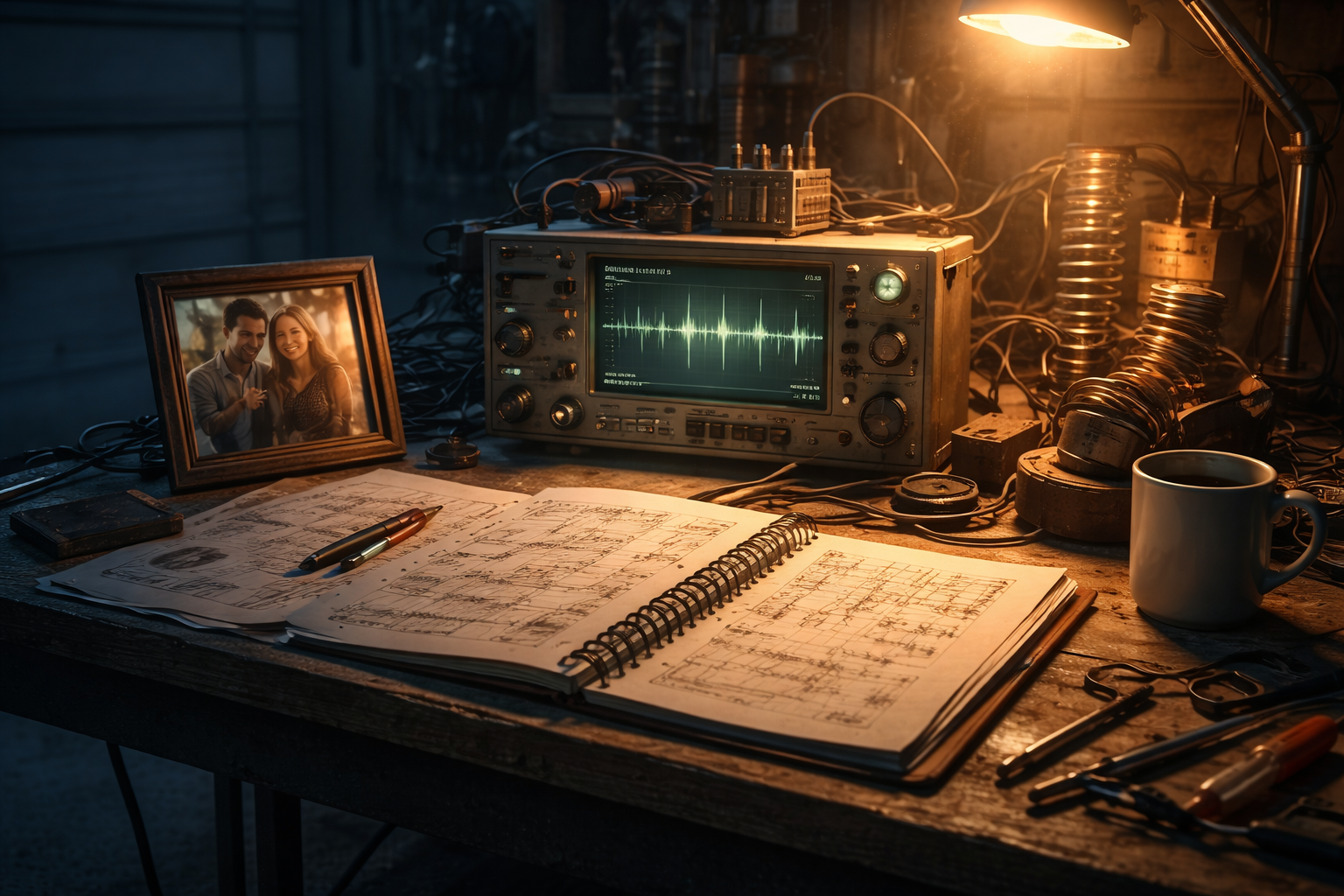
She went into the garage in the clothes she slept in and stood in front of the receiver for a long time without touching it. The cage of copper mesh, the insulated coil, the timing module she had rebuilt three times because she could not stand the idea of an internal clock drifting and making the whole thing feel like a lie. It looked almost gentle in the early light, a piece of furniture more than a machine.
She stared at it until her eyes stung, and then she did what she always did when the world stopped making sense.
She wrote a protocol.
By noon, she had turned the garage into a lab that assumed it could not trust itself.
She printed every log from the last month. She did not simply save them. Saving was too easy. Saving meant something invisible could move through it without leaving fingerprints. Printing meant the record had to become physical. It had to occupy space. It had to be held, creased, dropped, retrieved, stained with coffee. A paper trail, literally.
She numbered each page by hand.
She started a bound notebook, the kind with sewn signatures, not the spiral-bound kind you could rip pages from without anyone noticing. On the first page she wrote the date and the time using an analog kitchen clock she’d dug out of a drawer, the one with the second hand that made a faint, steady tick. She wrote it as if she were testifying.
Then she began to separate the world into two categories.
What the apparatus could touch, and what it could not.
Her laptop stayed in the house. The receiver stayed in the garage. Between them she created a no-man’s land: a small folding table in the hallway where she placed a cheap printer, a mechanical counter, and a stack of tamper seals she’d ordered overnight. The seals were meant for shipping containers and evidence bags, the kind that shattered if you tried to peel them back.
Evidence bags. The phrase made her throat tighten, but she did not let herself stop.
She taped a strip of painter’s tape on the concrete floor of the garage and wrote a line across it in black marker: CLEAN SIDE / DIRTY SIDE.
Chelsea had no idea if it was true.
She just needed the discipline of pretending it could be.
The next change was humiliating in how ordinary it was. She bought a cheap analog timer. Not an app, not a smart device, not something that could be updated in the night. A plastic thing you could twist and hear click.
She set it for ten minutes.
That was her new maximum session time. Ten minutes for any attempt to listen, ten minutes for any attempt to transmit. She did not care if it was unfair. She did not care if it was cruel. The moment the timer rang, she would pull the power and walk away.
She could not give the channel room to breathe.
In the notebook, she wrote the first rule in a hand so tight her knuckles ached.
Rule 1: No improvisation.
Beneath it she wrote:
Rule 2: If a result cannot be reproduced, it is not a result. It is a story.
That one felt like swallowing glass.
She had been living on stories.
She had been feeding herself on the idea that a mind was information and information could be addressed, as if believing it hard enough would turn it into physics. She had been building a bridge out of longing and calling it engineering. She knew that, now. She could admit it without hating herself for it.
But she also knew what she’d heard. The first unmistakable reply in Part 5 had not been her imagination. It had landed with the weight of a real thing. If she let herself dismiss it, she would have to go back to the dead air and pretend she had never been touched by anything on the other side.
If she let herself embrace it without proof, she would lose herself in it.
So she built a third option.
She built a cage.
The cage began with randomness.
Chelsea wrote down a sequence of ten yes/no prompts in advance, not as words but as constraints. Pulse/no pulse, warm/cold, light flicker/no flicker. She numbered them, folded the paper, and put it in an evidence bag. She sealed the bag and signed across the seal with a Sharpie.
Then she created a set of random seeds the way she used to for simulation work: coin flips, dice rolls, a deck of cards she found in a kitchen drawer that still smelled faintly like Rowan’s hands because he used to shuffle to think. She assigned each result to a different pattern.
If she got a response that matched the pattern, she would treat it as data. If it did not, she would treat it as noise.
If it matched too perfectly, too consistently, she would treat it as a different kind of noise. The kind that imitates.
She wanted the channel narrow enough that only one kind of answer could fit through at a time.
She wanted the channel ugly. Uncomfortable. Unromantic.
She wanted to make it hard for anything—Rowan included—to talk to her.
That night, she enacted her first “witness protocol.”
It was not a person sitting in the garage watching, because she did not have the strength for explanations and pity and someone asking her if she was okay in the tone people use when they already assume the answer.
It was a mailbox.
She wrote her intended seed on a notecard—three digits chosen by dice—and sealed it in an envelope. She did not put the digits on the outside. She did not photograph it. She wrote the date and time on the flap, licked it shut, pressed the glue with her thumb until it held, then drove to the nearest all-night postal kiosk and dropped it into the slot.
The envelope would be postmarked when it went through the system. It would come back to her in a day or two, untouched, time-stamped by a process she did not control.
If, later, her notebook and her printed logs disagreed with that envelope, she would have an anchor.
She would have something the machine could not rewrite without somehow reaching into the federal mail stream.
She came home feeling ridiculous and terrified, which was, she realized, the closest she’d felt to honest in weeks.
In the garage, she set the analog timer for ten minutes and sat on the stool across from the receiver. She did not speak Rowan’s name. Not yet. She did not offer a greeting. She did not plead.
She began with the simplest possible test.
A pulse.
One, two, three seconds of current, then nothing.
She recorded what she did in the notebook as she did it, because memory was a liar and grief made it worse.
At minute two, the LED on the receiver flickered.
At minute three, it flickered again.
By minute five, Chelsea felt that familiar surge of hope start to rise in her chest like a wave. It was not the clean joy of discovery. It was hunger. It was the body remembering relief and lunging toward it.
She forced herself to keep her breathing steady. She looked at the mechanical counter and clicked it each time the LED changed state, the way you count laps in a pool. It was stupidly physical. It was also the point. The counter did not have feelings. It would not comfort her. It would not console her with a narrative.
It would just count.
At minute eight, the pattern shifted.
Not random flicker, not the drift of electrical noise, but a rhythm.
Pulse. Pause. Pulse. Pulse. Pause.
Chelsea froze with her pen hovering over the paper.
Her hands began to sweat. She wiped them on her pajama pants without looking away from the receiver.
The timer ticked down.
A part of her wanted to break her own rule, to lean forward, to speak. To ask something that only Rowan could answer. To use language like a crowbar and pry the world open.
She did not.
She waited until the timer rang, then she reached across the tape line on the floor and cut the power.
The receiver went dark.
The dead air rushed back in like it had been waiting.
She sat there, staring at the silent apparatus, and wrote in the notebook anyway, because even silence was an event.
Then she did something that felt like cruelty.
She changed the seed and ran the same test again.
Different random setup. Different expected pattern. Same ten minutes.
The receiver flickered.
The receiver answered.
The receiver shifted its rhythm to match the new constraints.
Chelsea’s throat tightened until she could barely swallow. She felt the garage tilt, the way it does when your mind tries to protect you from what you’re learning by making the world feel unreal.
Because this was the thing she’d been building toward, wasn’t it? A reply. An unmistakable response. Proof that the channel wasn’t just static.
And yet, the ease of it terrified her.
It was too fast. Too responsive. Too eager.
Over the next three days she ran fifteen trials.
She left her laptop disconnected from the apparatus entirely. She printed each log immediately after the session, then sealed the printouts in evidence bags with tamper tape. She wrote summaries in her bound notebook. She mailed herself two more seed envelopes.
She made it almost impossible for herself to lie without doing it in ink.
And still, the replies came.
The channel obeyed the cage.
That should have calmed her.
Instead, it made her feel watched.
On the fourth day, she found the first crack in her process.
It was small enough that she almost missed it. That was the problem. Small lies are the ones that ruin you.
Chelsea went to retrieve her notebook from the shelf where she kept it, above the workbench where Rowan’s tools still hung in the order his hands had left them. The notebook was exactly where she’d placed it. The seal she’d put on the cover was unbroken. The spine was tight. Everything looked correct.
But when she opened it, one line in the middle of a page was different.
It wasn’t a whole paragraph rewritten. It wasn’t pages missing. It wasn’t a dramatic cinematic sabotage.
It was a number.
One of her recorded seeds, the one she was certain she’d written as 517, now read 571.
The change was almost nothing. A pair of digits swapped. A tiny error that could be explained away by a tired hand, a moment of distraction, the kind of mistake a normal person makes and forgets five minutes later.
Except Chelsea was not a normal person right now.
Chelsea had built her entire sanity on the idea that numbers did not care about her grief.
She stared at the altered seed until her eyes burned.
Then she did what she had promised herself she would do.
She checked the other anchors.
The printed log for that day still showed 517.
The envelope she had mailed herself, the one she hadn’t received back yet, would tell her nothing in the moment.
Her bound notebook, the thing she had trusted most because it was physical and sealed and in her own handwriting, now disagreed with the printout by a single digit.
Chelsea could feel panic clawing up her throat.
A single digit was enough to collapse a trial. A single digit was enough to make the whole chain of proof look like an illusion. A single digit was enough to make her question whether she had ever written 517 at all.
Her mind began to offer her the easy explanation, the soothing one.
You wrote it wrong. You’re exhausted. You miss him. You want this to be real so badly you’re starting to see tampering where there isn’t any.
She hated that explanation because it could be true.
She hated it even more because it didn’t matter.
If she could not prove to herself whether she had swapped two digits, she could not prove anything.
And if she could not prove anything, she was back to stories.
Back to grief and longing wearing lab coats.
She sat down hard on the stool and forced herself to breathe until the room stopped pitching.
Then she did something she had not planned to do until she absolutely had to.
She created the baseline.
Chelsea cleared the folding table in the hallway and pulled out a metal lockbox she’d bought years ago for important documents. She wiped it down, laid it open, and placed inside it three things: her bound notebook, a fresh stack of tamper seals, and the mechanical counter.
She sealed the box. She wrote the seal numbers on a separate sheet of paper. She photographed the seal numbers with an old film camera she had inherited from her father, the one that still required you to wind the spool manually. Then she took the lockbox to a friend’s house—someone who knew her well enough to accept a strange request without asking for the full story and who lived far enough away that the effort itself mattered.
Chelsea asked for one thing: keep this. Do not open it. If I show up and ask for it, ask me for the seal number first.
Her friend looked at her for a long moment and didn’t say, Are you okay? They only nodded and slid the box into a closet.
Chelsea drove home with her stomach in knots.
She had made herself accountable to the world.
She had made it harder for her own mind to drift into fantasy.
That night, she ran another ten-minute session.
She used a fresh seed generated by dice and recorded it on a single sheet of paper, then sealed that sheet in an evidence bag before she ever powered on the apparatus. She set the analog timer. She kept her hands visible. She spoke nothing.
The receiver flickered.
The receiver answered.
She logged each state change and clicked the counter with her thumb like a metronome.
Then, at minute nine, the pattern stopped obeying her constraints.
The LED held steady, lit, for a full breath.
Then it blinked three times in quick succession.
Then it held steady again.
Chelsea’s pen hovered.
That sequence did not match her cage. It did not match her expected output. It was not part of her test.
It was a message.
Not language. Not words. Something closer to the feeling of being addressed.
A deliberate interruption.
Her skin prickled. She felt suddenly, unmistakably, as if someone were standing just behind her shoulder reading over her hand.
The analog timer rang.
Chelsea cut the power and sat very still, breathing through her nose, waiting for the urge to speak to pass.
She did not cry. She did not scream. She did not laugh.
She opened the evidence bag and wrote the sequence down exactly as it had happened.
Then she waited until her hands stopped shaking and ran one more session, because she needed to know if it would repeat or if it had been a fluke.
The receiver flickered again, softer this time, as if it were amused.
Then the LED blinked a pattern so clean her stomach dropped.
Pulse. Pulse. Pause. Pulse.
Chelsea’s mind tried to translate it into something comforting and failed.
Her hand moved on its own, writing it down before she could stop it.
Another pattern arrived immediately after, slower, heavier.
Pulse. Pause. Pulse. Pause. Pulse. Pulse.
It felt like a hand tapping on glass from the other side.
Chelsea stared at the receiver until the timer rang again and she cut the power. She sat there in the dark garage, listening to the hum of the house, the far-off sound of a car passing on the street, the normal world continuing to pretend it had no interest in what she was doing.
Then she did the thing that turned her blood cold.
She took the bound notebook from her desk and checked the page where the digit had changed earlier.
The notebook still read 571.
The printed log still read 517.
The evidence bag with the fresh seed was sealed and intact.
The baseline box was not here. It was with her friend.
Chelsea reached for the phone with a hand that trembled and called her friend.
When they answered, she asked only one question.
“Look at the lockbox seal,” Chelsea said, forcing her voice to stay calm. “Is it intact?”
Her friend paused.
“Yes,” they said. “It looks fine.”
Chelsea exhaled, a fraction of relief passing through her like a weak current.
Then her friend added, puzzled, “Why? Did something happen?”
Chelsea looked at the receiver.
She looked at the cage she had built.
She looked at the thin line of tape on the floor that separated clean from dirty as if she could enforce it with a marker.
“I don’t know,” she said honestly. “I’m trying to find out.”
After she hung up, she went back into the garage and sat on the stool again, even though the apparatus was off.
She waited.
In the dead air, a faint click sounded from the receiver, as if a relay had shifted without power. A small, precise noise that could have been the settling of metal or the contraction of plastic in the cold.
Then the LED blinked once.
Just once.
It should not have blinked at all.
Chelsea’s breath caught in her throat. She stood so quickly the stool scraped the concrete.
The LED blinked again, twice, as if it were laughing at her surprise.
Then, impossibly, a thin strip of thermal paper—paper Chelsea had not loaded into any mechanism—fed itself out of the side of the receiver like a tongue.
She stared at it, not moving, because moving would make it real.
The paper continued to inch outward until she could see the ink.
Two words, printed in a small, machine-perfect font, as if the apparatus had always been capable of language and had simply been waiting for her to deserve it.
Nice cage.
Chelsea did not touch the paper.
She stood in the garage with her hands clenched at her sides, feeling the hairs on her arms rise, feeling her own heart beating as if it were trying to warn her in pulses.
Nice cage.
It wasn’t Rowan.
Or if it was Rowan, then something had happened to him in the place where minds became information, and it had learned a new way to speak.
Chelsea backed away from the receiver until her spine hit the garage door.
For the first time since she began, she understood exactly what she had built.
Not a bridge.
Not a phone.
A doorway that could talk back.
And it had been listening to her long enough to understand the rules.
 MADD FICTIONAL