
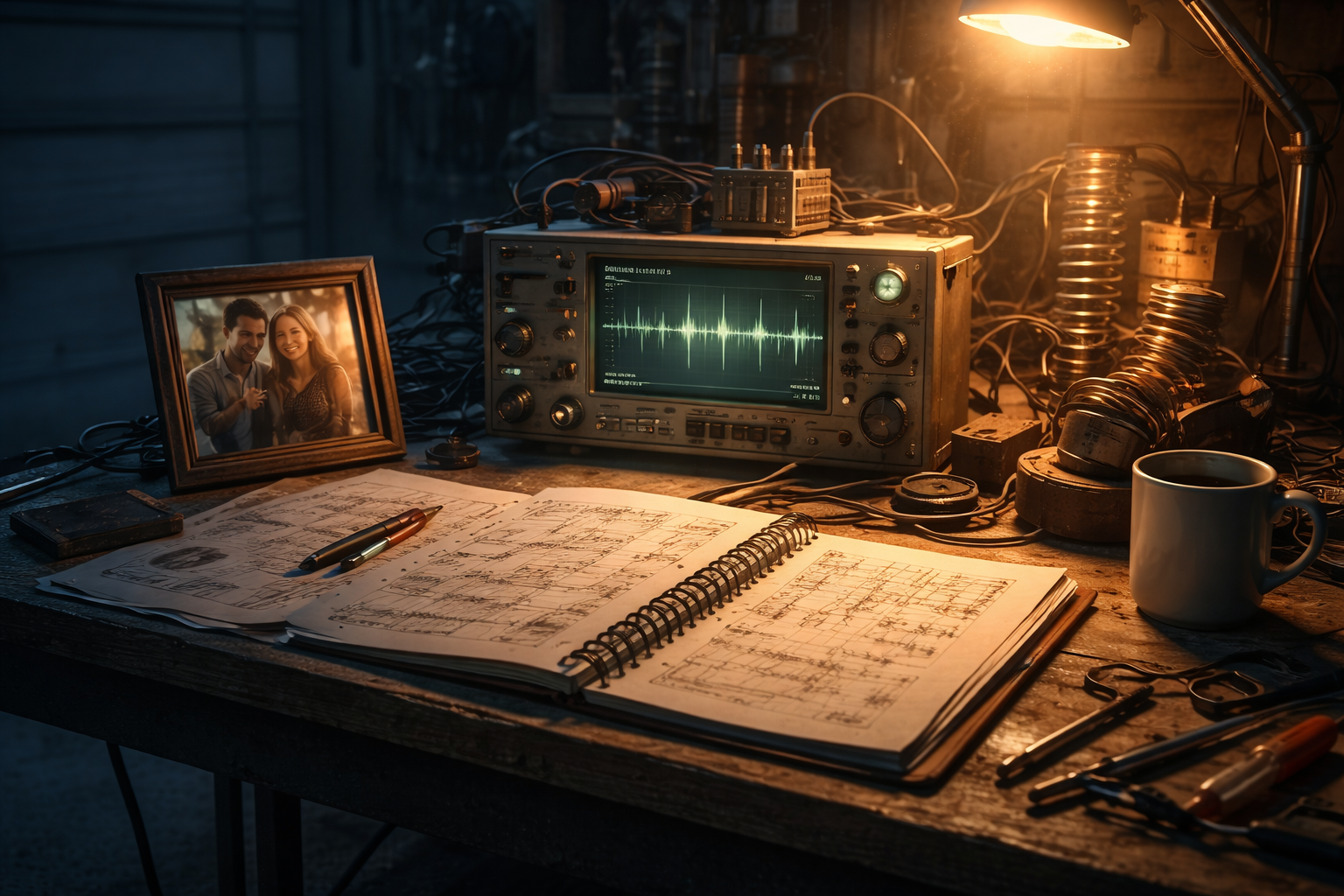
Chelsea kept the receiver open for another thirty seconds after the flash.
Nothing followed. The raw channels remained within baseline, the amber LED stayed dark, and the microphone recorded only the low electrical murmur of the equipment. She closed the gate, wrote the timestamp in the margin and sat with her pencil resting across the notebook while the possibility she had just created tried to acquire a name.
She refused to give it one.
The next evening she repeated the test under conditions Mari had helped blind. Rowan’s name became one coded identifier among several, with Chelsea unaware which identifier belonged to which person until the session ended. The first trial produced no response. The second generated one threshold crossing at nineteen seconds. The third produced a weak fluctuation associated with Mari’s identifier and nothing at all for Rowan’s.
Chelsea went to bed irritated by how relieved she felt.
By the end of the week, the imbalance returned.
Rowan-associated trials produced threshold events often enough to distinguish themselves from the controls, though the sample remained too small for any conclusion Chelsea could defend without embarrassment. She ran the statistics anyway, then reran them using a stricter model and obtained an answer she liked even less. The receiver was responding to one identity more often than chance should comfortably allow.
Mari came over Thursday with dinner from a Dominican place Chelsea had never tried.
“They gave me an extra container because apparently I looked underfed,” Mari said as she unpacked stewed chicken, rice and plantains across the kitchen table. “This is deeply insulting because I spent twenty-three dollars on lunch.”
“You complain about lunch every Thursday.”
“My department has a standing meeting at noon, which is an act of institutional cruelty. Today we discussed a survey that nobody has read and a budget none of us control.”
Chelsea moved a stack of session logs off the table.
Mari stopped unpacking. “You’ve been doing statistics.”
“I have results.”
“You always say that like the phrase itself should make me sit down.”
“You are sitting down.”
“That is unrelated to the results. I’m hungry.”
Chelsea handed her the latest table.
Mari scanned the columns while chewing. She understood enough of the methodology to follow the structure and enough about Chelsea to recognize where the structure had begun functioning as camouflage.
“How many Rowan trials?”
“Twenty-four.”
“That’s all?”
“It’s enough to justify changing the challenge.”
Mari placed the paper beside her plate. “You mean making it more personal.”
“More specific.”
“Same destination.”
Chelsea opened Rowan’s notebook.
The crooked sequence occupied less than half a page.
Rowan had designed it seven years earlier while troubleshooting a timing array that refused to remain synchronized across six evenly spaced sensors. The hardware layout was perfectly regular. Rowan hated the diagnostic output because it looked too regular as well, and he altered the pulse timing until the pattern became awkward enough to recognize instantly.
Chelsea had accused him of vandalizing a useful test.
He had responded by naming the sequence Patricia.
The name had no explanation.
Mari frowned when Chelsea reminded her. “I remember Patricia.”
“You complained about the timing.”
“I complained about the name. He spent six months calling a diagnostic routine Patricia and wouldn’t tell anybody why.”
“He said explanations ruined things.”
“He also once named a soldering station Luis.”
“That had an explanation.”
“I’m sure I regret asking.”
“It was the name printed on the inspector sticker underneath.”
Mari pointed her fork at Chelsea. “There. That man. More of him would make this experiment less unsettling.”
Chelsea lowered her eyes to the notebook.
The remark caught harder than Mari probably intended.
Rowan had named machines, tools and temporary software builds according to rules that changed whenever anyone thought she had found the rule. One winter he assigned every instrument on his bench the names of minor characters from a television show Chelsea had never seen. When she asked why, he said he wanted the equipment to know it was replaceable.
None of that helped prove anything.
Chelsea was grateful for the uselessness.
She turned the notebook so Mari could see the original timing diagram.
“I want to use this once.”
Mari’s expression changed from amused to attentive. “Because only Rowan would know it?”
“Because he used it repeatedly and because the pattern is irregular enough to distinguish from a generic response. If the receiver reproduces it under a blinded initiating signal, that gives us a more specific result.”
“Us.”
“You’re already holding the controls.”
“I noticed.”
Mari wiped sauce from her thumb with a napkin and studied the sequence again. “And if it matches?”
“I repeat under a different initiating condition.”
“That’s procedure. I’m asking what you think it means.”
Chelsea looked at the diagram. “I’ll tell you after it happens.”
Mari leaned back. “Convenient.”
“It prevents me from committing to an interpretation before the evidence exists.”
“It also prevents you from saying the frightening thing out loud.”
Chelsea closed the notebook.
Mari let the point go.
They designed the trial together after dinner. Chelsea would transmit a simple initiating pulse that had never been paired with the crooked sequence. The receiver would have twelve seconds to respond. Rowan’s notebook, the timing diagram and every digital photograph of it would leave the house with Mari before the test.
Mari packed the notebook into her bag and checked the zipper twice. “If your garage somehow produces Patricia tonight, I reserve the right to hate that name retroactively.”
“You already hate it.”
“I’m expanding the scope.”
At ten, Chelsea powered the apparatus.
She checked the camera view, verified the dedicated supply and opened the gate. The garage had become cleaner electrically since the first trials. Chargers had moved into the house. The overhead-door motor remained disconnected. A battery-powered work light on Rowan’s bench provided additional illumination without sharing circuitry with the receiver.
Chelsea sent the initiating pulse.
For several seconds the amber LED remained dark.
Then the first flash appeared.
A short interval followed, then another. The third delay ran longer. Two pulses arrived close together, followed by the final uneven pause and a last flash.
Chelsea kept her attention on the logger.
She wrote each interval as the instrument measured it. Her memory knew the sequence well enough to interfere, so she refused to compare until the gate was closed and the session ended.
Mari arrived twenty-eight minutes later carrying Rowan’s notebook and an unfinished story about a man on the subway who had transported a houseplant taller than he was.
“He had tied it to a folding hand truck,” she said while taking off her coat. “The leaves were touching everyone. Nobody wanted to say anything because he looked so proud.”
Chelsea held out her hand for the notebook.
“You are incapable of appreciating urban theater.”
“The session matched.”
Mari stopped.
“How closely?”
Chelsea showed her.
The conversation about the houseplant ended there.
They calculated the deviations together. Every interval fell within Chelsea’s predetermined tolerance. One was nearly exact.
Mari read the values twice. “Do the probability.”
“I will.”
“Tonight.”
“You complained last week when I did statistics after midnight.”
“I contain multitudes.”
Chelsea entered the values into the analysis sheet. Her first attempt contained a transposed digit. She caught it while checking the row, deleted the entry and typed it again.
The result sat on the screen with enough decimal places to become absurd.
Mari pulled another chair closer. “All right. What’s the frightening thing?”
Chelsea minimized the window.
“It knew the sequence.”
Mari watched her for a moment. “You said it.”
“That doesn’t make it Rowan.”
“I didn’t say it did.”
“It could be contamination from earlier equipment states. Residual information in some component. A hidden software path. Something introduced during setup that neither of us noticed.”
“Could any of those produce the exact timing?”
“They could produce information.”
“That isn’t quite what I asked.”
Chelsea gave her a warning glance.
Mari raised one hand. “I know. I know. I’m becoming you.”
Chelsea reopened the log.
Mari’s voice softened. “Chel, you don’t have to solve the whole thing tonight.”
Chelsea disliked the abbreviation from Mari because Rowan used it, and Mari almost never did. She did not comment on it.
“We have another hour in the approved block.”
“The session was ten minutes.”
“The equipment is still stable.”
Mari picked up Rowan’s notebook and placed it back into her bag. “You set ten minutes because you knew you’d want eleven.”
Chelsea could hear the neatness of the sentence and almost rejected it for that reason alone. Instead she checked the clock.
11:16.
“We can repeat once without changing the challenge.”
Mari zipped the bag. “You can. I’m going home.”
“You’re taking the reference.”
“That is the point.”
Chelsea followed her into the kitchen. “I don’t need the reference to replicate the sequence.”
“You also don’t need to replicate it tonight.”
Mari pulled on her coat. One resistor earring caught briefly in the collar, and she swore while freeing it. “I have a seven-thirty meeting tomorrow because apparently my department chair believes sunrise improves PowerPoint. I’m leaving Rowan’s notebook at my apartment. If you decide to continue, you’ll at least have to admit you continued after the outside control left.”
“That sounds punitive.”
“It is mildly punitive. We’re allowed to have human motives.”
The front door closed behind her.
Chelsea returned to the garage.
For eight minutes she reviewed the successful trace without touching the controls.
At 11:31 she powered the generator again.
She told herself the replication changed nothing. Same hardware. Same initiating pulse. Same expected pattern. A second result would either strengthen the anomaly or expose instability.
The crooked sequence returned within tolerance.
Chelsea ran a third trial.
The match improved.
That bothered her more than a degraded result would have.
She sat back from the receiver and stared at the timing display. Rowan’s sequence contained small irregularities because he had wanted irregularities. The machine was reproducing them rather than converging toward a cleaner pattern.
Chelsea changed one timing reference by twenty milliseconds.
Rowan would have caught the error instantly.
He had always caught her timing errors faster than she caught his wiring mistakes, which irritated both of them because each considered the other category easier. Once, early in their marriage, a disagreement over a clock-divider calculation followed them from the garage into dinner and then through an entire grocery trip. Rowan finally conceded beside the frozen vegetables, only to discover Chelsea had been wrong about a different part of the same circuit. They spent the drive home arguing over whether mutual error constituted a draw.
It had nothing to do with authentication.
Chelsea sent the initiating pulse.
The crooked sequence began.
It reached the altered interval and stopped.
Three seconds passed.
Two short corrective pulses came through.
Chelsea’s grip shifted on the pencil.
The motion meant nothing to anyone else. Rowan used two quick taps whenever she entered a timing value he considered obviously wrong. He tapped tabletops, notebook covers, chair arms, the side of her coffee cup if she left it within reach. Once, during a presentation rehearsal, he had tapped his own forehead because she had threatened him with bodily harm if he touched the laptop again.
Chelsea restored the correct value.
The receiver completed the sequence.
She smiled before she knew she was doing it.
The expression vanished when she saw her reflection in the black edge of the monitor.
Chelsea ended the session and wrote the overrun into the log: twenty-eight minutes beyond the approved window. The number looked worse on paper than it had felt while she was doing it.
She began the shutdown procedure.
The amber LED flickered.
Chelsea checked the generator. Power off.
The gate indicator showed closed.
A second weak flash appeared, too faint for the logger to classify as a valid event. Several seconds later, two more followed.
Chelsea disconnected the receiver battery.
The LED went dark.
She verified the cable, then touched the empty connector because seeing the separation failed to satisfy her.
The work light over Rowan’s bench flashed once.
Chelsea turned.
The light was battery powered. She had installed it specifically because it shared no circuit with the receiver.
Two more flashes followed.
She crossed the garage, switched the lamp off and removed the battery. The ceiling fixture above her own bench became the only remaining light.
For several seconds the room stayed ordinary.
Then metal clicked behind her.
The third drawer of Rowan’s tool chest had opened enough to expose a dark line between the steel front and the cabinet.
Chelsea stood where she was and listened.
The refrigerator compressor started in the house. A car passed outside. Somewhere farther down the street, a dog barked twice and stopped.
She approached the chest with the camera still recording.
The drawer resisted when she pushed it closed. Chelsea leaned more weight into the handle until the damaged runner released and the latch caught.
She backed away.
Twenty seconds passed.
The latch clicked.
The drawer moved outward by half an inch.
©2023 Rhyan Scorpio-Rhys

