Mechanics of the Ghost Machine (Part 1)

They were the kind of couple who flirted in equations.

Chelsea and Rowan Knepper (engineers, both of them) built their marriage the way they built everything else: carefully, iteratively, with a shared belief that anything could be solved if you stayed in the room long enough. When something broke, they didn’t pray. They tested. They recalibrated.

And when Rowan died, Chelsea did what she had always done.

She tried to fix the impossible.

At first, it looked like grief dressed up as productivity: sleepless nights in the workshop, notebooks filled with diagrams, the soft click of relays and coils as the house turned into a private laboratory. Friends called. Family begged. Chelsea said she was fine.

She wasn’t fine. She was building a door.

Not the spiritual kind. Not a seance circle with candles and trembling hands. Chelsea didn’t trust rituals she couldn’t quantify. If the dead were anywhere at all, then they were somewhere real — somewhere with rules. Somewhere with pressures and thresholds and a physics she hadn’t learned yet.

The machine began as a listening device. A blind instrument.

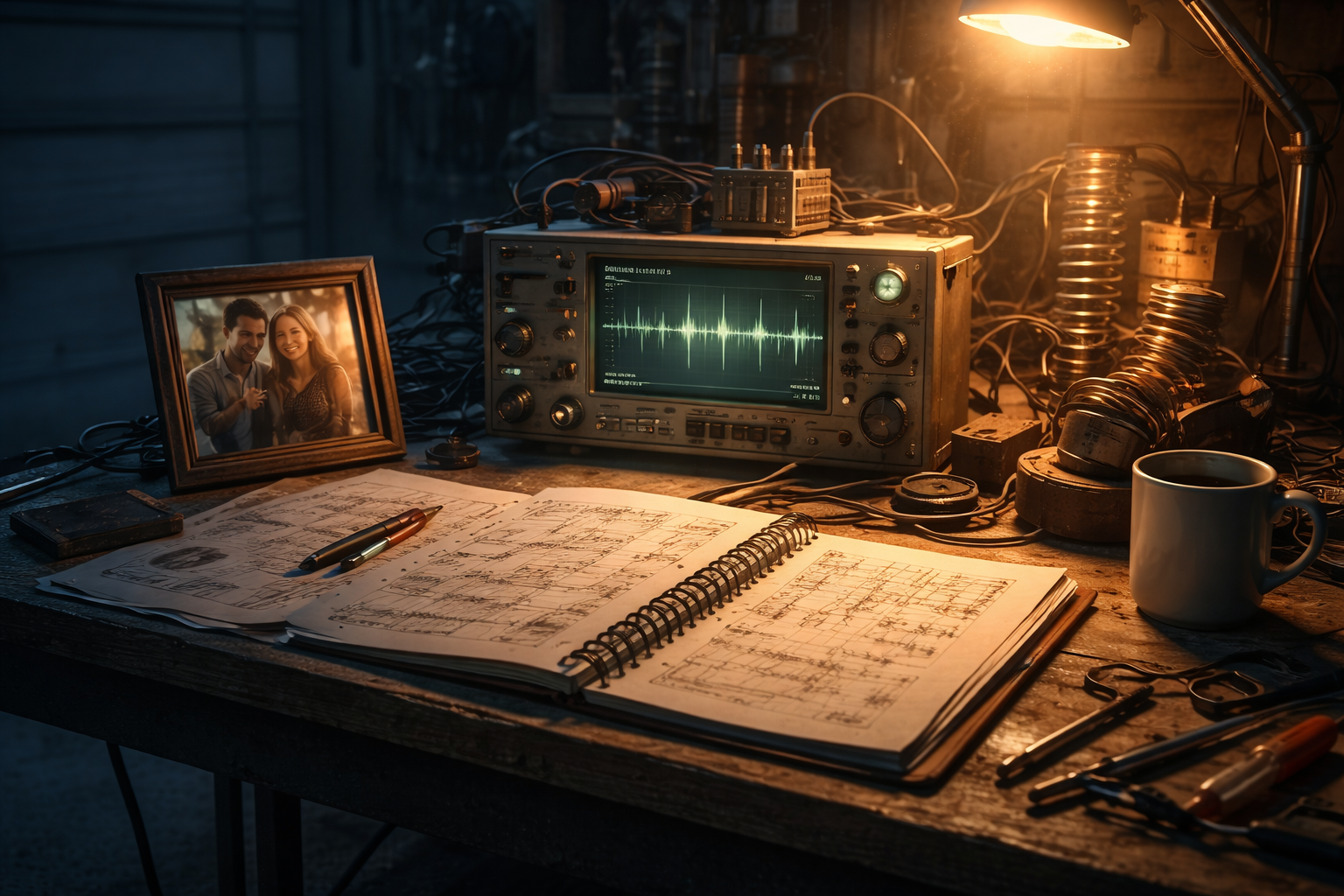
A field generator that pulsed in controlled intervals. A receiver tuned to patterns that shouldn’t exist in static. A lattice of sensors that recorded the smallest disturbances: temperature drift, electromagnetic jitter, particulate movement, the microscopic shifting of dust that happened when nothing touched it.

Chelsea told herself she was chasing data.

What she was chasing was Rowan.

The first sign it was working wasn’t a voice. It was a response.

One night, after hours of cycling the signal, the receiver produced a clean interruption — not random, not noise: a deliberate break at the exact interval she’d used for their old inside joke. Three short pulses. Two long. Three short again.

Their anniversary.

Chelsea sat so still she thought she might stop breathing.

She ran the sequence again.

The machine answered again.

Then, finally, the smallest miracle: a single word formed in the hiss, like a hand pressing letters into fog.

CHEL.

She couldn’t tell anyone. Not yet. If she said it out loud, it would become vulnerable to other people’s disbelief — and to her own. So she did what scientists do when something impossible gives them one inch.

She tried to take a mile.

She upgraded the apparatus until the garage became a cathedral of metal and light. Coils stacked like vertebrae. Glass tubes that glowed faintly when the field peaked. A console of switches labeled in her tight, unsentimental handwriting: AMPLIFY. SYNC. OPEN.

She mapped the signal into a language.

Yes/no questions first. Then numbers. Then letters. Then sentences. It was slow, exhausting, and intimate in a way that made her feel guilty — as if she were cheating on life with a dead man.

But Rowan was there.

Not as a floating shape. Not as a face in a mirror. As pattern. As presence. As someone pushing back from the other side of a membrane with no name.

When he began to “speak” more clearly, the messages were not poetic.

They were practical.

He asked about her sleep. He asked if she was eating. He asked if she still left the porch light on out of habit.

And then he asked for materials.

Not candles. Not offerings. Components.

He wanted her to build something on her side that would match what he was building on his.

Chelsea laughed the first time she understood what he meant. A short, cracked laugh — equal parts joy and terror.

Because it meant the dead weren’t just drifting.

They were working.

So Chelsea built the second machine — the answering machine — designed not only to receive Rowan’s signal, but to strengthen it. To widen the channel. To take the hairline fracture between worlds and make it useful.

She told herself she was doing it for love.

But love is a powerful excuse for obsession.

And obsession doesn’t stay polite.

The first wrong thing happened on a Tuesday afternoon when the machine activated by itself.

Chelsea was across the room, hands nowhere near the controls, when the console lights climbed in sequence like something waking up. The receiver hissed — and beneath it, a voice flickered through, too close to be static.

Not Rowan.

A second voice, layered underneath the first, like someone listening in from another room.

Chelsea froze, heart thudding.

The machine printed a message anyway, spooling it out with mechanical calm:

WE HEARD YOU CALLING.

Chelsea didn’t shut it down.

She should have.

She told herself it was an artifact. Interference. A mistake she could troubleshoot.

But that night, when she asked Rowan if he’d said it, the machine answered in a pattern that felt almost… amused.

And then Rowan sent his next message, the clearest yet:

DON’T TRUST THE QUIET.

That was the moment Chelsea understood what she had built.

Not a phone line.

A beacon.

And whatever lived beyond the veil wasn’t all Rowan Knepper, patiently waiting to talk to his wife.

Some of it had been waiting for anyone at all.

Hayley Red (Part 3): The Report

The next morning, the sun came up like it always does—bright, indifferent, almost smug about it. As if the universe wanted to prove a point: tragedy is not a weather event. It doesn’t change the forecast. It doesn’t cancel the day.

Peg didn’t sleep.

Neither did I, not really. I did that thing people do when their bodies shut down without permission—short, ugly blackouts that aren’t rest, just absence. Every time my eyes closed, I saw that corridor. The red strips. The fog. The door sealing like it had always been waiting to do it.

At some point, someone from the base called. Then someone else. Then a third person whose job title sounded like it had been built by committees: Casualty Liaison Integration Specialist. She spoke with the careful calm of someone trained to be human without becoming it.

We were told to come in.

We were told to bring identification.

We were told to eat something first.

We were told, gently, that we might want a friend to drive us.

Peg stared at the wall while she listened, then ended the call without saying goodbye. That was the first time I watched my wife—the woman who believed in jinxes, who counted her steps around luck, who wouldn’t even whisper the word “nursery” until we had a living baby—become utterly superstitious in a different way.

Not afraid of bad luck.

Afraid of the world itself.

On the way to the base, the traffic lights looked wrong. Every red light felt like the universe clearing its throat, trying to get my attention.

Stop.

Stop.

Stop.

And the sick truth is: I did stop. Every time. Because I’m trained to obey red. I’m trained to respect it.

And the part of me I can’t forgive is that my daughter wasn’t trained the same.

We were taken to a room that looked like it had been designed to keep people from having emotions inside it. Gray walls, neutral lighting, furniture with rounded corners, a table that wasn’t quite a table and chairs that weren’t quite comfortable. There was water. There were tissues. There was a screen on the wall, black for now, like it was waiting to show us something we could never unsee.

The officer who came in wasn’t a Marine. He was civilian oversight. Clean uniform, clean hands, clean voice. He introduced himself and then introduced the concept of a “sequence of events,” as if our child had become a timeline.

He said he was sorry.

He said it wasn’t anyone’s fault.

He said there would be an investigation.

He said a lot of things that sounded like doors closing.

Peg didn’t cry. Peg didn’t tremble. Peg didn’t look at the man.

She looked past him, at the corner of the room, where a small indicator panel glowed.

Not red. Thank God. Blue.

Routine.

Neutral.

Safe.

Peg stared at it like she was taking notes for a war.

The officer slid a small tablet toward us. “This is the incident summary. We’ll go through it together.”

Peg didn’t touch it.

I did.

My fingers shook, and I hated myself for that too. Not because shaking is weak, but because my hands were the hands that should have been on my daughter. My hands should have been the wall. My hands should have been faster than a door.

The report was sterile. The report was brilliant. The report was cruel.

At 17:42:08, an unauthorized minor entered a restricted corridor during an active containment pre-sequence.

Unauthorized minor.

Not Hayley.

Not our miracle.

Not a little girl who loved red.

At 17:42:11, the atmospheric isolation threshold was reached.

Threshold.

Like my daughter was a measurement.

At 17:42:15, primary seal engaged.

Primary seal.

Like there’s a secondary seal in case the first one doesn’t do the job.

Then came the line that felt like the universe had slapped me with paperwork.

Fatality occurred due to environmental exposure within sealed corridor.

Environmental exposure.

Like she went outside without a coat.

I made a sound then. Not a sob, not quite. A laugh with no humor in it. A noise that escaped me because the human brain refuses to accept some sentences as real.

Peg finally looked at the tablet.

Her eyes moved down the text. I watched her reading, and it felt like watching ice form.

She tapped one line with her finger—slow, precise.

Safety logic assumed minor was accompanied by authorized adult due to lack of visitor-tag restriction.

She read it once.

Then again.

Then she looked up at the officer.

“Say it,” she said.

The officer blinked. “Ma’am?”

“Say it out loud,” Peg said, voice steady, quiet, lethal. “Explain to me why the system let my daughter through a barrier that stopped her father.”

The officer’s expression tightened. He was trained for grief, but not for someone who refused to perform it politely.

“The system’s visitor-tag protocols restrict adults,” he began carefully. “Children aren’t tagged the same way because—”

“Because you built it to assume I wouldn’t make a mistake,” Peg said.

The officer paused.

Peg nodded once, like she’d just confirmed a theory.

“You built it to assume I wouldn’t blink.”

Her hands were folded in her lap, perfectly still. The only sign that she was breaking was the skin around her knuckles—white with pressure.

The officer shifted into another register—the register people use when they’re explaining something expensive.

“We’ve identified the triggering event as a coolant microfracture. An aerosolized chemical leak. The containment sequence functioned as designed.”

Peg’s gaze narrowed. “Functioned as designed.”

“Yes, ma’am.”

“And the design allows for a child to enter during a pre-sequence.”

“It’s… a rare confluence of circumstances.”

Peg’s smile appeared like a knife.

“A rare confluence. You mean a miracle.”

The officer looked uncomfortable. “Ma’am, I’m very sorry.”

Peg leaned forward. “Don’t be sorry. Be accurate.”

Silence.

He swallowed. “The system did not account for a minor entering the corridor unsupervised.”

Peg nodded again.

That nod was the sound of a door opening inside her.

Not to grief.

To purpose.

I tried to reach for her hand under the table. Peg didn’t pull away, but she didn’t squeeze back either. It was like she’d already begun to leave my side—not emotionally, but tactically. Like she’d stepped onto a different map.

The officer cleared his throat. “There are… procedures. Counseling services. Support groups. Compensation—”

“Stop,” Peg said.

The word came out like an order.

He stopped.

Peg looked at the black screen on the wall. “Show me the footage.”

The officer hesitated. “It may be distressing.”

“Show me,” Peg repeated.

The officer’s eyes flicked to me, like he hoped I’d intervene and say no.

I couldn’t speak. My throat was full of corridor fog.

He activated the screen.

And there we were—me, Hayley, the waiting area. Grainy security footage that looked like it belonged to someone else’s life. Hayley balancing on the floor seam. Hayley turning her head. Hayley’s body going still as the red strips ignited.

On camera, it was worse in a way I can’t explain. In memory, there’s a haze, a mercy. On video, it’s crisp.

My hand reaching.

The tech swiping in.

The door opening.

Hayley slipping forward like a thought.

And then the barrier stopping me.

Not violently. Just… refusing.

Hayley turning back with that happy look like she was sharing a secret.

Then the door sealing.

The fog.

The last image of her hand against the glass.

Peg watched without blinking.

I watched until my vision fractured.

When it ended, the screen went black again.

The officer spoke softly. “We can stop there.”

Peg didn’t even look at him.

She stood.

“So,” she said, and for the first time her voice wavered—not with tears, but with contempt so pure it almost sounded like prayer. “You have a system where red means emergency and safety, and the emergency system killed my daughter because it did exactly what it was built to do.”

The officer opened his mouth.

Peg cut him off. “Don’t correct me.”

She turned to leave.

I stood too, on instinct, like a man following orders in a life where orders still make sense.

Peg paused at the door, then looked back—not at the officer, not at the room, but at me.

And I saw what I’d been avoiding.

Peg didn’t blame the base first.

Peg blamed the world.

And the world, unfortunately, includes me.

I reached for words. Anything. An apology. A promise. A plan. A prayer.

What came out was small.

“I should’ve—”

Peg raised a hand.

“Don’t,” she said.

Not cruel.

Just final.

Outside the building, the day was bright. People walked past us with cups of coffee and badges and sleepy faces. Normal life continuing, because normal life always does.

A transport vehicle rolled by with hazard lights flashing.

Amber.

Then red.

That rhythmic pulse.

That same directional insistence.

Peg’s head snapped toward it so fast it looked like a reflex. Her breath hitched, the first crack in her armor.

Then her face hardened.

She didn’t look away.

She stared at the red until it passed.

And I understood then: Peg wasn’t going to grieve like a widow.

Peg was going to prosecute reality.

That night at home, I did what I thought a good father does when the unthinkable happens.

I went into Hayley’s room.

I picked up her red blanket.

I held it to my face like it might still smell like her.

I sat on the floor and I tried to let myself break.

But grief isn’t always a clean collapse. Sometimes it’s a long, humiliating negotiation with detail.

The way her socks were still in the drawer.

The way the cup with the cartoon rocket still sat beside the sink.

The way the red night light was still plugged in.

I didn’t turn it on.

I couldn’t.

I went back out into the hall and found Peg in the kitchen.

She had the tablet open on the counter. Not the incident summary—something else. A systems manual. A protocol tree. Names of departments. Names of contractors. A list of the people who designed the barrier, the sensor suite, the assumptions.

She wasn’t crying.

She was compiling.

“Peg,” I said quietly.

She didn’t look up.

“I don’t know what to do,” I admitted, because truth was the only currency I had left.

Peg’s voice was flat. “You’re going to do what you always do.”

I frowned. “What’s that supposed to mean?”

Peg finally lifted her eyes to mine.

And I saw it—the raw thing underneath. Not anger. Not hatred.

Betrayal.

“You’re going to try to make it hurt less,” she said. “You’re going to try to soften it. You’re going to try to tell a story where it makes sense, where it was fate, where it was a mistake, where it was anything but what it was.”

She swallowed, jaw tightening.

“I’m not doing that.”

I stepped closer. “Peg—”

She raised a hand again, the same gesture as before.

“No,” she said. “Not yet.”

Then she reached into a drawer and pulled something out.

A small strip of red fabric.

One of Hayley’s ribbons.

Peg held it between her fingers like evidence.

“You said she loved red,” Peg murmured. “So I’m going to learn what red really means in this world. I’m going to learn every place it’s used. Every reason. Every protocol. Every assumption.”

She looked at the ribbon, then at me.

“And if red is the color that took her,” she said, voice steady again, “then red is going to be the color that tells the truth.”

I wish I could tell you I understood her right then.

I didn’t.

All I felt was fear.

Because the moment Peg said that, it stopped being a tragedy that happened to us.

It became a story with momentum.

And I could already see where momentum goes when it has nowhere safe to stop.

That night, sometime after midnight, I woke to the sound of a plug being pulled.

I stumbled out into the hall.

Hayley’s door was open.

Peg stood in the doorway holding the night light in her hand, its cord dangling like a severed vein.

The room was dark.

Blank.

Not warm. Not ember-glow. Not comfort.

Just absence.

Peg looked over her shoulder at me.

“I can’t,” she whispered.

It was the first time she sounded like my wife again. And then, in the quietest voice I’ve ever heard from her, she said something that made my blood go cold.

“I keep thinking… if I follow it.”

I blinked. “Follow what?”

Peg’s eyes flicked toward the base, as if she could see through walls and distance.

“The red,” she said. “If I follow where it goes. If I learn every door it closes. Every corridor it seals.”

She swallowed hard.

“Maybe I’ll find the place it put her.”

I didn’t know how to answer that because part of me—the insane part grief grows—wanted to follow it too. Wanted to believe there was a place. A chamber, or a pocket of procedure where you could go and retrieve what you lost, if you just knew the right code.

Peg set the night light down in the trash. It landed with a dull plastic thud. And in the dark hallway, with our daughter’s room behind us like a wound, the only thing I could think was this:

Red doesn’t just mean stop. Sometimes it means come back. And we were going to spend the rest of our lives trying to tell the difference.

Hayley Red (Part 2): The Color of Emergency

If you’ve never lived around a Marine base, you learn colors the way you learn weather. You don’t think about them until you have to.

Green means go. Blue means routine. Amber means pay attention. And red—red is the color you do not romanticize.

Red is lockdown. Red is vacuum. Red is heat. Red is the kind of light that doesn’t just illuminate; it warns.

Peg knew this better than anyone. She’d spent four years of active duty with red strobes washing over her helmet in training drills and real alerts, red lines painted on bulkheads that meant “beyond this point, the air might not be your friend.” If anyone in our house was immune to the charm of a blinking crimson panel, it should have been her.

But immunity is a luxury parents rarely get.

Hayley’s fascination didn’t fade as she grew. It sharpened. It became preference, then habit, then a kind of quiet certainty—as though somewhere inside her, red wasn’t just a color. It was a signal meant specifically for her.

We told ourselves it was normal. Kids latch onto things. Some want dinosaurs. Some want trucks. Ours wanted red. We leaned into it because leaning into it felt like we were finally allowed to enjoy something without bracing for impact.

Red socks. Red ribbons. Red bedtime lights turned low and warm like embers.

Hayley would fall asleep clutching a soft red blanket like it was an organ she couldn’t live without.

And then Peg got the message that changed our routines.

A call-up. Not a full return to active duty, but a short assignment back on base to consult on a systems rollout—two weeks of being physically present, a handful of long days, the sort of “temporary” that still rearranges your life.

We didn’t have family nearby. We didn’t have built-in support. So we did what couples do when they’re out of options: we made it work.

I took Hayley with me to pick Peg up at the end of the day sometimes. We’d park in visitor, pass through security, follow the painted paths like we’d been told, and wait outside the Administration Annex where Peg’s office was. It was usually boring. It was usually safe.

And that’s the lie that makes tragedy possible. “Usually.”

The Annex was attached to a larger complex—half offices, half operations. The kind of building that looked like nothing from the outside and contained half a city’s worth of machinery inside. Air scrubbers. Battery banks. Clean rooms. Server vaults. Emergency systems that hummed like sleeping animals.

There were signs everywhere. Symbols that meant nothing to a child and everything to an adult.

RESTRICTED

AUTHORIZED PERSONNEL ONLY

AUTOMATED DOORS

ATMOSPHERIC SEAL

And the most honest sign of all: red light strips embedded in the floor in straight, uncompromising lines.

Hayley noticed those lights the first day we waited there. Of course she did.

Her whole body would go still when they pulsed. Her eyes would widen the way they did at fireworks. She’d point and make a little sound—soft, pleased—like she’d found a friend in a crowd.

“Pretty,” she said.

“It’s not pretty,” Peg told her that night, smiling but firm. “Red means danger.”

Hayley stared at her mother like she was hearing a story she didn’t believe.

“Danger,” she echoed, testing the word.

Peg kissed her forehead. “Danger.”

I backed Peg up the way you’re supposed to. I made it a little game. I’d point at different colors when we were out. Ask Hayley what they meant.

Green: go.

Yellow: careful.

Red: stop.

She learned it easily. She was smart. She was our miracle. She was the child we were afraid to name before she existed, and now she was speaking in full sentences and picking up rules like she’d been born with them.

So when Peg told me, “She understands,” I believed her.

That’s another lie tragedy likes: the kind you tell because it feels like relief.

The night it happened, nothing felt strange until it was too late to rewind it.

It was late afternoon. Base-hours lull. People leaving offices with that drained look of professionals who’ve spent all day not saying what they mean. Peg texted that she’d be five minutes longer. I was standing with Hayley in the designated waiting area—bright, clean, boring—watching her try to balance on a seam in the floor tile like it was a tightrope.

Then the lights changed.

At first it was subtle, an environmental shift you feel more than see. The air pressure adjusted. The hum deepened. Somewhere far inside the building, a tone sounded—low, steady, almost musical.

Hayley paused mid-step.

Her head snapped toward the corridor that led deeper into operations. Toward the red floor lights.

They had come on.

Not the soft decorative glow she’d admired before. These were emergency strips—harder, brighter—racing in directional pulses toward a sealed door. The kind of light designed to move adults quickly, to shepherd bodies toward procedures.

To a child, it looked like the building itself was playing.

Hayley’s face lit with recognition so pure it punched the breath out of me.

“Red,” she whispered. Not “pretty.” Not “danger.” Just: “Red.”

I reached for her hand.

At the exact same moment, a tech in a hurry brushed past me, swiping an authorization badge at a panel to enter the corridor. The door acknowledged him with a chirp. The seal disengaged with a sigh. The opening widened just enough for a person to slip through.

And Hayley slipped.

She was small. Fast. Silent in the way toddlers can be when they’re doing something they know you’ll stop.

One second she was beside me.

The next she was three steps ahead, drawn along those pulsing red strips like they were a path made for her.

“Hayley!” I shouted, louder than I meant to in a place that prefers quiet.

She looked back once.

Not guilty. Not afraid. Happy.

I lunged, but visitor protocols are designed to keep visitors out. The corridor had a threshold—an invisible field that recognized authorized implants and badges. The tech passed without resistance. I hit it like a wall.

It didn’t knock me down. It didn’t shock me. It simply refused me, politely and absolutely, like a door in a dream.

Hayley did not hit that wall. Because she wasn’t tagged as a visitor in the system. Because she was a child.

Because the base’s safety logic—cold, unromantic logic—assumed a child wouldn’t be alone in a restricted corridor unless an authorized adult had brought her there. Because the system was not built to imagine a father on the wrong side of the rules, reaching.

A second alarm tone sounded then—higher, sharper.

The red strips brightened.

A voice came over the corridor speakers, calm and automated, as if the building itself had excellent bedside manner.

“Containment sequence initiating.”

Hayley turned forward again, entranced.

The sealed door ahead of her—thick, segmented, industrial—began to close.

I screamed her name until it stopped sounding like language.

The tech spun around, suddenly aware that something had gone wrong, his face going pale. He slapped his badge at the panel again, shouting something I couldn’t hear over the alarms. The door stuttered, halted, then resumed closing with relentless patience.

Hayley did what children do when they see a door closing: she ran to beat it.

She ran toward the red.

And in that moment, I understood with nauseating clarity what Peg had been trying to teach us.

Red doesn’t mean “stop” because it’s symbolic. Red means stop because the machine doesn’t care what you meant.

The door sealed with a sound like the end of a sentence.

The red strips flickered once.

Then held steady.

A moment later, the corridor glass fogged, as if the air on the other side had decided to become something else.

The calm voice spoke again.

“Atmospheric isolation complete.”

I don’t remember getting to the panel. I don’t remember how many times I slammed my palm against it. I don’t remember what I said, only that I said it to a machine that had already moved on to the next step in its procedure.

All I remember clearly is the red. How it washed over the corridor like blood through water. How it made the world look unreal.

How, for one brief second before the fog took everything, I saw Hayley press her small hand to the glass on the other side.

Not panicked. Not crying. Just curious, like she was watching snow fall.

Peg arrived on a dead sprint, her boots too loud, her face already forming the shape of horror before she even knew why. She took in the lights, the seals, my posture, the tech’s stammered explanation.

And then she made a sound I had never heard from her in all the years I’d known her—a noise that wasn’t grief yet, because grief takes time, but was the raw animal recognition that grief was coming.

She tried to override it. Of course she did. Her hands moved fast, expert, desperate. She barked codes and slammed her badge against the panel so hard it scratched. She demanded human control, manual release, anything.

But the building stayed calm. The building stayed logical. The building did not care that our clutch baby was on the wrong side of a safety procedure. It only cared that something inside that corridor had tripped a threshold.

Containment wasn’t a punishment. It was a protocol.

And protocols don’t make exceptions for miracles.

Later—much later—we would learn what triggered the sequence. A microfracture in a coolant line. A chemical leak. A sensor error that read as lethal risk. Something mundane, something fixable, something that should have been nothing more than a report and a repair order.

But it wasn’t mundane to us. It was red. It was the color that had loved our daughter back.

That night, when they finally let us go home, Peg didn’t speak in the car. She didn’t cry. She drove like she was still on duty, hands steady, eyes forward, jaw clenched so tight I thought her teeth might crack.

At home, she walked into Hayley’s room—still not a nursery we’d properly decorated, because we were fools who thought superstition could keep us safe—and she turned on the small red night light Hayley liked.

The room filled with that gentle ember-glow.

And Peg stared at it the way you stare at something that has betrayed you.

That’s when she finally spoke. Not to me. Not to God. To the color.

“You took her,” she whispered.

And the red light, as always, simply shone.

Hayley Red (Part 1): The Color That Found Her

Our daughter always liked the color red. That’s important. You’ll want to remember it.

And you should know one more thing right away: she was our clutch baby.

I don’t mean “clutch” like she saved the day. I mean clutch like eggs. Like a last handful in a bowl. Like the final attempt you don’t tell anyone about because you can’t survive the pity if it doesn’t work.

My wife Peg and I always wanted kids. Not one. Not two. A whole boatload. We were both only children, and we agreed early on that we wanted our kids to have the kind of built-in family support we never had. A loud kitchen. A crowded couch. Someone always taking someone’s side. No one ever being fully alone.

But plans are polite things. Life is not.

Peg was a soldier in the Galactic Marines. Four years active duty, then two years inactive. She didn’t want to miss first steps, first words, first everything. So we waited. We did the responsible thing. We did the “smart” thing. We did the thing people congratulate you for—right up until your body stops cooperating and the calendar starts sounding like a threat.

There were complications. I’m not going to drag you through the medical language of it, or the fluorescents, or the way you start to hate waiting rooms. The simplest version is this: we harvested three eggs.

Three.

Two attempts didn’t result in pregnancy. Which is a clean way to say there were two times we let ourselves hope and then had to swallow it whole. By the time the third one worked, we didn’t celebrate. We didn’t announce. We didn’t do any of the things people do when they believe the future belongs to them.

Peg believed in the jinx. She believed in it the way some people believe in gravity. So we told no one.

No nursery. No shopping. No name list. No baby shower. No little socks folded into little jokes. Nothing that might tempt the universe to notice us and decide we were getting away with something.

Every trimester felt like a dare. Every appointment felt like a verdict. We lived in a kind of quiet, superstitious tenderness, like we were carrying a candle through a windstorm and pretending we weren’t afraid of the dark.

When Hayley was born, all that fear didn’t vanish. It just changed flavors.

People say some folks go through their whole lives without ever really knowing what love is. I used to think that was something people said to make feelings sound profound. But the first time Hayley opened her eyes and looked at me, I understood it—not as an idea, but as a physical event.

It hurt.

Love arrived like pressure in my ribs. Like the sudden knowledge that there is now a person in this world you would die for without needing a reason.

I loved her more than anyone. More than my friends. More than my work. More than myself. And yes—more than her mother, too. Not because I loved Peg less. But because Hayley was the kind of love that rearranges your definition of love.

And Peg… Peg was worse than me, in the best way. She was a Marine and she still looked at that baby like she’d been assigned the most sacred mission in the galaxy.

Hayley’s first months were small and bright. The kind of bright you barely trust. She was calm. Watchful. She had this habit of studying faces like she was learning a language you couldn’t hear.

And when she got old enough to reach for things, she reached for color before she reached for shape.

Red got her first.

A red ribbon on a gift bag. A red spoon. A red sock I thought we’d lost in the wash. She would go still when she saw it, as if something inside her had recognized a signal.

At first, it was charming. A quirk. A preference.

You tell yourself that because you don’t want to be the kind of parent who assigns meaning to everything. You don’t want to be superstitious. You don’t want to be like Peg and her jinxes. You want to believe you’re normal people who finally got lucky.

So when Hayley began to love red—really love it, the way a person loves a song, the way a person loves a smell that takes them somewhere—we treated it like a joke that belonged only to us. Peg would hold up a red blanket and Hayley would light up like she’d been praised by God. I’d put two toys in front of her, identical except for color, and she’d reach for the red one like she was choosing it out of loyalty.

Hayley Red.

That’s what we called her sometimes, laughing like parents do when they’re allowed to be happy.

And now you’re thinking: okay. Cute. Sweet. Where’s the tragedy?

I’ll tell you this much, and only this much, for now: nothing that comes later makes sense unless you understand how innocent it started. Unless you understand that red wasn’t a warning sign at first.

It was joy.

And we were so relieved to finally have something joyful, we didn’t notice the moment the color stopped being a preference and started becoming a pull.