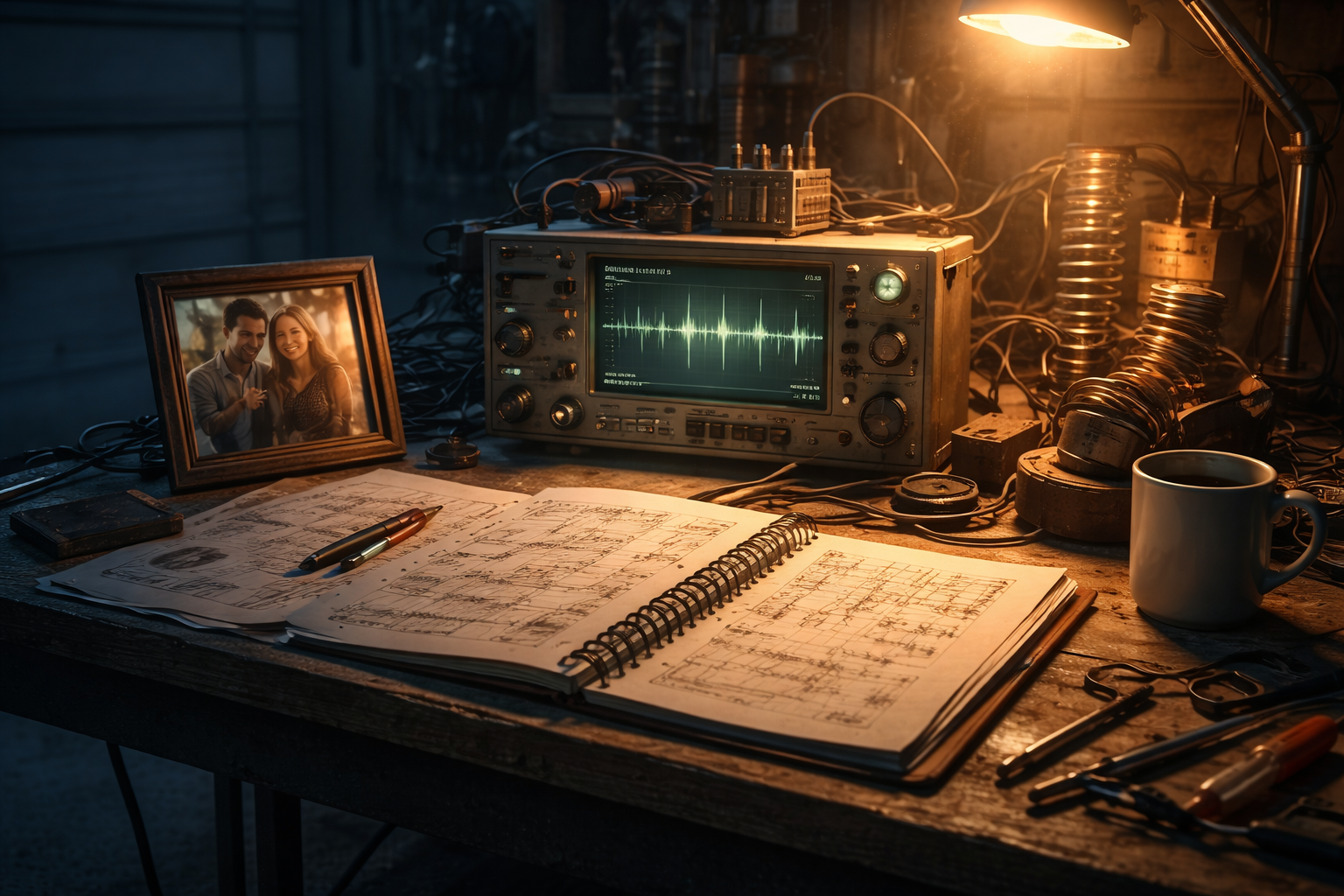

Chelsea braced one hand against Rowan’s tool chest and pulled the third drawer harder than she meant to. The steel runners gave with a scrape, sending a socket into the back corner where she could not reach it without removing the drawer completely. She left it there and found the masking tape beside three loose machine screws, an obsolete multimeter lead, two hex keys that belonged to different sets, and the brass shim stock Rowan had insisted would become useful eventually. Eight months earlier he would have heard the socket roll and accused her of abusing precision instruments, though the chest was older than their marriage and most of its dents were his.
Rowan kept masking tape in three places because designated storage, according to him, imposed a false hierarchy on adhesive. Chelsea had spent eleven years returning every wandering roll to this drawer. She tore off four lengths, labeled the cables on the temporary assembly occupying her bench and pressed each label flat with the side of her thumbnail. The cables already carried heat-shrink identifiers at both ends, and she could trace the circuit without them. She finished labeling anyway, then noticed that her handwriting had become smaller enough over the past several months to fit an entire component designation where she once would have abbreviated it.
Her side of the garage had continued changing after the accident because work demanded it. Components migrated, instruments were recalibrated, a power supply failed and was replaced. Colleagues borrowed equipment during the weeks Chelsea claimed she would be back at the office soon, then stopped asking for return dates when soon became a word everyone politely avoided. Rowan’s half remained largely as he had left it: his coffee mug on the shelf above the vise, a pencil chewed nearly through the lacquer beside an open notebook, an unfinished communications stabilizer beneath the dust cover Chelsea had made from an old pillowcase.
She had washed the mug once after the funeral. That had been worse than leaving it dirty, because the dishwasher removed the last coffee residue inside while failing to touch the permanent brown crescent near the rim. She had put it back on the shelf and disliked herself for the relief she felt when the stain remained.
Chelsea forced the tool drawer closed with her hip. The damaged runner resisted at its usual point before the latch caught.
The sound brought back the toaster.
They had owned the house for five days. Half the kitchen still lived in cardboard boxes, their mattress remained on the bedroom floor, and Chelsea wanted breakfast before another trip to the hardware store. Rowan decided that morning that the toaster’s browning control was defective.
“You know they sell these already assembled,” Chelsea said when she found him cross-legged on the tile with the toaster between his knees.
He shook several years’ worth of crumbs onto a sheet of newspaper. “That attitude is why civilization peaked before noon.”
“You’ve dismantled the only appliance in the house that can make breakfast.”
“We own a stove.”
“We also owned a toaster ten minutes ago.”
Rowan removed the base plate with one of the few screwdrivers they had unpacked. “Still do.”
Chelsea crouched beside him and found a loose contact before he did. Rowan spent twenty minutes proving that the contact could not account for the uneven cycle, another twenty establishing that he had been right about that portion of the diagnosis, and nearly an hour introducing a second fault while trying to improve the first. By the time the kitchen smelled faintly of overheated insulation, Chelsea took the screwdriver from his hand.
“I was using that.”
“You were converting breakfast into an insurance claim.”
“That seems disproportionate.”
“The counter is scorched.”
“The counter has character.”
She repaired the damage while Rowan sat beside her and offered increasingly unwanted suggestions. When she finally pushed the toaster back against the wall, he examined the bread lever, the control dial and the section he had nearly ruined.
“I want the record to show that we understand this machine substantially better than we did when it worked.”
“The record will show that you are banned from breakfast equipment.”
“You can’t enforce that.”
“I have the screwdriver.”
Rowan disappeared upstairs and returned six minutes later carrying another one over his shoulder like a ceremonial weapon. They ate cold bread for lunch and used the same toaster for nine more years.
Chelsea remembered that morning more easily than the wedding. Photographs had organized the wedding into an event she could retrieve at will: date, restaurant, guest list, the exact moment Rowan’s sister dropped her bouquet into a bowl of soup. The toaster lived somewhere less orderly. Sometimes it returned because Chelsea burned bread. Sometimes because she opened a drawer and found the wrong screwdriver. Once it returned during a budget meeting when a vice president used the phrase operational character, and Chelsea had needed several seconds before she could trust herself to speak.
Her phone vibrated against the workbench.
ISAAC BELLAMY filled the screen.
Chelsea had deleted his number twice and restored it both times because the absence of a name made his calls harder to ignore. She answered on the third vibration.
“Bellamy.”
“You called yesterday.” Paper moved near his microphone. Bellamy printed everything, including documents created electronically and stored in systems specifically designed to prevent people like him from printing them. During the accident review Chelsea had once seen his office floor covered with color-coded copies of the same wiring diagram.
“I left a message.”
“I found it beneath two others in which you asked me essentially the same question with different timestamps.”
“I found another discrepancy in the sensor log.”
“That makes three this month.”
“Channel four reports nominal at 14:07:18. The post-incident inspection shows the cooling loop was already outside tolerance.”
“I remember.”
“The controller should have opened the interlock.”
“It should have.”
Chelsea pulled Rowan’s timing-stabilizer cover halfway back while she spoke. Dust had gathered on the pillowcase seam but nowhere beneath it. “The log says it received a safe state.”
“Yes.”
“The physical system was unsafe.”
“Yes.”
Bellamy took a drink of something. Chelsea heard ice strike glass.
“So the controller received information that did not match the equipment.”
“That wording I’ll accept.”
“Where did the information come from?”
Bellamy sighed. “And there’s the part you keep trying to make me answer.”
Chelsea uncovered the stabilizer completely. Rowan’s board was densely populated along one edge and nearly empty along the other because he had changed the architecture midway through construction. Two blue jumper wires crossed where the latest schematic said they should not.
“I’m asking about possible mechanisms.”
“You’re asking which mechanism occurred.”
“I’m asking what can produce a safe-state input under those conditions.”
“Sensor failure. Wiring fault. Controller fault. Damage we can’t reconstruct because the discharge carbonized part of the board. Human intervention. Several combinations of those.”
Chelsea stopped with her fingers resting on the pillowcase. Bellamy rarely volunteered the last possibility so plainly.
“You considered deliberate bypass.”
“We considered every mechanism that could produce the recorded state.”
“And found no evidence sufficient to establish deliberate bypass.”
“That sentence is in the report because it remains true.”
“Rowan complained about nuisance trips.”
“I know.”
“He thought the threshold was too conservative.”
“I know that too.”
“He also knew what the interlock protected.”
Bellamy’s chair creaked. “People know what safety systems are for and still make mistakes around them. People also blame operators after hardware failures because dead operators can’t answer questions. I had no basis for doing either.”
Chelsea walked to the end of Rowan’s bench. The shallow saw groove near the vise caught her fingertip, an old mark from a shelving project that had cost them three boards and most of a Saturday. Rowan had blamed the saw. Chelsea had blamed Rowan’s refusal to clamp the wood properly. Neither had changed position after lunch.
“If you believed he bypassed it, would you tell me?”
“I would tell you if the evidence justified saying it. I’d also tell you if the evidence proved the controller failed independently. It proves neither.”
“Eight months of review should have narrowed it further.”
“Time doesn’t repair burned circuitry.”
Chelsea disliked the answer partly because Bellamy had already given it to her in March. Repetition had not weakened it.
“I want the original channel-four export again.”
“I sent it last month.”
“That was a converted copy.”
“You accused the conversion of changing a forty-millisecond discontinuity.”
“I said I wanted to eliminate the possibility.”
“I remember the distinction you made.”
There was dry amusement in his voice now, which belonged more to Bellamy than the patient investigator Chelsea kept turning him into when she replayed these conversations later. He was fifty-six, chronically unimpressed by certainty, and willing to spend twenty minutes arguing over a file format because somebody might cite him afterward.
“I’ll send the original,” he said. “Then I am going to dinner with my daughter, and you are going to do something unrelated to accident reconstruction for at least one hour.”
“You don’t have jurisdiction over my evening.”
“Good. I’d hate the paperwork.”
The line went dead a moment later.
Chelsea remained by Rowan’s bench with the phone in her hand. Bellamy had ended calls first only twice during the investigation. She considered calling back to ask whether the original export included the pre-fault checksum, then put the phone face down instead.
Rowan’s unfinished stabilizer occupied most of the cleared space before her. Its purpose had been ordinary by his standards: detect timing drift across distributed transmitters and correct the phase relationship before accumulated error damaged the signal. Chelsea had read all three of his project notebooks after the funeral. She told Mari she was cataloguing Rowan’s work for insurance and intellectual-property questions, which had been true for perhaps the first forty pages.
She opened the nearest notebook.
Rowan’s handwriting deteriorated whenever he became interested enough to resent the act of recording what he was doing. The first pages were tidy. By the middle, component values climbed diagonally into margins and timing calculations continued upside down when he ran out of room. Beside an abandoned oscillator design he had written GOOD ENOUGH FOR GOVERNMENT WORK, crossed out GOVERNMENT, and replaced it with NOBODY.
Several pages later, beneath measurements showing progressive phase drift, he had written:
If you can measure it, you can address it.
Chelsea had mocked the sentence while he was alive. Rowan applied it to unstable oscillators, the leak beneath their upstairs sink and once, disastrously, to a disagreement with his sister. During dinner afterward, Chelsea had told him human beings were not addressable systems. Rowan spent the rest of the meal attempting to demonstrate otherwise with the restaurant pager until she threatened to leave him with the check.
Now she turned the page and examined the timing architecture again.
The stabilizer sampled noisy input repeatedly, compared successive intervals and searched for structure that persisted when transient variation fell away. Nothing in the mathematics was exotic. Communications systems had been extracting useful information from noise for generations.
Chelsea’s temporary assembly on the other bench used several of the same principles for an isolation problem at work. Temperature sensors, electromagnetic monitoring and vibration pickup fed into a receiver stage she had added sometime after lunch.
She could not remember deciding to add it.
That bothered her more than the circuit itself.
Chelsea crossed to her bench and opened the work log. The morning entries documented the original isolation test. At 13:40 she had recorded a calibration change. At 14:05 the notes resumed with the added receiver already present, as though the forty minutes between required no explanation.
She examined the hardware. Every connection was sound. The additional stage did exactly what she would have designed it to do if somebody had given her the requirement: search low-amplitude noise for recurring structure and reject transient events.
The requirement existed nowhere in the log.
Chelsea opened a drawer and took out a fresh laboratory notebook. The stiff binding resisted until she pressed the first page flat against the bench. She entered the date and time, then wrote one heading and crossed it out. The second lasted longer before she struck through that as well.
Her third choice remained on the page.
PERSISTENCE TEST — BASELINE
Chelsea set Rowan’s notebook beside her own. She removed the microphone she had almost connected without documenting it, put it back in the parts drawer and began stripping the circuit down to components whose behavior she could account for.
By the time she finished, the garage had gone dark beyond the workbench lamps.
The receiver remained.
Chelsea left it there.
©2023 Rhyan Scorpio-Rhys


Leave a Reply