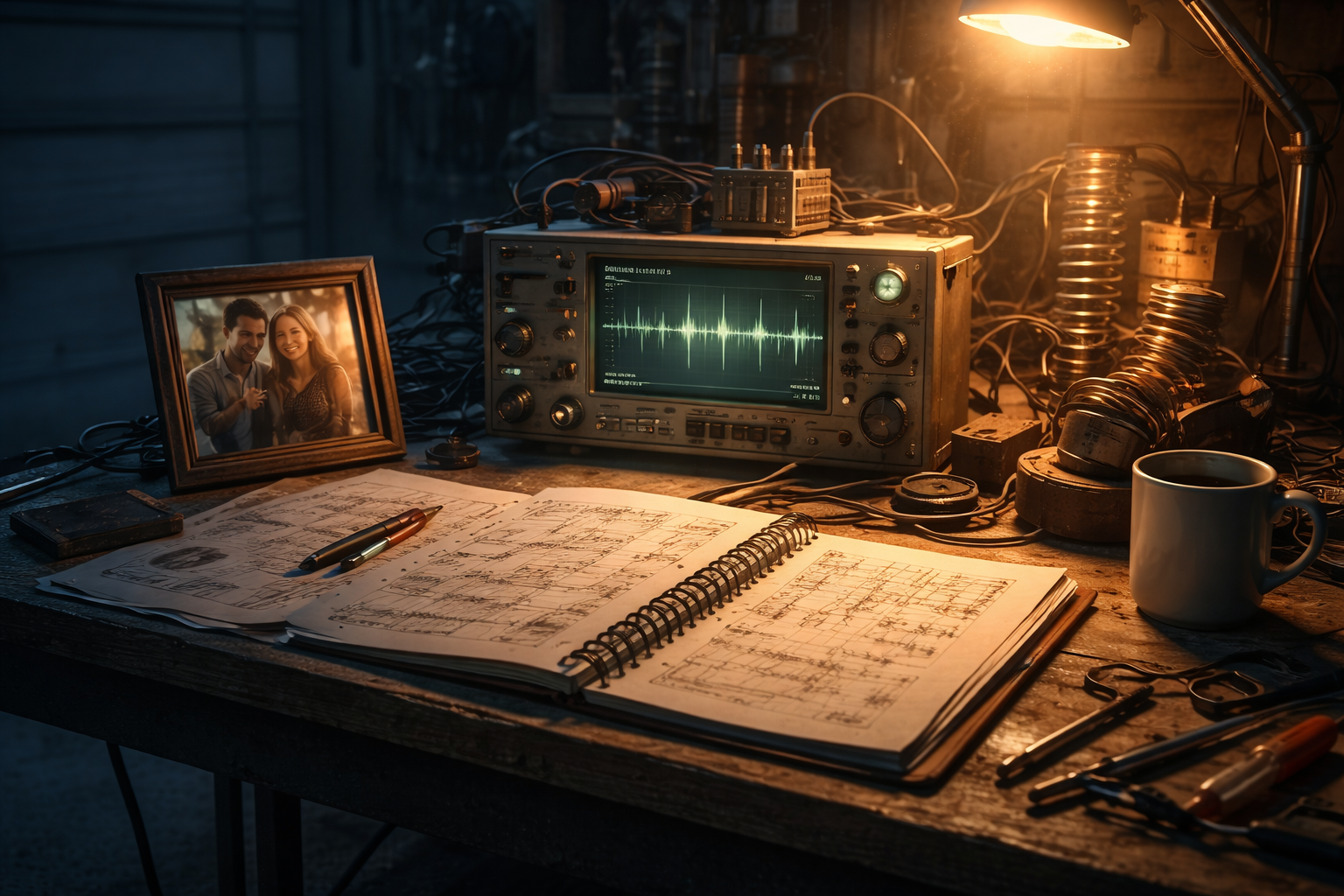

Chelsea spent the next four evenings proving that her equipment could detect the house.
The furnace announced itself as a broad electromagnetic rise followed by vibration through the garage slab. The refrigerator registered faintly on one sensor and strongly on another because Rowan had once run conduit along the shared wall rather than through the route shown on the original electrical plans. Passing vehicles produced low-frequency disturbances that varied with weight and speed. At 2:13 each morning, a short radio-frequency burst appeared near the same part of the spectrum. Chelsea traced it on the third night to the neighbor’s irrigation controller after carrying a portable analyzer into the backyard in slippers and waiting beside the fence while someone’s motion-sensitive porch light repeatedly illuminated her.
The neighbor came outside on the fourth cycle.
“Everything okay?”
Chelsea stood in wet grass holding an analyzer connected to a directional antenna. “Your sprinkler timer is noisy.”
He studied her equipment, then the dark yard beyond her. “Is that bad?”
“For me, currently.”
“Should I turn it off?”
“It runs for eleven seconds.”
“Okay.”
Chelsea waited for him to ask more. He scratched his bare shoulder, apparently decided against it and returned inside.
Rowan would have found the exchange delightful. He once spent six weeks exchanging increasingly elaborate notes with that same neighbor about a tree branch that crossed the property line. The dispute began with a polite request, moved through a drawing of the branch’s projected growth radius, and ended when Rowan attached a tiny paper flag to the offending limb reading INTERNATIONAL INCIDENT. The neighbor cut it the next morning and left the flag in their mailbox.
Chelsea still had it somewhere.
She returned to the garage and logged the irrigation burst.
By Sunday afternoon she had reduced the receiver’s sensitivity enough that most of the house disappeared from its output. The furnace still registered when the blower started, though now at a level she could exclude reliably. A delivery truck on the street produced a recognizable vibration signature. The garage-door motor created so much interference that Chelsea stopped using it during test windows and entered through the kitchen instead. The remaining noise was sparse enough to study without pretending ordinary household equipment had developed opinions.
Mari arrived shortly after six carrying a paper sack and talking before she reached the garage.
“I have spent forty-seven minutes in traffic because a delivery van attempted to occupy two lanes while reversing uphill, and if you tell me transportation systems are statistically safer than they feel, I’m leaving with your dinner.”
Chelsea remained bent over the receiver. “I wasn’t going to tell you that.”
“You were thinking it.”
“I was thinking that reversing uphill changes the problem.”
Mari came through the door. “See? This is why normal people have friends who sell real estate.”
She wore jeans, a navy sweater and the silver resistor earrings Chelsea had given her thirteen years earlier after Mari complained that every piece of science-themed jewelry marketed to women involved atoms, DNA helices or equations nobody had checked. One earring had lost part of its enamel. Mari had been saying she would repair it for almost a year.
She put the food on the clear end of the bench and inspected Chelsea’s assembly. “This is larger than the isolation test you described on Thursday.”
“It changed.”
“Into what?”
“I’m characterizing persistent structure in low-amplitude noise.”
Mari removed two burritos, a container of rice and a bag of tortilla chips. “You understand that sentence sounds much more innocent to you than it does to me.”
Chelsea unplugged a probe and rewound its cable. “It is innocent.”
“Wonderful. Eat while it still has that quality.”
Mari shifted Rowan’s old coffee mug away from the food and took the stool beside Chelsea’s bench. She knew the garage well enough to move around it without asking permission, though she had stopped opening Rowan’s drawers after the funeral. Chelsea had never requested that courtesy. Mari had simply noticed where Chelsea’s tolerance ended and stayed on her side of it.
Chelsea unwrapped one burrito because refusing would prolong the visit.
Mari opened the rice. “My department chair has started using the phrase innovation ecosystem.”
“That should be reportable.”
“I considered filing a workplace-harassment complaint.”
“On what grounds?”
“He also said ideation pipeline.”
Chelsea took a bite.
“There,” Mari said. “That expression. I have restored human feeling.”
“You’ve restored indigestion.”
“I’ll take what I can get.”
The ordinary conversation lasted another few minutes before Mari returned to the apparatus. She leaned close enough to read Chelsea’s latest labels but kept her hands off the controls.
“What are you hoping persists?”
Chelsea continued eating.
Mari waited through several seconds, then opened the bag of chips. “I’m capable of waiting, but I want you to know I brought snacks.”
“I’m looking for structure that survives changes in environmental conditions.”
“That answers how.”
“It answers what.”
“It answers what your equipment is doing. I asked what you hope is doing it.”
Chelsea folded the foil farther down the burrito. “Hope is a variable I’m trying to remove.”
Mari chewed thoughtfully. “That sentence should concern you more than it seems to.”
Chelsea put the burrito down. “I need a blind control.”
“Ah. We’ve reached the part where friendship becomes unpaid laboratory labor.”
“I can generate challenge sequences and seal them before testing, but if I generate and select them myself, there is too much opportunity for contamination. I need someone else to hold and choose them.”
“Someone gullible.”
“Someone who understands procedure.”
Mari considered this while reaching for another chip. “Very flattering recovery. What do I have to do?”
Chelsea had prepared twelve envelopes.
Mari read the protocol before agreeing. She asked two questions Chelsea had not anticipated, including whether the order of challenge selection could itself create a bias if Chelsea knew how many envelopes remained. They changed the procedure accordingly. Mari would shuffle the stack again at home, number them using a sequence Chelsea never saw and text only the identifier needed for each session.
“You understand I’m taking these because I would rather be involved than find out later you’ve been doing this alone at three in the morning.”
“That isn’t a methodological requirement.”
“I have interests outside methodology.”
Chelsea photographed each signed seal before Mari packed the envelopes into the grocery bag she had brought. The bag still smelled faintly of onions.
For the first three nights, the procedure produced nothing worth preserving.
The first selected challenge generated scattered pulses that matched none of the assigned intervals. Chelsea spent an hour checking for interference before accepting the obvious result.
The second produced no threshold crossings at all.
On the third night, two pulses appeared during a heating cycle. Chelsea rejected the session before the envelope was opened and rescheduled the trial. Mari came over anyway because she had already left home and wanted the tea Chelsea had once promised existed in the kitchen.
“You realize,” Mari said while searching a cabinet, “that every time this fails, I become slightly happier.”
Chelsea opened the correct cupboard above her. “You’re cheering against my experiment.”
“I’m cheering for your garage to remain boring.”
“It has never been boring.”
“Your garage once contained a six-week argument about whether Rowan’s homemade battery charger technically violated the fire code.”
“It did violate the fire code.”
“Then I rest my case.”
Chelsea found the tea.
Mari found a tin of crackers that expired eighteen months earlier and placed them in the trash before Chelsea could argue.
The fourth night stayed electrically dull.
Chelsea entered the garage at ten, verified the dedicated supply and checked the camera view. The receiver output had been simplified to a single amber LED. A threshold crossing would illuminate the light while the logger captured duration and spacing. She had removed enough interpretive layers that the apparatus could do very little besides say something happened.
At 10:02:14, it did.
Three flashes appeared in succession.
Chelsea entered the timestamp and kept both hands visible to the camera. The intervals were close enough to equal that she marked them as a sequence.
The LED remained dark for a little over four seconds, then flashed five times.
Chelsea’s pencil stopped against the paper.
She checked the raw sensor channels before doing anything else. Temperature held. Vibration remained below threshold. The electromagnetic trace contained no spike large enough to explain the receiver behavior. She widened the display scale and searched for a smaller event she might have missed. Nothing aligned with the sequence.
At 10:03:01, two irregular flashes appeared. Chelsea marked them as noise. The remaining session passed without another threshold event.
When the timer reached ten minutes, she closed the gate, powered down the generator and reviewed the recording. The three-pause-five sequence remained visible on playback. She checked the house power monitor and the outdoor camera, then compared every sensor timestamp against the event.
The result survived the first pass.
Chelsea called Mari.
“I need envelope seven.”
“Now?”
“Yes.”
There was movement on Mari’s end, followed by what sounded like a cupboard closing. “I am wearing pajamas with lemons on them.”
“I don’t care what you’re wearing.”
“I care. They’re humiliating.”
“You bought them.”
“They were on sale. I’ll be there in twenty.”
Mari arrived twenty-six minutes later in a raincoat buttoned to the throat. Chelsea did not ask what was underneath it.
“You may laugh once,” Mari said as she entered the kitchen. “After that, the experiment loses independent oversight.”
Chelsea cleared a space on the table. “Give me the envelope.”
Mari removed it from an inside pocket. “That tone earns you no pajama privileges.”
The seal matched Chelsea’s photograph, including the slight smear in the final stroke of Mari’s signature. Chelsea checked it anyway and passed over the small kitchen knife.
Mari cut the flap and unfolded the index card inside.
Her eyebrows rose.
Chelsea reached across the table before Mari could put the card down.
3 pulses / 4-second interval / 5 pulses
The session log recorded 4.18 seconds between the groups. Chelsea had set the acceptable tolerance at half a second before the trial.
Mari pulled out a chair and sat heavily. “All right.”
Chelsea retrieved the video.
“I don’t need to see it yet.”
“I want you to verify the timestamps.”
“I believe you recorded what you say you recorded.”
“I want you to verify them anyway.”
Mari took the laptop. “You become deeply annoying when frightened.”
Chelsea almost corrected the adjective and stopped herself.
Mari noticed.
“Interesting.”
“What?”
“You decided not to argue.”
“There is nothing to argue about.”
“Also interesting.”
They reviewed the footage together. Mari checked the session timer against the recording and compared Chelsea’s written log to the camera timestamps. She asked whether a hidden diagnostic process could generate a test sequence. Chelsea showed her the firmware. Mari suggested coupling from another device. Chelsea brought out the house monitor.
By midnight they had assembled several explanations and eliminated none conclusively.
That irritated Chelsea less than the card on the table.
Mari finally shut the laptop. “You’re done tonight.”
“I need to inspect the receiver while the configuration is unchanged.”
“You can photograph the configuration and inspect it tomorrow.”
“Temperature drift can alter—”
“Chelsea, if the answer to everything is one more test, there is no stopping rule.”
Mari said it plainly, without the precision she used when discussing actual laboratory work. Chelsea heard fatigue underneath it and something else she did not want to identify while sitting beside a challenge card that had just done something impossible.
She photographed the apparatus and shut down the remaining equipment.
Mari stayed another half hour because the rain had become heavy and because neither woman admitted that this was why she stayed. She told Chelsea about a graduate student who had managed to contaminate an entire microscopy run with glitter from a birthday card. The story went on too long, involved two technicians Chelsea had never met and ended without much of a punch line. Chelsea listened anyway.
After Mari left, the house seemed noticeably emptier.
Chelsea returned to the garage to enter the result in her notebook. She listed plausible sources of error until the page began sounding argumentative: unknown interference, equipment fault, procedural contamination, coincidence, challenge-generation bias. She stopped before adding another.
Across the room, Rowan’s timing stabilizer remained beneath its dust cover.
Chelsea removed the cover and opened his notebook to the phase-drift calculations. His sentence curved around the timing diagram in the margin.
If you can measure it, you can address it.
She closed the notebook again.
The receiver was still connected.
Chelsea started a fresh recording and opened the noise gate. She listened to the ordinary electrical output for nearly twenty seconds before moving the microphone closer.
“Rowan Knepper,” she said. “If there is a repeatable signal associated with that name, respond once.”
The amber LED remained dark long enough for Chelsea to feel foolish.
Then it flashed.
©2023 Rhyan Scorpio-Rhys


Leave a Reply