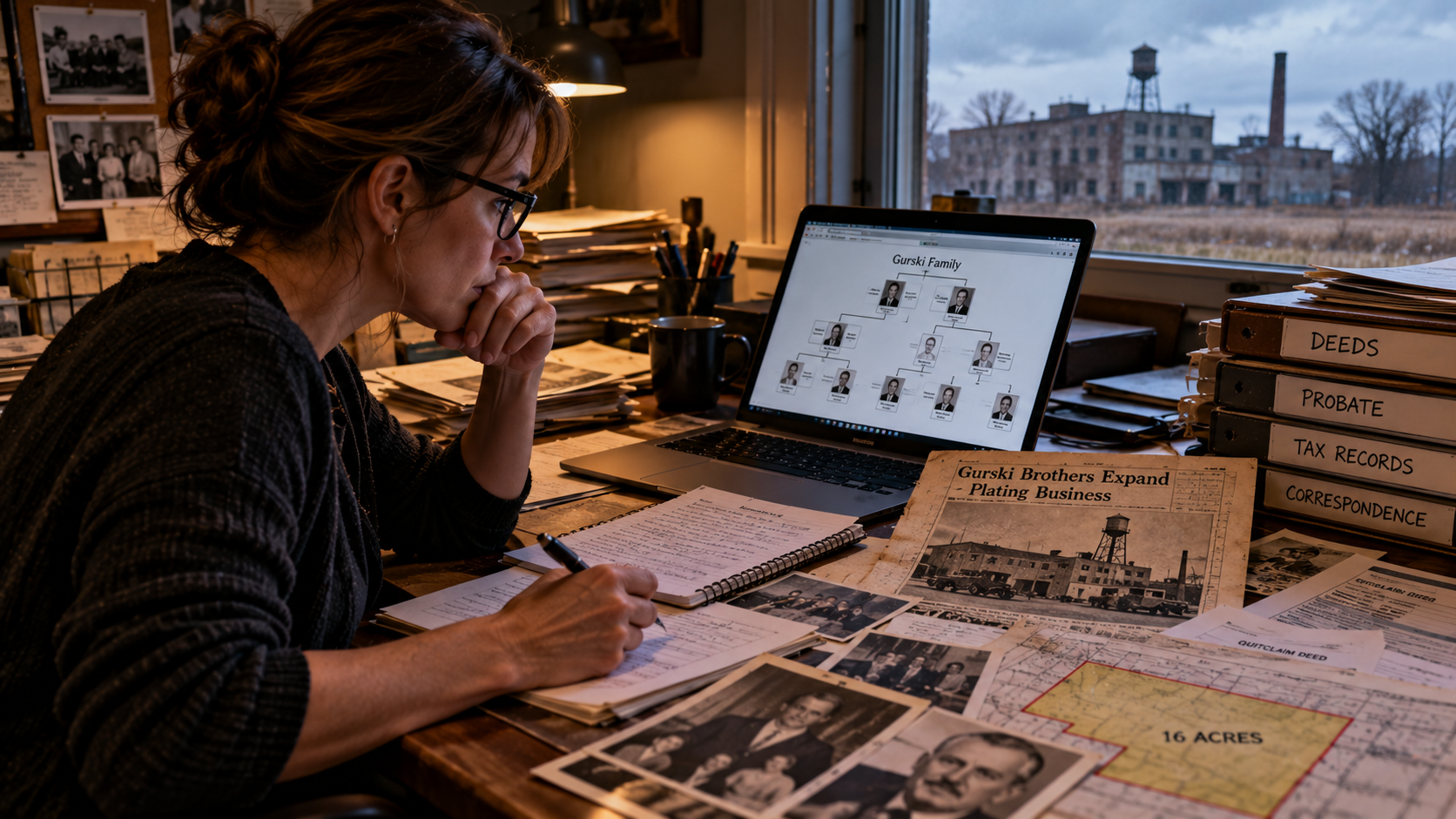


Monica Szarek found the first living descendant before lunch and the seventh before anybody told her the land might be poisoned.
The assignment arrived from Kelton Title Curative with forty-three pages of deed copies, probate indexes, tax-sale records, and a one-page instruction sheet describing the work as an heirship cleanup. A developer wanted sixteen acres outside New Castle for a warehouse and cold-storage complex. The county redevelopment authority could convey most of the tract, but its title insurer objected to an interest that might have survived a defective tax sale more than thirty years earlier.
Monica had handled worse.
Her work rarely resembled the genealogy people performed for television programs. Nobody cried over sepia photographs while a piano played. Monica spent her days reading death certificates, obituaries, marriage notices, assessment cards, docket sheets, cemetery records, and social-media pages belonging to people who posted enough birthday photographs to reconstruct an entire family without realizing it. She found missing owners, heirs, former spouses, dissolved partnerships, and whoever inherited the legal fragment everybody else wanted removed from a title report.
The New Castle file began with Raymond Gurski.
Raymond and his brother Stanley bought the industrial tract in 1961, each holding an undivided half interest. Stanley conveyed his share to the operating company years later. Raymond never did. The plating business failed in the 1980s, Raymond died in 1987, and the county eventually sold the property for unpaid taxes.
The tax sale should have ended the problem.
The title insurer disagreed.
Notice went to Raymond at an address where he no longer lived. His estate had never been opened for the industrial parcel. No proof in the tax file established that his heirs received statutory notice. Subsequent transactions carried the same exception forward until everyone treated the county as owner while the unresolved half interest remained buried in schedules nobody wanted to litigate.
Kelton’s client preferred signatures to litigation.
Each verified descendant would receive seven hundred fifty dollars for executing a quitclaim deed and heirship affidavit. The documents made no promise that an heir actually owned anything. They simply conveyed whatever interest, if any, had descended through Raymond Gurski.
Monica had done dozens of those.
She built Raymond’s family from the obituary first. Two daughters. One son who died without children.
The older daughter had three children. The younger had two. One grandchild died young but left a daughter. Another moved to Arizona and disappeared from the family’s online trail after a divorce. By ten thirty, Monica had a spreadsheet with names, dates of birth, death dates, marriages, addresses, and confidence levels.
At eleven twelve she called Marla Sedor in Erie.
“Mrs. Sedor, my name is Monica Szarek. I’m doing title research involving property that may have descended through your grandfather, Raymond Gurski.”
Silence followed.
“My grandfather?”
“Raymond Gurski.”
“He died when I was a kid.”
“Yes, ma’am. I’m calling about an old real-estate interest in Lawrence County.”
Marla laughed softly. “If Grandpa owned something valuable, everybody missed the memo.”
Monica had heard versions of that response many times.
“A redevelopment transaction has brought up a possible inherited interest. The buyer is offering compensation for a quitclaim deed so the title can be cleared.”
“How much compensation?”
“Seven hundred fifty dollars.”
“That answers the valuable part.”
Monica smiled despite herself. “The paperwork will explain that the amount is consideration for releasing any interest you may have. It doesn’t establish that you definitely own part of the property.”
“What property?”
Monica read the parcel description and gave the road.
Marla went quiet again.
“That old factory?”
“You know it?”
“My mother called it the chrome place. We weren’t allowed near it when we visited my aunt.”
“Do you know anything about your grandfather’s ownership?”
“Only that he and Uncle Stanley fought over something before Grandpa died.”
Monica entered that into her notes.
Marla asked, “If I sign this, I’m not taking ownership of anything, right?”
Monica used the wording Kelton required.
“The deed conveys any possible interest away from you. I can explain the purpose of the documents, but I can’t give legal advice about their effect on your individual rights. The package includes a recommendation that you consult your own attorney if you have questions.”
“That means nobody actually does.”
“I can’t speak for other people.”
Marla laughed again. “At least you’re honest.”
Monica took down her email address.
Todd Kmetz was easier.
He lived outside Youngstown and wanted to know whether the seven hundred fifty dollars would be taxed. Monica told him to ask a tax professional. He asked whether everyone received the same amount. She confirmed the offer was uniform. He supplied his email before she finished explaining the heirship affidavit.
The third descendant, Phyllis Goral, refused immediately.
“I don’t sign things about property I’ve never seen.”
“That’s perfectly fine.”
“You people always say that until the letters start.”
“There’s no requirement that you sign.”
“What happens if I don’t?”
“The title exception remains unresolved as to whatever interest you may have.”
“Then leave it unresolved.”
Monica marked Phyllis DECLINED — NO FURTHER CONTACT WITHOUT CLIENT INSTRUCTION.
By four, she had reached six descendants and confirmed contact information for another. Two agreed to receive documents. One declined. Three wanted paper copies before discussing anything further.
A routine day.
The environmental report arrived the following morning because someone copied the wrong distribution list.
Monica almost deleted it.
The subject line read GURSKI TRACT — PHASE II SUMMARY / CLIENT REVIEW, and the attachment belonged to the developer’s due-diligence file. She recognized the parcel number from her heirship assignment.
Monica opened the email only far enough to determine whether it affected her work.
Three minutes later, she printed the executive summary.
The former plant had operated metal-finishing and electroplating lines for decades. Sampling identified chromium, nickel, chlorinated solvents, and other contaminants in soil and groundwater. A solvent plume extended beyond the central building footprint. Several monitoring points showed concentrations requiring further investigation, and the consultant recommended additional delineation before acquisition.
The abandoned structures had problems of their own. Roof failure. Open floor penetrations. A partially collapsed annex. Unsecured areas despite fencing.
The estimated remediation costs were not final. The preliminary range began well above the projected land value.
Monica reopened her instruction sheet.
Obtain heirship affidavits and quitclaim deeds from all verified descendants. Consideration: $750 per executed package.
Nothing mentioned contamination.
She called her project contact at Kelton.
Arden Vesely answered while eating something crunchy.
“I think I got copied on an environmental report by mistake.”
“For Gurski?”
“Yes.”
“Delete it.”
“Does the client still want signatures?”
“As far as I know.”
“The heirs know what the site is?”
“They’re quitclaiming out.”
“That wasn’t my question.”
Arden stopped chewing.
“What exactly are you asking?”
“Are we disclosing the environmental condition before they sign?”
“We don’t provide property-condition representations. Our letter already says they may have an interest and should get independent counsel.”
“One woman asked me directly whether signing meant she wasn’t taking ownership.”
“And you gave the script?”
“Yes.”
“Then you handled it correctly.”
Monica looked at the report.
“What happens if the developer walks?”
“Why would they walk?”
“Have you read this?”
“No.”
“The cleanup estimate is ugly.”
Arden sighed. “Monica, we’re title researchers. Environmental diligence belongs to the buyer.”
“The people I’m calling may already own part of it.”
“They may hold a title interest. That’s why we’re curing it.”
“And we’re paying them to sign something.”
“Yes. That’s generally how consideration works.”
Monica disliked his tone because it made her question sound naive when she knew it was not.
“Hold my outbound packages until I talk to counsel.”
“You don’t need counsel.”
“I want the effect of these documents confirmed.”
“Kelton’s counsel drafted them.”
“Good. He can answer quickly.”
Arden told her to email the question.
Monica did.
The response came at 1:17 p.m. from Howard Laska, outside counsel for the title-curative firm.
He answered carefully.
An heir who possessed a potential inherited interest could, under Pennsylvania law, have disclaimer rights depending upon the facts. A valid disclaimer made before acceptance could relate back to the decedent’s death. Certain actions could constitute acceptance, including a conveyance or a contract to convey. Whether the Kelton documents would bar a later disclaimer depended on the circumstances and was not a question Monica should answer for any heir.
She read the message again more slowly. Then she opened Pennsylvania’s disclaimer statute herself.
The language was plain enough in the section that mattered. Acceptance could be express. It could also be inferred. Taking possession. Written waiver. Assignment. Conveyance. A contract to transfer. A representation that the interest had been or would be accepted when someone relied on it.
Monica printed that page too.
At two thirty, Marla Sedor called.
“I got the documents.”
Monica closed the statute window.
“All right.”
“This says I’m one of Raymond Gurski’s heirs.”
“The affidavit states the family relationship we documented.”
“And the deed says I quitclaim my interest.”
“Yes.”
“What if I don’t have an interest?”
“Then the deed conveys whatever you have, including none.”
Marla shuffled paper near the phone.
“Why does the buyer need all this if the county owns the property?”
“The title company found a defect in the old tax-sale chain.”
“You said that yesterday.”
“Yes.”
“What you didn’t say is the place is contaminated.”
Monica sat straighter.
“Where did you hear that?”
“My brother searched the address.”
Public records. Old news coverage. Environmental filings.
The information had never been secret.
Marla continued. “He found something about groundwater.”
“The property does have documented environmental issues.”
“That sounds like an important sentence to leave out.”
“I learned more about the current investigation this morning.”
“Would you have told me if I hadn’t called?”
Monica looked at the instruction sheet.
“Yes.”
She knew immediately that the answer committed her to more than a conversation.
Marla asked, “Am I responsible for that place?”
“I can’t tell you.”
“Can anybody at your company?”
“I can give you the name of counsel, but he represents our company and the transaction. You need someone who represents you.”
“I’m supposed to hire a lawyer over seven hundred fifty dollars?”
“That may be the sensible thing to do before signing.”
Marla stopped shuffling the papers.
“You’re not very good at selling this.”
“I’m not selling it.”
The call ended with Marla promising nothing.
Monica contacted every heir who had received documents and told them the redevelopment parcel had documented environmental contamination. She stayed within facts she could verify. She recommended independent legal advice before anyone executed the package.
Todd Kmetz had already signed.
A mobile notary met him that morning.
He had also deposited the electronic payment.
“What does that mean?” he asked.
“It means you signed the quitclaim and affidavit.”
“I understand that part. Does it mean I own the factory?”
“I can’t answer that for you.”
“You called me.”
“Yes.”
“You told me they were paying me to give up whatever piece I might have.”
“That’s what the transaction was designed to do.”
“Was?”
Monica heard herself use the past tense.
“The developer is still conducting due diligence.”
“You’re making this sound worse every thirty seconds.”
“I’m trying to give you information I didn’t have yesterday.”
Todd’s voice hardened. “Then why were you calling people yesterday?”
She had no answer that would improve the conversation.
Todd asked for Howard Laska’s number.
Monica gave it to him.
By five, Arden Vesely knew what she had done.
He came into her office carrying no paperwork, which usually meant the conversation itself was the document he intended to create afterward.
“You stopped outreach.”
“I paused signature solicitation.”
“You called people who were already contacted and introduced an issue outside our scope.”
“It affects what they’re signing.”
“They are conveying away a possible inherited interest. Environmental liability belongs with counsel.”
“Exactly.”
Arden shut the door.
“Then let counsel handle it.”
“Counsel wasn’t talking to them.”
“The letter tells them to obtain counsel.”
“After offering seven hundred fifty dollars for a document our own lawyer says could affect disclaimer rights.”
Arden sat across from her desk. “You are drifting into legal advice.”
“I told them to get legal advice.”
“You characterized the property.”
“I told them it has documented contamination.”
“You received that report accidentally.”
“The contamination is also public.”
“That doesn’t make you authorized to discuss the buyer’s due diligence.”
Monica pushed Howard’s email toward him.
“Are these people potentially giving up a right to disclaim?”
Arden did not read the page.
“That depends on their circumstances.”
“Then the answer was important before we mailed deeds.”
“Our job is to clear title.”
Monica looked at the family chart hanging beside her monitor.
Seven living descendants confirmed.
Four more probable.
Two lines still incomplete.
The chart had seemed like progress yesterday.
“Put me off the assignment,” she said.
“I might have to.”
“Good.”
Arden left without taking Howard’s email.
The developer terminated the acquisition agreement three days later.
The Phase II work did not establish a final cleanup cost, but it established enough. The planned warehouse required extensive subsurface work, stormwater construction, utilities, and foundation excavation through areas the consultant did not consider sufficiently characterized. The developer exercised its due-diligence termination right.
Kelton stopped all title-curative work.
The deeds already signed by Todd Kmetz and two other heirs were never recorded.
Their option agreements and heirship affidavits remained executed.
Marla never signed.
Neither did Phyllis.
Monica received the termination notice at 8:06 Monday morning.
Todd called at 8:19.
“My lawyer says I may have screwed myself.”
Monica closed her office door.
“What did he tell you?”
“That I might have been able to disclaim this thing before I signed your papers.”
“I’m sorry.”
“He says signing the agreement could count as accepting the inheritance.”
“That is one of the issues I raised with our counsel.”
“After I signed.”
“Yes.”
Todd breathed into the phone for several seconds.
“What happens now?”
“I can’t give you that answer.”
“Can your company undo it?”
“I don’t know.”
“You sent the documents.”
“Yes.”
“You sent the money.”
“The client funded the payment through Kelton.”
“I don’t care whose checking account it came from.”
Monica had nothing useful to offer him.
Todd’s lawyer had already advised him to return the money and preserve every document. He was evaluating whether the quitclaim and agreement could be rescinded, whether acceptance had occurred, whether a disclaimer remained available, and what environmental protections might apply to an inherited interest.
Todd kept returning to one question.
“How can I inherit a factory from a man who died when I was six?”
Monica explained that the old interest might have descended through his mother before reaching him.
“That’s worse.”
“I know.”
“No, you deal with this all day. You don’t know what this sounds like when somebody calls and tells you your dead mother might have left you part of a poisoned building.”
Monica accepted the correction.
The municipality entered the story on Wednesday.
Marla called first.
“I got a certified letter from Baines Township.”
Monica put down the title abstract she was reviewing for another job.
“What does it say?”
“It says I’m a possible owner or party in interest and they’re inspecting the site for code violations.”
“Does it order you to do anything?”
“Not yet. It says they’re updating responsible-party records.”
“How did they get your name?”
“I was hoping you could tell me.”
Monica opened the Gurski file.
The redevelopment authority had obtained Kelton’s heirship chart as part of the title-curative package. Once the development agreement died, the authority still possessed the research identifying descendants associated with the unresolved ownership exception.
The chart did not create their property interests.
It made the people behind those interests findable.
That difference felt academic when certified mail reached their homes.
Monica contacted the redevelopment authority and learned that the township had requested the title materials because the abandoned plant’s roof deteriorated further during a recent storm. Officials wanted every potentially responsible owner or claimant identified before issuing formal notices.
Nobody had been billed for cleanup. Nobody had been ordered to remediate groundwater. No agency had declared the located heirs personally liable for environmental costs.
The problem remained less dramatic and more durable than that.
Their names now existed inside the property’s active administrative life.
Marla called again that evening.
“My attorney says I can probably disclaim because I never signed anything.”
“That’s good.”
“He says Pennsylvania doesn’t make me lose the right just because I found out about the property.”
“Yes.”
“He also says I should do it properly and record the disclaimer because real estate is involved.”
Monica wrote the information down although she already knew the statute.
Marla continued. “My cousin Todd may not be able to.”
“I know.”
“You people paid him to make himself an owner.”
Monica chose her answer carefully.
“We paid him for a conveyance of whatever interest he already possessed. The problem is that executing the conveyance may affect whether he can now disclaim that inherited interest.”
“That sounds like the lawyer version.”
“It’s the accurate version.”
“It still leaves him with the factory.”
“His attorney is working on that.”
Marla became quiet.
“Are you still finding people?”
“No.”
“Good.”
The next probable heir on Monica’s chart was Maribeth Ulan, thirty-nine, living in Grand Rapids. She descended from Raymond’s younger daughter through a son who died in 2014. Monica had already verified the family line and located her address, but the first letter had not gone out before she suspended outreach.
A mobile-notary request remained in the canceled work queue anyway.
Monica checked the timestamp.
It had been created Friday morning, before the developer terminated, by an automated workflow that generated signing appointments once an heir’s identity score passed the firm’s verification threshold. Maribeth’s contact package had apparently advanced farther than Monica realized.
The appointment was scheduled for Thursday at six.
Monica called the notary vendor and canceled it.
Then she called Maribeth.
The woman answered from somewhere noisy.
“Hello?”
“Ms. Ulan, my name is Monica Szarek. I’m a title researcher in Pennsylvania. I’m calling about an old property interest that may have descended through your great-grandfather, Raymond Gurski.”
“That sounds like spam.”
“Fair.”
“Do I owe somebody money?”
“I don’t know.”
That stopped her.
“What kind of property?”
“Former industrial land near New Castle. There’s an unresolved title issue, and our firm was retained to locate descendants.”
“Why?”
“A developer intended to acquire the site. That deal has ended.”
“So why are you calling me?”
“Because a signing appointment was generated before the project stopped. I canceled it. If anyone contacts you asking you to sign an heirship affidavit, quitclaim deed, option agreement, or anything else concerning that property, I recommend you speak with a Pennsylvania attorney who represents you before signing.”
Maribeth moved away from the noise at her end.
“What’s wrong with the property?”
“It’s a former metal-plating site with documented environmental contamination and serious building deterioration.”
A long silence followed.
“My mother never owned property in Pennsylvania.”
“There may be an interest that came through her family without anybody administering it.”
“How much is it worth?”
“I don’t have a valuation.”
“Is that the careful answer?”
“Yes.”
“What’s the uncareful answer?”
Monica looked at the Phase II summary.
“The last buyer walked away.”
Maribeth thanked her for calling.
Nobody from Kelton had authorized the conversation.
Monica documented it anyway.
Arden appeared in her doorway fifteen minutes later.
“You contacted Ulan.”
“Yes.”
“After the client terminated us.”
“A notary appointment was still active.”
“You cancel the appointment and stop.”
“I canceled it. Then I warned her why she shouldn’t sign stray paperwork if the automation sent anything else.”
Arden stepped into the office.
“You are making this firm responsible for advice we were never retained to give.”
“I told her to obtain her own lawyer.”
“You disclosed client information.”
“The sale termination is in our file, and the contamination is public.”
“You’re finished on Gurski.”
“I told you that last week.”
“I mean completely. No more contacts, no more research, no more calls to agencies, heirs, notaries, counsel, anybody.”
Monica turned toward the family chart.
“What happens to the eight people we haven’t found yet?”
“Nothing.”
“Until the township hires somebody else.”
“That is no longer our concern.”
Arden left.
Monica removed the Gurski chart from the wall.
She did not destroy it.
Destroying title research after a dispute would be idiotic.
She scanned her handwritten notes, saved the call log, preserved the original instruction sheet, Howard Laska’s legal email, the environmental report she had received, and the developer’s termination notice. She wrote a memorandum explaining when she learned of the contamination, which descendants received documents before that date, which people signed, which people declined, and which contacts she made afterward.
Then she opened Kelton’s old title-production system.
Most current files ended with ordinary statuses: CLEARED, INSURABLE, CLOSED, CANCELED. Older files contained another status left over from a predecessor company whose database Kelton acquired in the 1990s.
SUSP meant the exception remained unresolved and should survive any automated closing or archival process.
Monica had used it perhaps six times in eleven years.
She changed the Gurski ownership exception from CURATIVE IN PROGRESS to SUSP — UNRESOLVED HEIRSHIP / TRANSACTION TERMINATED.
The system required a reason.
Monica entered the developer’s termination date and the instruction that no further heir solicitation occur without new counsel review.
She attached the memorandum.
By Friday, Todd Kmetz’s attorney had sent Kelton a preservation letter.
Marla Sedor filed a disclaimer in Lawrence County the following week. Phyllis Goral hired the same lawyer after Marla gave her the number. Monica heard nothing further from Maribeth.
The Gurski plant remained where it had been for decades.
The township erected new fencing after part of the annex roof collapsed. State environmental personnel continued reviewing the groundwater investigation. The redevelopment authority postponed marketing the parcel while counsel reconsidered how to address the ownership defect.
Nobody inherited a cleanup invoice because Monica found their phone number.
Three people still had executed documents they wished they had never seen.
Their lawyers would decide what those signatures meant.
Months later, Monica searched the title system while working an unrelated parcel in the same township. The old Gurski exception appeared beneath the county’s ownership entry because the system still refused to archive it as cleared.
The status remained SUSP.
Monica left it there and returned to the parcel she had been hired to resolve.
©2026 Rhyan Scorpio-Rhys