Tag: halloween

  • Thirteen for Halloween: The Duplicate Address

    Thirteen for Halloween: The Duplicate Address

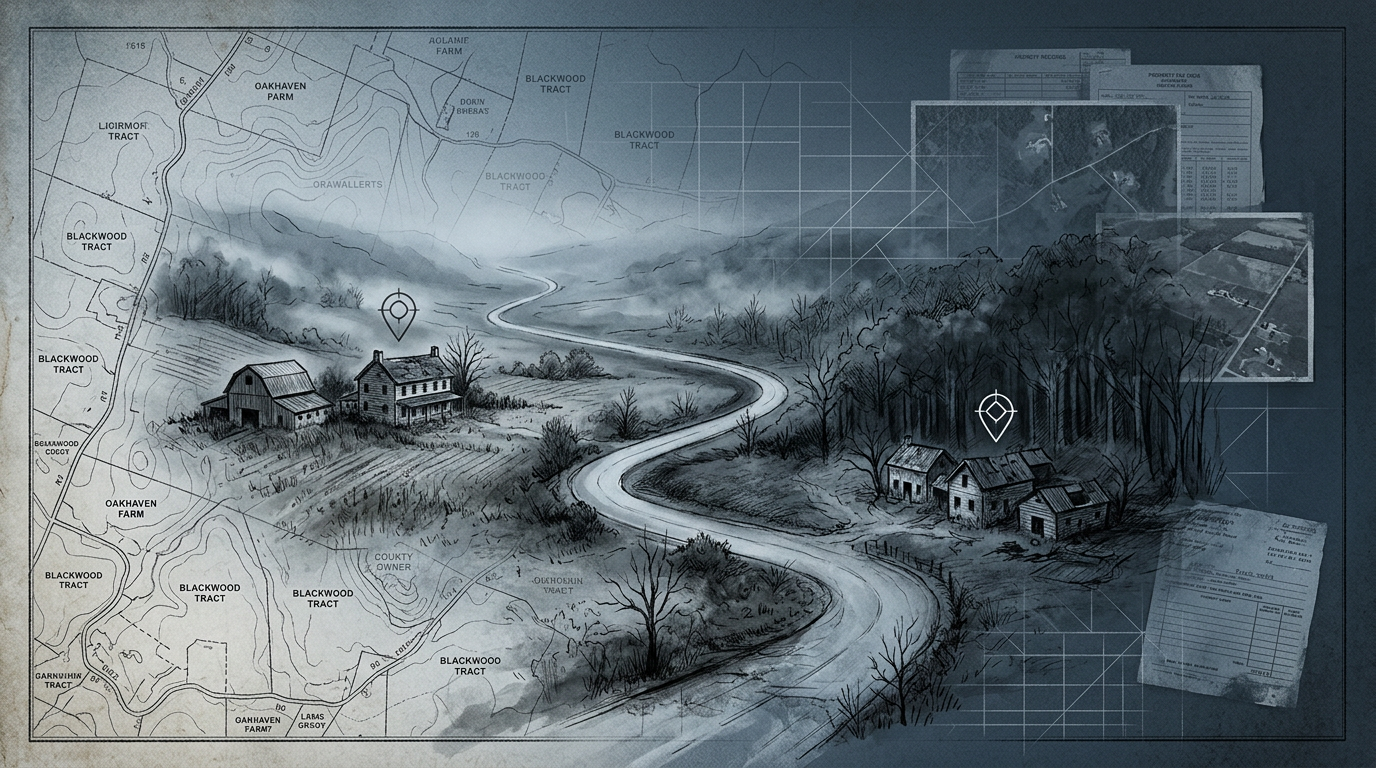
    Illustrated rural map with winding road, farms, forest, and location markers
    The Duplicate Address

    Lori Bender found the duplicate at 8:43 on Monday morning, thirty-seven records into a quality-control report that contained 1,126 errors and approximately nine hundred reasons for people to blame someone else.

    Most were harmless. A private road lacked a suffix in one layer and carried it in another. Four mobile homes shared coordinates because an old conversion placed every unit at the park entrance. A township boundary clipped the corner of a garage. Several addresses contained directional prefixes that nobody living on the roads actually used. The county’s transition work for Next Generation 911 had collected twenty years of such debris and presented it back to Lori as though every inconsistency represented a fresh discovery.

    The duplicate was different only because both records appeared clean.

    214 Harris Run Road.

    Two site points. Two occupied structures. Two parcel numbers. Two driveways separated by nearly a quarter mile. Both belonged to Wexler Township, both passed road-name validation, and neither contained the apartment, unit, rear, or secondary-structure information that sometimes explained apparent duplicates.

    Lori opened the first record. The house sat close to Harris Run Road on a narrow parcel stretching uphill toward woods. County imagery showed a two-story farmhouse, detached garage, vegetable beds, and a shed that had moved three times between aerial surveys. Assessor records belonged to Blaine Turocy, who purchased the property in 1978.

    The other 214 sat farther south, beyond a bend where Harris Run crossed under a transmission corridor. Sheryl Danner owned that parcel. Her single-story house dated from 1986, though the county did not create a separate parcel for it until several years later.

    Lori checked the road centerline ranges. The second property should never have been 214. Based on the established sequence, 226 fit cleanly between its neighbors.

    She opened the address history.

    The oldest electronic record for Turocy showed 214 Harris Run Road from the first countywide conversion. Danner’s property entered the current database during a 2004 migration, also as 214. No change order appeared in the scanned folder attached to the record.

    Lori picked up the desk phone.

    Blaine Turocy answered after enough rings for her to assume voicemail would take over.

    “Mr. Turocy? Lori Bender with Lanning County Public Safety. I work with the county addressing office.”

    “If you’re selling signs, I bought one off you people already.”

    “We don’t sell signs. I’m calling about your house number.”

    “That better not cost anything either.”

    Lori opened his parcel map while he spoke. “I’m cleaning up an address conflict on Harris Run. I need to confirm the number displayed at your driveway.”

    “Two-fourteen. Big black numbers on a white board. Been two-fourteen longer than you’ve been working there.”

    “That’s probably true. Do you remember when the county assigned it?”

    “The county didn’t assign me anything. That address was there when we bought the place.”

    “Do you still have paperwork from the purchase?”

    A chair or table scraped at his end of the call. “Lady, I got paperwork from Nixon.”

    “That could make you very useful to me.”

    Turocy laughed once. “My wife called it hoarding. You county people finally found a respectable name for it.”

    He agreed to search for an old tax notice or deed showing the address. Lori thanked him and called Sheryl Danner.

    Danner answered quickly and knew why the county might be calling before Lori finished introducing herself.

    “This is about the address again, isn’t it?”

    Lori moved her hand away from the keyboard. “Again?”

    “They tried changing it when my mother lived here. Nineteen ninety-something. She raised hell until somebody told her to forget about it.”

    “Do you remember what number they wanted to give her?”

    “No. She kept the letter, though. It should be with the house papers.”

    “That would help. The current county system shows your property and another house as 214 Harris Run.”

    “I know the other house. The old place before the bend.”

    “Yes.”

    “He gets our mail sometimes.”

    “How often?”

    “Christmas cards mostly. Once I got his new checks. He brought them down himself and told me if I spent any he wanted half.”

    Lori entered a note. “Have you ever had trouble with emergency services finding your house?”

    “Ambulance came here for my mother in 2019. They found us.”

    “Any trouble with deliveries, utilities, permits?”

    “GPS sends people up to him once in a while. Amazon figured it out years ago.”

    None of that surprised Lori. Residents often compensated for defective addresses so successfully that bad records survived for decades. They gave drivers landmarks, added instructions to online orders, learned which version of an address each company preferred, and eventually forgot they were maintaining a private correction layer around themselves.

    “I may need to assign your property a different civic number,” Lori said. “Nothing is changing today. I’m researching the history first.”

    Danner became quiet for a few seconds. “How much trouble does that make for me?”

    “Some. Driver’s license, insurance, utilities, deliveries, banks. We provide an official change notice, and there’s usually a transition period.”

    “You said nothing’s changing today.”

    “Correct.”

    “Then research away. I’ll find Mom’s letter after work.”

    Lori ended the call and created a case.

    By ten fifteen, Blaine Turocy emailed photographs of three documents taken on a kitchen table covered by a red-checkered cloth. A 1981 property-tax notice used 214 Harris Run Road. So did a homeowner’s insurance declaration from 1984 and a faded piece of correspondence from the township concerning a drainage complaint.

    Turocy’s claim was settled as far as Lori was concerned.

    At 10:28, she created 226 Harris Run Road in the staging layer for Danner’s parcel. Staging records existed for review and quality control before publication to the county’s authoritative address layer. She adjusted the point to the center of the habitable structure, checked the driveway connection, confirmed the odd-even sequence, added a note explaining the duplicate, and saved the proposed assignment.

    She did not approve it.

    At 10:51, her desk phone rang.

    Sheryl Danner did not bother with a greeting. “What did you change?”

    “I haven’t changed anything.”

    “My grocery account says 226 Harris Run now.”

    Lori reopened the case. “Which grocery account?”

    “Faber Market. I’ve used their delivery service since COVID. They emailed me twenty minutes ago asking me to confirm my corrected service address.”

    “Can you forward the email?”

    “I thought you said nothing was changing today.”

    “Nothing was supposed to.”

    “Those sound like different sentences from where I’m sitting.”

    Lori gave her county email address and kept Danner on the line while she checked the production layer. Danner remained 214. The nightly export had not run. The staging record for 226 showed Lori as creator, with no approval user and no publication timestamp.

    The forwarded email arrived.

    We’ve updated your delivery location to improve service accuracy. Please verify: 226 Harris Run Road.

    The message time was 10:46.

    Lori checked the county application logs. Nobody besides her had opened the proposed record. No public API exposed staging data. The grocery company was not among the county’s address-data subscribers anyway.

    “Mrs. Danner, did you enter 226 anywhere yourself?”

    “Why would I do that?”

    “I have to rule it out.”

    “You gave me that number for the first time just now.”

    Lori had not. She mentioned a possible new civic number during the earlier call and deliberately withheld the number because it had not been approved.

    “You’re right,” she said. “Please don’t confirm anything in that email. I’m going to find out where they got it.”

    “That was already my plan.”

    Danner disconnected.

    Lori checked the assessor’s public property search next, mostly because it was convenient. The parcel still belonged to Sheryl Danner. The parcel number, acreage, assessed value, deed reference, and structure details remained unchanged.

    The situs address displayed 226 Harris Run Road.

    Lori opened the internal assessor database. Same result.

    She called downstairs.

    A property-records technician answered and searched the parcel while Lori explained what she was seeing.

    “Shows 226 here.”

    “Who changed it?”

    “System says address refresh.”

    “From what source?”

    “County address layer, I assume.”

    “It isn’t in the county address layer.”

    Keys clicked at the other end. “Well, something fed it.”

    “When?”

    “Ten thirty-three.”

    Five minutes after Lori saved the proposed record.

    “Can you restore 214?”

    “I can overwrite the situs field manually, but if your next refresh sends 226 again, we’ll be right back here.”

    “My next refresh won’t send it. We never sent the first one.”

    The technician gave a small, uncertain laugh. “Then I’ve got nothing useful for you.”

    By eleven thirty, Lori had enough useful information to become deeply annoyed.

    The staging server showed no outbound transaction. The production database showed no change. The county integration logs contained no reference to 226 Harris Run Road. The GIS administrator checked replication jobs and found nothing. Assessor staff restored Danner’s situs address to 214 manually.

    At 11:42, the county utility liaison called Lori directly.

    “I’ve got Penn Allegheny asking whether you renumbered something on Harris Run.”

    Lori pinched the bridge of her nose and immediately became irritated with herself for doing it. “Which address?”

    “Two-fourteen to two-twenty-six.”

    “We haven’t issued the change.”

    “They have a service-location update dated this morning.”

    “Who sent it?”

    “That’s what they’re asking us.”

    Lori pulled Danner’s utility-service map onto a second monitor. The meter identifier remained attached to the correct parcel.

    “Tell them to hold the existing address.”

    “I already did. You want the request ticket?”

    “Yes. Send the whole thing.”

    The service-location update showed a source category Lori did not recognize. It did not name Lanning County. It did not name the utility. A generic field labeled ADDRESS AUTHORITY contained the county’s standard jurisdiction code, but the format belonged to neither organization.

    The timestamp was 10:36.

    Lori printed the page.

    At noon, she ate half a turkey sandwich while comparing system logs. By twelve twenty, she had forgotten where she placed the other half and found it beneath a road-centerline printout. She threw it away rather than decide whether toner dust counted as seasoning.

    A building-code clerk called shortly afterward.

    “You doing something with Harris Run?”

    Lori lowered the receiver slightly before answering. “Apparently everybody is.”

    “We got an online permit inquiry for 214. System attached it to the Turocy parcel, but the applicant lives at the Danner property.”

    “What kind of permit?”

    “Deck repair. Nothing submitted yet. He searched the address, and the parcel lookup gave him the other house.”

    “That has happened before.”

    “Probably. The weird part is the alternate-address field. It lists 226 for Danner now.”

    “Where did it get that?”

    “If I knew, I’d be telling you instead of asking.”

    Lori opened the countywide address QC report again.

    The duplicate error remained.

    She refreshed.

    The two 214 points vanished from the duplicate list.

    Her first reaction was relief. Then she searched the map.

    Both structures remained visible. Turocy’s point existed exactly where it belonged. Danner’s point existed exactly where it belonged. Each record still displayed 214 Harris Run Road.

    The QC application now treated them as one feature.

    Lori opened the raw geometry table. Two unique identifiers remained. Two coordinate pairs remained. Two parcel links remained. The quality-control system returned a single record count.

    She exported the features into a local project disconnected from the county network.

    Two points appeared.

    She ran her own duplicate query.

    Two records.

    The enterprise QC tool returned one.

    Lori called the GIS administrator and asked him to run the same check from his workstation. He got one.

    “Could be indexing corruption,” he said.

    “Only on these two records?”

    “Weird things happen.”

    “They usually happen in batches.”

    “I can rebuild the index tonight.”

    Lori closed the report. “Leave it alone for now.”

    She withdrew 226 Harris Run Road from staging at 1:07.

    The proposed record disappeared cleanly.

    At 1:19, Faber Market emailed Sheryl Danner again and restored her delivery address to 214.

    At 1:31, the assessor’s situs field changed from 214 to 226 a second time.

    At 1:38, Penn Allegheny’s service record reverted to 214.

    At 1:46, the building-code system removed 226 from its alternate-address field and attached Danner’s pending inquiry to Turocy’s parcel permanently.

    Lori called the building department and asked them to delete the inquiry.

    “We can’t delete an applicant session,” the clerk said. “He has to abandon it or submit it.”

    “Can you detach the parcel?”

    “I tried.”

    “What happened?”

    “It attached again.”

    Lori considered another round of logs, calls, and screenshots. None would tell her why a deleted staging record continued to exist elsewhere or why independent systems were choosing different versions of it.

    She took the county vehicle keys instead.

    Harris Run Road left the borough fringe behind within five minutes and narrowed between hills covered in second-growth woods. October had reached the stage when half the trees were bare enough to show houses previously concealed by leaves. Lori passed 188, 196, and 202 before finding a gravel drive marked with black numerals on a white board.

    Blaine Turocy’s farmhouse sat thirty yards from the road. He was in the garage when she arrived, wearing work pants and a sweatshirt with the sleeves shoved toward his elbows. He came down the drive carrying a yellow folder.

    “You’re younger than I pictured.”

    “I’m fifty.”

    “So’s my daughter. I picture her young too.”

    Turocy handed over the folder before she could answer. “That’s everything I found with the number on it. You taking my address away?”

    “No. Your assignment fits the road sequence and predates the other record.”

    “Good. I already memorized this one.”

    Lori photographed two older documents, thanked him, and continued south.

    The second 214 appeared after the bend exactly where the map placed it. A green reflective plate displaying the number stood beside a paved driveway. Sheryl Danner’s house occupied a shallow rise behind several mature maples, close enough to the road that no ambulance crew could confuse it with Turocy’s farmhouse unless somebody gave them the wrong coordinates.

    Danner came out carrying a clear plastic document envelope.

    “I found Mom’s letter.”

    Lori took it on the hood of the county vehicle.

    The paper carried the old Lanning County Public Safety letterhead and a date from May 1998. The text informed the property owner that, as part of the county’s enhanced emergency addressing project, the residence formerly identified by a rural-route box number would thereafter be recognized as 214 Harris Run Road.

    “So the county assigned it,” Danner said.

    “Yes.”

    “And now the county says it shouldn’t have.”

    “It appears we assigned the same number twice.”

    “My mother told them that.”

    Lori lifted her attention from the page. “In 1998?”

    “She knew the Turocys. Everybody out here did. She called whatever office sent that letter and said there was already a 214. Somebody came out. After that, she never heard another word.”

    “Do you have anything from the follow-up?”

    “That’s all I found.”

    Lori turned the letter over.

    A faded routing stamp occupied the lower corner on the back. Most of it was illegible. A handwritten case number remained visible beside an abbreviated status.

    SUSP

    Lori knew the value.

    She had seen it in old records during the current cleanup, usually attached to addresses carrying incomplete geometry or unresolved road information. The current software translated the field as Suspended. Nobody used it anymore because the NG911 workflow offered more precise exception categories.

    “When did your mother die?” Lori asked.

    “2021.”

    “Did she ever mention this after 1998?”

    “She complained whenever somebody’s package showed up here. Otherwise, no.”

    Lori photographed the back of the letter.

    Before leaving, she drove both approaches again. Turocy’s mailbox, Danner’s reflective marker, the spacing of neighboring numbers, and both driveways matched county imagery. Nothing on Harris Run itself had become uncertain.

    Back at the office, she searched the legacy table for SUSP.

    There were forty-three address records carrying the value.

    Most belonged to places she expected to be troublesome: seasonal camps, properties reached through neighboring municipalities, houses on private lanes, old industrial parcels, structures demolished before an addressing case closed. Eight were occupied residences.

    Lori sampled them.

    One had conflicting municipality names between postal and civic records. Another shared a number with a detached structure that later became a separate residence. A third sat on a road renamed in one township and left unchanged in the next.

    None had generated a duplicate-address complaint during the NG911 cleanup.

    She checked their migration history.

    The records survived the 2004 conversion. They survived the 2011 GIS rebuild. They survived a database replacement in 2018 and the current NG911 staging process.

    Their data was ugly.

    It was also stable.

    Lori reopened the Harris Run records.

    The modern system offered several ways to resolve duplicates. Retire one point. Renumber a structure. Merge records. Mark an approved exception. Each choice demanded that somebody define which record represented the authoritative condition.

    The old SUSP field demanded nothing beyond admitting that the county had not settled the question.

    She restored Danner’s point to the authoritative layer, confirmed both parcel relationships, and changed the status on each record to SUSP.

    The application displayed a warning:

    LEGACY STATUS. RECORD EXCLUDED FROM AUTOMATED PROVISIONING.

    Lori accepted it.

    Both address points remained on the map.

    The duplicate counter increased by one.

    For the first time all day, nothing else happened.

    At 3:12, she checked the assessor. Danner remained 214.

    At 3:28, Penn Allegheny still showed 214.

    At 3:51, the grocery account had not changed.

    Lori scheduled an address-verification test with the county 911 center for the following morning. She also opened a formal readdressing case for Danner’s property. Whatever else was happening, two occupied houses on one road could not permanently share one emergency address.

    Sheryl Danner called at four.

    “My grocery people haven’t emailed me again. Is that good?”

    “For today.”

    “You changing me to 226 eventually?”

    “Probably. You’ll receive a written notice before anything becomes official.”

    “Can I fight it?”

    “You can request review.”

    “My mother would.”

    “I gathered that.”

    Danner laughed. “All right. Send me whatever I have to complain about.”

    The next morning, Lori joined a 911 addressing technician for the scheduled verification. Sheryl Danner placed a test call according to the center’s procedure while Lori monitored the GIS display from the county office.

    The call plotted on Harris Run.

    A warning box opened beside it:

    DUPLICATE CIVIC ADDRESS — VERIFY SITE ACCESS

    Below the warning were two separate location points.

    The call-taker asked Danner which driveway responders should use. Danner described the green reflective marker beyond the transmission crossing. The technician selected the southern point and confirmed the coordinates.

    Nothing merged. Nothing renumbered itself. No outside account changed while they watched.

    After the test, Lori prepared the field-verification packet for the formal readdressing. She attached photographs of both number signs, copies of Turocy’s historical documents, Danner’s 1998 assignment letter, the road-range map, and screenshots documenting the systems that acquired 226 before publication.

    The screenshots created the worst part of the file because Lori could explain every field on them except how the information arrived.

    She wrote no theory.

    The proposed number remained 226. Turocy remained 214. Danner remained 214 pending notice, review, and final assignment. Both records carried the same legacy status until the county could coordinate the change with public safety, property records, utilities, postal services, and the residents themselves.

    Lori saved the case and returned to the quality-control report.

    There were 1,089 errors left.

    Harris Run no longer appeared among the items demanding automatic correction. It had moved into the exception queue, where the two houses remained separately mapped, separately owned, separately occupied, and temporarily allowed to disagree with the county’s desire for one clean answer.

    Beside each record, the status column contained four letters.

    SUSP.

    ©2026 Rhyan Scorpio-Rhys

  • Thirteen for Halloween: Switchboard, 1954

    Thirteen for Halloween: Switchboard, 1954

    Telephone operators connect calls beneath a sign reading “CRITICAL OVERLOAD—ALL HANDS ON DECK.”
    Switchboard, 1954

    It was only Monday and not even lunchtime yet and Thelma Keener had connected a bomb-damage report to payroll, sent an imaginary ambulance to the machine shop, and listened to a shipping clerk announce three fictional dead men with enough relish that Mrs. Tipton at the message desk told him to try again without enjoying himself so much.

    Operation Alert had given Darnell Fibre & Paper permission to rehearse catastrophe during regular business hours, and half the mill seemed determined to make an occasion of it. The company switchboard occupied a narrow room on the administration building’s first floor, separated from the temporary exercise desk by a waist-high partition and an aisle that forced people carrying message slips to turn sideways when they met. Thelma worked the left-hand position, headset against one ear, cord pairs hanging in orderly loops beneath the board. Signal lamps blinked across the panel faster than they did on an ordinary Monday. Beside her, Marjorie Kitts handled internal traffic while a sixteen-year-old office boy named Hollis carried handwritten messages between Mrs. Tipton and the men running the exercise down the hall.

    A lamp came on. Thelma inserted the answering cord and pressed the key. “Darnell Fibre.”

    “Extension forty-two for purchasing.”

    She connected the call. Before the supervisory lamp cleared, another signal appeared two rows above it. A bleaching-department foreman wanted the exercise-control desk and told Thelma, while she worked the cord into place, that Warehouse Two had been flattened in the attack.

    “You can tell them yourself, Mr. Bledsoe.”

    “Thought you girls were supposed to make this thing efficient.”

    “If we did everything for you, they’d have to close the mill.”

    He laughed as she transferred him. Drill calls belonged to Mrs. Tipton’s side of the room unless they entered through the wrong extension, which they frequently did. Darnell Fibre circulated two typed pages before the exercise explaining how simulated emergency traffic should be identified. Within fifteen minutes, several men had misplaced the instructions, one had forgotten the prescribed wording, and another had reported imaginary burns so convincingly that the infirmary sent an orderly halfway across the grounds before somebody caught the mistake.

    Thelma expected the afternoon to deteriorate.

    The nationwide exercise began at eleven. Radios in offices around Darnell carried reports concerning hypothetical attacks and civil-defense activity elsewhere in Tennessee. Management had volunteered the mill for more participation than the minimum because Darnell Fibre maintained its own fire brigade, infirmary, trucks, internal telephone system, emergency pumps, and enough dangerous material to justify rehearsal even without Washington’s encouragement. Exercise control occupied a conference room usually reserved for production meetings. Mrs. Tipton and Hollis converted reports into message slips and sent them down the hall, where supervisors decided what imaginary equipment and imaginary personnel should be committed to imaginary destruction.

    The real mill continued beneath the exercise. Maintenance needed stores. Sales needed long distance. A driver at the east gate lacked a signature on his bill of lading. Two secretaries tied up an internal line discussing whether the cafeteria’s chicken salad tasted different because somebody new had begun making it. Thelma separated routine traffic from drill traffic with the same patience she used when department heads forgot extension numbers or salesmen insisted their calls deserved priority because Chicago was waiting.

    At eleven twenty-three, extension seventy-one lit.

    “Darnell Fibre.”

    “Infirmary.”

    The call came from the bleach plant. Thelma recognized the caller by his flattened consonants and his habit of making every request sound like the continuation of a conversation nobody else had heard.

    “Putting you through.”

    She joined seventy-one to the infirmary and moved on. Bleach-plant men called there often enough. Chemical splashes, pinched fingers, steam burns, cuts, headaches, strained backs and irritated eyes came through the board without ceremony.

    Three minutes later, extension seventy-four signaled.

    “Fire brigade,” the caller said. Machinery hammered somewhere behind him, swallowing parts of his voice. “Two men down by the chlorine siding. Tell ’em bring masks.”

    Thelma’s fingers stayed above the fire-brigade jack for a moment while she listened to the background noise.

    “Is this exercise traffic?”

    “What?”

    “Are you reporting this for Operation Alert?”

    “Get the brigade over here.”

    The receiver struck something hard. The line remained open.

    Thelma connected him to the plant fire station and raised a hand toward Mrs. Tipton. “Bleach plant reports two men down at the chlorine siding. Caller didn’t identify the report as drill traffic.”

    Mrs. Tipton pulled a fresh message blank toward her. She was a broad woman in her early fifties who wrote compact block letters and wore a pencil on a string around her neck whenever paperwork threatened to multiply. “Extension?”

    “Seventy-four.”

    “Name?”

    “He didn’t give one.”

    Mrs. Tipton wrote the extension, time, and substance of the report. Hollis carried the slip toward exercise control while Thelma returned her attention to the board. Seventy-four remained engaged. She listened long enough to hear no one near the instrument. Farther away, somebody shouted. Metal struck metal, followed by coughing from more than one person.

    She restored the listening key and left the circuit in place.

    Hollis returned with the slip pinched between two fingers. “They want safety to verify it.”

    Mrs. Tipton took the paper, wrote four letters in one corner, and clipped it beneath three messages awaiting follow-up.

    Thelma could read the notation upside down: SUSP.

    One of the other messages concerned a simulated bridge collapse. Another described a fictional water-main break. The third was a routine fuel request from stores that somebody routed through an exercise number by mistake.

    Extension twenty-nine called for the infirmary. Thelma completed that connection, and the infirmary almost immediately requested Central Supply. Before either line cleared, the south gate signaled.

    “Do you know if the bleach road’s closed?” the gate man asked.

    “Who told you it was?”

    “Somebody from fire. I got six trucks stacked out here.”

    “I haven’t received an order from traffic control.”

    “Well, I can’t keep ’em sitting across the gate.”

    She put him through to security.

    Mrs. Tipton began another message slip.

    The accumulation irritated Thelma before it frightened her. Men down, road closure, fire brigade, infirmary traffic—exercise control spent the morning filling the mill with the same language. Real trouble could arrive through the switchboard and resemble somebody else’s scenario closely enough to earn a pencil notation and a place beneath a clip.

    Another internal lamp came on.

    “Darnell Fibre.”

    “This is paper machine three. We got chlorine down here. Who do we call?”

    Thelma moved immediately to the safety-office extension. No answer. She tried the bleach superintendent. No answer there either.

    The fire station line remained occupied. So did the infirmary. She connected paper machine three to exercise control and took another cord pair to call the conference room directly.

    “Kitts,” a man answered.

    “This is Keener at the board. Paper machine three reports chlorine. Bleach plant called two men down at the siding. The infirmary’s taking more traffic.”

    “Has safety confirmed a release?”

    “I can’t reach safety.”

    “Keep the original report in suspense until they do.”

    “The bleach road may already be closed.”

    “On whose authority?”

    “I don’t have that information.”

    He spoke to someone away from the telephone, then returned. “We’ve got evacuation injects scheduled this morning. We can’t put a chemical alarm through the plant on an unverified report.”

    Thelma could follow his reasoning. Exercise control possessed messages on paper, several already contaminated by employees who treated drill procedure casually. A false chlorine warning could send hundreds of workers moving through an operating mill for no cause.

    “What do you want me to do with infirmary requests?”

    “Route ordinary traffic normally. Send actual status reports here.”

    He rang off.

    Marjorie Kitts worked three cords at once beside her. “Bleach side?”

    “Mostly.”

    “I’ve got accounting complaining nobody answers in maintenance.”

    Mrs. Tipton tried safety again. “Still nothing.”

    The infirmary lamp flashed.

    Thelma answered. “Darnell Fibre.”

    “County hospital.”

    The nurse’s request changed the practical problem immediately.

    “Are you asking for an outside trunk?”

    “I need County Memorial.”

    “Has outside assistance been cleared?”

    “I don’t know what anybody cleared. I have four men here and more coming.”

    Thelma turned toward the message desk. “Infirmary wants County Memorial. Four casualties there, more expected.”

    Mrs. Tipton pushed back from the desk. “Send the report to control.”

    “The nurse wants the hospital.”

    “Thelma—”

    “She’s on my line now.”

    Mrs. Tipton reached for the telephone beside her while Thelma took an outside trunk. Central office answered with the familiar flat efficiency of an operator who expected numbers before explanations.

    “This is Darnell Fibre. County Memorial Hospital, please. Emergency traffic.”

    The central-office operator repeated the destination and built the connection outward. Thelma held the nurse until a woman at County Memorial answered.

    “Darnell Fibre infirmary calling.”

    Thelma joined them and withdrew from the conversation. The nurse was already speaking.

    “Chemical exposure. Chlorine. Four here now, possibly more.”

    Mrs. Tipton spoke into the exercise-control telephone behind her. “Yes, sir. She put them through. The infirmary requested the call directly.”

    Two internal signals lit almost together. Thelma handled them in sequence. The west yard needed instructions about moving a switching crew away from the bleach siding. A secretary wanted to know whether the noon executive luncheon would still be served in Conference B.

    Marjorie took the luncheon question.

    Thelma sent the switching crew to the yardmaster.

    Central office signaled on the outside trunk. “Darnell Fibre, county sheriff’s office wants your plant manager concerning emergency access.”

    She connected the sheriff to administration. Another outside call followed from County Memorial, asking which entrance the ambulance should use. Then central office asked whether the mill wanted incoming calls restricted while emergency traffic occupied the trunks.

    The confusion now extended beyond Darnell Fibre’s own paperwork. County offices and a hospital were acting on information that exercise control still treated cautiously.

    Mr. Kitts called the board directly.

    “Keener, who instructed you to call County Memorial?”

    “The infirmary requested the hospital.”

    “You were supposed to clear external emergency traffic through control.”

    “The nurse asked me for County Memorial.”

    “You know the procedure.”

    “I know what she requested.”

    Voices overlapped behind him. Somebody wanted a road map. Another man asked whether the south approach could take an ambulance.

    “Route all plant emergency traffic through us from this point forward.”

    “I’ve got County Memorial, the sheriff and central office calling in. If everything comes through your desk, somebody there needs to stay on the telephone.”

    He covered the mouthpiece or moved away. When he returned, his tone carried less certainty. “Use your judgment on incoming calls. Outgoing requests come through control.”

    Thelma cleared the connection and answered the bleach superintendent’s extension.

    A hoarse voice asked for the plant manager.

    She recognized Mr. Harker only after he identified himself. “Are you injured, Mr. Harker?”

    “Get Pruitt.”

    Thelma connected him to the safety director’s office, received no answer, then tried exercise control. Harker stayed on while she found someone who could take him.

    The next forty minutes gave her too much work for fear to organize itself into anything useful. Outside trunks filled. Calls crossed. The fire brigade wanted maintenance. Maintenance wanted power. Power wanted instructions concerning ventilation in one section. The infirmary requested another ambulance. Security asked for county help keeping vehicles away from the south approach. Shipping tried to place a long-distance call about a rail delay and complained when Thelma refused to release an emergency trunk.

    The crisis altered the shape of the board as people learned pieces of it.

    Early calls asked whether anything had happened. Later calls concerned what could still be moved, shut down, opened, counted, fetched or sent. The bleach superintendent stopped asking for management and began asking for the fire-brigade chief. The infirmary needed names of workers from the siding. The south gate quit requesting instructions and started telling drivers where they could turn around.

    Thelma remained inside the telephone room and knew the plant only through those changes. She could not tell how large the release was. She knew fewer calls originated from the bleach plant itself, which might mean improvement, evacuation, or damaged instruments. She knew County Memorial sent another ambulance because the hospital told her before anyone inside the mill did. She heard the plant whistle once, then again several minutes later, and the second sounding brought a new rush of internal calls.

    At twelve eighteen, safety finally came onto the board.

    “Exercise control,” Mr. Pruitt said.

    His breathing rasped near the transmitter.

    “Putting you through.”

    Before she completed the circuit, he added, “Tell them we’ve got the release isolated.”

    Thelma joined him to the conference room and moved to the next signal. No announcement followed. The calls changed again, moving toward transportation, worker accountability, damaged equipment and cleanup. That was sufficient.

    Lunch came and went. The cafeteria sent coffee to the fire brigade and sandwiches to the infirmary after somebody in administration finally answered the question Marjorie routed earlier. Ordinary business began pressing back into the board around the emergency. Purchasing needed a supplier. Payroll wanted personnel. A secretary requested long distance and apologized when Thelma told her both outside trunks remained occupied.

    Operation Alert disappeared from conversation before anyone officially canceled it.

    Its paperwork continued growing.

    Mrs. Tipton and Hollis accumulated stacks across the message desk: genuine emergency reports, drill reports, routine business misrouted into exercise channels, duplicate messages, corrected messages, and slips whose first classifications could no longer be defended. Men from the conference room carried folders back and forth. One instructed Mrs. Tipton to separate chlorine-release traffic from Operation Alert material for management review.

    “Easy instruction,” Mrs. Tipton said after he left. “He should come sort it.”

    Thelma flexed her fingers below the board. Cord work usually left her hands stiff by late afternoon, but the continuous plugging and clearing of the past two hours had brought the ache early. Marjorie removed her headset briefly and pressed one palm against her ear.

    “Think they’ll start the drill again?”

    “They can try.”

    “That observer from Nashville was supposed to stay through the afternoon phase.”

    “He got plenty to observe.”

    Marjorie let out a tired breath that carried the remains of a laugh.

    At one thirty-seven, Mr. Kitts entered the switchboard room.

    Thelma knew his voice better than his face. He was narrower than she pictured when speaking to him by telephone, with damp hair combed away from a high forehead and one shirt sleeve rolled higher than the other. He spent several minutes with Mrs. Tipton, reading message slips and asking about times, before approaching Thelma’s position.

    “You stayed on the board throughout?”

    “Yes.”

    “You contacted County Memorial directly.”

    “The infirmary requested them.”

    “I’ve spoken to the nurse.”

    A signal appeared on the lower right portion of Thelma’s board. She placed one finger near the corresponding jack without answering yet.

    “The sequence will be reviewed,” Kitts said.

    “I expected that.”

    He rested two fingers against the wooden edge below the panel, well away from the cords. “The first ambulance arrived before the plant’s formal outside request was logged.”

    The signal continued glowing.

    “Do you need anything else from me, Mr. Kitts?”

    He followed her attention to the board. “Stay on your position.”

    Thelma answered the waiting call.

    Mrs. Tipton made no comment after Kitts left. Marjorie kept working. Thelma preferred both women for their restraint.

    By midafternoon, most bleach-area calls concerned cleanup, inspections, damaged equipment, and the accounting of workers transported to the hospital or sent home. The switchboard received no report of a death. Thelma treated that absence as incomplete information and continued routing calls.

    Mrs. Tipton began separating the papers in earnest. Operation Alert material went into one cardboard records box and chlorine-release messages into another. She worked slowly, drawing single lines through incorrect annotations so the original writing remained legible, adding times from the switchboard log, clipping related slips together, and consulting Hollis when she could not remember which runner carried a message first.

    Several slips remained on the desk between the boxes.

    Mrs. Tipton picked up the earliest report from extension seventy-four.

    TWO MEN DOWN CHLORINE SIDING. FIRE BRIGADE REQUESTED. CALLER UNIDENTIFIED.

    Time received: 11:26.

    The four penciled letters remained in the upper corner.

    “Where are you putting that one?” Thelma asked.

    Mrs. Tipton turned the message over, checked the serial number, and compared it with another slip. “That’s what I’m trying to decide.”

    “Chlorine file.”

    “It went to exercise control before anybody confirmed it. They held it as possible drill traffic.”

    “The men were real.”

    “So was the way the message got handled.” Mrs. Tipton tapped the serial number with her pencil. “If I move the original into the accident file, the Operation Alert record loses the message they actually received.”

    “Make a carbon for one box.”

    “They want originals kept by serial.”

    Another lamp came on before Thelma could answer.

    She connected the call while Mrs. Tipton considered the two boxes, then the slip in her hand. After a few seconds she returned the paper to the metal suspense clip above the desk. Its station number and time remained readable from Thelma’s chair, along with the routing initials and the penciled notation that had kept it outside both files: SUSP.

    ©2026 Rhyan Scorpio-Rhys

  • The Eternal Vows of Aida

    The Eternal Vows of Aida

    The desolate landscape seemed to stretch endlessly before Aida. Memories of the long, strenuous journey weighed on her, but the thought of returning gave her strength. Over time, life had taken its toll on her vision. Bright sunlight became her nemesis, causing her eyes to blur. But this handicap couldn’t defeat her spirit. She embraced the deep contrasts of the world, moving within the comforting embrace of the shadows, letting her heart be her compass.

    As she trudged on, the past echoed in her mind. The way the sunlight streamed through the stained-glass windows, casting vibrant hues across the church hall. The love in his eyes, the promise of forever, and the binding words they shared. Before God and loved ones, Aida had pledged her loyalty, her fidelity, her nurturing love. A promise, not just to her husband but to herself, to never betray the sacred bond they were forming.

    However, an unforeseen twist of fate took her life prematurely. The man she loved, whom she had bound her soul to, brutally ended her existence. Though her physical form was no more, her essence remained trapped on this plane of existence, anchored by an insatiable need for vengeance.

    Yet, here she was, a spirit tethered between realms, drawn back to the place of her untimely demise. Aida stood concealed within the shadows, observing him from a distance. Her ethereal form was barely more than a whisper, but the intensity of her emotions was palpable. Her gaze scoured the surroundings, seeking a connection, a beacon that would guide her back to confront the monstrous act of the man she once loved.

    As the weight of her grief and anger converged, the shadows around her began to shift and dance. They wrapped around her, merging with her essence, empowering her with a force she had never known.

    Driven by a burning desire for justice and to protect others from suffering her fate, Aida stepped out from the shadows, her presence more powerful than before. With each step, memories of love, trust, and betrayal fueled her resolve.

    The confrontation was imminent, and the weight of their shared past would determine their entwined fates. But Aida was no longer the naive bride. She was a force of nature, a specter of love wronged, ready to reclaim her vows and ensure that no one else would fall prey to his treachery.

    The atmosphere within the grand manor was suffocating. Shadows clung to the walls, and the weight of past sins permeated every room. As Aida’s spectral form made her presence felt, Frederick’s demeanor shifted from casual indifference to unease.

    A cold, unsettling breeze swept through the room, causing Frederick to shiver. He could feel her presence even before he saw her—his past coming back to haunt him in the most literal sense.

    “Frederick,” Aida’s ghostly voice resonated, echoing eerily in the vast space of the room.

    Frederick jumped, his eyes darting around, seeking the source of the voice. “Who’s there?!” he demanded, his voice betraying a hint of fear.

    “Have you forgotten your bride so quickly?” her voice replied, sorrow and anger evident in her tone.

    Frederick’s face went pale as the moon. “It can’t be. You’re… you’re gone.”

    Aida’s form began to materialize, her once lively eyes now empty sockets, her flowing dress stained with the memory of her untimely death. “You did this,” she accused, pointing a translucent finger at him.

    Frederick backed away, horror written on his face. “No! It wasn’t my fault.. it was an accident!”

    Aida’s laugh, cold and hollow, echoed around him. “Denial won’t save you,” she whispered. The room grew colder, and the very walls seemed to close in on Frederick. Shadows writhed and stretched, taking on grotesque shapes that mirrored his worst fears.

    He could feel hands—cold, clammy, and disembodied—grabbing him, pulling him closer. Aida leaned in and pressed her lips to his, forcing an unnatural kiss that was suffocating him. And in that kiss he could hear the cries of anguish, feel the pain he had inflicted on Aida. Every emotion she had felt in her final moments was now his to bear.

    “Please!” Frederick begged, when the kiss ended, tears streaming down his face. “I’ll do anything!”

    Aida’s ghostly form loomed over him, her voice dripping with disdain. “Confess. Admit to what you did. Make amends.”

    Frederick, trembling and gasping for breath, nodded frantically. “I will. I swear it.”

    She leaned closer, her face inches from his, her cold breath chilling him to the bone. Frederick feared another kiss, but instead, Aida said, “You will dedicate every waking moment to making up for your sins. Or I will return, and next time, there will be no escape.”

    With that final warning, Aida’s form began to dissipate, leaving Frederick alone, sobbing and broken, in the vast, echoing emptiness of the mansion. But he was a changed man. The weight of his sins bore down on him, and he knew he had to atone.

    And so, in the days that followed, the town saw a transformation in Frederick. The once proud and ruthless man was now a beacon of charity and goodwill, dedicating his life to helping others. But behind his reformed exterior, there was always a hint of fear, a reminder of the ghostly visit that had set him on this path of redemption.

  • Rules of Visitation (Revised)

    Rules of Visitation (Revised)

    I almost missed her visit. My disbelief in ghosts had fortified a stubborn veil over my perceptions, making me almost immune to the spectral. But tonight was different. The rain was falling in torrents, its ceaseless hiss drowning out all other sounds, and then there it was—her voice.

    “James,” it whispered, woven into the tapestry of rainfall, each drop a syllable of her name. “James.”

    At first, I dismissed it as an auditory illusion, a byproduct of my loneliness. But she persisted, her voice cascading with the rain, and my eyes, driven by an inexplicable impulse, moved toward the window.

    She was there, a fragile wisp of memory made visible, pressed against the glass. Rainwater dribbled down her translucent face, like tears shed by the sky itself. My heart surged with a blend of love and sorrow, a cocktail of emotions I hadn’t tasted since the day she was taken from me.

    I rushed to the window, hands trembling, but it wouldn’t budge. An invisible tether held me back, a boundary I couldn’t cross. My fingers barely touched the cold glass, craving the warmth her presence used to offer.

    “Rosalyn,” I mouthed, my voice choked with regret and questions. “How? Why now?”

    Her spectral eyes met mine, brimming with a serenity that could calm even the fiercest storms. “There are rules, James,” she began, her voice emanating from the fog of her form. “Rules that even love can’t bend.”

    “What rules? What are you talking about?”

    She floated closer, her form illuminating the darkness of the room. “Our love, pure as it is, must now abide by the laws of my new existence. I can only visit you when it rains, and only on days that are sacred to us—our birthdays, our wedding anniversary, and today, the day my earthly journey ended.”

    The weight of her words settled over me, anchoring me to an altered reality. As quickly as she appeared, Rosalyn began to fade, her form dissipating into the mist outside the window, becoming one with the rain.

    “I love you,” she said, her voice gradually swallowed by the falling drops, becoming a silent echo that only my heart could hear.

    “And I you,” I whispered back, pressing my palm against the cold glass, a poor substitute for her touch. But it was a touch nonetheless, a fleeting connection that would have to sustain me until the heavens wept again on a day we once celebrated. Then, and only then, could our sorrow reunite us, even if just for a moment.

  • 13 for Halloween: Final Thought (audio)

    13 for Halloween: Final Thought (audio)

    Part 1 * Part 2 * Part 3 * Part 4 * Part 5 * Part 6

    Six months. That’s all it took for the world to collapse. Six months after the first demon portal opened and if there was another living human soul left on the planet besides Mitchell Larkin, they’d be living an isolated life within a hidey-hole in the deserted ruins of some city or town, which meant they might as well be on the moon.

    But that hadn’t meant Mitchell gave in to defeat, no siree bob. Part of his daily routine, after searching for food and supplies, was to scour all the books on the occult that he was able to scavenge, searching for a way to reverse the damage done by that lunatic couple in the deadly viral video.

    He never had much use for religion, never believed in the supernatural, let alone the occult, but now, you’d be hard-pressed to find a more devout man on the face of the Earth, that was if you could have found another man on the face of the Earth.

    He managed to survive so long because he barricaded himself inside his heavily fortified house, setting snare traps along the perimeter, and studied the patterns of the demons’ movements and attacks, assessing their strengths and weaknesses. That, and he uncovered a ritual that somehow masked his house from the demons’ senses. The practicing of dark arts went against the principles of his newfound religion, but he was a desperate man working on the fly so he hoped God would realize this and cut him a little slack.

    This wasn’t to say that Mitchell was always on the top of his game. There were days that he simply went through the motions, and it was on one of these days that he accidentally stumbled on a possible solution. Within the pages of a book he thumbed through a thousand times, there were details that, when combined with a separate incantation from another book, should theoretically do the trick of exiling those bastard demons from Earth forever.

    Mitchell was now a man with a mission. He checked and triple-checked his calculations, made special runs into dangerous territories to secure the items he needed, and prayed that God would look the other way this one last time. The newly converted should have been eligible for a three-strike rule, in his humble opinion, even if this was strike four.

    The ritual was dangerous in the extreme, and if Mitchell mucked it up he could wind up pushing daisies, and to be clear, he didn’t want to die, but he couldn’t see any other options at this point.

    Pulling off the ritual required knowledge and power. The former Mitchell was sadly lacking being a novice and all. The latter? Well, he just had to hope that the power of his convictions was good enough.

    Mitchell created a large circle out of sea salt in the center of the living room floor and inside that circle, he salted the pattern of a pentacle. Dragging a steak knife across his left palm, he squeezed several drops of blood on each of the star’s points. Then he stripped down to his birthday suit, placed a lit white candle anointed in olive oil within the circle at magnetic north, and sat in the middle of the power circle.

    Concentrating on the candle flame, Mitchell attempted to clear his mind of all distractions even though the salt was irritating his bare butt. His nervousness showed in the recitation of the rhythmic chant, he was speaking the words too quickly and had to force himself to slow his pace. Yes, time was running out for the human race, but in truth, he had all the time in the world.

    He repeated the incantation over and over again, to the point of his throat becoming raw, and he thought he made an error somewhere, mispronounced a word, Latin wasn’t his strong suit, after all, and his confidence was on the verge of faltering…when the air suddenly crackled with charged particles.

    Then he felt it, the tingle of the raw power of the earth itself, traveling up his chakras, filling his frame with the awesome energies of nature. For the briefest of moments, Mitchell existed in the sweet spot of existence, breathing in the rarified air of a cosmic entity as his soul made a connection with not only the planet of his birth but the entire universe as well.

    And he wasn’t alone. Something tapped the outer fringes of his expanding awareness, a force that was unmistakably feminine. As their essences intermingled, Mitchell discovered her name was Flora when she used to have a physical body. She had been an astral traveler exploring higher planes of existence when the demons feasted on her dormant flesh.

    Mitchell’s chanting drew her essence to this spot and as she had a score to settle with the beasties, Flora graciously infused his energies with her own. For a scintilla of a second, Mitchell felt invincible, filled to bursting with power and endless possibilities. Alas and lack, this power brought about its own set of difficulties.

    The Mitchell/Flora union caused an energy surge that shattered the magicks which cloaked his home from the demons and, to make matters worse, it served as a beacon, beckoning the interdimensional invaders, challenging them to come. And they came in droves, from every direction, wave after wave.

    Flora tried her best to keep the creatures at bay in order to give Mitchell the chance to finish the ritual and send the hellspawn packing back to wherever the hell they came from, but they both knew sure as bread fell butter side down that there was no way in hell that their combined energy was strong enough to see the matter through. And even if they had been able to draw upon more power, neither had the knowledge base to pull off a feat of that magnitude.

    In his final act, Mitchell thanked Flora for trying to help and released her energy back into the universe. There was no sense in taking her with him. And when the ravenous demon horde eventually tore through his makeshift security measures and entered the room, an odd thought struck him:

    “Will I taste like chicken?”

    And that just about does it for the 13 for Halloween series. I want to thank all of you who followed me on this experimental journey. I know I run this phrase into the ground but, it's very much appreciated.
    And not only is it Halloween but it also happens to be my birthday, so please feel free to pick up a slice of PumpKill BirthSlay cake (okay, okay, I'm officially laying off the Cryptkeeper puns) on your way to the egress. HAPPY HALLOWEEN, all!
  • 13 for Halloween: Disobedient Iczer (audio)

    13 for Halloween: Disobedient Iczer (audio)

    Part 1 * Part 2 * Part 3 * Part 4 * Part 5

    Once upon a dimension, there existed four little hellspawns named Qemno, Gatoix, Byanki, and Iczer, and they lived with their mother in the festering pus sac of a decaying creature trapped in the dried magma of the root of a very large bleeder tree.

    “Youngling rapscallions,” said Mama Hellspawn one morning, in her guttural native tongue. “This pus sac is devoid of nutrients and so you must go out into the realm and fend for yourselves for a while. You may have noticed portals opening to badlands, stay away from these doorways. Your father entered one and was slaughtered by the beasts called hoo-mans. They are unnatural creatures and must be avoided at all costs.”

    “Why?” asked Iczer.

    “Because they will put you in a stew and eat you until you are no more,” answered Mama.

    “No, Mama, why did we open the doorways to danger?” Iczer clarified.

    “The hoo-mans opened the portals…to slay us. Now, run along and feed yourselves but do not become prey. When I have found a new home, I will send for you.” Mama Hellspawn turned to leave, resetting her jaw from conversation mode to evisceration mode in order to hunt and take down a large beast for their new home.

    Qemno, Gatoix, and Byanki were obedient hellspawns and did as they were bade, venturing out and using their enhanced sense of smell to detect the scent of victuals and root through the gravepits until they reached pockets of cadaverous dung worms.

    But Iczer, the disobedient one, scampered straight to the nearest portal and clambered his way into the badland place his mother called Errth.

    But what made these lands bad? Iczer wondered. He encountered several beasts that traveled on all fours just like him. Were these hoo-mans? No, for they were not scary at all. He unhinged his jaw and swallowed them whole for his stomach teeth to gnaw on.

    But then, when his belly was slaying the meal inside him, whom should he meet but a hoo-mans! Mama was right, it was frightfully ugly and walked on twos instead of fours.

    The hoo-mans ran after Iczer, waving a painstick and screeching something unintelligible. Iczer was most dreadfully frightened; he rushed all over the badlands, for he had forgotten the way back to the portal. He lost one of his legs when it became wedged in a crack in the stone ground and he was forced to detach it to evade capture, and sacrificed an exploding eye which emitted a poisonous gas to choke the hoo-mans.

    After losing the hoo-mans, Iczer thought he had gotten away altogether, but he unfortunately ran into a web of some sort and got himself all tangled up.

    Iczer gave himself up for lost as more hoo-mans came with their painsticks to kill him, but he remembered Mama showing him how to escape a web, so he wriggled and wriggled just as he had been taught. It was no use, he was still trapped even though he was sure he had done everything the right way.

    The hoo-mans beat him with painsticks and he was helpless to defend himself. Iczer shed big tears and let out a wail that only made the hoo-mans beat him harder. They beat him and beat him and when they tired themselves out or lost interest because he was unable to scream anymore, they picked him up within the web, probably to put him in a stew and eat him all up. He would have cried if he had any tears left.

    This was the end, he felt it in his three hearts, so he said the only prayer he knew, a youngling’s prayer for safety before hibernation, and tried to be a brave little hellspawn as he gave up his life.

    But there was a commotion and he was thrown violently to the ground. All around him the hoo-mans were squealing, squawking and yawping at a decibel that hurt his ears to hear. And they were exploding, spraying liquid everywhere.

    Was that what their blood looked like? Iczer wondered. And when the last of them had fallen, the reason for the sudden burst of chaos came into his line of sight…Mama.

    “I came as soon as I heard your call,” Mama Hellspawn said, extricating the broodling from the web.

    Iczer collapsed into the folds of her being, comforted at first by her cooing. When her tone turned to admonishment, he didn’t care for he was safe within her now, and the world was normal again.

    And after she was done reprimanding and punishing him, he would ask her to show him what she had done to the hoo-mans to rescue him because Iczer planned to return to these badlands when he was stronger and make every single creature here pay for their cruelty.

  • 13 for Halloween: Baby’s First Feeding (audio)

    13 for Halloween: Baby’s First Feeding (audio)

    Felicia Dunner hated people. Always had. Even as a little girl.

    Why? Because people were ineradicably violent, unavailingly vindictive, immeasurably self-righteous, and the list went on. But plants? Oh, with plants she could just sit in their company for hours, enjoying the warm summer nights, breathing in the relaxing scents of honeysuckle and jasmine, plumenia, and gardenias.

    Nighttime was always best. When she was young, Felicia would sneak out of the house while the rest of her family was asleep, step into the peaceful hush of her dormant neighborhood, kneel in the rich soil and listen to the gentle and soft evening breeze that rustled the leaves in the trees. And it was on one of those oh so long ago summer nights, when she was fed up with dealing with people, that her lifelong purpose came to her with a clarity she had never experienced before or since.

    She studied botany, first on her own, devouring any and every book the library had to offer, then as an elective when it became available in school. Felicia had been blessed with strong analytical, mathematical, and critical thinking skills, and threw herself into the fields of botany, plant science, and biology to earn her doctoral degree.

    A sizeable grant aided her in setting up a research facility deep within the Amazon Rainforest under the guise of discovering a plant-based cure for cancer. In reality, Felicia’s goal was to transcend the trappings of matter and biochemical pathways in order to twist evolution by stripping two disparate species and braiding them into a new, better, and stronger whole. If successful, the homo sapiens would experience the slow fade of an endangered species and give way to plantae sapiens, a race of human plants.

    During her college years, she dated voraciously. Those who were narrow-minded and envious of her accomplishments branded Felicia as promiscuous, while those who sought to know her better thought she was coming out of her shell, stepping outside her comfort zone. Little did either faction know that she was collecting samples. Enzymes and plasmids were needed to help fuel her gene splicing and cloning experiments, so she compartmentalized her disdain for human contact and cast a wide net into the dating pool, male and female alike. To her, flesh was flesh, and as she was asexual and only interested in collecting raw genetic materials, she was immune to the preference of one gender over the other.

    Felicia was plagued with failure upon failure, approaching her experiments from the standard cloning procedures of taking the plant-human spliced DNA and preparing an egg cell, inserting somatic cell material, convincing the egg that it was fertilized, and implanting it into an artificial womb. And it wasn’t until she had exhausted all of her genetic materials that she realized her error and cursed her meat-based brain. She was approaching the matter all wrong, thinking like a human.

    Her misanthropic manner eventually drove away all her assistants so Felicia was forced to use samples cultivated from her own body, and instead of creating a replica of a human egg, she created a plant-like seed the size of a peach pit.

    Felicia placed the seed in a container filled with a solution infused with human and plant enzymes and stored it in a dark place at room temperature for twelve hours to let the seed soak and initiate the germination process.

    Failure.

    Then she tried sowing the seed in quality soil with a sterile, seed-starting mix, planting it at the proper depth according to her calculations. She watered it wisely, maintaining consistent moisture, kept the soil warm, fertilizing, giving the seed enough light, and circulated the air.

    Again, failure.

    Giving up was never an option, but Felicia couldn’t deny she was balancing on the precipice of admitting the futility of her efforts, when, out of the blue, a thought struck her. Had she been planting the seed in the wrong soil? It had been nutrient-rich, to be sure, but perhaps it was missing that certain something, that bit of magic that existed in the blindspot of her prejudice. A human variable.

    Hoping against hope, Felicia extracted the seed from the soil, rinsed and drained it, and then replanted it in the richest soil she possessed. With equal amounts of care and effort, she placed this unique seed, neither fully plant nor human, deep within her lady garden. She knew full well the dangers of retaining foreign objects in the uterus: infection and purulent malodorous discharge, granulation tissue formation leading to adhesions, and fibrosis, but she was desperate.

    At first, she thought she was facing yet another failure but a missed period and tender, swollen breasts clued Felicia in that she was finally on the right track. All the other symptoms soon followed: nausea, but thankfully no vomiting, only dry heaving, increased urination, fatigue, light spotting, cramping, bloating, and constipation. Also, her sense of smell and taste became heightened and she was experiencing abdominal twinges, the sensation of her stomach muscles being pulled and stretched. All this occurred within the first three days.

    Felicia’s stomach became upset on day four, as if her digestive system was in turmoil, swelling like a tidal wave before gradually subsiding. On day five, she awoke to a dull ache in her back and lower abdomen and there was a pressure in her pelvis that was indescribable, accompanied by strong waves that felt like diarrhea cramps. They couldn’t have been labor contractions, it was far too soon, and it hadn’t matched with any of her calculations!

    Despite that fact, there was a pounding in her uterus and a wrenching intestinal cramping that felt like severe gas pains and just when it felt like she was about to pass out, her entire body was flooded with numbness. Felicia was aware of anesthetics that existed in nature. Was the seed releasing eugenol to numb her nerves?

    Reclining on a makeshift examination table, she watched in absolute calmness as if detached from her physical body, as thin tentacle-like vines pushed their way free of her lady garden, extending, probing her thighs and calves until they located her ankles. Snaking around the bone just above her feet, the vines slowly drew her legs close. Felicia could feel her baby shift and move, it was extricating itself, pulling itself free from her womb, in essence, birthing itself.

    Once breached, the vines released her ankles, leaving nasty welts, and crawled up to her belly, using its tentacle appendages as legs. Felicia cupped the leafy infant in her hands. It was so light yet so firm and it radiated such heat. She tickled the bulb of its head on some sort of motherly instinct and the petals began to unfurl to reveal the humanish face within that bore a resemblance to pictures of herself as a child if she had been made of foliage.

    Felicia bore her breast and placed her baby’s lips to her nipple. This was indeed a product of her loins, her experimental hybrid baby was a flaming success, the next step in evolution, and yes, it would replace humankind but not in the way that the botanist had envisioned. Homo sapiens would become an endangered species because her progeny was a creation born not with the need for mother’s milk, but with the taste for human flesh, and she had no other choice than to see that her baby was properly fed.

  • 13 for Halloween: Helpless Beauty (audio)

    13 for Halloween: Helpless Beauty (audio)

    Part 1 * Part 2 * Part 3 * Part 4

    A fortnight after the news reported the first interdimensional portal opening, Campbell stepped out of a gutted convenience store with several tin cans missing labels, a few jars of baby food, and a couple of packets of smashed ramen in his backpack. It was the first find in the seven stores he visited and while it wouldn’t have passed as fine dining, it was a damn sight better than the zero food in his apartment.

    The main avenue outside looked like the aftermath of a demolition derby, abandoned cars smashed into one another in the street and on the sidewalk for more than three blocks. It was eerily quiet, especially for the city midday, and the air stank of insect musk and mildew. Soot-laden clouds hung so low a person could stand on the roof of a building, reach out a hand, and touch their underbelly as they drifted past.

    He was about to head off in a different direction to try another store when he spotted a woman standing in the intersection, naked and alone, shivering in the ninety-degree heat. Campbell stopped dead in his tracks and rubbed his eyes almost like a cartoon character trying to clear a mirage from his vision. Head on a swivel, he looked around for any sign of demon threat and when he found none, against every ounce of common sense in his possession, he approached her.

    Campbell made a throat-clearing sound and it startled the woman as if she hadn’t noticed him although she was looking directly at him as he approached.

    “Don’t worry,” Campbell put his hands out. “I’m not going to hurt you.”

    “…hurt you…” the shivering woman said. Her quavering voice was an octave higher than his but still on the husky side, and she spoke in an accent that he couldn’t quite place.

    “Now, I know how this looks,” Campbell said as he set his backpack down and began unbuttoning his shirt. “But I assure you I’m not that kind of guy, okay? You just look like you need help.”

    “…need help…” the woman repeated. She wrapped her arms across her bare breasts.

    Campbell held his shirt out. “Here, take this.”

    The woman said, “…take this…” but stood motionless, paying no regard to the shirt at all.

    Poor thing must be in shock, Campbell thought, or maybe she didn’t understand English, the way she kept parroting the last words he spoke.

    Holding his shirt out like a muleta, Campbell approached the woman slowly like a timid matador and made the shushing noise parents used to calm newborns. She remained stock-still as he maneuvered behind her and draped the shirt over her shoulders, but shied away when he tried to adjust it for a better fit.

    “Okay, no touching,” Campbell said, backing off. “Understood. It’s all good.”

    “…all good…”

    “Are you all right?” asked Campbell, moving back into her line of sight. “What happened to you? Are you alone? Where do you live?”

    “…you live…”

    “Okay, too many questions at one time. How about this, are you hungry?” Campbell mimed putting food in his mouth and chewing.

    “…hungry…”

    Scooping up the backpack, he opened it and pointed at the tin cans and ramen. “Food.”

    “…food…”

    “That’s right, food, eat food, but we can’t eat here, we have to go someplace safe. I live nearby…”

    “…near by…”

    “I’ll share it with you but you have to come with me back to my apartment.”

    “…apart ment…”

    Campbell sighed. He wasn’t sure how much of what he said had actually gotten through but too much time was spent standing out in the open in this one spot and he was beginning to get nervous. And if he was being totally honest with himself, he had never been comfortable with his body and he was now shirtless in front of a beautiful woman. Yes, even though she was covered in grime, there was no denying how breathtakingly beautiful she was.

    That wasn’t the reason he stopped to help her, he told himself, and almost believed it to be true.

    Slipping the pack on his bare back, Campbell gestured for the woman to follow him before he turned and walked away. If she did, fine, and if not, then he tried, but he wasn’t about to risk burning any more sunlight out in the open. He hadn’t looked to see if she was following because if she wasn’t he’d be more depressed than he was willing to admit, but he did walk at a much slower pace than normal, just in case.

    Remarkably, there was almost a peaceful quality to the city today, no roaming packs of either demons or human scavengers. All things considered, it was a good day in the apocalypse. And it just kept getting better because when he reached his apartment building, the woman was ten paces behind, walking with an unusual gait. He hadn’t lost her or his lucky shirt.

    I’ll check her for injuries once we’re safely upstairs, Campbell thought, because the woman walked with an unusual gait, which made the climb up the stairwell time-consuming. When they eventually made it inside the apartment, the sun was beginning to set and the power had gone out eight days ago, so the first task was to light a few candles.

    He silently cursed himself for not thinking to look for more candles when he was out. Sure, he had enough votives to last a few nights but having extra certainly wouldn’t hurt. He was going to have to learn to start making lists before going out to forage for supplies, especially now that he’d be providing for two.

    He offered the woman a seat several times while he was darting around trying to tidy the messy apartment up but she continued to stand by the front door, shivering.

    When his place was as clean as it was going to get at the moment, Campbell ducked into the kitchen to fetch a bowl which he filled with distilled water from a plastic jug. The building still had running water but the pressure was so low as to be nonexistent. He added a few drops of dishwashing liquid and gave it a quick stir with his index finger to kick up some soap bubbles.

    Snatching a mostly clean tea towel off the rack, he set it along with the bowl on the foyer table near the woman.

    “Get yourself cleaned up,” he said. “I’ll rustle up something for you to wear.”

    “…to wear…” the woman said but paid no attention to the water or cloth.

    “Look, you’re gonna have to get that gunk off you if you wanna stay here…”

    “…stay here…”

    With a huff of exasperation, Campbell took up the tea towel, dipped it in the sudsy water, and attempted to wipe the schmutz off her face, which up close was even more beautiful, almost unreal, like an oil painting.

    The woman twitched and from somewhere inside the apartment came a scrabbling noise, which made his hand jerk and touch her face. A faultline appeared where the cloth made contact and divided her features. He gasped and took a step back as the crack in her face traveled down her body. She was being torn apart!

    Campbell’s mind clutched at the straw of reason, explanation, anything that could have made even the tiniest bit of sense out of what he was seeing. The first thing to come to mind was that a creature had somehow burrowed its way beneath her skin and now it was eating its way out but as he watched the way her body segmented itself and rearranged the parts in a way that defied the laws of biology, he saw that she wasn’t being eaten alive. Something unholy and unnatural was unfolding from within her.

    All too late he pieced the clues together. Of course, she was too beautiful to be real because it was a clever disguise, a camouflage used to lure in dumb human apes, the way certain animals and insects disguised themselves to fool predators or attract prey. She wasn’t shivering because she was cold, it was struggling to keep itself compressed within the bits of its carapace that resembled a human woman when pressed together in the proper formation. And its voice, that sounded oddly familiar now that he thought of it, was his own parroted back at him at a higher pitch.

    What a complete and utter fool he was, thinking that rescuing a helpless beauty would put an end to his loneliness when all it actually did was end his life.

  • 13 for Halloween: Better Left Unasked (audio)

    13 for Halloween: Better Left Unasked (audio)

    “I don’t believe you.”

    “What are you talking about?”

    “Your husband just walked past us looking like he stepped out of an abattoir, which isn’t exactly a normal look for an accountant, and you don’t seem fazed by it at all.”

    “Well, it’s not the first time.”

    “What?”

    “Lately, Hughie’s been coming home bloody every night.”

    “And you never thought to ask him why? Or what’s going on in his life?”

    “No. My mother taught me early on that sometimes the secret to happiness is figuring out which questions you’re better off not knowing the answers to.”

    Consider this light fare a palate cleanser from yesterday’s post while I concoct tomorrow’s entry.

  • 13 for Halloween: Unplanned Cesarean (audio)

    13 for Halloween: Unplanned Cesarean (audio)

    Part 1 * Part 2 * Part 3

    Certain truths take a while to be accepted as fact. The world going to hell was the latest example of this, and unfortunately for the human race, most likely the final time it would happen because, by the time the populace at large began taking the news seriously, it was already far too late.

    When media outlets first began reporting that the viral internet video which led to the Presidential Internet Shutdown was responsible for opening interdimensional portals all across the globe, allowing demonic creatures to invade the Earth, it was easy to see how the news could have been ignored. It sounded like a prank on the scale of the Orson Welles’ 1938 “War of the Worlds” radio scare. But the portals would continue to appear until it was no longer possible to ignore.

    Those who had never been in the presence of pure evil before soon discovered it to be a palpable sensation that overwhelmed all the senses because its very nature was too raw for the sane mind to handle. That was the scene in the Corbyn household. As the other residents of the Notre Villa Cooperative fled the city in search of a safe haven, Barnaby Corbyn was boiling hot water and fetching towels for his wife, Margot, who was in labor.

    Out of his depth, the poor man tried contacting his wife’s doctor, the hospital, the ambulance service, and even the police, but none of the calls were able to get through because there was no longer a dial tone on their landline or signal on either of their mobile phones.

    Normally, Barnaby was not a man who was good in a crisis and knew absolutely nothing about delivering a baby, but needs must when the Devil drives, so he intended to follow his instincts and do his level best, which included keeping Margot calm despite the oppressive tension that filled the bedroom. He soon discovered that his level best would prove insufficient to the task at hand when he caught an unnatural movement out of the corner of his eye.

    His legs buckled as he staggered toward the bed. At first, what he saw had not made a bit of sense. Margot had gone limp suddenly during her patterned breathing, her face taking on a deathlike pallor, and pushing its way free of her pregnant stomach was what appeared to be a tiny obsidian hand.

    A shriek that had never been issued from a human, let alone a man of his stature, escaped Barnaby as fingernails sharpened to scalpel points slowly and deliberately scratched at his wife’s bloody belly flesh. Instinctively, he covered his mouth, attempting to choke back the bile rising in his throat at the same time as he was screaming.

    Sanity slowly leaked from Barnaby’s ears as the realization dawned on him that one of those interdimensional demon portals had opened in the last place anyone could have expected…inside Margot’s womb.