Too Fragile, This Heart

A long, long time ago, when words still contained magic, and abstract concepts were living things, there lived a woman, who was a wife, that lived alone. Deserted by her husband, for reasons known only to him, she would have been crushed if not for her pregnancy. She poured every ounce of love that her heart possessed into preparing a loving home for her child, and one day, while out chopping firewood, she gave birth.

The child was not the seventh son of the seventh son, nor born ‘neath the lucky star, nor blessed with any special gifts which would have set him apart from anyone else of woman born. With the exception, that he was born dead.

So torn with grief was the mother, that she wailed unrelentingly, without stopping to catch a breath, nor pass out from exhaustion for three days straight, which attracted the attention of a traveling wish.

“Why wail you so?” asked the wish.

“My son–untimely from me snatched was he,” the woman said, holding up her blue-hued baby boy.

“Tis sad indeed,” said the wish.

The woman examined the wish closely. “You are a wish, are you not?” of which she was certain, for nothing else on Earth looked like a wish.

“That I am,” the wish nodded.

The woman pleaded, “Then grant me the life of my son!”

“Alas and alack, I cannot,” the wish said, its countenance growing sullen.

“And why not?”

“I am not your wish. I belong to another.”

“Then I am ended. There is no place for me in this world. Not without my son.”

The wish pondered a moment, in a way only a wish could. “All may not be lost if I can, No, you would not want that.”

“What?”

“Nothing. Forget I spoke. It was a foolish, errant thought.”

“Speak it, o wish, for I have ears for thought, errant and foolish alike, if it may offer me but the tiniest hope.”

“Well,” the wish said hesitantly, “Though I cannot grant a wish to you, I may exchange a boon with thee.”

“Anything!”

“Speak not so quickly–“

“My tongue cannot carry conveyance at the speed my heart travels, so without hesitation, without reservation, I bid thee, wish, to speak thy will!”

“I propose a trade.”

“Of what shall we barter?”

“I cannot say.”

“What? I do not follow your meaning.”

“You must accept the trade on blind faith. Agree, and be bound to it.”

“I agree to it then!”

“Are you certain?”

“As certain as you are a wish, and I am a soulless wretch without my son.”

“Is this boy child truly your heart?”

“Yes!”

“And you desire it above all else, this heart of yours?”

“Oh, yes!”

“Then I will give you your heart,” the wish said, closing its eyes in concentration, and the woman felt the boy twitch in her arms. Then the body grew still for a long moment, and her heart sank even lower than she could have imagined possible. As she was about to turn her rage upon the wish, her son, born dead, and remaining thus for three days hence, took a deep breath, and let out a cry that could be heard ‘round the countryside. To the woman, it was the most glorious sound she had ever heard.

“You have given me the thing I wanted most in this world,” she said to the wish. “Now what would you have me trade?”

“I have already taken it.” answered the wish.

“What was it?”

“I have given you your heart, correct?”

“Yes.”

“And in exchange, I have taken his,” the wish said, gesturing at her son.

“My son has no heart?”

“Not such as you know. Because no being can survive without a heart, I have given him a heart, perfectly carved of the purest red glass, that is as fragile to the touch as his birth heart.”

“But why a glass heart?”

“The exchange had to be equal. a fragile heart for a fragile heart.”

“Will my boy be cursed to possess a glass heart forever?”

“You must guard his fragile heart, and teach him to do the same, for it will shatter far too easily. And it will remain this way until his real heart is delivered by a person who truly loves your son and whom he also loves.”

This answer saddened the mother, for she knew that without a real heart, her boy could not properly love anyone or inspire love in another to undertake the quest for his real heart.

This was the story the woman told her son when he was old enough to properly comprehend the situation. Until hearing this story, the boy thought all children were born with glass hearts that slowly became real as they grew older. Funny how the mind of a child worked.

“And where is my real heart?” her son queried.

“According to the wish, it lies East of the Sun and West of the Moon,” she recited by rote. “Farther than the farthest thing the eye can behold. There you will find an endless sea. And in that sea, there is an unscalable mountain. And atop that mountain, there is an uninhabitable castle. And within the grounds of that castle, there is a bottomless well. And in that well swims a flightless swan. And in that swan, there lies a shatterproof egg. And in that egg, there lies your heart.”

The boy asked, “Well, why can I not just retrieve it myself?” which was a fair enough question. The journey sounded like a grand adventure, just the sort that little boys craved.

“Because it will always be just beyond your ability to detect. So, even if you managed to travel farther than the farthest thing, swim the endless sea, climb the unscalable mountain, dive into the bottomless well, find the swan, make it lay its egg, and crack it open wide, it will be empty to you,” the mother waved off the foolish notion as if she were swatting a fly. “So, do not even try, for it will then move to yet another location, even more impossible to reach.”

And so, the boy lived a careful life. Oh, he was active enough and none could tell that there was the slightest thing awry, that was until he fell in love. Now, the brightest among you might be asking, “How is it that a boy with no heart could love?” please allow me to tell you that I honestly do not know the answer to that question, yet the boy loved just the same. In his own way.

And unfortunately, that way was never quite enough to satisfy the young ladies he courted. And even though the boy explained his plight to all he loved, it mattered not to them. They all left him, in their turn, each cracking his red glass heart a bit.

Then one day, when the boy was well into manhood, he suffered a heartbreak that sent him to the family doctor, who was aware of his unique condition. After the examination, the doctor said grimly, “You must be careful not to attempt to love again, for should you suffer heartache but one more time, your heart shall surely shatter.”

Not love? Impossible. The glass-hearted man could not sit idly by and feel no love for the rest of his life, nor could he risk another heartbreak. So, despite his mother’s warning, he set off west in search of his stolen heart.

Why west, you ask? Because he needed to speak with the Sun and could not do that in the East as it rose, for he would surely be blinded by its brilliance. No, the man needed to find the Sun in the East while it slumbered for the night. And after some time had passed, he arrived at the place where the Sun rested.

“Ahem.” The glass-hearted man cleared his throat as loudly and as politely as he could.

“Who are you?” the Sun grumbled, peering at him through the narrowest slit of its solar eye.

“My name is,”

“I did not ask for your name, did I?” the Sun said curtly. “I asked who you were! Are you merely your name?”

“Um, no, sir–or madam,” he was not versed in the gender of the Sun, and he, she, they, had not bothered to correct him, so on that fact, he remained clueless.

“Then who are you?”

“Who I am is a born-again optimist. What I believe is that love is not denied to anyone, even to those born with glass hearts, such as myself. What I know is that I am wise enough to accept love as it finds me and not reject it because it doesn’t come wrapped in a pretty package. What I hope is that someday every lonely person will reach out to another lonely person and befriend them so that the word lonely fades from our lexicon.”

“Glass heart, eh?” the Sun sighed, and his, her, their, breath was a warm Summer’s breeze. “So, you have finally come. I will tell you where to find the Moon, for that is your next destination.”

The Sun expected him? How much did he, she, they, know? I wanted to ask questions, but the Sun rattled off a set of instructions and promptly rolled over and fell fast asleep. The man had been summarily dismissed, but he didn’t mind. He smiled as he trekked to meet the Moon.

The glass-hearted man had a dreadful time with directions and could scarcely follow his train of thought even with a road map, normally, but the directions given to him by the Sun were spot on, and in no time flat, he found himself at the lair of the Moon.

“Well, do not stand around dawdling all day, come in!” a cool voice said impatiently. And as the man entered the chamber, he saw the Moon sitting on the edge of its celestial bed. “I heard your approach from a mile away. I am a light sleeper. Must be all the sunlight in my eyes.”

“I am very sorry to disturb you–“

The Moon cut him off. “You have a glass heart, searching for the genuine article, east of the Sun, west of me, blahdy-blah, and you need me to point you in the right direction, correct?”

“Uh, yes, sir or madam.”

“There will be none of that nonsense here, young man!” the Moon sniffed. “I am The Moon, and you can either address me as such, or do not address me at all, but do not seek to confine me to a gender.”

“Sorry.”

“And don’t apologize. How were you to know? Now, come here and climb aboard,” The Moon said, diminishing into a crescent in order to provide a seat for the man, and no sooner had he positioned himself when the Moon rocketed skyward and it was all the man could do to keep himself from falling.

“Look to your left and tell me what you see,” said the Moon. I turned my head and was about to speak when the Moon said, “Your other left.”

Embarrassed, the man looked in the opposite direction. “I see the city.”

“Look farther.”

“Um, I see land.”

“Farther.”

“The ocean.”

“And farther still.”

The man strained his eyes out past the sea of glimmering blue, searching, searching until, “I think I see land!” he exclaimed. “But it is so far away that it might be a trick of the Sun reflecting off the water.”

“That is no trick. That is where you must go,” the Moon said and began lowering the man to the ground. “Off you go, for I must sleep or it will be a long night for all concerned, if you catch my meaning.”

The glass-hearted man thought he did, but was not quite sure and had not wanted to seem like a dolt for asking, so he let the comment pass. And off he went, to travel past the farthest thing he could see.

He walked for days on end, and if such a thing as wanderlust existed within him, it had long stopped by the side of the road to rest its feet. The man, however, did not have that luxury. He traveled past the point where the soles of his shoes were worn down to nothing and the soles of his feet became as rough as leather, until he finally hit land’s end.

The glass-hearted man sat on a dock and pondered his situation. He was bone-weary, penniless, and staring out across an endless blanket of glimmering diamonds. Had he traveled all this way to simply end here?

“Ahoy!” a voice called out, and he turned to see a woman with hair the color of sunset, and eyes of the clearest aqua, leaning over the bow of a boat.

“You are not thinking of diving in, are you?” she asked. “That would not be a smart thing to do.”

“Uh, no. I cannot swim,” the man admitted.

“Then what brings you to the sea?” she asked, and he told her his story. When she was done, she stared at the sun-baked man and rubbed her chin. “Farther than the farthest thing, eh? And it is out past the sea? Fancy a lift?”

“I could not ask you to put yourself out like that,” he waved off the invitation.

“Pshaw. Got nothing better to do, and I love me a good adventure I do. ‘Sides, how can I turn my back on someone who had conversations with the Sun and the Moon? The name is Bryony, by the way.”

To Be Continued…

Text and audio ©2011-2021 Rhyan Scorpio-Rhys

Dream Lover

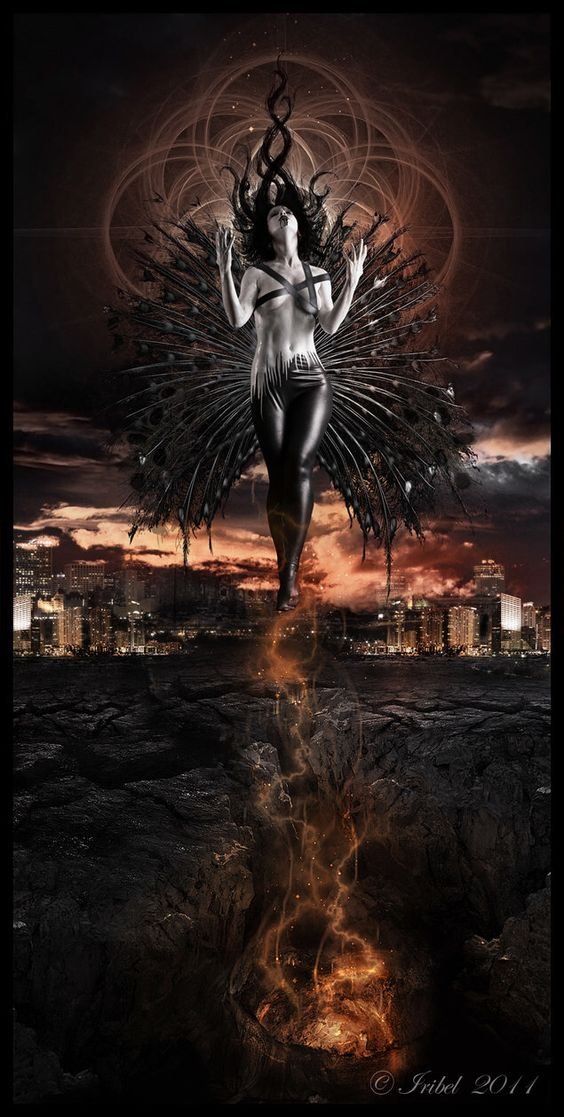
I have become narcoleptic in order to serve she who haunts my dreams. I know that I should stay awake and stay away from this mysterious woman who is hellbent on stealing my soul, but although her presence strips away my courage, I am enraptured at the sight of her beauty and addicted to the danger that she wears like an aromatic scent.

My nameless dream lover is a paradox, duskily exotic yet of no recognizable ethnic descent and so pale as to make alabaster appear tanned. Her long flowing hair is a tangle of locks, thick, wild and constantly billowing like obsidian curtains in the wind, streaked with grey at her pronounced widows peak and temples. Her eyebrows, dense and dark, contrast colorless retinas that draw my eyes down along an aquiline nose to her pink rosebud lips that drip crimson onto the hi-necked lace top that seems to rise and crash against her shoulders and breasts.

My knees buckle and I kneel at her approach, weak, naked and shivering as she towers over me. Her narrow hands with their thin, scalpel-like fingers, hover inches from my exposed throat, twitching in anticipation. She plans to kill me, and I should be afraid, but all I can think about, all I care about, is if I will feel her touch, taste her lips and fulfill my desire one last time before she takes from me a life that I would give to her freely.

I always awaken the same way, unfulfilled, miserably alone, and alive, much to my dismay.

Text and audio ©2004-2021 Rhyan Scorpio-Rhys

One Man’s Meat

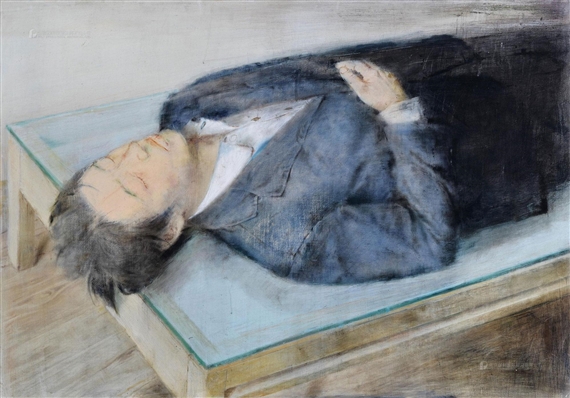
I tested the ripeness of Mr. Skelly’s soul more than thirty times this evening, all at the insistence of his wife, Tamara, who never left my side for an instant. I tried to explain to her that this was a delicate process that could not be rushed, but my words never reached her, as if her ears were made of cloth. Mr. Skelly’s ash gray body was laid out on the dining room table like a flesh centerpiece, table decorated with the finest cloth and place settings that she could afford.

This wasn’t uncommon. Most people were ignorant of the proper protocol in matters such as this. They would set out red wine and wafers, or specially baked breads and cakes, and some even brewed their own ales. Those trappings weren’t necessary, born mostly of superstition and old wives’ tales, but had they been presented, I would have tasted the offering.  If for no other reason than to be polite.

Her husband had come to see me some six months earlier. He was skeptical, as most people are when seeking my services, but I never believed in hard selling my skills. It was a matter of faith. Either you believed that I could do what I claimed I could do, or you couldn’t.  In the end, Mr. Steven Skelly did believe.  He told me he had Acute Lymphocytic Leukemia and wasn’t expected to survive the year. And the diagnosis proved to be accurate.

When I first arrived at her door, Tamara debated whether or not to let me in. Not with me. She debated with herself. A loud conversation, as if both halves of her brain, the logical and the emotional sides, succeeded in separating themselves from one another and exercised shared control over the body. A conversation only the bereaved could have and still seem sane.

This was nothing new to me, in fact, Tamara’s discourse with herself counted amongst the tamer exchanges I had been witness to over the past ten years. I remained silent, taking no side in the argument, and was prepared to comply with her decision, either way. If she declined my services, I would quietly tip my hat and walk away.

When she quieted down, we stood there, me on her porch, unmoving, and she wedged in between the narrow crack of her door, unspeaking.  Then, she shifted aside slightly, which I took as an invitation to enter, and squeezed past her as politely as I could manage in the limited space provided.

As I stated earlier, Mr. Skelly was laid out on the table in the dining room, dressed in his Sunday best, a bible laid on his chest with his hands folded upon it.

“Mrs. Skelly, I wish you hadn’t gone through all this trouble—“

“Tamara, please, and it was no trouble at all.” she smiled kindly as she touched her dead husband’s face.

“No, what I mean is, we’ll have to remove your husband’s clothes. I can’t perform my job this way.”

“Oh. I’m sorry. I thought—“

“It’s all right, you didn’t know. How could you know?”

Mr. Skelly was a tall man, a sturdy man, and even the cancer couldn’t rob him of that, but it made his dead weight all the more difficult to manage. How Tamara succeeded in dressing him all by herself in the first place was remarkable. Where there’s a will, I suppose. In silence and in tandem, we stripped the corpse, being as respectful to the man who was no longer with us as we could manage.

“How long?” Tamara asked.

“Excuse me?”

“How long will it take for you to do your—thing?”

“There isn’t a set timeframe for this sort of thing, Tamara.” I took one of her hands in mine, and she let me. “Most people believe that life and the soul are one and the same thing. This simply isn’t the case. Life ends when the human body shuts down completely. The soul is eternal. The soul doesn’t power the body. If that were the case, we’d all live forever.”

Tamara looked at her husband, hopeful. “So, you mean Steven’s soul is still here, with us?”

“His soul hasn’t released itself from the flesh yet, so yes, in some way, it is still with us.”

Tamara pulled her hand free of my grasp and rushed over to the table and caressed Steven’s face gently. “Honey? Steven? Are you still in there? Can you hear me? Give me a sign if you can hear me!”

I moved behind Tamara, placed my hands on her shoulders and whispered into her ear, “It doesn’t work that way. I’m sorry, it just doesn’t.”

She turned on her heels and was in my face suddenly, like an attack dog. Delicate hands balled into fists and pounded into my chest. “Then why are you just standing here? Why aren’t you doing what we paid you to do?  Why aren’t you helping my Steven? I can’t bear to think of him trapped in there like that, helpless!”

Her energy spent, she folded herself into my chest and I held her.

“He isn’t trapped, Tamara. He’s in a transitional stage, like a caterpillar transforming into a butterfly. If you can imagine a spiritual chrysalis, enveloping his soul, molding and shaping his essence into what it needs to become in order to move on, that’s what’s happening now.”

Tamara looked up at me, concerned. “Then shouldn’t you be getting to work now?  Before it’s too late?”

“His soul isn’t ready.”

“But how do you know?”

I couldn’t stifle a slight chuckle.  “I’ve been doing this for over ten years now. I just know.”

“And you’ve never been wrong? Never made a mistake? Not once?”  Her concern was understandable, but unjustified.

“Not once.  When his soul is ready, when it reaches the stage just before it emerges in it’s new form, I’ll do what I’ve been paid to do.”

“You’ll eat his sin?”  That question was the one thing that never varied in deliverance, from person to person, job to job, regardless of who said it. It always came out sounding the same. Part skepticism, part hope.

“Every drop of it.”

“And there’ll be no retribution?” she looked up at the ceiling but I understood her meaning.

“No retribution. He’ll move on to a better place and none of his sins will transfer to you.”

“And what about you? You take this– all of this on yourself. What happens to you?”

“With all do respect, that’s none of your concern.”  I was expecting an argument. None came.

“Well then,” Tamara straightened up and composed herself.  “Can I interest you in a cup of tea?”

“Tea would be nice.”

She stared at me a long moment, no doubt trying to decipher what made me do what I did. Trying to puzzle out how I came into this profession. But she never asked. I think she knew I wouldn’t be very forthcoming anyway, so she simply shook her head slightly and moved to the kitchen to put the kettle on.

Text and audio ©2013 Rhyan Scorpio-Rhys

The Harbinger of Fate

It was all coming to an end, which was a surprise to absolutely none present. All things, both good and ill, ended eventually, only this was occurring far sooner than any of the ancient writings prophesied. But the deities of the various so-called pagan religions refused to go quietly into that final good night, so they dispatched their chosen ones, entities imbued with long-forgotten magicks which were run-off energies that still lingered from the Big Bang, to meet the challenge of halting the all-consuming maelstrom. Alas and alack, it was to no avail, for one by one, these champions were crushed beneath the heel of inevitable death, until there was but one lone defender.

She was born Hannah of Cahokia, but her messianic name was, Gelysa Tinelan, and she fought bravely but was seriously outmatched, and when it appeared as if she would succumb to time’s tempest, Fate’s harbinger actually rose into the air, not unlike a human phoenix, playing chords of entropy that increased in intensity, calling the souls of the fallen chosen champions back from the dead in the form of a ShadowsReich, and together they engulfed and nullified the chronal apocalypse, at least for the present.

Her task accomplished, Fate gently folded Gelysa within a patch of void borrowed from beyond the edge of the expanding universe, and placed its champion in a state of suspended animation until the next apocalypse rose its destructive head.

Text and audio ©2020 Rhyan Scorpio-Rhys

The Influencers

I am among the few ragtag wandering survivors of Earth and the question I hate being asked the most is, “How did you lose your planet?” because we lost it in the most embarrassing way possible. My homeworld was stolen from the human race via social media. At this point, I would have to explain to extraterrestrials what TikTok, Instagram, and Twitter were, and regardless of whether the alien I was speaking to had a mouth or not, I would get laughed at.

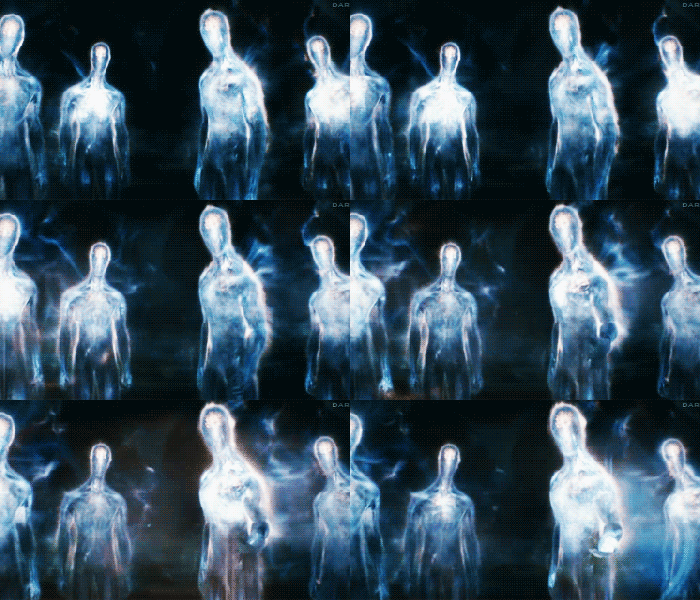
The beings, known as DAC, or the Doublyxian Aelonide Collective, were infants when they first approached Earth. Widely known as a pest control race, they were assigned the task of ridding the world of its inhabitants with significantly less destruction than a planetary war would bring. Studying all the various cultures, they assumed a form as close as they could manage to human, mastered our etiquette, and took to social media platforms, becoming bioluminescent influencers who created a series of challenges, which got progressively harder to perform and resulted in a staggering number of accidental deaths.

Not everyone was so easily influenced but we who remained were so few in number that our every rebellion attempt ended in failure. Eventually, we were captured and to our surprise were treated quite civilly. The DACs were quick to point out that they had committed no act of aggression upon the planet’s inhabitants and were not responsible for any of the human deaths. As they put it, “Earthlings had foolishly acted in a manner contrary to continued existence.”

“But we are not without compassion,” a spokesman for The Collective said. “You are invited to remain here on this world that was previously your home, living a life of what you would consider being luxury as our pampered pets.” An offer which outraged me to no end, but apparently I was in the minority. Most of the survivors accepted the terms of their servitude while I and the rest were given provisions, placed aboard a spaceship, and launched in the direction of the nearest star.

Now, we travel the spaceways in search of a planet where we can become the next wave of influencers and perhaps win a new home for ourselves in the same way ours was stolen from us.

Text and audio ©2020 Rhyan Scorpio-Rhys

Tabula Rasa

There comes a time in every life where a persona goes as far as it can go, meaning atrophication and death are not far behind. But Kaidance refused to let that be the end of her story. Just as a snake sheds its skin in the process of growth, she cast off all the things that made her who she was, abandoning an existence that was no longer large enough to accommodate her new and transformative life energy. Her new persona was a tabula rasa, a blank slate on which she would write for herself a better destiny and a new life for this new year.

To those loyal few who take the time to read my daily scribblings, I just wanted to say, Thank you! Warm wishes for you to have a promising and fulfilling New Year!

Text and audio ©2019 Rhyan Scorpio-Rhys

More Words Than You Need – Some Darlings Ain’t Long For This World

“So the writer who breeds more words than he needs, is making a chore for the reader who reads.” ― Dr. Seuss

No better moment exists than when you first get hit with that brand spanking new premise for a story. There will be those of you who disagree, citing the signing of a contract and being handed a check for your work as a better moment, but I beg to differ. When a story first bursts to life in your mind, you are in the superposition of optimism. The story will be great, the best thing you’ve ever written and will be well-received by the washed and unwashed masses alike. No reality lurking about to place limitations on your spectacular vision at this point.

So, you do your prep work—outlining, research, character development, etc.—and pound out your first draft. And you’re happy with yourself. Real happy. Your first instinct is to share it with the world, but before you slap your baby in the mail or post it online, I need to break some bad news to you. Your story isn’t perfect. Not only is it filled with mistakes but it’s a tad overweight.

Since you most likely don’t have access to an editor at this stage in your writing career, the onus is on you to sharpen the edge of your blue-pencil blade to fix typos and cull clumsy or ambiguous phrasing.

If you’ve ever handed a story to someone to read, a story you were sure was error-free, you quickly learned that spotting mistakes in your own writing is difficult. The problem with self-editing is your mind glosses over errors because it knows what you meant to write and sometimes reads that instead of what you actually wrote. Fortunately, self-editing is a skill you can learn to hone in order to eliminate mistakes and improve the quality of your writing:

1. Don’t edit on the fly

I know this is a hard thing to do, but when you’re writing why not concentrate on getting your idea down on paper first? Sure, if you spot a typo it’s okay to correct it or to approach a sentence from a different angle in order to keep flow going, but when you begin deleting sections of your work or get caught in the dreaded rewrite loop—reworking the same paragraph over and over again—you’re placing road blocks between you and the forward progression of your story.

One solution to help break you out of this bad habit may be to try a distraction-free writing program like OmmWriter, Write or Die, Freedom, Grandview, and Don’t Look Back.

2. Set it and forget it

Once you’ve finished your latest magnum opus, stuff it in a drawer and go about your business before you even think about attempting to edit it. Concentrate instead on one of the many things you had to put aside in order to make time to write. What you’re doing here is stepping out from among the trees so you can see the entire forest.

You’ll find when you eventually return to your work, you’re approaching it with a new set of eyes that are better equipped to spot things you’ve missed, things that don’t work as well as you initially thought they did, inconsistencies, etc.

3. Big picture editing before sentence micromanagement

I know, I know, you’re eager to jump in and fine tooth comb your work sentence by sentence, and good on you for being that keen, but before you get into the detail work, I need you to consider examining your content and overall structure. Is there important information missing from the piece? Or a section that’s either irrelevant or seems out of place? How about scenes in desperate need of drastic revision?

Focus on the major issues before you begin tweaking words and sentences.

4. Put your work on a diet

You’ve over-written the piece. Uh-uh, don’t argue. You’re a writer who’s in love with the notion of stringing words together to convey ideas that plant images your audience’s mind, which means you over-write. Don’t be ashamed, most writers use more words than are absolutely necessary.

It’s time to get your piece into fighting shape by cutting its body mass index by ten percent. It’s easier to drop this excess poundage than you think, by simply losing mediocre phrases, unnecessary adjectives, and repeated points.

5. Don’t rely solely on spell-check

A spell-checking program can be your friend, but we all know from experience that it isn’t foolproof. The human eye is still the best tool for catching those sneaky homophone imposter stand-ins (to, too, two; it’s, its; yaw, yore, your, you’re; there, their, they’re), the ever-elusive missing words, auto-correct mishaps, etc.

6. Be backwards in your reading

Mistakes love sliding past you because they realize how tough it is proofing your own work. One of the ways to flip the script and catch them at their diabolical game is to start at the very end of your story and read it backwards. Sounds silly, but it works.

7. Push your darlings out of the nest

One of the awful things about being a writer is that you’re never one hundred percent completely satisfied with your work. But no matter how determined you are to touch the face of perfection, the hard fact is your writing will never be flawless. Accept it. You’re just going to have to settle for the best you can humanly manage. You’ll know when you’ve reached that point when you begin making slight adjustments, then reverting it back to its original form.

It’s time to stop, kiss your darlings on the forehead and push them out of the nest and let them fly into the world.

***

Actually, there are a plethora of editing tips that you can utilize before you get to this stage and instead of listing them all, I’ve decided to post the links below and allow you to browse them at your leisure and cherry pick the ones that work best for you.

30 Quick Editing Tips Every Content Creator Needs to Know

10 Tips For Effective Editing

Editing Tips for Effective Writing

21 Proofreading and Editing Tips for Writers

And just for kicks I decided to link a list of homophones. Ya never know, might come in handy:

A List of English homophones

Sally forth and be writeful.

Don’t Be A Chump, Don’t Infodump

Image

Finding balance in your life isn’t simple. Balancing life and writing is even harder. Finding balance in your writing? That’s something you’ll be working on for the rest of your natural writing life, because a well-written story balances exposition, description, action and dialogue, but not in equal measure. You need to keep a watchful eye on exposition.

In its basic form, exposition is the part of a story that sets the stage for the drama to follow, introducing the theme, setting, characters, and circumstances, usually at the beginning of the story. Sounds straightforward enough, right? Well, writing good exposition that flows with the story and continues to draw the audience in, isn’t as easy as it sounds. In fact, many writers misuse exposition as an illegal dumping ground for information that not only causes a distraction that breaks the flow of a story, but also decreases interest.

And you don’t have to be an expert to spot the exposition dump (aka infodump) because we’ve all experienced and recognized it while reading a novel or watching a movie or television program. It’s that speed bump or sometimes roadblock in the story where the writer unloads a ton of information at once as a means of explaining things like backstory, characters, and the rules of the story world. If you’re a culprit of this, stop it now. We’ll forgive your ignorance in past works (go back and cull the exposition, if at all possible) but it’s a bad exposition technique and the line must be drawn here. This far, no further.

Typically, infodumping occurs when a character, new to the scene, is introduced to a foreign setting and is force-fed all the knowledge of the various individuals at play, the rules of the micro society, and the overall big picture of the story world. You’ll find this a lot in science fiction and fantasy tales.

Other bad/lazy infodumping techniques include “The Lecture,” where a speaker over-explains information the writer discovered during their research period of the writing process and thought would show their faux expertise in the subject. The other offender is commonly known in the sci-fi writing community as the “As You Know, Bob,” conversation, where one character tells another character information they already know. Please don’t do this. Not only is it lazy, but it comes across as unrealistic.

This isn’t to say that all exposition is bad, in fact, properly executed, it takes up roughly 10% of a well-balanced written piece (the other 90%, of course, being the description, action and dialogue that make up the scenes). Some of the information embedded within expository text is actually relevant, it simply requires a little finesse to fit it in seamlessly and not disrupt the story’s flow.

Of course, if you handle your description, action and dialogue properly, you can whittle that 10% down and most people won’t notice or care about the missing exposition.

Well, that’s enough infodumping for me today. I’m off to tear a story down and rebuild it.

Sally forth and be writeful.

Be Violent And Original (in your writing, naturally)

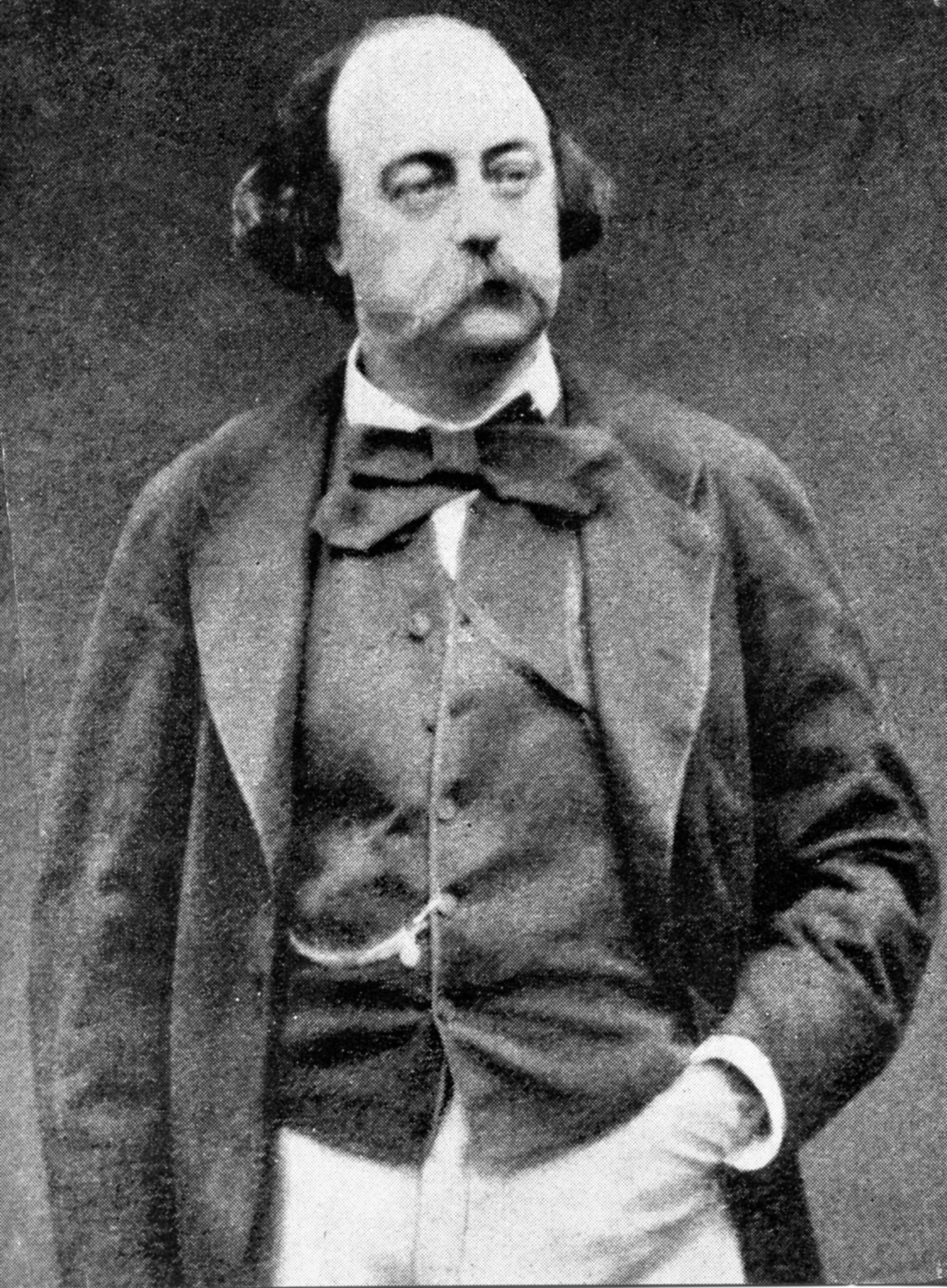
Image“Be regular and orderly in your life, so that you may be violent and original in your work.” – Gustave Flaubert

Live a good life. This isn’t something I should have to tell you. As you make your way through the workaday world, you should strive to do no harm, treasure your relationships with family and friends, seek calming pleasures that contribute to peace of mind, and live in harmony and balance.

Your written life? That’s a different creature all together.

Safe, tame, bland, and sometimes “it’s good” (with the unspoken “but…” attached on the end like a phantom limb) are among the worst things someone can say about your work. Whenever you write, your goal should be to provide elements that hook your audience and reels them in and after the story has been told, leaves them with an emotional takeaway.

Writing is about risk-taking, about snapping off the handbrakes, about shrugging off restraint, about leaving your internal censor bound and gagged in a tiny room, allowing your words and imagination to run amuck and wreak havoc in the world you’ve created.

If you’re not currently writing this way, what’s holding you back? What’s bridling your passion? What’s preventing you from creating bold characters, powerful phrases and dangerous situations? If not yours, then whose hand is on the lever that controls the sluice gates holding back the churning anxiety, obsession and peril your story desperately needs?

Are you trapped within the safe zone because of fear? Then allow me to geek out a moment as I quote the litany of fear, an incantation used by the religious/political sisterhood known as the Bene Gesserit from Frank Herbert’s science fiction classic, Dune:

I must not fear. Fear is the mind-killer. Fear is the little-death that brings total obliteration. I will face my fear. I will permit it to pass over me and through me. And when it has gone past I will turn the inner eye to see its path. Where the fear has gone there will be nothing. Only I will remain.

Fear is also an art-killer. It’s typically the fear of being judged by professionals, critics and peers, of not being admired by the audience for taking a controversial stance or doing horrible things to characters. But the possible opinions and tastes of everyone outside yourself shouldn’t factor in while you’re creating your story. The transfer of ownership hasn’t taken place at this point. It isn’t the reader’s story yet, it’s still yours, so why not write fiercely?

Give your characters barbed tongues and let them spit venom. Give them the courage to do all the things you would never dream of attempting, even on your most adventurous or foolhardy day. Tear their hearts out and make them suffer as you place them smack dab in the center of conflict and tension-filled drama.

Basically, I’m asking you to fish out that key that you’ve hidden in the back of a junk drawer within the deep recesses of your mind and open the door to your wildest imaginings.

You’ll come to discover that if you’re open, honest and free in your writing, yes, you will have your critics and people who won’t either like or understand your work, but you’ll also attract an audience that will come back for more.

What’s that? You need more incentive? Okay, well I didn’t want to break out the big guns but here goes:

I dare you to become more engaging and intriguing with your writing. I double-dog dare you.

See what you made me do? Happy now?

Sally forth and be writeful.

Mary Christmas

Luckily my favorite table was open at the bistro I frequented in Alphabet City, the one by the window where the midday sun filtered through shelves of antique colored milk bottles, mason jars, and assorted glassware.

I scanned through the menu feigning interest in all the food options available for some unknown reason though I knew what I was going to order because my order hadn’t changed in over three years. The food here wasn’t really great but it was one of the few places in the city that had a natural ambiance that suited my temperament.

I felt a presence looming over me that smelled of Christmas—actually, the smell was of apples and cinnamon, which always reminded me of Christmas—so I placed my order by rote without looking up from the menu, keeping up the pretense of struggling with the choices of so many delectable options which was silly but perhaps I wanted the staff to recognize how much I liked the place.

“Um, that sounds delicious,” a voice said in a register higher than I was accustomed to in the bistro, a woman’s voice. “But I don’t actually work here.”

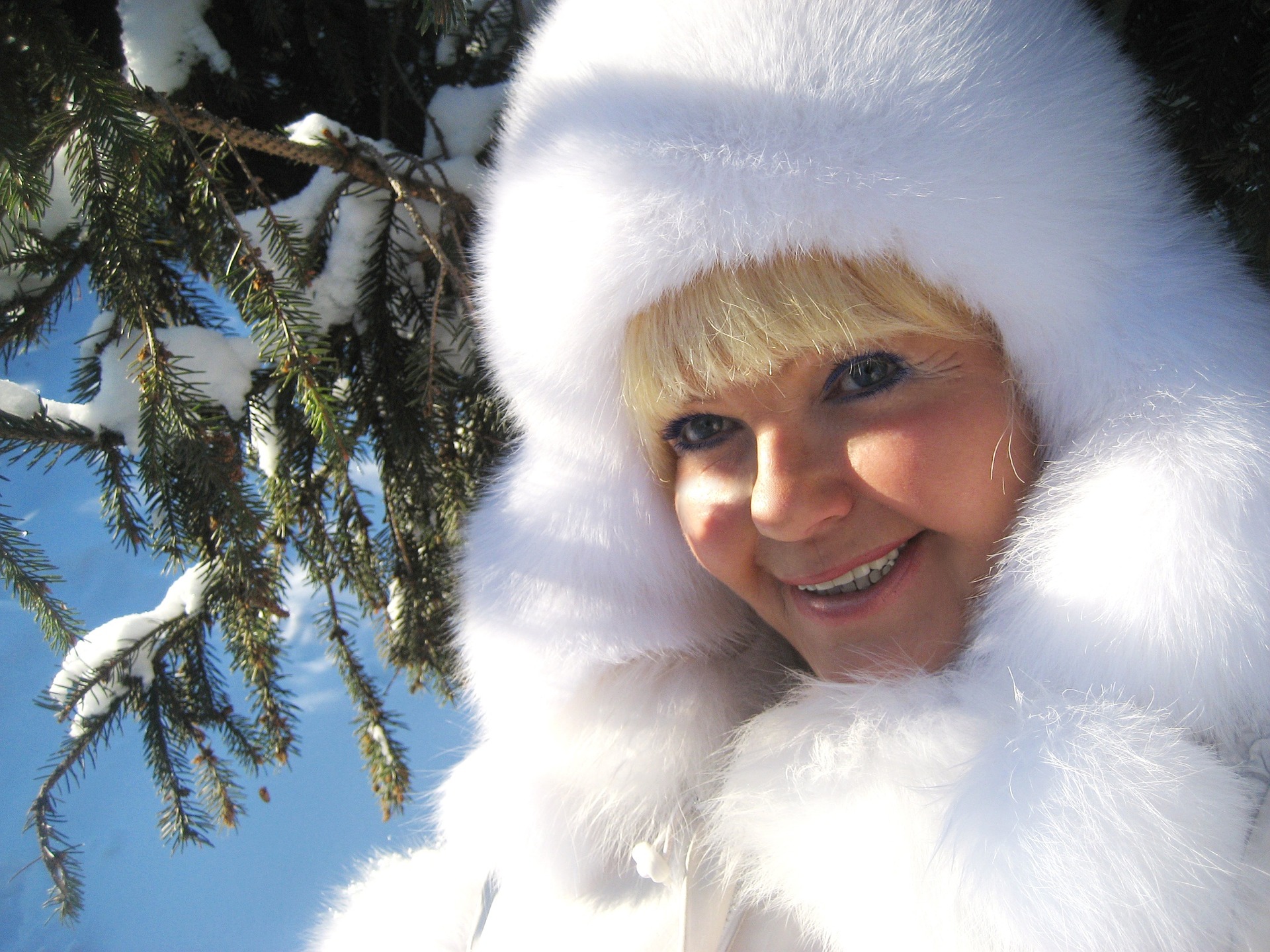
I looked up and was nearly blinded by a rosy-cheeked, platinum blonde woman bundled in the whitest fur coat in existence—hopefully not a real fur coat because that would be cruel—topped with a fur hat.

“Is anyone sitting here?” she pointed at the empty chair across the table from me.

I answered, “No…” as I glanced around at all the vacant tables situated throughout the eatery and I was about to bring this to her attention when she daintily and skillfully seated herself.

“Hi, my name is Mary, Mary Christmas,” she beamed a smile and proffered her white-mittened hand to shake. “You have a kind face so you may call me Mary or Your Royal Majesty Queen-Empress of the Known Universe, absolutely your choice but under no circumstances are you to refer to me as Merry as in Merry Christmas. I grew up being teased by that and I’m not having anymore of it.”

I didn’t answer because I was too busy processing what was happening which she took an entirely different way, most likely because I hadn’t completed the handshake ritual.

“Oh, you’re one of those, are you?” she sighed, slipping the mitten off her hand and rummaging through a white handbag produced from a fold in her coat almost if by magic.

“One of those?”

“A non-believer. A person who has to be shown instead of accepting things at face value,” she said as she pulled something out of her purse and handed it to me. “Here, proof.” It was her driver’s license and I’ll be damned if it didn’t list her name as Mary Christmas.

“Look, miss…”

“Mary.”

“Mary, I wasn’t doubting your name, strange as it may be, no offense…”

“None taken.”

“It’s just that, you know…”

“Know what?”

“Come on, you have to admit it’s a bit unusual for an absolute stranger to sit at your table uninvited.”

“Oh, but you did invite me.”

“I did?”

“Well, not you verbally, but your loneliness called out to me. I’m sensitive to things of that nature, people’s loneliness and all that.”

“I appear lonely to you?”

“Most definitely. No offense.”

“None taken, I guess.”

“And well, it’s Christmas time and no one should feel lonely on Christmas.”

“Oh, I get it,” I blushed against my will and was suddenly unable to keep eye contact with her. “Um, I’m flattered, I guess but this really isn’t my sort of thing. I don’t pay for…”

“Wait a minute, you think I’m a…”

“You’re not?”

“Definitely not.”

“I-I am so sorry! It’s just beautiful women don’t make it a habit of approaching me and…”

“Let me stop you right there. I will allow the infraction because you called me beautiful and before you misread anything else into me sitting at your table, if you and I become anything it will simply be friends, not friends with benefits or any of this other modern-day nonsense. I’m far too old-fashioned for that. And yes, even as a friend I still expect you to be gentleman enough to open doors for me as well as pull out my chair when we dine, thank you very much.”

“Um, okay?”

“And quit acting like this is weird,” Mary said. “Tis the season and I have no gift to bring other than to say, I see you. This has grown to be an unintentional world where people are acknowledged more on the internet than in real life, so I intend to change that, right here, right now, starting with you by asking you a simple question.”

“And what question would that be?”

“How are you doing?” Mary asked, looking me in the eye and giving me her full attention and I was about to respond with the automatic faux “Fine,” but there was something in her expression that made me feel that she was interested in hearing my honest response, so I told her.

I told her how I thought I was at the end of my rope. As an older gentleman who was closer to the end of the race than the beginning, I felt absolutely lost. My life was empty. I had felt this way before but then I wore a younger man’s clothes and was far more resilient, able to pick myself up by the bootstraps and rebuild my life but the change was always temporary and things crumbled and I had to begin again. The problem was I didn’t think I had the strength or wherewithal to start over again. I had lost all interest in the things I was once passionate about and all motivation to find something new was gone.

“Sometimes,” Mary reached her hand across the table and held mine. “We just need to focus on things beyond our circumstances to maintain our sense of peace and allow our senses to lead us to our true path.”

“Like you did by sitting at my table?”

Mary smiled and nodded. “Something like that.”

Now, I wasn’t one to believe in Christmas miracles but this bizarre woman, bless her heart, offered to be a knot at the end of my rope, transforming her from a random stranger to a catalyst of joy. And as the conversation continued, we discussed making a greater impact on society by acknowledging strangers and becoming a source of compassion for those in need and in turn challenging them to make the world a better place, filled with upturned smiling faces, happy to make contact with a living being instead of blue-lit zombies scouring their phones for acceptance and approval.

I never gave much credence to the idea of living a life of service as I equated it to religion and I was not a spiritual man by any stretch of the imagination but there was no denying how constantly amazed I was that a spontaneous conversation or a meaningful smile were so rare that they could literally be the highlight of someone’s day. Now, my newfound purpose in life had become making these rare moments of love between complete strangers the norm.

Thank you, Mary Christmas, for starting a revolution.

Happy Holidays, everyone! Be safe and be well!

Text and audio ©2020 Rhyan Scorpio-Rhys