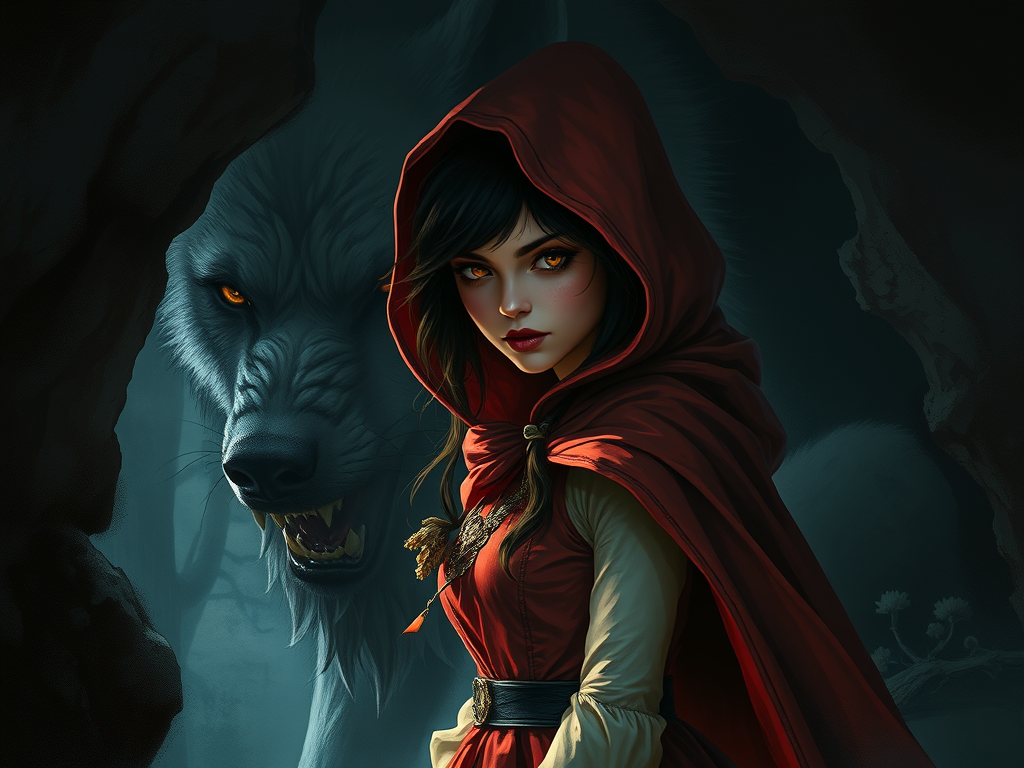
Little Noir Riding Hood Part I: The Client in Red

Bzou smelled her before he heard her.

Blood—cold, human, female—threaded through the damp air outside his den like a slow confession. Not fresh injury. Not panic. Something older and deeper, a stain that didn’t rinse out. It clung to her the way smoke clung to clothes after a long night near a dying fire.

He opened his eyes as the emberlight behind him guttered low. The cave held the kind of darkness that belonged to the world before lanterns, before roads, before people decided shadows were a problem to be solved. His breath steamed in the cold, a pale ribbon curling toward the ceiling, and he listened.

Footsteps, careful.

Not the stumbling, drunk courage of a villager. Not the hurried, frantic rush of someone lost in the woods. These were measured. Intentional. The sound of someone who had made a choice and was prepared to live with it.

She appeared at the mouth of the cave with the fog behind her like a curtain. Hood up, shoulders squared. The cloak was red, but not bright. Not storybook scarlet. Darker. A red that had been slept in, rained on, dragged through thorns and older regrets. The kind of red that didn’t beg attention, but demanded it.

Bzou didn’t rise. He didn’t have to. The den was his kingdom. Anyone who entered it had already crossed a line.

“You shouldn’t be here,” he said.

His voice was the voice of stone rubbed raw. It pressed against the damp air and made the fog feel heavier.

She didn’t flinch.

“I know.”

That alone was wrong. Most humans heard his voice and remembered they were made of soft things. Most humans took a step back even if they didn’t mean to. Fear was automatic. A reflex. A truth.

This woman stood still as a nail.

Bzou watched her for a long moment. The firelight crawled over his fur and over the ridges of his back, catching on the old scars that never fully faded. In the village they called him wolf. Monster. Pact-keeper. Curse. They said a lot of things when they were trying to keep their hands clean.

He shifted, slow and deliberate, and his bones cracked quietly as he unfolded himself from the hollow where he’d been curled.

“What do you want?” he asked.

The woman reached up and pushed back her hood.

Her hair was dark as wet bark, her cheekbones sharp enough to cut glass, her eyes too steady for someone standing at the edge of a predator’s home. Her lips were painted deep red—not for vanity, not for seduction, but like punctuation. A period at the end of a sentence she’d been repeating to herself for days.

She wanted to be seen.

“A missing person,” she said.

Bzou almost laughed, but it would have sounded like a growl. “Not my world.”

He turned away from her, toward the dwindling embers, toward the quiet he’d earned. The village’s problems belonged to the village. The village had chosen its rules. He had chosen exile. That was the pact: he stayed on the edge, and they left him alone. A boundary drawn in old blood and older fear.

Her voice came again, closer than it should have been.

“My grandmother is gone.”

Bzou didn’t turn, but the words tightened something inside him. Missing people were common. People disappeared into woods, into drink, into other people’s cruelty. The world took what it wanted. Sometimes it didn’t even bother to leave a reason behind.

But she didn’t say it like someone repeating the village’s comforting lie. She said it like someone naming a crime.

“They said she wandered off,” the woman continued. “But she didn’t. She was taken.”

Now Bzou turned.

Not quickly. Not with alarm. With the slow attention of something that had learned not to waste energy on false alarms.

“What’s your name?” he asked.

She hesitated. Just long enough to betray a private argument she’d already lost.

“Redalhia.”

It sounded like a name from somewhere else. Somewhere old. Somewhere that didn’t belong to Gildengrove’s neat little square and its tidy sermons and its polite lies.

Bzou studied her. “If your grandmother was taken, why come to me?”

Redalhia didn’t look away. “Because the village doesn’t hunt its own sins.”

Bzou felt a low rumble gather in his chest, not quite a growl. Not quite a laugh. The kind of sound that meant you’re closer to the truth than you should be.

“You’re not from there,” he said.

“I was,” she replied. “Then I wasn’t.”

That was all she offered, and it was enough. The people who left Gildengrove didn’t come back. Not unless they were dragged. Not unless they were desperate. Not unless they were carrying something the village wanted.

Bzou stepped closer. Not to threaten. To measure. The air around her was dense with layers: soap, rain, a trace of cheap tobacco, iron from old blood, and beneath it a faint sweetness like crushed berries that had begun to rot. He could smell nights without sleep. He could smell decisions made in the dark.

“You want me to walk into the village,” he said.

“Yes.”

“You know what that means.”

Redalhia’s jaw tightened. “I know what it means for you.”

Bzou’s eyes narrowed. “And what does it mean for you?”

For the first time something flickered across her face—not fear, not regret, but something like a tired acceptance.

“It means I stop pretending the story they told me makes sense,” she said. “And I stop acting like I’ll survive by keeping my head down.”

Bzou watched her. A long, quiet assessment. He had seen women like her before—women who had been forced into sharpness by dull men. Women who had learned the cost of being small.

“You came alone,” he said. “That’s either brave or stupid.”

Redalhia’s lips curved slightly, but there was no warmth in it. “I didn’t come unarmed.”

Bzou’s nostrils flared. He could smell steel under her cloak. A knife. Maybe more.

“That’s not what I mean.”

“I know.”

The silence between them thickened. The cave’s mouth framed her like an omen.

Bzou’s gaze dropped to her cloak again. The red wasn’t simply red. It had a history. A texture. A depth. It wasn’t a costume.

“How long has she been missing?” he asked.

“Three nights,” Redalhia said. “They told me she wandered into the woods during a fog and didn’t come back. They said she’s old, forgetful, that she probably fell. They asked me to be sensible.”

Bzou’s throat tightened with the old familiar disgust. Sensible. The word people used when they wanted you to agree to something monstrous.

“And you weren’t.”

“I was,” Redalhia said quietly. “For one night. And then I went to her house.”

Bzou stilled. “Her house is sealed.”

Redalhia nodded once. “Yes.”

“You shouldn’t be able to get in.”

“I didn’t get in.” Her eyes hardened. “But I smelled something through the cracks. Not her. Not death. Something else.”

Bzou felt his fur lift along his spine. “What did you smell?”

Redalhia’s gaze didn’t waver. “Tallow.”

Bzou’s jaw clenched.

Tallow meant torches. It meant huntsmen. It meant old rites with clean names. It meant the village doing something it didn’t want seen in daylight.

Redalhia took a slow breath, as if she’d been holding this in for days.

“They nailed her shutters shut from the outside,” she said. “Iron nails. Like she was a thing to be contained.”

Bzou turned his head slightly, listening past her words to the world outside. The fog was thick tonight. The kind of fog that made distances lie. The kind of fog his kind moved through easily.

He looked back at her.

“There was a pact,” Bzou said.

Redalhia’s eyes sharpened. “So you admit it.”

He didn’t answer. The pact wasn’t a story for outsiders. It was an arrangement carved out of survival. The village kept its hearths and its children; Bzou kept the things that crawled at the edges. Sometimes, when the forest spit up something wrong, he put it back down. Sometimes he dragged it into the dark and broke it there.

He did not interfere with human business. Not anymore.

“You ask me to break it,” he said.

Redalhia stepped closer, too close, the red of her cloak absorbing the firelight. “I ask you to look me in the eye and tell me you don’t already want to.”

Bzou’s breath steamed between them. He could hear her heart. Not racing. Not pleading. Steady. Determined. Like a drum.

“You think you know what I want,” he said.

“I know the village is rotting,” Redalhia replied. “I know they’re hiding something under their clean faces. And I know you smell it too, whether you admit it or not.”

Bzou stared at her for a long time. In the old stories, the girl in red wandered into the woods because she was naive. Because she didn’t understand the rules. That story was a lie. Girls in red wandered into the woods because no one else would go. Because someone had to. Because the world didn’t protect the soft.

Redalhia wasn’t soft. Not anymore.

“What’s your grandmother’s name?” Bzou asked.

Redalhia’s voice tightened. “Mireille.”

The name landed heavy. Not because Bzou knew the woman—he didn’t. Not because the name had power in itself. But because naming a missing person was a form of refusal. Refusal to let them become rumor. Refusal to let them become a lesson.

Bzou turned away from the fire. He moved deeper into the cave for a moment, into the shadows where Redalhia couldn’t see his face. He reached into a crevice in the stone and drew out something wrapped in old cloth.

A token. A reminder.

He returned to the firelight and unwrapped it.

A strip of leather, cracked with age, threaded with beads that had once been white and were now the color of old teeth. At its center, a small metal medallion stamped with a symbol the village pretended not to recognize: a wolf’s head inside a ring of thorns.

Redalhia’s eyes flicked to it, then to him.

“What is that?” she asked.

Bzou held it between two fingers. “Proof.”

“Of what?”

He didn’t answer directly. He looked at her and asked, “When you were a child, did they tell you the woods were dangerous?”

Redalhia’s mouth tightened. “They told me the woods were punishment.”

Bzou nodded once. “Then you learned their favorite lie.”

He let the medallion fall back into his palm and wrapped it again, slow, as if each motion was a decision.

“I don’t walk into Gildengrove,” he said.

Redalhia didn’t move. “Then Mireille dies.”

“That’s not a certainty.”

Redalhia’s voice turned razor-thin. “It’s a pattern.”

The fire popped. The sound snapped through the cave like a breaking bone.

Bzou met her eyes. In them he saw something he hadn’t expected. Not just anger. Not just fear. A quiet, brutal certainty that she would go alone if he refused. That she would step into the village, into its teeth, because no one else would.

And that she might not come back.

Bzou exhaled, slow.

“You have one more thing you’re not telling me,” he said.

Redalhia’s lashes fluttered once. A tell. A crack.

He stepped closer until he could smell the faintest trace of something beneath everything else. Not scent exactly. More like residue. Like a touch left behind.

Something old.

Something that didn’t belong to a human body.

“You’ve been marked,” Bzou said quietly.

Redalhia’s throat worked. “I don’t know what you mean.”

Bzou lifted his hand and stopped just short of touching her face. He didn’t need to. He could feel it in the air around her—the faint pull like gravity slightly wrong.

“She’s not only missing,” he said. “She left you something. Or something left her through you.”

Redalhia held his gaze, and for the first time the calm in her expression wavered.

“I started dreaming,” she admitted. “After the second night. Same dream, every time.”

Bzou’s voice dropped. “Tell me.”

Redalhia swallowed. “A well.”

The word fell into the cave like a stone into deep water.

Bzou went still.

Redalhia continued, her voice quieter now, as if speaking too loudly would wake something. “It’s boarded up. Nailed shut. There are symbols carved into the wood. I’m standing at the edge, and I can hear breathing from below.”

Bzou’s jaw tightened. The old boundary inside him—the pact, the rules, the careful distance—shifted like a rotten fence post giving way.

“Do you know where the well is?” he asked.

Redalhia nodded once. “Near the oldest houses. Off the square.”

Bzou stared at her. He didn’t like coincidences. He didn’t trust them. Dreams came from somewhere, even if people pretended otherwise.

He looked toward the cave mouth, where fog rolled like a living thing.

“The village didn’t let you in because they wanted you safe,” he said.

Redalhia’s lips pressed together. “No.”

“They let you in because they wanted you close.”

Redalhia didn’t ask who they were. She didn’t have to. Something in her already knew.

Bzou reached for his cloak—dark, heavy, old. Not a garment, a second skin. He swung it around his shoulders.

Redalhia’s breath caught, just once. Not relief. Not victory. Something more complicated. Like she hadn’t believed he would say yes until the moment he moved.

“You’re coming,” she said.

Bzou’s eyes narrowed. “We’re going.”

Redalhia’s fingers curled under her cloak around the knife she carried, as if it steadied her.

Bzou stepped past her into the fog. It swallowed the cave and the fire behind him immediately, taking the warmth away like it had never existed.

He paused at the threshold and looked back once.

“If you lie to me,” he said, “I will leave you there.”

Redalhia met his gaze. “If I lie to you,” she said, “I deserve to be left.”

Bzou turned forward again and started walking.

The fog thickened as they moved through the trees, making the world feel like a half-remembered story. The forest accepted him the way it always had, bending around his presence, quieting its small animals, swallowing its own sounds. Redalhia followed close behind, steady-footed, more capable than most humans. She didn’t speak. Neither did he.

Words weren’t the point anymore. The point was the border they were crossing.

When the first rooftops of Gildengrove emerged out of the fog, Bzou stopped.

The village sat low and neat between the trees, lights glowing warm in windows, smoke curling from chimneys—an image of comfort practiced so often it had become a weapon. The cobblestone road into town was damp, black with rain, and the air smelled too clean. Too scrubbed. Too much sage burned to hide the wrongness beneath.

Bzou inhaled.

There it was—tallow, old iron, lamb fat, and something else threaded underneath, thin but unmistakable. Burned hair. Metal. And the faintest trace of wolf.

Bzou’s eyes narrowed as he stared into the fog-shrouded streets. “They know,” he said.

Redalhia’s voice came quiet beside him. “Know what?”

Bzou didn’t look at her. His gaze stayed locked on the village.

“That you came to my den,” he replied. “And that I said yes.”

They stood at the edge of Gildengrove, just outside its first fence line, while the fog curled around them like the breath of something large and waiting.

From somewhere deeper in town—a sound, distant but clear enough to tighten the skin.

A crackle. A flare. Fire being fed.

Bzou exhaled once, slow and grim. “Stay close,” he said.

Redalhia’s hand slid fully onto the knife under her cloak. “I wasn’t planning on wandering,” she replied.

Bzou stepped forward.

And the village, smelling of clean lies and old smoke, opened its mouth.

The Eternal Vows of Aida

The desolate landscape seemed to stretch endlessly before Aida. Memories of the long, strenuous journey weighed on her, but the thought of returning gave her strength. Over time, life had taken its toll on her vision. Bright sunlight became her nemesis, causing her eyes to blur. But this handicap couldn’t defeat her spirit. She embraced the deep contrasts of the world, moving within the comforting embrace of the shadows, letting her heart be her compass.

As she trudged on, the past echoed in her mind. The way the sunlight streamed through the stained-glass windows, casting vibrant hues across the church hall. The love in his eyes, the promise of forever, and the binding words they shared. Before God and loved ones, Aida had pledged her loyalty, her fidelity, her nurturing love. A promise, not just to her husband but to herself, to never betray the sacred bond they were forming.

However, an unforeseen twist of fate took her life prematurely. The man she loved, whom she had bound her soul to, brutally ended her existence. Though her physical form was no more, her essence remained trapped on this plane of existence, anchored by an insatiable need for vengeance.

Yet, here she was, a spirit tethered between realms, drawn back to the place of her untimely demise. Aida stood concealed within the shadows, observing him from a distance. Her ethereal form was barely more than a whisper, but the intensity of her emotions was palpable. Her gaze scoured the surroundings, seeking a connection, a beacon that would guide her back to confront the monstrous act of the man she once loved.

As the weight of her grief and anger converged, the shadows around her began to shift and dance. They wrapped around her, merging with her essence, empowering her with a force she had never known.

Driven by a burning desire for justice and to protect others from suffering her fate, Aida stepped out from the shadows, her presence more powerful than before. With each step, memories of love, trust, and betrayal fueled her resolve.

The confrontation was imminent, and the weight of their shared past would determine their entwined fates. But Aida was no longer the naive bride. She was a force of nature, a specter of love wronged, ready to reclaim her vows and ensure that no one else would fall prey to his treachery.

The atmosphere within the grand manor was suffocating. Shadows clung to the walls, and the weight of past sins permeated every room. As Aida’s spectral form made her presence felt, Frederick’s demeanor shifted from casual indifference to unease.

A cold, unsettling breeze swept through the room, causing Frederick to shiver. He could feel her presence even before he saw her—his past coming back to haunt him in the most literal sense.

“Frederick,” Aida’s ghostly voice resonated, echoing eerily in the vast space of the room.

Frederick jumped, his eyes darting around, seeking the source of the voice. “Who’s there?!” he demanded, his voice betraying a hint of fear.

“Have you forgotten your bride so quickly?” her voice replied, sorrow and anger evident in her tone.

Frederick’s face went pale as the moon. “It can’t be. You’re… you’re gone.”

Aida’s form began to materialize, her once lively eyes now empty sockets, her flowing dress stained with the memory of her untimely death. “You did this,” she accused, pointing a translucent finger at him.

Frederick backed away, horror written on his face. “No! It wasn’t my fault.. it was an accident!”

Aida’s laugh, cold and hollow, echoed around him. “Denial won’t save you,” she whispered. The room grew colder, and the very walls seemed to close in on Frederick. Shadows writhed and stretched, taking on grotesque shapes that mirrored his worst fears.

He could feel hands—cold, clammy, and disembodied—grabbing him, pulling him closer. Aida leaned in and pressed her lips to his, forcing an unnatural kiss that was suffocating him. And in that kiss he could hear the cries of anguish, feel the pain he had inflicted on Aida. Every emotion she had felt in her final moments was now his to bear.

“Please!” Frederick begged, when the kiss ended, tears streaming down his face. “I’ll do anything!”

Aida’s ghostly form loomed over him, her voice dripping with disdain. “Confess. Admit to what you did. Make amends.”

Frederick, trembling and gasping for breath, nodded frantically. “I will. I swear it.”

She leaned closer, her face inches from his, her cold breath chilling him to the bone. Frederick feared another kiss, but instead, Aida said, “You will dedicate every waking moment to making up for your sins. Or I will return, and next time, there will be no escape.”

With that final warning, Aida’s form began to dissipate, leaving Frederick alone, sobbing and broken, in the vast, echoing emptiness of the mansion. But he was a changed man. The weight of his sins bore down on him, and he knew he had to atone.

And so, in the days that followed, the town saw a transformation in Frederick. The once proud and ruthless man was now a beacon of charity and goodwill, dedicating his life to helping others. But behind his reformed exterior, there was always a hint of fear, a reminder of the ghostly visit that had set him on this path of redemption.

Rules of Visitation (Revised)

I almost missed her visit. My disbelief in ghosts had fortified a stubborn veil over my perceptions, making me almost immune to the spectral. But tonight was different. The rain was falling in torrents, its ceaseless hiss drowning out all other sounds, and then there it was—her voice.

“James,” it whispered, woven into the tapestry of rainfall, each drop a syllable of her name. “James.”

At first, I dismissed it as an auditory illusion, a byproduct of my loneliness. But she persisted, her voice cascading with the rain, and my eyes, driven by an inexplicable impulse, moved toward the window.

She was there, a fragile wisp of memory made visible, pressed against the glass. Rainwater dribbled down her translucent face, like tears shed by the sky itself. My heart surged with a blend of love and sorrow, a cocktail of emotions I hadn’t tasted since the day she was taken from me.

I rushed to the window, hands trembling, but it wouldn’t budge. An invisible tether held me back, a boundary I couldn’t cross. My fingers barely touched the cold glass, craving the warmth her presence used to offer.

“Rosalyn,” I mouthed, my voice choked with regret and questions. “How? Why now?”

Her spectral eyes met mine, brimming with a serenity that could calm even the fiercest storms. “There are rules, James,” she began, her voice emanating from the fog of her form. “Rules that even love can’t bend.”

“What rules? What are you talking about?”

She floated closer, her form illuminating the darkness of the room. “Our love, pure as it is, must now abide by the laws of my new existence. I can only visit you when it rains, and only on days that are sacred to us—our birthdays, our wedding anniversary, and today, the day my earthly journey ended.”

The weight of her words settled over me, anchoring me to an altered reality. As quickly as she appeared, Rosalyn began to fade, her form dissipating into the mist outside the window, becoming one with the rain.

“I love you,” she said, her voice gradually swallowed by the falling drops, becoming a silent echo that only my heart could hear.

“And I you,” I whispered back, pressing my palm against the cold glass, a poor substitute for her touch. But it was a touch nonetheless, a fleeting connection that would have to sustain me until the heavens wept again on a day we once celebrated. Then, and only then, could our sorrow reunite us, even if just for a moment.

Tiny Stories: You Will Know When You Receive A Sign (Revised)

Popular belief has it that the universe is comprised of atoms. In reality, the universe is actually made up of…

As a child, I found solace in skepticism, surrounded as I was by a cacophony of fervent prayers and whispered ‘Amens’ that filled the hollow chambers of my family’s home. To me, religion was a relic, a museum piece best observed from a distance. I prided myself on my detachment, content to witness the ritualistic gestures and solemn hymns without ever feeling their tug on my soul.

That was until the day the very fabric of the sky seemed to tear open. A sudden roar rattled the air, like the trumpet of an apocalyptic angel, followed by an unnatural silence that seemed to swallow all other sounds. People stopped in their tracks, heads tilted upward in collective anticipation. Then, without warning, a violent column of fire spiraled down from an otherwise pristine, storybook-blue sky.

As it descended, I felt a wave of blistering heat wash over me, searing the air and leaving a sulfurous smell that stung my nostrils. The ground beneath my feet trembled, and for a moment, it felt as if the Earth itself were recoiling in horror. The fire targeted my home with an uncanny, surgical precision, leaving everything else untouched. Within seconds, the life I’d meticulously constructed was reduced to ashes and cinders, a smoldering ruin that sent tendrils of smoke high into the atmosphere.

The aftermath was surreal, like standing in the epicenter of a storm that had passed as quickly as it arrived. All that remained was a blackened scar on the Earth, an indelible mark as though the hand of Divinity had chosen to brand me.

Questions erupted inside me like shards of broken faith. Had I mocked the cosmic order one time too many? Was this devastation a punishment, a warning, or perhaps the ultimate test of spirit?

“Why do you tremble?” my neighbor, Miss Hattie, an old woman known for her devoutness, approached me as I stood by the smoldering ruin that used to be my life.

“Wouldn’t you?” I retorted, my voice laced with newly formed bitterness and awe. “The sky declared war on me.”

“Or maybe,” she glanced upwards, “It invited you to listen.”

Her words were like a seed planted in freshly tilled soil. My skepticism still lingered, haunting the edges of my newfound vulnerability, but the need to explore—to quench this sudden thirst for understanding the divine—became irresistible.

With nothing left but a suitcase of doubts and the fragmented memories of my past life, I began my pilgrimage. Was it a quest to seek forgiveness or perhaps to sate my nascent spiritual curiosity? The answer was a foggy mirage on the horizon, but for the first time, I felt the grip of faith seize my once-wayward soul. And it held on with a voracity that mirrored my own accelerating race against time, each step a stride toward an elusive salvation.

Tiny Stories: Cosmetic Layers (Revised)

Popular belief has it that the universe is comprised of atoms. In reality, the universe is actually made up of…

As the world teetered on the edge of chaos, Kathryn found she possessed a gift that was not just a personal shield but a societal glue. She had the rare ability to project an aura of calm, sewn from threads of an arcane energy that existed before humankind was a twinkle in evolution’s eye, a veneer that was more than skin-deep. Her placid demeanor was contagious, radiating outward like ripples in a pond, and wherever she went, discord transformed into harmony.

Her soft, doe eyes weren’t merely deceptive; they were enchanting, ensnaring anyone who locked gaze with her into a trance of tranquility. Her rouge-cheeked smile wasn’t counterfeit; it was a magical sigil that disarmed hostility and forged connections.

But this power came at a steep price. Every rough patch she smoothed in the world around her manifested within her, stored in hidden pockets of her psyche. Over time, these collected fragments began to unravel the very fabric of her reality. No one knew the true face that lay behind her silken mask, a disarray of emotions and unresolved conflicts that only she could see.

And so, Kathryn found herself at a crossroads, suspended between the utopia she could create for others and the inner dystopia she had to endure. Could she continue to be the linchpin holding society together, or would she finally allow her inner turmoil to surface, unleashing chaos onto the fragile world?

Before she could contemplate it further, Kathryn found that her soul-searching stroll led her to a particularly volatile protest. And as the riot between protestors and police slowly transformed into a peaceful gathering in her presence, she felt something snap deep within her.

Kathryn had finally reached her limit. The reservoirs of her psyche had finally overflowed. The pain was unbearable, like white-hot needles weaving through her consciousness, tying knots around her sanity. Her eyes, once a beacon of serenity, became stormy whirlpools that sucked in light but emitted none. Her smile, which used to disarm even the harshest critics, twisted into a pained grimace.

As she staggered through the crowd, the world around her began to disintegrate. The serenity she had cast over the people evaporated as if it had never been. Arguments resumed, fights broke out, and the air became charged with the stench of anarchy.

Kathryn fell to her knees, clutching her head in her hands as if trying to hold her unraveling mind together. Her aura of calm shattered, releasing all the stored discord in an explosive burst that radiated outward, a shockwave of raw emotion.

The crowd recoiled as if struck by an invisible force. Those close to her collapsed, overwhelmed by the unleashed turmoil.

And then, she was gone.

Kathryn disintegrated into a shower of arcane embers that dissipated into the air, leaving behind only an empty space where she once stood. The crowd, now dazed and confused, looked around as if waking from a long, strange dream.

Though no one could explain what had just happened, a sense of loss hung in the air, a collective understanding that something vital had been extinguished. Society had lost its linchpin, but Kathryn had paid the ultimate price for a borrowed harmony, her existence consumed by the very chaos she had tried to contain.

Tiny Stories: Of Prefaces Unread

Popular belief has it that the universe is comprised of atoms. In reality, the universe is actually made up of…

Technology had finally advanced to the point where dermal holographic emitters showcased prefaces above everyone’s heads—bullet points of the highs, lows, and turning points in a person’s life—and society had become a library of human experience. Couples formed with a glance, prejudices shattered, and crime rates dropped, all because everyone was an open book.

Except Samuel.

An author who had lived a life meticulously crafted for the perfect preface, he found himself a book gathering dust on a neglected shelf. He watched enviously as people engaged in instant connections, their eyes scanning the floating words above heads. His own preface, filled with layers of subtext and metaphors, resonated only with his fellow authors, none of whom took the extra step to genuinely know him.

Frustrated, he thought, “If only I could rewrite my preface to appeal to them, to make them see.” So, he studied, analyzed, and crafted tales aimed at resonating with the hearts of others. But despite his efforts, his works—and his life—remained tragically unread.

In a cruel twist of fate, Samuel was involved in a car accident. As he lay on the asphalt, gasping for air, he noticed something: people gathering around him were reading his preface, now flashing the words “Tragic End” in bold letters. For a brief, heartbreaking moment, Samuel had an audience.

And then, his preface faded away, the last lines unwritten, unshared, and unread.

Tiny Stories: Prelude to a Fight (Revised)

Popular belief has it that the universe is comprised of atoms. In reality, the universe is actually made up of…

“Let’s just talk about this some other time,” Lexi sighed, exasperatedly flicking a loose strand of hair behind her ear. She scanned the almost empty bistro, where a solitary server bustled between tables, clearly not ours. She’d always been keenly aware of her surroundings.

“Why not settle it now?” I pressed, my fingers nervously tapping the edge of the table.

The furrow in Lexi’s brow deepened as she bit back her initial response. She took a deep, measured breath, as if inhaling courage, and said, “Because you’re not here, not really. You’re a million miles away, even when you’re looking right at me.”

“Don’t be absurd. You have my full attention.”

“Quit lying to me. Just this once, can you do that? I see that far-off look in your eyes like you’re solving a puzzle in your head.”

Caught, I wanted to glance away. “That’s just how my face looks, Lexi.”

“Ah, deflecting with humor. Classic you.”

“You love drama, don’t you? Creating mountains out of molehills.”

She clenched her fists, white-knuckled. “If you’d stop treating our relationship like a series of escape rooms, maybe we’d get somewhere!”

I sighed. “Our non-relationship, you mean? We broke up. I don’t owe you any explanations.”

Lexi’s voice lowered to a whisper. “That’s why we’re over, isn’t it? Because you’re an enigma wrapped in a riddle and I’m tired of solving for X.”

The server finally appeared, tray in hand. “Are you two ready to order?”

“No,” Lexi snapped. “We’re not.” She pushed her chair back so forcefully it almost toppled. “Maybe when you’re ready to be real with someone, give me a call. Until then, enjoy solving your puzzles alone.”

As she walked away, leaving me in an emotionally charged silence, it finally hit me. The biggest puzzle I could never solve was sitting across from me this whole time. And now, she was a riddle walking out the door.

Tiny Stories: Lost in Snow (Revised)

Popular belief has it that the universe is comprised of atoms. In reality, the universe is actually made up of…

Duke had always loved the feeling of snow under his paws, the crisp winter air filling his lungs as he and his human trudged along the mountain trail. They had had their differences before setting out on this trek—maybe about a chewed-up shoe or an untimely bark—but none of that mattered now. They were a team bound by love and a shared sense of adventure.

However, the mountain had its own plans.

With a deafening roar, the serenity of the alpine setting shattered as an avalanche ripped through the trees and descended upon them. In a panic, Duke latched onto his human’s leg, determined to be the good boy he had always tried to be. Snow, merciless and unforgiving, surged around them like a tidal wave, snuffing out the daylight and encapsulating them in a tomb of ice and cold.

Time seemed to stretch and distort in the dark quietude. Then, with an instinctual burst of adrenaline, Duke managed to push his head through the icy encasement, gulping in air tinged with frost. His throat scorched with each hoarse bark he let out, a desperate call for his lost human. But there was no response, just the unsettling silence that comes when nature asserts its brutal dominion.

Yet Duke would not—could not—give up. He began to dig, his paws flurrying through the snow with a frantic energy. Each scoop was a promise, each layer he penetrated, a prayer. Finally, his paw brushed against fabric, then skin. His human was cold, unresponsive, but alive.

With every ounce of his being, Duke barked until the sound echoed through the mountains, reaching the ears of a rescue team. When they arrived, they found a nearly miraculous scene: a human, unconscious but breathing, and a dog, steadfast and unwavering in his loyalty.

For Duke, being a good boy was not just a matter of following commands or playing fetch; it was a commitment, a pact between two souls who had ventured into the wilderness as partners. And even when faced with the immense power of nature’s fury, it was a pact that neither an avalanche nor the cold hand of fate could ever break.

Tiny Stories: Remember The Grain (Revised)

Popular belief has it that the universe is comprised of atoms. In reality, the universe is actually made up of…

Valeria sat at the head of an opulent banquet table, her eyes gleaming at the culinary wonders that surrounded her. A dizzying array of meats—venison, beef, lamb—filled the air with their mouthwatering aroma. To any observer, it seemed like the epitome of a feast, a carnivorous heaven—all designed to celebrate Valeria’s notorious predilections.

Her hosts, wearing enigmatic smiles, stepped forward to offer her a dish swathed in gold leaf and encrusted with exotic spices. Yet Valeria hesitated, her eyes narrowing at the proffered plate. In a world where her carnivorous tastes were well-known and celebrated, her refusal shocked the room into a leaden silence.

It wasn’t that Valeria was averse to exotic fare. No, her palate was as adventurous as they came. But there was a very distinct, haunting reason behind her reluctance—a reason so repulsive and gut-wrenching that it defied polite explanation.

The meat on that gilded plate was human flesh.

She recognized its subtle but unmistakable grain, its texture, and smell, a scent forever imprinted on her memory like a brand. Years ago, a dreadful accident had occurred in her family’s home, a mishap that turned a sibling rivalry into a tragic horror. Her younger brother had become dinner, not out of design but due to a grotesque series of events that culminated in his unknowing preparation and serving.

That night had forever changed Valeria, transforming her not only into a carnivore of human flesh but also a prisoner of her own abhorrent knowledge. She had lived with the indelible stain of that memory, an internal scar that defied healing. And as her gaze met the eyes of her hosts, she knew they understood the monstrous dilemma that loomed before her—a silent acknowledgment of the darkest aspects of human desire and taboo.

The One Rule: A Story ReTold in Haiku

When I get bored, I experiment (hey, everyone’s gotta have a hobby) so I decided to take one of my Tiny Stories and tell it in a series of haikus. Let me know what you think (the actual story follows the haiku, for comparison).

Jenna's warning sounds,
Bernadette doubts its power,
Seduction awaits.

Eyes locked, Bryce's secret,
Svengali of enticement,
Web of seduction.

Bernadette's challenge,
Promising to stay untouched,
Ignoring warnings.

The office reveals,
A gnome-like man, quite ordinary,
Invisible allure.

Bernadette's gaze breaks,
Green eyes captivate her soul,
Fantasies take hold.

Consumed by desire,
Bryce seeks her essence true,
She willingly falls.

Original version:

“Before you step in there,” Jenna said, making sure to lock eyes with her friend. “I need to warn you about Bryce’s…ability.”

“Ability? C’mon, Jenn.” Bernadette hadn’t meant her tone to sound so dismissive but she had other more important matters on her mind at the moment.

“It’s uncanny, actually.”

“What are you even talking about?”

“Do you believe in the power of seduction?”

“Um, I believe that people who are seduced wanted to be seduced.”

“Well, you might want to rethink that.”

“Why? Because you think I’m going to walk in there and suddenly become enticed into taking a course of action counterproductive to my goals?”

“I’m not calling into question your intestinal fortitude, Bernie, it’s just that I’ve seen firsthand that man in action and I’m telling you Bryce has this weird Svengali innate ability to ensnare people into his web of seduction, women and men alike.”

“Hashtag challenge accepted. I think I’m going to be just fine.”

“Look, just do me a favor please, and gird your loins.”

“Gird my what? Did we just slip and accidentally fall into the Old Testament?”

“Promise me you’ll avoid eye contact.”

“What?”

“Train your eyes on the point just between his eyes and soften your focus.”

“Soften my—?”

“Promise me!”

“Okay, okay, I promise…gawd. You are so weird.”

“Good luck in there.”

The office was on the smallish side compared to the others Bernadette had seen in the building but the weight of a room had been dispersed equally as to lend an air of spaciousness. Bryce offered a smile as he gestured to the leather chair opposite him across the desk.

Bernadette, armed with her list of questions, took the seat and made the attempt to soften her focus and not make eye contact, but the truth of the matter was she wanted to look, to see what all the fuss was about.

And she wasn’t all that impressed.

Not that she considered herself a statuesque beauty by any stretch of the imagination, nor did she feel in a position to judge anyone’s appearance, but after all the send-up, Bryce MacDowell turned out to be a nebbishy gnome of a man. Frankly, he was quite ordinary enough in appearance to be considered invisible in modern-day society and any charisma granted to him likely wouldn’t have had the power to beguile even the weakest of minds.

The one rule in being granted the interview, not to look the man directly in the eye, Bernadette had broken that in less than a minute. And in even less time than that she found herself gazing into the most exhilarating green eyes in existence, eyes older, wiser, and more powerful than anything she had ever encountered or read about in her entire life. His plain forgettable face became an immaculate work of art that ran through every aspect of her mind. She was instantly and utterly consumed by fantasies of kissing his lips that seemed so tender, pink, and inviting, of running her fingers through the obsidian silk of his hair, of caressing his pearlescent alabaster skin, of letting him inside her, not physically, no, that would surely come later. She knew he truly wanted access to the core of her being. He wanted to absorb her very soul…

…and she was happy to let him.