There was something wrong with Susa. Not in the way of outward deformity or disturbing behavior. No, her skin was like polished ivory, her voice always soft, sweet even, a child of perfect manners and perfect calm. She loved her parents, was kind to animals, and never, ever raised her voice in anger. She never threw a tantrum, never shed a tear in frustration. If you wronged her, she simply blinked those glassy, wide-set eyes and moved on with the kind of detachment that made you uneasy, like a predator deciding it wasn’t hungry just yet.
But something was off. People whispered about her behind closed doors. The other children kept their distance, casting quick, suspicious glances her way. Adults, for all their smiles and nods, couldn’t help but feel an instinctual unease whenever she was near, though no one could put their finger on why.
Susa seemed… otherworldly, like a porcelain doll with a soul just barely contained within it.
It wasn’t until the nightmares began that people realized the truth.
The first victim was a boy from her class, a bully who had made Susa cry in front of everyone by ripping the head off her favorite doll. He thought nothing of it. The next night, his screams woke the entire neighborhood. He ranted in feverish terror, his hands clutching his hair, eyes wide as if seeing something no one else could. He spoke of a place—Susa’s playground, he called it.
He described a vast, bleak expanse of dead earth stretching in all directions, a blood-red sky hanging overhead like the edge of some long-forgotten apocalypse. In the distance, there was a swing set. Only, instead of swings, it held rows of lifeless bodies, slowly swaying back and forth as though moved by a wind no one could feel. The figures were familiar. He recognized his parents, his friends, and even strangers he had passed by in his life—all hollowed out, their faces twisted in eternal agony.
And there, standing at the center of it all, was Susa, watching him with those blank, doll-like eyes, her pale lips twitching into a faint smile. She said nothing. She didn’t need to. The moment he saw her, the boy said, he knew he was never safe again, not even in his sleep.
The next night, another child. Then another.
And it wasn’t just children.
Adults too, those who had ever been rude to her, ever given her the slightest hint of disdain or condescension, found themselves whisked away into Susa’s nightmare realm as soon as their heads hit the pillow. The dreams were vivid, too vivid, filled with grotesque landscapes that seemed to bleed malice from every corner.
Some saw fields of rotting corpses, the faces of their loved ones among the dead. Others wandered through endless tunnels where the walls pulsed like the insides of a living creature, their footsteps echoing in a rhythmic, heart-like beat that grew louder with every step. And always, always, at the center of these nightmares stood Susa, her eerie silence louder than any scream.
She never threatened them. She never raised a hand against them. She simply watched.
And yet, those who awoke from Susa’s dreams never felt safe again. They couldn’t shake the feeling that some part of them had been left behind in that desolate place. Some refused to sleep at all, terrified of returning to her playground, and yet, sleep always came. And with it, the nightmares.
Soon, people began disappearing.
At first, it was a trickle—an old woman who had once snapped at Susa for crossing her lawn, a bus driver who had scolded her for not paying the fare. Then it became a flood. Entire families vanished overnight, their beds left untouched as though they had simply been plucked from their slumber and spirited away.
Authorities searched, but no trace of the missing was ever found. The only common thread was Susa, that quiet, unassuming little girl with the alabaster skin and the vacant eyes.
But by then, no one dared question her.
People began avoiding her entirely, crossing the street when they saw her coming, whispering prayers under their breath whenever she passed by. Parents pulled their children from school, families moved out of town, desperate to escape her presence.
Yet Susa remained. Unchanging. Untouched.
She never chased after those who fled, never lifted a finger to hurt anyone directly. But the nightmares persisted. Each night, more people found themselves dragged into her desolate playground, where they would wander through endless deathscapes, unable to escape the feeling that something vital was slowly being drained from them.
And every night, Susa was there. Watching.
Not as punishment. Not even as revenge.
No, her playground wasn’t a place of retribution. It was a warning—a glimpse into the death that awaited anyone who crossed her.
Because Susa wasn’t like the rest of humanity. She was something far older, something that wore the skin of a little girl but carried the weight of a much darker power.
And as the last few townsfolk packed up and left, they couldn’t shake the feeling that Susa wasn’t bound by geography. You could leave town, leave the country even, but you could never leave her behind.
Lonnie Hatch was a cartographer of comfort, meticulously mapping the familiar coordinates of his life. Every morning, precisely at 7:18 AM, come fog thick as wool or sunshine that made the asphalt shimmer, he embarked on what his wife, Carol, called his “bagel pilgrimage.” The destination: Goldberg’s Deli, three blocks down, one block over. It wasn’t merely about the destination – the perfectly dense, chewy everything bagel, generously smeared edge-to-edge with their signature scallion cream cheese. It was the ritual itself. The rhythmic thump-thump of his worn sneakers on the sidewalk, the specific way Mrs. Henderson always waved from her window, the slightly-too-loud greeting from Sal behind the counter (“Lonnie! The usual? You got it!”). It was the comforting fug of malt, yeast, and roasting onions that hit you a half-block away, a promise of simple satisfaction.
Lonnie treasured these anchors in a world that often felt adrift. He was, by his own admission, a simple man. He found deep contentment in the steady rhythm of his days: his quiet work as an accountant, the shared laughter with Carol over dinner, the worn armchair where he read history books, and especially, his volunteer shifts ladling soup at St. Jude’s kitchen downtown. Helping felt less like a duty and more like breathing. His parents, pragmatic but kind souls, had woven service into the fabric of his upbringing – “Leave things a little better than you found them, son,” his father used to say. Lonnie lived a righteous life, not from fear of some celestial scorecard, but because kindness felt like the most logical, most human response to the world’s sharp edges. It simply felt right.
This particular Tuesday morning carried the crisp promise of early autumn. The air was cool against his face, carrying the scent of damp leaves and distant exhaust fumes. Lonnie walked with a familiar spring in his step, his thoughts pleasantly tangled around Carol’s upcoming birthday. A necklace? Too predictable. Those fancy gardening gloves she’d admired? Perhaps. He was so engrossed in weighing the merits of artisanal pruning shears versus a weekend getaway that he barely registered the frantic screech of tires tearing through the urban symphony.
He looked up, confused, just as a yellow taxi, moving far too fast, mounted the curb with a sickening lurch. It wasn’t aiming for him, but for the squat, red fire hydrant standing sentinel a few feet away. Time seemed to warp. He saw the driver’s wide, panicked eyes, the metallic shriek as bumper met iron, the impossible physics of the collision. The hydrant didn’t just break; it sheared off its base with explosive force, a sudden, brutal projectile launched directly into his path. Lonnie had only a fraction of a second to register the blur of red metal hurtling towards him, a final, absurd punctuation mark to his meticulously ordered life. Then, only blackness, absolute and instantaneous.
The newspapers would later describe it as a “one-in-a-million freak accident,” a tragic confluence of speed, distraction, and unfortunate positioning. A testament to the cruel randomness of urban life.
But randomness, Lonnie was about to learn, was a concept largely confined to the mortal plane. His death, far from being an anomaly, had been a scheduled event, noted centuries ago in the incomprehensibly vast ledger known colloquially as the Book of Life. A cosmic domino, nudged at the appointed hour.
There was no tunnel of light, no choir of angels, no St. Peter polishing the Pearly Gates. Instead, Lonnie experienced a profound sense of dislocation, like being pulled inside out and reassembled in the same instant. He found himself standing, disoriented but strangely intact, in a chamber of impossible scale. It was vast, utterly sterile, and bathed in a soft, sourceless light that cast no shadows. Around him, stretching further than his earthly eyes could comprehend, were others. Thousands upon thousands – a quick, bewildered estimate suggested maybe one hundred and fifty thousand souls – all freshly transitioned.
A low, pervasive hum filled the space, woven from the threads of countless emotions: the soft sobbing of bewildered grief, the sharp intake of shocked realization, the low murmur of confusion, the stony silence of utter disbelief. Some souls shimmered faintly, others looked as solid as they had moments before death. Lonnie instinctively touched his face, expecting to feel the catastrophic impact, but there was nothing. Only a strange, numb detachment. He looked for Carol, a desperate, automatic reflex, but saw only strangers adrift in the same sea of uncertainty.
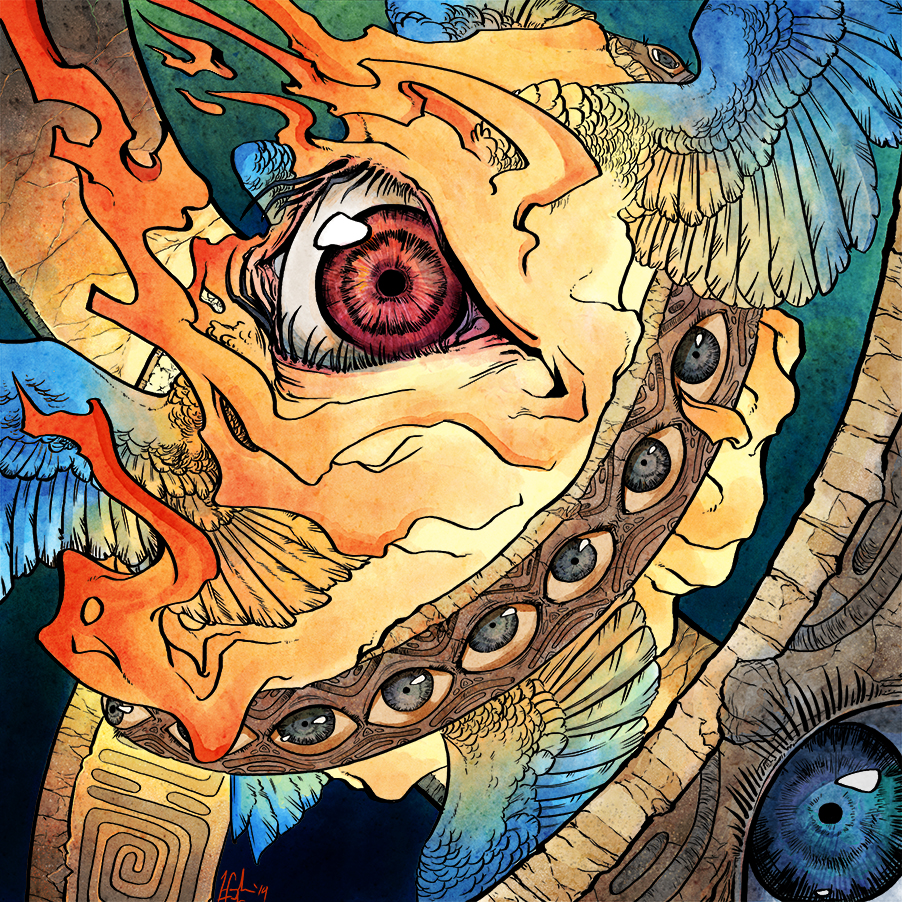
Then, the ambient hum shifted, coalescing into a focused point of energy at the perceived center of the immense room. Light didn’t bend towards it; reality itself seemed to warp, allowing the presence to manifest. It was an Ophanim, one of the formidable Wheels within Wheels described in hushed tones in ancient texts. Not a winged humanoid, but a construct of impossible geometry – interlocking rings of what looked like burning gold, constantly rotating in different directions, the rim of each wheel studded with countless, unblinking eyes. These eyes, terrifyingly perceptive, swept across the assembled souls, seeing not just their bewildered forms, but the entirety of their lives, their choices, their deepest natures. Its presence wasn’t merely seen; it was felt – an overwhelming wave of ancient power, intricate purpose, and undeniable authority.
“Welcome, Heaven Seekers,” the Ophanim’s voice resonated, not through the air, but directly within each soul’s consciousness. The sound was like the grinding of galaxies, yet perfectly clear. “Some among you may have already grasped the transition you have undergone. For those who remain uncertain, allow me to confirm: the existence you knew, the life you inhabited on Earth, is concluded.”
A collective sigh, a wave of despair and dawning acceptance, rippled through the multitude. The Ophanim paused, its thousand-fold gaze seeming to acknowledge their grief without dwelling on it.
“Your anticipated entry into the Kingdom,” the celestial being continued, its voice devoid of emotion yet carrying immense weight, “has been temporarily deferred. An exigency has arisen. Heaven requires assistance.”
Another ripple, this time of pure confusion. Heaven needed… help?
“The terrestrial sphere, your Earth, has been significantly disrupted by the recent global pandemic. Its effects ripple beyond the merely physical, upsetting delicate spiritual balances cultivated over millennia. While this event does not herald the prophesied End Times, the scales measuring hope against despair, connection against isolation, have tipped unfavorably. The trajectory, if unaltered, leads toward escalating devastation – not necessarily apocalyptic, but a profound diminishment of the qualities Heaven seeks to foster.”
The Ophanim’s wheels spun, eyes blinking in asynchronous patterns. “Therefore, we are extending an invitation. We seek volunteers from this cohort – souls whose earthly lives demonstrated resilience, compassion, and a propensity for service – to return to Earth. You would be imbued with entirely new identities, new circumstances, severed completely from your past lives. Your mission: to subtly intervene, to act as counterweights, to assist in mitigating the coming discord and gently guiding humanity back towards equilibrium, or at least towards a new, more sustainable ‘normal’.”
The Ophanim let the proposition hang in the vast silence. “Consider this carefully. Your decision will not prejudice your ultimate acceptance into the Kingdom; entry is assured for all present based on your earthly merits. Declining this task carries no penalty. However,” the voice seemed to lower conspiratorially, though it still filled every mind, “choosing to volunteer confers certain… benefits upon your eventual, permanent arrival here. The nature of these benefits, I am not at liberty to disclose at this juncture.”
A current of speculation surged through the crowd. Whispers erupted in thought-forms Lonnie could now perceive. Benefits? What benefits? A higher sphere? Less waiting?
Lonnie felt a familiar ache, a phantom sensation in his chest. If this offer had come yesterday, when he was still Lonnie Hatch, bagel pilgrim, soup kitchen volunteer, Carol’s husband… the choice would have been instantaneous. Pack a bag, lace up the boots, get to work. That was his nature. But here, now? Standing on the very threshold of Paradise, the promise of eternal rest, of reunion, of peace beyond understanding, was an almost physical pull. It was the ultimate reward, the cessation of striving he hadn’t known he craved until this very moment. He felt weary, not just from his life, but from the shock of its ending.
Was this the real test? Not the good deeds on Earth, but this choice, right here, right now? A final, cosmic essay question determining his ultimate placement? Refuse, and enjoy the earned rest. Accept, and plunge back into the struggle, albeit in a new form.
He looked around at the sea of souls, each facing the same impossible choice. The weight of it settled upon him, heavy and profound. Things were never easy, it seemed. Not in life, and certainly not at the doorstep of eternity. The Ophanim waited, its myriad eyes patient, eternal, observing the quiet, monumental struggles unfolding within one hundred and fifty thousand souls.
When the pastries first went viral, people called them Ganymuffins, though, to be honest, they weren’t even remotely related to the muffin family, or even to the Jupiter moon, Ganymede, for that matter. The actual ingredients remained a mystery until Doughmenic Bakery, Inc. filed a patent and listed the horribly renamed ConstellaScones as:
a laminated soy-based dough, deep-fried in pumpkin seed oil, which is then dusted with confectioners sugar, filled with a proprietary fruit preserve recipe and glazed.
This turned out to be a big fat lie.
It wasn’t until much later that we learned the real ingredients and how the baked goods were actually made. Then, everyone called them blood doughnuts, which should have affected sales, but by then it was far too late. We had been hooked on them for at least a decade.
***
Maybe that wasn’t the best way to start. My father always told me I couldn’t tell a story good and proper, always back to front with everything jumbled up in the middle. Perhaps I should have begun by mentioning our first contact with the Tiiwarnias? Sound good to you? Okay, let’s rewind and give that one a go.
On August 15, 1977, while searching for extraterrestrial intelligence, the Big Ear radio telescope located at Ohio State University received a strong narrowband radio signal that appeared to originate from the constellation Sagittarius. Dubbed the Wow! signal after Astronomer Jerry R. Ehman circled the recorded data on a computer printout and wrote the comment Wow! beside it, the anomaly lasted a full 72 seconds and bore the expected hallmarks of extraterrestrial origin.
A set of first contact protocols were rushed into draft that essentially stated if anyone received an extraterrestrial signal they were obligated to share the information with the rest of the world and were warned against broadcasting any replies without international consultation. In actuality, we could have taken our time composing the protocols because it took decades for the extraterrestrials to receive the reply and by the time they had, they were already here.
World governments rallied together and held a conference to (1) devise a plan of action to the potential threat posed by these unknown extraterrestrials and their alien motivations; and (2) discuss making the right first impression, whether we should tell the aliens all the bad things about humanity, or just the good things, and what language we would use. What would be the official first contact language of Earth?
In the end, none of it mattered.
As the Tiiwarnias touched down on American soil, all reports came through the White House which, of course, caused tensions with the rest of the world. The U.S. government agreed to work together with the United Nations to create a team of scientists and researchers from each nation to join in the first contact mission.
The public was informed through government officials and the White House Press Secretary that the aliens couldn’t speak any of our Earth languages and expert linguists made the determination that we would never be able to speak theirs, so a hybrid-speak was mutually adopted that combined the simplest words of all the languages, which the news explained as a sort of interstellar pig Latin. Because of this, it was nearly impossible to determine their level of intelligence but it was simply assumed that beings capable of interstellar spaceflight were orders of magnitude smarter than the brightest among us. From our increased dealings with them, they appeared to be beyond thoughts and acts of aggression and war and treated us with immense consideration and respect.
Yet, despite the aliens’ politeness, there was something… off. The way official reports danced around certain questions. The way scientists who had once been eager to discuss first contact suddenly went quiet. No leaks, no whistleblowers, no “anonymous sources” spilling classified details to reporters in dimly lit parking garages. Just silence.
And then there was the biggest red flag of all: no footage.
Not one single leaked video, blurry photo, or grainy livestream of the Tiiwarnias outside the government’s carefully orchestrated press events. Not even a rogue intern snapping a pic for clout. Either we’d suddenly become a species capable of keeping a secret, or someone was scrubbing every unauthorized glimpse before it ever saw the light of day.
And if there’s one thing history has taught us? When the government tells you everything is fine, everything is definitely not fine.
The Tiiwarnias earned their name from a television field reporter who attempted the nearest pronunciation our human tongues could manage of a word the alien visitors repeated frequently.
As far as shared technology went, the aliens were absolutely uninterested in our advancement and theirs was so beyond our understanding there was no way to adapt it to our systems or reverse engineer it. Even their seemingly limitless power source was both visible and touchable yet not liquid or gas or matter in any way we could measure or analyze. We weren’t capable of using it as a fuel or power source and more importantly, it existed beyond our ability to be weaponized. So while an international team of theoretical physicists continued to study it and create theories to explain it, the world at large lost interest in the Tiiwarnias.
That was until the press conference.
Until their television appearance, the public hadn’t laid eyes on the aliens. There had been artist renditions based on reports but none came close to capturing their unique alienness. When the broadcast cut to the live feed, the world finally saw them—and let me tell you, the artist renditions hadn’t even come close.
The Tiiwarnias were… unsettling. Not in a monstrous, tentacled-horror kind of way, but in the way your brain struggled to place them. Like an optical illusion that made sense only until you looked too long. They had faces, but not the kind you’d instinctively trust. Too symmetrical, too smooth, like something designed by a committee that couldn’t agree on what a person should look like. Their mouths were thin suggestions of shape, never quite moving when they spoke, and their eyes—God, their eyes.
Not black, not pupil-less, not the soulless void Hollywood loved to slap onto anything alien. No, these were worse. Multi-layered, refractive, shifting between colors like an oil slick catching the light. When they turned their gaze to the cameras, I swear you could feel it. Like looking at something that was looking back with interest, but no real understanding.
They were tall, but not towering. Their limbs just slightly too long, their fingers tapering into delicate, unnecessary points. Their skin—if you could call it that—was pale but not white, translucent but not see-through, as if they were composed of something that hadn’t quite decided whether it wanted to be solid or liquid.
And yet, they moved with an almost absurd grace, like dancers trained in a gravity different from our own. Effortless. Unnatural.
No wonder the government hadn’t shown them to us sooner. The moment they appeared on-screen, every human instinct screamed wrong.
And then they presented us with donuts.
At first, nobody moved.
The President—flanked by a dozen tight-lipped officials—stared at the silver tray piled high with what, by all appearances, looked like donuts. A slight sheen of glaze, powdered sugar dusted over the tops, the kind of thing you’d find in any grocery store bakery aisle.
A long silence stretched between species.
Were they serious? This was first contact—the moment humanity had dreamed of for generations—and the first thing they did was roll up with intergalactic Krispy Kremes?
The press, bless them, snapped out of the collective daze first. Murmurs rippled through the room, cameras flashing, reporters already forming the inevitable what does it mean? headlines.
The President glanced at his Chief of Staff, then at the tray. His face betrayed deep suspicion, but also something else: the impossible weight of being the guy who either (A) rejected the first gift from an alien race, potentially causing an interstellar diplomatic incident, or (B) took the first bite and died on live television.
The room held its breath.
Finally, in a move that could only be described as passing the buck, the President turned to Dr. Marina Solano, head of the international First Contact Research Division. She blinked, pointed at herself, and mouthed, me?
A slight nod.
Swallowing hard, Solano stepped forward, selected a donut—no, not a donut, a ConstellaScone, a name Doughmenic Bakery would shove down our throats later—and hesitated just long enough for every camera in the room to zoom in.
Then she took a bite.
And her face changed.
It wasn’t a oh, this is good change. It wasn’t even a holy hell, this is the best thing I’ve ever eaten change. It was something deeper, something more visceral—as if every pleasure receptor in her brain had just been hardwired into something beyond human comprehension.
Her breath hitched. Her pupils blew wide.
The entire world watched as Dr. Marina Solano, esteemed astrophysicist, decorated scholar, and one of the most rational minds on the planet, devoured the rest of the donut like a starving animal.
A second of stunned silence.
Then the rest of the delegation lunged for the tray.
The aliens, eerily patient, merely watched as the most powerful figures on Earth shoveled bite after bite into their mouths, eyes glassy, hands trembling, as if they had just been offered the answer to a question they didn’t even know they were asking.
By the time the press got their hands on the leftovers, it was already too late.
We were hooked.
***
As mentioned before, the Tiiwarnias ship touched down planetside deep within a national forest on a 140-acre ranch in Sedona, Arizona, that belonged to a Hollywood stuntman and was used as a filming location for several movies. It also just so happened to be one of the most popular destinations in America for spotting supposed unidentified flying objects.
The ranch was reported to have been confiscated by the U.S. Government and certain areas of the national park were deemed off-limits but there were individuals who operated clandestine tours at night and that was how I became involved.
I worked for a rag named, Candor Weekly, as an investigative reporter, and my assignment was to infiltrate the base where the aliens were being held and uncover the things the government wasn’t sharing with us. So, I joined the Truth Seekers tour group and rented the suggested pair of night vision glasses and binoculars that had seen better days, after I signed an accident waiver and release of liability form, in which I agreed to hold harmless, and indemnify Truth Seekers Tours from and against all losses, claims, damages, costs or expenses (including reasonable legal fees, or similar costs). I wondered which one of these Einsteins thought they would be able to enforce the document for their illegal tour company that routinely trespassed on government land?
The tour group gathered two hours before sunset for orientation where we had been given a brief history of the strange occurrences that happened almost nightly since the aliens arrived.
“First, all of the animals on the ranch, dogs, and horses mostly, became sick with diseases that none of the vets in these parts were able to explain,” Tourguide Flint said and quickly followed with, “But not to worry, though, whatever bug is flying around out there only affected animals. I’ve been conducting these tours nightly and my doc says I’m fit as a fiddle!”
“Also, you’re gonna want to take pictures because there’s some freaky stuff that goes on out there especially during the last hour of twilight,” Flint continued.
“What kind of freaky stuff?” I asked.
“All kinds. From crazy light shows in the sky to bigfoot and dinosaur sightings and the biggest of them all, thelight portal!”
“The what?”
“Hey, man, I don’t invent it, I just record it,” Flint held up his hands in a don’t shoot the messenger fashion. “I’ve got plenty of photographic proof over there in the tour log book. Now, I’m not saying that it allows beings from other dimensions to travel here and vice versa, like some of the less reputable tour guides claim, but the portal’s the real deal, man, as real as it gets!”
“Oh, and there are two things you should know,” Flint added. “One: we’re uninvited guests on government land so it’d be a smart thing to turn off your camera’s flash. You don’t want to give our presence away, do you? And two: your electronic devices will not work out there, so the cameras on your phones will be useless. Not to worry though, we sell disposable cameras with 400-speed film which is excellent for taking nighttime photos.”
Probably a lie and scam to part the tour group with more of their money, but I bought a couple of cameras just to be on the safe side.
“Uh, sorry for all the questions,” I raised my hand.
“Knowledge is essential, man,” Flint smiled. “Ask away.”
“If this place is as heavily guarded as people say, how are you able to take tours out each night?”
“That’s because most of the barracks you’ll see are all decoys, man. The real base is underground, accessible by an elaborate tunnel system, used by both the military and the extraterrestrials.
“Course, some folks went poking around to find the real deal,” Flint said, lowering his voice like he was letting us in on some deep, dark secret. “Journalists. UFO nuts. Couple of rich boys with more money than sense.”
“And?” I asked.
“And nothing.” He gave me a knowing look. “Because they were never seen again. Oh sure, you’ll hear the usual excuses—car accidents, sudden retirements, tragic boating mishaps. But we all know what’s really going on. You get too close, you stop being a problem real quick.”
A woman in the group laughed nervously. “You’re just trying to scare us.”
“Am I?” Flint shrugged. “All I’m saying is, some questions ain’t meant to be answered. And some things? They stay buried for a reason.”
He clapped his hands together, jolting the group out of the heavy silence. “Now! Who’s ready to see some UFOs?”
I forced a grin, but my gut twisted. Because if half of what he was saying was true, I wasn’t just looking for a story anymore.
I was walking into a cover-up.
If there was a base out there, this was most likely true.
Once the sun set, the tour began with a two-hour meditation walk starting at the Amitabha Stupa, supposedly Sedona’s most spiritual vortex. Flint took us through a painfully boring guided meditation that ended at a well-known hot spot of UFO activity where we were guaranteed sightings of UFOs, using special night vision goggles. People in the group swore up and down to have spotted objects. I turned up a big fat goose egg.
Flint began rambling again about the “decoy barracks” and “elaborate tunnel systems” and while the rest of the tour group nodded at the prospect of uncovering the truth of the government UFO cover-up, I found myself in the grip of an irresistible gravitational pull, to be anywhere else at the moment.
But maybe there was something to the whole elaborate tunnel thing, so I slipped away from the oblivious group and I must have done some fantastically good deed in a former life, because after fifteen minutes of mindless wandering with my borrowed night-vision goggles, I luckily stumbled upon something.
A maintenance door? An emergency exit? Whatever it was, it was discreetly tucked behind what appeared to be a Hollywood movie prop of a pile of boulders. My heart raced as I dug my fingers into the seam and managed to pry the door open with the kind of stealth usually reserved for midnight snack raids.
The narrow tunnel was dim, lit only by the intermittent sputter of the night-vision goggles. The silence was oppressive and every step echoed, mingling with a faint, almost mocking aroma of something being baked—a scent that brought me back to childhood Sunday baking days with Mom, which was profoundly out of place in an underground labyrinth.
The descent into the heart of darkness felt like it went on forever but eventually the tunnel opened to a vast, cavernous chamber and in the middle of it lay a massive structure that could only have been described as an alien ship. Not the sleek, awe-inspiring craft of sci-fi cinema, but a crumpled, battered wreck, half-swallowed by the earth. Its metal skin, scarred by impact and time, gave off that same beguiling aroma of freshly baked goods. I hesitated for a moment before the allure of inexplicable contradictions forced me to press on.
Creeping along the ship’s rusted exterior, I discovered a side entrance open just enough to allow me to slip inside undetected. The interior was bizarre beyond words: stark, high-tech surfaces clashed with an oddly domestic atmosphere. And then I saw it—a surreal assembly line of sorts. There, strapped to a conveyor belt contraption that could have been ripped straight from a mad inventor’s sketchpad, was a creature whose features were unmistakably alien yet curiously reminiscent of a human in an uncanny valley sort of way. It was bound in restraints, its pale, unearthly skin lit by the harsh glare of a single overhead lamp, and from its body—of all things—continued to emerge a steady stream of what looked unmistakably like ConstellaScones.
I was never what anyone would have ever called “quick on the uptake” but my breath hitched in my throat and my heart pounded with horror, because I instantly knew what I was looking at. And the absurdity of it all was almost too much to comprehend: an alien was being forced into a subservient role that even the most desperate and despicable of culinary con artists wouldn’t consider. Before I could fully process the scene, I heard muffled voices coming from a nearby room or compartment or whatever they were called on an alien ship.
Slipping into a narrow passage, I pressed my ear to a cold, metallic wall and caught fragments of conversation between two individuals: one whose tone was clinical and detached, the other brimming with a greasy sort of enthusiasm.
“—so, you’re telling me it’s exactly the same as donuts?”
“Chemically, there’s no difference,” the clinical and detached speaker said. “I know you’re new here but surely you can smell it, can’t you? And have you tasted one? It’s donuts. Addictive as hell, and beyond our wildest indulgences.”
The other voice, smoother yet laced with dark humor, replied, “In the briefing they said only two of them survived the crash, and that one of them recently died and the other one’s been on a permanent strike ever since they started the forced-feed routine. So, how are they still shipping out ConstellaScones?”
“It turns out if you break them down to raw materials, you can manufacture a whole new batch.”
“So, they’ve been turning the dead bodies into alien donut poop?”
“Poop? Is that what they told you? The scientists discovered a while ago that we haven’t been eating their excrement at all. We’ve been snacking on their offspring.”
I nearly dropped my night-vision goggles. The implications ricocheted around in my head like a badly tossed frisbee at a Fricket match. Here I was, in a subterranean facility that smelt of freshly baked betrayal, and the dark truth was layered like a well-crafted éclair: a high-stakes, interstellar donut racket where survival, exploitation, and culinary perversion meshed into one twisted recipe.
As I absorbed the conversation, my mind raced with a cocktail of disgust, fascination, and a grim sense of responsibility. I knew I should retreat and report what I’d found, but the deeper I delved, the more I felt that the true story was just beginning to rise—like dough left to proof in the most unlikely of ovens.
Clutching my evidence—a hastily snapped photo of the conveyor belt and a recording of the hushed voices—I backed away from the macabre production line. My next move was clear: I had to expose this unholy alliance between extraterrestrial misfortune and human greed.
As I retraced my steps through the tunnel, the weight of what I’d uncovered pressed down on me like an overfilled jelly donut about to burst. My mind spun through the possibilities—if I got this story out, if people knew the truth, if they understood what they’d been eating, they’d…
They’d what?
Panic? Riot? Demand justice? Burn down every Doughmenic Bakery in righteous fury?
Or—
Would they shrug, lick the glaze off their fingers, and take another bite?
A cold realization slithered up my spine, slow and insidious. We’d been eating them for years. A decade of blind devotion, of cult-like devotion. We hadn’t just accepted the addiction. We’d embraced it.
Would I be exposing a horror? Or just ruining breakfast?
That’s when I heard it—a distant clink, the unmistakable scrape of a boot against stone.
The cerulean sun of Myxlos IV cast long, skeletal shadows over the petrified forest, the alien landscape both haunting and beautiful. Delaria stepped off the inter-dimensional transport and inhaled deeply. The air carried an electric tang, sharp and unfamiliar. She was here for solitude, to unravel the knots her doctoral defense had tied in her chest. Myxlos IV was her retreat, a place famed for its quiet and secrets older than memory.
Delaria wasn’t just a cartographer by trade. She considered herself a mapmaker of her own soul, charting her emotional landscapes through the lens of distant worlds. And if she were honest, she was running—from what, she hadn’t yet dared to name.
The hike was longer than anticipated, the fine, glass-like sand shifting under her boots. When she found the cave, it wasn’t marked on any maps. Its entrance was shrouded in shimmering, moss-like tendrils that moved faintly in the still air. Something about it pulled at her, an almost gravitational lure.
Inside, the temperature dropped sharply, and the air thickened with a scent like wet earth and ozone. The walls hummed faintly, a low vibration that settled into her chest. At the back of the cave, nestled in a bed of pulsating purple flora, lay skeletal remains. The bones were twisted, the proportions unsettling, like a grotesque marriage of plant and animal. Tendrils of moss clung to the ribcage, their tips alight with a soft, bioluminescent glow.
Then she saw it—a thumb-sized, opalescent creature resting in the cradle of the ribs. It pulsed gently, almost as if breathing. The scientist in her took over, curiosity overwhelming caution. She reached out, her fingers trembling.
When the creature moved, it was faster than her eyes could track. Pain lanced through her wrist as it burrowed under her skin. Delaria screamed, the sound swallowed by the cave’s oppressive silence.
The pain faded quickly, replaced by a disorienting rush of sensations. The cave blurred and sharpened, colors deepening and shimmering in impossible hues. Delaria staggered, her mind swimming. When her vision cleared, a voice—or something like a voice—pressed into her thoughts.
I am V’tharr.
The words weren’t spoken but felt, an intrusive force brushing against the edges of her mind. Delaria clutched her wrist, where a faintly glowing scar now marked her skin.
“What… what did you do to me?” Her voice cracked, trembling with fear and anger.
You are my vessel. The voice carried no malice, only a cold certainty. Images flooded her mind: a landscape bathed in red light, a towering figure with three segmented limbs, and the sickening crunch of bone. Justice must be served.
Delaria’s limbs moved without her consent. Her body, now imbued with an alien strength, obeyed V’tharr’s will. She screamed inside her own mind, clawing at the mental barrier, but the symbiote’s control was absolute. Her thoughts tangled with its purpose—a singular, burning need for vengeance.
Days passed in a haze of forced marches and whispered commands. V’tharr navigated the Myxlosian terrain with an unsettling familiarity, guiding Delaria’s body with predatory grace. She became a passenger in her own flesh, her autonomy stripped away.
The three-limbed figure haunted V’tharr’s memories, a hunter who had killed V’tharr’s previous host to harvest its marrow. Delaria felt the symbiote’s grief, its rage—a storm of emotion that threatened to drown her. But she also felt its desperation, its guilt for dragging her into this.
As they closed in on the hunter’s trail, Delaria fought harder, slamming her mind against the walls of V’tharr’s control. For fleeting moments, she broke through, regaining her body. Her fingers trembled as she reached for a communicator, but the symbiote seized her again, wrenching her limbs into submission.
“Please,” she begged, her voice a whisper in the vast wilderness. “You don’t have to do this.”
It is justice. But there was hesitation now, a flicker of doubt that Delaria seized upon.
When they found the hunter, the scene was surreal—a clearing bathed in the cerulean sun’s light, the air crackling with tension. The hunter turned, its segmented limbs flexing, a blade-like appendage gleaming in its grasp.
V’tharr unleashed Delaria’s body with terrifying precision, driving her into a brutal dance of combat. Each movement was fluid, lethal, and utterly foreign to her. Blood sprayed as the hunter faltered, its weapon clattering to the ground.
Finish it, V’tharr commanded.
But Delaria resisted, her will surging against the symbiote’s. “This isn’t justice,” she spat, her voice breaking with desperation. “This is revenge.”
For the first time, V’tharr hesitated. The connection between them wavered, and Delaria seized the moment. She drove the blade into the ground, not the hunter, who fled into the shadows.
The symbiote withdrew, its tendrils unraveling from her mind. Delaria collapsed, gasping for air as the weight of what she had been forced to witness and do crashed over her. The glow on her wrist faded, leaving a faint, iridescent scar.
“You used me,” she whispered into the stillness, her voice hollow. “You stole from me.”
I am sorry. The words were soft, almost mournful, and then V’tharr was gone.
Delaria sat in the clearing, the cerulean sun sinking below the horizon. The map of her soul was forever altered, the landscape scarred by alien rage and her own helplessness. She knew she could never return to who she was before. The universe was no longer a place of discovery and wonder—it was a place of violence, secrets, and profound, inescapable connections.
And yet, as she traced the scar on her wrist, she felt something new: a determination to chart these uncharted depths, to understand what had happened, and to ensure no one else would ever lose themselves to another’s justice.
The recycled air of the Kestrel Customs checkpoint tasted like stale ozone and bureaucracy, clinging to the back of Jax Varis’ throat as he stood at his post. His uniform, still stiff from the replicator’s press, chafed under his arms, a daily reminder that this was far from where he thought he’d be. The Academy had trained him for diplomacy, for first contact, for situations that tested the limits of human resilience and ingenuity. Yet here he was, watching luggage scans flicker on holoscreens, his dreams collecting dust like the corners of the checkpoint’s low ceiling.
He had just finished clearing a businessman with an overpacked cryo-briefcase when he noticed her in line. She stood out immediately, not for her appearance, but for the stillness that surrounded her. The queue was a river of impatience—mutters, shifting feet, and side-glances—but she stood calm, silent, her gaze fixed ahead.
Her skin was the color of desert sand, etched with the wear of interstellar travel. Her hair fell in uneven strands, and her cracked lips hinted at dehydration. But it was her eyes—deep, obsidian pools that swallowed the harsh fluorescence of the terminal—that made Jax’s stomach twist. She carried a worn canvas backpack, its edges frayed, as though it had seen more of the universe than most starships.
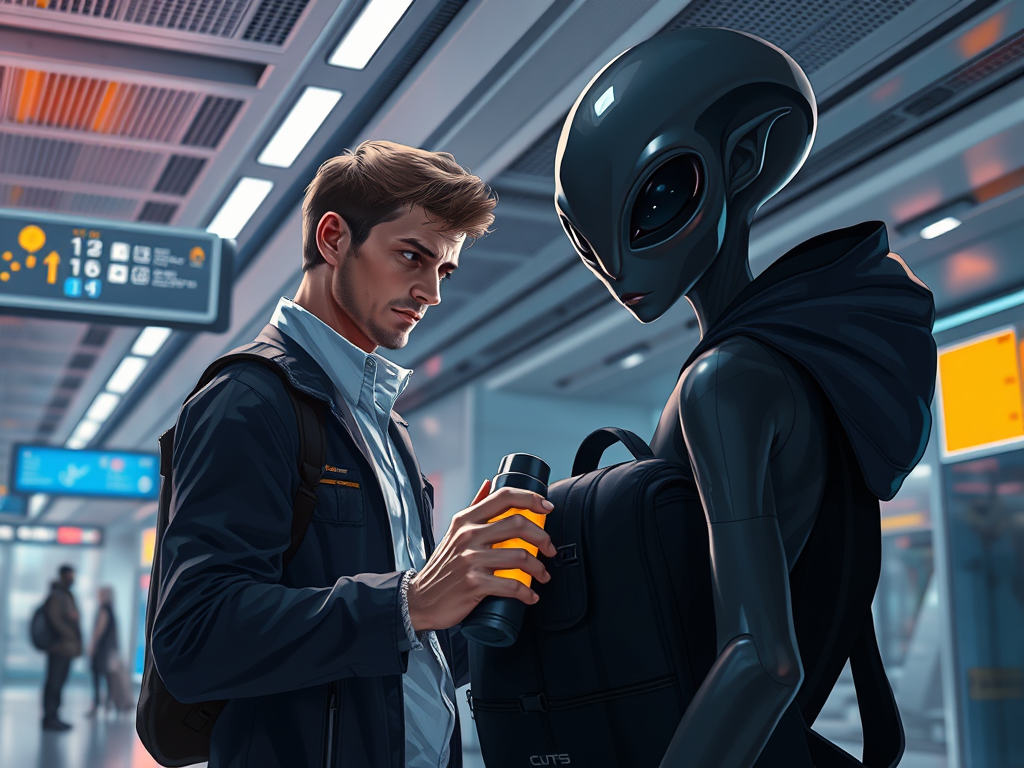
Jax adjusted his scanner as she stepped forward, his voice steady but louder than he intended. “Ma’am, may I inspect your bag?”
She turned to him, her gaze sharp enough to cut through his poorly maintained confidence. “Of course,” she said, her voice soft and low, like a melody hummed to oneself.
The bag opened with a faint creak. Nestled among folded cloth and survival pouches was a tarnished thermal flask. Jax’s gut tightened. It wasn’t just the flask’s age or the strange hum his scanner emitted as it passed over it. It was the faint luminescence that seemed to pulse from within, like a heartbeat trapped in steel.
“Step aside, please,” Jax said, masking his unease with protocol. He motioned her to a secondary inspection station.
She complied without hesitation, but something about her composure felt wrong. Not defiant—accepting. She knew what was coming.
Jax’s gloved hands gripped the flask, its surface cool to the touch. A faint crackling sound filled the air as he unlatched the seal. Inside, suspended in a viscous amber liquid, was a creature unlike anything he had ever seen. It resembled a jellyfish, but its tentacles branched like crystalline trees, each tip glowing faintly. The light inside the flask flared, and for a moment, Jax thought he saw images in its shimmer—a distant skyline, a spiral galaxy, faces frozen in time.
His scanner buzzed and went dead. Error codes flashed on the screen.
“What is this?” he asked, his voice tighter than he intended.
“It’s called a Lumina,” she said, her fingers twitching toward the flask before retreating. “A thought made real. A memory given form.”
He frowned. “A memory of what?”
“A civilization older than your species,” she said, her voice carrying an ache that made Jax’s throat dry. “Their stars have burned out. Their worlds are dust. This is all that remains of them.”
Jax stared at the Lumina, its glow pulsing in rhythm with his racing heart. He imagined what would happen if he followed protocol. The labs would dissect it, catalog it, and in doing so, destroy it. It would become data in a database—useful, maybe, but dead. His duty, drilled into him since the Academy, demanded compliance. But his instincts screamed that this was something more. Something sacred.
“I can’t let you leave with this,” Jax said, his voice faltering.
The woman didn’t argue. She didn’t plead. She only looked at him, her expression hollow. “I’ve been carrying it for five years,” she said. “From station to station, system to system. Running from people like you. Do you know what they do to it in your labs? They don’t study it—they break it. They break it.” Her voice cracked, the calm giving way to desperation. “Please. If it dies, they die.”
The weight of her words settled in Jax’s chest like lead. He thought of his family—his sister’s bright smile, his mother’s proud eyes. They’d always told him he’d do great things, make the universe better. But what did that mean now? Following orders, or breaking them to protect something he barely understood?
A sharp alarm cut through the air. Security officers approached, their boots heavy on the polished floor. Jax’s supervisor, a man whose bark was as unforgiving as his bite, stepped into view. “Problem, Officer Varis?” he barked.
Jax’s grip tightened on the flask. His pulse thundered in his ears. He could hand it over, pass the burden on, and live with the guilt. Or he could trust his instincts, jeopardizing everything he’d built.
“No problem, sir,” Jax said, slipping the flask back into the woman’s bag. “Routine scan error.”
The supervisor narrowed his eyes. “We’ll need to check her, then.”
Jax stepped in front of her, blocking the supervisor’s path. “I’ve cleared her,” he said, his voice firm. “She’s free to go.”
The silence that followed was deafening. The supervisor stared at him, the air thick with unspoken consequences. Finally, he nodded. “Fine. Move on.”
The woman slipped past without a word, her backpack slung over one shoulder. Jax watched her go, her figure swallowed by the crowd.
Hours later, when his shift ended, Jax sat alone in the staff locker room. The holo-news displayed a headline about a fugitive escaping Kestrel Customs. He didn’t need to read it to know who they meant.
His hands trembled as he pulled out the small data chip with his family’s photo. He’d made his choice. Whether it was the right one, he didn’t know. But the uniform on his shoulders no longer felt so heavy.
For a brief shining moment he wasn’t just an officer. He was a guardian of something greater. And that, he thought, was a start.
Two highly professional and well-established podcasters, Donna Talmadge and Ross Tamecko, take a deep dive into my latest novel, “My Surfer Scientist Secret Wife.”
Description: When perfectionist pastry chef Ira Sea agrees to a marriage of convenience with NixonNina—a daring surfer with a penchant for secrets—his life takes a surreal turn. NixonNina isn’t just a thrill-seeker; she’s an undercover scientist on a mission tied to a mysterious rift in reality.
As the Sea & Sugar bakery becomes a hub for otherworldly phenomena, customers claim the pastries reveal glimpses of alternate dimensions, rival bakers launch sabotage campaigns, and interdimensional chaos brews just beyond their small coastal town.
Together, Ira and NixonNina must unravel the secrets of the rift, outwit shadowy figures intent on its exploitation, and perfect a croquembouche that might just save reality itself.
Quirky, thrilling, and irresistibly heartwarming, “My Surfer Scientist Secret Wife” is a genre-bending tale of love, adventure, and embracing the beauty of imperfection. Perfect for fans of romance, supernatural suspense, and absurd adventures with a touch of pastry magic.
The narrow street felt like a forgotten corner of the world, shadowed by crumbling buildings and dimmed by the setting sun. Renee had passed this way hundreds of times, always ignoring the rusted neon sign that flickered above the doorway: Madame Celeste—Fortunes Told. She never believed in that sort of thing.
But today was different.
Fresh out of a five-year sentence for armed robbery, her body was free, but her mind had remained shackled to one thought: her daughter, Ellie. Five years of missed birthdays, five years of wondering whether her child even remembered her, five years with no answers. The State had taken Ellie, placed her with some family she’d never met. No matter how hard Renee searched, it was as if her daughter had vanished.
Desperate, with nowhere else to turn, she stood at the entrance of the dingy fortune-telling parlor, the name Madame Celeste practically buzzing like an insect in her ears.
The inside was worse than she expected. Threadbare curtains, a single flickering candle, and the heavy scent of incense thickened the air. A table, draped in velvet, sat in the middle of the room, and behind it, the fortune teller herself: a gaunt woman in a patchwork of scarves and jewelry, her face obscured by a veil of beads.
“I’ve been expecting you,” the woman said, her voice smooth, with a hint of a rasp.
Renee hesitated, her pulse quickening. “How could you—?”
“I know why you’re here,” Madame Celeste interrupted, gesturing to the chair. “Sit. We’ll find her together.”
Renee’s breath caught. How could this stranger know? Was this a scam? But the thought of Ellie—the need to see her again, hold her again—was stronger than her suspicion. She sat.
“Your daughter… Ellie,” the fortune teller whispered, the name slipping from her lips like smoke. Her long fingers danced over a worn deck of tarot cards, shuffling them with an eerie grace. “She’s closer than you think.”
The cards fell, one by one. The Hanged Man. The Tower. Death.
Renee’s throat tightened. “What does that mean? Where is she?”
Madame Celeste smiled, revealing teeth too sharp for comfort. “She’s waiting for you. But to find her, you must follow the path unseen. The roads of the dead. You’ve walked close to the edge before, haven’t you? You know the place where life and death blur?”
Renee clenched her fists. “What are you talking about?”
“The place you’re looking for is not a physical one,” the seer murmured. “Ellie has crossed over, but not in the way you fear. Her spirit is bound to this world, wandering, waiting. She needs you to set her free.”
A chill crawled up Renee’s spine. “No… no, Ellie’s alive. She’s out there. I just need to find her.”
Madame Celeste leaned closer. “She was alive. But when you went away, no one came for her. No one cared. The family she was placed with—”
“What are you saying?” Renee’s voice cracked.
The fortune teller’s gaze pierced her, unblinking. “Your child died alone. Starved. Forgotten. The only way to reunite with her is to cross over yourself.”
Renee shot up from the table, her heart pounding. “You’re lying!”
But deep down, something in the words resonated. She had nightmares in prison, visions of Ellie calling out for her, crying, alone. She’d always woken up drenched in sweat, praying it was just her mind playing tricks.
“Go to the place where you were happiest with her,” Madame Celeste said softly. “She will meet you there.”
With shaking hands, Renee fumbled for the door. The fortune teller’s voice echoed in her ears as she stumbled into the night, a single word repeating: cross over.
The old playground. It hadn’t changed in all these years. Rust clung to the swings, the slide was chipped and faded, and the jungle gym looked skeletal under the streetlights. Renee stood there, the memories rushing back—of Ellie laughing, her tiny hands clutching the chains as she swung higher and higher.
“Ellie?” Renee whispered into the cold night air.
A shadow flickered at the far end of the playground. A small figure, no taller than a child, emerged from the gloom.
Renee’s heart lurched. “Ellie?”
The figure stepped closer, and as it did, Renee’s stomach twisted. It wasn’t Ellie. The thing that approached had her daughter’s shape, but its skin was wrong—pale, sagging, with hollow eyes that stared without seeing. It moved with a jerking motion, like a puppet on tangled strings.
“Mommy?” the thing rasped, its voice an echo of the child Renee once knew, but distorted, broken.
Renee’s legs buckled. “No… no, this isn’t real!”
The thing’s head tilted, its cracked lips curling into a grotesque smile. “You left me. Why did you leave me, Mommy?”
Renee screamed, backing away, but the figure advanced, faster now. Its skeletal hand reached for her, ice-cold fingers grazing her skin.
“I was waiting for you,” it whispered. “Now you can stay with me… forever.”
The world around Renee darkened, the playground fading as the shadows closed in. Her breath came in ragged gasps, and in her last moments, the memory of Ellie’s real laughter—pure and joyful—was drowned out by the horror that had taken its place.
The next day, the sidewalk fortuneteller packed up her things and moved on.
The playground remained, but the swing no longer moved in the wind. In its place, a new shadow hung in the air—one that sometimes whispered a name, searching, always searching, for the child she’d lost.
It started with small anomalies. Reality began to twist and warp in ways that defied explanation – time seemed to stretch and compress, colors shifted in impossible hues, and the very fabric of space rippled like the surface of a pond disturbed by a falling stone. As the phenomena intensified, humanity scrambled to understand the cause of the bizarre occurrences.
Dr. Jenifer Troy, a noted astrophysicist and social media influencer, was at the forefront of the investigation. Her groundbreaking discovery came about through a series of unconventional experiments and innovative data analysis techniques. As the disturbances grew more pronounced, Jenifer began to suspect that the cause was not rooted in any known physical phenomena. She theorized that the anomalies might be originating from a source beyond our perceivable dimensions.
To test her hypothesis, Jenifer worked with a team of engineers who designed a cutting-edge sensor array that could detect fluctuations in the fabric of space-time across multiple dimensions. With the help of fellow scientists, she placed these sensors at strategic locations around the globe, focusing on areas where the disturbances were most intense.
“These sensors could be our eyes and ears into dimensions beyond our own,” Jenifer explained to her team. “If my theory is correct, we could be on the brink of a monumental discovery.”
As data streamed in from the sensors, Jenifer used artificial intelligence applications to create advanced algorithms to analyze the patterns and frequencies of the anomalies. She discovered that the disturbances were not random, but rather followed a complex and intricate pattern that seemed to defy the laws of physics as we understand them.
Poring over the data with her colleagues, Jenifer mused, “Look at this pattern. It’s not random; it’s almost like… a message. Could these anomalies be attempts at communication?”
Delving deeper into the data, Jenifer noticed that the anomalies appeared to be emanating from specific points in space, almost like cosmic beacons. She cross-referenced these coordinates with satellite imagery and discovered that, at each location, there were faint, shimmering auras that seemed to hover just above the Earth’s surface.
Intrigued, Jenifer coordinated the development of a specialized camera that could capture images across a wide spectrum of frequencies, including those beyond the visible light range. When she focused this camera on the shimmering auras, she was astounded to see the ethereal forms of the ninth-dimensional beings.
Jenifer addressed a perplexed audience at an international conference, explaining her findings, “We’ve observed phenomena that suggest the presence of higher-dimensional forces at play. Our traditional models of physics cannot fully explain the anomalies we’re witnessing.”
These entities appeared as translucent, shimmering figures, their outlines constantly shifting and warping as if they were not entirely stable in our reality. Jenifer realized that these beings were the source of the disturbances and that their presence was somehow interacting with the fundamental forces of our universe.
“These entities,” Jenifer whispered to herself, examining the images, “they’re unlike anything we’ve ever seen. How do we even begin to understand beings that operate on such a fundamentally different level of reality?”
To confirm her findings, Jenifer conducted a series of experiments in which she attempted to communicate with the beings using a variety of methods, including modulated light frequencies and complex mathematical sequences. To her surprise, the beings seemed to respond, their forms flickering and pulsing in patterns that corresponded to the signals she sent.
“Did you see that?” she exclaimed to her assistants. “It responded! This could be the first step in establishing communication.”
Through these initial communications, Jenifer gleaned that the beings were not intentionally causing the disturbances, but rather that their mere presence in our dimension was enough to trigger the anomalies. “If their existence in our dimension causes these effects,” she pondered. “what does it mean for the fabric of our reality? And more importantly, how can we mitigate these disturbances?” She realized that to truly understand the nature of these visitors and the reason for their appearance, she would need to find a way to bridge the gap between our reality and their own.
As Jenifer delved deeper into the mystery, she found herself drawn to Dr. Terry Perry, a neurologist from a rival research institute. Despite their initial mistrust, the two scientists soon realized that their unique perspectives were the key to unraveling the truth behind the visitors.
In a heated debate turned collaborative discussion, Terry proposed, “What if the disturbances are not just physical but also impact the neural substrates of perception? Your data could be the key to understanding how these beings influence both our world and our minds.”
Through a series of daring experiments and mind-bending calculations, Jenifer and Terry discovered that the beings were not mere visitors, but rather manifestations of pure love. In their ninth-dimensional realm, love was a tangible force, capable of warping the very laws of physics. As the entities moved through our world, their love for one another radiated outwards at nine times the speed of light, causing the strange disturbances that had baffled humanity.
As Jenifer and Terry worked tirelessly to bridge the gap between dimensions, they found themselves inexplicably drawn to one another. In the face of the surreal and the impossible, their bond deepened, their minds and hearts entangled in a connection that defied the boundaries of space and time.
The closer they came to understanding the visitors, the more intense the anomalies became. Reality twisted and warped around them, their surroundings shifting into impossible geometries and kaleidoscopic colors. Jenifer and Terry realized that they were on the brink of a revelation that would shatter the very foundations of human understanding.
In a final, desperate attempt to communicate with the beings, the two scientists constructed a device that would allow them to project their consciousness into the ninth dimension. As they activated the machine, their minds were catapulted into a realm beyond comprehension, where love was the only constant in a sea of chaos.
There, amidst the swirling vortices of emotion and energy, Jenifer and Terry finally understood the true nature of the visitors. They were not separate entities, but rather fragments of a single, cosmic consciousness – a manifestation of the universe’s fundamental desire for connection and unity.
With this knowledge, the scientists returned to their own reality, forever changed by their encounter with the infinite. As they looked upon the world with new eyes, they saw the echoes of the ninth dimension all around them – in the way the wind danced through the trees, in the way the stars shimmered in the night sky, and in the way their own hearts beat as one.
One unforeseen side effect of the investigation was as Jenifer and Terry worked together, their initial distrust slowly gave way to a mutual admiration. Late nights spent poring over data and discussing theories turned into moments of shared laughter and lingering glances. They found themselves drawn to each other’s brilliant minds and passionate dedication to their work.
One evening, as they were fine-tuning a device designed to communicate with the beings, their hands brushed against each other, and they felt an inexplicable jolt of energy. They looked into each other’s eyes, and in that moment, they realized that their connection ran deeper than mere colleagues or even friends.
As their love blossomed, Jenifer and Terry discovered that their emotional bond seemed to be amplified by the strange energies emanating from the ninth-dimensional beings. They could sense each other’s feelings and thoughts with an intensity that defied explanation, as if their love was resonating at nine times the speed of light.
During one critical experiment, as they attempted to open a stable portal to the ninth dimension, something went terribly wrong. The device malfunctioned, and a vortex of swirling energy engulfed the lab. In a desperate attempt to protect Jenifer, Terry pushed her out of the way, but in doing so, he was caught in the vortex himself.
Jenifer watched in horror as Terry was pulled into the ninth dimension, his form stretching and distorting as he crossed the boundary between realities. She felt a searing pain in her heart, as if a part of her very being had been torn away.
In the days that followed, Jenifer worked tirelessly to find a way to bring Terry back. She poured over the data from the experiment, searching for any clue that could help her navigate the strange and unpredictable realm of the ninth dimension.
As she delved deeper into the mystery, Jenifer began to experience a strange sensation – a tug at the edge of her consciousness, a whisper of emotions that were not her own. She realized that, even across the vast distances of dimensions, her love for Terry had created a quantum entanglement between their hearts.
Through this entanglement, Jenifer could sense Terry’s presence, could feel his love and his longing to return to her. She focused on these feelings, allowing them to guide her as she worked to create a stable gateway between the dimensions.
Finally, after weeks of tireless effort, Jenifer succeeded in opening a portal to the ninth dimension. She stepped through, her heart racing as she followed the pull of her quantum-entangled love. In a realm of swirling colors and impossible geometries, she found Terry, his form shimmering and ethereal.
As they embraced, their love blazed brighter than ever, a force that transcended the barriers of space and time. They marveled at the strange and wondrous realm they found themselves in, and at the incredible power of their connection.
Hand in hand, Jenifer and Terry explored the ninth dimension, their love guiding them through the challenges and wonders they encountered. And though they questioned the nature of free will and the meaning of their quantum-entangled emotions, they knew one thing for certain: their love was a force that could overcome any obstacle, a bond that would endure across the very fabric of the universe itself.
They come from miles around, my characters do, traveling the great distance from the fringes of my mind’s eye, some even making the long and arduous haul from my childhood, just to sit and talk. They do this whenever I’m alone.
As they gather ’round, I cast an eye upon their many and various faces and can’t help but feel the slightest twinge of remorse. Being in my company, locked within the confines of my imagination, is not wholly unlike a purgatory for them. A holding pattern, a waiting room, where they converse amongst themselves in voices audible only to myself, trying to catch my attention in the slimmest hope of being set free. Birthed into a story.
Some are fresh meat, the rest lifers, each easily spotted by the differences in their appearance and the strength of their voices. Fresh meats are gossamers—newly formed characters, little more than a stack of traits—who shout in whispers. Lifers, on the other hand, are as fleshed out as you or I, perhaps even more so, who have acquired the proper pitch and turn of phrase to catch me unawares during the times when my mind idles.
Before the talks begin–serious conversation, not the normal natterings they engage in–a flying thing the size of a butterfly, jewel-toned blue stripes, greenish-gold spots, with flecks of silver on the wings, lands in the palm of my outstretched hand.
“What is that then?” a childlike voice asks from somewhere deep in the crowd, low to the ground. I recognize it instantly.
“It’s an anecdote, Duchess. Come see for yourself.” I reply as the creature’s wings beat softly on my palm.
The throng–my personal rogue’s gallery whose roster includes reputables and reprobates alike–part like the Red Sea, making way for the noblest of all serval cats, The Duchess.
“An antidote? Have you been poisoned?” The Duchess queries as she saunters into the open space, a dollop of concern gleaming in her vivid blue eyes.
I try to not laugh, partly out of respect, but mostly due to the fact that though she is the eldest of my unused characters, she is technically still but a kitten. “No, Duchess, it’s an anecdote, as in a short, amusing, or interesting story about a person or an incident.“
“I know full well what an anecdote is, thank you kindly. I was merely attempting to lighten the dreadfully somber mood with a bit of levity.” Not her best faux pas cover, but it was swift, which should count for something. As casually as she could manage, the kitten turned to see if anyone found amusement at her expense. No one did. They knew better. “May I hold it?”
I hesitate and stare at the leapling. Created on February 29th all those many years ago, it was my rationale–on paper–for keeping her a kitten, seeing as she had fewer birthdays, she would naturally age at a decelerated rate. The actuality is I have an affinity for kittens. For full-grown cats? Not so much. And now the dilemma is if her kittenish nature should come into play, and without meaning to, cause injury to the anecdote, then all this would be for naught.
Her eyes plead with all the promise of being good and I have no choice but to relent. “It’s fragile, so be gentle. Take care not to crush it.” I gently place the anecdote in her cupped paws.
“Why does one need an anecdote?” The Duchess of Albion asked, her nose twitching whenever the creature moves its wings.
“To tell a proper story,” I answer. “More than just a sequence of actions, anecdotes are the purest form of the story itself.“
“But I thought characters are at the heart of every great story?“
“They are and anecdotes connect the hearts and minds of those characters to a story.” I try to feign calm but I can see the kitten’s body tensing up. Her eyes, those glorious baby blues, are studying the creature closely. Was I wrong in my decision to trust that she rules her instincts and not the other way around?
“They also add suspense to your story, giving the audience a sense that something is about to happen. If you use them right, you can start raising questions right at the beginning of your story—something that urges your audience to stay with you. By raising a question, you imply that you will provide your audience with the answers. And you can keep doing this as long as you remember to answer all the questions you raise.“
The kitten’s breath becomes rapid and her paws close in around the anecdote and I want to cry out, urge her to stop, but it’s far beyond that point now. She is in control of her own fate. Canines bare themselves, paws pulling the creature closer to her mouth.
“No!” she shakes her head violently. Her ears relax and her mouth closes as her breathing returns to normal. Then, the oddest thing happens…
The Duchess begins to vanish. All the characters look on in dazed silence, uncertain how to react.
“What is happening to me?” she shoots me a panicked glance as cohesion abandons her form.
“Haven’t you sussed it out yet?“
“No… I’m scared!“
“Don’t be,” I smile. “Look around you. You’re at the heart of a story. You’re free.“
“Truly?” she is suddenly overwhelmed with delight, her expression priceless. “But — but what do I do with the anecdote now?”
“Open your paws, let it fly off.”
She unfolds her paws. Tiny wings beat their path to freedom. Then someone from the back of the crowd gives The Duchess a slow clap. Soon, others join in, building into a tidal wave of applause.
The now translucent Duchess waves a tearful thank you to the crowd, before turning back to me with a request, “Say my name.“
“Why?“
“Because you always simply address me as Duchess and I want to hear you call me by my full name one last time before I g– —“
And just like that, she was gone.
I bid you a fond farewell, Your Grace the Duchess of Albion Gwenore del Septima Calvina Hilaria Urbana Felicitus-Jayne Verina y de Fannia. Enjoy your journey. You will be missed.
Because it was bored and had little else to do but support my head while my body shut down to replenish itself, my pillow took advantage of the moment by whispering my destiny in my ear in the dead of night during that flash second of waking from a nightmare, the moment where the line between illusion and reality blurred, when fear tangled around the heart like a sweat-soaked bed sheet. It said:
Heaven holdsno place for you.
It spoke to me in English but with a tongue drenched in an accent I was unable to place. Some dead language known only to pillows, I supposed.
My own unique brand of pillow talk first happened when I was a child and in defiance of all the childhood messages that slipped away unremembered, this one had taken root. I had accepted my fate at a tender age and decided to play the hand I was dealt. And after a lifetime spent in disregard of my fellow man and the consequences of my selfish actions as I baby-stepped my way through my sinful prophecy—I slipped and fell…
Down through the frozen landscape of Niflheim, where the branches, bramble and roots of the World Tree, Yggdrasill, beat my face and tore at my skin. And where Hel, daughter of Loki, stood on the Shore of Corpses, petting the head of Nidhogg, the giant snake that fed on the dead
Carried along on the poisonous snake river, Tuoni, I was brought through Tuonela, a place not wholly unlike Earth under the gloomiest conditions, where the maid of Death, Tytti, cast me down further for bringing no provisions as a tribute.
Down further, I was injured whilst falling onto the Chinavat Bridge, which was thinner than a hair, yet sharper than a blade. The twin four-eyed guardian dogs snapped their jaws at me, judging me based on the deeds in my life.
The bridge turned on its side, for my bad deeds outweighed the good, and pitched me into the demon-filled pit below, where the demon Vizaresh dragged me into the House of Lies, a place of disgusting filth, where I was served spoiled food and tortured by demons, hundreds in number, each representing a specific sin, before Apaosha, the demon of drought and thirst, and Zairika, the demon that makes poisons, cast me further down.
Through a lake of fire and up against an iron wall where I passed through a series of gates guarded by half-animal, half-human creatures named The Blood-Drinker Who Comes From The Slaughterhouse, and The One Who Eats The Excrement Of His Hindquarters, into Duat where my heart was weighed against a feather and eaten by the demon Ammut. Although horrified at the sight of my heart being eaten, I was fascinated by the sight and wanted to watch but I could not stop myself from falling…
Down through Gehenna, a deep and desolate place in which noxious sulfuric gasses hung in the air and flames continuously burned and rained from the sky into rivers of molten metal and where the followers of Moloch sacrificed children in the great fires. My fingertips clutched for purchase on this foundation but I fell…
Down past the nine-headed hydra, into Tartaros, where I was whipped by Tisiphone as I tumbled deeper into the deep black dungeon full of torture and suffering.
Down through Maharaurava where the serpent demon Ruru tried to eat my flesh.
Through Kumbhipaka where I was nearly boiled in hot oil.
Through Diyu where Yama Loki of Naraka condensed the 96,816 hells into 10 sections the Chamber of Tongue Ripping, The Chamber of Scissors, The Chamber of Iron Cycads, the Chamber of Mirror, Chamber of Steamer, Forest of Copper Column, Mountain of Knives, the Hill of Ice, Cauldron of Boiling Oil, Chamber of Ox, Chamber of Rock, Chamber of Pounding, Pool of Blood, Town of Suicide, Chamber of Dismemberment, Mountain of Flames, Yard of Stone Mill, and Chamber of Saw.
Down through Xibalba, where the lords of the afterlife inflicted various odd forms of torture on me such as causing pus to gush from my body, squeezing me until blood filled my throat and I vomited my organs…
Before being cast even lower into rivers filled with blood, scorpions, and pus, where I cascaded over a waterfall to my final death, crashing into oblivion and shattering into millions of pieces…
Only to wake up and hear my pillow whisper in its thick accent:
Hell holds no place for you.
So, again I lost my footing and fell, through limbo this time, into…






 MADD FICTIONAL