Little Noir Riding Hood Part I: The Client in Red

Bzou smelled her before he heard her.

Blood—cold, human, female—threaded through the damp air outside his den like a slow confession. Not fresh injury. Not panic. Something older and deeper, a stain that didn’t rinse out. It clung to her the way smoke clung to clothes after a long night near a dying fire.

He opened his eyes as the emberlight behind him guttered low. The cave held the kind of darkness that belonged to the world before lanterns, before roads, before people decided shadows were a problem to be solved. His breath steamed in the cold, a pale ribbon curling toward the ceiling, and he listened.

Footsteps, careful.

Not the stumbling, drunk courage of a villager. Not the hurried, frantic rush of someone lost in the woods. These were measured. Intentional. The sound of someone who had made a choice and was prepared to live with it.

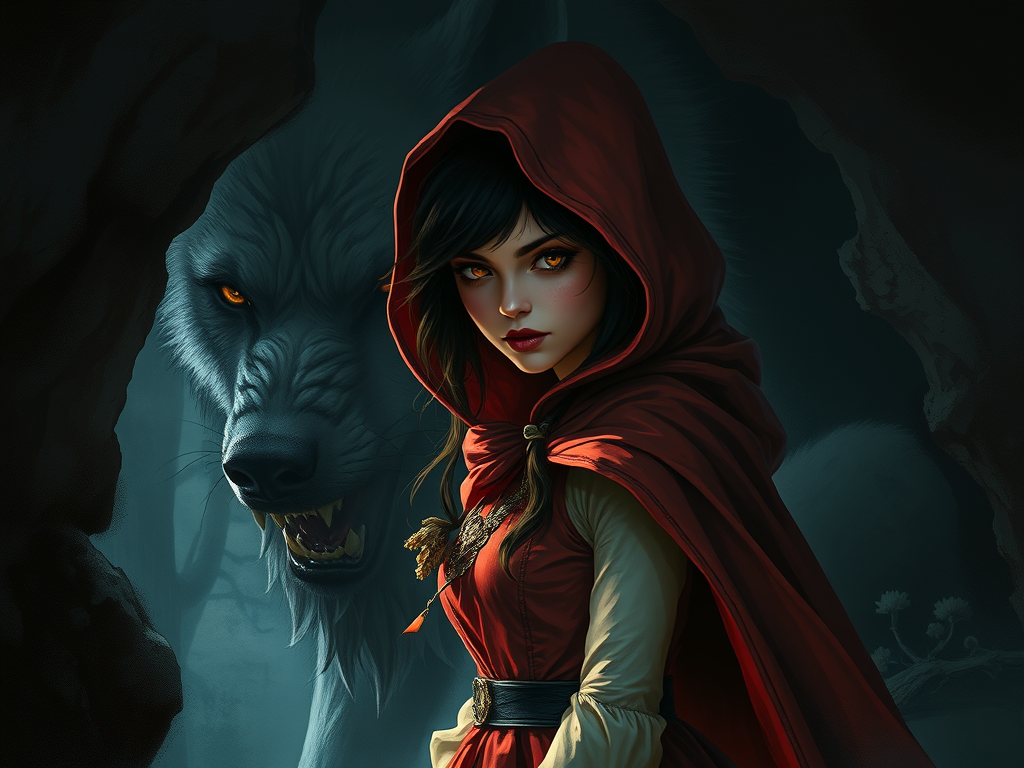
She appeared at the mouth of the cave with the fog behind her like a curtain. Hood up, shoulders squared. The cloak was red, but not bright. Not storybook scarlet. Darker. A red that had been slept in, rained on, dragged through thorns and older regrets. The kind of red that didn’t beg attention, but demanded it.

Bzou didn’t rise. He didn’t have to. The den was his kingdom. Anyone who entered it had already crossed a line.

“You shouldn’t be here,” he said.

His voice was the voice of stone rubbed raw. It pressed against the damp air and made the fog feel heavier.

She didn’t flinch.

“I know.”

That alone was wrong. Most humans heard his voice and remembered they were made of soft things. Most humans took a step back even if they didn’t mean to. Fear was automatic. A reflex. A truth.

This woman stood still as a nail.

Bzou watched her for a long moment. The firelight crawled over his fur and over the ridges of his back, catching on the old scars that never fully faded. In the village they called him wolf. Monster. Pact-keeper. Curse. They said a lot of things when they were trying to keep their hands clean.

He shifted, slow and deliberate, and his bones cracked quietly as he unfolded himself from the hollow where he’d been curled.

“What do you want?” he asked.

The woman reached up and pushed back her hood.

Her hair was dark as wet bark, her cheekbones sharp enough to cut glass, her eyes too steady for someone standing at the edge of a predator’s home. Her lips were painted deep red—not for vanity, not for seduction, but like punctuation. A period at the end of a sentence she’d been repeating to herself for days.

She wanted to be seen.

“A missing person,” she said.

Bzou almost laughed, but it would have sounded like a growl. “Not my world.”

He turned away from her, toward the dwindling embers, toward the quiet he’d earned. The village’s problems belonged to the village. The village had chosen its rules. He had chosen exile. That was the pact: he stayed on the edge, and they left him alone. A boundary drawn in old blood and older fear.

Her voice came again, closer than it should have been.

“My grandmother is gone.”

Bzou didn’t turn, but the words tightened something inside him. Missing people were common. People disappeared into woods, into drink, into other people’s cruelty. The world took what it wanted. Sometimes it didn’t even bother to leave a reason behind.

But she didn’t say it like someone repeating the village’s comforting lie. She said it like someone naming a crime.

“They said she wandered off,” the woman continued. “But she didn’t. She was taken.”

Now Bzou turned.

Not quickly. Not with alarm. With the slow attention of something that had learned not to waste energy on false alarms.

“What’s your name?” he asked.

She hesitated. Just long enough to betray a private argument she’d already lost.

“Redalhia.”

It sounded like a name from somewhere else. Somewhere old. Somewhere that didn’t belong to Gildengrove’s neat little square and its tidy sermons and its polite lies.

Bzou studied her. “If your grandmother was taken, why come to me?”

Redalhia didn’t look away. “Because the village doesn’t hunt its own sins.”

Bzou felt a low rumble gather in his chest, not quite a growl. Not quite a laugh. The kind of sound that meant you’re closer to the truth than you should be.

“You’re not from there,” he said.

“I was,” she replied. “Then I wasn’t.”

That was all she offered, and it was enough. The people who left Gildengrove didn’t come back. Not unless they were dragged. Not unless they were desperate. Not unless they were carrying something the village wanted.

Bzou stepped closer. Not to threaten. To measure. The air around her was dense with layers: soap, rain, a trace of cheap tobacco, iron from old blood, and beneath it a faint sweetness like crushed berries that had begun to rot. He could smell nights without sleep. He could smell decisions made in the dark.

“You want me to walk into the village,” he said.

“Yes.”

“You know what that means.”

Redalhia’s jaw tightened. “I know what it means for you.”

Bzou’s eyes narrowed. “And what does it mean for you?”

For the first time something flickered across her face—not fear, not regret, but something like a tired acceptance.

“It means I stop pretending the story they told me makes sense,” she said. “And I stop acting like I’ll survive by keeping my head down.”

Bzou watched her. A long, quiet assessment. He had seen women like her before—women who had been forced into sharpness by dull men. Women who had learned the cost of being small.

“You came alone,” he said. “That’s either brave or stupid.”

Redalhia’s lips curved slightly, but there was no warmth in it. “I didn’t come unarmed.”

Bzou’s nostrils flared. He could smell steel under her cloak. A knife. Maybe more.

“That’s not what I mean.”

“I know.”

The silence between them thickened. The cave’s mouth framed her like an omen.

Bzou’s gaze dropped to her cloak again. The red wasn’t simply red. It had a history. A texture. A depth. It wasn’t a costume.

“How long has she been missing?” he asked.

“Three nights,” Redalhia said. “They told me she wandered into the woods during a fog and didn’t come back. They said she’s old, forgetful, that she probably fell. They asked me to be sensible.”

Bzou’s throat tightened with the old familiar disgust. Sensible. The word people used when they wanted you to agree to something monstrous.

“And you weren’t.”

“I was,” Redalhia said quietly. “For one night. And then I went to her house.”

Bzou stilled. “Her house is sealed.”

Redalhia nodded once. “Yes.”

“You shouldn’t be able to get in.”

“I didn’t get in.” Her eyes hardened. “But I smelled something through the cracks. Not her. Not death. Something else.”

Bzou felt his fur lift along his spine. “What did you smell?”

Redalhia’s gaze didn’t waver. “Tallow.”

Bzou’s jaw clenched.

Tallow meant torches. It meant huntsmen. It meant old rites with clean names. It meant the village doing something it didn’t want seen in daylight.

Redalhia took a slow breath, as if she’d been holding this in for days.

“They nailed her shutters shut from the outside,” she said. “Iron nails. Like she was a thing to be contained.”

Bzou turned his head slightly, listening past her words to the world outside. The fog was thick tonight. The kind of fog that made distances lie. The kind of fog his kind moved through easily.

He looked back at her.

“There was a pact,” Bzou said.

Redalhia’s eyes sharpened. “So you admit it.”

He didn’t answer. The pact wasn’t a story for outsiders. It was an arrangement carved out of survival. The village kept its hearths and its children; Bzou kept the things that crawled at the edges. Sometimes, when the forest spit up something wrong, he put it back down. Sometimes he dragged it into the dark and broke it there.

He did not interfere with human business. Not anymore.

“You ask me to break it,” he said.

Redalhia stepped closer, too close, the red of her cloak absorbing the firelight. “I ask you to look me in the eye and tell me you don’t already want to.”

Bzou’s breath steamed between them. He could hear her heart. Not racing. Not pleading. Steady. Determined. Like a drum.

“You think you know what I want,” he said.

“I know the village is rotting,” Redalhia replied. “I know they’re hiding something under their clean faces. And I know you smell it too, whether you admit it or not.”

Bzou stared at her for a long time. In the old stories, the girl in red wandered into the woods because she was naive. Because she didn’t understand the rules. That story was a lie. Girls in red wandered into the woods because no one else would go. Because someone had to. Because the world didn’t protect the soft.

Redalhia wasn’t soft. Not anymore.

“What’s your grandmother’s name?” Bzou asked.

Redalhia’s voice tightened. “Mireille.”

The name landed heavy. Not because Bzou knew the woman—he didn’t. Not because the name had power in itself. But because naming a missing person was a form of refusal. Refusal to let them become rumor. Refusal to let them become a lesson.

Bzou turned away from the fire. He moved deeper into the cave for a moment, into the shadows where Redalhia couldn’t see his face. He reached into a crevice in the stone and drew out something wrapped in old cloth.

A token. A reminder.

He returned to the firelight and unwrapped it.

A strip of leather, cracked with age, threaded with beads that had once been white and were now the color of old teeth. At its center, a small metal medallion stamped with a symbol the village pretended not to recognize: a wolf’s head inside a ring of thorns.

Redalhia’s eyes flicked to it, then to him.

“What is that?” she asked.

Bzou held it between two fingers. “Proof.”

“Of what?”

He didn’t answer directly. He looked at her and asked, “When you were a child, did they tell you the woods were dangerous?”

Redalhia’s mouth tightened. “They told me the woods were punishment.”

Bzou nodded once. “Then you learned their favorite lie.”

He let the medallion fall back into his palm and wrapped it again, slow, as if each motion was a decision.

“I don’t walk into Gildengrove,” he said.

Redalhia didn’t move. “Then Mireille dies.”

“That’s not a certainty.”

Redalhia’s voice turned razor-thin. “It’s a pattern.”

The fire popped. The sound snapped through the cave like a breaking bone.

Bzou met her eyes. In them he saw something he hadn’t expected. Not just anger. Not just fear. A quiet, brutal certainty that she would go alone if he refused. That she would step into the village, into its teeth, because no one else would.

And that she might not come back.

Bzou exhaled, slow.

“You have one more thing you’re not telling me,” he said.

Redalhia’s lashes fluttered once. A tell. A crack.

He stepped closer until he could smell the faintest trace of something beneath everything else. Not scent exactly. More like residue. Like a touch left behind.

Something old.

Something that didn’t belong to a human body.

“You’ve been marked,” Bzou said quietly.

Redalhia’s throat worked. “I don’t know what you mean.”

Bzou lifted his hand and stopped just short of touching her face. He didn’t need to. He could feel it in the air around her—the faint pull like gravity slightly wrong.

“She’s not only missing,” he said. “She left you something. Or something left her through you.”

Redalhia held his gaze, and for the first time the calm in her expression wavered.

“I started dreaming,” she admitted. “After the second night. Same dream, every time.”

Bzou’s voice dropped. “Tell me.”

Redalhia swallowed. “A well.”

The word fell into the cave like a stone into deep water.

Bzou went still.

Redalhia continued, her voice quieter now, as if speaking too loudly would wake something. “It’s boarded up. Nailed shut. There are symbols carved into the wood. I’m standing at the edge, and I can hear breathing from below.”

Bzou’s jaw tightened. The old boundary inside him—the pact, the rules, the careful distance—shifted like a rotten fence post giving way.

“Do you know where the well is?” he asked.

Redalhia nodded once. “Near the oldest houses. Off the square.”

Bzou stared at her. He didn’t like coincidences. He didn’t trust them. Dreams came from somewhere, even if people pretended otherwise.

He looked toward the cave mouth, where fog rolled like a living thing.

“The village didn’t let you in because they wanted you safe,” he said.

Redalhia’s lips pressed together. “No.”

“They let you in because they wanted you close.”

Redalhia didn’t ask who they were. She didn’t have to. Something in her already knew.

Bzou reached for his cloak—dark, heavy, old. Not a garment, a second skin. He swung it around his shoulders.

Redalhia’s breath caught, just once. Not relief. Not victory. Something more complicated. Like she hadn’t believed he would say yes until the moment he moved.

“You’re coming,” she said.

Bzou’s eyes narrowed. “We’re going.”

Redalhia’s fingers curled under her cloak around the knife she carried, as if it steadied her.

Bzou stepped past her into the fog. It swallowed the cave and the fire behind him immediately, taking the warmth away like it had never existed.

He paused at the threshold and looked back once.

“If you lie to me,” he said, “I will leave you there.”

Redalhia met his gaze. “If I lie to you,” she said, “I deserve to be left.”

Bzou turned forward again and started walking.

The fog thickened as they moved through the trees, making the world feel like a half-remembered story. The forest accepted him the way it always had, bending around his presence, quieting its small animals, swallowing its own sounds. Redalhia followed close behind, steady-footed, more capable than most humans. She didn’t speak. Neither did he.

Words weren’t the point anymore. The point was the border they were crossing.

When the first rooftops of Gildengrove emerged out of the fog, Bzou stopped.

The village sat low and neat between the trees, lights glowing warm in windows, smoke curling from chimneys—an image of comfort practiced so often it had become a weapon. The cobblestone road into town was damp, black with rain, and the air smelled too clean. Too scrubbed. Too much sage burned to hide the wrongness beneath.

Bzou inhaled.

There it was—tallow, old iron, lamb fat, and something else threaded underneath, thin but unmistakable. Burned hair. Metal. And the faintest trace of wolf.

Bzou’s eyes narrowed as he stared into the fog-shrouded streets. “They know,” he said.

Redalhia’s voice came quiet beside him. “Know what?”

Bzou didn’t look at her. His gaze stayed locked on the village.

“That you came to my den,” he replied. “And that I said yes.”

They stood at the edge of Gildengrove, just outside its first fence line, while the fog curled around them like the breath of something large and waiting.

From somewhere deeper in town—a sound, distant but clear enough to tighten the skin.

A crackle. A flare. Fire being fed.

Bzou exhaled once, slow and grim. “Stay close,” he said.

Redalhia’s hand slid fully onto the knife under her cloak. “I wasn’t planning on wandering,” she replied.

Bzou stepped forward.

And the village, smelling of clean lies and old smoke, opened its mouth.

Rules of Visitation (Revised)

I almost missed her visit. My disbelief in ghosts had fortified a stubborn veil over my perceptions, making me almost immune to the spectral. But tonight was different. The rain was falling in torrents, its ceaseless hiss drowning out all other sounds, and then there it was—her voice.

“James,” it whispered, woven into the tapestry of rainfall, each drop a syllable of her name. “James.”

At first, I dismissed it as an auditory illusion, a byproduct of my loneliness. But she persisted, her voice cascading with the rain, and my eyes, driven by an inexplicable impulse, moved toward the window.

She was there, a fragile wisp of memory made visible, pressed against the glass. Rainwater dribbled down her translucent face, like tears shed by the sky itself. My heart surged with a blend of love and sorrow, a cocktail of emotions I hadn’t tasted since the day she was taken from me.

I rushed to the window, hands trembling, but it wouldn’t budge. An invisible tether held me back, a boundary I couldn’t cross. My fingers barely touched the cold glass, craving the warmth her presence used to offer.

“Rosalyn,” I mouthed, my voice choked with regret and questions. “How? Why now?”

Her spectral eyes met mine, brimming with a serenity that could calm even the fiercest storms. “There are rules, James,” she began, her voice emanating from the fog of her form. “Rules that even love can’t bend.”

“What rules? What are you talking about?”

She floated closer, her form illuminating the darkness of the room. “Our love, pure as it is, must now abide by the laws of my new existence. I can only visit you when it rains, and only on days that are sacred to us—our birthdays, our wedding anniversary, and today, the day my earthly journey ended.”

The weight of her words settled over me, anchoring me to an altered reality. As quickly as she appeared, Rosalyn began to fade, her form dissipating into the mist outside the window, becoming one with the rain.

“I love you,” she said, her voice gradually swallowed by the falling drops, becoming a silent echo that only my heart could hear.

“And I you,” I whispered back, pressing my palm against the cold glass, a poor substitute for her touch. But it was a touch nonetheless, a fleeting connection that would have to sustain me until the heavens wept again on a day we once celebrated. Then, and only then, could our sorrow reunite us, even if just for a moment.

The One Rule: A Story ReTold in Haiku

When I get bored, I experiment (hey, everyone’s gotta have a hobby) so I decided to take one of my Tiny Stories and tell it in a series of haikus. Let me know what you think (the actual story follows the haiku, for comparison).

Jenna's warning sounds,
Bernadette doubts its power,
Seduction awaits.

Eyes locked, Bryce's secret,
Svengali of enticement,
Web of seduction.

Bernadette's challenge,
Promising to stay untouched,
Ignoring warnings.

The office reveals,
A gnome-like man, quite ordinary,
Invisible allure.

Bernadette's gaze breaks,
Green eyes captivate her soul,
Fantasies take hold.

Consumed by desire,
Bryce seeks her essence true,
She willingly falls.

Original version:

“Before you step in there,” Jenna said, making sure to lock eyes with her friend. “I need to warn you about Bryce’s…ability.”

“Ability? C’mon, Jenn.” Bernadette hadn’t meant her tone to sound so dismissive but she had other more important matters on her mind at the moment.

“It’s uncanny, actually.”

“What are you even talking about?”

“Do you believe in the power of seduction?”

“Um, I believe that people who are seduced wanted to be seduced.”

“Well, you might want to rethink that.”

“Why? Because you think I’m going to walk in there and suddenly become enticed into taking a course of action counterproductive to my goals?”

“I’m not calling into question your intestinal fortitude, Bernie, it’s just that I’ve seen firsthand that man in action and I’m telling you Bryce has this weird Svengali innate ability to ensnare people into his web of seduction, women and men alike.”

“Hashtag challenge accepted. I think I’m going to be just fine.”

“Look, just do me a favor please, and gird your loins.”

“Gird my what? Did we just slip and accidentally fall into the Old Testament?”

“Promise me you’ll avoid eye contact.”

“What?”

“Train your eyes on the point just between his eyes and soften your focus.”

“Soften my—?”

“Promise me!”

“Okay, okay, I promise…gawd. You are so weird.”

“Good luck in there.”

The office was on the smallish side compared to the others Bernadette had seen in the building but the weight of a room had been dispersed equally as to lend an air of spaciousness. Bryce offered a smile as he gestured to the leather chair opposite him across the desk.

Bernadette, armed with her list of questions, took the seat and made the attempt to soften her focus and not make eye contact, but the truth of the matter was she wanted to look, to see what all the fuss was about.

And she wasn’t all that impressed.

Not that she considered herself a statuesque beauty by any stretch of the imagination, nor did she feel in a position to judge anyone’s appearance, but after all the send-up, Bryce MacDowell turned out to be a nebbishy gnome of a man. Frankly, he was quite ordinary enough in appearance to be considered invisible in modern-day society and any charisma granted to him likely wouldn’t have had the power to beguile even the weakest of minds.

The one rule in being granted the interview, not to look the man directly in the eye, Bernadette had broken that in less than a minute. And in even less time than that she found herself gazing into the most exhilarating green eyes in existence, eyes older, wiser, and more powerful than anything she had ever encountered or read about in her entire life. His plain forgettable face became an immaculate work of art that ran through every aspect of her mind. She was instantly and utterly consumed by fantasies of kissing his lips that seemed so tender, pink, and inviting, of running her fingers through the obsidian silk of his hair, of caressing his pearlescent alabaster skin, of letting him inside her, not physically, no, that would surely come later. She knew he truly wanted access to the core of her being. He wanted to absorb her very soul…

…and she was happy to let him.

Pavement Tales: An Unexpected Trip

I love to walk…and my mind hates being idle, so every now and then during my morning constitutional I create…

I’d like to tell you there’s no story today, chiefly because while I was out for my daily constitutional and my mind was idle, I took a detour down a very ordinary Memory Lane. But that wouldn’t be the complete truth, because nothing is ever really ‘ordinary’ in the realm of memories, is it?

Normally, I’m not the sentimental type who sifts through the sands of the past. But today was different. My mind wandered to old acquaintances—people who had evaporated from my life not through conflict but simply because adulthood pulled us into different orbits.

As I strolled deeper into this labyrinth of nostalgia, I felt an odd sensation—as if the memories themselves were alive, breathing, watching. A shiver ran down my spine, and for a moment, it was as if I had stepped into a different time, a different place. The memories grew vibrant, almost hyper-real. I could hear the laughter from a joke told years ago; I could feel the grip of a long-lost friend’s handshake.

And then something truly strange happened: a memory I didn’t recognize. Faces unfamiliar, voices I had never heard, all speaking in a language that sounded like distorted echoes. I felt disoriented, as though caught in a narrative that wasn’t my own. Did memories have memories? Were these intruders, or were they forgotten fragments of experiences so deeply buried they seemed alien?

It’s tempting to say that perhaps I stumbled upon a wormhole in my own neural pathways, a secret tunnel that connected me to alternate versions of my life—or even stranger realms. But, of course, that would be acknowledging that today’s not-story is a story, and we can’t have that, can we?

So, let’s agree that there was no story today. But still, be in good health, stay sane and safe. Keep your fingers crossed, but also keep your mind open; you never know what ‘unstories’ might unfold when you least expect them.

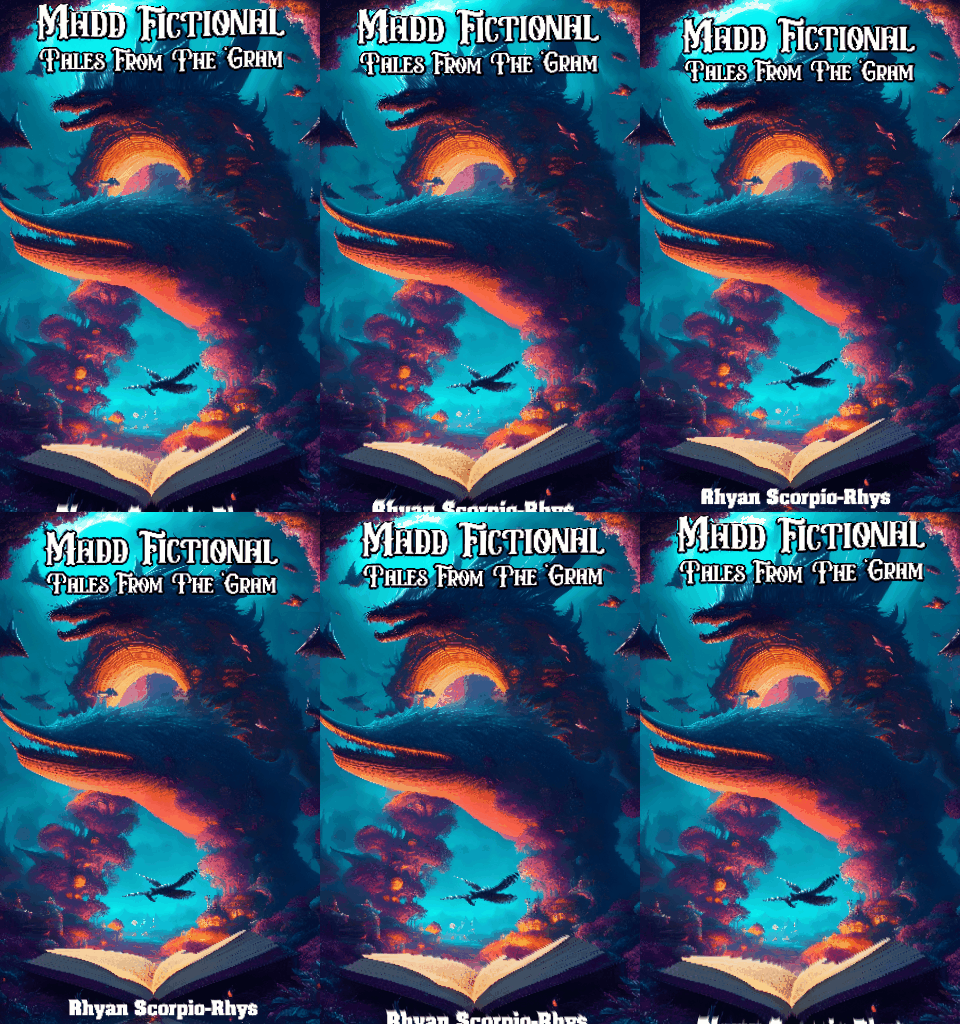
Madd Fictional Tales From The ‘Gram

Unleash your imagination and step into the extraordinary with “Madd Fictional Tales From The ‘Gram.” This vibrant anthology is a unique mosaic of short stories spanning speculative fiction, horror, science fiction, and fantasy. From the uncanny to the breathtaking, each tale will captivate your mind, leaving you teetering on the edge of reality as you traverse through realms of the fantastical and the terrifying.

Authored under the pen name Madd Fictional, Rhyan Scorpio-Rhys’ collection is a testament to the power of narrative, weaving a tapestry of emotion, suspense, and the sublime. Explore the enigmatic corridors of the human psyche, come face-to-face with unseen horrors, and journey through time and space with unforgettable characters.

“Madd Fictional Tales From The ‘Gram” transcends the ordinary, taking you on an exhilarating ride through the heart of the extraordinary. Each tale is a unique universe, beckoning you to step in, experience its wonders, and be enthralled by its compelling narrative force.

Immerse yourself in this riveting collection and experience storytelling at its finest. A treat for avid readers and casual browsers alike, “Madd Fictional Tales From The ‘Gram” is your passport to the realm where dreams and nightmares collide, reality takes a backseat, and the improbable becomes the norm.

Get your copy today: ORDER HERE

Eldritch Attraction: The Forbidden Mad Love of a Cthulhuian Woman

Dive into the uncharted depths of cosmic horror romance with “Eldritch Attraction: The Forbidden Mad Love of a Cthulhuian Woman,” a darkly captivating guide that transcends the boundaries of reality and delves into the mysterious world of love beyond human comprehension.

From navigating interdimensional courtship rituals to exploring the psychological impact of an otherworldly romance, this book offers an unparalleled glimpse into the enigmatic realm of Cthulhuian relationships.

As you journey through the pages of this enthralling how-to guide, you’ll be captivated by a series of diary entries that follow the haunting and unforgettable love story of a human protagonist and their alluring Cthulhuian partner.

Together, they defy the odds and face the unimaginable in a tale that blends cosmic horror, dark humor, and the power of love to transcend even the most insurmountable obstacles. Brace yourself for a love story that will take you to the furthest reaches of the cosmos and the darkest corners of the human heart.

Are you ready to embrace the madness and discover the eldritch attraction that awaits?—grab your copy of “Eldritch Attraction: The Forbidden Mad Love of a Cthulhuian Woman” today!

Available HERE:

At Last, The Destination

Although the sun sat high in the midday sky, the figure who approached me was draped in a shadow so complete as to let no light escape the boundaries of its form. Its frame was crisp but the features blurred and I knew in that instant that none who lived was allowed to view its terrifying countenance.

“You have come for me?” I asked, my voice betraying the courage I strove to display.

“Come?” the figure said in a voice neither male nor female but not wholly unpleasant. “No, my dear, I am always present.”

“But you surely do not deny that you are the Grim Reaper?”

“The Reaper I am, yet not so grim. And I pose no danger to you for Death is not to blame for death. If it offers you some measure of comfort, think of me as the ultimate destination of your lifelong journey.”

The Reaper spoke without guile. Its words, a wave of tranquility, washed over me and suddenly I found myself in the embrace of a satisfaction I had never known in all my days. This newfound contentment was accompanied by the realization that I had overcome insurmountable obstacles and completed a near-impossible task, and as I accepted the Reaper’s hand, warm and soft to the touch, I slowly exhaled all the limitations of the physical world and welcomed the painless transition into the final stage of existence.

The Secret

The moment Lavelle stepped through the door, I realized something was wrong. He had just come home for winter recess, head shaved bald and immediately retreated into his room claiming to be exhausted from the trip. When he finally made an appearance at the dinner table, he asked if we could go shopping for some new clothes from the big and tall section. Lavelle, like the rest of my side of the family was thin and vertically challenged so when I questioned him he claimed “it’s the style now, you wouldn’t understand.” It was an obvious lie but I loved my son and went along with the deception.

While selecting stretch fabric shirts and elastic band pants that were several sizes too big for his wiry frame, Lavelle shyly asked if I could take him to see an animal therapist. I could have handled my initial response better but it was such a bizarre request that caught me out of left field. I began badgering him with questions and demanding answers until he broke down in tears and revealed that he had become a werewolf.

We did a joint counselling session with a therapist who took my son’s claim in stride. She gently suggested that Lavelle could only have true happiness if he found a way to be comfortable with his authentic self. Doing my part, I assured my son that I would continue to love and support him. I told the therapist that I was scared for him because I felt with all the torment he was experiencing by holding everything in and hiding the truth for so long, something would cause him to break and harm himself, the way some people do when they reach the final straw.

The odd thing about the whole situation was I was never afraid for my own life. I knew my son would never hurt me. And the only major adjustment I had to make was whenever he visited home during full moon periods, he tended to leave portions of his victims on my doorstep, the way house cats brought glory gifts to their owners when they killed mice, leaving me to dispose of the evidence and follow YouTube tutorials on “biohazard remediation,” but these were the things one does for love.

Busker For The Dead (Part 1)

I don’t have that look. Some people do, but I’m not so lucky. I don’t look like my profession. I’m a busker. Don’t laugh, it’s a living. Problem is, when you shut your eyes and picture a busker in your mind, be they small or tall, slight or portly, I will never fit the bill. I have the unfortunate appearance of someone whose job title is preceded by the word man. Milkman. Mailman. Garbageman. Just not a streetmusicman.

You may be asking why this is important. Fair enough question. When you’re panhandling for money—come on, let’s face facts, street performing is begging with a musical accompaniment—having the look of a starving artist plays as much a part in getting people to part with their hard-earned cash as talent.

“Oh, look at the poor wretch having to sing for his supper, let’s toss him a pittance, shall we, dear?”

Some of the others have nailed the look down from the hair that refuses to be tamed to the ragged clothes just over the borderline from being hip and trendy. Me? I look like a well-fed blue-collar worker trying out a new hobby. That’s why I have to work twice as hard to earn half as much as my compadres. My audiences tend to be tight-fisted, self-absorbed philistines that expect blood for the bits of copper they toss my way.

Oh, I should probably mention that I busk for the dead.

Not the kind of job you rush out and apply for. Me? I kinda just fell into it. Turns out a friend of a friend knew a guy who used to work for the cousin of a woman who lived next door to a guy who was complaining that his employee just up and quit on him. Seems he couldn’t handle the stress of performing in Perdition, which I can plainly understand now.

What? No, I’m very much alive, thanks for asking. My work ID acts as a sort of day pass and allows me to mull about in Hell without experiencing any of the torment and damnation. Kinda cool, but it takes some getting used to.

Although it’s a paying gig, it ain’t enough to cover rent and bills—minimum wage in Hell is murder, no pun intended, so I rely heavily on the gratuity chucked into my hat. And yes, the dead have real money. Don’t ask me how that works. I’m still trying to wrap my head around the day pass into Hell thing.

My spot is the corner of Abaddon and Wretchedness, and while a part of the overall design of Hell, it’s technically Limbo, the waiting area where souls are processed and dispatched according to assessment. And as time moves differently in Hell, the wait can be an extensive one, so you figure folks would jump at the chance to experience anything that takes their minds off the situation at hand. That is so not the case. When facing damnation, the furthest thing from their minds is to listen to anyone sing. This is made evident from the contents of my hat. Today’s take so far consists of three dollars and eighteen cents in coins, a stick of chewing gum, a balled-up snotty tissue, and a punch card from some boutique java spot with one punch away from receiving a free coffee. The coins stay in the hat, the gum in my mouth, the tissue—ick—in the trash, and the punch card in my pocket. I’m not one to go in for designer coffee but like The Police sang, “When the world is running down, you make the best of what’s still around.”

“Not what I expected,” a voice says from behind, nearly startling me out of my skin.

I turn to see a woman in her sixties, seventies, maybe—I’ve never been good at guestimating people’s ages—all done up as if for a night on the town. “You’re not the first person to say that.”

“And is it just me or is it chilly here?”

She was right, you’d figure being so close to Hell there’d be some sort of radiant heat, but there was a constant wind that blew shivers down the spine. “Not just you.”

“You’re not half bad, you know.” the woman said, looking into the hat. “You deserve more than that.”

I look up and down the avenue, We’re the only two people on the street at the moment. “It’s like they say, it all comes down to location, location, location.”

The woman opens her purse, a small clutch bag that’s a throwback to a classier time, and produces a two-dollar bill. “I’m afraid I’m not in the habit of carrying cash, so this is all I have.”

“It’s the biggest tip I’ve received in a long while.” I smile as she places the bill into the hat.

“Not that I’ll have much need for it anymore.”

“Not unless you were crossing the river Styx.”

“You mean the ferryman doesn’t accept the card?” the woman pulls out an obsidian credit card. “I was told never to leave home without it.”

It’s an outdated reference, but we both chuckle at it.

“If you’ll pardon the intrusion,” the woman asks. “How did it happen?”

“How did what happen?”

“How did you die? Peacefully, I hope.”

“Oh, no. I’m not dead, I just work here.” I show the woman my day pass.

“How interesting.” and she appears to actually find it interesting but her expression drops.

“What’s the matter?”

“It would be my luck that the first conversation I strike up in the afterlife would be with a living person. I was sort of hoping to find a travel companion for what lies ahead. I’ve always dreaded doing things by myself.”

“I’m not sure that’s how it works here. I think isolation is part of the torment process.” I realize what I’m saying just a smidgen too late to pull it back.

“Torment. I hadn’t considered that.”

“Sorry.”

“Not your fault. You’re not responsible for my sins.”

“I know I’ve just met you but it’s hard to believe you’d have anything to worry about.”

“Kind of you to say, but we’re all sinners in one fashion or another. I just wish there was a way for me to plead my case. I believe my sins were righteous.”

“You can always try.”

“No, no. I’ve never been good at that sort of thing.”

“Maybe if you practiced, rehearsed what you want to say? You can try it out on me and I’ll give you my honest feedback.”

“No, I couldn’t.”

“What have you got to lose? If you botch it up, you’re still being condemned anyway, at least this way you’ll have had your say.”

“Like my final words?”

“Exactly.”

She contemplates it long and hard. “All right then, if it wouldn’t be a bother.”

I gesture up and down the block. “Not like I’m doing anything else. Ready?”

“No, but go on.”

I straighten my posture and assume an authoritative voice. “You stand here accused of the sin of…”

“Murder,” she adds, sheepishly.

“Murder,” I repeat, stunned. “What say you in your defense?”

“I don’t deserve to be here. I was sent to the wrong place. I did what needed to be done, what no one else had the courage to do and now I’m being punished for my actions.”

“And whose life did you take?”

“My own.”

“Why?”

“Others would have died if I didn’t.”

Not The End…

Tiny Stories: The Million Dollar Choice

Popular belief has it that the universe is comprised of atoms. In reality, the universe is actually made up of…

The cloth bag placed over her head not only prevented her from seeing where she was being taken but also blocked out all sound. Erica had no idea technology like that even existed. When the bag was removed, she found herself seated in a small nondescript room with a high-end tripod-mounted camera trained on her.

On the table before her sat an open attache case filled with twelve stacks of $100 dollar bills, eighty-three used and non-sequential notes to a stack. Beside the case were two glasses of red wine, one untampered with and the other laced with a deadly toxin.

Erica heard about things like this, private rooms on the dark web where people with money, people to whom a million dollars wasn’t life-changing like it was for her, but merely pocket change, wagered on the lives of the desperate and destitute. There were Russian roulette rooms, perverse puzzle rooms, and deadly escape rooms. She had gotten off lucky, she supposed. Hers was a simple fifty-fifty choice.

If she chose correctly, Erica stood to walk away with enough tax-free money to pay off her debts and do things the right way this time around. The smart choice would have been to ignore the invitation in the first place and find some other way to repair her damaged life, but she was inflicted with a serious gambling disease, something she inherited from her mother, and the opportunity was simply too good to pass up.

The catch? She was a lousy gambler, notorious for making bad choices even when she second-guessed herself, and her fatal flaw was that she could never pass up a dare or a bet.

Erica wasn’t allowed to touch the glasses before making her choice, so her eyes darted left to right, from one to the other, looking for the slightest discoloration between the two, and she even sniffed the air above each glass, which was pointless. These people were professionals and whatever lethal venom they used was no doubt undetectable by sight or smell.

She had a feeling in her waters that the one on the left was the dead cert unpoisoned wine glass, but was it strategically placed just a half-inch closer to her to make her select it subconsciously? Then she opted for the one on the right but suspected she was outfoxing herself. Then there was the possibility that both glasses had been tampered with. No, she couldn’t allow herself to think that way. Morty, the guy who set up this bet, had always been a straight shooter. He looked out for her whenever he could. Even when you made a habit of dealing with less than reputable people, you had to place your trust in someone. So Erica girded her loins and went with her initial instinct.

Was it her overactive imagination playing tricks on her or did she feel a static shock of electricity as she lifted the glass on the left by the stem? She tilted the snifter slowly, praying to the gods of luck and good fortune, and the moment the chilled wine touched her trembling lips, she knew…