Shinichi Mochizuki’s solution to the ABC Conjecture
One of the major downsides to tech advancement on Earth, after our biggest brains finally made faster than light interstellar space travel a reality and we opened our planetary borders to all friendly offworld visitors, was that the human dating pool became oh so very shallow.
Bored with the same old same old, curious and adventurous single and married people began dipping their toes in alien waters, some for the experience, others for committed relationships, and the rest simply for bragging rights. It had gotten so bad that finding a partner interested in a same species relationship became near impossible. And those not willing to get it on with an extraterrestrial, chose to marry their farm animals, automobiles, cartoon characters and even holograms, rather than share intimacy with another human being.
I tried to fight the good fight and preserve the human race, but there’s only so much rejection a man can face before throwing in the towel. I resigned myself to a fate of hermitry, and searched for hobbies to occupy my mind until the day my card was punched for the final time.
But the universe wasn’t done tormenting me yet. On my birthday, I received an anonymous gift in the mail: an all expenses paid trip to an orbital platform that was hosting a speed dating event. My first reaction was to chuck the invite in the trash and return to my 40,000 piece jigsaw puzzle of the notorious math problem, “The ABC Conjecture.” What stopped me was the 7 course meal and open bar, guaranteed, whether you successfully found a match or not.
Shinichi Mochizuki’s mathematical solution could take the back seat for a night, while I stuffed my face in space and got absolutely pie-eyed.
I made a half-hearted attempt at looking decent, no sense in getting turned away at the space jitney depot for improper attire, and got a jumpstart on the festivities by knocking back as many complimentary cocktails on the flight up to the orbital platform as I could manage.
The plan was to make a beeline for the food and bar, and when I had my fill, catch the next available jitney home. The catch was that I had to complete at least one round of speed dating before having access to food and drink. The second disappointment was absolutely my fault for not reading the invite carefully. I was one of ten humans in attendance, all of them male, because this was an interspecies speed dating event. How in the world did I overlook that detail?
For four minutes at a pop, I went through the motions of engaging in conversation with an Onzuid, a Thraikket, a Brelgut, a Mellad, a Thaeqen, and a Raphoth, and a majority of those dates were spent struggling to communicate in broken english, which I had to give them credit for. They knew more of my language than I knew of theirs.
My final obstacle was a Neita, who spoke no english at all. She, the assumed pronoun because she wasn’t able to convey one herself, spoke an melodies while her bioluminescent skin shifted through the color spectrum with each note. I had no idea what she was saying but I had to admit, it was beautiful to watch.
When it was my turn to talk, I decided to sing about my upbringing, not knowing whether she would be impressed by my effort, or take offense, thinking she was being mocked, but I was only here for the food and drink, so what the hell.
I sang about being born in The Bronx, in a neighborhood that history marked as one of the most dangerous places to live in New York at the time, but on my block, everyone spoke like they knew you. We played on the concrete year ’round because there was no local park, ate free bologna and butter sandwich lunches at the public school during the summer and filled our days playing handball, riding bikes, competing in games like Steal The Bacon, Hot Peas And Butter, Ringolivio, Freeze Tag, Skelzies, and when we got a little older, Run-Catch-Kiss. Water fights consisted of anything you could fill from the open fire hydrant (pots, pans, cups, buckets, or whatever). And if you didn’t go home dirty, you weren’t having a good time. We ate whatever we wanted because no one knew a thing about food allergies (and fried chicken and red Kool-Aid was as important as the air we breathed). We fought with our hands and made up the next day like nothing happened. And if you showed disrespect to your elders, or looked in their mouth while they were talking to grown folks you would get put in your place immediately. And the universal rule was, once the street lights came on, that was our curfew. Anything left undone would have to wait until tomorrow.
When I was done, she smiled (at least I took it to be a smile) and glowed a calming shade of yellow. The bell rung and I nodded goodbye and made my way to the dinner table. To my surprise, she joined me, and we sang to each other for the rest of the night.
When the event was over (yes, I stayed to the end) and before we went our separate ways, I gave her my phone number. I wasn’t sure if she understood the gesture, if she would call me, or even how we would manage to meet up if she did call. All I knew was that love would find a way.
My monotony needed twisting yesterday, so I went for a stroll, sans iPod. You know, breathe in a bit of city fresh air, clear some cobwebs, that sort of deal.
There I was walking down the street, mind-sifting through character conversations and scene settings when I looked down at the pavement and realized that I was traipsing through what looked like the aftermath of the Great Worm War of 2021. The sidewalk was a battlefield littered with the corpses of thousands of earthworms that coated an entire city block.
Logically I knew how this could have happened. I knew they came to the surface either during the heavy rains–but it’s been dry weather for the past week–or to pair off and mate only to get caught on things that are hard for them to crawl across, like sidewalks and subsequently fry on the surface from sun rays–but that normally occurs during spring.
So, what then? Had there actually been a battle? Warring clans pitched against one another over territorial disputes? Factions in conflict over the claiming of a throne? Families locked in a deadly dispute over an unholy union?
Or was it a warning?
As I stood there, staring at their dried remains, curled into runic shapes, I wondered if they had been somehow gifted with a vision of the approaching apocalypse and had sacrificed themselves in an effort to warn us in the only language they knew. The last Germanic language spoken to them by man before the two species went their separate ways.
At that moment I felt like Indiana Jones in the passageway to the Grail chamber, trying to decipher the worm cadavers’ possible portents of doom, only without the aid of a diary or Sean Connery whispering something about, “Only the penitent man will pass.” or like John Nash without an ounce of the mental code breaking ability.
And I stood there. Longer than I’m comfortable admitting. Frustrated by the limits of my linguistics. Finally, I forced myself to move on, but not before making a promise:
Not my actual name, mind you, but there is no real reason for you to know me by anything else. I was born—well, that is not important either, is it? All you need to know is that I am an alien—the extraterrestrial kind, not the immigrant kind—we can engage in intercourse for a fee, and you will most certainly not survive the experience.
Upon entering my boudoir you will undoubtedly notice the notches on the posts of my ornate bed. Your first inclination might be to assume these markings to be sexual conquests, and you would be severely mistaken. They are actually deaths. The number of grooves carved into the wooden headboard is one hundred and ninety-seven, at present, but the actual number is at least four times that. Only the deaths I regret have been engraved here. The rest received precisely what they came seeking and ultimately deserved.
A bit harsh, I realize, but how could you expect me to pity or mourn the passing of those who have tossed away so many possibilities, so many futures in search of la mort parfaite?
But I digress.
Due to the residency protocols of your Office of Planetside Security, the majority of my life was made an open book, yet there are certain things that remain hard for me to discuss. It is known that I was charged with treason back home for defending my personal beliefs—which remains my concern alone—and because my mate stood by my side during the trial, we were both exiled from my homeworld.
Set adrift in space, my people chose to let the universe decide our fate. If we were intercepted by a space vessel and taken aboard or found a world that would permit us to stay, then we were fortunate and were surely meant to live. If not, we would die on our craft when the life support and/or provisions ran out.
We traveled for what seemed like an eternity and never crossed paths with another vessel. Eventually, the ship malfunctioned and crash-landed on your planet. Only I survived, pulled from the twisted wreckage of my prison ship by a farmer who hid me away and chained me in his barn like an animal. He hosed me down and threw me scraps to keep me alive. What I did not know was that he was mustering the courage to have his way with me.
When I realized what he had in mind, I tried to warn him but I didn’t speak the language yet. I’m not sure even if I did that it would have made a difference. He forced himself on me and upon orgasm, promptly died.
My race can only mate with one partner in our entire lifetime. The first union sets into play a biological defense against infidelity by secreting a vaginal toxin that forces orgasm and subsequently death.
I was later discovered by one of the farmer’s neighbors, set free, and promptly handed over to Planetside Security. There I was taught the fundamentals of English and given an aptitude test to determine if there was a place on Earth for me. It was grueling and humiliating. And when I was finally issued a caseworker, she sat with me and explained that the only opportunity available was in legalized prostitution. I was insulted and furious and baffled by the thinking behind this. Did they not understand that of all the professions they could have handed me that this was by far the worst possible choice? Then I stepped back to look at the bigger picture. The planet was overpopulated by indigenous humans and the influx of extraterrestrials and what better way to cull the population than to tempt the thrill seekers who wanted to risk death? To treat terminal patients who wanted sweet release?
So, I embraced my role in society and performed my duty and was dubbed the “Whorebinger of Death” and the “Grim Raper” by the press. And naturally, because humans are bizarre creatures, there were ladies who worked the same profession who envied me.
I have yet to warm to this planet and it does not resemble my homeworld in any way. My assimilation was slow to nonexistent and this was primarily my fault since I declined to undergo the genetic surgery offered to offworlders to make us appear more human. Though the human form is better suited for the physicality of this world and less cumbersome and my world has turned its back on me, I am still proud to be of my race.
The more time I spend here, the less confident I am about my appearance. On occasion, I have watched a television show or movie, or glanced at an advertisement, thinking the models to be a proper representation of the human race. I have since learned that there are those among you who feel your appearance does not measure up to the so-called perfect people placed on display. If you are one of these people who question their beauty, I ask you to consider this: at least you are of the same species.
I stand at the edge of acceptability, balancing on the fine line of grotesque fascination and physical revulsion simply because my eyes are not the same color or shape as humans, and my hair, what little I have in places considered odd by your lot, was actually tufts of fine fur.
I also need to be aware of my nails and keep them within an acceptable length to where they were not considered claws. The same with my smile. Apparently, when I bare my teeth it triggers a fight or flight response in most people.
“If only there could be an invention that bottled up a memory, like scent. And it never faded, and it never got stale. And then, when one wanted it, the bottle could be uncorked, and it would be like living the moment all over again.” ― Daphne du Maurier, Rebecca
I have a memory like a sieve. My recollections of the past come to me in flashes and snippets and I have to be mindful not to fall into one of the many great blank holes when traipsing around in half-forgotten yesterdays. Part of it is the result of a built-in self-defense mechanism, tamping down the harmful events that one never quite survives intact. The rest? Just plain negligence. I am a poor caretaker of retrospection.
And for a while, I wasn’t bothered by it. Then I reached a point in life when memories—–of love and pain and the whole damned thing—-became important because I found myself wanting to catalog my journey before I reached the end of the race (it’s always closer than you expect and they say you never see the finish line with your name on it).
But now, when I recount the tales of the various and sundry someones who impacted my life before blowing away like a leaf in the wind, someones whose names I used to be able to recite by rote, those names have now taken up permanent residence on the tip of my tongue but never so close as to venture past my lips.
I find that in order to remember a past event, I have to place it in a location that’s visible so that I don’t misplace it along with my keys and smartphone. I have chosen this place as the soil in which to plant my evaporating memories before they’re gone forever.
I put this moment here:
Of the girl that I fancied in the first grade whose name might have been Cheryl or Shirley but for some reason I remember it as “Squirrel,” whom I wrote about when the teacher asked the class to write about something we loved. And that selfsame teacher thinking it was so adorable that she took me to Squirrel’s class and made me read it aloud to her. You’re never too young to discover embarrassment.
I put this moment here:
Of the German woman who made me my first brown bag lunch for school that consisted of a healthy liverwurst sandwich which I enjoyed the taste of but stopped eating altogether after being teased at school by the other kids for eating dog food. It hurt her feelings and I wish I had a stronger conviction to continue eating the lunches she prepared with love.
I put this moment here:
Of the asexual woman I worked with at a car rental agency who looked like a young Peggy Lipton and lived in New Jersey. I remember riding the Path train to her house and we would regularly break dawn discussing her passion, serial killers. She didn’t own a television and instead had an impressive collection of serial killer and unsolved murder case books. I found her fascinating and in hindsight I suppose I’m lucky that I never went missing.
I put this moment here:
Of the woman I worked with at a banking institution, who I spent a bizarre New Year’s Eve with as we dropped tabs of acid that didn’t work and searched Manhattan for the perfect place to ring in the new year and ended up laying on the grass of Central Park making resolutions and wishing on stars for a better year to come.
Sometimes when my mind is idle, I struggle to recall the names of people and events trapped within synaptic pathways that withered from non-use, names and events I feel I should remember because of the emotions that linger despite the fact the memories have faded and recognition has faltered.
I lament the loss of these remembrances because they’re all a part of me and I’m afraid to learn the answer to what of myself will remain when all the memories have faded away.
Gather ye memories while ye may. You’ll miss them when they’re gone.
“Piece by piece, I fed my wardrobe to the night wind, and flutteringly, like a loved one’s ashes, the gray scraps were ferried off, to settle here, there, exactly where I would never know, in the dark heart of New York.” ― Sylvia Plath, The Bell Jar
The hawk was most definitely out tonight as I stood at the bow of the Staten Island ferry, coat collar popped and gloved hands thrust into pockets. This particular hawk bore a vicious set of teeth and wasn’t afraid to bite, which was fine by me. The colder weather combined with the icy wind that whipped off the bay afforded me some much-appreciated elbowroom, a concept that was foreign to most New Yorkers.
Being all alone out here wasn’t a problem. I had been alone most of my adult life. Alone in a crowded room. Alone in committed relationships. The people closest to me, those tenacious few who loved a challenge, were kept at an equidistant arm’s length.
Alone was my appetite.
Alone was my mantra.
Alone was my destiny.
“Not too cold out tonight, is it?” a voice said, almost causing me to leap out of my skin. There, suddenly beside me, was a woman bundled against the chill air, lips curled slightly in sarcasm. Right next to me. Within the boundaries of my personal space.
“Not as cold as it could be,” I replied more out of reflex than want. What I wanted was a little privacy, to tend to my own affairs as other people on the ferry tended to theirs. It was part of the unspoken rule when you agreed to live in this city. You avoided eye contact and kept yourself to yourself.
I looked at her, this stealthy woman that took me totally unawares. A full foot shorter than me, pretty, petite, and what was the politically correct term for it? Middle Asian? I wasn’t too sure and felt naked without my local ever-changing PC handbook to check for accuracy.
The immediate thing that came to mind wasn’t how stunningly attractive this woman was. My first thought was actually, Why are you talking to me? As a point of clarification, that was one of the things I admired about myself, whether it was my face or the vibe I gave off, people generally never felt the need to walk up and talk to me. Unless of course they were mentally challenged or capable—again I needed to consult the handbook—or nuts or out to start a fight with a stranger they mistakenly assumed was harmless. She was clearly none of those.
But the thought evaporated as suddenly as it appeared. She blurted out a simple statement of fact and I happened to be within earshot. Conversation over. Turn the page.
But it wasn’t over. “Do you know who you are?” she asked without a discernible trace of an accent.
“Pardon?” I was taken aback by the suddenness of the question. “What, like my name?”
“No, that is what you are called. I want to know if you had to describe yourself to an absolute stranger, what would you say?“
“Most likely? Nothing,” I admitted. “I’m not too fond of the question.“
“Really? What if Nazis held guns to your parents’ heads? What would you tell me then?” she smiled politely, waiting.
Damn. The Nazi ploy.
As much as I hated being manipulated in this fashion, I couldn’t allow anyone, not even this woman, the most un-New Yorkian person I had ever encountered, to think I was some heartless brute that would have allowed Nazis to murder my parents in an effort to avoid providing a self-summary.
“And just so you know,” she continued. “We, the Nazis and I, aren’t accepting you are a work in progress as a suitable answer, since we’re all works in progress until the moment we give up living.“
“Fair enough,” I nodded. It was one of those overused expressions that I couldn’t stand, just like thinking outside the box. I watched her with obvious suspicion and had half a mind not to answer, half a mind to walk away. Neither of those halves proved to be victorious.
I hadn’t the foggiest notion what came over me but words started spilling out of my mouth before I even realized I was speaking. “What I am is a pessimistic optimist, who believes love shouldn’t be denied to anyone, even to those born with icy hearts. What I know is that I’m wise enough to accept love as it finds me and not reject it because it doesn’t come wrapped in a pretty package. What I hope is that someday every lonely person will reach out to another lonely person and befriend them so that the word lonely fades from our lexicon.“
“You must be a writer because that was corny and clumsily poetic,” she eyed me for a long moment. “But an artful dodge, so I’ll let you get away with it. This time.“
This time? Just who did this woman think she was?
“Now it’s your turn,” I said. “Tell me something about yourself. Anything. Start with where you’re from.“
For the briefest instant, her expression took on a sadness that could only have belonged to reminiscence. “I was born and raised in India, longer ago than you would believe, but I have traveled all over, to places you probably do not even realize exist.“
“You’re probably right about that. Geography really isn’t my strong suit and I haven’t really traveled outside of the five boroughs,” I said, instantly embarrassed by my lack of worldliness. “So, what brings you to New York?“
She remained quiet for a moment before answering. “I work for an organization, currently in a state of transition, that suffered drastic downsizing due to image problems and public opinion. My employer is in the midst of rebranding and taking on a new staff to suit the company’s new direction. You can say that I am one of many headhunters.“
“Talk about your artful dodge. You said a mouthful just now and told me absolutely nothing about what your organization does to make a profit.“
“I can tell you, but only if you really want to know because that information comes at a price.”
“Which is?” I asked.
“Your undying loyalty.”
I chuckled. “Of course.”
“Of course, you agree to my terms, or of course, as in a mockery?” she cocked an eyebrow my way. “We must be clear about this.”
“The latter, no offense.”
“I see,” she ran a hand through her hair to remove it from her face. It was then that I noticed she wasn’t wearing gloves and hadn’t actually appeared to be cold. “You asked me what brings me to New York. Would you believe me if I said it was you?”
I held up my hands in surrender. “All right, this is where I officially punch out of this conversation.”
She took half a step closer. “Your loneliness, your isolation is like a beacon to me. I am drawn to you. I know your kind. I have seen your future and you will most assuredly die alone. No mate, no children to carry on your legacy.”
“I hate to break it to you, but I’m happily married with three kids who adore me.”
“Not true in the slightest. You have lived alone ever since your cat died of leukemia two years ago.”
“How — how could you know that?”
“The same way I know the first girl to break your heart was Shirley Hartsdale in the sixth grade when she began dating your best friend behind your back and made you the laughing-stock of the school. To this day you hold a distrust of people because of that incident, even friends and family.”
I hadn’t caught the last part of her sentence. My brain was flooded with thoughts of Shirley Hartsdale, someone I hadn’t thought of in years and even now, she left a bad taste in my mouth.
“The organization I work for has that sort of information available to them, not solely on you but everyone on the planet.”
Oh God, I started to panic. She’s a terrorist. Part of some ferry-riding Sleeper Cell that uses attractive women to pry information out of dumb single Americans. My photo was most likely going to land in some Homeland Security dossier marked Al Qaeda Sympathizers. In that moment I just wanted this woman to be away from me. Far, far away.
“I am not a terrorist,” she smiled. “Nor do I belong to a cult. What I am is a member of a peacekeeping task force that seeks to restore balance to the world with the help of people like you, the overlooked, the forgotten, the unloved. More than an organization, the company that employs me is my family and is directly descended from the first family ever to set foot on the earth. It can become your family, as well.”
“What I can offer you is a love unparalleled,” She touched a finger to my temple and the wind died away. The air barely moved for several moments and I listened as she spoke. My world began spinning savagely. I winced and swallowed hard to prevent nausea from triumphing as her words poured images into my mind, saturated with so much sensory information and emotion that I thought I might burst at the seams.
“You will want for nothing. I will bear you many children and you will have a family the size of a small nation. A family who will worship and adore you. All this and more if you will simply pledge yourself to me forever and always.”
She moved her finger away and the stillness of the air vanished as the wind rose once more. I staggered a moment, my mind reeling with the imagery that pressed a palpable weight on me. When I regained my balance and sight, I stood there stunned and in comparative silence after being shown a world that only existed as the flimsiest of pipedreams. The reality finally hit that I was dealing with something way beyond me, something that threatened to swallow me whole if I wasn’t careful.
“And you will be free to follow your dreams. Become a novelist and millions will read your words. You will be well received all around the world. Spend your days lecturing, even teaching and sculpting young minds, if that is your wish.”
“Or,” she continued. “Write and direct films that interest you and your following will be massive. Fellini, Scorcese, Hitchcock, Kubrick, Tarantino, would not be able to hold a candle to you. You could be like Woody Allen and release a film each year, all guaranteed blockbusters with the stars of your choice eager to play a role.”
“And all this will happen because of you?”
Her tone shifted, becoming as sharp as a finely honed blade. “No, because of your pledge to be with me and only me.”
“Like signing my soul over to you?” I knew the answer but had to ask anyway.
“What an archaic notion. All I need from you is your promise, sealed with a kiss. The question is: do you want to live the life you have always dreamed of living or not? After years of struggling and going unnoticed by women and society at large, you have learned to wear your isolation like a protective shell but this isn’t who you truly are, who you were meant to be. If anyone deserves a shot at the brass ring it most certainly is you, is it not?”
I had trouble meeting her eyes. “That’s tempting, it really is…but I can’t.”
“You would turn down everything?”
“I’m too old to believe I can have everything. And old enough to know I won’t be happy. Maybe at first, on the surface, I will, but as time goes by I’ll know deep down that I didn’t earn any of those things. You wouldn’t be with me because you love me. You’d be with me because you needed something from me. Something I’m not smart enough to figure out at the moment.” I felt foolish because I truly couldn’t see the angle. My soul wasn’t worth that much so there must have been something else.
And suddenly I was aware of the nearness of the woman and no longer thought she was in my personal space but that I was in hers and I worried about what being within her sphere of influence might do to me. I was afraid that her essence, the power she projected would have tainted me, marked and cursed me forever.
“It seems I misjudged you. All that talk of accepting love as it finds you and erasing loneliness from the lexicon is all just a mask. Your problem is not being too old, it is being too afraid.”
“What?” my voice cracked as I felt a sudden pang of fear.
“You are a dichotomy of fear. You are afraid of dying home alone, yet you fear leaving your house to meet a woman you can form a relationship with, you fear being friendless yet fear making friends, fear being childless yet fear the responsibility of having children, you fear being loved, fear being hated, you fear life and just about everything else and you are content to let it rot your soul as you waste away out of existence.”
The wind rose in unison with the pitch of her voice and I was hit with a blast so icy it made my eyes water. I wiped the tears away and the woman was gone.
I went inside because I felt the sudden and dire need to be around other people, be close to them, feel their warmth. I settled down in a seat between two strangers, neither of them pleased that I had invaded their personal space, but I was past caring at the moment.
Looking down the opposite end of the ferry I spotted the woman talking to a man, most likely another lonely bastard like me. I wanted to go over and warn him but he probably wouldn’t have believed me, and wasn’t it up to him to face his own temptations? Who’s to say that he wouldn’t have been within his rights to accept? And was I a fool for letting the opportunity to end my loneliness pass me by?
Then and there I made a promise to change my life, to put Shirley Hartsdale in perspective and get on with living and reconnect with old friends, if it wasn’t too late. I pledged to make new friends and actively seek out the love I deserved instead of waiting for it to come to me. Yes, that was what I planned to do.
About Personal Space: This is one of them thar inspired by true events stories that happened one winter’s night when I was riding home on the Staten Island ferry.
A woman walked up out of the blue and started talking to me, telling me that she worked in the UN as a member of the Peacekeeping Task Force and her husband was a prosecutor for the War Crimes Tribunal. He was in The Hague, at that time, prosecuting a war criminal. She went on to tell me about their very strange but open marriage.
I blogged about this encounter on numerous occasions, mostly touching on the psychological effects the news media outlets’ constant terrorism scare reporting tactics have on the average person, even if they happen to be apolitical. And how even people who consider themselves to be an egalitarian, can get caught up in subconscious racial profiling.
It’s an encounter that has its hooks deeply embedded in my soul and I guess I’ll keep writing about it until the realization becomes easier to deal with.
You’ve done your research, worked your mental fingers to the bone, and devoted all your time, energy and attention to detail into nailing the anatomy, structure and formatting of your very first short story/novel/poetry piece/article/screenplay, before sending it out for mass consumption.
And you wait, and wait, and wait, and wait for a response. When it finally arrives, your eyes will skim over the body of the letter and lock in on one sentence:
“After reviewing your work, we’ve decided that it isn’t a good fit for us and we’re going to have to pass.”
Don’t let that sentence shake you. Very rarely is a writer’s first written work good enough to be marketable. It takes experience to craft a truly sellable piece, experience you’ll earn by pressing on. This written piece leads to a second and a third and eventually you’ll find an editor, publisher or what have you that believes in your potential.
Somewhere between the synopsis and the treatment lies the plot outline, also known as a one page. Typically one-to-three pages in length, the plot outline is the bare bones of your story before it’s fleshed out with action description and dialogue.
Although there are no hard and fast rules on the level of detail that should be included, a standard plot outline generally contains:
The protagonist and their goal.
The antagonist and their goal.
The supporting cast and their main wants.
The five major plot points (as mentioned in a previous post)
The order of events and sequences.
A list of scenes that properly convey the story.
And if want to keep the anatomy of a plot outline in mind but you happen to be the forgetful type, have I got just the t-shirt for you: Plot Outline Tee (Hey, don’t even @ me. There’s no point in having a blog if you can’t indulge in a little shameless promotion every now and again).
“Show, don’t tell” is one of those bits of advice that gets handed to aspiring writers in writing courses, advice columns, blogs, seminars, and while it may seem simple on the surface, many scribes can’t differentiate the two in their own work.
Telling a story is the blunt delivery of facts. “She was pretty.” “He was hungry.” “They were angry.” Yes, it does get straight to the heart of the matter, which makes it ideal for journalism and academia. But for prose it’s too antiseptic and puts distance between your work and your audience. Your goal as a writer is to immerse the audience into the world and allow them to experience things, people and places for themselves.
How does pretty look on this woman? Is it in the way her terracotta hair carelessly cascades over her delicate shoulders? Or do her eyes have a certain indefinable sparkle to them, making them alluring and sensual, with a touch of mischief? How would you describe hunger? The growling of a stomach and salivation in response to the Pavlovian stimuli of the school lunch bell? And anger, believe it or not, offers you a larger palette to paint from when you explore the other emotions—hurt, fear, grief, exhaustion—at play within it.
So, how do you bring the “show” into your writing?
1. Dialogue – This is the easiest way to let your audience experience a character’s mood and emotions. The catch is to avoid “on the nose” dialogue (I’ll get more into this in another post) which simply means having a character say exactly what they mean. Not only is it bland and boring, it’s unrealistic. In real life people speak in subtext, hinting and beating around the bush, secretly nudging conversation toward what they want to know and even then have to decipher the other person’s true meaning.
2. Sensory language – Using words and details to add color and depth to writing by appealing to your audience’s senses (sight, touch, taste, hearing, smell, emotion) in order to let them fully experience what you’re writing about.
3. More descriptive, less adjectives – The tendency of most fledgling writers is to slap a string of adjectives together to describe an action or scene. But being descriptive is actually about selecting the right words and using them in moderation to put your meaning across. Remember: Adjectives tell. Verbs show.
4. Be specific – Want to frustrate your audience? Try using fuzzy language. Offering up vague sentences like, “It was a pleasant night”, “She was a strange-looking girl”, “His life was a mess”, doesn’t serve you as a writer. Why not invest the time and effort into describing the feeling of a scene and working out the best way convey it to your audience?
Does this mean everything you write should be “showing”? Of course not. Especially when you’re dealing with the dull bits of the story such as travel, transitions, unimportant characters, etc. Instead of boring your audience by expounding on necessary but not particularly interesting details, just say it and move on.
Speaking of moving on, I’m out of here. Sally forth and be writeful.
You write for yourself. More daydreams than proper stories, your writing at this point appeals to you more so than other people. These stories tend to reflect your desires and fantasies and may contain in-jokes and references unfamiliar to a general audience.
STAGE 2:
You strive to break free of your narcissistic writing shell and communicate with a broader audience, but your reach exceeds your grasp. You’re aware of what you want to write but you’re caught in that in-between space of partially-developed and fully-fleshed-out stories. This is usually where you begin receiving your rejection letters. Keep these. Sure, they’re crushing at the time but they’re great to look back on once you’ve sold your work.
STAGE 3:
Your stories have begun to flesh themselves out but they’re still not where they need to be structurally and/or technically. This is also where you begin to work on improving your character development.
STAGE 4:
You’ve acknowledged and tackled all the problems in the previous stages, and though you haven’t totally mastered them yet, you can compose stories competently enough to jam your foot in the doorway of the professional writer field.
Are there other stages? Sure, and I’ll address them in a later post (this should be more than enough for you to gnaw on for now), so until next time…
“So the writer who breeds more words than he needs, is making a chore for the reader who reads.” ― Dr. Seuss
No better moment exists than when you first get hit with that brand spanking new premise for a story. There will be those of you who disagree, citing the signing of a contract and being handed a check for your work as a better moment, but I beg to differ. When a story first bursts to life in your mind, you are in the superposition of optimism. The story will be great, the best thing you’ve ever written and will be well-received by the washed and unwashed masses alike. No reality lurking about to place limitations on your spectacular vision at this point.
So, you do your prep work—outlining, research, character development, etc.—and pound out your first draft. And you’re happy with yourself. Real happy. Your first instinct is to share it with the world, but before you slap your baby in the mail or post it online, I need to break some bad news to you. Your story isn’t perfect. Not only is it filled with mistakes but it’s a tad overweight.
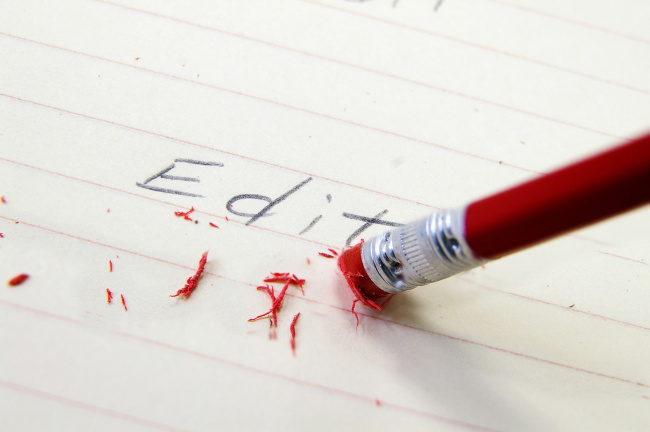
Since you most likely don’t have access to an editor at this stage in your writing career, the onus is on you to sharpen the edge of your blue-pencil blade to fix typos and cull clumsy or ambiguous phrasing.
If you’ve ever handed a story to someone to read, a story you were sure was error-free, you quickly learned that spotting mistakes in your own writing is difficult. The problem with self-editing is your mind glosses over errors because it knows what you meant to write and sometimes reads that instead of what you actually wrote. Fortunately, self-editing is a skill you can learn to hone in order to eliminate mistakes and improve the quality of your writing:
1. Don’t edit on the fly
I know this is a hard thing to do, but when you’re writing why not concentrate on getting your idea down on paper first? Sure, if you spot a typo it’s okay to correct it or to approach a sentence from a different angle in order to keep flow going, but when you begin deleting sections of your work or get caught in the dreaded rewrite loop—reworking the same paragraph over and over again—you’re placing road blocks between you and the forward progression of your story.
One solution to help break you out of this bad habit may be to try a distraction-free writing program like OmmWriter, Write or Die, Freedom, Grandview, and Don’t Look Back.
2. Set it and forget it
Once you’ve finished your latest magnum opus, stuff it in a drawer and go about your business before you even think about attempting to edit it. Concentrate instead on one of the many things you had to put aside in order to make time to write. What you’re doing here is stepping out from among the trees so you can see the entire forest.
You’ll find when you eventually return to your work, you’re approaching it with a new set of eyes that are better equipped to spot things you’ve missed, things that don’t work as well as you initially thought they did, inconsistencies, etc.
3. Big picture editing before sentence micromanagement
I know, I know, you’re eager to jump in and fine tooth comb your work sentence by sentence, and good on you for being that keen, but before you get into the detail work, I need you to consider examining your content and overall structure. Is there important information missing from the piece? Or a section that’s either irrelevant or seems out of place? How about scenes in desperate need of drastic revision?
Focus on the major issues before you begin tweaking words and sentences.
4. Put your work on a diet
You’ve over-written the piece. Uh-uh, don’t argue. You’re a writer who’s in love with the notion of stringing words together to convey ideas that plant images your audience’s mind, which means you over-write. Don’t be ashamed, most writers use more words than are absolutely necessary.
It’s time to get your piece into fighting shape by cutting its body mass index by ten percent. It’s easier to drop this excess poundage than you think, by simply losing mediocre phrases, unnecessary adjectives, and repeated points.
5. Don’t rely solely on spell-check
A spell-checking program can be your friend, but we all know from experience that it isn’t foolproof. The human eye is still the best tool for catching those sneaky homophone imposter stand-ins (to, too, two; it’s, its; yaw, yore, your, you’re; there, their, they’re), the ever-elusive missing words, auto-correct mishaps, etc.
6. Be backwards in your reading
Mistakes love sliding past you because they realize how tough it is proofing your own work. One of the ways to flip the script and catch them at their diabolical game is to start at the very end of your story and read it backwards. Sounds silly, but it works.
7. Push your darlings out of the nest
One of the awful things about being a writer is that you’re never one hundred percent completely satisfied with your work. But no matter how determined you are to touch the face of perfection, the hard fact is your writing will never be flawless. Accept it. You’re just going to have to settle for the best you can humanly manage. You’ll know when you’ve reached that point when you begin making slight adjustments, then reverting it back to its original form.
It’s time to stop, kiss your darlings on the forehead and push them out of the nest and let them fly into the world.
***
Actually, there are a plethora of editing tips that you can utilize before you get to this stage and instead of listing them all, I’ve decided to post the links below and allow you to browse them at your leisure and cherry pick the ones that work best for you.



 MADD FICTIONAL