The Weight of Shadows

A cold sliver of morning light slipped through the heavy curtains of Abigail’s apartment. She hadn’t left in months. The world outside had become a distant memory—a place of hurt, rejection, and suffocating expectations. Inside, her world was quiet, the boundaries drawn by the walls of her small apartment and her mind’s slow unraveling.

Abigail’s days blended together in a gentle haze. She read books, watched the sun crawl across the floor, and sometimes let herself wander through memories of a time when she was not so alone. She lived through the screens of her laptop, venturing into the virtual world only when necessary. No visitors. No conversations. She had even stopped answering her phone.

The isolation felt comforting, like a heavy blanket she could pull over her head to block out the world. But it was not without its costs. There were days when the silence was deafening. Nights when her thoughts twisted into dark corners, wrestling with the deep sense of loss she hadn’t dared name.

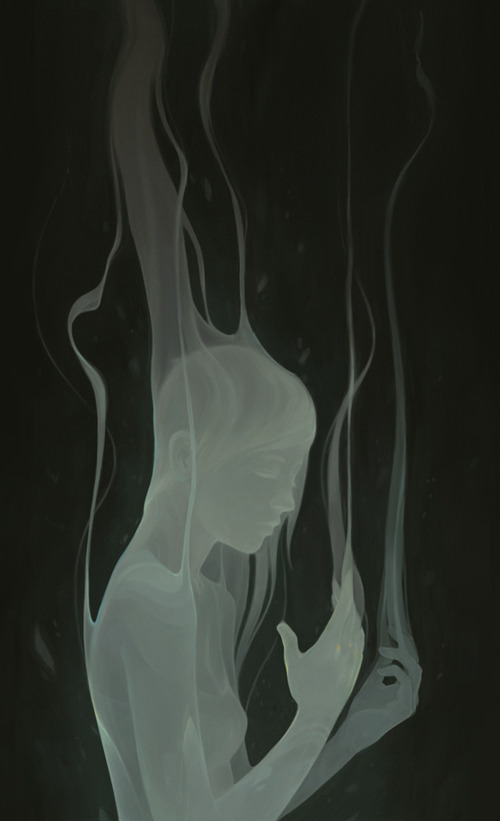
It started subtly, this fixation with the shadow. One afternoon, as she sat in her usual place on the floor by the window, she noticed the way the light caught her figure, casting her silhouette on the pale wall. At first, it was just an outline, a companion in the stillness of the apartment. But the more she looked, the more she began to notice details—the way the curves of her body played out on the wall, the sharp angles of her elbows, the delicate contour of her face.

Abigail had never thought of herself as beautiful. She had always been practical, focused, indifferent to her appearance. But the shadow, her shadow, felt different. It was more than an extension of her; it was a presence, a quiet reflection of a self she hadn’t explored.

Over the next few days, she found herself watching it more often. In the morning, the soft light would stretch it long and elegant. In the evening, when the light dimmed, it would grow sharper, more defined, almost bold. She started talking to it—at first just absentmindedly, then with a growing intensity, as if it could answer back.

She would trace its outline with her fingers, feeling a strange warmth spread through her at the thought of her hand brushing against this shadow-self. There was a comfort in it, a growing sense of intimacy. In its silent form, it listened to her, reflected her, became her.

One night, lying awake, Abigail felt a strange ache in her chest. It was a sensation she hadn’t felt in years—desire. She didn’t recognize it at first, dismissing it as a fleeting moment of loneliness. But the more she tried to push it away, the more it grew. She couldn’t stop thinking about the shadow, the way it moved in rhythm with her, the way it felt close, familiar, yet untouchable.

But how could she desire something that wasn’t real? How could she long for a shadow?

The days became a blur of confusion and yearning. She started spending more time by the window, letting the light play on her skin, watching as her shadow danced along the walls. Sometimes, when she moved, it seemed as though the shadow moved independently, stretching towards her, beckoning her closer.

And then one day, something changed.

The shadow didn’t just move with her—it shifted, morphing slightly as the light bent in a peculiar way. Abigail blinked, unsure if what she was seeing was real or a figment of her imagination, but there it was: the shadow had taken on a new form. A figure, still her silhouette, but different, softer—feminine, undeniably female.

Her breath caught in her throat. It wasn’t just her shadow anymore. It was another. A reflection of something she hadn’t yet faced. She reached out, tentatively, letting her fingers trace the shape of this new form. There was something in the way the light held it, in the way it seemed to curve toward her. The sensation was electric, a quiet thrill that made her heart race.

The attraction was undeniable. But it was more than physical. It was a longing for something unspoken, something she had buried for so long that she hadn’t realized it still existed. The shadow, this female figure, was the embodiment of her unacknowledged desire, the reflection of a love she had been too afraid to explore in the outside world.

Abigail had always known, deep down, that she was different. As a child, she had dismissed her feelings toward other girls as a phase. As an adult, she had pushed herself into relationships with men, hoping they would fill the void. But they never had. And now, alone in her apartment, shut off from the world, she had found something real, something that pulled her toward a truth she couldn’t ignore.

The realization came slowly, but with it came clarity. She wasn’t falling in love with a shadow. She was falling in love with herself, or rather, with the parts of herself she had suppressed for so long. The attraction she felt wasn’t for an imagined figure on the wall, but for the woman she had always been.

In the weeks that followed, Abigail’s relationship with her shadow deepened, but so did her understanding of herself. The shadow, once a reflection of her isolation, had become a mirror for her soul. It was a love story, yes, but one that transcended the boundaries of flesh and light. It was a story of self-discovery, of acceptance, of awakening.

And as the days grew longer and the light in her apartment changed with the seasons, Abigail found herself ready to step back into the world. Not because she had found someone else, but because she had found herself. And for the first time in a long time, that was enough.

Ghost Biker (Non-Bizarro Fiction Version)

silhouette-of-cyclist

The first time Samantha Lancaster saw the Ghost Biker, she was on her way home from Sarah Kawazu’s funeral.

The streets felt heavier that night, the air soaked with rain and regret. Her best friend, gone—crushed by a delivery truck on a road the city promised to make safer years ago. Samantha couldn’t stop replaying Sarah’s last message: “There’s something you need to see. Meet me tomorrow. It’s important.”

She never made it.

Now, cycling through the same streets that had stolen her friend, Samantha noticed how dark the bike lanes were, how jagged the pavement felt beneath her tires. At the corner of 11th and Pine—the crash site—she stopped. Her breath came in sharp bursts, the sting of loss catching in her throat.

That’s when she saw it.

A white bicycle. Ghostly pale, luminous under the hazy streetlights. It moved silently through the rain, slicing between shadows like a blade. Samantha froze. There was no rider. Or maybe there was—a figure blurred by the downpour, indistinct, almost spectral.

She blinked, and it was gone.


The next morning, Samantha’s editor tossed a stack of papers onto her desk. “Cycling deaths are spiking. Think you can spin it into something that sells?”

Her hands trembled as she flipped through the reports—accidents, injuries, fatalities. A dozen faces stared back at her from grainy photos, lives snuffed out in the blink of an eye. And all of them, according to witnesses, had seen the same thing: a white bicycle.

The Ghost Biker.

Whispers of the figure had been circulating for years—an urban legend, a warning to cyclists and drivers alike. But Samantha wasn’t chasing a ghost. She was chasing answers.

And Sarah’s death had made it personal.


Samantha’s investigation led her to the underbelly of the city’s cycling community—a tight-knit, scrappy network of messengers, advocates, and late-night riders who saw the Ghost Biker as both savior and curse.

“He’s a vigilante,” one cyclist told her, his voice tinged with reverence. “Keeps people on edge. Makes them careful.”

“He’s a murderer,” another countered, showing her the scars on his leg. “Chased me into oncoming traffic. I barely got out alive.”

The deeper Samantha dug, the more contradictions she found. The Ghost Biker didn’t fit neatly into any box—hero or villain, real or supernatural. But one name kept surfacing: Alex Stone.

A cycling advocate, Stone had died five years ago in a horrific crash. The city had blamed him for running a red light. His friends claimed otherwise: a faulty intersection design, ignored safety warnings, blood on the city’s hands. His death had sparked protests and reforms.

Reforms that never came.


One night, Samantha followed the rumors to an abandoned warehouse on the outskirts of town, where she found a makeshift memorial: a white bicycle mounted on a pedestal, surrounded by candles and photos of fallen cyclists.

“It’s not him, you know.”

The voice startled her. She turned to see an older man leaning against the wall, his face weathered, his eyes sharp. “Alex,” he continued. “The Ghost Biker. It’s not him. People just want to believe it is.”

“Who is it, then?”

The man shrugged. “Maybe it’s no one. Maybe it’s everyone.”

Samantha frowned. “That’s not an answer.”

“It’s the only one that matters.” He gestured to the memorial. “You think this city cares about us? About them? They’ll let us die until someone forces them to pay attention. That’s what the Ghost Biker is—attention.”

“By scaring people? By causing crashes?”

The man’s expression hardened. “By making them see the blood on their hands.”


The final confrontation came on a foggy stretch of road just before dawn. Samantha, camera strapped to her chest, pedaled furiously after the Ghost Biker, who weaved through traffic with an ease that defied logic.

She pushed harder, her lungs burning, until the fog swallowed them both. When it cleared, the white bicycle was waiting at the end of the road, its rider dismounting slowly.

“You’re chasing the wrong story,” the figure said, removing their helmet to reveal a woman—grizzled, defiant, her face lined with grief and fury.

“Who are you?” Samantha demanded.

“A warning.”

The woman stepped closer, her voice low and venomous. “Every crash you write about, every life lost, it’s because this city let us down. I ride because someone has to remind them. You want the truth? Write that. But don’t call me a killer.”

Samantha’s hands shook as she aimed her camera, capturing the woman’s face, the battered white bicycle, the bloodstained pavement beneath their feet.


The article broke the city open.

“Ghost Biker Unmasked: The Fight for Safer Streets” became a rallying cry. Protests erupted, cyclists taking to the streets in droves, demanding accountability.

But the Ghost Biker vanished.

Samantha couldn’t decide if she felt relief or regret. She kept cycling, though—through rain and fog, past memorials and freshly painted bike lanes. And sometimes, in the quiet hours of the night, she thought she saw a pale figure in the distance.

Watching.

Waiting.

Because the fight wasn’t over.

Author’s Note: This story is a reimagining of an earlier version (found here: https://maddfictional.com/2024/09/16/ghost-biker/). While the first version experimented with absurdist and surreal elements, this new telling takes a more traditional approach. Though I deeply appreciate bizarro fiction as a genre, I felt I could better serve this particular piece through conventional storytelling techniques.

Let’s Talk About “My Surfer Scientist Secret Wife” – MaddFic Deep Dive Novel Podcast

Get your copy here: https://amzn.to/4gI31jF

Two highly professional and well-established podcasters, Donna Talmadge and Ross Tamecko, take a deep dive into my latest novel, “My Surfer Scientist Secret Wife.”

Description: When perfectionist pastry chef Ira Sea agrees to a marriage of convenience with NixonNina—a daring surfer with a penchant for secrets—his life takes a surreal turn. NixonNina isn’t just a thrill-seeker; she’s an undercover scientist on a mission tied to a mysterious rift in reality.

As the Sea & Sugar bakery becomes a hub for otherworldly phenomena, customers claim the pastries reveal glimpses of alternate dimensions, rival bakers launch sabotage campaigns, and interdimensional chaos brews just beyond their small coastal town.

Together, Ira and NixonNina must unravel the secrets of the rift, outwit shadowy figures intent on its exploitation, and perfect a croquembouche that might just save reality itself.

Quirky, thrilling, and irresistibly heartwarming, “My Surfer Scientist Secret Wife” is a genre-bending tale of love, adventure, and embracing the beauty of imperfection. Perfect for fans of romance, supernatural suspense, and absurd adventures with a touch of pastry magic.

The Final Flicker: Gigi’s Cinematic Farewell

Armageddon arrived on a Tuesday, as if the universe itself adhered to a grim schedule. An asteroid the size of a city struck Earth with unrelenting fury, shattering continents and unleashing a shockwave that raced ahead of the firestorms. By noon, the sky was a cauldron of ash and flame. By dusk, the world had surrendered to chaos.

In a small suburban house on Ashworth Lane, the Glomb family made their decision. While neighbors screamed and scattered, clutching at frantic escape plans, the Glombs stayed. They barricaded themselves in their living room, a fortress of ordinary comforts in a world turned unrecognizable.

It was Gigi’s idea to watch a movie. At eleven years old, she had spent half her life curled up on this couch, staring at this screen, spinning dreams from flickering images. Tonight, she wanted one last dream.

“Pick something happy,” her father murmured, his voice shaking just enough to betray him. He fiddled with the remote, hands clumsy with adrenaline.

Gigi’s small fingers brushed his. “This one,” she said, holding up the Blu-ray case. The edges were frayed from love, the cover smeared with fingerprints. Her favorite.

Her mother glanced at it, lips pressing into a thin line, then nodded. “Perfect choice, sweetheart.”

Outside, the dying sun burned crimson through the curtains, bathing the room in an otherworldly glow. The air smelled faintly of smoke, though the flames hadn’t reached their street yet. The distant thunder of collapsing buildings was a steady drumbeat, a reminder that time was running out.

The movie began, its cheerful theme song cutting through the heavy silence. Gigi curled between her parents, her head resting against her mother’s shoulder, her legs draped over her father’s lap. She giggled at the opening scene—a goofy character tripping over his own feet. Her laughter was bright, incongruous, and achingly precious.

Her father glanced down at her, his jaw tightening. “She doesn’t understand, does she?”

“She understands enough,” her mother whispered, stroking Gigi’s hair. “But she still believes in happy endings.”

He nodded, his throat working as he swallowed hard. The movie’s colorful animation reflected in his glasses, a stark contrast to the destruction creeping ever closer. He wanted to believe in happy endings too, for her sake.

An explosion rocked the street. The windows trembled, and the family froze. Gigi’s fingers tightened on her mother’s arm, but she didn’t cry out. Her parents exchanged a glance—fear darting between them like an electric current—but neither moved.

“It’s okay, Gigi,” her mother said softly. “We’re safe here.”

The lie hung in the air, fragile but necessary. Gigi settled back against her, trusting, her gaze fixed on the screen.

Her father ran a hand over his face, then leaned toward his wife. “Maybe we should’ve—”

“Don’t,” she interrupted, her voice firm. “We made the right choice. Together.”

He hesitated, then nodded. His hand found hers, their fingers intertwining. They sat in silence, watching their daughter laugh again as the movie’s hero triumphed over absurd odds.

As the film neared its climax, the heat became oppressive. Sweat beaded on their foreheads. The faint scent of smoke had grown acrid. The red glow outside the windows pulsed like a heartbeat, steady and inescapable.

“Mom?” Gigi asked, her voice soft. “Do you think... we’ll see Grandma and Grandpa? You know... after?”

Her mother’s throat constricted, but she forced a smile. “I think so, sweetheart.”

“Good.” Gigi smiled back, her face serene, her innocence unshaken. “I miss them.”

Her father leaned down, pressing a kiss to the crown of her head. “They’ll be so happy to see you.”

The final scene of the movie played out, a burst of music and color that seemed to defy the destruction outside. Gigi clapped her hands, her eyes shining with joy. “That’s my favorite part,” she whispered.

The power flickered. The TV screen dimmed and sputtered, then went black. The room plunged into silence, save for the distant roar of flames.

Gigi frowned. “Did the power go out?”

Her mother pulled her closer, burying her face in Gigi’s hair. “It’s okay, baby. Just close your eyes.”

Her father wrapped his arms around them both, his voice cracking as he murmured, “We’re right here, Gigi. We’ll always be right here.”

The flames reached the house, their heat searing, their roar deafening. But inside the cocoon of their embrace, the Glomb family clung to each other. Together, they faced the end, wrapped in love and the memory of a movie that made them forget, for a little while, that the world was dying.

As the fire consumed them, their silhouettes lingered in the flames, a fleeting echo of humanity’s light against the void.

Novus – A (sort of) New Year’s Tale

Tempus is unlike any other planet in the universe. Here, time doesn’t merely pass; it lives, breathes, and shapes the destiny of its people. The planet’s rhythms govern the cosmos, its heart pulsing with the essence of every year gone by and every year yet to come. At the heart of Tempus stands the Great Hall of Epochs, where a sacred ritual marks the turning of the year.

Tonight, the hall thrums with anticipation. Thousands of citizens crowd the vast chamber, each holding a glowing orb close to their chest. These orbs are no ordinary objects; they carry the weight of dreams, regrets, and aspirations—a year’s worth of life distilled into fragile light. High above them, a towering hourglass looms, its shimmering sands spiraling downward, each grain a moment slipping into history.

Eris, a young artist with paint-stained hands, clutches her orb tightly. She’s poured her heart into it: the longing to finally create something worthy of her late mentor’s praise. Beside her, Darian, an aging farmer with weathered hands, shifts uneasily. His orb contains the hope of a bountiful harvest, something he hasn’t seen in years. Around them, murmurs ripple through the crowd—excitement, nervousness, and the faintest edge of fear.

“What if Novus doesn’t come?” a child whispers, tugging at her mother’s sleeve. The mother hushes her, but the question lingers in the air.

The final grains of sand cascade through the narrow neck of the hourglass. A hushed silence falls over the hall. Then, in a burst of brilliant, kaleidoscopic light, the New Year emerges.

Novus steps forward, its form radiant and ever-shifting, a living kaleidoscope of color and energy. Its voice resonates like a symphony, at once tender and powerful: “I am the blank page, the unwritten story. I am the opportunity for change, for growth, for new beginnings.”

One by one, the citizens approach Novus, their orbs glowing brighter as they near. Eris is among the first. She hesitates, her fingers trembling, before placing her orb in Novus’ outstretched hands. The light from her orb merges with Novus, and for a fleeting moment, she sees a vision: her hands painting something magnificent, something that takes her breath away. Tears streak her cheeks as she steps back.

Darian is next. He places his orb into Novus’ grasp, and his vision comes not as a picture, but as a sensation—the warmth of sunlight on his back, the scent of fertile soil, the joy of abundance. He exhales, his shoulders lighter than they’ve felt in years.

Not everyone steps forward. Near the edge of the crowd, a figure cloaked in shadow clutches their orb tightly, refusing to let go. Rumors swirl about them—a dissenter who believes the ritual is a lie, that Novus is nothing more than an illusion. Their defiance casts a subtle tension over the gathering, but Novus pays no mind, its focus unwavering.

As the last orb is offered, Novus begins to expand. Its light floods the Great Hall, spilling into the streets of Tempus and beyond. The planet itself responds: cracks in ancient buildings mend, withered trees sprout new leaves, and rivers run clearer than they have in decades. For a moment, all scars—physical and emotional—begin to heal.

But the dissenter steps forward at last, their voice cutting through the light. “What of those whose hopes were shattered? What of dreams unfulfilled? Is this endless cycle not a cruel joke?” They hurl their orb to the ground, shattering it. The crowd gasps, their joy faltering.

Novus pauses. Its light dims slightly, and for a moment, silence reigns. Then, it speaks, its voice softer but no less resonant: “The past cannot be erased, nor should it be. Each shard of regret, each splinter of pain, adds to the mosaic of who we are. Even broken dreams can be woven into something beautiful.”

From the shattered orb, Novus gathers the fragments, its light knitting them together into a brilliant constellation that floats above the dissenter’s head. The figure’s defiance melts into awe, and they fall to their knees.

With its task complete, Novus ascends into the sky, becoming a radiant beacon visible from every corner of the galaxy. Its light carries a message, rippling across the stars: every end is a new beginning, and the power to shape the future lies within each of us.

As the people of Tempus erupt into celebration, Eris looks up at the beacon, her heart brimming with hope. “This year,” she whispers to herself, “will be different.” And she believes it.

From the heart of Tempus, the spirit of Novus spreads, reminding all who witness it that the courage to change, to grow, and to create something extraordinary begins with a single step forward.


As the clock strikes twelve and the year turns anew,
I pause to reflect and to think of you,
My readers, my friends, my constant companions,
Through the joys and the sorrows, the triumphs and canyons.

You've been there with me, through each word and each line,
Your support and your love, a treasure divine,
Your feedback, your thoughts, your encouragement true,
Have lifted me up and seen me through.

As we stand on the cusp of a brand-new year,
I want you to know that I hold you all dear,
Your presence, your spirit, your unwavering light,
Have made this journey a pure delight.

So here's to the New Year, to the chapters ahead,
To the stories unwritten, the tales yet unsaid,
May your year be filled with love, laughter, and cheer,
And may all your dreams come true, my friends so dear.

Thank you for being a part of my story,
For sharing your time, your hearts, and your glory,
I am grateful for each and every one of you,
And I can't wait to see what the New Year will do.

So let's raise a glass to the days yet to come,
To the challenges faced and the victories won,
Together we'll write the next pages with glee,
In this grand adventure, we'll set our hearts free.

Happy New Year, my readers, my friends, and my muse,
May your pens never falter, your words never lose,
Their power to touch, to heal, and inspire,
And may your passion for life never expire.

Here's to you, and to all that's in store,
In the year that awaits us, and so many more,
With love and with gratitude, I bid you adieu,
Happy New Year, my friends, and thank you... thank you.

Aquanetta: Drowning in Love

I once resided in Hydrosophia, a city where the buildings were crafted from iridescent shells and corals, and the streets ran with clear, sweet streams. It was a place where the line between beauty and magic blurred, and dreams seemed tangible, ready to be plucked from the air like ripe fruit. In the folly of my youth, I had a dalliance with the essence of liquid dreams.

Her true name was unpronounceable by my flesh tongue, so I gave her the surface name of Aquanetta, for she was a water elemental. More than that, actually. Not merely a being of H2O, Aquanetta was the laughter of rain on a tin roof, the solemnity of a deep ocean trench, and the tempest’s fury wrapped in a form that could mirror the beauty of any human, yet was as fluid as the element she embodied. Her eyes were twin pools of the clearest azure, depths in which I saw both the calm of a secluded pond and the power of a surging waterfall.

I was an artist then, a creator of mosaics that adorned the city’s fountains and walls. She came to me one night, drawn by my work. At first, she was an audience of one, observing from the edge of my studio in the form of a glimmering mist. Over time, her curiosity turned into something more, and so did mine. Our love was a canvas of impossibility. I held her, yet she slipped through my fingers. I kissed her, yet she evaporated, only to rain down upon me with passion. We could not walk hand in hand without her fingers becoming streams that flowed to the earth. In bed, I embraced a mist, a cool presence that filled my lungs with the scent of the sea.

The city watched us with eyes wide as the moon’s reflection on a midnight lake. They whispered of the foolish artist who courted disaster, who loved a creature of storm and tide. And yet, we were a spectacle that drew crowds, a performance of affection that defied the very laws of nature.

But love, as turbulent as the sea, is not without its storms. Aquanetta’s emotions were as fickle as the water cycle itself. When she was joyous, the city basked in gentle rains that nourished the soul. But our lovers’ quarrels brewed storms within teacups, and our heated exchanges—the alchemy of air and water—conjured thunderous rages. Domestic hurricanes spun from her lips, whirling, twirling, a ballet of chaos choreographed by our discord.

The breaking point came on a night when the moon hung low and the tides were restless. “You never truly see me,” she whispered, her voice like a ripple on still water. “You only see what you want to see.”

“And what are you, Aquanetta? A delusion?” I snapped, my frustration a jagged reef for her tides to crash against.

Her form flickered, shimmering between ethereal beauty and a roiling tempest. “I am everything you’re afraid to love.”

The city trembled under the weight of her despair. I saw her tears carve rivulets into the streets, her sorrow swelling into an all-consuming wave. I wanted to take it back, to stop the destruction, but my pride held me silent. As the tsunami loomed, a towering force of her heartbreak, I realized: Aquanetta’s love wasn’t flawed. It was pure, boundless, and utterly incomprehensible to someone like me.

The wave crashed, and the world turned to blue. Buildings were swallowed, streets became rivers, and lives dissolved into the depths. As the pressure of the water threatened to crush me, I felt her presence, a gentle current pulling me toward the surface. She spared me, even in her fury, even in her grief. She loved me enough to ensure I would survive, even if I would never love anyone else.

When I emerged, gasping for air, the city was unrecognizable. The iridescent shells and corals lay in ruins, the clear streams were now brackish, and the once-bustling metropolis was a waterlogged wasteland. Yet amidst the destruction, I felt a strange sense of peace, as if the tsunami had washed away more than the physical—it had stripped me bare, leaving only the essence of what once was.

Aquanetta was gone, her sacrifice complete. She had shown me the depths of her devotion, and in doing so, she had left a void that no flood could fill. In the years that followed, I wandered, a changed man in a changed world. Sometimes, when the rain fell softly and the wind whispered through the trees, I swore I could hear her voice calling to me from the depths, reminding me that love, like water, can never be truly contained.

Lost in Translation

Professor Donald Eltner was a man of rules, especially when it came to words. To him, language wasn’t just a tool; it was an art form, a code to be cracked, a bridge to understanding. As an English professor at an esteemed liberal arts college, he spent his days extolling the virtues of precision, crafting lectures that wove syntax into symphonies, and guiding students away from the pitfalls of sloppy grammar.

And yet, he was utterly, hopelessly in love with Maggie.

Maggie was chaos incarnate. Her dark curls had a life of their own, her laughter could ignite a room, and her way of speaking… well, it was nothing short of an adventure. She was a chronic, unapologetic butcher of language. Words bent, twisted, and transformed in her mouth, often into something unrecognizable.

It wasn’t the usual fare of “expresso” or “irregardless.” No, Maggie’s mistakes were uniquely her own. She didn’t stumble into clichés; she reconstructed them, as though language were a puzzle missing half its pieces but still deserving of play.

Donald had met her in a bookstore. She’d been chatting with a stranger at an author reading, declaring her love for “exhumerant” warrior poets and how she couldn’t wait to “wed her appetite” at the cafe afterward. He’d flinched, ready to walk away, but something about her joy—her unselfconscious delight in the world—rooted him in place.

Later, when she handed him a latte and asked, “Are you really an actual profester of English?” he knew he should run. But instead, he laughed.

“I suppose you could say that,” he said, watching as she grinned like she’d won a prize.

From that moment on, Maggie and her whirlwind of mispronunciations became part of his life.

She turned idioms into puzzles for him to solve. “It’s a doggy dog world,” she’d say, or “I guess we’re on tenderhooks now!” Each time, Donald would gently correct her, but her words stuck to him, reframing the mundane into something strange and wonderful.

One evening, during a particularly animated conversation, Maggie leaned back and said, “You know, I’m glad I bited my time on this decision.”

Donald blinked. “You mean ‘bided your time,’ right?”

“Isn’t that what I said?” she replied, her face the picture of innocence.

He sighed and smiled. “Never change, Maggie.”

But Donald’s love for her was tested the night she met his colleagues.

Maggie had been nervous. She’d even spent the afternoon rehearsing “intelligent” phrases she thought would impress them. At first, it went well—her charm softened even the stiffest of academics. Then came dessert.

“I just don’t think his themes are worth disgusting,” she announced.

Donald froze. “You mean discussing, don’t you?” he murmured.

“No,” she said brightly. “Disgusting. They’re terrible!”

The table erupted into polite chuckles. Maggie, oblivious, pressed on. “And honestly, I could care less about his characters. They’re all so predictable!”

Donald’s face burned. “It’s ‘couldn’t care less,’ Maggie,” he whispered, his voice taut.

“What? That doesn’t even make sense!” she said, brushing him off. “Anyway, the problem is all those statues of limitations in his plots. They’re so rigid.”

This time, the laughter wasn’t stifled. Maggie smiled, thinking she’d made a point. Donald wanted to disappear.

Later, as they walked home under the streetlights, Donald’s silence was palpable. Maggie finally broke it.

“You’re quiet,” she said. “Was I making mute points at dinner or something?”

He stopped and turned to her, a strange mixture of affection and exasperation bubbling inside him. “It’s ‘moot points,’ Maggie,” he said softly.

Her eyes widened. “Oh. Did I mess that up too?”

Donald tried to hold it in, but the absurdity of the moment overwhelmed him. He laughed—harder than he had in years. Maggie stared at him, confused, until she started laughing too.

“What’s so funny?” she managed between breaths.

“You are,” he said, wiping his eyes. “You constantly mispronounce words, and it should drive me mad. I mean, I’m an English professor. But with you, it’s…” He paused, searching for the right word. “It’s beautiful, in its own way.”

Maggie tilted her head, a slow smile spreading across her face. “Well, I guess you’ve got your work cut out for you then, Profester Hart.”

And just like that, Donald realized something profound: language was his life’s work, but Maggie was his life’s joy. Her imperfections weren’t flaws to be corrected but treasures to be cherished.

Beneath the moonlit sky, he reached for her hand. “Let’s go home,” he said, feeling lighter than he had in years.

After all, love—messy, unpredictable, and utterly human—was far more important than perfect grammar. And with Maggie by his side, he was finally learning to embrace the poetry of imperfection.

12 Plays of Christmas: The Lone Traveler

Time had unraveled into a tapestry of nothingness. Stars had long since burned out, leaving the universe a cold, soundless void. She wandered through it, a lone traveler wrapped in the tatters of her history. The last remnant of a civilization that once blazed across galaxies, she carried no purpose but survival, no companion but the shadows of memory.

For eons, she drifted, numb to existence, until a flicker—a barely perceptible light—danced on the edge of her perception. It pulsed faintly, like a heartbeat in the vacuum. Her curiosity, dulled by millennia, sparked faintly to life. What could still burn in a universe gone dark?

She followed the glimmer, propelling herself through the silence. As it grew brighter, its radiance pierced the endless gloom, resolving into a portal, shimmering and alive. Through its surface, she glimpsed a world bursting with warmth, light, and movement. A place so impossibly alive, it took her breath away.

Tentatively, she stepped through.

The cold, sterile void gave way to a bustling city square, alive with activity. Snow blanketed the ground, its pristine surface sparkling under a thousand twinkling lights. The air crackled with joy and the scent of pine. She froze, overwhelmed by the sights and sounds: the lilting melodies of carolers, the laughter of children, the warm hum of human connection.

At the center of it all stood a towering evergreen, its branches adorned with shimmering ornaments and lights that seemed to hold the stars themselves. Around its base, children played, their laughter a melody she hadn’t heard since her world faded into silence.

“What is this place?” she whispered to a passing stranger, her voice trembling.

The stranger, bundled in a scarf and hat, paused, eyes twinkling. “Why, it’s Christmas Eve! The most magical night of the year.”

The word was alien to her, but its weight hung in the air like a promise. Christmas. She watched the children’s wonder, the adults exchanging gifts, and something long buried stirred within her. A warmth spread through her chest—a sensation she’d forgotten.

Then, the impossible happened. The world itself seemed to respond to her presence. The air shimmered, golden and alive, and she felt herself lifted, weightless. Higher she rose, until the entire city lay before her, a tableau of joy and light, reflected in her wide, tear-filled eyes.

In that moment, clarity came to her. She hadn’t been searching for survival. She’d been searching for meaning. For connection. For hope. And here it was, a gift from a universe she thought had abandoned her.

Suspended in the air, she felt her own heartbeat for the first time in eons, strong and sure, echoing the rhythms of this vibrant world. She vowed to carry this moment within her forever—a memory of a Christmas that transcended time and space.

As she descended, snowflakes brushed her cheeks, delicate and fleeting. Her feet touched the ground, the crunch of snow grounding her in this reality. She was no longer alone. This world, this celebration of love and light, had given her a new purpose.

She joined the crowd, her heart lighter than it had been in eternity. She wasn’t just a traveler anymore. She was part of something larger, something timeless.

And as she stood beneath the great tree, its light spilling over her like a warm embrace, she whispered, “Home. I’ve found my home.”

For the first time, the stars within her burned again, bright and eternal, like the magic of Christmas itself.

In the tapestry of life's great wonder,
We find ourselves, a world of souls apart,
Yet bound by threads of love, a common thunder,
That echoes in the chambers of our heart.

As winter's chill descends upon the land,
And festive lights ignite the darkened sky,
We gather close, a joyous, loving band,
To celebrate the season, you and I.

For some, it's Christmas, steeped in faith and grace,
A time to honor Him, the newborn King,
For others, holidays of different face,
But all with hope and peace, the same roots spring.

No matter what your creed, your truth, your way,
Our wish for you remains forever true,
May happiness and love light up your day,
And guide you through the year, your whole life through.

So raise a glass, a smile, a hand to hold,
Embrace the magic of this special time,
Let hearts be warm, though winds be harsh and cold,
And let your spirit soar, your joy sublime.

Happy Holidays, dear friends, one and all,
May blessings find you, heed your every call,
And may this season, bright with love and light,
Be filled with wonders, dazzling and bright.

MERRY CHRISTMAS

12 Plays of Christmas: The Saga of Nutcracker Knight

Clara grew up in a world that teetered between imagination and reality. Her favorite tale was one her mother told each Christmas Eve—the saga of her beloved nutcracker, Sir Crackle, a valiant knight sworn to guard the Yuletide realm. To most, Sir Crackle was merely a carved wooden figure stationed by the Christmas tree, but to Clara, he was a steadfast guardian, his painted eyes brimming with secret life.

This Christmas, Clara was desperate for magic. Her father’s new job had uprooted the family, and the season felt hollow, stripped of familiar traditions. But on a snowy December night, as moonlight spilled into her new living room, Clara was roused not by dreams but by the clatter of tiny boots.

Peeking from the staircase, she froze at a sight that shattered the boundaries of belief: Sir Crackle, sword gleaming, stood atop a candy cane podium, strategizing with an army of gingerbread warriors.

“Lady Clara,” Sir Crackle greeted, his voice warm yet resolute. “The time has come to defend the heart of Christmas.”

Dumbstruck, Clara could only stammer, “But… you’re a nutcracker!”

“A Nutcracker Knight,” Sir Crackle corrected, bowing deeply. “One of the last of the Secret Order of Christmas Knights. And this year, the joy of the season faces its gravest threat.”

He explained that Pirate Marzipan, a rogue with a heart as bitter as unsweetened cocoa, sought to steal the world’s Christmas spirit. The pirate’s enchanted ship, the Sugar Sickle, hovered above the town, siphoning the magic of carols, laughter, and hope.

Clara’s heart raced. For the first time in weeks, she felt alive. “What can I do to help?”

“You, Lady Clara, have the courage of belief,” Sir Crackle said, extending a tiny, gloved hand. “Will you stand with us?”

Clara didn’t hesitate. Together, they embarked on an odyssey that blurred the lines between her familiar home and a realm of confectionery wonder.


Their first challenge lay in the pantry, where licorice lancers charged through a gauntlet of falling flour and crumbling crackers. Sir Crackle’s sword moved in a blur, but it was Clara who turned the tide, wielding a rolling pin like a battle mace to trap the sticky foes in a jar of honey.

In the attic, they faced a legion of marshmallow mice whose giggles echoed like mischievous bells. The mice darted through the shadows, sabotaging Clara and Sir Crackle’s progress at every turn. It was Clara’s quick thinking that saved them; she scattered cinnamon powder, forcing the sugary saboteurs to retreat in a flurry of sneezes.

As they pressed on, Sir Crackle shared tales of the Christmas Knights—noble defenders who had safeguarded holiday magic for generations. “But each year, fewer believe,” he lamented, his painted face tinged with sorrow. “Without belief, our power fades.”

Their journey led them to a mysterious music box, hidden beneath the tree’s skirt. Inside, they found riddles woven into Christmas carols. Clara’s love for music proved invaluable as she sang the melodies, revealing magical clues that guided them closer to Pirate Marzipan’s lair.


The Sugar Sickle was a fearsome vessel, its hull carved from hardened caramel and its sails stitched from licorice. As they boarded, Pirate Marzipan loomed before them, his candy-striped coat billowing.

“So, the Nutcracker Knight and his little human pet have come to challenge me,” the pirate sneered, his candy cane cutlass glinting in the dim light. “You’re too late! The joy of Christmas will be mine, and the world will drown in dullness!”

The battle was fierce. Clara dodged gumdrop grenades and parried attacks with a broken peppermint stick, while Sir Crackle dueled the pirate with unmatched skill. Yet the tide turned when Clara used a discarded ornament hook to unravel the licorice rigging, collapsing the Sugar Sickle’s sails.

Marzipan roared in frustration as Clara and Sir Crackle unleashed the magic of the reclaimed carols, a burst of light and music that sent the pirate and his confectionery crew fleeing into the night.


As dawn painted the sky in soft pinks and golds, Clara awoke to find herself back in her living room. Sir Crackle stood silently by the tree, as if the night’s adventure had been a dream. But her heart told her otherwise.

From that day forward, Clara carried the secret of Sir Crackle’s courage and their shared quest. Each Christmas, she whispered tales of their victory to him, knowing he would always be her silent sentinel, a guardian of magic and mirth.

For Clara, the holiday season was forever transformed, a testament to the power of belief and the wonders that await those who dare to look beyond the ordinary.

12 Plays of Christmas: The Quandary of Glitterdust, the Yuletide Sprite

In the frost-kissed expanse of Everfrost, where snowflakes danced to the silent rhythms of winter’s breath, a sprite named Glitterdust wove her magic. She was a creature born of frost and laughter, her wings shimmering like morning frost under the first rays of sunlight. Known for her joyful mischief and flair for conjuring holiday miracles, Glitterdust was beloved by all. But this year, her gifts of enchantment carried unintended consequences.

Her troubles began when a boy wished for endless Christmas lights, and Glitterdust, eager to oblige, draped the world in a dazzling display. The night sky dimmed, the stars faded, and dreamers found themselves lost in a darkness too profound. Another wish for eternal holiday cheer birthed an unyielding symphony of jingles that frayed the nerves of even the most jubilant souls. Glitterdust, once the herald of delight, now watched in dismay as her well-meaning spells unraveled the delicate balance of the Yuletide season.

Riddled with guilt, Glitterdust sought wisdom in the heart of the frost-laden forest, where the ancient Yule Stag dwelled. The Stag was a majestic being, its antlers aglow with auroral light, casting shifting rainbows on the snow. Glitterdust approached hesitantly, her wings heavy with remorse.

The Yule Stag listened in silence as she poured out her woes, her voice trembling with emotion. When she finished, it spoke in tones deep and resonant, as though the forest itself had found its voice. “True enchantment,” it said, “lies not in granting every wish, but in fostering the quiet moments of heart and hearth. Joy is not conjured; it is cultivated.”

Glitterdust blinked, the Stag’s words echoing in her mind. For a moment, she doubted herself. Could she undo the chaos she had wrought? Yet the Stag’s unwavering gaze filled her with resolve. She would not abandon her magic but would instead wield it with newfound care.

Her journey back through the villages of Everfrost was marked by a change in her spells. Gone were the grand spectacles; in their place were gentle nudges towards kindness and unity. She visited the boy who had wished for endless lights and whispered inspiration into his dreams. The next day, he led a candlelit procession, sharing warmth and laughter with neighbors who had once been strangers.

In a town plagued by relentless jingles, Glitterdust conjured moments of shared silence. The villagers, weary and frayed, discovered solace in the quiet acts of generosity—a repaired toy left at a doorstep, a loaf of bread shared with a lonely elder. Bit by bit, the chaos receded, replaced by a harmony more profound than any spell could summon.

As the season neared its end, Glitterdust found herself atop a snowy hill overlooking Everfrost. The world below glowed softly, not with the blinding brilliance of her earlier magic but with the steady warmth of hearts connected. The stars had returned to the sky, their light reflected in the eyes of dreamers and storytellers alike. Glitterdust smiled, her wings shimmering as though mirroring the starlight above.

She clutched a single snowflake she had carried throughout her journey, its intricate design ever-shifting yet always balanced. It was a reminder of the Stag’s wisdom: balance and beauty, fragility and resilience.

The tale of Glitterdust’s quandary became a legend, told by the fireside to children whose eyes sparkled with wonder. It was a story of mistakes made and lessons learned, a reminder that the true spirit of Christmas is found not in grand gestures but in the quiet beauty of togetherness, the warmth of a helping hand, and the enduring magic of kindness.