Susa’s Playground Redux

There was something wrong with Susa. Not in the way of outward deformity or disturbing behavior. No, her skin was like polished ivory, her voice always soft, sweet even, a child of perfect manners and perfect calm. She loved her parents, was kind to animals, and never, ever raised her voice in anger. She never threw a tantrum, never shed a tear in frustration. If you wronged her, she simply blinked those glassy, wide-set eyes and moved on with the kind of detachment that made you uneasy, like a predator deciding it wasn’t hungry just yet.

But something was off. People whispered about her behind closed doors. The other children kept their distance, casting quick, suspicious glances her way. Adults, for all their smiles and nods, couldn’t help but feel an instinctual unease whenever she was near, though no one could put their finger on why.

Susa seemed… otherworldly, like a porcelain doll with a soul just barely contained within it.

It wasn’t until the nightmares began that people realized the truth.

The first victim was a boy from her class, a bully who had made Susa cry in front of everyone by ripping the head off her favorite doll. He thought nothing of it. The next night, his screams woke the entire neighborhood. He ranted in feverish terror, his hands clutching his hair, eyes wide as if seeing something no one else could. He spoke of a place—Susa’s playground, he called it.

He described a vast, bleak expanse of dead earth stretching in all directions, a blood-red sky hanging overhead like the edge of some long-forgotten apocalypse. In the distance, there was a swing set. Only, instead of swings, it held rows of lifeless bodies, slowly swaying back and forth as though moved by a wind no one could feel. The figures were familiar. He recognized his parents, his friends, and even strangers he had passed by in his life—all hollowed out, their faces twisted in eternal agony.

And there, standing at the center of it all, was Susa, watching him with those blank, doll-like eyes, her pale lips twitching into a faint smile. She said nothing. She didn’t need to. The moment he saw her, the boy said, he knew he was never safe again, not even in his sleep.

The next night, another child. Then another.

And it wasn’t just children.

Adults too, those who had ever been rude to her, ever given her the slightest hint of disdain or condescension, found themselves whisked away into Susa’s nightmare realm as soon as their heads hit the pillow. The dreams were vivid, too vivid, filled with grotesque landscapes that seemed to bleed malice from every corner.

Some saw fields of rotting corpses, the faces of their loved ones among the dead. Others wandered through endless tunnels where the walls pulsed like the insides of a living creature, their footsteps echoing in a rhythmic, heart-like beat that grew louder with every step. And always, always, at the center of these nightmares stood Susa, her eerie silence louder than any scream.

She never threatened them. She never raised a hand against them. She simply watched.

And yet, those who awoke from Susa’s dreams never felt safe again. They couldn’t shake the feeling that some part of them had been left behind in that desolate place. Some refused to sleep at all, terrified of returning to her playground, and yet, sleep always came. And with it, the nightmares.

Soon, people began disappearing.

At first, it was a trickle—an old woman who had once snapped at Susa for crossing her lawn, a bus driver who had scolded her for not paying the fare. Then it became a flood. Entire families vanished overnight, their beds left untouched as though they had simply been plucked from their slumber and spirited away.

Authorities searched, but no trace of the missing was ever found. The only common thread was Susa, that quiet, unassuming little girl with the alabaster skin and the vacant eyes.

But by then, no one dared question her.

People began avoiding her entirely, crossing the street when they saw her coming, whispering prayers under their breath whenever she passed by. Parents pulled their children from school, families moved out of town, desperate to escape her presence.

Yet Susa remained. Unchanging. Untouched.

She never chased after those who fled, never lifted a finger to hurt anyone directly. But the nightmares persisted. Each night, more people found themselves dragged into her desolate playground, where they would wander through endless deathscapes, unable to escape the feeling that something vital was slowly being drained from them.

And every night, Susa was there. Watching.

Not as punishment. Not even as revenge.

No, her playground wasn’t a place of retribution. It was a warning—a glimpse into the death that awaited anyone who crossed her.

Because Susa wasn’t like the rest of humanity. She was something far older, something that wore the skin of a little girl but carried the weight of a much darker power.

And as the last few townsfolk packed up and left, they couldn’t shake the feeling that Susa wasn’t bound by geography. You could leave town, leave the country even, but you could never leave her behind.
Things Are Never Easy (Redux)

Lonnie Hatch was a cartographer of comfort, meticulously mapping the familiar coordinates of his life. Every morning, precisely at 7:18 AM, come fog thick as wool or sunshine that made the asphalt shimmer, he embarked on what his wife, Carol, called his “bagel pilgrimage.” The destination: Goldberg’s Deli, three blocks down, one block over. It wasn’t merely about the destination – the perfectly dense, chewy everything bagel, generously smeared edge-to-edge with their signature scallion cream cheese. It was the ritual itself. The rhythmic thump-thump of his worn sneakers on the sidewalk, the specific way Mrs. Henderson always waved from her window, the slightly-too-loud greeting from Sal behind the counter (“Lonnie! The usual? You got it!”). It was the comforting fug of malt, yeast, and roasting onions that hit you a half-block away, a promise of simple satisfaction.

Lonnie treasured these anchors in a world that often felt adrift. He was, by his own admission, a simple man. He found deep contentment in the steady rhythm of his days: his quiet work as an accountant, the shared laughter with Carol over dinner, the worn armchair where he read history books, and especially, his volunteer shifts ladling soup at St. Jude’s kitchen downtown. Helping felt less like a duty and more like breathing. His parents, pragmatic but kind souls, had woven service into the fabric of his upbringing – “Leave things a little better than you found them, son,” his father used to say. Lonnie lived a righteous life, not from fear of some celestial scorecard, but because kindness felt like the most logical, most human response to the world’s sharp edges. It simply felt right.

This particular Tuesday morning carried the crisp promise of early autumn. The air was cool against his face, carrying the scent of damp leaves and distant exhaust fumes. Lonnie walked with a familiar spring in his step, his thoughts pleasantly tangled around Carol’s upcoming birthday. A necklace? Too predictable. Those fancy gardening gloves she’d admired? Perhaps. He was so engrossed in weighing the merits of artisanal pruning shears versus a weekend getaway that he barely registered the frantic screech of tires tearing through the urban symphony.

He looked up, confused, just as a yellow taxi, moving far too fast, mounted the curb with a sickening lurch. It wasn’t aiming for him, but for the squat, red fire hydrant standing sentinel a few feet away. Time seemed to warp. He saw the driver’s wide, panicked eyes, the metallic shriek as bumper met iron, the impossible physics of the collision. The hydrant didn’t just break; it sheared off its base with explosive force, a sudden, brutal projectile launched directly into his path. Lonnie had only a fraction of a second to register the blur of red metal hurtling towards him, a final, absurd punctuation mark to his meticulously ordered life. Then, only blackness, absolute and instantaneous.

The newspapers would later describe it as a “one-in-a-million freak accident,” a tragic confluence of speed, distraction, and unfortunate positioning. A testament to the cruel randomness of urban life.

But randomness, Lonnie was about to learn, was a concept largely confined to the mortal plane. His death, far from being an anomaly, had been a scheduled event, noted centuries ago in the incomprehensibly vast ledger known colloquially as the Book of Life. A cosmic domino, nudged at the appointed hour.

There was no tunnel of light, no choir of angels, no St. Peter polishing the Pearly Gates. Instead, Lonnie experienced a profound sense of dislocation, like being pulled inside out and reassembled in the same instant. He found himself standing, disoriented but strangely intact, in a chamber of impossible scale. It was vast, utterly sterile, and bathed in a soft, sourceless light that cast no shadows. Around him, stretching further than his earthly eyes could comprehend, were others. Thousands upon thousands – a quick, bewildered estimate suggested maybe one hundred and fifty thousand souls – all freshly transitioned.

A low, pervasive hum filled the space, woven from the threads of countless emotions: the soft sobbing of bewildered grief, the sharp intake of shocked realization, the low murmur of confusion, the stony silence of utter disbelief. Some souls shimmered faintly, others looked as solid as they had moments before death. Lonnie instinctively touched his face, expecting to feel the catastrophic impact, but there was nothing. Only a strange, numb detachment. He looked for Carol, a desperate, automatic reflex, but saw only strangers adrift in the same sea of uncertainty.

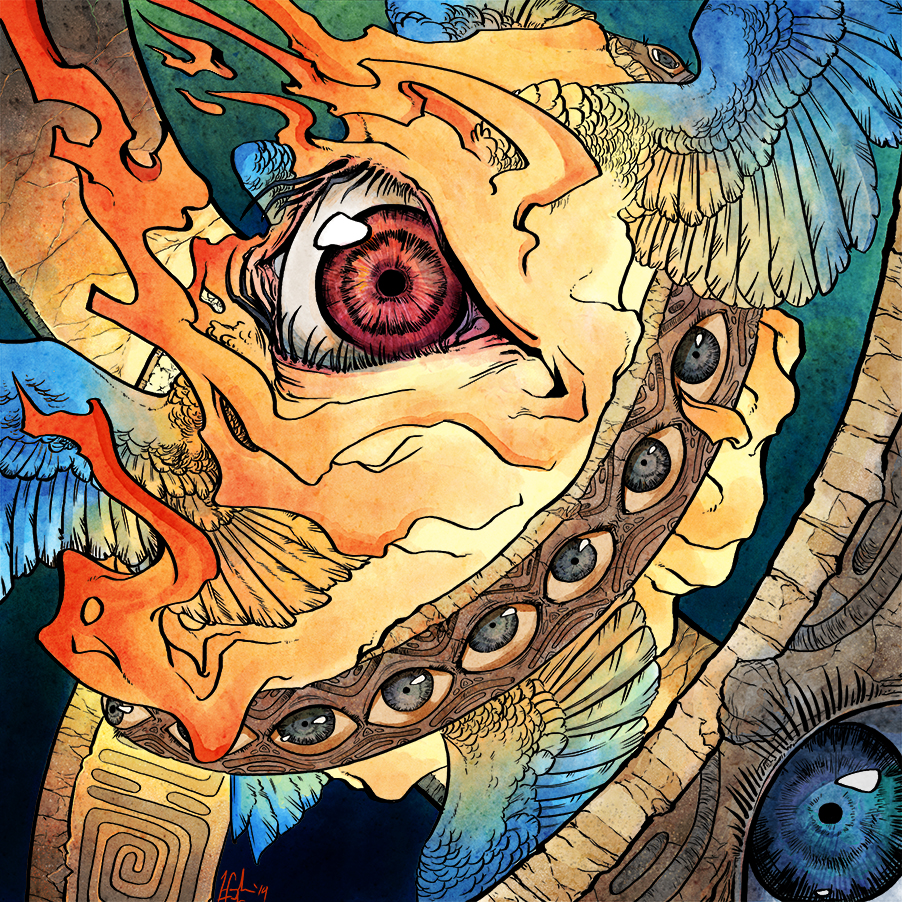
Then, the ambient hum shifted, coalescing into a focused point of energy at the perceived center of the immense room. Light didn’t bend towards it; reality itself seemed to warp, allowing the presence to manifest. It was an Ophanim, one of the formidable Wheels within Wheels described in hushed tones in ancient texts. Not a winged humanoid, but a construct of impossible geometry – interlocking rings of what looked like burning gold, constantly rotating in different directions, the rim of each wheel studded with countless, unblinking eyes. These eyes, terrifyingly perceptive, swept across the assembled souls, seeing not just their bewildered forms, but the entirety of their lives, their choices, their deepest natures. Its presence wasn’t merely seen; it was felt – an overwhelming wave of ancient power, intricate purpose, and undeniable authority.

“Welcome, Heaven Seekers,” the Ophanim’s voice resonated, not through the air, but directly within each soul’s consciousness. The sound was like the grinding of galaxies, yet perfectly clear. “Some among you may have already grasped the transition you have undergone. For those who remain uncertain, allow me to confirm: the existence you knew, the life you inhabited on Earth, is concluded.”

A collective sigh, a wave of despair and dawning acceptance, rippled through the multitude. The Ophanim paused, its thousand-fold gaze seeming to acknowledge their grief without dwelling on it.

“Your anticipated entry into the Kingdom,” the celestial being continued, its voice devoid of emotion yet carrying immense weight, “has been temporarily deferred. An exigency has arisen. Heaven requires assistance.”

Another ripple, this time of pure confusion. Heaven needed… help?

“The terrestrial sphere, your Earth, has been significantly disrupted by the recent global pandemic. Its effects ripple beyond the merely physical, upsetting delicate spiritual balances cultivated over millennia. While this event does not herald the prophesied End Times, the scales measuring hope against despair, connection against isolation, have tipped unfavorably. The trajectory, if unaltered, leads toward escalating devastation – not necessarily apocalyptic, but a profound diminishment of the qualities Heaven seeks to foster.”

The Ophanim’s wheels spun, eyes blinking in asynchronous patterns. “Therefore, we are extending an invitation. We seek volunteers from this cohort – souls whose earthly lives demonstrated resilience, compassion, and a propensity for service – to return to Earth. You would be imbued with entirely new identities, new circumstances, severed completely from your past lives. Your mission: to subtly intervene, to act as counterweights, to assist in mitigating the coming discord and gently guiding humanity back towards equilibrium, or at least towards a new, more sustainable ‘normal’.”

The Ophanim let the proposition hang in the vast silence. “Consider this carefully. Your decision will not prejudice your ultimate acceptance into the Kingdom; entry is assured for all present based on your earthly merits. Declining this task carries no penalty. However,” the voice seemed to lower conspiratorially, though it still filled every mind, “choosing to volunteer confers certain… benefits upon your eventual, permanent arrival here. The nature of these benefits, I am not at liberty to disclose at this juncture.”

A current of speculation surged through the crowd. Whispers erupted in thought-forms Lonnie could now perceive. Benefits? What benefits? A higher sphere? Less waiting?

Lonnie felt a familiar ache, a phantom sensation in his chest. If this offer had come yesterday, when he was still Lonnie Hatch, bagel pilgrim, soup kitchen volunteer, Carol’s husband… the choice would have been instantaneous. Pack a bag, lace up the boots, get to work. That was his nature. But here, now? Standing on the very threshold of Paradise, the promise of eternal rest, of reunion, of peace beyond understanding, was an almost physical pull. It was the ultimate reward, the cessation of striving he hadn’t known he craved until this very moment. He felt weary, not just from his life, but from the shock of its ending.

Was this the real test? Not the good deeds on Earth, but this choice, right here, right now? A final, cosmic essay question determining his ultimate placement? Refuse, and enjoy the earned rest. Accept, and plunge back into the struggle, albeit in a new form.

He looked around at the sea of souls, each facing the same impossible choice. The weight of it settled upon him, heavy and profound. Things were never easy, it seemed. Not in life, and certainly not at the doorstep of eternity. The Ophanim waited, its myriad eyes patient, eternal, observing the quiet, monumental struggles unfolding within one hundred and fifty thousand souls.

The Dragon’s Requiem

In the golden light of the royal court, Eldred knelt before the king. The ceremonial sword tapped his shoulder, each touch a reminder of the burden he now bore. A knight’s duty was honor. A knight’s heart was steel. Eldred had trained for this moment, but as the spurs were fastened to his boots, he felt not pride but a creeping weight in his chest.

“The realm calls upon you,” the king intoned, his voice a sonorous echo in the grand hall. “Rid us of the beast that haunts the forbidden forest. Do this, and your name will live forever.”

Eldred bowed, though the words felt hollow. The dragon was a legend, a specter of fear and awe. To slay such a creature would prove his worth—but to whom?

The forest swallowed him whole. For three moons, Eldred wandered its winding paths, his sword a cold comfort against the suffocating green. The trees whispered dark fates for foolish trespassers, and shadows danced menacingly just beyond the reach of his torchlight.

It was on the fourth day, when exhaustion gnawed at his resolve, that he found something unexpected.

A woman stood in a clearing, sunlight cascading through the canopy to gild her form. Her hair glinted like molten gold, and her eyes shone with an unnatural fire. She seemed a creature of dreams, too beautiful to belong to this world.

“Are you lost, knight?” she asked, her voice a melody that wove through the trees.

Eldred dismounted, his heart pounding. He should have questioned her presence, her purpose in this forbidden place. Instead, he found himself drawn forward, his sword slack in his grip.

“I seek the dragon,” he said, though the words felt distant, as if spoken by someone else.

She smiled, and the air between them shimmered like heat rising from a forge. “Then you have found her.”

The transformation was swift and terrible. The maiden fair's form twisted, golden hair replaced by gleaming scales, delicate hands by talons sharp enough to rend steel. She rose before him, a towering figure of power and frightening beauty, her emerald eyes now blazing with fire.

Eldred stumbled back, his breath catching. The dragon loomed over him, and yet he could not raise his blade. The creature was no monster, no mindless beast. She was exquisite. Terrible. Alive.

“Strike, knight,” she said, her voice still rich with melody, though it now carried an edge of mockery. “Is that not your purpose?”

He hesitated. This was his moment—his chance to prove his worth, to fulfill his oath. But the longer he stared into those piercing eyes, the more his resolve wavered. This creature was not what he had imagined. She was no mindless beast, but something ancient, intelligent, and impossibly beautiful.

“I... can’t,” he whispered, his voice breaking.

The dragon lowered her head, her gaze softening. “And why is that?”

“Because... you are not what I was taught to hate.”

For a moment, there was silence. Then the dragon shifted, her massive form shrinking back into that of the maiden. She stepped toward him, her movements slow and deliberate. “And yet you came to kill me.”

Eldred lowered his sword, the weight of his quest crushing him. “I didn’t understand,” he said, his voice barely audible.

“And now?” she asked, standing before him once more, her hand reaching out to brush the edge of his blade.

“I see you,” he said.

The sword slipped from his fingers, landing with a dull thud on the forest floor.

Eldred returned to the kingdom not as a hero but as a man changed. He spoke not of victory but of truth, of the folly of fearing what we do not understand. And though his name was not etched into the annals of legend, the tale of the knight who laid down his sword for the dragon who taught him to see lived on, whispered in the halls of power and the quiet of the woods.

Thirteen For Halloween: The Summer of Shattered Innocence

When it was Joanie Hayden’s turn, she strode proudly to the head of the classroom with her school writing assignment written neatly in cursive in blue ink on lined loose-leaf paper. Despite her confident posture, she looked a bit of a mess. She was noticeably thinner and paler since last semester, and her hair wasn’t quite as neat, her dress was on the rumpled side, and her patent leather shoes lacked their normal shine.

As she began to read, her voice echoed through the room, a haunting melody that spoke of unspeakable truths. “How I Spent My Summer Vacation,” she announced, the words dripping with a bitter irony that only she could fully comprehend.

Joanie moved through the open space, her steps measured and deliberate, each gesture a silent scream of the agony that had been etched into her very being. She spoke of the cellar, a dank and oppressive prison where she had been locked away, left to waste away in the shadows of her own despair.

The hunger had gnawed at her, a constant companion in her solitary confinement. She spoke of the cheese, stolen from rat traps in a desperate bid for survival, the taste of desperation and decay lingering on her tongue long after the last morsel had been consumed.

But it was the beatings that truly shattered her innocence, each blow a cruel reminder of the twisted love her mother had found in the arms of a monster. Joanie had endured in silence, her cries swallowed by the darkness, lest she incur the wrath of the man who had stolen her mother’s affection and shattered their once-happy home.

As she neared the end of her tale, Joanie held up the final page of her assignment, a splash of color amidst the monochromatic horror of her words. The map, meticulously crafted in vibrant hues, was a twisted treasure map, guiding the way to the remains of her tormentors.

The classroom fell silent, the weight of Joanie’s revelation settling upon them like a suffocating blanket. Her teacher and classmates, once so eager to hear of carefree summer adventures, now sat stunned, their faces etched with a mixture of shock, horror, and pity.

But Joanie stood tall, her eyes blazing with a fire that had been forged in the crucible of her suffering. She had endured the unimaginable, her innocence ripped away by the very people who were meant to protect her. And in the end, when the darkness had threatened to consume her entirely, she had found the strength to fight back, to reclaim her shattered soul from the abyss.

As the authorities descended upon the classroom, their sirens a discordant symphony outside the windows, Joanie felt a strange sense of peace wash over her. She had spoken her truth, laid bare the horrors of her summer, and in doing so, had finally set herself free.

In the years that followed, Joanie’s story would serve as a reminder of the monsters that lurk in the shadows of even the most idyllic homes. But for Joanie herself, the summer of her shattered innocence would forever be the defining moment of her unbreakable spirit, a reminder that even in the darkest of nights, a single spark of hope can illuminate the way to redemption.

And so, as she stepped down from the head of the classroom, her assignment clutched tightly to her chest, Joanie Hayden knew that she had not merely survived her summer vacation, but had emerged from the depths of hell itself, a phoenix rising from the ashes of her own destruction.

Thirteen tales of terror, woven in the night,
Guided by the flickering jack-o'-lantern's light.
From haunted playgrounds to twisted dreams,
We've explored the darkness, or so it seems.

Mad mothers and lost souls, a writer's deadly prose,
Innocence shattered, and secrets no one knows.
Each story a glimpse into the abyss,
Where horrors lurk, and shadows kiss.

But through it all, you've been by my side,
Brave readers, willing to take this eerie ride.
Your courage and curiosity, a guiding star,
Illuminating the path, both near and far.

As the veil grows thin, and the witching hour draws near,
I thank you for facing each tale without fear.
For delving deep into the macabre and grim,
And letting these stories seep beneath your skin.

Now, as the harvest moon hangs high above,
And the night is filled with a chilling sort of love,
I bid you a Happy All Hallow's Eve, my friends,
May your night be filled with spooks and delightful ends.

So light your candles, and carve your pumpkins with care,
For the spirits of Thirteen For Halloween are always there.
In the whispers of the wind, and the creaks of the floor,
Ready to haunt and thrill you, forevermore.

HAPPY HALLOWEEN!

Thirteen For Halloween: The Eternal Lullaby of Wilhelmina Soames

Every city has its ghosts, but few linger like Wilhelmina Soames. She haunted Main Street with her empty pram, its wheels squeaking on the cracked pavement, her presence as constant as the rising sun. The locals knew her by a hundred cruel names—The Mad Mother, The Lady in Rags—but her true title was whispered only by the bravest and the most foolish: The Collector.

“Nelda, Farley, Aubrey…” Wilhelmina’s voice rasped, a croak that slid down the city’s alleys like smoke. The names flowed from her lips in a ceaseless chant, each one spoken with the reverence of a mother calling her child home. Yet there were no children. Only the pram, and her eyes—wide and fever-bright—scanning the empty streets.

“Vance, Giselle, Wesley…” She called out to names long forgotten, her cracked lips curling into a smile that unsettled anyone who dared to listen too long.

The city had become numb to her presence, indifferent to the sight of her skeletal frame and wild hair, matted with dirt and debris. It was easier that way, to pretend she didn’t exist, to step over her as they did the other broken things the city swallowed whole. But those who whispered behind her back never lingered long near the places Wilhelmina wandered after dark.

Because Wilhelmina didn’t just push an empty pram. She collected.

At dusk, she ventured beyond the crowds, beyond the reach of streetlights, into forgotten corners of the city, the places where the shadows lingered thickest. Those who had been desperate enough to follow—whether out of morbid curiosity or cruel delight—never spoke about what they saw. Some said she rummaged through dumpsters, sifting through filth as if seeking something precious among the discarded refuse. Others claimed to hear her speaking softly to things unseen, her voice a strange lullaby meant to soothe the dead. But always, they said, she found something—someone. And when she did, she would cradle it in her arms, rocking it gently as if it weighed more than air.

Those few who dared to peer too long into her pram swore they caught a glimpse of something terrible. Tiny, disfigured shadows, twisting and writhing inside the carriage as if desperate to escape.

The rumors spread fast, and the stories became more elaborate with each retelling. Some claimed Wilhelmina had once been a nanny to a wealthy family, that she’d lost her charge in a tragic accident—a baby slipping from her grasp and into traffic, her mind snapping in two with the sound of that child’s body beneath tires. Others whispered of ancient curses, that Wilhelmina was cursed to roam the city, forever collecting the souls of the young who died before their time. She wasn’t just a madwoman, they said. She was a harbinger. A guardian of lost souls, condemned to ferry them to a place no living eyes could see.

And so, every night, her eerie refrain echoed through the streets, searching.

But the stories were never enough to explain what happened next.

On the night of her death, Wilhelmina entered the vacant lot, the one space in the city untouched by developers—a place where the air always felt cold, no matter the season. There, among the rubble and weeds, she bent low, her fingers sifting through the earth, frantic, searching as though time itself was running out.

And then she found it. Something unseen yet tangible to her alone. A bundle, light as air, and in her joy, she lifted it high, cradling it to her chest. But in her haste, she didn’t notice the jagged brick half-buried in the dirt.

She tripped. Her skull met the brick with a sickening crack, and the last breath of air left her body in a wet, gurgling gasp. Blood oozed into the soil, darkening the ground beneath her.

But Wilhelmina didn’t die—not in the way most do.

She awoke standing over her own body, her lifeless shell sprawled on the cold earth. The sight didn’t startle her. In fact, it comforted her. The years of madness, the endless wandering, the voices of lost children—she finally understood. She had been preparing for this moment all along.

Around her, the shadows deepened. Small, pale hands reached for her, dozens of tiny figures emerging from the gloom. Children, their faces contorted in silent screams, their eyes hollow and unblinking. They had waited for her, lost in the dark, and now they were ready to be guided to wherever it was that the forgotten dead go.

Wilhelmina smiled, her lips parting to release a lullaby that no living ear could hear. She gathered the children to her, one by one, her touch soothing the fear in their eyes. Her pram was no longer empty—it brimmed with the restless spirits of the city’s lost.

And so, Wilhelmina Soames, the Mad Mother of Main Street, became what she was always meant to be. No longer bound by flesh, she pushed her pram through the vacant lot, her song rising with the wind, a lullaby for the dead. Her voice drifted through the city, a melody of grief and longing, chilling the blood of those who walked too close.

She was no longer just a madwoman; she was their keeper. And the children of the city—those lost and forgotten—would forever hear the eternal lullaby of Wilhelmina Soames, calling them home.

Thirteen For Halloween: Her First Time Redux

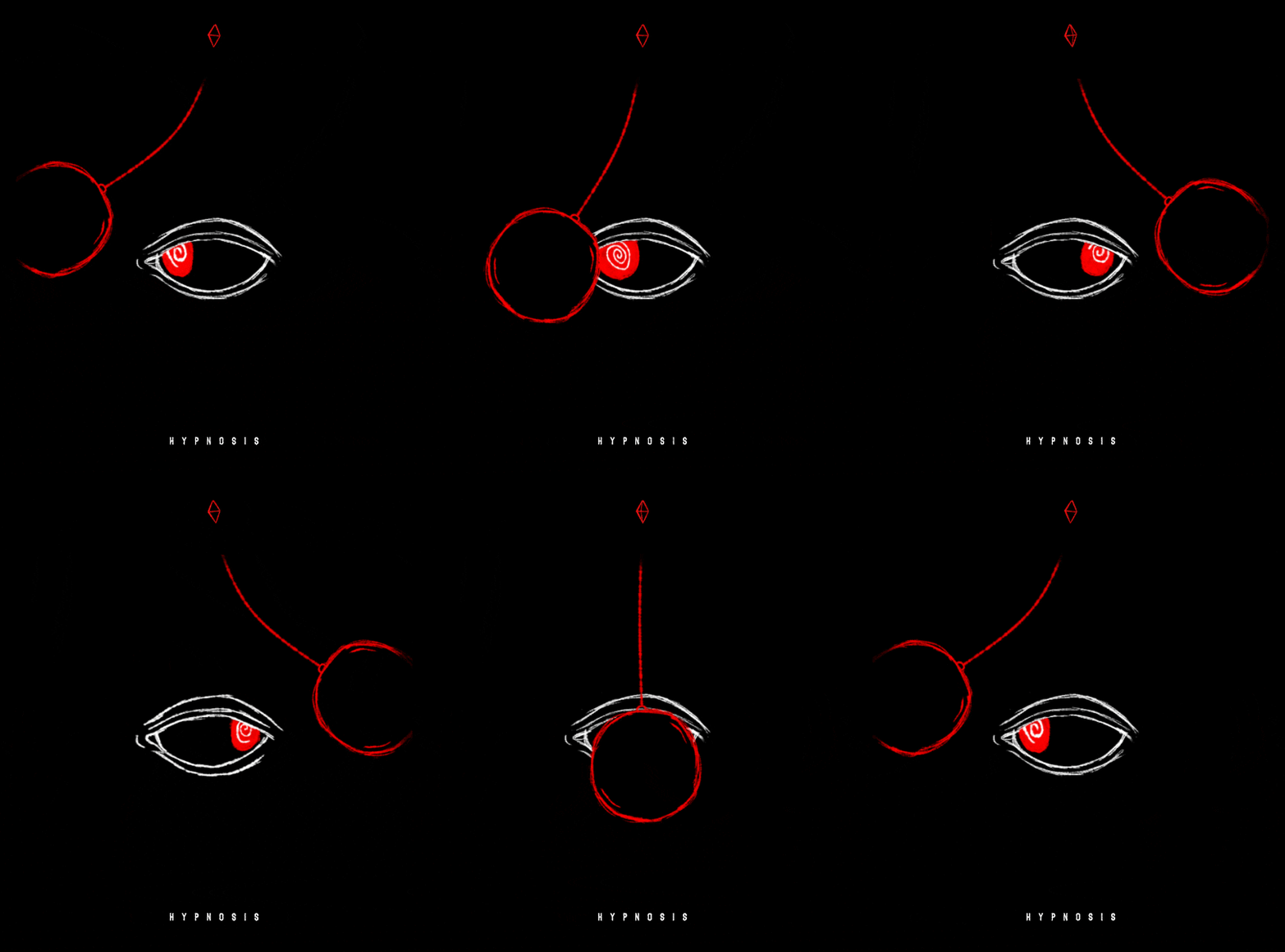
Vanessa’s eyes locked onto the swinging pocket watch, its brass glinting in the low candlelight, the rhythmic ticking sinking deeper into her mind. Each pendulum swing seemed to pull her further from the present and hurl her back to that night—the one she’d buried beneath layers of false memory, beneath years of carefully constructed lies.

She had rewritten the story so many times. In her version, the ’67 Chevy Impala was a haven, its worn leather seats a cradle of budding romance, and Jimmy Erler, her first, was tender, patient. But as Doc Halley’s hypnotic voice probed deeper, the truth began to surface, a nightmare she had kept locked away in the darkest corners of her mind.

Her breath quickened. The rain. She could hear it again, hammering the car’s roof, relentless as the truth clawed its way out. The soft whispers Jimmy once murmured in her ear weren’t sweet at all—they were commands, demands, filled with malice, punctuated by the scrape of his teeth against her skin. He wasn’t patient. He wasn’t tender. He was hungry.

Vanessa felt herself spiraling, the fragile mask of memory shattering, each fragment revealing the brutal reality she had long denied. There were no stolen kisses beneath the rain-soaked windows, no shy fumblings of young love. Instead, there was pain—her pain—and Jimmy’s mocking laughter as he forced her against the seat. His hands, once remembered as gentle, had clawed at her clothes with savage urgency.

And then… something had broken inside her.

In the shifting candlelight of Doc Halley’s office, Vanessa’s hands clenched involuntarily, her nails digging into her palms. The image in her mind grew sharper, crueler. Jimmy’s face—twisted with something darker than desire, eyes gleaming with cruelty—blurred, then fractured. Her own hands—those hands—were the ones clawing at him now, tearing at his skin, his clothes, anything she could reach.

She could still hear his voice, the smug bravado crumbling into panic as her fingernails raked his face, drawing blood, her teeth sinking into his shoulder. She had fought back. No, not fought—she had become something else, something feral, her rage drowning out all sense, all fear, until there was only the violence, the raw power coursing through her limbs.

Jimmy had screamed. But the more he screamed, the more alive she felt.

When the fog lifted, she remembered the silence. Jimmy had been curled up, his breath ragged, bloodied and trembling, his once cocky smile twisted into a grimace of terror. He was no longer the predator—he was prey, and she had tasted his fear.

The watch ticked on, its steady rhythm pulling her back to the present, but the weight of that night lingered, suffocating. The realization hit her like a fist to the gut. She hadn’t been the victim, not entirely. The real horror wasn’t Jimmy, or what he had done. It was what she had unleashed in herself.

Vanessa blinked, her mouth dry, her body rigid in the chair. Doc Halley’s voice cut through the silence like a knife, gentle but probing.

“What did you see, Vanessa?”

Her gaze shifted to the pocket watch again. The ticking was louder now, deafening.

“I… I didn’t stop,” she whispered, her voice barely audible. “I wanted to. But I didn’t.”

Doc Halley leaned closer, the candlelight casting strange shadows across his face. “What didn’t you stop?”

Her breath hitched. The memory had become a living thing, growing inside her, feeding off her guilt and her need for absolution. But there was none to be had. Not for this.

“I didn’t stop… hurting him.”

The room seemed to shrink, the darkness pressing in. She had lied to herself for years, convinced herself that Jimmy had been the monster, that she had been the innocent. But as the truth bubbled up, she knew it had been something else. She had felt good—terrifyingly, exhilaratingly good—when she tore him apart.

Doc Halley’s voice was distant now, almost drowned out by the watch’s ticking. “Do you think you can forgive yourself?”

Vanessa closed her eyes, but the image of Jimmy’s broken body wouldn’t fade. She hadn’t just taken back control that night. She had destroyed him.

The candle flickered and died, plunging the room into cold darkness.

“No,” she whispered into the void. “I don’t think I can.”

And in the silence that followed, she realized the monster she feared wasn’t lurking in Jimmy’s memory, or in some dark corner of her past. It had always been inside her—waiting.

Thirteen For Halloween: The Unwritten Chapters

The Cracked Spine was a secondhand bookstore that smelled of old paper from a bygone era. The air was thick with the weight of hardcover and paperback editions in search of new owners, each containing stories begging to be reread. We reached for the same copy of Proust’s In Search of Lost Time, fingers brushing in that intimate, fleeting way that only strangers can experience. It should have been a harmless moment, a serendipitous encounter, but instead, it marked the beginning of a descent into madness.

Nora, a figure swathed in the quiet allure of mystery, captivated me immediately. Her dark eyes, a shade too deep to be entirely human, held an intensity that unsettled as much as it intrigued. Our love for literature wove an initial bond, yet there was something deeper, an unspoken tension lurking beneath her every word. While I bared the pages of my soul, Nora remained an unread novel, her secrets bound in leather, sealed by something much darker than ink.

I should have known something was wrong when she invited me into her home. There was a weight to the atmosphere in her flat, a heaviness that pressed against my chest, making it hard to breathe. Rows of books lined every wall, like a silent congregation of forgotten lives watching my every move. But one book stood apart, a volume so ancient that its spine seemed to pulse with something… alive.

Nora noticed my gaze, and in an instant, her demeanor changed. She moved to block my path, her movements too quick, too desperate. “It’s not ready,” she said, her voice trembling—fearful, even. “It’s only a draft.”

But I couldn’t stop myself. My curiosity had taken root, festering into an obsession, and despite her protests, I reached for the book. The leather binding was unnaturally warm, as though the cover itself was alive, pulsing beneath my fingertips. The moment I opened it, I felt the floor beneath me tilt, the world spinning as the words leapt off the page, twisting and coiling around my mind like serpents.

The first few pages were innocuous enough—rough sketches, half-formed ideas, fragments of what could be—but the further I read, the more a terrifying pattern began to emerge. The protagonist was a man. He was a writer. He was me.

Each chapter chronicled intimate details of my life, moments no one else could possibly know. The way I always kept my pens organized by color. The whiskey I drank when I couldn’t sleep. The thoughts I only admitted to myself in the dead of night. But the horror didn’t end there—no, the final chapters were something else entirely.

They told of a slow, creeping descent into terror. Each word described how this man—how I—would die, alone and forgotten, hunted by something far more dangerous than Nora’s simple mystery. There were no metaphors here. No clever narrative tricks. This was a blueprint. A death sentence.

I looked up from the book to find Nora watching me, her expression unreadable. But there was something in her eyes, something dark and predatory. The warmth I had once seen was gone, replaced by an emptiness so cold it turned my blood to ice. She smiled—a slow, curling smile that never reached her eyes.

“I’ve been working on that for a long time,” she whispered, stepping closer. Her voice was low, intimate, as though we were lovers sharing a secret. “It’s my best work yet, don’t you think? The final chapter is… exquisite.”

The realization hit me with sickening clarity—this wasn’t fiction. It wasn’t a story. It was a prophecy. Nora had been crafting my death with the precision of a master artist, every detail sharpened to perfection, every emotion honed for the ultimate cut. And I was the masterpiece.

I stumbled back, dropping the book as though it had burned me, but there was nowhere to run. The walls of her apartment seemed to close in, the shadows stretching, growing, until they swallowed everything in their path. Nora’s figure loomed before me, her face twisted with something feral, something no human could ever possess.

“You were always meant to be the final chapter,” she breathed, her lips brushing my ear like a lover’s caress. “My magnum opus, completed in flesh and blood.”

I turned to flee, but the shadows reached out, cold fingers clawing at my ankles, dragging me down. My mind screamed, but my body betrayed me, frozen in place as she knelt beside me, her fingers tracing the outline of my throat.

“You’ll die beautifully,” she promised, her voice soft and soothing, like a lullaby sung by the damned. “I’ll make sure of it.”

The last thing I saw before the darkness consumed me was her smile—a perfect, serene smile, as though she had written this moment a thousand times before. And in that final, terrible instant, I realized the truth: Nora hadn’t just been writing my story.

She had been living it.

The unwritten chapters would be scrawled in blood, a story of obsession, murder, and twisted love. And I, the unwitting protagonist, had already lost my chance to rewrite the ending.

Thirteen For Halloween: Embrace of the Void

In the labyrinthine corridors of my mind, I wander like a condemned man, trapped in a purgatory of my own making. Each morning, I rise from the depths, a hollow shell of flesh and bone, reciting lifeless affirmations that dissipate into the cold silence. I set forth, a misguided crusader armed with delusions of redemption, determined to leave a mark on a world that long ago forgot my name.

But the path beneath my feet is a treacherous thing, twisted and serpentine, choked with the refuse of my squandered hopes and festering regrets. Misfortune trails me like a shadow that bleeds black at the edges, its hot breath caressing my neck, its claws raking ever closer. Each choice I make cleaves a piece from my soul, and with every step, I descend further into the maw of a darkness that devours all light.

The road I once called righteous has vanished, swallowed whole by a memory I cannot trust. I drift, lost in a sea of my own sins, the weight of my transgressions crushing me under the stench of decay. The rot is inescapable. It seeps into my pores, coils around my heart, whispering that the time to pay has come—and I am bankrupt, with nothing left to offer but the fragments of a wretched soul.

I collapse into the gutter, a broken thing, my body crumpling like paper soaked through with blood. The cold concrete beneath me drains the warmth from my flesh, and the world dissolves into a sickly blur. Colors bleed away until only the monochrome of oblivion remains. Then, in the midst of this dying delirium, she appears.

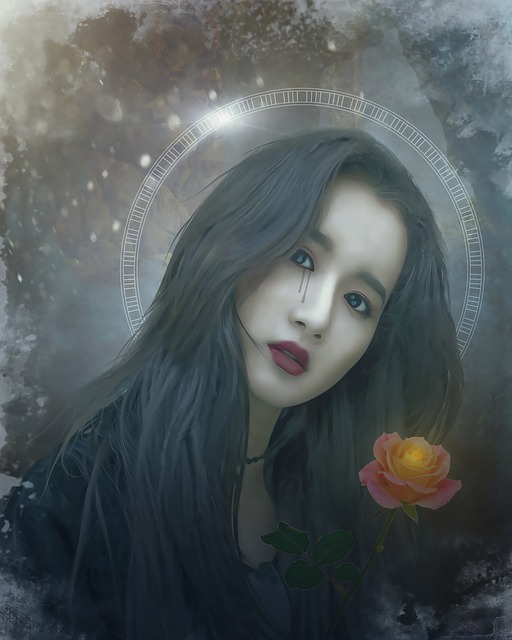
She stands above me, a vision carved from darkness, her beauty a dagger in my chest. Her skin is a porcelain pallor, her raven hair cascading in tendrils that curl like smoke. Her eyes, twin voids, drink in the light, leaving nothing but the blackened husk of a soul that once dared to hope. She is perfection amidst the filth, a sanctuary I have sought all my life, a deliverance I could never earn. But as I reach for her, desperate to feel the warmth of salvation, a terrible truth shatters the illusion.

She is not my salvation. She is Death itself, cloaked in false beauty. Her touch is the final cold, her kiss the last exhalation. She is a hallucination conjured by the failing mind of a man who can no longer distinguish agony from ecstasy. Yet even as the understanding seeps into my bones like poison, I yearn for her, ache to surrender to the dark mercy of her embrace. The void whispers that to yield is to find peace, that oblivion is a lover more faithful than hope ever was.

In the end, I am nothing but a hollowed-out husk, a cracked vessel through which the last vestiges of life trickle away. As I fall into the blackness, I cling to the pale specter of Death like a drowning man clutches the hand that pulls him under. I do not fight. I do not struggle. I welcome her embrace as the final union, the consummation of my shattered soul with the void that awaits.

And then, there is only the darkness. There is no salvation, no redemption. There is nothing left of the man I once was—nothing but the silence of the grave and the echo of a heartbeat that has already stopped.

Thirteen For Halloween: The Seer of Forsaken Alleys

The narrow street felt like a forgotten corner of the world, shadowed by crumbling buildings and dimmed by the setting sun. Renee had passed this way hundreds of times, always ignoring the rusted neon sign that flickered above the doorway: Madame Celeste—Fortunes Told. She never believed in that sort of thing.

But today was different.

Fresh out of a five-year sentence for armed robbery, her body was free, but her mind had remained shackled to one thought: her daughter, Ellie. Five years of missed birthdays, five years of wondering whether her child even remembered her, five years with no answers. The State had taken Ellie, placed her with some family she’d never met. No matter how hard Renee searched, it was as if her daughter had vanished.

Desperate, with nowhere else to turn, she stood at the entrance of the dingy fortune-telling parlor, the name Madame Celeste practically buzzing like an insect in her ears.

The inside was worse than she expected. Threadbare curtains, a single flickering candle, and the heavy scent of incense thickened the air. A table, draped in velvet, sat in the middle of the room, and behind it, the fortune teller herself: a gaunt woman in a patchwork of scarves and jewelry, her face obscured by a veil of beads.

“I’ve been expecting you,” the woman said, her voice smooth, with a hint of a rasp.

Renee hesitated, her pulse quickening. “How could you—?”

“I know why you’re here,” Madame Celeste interrupted, gesturing to the chair. “Sit. We’ll find her together.”

Renee’s breath caught. How could this stranger know? Was this a scam? But the thought of Ellie—the need to see her again, hold her again—was stronger than her suspicion. She sat.

“Your daughter… Ellie,” the fortune teller whispered, the name slipping from her lips like smoke. Her long fingers danced over a worn deck of tarot cards, shuffling them with an eerie grace. “She’s closer than you think.”

The cards fell, one by one. The Hanged Man. The Tower. Death.

Renee’s throat tightened. “What does that mean? Where is she?”

Madame Celeste smiled, revealing teeth too sharp for comfort. “She’s waiting for you. But to find her, you must follow the path unseen. The roads of the dead. You’ve walked close to the edge before, haven’t you? You know the place where life and death blur?”

Renee clenched her fists. “What are you talking about?”

“The place you’re looking for is not a physical one,” the seer murmured. “Ellie has crossed over, but not in the way you fear. Her spirit is bound to this world, wandering, waiting. She needs you to set her free.”

A chill crawled up Renee’s spine. “No… no, Ellie’s alive. She’s out there. I just need to find her.”

Madame Celeste leaned closer. “She was alive. But when you went away, no one came for her. No one cared. The family she was placed with—”

“What are you saying?” Renee’s voice cracked.

The fortune teller’s gaze pierced her, unblinking. “Your child died alone. Starved. Forgotten. The only way to reunite with her is to cross over yourself.”

Renee shot up from the table, her heart pounding. “You’re lying!”

But deep down, something in the words resonated. She had nightmares in prison, visions of Ellie calling out for her, crying, alone. She’d always woken up drenched in sweat, praying it was just her mind playing tricks.

“Go to the place where you were happiest with her,” Madame Celeste said softly. “She will meet you there.”

With shaking hands, Renee fumbled for the door. The fortune teller’s voice echoed in her ears as she stumbled into the night, a single word repeating: cross over.

The old playground. It hadn’t changed in all these years. Rust clung to the swings, the slide was chipped and faded, and the jungle gym looked skeletal under the streetlights. Renee stood there, the memories rushing back—of Ellie laughing, her tiny hands clutching the chains as she swung higher and higher.

“Ellie?” Renee whispered into the cold night air.

A shadow flickered at the far end of the playground. A small figure, no taller than a child, emerged from the gloom.

Renee’s heart lurched. “Ellie?”

The figure stepped closer, and as it did, Renee’s stomach twisted. It wasn’t Ellie. The thing that approached had her daughter’s shape, but its skin was wrong—pale, sagging, with hollow eyes that stared without seeing. It moved with a jerking motion, like a puppet on tangled strings.

“Mommy?” the thing rasped, its voice an echo of the child Renee once knew, but distorted, broken.

Renee’s legs buckled. “No… no, this isn’t real!”

The thing’s head tilted, its cracked lips curling into a grotesque smile. “You left me. Why did you leave me, Mommy?”

Renee screamed, backing away, but the figure advanced, faster now. Its skeletal hand reached for her, ice-cold fingers grazing her skin.

“I was waiting for you,” it whispered. “Now you can stay with me… forever.”

The world around Renee darkened, the playground fading as the shadows closed in. Her breath came in ragged gasps, and in her last moments, the memory of Ellie’s real laughter—pure and joyful—was drowned out by the horror that had taken its place.

The next day, the sidewalk fortuneteller packed up her things and moved on.

The playground remained, but the swing no longer moved in the wind. In its place, a new shadow hung in the air—one that sometimes whispered a name, searching, always searching, for the child she’d lost.

A Leap Day Repost: Duchess and the Anecdote

Duchess

They come from miles around, my characters do, traveling the great distance from the fringes of my mind’s eye, some even making the long and arduous haul from my childhood, just to sit and talk. They do this whenever I’m alone.

As they gather ’round, I cast an eye upon their many and various faces and can’t help but feel the slightest twinge of remorse. Being in my company, locked within the confines of my imagination, is not wholly unlike a purgatory for them. A holding pattern, a waiting room, where they converse amongst themselves in voices audible only to myself, trying to catch my attention in the slimmest hope of being set free. Birthed into a story.

Some are fresh meat, the rest lifers, each easily spotted by the differences in their appearance and the strength of their voices. Fresh meats are gossamers—newly formed characters, little more than a stack of traits—who shout in whispers. Lifers, on the other hand, are as fleshed out as you or I, perhaps even more so, who have acquired the proper pitch and turn of phrase to catch me unawares during the times when my mind idles.

Before the talks begin–serious conversation, not the normal natterings they engage in–a flying thing the size of a butterfly, jewel-toned blue stripes, greenish-gold spots, with flecks of silver on the wings, lands in the palm of my outstretched hand.

“What is that then?” a childlike voice asks from somewhere deep in the crowd, low to the ground. I recognize it instantly.

“It’s an anecdote, Duchess. Come see for yourself.” I reply as the creature’s wings beat softly on my palm.

The throng–my personal rogue’s gallery whose roster includes reputables and reprobates alike–part like the Red Sea, making way for the noblest of all serval cats, The Duchess.

“An antidote? Have you been poisoned?” The Duchess queries as she saunters into the open space, a dollop of concern gleaming in her vivid blue eyes.

I try to not laugh, partly out of respect, but mostly due to the fact that though she is the eldest of my unused characters, she is technically still but a kitten. “No, Duchess, it’s an anecdote, as in a short, amusing, or interesting story about a person or an incident.“

“I know full well what an anecdote is, thank you kindly. I was merely attempting to lighten the dreadfully somber mood with a bit of levity.” Not her best faux pas cover, but it was swift, which should count for something. As casually as she could manage, the kitten turned to see if anyone found amusement at her expense. No one did. They knew better. “May I hold it?”

I hesitate and stare at the leapling. Created on February 29th all those many years ago, it was my rationale–on paper–for keeping her a kitten, seeing as she had fewer birthdays, she would naturally age at a decelerated rate. The actuality is I have an affinity for kittens. For full-grown cats? Not so much. And now the dilemma is if her kittenish nature should come into play, and without meaning to, cause injury to the anecdote, then all this would be for naught.

Her eyes plead with all the promise of being good and I have no choice but to relent. “It’s fragile, so be gentle. Take care not to crush it.” I gently place the anecdote in her cupped paws.

“Why does one need an anecdote?” The Duchess of Albion asked, her nose twitching whenever the creature moves its wings.

“To tell a proper story,” I answer. “More than just a sequence of actions, anecdotes are the purest form of the story itself.“

“But I thought characters are at the heart of every great story?“

“They are and anecdotes connect the hearts and minds of those characters to a story.” I try to feign calm but I can see the kitten’s body tensing up. Her eyes, those glorious baby blues, are studying the creature closely. Was I wrong in my decision to trust that she rules her instincts and not the other way around?

“They also add suspense to your story, giving the audience a sense that something is about to happen. If you use them right, you can start raising questions right at the beginning of your story—something that urges your audience to stay with you. By raising a question, you imply that you will provide your audience with the answers. And you can keep doing this as long as you remember to answer all the questions you raise.“

The kitten’s breath becomes rapid and her paws close in around the anecdote and I want to cry out, urge her to stop, but it’s far beyond that point now. She is in control of her own fate. Canines bare themselves, paws pulling the creature closer to her mouth.

“No!” she shakes her head violently. Her ears relax and her mouth closes as her breathing returns to normal. Then, the oddest thing happens…

The Duchess begins to vanish. All the characters look on in dazed silence, uncertain how to react.

“What is happening to me?” she shoots me a panicked glance as cohesion abandons her form.

“Haven’t you sussed it out yet?“

“No… I’m scared!“

“Don’t be,” I smile. “Look around you. You’re at the heart of a story. You’re free.“

“Truly?” she is suddenly overwhelmed with delight, her expression priceless. “But — but what do I do with the anecdote now?”

“Open your paws, let it fly off.”

She unfolds her paws. Tiny wings beat their path to freedom. Then someone from the back of the crowd gives The Duchess a slow clap. Soon, others join in, building into a tidal wave of applause.

The now translucent Duchess waves a tearful thank you to the crowd, before turning back to me with a request, “Say my name.“

“Why?“

“Because you always simply address me as Duchess and I want to hear you call me by my full name one last time before I g– —“

And just like that, she was gone.

I bid you a fond farewell, Your Grace the Duchess of Albion Gwenore del Septima Calvina Hilaria Urbana Felicitus-Jayne Verina y de Fannia. Enjoy your journey. You will be missed.

HAPPY LEAP DAY, FOLKS!