Not that I have a snobbish attitude toward them, anything that gets the creative juices flowing and entices a person to write is okay in my book. Hell, I’ve even participated in a few hashtag games on Twitter, but none of the suggested prompt words, sentences, paragraphs, or pictures ever truly inspired me.
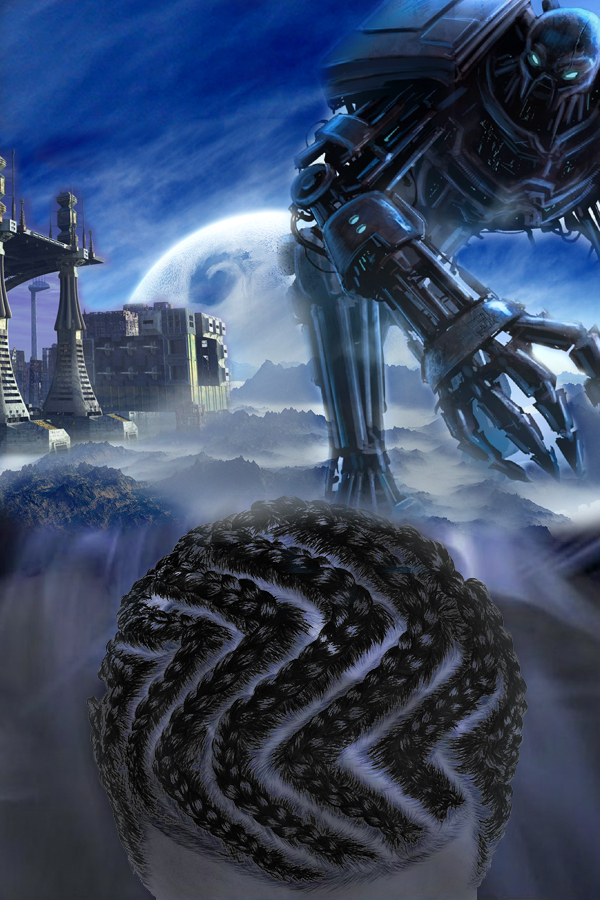
Until I stumbled upon the Noriyoshi Orai artwork shown above.
Blindsided by an idea, I began scribbling notes of an alien invasion futuristic war that keeps pushing its way further and further into Earth’s past with the intention of creating a zugzwang (a situation in which the obligation to make a move in one’s turn is a serious, often decisive, disadvantage) story using a fairy tale twist.
Why a fairy tale?
Because the old ones are replete with heavy messages, drenched in the misfortunes of the world, and yet faith, perseverance, and sometimes sheer luck, can turn the tide in overcoming life’s trials. I wanted to present it as an old story, told in archaic language, laced with a subtle message still relevant to the modern world.
If you ever want to hear your muse laugh, tell her your lofty goals for a story before you’ve actually written it.
“Rise of the Fallen 722nd” began life as a story examining patriotism, loyalty, ingenuity, and the enduring human spirit in the face of the ultimate no-win scenario. The outline wasn’t difficult to put on paper. The story itself? That’s a different matter altogether. This little darling of mine went through the draft mill forty-nine times, each revision drastically different from the one before. Only one patch of dialogue survived from the original piece.
Futuristic war? Check. Progressing forward into the past? Check. Zugzwang? Double check. Fairy tale twist? Not so much. The fairy tale elements weakened the integrity of the overall structure and sadly had to be put down like Old Yeller. Still, it’s been fun (and frustrating) to write. And I’m not done with it. They say the fiftieth time’s the charm, right?
The damnedest thing can place a bug in your brain. Rod Serling is the source of one of mine.
It happened while I was deep within my Twilight Zone infatuation phase, in the prehistoric information days before civilian access to the internet, when I devoured every Serling-related book, article or fanzine I could lay my grubby little mitts on. In one of the pieces, I read how Rod’s widow, Carol, found a number of scripts and stories amongst her late husband’s possessions that were unproduced at the time.
And thus the bug found a home in my grey matter.
I pictured Rod in the final moments before he shuffled off this mortal coil, his gaze sliding across the room until it fell on the closet door, eyes filled with that unique brand of sadness only known to writers. Carol would remember that stare and later be drawn to the closet by a mysterious force that urged her to dig out a box buried deep beneath the material remnants of Rod’s life, shed like so much old skin. A box filled with his regrets, the stories that remained untold, that never found a proper home.
You don’t have to say it, I know that’s all rubbish. Simply me fictionally placing myself in the position of a man I never met. If Rod had any regrets at all, I certainly wasn’t privy to them. But that doesn’t make my brain bug any less real.
You see, I have a box–well, it started off as a file folder and grew into a box–filled with stories in various stages of development. Ideas written on scraps of paper, composition notebooks loaded with concepts and outlines, and completed stories that only exist in paper form–written pre-computer on an Underwood typewriter, circa 1950–as I haven’t gotten down to the laborious task of transferring them to my computer.
I don’t discuss my box much and I only brought it up to respond to an email I recently received (copied and answered here with permission):
“I want to write a blog but I’m scared of being exposed and having people judge or attack me because of my opinions and I don’t think I have the writing skills to get my point across in the right way. What gives you the courage to write?“
Guess what? Self-doubt and anxiety regarding humiliation and criticism is all part of the process and grist for the mill, so welcome to the club. What separates writers from non-writers is that instead of running away from that fear, we invite it in for wine and cheese. Befriend the beast that frightens you most because there’s a story just waiting to be revealed in that encounter.
It’s true that honest writing takes courage, as does sharing your writing with people who may not be kind in their opinion of it, but you also have to realize that it’s not your job to make people like your writing. Some people will flat out hate it because of your views or your writing style, and because they may not know any better, can possibly hate you because of it. Hopefully, it’ll be the minority. Accept it as an unavoidable truth and move on.
As for the question, “What gives [me] the courage to write?” Everyone has their own reason for writing, and fear of acceptance isn’t high on my list. Sure, it’d be great if the unwashed masses loved my work, but the simple truth is all writing has its audience, whether infinite or infinitesimal, and if you never put your writing out there, there’s no chance in hell of your audience ever finding it.
The real reason I write is because of the aforementioned box. I just don’t want to be lying on my deathbed–hopefully many, many, many years from now–and staring at that damned box full of unwritten stories. I no doubt will have my fair share of regrets in my final days, but I’m determined not to have that box be one of them.
And since we’re on the topic of regrets, I recently read a book, “The Top Five Regrets of the Dying: A Life Transformed by the Dearly Departing” by Bronnie Ware, a palliative care nurse who cited the most common lamentations as being:
I wish I’d had the courage to live a life true to myself, not the life others expected of me.
I wish I hadn’t worked so hard.
I wish I’d had the courage to express my feelings.
I wish I had stayed in touch with my friends.
I wish that I had let myself be happier.
So, while I can’t offer you reasons why you should write, I can tell you that most of the regrets listed above factor heavily in my need to write.
In closing, someone once wrote, “writing is like getting into a small boat with a wonky paddle and busted compass and setting out on rough waters in search of unknown lands.“
So, paddle forth, friends, and be regret-freely writeful.
Author’s note: Since I’m never at a loss for ideas, I don’t dip into my story box as much as I’d like to, though I will occasionally post one or two of them on this blog or slip them into or in between current projects. The story idea folder on my computer? That’s a whole different story.
“Next question?” the woman at the podium asked. Her hawkish features placed her in the category of handsome rather than beautiful and were accentuated by raven hair cut straight around the head at jaw-level, with a fringe. She was dressed in a black Kevlar bodysuit which made her look like a cross between a superheroine and the baddie in a post-apocalyptic science fiction film.
“You there, the woman in the purple jumper,” she pointed into the sea of reporters.
“Miss Begum, given the mortality rate associated with your line of work, aren’t you the least bit scared that you’ll never grow old enough to start a family of your own?” the reporter asked.
Of all the questions Matilda Begum had ever been asked, this was the one she hated most, which was probably why it was the one asked most frequently.
“I learned to conquer my fear when I was young,” Matilda said, and then course-corrected. “Put a line through that. What I meant to say is that my father taught me at a very young age to use my fear as a motivator.”
“You mean, he endangered the life of a child by manipulating you to help him do his job,” another reporter piped in.
“First of all, my father was a good man,” Matilda snapped, caught herself then regrouped. “And he never manipulated me to do anything. I asked to help him in his work.”
“But as a parent,” yet another reporter added. “Wasn’t it his responsibility to keep his only daughter out of harm’s way?”
“You all already know this story, so I don’t know why you keep rehashing it, but for the sake of this conference, I’ll go through it one last time. My mother was murdered when I was a toddler, so I have zero memories of her. All I’ve ever had in my life was my father. When I was little, he was the biggest, smartest, most important person in the world. When I got older, I could see that he wasn’t really any of those things. He was just a man, flying by the seat of his pants, trying to do his best to raise a girl he didn’t properly understand. When I matured, I realized that he was pretty damned close to the man I thought he was as a child because he endured all my teenage rebellious nonsense, all the hatred and vitriol I spat at him, and never once held it against me.”
“That doesn’t answer my question,” the third reporter said.
“Who’s at the podium, you or me? I’ll answer your question anyway I see fit, and you will not interrupt me again if you wish to remain in this room. Clear?”
The reporter remained silent.
“Good,” Matilda smiled. “Now, where was I? Oh yes, my father would have preferred a son, he never said as much, but he raised me like one and I didn’t mind because I wanted to be just like him. He had turned his quest to find my mother’s murderer into an occupation, and when he finally located the killer, I wanted to be there, to help him get justice for a woman I never had the chance to meet.”
“But you were only ten at the time, were you not?” the second reporter asked.
“Ten going on fifty, as my father used to say.”
The first reporter asked, “And you weren’t scared?”
“Are you kidding me? I was petrified! We stood outside the killer’s house and I was shivering so much I could hardly stand.
“I told my father, I can’t do this!
“And he smiled and said, That’s okay, honey, you just wait here. This shouldn’t take long.
“But I told him I wanted to be there, I wanted to help, for my mother.
“And he asked me, What’s your shark? And I just looked at him like he was crazy.
“I never told you that story? he asked. I thought I did.
“Then he proceeded to tell me the story of the Sharks and Fish. Anyone familiar with it? No? Well, it goes like this:
The Japanese have always loved fresh fish, but the waters close to Japan haven’t held a great deal of fish for decades. So they built bigger fishing boats and traveled farther out to sea but the farther the fishermen went, the longer it took to bring in the fish. If the return trip took more than a few days, the fish weren’t fresh and people didn’t like the taste.
To solve this problem, fishing companies installed freezers on their boats to allow the vessels to go farther and stay longer. However, people could taste the difference and didn’t care for frozen fish, which brought down the price.
Then the fishing companies installed fish tanks, but once placed in the tanks, after a little thrashing around, the fish stopped moving. They were tired and dull, but alive. Unfortunately, the Japanese public could still taste the difference.
Apparently, because the fish didn’t move for days, they lost their fresh-fish taste. The fishing companies pondered over the dilemma until they stumbled onto the solution:
To keep the fish tasting fresh, the fishing companies still put the fish in the tanks, but now they added a small shark to each tank. Sure, the shark ate a few fish, but most of the fish arrived in a very lively state. The fish were being challenged.
“So, when you lot ask me if I’m scared, of course, I am and I think that anyone in this or any other profession should be in a constant state of fear when doing their job. This, of course, requires your willingness to break free from your comfort zone and push boundaries.
“If it isn’t already, life needs to be your exploration into that frightening undiscovered country. Every new project is an opportunity to attempt feats above your current skill set. To see what lies beyond the unfamiliar horizon. To embrace bizarre new thoughts, take on larger points of view. To shake hands with the intimidating unknown. To paint the world you live in with unique challenges. Anything less and you do a disservice not only to your work but also to your life.
“Challenging yourself is about punching above your weight class, learning to not only chew but swallow that which you’ve bitten off, and in essence growing as you come to the realization that you’ve just become something better than you believed yourself capable of.”
“So, when you lot ask me if I’m scared, of course, I am and I think that anyone in this or any other profession should be in a constant state of fear when doing their job. This, of course, requires your willingness to break free from your comfort zone and push boundaries.
“If it isn’t already, life needs to be your exploration into that frightening undiscovered country. Every new project is an opportunity to attempt feats above your current skill set. To see what lies beyond the unfamiliar horizon. To embrace bizarre new thoughts, take on larger points of view. To shake hands with the intimidating unknown. To paint the world you live in with unique challenges. Anything less and you do a disservice not only to your work but also to your life.
“Challenging yourself is about punching above your weight class, learning to not only chew but swallow that which you’ve bitten off, and in essence growing as you come to the realization that you’ve just become something better than you believed yourself capable of.”
“So, in the wake of your father’s passing, God rest his soul, does that mean you’ll keep up the family business?” a reporter off in the rear of the conference room shouted.
“Of course,” Matilda said, her smile beaming. “Vampire hunting is in my blood!”
“We gave the Future to the winds, and slumbered tranquilly in the Present, weaving the dull world around us into dreams.” ― Edgar Allan Poe, The Mystery of Marie Rogêt
I spent most of my early teens in the Bronx. The street I lived on, corner to corner, ran the length of three average city blocks and was the picture of diversity—the melting pot that New York had become famous for. It was all about migration. Italians were moving to new ground as black people nestled in and on their tail were Hispanics followed by West Indians. It was a neighborhood in transition where multi-cultures learn by cohabitation that differences in race didn’t make a person less human.
It was also the 70’s and I rocked a killer afro to end all ‘fros. Metal pronged afro pick with the handle clenched in a black power fist and a peace symbol carved out on the base, tucked in the back of my hair.
It drove my parents crazy. They rode my back constantly to get it cut but there was that preteen Samsonian fear that the strength of my personality—-my Madd-ness—-would be stripped away, were a barber to lay clippers on my precious locks. When I got the “as long as you’re living under my roof” speech, I knew I needed a solution and I needed it quick.
Enter: Cynthia Holloway. I mentioned my plight in passing and out of nowhere she offered to braid my hair into cornrows. So, we sat on the stoop of a private house and armed with only a comb and hair grease, Cynthia worked her nimble fingers like a loom.
She was one of those neighborhood girls that I’d never really spoken to before outside the odd hello. Not that there was anything wrong with her, she was simply a person that kept herself to herself. The type of person you’d have to make an effort to get to know.
It would take many years for me to become that type of person.
But in sitting with her I discovered she was both intelligent and imaginative, with interesting stories to tell. Her father was a retired Army Ranger colonel, who spent a great deal of his free time on the road in a jazz band.
I’m not sure how much of that was true. No one could ever remember seeing Cynthia’s dad, so maybe it was a story she invented to keep nosy kids at bay. Or perhaps it was one of the quiet lies that parents tell their children to spare them from the harsh realities of troubled marriages.
Since we had nothing but time to kill, we talked about our constricted home lives, mentioned the odd hobby, told a few jokes and had a couple of laughs, and when all the conversation wells had run dry, we told each other stories.
At the end of every month, when the braids began to look a little ratty, I’d take them out and Cynthia met me back on that stoop to repeat the process. And after a brief bit of catch-up, we’d go back to telling each other imaginary stories and without meaning to, wound up designing an illusory sanctuary from the burdens and pains of our everyday pre-teenage lives.
While we mentally terraformed our neighborhood row by cornrow, we got to know each other in those months as the monarchs of our fantasy world. We explored the surroundings, went on adventures, and basically forgot the world for a few hours a month.
Come the fifth month, I sat on the stoop and waited, my hair a wild crop of imagination waiting to be plowed, but Cynthia never showed. I later learned from a friend of a friend’s sister that she and her mother had moved away in the middle of the night without telling a soul where they were headed.
I tried to imagine all the possible reasons that would cause them to make a hurried escape under the cloak of twilight and seriously hoped it had nothing to do with her retired-Army-Ranger-colonel-jazz-band-dad. Nothing negative, anyway.
And yes, I eventually had no other choice than to submit to the butcher shop barbershop haircut. Much to my surprise, I managed to retain all of my Madd-ness afterward. I was still filled with my nerdy sameness and when I missed her a bit, I’d sometimes sit on the stoop and give an imaginary Cynthia updates on the latest goings-on in the world we created.
Thanks for humoring me as I wool-gathered.
PS. Cyn, if through some bizarre happenstance you should come across this, hit me up real quick. There’s a world in some need of serious upkeep.
My monotony needed twisting yesterday, so I went for a stroll, sans iPod. You know, breathe in a bit of city fresh air, clear some cobwebs, that sort of deal.
There I was walking down the street, mind-sifting through character conversations and scene settings when I looked down at the pavement and realized that I was traipsing through what looked like the aftermath of the Great Worm War of 2021. The sidewalk was a battlefield littered with the corpses of thousands of earthworms that coated an entire city block.
Logically I knew how this could have happened. I knew they came to the surface either during the heavy rains–but it’s been dry weather for the past week–or to pair off and mate only to get caught on things that are hard for them to crawl across, like sidewalks and subsequently fry on the surface from sun rays–but that normally occurs during spring.
So, what then? Had there actually been a battle? Warring clans pitched against one another over territorial disputes? Factions in conflict over the claiming of a throne? Families locked in a deadly dispute over an unholy union?
Or was it a warning?
As I stood there, staring at their dried remains, curled into runic shapes, I wondered if they had been somehow gifted with a vision of the approaching apocalypse and had sacrificed themselves in an effort to warn us in the only language they knew. The last Germanic language spoken to them by man before the two species went their separate ways.
At that moment I felt like Indiana Jones in the passageway to the Grail chamber, trying to decipher the worm cadavers’ possible portents of doom, only without the aid of a diary or Sean Connery whispering something about, “Only the penitent man will pass.” or like John Nash without an ounce of the mental code breaking ability.
And I stood there. Longer than I’m comfortable admitting. Frustrated by the limits of my linguistics. Finally, I forced myself to move on, but not before making a promise:
Today’s entry is a shortie because I’m busy wrestling with a wordy bastard of a story that refuses to be tamed but I’m in a particularly stubborn mood, so challenge met!
That said, I offer you my three simple facts of writing:
If you do not write the story you truly want to write, it will never be read. You can’t have the unwashed masses confirm your greatness when you haven’t given them anything to be in awe of.
If you don’t submit your work—–for review, publication, employment, or whatever—–the answer will always be no. The cruelest rejection you can ever receive is from yourself, the toughest critic you’ll ever know. If you never show your work, you never give an editor, publisher, prodco, or whatever, the chance to say yes (exercise caution, of course, and protect your writing before letting it fly out into the world).
If you don’t write, you’ll never be a writer. Plain and simple. Also, many, many, many years from now, when you’re lying on your deathbed, do you really want a box of regret—–filled with all the unwritten stories of your life—–hanging over your head like the sword of Damocles? I think not.
My past often crossed paths with my present, but never with the people I desired to see again. Because of this, I’m always filled with an odd mix of embarrassing nostalgia and unwanted reflection, followed by the inevitable introspection. I see where old acquaintances are in their lives and I can’t help but look at where I am in relation to my dreams and aspirations.
No matter if you’re the outgrower (the disinterested party) or the outgrown (the rejected party), neither are comfortable during a random meeting. Also, dealing with people from my past have had the effect of feeling like I was moving backward. As if all the growth I’d experienced after being separated from that person vanished because they’re present in my life again.
And these chance encounters happened in the damnedest places. At the time the incident that is the subject of this post occurred, I was tucked away in a small town in a new state on the opposite coast when I ran into a childhood friend. Well, friend might have been a bit of a stretch. She wasn’t really friends with anyone. Truer to say we ran in the same circles. Even truer than that, we ran in different circles that sometimes overlapped like a Venn diagram of societal misfit kids.
Rough and rugged, tough as nails, she took no shit off anyone, not even her parents. She went her own way, did her own thing, and everyone in the neighborhood, kid and adult alike knew she’d most likely end up either dead or in prison. Some people only left their future open for those two options.
Anyway, I was at the local thrift store when I heard someone calling my name. I assumed it couldn’t be me since I knew exactly zero people in Los Angeles, but as this person kept calling, my curiosity got the better of me and turned to see her: Tamika.
It took me a moment to work out who she was. Not that the years hadn’t been kind to her, it was just that she wasn’t a person I had ever thought about remembering.
She, on the other hand, treated me like we were lifelong buddies. Big hugs and kisses and a smile that could have lit the Hollywood Bowl. Time has a funny way of altering the past. She remembered our relationship very differently than I had.
So, we did what people who hadn’t seen one another in ages do. We shared past stories, gave abridged accounts of our lives since then, and painted the brightest possible picture for our futures. And me being me, I remarked on how I never thought I’d see her ever again. Of all the people, not including those that had passed, she was easily the last person I ever expected to clap eyes on.
She hadn’t taken offense. She knew better than anyone the type of person she was back then and she said she probably would have fulfilled everyone’s prophesy of jail or death if not for Chickie.
Chickie was the only other person who could’ve matched Tammy pound for pound. Cut from the same cloth, sisters from a different mister, they were thick as thieves. And probably would have been for life, had Chickie not met her maker at the claw end of a hammer in a drug deal gone horribly wrong.
That’s when Tam found the way.
My internal groan was so loud I feared she might’ve heard it. I myself am areligious, and though I don’t begrudge anyone their spiritual beliefs, I have a hard time listening to the sanctimony of proselytizing born-agains.
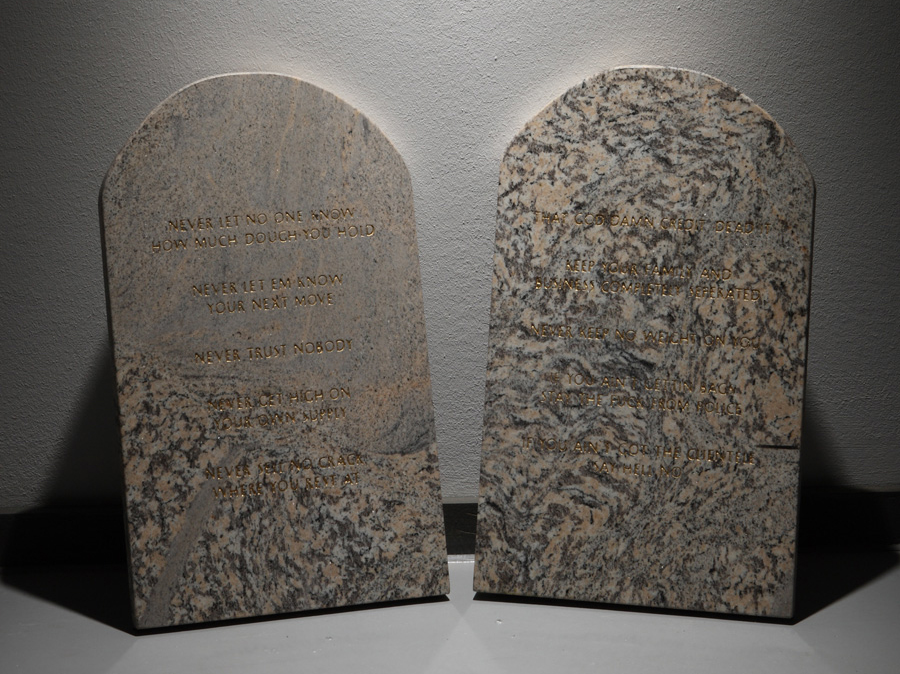
But she hadn’t found Jesus, at least not in that way. Nor had she joined a cult. She claimed she simply hit rock bottom and having no one to turn to, sat down and wrote out a list of commandments for herself. A self-imposed list of rules in which she would like to live by.
And while I wish I could remember the list verbatim–my memory, unfortunately, has a mind of its own–I instead offer up a similar list that contains many of Tamika’s instructions for living a good life:
The 82 Commandments of Alejandro Jodorowsky
1. Ground your attention on yourself. Be conscious at every moment of what you are thinking, sensing, feeling, desiring, and doing.
2. Always finish what you have begun.
3. Whatever you are doing, do it as well as possible.
4. Do not become attached to anything that can destroy you in the course of time.
5. Develop your generosity – but secretly.
6. Treat everyone as if he or she was a close relative.
7. Organize what you have disorganized.
8. Learn to receive and give thanks for every gift.
9. Stop defining yourself.
10. Do not lie or steal, for you lie to yourself and steal from yourself.
11. Help your neighbor, but do not make him dependent.
12. Do not encourage others to imitate you.
13. Make work plans and accomplish them.
14. Do not take up too much space.
15. Make no useless movements or sounds.
16. If you lack faith, pretend to have it.
17. Do not allow yourself to be impressed by strong personalities.
18. Do not regard anyone or anything as your possession.
19. Share fairly.
20. Do not seduce.
21. Sleep and eat only as much as necessary.
22. Do not speak of your personal problems.
23. Do not express judgment or criticism when you are ignorant of most of the factors involved.
24. Do not establish useless friendships.
25. Do not follow fashions.
26. Do not sell yourself.
27. Respect contracts you have signed.
28. Be on time.
29. Never envy the luck or success of anyone.
30. Say no more than necessary.
31. Do not think of the profits your work will engender.
32. Never threaten anyone.
33. Keep your promises.
34. In any discussion, put yourself in the other person’s place.
35. Admit that someone else may be superior to you.
36. Do not eliminate, but transmute.
37. Conquer your fears, for each of them represents a camouflaged desire.
38. Help others to help themselves.
39. Conquer your aversions and come closer to those who inspire rejection in you.
40. Do not react to what others say about you, whether praise or blame.
41. Transform your pride into dignity.
42. Transform your anger into creativity.
43. Transform your greed into respect for beauty.
44. Transform your envy into admiration for the values of the other.
45. Transform your hate into charity.
46. Neither praise nor insult yourself.
47. Regard what does not belong to you as if it did belong to you.
48. Do not complain.
49. Develop your imagination.
50. Never give orders to gain the satisfaction of being obeyed.
51. Pay for services performed for you.
52. Do not proselytize your work or ideas.
53. Do not try to make others feel for you emotions such as pity, admiration, sympathy, or complicity.
54. Do not try to distinguish yourself by your appearance.
55. Never contradict; instead, be silent.
56. Do not contract debts; acquire and pay immediately.
57. If you offend someone, ask his or her pardon; if you have offended a person publicly, apologize publicly.
58. When you realize you have said something that is mistaken, do not persist in error through pride; instead, immediately retract it.
59. Never defend your old ideas simply because you are the one who expressed them.
60. Do not keep useless objects.
61. Do not adorn yourself with exotic ideas.
62. Do not have your photograph taken with famous people.
63. Justify yourself to no one, and keep your own counsel.
64. Never define yourself by what you possess.
65. Never speak of yourself without considering that you might change.
66. Accept that nothing belongs to you.
67. When someone asks your opinion about something or someone, speak only of his or her qualities.
68. When you become ill, regard your illness as your teacher, not as something to be hated.
69. Look directly, and do not hide yourself.
70. Do not forget your dead, but accord them a limited place and do not allow them to invade your life.
71. Wherever you live, always find a space that you devote to the sacred.
72. When you perform a service, make your effort inconspicuous.
73. If you decide to work to help others, do it with pleasure.
74. If you are hesitating between doing and not doing, take the risk of doing.
75. Do not try to be everything to your spouse; accept that there are things that you cannot give him or her but which others can.
76. When someone is speaking to an interested audience, do not contradict that person and steal his or her audience.
77. Live on money you have earned.
78. Never brag about amorous adventures.
79. Never glorify your weaknesses.
80. Never visit someone only to pass the time.
81. Obtain things in order to share them.
82. If you are meditating and a devil appears, make the devil meditate too.
Not being a fan of dogma, creed, or commandments in general, I admit I can find merit in many items on this list as suggestions for people to find their own path in life. Hell, if it worked for Tamika, it damn sure couldn’t hurt giving it a go.
So, sally forth, true believers and blasts from the past, and be making your own commandments and living by themingly writeful.
“People they come together, People they fall apart,
No one can stop us now, ‘Cause we are all made of stars” — Moby
Ideas spark ideas, as I’m sure you well know, and while contemplating a previous post on the message I would send to my younger self, I was hit with another thought along similar lines, but the scenario requires a little theater of the mind setup first:
It begins with the SETI (Search for Extra-Terrestrial Intelligence) Institute detecting a radio signal that finally confirms the existence of extraterrestrial life. How did the aliens learn of our existence, you ask? You know the deal: Voyager 1 and 2 get swallowed up by a singularity and spit out in the middle of uncharted space and intercepted by a curious and as-yet-thought-to-be-benign alien race. Now quit bogging down my backstory with unnecessary questions.
Top minds–-including astrophysicists, cryptanalysts, linguists and mathematicians–-are called in to decipher the message and after an exhaustive code-breaking session, the oddest thing is found embedded in the communique: My name.
Uh-uh, no questions, remember?
After being properly vetted—they’d have to make sure I’m not some wackadoo that’s gonna build himself an Interocitor using off-world schematics or sell the Earth off to the highest bidder—I’m brought in to begin a controlled dialogue with the alien. During the exchange, my new intergalactic pen pal asks the question: “Who are you?” I answer with my personal history and the reply I get back is, “No, who are you?”
We’re all stumped at this point.
Over a pint and some pub grub, me, Neil DeGrasse Tyson, Brian Cox, and Michio Kaku (let’s face it, they’re all my buds at this point) are trying to puzzle this out when I’m struck with an idea, “What if the extraterrestrials are utilizing fourth-dimensional, or higher, level thinking and need broader definitions in which to extrapolate the answers they seek?” The astro-brainiacs think I might be onto something.
[I need to pause the post at this point because I can hear your laughter and it’s a bit disruptive. And rude, if I’m honest. Out of everything so far, the only problem you have is that I offered a solution in an astrophysics think tank? Really?]
And now we get to the meat of the nutshell:
If I had to encode myself into a relatively short information sequence, what sources would I pick?
Since mathematics and I feud constantly and are court-ordered to remain at least 500 yards apart from one another at any given time, I know I can’t make this work on a fundamental science level. My only option is to go the artistic route.
Now, the chore becomes one of selecting 10 works that once read/viewed/listened to/etc., would allow an absolutely non-terran life form to know the essence of me. This is what I came up with:
Movie: The Lion in Winter
The film takes place in the year 1183 AD and tells the story of King Henry II’s three sons all of whom want to inherit the throne, but Henry won’t commit to a choice, so they and his wife, Eleanor of Aquitaine, variously plot to force him.
I’ve chosen this to illustrate the relationship between me and all my families (both birth and extended). It speaks to the complexities of familial love and how I tend to love what I destroy and destroy the things I love.
Book: Stranger in a Strange Land by Robert A, Heinlein
In not so subtle Christ analogy, the book tells the story of Valentine Michael Smith, a human who comes to Earth in early adulthood after being born on the planet Mars and raised by Martians. It explores his interaction with—and eventual transformation of—terrestrial culture.
This was chosen to illustrate my social anxieties–that wax and wane in an unpredictable manner–and the fact that I never feel I properly fit in with any crowd that isn’t one of my making. There truly exists no place on Earth where I feel at home.
Poem: Desiderata by Max Ehrmann
Go placidly amid the noise and haste, and remember what peace there may be in silence. As far as possible without surrender be on good terms with all persons. Speak your truth quietly and clearly; and listen to others, even the dull and ignorant; they too have their story. Avoid loud and aggressive persons, they are vexations to the spirit. If you compare yourself with others, you may become vain and bitter; for always there will be greater and lesser persons than yourself.
Enjoy your achievements as well as your plans. Keep interested in your career, however humble; it is a real possession in the changing fortunes of time. Exercise caution in your business affairs; for the world is full of trickery. But let this not blind you to what virtue there is; many persons strive for high ideals; and everywhere life is full of heroism.
Be yourself. Especially, do not feign affection. Neither be critical about love; for in the face of all aridity and disenchantment it is as perennial as the grass.
Take kindly the counsel of the years, gracefully surrendering the things of youth. Nurture strength of spirit to shield you in sudden misfortune. But do not distress yourself with imaginings. Many fears are born of fatigue and loneliness. Beyond a wholesome discipline, be gentle with yourself.
You are a child of the universe, no less than the trees and the stars; you have a right to be here. And whether or not it is clear to you, no doubt the universe is unfolding as it should.
Therefore be at peace with God, whatever you conceive Him to be, and whatever your labors and aspirations, in the noisy confusion of life keep peace with your soul. With all its sham, drudgery and broken dreams, it is still a beautiful world. Be careful. Strive to be happy.
Chosen to represent my attempt at zen thoughts. These are the inner things I strive for that always seem to exist just beyond the reach of my higher consciousness fingertips. One day, though. This and the lottery. Hope springs eternal.
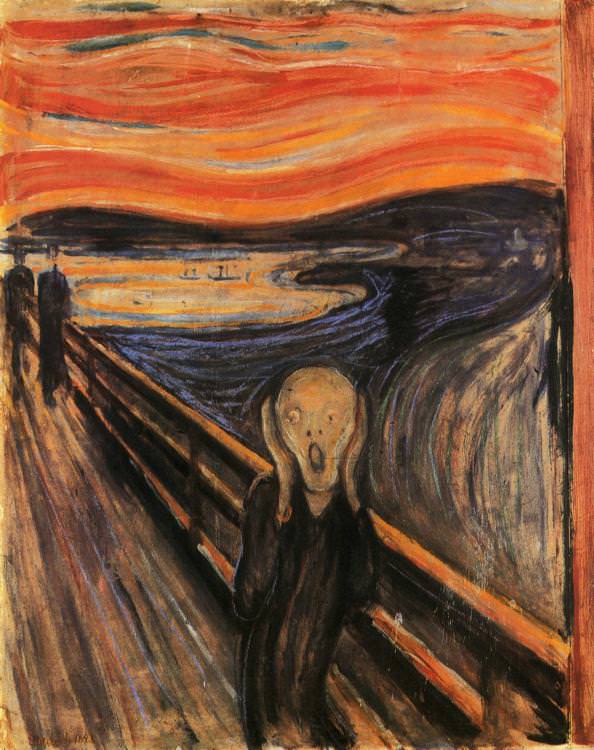
Art:The Scream by Edvard Munch
In his diary in an entry headed, Nice 22 January 1892, Munch described his inspiration for the image:
One evening I was walking along a path, the city was on one side and the fjord below. I felt tired and ill. I stopped and looked out over the fjord—the sun was setting, and the clouds turning blood red. I sensed a scream passing through nature; it seemed to me that I heard the scream. I painted this picture, painted the clouds as actual blood. The color shrieked. This became The Scream.
This piece represents the insanity that lies just beneath my cool surface. The things I see and hear that apparently, no one else acknowledges. But it’s real, dammit. It better be.
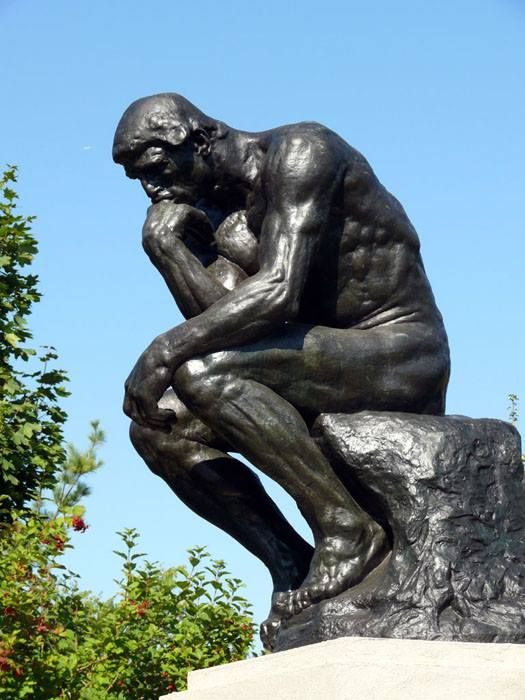
Sculpture: The Thinker by Auguste Rodin
The Thinker was originally meant to depict Dante in front of the Gates of Hell, pondering his great poem. This is precisely why I have chosen this, as I am well aware that I am the cause of most of the disasters that have occurred in my life and have often sat and pondered how I let things get to their current state.
Photography: Tank Man by Jeff Widener
The iconic photo of Tank Man, the unknown rebel who stood in front of a column of Chinese tanks in an act of defiance following the Tiananmen Square protests of 1989. This is an obvious one as it represents my personal autonomy and contemptuous behavior/attitude towards authority figures to the point of appearing as a provocateur or just plain anti-social.
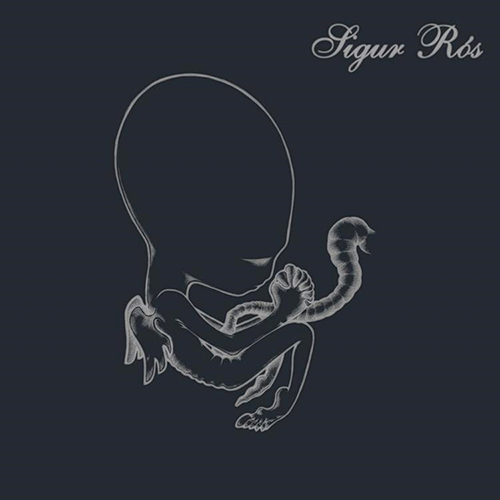
Music: Ágætis byrjun by Sigur Rós
This album is 72 minutes of sonically rich, emotionally pulverizing perfection. From the orchestral splendor of “Starálfur,” to the transcendent ache of “Ný batterí.” each decayed synth tone and cymbal splash conjures a world of endless possibilities. Jón Þór “Jónsi” Birgisson wrote the following mission statement:
“We are not a band, we are music. We are simply gonna change music forever, and the way people think about music. And don’t think we can’t do it, we will.” 14 years after the fact — Spin presented Birgisson with that quote. He responded with laughter, “You’re young and full of energy and have this cockiness,” he said. “I think it’s beautiful.”
This represents my initial mindset when I first began to write again.
Television: The Twilight Zone (1959 series) by Rod Serling and various
This science-fiction/fantasy anthology series consisting of unrelated stories depicting paranormal, futuristic, Kafkaesque, or otherwise disturbing or unusual events (typically featuring some sort of plot twist and moral), represents my imagination as it shaped the way I view fiction.
Play: Sweeney Todd: The Demon Barber of Fleet Street by Stephen Sondheim
A 1979 musical thriller set in 19th century England tells the story of Benjamin Barker, aka Sweeney Todd, who returns to London after 15 years transportation on trumped-up charges. When he finds out that his wife poisoned herself after being raped by the judge who transported him, he vows revenge on the judge and, later, the whole world. He teams up with a piemaker, Mrs. Lovett, and opens a barbershop in which he slits the throats of customers and has them baked into pies.
This speaks to my Scorpio nature of quietly holding a grudge with untold patience until the chance presents itself to sting back. Not so much anymore, though. I’ve mellowed in my old age. Stop looking at me like you don’t believe me.
Performance art: The Invisible Man: Liu Bolin’s camouflage artwork
Liu uses paint to camouflage him to make himself invisible in public. This represents the fact that I was born invisible and the only time I’m ever seen is when I write.
Before you start nitpicking the logic of sending earth-logic/culture-bound works of art to an alien, I refer you to the Moby lyrics quoted at the top of the post and if we are all truly made of stars, there surely must be some commonality that binds us together, yes? Why can’t art be the universe’s language?
“Happiness is not something ready made. It comes from your own actions.” — Dalai Lama
As writers, it’ll come as no shock to any of you when I say my mood largely affects my writing. When I slide into the dark places, although I attempt to slog my way through the anguish and negativity that gets so thick sometimes as to suffocate me, my writing naturally suffers.
This post stems from an article I read recently on a Swedish study that suggested writers have a higher risk than the general population of anxiety and bipolar disorders, schizophrenia, unipolar depression, and substance abuse. And if that wasn’t enough, we’re also about twice as likely to commit suicide.
I don’t know about you, but I’d like to head this off at the pass. So, below are a few suggestions to help you live a happier existence, broaden your horizons, create a positive environment in which to write, and hopefully bring energy and verve into your projects:
1. Appreciate Life
Be thankful that you beat the odds and woke up alive this morning, some folks weren’t as lucky as you. Develop a childlike sense of wonder towards life and focus on the beauty of things. Learn to make the most of each day, and stop taking things for granted. And definitely don’t sweat the small stuff. It’s small for a reason.
2. Choose Your Friends Wisely
Do your best to surround yourself with happy, positive people who share your values and goals. Friends that have the same ethics as you will encourage you to achieve your writing dreams. They help you to feel good about yourself and are good for a morale boost when needed.
3. Be Considerate
Accept and respect others for who they are as well as where they are in life. With a generous spirit, help when you’re able, without trying to change the person. As a rule, you should try to brighten the day of everyone you come into contact with. Especially the difficult ones.
4. Learn Continuously
Try new and daring things to spark interests, gain experience, and that you can bring back into your writing.
5. Develop Creative Problem Solving Skills
Stop wallowing in self-pity as soon as you face a challenge and instead get busy finding a solution. Don’t let set backs affect your mood, instead see each new obstacle you face as an opportunity to make a positive change. Learn to trust your gut instincts – it’s almost always right.
6. Laugh Lots
Stop taking yourself – or life for that matter — so damned seriously. You can find humor in just about any situation, so learn to laugh at yourself, because, let’s face it, nobody’s perfect. When appropriate, laugh and make light of the circumstances. (Naturally there are times that you should be serious as it would be improper to laugh. Try not to that person.)
7. Forgive!!!
Holding a grudge hurts no one but you. Forgive others for your own peace of mind. When you make a mistake, own up to it, learn from it, and forgive yourself.
8. Be Grateful
Develop an attitude of gratitude by learning to count your blessings; All of them, even the things that seem trivial. Be grateful for your home, your work and most importantly your family and friends.
9. Invest in Relationships
Always make sure your loved ones know you love them even in times of conflict. Nurture and grow your relationships with your family and friends by making the time to spend with them. Don’t break your promises to them. Be supportive.
10. Keep Your Word
Honesty is the best policy. Every action and decision you make should be based on honesty. Be honest with yourself and with your loved ones.
11. Meditate
Meditation gives your very active brain a rest. When it’s rested you will have more writing energy and function at a higher level. Whether it’s yoga, hypnosis, relaxation tapes, affirmations, visualization or just sitting in complete silence, find something you enjoy and make the time to practice daily.
12. Mind Your Own Business
Concentrate on creating your life the way you want it and take care of you and your family. Don’t get overly concerned with what other people are doing or saying. Don’t get caught up with gossip or name calling. Don’t judge. Everyone has a right to live their own life the way they want to – including you.
13. Be Optimistic
See the glass as half full. Find the positive side of any given situation. It’s there – even though it may be hard to find. Know that everything happens for a reason, even though you may never know what the reason is. Steer clear of negative thoughts. If a negative thought creeps in – replace it with a positive thought.
14. Love Unconditionally
Don’t put limitations on your love, even though you may not always like the actions of your loved ones – continue to love them.
15. Be Persistent
Never give up. Face each new challenge with the attitude that it’ll bring you one step closer to your goal. You’ill never fail, as long as you never give up. Focus on what you want, learn the required skills, make a plan to succeed and take action. As humans, we’re always happiest while pursuing something of value to us.
16. Be Proactive
Accept what can’t be changed. Happy writers don’t waste energy on circumstances beyond their control. Accept your limitations as a human being. Determine how you can take control by creating the outcome you desire – rather than waiting to respond.
17. Take Care of Yourself
Take care of your mind, body and health. Get regular medical check ups. Eat healthy and work out. Get plenty of rest. Drink lots of water. Exercise your mind by continually energizing it with interesting and exciting challenges.
18. Build Self Confidence
Don’t try to be someone you’re not (no one likes a phony). You know who you are on the inside so be confident with that, do the best you can manage and don’t second guess yourself.
19. Take Responsibility
Happy writers know and understand that they are 100% responsible for their life. They take responsibility for their moods, attitude, thoughts, feelings, actions and words. They are the first to admit when they’ve made a mistake.
And there you have it. Simple, common sense suggestions to help you take responsibility for your own happiness. I realize that some of these are easier said than done, but could it really hurt to try to work on developing at least a few of these habits as you own? Who knows, the more you incorporate the above habits into your daily lifestyle, the happier you could be.
Being gifted with creativity comes at a price, but it doesn’t have to be a terrible one.
“Write like you’ll live forever — fear is a bad editor. Write like you’ll croak today — death is the best editor. Fooling others is fun. Fooling yourself is a lethal mistake. Pick one — fame or delight.” ― Ron Dakron
Writing is a steep, uphill battle but it’s fierce and it’s beautiful and you’ll regret walking away from it before you’ve seen it reach its potential.
New people, experiences and opportunities to write about won’t stop coming into your life but you need to make space for them. Reexamine all your current relationships, obligations and habits and if you find value in them, hold onto them tighter. If their value escapes you, it’s time to let something go.
Resolve to be awesome for the rest of your life, starting right now. Just because.
Writing goals are not reserved for January 1st. Get in the habit of setting them monthly, hell, even weekly. Set them so that you’re moving forward and always trying to progress. Your writing can grow stagnant without them. Beware.
Confidence is an attractive thing. Readers dig it. Non-readers dig it. We all dig it.
Negative people chip away at your spirit. Flush the toxins and get yourself into a better writing head space.
And if you slag off another writer because their abilities fail to impress or interest you, maybe you’re on the road to toxicity. Peer relationships are too valuable to muddy with what you perceive to be the shortcomings of other writers. If you can’t find enjoyment in someone’s writing, don’t read it. Plain and simple.
You’re human and as such you’re going to waste many hours focusing on who you aren’t, or who you want to secretly be. But you won’t ever wake up and magically become that person. You’ve got to embrace what you bring to the table. If you don’t like what that is, have the courage to change it.
Regret is a very real thing. It’s going to happen to you at some point. Don’t hold onto things forever but learn from them and let the past go. The past will be a dictator if you let it.
Yes, when we write we create worlds, but the world doesn’t revolve around us. Turns out we’re just punctuations in a much larger story littered with periods and commas and dashes. How are you helping that story to be better? How are you being the best punctuation you can be?
Tech advancement is coming at us fast and furious and it’s all too easy to let an emoticon laden text do the talking for you, too easy to click a Like or +1 button instead of engaging people in an actual dialogue. Never lose sight of the beauty of a conversation where you can watch a person’s face express actual emotions. Let a person know that they are worth your words. They are worth your presence. They are worth more than just letters on a screen. Face to face connections are fading faster everyday. Please don’t let the machines win.












 MADD FICTIONAL