Not metaphorically — though we’ll get there — but physically. On my back. On my shoulders. On my spine, which was already worn down from life before I started sleeping on benches, stairs, and plastic train seats. I carry it up staircases that feel like mountains. I carry it into libraries and out of shelters and through revolving doors that were never meant for bags like mine.
And every ounce matters. A charger too heavy, a notebook too thick, a coat too warm when the sun decides to be cruel — it’s all weight. It’s all punishment. Your life becomes triage. What do I need more — a clean shirt, or Advil? Do I carry this book I love, or do I save space for soap?
The longer you’re out here, the more ruthless you become about what’s “worth it.” You pare yourself down until the bag is just survival. But the weight doesn’t leave.
Because then there’s the mental weight.
The constant tracking — of location, of time, of people, of threat. You have to remember where the power outlets are. Which parks have working water fountains. Which McDonald’s will let you sit for 22 minutes before kicking you out. Which guard turns a blind eye on Sundays. Which stairs are safer than sidewalks. You are in a constant state of strategy, even when your brain is fogged with hunger and half-sleep.
You carry your own invisibility. You carry being watched. You carry the awareness that people step around you like a wet tissue on the ground. You carry your own shame — even when you know you didn’t deserve this. Even when you know it could happen to them, too.
And then there’s the worst weight: Memory.
I carry the apartment I lost. The room with the quiet door and the plant I forgot to water. I carry the sound of heat turning on in winter. The hum of a refrigerator holding food just for me. I carry the versions of myself that had a home, and a nameplate, and a mailbox. I carry the man I was.
And on days when the pain is too much, I carry this voice in my head that whispers: “Maybe it’s better not to carry you anymore.”
But I do. I carry me. I carry me through aching feet and strangers’ stares and silence that grows louder every week. I carry me through being forgotten by algorithms and friends and time.
So if you’re reading this — even silently, without likes or comments — know this:
This is not content. This is not an act. This is the sound of someone still carrying himself, alone, across a city that doesn’t want to see him.
Welcome to No Fixed Address, a weekly series where I write candidly about what it means to be homeless—right now, in real life, not in some sanitized Hollywood version. I’m currently unhoused. Not “drifting.” Not “on a journey.” Just trying to survive in a world that looks away.
Each week, I’ll share personal accounts, hard truths, and moments that don’t make it into the movies. If you’re here to understand what homelessness actually looks like—not as a plot point, but as a life—then you’re in the right place.
This is not a cry for pity. It’s a record. A mirror. A small act of resistance.
There’s a man I see sometimes at a particular subway station who wears five coats, no socks, and sings showtunes to the column near the MetroCard machine. Not at the machine — to it. With reverence. Sometimes he calls it “Mother.” Sometimes he asks it why the moon forgot him.
Other times, he screams.
I don’t know his name, but I know his shape in the crowd. I know to give him space. I know he isn’t violent — not yet. But I also know he’s a walking nerve ending, exposed to the elements, and sooner or later, someone will provoke him. Or he’ll crack.
There are more of him now. And it’s getting harder to tell which ones are just talking to themselves, and which ones are holding it together by the thinnest thread of silence. I’ve shared benches with them. Ridden the same 2 a.m. train loops. Some mutter. Some shout. Some sob quietly into their sleeves for hours.
The line between homeless and psychologically unwell is not always the same — but it’s getting blurrier every week.
And here’s the thing: navigating the homeless landscape means navigating them, too. And they’re not okay. And neither are we.
I’m not here to speak over them. But I am here to say this: it is becoming genuinely dangerous to move through the city’s unhoused corridors — shelters, trains, stairwells, benches — because mental health care has utterly collapsed, and too many people have nowhere left to unravel except next to you.
I’ve had someone chase me down a platform for looking too long in their direction. I’ve had someone follow me up a stairwell whispering “I’m not gonna hurt you” in a tone that made me believe the opposite. I’ve seen a man bash his head against a pole until MTA police officers came to drag him away like luggage.
This isn’t “colorful city life.” This is a breakdown — of systems, of minds, of basic public safety. And every time a new person ends up on the street mid-episode, we’re all told to just accept it. Duck and weave. Look down. Dodge the danger, but show empathy. Keep your distance, but don’t dehumanize. It’s a losing equation.
There’s a rumor — more than a rumor, really — that certain New Jersey agencies have been quietly transporting individuals with severe mental health conditions across the river into New York once their Medicaid or charity care runs out. Allegedly, they’re given a one-way bus ticket and let loose near Penn Station or Port Authority.
“Not our problem anymore.”
I don’t have paperwork to prove it, but I’ve seen the fallout. The confused newcomers with hospital bracelets still on. The disoriented men asking how to get back to Hackensack or Newark. The women who say things like, “I was at a place with nurses and then I wasn’t.” You learn to read between the lines real fast out here.
Here’s the most brutal part: even the ones trying to get help often can’t. If you’re mentally unwell and homeless, the threshold to get admitted to psychiatric care is sky-high. You basically have to be actively suicidal and disruptive — and even then, you might just get a psych eval and kicked back out with a pamphlet.
And those of us just trying to survive — who aren’t (yet) in crisis — we’re left with the fallout. We dodge. We share space. We don’t sleep. We brace for the moment the shouting turns, or the eye contact lingers too long.
We’re not just sleeping rough anymore. We’re sleeping in someone else’s breakdown. And tomorrow, it could be our turn.
Welcome to No Fixed Address, a weekly series where I write candidly about what it means to be homeless—right now, in real life, not in some sanitized Hollywood version. I’m currently unhoused. Not “drifting.” Not “on a journey.” Just trying to survive in a world that looks away.
Each week, I’ll share personal accounts, hard truths, and moments that don’t make it into the movies. If you’re here to understand what homelessness actually looks like—not as a plot point, but as a life—then you’re in the right place.
This is not a cry for pity. It’s a record. A mirror. A small act of resistance.
Being homeless, you slowly develop the mutant ability of invisibility. You don’t ask for it, but it’s given to you, day by day, until you master the art of being looked through as if you didn’t exist. The city becomes a blur of legs and exhaust, a world that moves around a space you only temporarily occupy. On the rare occasion, however, someone’s focus snags on you, and for a moment, you flicker back into existence.
Such was the case for me at a church-run soup kitchen in a neighborhood that had long since given up trying to be safe. The air outside reeked of old urine and decay, but inside, it was a sterile blast of bleach and boiled coffee. Security was a serious affair: a guard with tired eyes checked bags and backpacks, and everyone submitted to the electronic chirp of a metal detector wand and an indifferent pat-down. A necessary ritual before you could be granted a breakfast tray of food.
The dining hall was a cramped, narrow space, lined with four long benches already crowded with hunched shoulders and weary faces. The room was made even smaller by the bustling team of volunteers, a small army of good intentions standing by to deliver the morning’s meal. Due to a series of funding cuts following the most recent presidential election, the breakfast was reduced to a single-serving packet of dry cereal, a small plastic cup of milk, a diced fruit cup swimming in syrup, a granola bar, a small bottle of water, and the choice of either a cup of coffee or tea. A checklist of calories.
As was my custom, I made my way down the line of volunteers, offering a quiet, “Hello, thank you for being here.” Some nodded back, a few offered a real smile. Most didn’t. It never bothered me. Acknowledging their presence was my way of holding onto a piece of the man I used to be. You are only responsible for your own actions, after all.
The volunteer who served me was a flurry of limbs and apologies. A tall, slender blonde woman whose thick glasses seemed to magnify the slight panic in her eyes. She stumbled bringing the tray over, her sneakers squeaking on the linoleum. She almost tripped setting it down, which caused the milk to slosh over the side, a white splash on the worn plastic.
“Oh, I am so sorry!” she gasped, her accented voice soft, with a melody to it I couldn’t place. She fumbled with a napkin, making the puddle worse.
“Hey, it’s totally fine,” I said, smiling. “Adds a little character to the tray.” And it really was fine because milk was the enemy. Being lactose intolerant, I always ate my cereal dry.
She paused her frantic dabbing and looked at me. Really looked. And then, to my surprise, she blushed. “I am also sorry I did not say hello when you came in,” she said, finally meeting my eyes. “I am afraid my klutziness made the first impression.”
I wish I’d had the presence of mind to remember her name, but alas and alack, my memory isn’t worth the paper it’s printed on. What I did recall was that she was from the Czech Republic, and was currently working as an au pair in New Jersey. She was in New York because she’d seen Moulin Rouge the night before and stayed in a hostel overnight in order to volunteer at the soup kitchen. Her face lit up as she described the play, transforming her persona from awkward to incandescent. She was a self-proclaimed fashion and craft nerd. She’d made gifts for the cast, contacted them through Instagram, and actually arranged to meet them backstage after the show. She showed me pictures on her phone of her beaming alongside the actors, holding up her handmade creations. She hoped, she confessed, that it might one day lead to costume design work in an actual Broadway or West End production. Her biggest fear was that the current administration would make it impossible to get another work visa after her current one expired in August.
She painted a picture of a life so different from mine it felt like a broadcast from another galaxy. Then, searching for common ground, I pointed to a small pin on her apron—a Starfleet insignia.
Her eyes widened behind her glasses like a starship engaging its warp drive. She was a Trekkie. A super-fan. She’d made her own uniforms from every series. “Even,” she whispered conspiratorially, leaning in, “Discovery.”
I chuckled. “That’s dedication.”
The kitchen had a strict ten-minute time limit per meal to keep the line moving. But I was the last one in, and the morning rush was over. The other volunteers started wiping down counters, their glances growing heavier, but she didn’t seem to notice. We talked Trek, debating the merits of Kirk versus Picard, the tragedy of Jadzia Dax, the sheer brilliance of the Dominion War arc. We were two strangers in a forgotten corner of the city, speaking a shared, secret language.
Then, her expression softened. “And what about you?” she asked.
I gave her the abridged version. You learn to edit your life story for polite company. But she listened with an unnerving intensity. I didn’t want to dim the light in her eyes after she’d just had such a perfect, starlit day.
She must have sensed my hesitation. “No, I mean,” she said, her voice dropping, “how does this… affect you? Mentally. Emotionally.”
The question was so direct, so human, it disarmed me. I decided to give her the truth.
“It grinds you down,” I said, the words feeling heavy and foreign in my mouth. “You start to feel less than human. Invisible. Like a ghost haunting a world that’s forgotten you’re even there.”
She looked at me for a long, silent moment, her head cocked to one side as if trying to solve a complex equation. Then, with a small, definitive nod, she said something that shattered the air between us.
“I would have your babies.”
I froze. My mind, which had just been soaring through the Alpha Quadrant, crashed back to Earth. I am old enough to be her father, maybe even her grandfather. The statement hung in the air, bizarre and profound. It wasn’t a proposition. It wasn’t a joke. It was a declaration. A strange, fiercely human, and impossibly beautiful testament that shot through layers of invisibility and said: I see you. You are a man. You are worthy.
I didn’t know how to process it. Still don’t. I didn’t push, or dig for meaning, or make a clumsy joke. I just let it sit there, an echo from a parallel world where such things could be said.
Some moments aren’t meant for deconstruction. They’re meant to be held, like a fragile, priceless thing. You just take the compliment, breathe it in, and let it be enough.
For that one conversation, in that cramped and sterile room, I wasn’t on the streets. I wasn’t a ghost. I was a man talking to a woman about starships and dreams.
And that was a kind of magic more real than anything I had felt in quite a while.
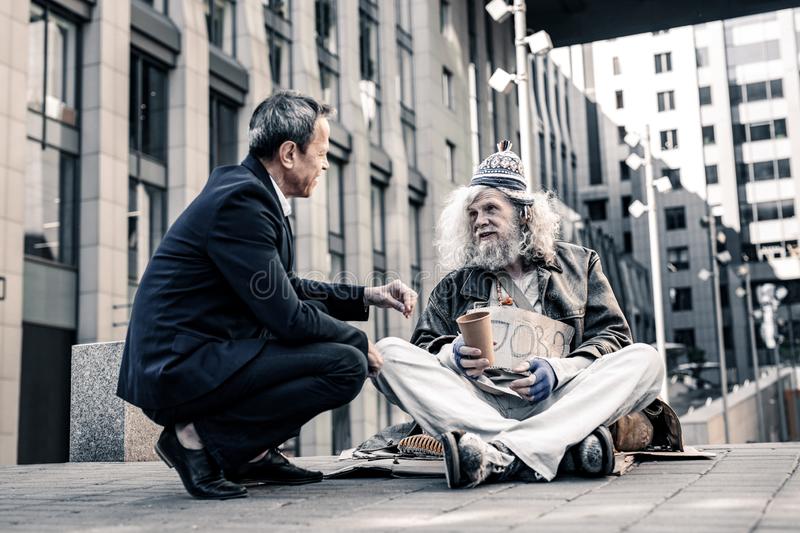
What caused me to speak to the man, I cannot rightly say, for I do not make it my business to chat with homeless people. They are a dime a dozen in the city in which I live and work and if I regularly engaged with them, I would never make any of my appointments on time. But there was something about this man with the sun-faded, barely legible cardboard sign, something in the deep well of his eyes that beckoned me.
He told me his name was Horace as I patted my pockets to add validation to my claim that I had no money to drop into his dingy paper coffee cup, a statement I made before he even asked. In truth, he never asked. I simply went into automatic defensive mode, not wanting to seem heartless, but not offering any charity, either.
“We all drop breadcrumbs in life,” Horace said.
“Do we?” I asked, struggling to mark his intention.
Horace nodded. “Even the most carefree among us, and we do this because normalcy comes well-equipped with comfort zones. You may take exception to the word normalcy but it has nothing to do with the definition society places on the word normal. Here it applies to the recurrent patterns in your life, the things you’ve grown accustomed to.”
“I don’t follow you.”
“The breadcrumbs are used to lead us back to the path of familiarity when the detours we take spiral beyond our ability to control and/or accept. I stray from the path constantly chiefly because my path is an uneventful one, which many people would kill for, but I find boring. I ought to be a baker with the number of breadcrumbs I’ve dropped over the years.”
“Um, I’d love to chat, but it’s Thanksgiving and I really must be on my way.”
“Since I’ve always been able to find my way home I never had a problem tearing my life apart,” Horace continued as if he hadn’t heard me. “Going on concrete jungle pilgrimages, and returning to my path at some later date to rebuild things from scratch. But this time is different. This time the demolition wasn’t of my choosing and there’s something about the way events have been playing out over the past six months that have clued me in on the fact I am near the end of the race.”
“You’re dying?”
“Homeless yet again, despite my best efforts to avoid it, I have this sinking feeling deep in my marrow that this will be the final time. There’s no way out and no way back. All the breadcrumbs I dropped to lead me back to the main road of rebuilding my life are gone. Most likely eaten by the crows of a fate long overdue. I guess you can only hit the reset button so many times in life.
“And I can’t honestly say I didn’t see it coming. Life stopped making sense about three years ago, though not all at once. Little by little, all the rules I had ever learned, all the tricks I added to my arsenal, no longer applied. Now, life, the daily routine that the majority of the population manages to perform without a second thought or breaking a sweat, is a game I no longer know how to play. Existence no longer makes sense to me.
“Needless to say, it doesn’t help matters that I have always possessed a nihilistic bug in the back of my brain that constantly questions the logic of struggling to achieve anything when all roads lead to death.
“As you can probably work out, I do not believe in the afterlife. So that we’re clear, this is not an invitation for proselytizers to dust off their soapboxes. I am an aspiritual entity and I’ve made my peace with the fact that I shall not receive salvation. If religion works for you, good on you, I wish you nothing but the best.”
I stood there in silence, wanting to walk away, but also wanting to make sense of this interaction. As if reading my mind, Horace said,
“The purpose of my stopping you from your events of the day and rambling on about things which bear no significance to you is to pass on as many of my thoughts and impressions before I lose my sanity to the streets and become one of the wandering bagmen screaming at invisible antagonists.”
And it finally dawned on me. “You want to be remembered,” I said.
“Who among us doesn’t want to be remembered?”
“You wouldn’t happen to be hungry, would you?” I asked.
“It was not my intention to solicit charity from you, sir, at least not of the monetary kind.”
“I didn’t say anything about giving you money. I need to put something in my stomach before I go on the search and I don’t like eating alone.”
“What are you searching for?”
“Breadcrumbs,” I answered. “You said you’ve been dropping them all your life. I’m sure there are enough lingering around somewhere to get you safely back on your path.”
HAPPY THANKSGIVING! Wishing all who celebrate the holiday (and even those who don’t) good food that fills your belly, good health as you strive for your unique brand of success, and good times with family and friends. May you have all the best delights in a life filled with moments that are as sweet as pumpkin pie!
A number of years ago, I volunteered to man the telephones during a pledge drive for WBAI, a New York-based non-commercial, listener-supported radio station, whose programming featured political news, talk and opinion from a left-leaning, liberal or progressive viewpoint, and eclectic music.
During popular programs that offered nice gift incentives for pledges, the phones never stopped ringing. When a less popular show was on the air, the phones experienced plenty of downtime. This was when you got to meet your fellow volunteers. Most were friendly, chatty folks, happy to make connections with people who shared their political interests, some were dyed in the wool anti-establishment protestors whose roots were still firmly planted in the hippie movement, and then there was Dave. And he sat next to me. Because I am a magnet for the unusual.
It was the middle of summer, and a brutal one, if memory serves, and Dave was wearing a wool hat, and thick cable knit sweater, with a woolen scarf beneath his puffer coat. But that wasn’t the first thing I noticed about Dave. Not to be cruel, but Dave hadn’t quite gotten his body odor under control. But he was friendly, so we got to talking and in the course of the conversation, Dave admitted that he was a homesteader.
Now, to me, a homesteader was a person who lived and grew crops on land given by the government, so I bombarded him with homesteading questions because I was genuinely curious about the arrangement. He had to stop me in order to explain the modern usage of the term. Dave would break into abandoned buildings, run extension cords to the street lamps for electricity, and arrange to receive mail at the address for at least a month to prove residency in order to avoid being tossed out onto the street without undergoing a proper eviction process.
Squatting wasn’t anything new, and in New York there used to be a law that if squatters were able to restore a derelict building with everything (electrical, plumbing, etc.) up to code, then they could petition as a group to form a business entity and place a bid to purchase the property, using the cost of repairs as a down payment.
Dave wasn’t a part of any such coalition. He was a one-man army and he claimed that he was facing ongoing battles with the owners of the abandoned properties—throwing his possessions out on the street, re-padlocking the property, sending “muscle” to physically evict him, etc.—but this is not the true issue of the post.
Dave (whose name wasn’t “Dave” because I wouldn’t out him like that) had no income and he lacked the skill set to rig the pipes in the abandoned buildings to run water, so he cased houses, and when he was sure that the owners were either away at work or on vacation, he broke into their homes, took showers, and made meals for himself before he left. He claimed he never took anything besides food, always cleaned up after himself, and effected minor repairs if he saw something that needed fixing.
So, the real issue of this post (a bit of a departure from normal) is to ask you a question:
“Besides the obvious breaking and entering charges, how severe a crime do you think the use of the shower and the fixing of a meal is, assuming Dave entered your home without your knowledge or permission?”