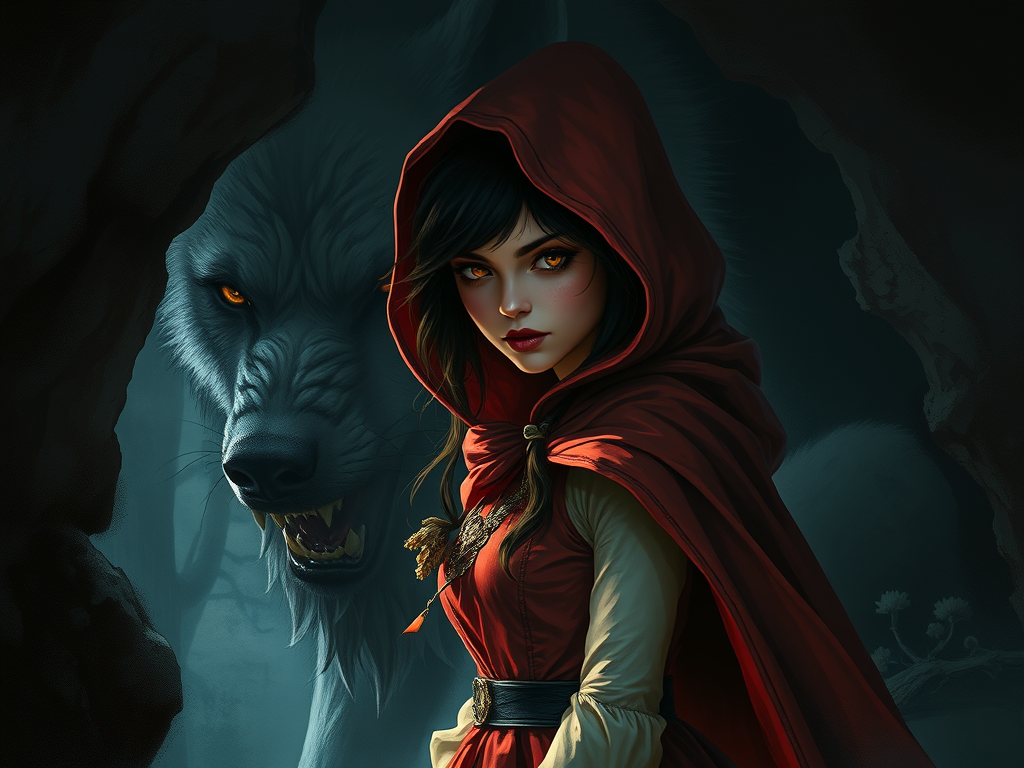
Little Noir Riding Hood Part I: The Client in Red

Bzou smelled her before he heard her.

Blood—cold, human, female—threaded through the damp air outside his den like a slow confession. Not fresh injury. Not panic. Something older and deeper, a stain that didn’t rinse out. It clung to her the way smoke clung to clothes after a long night near a dying fire.

He opened his eyes as the emberlight behind him guttered low. The cave held the kind of darkness that belonged to the world before lanterns, before roads, before people decided shadows were a problem to be solved. His breath steamed in the cold, a pale ribbon curling toward the ceiling, and he listened.

Footsteps, careful.

Not the stumbling, drunk courage of a villager. Not the hurried, frantic rush of someone lost in the woods. These were measured. Intentional. The sound of someone who had made a choice and was prepared to live with it.

She appeared at the mouth of the cave with the fog behind her like a curtain. Hood up, shoulders squared. The cloak was red, but not bright. Not storybook scarlet. Darker. A red that had been slept in, rained on, dragged through thorns and older regrets. The kind of red that didn’t beg attention, but demanded it.

Bzou didn’t rise. He didn’t have to. The den was his kingdom. Anyone who entered it had already crossed a line.

“You shouldn’t be here,” he said.

His voice was the voice of stone rubbed raw. It pressed against the damp air and made the fog feel heavier.

She didn’t flinch.

“I know.”

That alone was wrong. Most humans heard his voice and remembered they were made of soft things. Most humans took a step back even if they didn’t mean to. Fear was automatic. A reflex. A truth.

This woman stood still as a nail.

Bzou watched her for a long moment. The firelight crawled over his fur and over the ridges of his back, catching on the old scars that never fully faded. In the village they called him wolf. Monster. Pact-keeper. Curse. They said a lot of things when they were trying to keep their hands clean.

He shifted, slow and deliberate, and his bones cracked quietly as he unfolded himself from the hollow where he’d been curled.

“What do you want?” he asked.

The woman reached up and pushed back her hood.

Her hair was dark as wet bark, her cheekbones sharp enough to cut glass, her eyes too steady for someone standing at the edge of a predator’s home. Her lips were painted deep red—not for vanity, not for seduction, but like punctuation. A period at the end of a sentence she’d been repeating to herself for days.

She wanted to be seen.

“A missing person,” she said.

Bzou almost laughed, but it would have sounded like a growl. “Not my world.”

He turned away from her, toward the dwindling embers, toward the quiet he’d earned. The village’s problems belonged to the village. The village had chosen its rules. He had chosen exile. That was the pact: he stayed on the edge, and they left him alone. A boundary drawn in old blood and older fear.

Her voice came again, closer than it should have been.

“My grandmother is gone.”

Bzou didn’t turn, but the words tightened something inside him. Missing people were common. People disappeared into woods, into drink, into other people’s cruelty. The world took what it wanted. Sometimes it didn’t even bother to leave a reason behind.

But she didn’t say it like someone repeating the village’s comforting lie. She said it like someone naming a crime.

“They said she wandered off,” the woman continued. “But she didn’t. She was taken.”

Now Bzou turned.

Not quickly. Not with alarm. With the slow attention of something that had learned not to waste energy on false alarms.

“What’s your name?” he asked.

She hesitated. Just long enough to betray a private argument she’d already lost.

“Redalhia.”

It sounded like a name from somewhere else. Somewhere old. Somewhere that didn’t belong to Gildengrove’s neat little square and its tidy sermons and its polite lies.

Bzou studied her. “If your grandmother was taken, why come to me?”

Redalhia didn’t look away. “Because the village doesn’t hunt its own sins.”

Bzou felt a low rumble gather in his chest, not quite a growl. Not quite a laugh. The kind of sound that meant you’re closer to the truth than you should be.

“You’re not from there,” he said.

“I was,” she replied. “Then I wasn’t.”

That was all she offered, and it was enough. The people who left Gildengrove didn’t come back. Not unless they were dragged. Not unless they were desperate. Not unless they were carrying something the village wanted.

Bzou stepped closer. Not to threaten. To measure. The air around her was dense with layers: soap, rain, a trace of cheap tobacco, iron from old blood, and beneath it a faint sweetness like crushed berries that had begun to rot. He could smell nights without sleep. He could smell decisions made in the dark.

“You want me to walk into the village,” he said.

“Yes.”

“You know what that means.”

Redalhia’s jaw tightened. “I know what it means for you.”

Bzou’s eyes narrowed. “And what does it mean for you?”

For the first time something flickered across her face—not fear, not regret, but something like a tired acceptance.

“It means I stop pretending the story they told me makes sense,” she said. “And I stop acting like I’ll survive by keeping my head down.”

Bzou watched her. A long, quiet assessment. He had seen women like her before—women who had been forced into sharpness by dull men. Women who had learned the cost of being small.

“You came alone,” he said. “That’s either brave or stupid.”

Redalhia’s lips curved slightly, but there was no warmth in it. “I didn’t come unarmed.”

Bzou’s nostrils flared. He could smell steel under her cloak. A knife. Maybe more.

“That’s not what I mean.”

“I know.”

The silence between them thickened. The cave’s mouth framed her like an omen.

Bzou’s gaze dropped to her cloak again. The red wasn’t simply red. It had a history. A texture. A depth. It wasn’t a costume.

“How long has she been missing?” he asked.

“Three nights,” Redalhia said. “They told me she wandered into the woods during a fog and didn’t come back. They said she’s old, forgetful, that she probably fell. They asked me to be sensible.”

Bzou’s throat tightened with the old familiar disgust. Sensible. The word people used when they wanted you to agree to something monstrous.

“And you weren’t.”

“I was,” Redalhia said quietly. “For one night. And then I went to her house.”

Bzou stilled. “Her house is sealed.”

Redalhia nodded once. “Yes.”

“You shouldn’t be able to get in.”

“I didn’t get in.” Her eyes hardened. “But I smelled something through the cracks. Not her. Not death. Something else.”

Bzou felt his fur lift along his spine. “What did you smell?”

Redalhia’s gaze didn’t waver. “Tallow.”

Bzou’s jaw clenched.

Tallow meant torches. It meant huntsmen. It meant old rites with clean names. It meant the village doing something it didn’t want seen in daylight.

Redalhia took a slow breath, as if she’d been holding this in for days.

“They nailed her shutters shut from the outside,” she said. “Iron nails. Like she was a thing to be contained.”

Bzou turned his head slightly, listening past her words to the world outside. The fog was thick tonight. The kind of fog that made distances lie. The kind of fog his kind moved through easily.

He looked back at her.

“There was a pact,” Bzou said.

Redalhia’s eyes sharpened. “So you admit it.”

He didn’t answer. The pact wasn’t a story for outsiders. It was an arrangement carved out of survival. The village kept its hearths and its children; Bzou kept the things that crawled at the edges. Sometimes, when the forest spit up something wrong, he put it back down. Sometimes he dragged it into the dark and broke it there.

He did not interfere with human business. Not anymore.

“You ask me to break it,” he said.

Redalhia stepped closer, too close, the red of her cloak absorbing the firelight. “I ask you to look me in the eye and tell me you don’t already want to.”

Bzou’s breath steamed between them. He could hear her heart. Not racing. Not pleading. Steady. Determined. Like a drum.

“You think you know what I want,” he said.

“I know the village is rotting,” Redalhia replied. “I know they’re hiding something under their clean faces. And I know you smell it too, whether you admit it or not.”

Bzou stared at her for a long time. In the old stories, the girl in red wandered into the woods because she was naive. Because she didn’t understand the rules. That story was a lie. Girls in red wandered into the woods because no one else would go. Because someone had to. Because the world didn’t protect the soft.

Redalhia wasn’t soft. Not anymore.

“What’s your grandmother’s name?” Bzou asked.

Redalhia’s voice tightened. “Mireille.”

The name landed heavy. Not because Bzou knew the woman—he didn’t. Not because the name had power in itself. But because naming a missing person was a form of refusal. Refusal to let them become rumor. Refusal to let them become a lesson.

Bzou turned away from the fire. He moved deeper into the cave for a moment, into the shadows where Redalhia couldn’t see his face. He reached into a crevice in the stone and drew out something wrapped in old cloth.

A token. A reminder.

He returned to the firelight and unwrapped it.

A strip of leather, cracked with age, threaded with beads that had once been white and were now the color of old teeth. At its center, a small metal medallion stamped with a symbol the village pretended not to recognize: a wolf’s head inside a ring of thorns.

Redalhia’s eyes flicked to it, then to him.

“What is that?” she asked.

Bzou held it between two fingers. “Proof.”

“Of what?”

He didn’t answer directly. He looked at her and asked, “When you were a child, did they tell you the woods were dangerous?”

Redalhia’s mouth tightened. “They told me the woods were punishment.”

Bzou nodded once. “Then you learned their favorite lie.”

He let the medallion fall back into his palm and wrapped it again, slow, as if each motion was a decision.

“I don’t walk into Gildengrove,” he said.

Redalhia didn’t move. “Then Mireille dies.”

“That’s not a certainty.”

Redalhia’s voice turned razor-thin. “It’s a pattern.”

The fire popped. The sound snapped through the cave like a breaking bone.

Bzou met her eyes. In them he saw something he hadn’t expected. Not just anger. Not just fear. A quiet, brutal certainty that she would go alone if he refused. That she would step into the village, into its teeth, because no one else would.

And that she might not come back.

Bzou exhaled, slow.

“You have one more thing you’re not telling me,” he said.

Redalhia’s lashes fluttered once. A tell. A crack.

He stepped closer until he could smell the faintest trace of something beneath everything else. Not scent exactly. More like residue. Like a touch left behind.

Something old.

Something that didn’t belong to a human body.

“You’ve been marked,” Bzou said quietly.

Redalhia’s throat worked. “I don’t know what you mean.”

Bzou lifted his hand and stopped just short of touching her face. He didn’t need to. He could feel it in the air around her—the faint pull like gravity slightly wrong.

“She’s not only missing,” he said. “She left you something. Or something left her through you.”

Redalhia held his gaze, and for the first time the calm in her expression wavered.

“I started dreaming,” she admitted. “After the second night. Same dream, every time.”

Bzou’s voice dropped. “Tell me.”

Redalhia swallowed. “A well.”

The word fell into the cave like a stone into deep water.

Bzou went still.

Redalhia continued, her voice quieter now, as if speaking too loudly would wake something. “It’s boarded up. Nailed shut. There are symbols carved into the wood. I’m standing at the edge, and I can hear breathing from below.”

Bzou’s jaw tightened. The old boundary inside him—the pact, the rules, the careful distance—shifted like a rotten fence post giving way.

“Do you know where the well is?” he asked.

Redalhia nodded once. “Near the oldest houses. Off the square.”

Bzou stared at her. He didn’t like coincidences. He didn’t trust them. Dreams came from somewhere, even if people pretended otherwise.

He looked toward the cave mouth, where fog rolled like a living thing.

“The village didn’t let you in because they wanted you safe,” he said.

Redalhia’s lips pressed together. “No.”

“They let you in because they wanted you close.”

Redalhia didn’t ask who they were. She didn’t have to. Something in her already knew.

Bzou reached for his cloak—dark, heavy, old. Not a garment, a second skin. He swung it around his shoulders.

Redalhia’s breath caught, just once. Not relief. Not victory. Something more complicated. Like she hadn’t believed he would say yes until the moment he moved.

“You’re coming,” she said.

Bzou’s eyes narrowed. “We’re going.”

Redalhia’s fingers curled under her cloak around the knife she carried, as if it steadied her.

Bzou stepped past her into the fog. It swallowed the cave and the fire behind him immediately, taking the warmth away like it had never existed.

He paused at the threshold and looked back once.

“If you lie to me,” he said, “I will leave you there.”

Redalhia met his gaze. “If I lie to you,” she said, “I deserve to be left.”

Bzou turned forward again and started walking.

The fog thickened as they moved through the trees, making the world feel like a half-remembered story. The forest accepted him the way it always had, bending around his presence, quieting its small animals, swallowing its own sounds. Redalhia followed close behind, steady-footed, more capable than most humans. She didn’t speak. Neither did he.

Words weren’t the point anymore. The point was the border they were crossing.

When the first rooftops of Gildengrove emerged out of the fog, Bzou stopped.

The village sat low and neat between the trees, lights glowing warm in windows, smoke curling from chimneys—an image of comfort practiced so often it had become a weapon. The cobblestone road into town was damp, black with rain, and the air smelled too clean. Too scrubbed. Too much sage burned to hide the wrongness beneath.

Bzou inhaled.

There it was—tallow, old iron, lamb fat, and something else threaded underneath, thin but unmistakable. Burned hair. Metal. And the faintest trace of wolf.

Bzou’s eyes narrowed as he stared into the fog-shrouded streets. “They know,” he said.

Redalhia’s voice came quiet beside him. “Know what?”

Bzou didn’t look at her. His gaze stayed locked on the village.

“That you came to my den,” he replied. “And that I said yes.”

They stood at the edge of Gildengrove, just outside its first fence line, while the fog curled around them like the breath of something large and waiting.

From somewhere deeper in town—a sound, distant but clear enough to tighten the skin.

A crackle. A flare. Fire being fed.

Bzou exhaled once, slow and grim. “Stay close,” he said.

Redalhia’s hand slid fully onto the knife under her cloak. “I wasn’t planning on wandering,” she replied.

Bzou stepped forward.

And the village, smelling of clean lies and old smoke, opened its mouth.

Redhalia Redux

The path of pins was a lie. Swiftness, Redalhia had boasted, but the sun was already bleeding through the canopy, and she was late. A dull ache throbbed low in her belly, a new and unwelcome rhythm that left her feeling unsettled in her own skin. She clutched the basket, the warmth of her mother’s galette a small comfort.

At the fork in the road, he waited. Not a wolf, but a man with a woodsman’s shoulders and eyes like chips of ice. A predator’s stillness was in him.

“In a hurry, little bird?” he rumbled, his voice a gravelly purr. He sniffed the air, a gesture too animal for his human face. “Something sweet on the wind.”

Redalhia’s chin lifted. “I’m for my Grandmother’s cottage. And I’m not afraid of you.”

A slow smile spread across his lips, showing teeth that were a shade too long. “Fear is not the only path. There is the path of pins, for the quick and the clever. And the path of needles, for those who linger.” He gestured with a thumb. “Which will it be?”

“Pins,” she said, her youthful pride a sharp, foolish thing. “And I’ll be there long before you.”

He watched her go, hips swaying with a defiant rhythm. Only when she was gone did he allow the man-skin to peel away, and with a guttural sigh, Bzou loped down the path of needles on four silent paws.

When Redalhia arrived, the cottage was unnervingly quiet. “Grandmother?” she called, pushing the door open.

The old woman was in bed, blankets pulled to her chin. Her voice was a dry rasp. “Ah, my child. I am weak. But I’ve left a little something for you on the table. Meat to build your strength, and wine to warm your blood.”

On the table sat a small platter of dark, cooked meat and a goblet of what looked like watered wine. A barn cat on the windowsill let out a low, guttural yowl. “Kin eats kin,” it seemed to cry.

“That wretched cat,” rasped the figure in the bed. “Throw your shoe at it.”

Redalhia hesitated, but the wine’s aroma was strangely compelling, thick and metallic. She took a sip. It was dizzying, erasing the ache in her belly and clouding her thoughts. She ate the meat. It was rich and strangely familiar.

Sated and light-headed from the “wine,” she undressed as bidden and slipped under the covers. The bed was too warm, and her grandmother smelled of damp earth and musk.

“What fine, strong arms you have, Grandmother,” Redalhia murmured, her head spinning. She felt coarse hair brush her skin.

“All the better to hold you with,” came the rumbling reply.

“And what large, dark eyes you have.”

“All the better to see your fear with.”

A claw, sharp as a shard of glass, pricked her side. The fog in her mind tore away, replaced by icy terror. That was not Grandmother’s voice. That was not Grandmother’s touch.

“And what great teeth you have!” she shrieked, scrambling out of the bed as Bzou lunged, his true form exploding from the bedclothes.

He roared, “All the better to—”

But she was already gone, snatching her crimson cloak as she bolted out the door into the twilight. The wolf gave chase, slavering jaws snapping. Redalhia flung herself from the path, deep into a thicket of thorns, leaving her cloak behind as a blood-red sacrifice.

Bzou lunged for the flash of crimson, his howl of triumph turning into a yelp of pain as the thorns ensnared him. He thrashed, tearing himself free in ribbons of flesh and fur.

Redalhia didn’t stop. She fled to the river, where washer-women were gathering their linens. “Help me!” she cried, her voice raw.

Seeing the bloody wolf gaining on her, they stretched a heavy linen sheet taut across the churning water. Redalhia scrambled across, the sheet sagging and swaying. Just as she reached the far bank, she looked back. The wolf was halfway across. With a final, desperate sob, she yanked the sheet from the women’s grasp.

Bzou plunged into the current. The sheet, his winding-shroud, tangled around his limbs. As the river dragged him under, he fixed his icy eyes on her.

“Foolish girl!” he howled, water filling his throat. “The meat you ate was your grandmother’s flesh! The wine you drank… was my blood! The curse is in you now!”

The river swallowed his final words.

And so it was. Redalhia’s monthly flowering now brought a different kind of blossoming. When the full moon coincided with her blood, Mother would bolt the door to Grandmother’s old cottage, leaving her ravenous daughter chained within. And there, in the darkness, she would listen to the howls and pray for the dawn to deliver them both.

Charm of the Brake

Lena hadn’t thought of her grandmother’s stories in years. They had once filled her childhood, tales woven into lullabies of strange creatures, hidden worlds, and whispered warnings about a place she called “the Brake.” But time had dulled those memories. The stories faded into fragments, replaced by the mundane reality of adulthood.

Then the letter arrived.

It was written in her grandmother’s spidery hand—impossible, since she had passed five years ago. The courier who delivered it was just as strange: an older man dressed in an immaculate uniform, the insignia of a courier service Lena had never heard of etched on his cap. The envelope he handed her was thick and smelled faintly of damp wood.

Inside was a single slip of paper, her name scrawled across it in a familiar hand:
Lena, you must take the Charm. Time is running out. It is yours now—your duty.

No explanation. No signature. Just the echo of a childhood she thought she’d left behind.


The village was smaller than she remembered. Time had chipped away at its edges, leaving cracked cobblestones and shuttered windows. Her grandmother’s cottage, once vibrant with the scent of herbs and hearth smoke, now slouched beneath creeping vines and rotted shingles. The familiar smell of damp moss lingered in the air, sharp and earthy, dragging her back into the past.

The key to the cottage, impossibly heavy in her palm, turned with a reluctant groan. Inside, the air was thick with dust, the shadows long and clawing. Her footsteps echoed against the sagging floorboards as she wandered through what felt like a mausoleum of memories. Her grandmother’s chair, the embroidered cushions still bearing the imprint of her absence, sat untouched by the hearth. Above it, on the mantel, a small, ornately carved box glinted in the dim light.

It hadn’t been there before.

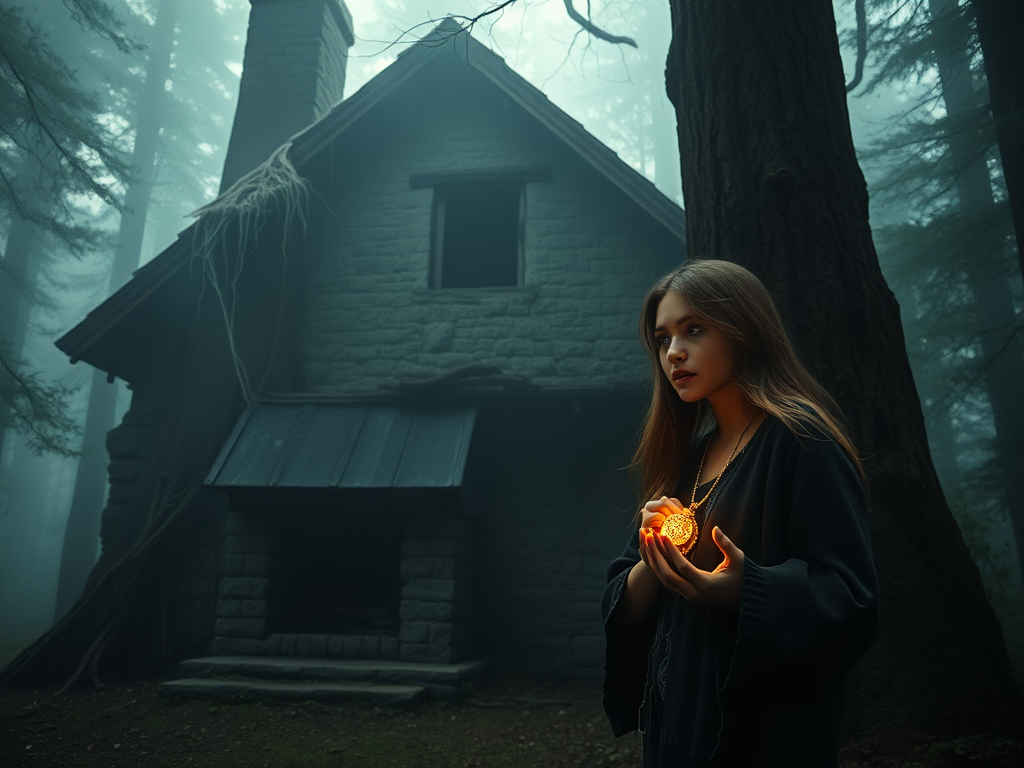
Lena hesitated. Something about the box felt wrong, like it had been waiting. When she opened the lid, the pendant inside shimmered with an eerie light. The chain was a delicate lattice of silver, impossibly fine, and at its center hung a stone of deep, shifting iridescence, encased in a ring of intricate runes.

The moment her fingers touched the stone, a sharp jolt surged up her arm, rooting her in place. The room chilled instantly, the air thickening as shadows in the corners stretched toward her. She gasped, trying to pull back, but the pendant burned warm in her palm, its energy thrumming in time with her heartbeat.

The world flickered.

When her vision cleared, the cottage was gone.


Lena stood in the heart of a dense, foreign forest. Mist clung to the air, thick and damp, swirling around her feet like smoke. Towering trees arched overhead, their gnarled branches interwoven into a canopy that blotted out the sky. The silence was suffocating. No birds, no rustling leaves—only the distant hum of her own breath.

This was the Brake.

Her grandmother’s stories crashed over her in a wave. A hidden realm, she had said, a place where magic ran wild and time unraveled. A world alive and ancient, testing those who entered, remaking them—or destroying them.

The memory of her grandmother’s warning struck like a knife: “Never take what the Brake offers unless you are ready to lose yourself.”

“You wear the Charm.”

The voice sliced through the silence, low and resonant, startling her. Lena spun toward it, her pulse thundering.

A figure emerged from the mist. A man—or something resembling one. His face was too sharp, his pale skin almost translucent, his eyes gleaming with a faint, unnatural light. His clothes were antiquated, tailored to perfection, but of no era she could place.

“Who are you?” Lena asked, her voice trembling as she gripped the pendant. “What is this place?”

The man’s gaze drifted to the Charm in her hand. His thin lips curved into a faint, unsettling smile. “I am a guardian of the Brake. And you… you are its new ward.”

“I didn’t ask for this.” Her voice cracked, but she forced the words out. “I don’t even know what this is!”

The guardian’s smile faded, replaced by an expression she couldn’t decipher—pity? Amusement? “The Brake chooses its own. Your grandmother knew this. She carried the Charm before you, and now it is yours. There is no asking. Only accepting.”

Lena’s breath quickened. The ground beneath her feet seemed to shift, the earth no longer solid but trembling, alive. “I don’t want this. I just came to—”

“To find her secrets?” The guardian stepped closer, his presence overwhelming, as though he carried the weight of the forest itself. “The Brake doesn’t care for your wants. It sees you as you are, not as you pretend to be. That is why it chose you.”

The pendant pulsed in her hand, its warmth spreading through her chest. A strange sense of connection flared, unbidden—like the Brake was reaching out to her, whispering through the roots beneath her feet and the mist swirling in the air.

“What happens if I refuse?” she demanded, though her voice shook with uncertainty.

The guardian tilted his head, his eyes glinting. “You cannot refuse. To hold the Charm is to bind yourself to the Brake. Protect it, or it will consume you. There is no middle path.”


The trees groaned, their branches curling inward like fingers. The mist thickened, coiling around Lena’s ankles, pulling her deeper into the forest. Her grandmother’s voice echoed in her mind: “The Brake will test you. It will break you if you let it. But it will give you strength if you are worthy.”

Lena clenched the pendant tighter, its energy buzzing through her veins. “I won’t let it destroy me,” she whispered, more to herself than to the guardian.

The Brake stirred in response, the fog swirling faster, the trees creaking like ancient bones. She felt it—its hunger, its power—but beneath that, something else: a curiosity, a waiting presence.

The guardian’s smile returned, sharper this time. “Good. Then prove it.”

The ground trembled. Lena staggered but didn’t fall. Instead, she let the Brake’s energy flow through her, its magic blending with her pulse, her breath. She reached out, not with her hands but with her will, and the Brake answered. The mist slowed, the trees stilled, and the forest exhaled a low, resonant hum.

“I will protect it,” Lena said, her voice steady now. “But I won’t be a prisoner.”

The guardian regarded her with something close to approval. “Then let the Brake be your guide.”

He dissolved into the mist, his form scattering like smoke. Lena was alone again, the pendant heavy around her neck, its pulse matching the ancient rhythm of the Brake.

The forest around her seemed to watch, silent but alive, its test far from over.

Lena took a breath, the scent of damp earth filling her lungs. The Brake was alive—and now, so was she.

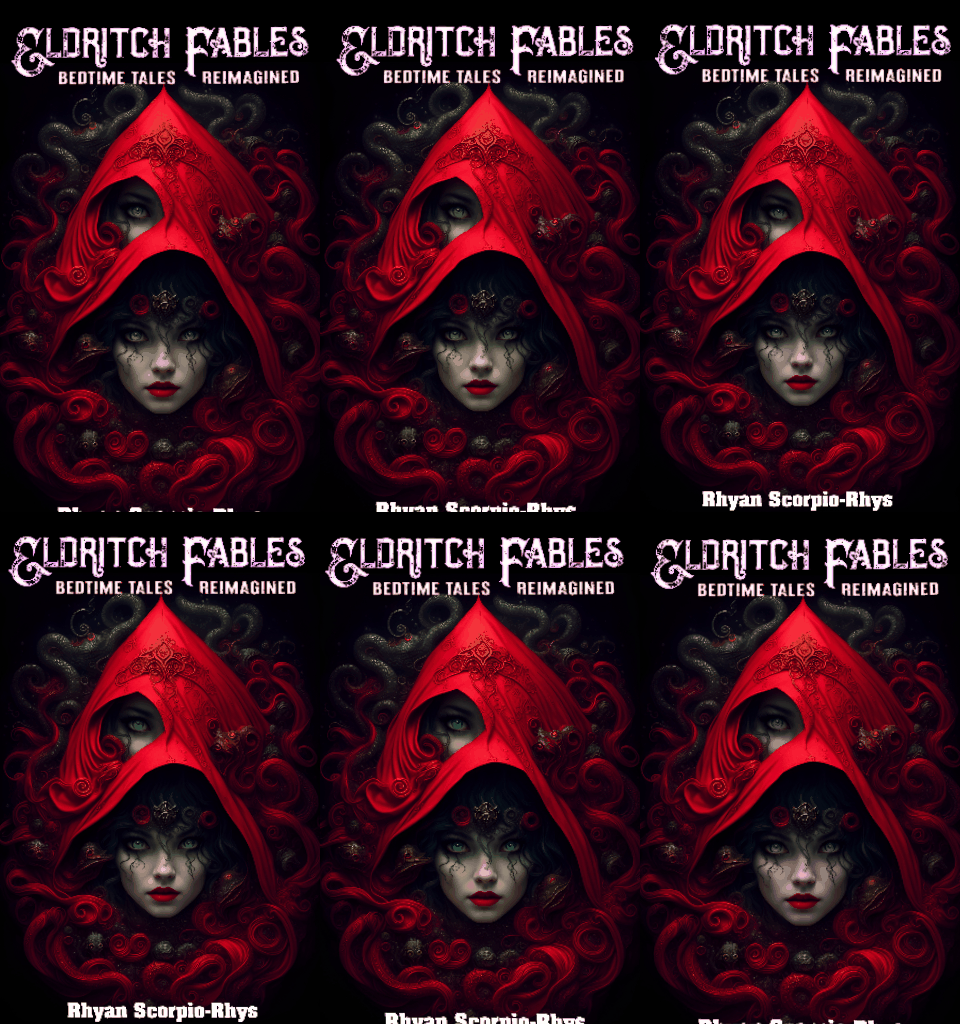
Eldritch Fables: Bedtime Tales Reimagined

Dare to enter a realm where familiar bedtime stories become twisted and nightmarish, revealing the sinister truth lurking beneath the surface of our world. “Eldritch Fables: Bedtime Tales Reimagined” is a collection of chilling tales that unearth the unspeakable horrors woven into the very fabric of existence.

Visionary author Rhyan Scorpio-Rhys has masterfully reimagined beloved fables and fairy tales, infusing them with a cosmic horror that exposes the eldritch terrors awaiting us all. Through these dark retellings, readers are granted a rare glimpse into the shadowy corners of the universe, where malevolent forces strive to unmake reality and claim our world for their own.

In these haunting stories, Jack’s beanstalk grows into a conduit for an ancient, otherworldly evil; Sleeping Beauty’s eternal slumber threatens to unleash a cosmic nightmare upon the land; Hansel and Gretel find themselves lost in an eldritch forest that preys upon their deepest fears; and many more familiar tales take a sinister turn.

Each story in “Eldritch Fables: Bedtime Tales Reimagined” unravels the tenuous threads holding our reality together, exposing the cosmic horrors that lie just beyond our perception. It is a journey not meant for the faint of heart, but for those who dare to face the truth and glimpse the darkness encroaching upon our world.

Embark on a journey through twisted realms and distorted fables, and prepare to confront the unspeakable terror waiting to claim us all. “Eldritch Fables: Bedtime Tales Reimagined” is a chilling exploration of cosmic horror and the hidden nightmares that lurk within the shadows of our most cherished stories. Read at your own peril, for once the veil has been lifted, there is no turning back – grab your copy today:

amzn.to/3IXzzre

Strong Roots Amongst The Clay

Clay Boy

Content Warning: This story contains violence and relationship abuse. Reader discretion is advised.

Once there was a kindly woman who was known all about the town as Lovely Lucy, not so much for her appearance, for she was endowed with plain features—which wasn’t a bad thing at all—but she was called this because she was arguably one of the sweetest people who ever walked the face of the planet. The only parts of her life that suffered were her love life and her inability to bear children.

One morning, Lucy went to market and spoke with the town sculptor, who made statues large and small, some for himself and some which he sold. Lucy hadn’t much money so she explained what she wanted to do and begged the sculptor to spare some clay and promised to pay him another day. The sculptor remembered how Lucy had brought soup and sat by his bedside when he had taken ill, and gladly gave her as much of his special clay as she could carry, free of charge.

Thanking the sculptor for his kindness, Lucy rushed home and began working on a life-sized statue of a boy, aged five. She made the little boy perfect. His reddish-brown features depicted an unblemished beauty and innocence such as no real boy had ever possessed. Although she had no skill at sculpting, she crafted the statue with such love that upon first glance it seemed to be a live boy standing still. She took great care in painting her little angel, making his eyes blue like the sky, his lips and cheeks pink like the sunset and his hair black as twilight.

Lucy marveled at her creation. She held his little clay hand, kissed his rosy cheek, and told him many times a day how much she loved him. When she went out to market, he was always in her mind, and she searched for presents for him – flat, smooth rocks for skipping across the lake, seashells for tooting like horns, and twigs and vines woven into a ball. She bartered her baked goods for hand-me-down children’s clothing and dressed him in different outfits each day. She even brought him a puppy from the neighbor’s litter for company while she was away.

Lucy was not able to manage the other part of her suffering as easily. For reasons unknown to anyone, she attracted the wrong sort of suitors and was far too kind of heart to dismiss them, despite their many transgressions against her. It pained the townsfolk to see a woman so intelligent in all other respects remain so foolish in love.

Her most recent failed relationship was with a traveler who suspected her of being unfaithful one day when she had gone out to market, so he barred her from her own house and drew obscene pictures of her and posted them about town. Lucy begged and pleaded with the traveler and after a week or so, he changed his opinion and let her back into her home to be reunited with her clay boy.

That evening the traveler fixed her dinner and his mouth was sweet with words of love and a possible reconciliation. Cautious at first, Lucy finally let her guard fall, assured that his feelings and his intentions were genuine. That was the last thing she remembered before she awoke the following afternoon, face down in her bedding. She felt groggy and her body ached in unspeakable places as though she had been violated. She knew she had been drugged.

Lucy reported the incident to the authorities. The traveler confronted her in public, on the road from the market, after the authorities questioned him. Wishing to avoid an argument, she simply turned to walk away. Her next waking recollection was being bound to a chair in her home. The traveler had struck her a cowardly blow to the back of the head. She was helpless as he raged against her with rock and branch. But fortune smiled upon her when a neighbor heard her cries of anguish and contacted the authorities. This time, he was imprisoned.

From his prison cell, the traveler requested an audience with Lucy, and she, having a forgiving nature, went to visit. And his tongue was dipped in honey and he spoke sweetness and there was yet again talk of a possible reconciliation, which she honestly considered.

All was calm and happy between Lucy and the traveler when he was once again a free man. They sat together and talked, went out to the seashore and walked, and the traveler also lavished attention on the clay boy. All seemed right with the world and Lucy’s life was as close to being perfect as it had ever been.

Until one night she bolted upright out of a sound sleep and found the traveler standing over her, eyes doused in rage.

“I know you play me for a fool!” He spat through gritted teeth. “I know you have taken a lover! Who is it? The neighbor? The sculptor? Tell me who it is or you will never know a moment’s peace ever again!”

When she did not answer, he stormed out of the room and Lucy hoped he would leave the house but instead the sound of his thunderous footsteps headed in the direction of her private room—the room where the clay boy lived.

“No!” she cried as she dashed from her bed.

In the private room, she found the traveler with the wood axe resting over one shoulder. He stood next to her perfect little boy.

“Shhh,” he said. “If you wake him up, I will have to kill him.”

Lucy hadn’t a clue what to do so she started begging for the statue’s life, whispering as not to anger the traveler.

“What can I do?” she kept asking him. “What can I do to make this right?”

The traveler commanded her to her knees and she did this without a second thought. “Down on all fours.” And she complied. Then he made her crawl from the room backward, back into her bedroom.

“Now, on your knees,” he said, closing the door behind him. “Close your eyes and smile.” She was nervous, of course, but she obeyed. The next thing she felt was the ax handle as it smashed into her mouth, shattering her front teeth.

“Your life is mine! Your sad statue is mine! You both will cease to exist if I so wish it!” the traveler ranted.

She felt his foot on her shoulder, pushing her over, toppling her flat on her back. She wanted to look at him but was afraid, so she squeezed her eyes shut as he straddled her and beat her. Her head swam with pain, but Lucy knew she couldn’t scream for fear of this madman destroying her little boy, so she took the beating until she passed out.

Lucy dreamed that she was an eagle soaring through clouds misted with morning dew above a river where children frolicked and although she was too high to hear the sounds of their tiny voices, she knew they were happy and having fun. But something tugged at her tail feathers like a dragging weight, pulling her back down to a place she did not want to go, a place of pain and sorrow—

When she woke up, regaining consciousness piece by piece, she was surrounded by the sharp claws of searing pain that pawed at her like a hungry animal. As her mind struggled for clarity she wondered where she was. In her bed? But how did she get there?

All around, the walls were covered in blood, so much blood. Too much to be her own. Then she saw the bits and pieces. Parts that belonged at one time to a whole, red soaked clumps of the remnants of the traveler. Divided from one another and from life itself by the wood ax buried in the man’s severed head.

She looked at her hands. Had she done this terrible thing? Then she heard a voice, tiny tingly, that chirped in song, “Not to worry, not to fear, everything is fine, Mama, I am here.”

She stared at a living boy whose eyes were blue as the sky, cheeks the color of the sunset and hair as black as twilight.

He hugged her neck and kissed her cheek and whispered, “I love you, too.”

About Strong Roots Amongst the Clay: As a kid I never had much interest in fairy tales. In fact, I hated them. My mother told me that someone had given her a book about Squanto, also known as Tisquantum—the Native American of the Patuxet tribe who assisted the Pilgrims after their first winter in the New World—thinking it was a book of fairy tales. And where Mother Goose and The Brothers Grimm failed to put me at rest at night, the adventures of Squanto did the job nicely.

And I wouldn’t fully appreciate the cultural richness and power of fairy tales until revisiting them in the 1980’s. For the longest time I searched for something to spark an idea for a fairy tale story that I probably would never bother writing—there’s a difference between the wanting of a thing and the doing of a thing.

Then one day a violent true story was relayed to me by a coworker at a retail job that I absolutely hated (the job, not the coworker) and the first thought that popped into my mind—after showing proper concern for my coworker, of course—was to incorporate elements of her story (with her consent, naturally) to give my fairy tale story a spin.

At the time I wrote the story, I wasn’t a fan of the fairy tale narration. I didn’t like reading it and I didn’t like writing it. I’m still not a big fan of a lot of the story’s voice,  but finally sitting down and writing a fairy tale piece taught me appreciation of it.

I’m still not sure if I like the ending or not. There’s a fine line between chilling and cheesy and I’m not sure which side I’m on.

All Her Yesterdays

The immortal bard once wrote that tomorrow, and tomorrow, and tomorrow, creeps in this petty pace from day to day, to the last syllable of recorded time. And as it was true for we poor mundanes trapped within the confines of this all too real world, so too were the mythical, mystical inhabitants of the Fairytale Realm subjected to the ravages of time, albeit creeping at a pettier pace.

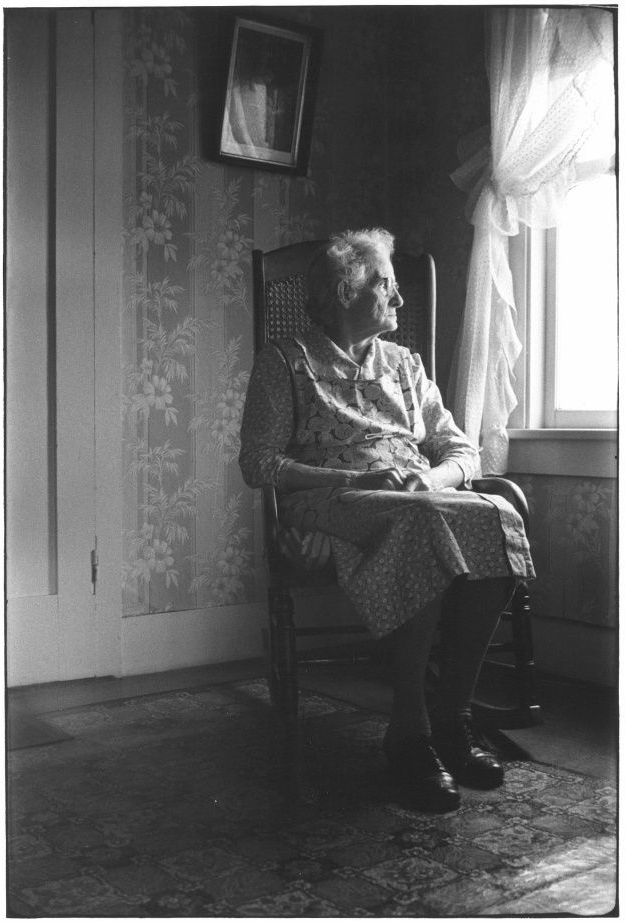
At two hundred and seven years of age, dementia had robbed the old woman of her name and memories but whenever she sat by the window of her woodland cottage, staring past seven small graves that had not been properly tended to in years, she sang a long forgotten song from when her hair was as black as ebony, lips as red as the rose, skin as white as snow and impossibly the birds in the air outside seemed to dance in time with her lovely, lonely melody.

Text and Audio ©2019 & 2021 Rhyan Scorpio-Rhys

Fairytale Romance

Tuesday night book club ended much the same as any other week. The women read and discussed Leslie Meier’s latest whodunit, “Irish Parade,” which dealt with a reporter trying to uncover the truth about a case in which her office rival was charged with the murder of a corrections officer. Well, everyone read the book aside from Irene Beaumont, who cribbed her notes from Wikipedia, despite having been caught and called out on it on several occasions. Afterwards, someone posed the question:

“If you could wake up to one wish, what would it be?”

Cynthia Granger wanted clarity of mind in order to be closer to God. Sarah Clemmens desired a meaningful life, one lived in service to others, especially those in emotional need. Delores Babcock wanted to be more intimate in her relationships and less afraid of life. Brenda Trotter wanted to know, without the shadow of a doubt, what her purpose was in the world, because she felt rudderless for so very long now. When it was Geneviève’s turn to answer, she shrugged off the question, offering some lame excuse, because she wasn’t comfortable explaining that she was actively working on fulfilling her wish.

What she desired more than anything else in the world, was a fairytale romance, and she was determined to get it by hook or by crook.

Geneviève decided to attend a mixer one night, without alerting her friends and family in case it went horribly wrong, and, to her astonishment, she met a man who ticked all the boxes on her potential suitor checklist. So, she implemented a plan to stretch the wooing period in an elaborate game of chase, dodged his attempts at popping the question until she was sure that he had fallen in love with her madly, truly, deeply, withheld sex throughout the entire courting and engagement process, and the list went on.

When they were finally wed, Geneviève realized her wish had come true. She moved into his palatial estate, which he shared with his six older brothers, who had either gone missing or were all dead; her husband’s servants were all either animated household items that would burst into song spontaneously, or woodland creatures gifted with human speech; she had to leave a trail of breadcrumbs whenever she left the house alone in order to find her way home again; she had access to every room in the mansion, except one, which was always locked and possessed no keyhole or doorknob or other mechanism in which to open it; and the biggest clue was that her mother-in-law dabbled in some sort of ancient arcane religion, and was always involved in some project or other that always almost accidentally killed Geneviève.

It didn’t get more fairytale than that.

Text and Audio ©2021 Rhyan Scorpio-Rhys

Too Fragile, This Heart

A long, long time ago, when words still contained magic, and abstract concepts were living things, there lived a woman, who was a wife, that lived alone. Deserted by her husband, for reasons known only to him, she would have been crushed if not for her pregnancy. She poured every ounce of love that her heart possessed into preparing a loving home for her child, and one day, while out chopping firewood, she gave birth.

The child was not the seventh son of the seventh son, nor born ‘neath the lucky star, nor blessed with any special gifts which would have set him apart from anyone else of woman born. With the exception, that he was born dead.

So torn with grief was the mother, that she wailed unrelentingly, without stopping to catch a breath, nor pass out from exhaustion for three days straight, which attracted the attention of a traveling wish.

“Why wail you so?” asked the wish.

“My son–untimely from me snatched was he,” the woman said, holding up her blue-hued baby boy.

“Tis sad indeed,” said the wish.

The woman examined the wish closely. “You are a wish, are you not?” of which she was certain, for nothing else on Earth looked like a wish.

“That I am,” the wish nodded.

The woman pleaded, “Then grant me the life of my son!”

“Alas and alack, I cannot,” the wish said, its countenance growing sullen.

“And why not?”

“I am not your wish. I belong to another.”

“Then I am ended. There is no place for me in this world. Not without my son.”

The wish pondered a moment, in a way only a wish could. “All may not be lost if I can, No, you would not want that.”

“What?”

“Nothing. Forget I spoke. It was a foolish, errant thought.”

“Speak it, o wish, for I have ears for thought, errant and foolish alike, if it may offer me but the tiniest hope.”

“Well,” the wish said hesitantly, “Though I cannot grant a wish to you, I may exchange a boon with thee.”

“Anything!”

“Speak not so quickly–“

“My tongue cannot carry conveyance at the speed my heart travels, so without hesitation, without reservation, I bid thee, wish, to speak thy will!”

“I propose a trade.”

“Of what shall we barter?”

“I cannot say.”

“What? I do not follow your meaning.”

“You must accept the trade on blind faith. Agree, and be bound to it.”

“I agree to it then!”

“Are you certain?”

“As certain as you are a wish, and I am a soulless wretch without my son.”

“Is this boy child truly your heart?”

“Yes!”

“And you desire it above all else, this heart of yours?”

“Oh, yes!”

“Then I will give you your heart,” the wish said, closing its eyes in concentration, and the woman felt the boy twitch in her arms. Then the body grew still for a long moment, and her heart sank even lower than she could have imagined possible. As she was about to turn her rage upon the wish, her son, born dead, and remaining thus for three days hence, took a deep breath, and let out a cry that could be heard ‘round the countryside. To the woman, it was the most glorious sound she had ever heard.

“You have given me the thing I wanted most in this world,” she said to the wish. “Now what would you have me trade?”

“I have already taken it.” answered the wish.

“What was it?”

“I have given you your heart, correct?”

“Yes.”

“And in exchange, I have taken his,” the wish said, gesturing at her son.

“My son has no heart?”

“Not such as you know. Because no being can survive without a heart, I have given him a heart, perfectly carved of the purest red glass, that is as fragile to the touch as his birth heart.”

“But why a glass heart?”

“The exchange had to be equal. a fragile heart for a fragile heart.”

“Will my boy be cursed to possess a glass heart forever?”

“You must guard his fragile heart, and teach him to do the same, for it will shatter far too easily. And it will remain this way until his real heart is delivered by a person who truly loves your son and whom he also loves.”

This answer saddened the mother, for she knew that without a real heart, her boy could not properly love anyone or inspire love in another to undertake the quest for his real heart.

This was the story the woman told her son when he was old enough to properly comprehend the situation. Until hearing this story, the boy thought all children were born with glass hearts that slowly became real as they grew older. Funny how the mind of a child worked.

“And where is my real heart?” her son queried.

“According to the wish, it lies East of the Sun and West of the Moon,” she recited by rote. “Farther than the farthest thing the eye can behold. There you will find an endless sea. And in that sea, there is an unscalable mountain. And atop that mountain, there is an uninhabitable castle. And within the grounds of that castle, there is a bottomless well. And in that well swims a flightless swan. And in that swan, there lies a shatterproof egg. And in that egg, there lies your heart.”

The boy asked, “Well, why can I not just retrieve it myself?” which was a fair enough question. The journey sounded like a grand adventure, just the sort that little boys craved.

“Because it will always be just beyond your ability to detect. So, even if you managed to travel farther than the farthest thing, swim the endless sea, climb the unscalable mountain, dive into the bottomless well, find the swan, make it lay its egg, and crack it open wide, it will be empty to you,” the mother waved off the foolish notion as if she were swatting a fly. “So, do not even try, for it will then move to yet another location, even more impossible to reach.”

And so, the boy lived a careful life. Oh, he was active enough and none could tell that there was the slightest thing awry, that was until he fell in love. Now, the brightest among you might be asking, “How is it that a boy with no heart could love?” please allow me to tell you that I honestly do not know the answer to that question, yet the boy loved just the same. In his own way.

And unfortunately, that way was never quite enough to satisfy the young ladies he courted. And even though the boy explained his plight to all he loved, it mattered not to them. They all left him, in their turn, each cracking his red glass heart a bit.

Then one day, when the boy was well into manhood, he suffered a heartbreak that sent him to the family doctor, who was aware of his unique condition. After the examination, the doctor said grimly, “You must be careful not to attempt to love again, for should you suffer heartache but one more time, your heart shall surely shatter.”

Not love? Impossible. The glass-hearted man could not sit idly by and feel no love for the rest of his life, nor could he risk another heartbreak. So, despite his mother’s warning, he set off west in search of his stolen heart.

Why west, you ask? Because he needed to speak with the Sun and could not do that in the East as it rose, for he would surely be blinded by its brilliance. No, the man needed to find the Sun in the East while it slumbered for the night. And after some time had passed, he arrived at the place where the Sun rested.

“Ahem.” The glass-hearted man cleared his throat as loudly and as politely as he could.

“Who are you?” the Sun grumbled, peering at him through the narrowest slit of its solar eye.

“My name is,”

“I did not ask for your name, did I?” the Sun said curtly. “I asked who you were! Are you merely your name?”

“Um, no, sir–or madam,” he was not versed in the gender of the Sun, and he, she, they, had not bothered to correct him, so on that fact, he remained clueless.

“Then who are you?”

“Who I am is a born-again optimist. What I believe is that love is not denied to anyone, even to those born with glass hearts, such as myself. What I know is that I am wise enough to accept love as it finds me and not reject it because it doesn’t come wrapped in a pretty package. What I hope is that someday every lonely person will reach out to another lonely person and befriend them so that the word lonely fades from our lexicon.”

“Glass heart, eh?” the Sun sighed, and his, her, their, breath was a warm Summer’s breeze. “So, you have finally come. I will tell you where to find the Moon, for that is your next destination.”

The Sun expected him? How much did he, she, they, know? I wanted to ask questions, but the Sun rattled off a set of instructions and promptly rolled over and fell fast asleep. The man had been summarily dismissed, but he didn’t mind. He smiled as he trekked to meet the Moon.

The glass-hearted man had a dreadful time with directions and could scarcely follow his train of thought even with a road map, normally, but the directions given to him by the Sun were spot on, and in no time flat, he found himself at the lair of the Moon.

“Well, do not stand around dawdling all day, come in!” a cool voice said impatiently. And as the man entered the chamber, he saw the Moon sitting on the edge of its celestial bed. “I heard your approach from a mile away. I am a light sleeper. Must be all the sunlight in my eyes.”

“I am very sorry to disturb you–“

The Moon cut him off. “You have a glass heart, searching for the genuine article, east of the Sun, west of me, blahdy-blah, and you need me to point you in the right direction, correct?”

“Uh, yes, sir or madam.”

“There will be none of that nonsense here, young man!” the Moon sniffed. “I am The Moon, and you can either address me as such, or do not address me at all, but do not seek to confine me to a gender.”

“Sorry.”

“And don’t apologize. How were you to know? Now, come here and climb aboard,” The Moon said, diminishing into a crescent in order to provide a seat for the man, and no sooner had he positioned himself when the Moon rocketed skyward and it was all the man could do to keep himself from falling.

“Look to your left and tell me what you see,” said the Moon. I turned my head and was about to speak when the Moon said, “Your other left.”

Embarrassed, the man looked in the opposite direction. “I see the city.”

“Look farther.”

“Um, I see land.”

“Farther.”

“The ocean.”

“And farther still.”

The man strained his eyes out past the sea of glimmering blue, searching, searching until, “I think I see land!” he exclaimed. “But it is so far away that it might be a trick of the Sun reflecting off the water.”

“That is no trick. That is where you must go,” the Moon said and began lowering the man to the ground. “Off you go, for I must sleep or it will be a long night for all concerned, if you catch my meaning.”

The glass-hearted man thought he did, but was not quite sure and had not wanted to seem like a dolt for asking, so he let the comment pass. And off he went, to travel past the farthest thing he could see.

He walked for days on end, and if such a thing as wanderlust existed within him, it had long stopped by the side of the road to rest its feet. The man, however, did not have that luxury. He traveled past the point where the soles of his shoes were worn down to nothing and the soles of his feet became as rough as leather, until he finally hit land’s end.

The glass-hearted man sat on a dock and pondered his situation. He was bone-weary, penniless, and staring out across an endless blanket of glimmering diamonds. Had he traveled all this way to simply end here?

“Ahoy!” a voice called out, and he turned to see a woman with hair the color of sunset, and eyes of the clearest aqua, leaning over the bow of a boat.

“You are not thinking of diving in, are you?” she asked. “That would not be a smart thing to do.”

“Uh, no. I cannot swim,” the man admitted.

“Then what brings you to the sea?” she asked, and he told her his story. When she was done, she stared at the sun-baked man and rubbed her chin. “Farther than the farthest thing, eh? And it is out past the sea? Fancy a lift?”

“I could not ask you to put yourself out like that,” he waved off the invitation.

“Pshaw. Got nothing better to do, and I love me a good adventure I do. ‘Sides, how can I turn my back on someone who had conversations with the Sun and the Moon? The name is Bryony, by the way.”

To Be Continued…

Text and audio ©2011-2021 Rhyan Scorpio-Rhys

The Little Dream Girl

Once upon a time, there was a poor little dream girl who, through no fault of her own, became separated from her mother and found herself lost in the real world. It was a terribly dark and lonely place and as she was the sleepy byproduct of ephemeral thoughts, ethereal ideas, and gossamer sensations, she was essentially naked. She roamed through the streets lacking the protective emotional outer layers mortals wrapped themselves with in order to survive the harshness of reality.

Added to her misfortune, Dream Girl quickly discovered the longer she remained on this all too physical plane of existence, the more solid, the more human she was becoming. She needed clothing to hide a nakedness that she was not previously aware of, as well as food and shelter if she was to survive, but unfortunately she possessed none of the currency of this world, so she plucked individual dreams from her nacreous cloud hair to barter for what she needed. They were all high quality fantasies and flights of imagination and she offered them at a fraction of their true worth but no one was interested. Another lesson she learned was that once plucked, dreams that were unattached to a dreamer, had a limited lifespan before eventually withering away from neglect.

During the day, even when the sun was at its apex, Dream Girl found reality to be cold and at night it became colder still. It was necessary to find shelter but despite the many doors she knocked on, no one took pity on her plight, so she was forced to hunker down in an alleyway to make her bedding. She plucked more dreams from her head and wove a crude blanket to help keep off the cold. As she slept, street urchins in dirty rags stole her blanket and plucked handfuls of dreams from her hair and when she woke in the early hours her mostly human body was blue from frost and her head nearly bald.

Dream Girl found that she lacked the strength to move from the alley, so she plucked one of the remaining dreams and attempted to turn it into a wish to return home, a trick she had watched her mother do on many occasions, but she was too young and lacked the knowledge and experience to perform the deed properly. Shivering, she hugged her knees to her chest, drawing herself into the tightest ball she could manage, and plucked another dream. And one after that. And another one still, trying in vain to open a doorway back to the place she belonged, back home with her family, until she had only one strand, one single dream remaining.

Dream Girl held the final dream between frozen fingers that had lost all sensation but this time there was no thought of turning it into a wish. She simply let a dream be a dream, and oh how she dreamed. It was the biggest dream she ever dreamt, which was filled with the most beautiful light in existence that washed away the gray of reality and gave off such a warmth as to permeate to her marrow. And in that magnificent light she saw the loving and concerned face of her mother.

“Mother, I am lost and I am dying,” Dream Girl said, breaking down into uncontrollable sobs.

“I am coming for you,” Dream Mother said. She too was crying but her tears were tiny glistening stars that fell upon her daughter, blanketing her in warmth. And as the little one stretched out her arms toward her mother, the dream evaporated.

***

In the early hours just before dawn, Dream Mother stepped into the gritty, gray alley, past the vermin and refuse and found her daughter, the little dream of her life, huddled in the farthest corner, frozen to death. She knelt and gingerly took the stiff corpse into her loving arms and from her own hair of swirling colorful fantasies, she plucked a special dream and began the gentle process of transmuting it into a wish.

Text and Audio ©2020 & 2021 Rhyan Scorpio-Rhys

Strong Roots Amongst The Clay

Clay Boy

Once there was a kindly woman who was known all about the town as Lovely Lucy, not so much for her appearance, for she was endowed with plain features—which wasn’t a bad thing at all—but she was called this because she was arguably one of the sweetest people who ever walked the face of the planet. The only parts of her life that suffered were her love life and her inability to bear children.

One morning, Lucy went to market and spoke with the town sculptor, who made statues large and small, some for himself and some which he sold. Lucy hadn’t much money so she explained what she wanted to do and begged the sculptor to spare some clay and promised to pay him another day. The sculptor remembered how Lucy had brought soup and sat by his bedside when he had taken ill, and gladly gave her as much of his special clay as she could carry, free of charge.

Thanking the sculptor for his kindness, Lucy rushed home and began working on a life-sized statue of a boy, aged five. She made the little boy perfect. His reddish-brown features depicted an unblemished beauty and innocence such as no real boy had ever possessed. Although she had no skill at sculpting, she crafted the statue with such love that upon first glance it seemed to be a live boy standing still. She took great care in painting her little angel, making his eyes blue like the sky, his lips and cheeks pink like the sunset and his hair black as twilight.

Lucy marveled at her creation. She held his little clay hand, kissed his rosy cheek, and told him many times a day how much she loved him. When she went out to market, he was always in her mind, and she searched for presents for him – flat, smooth rocks for skipping across the lake, seashells for tooting like horns, and twigs and vines woven into a ball. She bartered her baked goods for hand-me-down children’s clothing and dressed him in different outfits each day. She even brought him a puppy from the neighbor’s litter for company while she was away.

Lucy was not able to manage the other part of her suffering as easily. For reasons unknown to anyone, she attracted the wrong sort of suitors and was far too kind of heart to dismiss them, despite their many transgressions against her. It pained the townsfolk to see a woman so intelligent in all other respects remain so foolish in love.

Her most recent failed relationship was with a traveler who suspected her of being unfaithful one day when she had gone out to market, so he barred her from her own house and drew obscene pictures of her and posted them about town. Lucy begged and pleaded with the traveler and after a week or so, he changed his opinion and let her back into her home to be reunited with her clay boy.

That evening the traveler fixed her dinner and his mouth was sweet with words of love and a possible reconciliation. Cautious at first, Lucy finally let her guard fall, assured that his feelings and his intentions were genuine. That was the last thing she remembered before she awoke the following afternoon, face down in her bedding. She felt groggy and her body ached in unspeakable places as though she had been violated. She knew she had been drugged.

Lucy reported the incident to the authorities. The traveler confronted her in public, on the road from the market, after the authorities questioned him. Wishing to avoid an argument, she simply turned to walk away. Her next waking recollection was being bound to a chair in her home. The traveler had struck her a cowardly blow to the back of the head. She was helpless as he raged against her with rock and branch. But fortune smiled upon her when a neighbor heard her cries of anguish and contacted the authorities. This time, he was imprisoned.

From his prison cell, the traveler requested an audience with Lucy, and she, having a forgiving nature, went to visit. And his tongue was dipped in honey and he spoke sweetness and there was yet again talk of a possible reconciliation, which she honestly considered.

All was calm and happy between Lucy and the traveler when he was once again a free man. They sat together and talked, went out to the seashore and walked, and the traveler also lavished attention on the clay boy. All seemed right with the world and Lucy’s life was as close to being perfect as it had ever been.

Until one night she bolted upright out of a sound sleep and found the traveler standing over her, eyes doused in rage.

“I know you play me for a fool!” He spat through gritted teeth. “I know you have taken a lover! Who is it? The neighbor? The sculptor? Tell me who it is or you will never know a moment’s peace ever again!”

When she did not answer, he stormed out of the room and Lucy hoped he would leave the house but instead the sound of his thunderous footsteps headed in the direction of her private room—the room where the clay boy lived.

“No!” she cried as she dashed from her bed.

In the private room, she found the traveler with the wood axe resting over one shoulder. He stood next to her perfect little boy.

“Shhh,” he said. “If you wake him up, I will have to kill him.”

Lucy hadn’t a clue what to do so she started begging for the statue’s life, whispering as not to anger the traveler.

“What can I do?” she kept asking him. “What can I do to make this right?”

The traveler commanded her to her knees and she did this without a second thought. “Down on all fours.” And she complied. Then he made her crawl from the room backward, back into her bedroom.

“Now, on your knees,” he said, closing the door behind him. “Close your eyes and smile.” She was nervous, of course, but she obeyed. The next thing she felt was the ax handle as it smashed into her mouth, shattering her front teeth.

“Your life is mine! Your sad statue is mine! You both will cease to exist if I so wish it!” the traveler ranted.

She felt his foot on her shoulder, pushing her over, toppling her flat on her back. She wanted to look at him but was afraid, so she squeezed her eyes shut as he straddled her and beat her. Her head swam with pain, but Lucy knew she couldn’t scream for fear of this madman destroying her little boy, so she took the beating until she passed out.

Lucy dreamed she that she was an eagle soaring through clouds misted with morning dew above a river where children frolicked and although she was too high to hear the sounds of their tiny voices, she knew they were happy and having fun. But something tugged at her tail feathers like a dragging weight, pulling her back down to a place she did not want to go, a place of pain and sorrow—

When she woke up, regaining consciousness piece by piece, she was surrounded by the sharp claws of searing pain that pawed at her like a hungry animal. As her mind struggled for clarity she wondered where she was. In her bed? But how did she get there?

All around, the walls were covered in blood, so much blood. Too much to be her own. Then she saw the bits and pieces. Parts that belonged at one time to a whole, red soaked clumps of the remnants of the traveler. Divided from one another and from life itself by the wood ax buried in the man’s severed head.

She looked at her hands. Had she done this terrible thing? Then she heard a voice, tiny tingly, that chirped in song, “Not to worry, not to fear, everything is fine, Mama, I am here.”

She stared at a living boy whose eyes were blue as the sky, cheeks the color of the sunset and hair as black as twilight.

He hugged her neck and kissed her cheek and whispered, “I love you, too.”

©1989 & 2017 Rhyan Scorpio-Rhys

About Strong Roots Amongst the Clay: As a kid I never had much interest in fairy tales. In fact, I hated them. My mother told me that someone had given her a book about Squanto, also known as Tisquantum—the Native American of the Patuxet tribe who assisted the Pilgrims after their first winter in the New World—thinking it was a book of fairy tales. And where Mother Goose and The Brothers Grimm failed to put me at rest at night, the adventures of Squanto did the job nicely.

And I wouldn’t fully appreciate the cultural richness and power of fairy tales until revisiting them in the 1980’s. For the longest time I searched for something to spark an idea for a fairy tale story that I probably would never bother writing—there’s a difference between the wanting of a thing and the doing of a thing.

Then one day a story was relayed to me about a coworker at a retail job that I absolutely hated and the first thought that popped into my mind—after showing proper concern for my coworker, of course—was to give my fairy tale story a spin.

At the time I wrote the story, I wasn’t a fan of the fairy tale narration. I didn’t like reading it and I didn’t like writing it. I’m still not a big fan of a lot of the story’s voice,  but finally sitting down and writing a fairy tale piece taught me appreciation of it.

I’m still not sure if I like the ending or not. There’s a fine line between chilling and cheesy and I’m not sure which side I’m on.