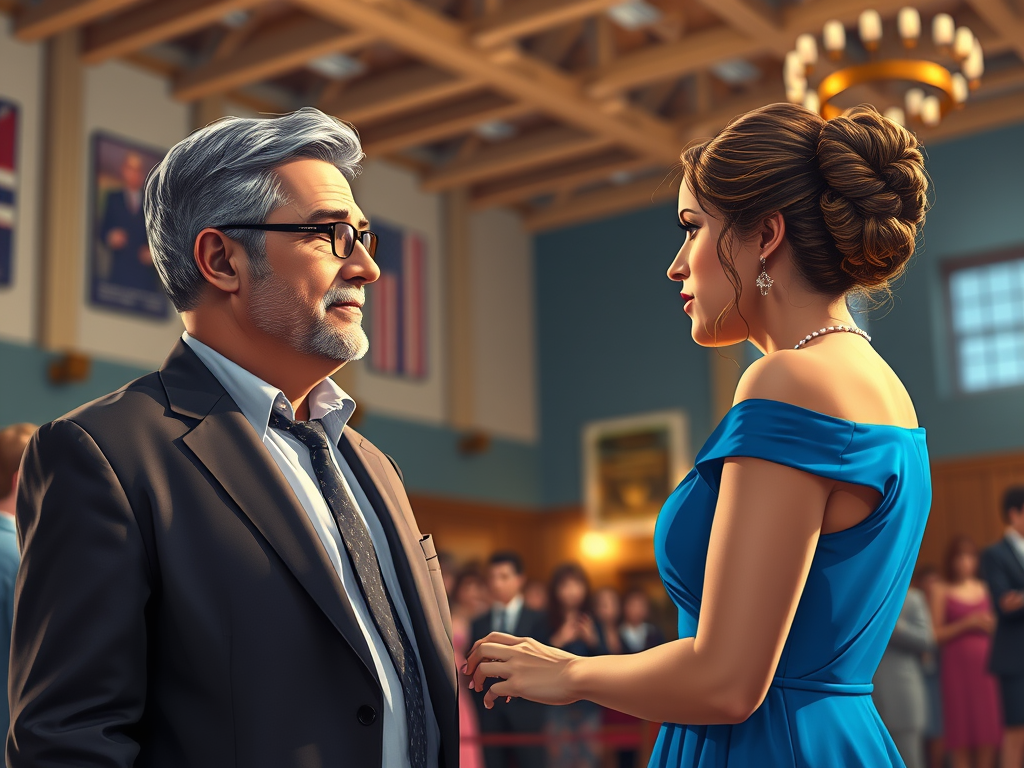
Echoes of Adonis

India hadn’t meant to open the invitation. The gold-embossed envelope had arrived weeks ago, hidden under a stack of unread mail. She told herself it didn’t matter, that revisiting her old college was pointless. But when she finally found it, half-crumpled and covered in coffee stains, her hands trembled.

The reunion.

And Keith might be there.

Keith. Even now, his name struck like a note of music she hadn’t heard in years but still knew by heart. The man she had loved—not just loved, but worshipped. He had been her Adonis, an impossible blend of androgynous beauty and untouchable charm. They had shared a summer—one incandescent, endless summer—before he disappeared.

She told herself it was youthful foolishness, that her adult self should scoff at such nostalgia. Yet she found herself staring in the mirror, wondering if she’d aged gracefully enough, wondering if he’d remember her the way she remembered him.

The weeks before the reunion were a blur of frantic preparation. A crash diet left her irritable and light-headed, but she rationalized it as dedication. She scoured boutique shops for the perfect dress, one that whispered sophistication while screaming “look at me.” The final touch was a makeover that erased every imperfection her 20s had forgiven but her 30s now flaunted.

“You look amazing,” her best friend Nita said as they stood in front of the bathroom mirror on the night of the event.

“I have to,” India replied. “This might be the only chance I get to see him again.”

“India…” Nita hesitated. “What if he’s not who you remember?”

India forced a smile. “He will be.”

The reunion was held in the same hall where they’d once danced under string lights and cheap disco balls. Now it was all polished wood and faux elegance, with catering trays that couldn’t disguise the lukewarm taste of regret. India’s pulse quickened as she entered, scanning the crowd for a familiar face.

And then, she saw him.

Keith stood by the bar, but he wasn’t the Keith she remembered. Gone were the ethereal features she had worshipped: the soft golden curls, the flawless complexion, the delicate curve of his lips. In their place was a man weathered by time, his hair streaked with gray, his frame heavier, his eyes duller. He looked ordinary.

Her chest tightened.

“India?” His voice pulled her back.

Keith was smiling, his teeth slightly crooked in a way she didn’t recall. But there was warmth in his expression, the kind that spoke of recognition, not regret. He looked genuinely happy to see her.

“Keith,” she said, her own smile brittle.

“I didn’t think you’d come.” He laughed, and it sounded real. “It’s been, what, fifteen years?”

“Something like that,” she managed.

As they fell into conversation, Keith told her about his life—a career in graphic design, a failed marriage, two kids he adored but rarely saw. He spoke with a vulnerability that caught her off guard, as if he weren’t trying to impress her, only to connect.

But India struggled to listen. She couldn’t stop comparing this man to the memory of the Keith she’d idolized. That memory was pristine, untouchable, while the man before her was flawed and human.

The breaking point came when Keith excused himself to the bathroom.

India wandered to the edge of the room, gripping her champagne flute as the weight of disappointment crushed her chest. Why had she come? To relive a fantasy? To prove something to herself?

“Still hung up on him?” a voice asked.

India turned to find Nita. “What are you doing here?”

“You looked like you needed backup,” Nita said with a shrug. “Also, I’m nosy.”

India laughed bitterly. “He’s not the Keith I remember.”

“Of course he’s not,” Nita said. “Neither are you. But the question is, why does that matter so much? What were you hoping for, India? That he’d sweep you off your feet and everything would magically fall into place?”

India’s throat tightened. “Maybe. I don’t know.”

“Well, you’ve got him right here. Flaws and all. You can walk away if you want, but don’t pretend this is about him. You’re the one stuck in the past.”

When Keith returned, India was still at the edge of the room. He hesitated, his hands shoved awkwardly into his pockets.

“Hey,” he said. “Are you okay?”

She took a deep breath. “I don’t know if I ever told you this, but back in college… I thought you were perfect.”

Keith blinked, surprised. “Perfect? Me? India, I was a mess.”

She smiled despite herself. “Yeah, I can see that now.”

They both laughed, and for the first time that night, India felt the tension ease.

“Listen,” Keith said, his voice soft. “I’m glad you came. You were always… special to me.”

The words hung between them, not quite a declaration, but more than a polite courtesy.

India studied him—the lines on his face, the silver in his hair, the warmth in his eyes. For the first time, she saw him as he was, not as she had idealized him to be. And she realized she had been chasing a ghost, not just of Keith, but of herself.

As they said their goodbyes, India felt lighter. She didn’t know if she and Keith would stay in touch or if their connection had run its course. But as she walked away from the reunion, heels clicking against the pavement, she didn’t feel regret.

Because in seeing Keith for who he truly was, she had begun to see herself the same way—flawed, human, and still worthy of love.

©2024 Rhyan Scorpio-Rhys

All The World Will Be Your Enemy 18: The Eye of the Storm

As the chaos and confusion surrounding her case reached a fever pitch, Beverly found herself at the center of a storm that threatened to consume everything and everyone she had ever known. The constant barrage of tests and procedures, the endless parade of doctors and scientists and government officials, all blurred together into a surreal, never-ending nightmare.

Cut off from her loved ones and the outside world, Beverly felt herself slipping deeper and deeper into a state of hopeless despair. The isolation and uncertainty of her situation weighed heavily on her mind, eroding her sense of self and leaving her questioning everything she had once believed about her life and her future.

She watched helplessly as her story became fodder for the 24-hour news cycle, her face plastered across every screen and her name on every tongue. The speculation and conspiracy theories ran rampant, with everyone from fringe bloggers to respected pundits weighing in on what her condition might mean for the fate of the world.

Some claimed that she was a harbinger of an impending alien invasion, a human-hybrid created by extraterrestrial beings as a way to infiltrate and conquer our planet. Others insisted that she was the product of a secret government experiment gone wrong, a bio-engineered weapon or a test subject for forbidden technologies.

As the theories grew wilder and more outlandish, the truth became increasingly difficult to discern. Beverly found herself questioning her own memories and perceptions, wondering if perhaps there was some kernel of truth hidden beneath the layers of speculation and conjecture.

Meanwhile, on the global stage, Beverly’s case had become a flashpoint for international tensions and diplomatic maneuvering. Foreign governments and health organizations clamored for access to her medical records and research data, each one seeking to gain some advantage or insight in the face of the unfolding crisis.

There were whispers of cover-ups and conspiracies, of backroom deals and clandestine operations. Some nations even went so far as to threaten military action if they were denied a seat at the table, arguing that the potential implications of Beverly’s condition were too great to be left in the hands of any one country or organization.

Amidst all of this, the scientific community found itself grappling with profound ethical questions and moral dilemmas. The drive to understand and potentially harness the mechanisms of Beverly’s transformation pushed the boundaries of what was considered acceptable research and experimentation.

Debates raged over issues of consent and autonomy, with some arguing that Beverly’s unique situation justified a more aggressive approach to studying her condition, while others insisted that her basic rights and dignity as a human being had to be protected at all costs.

For Beverly, caught in the middle of this maelstrom of competing agendas and conflicting interests, the toll on her mental and emotional well-being was immeasurable. She felt like a pawn in a game that she couldn’t begin to understand, a specimen to be poked and prodded and analyzed until there was nothing left of her former self.

As the days stretched into weeks and the weeks into months, Beverly found herself retreating deeper and deeper into her own mind, seeking some form of escape or solace from the unrelenting pressure and scrutiny. She lost herself in fantasies and daydreams, imagining a world where she was free from the constraints of her altered body and the expectations of those around her.

Not. The. End.

All The World Will Be Your Enemy 17: The Price of Hope

As news of Beverly’s condition spread through the medical world, it was only a matter of time before the pharmaceutical industry caught wind of her case. Within days, representatives from some of the world’s largest drug companies were descending on the government facility where she was being held, each one eager to stake their claim on what they saw as the discovery of the century.

To them, Beverly was more than just a patient or a research subject – she was a potential goldmine, a key to unlocking new treatments and therapies that could revolutionize medicine as we know it. Her unique biology, they argued, held the secrets to curing everything from cancer to Alzheimer’s to aging itself.

The bidding war that ensued was fierce and ruthless, with companies offering vast sums of money and resources in exchange for exclusive access to Beverly’s case. They promised state-of-the-art research facilities, teams of world-renowned scientists, and cutting-edge technologies that could unlock the mysteries of her condition in record time.

But even as the pharmaceutical giants battled for control of Beverly’s future, her family found themselves caught in the crosshairs. They were approached by armies of lawyers and executives, each one promising a different vision of what Beverly’s legacy could be.

Some offered money, vast sums that could set the family up for life and ensure that Beverly received the best possible care. Others promised fame and recognition, the chance to turn Beverly’s story into a symbol of hope and inspiration for millions around the world.

But through it all, Beverly’s loved ones remained wary and skeptical. They had seen firsthand the toll that her condition had taken on her, the way it had ravaged her body and mind and left her a shell of the person she once was. They knew that any decision they made would have profound consequences, not just for Beverly, but for the entire world.

As the pressure mounted and the offers grew more and more extravagant, Beverly’s family found themselves torn between their desire to protect her and their desperate need for answers. They knew that the pharmaceutical companies’ motives were not entirely altruistic, that they saw Beverly as a means to an end, a tool to be exploited for profit and power.

But at the same time, they couldn’t help but be tempted by the promise of hope, the chance to find a cure for Beverly’s condition and to spare others the same fate. They spent long, agonizing hours debating their options, weighing the risks and rewards of each path before them.

In the end, it was Beverly herself who made the decision. In a rare moment of lucidity, she called her family to her bedside and spoke to them in a voice that was barely above a whisper. She told them that she wanted her suffering to mean something, that she wanted her story to be one of progress and discovery, not just pain and tragedy.

And so, with heavy hearts and a sense of trepidation, Beverly’s loved ones signed the papers that would grant one of the pharmaceutical companies exclusive rights to her case. They watched as teams of researchers and scientists descended on the facility, their faces alight with excitement and ambition.

For Beverly, the days that followed were a blur of tests and procedures, of endless rounds of questioning and experimentation. She was poked and prodded, subjected to every cutting-edge technology and technique the company’s vast resources could provide.

Not. The. End.

All The World Will Be Your Enemy 16: Under Government Scrutiny

As the media frenzy surrounding Beverly’s case reached a fever pitch, it was only a matter of time before the government took notice. The first to arrive were the CDC, a team of top epidemiologists and infectious disease experts dispatched to investigate the possible public health implications of Beverly’s condition.

They descended on the hospital like a swarm of locusts, commandeering entire floors and setting up a makeshift command center. They pored over every scrap of medical data, interviewed every doctor and nurse who had come into contact with Beverly, and collected samples of everything from the air in her room to the lint in her bedsheets.

But even as the CDC conducted its investigation, other branches of the government were taking an interest in Beverly’s case. The NIH began its own parallel research effort, assembling teams of geneticists and molecular biologists to study the fundamental mechanisms of her transformation.

And then there were the whispers, the rumors that began to circulate in the halls of power. Some suggested that Beverly’s condition was the result of a deliberate attack, a new form of bioterrorism unleashed by a foreign power or a rogue non-state actor. Others speculated that she was the product of a secret government experiment, a classified military program that had gone horribly wrong.

As these rumors gained traction, the Department of Homeland Security was put on high alert. Teams of agents were dispatched to the hospital, their presence a constant reminder of the growing sense of unease and paranoia that had taken hold.

For Beverly, the arrival of the government only added to the surreal nightmare that her life had become. She was questioned relentlessly, subjected to endless rounds of interrogation by stone-faced agents who seemed more interested in her potential as a threat than in her well-being.

And then, one day, everything changed. Beverly was awakened in the middle of the night by a team of heavily armed soldiers, their faces obscured by gas masks and their weapons trained on her. They bundled her onto a stretcher, strapped her down with heavy restraints, and loaded her into the back of an unmarked van.

She was being moved, they told her, to a secure government facility where she could be studied and contained more effectively. Beverly’s mind reeled with terror and confusion as the van sped through the empty streets, the city lights flickering past the tinted windows.

When they arrived at the facility, Beverly was struck by the sheer scale of it – a vast, sprawling complex of buildings and fences that seemed to stretch on forever. She was wheeled inside, past checkpoints and guard stations and endless corridors of sterile white tile.

Her new home was a stark, featureless room, its walls lined with monitoring equipment and its air thick with the hum of machinery. A team of doctors and scientists in hazmat suits hovered over her, their faces obscured behind layers of plastic and rubber.

And so began a new chapter in Beverly’s ordeal, one marked by even greater isolation and uncertainty. She was poked and prodded, subjected to endless tests and experiments, all in the name of unlocking the secrets of her condition.

But even as the government’s top minds worked tirelessly to unravel the mystery of her transformation, Beverly could sense a growing unease among her captors. They seemed almost afraid of her at times, as if they knew something she didn’t, as if they had glimpsed some dark truth that they dared not share.

Not. The. End.

All The World Will Be Your Enemy 15: Viral Sensation

It started with a single post on social media, a blurry photo taken by a hospital worker who had caught a glimpse of Beverly through the window of her quarantine room. Within hours, the image had spread like wildfire, shared and reposted across every platform and news outlet.

At first, many people dismissed it as a hoax, a cleverly photoshopped prank designed to go viral. But as more details began to emerge, as leaked medical reports and eyewitness accounts hit the web, it became clear that something extraordinary was happening at the hospital.

Soon, the media descended en masse, setting up camp outside the hospital’s doors and clamoring for access. Reporters from every major news network and publication jockeyed for position, each one desperate to be the first to break the story of the century.

Inside the hospital, the atmosphere was one of barely controlled chaos. Security was immediately stepped up, with armed guards posted at every entrance and checkpoint. Doctors and nurses were given strict gag orders, threatened with termination and legal action if they spoke to the press.

But even the tightest security measures couldn’t stop the flow of information. Grainy photos and shaky video clips of Beverly continued to leak out, each one more shocking and disturbing than the last. Social media exploded with speculation and debate, with millions of people around the world obsessing over every new detail and development.

Some claimed that Beverly was the victim of a rare genetic disorder, a one-in-a-billion mutation that had caused her body to transform in ways never before seen. Others insisted that she was the result of a top-secret government experiment, a bio-engineered weapon or a test subject for alien technology.

Conspiracy theories ran rampant, with online forums and chat rooms buzzing with wild speculation and outlandish claims. Some even suggested that Beverly was a hoax after all, a masterful publicity stunt orchestrated by the hospital or some shadowy organization.

Through it all, Beverly remained locked away in her quarantine room, oblivious to the media circus that had erupted around her. She drifted in and out of consciousness, her mind and body ravaged by the relentless progression of her condition.

But even in her isolation, she could sense the growing frenzy outside, the weight of a million eyes and voices all fixated on her. It was a pressure that threatened to crush her, a fame that she had never sought and never wanted.

As the days wore on and the media’s appetite for her story only grew, the hospital was forced to take even more drastic measures. A wall of silence descended around Beverly’s case, with all information tightly controlled and rationed.

Press conferences were held, but they were brief and carefully choreographed, with doctors and officials reading from prepared statements and deflecting all questions. Interviews were granted, but only to a handpicked few, and always under the strictest conditions of secrecy and security.

But even as the hospital tried to maintain control, the speculation and rumors only intensified. Beverly’s name became a household word, her face a symbol of the strange and the unknown. She was the subject of countless memes and hashtags, the inspiration for art and music and endless online debate.

And through it all, Beverly could only watch from the sidelines, a helpless spectator to her own media circus. She knew that her story had taken on a life of its own, that she had become something more than human in the eyes of the world.

Not. The. End.

All The World Will Be Your Enemy 14: Uncharted Territory

Beverly drifted in and out of consciousness as the ambulance raced through the city streets, sirens blaring. The EMTs hovered over her, their faces obscured by masks and protective gear, their voices muffled and distant. She caught snippets of their conversation, words like “unknown pathogen” and “biosafety level 4” that sent chills down her spine.

When they arrived at the hospital, Beverly was immediately whisked away to a secure wing, far from the bustle of the main floors. She was placed in a sealed room, its walls lined with plastic sheeting and its air filled with the hum of negative pressure ventilation.

For hours, she lay there, barely aware of her surroundings, as a parade of doctors and specialists filed in and out. They took endless samples – blood, skin, saliva, even spinal fluid – and subjected her to a battery of tests and scans. All the while, they spoke in hushed, urgent tones, their expressions ranging from fascination to outright fear.

Beverly caught glimpses of herself in the reflections of their face shields, and each time, she had to stifle a scream. Her body was almost unrecognizable now, a twisted mass of writhing tentacles and mottled, pulsating flesh. The sight filled her with a horror so profound it bordered on madness.

As the days stretched into weeks, Beverly became a fixture of the hospital’s research wing. Teams of specialists from around the world were brought in to study her case, each one more baffled than the last. Geneticists sequenced her DNA, looking for mutations or anomalies that could explain her transformation. Dermatologists examined her skin, marveling at its strange texture and properties. Infectious disease experts tested her for every known pathogen, but found nothing.

Through it all, Beverly remained in a state of numb detachment, her mind retreating deeper and deeper into itself. She spoke little, ate only when prompted, and spent most of her time staring blankly at the ceiling, lost in a haze of drugs and despair.

The doctors tried everything they could think of to halt or reverse her condition. They pumped her full of antibiotics, antivirals, and experimental drugs. They subjected her to radiation and chemotherapy, hoping to kill off the aberrant cells that were taking over her body. But nothing seemed to make a difference.

As the weeks turned into months, the initial fervor surrounding Beverly’s case began to fade. The specialists drifted away, moving on to other projects and priorities. The hospital staff grew accustomed to her presence, no longer whispering or staring when they entered her room.

But for Beverly, the nightmare never ended. Each day brought new horrors, new reminders of the creature she had become. She watched in mute anguish as her body continued to change and warp, her humanity slipping away piece by piece.

And through it all, one thought haunted her, circling endlessly in her mind. What if this was only the beginning? What if her transformation was not an end, but a prelude to something even more terrifying and unknown?

In her darkest moments, Beverly found herself longing for death, for an end to the suffering and the fear. But even that seemed like a distant dream now, an escape that was forever beyond her reach.

For she knew, with a certainty that chilled her to the bone, that whatever she was becoming, it would not let her go so easily. She was being remade, forged in the crucible of her own flesh, for a purpose she could not yet comprehend.

And as the doctors and researchers continued to pore over her case, searching in vain for answers, Beverly could only lie there, a prisoner in her own body, and wait for the next phase of her transformation to begin.

Not. The. End.

All The World Will Be Your Enemy 13: The Deluge

Beverly awoke to a searing pain in her abdomen. She blinked, momentarily disoriented, before the events of the past few weeks came rushing back. The rings, the mottled skin, the fleshy growths around her waist…

Groaning, Beverly tried to sit up, only to collapse back onto the bed as a wave of dizziness washed over her. She looked down at her body and let out a choked sob at what she saw.

The growths on her waist had continued to lengthen, now resembling thick, ropy tentacles that coiled around her midsection. They pulsed and twitched with a life of their own, as if straining to break free from her skin.

But even more alarming was the state of her legs. They looked thin and atrophied, the muscles wasted away to almost nothing. As Beverly tried to stand, she found that they could no longer support her weight, buckling uselessly beneath her.

Panic rose in her throat as she clawed at the sheets, trying to pull herself upright. Her skin felt tight and itchy, flaking off in large, papery sheets as she moved. The sensation was maddening, an all-consuming discomfort that left her feeling raw and exposed.

Desperate for some kind of relief, Beverly began to crawl towards the bathroom, dragging her useless legs behind her. Each movement sent shockwaves of pain through her body, but she gritted her teeth and pushed on, driven by an instinctive need for water.

When she finally reached the bathtub, Beverly hauled herself over the edge with trembling arms. She fumbled with the faucet, her fingers clumsy and uncoordinated, until finally, blessedly, water began to flow.

As the tub filled, Beverly slumped against the cool porcelain, her eyes fluttering closed. The water rose around her, lapping at her skin like a balm, soothing the incessant itching and burning.

Time seemed to blur and stretch as Beverly drifted in and out of consciousness. The world narrowed to the sensation of the water, the gentle slosh of it against the sides of the tub, the way it buoyed her aching body.

She was only dimly aware of the sound of the water overflowing, spilling onto the bathroom floor in a steady stream. It mingled with the pounding in her head, the rush of blood in her ears, until all of it faded into a distant, meaningless hum.

Beverly had no idea how long she lay there, hovering on the edge of oblivion. But gradually, another sound began to penetrate the haze – a sharp, insistent knocking, coming from the direction of her front door.

She tried to call out, to respond in some way, but her tongue felt thick and heavy in her mouth, her words slurred and unintelligible. The knocking grew louder, more urgent, until finally, Beverly heard the unmistakable sound of a key turning in the lock.

Footsteps echoed through the apartment, accompanied by voices – unfamiliar at first, then shockingly, blessedly recognizable. Angele. Joanna. They were here. They had come for her.

But as the bathroom door swung open, as the concerned faces of the building management and her beloved friends came into view, Beverly felt a surge of shame and horror so intense it stole the breath from her lungs.

“Don’t look at me!” she screamed, her voice raw and ragged. “Don’t look at me!”

She cowered in the tub, trying to cover herself, to hide the grotesque changes that had ravaged her body. But it was too late. They had seen. They knew.

Beverly was only vaguely aware of the flurry of activity that followed – the gasps of shock, the hurried phone calls, the arrival of the EMTs. She slipped in and out of consciousness as they lifted her from the tub, her waterlogged tentacles trailing behind her like macabre streamers.

As she was strapped onto the gurney, Beverly’s gaze locked with Angele’s. In her friend’s eyes, she saw a swirl of emotions – fear, confusion, but also something else. Something that looked almost like…recognition. Understanding.

It was a fleeting impression, gone as quickly as it had come. But as Beverly was wheeled out of the apartment, as the world began to fade away once more, she clung to that look, to the faint glimmer of hope it represented.

Not. The. End.

All The World Will Be Your Enemy 12: Inconclusive Results and New Developments

Beverly sat in the doctor’s office, her heart pounding as she waited for the results of her medical tests. She had hoped that the battery of bloodwork, skin scrapings, and imaging would provide some answers, some explanation for the strange changes happening to her body.

But as Dr. Patel entered the room, her expression grave, Beverly felt her hopes sinking.

“I’m afraid the tests were inconclusive, Ms. Anderson,” Dr. Patel said, settling into the chair across from Beverly. “We couldn’t find any clear cause for your symptoms. No known allergies, no autoimmune markers, no signs of infection.”

Beverly’s hands clenched in her lap, the raised rings on her fingers feeling more prominent than ever. “So what does that mean? What’s happening to me?”

Dr. Patel sighed, her eyes sympathetic. “At this point, our best option is to do a skin biopsy. We’ll take a small sample of the affected tissue and examine it under a microscope. That should give us more information about what’s going on at a cellular level.”

Beverly nodded numbly, trying to process the news. A part of her had been hoping for a clear diagnosis, a name for the condition that was turning her body into a stranger. But another part of her feared what the biopsy might reveal, what new horrors might be lurking beneath her skin.

As she left the doctor’s office, Beverly couldn’t shake the sense of dread that clung to her like a second skin. And in the days that followed, her fears only grew as her physical symptoms continued to worsen.

The rings on her skin, once flat and discolored, now rose from her flesh like strange, fleshy ridges. They itched constantly, a maddening sensation that left Beverly clawing at her skin until it was raw and bleeding.

And then there was the mottling, the way her skin seemed to be changing color and texture before her very eyes. Patches of it took on a grayish, almost translucent hue, while other areas became rough and scaly, like the hide of some prehistoric creature.

But the most disturbing development came one morning when Beverly was getting dressed. As she pulled on her shirt, she felt a strange sensation around her waist, a tightness and pressure that made her gasp.

Looking down, Beverly’s eyes widened in horror at what she saw. Four small, fleshy nubs had sprouted from her skin, evenly spaced around her midsection. They were no more than an inch long, but they were unmistakably there, pulsing slightly with each beat of her heart.

Beverly’s mind reeled as she stared at the growths, trying to make sense of what she was seeing. Were they some kind of tumor? A side effect of whatever was causing her other symptoms?

She thought of the biopsy, of the tiny piece of herself that would soon be under a microscope, dissected and analyzed. Would it hold the answers she so desperately needed? Or would it only reveal new depths of strangeness, new levels of aberration?

Beverly closed her eyes, fighting back the panic that threatened to engulf her. She felt like she was losing herself, like her very identity was being erased and rewritten by the changes happening to her body.

And yet, even in the midst of her fear and confusion, Beverly couldn’t shake the sense that there was something else at work, some greater purpose or meaning behind her transformation. It was a feeling that had been growing steadily over the past weeks, a whisper in the back of her mind that spoke of destiny and transcendence.

She ran her fingers over the raised rings and fleshy nubs that now adorned her skin, and as much as the changes terrified her, as much as she longed for a return to normalcy, Beverly couldn’t deny the strange, electric thrill that ran through her at the thought of what she might be becoming. It was a feeling that both exhilarated and terrified her, a dance on the edge of the unknown.

Not. The. End.

All The World Will Be Your Enemy 11: Diagnosis/Isolation

Beverly sat on the examination table, her legs dangling over the edge, the crinkle of the paper gown sharp and grating in the sterile hush of the room. The overhead fluorescent lights buzzed faintly, their cold glow leaching warmth from her skin. Her fingers twisted together in her lap—pale, trembling, and marked.

The red rings stared back at her, angry and swollen, as if burned into her flesh. They weren’t smooth like rashes or welts. The edges were raised in tiny, curling ridges, irregular and almost… organic.

She traced one absently, shuddering at the wrongness of it. The texture was off—not rough, not soft, but something in between, something yielding yet firm. It didn’t feel like her. Not anymore.

Rubbery. Alien.

The door creaked open, and Beverly flinched, pulling the flimsy paper gown tighter around herself.

Dr. Patel stepped in, clipboard in hand, her crisp white coat a contrast to the warmth in her smile. She was a reassuring presence—calm, collected, the kind of person who had seen it all before.

“So, Ms. Anderson,” Dr. Patel said, scanning the chart. “Tell me what’s been going on.”

Beverly swallowed, her throat dry. Slowly, she turned her hands palm-up, revealing the grotesque red rings.

“They started about a week ago,” she said, voice barely above a whisper. “At first, just my hands and feet. But now…” She hesitated, then tugged up the hem of the gown, exposing her calves. The rings climbed her skin in irregular patterns, curling up her legs like invasive vines.

Dr. Patel frowned slightly, pulling on a pair of gloves. “May I?”

Beverly nodded, biting her lip as the doctor ran her fingertips over the raised edges of one of the rings.

The contact sent a ripple through her nerves—something between a shiver and a recoil. She twitched involuntarily, an unpleasant heat prickling under her skin.

“They itch, don’t they?” Dr. Patel asked, her voice calm but attentive.

Beverly let out a breath she hadn’t realized she was holding. “Yes, but it’s more than that. My skin… it feels wrong. Rough, like rubber or plastic. And sometimes I swear—” She cut herself off, shaking her head.

“Swear what?” Dr. Patel prompted.

Beverly hesitated. “It doesn’t feel attached. Like my body is…” She clenched her jaw. Saying it out loud felt ridiculous. “Like it’s turning into something else.”

Dr. Patel’s pen scratched against the chart. “You say this started suddenly? No previous conditions—eczema, allergies, autoimmune issues?”

“No,” Beverly said firmly. “Nothing. It just… started.”

The doctor leaned back, studying her thoughtfully. “It could be a few things—lichen planus, granuloma annulare, or even an unusual autoimmune response. We’ll run some tests.”

Tests. A slow, twisting dread coiled in Beverly’s stomach. She had wanted immediate answers, something solid. Not this.

“I’m prescribing a topical corticosteroid cream for now,” Dr. Patel continued. “It should help with the inflammation and itching. But Beverly…” Her gaze softened. “I know this must be frightening. We’ll figure it out, okay?”

Beverly nodded numbly. The words barely registered. A hollow reassurance, spoken through a thick pane of glass.


Back at her condo, Beverly stood in front of the bathroom mirror, staring at herself. She looked… wrong.

Her skin was pale, the rings stark against it like brands. Her once-lustrous hair hung limp around her face, and dark shadows rimmed her eyes. She barely recognized the woman in the glass.

With slow, careful movements, she uncapped the tube of cream and spread it over her arms and legs. The coolness was a brief relief—but the moment she stopped, the itching returned worse. It crawled beneath her skin, relentless, like something alive.

Her fingers twitched. She clenched them into fists. It was getting worse.

Her phone buzzed on the counter. She didn’t need to look to know it was Angele or Joanna. They had been calling, texting, reaching out all week. But Beverly had ignored every attempt. How could she face them now, after what she had done?

She sank onto the couch, pulling a blanket around herself like armor. The room was dark except for the flickering glow of the TV, its muted images blending into meaningless shapes. Finally, in desperation, she called her mother.

“Beverly, honey? What’s wrong?” Her mother’s voice was warm, familiar—a lifeline.

Beverly clutched the phone tighter. “Mom… is there anything in our family medical history I should know about? Allergies, diseases, anything strange?”

A pause. “Not that I can think of. Why? Are you feeling sick?”

“No,” Beverly lied. “Just a work thing. A medical questionnaire.”

Her mother hummed thoughtfully. “Well, your great-aunt Mildred had rheumatoid arthritis. And one of your cousins is gluten-intolerant. But nothing unusual.”

Nothing that explained this.

“Mom,” she asked hesitantly, “was I… normal? When I was little?”

Her mother laughed softly. “Of course you were, sweetheart. You were a bright, happy little girl. Why would you ask that?”

Beverly opened her mouth, then closed it again. How could she explain the storm inside her? The fear, the shame, the certainty that something was deeply, irreversibly wrong?

“I don’t know,” she mumbled. “I guess I’m just feeling lost.”

Her mother’s tone softened. “Oh, honey. Everyone feels that way sometimes. But you’re my beautiful, perfect daughter. No matter what, I will always love you.”

Tears welled in Beverly’s eyes, spilling down her cheeks. “Thanks, Mom. I love you too.”

After the call, she curled up on the couch, hugging a pillow to her chest. The longing for comfort, for connection, was unbearable. She thought of Angele and Joanna, of their warmth and laughter, and the ache in her chest deepened. She had ruined everything. And it was getting worse.

She tried to sleep, but at some point, she woke with a start. The room was silent except for her own breathing. Something felt off.

She shifted beneath the blanket—and froze. Her arms… felt different. Slowly, she lifted her hand to the dim light of the TV. Her fingers looked longer. More flexible. The joints—had they moved?

She turned her hand over. Her skin shone faintly in the low light. Smooth. Slick. Like something that belonged in water.

A chill ran through her.

Beverly curled her fingers into a fist, pressing them against her chest as if trying to hold herself together.

She didn’t know what was happening to her. But she knew one thing for certain. This wasn’t going to stop.

It was only the beginning.

Not. The. End.

All The World Will Be Your Enemy 10: Actions and Reactions

Beverly found herself adrift in the cozy ambiance of Angele and Joanna’s living room, a realm where laughter danced freely through the air and the warmth of companionship seemed to permeate every corner. The space, illuminated by the soft, golden glow of string lights artfully arranged by Joanna, felt like a haven from the storm of her own emotions. Lavender-scented candles flickered gently on the coffee table, their light casting playful shadows on the walls and infusing the air with a calming, fragrant haze.

Angele and Joanna moved through the space with effortless grace, their laughter a melody that harmonized with the clink of dishes and the rustle of conversation. But for Beverly, every sound seemed muffled, every moment surreal, as though she were a spectator in her own life. Beneath the veneer of idyllic gathering, she wrestled with a tumult of unsaid words, her meticulously rehearsed confessions dissolving into the ether.

Angele, with an empathy as intuitive as her smile was gentle, approached Beverly and sat beside her on the couch. Her presence was a balm, her luminous green eyes searching Beverly’s face with quiet concern. “Is everything okay, Bev? You seem a little… distant tonight.” Her voice, soft and soothing, carried the weight of genuine care.

In those verdant depths, Beverly saw her fears reflected back at her but also an unwavering kindness that beckoned her to abandon the safety of silence. Her mouth opened, a string of words tumbling forward in her mind, but none made it past her lips. Instead, compelled by a force greater than fear, she leaned into the space between them, her lips finding Angele’s in a kiss that was both a question and an answer.

The world narrowed to the warmth of Angele’s lips, the faint taste of wine mingling with the softness of her skin. Beverly’s heart thundered, and for a brief, suspended moment, it felt as though everything had fallen into place. But reality, with its cruel penchant for timing, intruded abruptly. Angele withdrew, her expression a canvas of shock and confusion, her hands hovering near Beverly’s shoulders as if unsure whether to push away or pull closer.

“I… I’m so sorry,” Beverly faltered, retreating into the shell of her anxieties. Her voice cracked under the weight of regret. “I shouldn’t have… I don’t know what I was thinking.”

Joanna, who had been setting down a tray of drinks, froze mid-step. Her dark eyes darted between the two women, her face a mixture of surprise and concern. “Beverly, wait—”

But Beverly was already retreating, propelled by a maelstrom of embarrassment and self-reproach. The sound of Angele calling after her rang in her ears, but it only spurred her legs to move faster. She stumbled out of the condo, her vision blurring with unshed tears.

By the time Beverly reached her own place, her breath was coming in ragged gasps. She slammed the door behind her and leaned against it, her trembling hands pressed to the cool wood. Her heart was a wild drumbeat, her mind a cacophony of conflicting thoughts.

What had she done? Had she just ruined everything, destroyed the most meaningful friendship she’d ever had, all because she couldn’t control her own emotions?

Sliding down the door to the floor, Beverly buried her face in her hands. She felt like she was coming apart at the seams, her carefully constructed life unraveling before her eyes.

She kissed a woman. For the first time in her life, she had crossed that invisible line, acted on feelings she had been trying so hard to ignore. And now, in the aftermath, Beverly felt like her entire world had been turned upside down.

It was one thing to fantasize about Angele and Joanna, to imagine what it might be like to hold them, touch them, to be with them in a way that went beyond friendship. But actually doing it—feeling the warmth of Angele’s breath, the way her lips trembled against Beverly’s—was something else entirely. It was electric, exhilarating… and terrifying.

Beverly considered herself straight. She had dated men, loved a few of them. The idea of being attracted to a woman, of wanting to kiss and touch and be with another female, had never even crossed her mind. Until Angele. Until Joanna. Until now.

And now, with a single impulsive action, Beverly had shattered the illusion of her own certainty and crossed a line she could never uncross. She felt like a stranger in her own skin, like everything she had ever known about herself was suddenly called into question.

But even worse than the confusion and self-doubt was the crushing weight of rejection. The look on Angele’s face—shock, confusion, and something unreadable—was seared into Beverly’s mind, a painful reminder of her own foolishness.

How could she have been so reckless? So stupid? How could she have risked everything—thrown away the most important friendship of her life—for a fleeting impulse?

Beverly’s chest heaved with silent sobs, her tears hot and relentless. As she curled into herself, a prickling sensation began to creep across her skin, starting in the soles of her feet and the palms of her hands. It was faint at first, like the brush of tiny needles, but it quickly grew into a persistent itch.

Frowning, Beverly held up her hands, squinting at them in the dim light of the living room. At first, they looked normal. But as she turned them over, her breath caught. Faint, red rings were forming on her palms, thin and perfectly circular. The skin beneath them tingled with an unnatural warmth.

A chill ran down her spine. Were they hives? Some kind of allergic reaction to the stress? Or something worse?

Her mind raced with possibilities, each more terrifying than the last. Ringworm, eczema, a rare autoimmune disorder… The red rings seemed to mock her, a physical manifestation of the chaos within. As her tears subsided, her focus sharpened on the patterns spreading across her skin. She couldn’t shake the sensation that this was more than a coincidence.

Her breath hitched as the faint red lines began to pulse, the rhythm matching the frantic beat of her heart.

Beverly hugged her knees to her chest, rocking back and forth. She had never felt so alone, so lost in the sea of her own making. She knew she should call someone, but the thought of explaining what had happened was too much to bear. For now, all she could do was sit in the darkness, nursing her broken heart and shattered illusions, and pray that somehow, someday, she would find a way to put the pieces back together.

Even if she knew, deep down, that nothing would ever be the same again.

Not. The. End.