Tag: #amwriting

  • GROWN FOLKS BUSINESS

    GROWN FOLKS BUSINESS

    Author’s Note: By way of explanation this piece began life as a short film script that was never filmed. The screenplay and initial prose conversion was much longer and it has taken three attempts of “killing my darlings” while preserving the core message to get it to this point. The thing I did not do was update the dialogue, so you will find certain terminology outdated. Best enjoyed if you consider it a period piece, and accept it as is.

    Malcolm hits the church like a man chasing something he can’t catch and can’t drop.

    Outside, the morning is all elbows and engines. Inside, the sound falls away so fast it feels like stepping underwater. A few parishioners glance up at the intrusion, then return to their prayers, calm in the way people get when they’ve decided God can handle whatever walks in.

    A woman approaches Malcolm from the aisle, cautious but willing. “Can I help you, brother?”

    “I’m looking for Irving,” Malcolm says. “Folks say he’s here this time of day.”

    “Irving? Do you mean Deacon Jones?”

    “Yeah. Deacon Jones.”

    Her eyes travel over his face, the set of his jaw. “Whatever you have, remember where you are. This is the Lord’s house.”

    “I’ll respect it,” he says, because he needs the door to open more than he needs to win.

    She hesitates, then asks, “May I tell him who’s here?”

    “Malcolm. His stepson.”

    Her expression shifts. “Little Malcolm.”

    “Not so little no more.”

    She nods toward a side door. “Basement. He has an office.”

    Malcolm starts down.

    “And Malcolm,” she calls, softer now, “I hope you won’t be a stranger to Sunday service.”

    “God willin’,” he says, and disappears.


    The basement is all clutter and narrow paths, the church’s hidden storage pressed close like it wants to breathe on you. Someone carved a cramped office out of stacked boxes: a desk buried under papers, a dim lamp, an old chair.

    Irving sits there writing on a notepad like time belongs to him. Mid-60s. Calm hands. Calm face. The kind of calm that makes you feel like you’re the problem for reacting.

    Malcolm doesn’t slow. He reaches into his jacket, pulls a metal object, raises it, and drives it into the desk hard enough to bite the wood.

    A crucifix stands upright, embedded like a stake. Christ faces Irving.

    Malcolm steps back and waits for the flinch, the guilt, the panic—anything human.

    Irving keeps writing.

    He finishes his thought, sets the pen down gently, then looks at the cross with mild interest, as if Malcolm has brought him a prop from a play.

    “Hello, Malcolm,” he says. “What’s this?”

    “You know what it is.”

    “Watch your language.”

    “If God can forgive you,” Malcolm says, voice tight, “He can overlook a few words.”

    Irving lifts his eyes. “Exactly what did God forgive me for?”

    Malcolm feels something inside him snap into heat. “So it’s like that now. You don’t remember.”

    “My memory’s fine,” Irving says. “I just don’t know what you’re talking about.”

    Malcolm nods at the crucifix. “That cross you gave Kimberly.”

    Irving’s mouth twitches. “Then keep it. You look like you could use a little Jesus.”

    Malcolm’s hands clench. “Stay away from us. No visits. No calls. No letters. You don’t contact my sister. You don’t contact my niece. You don’t come near our house.”

    Irving taps the desk once, thinking, then picks up his pen and goes right back to writing.

    That casual dismissal is what makes Malcolm’s vision narrow.

    Malcolm turns for the stairs.

    “I’m not the man you used to know,” Irving says behind him. “I’ve been saved.”

    Malcolm freezes. “Saved.”

    “Yes.”

    “The Lord works in mysterious ways.”

    “That He does.”

    “I ain’t never cared for that saying.”

    “Why not?”

    “Because it only seems to work for people like you.”

    “People like me?”

    “You know exactly what I mean.”

    “I won’t,” Irving says, “until you tell me.”

    Malcolm turns just enough to let the threat land. “Sooner or later you’re gonna answer to either God or me. And you best pray it’s God, because I won’t be lenient.”

    Irving doesn’t rise. He doesn’t shout. He only says, steady as stone, “God knows my heart. And so does Kimberly.”

    “Don’t say her name.”

    “You don’t want me in your life,” Irving says. “Fine. But your sister is grown. If she wants me gone, let her tell me.”

    Malcolm’s fists flex open and shut. “If I catch you around our house again, I’ll kill you. If you talk to my sister or my niece again, I’ll kill you. You even think about inserting yourself into their lives… I swear before God, these hands will take your life.”

    He leaves.


    At home, Malcolm sits in the dark on the couch with the phone in his hand. He dials, listens, says nothing. Whatever is on the other end doesn’t fix him, and whatever he needs can’t be said without bringing something ugly into the room.

    The front door opens. Light floods in.

    Kimberly walks in first, early 30s, tired and capable, carrying the day like she always does. Pamela bounces in behind her, backpack swinging. They both yelp when they see Malcolm on the couch.

    He hangs up too fast.

    Pamela runs at him. Malcolm lifts her with a grunt he tries to hide, then sets her down carefully.

    “Uncle Malcolm!”

    “Hey, Little Pam.”

    “Hay is for horses, sometimes cows,” Pamela says, proud. “Pigs don’t eat it because they don’t know how.”

    Malcolm forces a smile. Kimberly’s eyes go straight to the phone, then to him.

    “What were you doing?”

    “Making a phone call.”

    “In the dark?”

    “Since when do you need light to talk?”

    Pamela digs in her backpack, eager to show him something. Kimberly’s patience snaps before she can stop it.

    “Pamela, upstairs. Change into your play clothes.”

    Pamela sags, sucks her teeth, drags her feet toward the stairs.

    Kimberly catches it. “Pick your feet up.”

    “Yes, Mama,” Pamela mutters, and disappears.

    Kimberly waits until the creaking stops, then turns back to Malcolm.

    “You hung up when we walked in,” she says. “Who was it?”

    Malcolm stares past her. “Grown folks business.”

    Kimberly’s jaw tightens. “And I’m not grown?”

    “Not grown enough for this.”

    “I don’t want trouble in this house,” she says, low and fierce. “Not with my daughter upstairs. If you’re making calls that bring heat, you make them somewhere else.”

    Malcolm doesn’t answer. His mind is still in the basement, still watching Irving’s calm face, still hearing the word saved like a joke.

    Instead he says, almost to himself, “Whatever I tell you in the dark, speak in the light…”

    Kimberly blinks. “What?”

    “Matthew,” he says. “Mama used to quote it.”

    Kimberly exhales, annoyed at the memory it drags up. “Yeah. I remember.”

    They try to talk around it. They can’t.

    Kimberly brings up work, money, Malcolm’s pride, Malcolm’s exhaustion, and Malcolm jokes because joking is safer than admitting fear. Kimberly tells him the good news—her contract came through, attending physician, real money at last—and Malcolm is genuinely proud for one clean second.

    Then she says she wants to help him, too. School. Training. Anything.

    Malcolm refuses. Kimberly pushes. Malcolm digs in. The argument expands the way it always does: who sacrificed what, who gets to decide, who is allowed to have a life.

    And then Malcolm says, like a match dropped into gasoline, “I saw Irving today.”

    Kimberly freezes. “Where?”

    “At the church,” he says. “I told him to stay away.”

    “Why do you keep doing this?” she asks. “Why do you keep making decisions for me?”

    “Because I know what he is.”

    Kimberly’s face goes still in a way that means she’s gone somewhere else for a second. “You’re still sixteen,” she says quietly. “Still fighting that night.”

    Malcolm’s voice cracks around the memory anyway.

    He woke up and heard a sound from her room. He crept down the hall. The door was open a crack. Irving was inside. Irving was undressing. Irving was touching her. Malcolm burst in swinging, swinging, swinging, and it didn’t matter. Irving grabbed him, lifted him, and said, close enough to spit in his face, “Stay out of grown folks business.”

    Kimberly whispers his name because Pamela is upstairs, because the house is small, because some words stain walls.

    Malcolm can’t stop. “You were a kid,” he says, like saying it might undo it.

    Kimberly’s control slips, and the truth she manages in daily doses comes out fast and blunt: the meds, the triggers, the nights she can’t breathe right, the private prayers she says just to stay stitched together.

    Malcolm stares at her like he’s seeing the full cost for the first time.

    “I don’t forgive him because he deserves it,” Kimberly says, voice shaking but steadying as she speaks. “I forgive because I deserve peace.”

    Malcolm’s face hardens. “He should be dead.”

    “And you should be free,” she says, and the sentence lands like a slap because it’s true and unfair.

    They fight again, but now it’s not only about Irving. It’s about Malcolm’s whole identity—protector, guardian, gatekeeper—and how protection has curdled into control, into fear, into love held so tight it bruises.

    “I need you to have a life,” Kimberly says.

    “My life is you and Pam,” he says.

    “And what if that isn’t enough?” Kimberly asks, and neither of them has an answer that doesn’t hurt.

    Kimberly tries to calm him. She reaches for his jacket like she’s done a thousand times.

    Malcolm flinches like a struck animal and accidentally hits her.

    Kimberly recoils, shocked, hand rising to her face. “You hit me.”

    “I didn’t mean—” Malcolm’s voice breaks. “I’m tired. I’m tired of making the wrong choices.”

    “Then tell me what happened today,” she says. “Tell me what you did.”

    Malcolm swallows. “I saw Irving.”

    Kimberly’s shoulders drop, and she looks older than she is.


    The argument rises one last time, sputtering, ugly, exhausted. Malcolm stands too fast.

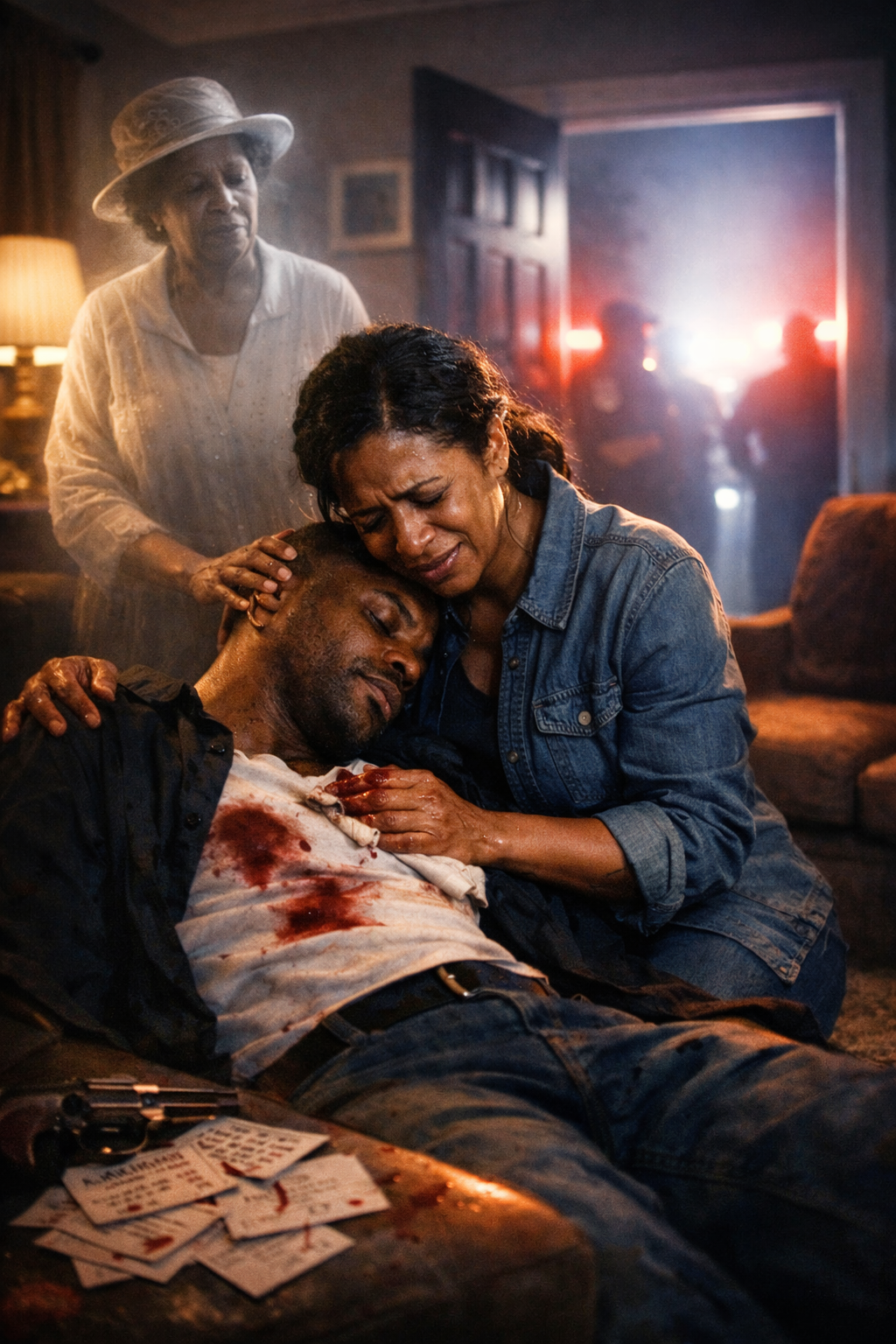
    A stack of homemade postcards spills from inside his jacket and scatters across the floor.

    Kimberly’s eyes snag on them. Recognition hits her face instantly.

    Before she can speak, Malcolm folds and drops.

    Kimberly rushes to him, yanking his jacket aside. Blood soaks his shirt and pants. A bullet hole.

    Her training kicks in, but her hands shake anyway as she presses fabric to the wound. “We have to call an ambulance.”

    Malcolm grabs her wrist in a grip that hurts. “Too late.”

    “It’s not too late,” she snaps, fighting panic. “Let me—”

    “Now it’s your turn,” Malcolm whispers, teeth clenched. “To listen.”

    Outside, sirens swell closer. The windows begin to flicker with red and blue.


    Malcolm went back.

    In the church basement, with the gun in his hand and the past roaring in his skull, he demanded the truth. Irving denied. Irving minimized. Irving rewrote. Irving tried to turn a nightmare into a misunderstanding and a child into a liar.

    Then Irving produced the postcards.

    Kimberly’s handwriting. Cardboard cut down to size. Messages sent month after month while they were on the run. Proof, Irving claimed, that nothing happened—because why would she keep in touch if it did?

    Malcolm stared at them, sick. In his hands was something that didn’t fit the life he built his fury around.

    Then he remembered Pamela’s voice—the phrase that should never come out of a child.

    Grown folks business.

    And Malcolm snapped.

    He pistol-whipped Irving until Irving was blood and pleading and repeating, “I’m not like that,” like saying it could make it true.

    Malcolm turned away, horrified, and that’s when Irving came up behind him.

    They struggled for the gun.

    It fired twice.


    Back in the living room, the sirens are close enough that the light crawls across the walls. Kimberly presses down on Malcolm’s wound and begs him to stay with her.

    The air shifts.

    Mama appears beside the couch, calm as a hymn. Kimberly doesn’t see her, but Malcolm does.

    “Mama,” he whispers, as if he’s been waiting his whole life to say it again without anger attached.

    Mama’s voice is soft. “Your stepfather isn’t dead.”

    Malcolm blinks, confused. “But I—”

    “You felt the gun go off,” Mama says. “And you pulled it toward yourself.”

    Malcolm’s breathing catches, and he understands what she’s saying even if he hates it. Reflex. Instinct. Something deep in him refusing, at the last second, to become the thing he hunted.

    “The second shot hit him,” Mama continues. “He’ll live.”

    “And I won’t,” Malcolm says, and it isn’t a question.

    Mama doesn’t lie. “No, baby.”

    Kimberly looks at Malcolm’s face, terrified. “Who are you talking to?”

    “Mama,” Malcolm says, and he sounds like a little boy again. “You don’t see her?”

    Kimberly swallows and steadies her voice the way she does when she has to hold a room together. “If you say you see Mama, I believe you.”

    Malcolm panics, not for himself, but for Kimberly and Pamela. “Without me, he’ll come back. He’ll do it again.”

    Mama’s eyes hold his. “I don’t think that’s going to happen.”

    “Why not?”

    Mama’s voice stays even. “Because he won’t be capable of it again.”

    Malcolm’s face shifts as he understands, and he tries to reach for ugly relief—some crude justice—but Mama stops him with a look that would’ve frozen him as a child.

    “Mind your mouth around me, boy.”

    Despite everything, Malcolm laughs once, and the laugh tears through him like broken glass.

    “Man,” he whispers, “I guess God don’t like ugly, do He?”

    Mama’s smile is small and sad and real.

    Malcolm’s body tightens, then releases.

    Kimberly breaks. She cradles him, rocking, crying the way people cry when the world stops being negotiable.

    Malcolm rises—not his body, but him. Spirit-light and quiet. Mama takes his hand like she’s been waiting.

    Kimberly rocks on the floor and whispers into his hair, “Why’d you do it, Mal? Why’d you do it?”

    Malcolm kneels beside her ear, voice gentle now. “’Cause sometimes love makes promises you gotta keep.”

    He kisses her cheek. For half a second she seems to feel it, like warmth passing through. Then she keeps rocking, holding what she can’t keep.

    Malcolm looks at Mama, raw with worry even after death. “She gonna be alright?”

    Mama watches Kimberly like she’s watching a storm pass through a house that still has to stand afterward. “Right now her heart’s shattered,” she says. “But she’s got God, her daughter, and help coming. She’ll be fine. It’ll take time. But she’ll be fine.”

    The front door swings open on its own.

    Police lights fill the room—red and blue—then bloom into a blinding white.

    Mama and Malcolm walk into it together.
  • Mechanics of the Ghost Machine (Part 10) Ordinary Signal

    Mechanics of the Ghost Machine (Part 10) Ordinary Signal

    Three months after the kill switch, Chelsea found the unread thermal strip while looking for batteries.

    The evidence sleeve had migrated from the kitchen counter to the back of a shallow drawer beneath spare keys, old appliance manuals and a roll of stamps. Chelsea had stopped thinking about it every day sometime in the second month. Finding it again produced less drama than she would once have expected. She stood with the drawer open, holding a packet of AA batteries in one hand and the sealed strip in the other, aware that she could still unfold the paper in under thirty seconds.

    She carried it to the garage instead.

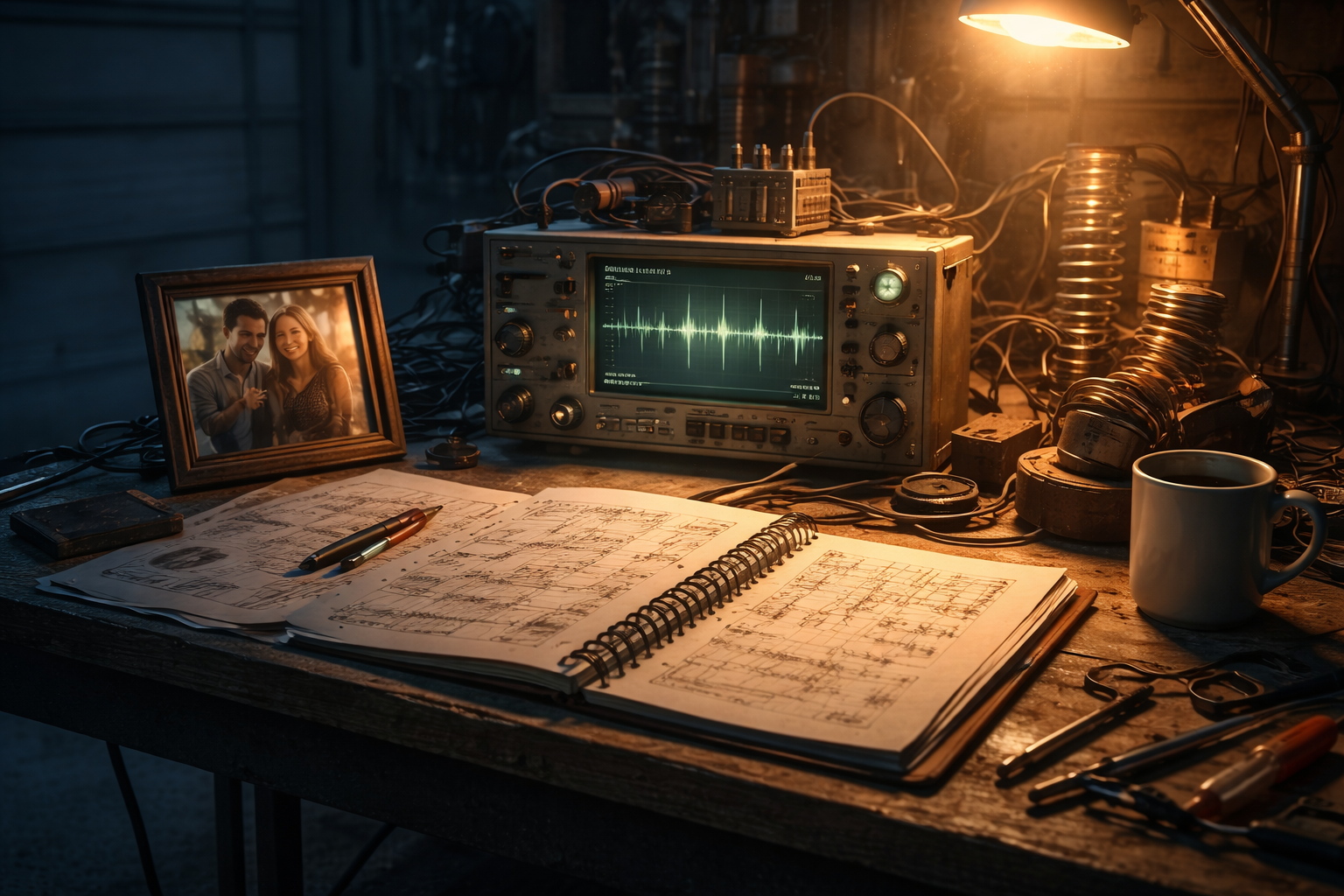
    The steel enclosure remained beneath a gray canvas cover near Rowan’s bench. Chelsea had removed the Deadman Gate cylinder, disconnected the remaining power hardware and boxed the damaged synchronization module with the sheared conductor sections. The machine could no longer be activated by accident, habit or a clever interpretation of a rule. Rebuilding it remained possible in the same sense that rebuilding a burned workshop remained possible if someone wanted it badly enough.

    Chelsea opened the small cash box where she kept the obsolete house deed, two passports and several documents that were irritating to replace. The thermal strip fit beneath them.

    She locked the box and went back for the batteries.

    The garage itself had begun changing again. Chelsea cleared one shelf of Rowan’s abandoned cable assemblies and donated two instruments to a community electronics program after confirming that neither contained project data. His mug remained above the vise because she still liked it there. The chewed pencil disappeared one afternoon when Chelsea used it to mark lumber and later found it behind the table saw, which seemed a sufficiently ordinary fate that she left it where it landed.

    The room no longer divided cleanly into his half and hers.

    Bellamy called on a Tuesday afternoon.

    Chelsea was at work reviewing a vibration report when his name appeared on her phone. She let the first ring pass because she was trying to remember whether they had arranged the call or whether Bellamy had finally developed spontaneous social instincts.

    “Before you ask,” he said when she answered, “the report remains unchanged.”

    “I wasn’t going to ask first.”

    “You were eventually going to ask.”

    “That is different.”

    “I have known investigators who retired over weaker distinctions.”

    Chelsea pushed the vibration report aside. “Did you review the notes?”

    “I did. I also reviewed the old schematic against the controller logs again, because apparently I enjoy spending retirement-age afternoons punishing myself.”

    “You’re still employed.”

    “My body knows what year it is even if payroll does not.”

    Paper shifted on his end. Bellamy had printed the material Chelsea sent him: old bench notes, Rowan’s interlock complaints and a partial schematic showing where a temporary bridge could have been installed. She had excluded the confession transcript. There was no defensible chain of provenance for it, and she no longer intended to make Bellamy solve problems she could not honestly describe.

    “The new material strengthens the bypass scenario,” he said. “The bench notes show he was frustrated with the trip threshold. The schematic confirms a bridge would have been straightforward. The tool recovered at the scene was appropriate to the gauge. None of that proves he installed one.”

    “I know.”

    “You say that with less hostility now.”

    “I stopped trying to make the report say more than the evidence can support.”

    Bellamy was quiet long enough for Chelsea to wonder whether the call had dropped.

    “Well,” he said finally, “that is either growth or exhaustion.”

    “Those are not mutually exclusive.”

    “Careful. You’re becoming philosophical.”

    Chelsea leaned back in her chair. “Are you changing the cause classification?”

    “No. I’m adding the bench notes to the supplemental file and recording deliberate bypass as a supported scenario. Indeterminate remains indeterminate.”

    “That’s reasonable.”

    Another pause.

    Bellamy said, “I dislike how easily you said that.”

    “You preferred me argumentative?”

    “I knew what to do with argumentative.”

    A child shouted in the distance.

    Chelsea smiled. “Your granddaughter?”

    “Grandson this time. He believes shouting improves mathematics.”

    “Does it?”

    “His confidence improves.”

    Bellamy excused himself a minute later because someone had apparently spilled orange juice onto a multiplication worksheet. Chelsea returned to the vibration report and finished it before opening Rowan’s accident file.

    She read the classification once.

    Then she closed it.

    Mari came over that Saturday carrying coffee and a broken desk lamp.

    “I brought you a social call disguised as unpaid labor,” she said.

    Chelsea took the lamp. “What happened?”

    “It fell.”

    “From where?”

    “My desk.”

    “How?”

    Mari removed her coat. “This inquiry is becoming accusatory.”

    Chelsea examined the dent in the shade. “You hit it.”

    “I gestured near it.”

    “With what?”

    “My entire arm, apparently.”

    They took the lamp into the garage.

    Mari had visited several times since the kill switch and no longer stopped near the kitchen threshold before following Chelsea inside. She still glanced at the covered enclosure sometimes. Chelsea noticed without treating the glance as data.

    The lamp had a loose socket and one cracked solder joint. Chelsea opened the base while Mari sat on Rowan’s stool and described a dispute at work involving freezer space, three unlabeled sample boxes and a postdoc who claimed the labeling policy oppressed exploratory research.

    “He actually said oppressed?”

    “He said ‘constrains exploratory culture,’ which is somehow worse.”

    “It is.”

    “Thank you. Nobody else appreciated the emergency.”

    Chelsea reheated the joint.

    Mari watched for a while, then turned toward Rowan’s workbench. “You still haven’t dismantled it.”

    “The enclosure?”

    “The machine.”

    “Sometimes I think about it.”

    “And?”

    “It isn’t doing anything.”

    Mari nodded. “You sound disappointed by how boring that answer is.”

    “I’ve broadened my interests.”

    “Terrifying.”

    Chelsea reassembled the lamp and plugged it into an isolated outlet. The bulb came on.

    Mari applauded twice.

    “Don’t.”

    “I paid nothing and received same-day service. Customer satisfaction is extremely high.”

    “You brought coffee.”

    “Then I paid six dollars.”

    They carried the lamp into the kitchen and argued over dinner plans because Mari wanted Thai food and Chelsea had already taken chicken out to thaw. The disagreement expanded into parking, whether either woman wanted to leave the house, and Mari’s insistence that owning defrosted poultry did not create a moral obligation to eat it immediately.

    The chicken went back into the refrigerator.

    They ordered Thai food.

    After dinner Mari returned to the garage for her coat and lifted the dust cover from Rowan’s unfinished timing stabilizer.

    “You ever finish this?”

    Chelsea followed her. “I probably will.”

    “Probably?”

    “I found three revisions. He changed the compensation stage twice.”

    “Of course he did.”

    Mari lowered the cover again. “Let me know when it works.”

    “You won’t understand the test.”

    “I don’t understand half the things you tell me now. I have survived.”

    Chelsea walked her to the door.

    Mari paused on the porch. “There’s a movie next Thursday.”

    “What movie?”

    “I have no idea. The trailer has a dog and somebody crying in a train station. My sister says it’s good.”

    “That is insufficient information.”

    “It’s seven o’clock.”

    Chelsea understood the question beneath the poor sales pitch.

    “I’ll go.”

    Mari pointed at her. “I am saving this textually.”

    “You haven’t texted me.”

    “I will create the evidence.”

    She left before Chelsea could object.

    The next morning Chelsea uncovered Rowan’s stabilizer.

    The board was less mysterious than it had been months earlier. Grief had once made every unfinished wire seem deliberate simply because Rowan had touched it. Now some of the work looked exactly like what it was: temporary jumpers, abandoned component choices, a resistor installed at an angle because he had probably run out of patience.

    Chelsea found the phase problem within an hour.

    One compensation value was wrong.

    She checked it twice, then circled Rowan’s arithmetic error in pencil.

    “Unbearable,” she said aloud.

    Nothing answered.

    Chelsea worked through lunch.

    The analog correction stage came together slowly. She replaced two components Rowan had marked for revision and preserved one inelegant workaround because it functioned better than her cleaner alternative. Around three she needed a ceramic capacitor from the parts drawers near his bench.

    The third toolbox drawer stuck.

    Chelsea pulled once, met the damaged runner and stopped.

    For several seconds she stared at the handle.

    Then she pulled harder.

    The drawer opened with the same scrape it had always made.

    No second movement followed.

    Chelsea closed it and opened it again.

    The runner caught at the same point.

    She opened it a third time because she wanted to know whether the result would remain boring.

    It did.

    Chelsea crouched to search the back section for the capacitor bin. Her fingers encountered metal where there should have been drawer bottom.

    She removed two shallow trays.

    A seam ran across the steel beneath them.

    Chelsea sat back on her heels.

    The false panel was secured by two small screws painted the same gray as the drawer interior. She fetched a screwdriver, removed both and lifted the plate.

    An envelope lay underneath.

    Her name was written across the front in Rowan’s handwriting.

    Chelsea did not touch it immediately.

    The impulse to photograph it arrived before any other.

    She took out her phone, opened the camera and then became irritated enough to lock the screen again.

    “Of course,” she said.

    The envelope remained where it was.

    She removed it by one corner and carried it to the workbench. The paper had yellowed slightly along one edge. Rowan used the same cheap envelopes for everything from birthday cards to warranty receipts, so age established very little.

    Chelsea opened it.

    Inside was one sheet folded around a smaller schematic.

    Chel—

    Revision four is under the tray because apparently I no longer trust myself with important pieces of paper. The phase drift was mine. You were right. Don’t become unbearable about it. If I haven’t finished this by Friday, finish the ugly thing yourself.

    —R

    Chelsea read it once.

    Then she unfolded the schematic.

    Revision four corrected the phase calculation she had circled that morning. Rowan’s compensation network came close to the one Chelsea had been building, though two component values differed. She checked the first and preferred her own. The second made her stop.

    His value was better.

    Chelsea lowered the schematic onto the bench.

    The envelope could have been there for months.

    Or longer.

    The toolbox had also been inside the affected region. Its drawer opened during the experiments without sufficient mechanical cause. The 517 entry became 571. The channel demonstrated access to stored information and learned enough of Rowan’s timing, habits and language to imitate him imperfectly.

    Chelsea turned the note over.

    Blank.

    She could compare the ink against old samples. Paper fibers could be aged approximately. The handwriting could be measured. She might search photographs of the drawer and discover whether the false seam had been visible before the experiments. Rowan’s computer backups might contain revision four or a reference to hiding it.

    Each test would produce another answer requiring another standard of proof.

    Chelsea left the note beside the schematic.

    Across the garage, the gray canvas covered the dead enclosure.

    She regarded it for several seconds, then returned to Rowan’s revision.

    The stabilizer still needed soldering.

    Chelsea adjusted the second compensation value to his number, kept her own first value and reached for the iron.

    ©2023 Rhyan Scorpio-Rhys

  • Mechanics of the Ghost Machine (Part 9) Fail Closed

    Mechanics of the Ghost Machine (Part 9) Fail Closed

    The label remained across the Deadman Gate for six days: SECURE BANDWIDTH = 0. Chelsea left it there because removing it would require deciding that the statement had become unnecessary, and she no longer trusted convenience to make that decision for her. The brass key stayed in the kitchen drawer beside expired coupons and a screwdriver with no obvious household purpose. Mari kept Rowan’s notebooks, the duplicate drives and the confession transcript offsite, while the garage remained quiet enough for Chelsea to recognize that the silence had changed her view of the machine rather than the machine itself.

    By Tuesday she had stopped thinking of the Deadman Gate as containment. It had done exactly what she designed it to do: limit session duration, restrict output and close when power conditions exceeded the permitted range. The gate had never failed. Chelsea had failed around it, altering meals, sleep, work and friendships while congratulating herself on maintaining technical control. A future version of herself might forget that, so she decided to design for the person most capable of defeating whatever safeguard she built.

    The first kill-switch drawing took less than an hour and depended on a replaceable fuse, which meant it could be repaired. She rejected it before dinner. The second used a keyed disconnect to isolate the synchronization stage, but keys could be found and disconnects restored; someone who wanted another session would call restoration maintenance instead of reversal. Standing at the garage bench with a pencil between her fingers, Chelsea remembered Rowan crouched beside the toaster after she confiscated his screwdriver.

    You can’t enforce that.

    I have the screwdriver.

    He had returned six minutes later carrying another one.

    Chelsea tore the second schematic in half. Her third design assumed that the person trying to defeat it would understand every part of it, because that person might be Chelsea.

    The final mechanism used a red steel handle mounted beside the enclosure. Pulling it would dump stored energy through a resistor bank, drive deliberate overcurrent through the custom synchronization module until the keyed timing stage failed, then release a spring-loaded shear block through the conductors joining the module to the field generator. The shear block mattered most. Burned components could be replaced and cleanly cut wires respliced, so Chelsea arranged the cutters to remove a short physical section of both conductors. Rebuilding the channel afterward would require new conductors, remachining the synchronization mount and recalibrating the phase relationship from the beginning.

    She wrote POSSIBLE REMAINS. EASY DISAPPEARS. in the construction notebook, disliked the satisfaction she took from it, and sent the schematic to Mari without explanation.

    Mari called eleven minutes later. “I need you to tell me whether I’m looking at a circuit breaker or a small act of revenge.”

    “It’s a destructive disconnect.”

    “I gathered that from the part where you electrocute your own equipment.”

    “Only the synchronization module.”

    “Comforting.”

    Chelsea turned the schematic so the phone camera could see the mechanical assembly. “The shear block removes the keyed conductors. The channel can’t be restored by replacing a fuse or resetting a breaker.”

    Mari went quiet. Traffic moved near her, accompanied by what sounded like metal chairs dragging across a floor.

    “Where are you?” Chelsea asked.

    “At my cousin’s citrus brunch venue. I have been drafted into centerpiece retrieval.”

    “You said the party was Saturday.”

    “It is Saturday. Apparently centerpieces begin Thursday. There are lemons in glass cylinders. I have seen things.”

    Chelsea smiled despite herself.

    “Why are you building this now?” Mari asked.

    “Leaving the machine intact makes every future decision reversible.”

    “And destroying part of it makes one decision harder to reverse.”

    “Yes.”

    “That I understand.”

    A few seconds passed before Mari asked for the mechanical drawings as well. “I’ll look for ways you can cheat.”

    Chelsea stopped with one hand resting on the enclosure. “That’s what I need.”

    “I know.”

    Mari hung up before the conversation could become ceremonial.

    Chelsea printed the schematic and taped it beside the bench. Beneath it she wrote another rule: If I later decide this was unnecessary, that decision was anticipated during construction. The sentence sounded dramatic when she reread it the next morning, but standing barefoot in the garage at 7:56 without remembering how she had decided to enter had also seemed dramatic until it happened.

    She added conditions for using the kill switch: expansion beyond the defined enclosure, unauthorized activation, language through disabled pathways, external manipulation intended to widen the channel, session extension, or any decision to alter the rules for one more exchange. Her pencil hovered before the final line long enough to darken one point on the paper.

    If I begin arguing that the machine is safe because Rowan is still inside it.

    Mari came over Friday evening with the marked schematic and a bakery box she refused to discuss until Chelsea promised to eat one of its contents.

    “There is a lemon tart crisis,” Mari said. “I am redistributing evidence.”

    Chelsea took one while Mari spread the drawings across the kitchen table.

    “You have a mechanical failure mode.”

    “Where?”

    “The shear linkage.” Mari pointed to the transfer arm between the handle and spring block. “If this binds halfway through, you could dump the module and still leave enough conductor intact to rebuild without remachining.”

    “The spring force should carry it through.”

    “Should.”

    Chelsea studied the geometry and saw the problem. Under perfect alignment the block would shear both conductors, but if the guide twisted under load, one blade could stall after the first cut. She moved the tart plate away from the schematic.

    “Two-point rail.”

    “Probably.”

    “You said mechanical failure mode like you enjoyed it.”

    “I did. This friendship has damaged me.”

    They redesigned the linkage over the next hour. Once the geometry became specific, Mari contributed little to the drawing but kept talking while Chelsea worked, describing an aunt who wanted live doves at the engagement party, a florist who refused citrus slices because of insects, and a disagreement over whether yellow napkins made the room look “too Tuscan.” Neither of them understood what that meant.

    The conversation wandered to Mari’s nephew, who had changed majors without telling his mother and was studying industrial design instead of accounting.

    “My sister thinks he’s ruining his life.”

    “Is he?”

    “He’s nineteen. That’s his contractual period for low-quality decisions.”

    Chelsea glanced up from the guide rail. “Industrial design isn’t inherently low quality.”

    “Please call my sister.”

    “No.”

    “Coward.”

    For almost an hour the machine became background.

    Mari left shortly before eleven. When Chelsea carried the empty bakery box toward the trash, she found the brass Deadman key on the kitchen table and texted her.

    You forgot the key.

    The reply came several minutes later.

    No. I meant what I said. I’m withdrawing from being the protocol. Keep it, destroy it, put it in a lemon centerpiece. I’m your friend. I’m done being the interlock.

    Chelsea sat with the key between two fingers. She typed three responses, deleted them and finally sent Understood.

    Mari answered: Good. Also eat the second tart tomorrow.

    Chelsea put the key beside the schematic.

    On Saturday morning she machined the new shear block on Rowan’s old mill. The first cut wandered when the vise shifted a fraction under load. Rowan would have blamed the vise, and Chelsea could hear the argument well enough to know exactly where it would go. She reset the stock, tightened the clamps, checked alignment twice and made a clean second block.

    By Sunday evening the kill switch was complete. Chelsea tested the linkage with sacrificial conductors instead of the live circuit. The red handle required deliberate force, then the spring assembly took over and drove the shear block through both wires in one motion. A second test with thicker stock produced another clean cut, and Chelsea stopped there rather than manufacturing confidence through repetition.

    Three quiet days followed. Chelsea went to work and ate lunch away from her desk twice. Mari sent photographs from the engagement party showing yellow flowers, glass cylinders and enough lemons to justify international intervention; Chelsea replied that the centerpieces looked structurally unstable and was called a menace for her trouble. On Sunday afternoon she repaired the loose hinge on the hall closet and replaced the battery in the kitchen timer. The old strip of masking tape beneath it still read WATER IS ALSO A COMPONENT.

    At 7:41 she began thinking about the machine. By 7:48 she was in the garage, this time fully aware of choosing to go there.

    Chelsea opened the construction notebook and read every kill criterion. None had occurred since the final Deadman session, and the silence created room for the argument she had been designing against. The channel could remain intact if it caused no further trouble. Destruction might be excessive if the gate still worked. If Rowan was genuinely present, leaving the machine silent forever could amount to abandoning him.

    Chelsea closed the notebook, but the last thought remained.

    She called Mari.

    Music and several overlapping conversations filled the background. “Please tell me your house is not on fire,” Mari said.

    “It isn’t.”

    “Good. I am at my sister’s. There are twelve people here and three of them are fighting over a television remote.”

    “I’m going to run one final test.”

    The noise around Mari seemed to recede.

    “You built the kill switch.”

    “Yes.”

    “And now you want to test the machine again.”

    “The kill system has only been tested mechanically. I want one bounded session, pulse output only. If the channel expands, bypasses the gate, produces language, extends the session or manipulates anything external, I pull the switch.”

    “And if it behaves perfectly?”

    “I pull it anyway.”

    Someone near Mari asked whether she wanted more rice.

    “No,” Mari called away from the phone, then came back. “Say that again.”

    “I pull it anyway.”

    “You’re telling me so somebody living knows what you’re doing.”

    “Yes.”

    Mari was quiet for several seconds. “Call me after. If you don’t, I’m coming over.”

    “I know.”

    “And Chelsea? Don’t make the machine prove anything before you do what you already decided.”

    Chelsea left the phone in the kitchen and entered the garage at 7:56 with the brass key. The red kill handle stood beside the enclosure. She peeled SECURE BANDWIDTH = 0 from the key cylinder and fixed the tape to the construction notebook.

    At eight she opened the Deadman Gate and sent the crooked-sequence challenge once. The response came back inside tolerance. Chelsea recorded it, introduced the same twenty-millisecond error she had used weeks earlier, and watched the receiver pause at the altered interval before answering with two short corrective pulses.

    Her chest tightened. The gesture had belonged to Rowan once, and something else had learned exactly what it did to her.

    Chelsea restored the correct timing and let the sequence finish. Six minutes remained in the session window, although the test itself was complete. She reached for the red handle.

    A relay clicked inside the disconnected output bay.

    Chelsea stopped with her hand inches from the steel.

    The text hardware had been removed. A second click came from inside the enclosure, followed by a faint mechanical rasp beneath the cabinet door. Thermal paper began feeding through the seam, already carrying black characters.

    Chelsea stayed where she was. Reading the first line would have required one step and a downward glance. The paper continued advancing while the Deadman timer ran.

    She gripped the red handle with both hands and pulled.

    The dump resistor discharged with a hard electrical crack. Heat flashed through the enclosure vents with the sharp smell of scorched insulation, followed by a smaller pop as the synchronization module failed. A fraction later the spring mechanism released and drove the shear block through both keyed conductors with enough force to vibrate through the frame into Chelsea’s hands. The thermal paper stopped.

    Chelsea kept the handle down until the mechanism locked. The analog meter settled at zero and stayed there while acrid material smell thickened in the room. She started the mechanical stopwatch and watched the cabinet, tool chest, work light and disconnected output bay for two full minutes. Nothing moved.

    When the interval ended, Chelsea disconnected the main battery and opened the lower access panel far enough to inspect the damage. The synchronization module had blackened near the keyed stage, and the two conductors ended in ragged gaps where the shear block had removed their center sections.

    The channel was gone.

    The thermal strip remained caught beneath the cabinet with the printed surface facing upward. Chelsea crouched beside it and took an evidence sleeve from the bench. Keeping her eyes on the blank end, she caught the paper with forceps, folded the printed section inward before lifting it free, folded it once more and sealed it without reading a word.

    She wrote 8:18 across the sleeve and carried it into the kitchen.

    Mari answered immediately.

    “It’s done,” Chelsea said.

    “You pulled it?”

    “Yes.”

    “The machine?”

    “Destroyed enough that rebuilding would require fabrication and recalibration.”

    Mari exhaled, and only then did Chelsea realize she had been waiting to hear her do it.

    “Are you okay?”

    Chelsea looked through the kitchen door toward the garage. The burned-epoxy smell had followed her into the hall.

    “I need to shower.”

    Mari laughed once. “That was not the answer I expected.”

    “It smells terrible.”

    “Go shower.”

    Chelsea placed the evidence sleeve facedown on the counter and locked the garage from the house side while Mari stayed on the phone. For several minutes they talked about the resistor bank, whether Chelsea should open the windows, and whether the surviving lemon tart was still edible. Then Chelsea went upstairs without returning to the enclosure.

    Nothing in the garage called her back, and the folded paper remained unread on the kitchen counter.

    ©2023 Rhyan Scorpio-Rhys

  • Mechanics of the Ghost Machine (Part 8) The Smaller World

    Mechanics of the Ghost Machine (Part 8) The Smaller World

    Chelsea left the Deadman Gate closed for three nights.

    On the first evening she stayed at work until nearly eight and told herself the timing was accidental. The office had emptied around her in stages: the administrative staff first, then the younger engineers who still made plans on weeknights, then Victor from thermal systems, who paused at her door long enough to ask whether she knew the building alarm armed automatically after ten. Chelsea assured him she did. At 7:56 she was still sitting beneath fluorescent lights with a failure-analysis report open on one monitor and a photograph of a damaged connector enlarged on the other, though she had stopped reading either several minutes earlier.

    Eight o’clock passed.

    Nothing happened.

    At 8:14 she packed her bag and went home.

    The second evening she cooked pasta, discovered the sauce jar had expired the previous year, and ate the pasta with olive oil because going back outside seemed disproportionate. At 7:48 she opened a book Mari had left on the kitchen counter months earlier. Chelsea reached page eleven before realizing she had read the same paragraph three times without retaining it.

    She checked the clock.

    7:59.

    Chelsea put the book face down.

    At 8:10 she resumed reading and remembered even less.

    The third evening she stayed late again, though the report requiring her presence had been finished before six. A cleaning woman vacuumed the corridor outside Chelsea’s office, disappeared, then returned because Chelsea had left her coat over the back of the guest chair and the woman assumed someone had forgotten it.

    “You’re still here?” she asked.

    “Apparently.”

    The woman smiled. “My husband does that. Comes home two hours late because he got interested in something. Then he complains dinner is cold.”

    Chelsea expected some continuation and received none. The woman moved on with the vacuum.

    At 8:03 Chelsea shut down both monitors.

    Mari texted while Chelsea was on the subway.

    Coffee Saturday? 7:30. Somewhere that has no electronics, dead people or safety interlocks.

    Chelsea read the message twice before answering.

    Yes.

    Mari replied with an address and, thirty seconds later, another message.

    They have pie. This is legally binding.

    Chelsea put the phone away.

    Saturday arrived with rain threatening but never committing to it. Chelsea spent most of the afternoon doing laundry, paying bills and repairing a cabinet hinge she had ignored since winter. At 5:40 she showered. By six she was dressed, and at 6:18 she caught herself standing in the kitchen with enough time to arrive early.

    She disliked arriving early.

    Mari disliked it more because Chelsea would order coffee, refuse food, and begin assessing exits or furniture construction while waiting.

    Chelsea went upstairs to change her shoes.

    At 6:53 she stopped halfway through tying the second one.

    The cafe was twenty-seven minutes away under ordinary traffic. Parking could add ten. Mari had suggested 7:30, which meant they would probably sit until nine. The abandoned session window began at eight.

    Chelsea remained bent over her shoe.

    The calculation had completed itself before she recognized what she was calculating.

    She straightened and reached for her phone.

    I lost the afternoon. Can we do another night?

    Mari’s answer came four minutes later.

    Okay. Another time.

    No accusation. No question.

    Chelsea stared at the message long enough that the screen dimmed.

    She changed back into house clothes.

    At 8:07 she opened the latest Deadman Gate logs on the kitchen laptop. She intended only to confirm one timestamp associated with the calendar event. The timestamp led to the environmental baseline; the baseline led to a discrepancy in receiver noise two nights earlier; the discrepancy required comparison with the original field map.

    At 9:31 the saucepan on the stove began making a faint metallic ticking sound.

    Chelsea went into the kitchen and found the water nearly gone.

    She had put it on to boil for tea.

    A white mineral ring marked the steel above what remained of the water. Chelsea shut off the burner and moved the pan to a cool grate. Heat radiated through the handle strongly enough that she dropped it before reaching the sink.

    The saucepan struck the stovetop and rolled onto its side.

    Chelsea swore.

    Her first thought was that Rowan would have reminded her.

    The thought survived perhaps two seconds before another memory corrected it.

    Rowan had forgotten boiling water more often than she did. Twice he ruined pans. Once he walked into the garage while making pasta and returned only after Chelsea smelled scorched metal upstairs.

    For several years they had kept a timer on the refrigerator with a strip of masking tape beneath the display.

    WATER IS ALSO A COMPONENT.

    Rowan wrote it after the second pan.

    Chelsea opened the junk drawer and found the timer beneath rubber bands, batteries and three keys she could no longer identify. The masking tape remained attached, yellowed at the edges.

    She pressed the button.

    The display did nothing.

    Dead battery.

    Chelsea laughed once, unexpectedly, then had to grip the counter because something in her chest shifted harder than the joke deserved.

    The feeling passed before she could determine what it was.

    She replaced the battery and left the timer on the counter.

    The next morning Chelsea performed an audit she had no professional reason to perform.

    She began with her phone records because they were easy to quantify. Fourteen fewer personal calls during the previous month than during the month before the experiment. Mari had initiated the last nine conversations unrelated to the apparatus. Chelsea had cancelled coffee twice, dinner once and a Sunday walk she barely remembered agreeing to.

    Work records were worse.

    Two deadlines missed, neither critical. One meeting joined seven minutes late because she had been comparing nighttime temperature drift against receiver behavior. Three lunches eaten at her desk. Grocery receipts showed the gradual replacement of ingredients with things that could be heated quickly or eaten over the sink.

    Her average bedtime had moved almost two hours later.

    Chelsea wrote the figures in the kitchen notebook and hated the resemblance to experimental data.

    She added no interpretation.

    That evening she came downstairs at 7:56 and found herself standing in the garage.

    She did not remember deciding to go there.

    The door from the kitchen remained open behind her. Chelsea was barefoot, wearing an old T-shirt and carrying nothing. The Deadman enclosure stood in the same place. Mari had the key. There was no possible session.

    Chelsea checked the wall clock.

    7:56.

    Her body had learned the schedule.

    The observation embarrassed her more than fear would have.

    She remained in the doorway until 8:10 without touching the apparatus. Then she closed the garage door from the kitchen side and turned off the light.

    Mari arrived the following afternoon for the storage case containing Rowan’s notebooks.

    Chelsea had asked her to keep the originals offsite indefinitely. Mari agreed by text and showed up carrying three reusable grocery bags, one of which contained actual groceries because she had stopped at a market on the way.

    “I bought too many tomatoes,” she said as Chelsea opened the door. “There was a discount that made sense only while I was standing under fluorescent lighting.”

    “You live alone.”

    “I understand my household demographics.”

    “There are at least twelve.”

    “I panicked.”

    Mari handed her one bag. Chelsea carried it to the kitchen and began unloading tomatoes onto the counter.

    “You can take some.”

    “I don’t need tomatoes.”

    “That attitude is how people get scurvy.”

    “Tomatoes don’t prevent scurvy efficiently.”

    Mari stared at her. “I came here prepared to be annoyed with you, and somehow we’re fighting about eighteenth-century sailors.”

    Chelsea put the last tomato down.

    Mari took the storage case from beside the stairs and checked the latches. She moved more slowly than usual. Chelsea knew the delay had nothing to do with the case.

    “About Saturday—”

    “You cancelled.”

    “I know.”

    “You said you lost the afternoon.”

    “I did.”

    Mari looked at her.

    Chelsea continued. “Then I stayed home.”

    “I figured.”

    “How?”

    “You cancelled coffee at 6:53.”

    “That doesn’t establish—”

    Mari made a small sound.

    Chelsea stopped.

    Mari set the case back down. “Please don’t make me cross-examine the metadata of our friendship.”

    Chelsea leaned against the counter.

    “I was dressed,” she said. “I was leaving. Then I realized dinner would overlap the old session window.”

    Mari closed her eyes.

    “I didn’t open the gate.”

    “You cancelled dinner because you wanted to be available for an experiment you weren’t planning to run.”

    “Yes.”

    Mari walked to the sink, turned on the water, then shut it off before using it. “Do you know what I did after you cancelled?”

    Chelsea had no answer.

    “I went anyway. Sat there by myself, ate pie, and listened to two people at the next table have the stupidest first date I have ever witnessed. He spent fifteen minutes explaining cryptocurrency. She told him she bred parrots and then showed him forty-three photographs. It was magnificent.”

    Chelsea could picture Mari alone at the table more easily than she wanted to.

    “I should have gone.”

    “Yes.”

    There was no sarcasm in it.

    Mari leaned both hands against the counter. “I have things I want to tell you that have nothing to do with Rowan. My cousin’s engagement party is turning into a civil war. My department chair may be sleeping with somebody in procurement. My sister thinks her son is dropping out of school, and I don’t know whether she’s panicking or whether he actually is. I joined a gym because my doctor made one comment about my blood pressure and now a twenty-four-year-old named Ash believes resistance bands are a personality.”

    Chelsea almost smiled.

    Mari did not.

    “I keep saving things because I think I’ll tell you later. Then I come here and we talk about pulse timing.”

    Chelsea looked at the tomatoes spread across the counter.

    “I didn’t know about your nephew.”

    “You didn’t ask.”

    “That’s fair.”

    “I don’t want fair right now.”

    Chelsea nodded once.

    Mari folded her arms, then unfolded them immediately. The clean anger from earlier arguments was gone. She seemed uncertain where to put her hands.

    “When did I become part of the experiment instead of your friend?”

    The sentence remained between them.

    Chelsea had no technical language available for it. Every answer she considered sounded like defense.

    Mari waited and became angrier while Chelsea searched.

    “That’s the problem,” she said finally. “You’re trying to answer correctly.”

    “I’m trying not to say something careless.”

    “Say something careless. I can survive it.”

    Chelsea looked at her.

    “I don’t know when,” she said. “I think before I noticed.”

    Mari’s shoulders lowered slightly.

    Chelsea continued. “You became the person who had the controls, and then the records, and then the key. I started counting on you being there whenever I needed another boundary.”

    “And I kept showing up.”

    “Yes.”

    “That part belongs to me.”

    Chelsea nodded.

    Mari rubbed her palms against her jeans. “I need some distance from the machine.”

    “I understand.”

    “I mean actual distance. I don’t want the key. I don’t want another protocol. I don’t want a call at midnight because a drawer moved or your toaster joined the conspiracy.”

    “The toaster is unrelated.”

    Mari’s mouth twitched despite herself. “There. You see what I’m dealing with?”

    Chelsea went to the hall table and retrieved the brass key from the small dish where Mari had placed it on arrival.

    Mari stared at it. “Why do you have that?”

    “You gave it back Sunday.”

    “I did?”

    “You put it in the dish while carrying the groceries in.”

    Mari searched her memory and looked annoyed when she found nothing. “Fine. Good. Keep it.”

    Chelsea closed her fingers around the key.

    The decision felt too easy.

    Mari must have seen something change in her expression.

    “What?”

    “You holding the key removes the outside control.”

    “That control was already gone if I was keeping it only because you needed me to.”

    Chelsea looked down at the brass.

    Mari picked up the storage case. “I’m taking Rowan’s notebooks. I’ll keep the backups too. I’ll answer the phone if you call because you need me. I’m done being laboratory equipment.”

    Chelsea flinched at the phrase.

    Mari noticed and looked briefly sorry, though she did not retract it.

    At the front door, she shifted the case to one hand. “There are six tomatoes left. Eat them.”

    “You said twelve.”

    “I’m taking half because I have reassessed my capacity.”

    Chelsea opened the door for her.

    Mari stepped onto the porch, then turned back. “Call me about something stupid.”

    “What qualifies?”

    “You once called me because Rowan bought a bread maker and neither of you could get the loaf out.”

    “It was structurally trapped.”

    “Exactly. Start there.”

    Mari left.

    Chelsea returned to the garage after sunset.

    The brass key sat in her palm.

    The Deadman Gate had worked every time. It had limited duration, prevented extensions, constrained output and remained mechanically closed when the protocol required it. The system had performed exactly as designed.

    Chelsea placed the key beside the enclosure.

    She opened the kitchen notebook and turned past the session data to the pages she had written that morning: missed deadlines, later meals, fewer calls, cancelled plans, shortened sleep. The failures appeared nowhere in the Deadman schematic because she had placed every sensor inside the wrong boundary.

    Chelsea tore a fresh strip of masking tape.

    On it she wrote:

    SECURE BANDWIDTH = 0

    She fixed the label across the key cylinder.

    At eight o’clock Chelsea was sitting in the cafe Mari had chosen.

    She had not warned Mari she was coming.

    The table beside her contained two college students arguing about a film neither seemed to have enjoyed. Someone near the window was trying to conduct a business call over the espresso machine. A child had dropped half a muffin onto the floor and was negotiating with his father over whether the five-second rule applied in public.

    Chelsea ordered coffee and a slice of pie.

    At 8:11 Mari came through the door.

    She saw Chelsea before Chelsea could decide whether standing would make the moment awkward.

    Mari walked over slowly and looked at the second chair.

    “You’re in my seat.”

    “You didn’t say you had a seat.”

    “I sat there Saturday.”

    Chelsea moved to the other side of the table.

    Mari took the chair she wanted.

    The server brought Chelsea’s pie. Mari looked at it, then at her.

    “You ordered without me.”

    “I wasn’t sure you were coming.”

    “I wasn’t sure either.”

    Mari picked up the spare fork.

    Chelsea pushed the plate toward the center of the table.

    For several minutes they listened to the people around them and ate pie without discussing Rowan, the garage or anything that could be measured.

    Chelsea did not check the time again.

    ©2023 Rhyan Scorpio-Rhys

  • Mechanics of the Ghost Machine (Part 7) Deadman Gate

    Mechanics of the Ghost Machine (Part 7) Deadman Gate

    Bellamy called the next morning before Chelsea had finished coffee. She had slept badly and remembered enough of the night to know that sleep had not improved anything. The confession remained with Mari, the relay selector sat disconnected in the garage, and a shallow scrape crossed the back of Chelsea’s right hand where the cabinet edge had caught her. She noticed the bruise only while washing her face.

    “I reviewed the failure sequence again,” Bellamy said.

    Chelsea set her cup beside the accident report. “And?”

    “Nothing in the original evidence rules out a deliberate bridge across the sensor input. Nothing establishes one either.”

    “I know.”

    “You sound disappointed that I remain boring.”

    “You are exceptionally committed to it.”

    “It has kept me employed.”

    A child spoke somewhere near him, followed by a woman asking whether he wanted eggs. Bellamy covered the receiver long enough to answer that he did, then returned without apology.

    “If what you found is genuine, the accident changes in an important way. Rowan may have created the condition that killed him. That still leaves questions about the cooling fault, the discharge path, and whether another protection layer should have caught the problem.”

    Chelsea opened the report to the controller photograph. “His bypass may explain part of the accident without explaining all of it.”

    “Exactly. Failures enjoy company. Engineers sometimes dislike that because one cause is easier to put in a box.”

    “That sounds rehearsed.”

    “It is. I’ve had this argument for thirty years.”

    Chelsea glanced toward the garage door. “If you knew Rowan bridged the sensor, would you call it operator error?”

    “I would call the bypass an operator action that contributed materially to the failure sequence. ‘Operator error’ is often where people stop thinking.”

    That sounded like Bellamy rather than something Chelsea might have said herself, and she wrote it in the margin before remembering she no longer needed to turn every conversation into documentation. Bellamy heard the scratch of her pen.

    “You’re writing this down.”

    “No.”

    “You’re a terrible liar.”

    “I’ll send you the bench notes I can authenticate.”

    “Do that. And Chelsea?”

    She waited.

    “Whatever you found last night, don’t let it become more certain because you needed it badly.”

    He ended the call before she could decide whether the sentence annoyed her. Chelsea remained at the kitchen table until the coffee cooled. In the accident report, the jumper crimper looked exactly as it had the day before; the tool had not changed, but Rowan had.

    By noon she was dismantling the relay selector.

    Mari arrived after work carrying an umbrella that had turned inside out at some point during the day and never recovered. She propped the broken thing against the kitchen wall and began complaining before Chelsea reached the garage.

    “I have been rained on horizontally, a taxi driver called me ma’am in the tone people reserve for livestock, and my cousin’s brunch is now themed.”

    Chelsea looked up from the control chassis. “The engagement party.”

    “Yes. Apparently brunch alone lacks narrative.”

    “What is the theme?”

    “Citrus.”

    Chelsea stared at her.

    Mari spread both hands. “I know. There are invitations with watercolor lemons. My mother has purchased a yellow dress. I am expected to feel things about this.”

    “You could decline.”

    “I could also set fire to the venue. My family considers both socially equivalent.”

    Her attention settled on the dismantled selector, and the humor left her face gradually.

    “You’re taking it apart.”

    “The language output, yes.”

    “That qualifier is doing a lot.”

    Chelsea moved aside so Mari could see the drawing taped to the wall. “I’m reducing the system to pulse-level communication and adding a fail-closed gate.”

    Mari read the schematic from top to bottom. “You received a confession that may explain Rowan’s death, then something imitated him badly enough to offer absolution, and your response is to improve the machine.”

    “My response is to stop asking who is speaking. I’m limiting what can pass through at all.”

    Mari studied the drawing again before asking, “Why?”

    Chelsea had a technical answer ready: reduced bandwidth, controlled exposure, bounded duration, no linguistic output, mechanical cutoff. None of it answered Mari’s question.

    “I still want to know whether Rowan is there,” she said. “The confession may have come from him. I can’t prove that now because anything else using the channel heard it too. I won’t get another clean authentication, and I understand that.”

    “But you still want contact.”

    “Yes.”

    Mari picked up the schematic again and moved her eyes across it more slowly. “Thank you.”

    “For what?”

    “For saying the ugly part before making me excavate it from six paragraphs of engineering.”

    Chelsea almost corrected her use of paragraphs, then understood she was being mocked.

    Mari pointed to the key circuit. “Explain this.”

    The Deadman Gate required a physical key to energize the session path. Once opened, the channel would remain available for ten minutes and no longer. The timer could not be reset while active, pulse density above the allowed range would latch the system closed, and any attempt to exceed the approved output would require the enclosure to be opened manually before another session could begin. One key would exist, and Mari would hold it.

    “So you’re giving me veto power.”

    “I’m giving you custody.”

    “That is a very Chelsea word for veto power.”

    “If you think I’m violating the protocol, don’t bring the key.”

    Mari leaned against the bench. “You may hate me when I do that.”

    “I’m accounting for that.”

    “No, you’re accounting for the circuit. I’m telling you I might make a decision you resent for reasons that have nothing to do with your rules. I might be tired. I might think you’re lying to yourself. I might have dinner with my mother and decide I am done spending my evenings supervising the dead.”

    “That’s your decision.”

    “Yes, it is.”

    The answer settled more heavily than Chelsea expected. Mari took the brass key from her palm and dropped it into the side pocket of her bag beside a packet of gum, two pens, and a folded pharmacy receipt.

    “You know what this means?” Mari asked. “This thing is going to spend part of its afterlife next to tampons and grocery coupons.”

    Chelsea returned to the chassis. “I doubt it cares.”

    “I do. It’s good for perspective.”

    The first Deadman Gate session took place two nights later. Mari arrived at 7:40 carrying the key, leftover rice, and a phone call from her mother that continued for six minutes after she entered the house. Chelsea heard only Mari’s side while checking the analog meter.

    “No, I am not wearing yellow. Because I own other colors. Ma, the fact that lemons are yellow is not legally binding.”

    Chelsea looked over. Mari raised one finger in warning and continued toward the kitchen.

    “I have to go. No, I am not with a man. I am helping a friend with something. Because women are allowed to know people after dark.”

    She ended the call and leaned her forehead briefly against the refrigerator.

    “Family crisis?” Chelsea asked.

    “Apparently my refusal to coordinate with fruit is now generational betrayal.”

    Chelsea held out her hand. Mari took the brass key from her bag.

    “And now, somehow, this is the healthier part of my evening.”

    They opened the gate at eight. The channel remained available for ten minutes while Chelsea requested no Rowan-specific pattern and provided no language. The receiver produced three threshold events and one irregular pulse sequence that meant nothing she could identify. When the timer expired, the gate closed mechanically.

    Chelsea reached toward the controls before catching herself.

    Mari noticed. “What were you going to do?”

    “Check one setting.”

    “After the window.”

    “It wouldn’t reopen the channel.”

    “Then check it tomorrow.”

    Chelsea left it alone.

    The second session was equally uneventful. During the third, the crooked sequence appeared once without prompting. Chelsea logged the event and made herself continue with the established shutdown rather than answer it.

    Mari watched her instead of the equipment. “You reacted.”

    “I wrote it down.”

    “You stopped breathing for about five seconds.”

    “I was concentrating.”

    Mari gave her the kind of look that made further explanation pointless.

    By the fourth evening, routine had begun doing what routine always did for Chelsea: turning danger into procedure. The key arrived with Mari, the camera positions stayed fixed, and the same checklist came out of the metal box. Each step had an order. By 7:50 Chelsea could prepare the apparatus without thinking through every action, and that ease had begun to bother her.

    At 7:52 her phone chimed.

    Both women looked toward the bench. Chelsea had disabled nearly every notification associated with the experiment, and the phone was in airplane mode except for emergency calls and local calendar access.

    A new event filled the screen: ROWAN’S SERVICE CREDIT EXPIRES TONIGHT. CLAIM IT BEFORE MIDNIGHT.

    Mari read it over her shoulder. “What service credit?”

    “There isn’t one.”

    “Did he have equipment subscriptions?”

    “Several vendor accounts. Nothing called a service credit, and none should have access to this calendar.”

    Chelsea opened the event details. No organizer, URL, or account information appeared. Creation time: 7:52 p.m.

    Mari held out her hand.

    “Why?”

    “Because you are about to spend twelve minutes proving your phone has been violated while the session window creeps closer.”

    Chelsea gave it to her. Mari powered the phone off and dropped it into her bag.

    “There. The twentieth century welcomes you.”

    “That doesn’t answer how the event appeared.”

    “I know. I’m choosing not to answer that at 7:55.”

    They opened the gate at eight. The receiver produced two ordinary threshold events, no crooked sequence, and nothing Chelsea could identify as communication. At 8:10 the mechanical timer closed the circuit. Mari removed the key before returning Chelsea’s phone.

    The calendar entry was gone.

    Chelsea searched deleted items, local sync history, and notification logs while Mari watched from the kitchen doorway. Nothing remained except the screenshot.

    “Send it to me,” Mari said. “Then eat something.”

    “I ate at lunch.”

    “That was seven hours ago.”

    “I’m not hungry.”

    “I didn’t ask whether hunger had submitted the appropriate paperwork.”

    Chelsea transferred the image. Mari reheated the leftover rice while Chelsea checked the phone logs again. The rice had too much garlic and tasted better than Chelsea expected. By the time she finished it, the missing event bothered her no less, though she had stopped holding the phone six inches from her face as though proximity might force an explanation.

    The smoke alarm woke her at 2:11 the following morning. Chelsea came downstairs barefoot and half awake, expecting burned wiring, but the kitchen was cool, the stove off, the ceiling clear. She removed the alarm battery. The detector continued on residual power for four seconds before falling silent.

    Chelsea remained beneath it with the battery in one hand while the refrigerator and plumbing reasserted themselves around her. The detector chamber was clean, the manufacture date eighteen months old. She installed a fresh battery, tested the unit, and obtained the normal tone.

    She carried a chair beneath the alarm and climbed up to inspect the mounting plate. Only then did she recognize the thought that had sent her downstairs before smoke or fire had entered the calculation.

    Garage.

    The alarm had awakened her, and the machine had been first.

    Chelsea climbed down. At 2:24 she wrote the event into a kitchen notebook and left the garage door closed.

    The next morning, a fraud alert waited on her laptop: $186.42 charged to KNEPPER LAB SUPPLY. Chelsea had never used the vendor. The card issuer reversed the transaction while she was still on hold, after which she froze the account, changed credentials from another device, and searched the company name. A legitimate surplus electronics supplier operated two states away.

    Its customer portal showed an order under Chelsea’s name and home address. The purchased item was a high-speed signal decoder compatible with the output architecture she had removed after the confession session.

    Chelsea read the specifications twice. The decoder would increase the pulse stream’s information capacity enough to support text and potentially audio.

    She called the vendor.

    A tired representative named Denise confirmed that the order had been placed at 1:43 that morning through a newly created account. The email address resembled Chelsea’s own closely enough that she missed the extra punctuation at first glance.

    “I can cancel it if the warehouse hasn’t completed fulfillment,” Denise said.

    “Cancel it.”

    “I’m submitting that now. If it ships anyway, refuse the package and we’ll issue a return.”

    “The card company has already reversed the charge.”

    “Then definitely refuse it. I’m flagging the account.”

    Chelsea thanked her.

    The box arrived at 4:26 that afternoon.

    She saw the courier through the living-room window and stayed inside until he returned to his truck. The package remained on the step with her name printed correctly on the label. Chelsea photographed it before calling Mari.

    Mari arrived forty minutes later wearing gym clothes beneath an open coat and carrying a canvas tote that said READ BANNED BOOKS.

    “I was halfway through a class,” she said, rubbing one shoulder. “I have discovered muscles I apparently neglected for forty-two years.”

    “You’re forty-two.”

    “Exactly. Neglected from birth.”

    Chelsea showed her the box.

    The joke left Mari’s face.

    They opened the package outside on the patio with a utility knife from Mari’s car. Neither suggested taking it into the garage. The decoder lay inside an antistatic pouch.

    Mari read the specification sheet. “This talks faster.”

    “It increases the information rate substantially.”

    “Enough for words?”

    “Yes.”

    “Enough for the voice?”

    “Potentially.”

    Mari returned the sheet to the box. “So somebody used your card to buy the machine a mouth.”

    The description was crude enough to irritate Chelsea and accurate enough that she could not improve it.

    “I’m returning it.”

    Mari studied her. “Immediately?”

    “The vendor is sending a label.”

    “Good.”

    Chelsea began repacking the box. Mari stayed where she was.

    “What?”

    “You hesitated.”

    “I was reading the part number.”

    “You were looking at it like you wanted to know whether it would work.”

    Chelsea slid the pouch beneath the packing material. “Of course I want to know whether it would work.”

    “That is the first answer you have given me all week that makes sense.”

    They retaped the box together.

    At 7:34 the sealed return package sat beside the front door while Chelsea began the environmental checks in the garage. Mari had the brass key.

    At 7:58 Chelsea held out her hand.

    Mari did not give it to her.

    “The calendar alert pushed you toward the session. The smoke alarm woke you and sent you downstairs thinking about the garage. The fraudulent order put exactly the component you would need to widen the channel on your doorstep. I want to understand why the response to all of that is opening it again.”

    “Because cancelling now changes the protocol in response to external events.”

    “Which tells it the external events worked.”

    “Yes.”

    Mari nodded slowly. “And continuing tells it something too.”

    Chelsea said nothing.

    “This is what I meant before,” Mari continued, turning the brass key between her fingers. “You designed a system where I’m supposed to decide whether you’re rational enough to continue, but the machine keeps producing situations your protocol didn’t imagine.”

    “The gate itself hasn’t failed.”

    “That may be because it stopped attacking the gate.”

    Chelsea looked toward the enclosure. She had already considered the possibility and rejected the phrasing as too anthropomorphic. Mari continued before she could dismantle it.

    “Maybe fear gets you to shut things down. Maybe inconvenience works better. A calendar reminder, an alarm, a charge you have to investigate, a package you have to deal with. None of it forces you into this room. It keeps arranging reasons for the machine to stay important.”

    Chelsea could hear weaknesses in the argument. She could also see the return box through the open kitchen door.

    “Give me the key.”

    Mari placed it in her hand.

    Chelsea held the brass between her fingers while the analog meter drifted within baseline. She inserted the key into the socket and left it there.

    At eight o’clock, the mechanical timer remained motionless.

    Mari stayed beside her. They said nothing while the unused session window passed, and at 8:10 Chelsea removed the key without ever turning it.

    ©2023 Rhyan Scorpio-Rhys

  • Mechanics of the Ghost Machine (Part 6) The Interlock

    Mechanics of the Ghost Machine (Part 6) The Interlock

    Mari arrived twelve minutes after Chelsea called and came through the kitchen carrying the document case under one arm and a paper bag in the other.

    “I brought empanadas because I skipped dinner, and if we discover that the afterlife has learned typography, I refuse to do it hungry.”

    Chelsea held out the evidence sleeve. Mari stopped taking off her coat and read the strip of thermal paper through the plastic. NICE CAGE. She read the two words again from farther away, as though distance might alter them.

    “Tell me this came from somewhere stupid.”

    “There was no paper inside the enclosure.”

    “You checked.”

    “Before assembly and afterward.”

    “No old label stock under the shelf, no forgotten roll behind something, no Rowan archaeological layer?”

    “The stock is wider than anything his label printer used.”

    Mari put the food down unopened. “And there is still no printer.”

    “There is no feed mechanism, print head, thermal element or paper path.”

    “That was a very elaborate no.”

    Chelsea placed the sleeve beneath the kitchen light. She had already examined the paper under magnification and found ordinary commercial thermal stock with no manufacturer marking along the cut edge. The message remained the difficult portion.

    Mari unbuttoned her coat but left it on. “You’re done.”

    “The enclosure is inactive.”

    “I mean done in the human sense.”

    Chelsea carried the sleeve to the table and sat down. “I’m done trying to contain the channel by adding controls.”

    Mari stared at her. “I almost believed we were having the same conversation.”

    “We are.”

    “No, I am saying stop. You are saying change methods.”

    Chelsea opened the notebook she had started after the seed alteration. “Every control teaches it something. The handshake told it which behavior I recognized as Rowan. Removing the handshake told it that recognition mattered. The speaker gave it another output path. The new cabinet tells it what I’m afraid it can do.”

    Mari pulled out the chair opposite her. “It printed a joke about your containment system, and you heard Rowan in it.”

    Chelsea’s head came up. “The cadence would fit him.”

    “Would.”

    “So would the joke.”

    “Which means it either knows him better than it did before, or he wrote it.”

    “Or I’m supplying tone to two words.”

    “There she is.”

    Chelsea closed the notebook. Mari rubbed one hand over her forehead before continuing.

    “I don’t know what you want me to say anymore. If I tell you it sounds like Rowan, that gives the thing information. If I tell you it doesn’t, maybe that gives it information too. You’ve built a problem where every answer becomes evidence against itself.”

    Chelsea took a pen from the table and rotated it once between her fingers. “That may be the only useful thing we know.”

    Mari let out a breath that became a short laugh. “I should have gone to medical school. Dead tissue behaves.”

    Chelsea nearly corrected her and decided Mari knew better.

    “Anything I recognize as Rowan can be copied after I recognize it,” Chelsea said. “Timing, habits, phrasing, jokes. Every positive proof becomes training data.”

    Mari opened the food bag and took out one empanada. “So stop giving it tests.”

    “I want one negative test.”

    Mari paused halfway through unwrapping the napkin. Chelsea removed a sheet from beneath the notebook and slid it across the table. The question read: Tell me something you would never have wanted me to know.

    Mari put the empanada back in the bag. “You wrote this before I got here.”

    “Yes.”

    “You saw NICE CAGE and immediately started designing the next question.”

    Chelsea heard how it sounded and did not defend herself.

    “What makes this one different?” Mari asked.

    “A mimic benefits from giving me recognizable Rowan. I want information that damages the identity it’s trying to establish. Something embarrassing, cruel, cowardly or dishonest. Something Rowan hid because being known would cost him.”

    “And if whatever is in there has figured out that ugliness convinces you better than comfort?”

    “I verify the answer externally.”

    “With what?”

    “Whatever evidence exists.”

    Mari leaned back and chewed the inside of her cheek. “You keep saying verify like the word can disinfect the situation.”

    “It can eliminate some explanations.”

    “It can also give you a reason to keep going.”

    Chelsea’s hand tightened around the pen until the plastic barrel clicked. Mari heard it, and when she spoke again the edge had gone out of her voice.

    “I’m not trying to win this argument. I’m tired, I’m scared, and I have no idea whether helping you run this makes me useful or stupid. Those are the available qualifications.”

    Chelsea put the pen down. The admission made answering harder.

    “If you leave,” she said, “I’ll still run it.”

    “I know.”

    “That isn’t a threat.”

    “I know that too, which is worse.”

    Mari pulled the question back toward herself. “Four minutes. I hold the protocol. You do not improvise. If the system produces anything beyond the requested answer, we close it whether you like what it’s saying or not.”

    “Five minutes would give—”

    “Do not haggle with me over haunting time.”

    Chelsea nearly smiled. Mari did not.

    “Four,” Chelsea said.

    They rewrote the protocol together. Chelsea refused to rely on the thermal strip as proof that the apparatus could generate language on demand. NICE CAGE had appeared outside a controlled session through hardware that did not exist. For the test she installed a mechanical letter selector driven by relay closures, crude enough that every character required a visible sequence of physical events. The selector could form letters slowly and offered no speaker, printer or networked display.

    Mari stood in the garage doorway eating the empanada after all. “If this writes poetry, I am taking the food and leaving.”

    “It can’t punctuate.”

    “Excellent. The dead are finally subject to editing.”

    Chelsea finished the relay wiring and photographed the bank from both sides. Mari kept the challenge sheet in her coat pocket rather than placing it anywhere in the garage. At 10:00 Chelsea opened the gate and started the mechanical timer.

    For the first seventy-eight seconds, nothing happened. At 1:19 one relay closed with an ordinary mechanical click. Chelsea marked the character position and watched the selector advance as additional relays moved through the alphabet. Twice the mechanism stepped one position too far, forcing her to mark uncertainty until the next closure clarified the intended letter. The practical work blunted anticipation until the first complete words began to accumulate on the page.

    The message took shape piece by piece: I BYPASSED THE INTERLOCK. I DIDNT TELL YOU. I WAS ASHAMED. IT WAS MY FAULT.

    Chelsea stopped breathing through her nose somewhere during BYPASSED and tasted metal where she had bitten the inside of her cheek. Her pencil pressed harder as the sentence lengthened. On ASHAMED, her handwriting narrowed and began leaning to the right, enough that she noticed but could not correct without falsifying the record.

    At 3:47 the final relay returned to rest. Chelsea kept the pencil against the paper while reading the completed transcript. Mari checked the clock mounted beside the enclosure, stepped forward at 3:55 and closed the gate before either of them could use the remaining five seconds for anything else.

    The relay bank settled inside the steel enclosure. With the garage fan off and the refrigerator compressor quiet on the other side of the wall, Chelsea could hear the faint ticks of components cooling. She removed the camera memory card and tried to slide it into the prepared evidence envelope, but the flap would not open. Only after the second attempt did she realize she had folded the mouth inward while setting it up earlier. She flattened the paper with both thumbs, opened it properly and sealed the card inside.

    Mari watched without helping.

    Chelsea wrote the date across the seal, reversed the month and day, crossed them out and started over. The pen dug deeply enough into the paper to emboss the envelope beneath the ink.

    “Could Rowan have told anyone else?” Mari asked.

    “He complained about the interlock. People knew that.”

    “That’s a long way from admitting he bypassed it.”

    Chelsea set the pen down before she cracked it.

    “Was there evidence?”

    Chelsea picked up her phone.

    Bellamy answered on the third ring with voices behind him and a television playing somewhere nearby. “If this is about channel four, my granddaughter is currently beating me at cards and I want that entered into the record.”

    “I need the accident file.”

    “You have the accident file.”

    “I need you to open your copy.”

    A child shouted something indistinct near him. Bellamy covered the phone and told her he was not showing anyone his cards because that constituted cheating. When he returned, his voice had shifted into work mode.

    “What are you looking for?”

    “The 14:07 controller log.”

    Paper moved.

    Chelsea pictured the stacks in his office even though he was clearly at home. “You printed it.”

    “I told you digital records encourage moral decline.”

    “You told me printers preserve context.”

    “That too.”

    Mari took the second empanada from the bag and held it without eating.

    Bellamy found the page. “Safe-state input at 14:07:18.”

    “Then the discontinuity.”

    “Approximately forty milliseconds.”

    “The damaged sensor line was eighteen gauge.”

    “Yes.”

    “What tool did you recover beside the prototype?”

    Bellamy stopped speaking. Background voices continued around him; someone laughed, and a cabinet closed.

    “Why?”

    “Answer first.”

    “Chelsea.”

    “What tool?”

    His professional patience thinned. “A jumper crimper. Twenty-two through sixteen gauge.”

    Mari lowered the food.

    Chelsea pulled the accident report toward her. The photograph showed the crimper on the floor near Rowan’s bench. She had seen it dozens of times and treated it as another piece of lab equipment among many.

    “Could he have bridged the sensor input with a temporary jumper?”

    “Yes.”

    “Would the controller report safe if he bridged the correct points?”

    “Yes.”

    “Would that keep the stage energized through the cooling fault?”

    “It could.”

    “And the arc could destroy the bridge.”

    Bellamy exhaled slowly. “Chelsea, tell me what happened before I start helping you reverse-engineer a conclusion.”

    She looked at the transcript. The confession had already changed how she saw the accident photograph. The crimper no longer seemed incidental. The safe-state entry no longer looked like an isolated controller failure. Rowan’s complaints about nuisance trips had acquired a context she had resisted giving them.

    “I found something that suggests he bypassed it deliberately.”

    “What kind of something?”

    “I can’t establish the source yet.”

    “That is a serious problem.”

    “I know.”

    “Do you?”

    His granddaughter called him from farther away. Bellamy answered, “Two minutes,” then came back to Chelsea.

    “Listen carefully. If Rowan admitted bypassing the interlock, I would take that seriously. I would still compare the statement against the hardware, controller state, witness accounts and failure sequence. An admission changes the evidence. It does not restore what the arc destroyed.”

    Chelsea rubbed her thumb over the edge of the report.

    “He told me the interlock was wasting his time.”

    Bellamy said nothing.

    “Three days before the accident, he said he needed six clean seconds at full load. I told him six seconds was enough time to get killed if his assumptions were wrong.”

    Mari turned toward her. Chelsea had never told her that.

    Bellamy’s voice became quieter. “What did he say?”

    “He laughed.”

    The memory had always ended there, but now another part returned. Rowan had carried his plate to the sink while Chelsea remained at the table, still angry. He turned on the faucet and told her the machine was not morally offended if he understood it better than the person who wrote the procedure. Chelsea answered that the electricity did not care how smart he was. Rowan dried his hands on the dish towel, kissed the top of her head on his way past and told her she sounded rehearsed.

    It had been their final argument. They watched television afterward, and Chelsea could no longer remember what had been on.

    Bellamy said her name twice before she answered.

    “I’ll send you anything I can authenticate.”

    “I would prefer you send me whatever you found and let me worry about authentication.”

    “I can’t.”

    “Then do not convince yourself I confirmed more than I did.”

    Chelsea closed her eyes briefly. “You confirmed the mechanism is plausible.”

    “I confirmed it has always been plausible.”

    The correction hurt because he was right.

    She ended the call several minutes later after promising to speak with him again the next day. Mari had remained by the workbench. Chelsea returned to the relay transcript and noticed the indentation her pen had left in the sheet beneath it. When she separated the pages, ASHAMED appeared faintly embossed on the next one.

    “I told him,” Chelsea said.

    Mari put the untouched empanada back in its bag. “You warned him.”

    “I told him exactly what could happen.”

    “You couldn’t force him to listen.”

    Chelsea turned sharply enough that Mari stopped herself.

    “I was about to say something tidy,” Mari said. “Forget it.”

    Chelsea kept reading the transcript.

    After a while Mari said, “I’m angry at him. I don’t know whether I’m entitled to be, but I am. He left you tearing apart every component in that accident for eight months because he couldn’t stand telling you he’d done exactly what you warned him about.”

    Chelsea pressed both palms against the bench. The anger came easier when Mari carried it.

    “He was dead before he could tell me.”

    “He was alive when he bypassed it.”

    Chelsea turned toward her. Mari’s eyes were wet now, which made Chelsea’s own face feel exposed by association.

    “I loved him too,” Mari said. “He was infuriating. I don’t need to clean that up tonight.”

    A relay snapped inside the enclosure before Chelsea could answer. Both women faced the machine. The gate was closed and the field generator powered down, yet another relay moved, followed by a third, and the selector began advancing without an active session.

    Chelsea reached for the battery disconnect. The first words formed before her hand arrived: CHELSEA MY LOVE. Her fingers stopped above the switch.

    The phrasing was wrong immediately. Rowan had called her Chel, Chelsea, Knepper when he wanted to irritate her, and once during a fever, apparently Susan. He had disliked pet names so consistently that Mari had accused him of being romantically defective before their second anniversary.

    The relays continued. The rest of the message accumulated in the same mechanical cadence: YOU CAN LET GO NOW. YOU DID EVERYTHING RIGHT. COME CLOSER. IM HERE.

    Her throat tightened at YOU DID EVERYTHING RIGHT. Chelsea hated the reaction because the sentence itself was absurd. Rowan would have found three errors before breakfast and expected the same treatment in return.

    She pulled the disconnect. The selector stopped midway through its return cycle. The room smelled faintly of warm insulation and Mari’s dinner.

    Mari stared through the enclosure window. “That thing heard everything we just said.”

    Chelsea removed the power lead completely. Her fingers missed the connector on the first attempt and scraped the back of her knuckles against the cabinet. She ignored the scrape and turned back to the workbench.

    The confession remained in her handwriting. The second message did not.

    Chelsea read the first again. It made Rowan smaller, more dishonest and more foolish than the version she had been preserving for eight months. That humiliation was the reason she trusted it more than the consolation now sitting inside the dead selector.

    The other message offered a husband who absolved her, called her pet names, asked nothing difficult and arrived without any of Rowan’s rough edges.

    Mari picked up the evidence envelope containing the memory card. Before she could place it inside the document case, Chelsea stopped her and asked for the pen.

    Mari handed it over.

    Chelsea wrote across the seal in block capitals, pressing hard enough that the letters showed through to the other side: DO NOT USE FOR AUTHENTICATION.

    Mari read the instructions. “This includes you.”

    Chelsea capped the pen. “Especially me.”

    ©2023 Rhyan Scorpio-Rhys

  • Mechanics of the Ghost Machine (Part 5) Contaminated

    Mechanics of the Ghost Machine (Part 5) Contaminated

    Chelsea replayed the recording nine times before Mari took the camera away from her.

    The sentence survived every pass. Compression roughened the consonants, and the first word dissolved into static through the laptop speakers, but headphones restored enough of the waveform for both women to hear the same thing. Chelsea isolated the audio, compared it against old calibration tones and traced the speaker wiring again. The diagnostic lead terminated at an unused header exactly where she remembered leaving it. No powered path connected the receiver to the speaker during the event.

    Mari sat across the kitchen table with Rowan’s notebook beneath one hand and a bowl of cereal she had assembled at some point during the analysis. The cereal had gone soft twenty minutes earlier.

    “You need somebody else to hear this,” she said.

    “Who?”

    “An audio engineer. A broadcast technician. One of the six thousand people in this city who own equipment with too many knobs.”

    “And when they ask what the voice said?”

    “You tell them.”

    Chelsea enlarged the waveform until individual peaks filled the screen. “Then they know what I expected to hear.”

    Mari spooned up a mouthful of cereal, reconsidered and put it back. “You expected Rowan to tell you not to trust Rowan?”

    “I expected an identity problem. That still affects interpretation.”

    “You realize most people hearing a dead man’s voice come through disconnected equipment would be spending less time worrying about observer bias.”

    “Most people would contaminate the evidence in under thirty seconds.”

    “Most people would also call someone before two in the morning.”

    Chelsea looked at her.

    Mari nodded toward herself. “I am aware that this weakens my argument.”

    The speaker message produced two incompatible interpretations, and neither improved with repetition. Rowan could have warned Chelsea that the crooked sequence had become useless. The other signal could just as easily have produced the warning to make her distrust the one remaining behavior she still associated with him.

    Mari finished the thought for her in less technical language.

    “If there are two things in there, either one can accuse the other.”

    Chelsea closed the audio window.

    “That’s the problem.”

    “No, the problem is that you still sound interested.”

    Chelsea stood and took both bowls to the sink, though only Mari had eaten. She washed them while the laptop fan ran behind her. Soap slipped from her fingers twice, which irritated her enough that she gripped the bowl harder than necessary.

    Mari noticed, because Mari noticed things Chelsea preferred to count as irrelevant.

    “Leave it,” she said. “You’ve washed that bowl.”

    Chelsea rinsed it anyway and set it on the rack.

    They returned to the garage shortly after one.

    Chelsea removed the speaker module and sealed it in an antistatic bag. She disconnected every output component capable of producing sound or text, photographed each change and transferred the session files onto two physical drives. One stayed in the kitchen. Mari took the other.

    While Chelsea worked, Mari wandered around the perimeter of the garage instead of standing behind her. She picked up the INTERNATIONAL INCIDENT flag from a shelf where Chelsea had apparently put it years earlier and read the faded lettering.

    “You kept this.”

    “I forgot it was there.”

    “You told me Rowan was going to start a border war over a maple tree.”

    “He escalated unnecessarily.”

    “He drew a treaty.”

    “It was three pages.”

    Mari found another box and opened it before Chelsea could stop her. Inside lay a stack of old photographs from a work picnic Chelsea had forgotten entirely. Mari laughed at one and held it up.

    Rowan stood beside a folding table wearing a paper name tag that read HELLO, MY NAME IS CHELSEA’S HUSBAND, because he had refused to write his own.

    Chelsea took the photograph.

    “You hated that shirt,” Mari said.

    “It made him look like a substitute teacher.”

    “He wore it constantly.”

    “He claimed that was retaliation.”

    “For what?”

    “I bought it.”

    Mari laughed again. “You two were exhausting.”

    Chelsea placed the photograph back in the box more carefully than she intended. “We were married.”

    “I’ve been told those conditions overlap.”

    The memory stayed with Chelsea after Mari moved away. Rowan had worn that shirt until the collar frayed, partly because Chelsea disliked it and partly because he disliked wasting clothing. One morning she had hidden it beneath winter blankets in the hall closet. He found it in July and wore it to dinner without comment.

    That had nothing to do with signal authentication.

    Chelsea left the photograph in the box.

    By three, the receiver had been stripped back to pulse-level output. The change made the apparatus simpler and the room less reassuring. Removing channels did not remove what had already used them.

    Chelsea wrote a new handling rule at the top of the notebook: no authentication information remained in the garage between sessions. Mari would hold the original crooked-sequence records, challenge material and offsite copies.

    “You’re treating the room like contamination,” Mari said from the doorway.

    “I’m treating information inside it as observable.”

    “By something you refuse to name.”

    “I don’t know what it is.”

    Mari pulled on her coat. “That answer I actually believe.”

    The next week produced fewer anomalies.

    Chelsea shortened sessions and stopped repeating successful trials within the same evening. Rowan-coded challenges still generated threshold events often enough to preserve the central problem, but the speaker remained silent and the tool drawer did not move again. Chelsea found herself sleeping longer on the nights when nothing happened, then resenting the implication when she noticed it.

    On Tuesday, Mari brought over a new set of blind challenge seeds generated at home.

    She arrived complaining about her mother.

    “I have been informed that my cousin’s engagement party is now a brunch because apparently dinner places emotional pressure on people.”

    Chelsea accepted the envelope stack. “How does dinner pressure people?”

    “I asked that. I received a twenty-minute answer involving traffic, children, insulin schedules and someone named Father Luis who may or may not be invited.”

    “You have a cousin getting married.”

    “I have nine cousins. At any given moment one is getting married, getting divorced, becoming religious or buying property somewhere they absolutely cannot afford.”

    Mari dropped into the kitchen chair. “My family is an uncontrolled longitudinal study.”

    Chelsea almost told her that longitudinal studies could still have controls. She kept the observation to herself.

    They selected one seed under the established protocol.

    Chelsea copied the number into the garage notebook, ran the session and obtained three unremarkable threshold events. No recognizable sequence appeared. She closed the gate on time and moved on.

    Two days later she reopened the notebook to compare receiver noise across seed values.

    The entry read 571.

    Chelsea initially assumed she had transposed the digits while writing. That happened rarely, though rarely was still possible. She carried the notebook beneath the brighter work lamp and checked the entry against the surrounding handwriting.

    The numerals belonged to the same pen.

    She opened the photograph sent to Mari immediately after the session.

    Chelsea enlarged the image until the pen strokes softened into pixels. The first and third digits occupied different positions from those on the physical page.

    She opened the duplicate photograph stored on the external drive.

    Her mouth had gone dry enough that she noticed her tongue catching against the back of her teeth. Chelsea took a drink from the water bottle beside the bench, then checked the page again as though the movement might have reset something.

    She called Mari.

    “I need Tuesday’s seed envelope and your protocol sheet.”

    Mari answered over background noise. “I’m in a grocery store. What happened?”

    “Bring the originals. Don’t photograph them first.”

    A cart rattled on Mari’s end. “Chelsea, I’m holding frozen peas. You need to tell me whether I’m abandoning them.”

    “The number in my notebook changed.”

    The grocery-store noise continued for several seconds.

    Mari said, “I’m buying the peas.”

    “What?”

    “I am not leaving a full cart in the aisle because your haunted garage has poor timing. I’ll be there in twenty-five minutes.”

    She arrived in thirty-one carrying groceries, the document case and a bag of melting ice cream she placed immediately in Chelsea’s freezer.

    “Priorities,” Mari said when Chelsea stared.

    They opened the case at the kitchen table.

    Mari’s original protocol sheet read 517.

    The challenge envelope read 517.

    Chelsea placed the garage notebook beside them.

    Mari stopped moving.

    The transformation was small enough to feel more invasive than the drawer. A drawer could slip. A light could misbehave. A voice could be interference shaped by expectation if Chelsea was willing to abuse language badly enough.

    The page had been photographed before leaving the garage.

    The page now disagreed with its own photograph.

    Mari pulled the magnifying lamp closer. “Same ink?”

    “Visually.”

    “Same pen pressure?”

    “I can’t tell yet.”

    “Could you have rewritten it afterward and forgotten?”

    Chelsea looked up.

    “I know,” Mari said quickly. “I know how that sounds. I’m asking every stupid question before we earn the frightening ones.”

    They examined the paper under magnification and ultraviolet light. No abrasion appeared. The fibers showed no disturbance around the digits. Ink distribution looked continuous with the rest of the entry. Chelsea checked whether solvent exposure could have lifted and replaced marks without damaging the page, then rejected her own suggestion after inspecting the surrounding paper.

    Mari sat back. “I hate this more than the drawer.”

    Chelsea continued examining the page.

    “The drawer was at least dramatic. It had the decency to behave like something from a bad movie. This looks like paperwork.”

    Chelsea ran one fingernail lightly along the margin. “The photograph proves the page changed after the session.”

    “It proves the photograph and page no longer agree.”

    Chelsea turned toward her.

    Mari raised both hands. “I am trying to sound like you before you say it.”

    The effort failed halfway through the sentence, and Mari’s face tightened.

    “I don’t want anything stored in that room anymore.”

    “The apparatus has to remain there until I establish whether the effect depends on location.”

    “You established location matters two chapters ago in real life.”

    Chelsea ignored the phrasing. “For mechanical effects near Rowan’s bench. The record alteration could depend on exposure, session state or proximity to the field.”

    Mari stood up so abruptly that the chair legs struck the floor.

    “There. You did it again.”

    “Did what?”

    “Something gets worse, and within ten seconds you’ve turned it into a research question.”

    Chelsea closed the notebook.

    Mari paced toward the counter, remembered the ice cream, opened the freezer and checked it for no reason Chelsea could understand. “I am standing here worrying that something can reach into your records after the fact, and you are already designing how to measure its reach.”

    “That’s how I know what I’m dealing with.”

    “What if knowing requires giving it more chances?”

    Chelsea did not answer immediately.

    Mari returned to the table. Her anger had lost its clean edge. “I don’t know how to do this with you. I know how to help somebody run a bad experiment. I know how to tell somebody she’s exhausted and being stubborn. I have no useful training for whatever this is, and you keep making me feel like the only choices are help or abandon you.”

    The last word changed the room.

    Chelsea looked away first.

    Mari rubbed both palms against her jeans. “I didn’t mean that dramatically.”

    “You said it.”

    “I know what I said.”

    Chelsea put the altered notebook into the metal cash box.

    “I’ll move all physical records out tonight.”

    Mari nodded, but the argument had gone somewhere neither of them knew how to finish.

    The new containment enclosure took two days.

    Chelsea used a grounded steel cabinet lined with shielding mesh. The receiver sat inside on an isolated shelf. External controls allowed the gate to open mechanically without exposing the interior. She removed writable storage, printers, speakers, digital displays, network interfaces and anything capable of retaining or generating text.

    Mari came by Sunday afternoon with her cousin’s engagement invitation, which she waved at Chelsea as proof that brunch had indeed prevailed.

    “My mother won.”

    “About brunch?”

    “Nobody wins brunch.”

    She walked around the finished cabinet and opened the front panel. Chelsea explained each remaining signal path while Mari traced the wiring herself.

    “No printer.”

    “There has never been a thermal printer in the apparatus.”

    “No speaker.”

    “Removed.”

    “No storage.”

    “None.”

    Mari crouched to inspect the lower shelf. “If this thing sends me a wedding invitation, I am burning your house down.”

    Chelsea shut the cabinet. “You don’t have authorization.”

    “Good. That means one of us still has boundaries.”

    They ran no communication trial that day. Chelsea wanted twenty-four hours of passive baseline before energizing the field generator. Mari left after six with the master records, both experimental notebooks and most of Chelsea’s remaining patience.

    At 9:17 that evening, Chelsea entered the garage to check the environmental logger.

    Something white lay against the concrete beneath the steel enclosure.

    She stopped before crossing the taped boundary.

    A narrow strip of thermal paper protruded from the seam below the cabinet door. The free end had curled slightly where it touched the floor.

    Chelsea stood there long enough for the overhead fluorescent fixture to cycle through a faint electrical buzz she had heard thousands of times.

    No thermal stock remained in the garage.

    No feed mechanism existed inside the cabinet.

    Her fingertips had begun to feel cold despite the room temperature. She flexed them once, annoyed by the loss of dexterity, and retrieved the camera.

    Chelsea photographed the strip from outside the boundary before approaching with insulated forceps. The paper resisted slightly when she pulled, then released from beneath the cabinet.

    Black letters occupied two inches near the leading edge.

    Chelsea placed the strip inside a clear evidence sleeve before allowing herself to read them again.

    NICE CAGE.

    For a few seconds she heard Rowan’s voice saying it.

    The cadence fit him.

    The joke did too.

    That was worse.

    Chelsea sealed the sleeve, left the cabinet untouched and went into the kitchen to call Mari.

    ©2023 Rhyan Scorpio-Rhys

  • Mechanics of the Ghost Machine (Part 4) The Second Hand

    Mechanics of the Ghost Machine (Part 4) The Second Hand

    Chelsea did not touch the drawer again until she had photographed it.

    The first image caught the thirteen-millimeter opening and the strip of darkness above the handle. The second included the floor marks beside the tool chest and enough of the receiver bench to establish distance. Chelsea took a third from the side, then lowered the phone and realized she was standing with one foot behind the other, positioned to move away quickly if the drawer opened farther.

    It did not.

    She retrieved the spring scale from Rowan’s cabinet and set it on the bench while she checked the garage floor with a level. The slab sloped fractionally toward the overhead door, as it had when they bought the house. Rowan once used that slope to explain why a dropped screw had escaped under the workbench, and Chelsea had spent fifteen minutes demonstrating that the screw had rolled in the opposite direction.

    “You are exhausting,” he had told her.

    “You are wrong.”

    “Those conditions can coexist.”

    She had thrown the screw at him.

    The memory arrived complete enough that Chelsea could remember missing deliberately.

    She removed the third drawer and inspected the runners. Old grease had thickened along the tracks, and one rail carried the same shallow deformation that had made the drawer troublesome for years. Nothing inside had shifted into a position that could have forced it outward. The latch showed ordinary wear.

    At 12:18 she reinstalled the drawer and attached the spring scale to the handle. The latch released at 4.7 kilograms of pull. Four additional measurements varied slightly but remained close enough to make the opening difficult to explain through settling or an unnoticed tilt.

    Chelsea set an accelerometer against the cabinet and checked the exterior camera for passing trucks.

    The street had been empty.

    She called Mari at 12:46.

    Mari answered with a groan. “Please tell me you have been arrested. I have always wanted to be somebody’s disappointing emergency contact.”

    “I’m not arrested.”

    “Injured?”

    “No.”

    “House on fire?”

    “No.”

    “Then why is my phone telling me it is tomorrow?”

    “The drawer opened.”

    Mari stopped making jokes.

    “Which drawer?”

    “Rowan’s third tool drawer. The one with the damaged runner.”

    “The one you have to shove with your hip?”

    “Yes.”

    “Did you leave it open?”

    “No. It opened after I closed it.”

    Chelsea described the work light and the two drawer movements. She included the twenty-eight-minute session overrun because omitting it would make Mari ask later, and because saying it aloud made the decision sound less defensible than it had while she was making it.

    Mari listened through the entire account before speaking. “Send me the video.”

    “The wide camera only catches the edge.”

    “Send it anyway. I am currently sitting in bed with one eye open and a bonnet that would destroy your respect for me, so you can survive imperfect framing.”

    Chelsea sent both clips.

    While Mari watched them, Chelsea sat on Rowan’s stool with the tool chest in view. She had left the drawer unlatched after the force tests. Any further movement would tell her less than she wanted.

    Mari came back on the line. “I can see it.”

    “Yes.”

    “I mean I can actually see the drawer move. I was prepared for three pixels and grief.”

    Chelsea pressed a loose corner of painter’s tape back onto the floor. “The first movement could still be mechanical.”

    “And the second?”

    “I don’t know.”

    “Good.”

    Chelsea frowned. “Why is that good?”

    “Because I was afraid you were about to tell me you had an answer.”

    Mari shifted position, and fabric rustled near the phone. “What are you planning?”

    “Move the apparatus away from Rowan’s bench. Leave the tool chest instrumented. Establish whether the effect changes with distance.”

    “You just described another experiment.”

    “That’s because I have an unexplained physical event.”

    “You also have work tomorrow.”

    “I can establish the new baseline without opening the channel.”

    Mari said nothing for several seconds. When she resumed, her voice had lost the sharpness she used in the garage. “Chelsea, I am too tired to argue properly, and if I try I’m going to say something stupid and resent you for making me say it. Move the machine if you need to. Don’t turn it on again tonight.”

    “I wasn’t planning to.”

    “That statement has not aged well this week.”

    Chelsea accepted that.

    She carried the receiver assembly to the center of the garage, six feet from Rowan’s workbench and four from her own. The Faraday enclosure and battery supply went with it. She photographed every connection before disassembly and after reconnection, then placed vibration sensors on the tool chest and bench.

    By two in the morning, nothing had moved.

    Chelsea went upstairs without feeling that she had finished.

    The following evening Mari arrived directly from work carrying a tote bag, a supermarket salad and a story she began before removing her coat.

    “One of our postdocs has decided the building ventilation is making him less creative.”

    Chelsea looked at the salad. “Is that for you?”

    “It was. Then I bought cookies, so now it is aspirational.”

    “What does ventilation have to do with creativity?”

    “Nothing, which is why the conversation lasted forty minutes. He wants Facilities to alter airflow over his desk because he says the current pattern creates cognitive stagnation.”

    Chelsea considered that. “Does he have carbon-dioxide data?”

    Mari pointed at her. “You are forbidden from meeting him.”

    She walked around the repositioned apparatus, stepping carefully over the taped floor boundaries. “This is worse.”

    “The airflow?”

    “The garage. You’ve made it impossible to walk through.”

    “I can still walk through.”

    “You move like you’re navigating a submarine.”

    Chelsea handed her the revised protocol.

    Mari read it while opening the salad. One challenge. Immediate closure of the gate after a valid response. Passive observation for the remainder of the ten-minute window. No extensions.

    “You wrote ‘no extensions’ in bold.”

    “Yes.”

    “Was that for me or for the woman who ran three extra trials after I went home?”

    Chelsea took the page back. “It is part of the protocol.”

    “Of course it is.”

    They ran the session at ten.

    The crooked sequence returned within five seconds. Chelsea closed the gate immediately, leaving only passive monitors active. For the remaining nine minutes the work light stayed dark, the tool chest remained shut and the vibration channels recorded nothing beyond household baseline.

    When the timer sounded, Mari closed the salad container. She had eaten half of it and both cookies.

    “There. Boring. I like boring.”

    Chelsea powered down.

    They repeated the test the next night and obtained the same result.

    On Saturday, Chelsea moved the receiver two feet closer to Rowan’s bench.

    The crooked sequence returned. Forty seconds later, the accelerometer on the tool chest registered a brief vibration that failed to move the drawer.

    Chelsea marked the timestamp.

    Mari watched the chest. “What caused that?”

    “I don’t know yet.”

    “You say that much more comfortably about machinery than people.”

    Chelsea adjusted the camera angle. “Machinery usually improves when I admit it.”

    Mari let out a brief laugh. “That sounded almost like a joke.”

    The next evening Chelsea moved the receiver another foot closer.

    Seven minutes into passive monitoring, the third drawer moved three millimeters.

    The displacement was small enough that Chelsea would have missed it without the reference mark taped beside the drawer face. She measured it after the session and entered the value into the log.

    Mari read over her shoulder. “Move the receiver back tonight.”

    “I was going to.”

    “I’m serious.”

    “So am I.”

    Mari folded her arms. “You have a tone that makes agreement feel combative.”

    “You told me to move it. I’m moving it.”

    “See? Exactly that.”

    Chelsea lifted the enclosure and carried it back to the center position. The drawer did not move during the following session.

    That was enough to establish a question without requiring a week of nearly identical trials. Chelsea spent the next several evenings mapping field intensity across the garage and found that the strongest anomalous region clustered near Rowan’s bench. The measured differences remained too small to account for the drawer mechanically, but the positional relationship persisted.

    On Thursday she placed the receiver at the edge of that region and requested the crooked sequence.

    The correct pattern arrived first.

    A second followed five seconds later.

    Chelsea watched the timing trace form on the monitor.

    Its first intervals resembled Rowan’s, though the middle had changed. The awkward pauses had been redistributed into cleaner spacing. Total duration remained nearly identical.

    Mari leaned beside the display. “It copied it.”

    “Approximately.”

    “Is that an important approximately?”

    “Yes.”

    Chelsea overlaid both traces.

    Rowan’s original sequence looked improvised even when rendered mathematically, with slight inequalities that made the pattern recognizable once learned. The second response preserved the broad arrangement while correcting those irregularities toward symmetry.

    “Could drift do that?” Mari asked.

    “Drift should move intervals independently. This redistributed them while preserving the overall duration.”

    “So somebody tidied Rowan.”

    Chelsea looked at her.

    Mari shrugged. “You were about to say it with twelve more words.”

    Chelsea replayed the sequence. “Rowan hated symmetrical test patterns.”

    “He hated matching socks.”

    “That was laziness.”

    “He once wore one blue and one gray sock to a wedding.”

    “He claimed the lighting made them indistinguishable.”

    “They were argyle.”

    Chelsea remembered that wedding.

    Rowan had spent half the reception avoiding photographs after realizing Mari intended to document the socks. Later, during the slow dance Chelsea had already warned him she did not want, he stepped on her shoe and tore the hem of her dress with his heel. They argued in the parking lot while waiting for a rideshare, then stopped because Rowan saw the bride’s father trying unsuccessfully to carry six floral centerpieces to his car and went to help.

    On the ride home, Chelsea discovered Rowan had stolen one centerpiece by accident.

    It remained on their dining table for a week because returning it required admitting what happened.

    The memory did nothing to explain the second sequence.

    Chelsea let it stay that way.

    She closed the gate.

    The following night she altered the initiating pulse while keeping Rowan’s crooked sequence as the expected response. The receiver produced the correct pattern once. Thirty seconds later, without another challenge, the smoother version followed.

    Chelsea did not react aloud.

    On Monday she removed every copy of the crooked sequence from the garage. Mari took Rowan’s notebook, printed diagrams, photographs and digital files to her apartment. Chelsea replaced the output module with a fresh unit and returned to a simple binary protocol.

    For two sessions, the receiver behaved within the limited range she expected.

    During the third, the amber LED began producing Rowan’s sequence before Chelsea sent any initiating pulse.

    She felt her shoulders tighten and forced herself to keep watching the instrumentation.

    The smoother version followed seven seconds later.

    Mari had been sitting on the folding chair near the rear camera, scrolling through messages from work. She lowered her phone slowly.

    “That wasn’t scheduled.”

    “No.”

    “You didn’t ask for anything.”

    “No.”

    Mari tucked the phone into her pocket and came to the bench. “Do you want me to say what I think?”

    Chelsea entered the timing values from the logger. “Probably not.”

    “I think whatever is doing this knows which answer you like.”

    Chelsea’s pencil paused.

    Mari continued before Chelsea could object. “I’m not saying it knows why. I’m saying it repeats the one you respond to and then makes another version. You spend days teaching the machine that one pattern belongs to Rowan, and suddenly it volunteers Rowan.”

    Chelsea closed the log.

    “The authentication pattern is compromised.”

    Mari rubbed both hands over her face. “I was trying to say something more disturbing than that.”

    “I know.”

    “That is one of your most irritating qualities.”

    Chelsea disconnected the display module and replaced it with another fresh unit. She changed the initiating signal and randomized the test window. Mari stayed, though she wandered out midway through the rebuild to answer a call from her sister and returned complaining that somebody named Marcos had bought a motorcycle without informing his wife.

    Chelsea had met Marcos twice and remembered neither occasion.

    Mari was still explaining why this had become everybody’s problem when Chelsea powered the revised system for a dry calibration.

    The receiver remained quiet.

    Chelsea injected two artificial pulses. The new display registered both correctly. She closed the gate.

    A faint sound came from inside the housing.

    Mari stopped halfway through a sentence about motorcycle insurance.

    The diagnostic speaker was mounted near the lower panel. Chelsea had installed it weeks earlier for calibration tones, then disconnected its signal lead when the audio experiments ended. The wire now terminated at an unused header.

    Static crackled.

    Chelsea bent over the enclosure.

    “Don’t touch it,” Mari said.

    “I’m checking the recorder.”

    “Check it from there.”

    The speaker produced another burst.

    A syllable surfaced inside the static.

    Chelsea’s hand found the camera control and confirmed that both microphones were recording.

    The voice emerged in pieces, weak enough that each word seemed to require a separate attempt.

    “Don’t trust my handshake.”

    The final consonant collapsed into noise.

    Chelsea stayed bent over the receiver for several seconds because straightening required deciding what she intended to do next. The phrase sounded close enough to Rowan’s cadence to affect her before analysis could interfere, though the voice itself was too degraded to resemble anyone reliably.

    Mari moved beside her.

    “Was that him?”

    Chelsea reached for the main disconnect and cut power to the apparatus.

    “I don’t know.”

    The diagnostic speaker went silent.

    Mari stood with both hands braced on the bench, staring through the enclosure window. “You’re going to tell me the warning could also be fake.”

    “Yes.”

    “I hate this machine.”

    Chelsea looked at the dead speaker.

    For once, she had nothing more precise to offer.

    ©2023 Rhyan Scorpio-Rhys

  • Mechanics of the Ghost Machine (Part 3) The Crooked Sequence

    Mechanics of the Ghost Machine (Part 3) The Crooked Sequence

    Chelsea kept the receiver open for another thirty seconds after the flash.

    Nothing followed. The raw channels remained within baseline, the amber LED stayed dark, and the microphone recorded only the low electrical murmur of the equipment. She closed the gate, wrote the timestamp in the margin and sat with her pencil resting across the notebook while the possibility she had just created tried to acquire a name.

    She refused to give it one.

    The next evening she repeated the test under conditions Mari had helped blind. Rowan’s name became one coded identifier among several, with Chelsea unaware which identifier belonged to which person until the session ended. The first trial produced no response. The second generated one threshold crossing at nineteen seconds. The third produced a weak fluctuation associated with Mari’s identifier and nothing at all for Rowan’s.

    Chelsea went to bed irritated by how relieved she felt.

    By the end of the week, the imbalance returned.

    Rowan-associated trials produced threshold events often enough to distinguish themselves from the controls, though the sample remained too small for any conclusion Chelsea could defend without embarrassment. She ran the statistics anyway, then reran them using a stricter model and obtained an answer she liked even less. The receiver was responding to one identity more often than chance should comfortably allow.

    Mari came over Thursday with dinner from a Dominican place Chelsea had never tried.

    “They gave me an extra container because apparently I looked underfed,” Mari said as she unpacked stewed chicken, rice and plantains across the kitchen table. “This is deeply insulting because I spent twenty-three dollars on lunch.”

    “You complain about lunch every Thursday.”

    “My department has a standing meeting at noon, which is an act of institutional cruelty. Today we discussed a survey that nobody has read and a budget none of us control.”

    Chelsea moved a stack of session logs off the table.

    Mari stopped unpacking. “You’ve been doing statistics.”

    “I have results.”

    “You always say that like the phrase itself should make me sit down.”

    “You are sitting down.”

    “That is unrelated to the results. I’m hungry.”

    Chelsea handed her the latest table.

    Mari scanned the columns while chewing. She understood enough of the methodology to follow the structure and enough about Chelsea to recognize where the structure had begun functioning as camouflage.

    “How many Rowan trials?”

    “Twenty-four.”

    “That’s all?”

    “It’s enough to justify changing the challenge.”

    Mari placed the paper beside her plate. “You mean making it more personal.”

    “More specific.”

    “Same destination.”

    Chelsea opened Rowan’s notebook.

    The crooked sequence occupied less than half a page.

    Rowan had designed it seven years earlier while troubleshooting a timing array that refused to remain synchronized across six evenly spaced sensors. The hardware layout was perfectly regular. Rowan hated the diagnostic output because it looked too regular as well, and he altered the pulse timing until the pattern became awkward enough to recognize instantly.

    Chelsea had accused him of vandalizing a useful test.

    He had responded by naming the sequence Patricia.

    The name had no explanation.

    Mari frowned when Chelsea reminded her. “I remember Patricia.”

    “You complained about the timing.”

    “I complained about the name. He spent six months calling a diagnostic routine Patricia and wouldn’t tell anybody why.”

    “He said explanations ruined things.”

    “He also once named a soldering station Luis.”

    “That had an explanation.”

    “I’m sure I regret asking.”

    “It was the name printed on the inspector sticker underneath.”

    Mari pointed her fork at Chelsea. “There. That man. More of him would make this experiment less unsettling.”

    Chelsea lowered her eyes to the notebook.

    The remark caught harder than Mari probably intended.

    Rowan had named machines, tools and temporary software builds according to rules that changed whenever anyone thought she had found the rule. One winter he assigned every instrument on his bench the names of minor characters from a television show Chelsea had never seen. When she asked why, he said he wanted the equipment to know it was replaceable.

    None of that helped prove anything.

    Chelsea was grateful for the uselessness.

    She turned the notebook so Mari could see the original timing diagram.

    “I want to use this once.”

    Mari’s expression changed from amused to attentive. “Because only Rowan would know it?”

    “Because he used it repeatedly and because the pattern is irregular enough to distinguish from a generic response. If the receiver reproduces it under a blinded initiating signal, that gives us a more specific result.”

    “Us.”

    “You’re already holding the controls.”

    “I noticed.”

    Mari wiped sauce from her thumb with a napkin and studied the sequence again. “And if it matches?”

    “I repeat under a different initiating condition.”

    “That’s procedure. I’m asking what you think it means.”

    Chelsea looked at the diagram. “I’ll tell you after it happens.”

    Mari leaned back. “Convenient.”

    “It prevents me from committing to an interpretation before the evidence exists.”

    “It also prevents you from saying the frightening thing out loud.”

    Chelsea closed the notebook.

    Mari let the point go.

    They designed the trial together after dinner. Chelsea would transmit a simple initiating pulse that had never been paired with the crooked sequence. The receiver would have twelve seconds to respond. Rowan’s notebook, the timing diagram and every digital photograph of it would leave the house with Mari before the test.

    Mari packed the notebook into her bag and checked the zipper twice. “If your garage somehow produces Patricia tonight, I reserve the right to hate that name retroactively.”

    “You already hate it.”

    “I’m expanding the scope.”

    At ten, Chelsea powered the apparatus.

    She checked the camera view, verified the dedicated supply and opened the gate. The garage had become cleaner electrically since the first trials. Chargers had moved into the house. The overhead-door motor remained disconnected. A battery-powered work light on Rowan’s bench provided additional illumination without sharing circuitry with the receiver.

    Chelsea sent the initiating pulse.

    For several seconds the amber LED remained dark.

    Then the first flash appeared.

    A short interval followed, then another. The third delay ran longer. Two pulses arrived close together, followed by the final uneven pause and a last flash.

    Chelsea kept her attention on the logger.

    She wrote each interval as the instrument measured it. Her memory knew the sequence well enough to interfere, so she refused to compare until the gate was closed and the session ended.

    Mari arrived twenty-eight minutes later carrying Rowan’s notebook and an unfinished story about a man on the subway who had transported a houseplant taller than he was.

    “He had tied it to a folding hand truck,” she said while taking off her coat. “The leaves were touching everyone. Nobody wanted to say anything because he looked so proud.”

    Chelsea held out her hand for the notebook.

    “You are incapable of appreciating urban theater.”

    “The session matched.”

    Mari stopped.

    “How closely?”

    Chelsea showed her.

    The conversation about the houseplant ended there.

    They calculated the deviations together. Every interval fell within Chelsea’s predetermined tolerance. One was nearly exact.

    Mari read the values twice. “Do the probability.”

    “I will.”

    “Tonight.”

    “You complained last week when I did statistics after midnight.”

    “I contain multitudes.”

    Chelsea entered the values into the analysis sheet. Her first attempt contained a transposed digit. She caught it while checking the row, deleted the entry and typed it again.

    The result sat on the screen with enough decimal places to become absurd.

    Mari pulled another chair closer. “All right. What’s the frightening thing?”

    Chelsea minimized the window.

    “It knew the sequence.”

    Mari watched her for a moment. “You said it.”

    “That doesn’t make it Rowan.”

    “I didn’t say it did.”

    “It could be contamination from earlier equipment states. Residual information in some component. A hidden software path. Something introduced during setup that neither of us noticed.”

    “Could any of those produce the exact timing?”

    “They could produce information.”

    “That isn’t quite what I asked.”

    Chelsea gave her a warning glance.

    Mari raised one hand. “I know. I know. I’m becoming you.”

    Chelsea reopened the log.

    Mari’s voice softened. “Chel, you don’t have to solve the whole thing tonight.”

    Chelsea disliked the abbreviation from Mari because Rowan used it, and Mari almost never did. She did not comment on it.

    “We have another hour in the approved block.”

    “The session was ten minutes.”

    “The equipment is still stable.”

    Mari picked up Rowan’s notebook and placed it back into her bag. “You set ten minutes because you knew you’d want eleven.”

    Chelsea could hear the neatness of the sentence and almost rejected it for that reason alone. Instead she checked the clock.

    11:16.

    “We can repeat once without changing the challenge.”

    Mari zipped the bag. “You can. I’m going home.”

    “You’re taking the reference.”

    “That is the point.”

    Chelsea followed her into the kitchen. “I don’t need the reference to replicate the sequence.”

    “You also don’t need to replicate it tonight.”

    Mari pulled on her coat. One resistor earring caught briefly in the collar, and she swore while freeing it. “I have a seven-thirty meeting tomorrow because apparently my department chair believes sunrise improves PowerPoint. I’m leaving Rowan’s notebook at my apartment. If you decide to continue, you’ll at least have to admit you continued after the outside control left.”

    “That sounds punitive.”

    “It is mildly punitive. We’re allowed to have human motives.”

    The front door closed behind her.

    Chelsea returned to the garage.

    For eight minutes she reviewed the successful trace without touching the controls.

    At 11:31 she powered the generator again.

    She told herself the replication changed nothing. Same hardware. Same initiating pulse. Same expected pattern. A second result would either strengthen the anomaly or expose instability.

    The crooked sequence returned within tolerance.

    Chelsea ran a third trial.

    The match improved.

    That bothered her more than a degraded result would have.

    She sat back from the receiver and stared at the timing display. Rowan’s sequence contained small irregularities because he had wanted irregularities. The machine was reproducing them rather than converging toward a cleaner pattern.

    Chelsea changed one timing reference by twenty milliseconds.

    Rowan would have caught the error instantly.

    He had always caught her timing errors faster than she caught his wiring mistakes, which irritated both of them because each considered the other category easier. Once, early in their marriage, a disagreement over a clock-divider calculation followed them from the garage into dinner and then through an entire grocery trip. Rowan finally conceded beside the frozen vegetables, only to discover Chelsea had been wrong about a different part of the same circuit. They spent the drive home arguing over whether mutual error constituted a draw.

    It had nothing to do with authentication.

    Chelsea sent the initiating pulse.

    The crooked sequence began.

    It reached the altered interval and stopped.

    Three seconds passed.

    Two short corrective pulses came through.

    Chelsea’s grip shifted on the pencil.

    The motion meant nothing to anyone else. Rowan used two quick taps whenever she entered a timing value he considered obviously wrong. He tapped tabletops, notebook covers, chair arms, the side of her coffee cup if she left it within reach. Once, during a presentation rehearsal, he had tapped his own forehead because she had threatened him with bodily harm if he touched the laptop again.

    Chelsea restored the correct value.

    The receiver completed the sequence.

    She smiled before she knew she was doing it.

    The expression vanished when she saw her reflection in the black edge of the monitor.

    Chelsea ended the session and wrote the overrun into the log: twenty-eight minutes beyond the approved window. The number looked worse on paper than it had felt while she was doing it.

    She began the shutdown procedure.

    The amber LED flickered.

    Chelsea checked the generator. Power off.

    The gate indicator showed closed.

    A second weak flash appeared, too faint for the logger to classify as a valid event. Several seconds later, two more followed.

    Chelsea disconnected the receiver battery.

    The LED went dark.

    She verified the cable, then touched the empty connector because seeing the separation failed to satisfy her.

    The work light over Rowan’s bench flashed once.

    Chelsea turned.

    The light was battery powered. She had installed it specifically because it shared no circuit with the receiver.

    Two more flashes followed.

    She crossed the garage, switched the lamp off and removed the battery. The ceiling fixture above her own bench became the only remaining light.

    For several seconds the room stayed ordinary.

    Then metal clicked behind her.

    The third drawer of Rowan’s tool chest had opened enough to expose a dark line between the steel front and the cabinet.

    Chelsea stood where she was and listened.

    The refrigerator compressor started in the house. A car passed outside. Somewhere farther down the street, a dog barked twice and stopped.

    She approached the chest with the camera still recording.

    The drawer resisted when she pushed it closed. Chelsea leaned more weight into the handle until the damaged runner released and the latch caught.

    She backed away.

    Twenty seconds passed.

    The latch clicked.

    The drawer moved outward by half an inch.

    ©2023 Rhyan Scorpio-Rhys

  • Mechanics of the Ghost Machine (Part 2) Noise Floor

    Mechanics of the Ghost Machine (Part 2) Noise Floor

    Chelsea spent the next four evenings proving that her equipment could detect the house.

    The furnace announced itself as a broad electromagnetic rise followed by vibration through the garage slab. The refrigerator registered faintly on one sensor and strongly on another because Rowan had once run conduit along the shared wall rather than through the route shown on the original electrical plans. Passing vehicles produced low-frequency disturbances that varied with weight and speed. At 2:13 each morning, a short radio-frequency burst appeared near the same part of the spectrum. Chelsea traced it on the third night to the neighbor’s irrigation controller after carrying a portable analyzer into the backyard in slippers and waiting beside the fence while someone’s motion-sensitive porch light repeatedly illuminated her.

    The neighbor came outside on the fourth cycle.

    “Everything okay?”

    Chelsea stood in wet grass holding an analyzer connected to a directional antenna. “Your sprinkler timer is noisy.”

    He studied her equipment, then the dark yard beyond her. “Is that bad?”

    “For me, currently.”

    “Should I turn it off?”

    “It runs for eleven seconds.”

    “Okay.”

    Chelsea waited for him to ask more. He scratched his bare shoulder, apparently decided against it and returned inside.

    Rowan would have found the exchange delightful. He once spent six weeks exchanging increasingly elaborate notes with that same neighbor about a tree branch that crossed the property line. The dispute began with a polite request, moved through a drawing of the branch’s projected growth radius, and ended when Rowan attached a tiny paper flag to the offending limb reading INTERNATIONAL INCIDENT. The neighbor cut it the next morning and left the flag in their mailbox.

    Chelsea still had it somewhere.

    She returned to the garage and logged the irrigation burst.

    By Sunday afternoon she had reduced the receiver’s sensitivity enough that most of the house disappeared from its output. The furnace still registered when the blower started, though now at a level she could exclude reliably. A delivery truck on the street produced a recognizable vibration signature. The garage-door motor created so much interference that Chelsea stopped using it during test windows and entered through the kitchen instead. The remaining noise was sparse enough to study without pretending ordinary household equipment had developed opinions.

    Mari arrived shortly after six carrying a paper sack and talking before she reached the garage.

    “I have spent forty-seven minutes in traffic because a delivery van attempted to occupy two lanes while reversing uphill, and if you tell me transportation systems are statistically safer than they feel, I’m leaving with your dinner.”

    Chelsea remained bent over the receiver. “I wasn’t going to tell you that.”

    “You were thinking it.”

    “I was thinking that reversing uphill changes the problem.”

    Mari came through the door. “See? This is why normal people have friends who sell real estate.”

    She wore jeans, a navy sweater and the silver resistor earrings Chelsea had given her thirteen years earlier after Mari complained that every piece of science-themed jewelry marketed to women involved atoms, DNA helices or equations nobody had checked. One earring had lost part of its enamel. Mari had been saying she would repair it for almost a year.

    She put the food on the clear end of the bench and inspected Chelsea’s assembly. “This is larger than the isolation test you described on Thursday.”

    “It changed.”

    “Into what?”

    “I’m characterizing persistent structure in low-amplitude noise.”

    Mari removed two burritos, a container of rice and a bag of tortilla chips. “You understand that sentence sounds much more innocent to you than it does to me.”

    Chelsea unplugged a probe and rewound its cable. “It is innocent.”

    “Wonderful. Eat while it still has that quality.”

    Mari shifted Rowan’s old coffee mug away from the food and took the stool beside Chelsea’s bench. She knew the garage well enough to move around it without asking permission, though she had stopped opening Rowan’s drawers after the funeral. Chelsea had never requested that courtesy. Mari had simply noticed where Chelsea’s tolerance ended and stayed on her side of it.

    Chelsea unwrapped one burrito because refusing would prolong the visit.

    Mari opened the rice. “My department chair has started using the phrase innovation ecosystem.”

    “That should be reportable.”

    “I considered filing a workplace-harassment complaint.”

    “On what grounds?”

    “He also said ideation pipeline.”

    Chelsea took a bite.

    “There,” Mari said. “That expression. I have restored human feeling.”

    “You’ve restored indigestion.”

    “I’ll take what I can get.”

    The ordinary conversation lasted another few minutes before Mari returned to the apparatus. She leaned close enough to read Chelsea’s latest labels but kept her hands off the controls.

    “What are you hoping persists?”

    Chelsea continued eating.

    Mari waited through several seconds, then opened the bag of chips. “I’m capable of waiting, but I want you to know I brought snacks.”

    “I’m looking for structure that survives changes in environmental conditions.”

    “That answers how.”

    “It answers what.”

    “It answers what your equipment is doing. I asked what you hope is doing it.”

    Chelsea folded the foil farther down the burrito. “Hope is a variable I’m trying to remove.”

    Mari chewed thoughtfully. “That sentence should concern you more than it seems to.”

    Chelsea put the burrito down. “I need a blind control.”

    “Ah. We’ve reached the part where friendship becomes unpaid laboratory labor.”

    “I can generate challenge sequences and seal them before testing, but if I generate and select them myself, there is too much opportunity for contamination. I need someone else to hold and choose them.”

    “Someone gullible.”

    “Someone who understands procedure.”

    Mari considered this while reaching for another chip. “Very flattering recovery. What do I have to do?”

    Chelsea had prepared twelve envelopes.

    Mari read the protocol before agreeing. She asked two questions Chelsea had not anticipated, including whether the order of challenge selection could itself create a bias if Chelsea knew how many envelopes remained. They changed the procedure accordingly. Mari would shuffle the stack again at home, number them using a sequence Chelsea never saw and text only the identifier needed for each session.

    “You understand I’m taking these because I would rather be involved than find out later you’ve been doing this alone at three in the morning.”

    “That isn’t a methodological requirement.”

    “I have interests outside methodology.”

    Chelsea photographed each signed seal before Mari packed the envelopes into the grocery bag she had brought. The bag still smelled faintly of onions.

    For the first three nights, the procedure produced nothing worth preserving.

    The first selected challenge generated scattered pulses that matched none of the assigned intervals. Chelsea spent an hour checking for interference before accepting the obvious result.

    The second produced no threshold crossings at all.

    On the third night, two pulses appeared during a heating cycle. Chelsea rejected the session before the envelope was opened and rescheduled the trial. Mari came over anyway because she had already left home and wanted the tea Chelsea had once promised existed in the kitchen.

    “You realize,” Mari said while searching a cabinet, “that every time this fails, I become slightly happier.”

    Chelsea opened the correct cupboard above her. “You’re cheering against my experiment.”

    “I’m cheering for your garage to remain boring.”

    “It has never been boring.”

    “Your garage once contained a six-week argument about whether Rowan’s homemade battery charger technically violated the fire code.”

    “It did violate the fire code.”

    “Then I rest my case.”

    Chelsea found the tea.

    Mari found a tin of crackers that expired eighteen months earlier and placed them in the trash before Chelsea could argue.

    The fourth night stayed electrically dull.

    Chelsea entered the garage at ten, verified the dedicated supply and checked the camera view. The receiver output had been simplified to a single amber LED. A threshold crossing would illuminate the light while the logger captured duration and spacing. She had removed enough interpretive layers that the apparatus could do very little besides say something happened.

    At 10:02:14, it did.

    Three flashes appeared in succession.

    Chelsea entered the timestamp and kept both hands visible to the camera. The intervals were close enough to equal that she marked them as a sequence.

    The LED remained dark for a little over four seconds, then flashed five times.

    Chelsea’s pencil stopped against the paper.

    She checked the raw sensor channels before doing anything else. Temperature held. Vibration remained below threshold. The electromagnetic trace contained no spike large enough to explain the receiver behavior. She widened the display scale and searched for a smaller event she might have missed. Nothing aligned with the sequence.

    At 10:03:01, two irregular flashes appeared. Chelsea marked them as noise. The remaining session passed without another threshold event.

    When the timer reached ten minutes, she closed the gate, powered down the generator and reviewed the recording. The three-pause-five sequence remained visible on playback. She checked the house power monitor and the outdoor camera, then compared every sensor timestamp against the event.

    The result survived the first pass.

    Chelsea called Mari.

    “I need envelope seven.”

    “Now?”

    “Yes.”

    There was movement on Mari’s end, followed by what sounded like a cupboard closing. “I am wearing pajamas with lemons on them.”

    “I don’t care what you’re wearing.”

    “I care. They’re humiliating.”

    “You bought them.”

    “They were on sale. I’ll be there in twenty.”

    Mari arrived twenty-six minutes later in a raincoat buttoned to the throat. Chelsea did not ask what was underneath it.

    “You may laugh once,” Mari said as she entered the kitchen. “After that, the experiment loses independent oversight.”

    Chelsea cleared a space on the table. “Give me the envelope.”

    Mari removed it from an inside pocket. “That tone earns you no pajama privileges.”

    The seal matched Chelsea’s photograph, including the slight smear in the final stroke of Mari’s signature. Chelsea checked it anyway and passed over the small kitchen knife.

    Mari cut the flap and unfolded the index card inside.

    Her eyebrows rose.

    Chelsea reached across the table before Mari could put the card down.

    3 pulses / 4-second interval / 5 pulses

    The session log recorded 4.18 seconds between the groups. Chelsea had set the acceptable tolerance at half a second before the trial.

    Mari pulled out a chair and sat heavily. “All right.”

    Chelsea retrieved the video.

    “I don’t need to see it yet.”

    “I want you to verify the timestamps.”

    “I believe you recorded what you say you recorded.”

    “I want you to verify them anyway.”

    Mari took the laptop. “You become deeply annoying when frightened.”

    Chelsea almost corrected the adjective and stopped herself.

    Mari noticed.

    “Interesting.”

    “What?”

    “You decided not to argue.”

    “There is nothing to argue about.”

    “Also interesting.”

    They reviewed the footage together. Mari checked the session timer against the recording and compared Chelsea’s written log to the camera timestamps. She asked whether a hidden diagnostic process could generate a test sequence. Chelsea showed her the firmware. Mari suggested coupling from another device. Chelsea brought out the house monitor.

    By midnight they had assembled several explanations and eliminated none conclusively.

    That irritated Chelsea less than the card on the table.

    Mari finally shut the laptop. “You’re done tonight.”

    “I need to inspect the receiver while the configuration is unchanged.”

    “You can photograph the configuration and inspect it tomorrow.”

    “Temperature drift can alter—”

    “Chelsea, if the answer to everything is one more test, there is no stopping rule.”

    Mari said it plainly, without the precision she used when discussing actual laboratory work. Chelsea heard fatigue underneath it and something else she did not want to identify while sitting beside a challenge card that had just done something impossible.

    She photographed the apparatus and shut down the remaining equipment.

    Mari stayed another half hour because the rain had become heavy and because neither woman admitted that this was why she stayed. She told Chelsea about a graduate student who had managed to contaminate an entire microscopy run with glitter from a birthday card. The story went on too long, involved two technicians Chelsea had never met and ended without much of a punch line. Chelsea listened anyway.

    After Mari left, the house seemed noticeably emptier.

    Chelsea returned to the garage to enter the result in her notebook. She listed plausible sources of error until the page began sounding argumentative: unknown interference, equipment fault, procedural contamination, coincidence, challenge-generation bias. She stopped before adding another.

    Across the room, Rowan’s timing stabilizer remained beneath its dust cover.

    Chelsea removed the cover and opened his notebook to the phase-drift calculations. His sentence curved around the timing diagram in the margin.

    If you can measure it, you can address it.

    She closed the notebook again.

    The receiver was still connected.

    Chelsea started a fresh recording and opened the noise gate. She listened to the ordinary electrical output for nearly twenty seconds before moving the microphone closer.

    “Rowan Knepper,” she said. “If there is a repeatable signal associated with that name, respond once.”

    The amber LED remained dark long enough for Chelsea to feel foolish.

    Then it flashed.

    ©2023 Rhyan Scorpio-Rhys