Thirteen For Halloween: The Eternal Lullaby of Wilhelmina Soames

Every city has its ghosts, but few linger like Wilhelmina Soames. She haunted Main Street with her empty pram, its wheels squeaking on the cracked pavement, her presence as constant as the rising sun. The locals knew her by a hundred cruel names—The Mad Mother, The Lady in Rags—but her true title was whispered only by the bravest and the most foolish: The Collector.

“Nelda, Farley, Aubrey…” Wilhelmina’s voice rasped, a croak that slid down the city’s alleys like smoke. The names flowed from her lips in a ceaseless chant, each one spoken with the reverence of a mother calling her child home. Yet there were no children. Only the pram, and her eyes—wide and fever-bright—scanning the empty streets.

“Vance, Giselle, Wesley…” She called out to names long forgotten, her cracked lips curling into a smile that unsettled anyone who dared to listen too long.

The city had become numb to her presence, indifferent to the sight of her skeletal frame and wild hair, matted with dirt and debris. It was easier that way, to pretend she didn’t exist, to step over her as they did the other broken things the city swallowed whole. But those who whispered behind her back never lingered long near the places Wilhelmina wandered after dark.

Because Wilhelmina didn’t just push an empty pram. She collected.

At dusk, she ventured beyond the crowds, beyond the reach of streetlights, into forgotten corners of the city, the places where the shadows lingered thickest. Those who had been desperate enough to follow—whether out of morbid curiosity or cruel delight—never spoke about what they saw. Some said she rummaged through dumpsters, sifting through filth as if seeking something precious among the discarded refuse. Others claimed to hear her speaking softly to things unseen, her voice a strange lullaby meant to soothe the dead. But always, they said, she found something—someone. And when she did, she would cradle it in her arms, rocking it gently as if it weighed more than air.

Those few who dared to peer too long into her pram swore they caught a glimpse of something terrible. Tiny, disfigured shadows, twisting and writhing inside the carriage as if desperate to escape.

The rumors spread fast, and the stories became more elaborate with each retelling. Some claimed Wilhelmina had once been a nanny to a wealthy family, that she’d lost her charge in a tragic accident—a baby slipping from her grasp and into traffic, her mind snapping in two with the sound of that child’s body beneath tires. Others whispered of ancient curses, that Wilhelmina was cursed to roam the city, forever collecting the souls of the young who died before their time. She wasn’t just a madwoman, they said. She was a harbinger. A guardian of lost souls, condemned to ferry them to a place no living eyes could see.

And so, every night, her eerie refrain echoed through the streets, searching.

But the stories were never enough to explain what happened next.

On the night of her death, Wilhelmina entered the vacant lot, the one space in the city untouched by developers—a place where the air always felt cold, no matter the season. There, among the rubble and weeds, she bent low, her fingers sifting through the earth, frantic, searching as though time itself was running out.

And then she found it. Something unseen yet tangible to her alone. A bundle, light as air, and in her joy, she lifted it high, cradling it to her chest. But in her haste, she didn’t notice the jagged brick half-buried in the dirt.

She tripped. Her skull met the brick with a sickening crack, and the last breath of air left her body in a wet, gurgling gasp. Blood oozed into the soil, darkening the ground beneath her.

But Wilhelmina didn’t die—not in the way most do.

She awoke standing over her own body, her lifeless shell sprawled on the cold earth. The sight didn’t startle her. In fact, it comforted her. The years of madness, the endless wandering, the voices of lost children—she finally understood. She had been preparing for this moment all along.

Around her, the shadows deepened. Small, pale hands reached for her, dozens of tiny figures emerging from the gloom. Children, their faces contorted in silent screams, their eyes hollow and unblinking. They had waited for her, lost in the dark, and now they were ready to be guided to wherever it was that the forgotten dead go.

Wilhelmina smiled, her lips parting to release a lullaby that no living ear could hear. She gathered the children to her, one by one, her touch soothing the fear in their eyes. Her pram was no longer empty—it brimmed with the restless spirits of the city’s lost.

And so, Wilhelmina Soames, the Mad Mother of Main Street, became what she was always meant to be. No longer bound by flesh, she pushed her pram through the vacant lot, her song rising with the wind, a lullaby for the dead. Her voice drifted through the city, a melody of grief and longing, chilling the blood of those who walked too close.

She was no longer just a madwoman; she was their keeper. And the children of the city—those lost and forgotten—would forever hear the eternal lullaby of Wilhelmina Soames, calling them home.
Thirteen For Halloween: Her First Time Redux

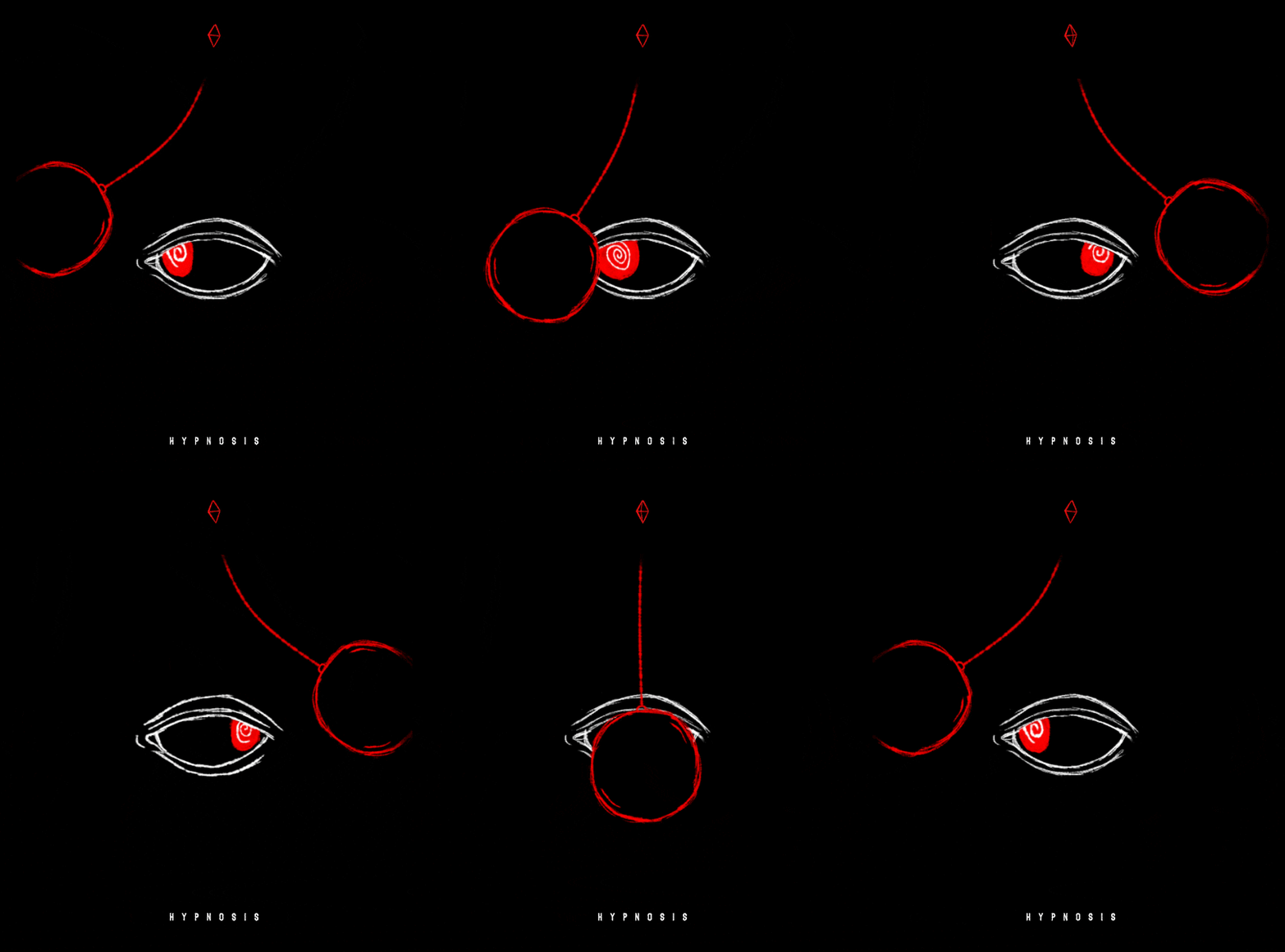
Vanessa’s eyes locked onto the swinging pocket watch, its brass glinting in the low candlelight, the rhythmic ticking sinking deeper into her mind. Each pendulum swing seemed to pull her further from the present and hurl her back to that night—the one she’d buried beneath layers of false memory, beneath years of carefully constructed lies.

She had rewritten the story so many times. In her version, the ’67 Chevy Impala was a haven, its worn leather seats a cradle of budding romance, and Jimmy Erler, her first, was tender, patient. But as Doc Halley’s hypnotic voice probed deeper, the truth began to surface, a nightmare she had kept locked away in the darkest corners of her mind.

Her breath quickened. The rain. She could hear it again, hammering the car’s roof, relentless as the truth clawed its way out. The soft whispers Jimmy once murmured in her ear weren’t sweet at all—they were commands, demands, filled with malice, punctuated by the scrape of his teeth against her skin. He wasn’t patient. He wasn’t tender. He was hungry.

Vanessa felt herself spiraling, the fragile mask of memory shattering, each fragment revealing the brutal reality she had long denied. There were no stolen kisses beneath the rain-soaked windows, no shy fumblings of young love. Instead, there was pain—her pain—and Jimmy’s mocking laughter as he forced her against the seat. His hands, once remembered as gentle, had clawed at her clothes with savage urgency.

And then… something had broken inside her.

In the shifting candlelight of Doc Halley’s office, Vanessa’s hands clenched involuntarily, her nails digging into her palms. The image in her mind grew sharper, crueler. Jimmy’s face—twisted with something darker than desire, eyes gleaming with cruelty—blurred, then fractured. Her own hands—those hands—were the ones clawing at him now, tearing at his skin, his clothes, anything she could reach.

She could still hear his voice, the smug bravado crumbling into panic as her fingernails raked his face, drawing blood, her teeth sinking into his shoulder. She had fought back. No, not fought—she had become something else, something feral, her rage drowning out all sense, all fear, until there was only the violence, the raw power coursing through her limbs.

Jimmy had screamed. But the more he screamed, the more alive she felt.

When the fog lifted, she remembered the silence. Jimmy had been curled up, his breath ragged, bloodied and trembling, his once cocky smile twisted into a grimace of terror. He was no longer the predator—he was prey, and she had tasted his fear.

The watch ticked on, its steady rhythm pulling her back to the present, but the weight of that night lingered, suffocating. The realization hit her like a fist to the gut. She hadn’t been the victim, not entirely. The real horror wasn’t Jimmy, or what he had done. It was what she had unleashed in herself.

Vanessa blinked, her mouth dry, her body rigid in the chair. Doc Halley’s voice cut through the silence like a knife, gentle but probing.

“What did you see, Vanessa?”

Her gaze shifted to the pocket watch again. The ticking was louder now, deafening.

“I… I didn’t stop,” she whispered, her voice barely audible. “I wanted to. But I didn’t.”

Doc Halley leaned closer, the candlelight casting strange shadows across his face. “What didn’t you stop?”

Her breath hitched. The memory had become a living thing, growing inside her, feeding off her guilt and her need for absolution. But there was none to be had. Not for this.

“I didn’t stop… hurting him.”

The room seemed to shrink, the darkness pressing in. She had lied to herself for years, convinced herself that Jimmy had been the monster, that she had been the innocent. But as the truth bubbled up, she knew it had been something else. She had felt good—terrifyingly, exhilaratingly good—when she tore him apart.

Doc Halley’s voice was distant now, almost drowned out by the watch’s ticking. “Do you think you can forgive yourself?”

Vanessa closed her eyes, but the image of Jimmy’s broken body wouldn’t fade. She hadn’t just taken back control that night. She had destroyed him.

The candle flickered and died, plunging the room into cold darkness.

“No,” she whispered into the void. “I don’t think I can.”

And in the silence that followed, she realized the monster she feared wasn’t lurking in Jimmy’s memory, or in some dark corner of her past. It had always been inside her—waiting.

Thirteen For Halloween: The Unwritten Chapters

The Cracked Spine was a secondhand bookstore that smelled of old paper from a bygone era. The air was thick with the weight of hardcover and paperback editions in search of new owners, each containing stories begging to be reread. We reached for the same copy of Proust’s In Search of Lost Time, fingers brushing in that intimate, fleeting way that only strangers can experience. It should have been a harmless moment, a serendipitous encounter, but instead, it marked the beginning of a descent into madness.

Nora, a figure swathed in the quiet allure of mystery, captivated me immediately. Her dark eyes, a shade too deep to be entirely human, held an intensity that unsettled as much as it intrigued. Our love for literature wove an initial bond, yet there was something deeper, an unspoken tension lurking beneath her every word. While I bared the pages of my soul, Nora remained an unread novel, her secrets bound in leather, sealed by something much darker than ink.

I should have known something was wrong when she invited me into her home. There was a weight to the atmosphere in her flat, a heaviness that pressed against my chest, making it hard to breathe. Rows of books lined every wall, like a silent congregation of forgotten lives watching my every move. But one book stood apart, a volume so ancient that its spine seemed to pulse with something… alive.

Nora noticed my gaze, and in an instant, her demeanor changed. She moved to block my path, her movements too quick, too desperate. “It’s not ready,” she said, her voice trembling—fearful, even. “It’s only a draft.”

But I couldn’t stop myself. My curiosity had taken root, festering into an obsession, and despite her protests, I reached for the book. The leather binding was unnaturally warm, as though the cover itself was alive, pulsing beneath my fingertips. The moment I opened it, I felt the floor beneath me tilt, the world spinning as the words leapt off the page, twisting and coiling around my mind like serpents.

The first few pages were innocuous enough—rough sketches, half-formed ideas, fragments of what could be—but the further I read, the more a terrifying pattern began to emerge. The protagonist was a man. He was a writer. He was me.

Each chapter chronicled intimate details of my life, moments no one else could possibly know. The way I always kept my pens organized by color. The whiskey I drank when I couldn’t sleep. The thoughts I only admitted to myself in the dead of night. But the horror didn’t end there—no, the final chapters were something else entirely.

They told of a slow, creeping descent into terror. Each word described how this man—how I—would die, alone and forgotten, hunted by something far more dangerous than Nora’s simple mystery. There were no metaphors here. No clever narrative tricks. This was a blueprint. A death sentence.

I looked up from the book to find Nora watching me, her expression unreadable. But there was something in her eyes, something dark and predatory. The warmth I had once seen was gone, replaced by an emptiness so cold it turned my blood to ice. She smiled—a slow, curling smile that never reached her eyes.

“I’ve been working on that for a long time,” she whispered, stepping closer. Her voice was low, intimate, as though we were lovers sharing a secret. “It’s my best work yet, don’t you think? The final chapter is… exquisite.”

The realization hit me with sickening clarity—this wasn’t fiction. It wasn’t a story. It was a prophecy. Nora had been crafting my death with the precision of a master artist, every detail sharpened to perfection, every emotion honed for the ultimate cut. And I was the masterpiece.

I stumbled back, dropping the book as though it had burned me, but there was nowhere to run. The walls of her apartment seemed to close in, the shadows stretching, growing, until they swallowed everything in their path. Nora’s figure loomed before me, her face twisted with something feral, something no human could ever possess.

“You were always meant to be the final chapter,” she breathed, her lips brushing my ear like a lover’s caress. “My magnum opus, completed in flesh and blood.”

I turned to flee, but the shadows reached out, cold fingers clawing at my ankles, dragging me down. My mind screamed, but my body betrayed me, frozen in place as she knelt beside me, her fingers tracing the outline of my throat.

“You’ll die beautifully,” she promised, her voice soft and soothing, like a lullaby sung by the damned. “I’ll make sure of it.”

The last thing I saw before the darkness consumed me was her smile—a perfect, serene smile, as though she had written this moment a thousand times before. And in that final, terrible instant, I realized the truth: Nora hadn’t just been writing my story.

She had been living it.

The unwritten chapters would be scrawled in blood, a story of obsession, murder, and twisted love. And I, the unwitting protagonist, had already lost my chance to rewrite the ending.

Thirteen For Halloween: The Hollow Within

image

In the echoes of my mother’s fading voice, I cling to the remnants of her wisdom, a child lost in the labyrinth of grief. Her words, once a comforting whisper, now haunt me like a twisted lullaby: “Guard the things you hold precious by keeping them hidden inside you.” But how could I, a mere child, comprehend the intricacies of love and loss? How could I find solace in the hollow chambers of my own heart when all I knew was the consuming emptiness of her absence?

I watched, helpless and alone, as her body decayed, a grotesque tableau of life’s fragility. The stench of rotting flesh filled my nostrils, a sickening perfume that permeated every corner of my existence. I searched, desperate and frantic, for the precious things she claimed to keep hidden within her, hoping to uncover the secrets that would guide me through this nightmare. But as I picked the vermin from her flesh and fought the carrion that sought to claim her, I found nothing but the hollow emptiness of death.

Her heart, once a mystery I longed to unravel, revealed itself to me in the most horrific of ways. I watched as it bruised and withered, a rotten apple consumed by the decay that surrounded it. And within its chambers, I found not love, not the answers I so desperately craved, but a writhing mass of maggots, feasting upon the remnants of her essence. The precious things she kept were nothing more than the disgusting creatures that stripped away her beauty, leaving me with nothing but the fading memories of her face.

In my dreams, she comes to me, a twisted apparition of the mother I once knew. Her face, a roiling storm of clouds, speaks to me in a voice that is a swarm of black bees, devouring all that is living and good. I run, through the forest of forgetfulness, seeking escape from the nightmare that consumes me. But there is no refuge, only the brackish waters of a black pond that beckon me with their siren’s call.

I plunge into the depths, only to find myself ensnared in a tar-like embrace, choking on the bitter molasses that fills my lungs and melts my flesh. I wake, gasping for air, my chest heavy with the weight of fear, my breathing a sickening, wet noise that echoes in the darkness. And in that moment, I know that I am no longer safe in this world, that the horrors that haunt me will never relent.

And so, in a final act of desperation, I crawl inside the remains of my mother’s body, wrapping her decaying flesh around me like a cocoon. I become the thing she kept precious, the maggot that feasts upon her essence, the hollow within that consumes all that is left of her. For in this twisted embrace, I find the only solace I have ever known, the only way to keep the precious things hidden inside me, safe from the horrors that lurk beyond the veil of death.

Thirteen For Halloween: Embrace of the Void

In the labyrinthine corridors of my mind, I wander like a condemned man, trapped in a purgatory of my own making. Each morning, I rise from the depths, a hollow shell of flesh and bone, reciting lifeless affirmations that dissipate into the cold silence. I set forth, a misguided crusader armed with delusions of redemption, determined to leave a mark on a world that long ago forgot my name.

But the path beneath my feet is a treacherous thing, twisted and serpentine, choked with the refuse of my squandered hopes and festering regrets. Misfortune trails me like a shadow that bleeds black at the edges, its hot breath caressing my neck, its claws raking ever closer. Each choice I make cleaves a piece from my soul, and with every step, I descend further into the maw of a darkness that devours all light.

The road I once called righteous has vanished, swallowed whole by a memory I cannot trust. I drift, lost in a sea of my own sins, the weight of my transgressions crushing me under the stench of decay. The rot is inescapable. It seeps into my pores, coils around my heart, whispering that the time to pay has come—and I am bankrupt, with nothing left to offer but the fragments of a wretched soul.

I collapse into the gutter, a broken thing, my body crumpling like paper soaked through with blood. The cold concrete beneath me drains the warmth from my flesh, and the world dissolves into a sickly blur. Colors bleed away until only the monochrome of oblivion remains. Then, in the midst of this dying delirium, she appears.

She stands above me, a vision carved from darkness, her beauty a dagger in my chest. Her skin is a porcelain pallor, her raven hair cascading in tendrils that curl like smoke. Her eyes, twin voids, drink in the light, leaving nothing but the blackened husk of a soul that once dared to hope. She is perfection amidst the filth, a sanctuary I have sought all my life, a deliverance I could never earn. But as I reach for her, desperate to feel the warmth of salvation, a terrible truth shatters the illusion.

She is not my salvation. She is Death itself, cloaked in false beauty. Her touch is the final cold, her kiss the last exhalation. She is a hallucination conjured by the failing mind of a man who can no longer distinguish agony from ecstasy. Yet even as the understanding seeps into my bones like poison, I yearn for her, ache to surrender to the dark mercy of her embrace. The void whispers that to yield is to find peace, that oblivion is a lover more faithful than hope ever was.

In the end, I am nothing but a hollowed-out husk, a cracked vessel through which the last vestiges of life trickle away. As I fall into the blackness, I cling to the pale specter of Death like a drowning man clutches the hand that pulls him under. I do not fight. I do not struggle. I welcome her embrace as the final union, the consummation of my shattered soul with the void that awaits.

And then, there is only the darkness. There is no salvation, no redemption. There is nothing left of the man I once was—nothing but the silence of the grave and the echo of a heartbeat that has already stopped.

Thirteen For Halloween: The Demon’s Lament

Alethea stood at the edge of twilight, a figure straddling the sacred and profane, cloaked in human flesh that barely concealed the infernal fires beneath. Her beauty was a mask, her voice a siren's call, lilting with promises of protection and devotion. She breathed lies as easily as air, each word slipping like silk around the throat of her chosen prey.

"Calvin," she whispered, the sound curling through the gloom. "You need not fear me. I only seek to keep you safe."

The air grew thick with the scent of decay, the cloying perfume of ancient temptation. Calvin, a man anchored in faith, clutched his rosary so hard his knuckles paled. His heart beat against his ribs like a frantic animal, but his thoughts held firm, fortified by the Scriptures that warned against the Beast's seductive touch.

“Stay back,” he stammered, eyes wide, the cross held between them like a blade. “You are not of this world. You are a creature of darkness.”

Alethea's gaze softened with an almost imperceptible sadness, a crack in the veneer of her monstrous facade. "You speak of darkness as if you truly understand it," she said, her voice as cold as the grave. "You cling to your faith, your symbols, as though they could protect you from the reality that lies beneath your skin. We are not so different, you and I."

Her eyes, black pools that swallowed the light, seemed to plead with him to see beyond the horror, to recognize the fractured soul trapped within the demon's form. But Calvin’s grip tightened, and his lips moved silently, reciting prayers he had learned as a child. The holy words fell from his tongue like ash.

“Get thee behind me, Satan,” he spat, though his voice quivered. “I will not succumb to your wiles.”

Alethea’s expression darkened, the illusion of warmth draining from her face like a sunset giving way to the night. Her features sharpened, revealing the contours of something ancient and hungry lurking just beneath the surface of her skin. The sadness in her eyes flared into rage, a cold flame that burned without heat.

“You fool,” she hissed, her voice reverberating like the tolling of a funeral bell. “You speak of salvation, but you have damned yourself by your own hand. Had you not recoiled in fear, I would have shielded you from the evils of this world until the stars themselves burned out.”

The shadows around her twisted and writhed, alive with malice. Calvin stumbled back, his faith wavering as an icy dread clawed its way up his spine. In that instant, the mask fell away, and the full horror of her true form unfurled before him: a thing forged in the abyss, its skin a darkened marble streaked with cracks through which a hellish glow seeped. Her mouth split wide, revealing rows of needle-like teeth slick with hunger.

A scream clawed its way from Calvin's throat as she descended upon him. Her nails, sharp as daggers, raked his flesh, and her mouth, unhinged and yawning like a pit to oblivion, latched onto his throat. As she fed, the life drained from his eyes, the rosary slipping from his limp fingers to the cold earth below. His soul, severed from its mortal tether, slipped into darkness, vanishing like a final breath on the chill wind.

When the feeding was done, Alethea stood amidst the carnage, her hunger sated but her heart hollow. She knelt beside Calvin's body, her bloodstained lips trembling as she whispered, “I would have loved you.” Her words fell into the night, unanswered and unheard, a lament carried away by the wind.

The silence that followed was suffocating, and Alethea found herself staring into the void, a creature born of darkness yet grieved by a love that had been poisoned by the prejudice of mortal men. In the end, she was left with nothing but the taste of regret and the certainty that true damnation lay not in her infernal nature, but in the hearts of those who could only see her as a monster.

The night wore on, and the demon wept tears of blood over a love that had died before it had ever truly lived.

Thirteen For Halloween: The Seer of Forsaken Alleys

The narrow street felt like a forgotten corner of the world, shadowed by crumbling buildings and dimmed by the setting sun. Renee had passed this way hundreds of times, always ignoring the rusted neon sign that flickered above the doorway: Madame Celeste—Fortunes Told. She never believed in that sort of thing.

But today was different.

Fresh out of a five-year sentence for armed robbery, her body was free, but her mind had remained shackled to one thought: her daughter, Ellie. Five years of missed birthdays, five years of wondering whether her child even remembered her, five years with no answers. The State had taken Ellie, placed her with some family she’d never met. No matter how hard Renee searched, it was as if her daughter had vanished.

Desperate, with nowhere else to turn, she stood at the entrance of the dingy fortune-telling parlor, the name Madame Celeste practically buzzing like an insect in her ears.

The inside was worse than she expected. Threadbare curtains, a single flickering candle, and the heavy scent of incense thickened the air. A table, draped in velvet, sat in the middle of the room, and behind it, the fortune teller herself: a gaunt woman in a patchwork of scarves and jewelry, her face obscured by a veil of beads.

“I’ve been expecting you,” the woman said, her voice smooth, with a hint of a rasp.

Renee hesitated, her pulse quickening. “How could you—?”

“I know why you’re here,” Madame Celeste interrupted, gesturing to the chair. “Sit. We’ll find her together.”

Renee’s breath caught. How could this stranger know? Was this a scam? But the thought of Ellie—the need to see her again, hold her again—was stronger than her suspicion. She sat.

“Your daughter… Ellie,” the fortune teller whispered, the name slipping from her lips like smoke. Her long fingers danced over a worn deck of tarot cards, shuffling them with an eerie grace. “She’s closer than you think.”

The cards fell, one by one. The Hanged Man. The Tower. Death.

Renee’s throat tightened. “What does that mean? Where is she?”

Madame Celeste smiled, revealing teeth too sharp for comfort. “She’s waiting for you. But to find her, you must follow the path unseen. The roads of the dead. You’ve walked close to the edge before, haven’t you? You know the place where life and death blur?”

Renee clenched her fists. “What are you talking about?”

“The place you’re looking for is not a physical one,” the seer murmured. “Ellie has crossed over, but not in the way you fear. Her spirit is bound to this world, wandering, waiting. She needs you to set her free.”

A chill crawled up Renee’s spine. “No… no, Ellie’s alive. She’s out there. I just need to find her.”

Madame Celeste leaned closer. “She was alive. But when you went away, no one came for her. No one cared. The family she was placed with—”

“What are you saying?” Renee’s voice cracked.

The fortune teller’s gaze pierced her, unblinking. “Your child died alone. Starved. Forgotten. The only way to reunite with her is to cross over yourself.”

Renee shot up from the table, her heart pounding. “You’re lying!”

But deep down, something in the words resonated. She had nightmares in prison, visions of Ellie calling out for her, crying, alone. She’d always woken up drenched in sweat, praying it was just her mind playing tricks.

“Go to the place where you were happiest with her,” Madame Celeste said softly. “She will meet you there.”

With shaking hands, Renee fumbled for the door. The fortune teller’s voice echoed in her ears as she stumbled into the night, a single word repeating: cross over.

The old playground. It hadn’t changed in all these years. Rust clung to the swings, the slide was chipped and faded, and the jungle gym looked skeletal under the streetlights. Renee stood there, the memories rushing back—of Ellie laughing, her tiny hands clutching the chains as she swung higher and higher.

“Ellie?” Renee whispered into the cold night air.

A shadow flickered at the far end of the playground. A small figure, no taller than a child, emerged from the gloom.

Renee’s heart lurched. “Ellie?”

The figure stepped closer, and as it did, Renee’s stomach twisted. It wasn’t Ellie. The thing that approached had her daughter’s shape, but its skin was wrong—pale, sagging, with hollow eyes that stared without seeing. It moved with a jerking motion, like a puppet on tangled strings.

“Mommy?” the thing rasped, its voice an echo of the child Renee once knew, but distorted, broken.

Renee’s legs buckled. “No… no, this isn’t real!”

The thing’s head tilted, its cracked lips curling into a grotesque smile. “You left me. Why did you leave me, Mommy?”

Renee screamed, backing away, but the figure advanced, faster now. Its skeletal hand reached for her, ice-cold fingers grazing her skin.

“I was waiting for you,” it whispered. “Now you can stay with me… forever.”

The world around Renee darkened, the playground fading as the shadows closed in. Her breath came in ragged gasps, and in her last moments, the memory of Ellie’s real laughter—pure and joyful—was drowned out by the horror that had taken its place.

The next day, the sidewalk fortuneteller packed up her things and moved on.

The playground remained, but the swing no longer moved in the wind. In its place, a new shadow hung in the air—one that sometimes whispered a name, searching, always searching, for the child she’d lost.

Thirteen For Halloween: The Skin Thief

The sterile air of the hospital was heavy, tinged with the scent of antiseptic and decay. Karl lay there, a fragile wisp of the child he had once been, his skin pale, stretched taut over bones that should have still been growing. The disease had whittled him down to something less than a boy, more like a flickering candle, guttering on the edge of darkness.

The heart monitor beeped in slow, shallow rhythms—each sound a metronome counting down his final hours. His parents sat nearby, hollow-eyed, their hands trembling as they held his, as if their love alone could keep him tethered to this world. But their love was powerless against the ravenous hunger that lurked unseen.

In the corner of the room, Karl’s imaginary friend, King Koda, waited. He was a tall figure, clothed in shimmering robes that only Karl could see, with a face that radiated kindness. Or, at least, it had once. Lately, something about the king's eyes had changed—becoming darker, hungrier.

Karl didn’t notice. He saw only his beloved companion, the king who had been with him through lonely nights and hospital stays. King Koda had always promised to protect him, to shield him from pain. But tonight, there was something wrong with that smile.

The boy dreamed of worlds
Where kings were friends and nightmares were myths
But some monsters wear familiar faces
And not all imaginary friends are safe


As his breaths grew shallow, Karl’s vision blurred. His parents whispered soothing words, but their voices seemed distant. And in the fog of his fading consciousness, Karl felt King Koda’s hand touch his—warm, far too warm, almost burning.

"Don’t be afraid," King Koda said, his voice soft, like silk sliding over a blade. "I will take care of you. I’ll make sure you live forever."

The words should have comforted Karl. But something was wrong. The touch of the king’s hand felt different now—too solid, too real. The air around the bed felt thick, oppressive, like the room itself was closing in, trapping him.

A promise laced with venom
The king whispers his dark command
In the shadow of death
There is a hunger older than time


Karl’s breath hitched, and for the first time in weeks, fear coursed through his frail body. He tried to call for his parents, but his voice was caught in his throat. His eyes darted toward them, desperate—but they sat, heads bowed, oblivious, as if some unseen force held them in a trance.

King Koda leaned closer, his once regal face now twisted into something grotesque, his teeth too sharp, his eyes too hollow. “It’s time, Karl. You have something I need.”

A coldness crept into the room, a suffocating weight. Karl’s skin prickled, and the little light left in his eyes began to dim as Koda’s true nature unveiled itself. The king wasn’t a friend. He wasn’t even human. He was something ancient, something that had fed on the minds of the vulnerable for centuries.

And now, he would take Karl’s life as his own.

Innocence devoured by shadows
A king of nightmares sheds his guise
A child’s light extinguished
As the Skin Thief claims his prize


With a sickening crack, King Koda’s form began to shift. His once-fantastical body twisted, growing taller, the flesh warping and tearing until it was no longer robes and crowns, but sinew and bone, stealing Karl’s shape. The frail child beneath him gasped, his last breath a shallow wheeze as the boy’s form slipped away—just another hollow shell for the creature to wear.

The heart monitor flatlined, its shrill scream blending with the rising wind of the creature’s birth. The room was filled with a gust that seemed to come from nowhere, scattering the tokens of love—the toys, the blankets, the flowers—as though they had never mattered.

And then, in the stillness, it stood—no longer King Koda, but Karl. Or something that wore Karl’s face.

The parents rushed to their son’s side, but it was too late. The thing that stood before them blinked with the same blue eyes, smiled with the same soft lips—but it was not their son. Not anymore.

Beneath the skin, something else watched them, something ravenous. The creature’s lips curled up, just slightly, as it settled into its new form. A wave of terror washed over the parents, though they didn’t understand why. Not yet.

“Mom? Dad?” the thing that was not Karl said, its voice innocent, perfect.

They wept with joy, not knowing that what they embraced was a monster.

In the mask of a child’s flesh
The Skin Thief walks the earth
Preying on those who see only what they wish


The hospital lights flickered as the creature left, hand in hand with Karl’s parents, their hearts too broken to sense the wrongness beside them. But deep inside, the thing smiled. It had taken Karl’s skin, his life, and now it would take more—because hunger like this is never satisfied.

And out in the night, a shadow passed across the moon, as another innocent life was claimed by the Skin Thief.

Thirteen For Halloween: The Fault of the Nightlight Redux

Darkness descends, not gently but with weight—a suffocating shroud. The click of the light switch, the thud of the closing door. Sounds that, in the daylight, are small, meaningless. But at night, they grow loud, like the ticking of a clock running out of time.

Parental abandonment
The nightly ritual
Leaving little Evan
To face the shadows’ revival

The nightlight flickers, its glow pale and inconsistent, the kind that hides more than it reveals. The soft yellow light twists the room’s familiar shapes into sinister figures—elongated, contorted, twitching as if ready to leap off the walls.

Shadows stretch and swell
A puppet show of terror
Hinting at horrors
Lurking beyond the veil

Evan pulls the covers to his chin, eyes darting to every shifting corner. He tries to pretend it’s just his imagination, but he knows better. The flickering of the nightlight is more than a malfunction. It’s a signal, a summoning. The witching hour approaches, when the boundary between worlds grows thin, and what hides in the dark comes forth.

The witching hour strikes
Whispers, scratches
Nightmares stir
In the waking world’s cracks

The first sound is always the scuttling—tiny legs, hundreds of them. Evan presses his hands over his ears, but it’s no use. He feels them first, their brittle bodies brushing against his skin beneath the covers. Cockroaches. Feral. Their exoskeletons scrape like nails on glass, filling the air with a cacophony of insectile chatter.

Chitinous swarms
A living tide
Engulfing innocence
In their crawling pride

But they aren’t the worst of it. Not by far. The rats come next, skeletal things with gaping sockets where eyes should be, noses twitching as they search, search for something to devour. Evan’s breath hitches as he feels the cold, wet slap of a rat’s tail against his ankle. He stifles a scream.

Eye-less vermin
Scavengers of sanity
Gnawing at the fragile edges
Of reality

The air grows colder. Evan’s breath fogs in front of him, though the window remains shut. From the ceiling, something moves, a shape more felt than seen—spectral, weightless, like a wisp of mist that curls down toward his bed. The bedsheet-wraiths, as Evan calls them. They glide silently, their touch icy and wrong, as if they feed off warmth and leave only cold despair in their wake.

Soul-sucking specters
Hungry for life’s heat
Draining vitality
Leaving hollow defeat

A shadow flickers to his left. Evan turns his head just in time to see them—the toys. His toys. The plastic dinosaurs he once played with, now standing on twisted legs, their eyes glowing red. They stalk forward with slow, deliberate steps, jaws snapping, eager to taste his skin.

Childhood whimsy, perverted
A Jurassic nightmare
Toys turned predators
In their colorful, carnivorous snare

And then, the sound that undoes him. The rapid, chattering clack of the windup teeth. They move faster than they should, crossing the floor in mechanical bursts. They leap onto the bed, gnashing with mechanical hunger, a mindless frenzy.

Grinning monstrosities
Gears grinding in delight
Seeking to strip identity
To devour his fight

Evan wants to scream. His mouth opens, but no sound escapes. His heart pounds in his throat, tightening like a noose. He reaches for the nightlight. Maybe if he shakes it, the glow will strengthen, will hold them back. But as his fingers brush its plastic surface, the light flickers again—once, twice, before dimming to nearly nothing.

That’s when he hears it. Not a noise, but a voice. It slithers into his mind, oily and cold.

“You brought us here.”

Evan’s hand jerks back. His breath is ragged now, eyes wide as the realization dawns.

The nightlight wasn’t protection. It never was. Its flickering was an invitation. He turns, wide-eyed, as the shadows close in around him, their voices growing louder, their forms more solid, more real.

A cold touch grazes his cheek. A windup tooth clatters onto his pillow.

His hand trembles as he reaches to switch the nightlight off. His last hope—darkness, silence, anything to stop the nightmare. But his fingers hover over the switch, frozen.

Because in the dark, they would still be there. And in the dark, he wouldn’t see them coming.

The light flickers once more, and the last thing Evan hears is the low, cruel laughter from the shadows.

The nightlight’s glow—
A cruel trick
Not safety, but the key
To the Nightmare Realm’s thick

Thirteen For Halloween: The Reaping Kiss

Soledad drifts in fevered twilight, her mind unraveling at the edges of a brittle reality. The air, thick with weightless shadows, hums with something—something ancient, something eager. The room bends with a rhythm it should not possess, a slow twisting of perception as the walls pulse in time with the erratic beats of her heart.

She can no longer tell where her body ends and the shadows begin.

In her final hours, her sanity unwinds like thread caught on a rusted nail, taut one moment and fraying the next. She stares at the cracks in the ceiling, but the cracks stare back, widening, breathing.

The whispers are the worst. A sickening rasp, crawling just beneath the audible. It claws through the air, finding her, winding around her, each syllable a thread tightening around her throat.

“Soledad…”

It’s more than a voice. It’s a presence—no, a hunger, murmuring her name like a forbidden prayer.

“Soledad…”

The voice coils, pulls her downward. She’s drowning, gasping, but the room is bone-dry. She reaches for something, anything to hold onto, her hands grasping at nothing, clawing at phantoms in the air.

“Soledad.”

She is falling, slowly, eternally, sinking through her own skin, lost in the spaces between each labored breath. The sound of her heartbeat stretches, drags her with it, beats colliding with moments that feel like centuries.

Each second an eternity.

Then, something touches her.

Not skin. Not flesh. A pressure, like the weight of a world pressing against her lips—no, like something beneath the world. A kiss, cold as the void itself, yet burning her from the inside out. The air collapses in on itself, and her body stiffens, every nerve alight with raw sensation.

She gasps, and it takes her in deeper.

In that kiss, everything ceases to be what it was. The world dissolves. Her thoughts, her fears, her memories—they become irrelevant, unmade, as if they had only been dreams borrowed from someone else’s life.

The kiss devours her, and she opens herself to it, the desire, the need, blending with pain so sharp it is indistinguishable from pleasure. She melts, becomes less than human. She becomes the kiss itself.

Her self, her Soledad, drains away, slipping into the void with the remnants of her soul. She doesn’t fight it. Why would she? This has always been her path.

It was always leading here.

It was always leading to him.

The voice—the lips—they aren’t human. She understands now. The reaper had been patient, silent, waiting for the moment her walls would finally collapse. All those years spent running, all the pointless resistance. It had known. It had always known.

“My Soledad…”

The rasping voice caresses her, full of mockery, full of possession. She is not her own anymore. She was never her own. This, this terrible moment, this is the truth of her existence, the only truth that matters.

Soledad had been courting death all along, chasing the inevitable with every heartbeat, every breath, until there were no more to give. She sees it now. A lover that was always waiting, just beyond the edge of sight, behind every decision she had ever made.

The kiss has taken everything, and yet it remains. It is eternal, lingering long after her name, her mind, her essence, have vanished into the dark. Her body—a hollow shell—is the only testament left, a discarded relic of the woman she once was.

But that laugh—oh, that laugh.

The laugh bubbles up from somewhere deep in the void, cruel and knowing, echoing in the places where the light never touches. It doesn’t fade; it only grows louder, spreading like frost over her vacant form, seeping into the marrow of her discarded bones.

And the kiss waits there, too. Lingering. Watching.

Soledad is gone. A husk, a work of macabre art left behind, but this story isn’t over. The kiss isn’t finished.

There will be others. There are always others.

Another will stumble into its grasp, another lost soul, another broken defense. And when they do, the kiss will be waiting, ravenous, timeless.

It always has been.