
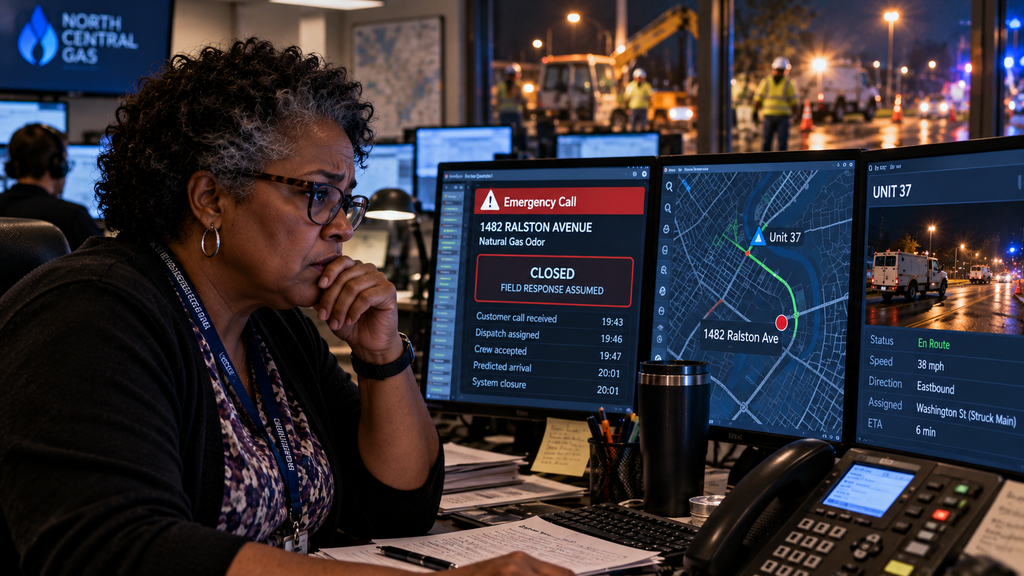
Toni Radomski first noticed the missing gas call because Curtis DeWitt was driving in the wrong direction.
His service truck appeared on the dispatch map as a blue triangle moving east along Washington Street, away from the neighborhood where Toni sent him twelve minutes earlier. The emergency ticket assigned to his unit should have remained at the top of her active queue until Curtis acknowledged arrival. Instead, the queue held six newer calls and no trace of the duplex on Ralston Avenue.
Toni searched the address.
The ticket came up CLOSED — FIELD RESPONSE ASSUMED.
She checked the timestamps.
Customer call received: 19:43.
Dispatch assigned: 19:46.
Crew accepted: 19:47.
Predicted arrival: 20:01.
System closure: 20:01.
Current time: 20:04.
There was no arrival confirmation.
Toni keyed Curtis’s radio channel.
“Unit thirty-seven, dispatch.”
Curtis answered over road noise. “Thirty-seven.”
“Status on Ralston.”
“Haven’t made it.”
“I can see that. Why are you eastbound?”
“Control pulled me to the struck main on Washington.”
“Who reassigned you?”
“Regional emergency. Everybody close got grabbed.”
Toni opened the struck-main incident. Curtis had been added to it at 19:56 by the network-control desk after an excavator damaged a four-inch distribution main behind a strip mall. Fire and police were already evacuating three businesses. Five gas crews were responding.
Nobody had returned the Ralston odor call to the unassigned queue.
“Ralston reported indoor odor,” Toni said.
“I know. I told the tablet I was diverted.”
Toni found the diversion event in the vehicle log.
The emergency ticket still showed closed.
“Stay on Washington. I’ll reassign Ralston.”
“Copy.”
Toni reopened the call manually.
The dispatch system resisted.
SERVICE EVENT COMPLETED BY ARRIVAL RECONCILIATION
She selected REOPEN — CREW DID NOT ARRIVE.
A warning appeared.
REOPENING COMPLETED EVENT MAY AFFECT RESPONSE METRICS. CONFIRM FIELD STATUS BEFORE ACTION.
Toni muttered at the monitor and confirmed it.
Ralston returned to the active queue in red.
She assigned the nearest free technician, who was nineteen minutes away.
Then she called the customer.
A man answered.
“This is North Central Gas emergency dispatch. You reported a gas odor at 1482 Ralston?”
“Yeah. Somebody supposed to be coming?”
“Yes. I need to update you. Are you outside the building?”
“No. Smell went away.”
Toni straightened in her chair. “Sir, you need to leave the building and stay outside until it has been checked.”
“I opened the basement windows.”
“Please leave now. Don’t operate switches or appliances on the way out. Take everyone with you and call us back from outside if you need to.”
“My wife says she can’t smell it anymore either.”
Toni repeated the instruction, keeping her voice steady until the man finally agreed.
She added a note to the ticket and requested fire-department notification through the emergency liaison desk. Once the replacement technician acknowledged the assignment, Toni returned to the closed-event screen.
The system should never have reached that status.
North Central Gas introduced the new dispatch platform five weeks earlier. The old software remained underneath it, a collection of databases and routing tables accumulated through acquisitions, regional consolidations, and technology changes extending back decades. The new interface promised to unify customer calls, crew locations, route optimization, emergency prioritization, work orders, tablet status, and performance reporting inside one system.
Dispatchers complained about it from the first night.
Dispatchers complained about every new system.
Toni had worked utility dispatch for twenty-three years and considered complaining part of the commissioning process. Experienced operators found the assumptions designers missed, the trainers called those findings edge cases, patches arrived, and after six months everybody forgot which annoyances belonged to the old software and which belonged to the new.
The Ralston closure felt different.
Toni opened the activity log and scrolled through system events.
At 19:47, Curtis accepted.
At 19:48, RouteSure calculated a fourteen-minute ETA.
At 19:53, traffic data reduced it to eight minutes.
At 19:56, network control diverted Curtis to Washington.
At 19:56, his field tablet recorded DIVERTED — HIGHER PRIORITY INCIDENT.
RouteSure continued calculating his arrival at Ralston.
At 19:58, predicted arrival became three minutes.
At 20:00, one minute.
At 20:01, the application marked the emergency call FIELD RESPONSE ASSUMED, removed it from Toni’s active queue, and transferred ownership to the field-service layer.
Curtis never arrived.
Toni called her shift lead.
Armand Havel was sitting three rows behind her reviewing the Washington Street incident with network control. He came over wearing his headset around one ear.
“What’s up?”
She showed him the log.
“Curtis got diverted. Ralston auto-closed anyway.”
Armand leaned toward the monitor.
“That’s field handoff, not final completion.”
“It disappeared from emergency dispatch.”
“Did the work order stay open?”
Toni pulled it up.
The field work order showed PENDING TECHNICIAN DOCUMENTATION.
Assigned technician: Curtis DeWitt.
Location status: EXPECTED ON SITE.
“The work order is technically open,” Armand said.
“With a technician who’s two miles away at a broken main.”
Armand read the timestamps again.
“Send this to systems.”
“I reopened it.”
“Good.”
“That customer was still inside.”
That got his attention.
“Did he evacuate?”
“He says he is now.”
Armand looked toward the wall display where emergency events appeared by district.
“Any actual gas reading?”
“Replacement crew isn’t there yet.”
“Tag the incident for safety review.”
Toni did.
Armand returned to Washington Street because a damaged main feeding occupied businesses required immediate attention and the Ralston call was moving again.
At 20:29, the replacement technician reached the duplex.
At 20:34, he reported a positive combustible-gas reading in the basement.
Toni stopped treating the software event as an interesting defect.
The technician shut off service to the building, requested a leak-survey crew, and found migration near the service entry. The occupants remained outside. Fire personnel stood by until the building was ventilated and readings cleared.
Nobody was injured.
Toni printed the dispatch log anyway.
By nine, Washington Street was stabilizing. The damaged section had been isolated, the immediate evacuation zone was no longer expanding, and several field units became available for ordinary emergency calls again.
Toni searched the evening’s completed odor reports.
There were forty-eight.
She filtered for calls where FIELD RESPONSE ASSUMED preceded an actual ONSITE event.
Most looked normal. A technician approached the address, the system advanced the dispatch event into field ownership near the predicted arrival, and the crew recorded arrival seconds or minutes later.
Four did not.
Toni opened the first.
Crew assigned to an outside odor.
Predicted arrival 18:11.
Dispatcher event auto-closed 18:11.
Actual arrival 18:26.
The technician had stopped for a train.
Second call: auto-close preceded arrival by nine minutes.
Third: seventeen minutes.
Fourth: no arrival event at all.
Toni opened the fourth.
632 BOYER STREET — ODOR NEAR METER
Customer called at 17:38.
Crew accepted at 17:41.
Predicted arrival 17:55.
Auto-close at 17:55.
The field work order remained PENDING TECHNICIAN DOCUMENTATION.
Assigned technician: S. Kocur.
Toni radioed the technician.
“Unit nineteen, dispatch.”
A woman answered. “Nineteen.”
“Did you handle six-thirty-two Boyer around eighteen hundred?”
“No.”
Toni felt the room around her narrow into screens and timestamps.
“You accepted it at seventeen forty-one.”
“I got diverted to the school hit.”
“Did you mark the diversion?”
“Yeah.”
The log confirmed it.
“Did anybody send you back afterward?”
“No. I assumed it reassigned.”
It had not.
Toni reopened Boyer.
The original customer did not answer the phone.
She called again.
Voicemail.
Toni sent the nearest available crew and requested police or fire contact at the residence because the original report involved odor near a gas meter and nobody could reach the caller.
Armand returned when she waved him over.
“There’s another one.”
She showed him Boyer.
His face changed.
“How many?”
“I found two actual misses so far. Four delayed handoffs beyond the auto-close.”
“Stop searching and give me the list.”
“I need to know how many disappeared.”
“Give me what you have first.”
Toni emailed the records while Armand called the operations manager.
The replacement crew reached Boyer at 21:27.
Nobody answered.
The technician found a noticeable gas odor near the outside meter set and elevated readings at the foundation. Firefighters forced entry after police confirmed the registered occupant’s vehicle sat in the driveway and repeated calls produced no response.
The house was empty.
The resident turned out to be working an unplanned evening shift and left shortly after making the original report. He assumed the gas company would investigate without him.
The technician found a leaking service connection outside.
Another near miss.
No casualty.
No explosion.
No dramatic punishment arrived to justify the seriousness of what Toni was seeing.
The system simply failed to keep two emergency notices visible after crews stopped heading toward them.
At 22:05, North Central’s operations manager joined a conference call with dispatch leadership, IT support, field operations, network control, and the vendor’s overnight support desk.
Toni was invited because she found the defect.
The vendor engineer called the feature arrival reconciliation.
“It advances dispatch ownership when a crew’s projected arrival reaches the service point,” he explained. “That prevents completed field events from remaining active in the dispatcher workload when technicians are delayed in updating status.”
Toni sat at her console with the conference audio in one ear.
“It doesn’t advance when the crew arrives,” she said. “It advances when your route engine predicts arrival.”
“Under normal workflow, those should correspond closely.”
“They don’t correspond when the crew gets diverted.”
The engineer asked whether diversions were sent through the integrated emergency-routing function.
Network control answered that regional incident assignments originated in a separate operations module.
“That may explain why the forecast isn’t being canceled,” the engineer said.
Toni looked at the Ralston log.
“The field tablet recorded the diversion.”
“Yes, but that event may not invalidate the route object used by arrival reconciliation.”
“So your system knows the technician left the job and still assumes he arrived.”
The engineer avoided the simplification.
He explained that separate services maintained crew task state, vehicle routing, and dispatcher ownership. The new interface displayed them together, which made them appear more unified than they were.
Toni understood enough software architecture to dislike the sentence.
Armand asked the question that mattered.
“Can we turn arrival reconciliation off?”
The engineer said configuration changes required change control.
“How long?”
He would have to contact the on-call application owner.
Operations management instructed dispatchers to manually verify every gas-odor event that transitioned through FIELD RESPONSE ASSUMED until the feature could be disabled.
Toni looked at the queue.
Thirty-one active emergency calls.
Seven dispatchers.
Two new odor reports arrived while the conference continued.
Manual verification sounded excellent in a meeting.
It sounded different when the calls kept coming.
At 22:41, Toni found the third orphaned event.
At 22:47, another dispatcher found two.
At 23:03, a district supervisor called about a crew whose tablet showed four old jobs still pending even though dispatch considered them complete.
Some were paperwork.
Some were duplicate customer reports from the same incident.
One was an inside-odor call from nearly three hours earlier.
That customer answered immediately and said a technician had already come.
The field technician forgot to update the tablet.
Everyone wanted more of those.
Toni began using an old status to keep questionable calls in her queue.
SUSP.
The code survived from the previous dispatch system and meant the event required resolution before archival. The new interface still recognized it because migration rules preserved legacy exception states.
She changed Ralston to SUSP — AUTO-CLOSE REVIEW.
Boyer received the same status.
When another dispatcher found a call with no verified field arrival, Toni told him to use SUSP.
The calls stopped disappearing.
For twenty minutes, the workaround seemed almost elegant.
Then the route engine began behaving strangely.
Available crews disappeared from recommendation lists after any SUSP assignment touched their history. One technician remained shown as committed to a suspended job he had completed two hours earlier. Another became unavailable for automated routing across an entire district.
Dispatchers compensated manually.
At midnight, the center looked the way Toni remembered it from years earlier, before optimization software began proposing crews automatically. People spoke across aisles, compared maps, called field supervisors, and wrote unit numbers on scrap paper.
The computers were still there.
Nobody trusted the green recommendations.
Armand came to Toni’s station.
“SUSP is poisoning crew availability.”
“It keeps the calls open.”
“I know.”
“You want me to stop?”
“I want another option.”
“There isn’t one.”
A new emergency call entered Toni’s queue.
STRONG GAS ODOR — MULTIUNIT RESIDENCE
She assigned a crew manually.
Another call appeared before she finished.
Cold weather had settled over the service territory, and furnaces cycling on for the first sustained autumn chill were generating odor calls, appliance complaints, ignition problems, and actual leaks faster than the quiet hours earlier in the evening suggested.
The vendor engineer returned to the conference line at 00:18.
He could disable arrival reconciliation at the regional level.
Operations asked what would happen.
“There may be an immediate restoration of dispatch events currently held in field ownership without terminal completion.”
“How many?” Armand asked.
“I can’t determine that until the service is disabled.”
Toni turned in her chair.
“That’s the number we need before we decide?”
Nobody answered her directly.
The engineer explained that the dispatch interface might repopulate with events technicians already completed physically but failed to close electronically. Historical events within the active retention window could also return if their field state remained unresolved.
The operations manager asked whether disabling the feature could interfere with emergency routing.
“It should remove automated arrival handoff. Routing itself stays active.”
“Should?”
“The components are separate.”
Toni heard someone at network control swear with his microphone open.
The operations manager requested five minutes.
Supervisors spoke among themselves.
Dispatchers kept working.
Toni opened the active-event history and looked at the two calls that started the problem. Ralston eventually led to a leaking service entry. Boyer involved an outside connection. Neither became a catastrophe.
The software would have looked successful if nobody went searching.
That bothered her more than an obvious crash would have.
At 00:24, the operations manager authorized the shutdown.
The vendor engineer disabled arrival reconciliation.
For several seconds, nothing happened.
Then Toni’s queue changed from twenty-two active events to forty-seven.
Across the room, another dispatcher said, “Oh, hell.”
Forty-seven became eighty-one.
The wall display refreshed.
District counts doubled.
A warning banner appeared across the dispatch application.
UNRESOLVED FIELD EVENTS RESTORED
The count passed one hundred.
Some events dated back to the afternoon shift.
A few came from the previous day.
Toni’s personal queue reached ninety-three before assignment balancing redistributed them.
Nobody spoke for several seconds.
Then Armand stood.
“Listen up. We triage by emergency class and last verified human contact. Nobody bulk-closes anything. Inside odor first, active outside leak second, damaged facilities next. Completed work with missing paperwork goes to the side. Call field supervisors for anything older than two hours. If you cannot establish response, treat it as unanswered.”
The dispatch room became loud.
Toni took the oldest inside-odor ticket assigned to her.
The technician’s field notes existed.
He had arrived, found a defective range connector, shut off the appliance, ventilated, and cleared the residence.
She marked it verified.
Next.
Duplicate report. Same apartment building, same field incident.
Verified.
Next.
Technician arrived but failed to enter the final completion code.
Verified through radio log.
Next.
Customer reported odor at 16:52.
No field note.
No arrival.
Crew diverted.
Toni called.
The customer answered after six rings.
“Yes?”
“This is North Central Gas. You called earlier about an odor.”
“That was hours ago.”
“Did a technician come?”
“No.”
Toni stopped typing.
“Are you still at the address?”
“No. We went to my sister’s. I got tired of waiting.”
“Did the odor remain when you left?”
“Yes.”
Toni assigned the nearest crew manually and requested fire-department notification.
The ticket stayed on her screen.
Nobody allowed the system to make it disappear.
By 2:00 a.m., they had cleared most of the restored events as documentation failures, duplicate reports, properly handled jobs, or calls with verifiable field response.
Eleven required crews to return or investigate.
Four involved customers who had left before anyone arrived.
Three involved leaks requiring repair.
No injuries were found.
The count mattered less than Toni expected.
One would have been enough.
The vendor engineer remained on the line while IT exported every affected event for review. Arrival reconciliation would stay disabled pending testing. Network control agreed to route diversion events through a temporary manual notification process so dispatch owned each abandoned emergency until reassignment.
Nobody called the solution efficient.
At 3:16, Toni worked through the final cluster of old calls.
A ticket from another district caught her attention because its status differed from everything around it.
SUSP
Creation date: three years earlier.
No customer address appeared in the current interface.
Only a legacy event number survived.
Toni opened it.
The new system returned an error.
RECORD EXCLUDED FROM AUTOMATED RECONCILIATION
She tried the old database viewer.
The event belonged to a migration test performed during an earlier software conversion. No live emergency attached to it. A trainer created the record, marked it SUSP to keep it from closing with production work, and apparently never removed it.
The useless ticket survived three years of upgrades because every cleanup routine had been instructed to leave unresolved exceptions alone.
Toni looked at the screen for a while.
Then she closed the viewer without changing the status.
At 5:40, the morning shift began arriving.
The overnight dispatchers gave handoff reports aloud because nobody trusted the automated summary enough to rely on it alone. Armand distributed printed lists of every restored emergency event still requiring review. The wall display contained more open work than anyone liked, though each entry now represented something a human being had either verified or still needed to verify.
Toni finished the Ralston safety report before logging out.
Under CONTRIBUTING FACTOR, she selected DISPATCH SYSTEM / WORKFLOW.
Under DESCRIPTION, she wrote that automated arrival reconciliation removed an emergency gas report from the active dispatch queue based on predicted arrival despite a documented crew diversion. She attached Boyer and the other recovered calls as related events.
The form asked for corrective action.
Toni entered:
Automated dispatch closure disabled. Emergency events remain dispatcher-owned until verified field arrival or deliberate reassignment. Restored unresolved events require human review before closure.
She saved the report.
The system returned a warning.
OPEN EXCEPTIONS REMAIN
Toni clicked ACKNOWLEDGE.
She left them open.
©2026 Rhyan Scorpio-Rhys