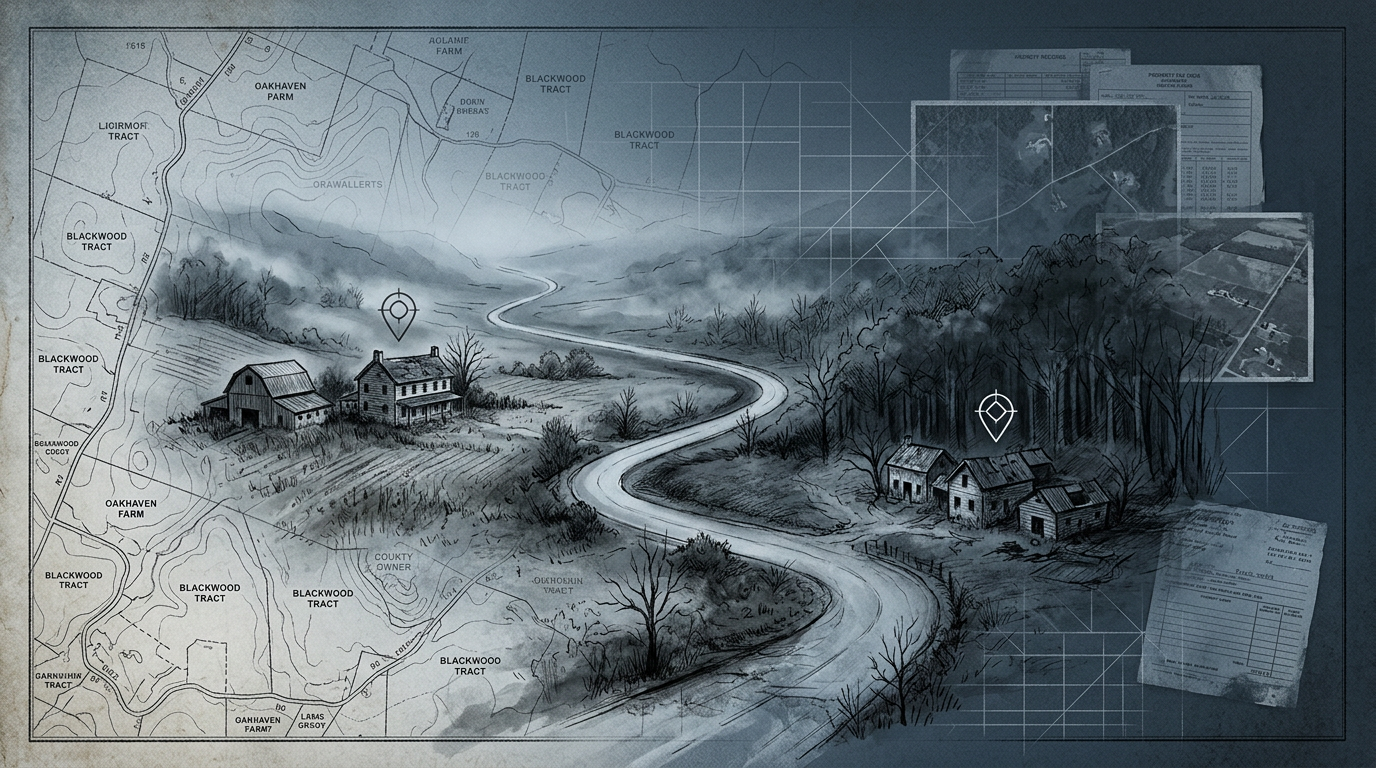


Lori Bender found the duplicate at 8:43 on Monday morning, thirty-seven records into a quality-control report that contained 1,126 errors and approximately nine hundred reasons for people to blame someone else.
Most were harmless. A private road lacked a suffix in one layer and carried it in another. Four mobile homes shared coordinates because an old conversion placed every unit at the park entrance. A township boundary clipped the corner of a garage. Several addresses contained directional prefixes that nobody living on the roads actually used. The county’s transition work for Next Generation 911 had collected twenty years of such debris and presented it back to Lori as though every inconsistency represented a fresh discovery.
The duplicate was different only because both records appeared clean.
214 Harris Run Road.
Two site points. Two occupied structures. Two parcel numbers. Two driveways separated by nearly a quarter mile. Both belonged to Wexler Township, both passed road-name validation, and neither contained the apartment, unit, rear, or secondary-structure information that sometimes explained apparent duplicates.
Lori opened the first record. The house sat close to Harris Run Road on a narrow parcel stretching uphill toward woods. County imagery showed a two-story farmhouse, detached garage, vegetable beds, and a shed that had moved three times between aerial surveys. Assessor records belonged to Blaine Turocy, who purchased the property in 1978.
The other 214 sat farther south, beyond a bend where Harris Run crossed under a transmission corridor. Sheryl Danner owned that parcel. Her single-story house dated from 1986, though the county did not create a separate parcel for it until several years later.
Lori checked the road centerline ranges. The second property should never have been 214. Based on the established sequence, 226 fit cleanly between its neighbors.
She opened the address history.
The oldest electronic record for Turocy showed 214 Harris Run Road from the first countywide conversion. Danner’s property entered the current database during a 2004 migration, also as 214. No change order appeared in the scanned folder attached to the record.
Lori picked up the desk phone.
Blaine Turocy answered after enough rings for her to assume voicemail would take over.
“Mr. Turocy? Lori Bender with Lanning County Public Safety. I work with the county addressing office.”
“If you’re selling signs, I bought one off you people already.”
“We don’t sell signs. I’m calling about your house number.”
“That better not cost anything either.”
Lori opened his parcel map while he spoke. “I’m cleaning up an address conflict on Harris Run. I need to confirm the number displayed at your driveway.”
“Two-fourteen. Big black numbers on a white board. Been two-fourteen longer than you’ve been working there.”
“That’s probably true. Do you remember when the county assigned it?”
“The county didn’t assign me anything. That address was there when we bought the place.”
“Do you still have paperwork from the purchase?”
A chair or table scraped at his end of the call. “Lady, I got paperwork from Nixon.”
“That could make you very useful to me.”
Turocy laughed once. “My wife called it hoarding. You county people finally found a respectable name for it.”
He agreed to search for an old tax notice or deed showing the address. Lori thanked him and called Sheryl Danner.
Danner answered quickly and knew why the county might be calling before Lori finished introducing herself.
“This is about the address again, isn’t it?”
Lori moved her hand away from the keyboard. “Again?”
“They tried changing it when my mother lived here. Nineteen ninety-something. She raised hell until somebody told her to forget about it.”
“Do you remember what number they wanted to give her?”
“No. She kept the letter, though. It should be with the house papers.”
“That would help. The current county system shows your property and another house as 214 Harris Run.”
“I know the other house. The old place before the bend.”
“Yes.”
“He gets our mail sometimes.”
“How often?”
“Christmas cards mostly. Once I got his new checks. He brought them down himself and told me if I spent any he wanted half.”
Lori entered a note. “Have you ever had trouble with emergency services finding your house?”
“Ambulance came here for my mother in 2019. They found us.”
“Any trouble with deliveries, utilities, permits?”
“GPS sends people up to him once in a while. Amazon figured it out years ago.”
None of that surprised Lori. Residents often compensated for defective addresses so successfully that bad records survived for decades. They gave drivers landmarks, added instructions to online orders, learned which version of an address each company preferred, and eventually forgot they were maintaining a private correction layer around themselves.
“I may need to assign your property a different civic number,” Lori said. “Nothing is changing today. I’m researching the history first.”
Danner became quiet for a few seconds. “How much trouble does that make for me?”
“Some. Driver’s license, insurance, utilities, deliveries, banks. We provide an official change notice, and there’s usually a transition period.”
“You said nothing’s changing today.”
“Correct.”
“Then research away. I’ll find Mom’s letter after work.”
Lori ended the call and created a case.
By ten fifteen, Blaine Turocy emailed photographs of three documents taken on a kitchen table covered by a red-checkered cloth. A 1981 property-tax notice used 214 Harris Run Road. So did a homeowner’s insurance declaration from 1984 and a faded piece of correspondence from the township concerning a drainage complaint.
Turocy’s claim was settled as far as Lori was concerned.
At 10:28, she created 226 Harris Run Road in the staging layer for Danner’s parcel. Staging records existed for review and quality control before publication to the county’s authoritative address layer. She adjusted the point to the center of the habitable structure, checked the driveway connection, confirmed the odd-even sequence, added a note explaining the duplicate, and saved the proposed assignment.
She did not approve it.
At 10:51, her desk phone rang.
Sheryl Danner did not bother with a greeting. “What did you change?”
“I haven’t changed anything.”
“My grocery account says 226 Harris Run now.”
Lori reopened the case. “Which grocery account?”
“Faber Market. I’ve used their delivery service since COVID. They emailed me twenty minutes ago asking me to confirm my corrected service address.”
“Can you forward the email?”
“I thought you said nothing was changing today.”
“Nothing was supposed to.”
“Those sound like different sentences from where I’m sitting.”
Lori gave her county email address and kept Danner on the line while she checked the production layer. Danner remained 214. The nightly export had not run. The staging record for 226 showed Lori as creator, with no approval user and no publication timestamp.
The forwarded email arrived.
We’ve updated your delivery location to improve service accuracy. Please verify: 226 Harris Run Road.
The message time was 10:46.
Lori checked the county application logs. Nobody besides her had opened the proposed record. No public API exposed staging data. The grocery company was not among the county’s address-data subscribers anyway.
“Mrs. Danner, did you enter 226 anywhere yourself?”
“Why would I do that?”
“I have to rule it out.”
“You gave me that number for the first time just now.”
Lori had not. She mentioned a possible new civic number during the earlier call and deliberately withheld the number because it had not been approved.
“You’re right,” she said. “Please don’t confirm anything in that email. I’m going to find out where they got it.”
“That was already my plan.”
Danner disconnected.
Lori checked the assessor’s public property search next, mostly because it was convenient. The parcel still belonged to Sheryl Danner. The parcel number, acreage, assessed value, deed reference, and structure details remained unchanged.
The situs address displayed 226 Harris Run Road.
Lori opened the internal assessor database. Same result.
She called downstairs.
A property-records technician answered and searched the parcel while Lori explained what she was seeing.
“Shows 226 here.”
“Who changed it?”
“System says address refresh.”
“From what source?”
“County address layer, I assume.”
“It isn’t in the county address layer.”
Keys clicked at the other end. “Well, something fed it.”
“When?”
“Ten thirty-three.”
Five minutes after Lori saved the proposed record.
“Can you restore 214?”
“I can overwrite the situs field manually, but if your next refresh sends 226 again, we’ll be right back here.”
“My next refresh won’t send it. We never sent the first one.”
The technician gave a small, uncertain laugh. “Then I’ve got nothing useful for you.”
By eleven thirty, Lori had enough useful information to become deeply annoyed.
The staging server showed no outbound transaction. The production database showed no change. The county integration logs contained no reference to 226 Harris Run Road. The GIS administrator checked replication jobs and found nothing. Assessor staff restored Danner’s situs address to 214 manually.
At 11:42, the county utility liaison called Lori directly.
“I’ve got Penn Allegheny asking whether you renumbered something on Harris Run.”
Lori pinched the bridge of her nose and immediately became irritated with herself for doing it. “Which address?”
“Two-fourteen to two-twenty-six.”
“We haven’t issued the change.”
“They have a service-location update dated this morning.”
“Who sent it?”
“That’s what they’re asking us.”
Lori pulled Danner’s utility-service map onto a second monitor. The meter identifier remained attached to the correct parcel.
“Tell them to hold the existing address.”
“I already did. You want the request ticket?”
“Yes. Send the whole thing.”
The service-location update showed a source category Lori did not recognize. It did not name Lanning County. It did not name the utility. A generic field labeled ADDRESS AUTHORITY contained the county’s standard jurisdiction code, but the format belonged to neither organization.
The timestamp was 10:36.
Lori printed the page.
At noon, she ate half a turkey sandwich while comparing system logs. By twelve twenty, she had forgotten where she placed the other half and found it beneath a road-centerline printout. She threw it away rather than decide whether toner dust counted as seasoning.
A building-code clerk called shortly afterward.
“You doing something with Harris Run?”
Lori lowered the receiver slightly before answering. “Apparently everybody is.”
“We got an online permit inquiry for 214. System attached it to the Turocy parcel, but the applicant lives at the Danner property.”
“What kind of permit?”
“Deck repair. Nothing submitted yet. He searched the address, and the parcel lookup gave him the other house.”
“That has happened before.”
“Probably. The weird part is the alternate-address field. It lists 226 for Danner now.”
“Where did it get that?”
“If I knew, I’d be telling you instead of asking.”
Lori opened the countywide address QC report again.
The duplicate error remained.
She refreshed.
The two 214 points vanished from the duplicate list.
Her first reaction was relief. Then she searched the map.
Both structures remained visible. Turocy’s point existed exactly where it belonged. Danner’s point existed exactly where it belonged. Each record still displayed 214 Harris Run Road.
The QC application now treated them as one feature.
Lori opened the raw geometry table. Two unique identifiers remained. Two coordinate pairs remained. Two parcel links remained. The quality-control system returned a single record count.
She exported the features into a local project disconnected from the county network.
Two points appeared.
She ran her own duplicate query.
Two records.
The enterprise QC tool returned one.
Lori called the GIS administrator and asked him to run the same check from his workstation. He got one.
“Could be indexing corruption,” he said.
“Only on these two records?”
“Weird things happen.”
“They usually happen in batches.”
“I can rebuild the index tonight.”
Lori closed the report. “Leave it alone for now.”
She withdrew 226 Harris Run Road from staging at 1:07.
The proposed record disappeared cleanly.
At 1:19, Faber Market emailed Sheryl Danner again and restored her delivery address to 214.
At 1:31, the assessor’s situs field changed from 214 to 226 a second time.
At 1:38, Penn Allegheny’s service record reverted to 214.
At 1:46, the building-code system removed 226 from its alternate-address field and attached Danner’s pending inquiry to Turocy’s parcel permanently.
Lori called the building department and asked them to delete the inquiry.
“We can’t delete an applicant session,” the clerk said. “He has to abandon it or submit it.”
“Can you detach the parcel?”
“I tried.”
“What happened?”
“It attached again.”
Lori considered another round of logs, calls, and screenshots. None would tell her why a deleted staging record continued to exist elsewhere or why independent systems were choosing different versions of it.
She took the county vehicle keys instead.
Harris Run Road left the borough fringe behind within five minutes and narrowed between hills covered in second-growth woods. October had reached the stage when half the trees were bare enough to show houses previously concealed by leaves. Lori passed 188, 196, and 202 before finding a gravel drive marked with black numerals on a white board.
Blaine Turocy’s farmhouse sat thirty yards from the road. He was in the garage when she arrived, wearing work pants and a sweatshirt with the sleeves shoved toward his elbows. He came down the drive carrying a yellow folder.
“You’re younger than I pictured.”
“I’m fifty.”
“So’s my daughter. I picture her young too.”
Turocy handed over the folder before she could answer. “That’s everything I found with the number on it. You taking my address away?”
“No. Your assignment fits the road sequence and predates the other record.”
“Good. I already memorized this one.”
Lori photographed two older documents, thanked him, and continued south.
The second 214 appeared after the bend exactly where the map placed it. A green reflective plate displaying the number stood beside a paved driveway. Sheryl Danner’s house occupied a shallow rise behind several mature maples, close enough to the road that no ambulance crew could confuse it with Turocy’s farmhouse unless somebody gave them the wrong coordinates.
Danner came out carrying a clear plastic document envelope.
“I found Mom’s letter.”
Lori took it on the hood of the county vehicle.
The paper carried the old Lanning County Public Safety letterhead and a date from May 1998. The text informed the property owner that, as part of the county’s enhanced emergency addressing project, the residence formerly identified by a rural-route box number would thereafter be recognized as 214 Harris Run Road.
“So the county assigned it,” Danner said.
“Yes.”
“And now the county says it shouldn’t have.”
“It appears we assigned the same number twice.”
“My mother told them that.”
Lori lifted her attention from the page. “In 1998?”
“She knew the Turocys. Everybody out here did. She called whatever office sent that letter and said there was already a 214. Somebody came out. After that, she never heard another word.”
“Do you have anything from the follow-up?”
“That’s all I found.”
Lori turned the letter over.
A faded routing stamp occupied the lower corner on the back. Most of it was illegible. A handwritten case number remained visible beside an abbreviated status.
SUSP
Lori knew the value.
She had seen it in old records during the current cleanup, usually attached to addresses carrying incomplete geometry or unresolved road information. The current software translated the field as Suspended. Nobody used it anymore because the NG911 workflow offered more precise exception categories.
“When did your mother die?” Lori asked.
“2021.”
“Did she ever mention this after 1998?”
“She complained whenever somebody’s package showed up here. Otherwise, no.”
Lori photographed the back of the letter.
Before leaving, she drove both approaches again. Turocy’s mailbox, Danner’s reflective marker, the spacing of neighboring numbers, and both driveways matched county imagery. Nothing on Harris Run itself had become uncertain.
Back at the office, she searched the legacy table for SUSP.
There were forty-three address records carrying the value.
Most belonged to places she expected to be troublesome: seasonal camps, properties reached through neighboring municipalities, houses on private lanes, old industrial parcels, structures demolished before an addressing case closed. Eight were occupied residences.
Lori sampled them.
One had conflicting municipality names between postal and civic records. Another shared a number with a detached structure that later became a separate residence. A third sat on a road renamed in one township and left unchanged in the next.
None had generated a duplicate-address complaint during the NG911 cleanup.
She checked their migration history.
The records survived the 2004 conversion. They survived the 2011 GIS rebuild. They survived a database replacement in 2018 and the current NG911 staging process.
Their data was ugly.
It was also stable.
Lori reopened the Harris Run records.
The modern system offered several ways to resolve duplicates. Retire one point. Renumber a structure. Merge records. Mark an approved exception. Each choice demanded that somebody define which record represented the authoritative condition.
The old SUSP field demanded nothing beyond admitting that the county had not settled the question.
She restored Danner’s point to the authoritative layer, confirmed both parcel relationships, and changed the status on each record to SUSP.
The application displayed a warning:
LEGACY STATUS. RECORD EXCLUDED FROM AUTOMATED PROVISIONING.
Lori accepted it.
Both address points remained on the map.
The duplicate counter increased by one.
For the first time all day, nothing else happened.
At 3:12, she checked the assessor. Danner remained 214.
At 3:28, Penn Allegheny still showed 214.
At 3:51, the grocery account had not changed.
Lori scheduled an address-verification test with the county 911 center for the following morning. She also opened a formal readdressing case for Danner’s property. Whatever else was happening, two occupied houses on one road could not permanently share one emergency address.
Sheryl Danner called at four.
“My grocery people haven’t emailed me again. Is that good?”
“For today.”
“You changing me to 226 eventually?”
“Probably. You’ll receive a written notice before anything becomes official.”
“Can I fight it?”
“You can request review.”
“My mother would.”
“I gathered that.”
Danner laughed. “All right. Send me whatever I have to complain about.”
The next morning, Lori joined a 911 addressing technician for the scheduled verification. Sheryl Danner placed a test call according to the center’s procedure while Lori monitored the GIS display from the county office.
The call plotted on Harris Run.
A warning box opened beside it:
DUPLICATE CIVIC ADDRESS — VERIFY SITE ACCESS
Below the warning were two separate location points.
The call-taker asked Danner which driveway responders should use. Danner described the green reflective marker beyond the transmission crossing. The technician selected the southern point and confirmed the coordinates.
Nothing merged. Nothing renumbered itself. No outside account changed while they watched.
After the test, Lori prepared the field-verification packet for the formal readdressing. She attached photographs of both number signs, copies of Turocy’s historical documents, Danner’s 1998 assignment letter, the road-range map, and screenshots documenting the systems that acquired 226 before publication.
The screenshots created the worst part of the file because Lori could explain every field on them except how the information arrived.
She wrote no theory.
The proposed number remained 226. Turocy remained 214. Danner remained 214 pending notice, review, and final assignment. Both records carried the same legacy status until the county could coordinate the change with public safety, property records, utilities, postal services, and the residents themselves.
Lori saved the case and returned to the quality-control report.
There were 1,089 errors left.
Harris Run no longer appeared among the items demanding automatic correction. It had moved into the exception queue, where the two houses remained separately mapped, separately owned, separately occupied, and temporarily allowed to disagree with the county’s desire for one clean answer.
Beside each record, the status column contained four letters.
SUSP.
©2026 Rhyan Scorpio-Rhys

