
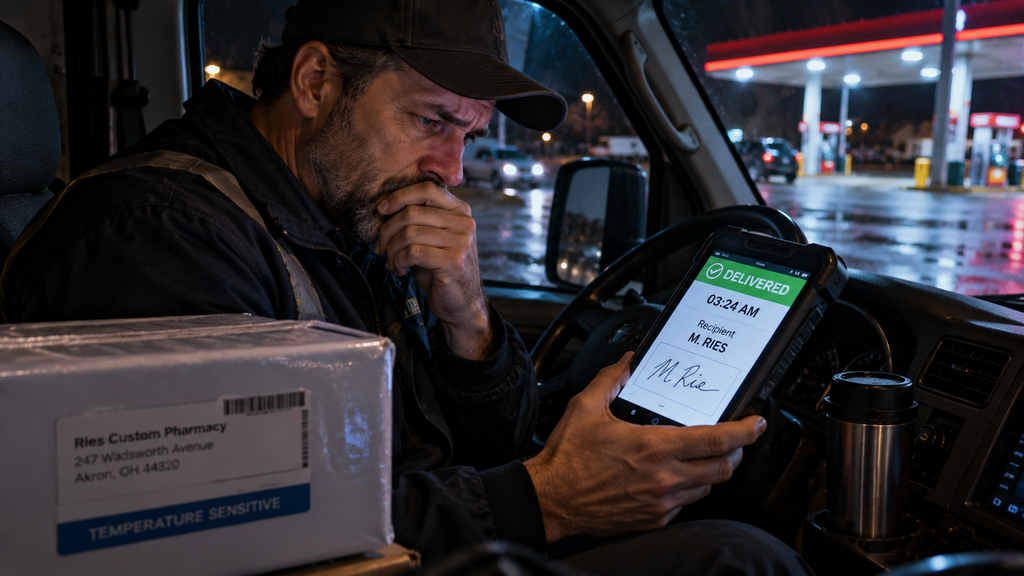
Darryl Beranek knew Mrs. Ries’s signature well enough to recognize it at 3:07 in the morning, which presented a problem because her package was still beside him in the van.
He was parked outside a twenty-four-hour gas station south of Akron when the handheld displayed the completed delivery: the barcode from the insulated carton on his passenger-side shelf, the correct Wadsworth Avenue address, recipient M. RIES, and a signature shaped like a crooked capital M followed by the descending slash she used for most of her surname.
The completion time showed 03:24. Darryl checked the dashboard clock, then the carton label, then returned to the delivery record without finding anything that made the seventeen-minute discrepancy less absurd.
The route map had already shaded Mrs. Ries’s stop green and promoted the next destination to the top of the sequence. Darryl reopened the completed stop, but the application offered no ordinary delivery controls anymore. It regarded the matter as finished.
He called dispatch.
“Eastline overnight,” Inez Paprocki said on the second ring.
“It’s Beranek. Route sixteen. My Ries stop closed itself.”
“Closed how?”
“Delivered and signed. I’m still fifteen minutes away.”
Keyboard noise came through the van speaker while Inez pulled up his route. Darryl drove Eastline’s overnight run five nights a week, carrying pharmacy orders, machine parts, laboratory materials, legal packets, and whatever else businesses paid extra to move while most people slept. Route sixteen began at the regional depot in Copley, ran south and east through industrial parks and suburbs, then curled toward Akron before returning after dawn. Seventeen years on variations of that route taught Darryl which receiving doors opened early, which security guards required identification every time, and which loading docks became impossible once daytime traffic arrived.
“I see delivery at three twenty-four,” Inez said.
“What time do you have right now?”
“Three oh-eight.”
“Then somebody’s doing excellent work ahead of schedule.”
“Could you have hit complete by accident?”
“The proof includes her signature.”
Inez became quieter. “Where’s the parcel?”
“Passenger shelf.”
“Truck GPS has you at the gas station.”
“Good. At least one machine knows where I am.”
She tried reopening the stop and failed because the system considered proof complete. Darryl asked where the signature came from. The audit trail identified his driver device, which he was holding while the parcel remained beside him. Inez flagged the stop for operations and told him to deliver normally, using exception notes if the application refused another signature.
At 3:22, Darryl backed into the narrow space beside Ries Custom Pharmacy. Margaret Ries opened the side entrance before he reached it, wearing blue scrubs beneath a cardigan and carrying a mug that read ASK YOUR PHARMACIST, NOT FACEBOOK.
“You’re early,” she said.
“By about two minutes. I need you to humor me.”
“That sentence usually costs money.”
He scanned the carton. The handheld vibrated and displayed ITEM ALREADY DELIVERED, exactly as expected. Darryl showed Margaret the existing proof, then opened the exception-note screen and asked her to sign there instead.
She wrote quickly and handed the device back. “What happened?”
Darryl placed the two signatures beside each other on the screen. The first carried the crooked M and long descending stroke he knew from years of deliveries. The second matched closely enough that Margaret’s amusement faded.
“Did I sign something for you earlier?” she asked.
“You opened that door about thirty seconds ago.”
Margaret enlarged both images and studied the lower portion. “They aren’t exact. This one is what I just wrote. My hand dragged against the edge of the screen.”
“So the earlier one isn’t a straight copy.”
“Could still be software pulling an older signature and cleaning it up.”
“Maybe.”
The pharmacy wall clock read 3:25. Darryl placed the carton on the counter, entered an exception note, and returned to the van because the route still contained more than thirty stops and software defects rarely improved when stared at.
The next seven deliveries behaved normally. A machine shop in Barberton accepted two small crates through its receiving cage, a rehabilitation facility signed for four parcels at the night desk, and an industrial laboratory required both a signature and a photograph of a sealed specimen case inside its receiving refrigerator. Every event appeared afterward with the expected timestamp and GPS coordinates. By 4:18, Mrs. Ries’s signature had begun shrinking into the category of system failure Darryl could complain about later.
At 4:21, the handheld announced his next stop complete while he was driving. Darryl entered an empty bank lot before checking the notification.
JAREK MOTION SYSTEMS — DELIVERED
Scheduled arrival: 4:36.
Completion time: 04:39.
Proof consisted of a photograph showing a rectangular Eastline carton on the concrete ledge beside Jarek’s employee entrance. A chipped yellow bollard occupied the left edge, and the bottom of the steel door appeared behind the parcel. Darryl reached into the cargo area and touched the Jarek box, still secured on its assigned shelf.
He called Inez again.
“Jarek completed itself too.”
“Where are you?”
“Fourteen minutes west.”
“I can see the van.”
“Open the proof photo.”
“I have it.”
“The carton in that picture is physically behind my seat.”
Inez verified the tracking number with him and confirmed that the metadata claimed the image came from Darryl’s device at 4:39. His handheld gallery contained no such photograph. Operations had begun checking for software testing or corruption, but nobody offered an explanation that accounted for a picture taken in a place Darryl had not reached.
He drove to Jarek.
At 4:37, Darryl entered the industrial park and rounded the building toward the employee entrance. The chipped yellow bollard, concrete ledge, and lower portion of the steel door matched the proof image closely. He placed the carton on the ledge, then shifted it to the opposite side of the doorway simply because the existing photograph showed the other position.
Using his personal phone, he photographed the actual delivery. The Eastline application still refused another completion event, so Darryl typed an exception note with the physical placement and returned to the van. When he refreshed the original proof at 4:43, the stored photograph changed. The carton now sat on the opposite side of the doorway, with Darryl’s legs faintly reflected in the steel.
His personal photograph came from chest height and included more wall. The delivery proof came from the lower angle he normally used with the company handheld.
Darryl called dispatch a third time. Inez transferred him to Oren Bisek, the overnight operations supervisor, who began with the practical information instead of questions Darryl had already answered.
“Your next clean handoff point is Fairlawn. Tomko can meet you there in about forty minutes and take the remaining route.”
“That leaves freight sitting while we wait.”
“We have completed delivery records originating from your device before arrival. I need the handheld and the route history preserved.”
“The truck GPS shows where I actually went?”
“It does.”
“Then we agree on one useful fact.”
Oren instructed him to avoid resetting or signing out of the device. Darryl could complete physical stops while they remained open, photograph exceptions on his personal phone, and meet Tomko at Fairlawn by 5:15. Darryl disliked returning freight or surrendering a route halfway through because somebody else would inherit businesses they did not know, but he agreed.
His next stop behaved properly. The following one completed six minutes before his arrival with the signature of Franklin Wojtas, a night receiving clerk Darryl knew by sight.
When Darryl reached the warehouse, Franklin came through the receiving door with a clipboard.
“You already signed for this.”
“Then I hope I liked it.”
Darryl showed him the screen. Franklin identified the first scribble as his own without much confidence until Darryl asked him to sign the exception note. The second signature differed naturally in several places, but both carried the same basic movement.
“Could the first be an old one?” Darryl asked.
Franklin scratched his beard with the back of one hand. “Could be. I sign so much garbage every night I wouldn’t swear which one came from which day.”
Darryl recorded the real handoff and departed.
At 5:02, his route reorganized itself. Optimization changes happened regularly when traffic, delivery windows, or delayed stops made another sequence more efficient, and Darryl often ignored minor rearrangements because he knew the territory better than the software at that hour. This time the application inserted an address that had not appeared on the manifest when he left the depot.
3874 WALDEN SERVICE ROAD
No recipient name appeared. Package count was blank. The stop details showed a completed delivery scheduled for 05:41, with proof identified as DRIVER ACKNOWLEDGMENT.
The signature beneath it belonged to Darryl.
He had signed thousands of route forms over the years. His normal signature began with a large D, compressed the remainder into a running line, and ended with an upward kick developed through years of signing against counters, clipboards, steering wheels, doorframes, and occasionally the back of his own hand. The signature on the screen contained every habit.
Walden Service Road ran through an old distribution district east of Fairlawn. Darryl knew the area well enough to picture several warehouses, a plumbing supplier, an equipment-rental yard, and a freight terminal that sat vacant the last time he passed it. He had no memory of 3874.
Inez found no Eastline delivery scheduled there. Oren joined the call after she told him what had appeared.
“Do not go to that address,” he said.
“I wasn’t volunteering.”
“Drive directly to Fairlawn.”
“The application is already trying to put Walden first.”
“Let it complain.”
Darryl selected the next actual delivery manually. The application returned to Walden. He chose another stop and received the same result. He turned navigation off and drove west from memory.
At 5:09, the handheld warned of route deviation. Three minutes later it labeled the new stop AT RISK. By 5:16, it reported that the delivery window would be compromised even though the listed completion time remained twenty-five minutes away. Darryl continued toward Fairlawn and reached the shopping center transfer point with the handheld still insisting he should be somewhere else.
Tomko was running late.
While waiting, Darryl climbed into the cargo area and checked every remaining parcel against the manifest. The first shelf matched. The second matched. Beneath two pharmacy totes near the rear door sat a padded archive carton that did not belong to route sixteen.
It carried no Eastline label.
A white shipping label read:
MIDVALE RECORD STORAGE
3874 WALDEN SERVICE ROAD
Darryl took the carton forward and called Oren.
“I found something addressed to Walden.”
“Tracking number?”
“None of ours.”
“Barcode?”
Darryl read the smaller number printed along the lower edge of the label. Inez searched the company system and found nothing.
“Return address?” Oren asked.
“Lanning County Records Services, Pennsylvania.”
The name meant nothing to Darryl, and he had no interest in making it mean something. What mattered was that an unmanifested carton entered his van without a scan and matched the stop his route software created later.
“Was it in your load when you departed?” Oren asked.
“I scanned every route piece myself.”
“Could it have been buried under a tote?”
“Anything could be buried under something. It still isn’t ours.”
“Leave it sealed.”
Darryl put the carton on the passenger floor.
At 5:26, Tomko texted that he was fifteen minutes away. The handheld recalculated again and preserved Walden at the top of the route, still marked for completion at 5:41. Darryl reopened the proof and discovered a new field beneath his signature.
GPS VERIFIED
Coordinates placed the vehicle directly on 3874 Walden Service Road.
His actual van remained in Fairlawn, which Eastline’s independent telematics also confirmed. Darryl put the handheld face down on the passenger seat and kept the mystery carton beside it.
Tomko arrived shortly before 5:40. They transferred all thirty-two legitimate delivery pieces by scanning them from one vehicle to the other with Tomko’s handheld while Darryl’s device remained untouched for preservation. The final tote crossed into the replacement van at 5:40.
At 5:41 exactly, Darryl’s handheld chimed.
The Walden stop now displayed DELIVERED, along with his signature and the GPS verification.
The padded archive carton remained beneath Darryl’s passenger seat.
Oren confirmed that Eastline’s route server recorded the Walden delivery while fleet telematics continued placing Darryl in Fairlawn. Tomko witnessed the transfer and his own handheld contained scans proving the remaining route freight had been handed over at the shopping center. The company now maintained two incompatible records of one van’s location without either system reporting a fault.
Darryl opened the Walden proof details. The route history showed a segment from Fairlawn to Walden Service Road that he never drove, followed by no corresponding return. According to the delivery application, he existed in the industrial district. According to the truck, security cameras, Tomko, and Darryl himself, he remained thirty miles away.
Tomko leaned through the passenger doorway. “You want me taking the mystery box?”
“Absolutely not.”
“That is the best answer I’ve heard all morning.”
Tomko left with route sixteen. Oren told Darryl to return directly to the depot with the handheld and unmanifested carton.
During the drive back, earlier delivery records began correcting themselves. Ries Pharmacy shifted from 3:24 to 3:25, matching the approximate time Margaret actually signed. Jarek moved from 4:39 to 4:43. Franklin Wojtas’s warehouse changed to Darryl’s physical arrival time. Whatever process created the advance proofs seemed capable of revising most of them after the real event occurred.
Walden remained unchanged.
Darryl reached the depot at 6:18. Oren met him inside the security gate with Inez and Carey Gluski from systems support. Darryl surrendered the handheld before anyone asked, and Carey sealed it in a clear evidence pouch normally used for damaged or disputed equipment.
“You think I altered it?” Darryl asked.
“I think nobody updates that device until I have the logs.”
“Pull the truck data too.”
“Already exported.”
Oren took possession of the carton. Carey scanned its printed barcode with a separate reader and received no result from Eastline inventory. Inez entered the destination manually, but 3874 Walden Service Road did not exist as an Eastline customer location.
A public map showed the address and a rectangular warehouse identified as Midvale Record Storage.
Oren called the facility.
Someone answered at 6:31.
“This is Oren Bisek with Eastline Overnight. I’m calling about a parcel addressed to your facility.”
“Tracking number?”
“It doesn’t appear to be moving through our network. We’re trying to determine how it entered our vehicle.”
“What sender?”
“Lanning County Records Services.”
The employee asked him to hold while checking transfer information. Darryl leaned against the dispatch counter with both hands behind him, keeping them away from the carton because touching it had begun to feel like participation.
A different Midvale employee came onto the line.
“We do receive archive transfers from Lanning County.”
“Were you expecting one today?”
“I’d need the transfer number.”
Oren read the reference numbers from the label. The Midvale employee found one that matched.
“Transfer RC-18427.”
Oren wrote it down. “What status do you show?”
“Received.”
The dispatch room became very quiet.
“When?” Oren asked.
“Five forty-one this morning.”
“Who accepted it?”
“Driver release.”
“Name?”
“D. Beranek.”
Darryl shifted his weight away from the counter.
Oren’s voice stayed even. “Is the carton physically at your facility?”
“Let me check.”
The Midvale employee put the phone down instead of using hold. Voices moved in the distance, followed by a door opening and the rattle of a cart over concrete. Darryl’s carton sat in front of Oren throughout the search, sealed with the original tape.
The employee returned.
“Receiving cage three. It’s here.”
Oren asked him to repeat the transfer number. RC-18427. Same number.
“What does the carton look like?”
“Brown padded archive carton. White county transfer label.”
“Any handwriting?”
“Blue marker on top. Twenty-six slash B.”
Darryl turned the carton on the counter. Blue marker crossed the upper flap.
26/B
Carey photographed the label and writing without moving anything else. Oren told the Midvale employee they might call again and ended the conversation.
Inez backed away from the counter. “So there are two.”
Carey answered carefully. “We have one here and a facility employee reporting one there with the same transfer identity. I’m comfortable saying that much.”
“We should open this,” Darryl said.
“County property,” Oren replied. “We call the sender first.”
Lanning County Records Services did not open until eight. Oren locked the carton inside the damaged-freight cage and placed numbered seals through the mesh door while Carey collected route histories, device records, vehicle telematics, and the exception photographs Darryl took on his personal phone. Darryl completed an incident statement describing the sequence without trying to explain it.
When he signed the form at 7:04, the shape pulled his attention immediately. Large D, compressed middle, upward finish.
Carey compared it with the Walden proof on a printout.
“Would you identify that as your signature?” he asked.
“It looks like mine.”
“Did you make the one attached to the delivery?”
“I was standing in Fairlawn when your system says I made it.”
Carey attached the statement to the logs without arguing over terminology.
Darryl still had to complete the ordinary vehicle-return process. Fuel level, mileage, exterior condition, undelivered freight. The system rejected his attempt to report the mystery carton because route sixteen showed every assigned package delivered and the carton had never been assigned to Eastline in the first place.
He entered RC-18427 manually.
The terminal returned:
ITEM ALREADY RECEIVED AT DESTINATION
Darryl showed Oren, who printed that screen with the rest.
By then the first day-shift drivers were entering the building carrying coffee and complaining about traffic, faulty heaters, lost charging cables, and route assignments. The depot maintained its ordinary morning rhythm around a carton that Midvale Record Storage also claimed to possess.
Darryl collected his coat from the locker room before leaving. On the way out, he passed the damaged-freight cage and checked the numbered seals because he knew he would wonder later whether he had.
Both remained intact.
The carton sat behind the mesh beneath fluorescent light, county label turned outward. The blue 26/B crossed the top flap exactly where it appeared on the box described thirty miles away.
On the operations server, route sixteen remained complete.
©2026 Rhyan Scorpio-Rhys