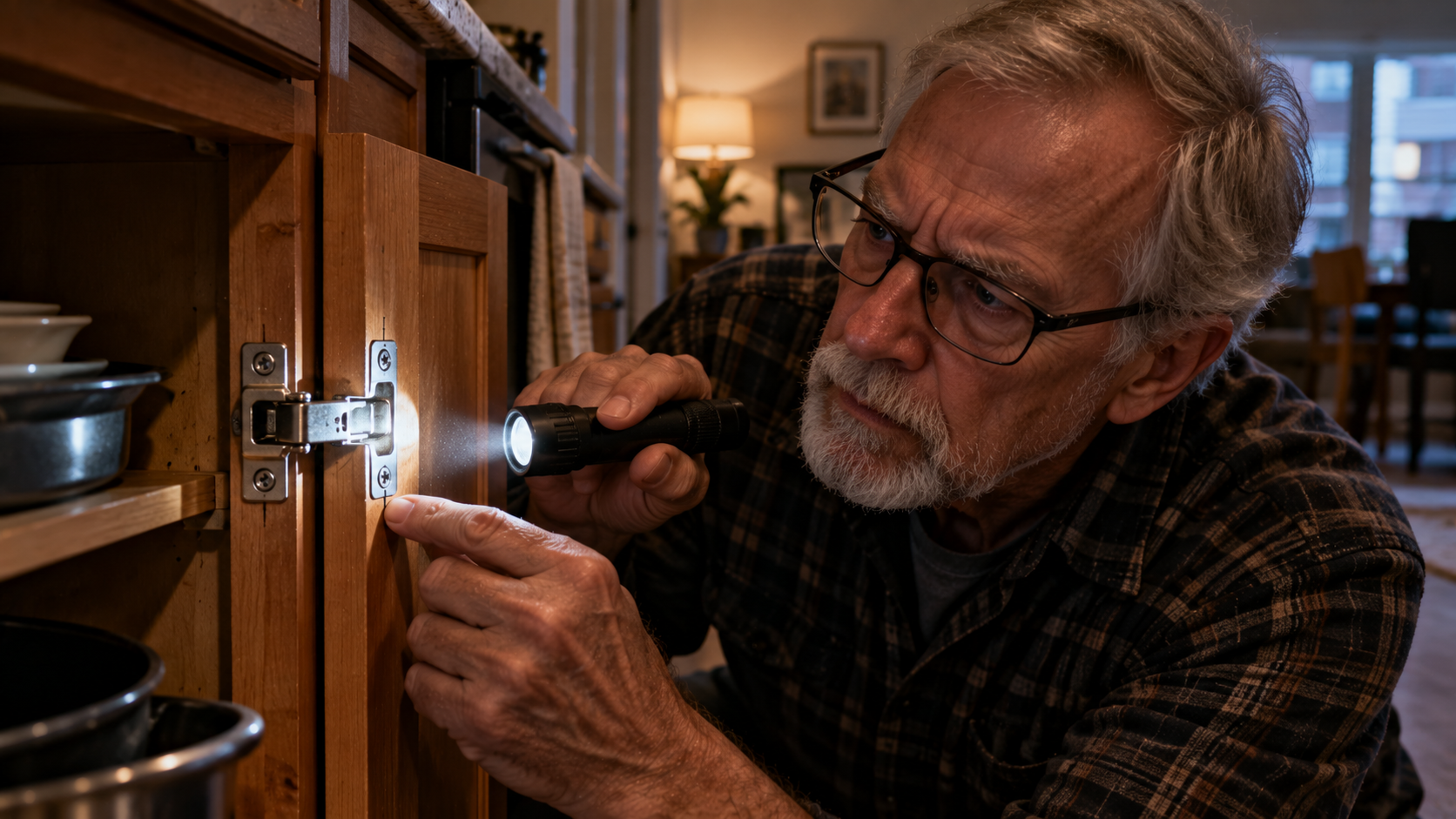


Gary Lunsford knew somebody adjusted the kitchen cabinet because the hinge screws no longer agreed with his pencil marks.
He found it after breakfast while returning a skillet to the lower cabinet beside the stove. The left door dragged slightly across the face frame, enough to change the sound when it closed. Gary opened it again and crouched as far as his knees comfortably allowed.
Two weeks earlier, he put a short pencil line across each hinge screw and onto the metal plate after the same door began sagging. He meant to tighten the screws himself, then remembered Northfield Senior Apartments prohibited residents from making repairs involving mounted hardware. The rule irritated him on principle, but Gary spent thirty-eight years maintaining commercial buildings and knew exactly how quickly a harmless adjustment became management’s excuse to blame a tenant for later damage.
The upper screw now sat nearly a quarter turn clockwise from its witness mark.
Gary touched the screw head with one fingertip. The Phillips recess showed fresh wear.
He opened the work-order application on his phone and checked the maintenance history for Apartment 412. His last request concerned a slow bathroom drain six weeks earlier. Nothing mentioned cabinetry.
Gary photographed the hinge.
He measured the cabinet door gap with the small steel rule kept in his kitchen junk drawer, wrote the measurement on a grocery receipt, then continued putting dishes away. The door worked better than it did yesterday.
That was inconvenient.
At ten, Gary went downstairs for mail. Northfield occupied a six-story former insurance office converted into apartments for residents sixty-two and older. The conversion gave the place wide corridors, two elevators, lever handles, automatic lobby doors, a community room nobody called by the sponsor’s branded name, and kitchens with cabinets installed slightly too high for half the tenants.
Gary moved there four years earlier after maintaining his three-bedroom house became more work than living in it justified. He liked Northfield more than he expected. The rent was manageable. The building stayed clean. Somebody else shoveled snow. He could complain about management while recognizing that management generally performed the job.
A poster beside the mailboxes announced another visit from the Home Independence Partnership, the voluntary aging-in-place program Northfield introduced that summer. The program was funded through a regional health plan and a nonprofit grant. Residents received home-safety assessments, minor accessibility improvements, and recommendations intended to help them remain independent longer.
Gary signed up because the first flyer offered free bathroom grab bars.
He got the grab bars.
He also got Asha Menon.
Asha was an occupational therapist in her forties who arrived with a tablet, tape measure, clipboard, and no visible interest in treating him like an old man for sport. She watched Gary move through the apartment, asked which daily activities gave him trouble, checked the bathroom layout, measured door clearances, discussed lighting, and asked about falls.
Gary told her about slipping on ice outside a hardware store the previous winter.
“That counts,” she said.
“That was ice.”
“It counts as a fall.”
“Then gravity has been collecting data on me since 1952.”
Asha smiled and entered something into the tablet.
She tested his balance, watched him get into and out of the shower, asked about medications, and ran through a brief set of memory and attention questions that Gary found more annoying than difficult. He remembered the words she gave him, drew the clock, and resisted the urge to improve the poorly printed floor plan she used during the home tour.
Her recommendations were sensible. Better lighting near the entry. A second handrail where the short change in level near the community laundry created problems for several residents. Two grab bars in Gary’s bathroom. A contrasting strip along the shower threshold.
Gary approved the bars and declined everything inside the apartment that he did not need.
The cabinet adjustment happened six days after Asha’s third visit.
Gary mentioned it to Veda Smoot, Northfield’s property administrator, when he returned from checking the mail.
“Maintenance come into my unit yesterday?”
Veda worked behind a glass-fronted office near the lobby, though the glass remained open unless she was discussing rent, illness, or somebody’s relatives. She checked her computer.
“I don’t have an entry for 412.”
“Anybody from the Independence program?”
“They’re scheduled Thursday.”
“Somebody adjusted my cabinet.”
“Maybe housekeeping?”
“I don’t use housekeeping.”
Veda typed again. “No access record yesterday.”
Gary nodded. “All right.”
“You want maintenance to check it?”
“It works.”
Veda laughed. “You came down here to report a repair that fixed itself?”
“I came down to find out who entered my apartment.”
The laugh disappeared. “Nobody should be entering without documentation.”
“I know.”
“I’ll check the electronic lock report.”
“Send me a copy.”
Veda agreed.
Gary continued to the mailboxes.
The lock report arrived that afternoon. His apartment door recorded Gary’s entries and exits, one visit from Asha nine days earlier, and no management access since then.
Gary printed the report anyway.
On Wednesday, the living-room chair moved.
He kept a square oak side chair near the bookcase because it served mostly as a place to leave newspapers before recycling them. The chair normally sat with its rear legs aligned to the edge of a floorboard seam. Gary noticed the change because one leg now covered the seam.
Three inches, perhaps four.
He placed the chair where it belonged and checked beneath the feet. No fresh scratches marked the floor.
The apartment contained nobody else.
Gary photographed the chair, measured its position from the bookcase, and put a tiny piece of blue painter’s tape beneath the rear rail where it could not be seen without getting close to the floor.
On Thursday morning, the chair remained where he placed it.
The silverware drawer did not.
Gary always kept forks in the left compartment, spoons in the middle, knives on the right. The organizer now sat reversed.
He removed it and inspected the drawer. Nothing else changed. The apartment door log showed no entry.
Gary telephoned his daughter Tracy after lunch. “You’re going to ask me whether I moved my own silverware.”
“Were you cleaning?”
“No.”
“Did somebody come in?”
“Door says nobody did.”
“What do you mean the door says?”
“Electronic access record.”
“You asked management for the access log?”
“I asked them who came into my apartment.”
Tracy paused. “Why?”
“Somebody adjusted the cabinet, moved a chair, and turned the silverware tray around.”
Another pause followed. Gary disliked that one.
“I’m not forgetting where I put silverware.”
“I didn’t say you were.”
“You were deciding how to ask.”
“I was deciding whether this is worth driving up there over.”
“It isn’t.”
“You called me.”
“Calling isn’t asking you to come.”
Tracy worked as a payroll administrator outside Cincinnati and lived forty-five minutes away when traffic cooperated. Gary loved her and knew she could turn concern into project management before anybody granted permission.
“Dad, you’re in that home-safety program, right?”
“Yes.”
“Could they be doing something?”
“Without entering the apartment?”
“I don’t know. Maybe they have another key that isn’t logging.”
“That would be worse.”
“I agree.”
Gary accepted that.
On Thursday afternoon, Asha arrived for the scheduled program visit with a young man Gary had not met. His badge identified him as a program field coordinator.
Asha introduced him as Malcolm and said they were reviewing environmental recommendations.
Gary let them inside.
“I have a question before we start,” he said. “Does your program alter anything in the apartment between visits?”
Asha’s expression changed enough for Gary to notice.
“What kind of alteration?”
“Move furniture. Reorganize a drawer. Adjust cabinet hardware.”
Malcolm answered first. “Some environmental observations can include household setup.”
“That wasn’t my question.”
Asha placed her tablet on the kitchen counter. “Gary, I don’t personally change residents’ belongings outside a scheduled visit.”
“Does somebody else?”
Malcolm shifted the folder under his arm. “The program uses environmental-response measures in participating properties.”
Gary turned toward him. “Explain that in regular English.”
“It evaluates how residents respond to changes in their living environment.”
“What changes?”
“Low-risk alterations. Object placement, furniture orientation, routine household organization. Nothing intended to create a hazard.”
Gary let several seconds pass because Malcolm appeared capable of continuing if nobody rescued him.
“You moved my chair.”
“The program may introduce minor environmental variations.”
“You reversed my silverware tray.”
“I don’t have the individual intervention list.”
“You adjusted a cabinet hinge.”
Malcolm’s confidence weakened. “Hardware adjustments aren’t usually part of it.”
Gary faced Asha. “Did you know they were doing this?”
“I knew the pilot included environmental-response observations. I understood those to occur during assessment visits.”
“Did you know people were entering apartments?”
“I did not know staff were making changes between my visits.”
Malcolm began, “Entry procedures are coordinated through property management under the participation agreement.”
Gary reached for the folder. “Show me.”
Malcolm did not give it to him.
Gary held out his hand until the younger man placed the participation packet there.
The consent form ran six pages.
Gary recognized his signature on the last one.
He read the section Malcolm indicated.
The program could conduct scheduled assessments, review safety conditions, document functional performance, and implement temporary environmental adjustments associated with program evaluation.
“Where does this say somebody can enter when I’m gone?”
Malcolm pointed to another paragraph allowing property personnel to facilitate program access consistent with building policy.
“Building policy requires notice except emergencies and scheduled maintenance.”
“We were told management cleared access.”
Gary went to the door.
“Visit’s over.”
Malcolm began explaining the program’s safeguards.
Gary opened the door wider.
Asha picked up her tablet. “I’m going to report this from my side too.”
“I’d appreciate that.”
Malcolm followed her into the corridor.
Gary closed the door and immediately called Veda.
She came upstairs twenty minutes later carrying printed access records and a face that told Gary she already knew why he called.
“They had a building master credential,” she said.
“That isn’t in my door report.”
“No. It logs under the mechanical-room system because the credential belongs to the facilities vendor.”
“Why?”
“The pilot contractor requested access for environmental checks. We were told participating residents consented.”
“You gave strangers a key that doesn’t show on resident access reports.”
“They aren’t strangers. They’re contracted personnel.”
“That explanation should make the insurance company feel wonderful.”
Veda pulled a chair away from the kitchen table.
Gary pointed at it. “Leave it where it was.”
She pushed it back exactly.
“I’m serious, Veda.”
“So am I.”
She opened the packet she carried. “I started going through their access dates after you called downstairs Tuesday. They entered your unit three times outside scheduled visits.”
“When?”
Veda gave him the dates. One matched the cabinet. Another matched the chair. The third matched the silverware.
Gary wrote them down. “What did they do?”
“I requested the intervention logs.”
“And?”
“They sent me codes.”
“What codes?”
Veda showed him the page.
EO-2: LOW-SALIENCE OBJECT RELOCATION
HO-1: HOUSEHOLD ORGANIZATION VARIATION
FM-3: MINOR FIXTURE MODIFICATION
Gary tapped the last line. “They did the hinge.”
“Apparently.”
“How does changing a hinge tell anybody whether I can live alone?”
“I don’t know.”
“Did they do this to everybody?”
“Everyone enrolled in the pilot received some version.”
Gary turned the page.
A scoring column recorded whether each resident noticed a change, corrected it, reported it, adapted without complaint, or showed no observed response.
Gary’s entries read:
FM-3 — CORRECTED? UNKNOWN / NO REPORT WITHIN 24 HRS
EO-2 — CORRECTED / NO REPORT
HO-1 — REPORTED INDIRECTLY THROUGH MANAGEMENT
The sheet assigned him an Environmental Awareness Index.
Gary laughed once.
Veda rubbed one side of her forehead. “I already suspended all unscheduled access for the program.”
“Suspend my participation.”
“I can withdraw you.”
“Do it.”
“I’m also sending this to ownership and counsel.”
“Good.”
She gathered the papers, then left him copies.
Gary called Tracy afterward.
She drove up that evening despite his telling her she did not need to.
For once, he did not complain.
Tracy spent an hour photographing the consent packet, intervention logs, door records, cabinet hinge, chair location, and silverware drawer. Her anger was less theatrical than Gary’s and therefore lasted longer.
“They’re scoring whether people complain,” she said.
“Apparently.”
“So somebody who doesn’t notice gets marked down, somebody who notices and says nothing gets marked differently, and somebody who complains becomes evidence too.”
“That’s usually how forms work. Every answer earns another box.”
“This could affect whether the building thinks people need services.”
“Maybe.”
“Insurance?”
“Maybe.”
“Whether somebody can stay here?”
Gary put the intervention sheet down. “That’s the question I want answered.”
The next morning, Veda emailed confirmation that Gary was withdrawn from the pilot and that no program personnel were permitted to enter 412. Northfield’s ownership group announced an immediate internal review of the Home Independence Partnership. Asha called privately and told Gary she had filed her own complaint with the program’s clinical director because the between-visit alterations were never part of the assessment method she agreed to perform.
Gary believed her.
The changes ceased for three days.
He spent those days creating his own baseline.
He photographed every cabinet hinge, door latch, grab bar, thermostat, light switch, window lock, shelf, and major piece of furniture. He measured the bathroom doorway at thirty inches clear, the kitchen passage at thirty-four and three-eighths, and the distance from the bedroom dresser to the wall at eleven and one-quarter. Pencil witness marks crossed selected hinge screws. Small pieces of removable tape sat beneath furniture feet. Gary stored the photographs on his computer and copied them to a flash drive Tracy took home.
She told him he was overdoing it.
Gary agreed.
He continued.
On Monday morning, the bathroom doorway measured thirty-two inches.
Gary kept the tape measure extended across the opening for a long time.
He measured again from jamb to jamb.
Thirty-two.
The door itself had changed.
A thirty-inch opening could not accept the slab now hanging there. The new door measured thirty-two inches nominal width, with the clear opening slightly less depending on hinge projection. Gary removed the hinge-side casing carefully enough to avoid damaging paint.
The framing beneath it showed no fresh work. No cut studs. No patched drywall. No new fasteners. No difference in paint layers.
He removed the strike-side casing. Same result.
The doorway had been built at its current width.
Gary fetched the photograph from Saturday. The image showed his tape measure stretched across the opening. Thirty inches.
He compared details around it. Same trim. Same paint nick near the lower hinge. Same small knot in the wood casing. Same screw heads.
The opening in the photograph was thirty inches. The opening in front of him was thirty-two.
Gary called Veda upstairs.
She brought the maintenance supervisor.
Neither had entered since Friday. The building’s access system showed no one except Gary.
The supervisor examined the exposed framing. “This isn’t new work.”
“I know.”
“You sure your old measurement was clear opening versus frame?”
Gary handed him the Saturday photograph.
The supervisor enlarged it on his phone. He measured the doorway himself. Then he checked the building renovation plans stored electronically.
The plan called for a thirty-two-inch bathroom door.
Gary felt a small movement beneath his ribs that had nothing to do with fear and everything to do with becoming very tired of evidence changing categories.
“Pull my Home Independence recommendations,” he said.
Veda opened the program portal from her tablet.
Gary’s final assessment remained accessible despite his withdrawal.
Most recommendations were familiar: lighting, entry contrast, laundry handrail.
One item appeared under FUTURE ACCESSIBILITY MODIFICATIONS.
Bathroom doorway: widen existing 30-inch opening to 32 inches where structurally feasible.
Veda lowered the tablet.
The maintenance supervisor measured the opening once more.
“When was that recommendation entered?” Gary asked.
Veda checked the metadata. “Thursday.”
“Was there a work order?”
“No.”
“Permit?”
“No.”
“Contractor access?”
“No.”
Gary turned toward the exposed casing and framing. “Put the trim back.”
The supervisor did.
Gary filed a written complaint with Northfield ownership that afternoon. He included the covert intervention documents, his withdrawal confirmation, the access records, the photographs, and the bathroom-door discrepancy. He described the first part as unauthorized environmental manipulation and the second as an unexplained alteration for which no work record existed.
He did not use the word impossible.
The complaint system required a category.
Gary chose UNAUTHORIZED UNIT MODIFICATION.
Two days later, the housing company’s regional office contacted him. An investigator interviewed Gary, Veda, the maintenance supervisor, Asha, and several residents enrolled in the pilot. The company suspended the entire program at Northfield and disabled the contractor’s building credentials.
The investigator understood the cabinet, chair, and silverware.
She could not explain the doorway.
A building engineer inspected it. His report stated that the opening appeared consistent with the original 2011 senior-housing conversion. Historical photographs available to ownership were inconclusive. The architectural drawing called for thirty-two inches.
Gary supplied his Saturday photograph.
The engineer verified that the image metadata preceded the complaint.
Her report used the phrase measurement discrepancy.
Gary disliked the phrase and understood why she used it.
Northfield ownership offered him a meeting with regional management, legal counsel, and the program administrator. Gary declined the first proposed date and attended the second with Tracy.
The program administrator apologized for the environmental-response protocol.
She explained that it originated with a subcontractor responsible for evaluating behavioral adaptation to low-risk household changes. The method was never supposed to affect clinical determinations independently, though Gary’s score did enter a broader resident-risk profile.
Tracy asked whether that profile went to the health plan.
It did.
She asked whether residents were told.
The administrator pointed to the consent language.
Gary pushed the copy back across the table.
“You can keep explaining that paragraph until retirement. I’m still leaving.”
Veda had already helped him obtain a transfer option, though the available unit was in another property across town and cost more each month. It lacked Northfield’s enclosed parking and put Gary farther from his grocery store, doctor, barber, and the diner where he met two former coworkers on Fridays.
He took it anyway.
The housing company waived the transfer fee and moving charge.
Tracy wanted him to move closer to her.
Gary declined.
He had no intention of answering one badly managed loss of independence by surrendering another voluntarily.
Packing took nine days.
The apartment accumulated boxes without mystery for once. Books went into small cartons because Gary knew better than to load forty pounds of hardcovers into something labeled LARGE. Tools occupied two plastic cases. Kitchenware went last.
On the morning the movers arrived, Gary removed the last of his witness tape from beneath the furniture.
The cabinet hinge marks still aligned.
The bathroom doorway remained thirty-two inches.
Veda brought the final unit-condition form upstairs.
They went room by room. Walls acceptable. Flooring acceptable. Appliances functional. Grab bars to remain in place. No tenant-caused damage beyond two picture-hook holes Gary agreed to patch before surrendering the keys.
At the bottom of the form was a section for unresolved maintenance issues.
Gary wrote:
Bathroom doorway dimensions inconsistent with resident documentation. No authorized work order located.
Veda made a copy for him.
When she entered the item into the property system, a status appeared beside it.
SUSP
Gary pointed toward the screen. “What’s that?”
“Suspended pending review.”
“Does it make anything happen?”
“It keeps the ticket open without assigning work.”
“Leave it there.”
Veda did.
The movers carried the final boxes out shortly after noon.
Gary’s new apartment was smaller and fifteen minutes farther west. The building was ordinary market-rate senior housing without a health-plan pilot, an environmental-awareness score, or free grab bars. His monthly expenses increased enough that he would notice, though not enough to send him back.
He unpacked the tool cases first because they contained the screwdriver needed to assemble the bed frame.
After the movers left, Gary worked through the rooms with a tape measure and pencil.
He recorded the bathroom doorway, kitchen opening, window widths, cabinet heights, and the distance between the bedroom wall and closet jamb. He photographed the measurements and emailed a copy to Tracy before she could ask.
The kitchen cabinet doors were square.
Gary opened the one beneath the sink and examined its hinges. Each plate carried two ordinary Phillips screws driven cleanly into the cabinet frame.
He drew a short pencil line across the upper screw and onto the metal hinge.
Then he unpacked the dishes.
©2026 Rhyan Scorpio-Rhys