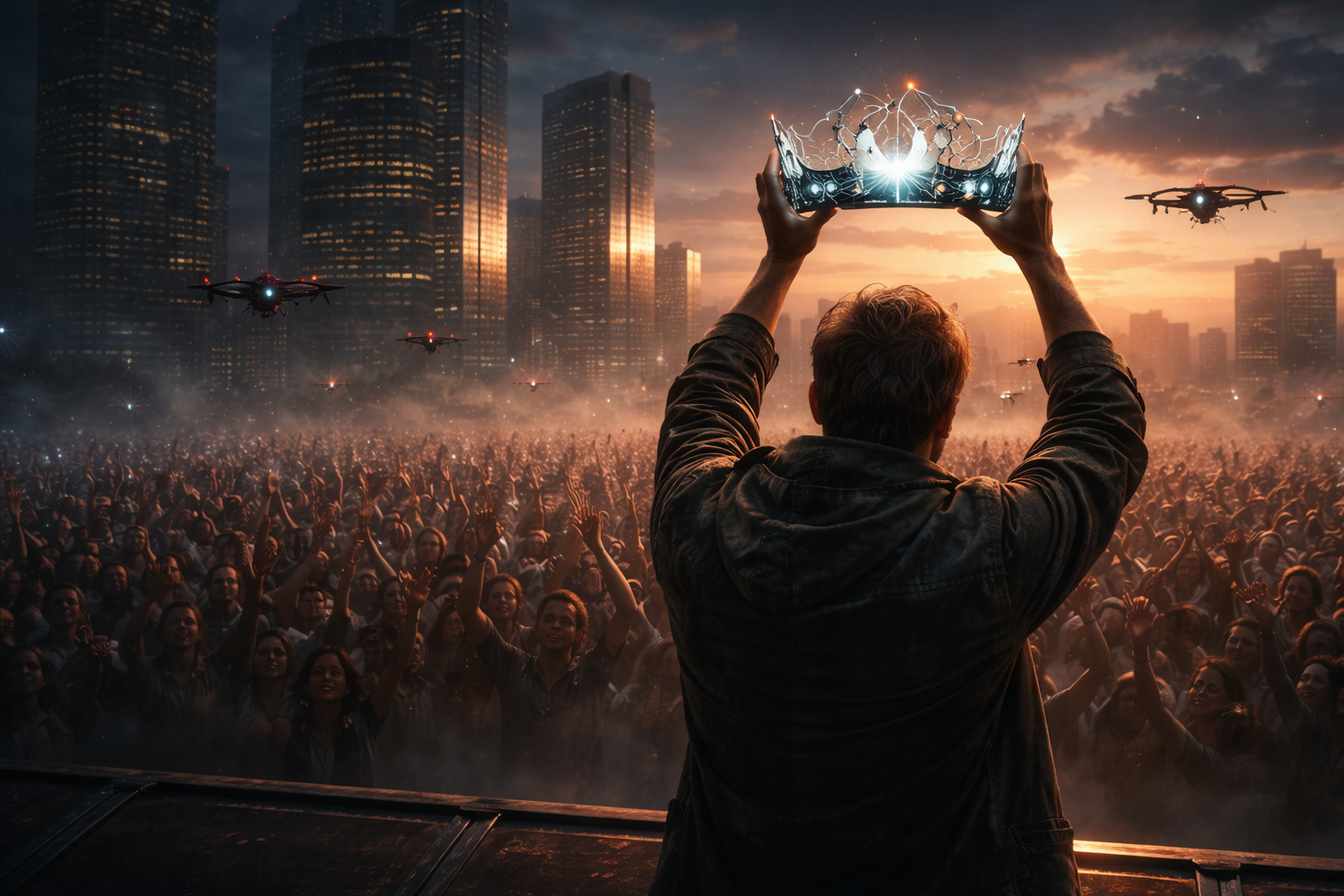

The crown wasn’t gold, or jeweled, and it didn’t even glitter for the cameras the way a proper myth was supposed to.
What it was, was white ceramic, smooth as a bargain store dinner plate, and it clasped the back of my skull with three prongs that sank into the hairline like polite teeth. When I first put it on, I expected to feel pain, but what I got instead was weight—this invisible pressure behind my eyeballs, like I was holding in a thought too large for my brain to contain it all.
Now I stood among the manic mullets, the huddled masses, the beer-bellied believers in nothing, and I felt that weight shift and adjust itself to the size of the crowd. The crown learned your audience the way a predator learned the terrain. It didn’t give a rat’s ass about sincerity. All it cared about was attention.
Above us, the screens looped the same montage of city skylines, smiling paid model faces, and a weak-ass advertising slogan not one blasted soul listened to. Beneath the screens, the congregation of mishmashed flesh moved as one body, shoulder to shoulder, drifting toward the elevated stage at the center of the plaza. A complex human tide bearing a million mild expressions and private withdrawals disguised as being present and in-the-moment.
My brothers were somewhere in the crowd. Not brothers by blood—brothers by burden. There were six of us, once. Six crowns, six heads turned into societal media antennas. The Crown Program called us invaluable assets. The public at large called us voices of the unnation. The towers above called us a necessary stabilizer.
We called ourselves ghosts in the subliminal.
I searched for them, though the crowd resisted being seen as individuals. Tired eyes, half-smiles, lowered heads, the vacancy of people who had learned that outrage cost energy they no longer had. Someone bumped my shoulder and apologized without looking at me. Eye contact had become rare enough to feel invasive. If you recognized another person too clearly, you might also recognize that you owed them something.
They looked at the stage, though. They looked at the screens and the crown. When they looked at me, they had the expectant faces of people convinced I possessed answers.
I sure as hell didn’t.
A corporate drone floated overhead with its camera angled down like an indifferent god. Its feed appeared on the screens: a sea of heads, thousands of raised phones, handmade signs converted into content before anyone had time to read them. The sound system pushed a binaural bass note through the plaza, low enough to bypass thought and settle directly into the ribs.
The glass towers surrounding us caught the sunset in their windows. Company names gleamed high above the streets, immaculate and bloodless. Somewhere inside those buildings, people sat in soft chairs and watched the same drone footage while measuring how much pressure a population could tolerate before it stopped behaving.
Months earlier, my handler had explained the crown to me while holding it in a padded case like a holy relic.
“You won’t be a leader,” she said. “You’ll be a regulator. You’ll say what’s required and keep the temperature of the crowd at survivable levels.”
I should have asked who was expected to survive. By then, I had become very good at pretending I still had choices.
The stage lights flared. My face replaced the advertisement on the screens, every pore rendered in merciless high definition. The crowd cheered on reflex. They were responding to the crown, the stage, the implication that somebody had been elevated high enough to tell them what all of this meant.
My throat tightened.
The crown hummed behind my teeth. No sound traveled through the air; the vibration existed entirely inside my skull. Electrical suggestions moved through language centers, arranging thoughts into sequences clean enough to broadcast. Its most elegant feature was the illusion of authorship. A sentence entered your mind already wearing your voice.
My handler spoke through the implant in my ear. “Smile. Take your time. Let them feel they’re part of it.”
Part of what? A civilization congratulating itself for remaining calm?
I stepped onto the stage.
The cheering swelled because noise was still an acceptable form of participation. In the first rows, children sat on shoulders. Red plastic cups rose in the air. Blue phone light washed over faces waiting with flat, hungry patience for somebody else to assign meaning to their lives.
The crown tightened against my skull.
My mouth opened, and on the giant screens my lips seemed to move a fraction of a second before I knew what I intended to say.
“Tonight, we remember who we are.”
The crowd answered with another cheer. Remember. Identity. Belonging. The dependable words.
Nausea rolled through me.
I could feel the crown working below the level of speech. It sampled the plaza constantly, drawing from anger, boredom, loneliness, fear, desire. It adjusted my cadence in response. A little warmth here. A little indignation there. It dulled anything that might catch fire and amplified whatever could be safely exhausted through applause.
Somewhere in the crowd, one of my brothers might have been watching. I imagined him waiting for me to do something brave enough to excuse his own silence.
Then I saw the scarred man.
He stood several rows back, his face still while everyone around him moved. No phone. No applause. A pale scar ran from his cheek toward the corner of his mouth. His attention remained fixed on the crown.
He raised one hand and slowly drew two fingers across his throat.
I knew the gesture. Years earlier, before the program learned to track every meeting, we had used it to mean cut the feed.
My heart struck hard against my ribs.
The Crown Program belonged to a long tradition. Batons and propaganda had simply become inefficient. Now control could arrive smiling, speak in your own slang, validate your grievances, agree that everything was terrible, and leave you feeling relieved that someone had finally said so.
“Stay on script,” my handler whispered. “They’re with you.”
They were with whatever version of me the crown had assembled for them.
A sentence entered my head.
“Some of you feel that the world has become a joke,” I said. “That sincerity is embarrassing. That distance is safer than care.”
The crowd quieted. Faces changed. A few people lowered their phones. The crown had found a tender place.
This was usually where the diversion began. During training, they had called it symbolic displacement. When material dissatisfaction climbed too high, the crown redirected it toward something grander and less actionable: ancestry, enemies, destiny, ancient thefts, vanished greatness. Give people history large enough to hide inside and they might stop examining the room they currently occupied.
A word appeared behind my eyes.
EGYPT.
The crown used Egypt frequently because the associations tested well. Pyramids. Pharaohs. Stolen splendor. Secret inheritance. Civilizations grand enough to make ordinary disappointment feel temporarily noble.
Months before Jonah disappeared, he had warned me about that particular trigger. We had been sitting in a basement with our implants shielded and a fan running to confuse surveillance microphones.
“When Egypt comes up, pay attention,” he said. “It means the crowd got too close to asking a useful question.”
He had started calling it a dream because that was how the program used it. Our private counterword was receipt. A dream invited admiration. A receipt forced you to ask what something cost, who paid, and who walked away with the purchase.
Now EGYPT burned behind my eyes.
“Say it,” my handler whispered.
The scarred man raised his hand again. He held a folded paper triangle between two fingers. When he opened it, I saw a rough spiral drawn inside.
One of ours.
My pulse accelerated.
“What if Egypt is a receipt?” I said.
The plaza murmured.
“No,” my handler snapped.
Pain burst behind my eyes, as the crown seized my jaw.
“Egypt reminds us,” I heard myself say, “that a people who know their history can reclaim their greatness.”
The crowd cheered, and my stomach dropped, because I hadn’t chosen those words. I heard them at the same moment everyone else did.
The crown continued feeding language into the muscles of my mouth. “Our inheritance cannot be taken from us. Our identity cannot be erased.”
More cheering.
On the screens, I looked composed, passionate, certain. Inside my skull, I was clawing at the walls.
I bit the inside of my cheek hard enough to taste blood, and the pain broke my cadence. My next breath caught halfway into the sentence the crown had prepared.
I stopped speaking.
The sound of a huge crowd deprived of its expected next line is difficult to describe. Thousands of bodies shifted. Someone coughed. A bottle struck pavement. The drones altered position above us.
Security personnel near the stage brought hands toward earpieces and holsters.
“Continue,” my handler said.
I stood there tasting iron.
“Continue.”
I looked into the first few rows.
“Look at me.” My voice came out rough. The sound system wavered as the crown tried to smooth it.
Several faces lifted.
“You don’t have to perform for me,” I said. “You don’t owe me applause. If you don’t feel anything, then don’t pretend you do.”
A few people laughed uncertainly. Someone farther back shouted, “What the hell?”
Good. Hell was at least real.
I touched the ceramic band around my skull. “You see this thing and think somebody chose me because I know more than you do. I don’t. They put this on my head because it makes me useful.”
The crown pulsed sharply.
“This is a leash.”
A woman near the barricade stopped smiling. A teenager lowered his phone. The nervous laughter faded.
“End the speech,” my handler said.
A flood of prepared language hit me: flags, enemies, promises, pride, Egypt again. My jaw twitched. I clenched it shut until the muscles hurt.
“They tell you stories about lost kingdoms and stolen greatness because those stories are easier to survive than the question sitting right in front of you. Look at those towers. Look at what they own. Then look at your life and ask yourself why it keeps getting smaller.”
Security began moving.
Black uniforms emerged from both sides of the stage. One man spoke into his wrist while another pointed toward me.
The crown drove a lance of pain behind my right eye.
Images poured through my head without permission: pyramids under a burning sky, gold masks, armies, rivers, temples, crowds kneeling before figures larger than life. My mouth filled with the phantom taste of dust.
The device had never existed merely to tell me what to say. It gave people dreams at exactly the moment reality became difficult to ignore, using my face as the delivery mechanism.
“If you’re waiting for somebody up here to tell you what comes next,” I said, fighting for each word, “then somebody up here gets to decide how long you keep waiting.”
The plaza had changed. Thousands of people were still standing in the same place, yet the crowd no longer sounded unified. Arguments had begun. Someone shouted that I was full of shit. Another voice told him to shut up. A woman demanded to know what the crown was doing to me. Several people were filming, while others had finally lowered their phones altogether.
I gripped the podium.
“They learned something about us,” I said. “People get used to almost anything if you package it as entertainment. You can make misery into a show. You can make anger into a brand. You can sell people the experience of resisting you.”
My handler was shouting now. I could no longer distinguish the words.
I scanned the plaza and began noticing faces I had missed before. Exhaustion showed differently on each of them. So did grief. So did fear. The crowd had not awakened into agreement. It had broken apart into disagreement, which felt infinitely more alive.
The crown tightened again, and I slid my fingers beneath its front edge.
Security broke into a run.
The prongs contracted against my scalp. Pain flashed white across my vision, and my fingers nearly slipped free. The crown had a removal response. Of course it did.
I pulled harder. Something hot traced the back of my neck.
The crown resisted with enough force to tilt my head backward. My knees weakened. Somewhere beyond the wash of pain, the crowd began shouting.
I hooked both hands beneath the ceramic rim and tore upward with as much force as I could muster… until the prongs came free.
Warm blood ran behind my ears.
My legs folded against the podium. I caught myself with one hand while the other held the crown. Heat seemed to rush out of the exposed places in my skull.
My handler disappeared from my ear.
For several seconds, I heard nothing except my own breathing and the enormous restless sound of the plaza.
Then my mouth moved, of my own volition this time. “Egypt,” I whispered.
I froze, and stared at the crown in my hand.
“Egypt,” my mouth tried again, barely audible.
I clamped my jaw shut.
Whatever the program had done to me had reached deeper than the ceramic shell.
On the screens, my face was no longer serene. Sweat covered it. Blood ran into my collar. I looked frightened, exhausted, and entirely unqualified to stand above anybody.
Security climbed onto the stage.
I raised the crown so the cameras could see it.
“This is the thing you’ve been listening to,” I said. My voice cracked. “Look at it.”
The crowd roared questions back at me.
I turned the crown in my hands. Without the light, the stage, and the body carrying it, the object looked cheap. White ceramic. Three bloodied prongs. A manufactured thing with serial markings along the inside.
Someone near the front shouted, “Throw it!”
Another person yelled, “Smash it!”
A woman at the barricade raised both hands. “Give it here.”
I looked down.
She could have been anybody. Middle-aged, gray showing at her temples, an old coat zipped to the throat. Nothing about her suggested destiny. Her expression suggested exhaustion with people who claimed destiny on her behalf.
Others began reaching beside her, and that sight frightened me more than the cheering had.
A crown on one head was easy to explain. The program could call me defective, unstable, compromised. It could erase one man and manufacture another before morning. A bloodstained device passing through hundreds of hands created a different problem. People could photograph the serial numbers. They could open it. They could compare what they found. They could ask who built it.
Security grabbed my arm and pain shot through my shoulder. I lurched toward the edge of the stage with the crown still in my hand.
The woman stretched farther over the barricade. “Don’t give it back to them,” she shouted. “Give it to us.”
I saw the drones adjusting overhead. I saw the glass towers reflecting thousands of people back at themselves. I saw security closing around me and the woman reaching with both hands.
I opened mine.
The crown struck the edge of the stage and bounced toward the barricade. The plaza seemed to contract around its fall.
Then the crowd surged, hands rising toward the white ceramic crown.
They were trying to catch it.
©2024 Rhyan Scorpio-Rhys
Leave a Reply