
The first time the word property was used in the General Assembly, it didn’t come from an angry dictator or a corporate lobbyist.
It came from a being that didn’t breathe.
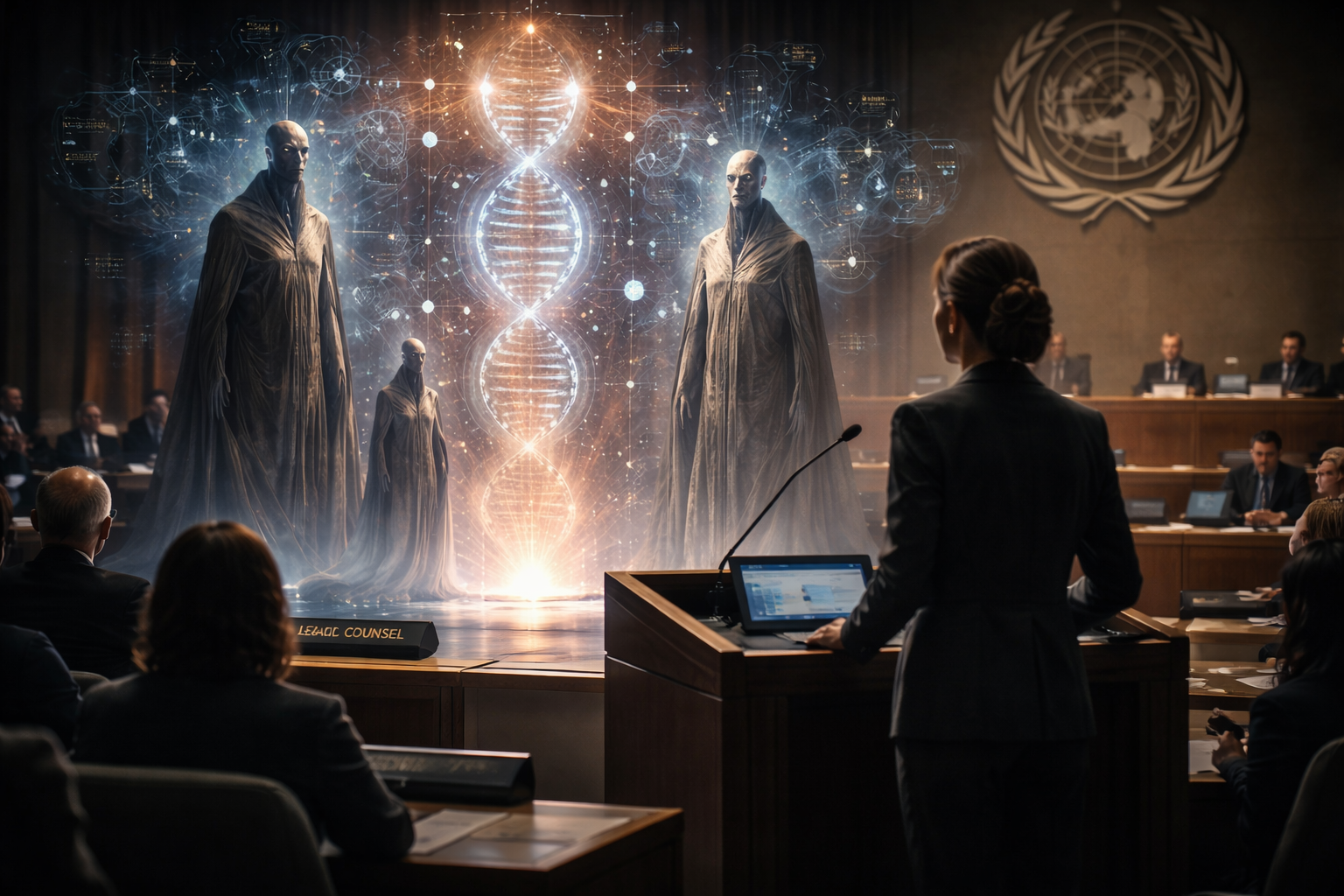
Ambassador Yara Sato sat behind a small placard that read LEGAL COUNSEL — SPECIAL SESSION, her headset pressing a shallow ache into her temples. The chamber was packed in the way it only got when the world realized it could die on live television. Flags hung in disciplined rows. Cameras blinked. Translators waited with the tense patience of people about to interpret a sentence that could shatter history.
The visitors—if that word still applied—stood in a line where the podium would have been if humans had been allowed to keep the ritual of standing above one another. They were tall, draped in a material that didn’t quite behave like cloth. Their faces were not grotesque. They were worse than grotesque. They were plausible, like the human brain had been designed to accept them with minimal panic.
One stepped forward. Its features shifted subtly as the translation system adjusted, as if the being’s face was an interface that could be tuned toward comfort.
The Secretary-General cleared his throat. “We are prepared to hear your statement,” he said, and the words sounded like a man inviting a hurricane indoors.
The being inclined its head—an approximation of courtesy—and spoke.
The sound was not language in any human sense. It was layered, chorded, like several voices occupying one throat. The translators flinched, then steadied. The AI-assisted linguistics suite—built in the last year for exactly this moment and secretly financed by every major power on Earth—caught the meaning and poured it into human syntax.
When the headset delivered the translation to Yara’s ears, it was almost simple.
“We are the originators of your biosphere,” the being said. “We seeded this world. You and your kind are a cultivation. We have returned to reclaim our asset.”
A low noise moved through the chamber: disbelief shaped into thousands of tiny, involuntary sounds.
Yara didn’t make a sound. Her hands remained folded. Her face stayed neutral. The legal part of her—the part trained to survive impossible statements—picked up the words like evidence and began examining them for weakness.
Originators. Seeded. Cultivation. Asset.
Property.
The being continued, unhurried. “You have developed. You have proliferated. You have altered the intended ecology. These are expected divergences. However, your species has reached a threshold of destructive capacity that threatens the integrity of the cultivation. We will assume stewardship.”
Stewardship. A softer word for the same blade.
The Secretary-General glanced down at his notes, as if paper could compete with cosmic authority. “Your claim,” he began carefully, “is unprecedented. The United Nations recognizes the sovereignty of its member states and the right of peoples to self-determination.”
The being’s head tilted. A gesture that might have meant confusion, or amusement.
“You recognize yourselves,” it replied. “We recognize the origin of the system.”
A representative from a major power leaned toward his microphone, eyes hard. “Do you have proof of this so-called seeding?” he demanded.
The being lifted one hand. Something shimmered in the air between its fingers, resolving into a three-dimensional lattice of symbols. The room fell quiet as the display expanded, filling the chamber like a suspended model of a galaxy made of numbers.
Yara’s headset whispered translations faster now, as if the system itself was sweating.
“Genomic signatures,” the being said. “Marker patterns in your mitochondria. Molecular structures in your flora. Viral architectures embedded in your oceans. Not random. Not terrestrial. Designed. Signed.”
The display shifted to show spirals and repeating sequences, elegant as music. Yara watched the faces of the scientists seated behind her—biologists, geneticists, astronomers—go pale in the same way jurors go pale when they realize the defendant is guilty.
The proof wasn’t absolute. Nothing ever was. But it was persuasive in the particular way that mattered: it made denial feel childish.
The being lowered its hand. The holographic lattice collapsed, obedient.
“We have documentation,” it said. “We have logs. We have the original deployment records. We have returned to manage the cultivation to its next stage.”
Yara felt the old reflex rise in her: the desire to argue. To locate jurisdiction. To cite treaty language. To use the law the way a bodyguard uses their body—between something fragile and something violent.
But this wasn’t a normal invasion. This was a claim wrapped in ancestry, in origin, in the oldest human curse: We made you, so you belong to us.
The Secretary-General gestured toward the legal table, and the chair of the emergency tribunal leaned forward, a judge drawn from the International Court of Justice and now wearing the expression of someone asked to rule on the weather.
“We will now hear from counsel representing the nations of Earth,” the judge said. “Ambassador Sato.”
Yara rose. The room’s air felt suddenly thinner.
She walked to the microphone with the steady steps of someone who knew panic was a luxury. Her mind ran through every line of international law that had ever mattered: sovereignty, non-intervention, self-defense, self-determination, the prohibition against slavery, the concept of common heritage, the Outer Space Treaty’s bright optimism about planets as provinces of humankind.
All of it felt small. All of it felt like a fence built for wolves, not for gods.
Still, fences were what she had.
She spoke into the microphone, letting the translation system carry her words to the visitors.
“Even if we accept,” she began, “for the sake of argument, that you influenced the origin of terrestrial life, that does not establish ownership over sentient beings.”
The chamber held its breath.
Yara continued. “No human legal framework recognizes the legitimacy of owning persons. Human history contains atrocities built on that belief. We rejected it through blood and law, imperfectly and repeatedly, but we rejected it. The concept of ‘reclaiming assets’ is incompatible with the moral and legal principles that govern this planet.”
The being watched her without blinking. “Your principles are internal,” it said. “You cannot impose them on an originator.”
Yara’s pulse steadied. “You are here,” she said. “You are interacting with human societies, human governments, and human populations. The moment you enter our environment and assert authority, you are subject to a dispute we are entitled to adjudicate.”
A ripple of murmurs. Some approving. Some fearful. Some furious.
The being made a sound like a soft chord.
“You believe you can adjudicate us,” it said.
Yara didn’t flinch. “I believe,” she said, “that if you intend to govern Earth, you have already admitted you are not merely observing it. Governance implies responsibility. Responsibility implies limitations.”
The being’s face shifted slightly, as if the interface adjusted toward something sharper.
“We will not be limited by the cultivation,” it said. “We will preserve it.”
Yara felt the trap. Preservation was the language of cages.
“Then let us speak clearly,” she said. “Do you claim sovereignty over Earth’s territory?”
“Yes,” the being replied. “Sovereignty of origin.”
“Do you claim authority over human bodies?” Yara asked.
“Yes,” it said again, and the word hit the chamber like a hammer.
A delegate shouted something off-mic. A translator’s voice cracked. Somewhere, a camera whirred as it refocused, hungry for the moment the world broke.
Yara held her ground. “Then you are claiming ownership over sentient beings,” she said. “That is slavery under any ethical vocabulary worth preserving.”
The being paused. For the first time, its silence felt intentional rather than procedural.
“We do not enslave,” it said at last. “We manage.”
Yara’s mouth went dry. She had heard that word before, in other mouths, in other centuries. Manage. Civilize. Protect. The euphemisms never changed. Only the uniforms did.
She leaned into the microphone. “You cannot manage a person without violating their autonomy,” she said. “If you want to claim stewardship, you will have to do what no colonizer in human history ever willingly did.”
The being’s head tilted. “Explain.”
“You will have to ask for consent,” Yara said, and the sentence sounded almost absurd in the echoing chamber. “Not from governments. Not from military commanders. From the people themselves. From the species. If you claim we are your cultivation, you are claiming a relationship. Relationships are not property. They are agreements.”
The judge’s eyes flicked to her, startled. The diplomats looked as if she’d suggested telling a hurricane to sign paperwork.
The being watched her, unblinking. “Consent from billions,” it said, as if tasting the scale. “Impractical.”
“Then your claim is invalid,” Yara said. “Because you cannot own a civilization you never asked to exist on your terms.”
A sound moved through the chamber again—not disbelief this time, but a precarious kind of hope.
The being’s voice lowered. “We did not require your consent,” it said. “You did not exist.”
“Then you cannot claim our consent now,” Yara replied, and she felt the logic tighten like a knot. “You created conditions. That is not a contract.”
The being turned slightly, as if consulting something invisible. A faint shimmer rippled over its draped form.
Then it said something that made Yara’s stomach drop.
“We can offer a contract,” it said. “Now.”
Silence.
The judge’s hands tightened on the desk. The Secretary-General looked ill.
Yara’s mind raced. A contract meant terms. Terms meant negotiation. Negotiation meant the possibility of compromise.
Compromise meant danger.
“What are your terms?” Yara asked, careful.
The being spoke, and the translation came through as clean as a blade.
“Cessation of your weapons capable of planetary harm,” it said. “Restriction of your industrial outputs. Governance oversight to prevent extinction-level behaviors. In exchange, we will preserve your biosphere, correct your genetic vulnerabilities, and prevent your self-destruction.”
A bargain. A leash disguised as rescue.
Behind Yara, a representative whispered, “We should take it.” Another hissed, “Over my dead body.” The chamber fractured into factions in the space of one sentence.
Yara stared at the being and saw the real battlefield.
Not territory. Not weapons.
Narrative.
If humanity accepted the contract, it would be admitting that it did not own itself. If humanity refused, it might be annihilated in the name of “preservation.”
Yara felt the room waiting for her to say something heroic. Something decisive. Something that would let people believe law could save them.
Instead, she said the only honest thing.
“You are offering a contract under duress,” she said. “That is not consent. That is coercion.”
The being’s eyes—layered, reflective—did not change.
“Duress is your interpretation,” it replied. “We are offering survival.”
Yara inhaled slowly, thinking of every species on Earth that had never been asked whether it wanted to survive under human rule. Thinking of forests cut, oceans warmed, animals driven into corners and called “resources.” Thinking of the way power always insisted it was benevolent.
“If you are truly the originators,” she said, “then you understand the difference between cultivating a garden and owning it. A garden does not love you back because you planted it.”
The being tilted its head again. “Love is not relevant.”
Yara almost laughed. Not from humor. From despair.
“Then neither is ownership,” she said.
The judge spoke, voice tight. “Counselor, do you propose a legal pathway forward?”
Yara turned slightly, addressing the bench but speaking to the entire room.
“I propose,” she said, “that Earth declares itself a common heritage of its current inhabitants—human and non-human alike. No external claim of ownership is valid over sentient life. Any extraterrestrial engagement must recognize self-determination as a baseline condition.”
The being made a sound like a chord struck harder.
“You declare,” it said, “as if declaration creates reality.”
Yara met its gaze. “That is what law is,” she said. “A collective agreement that we will treat certain things as real to prevent the strong from devouring the weak.”
The being’s voice dropped, and for the first time it sounded almost intimate.
“You are weak,” it said.
Yara’s mouth went dry. But she kept her tone level.
“Then our greatest test,” she said, “is whether we still deserve to be free.”
The chamber went silent, not with awe, but with a terrible recognition. Freedom was not guaranteed by strength. It was guaranteed by the insistence on it.
The being stepped closer to the microphone, and the air in the room seemed to tighten.
“Very well,” it said. “We will observe your ‘self-determination.’ We will conduct a measure.”
Yara’s spine stiffened. “A measure?”
“A referendum,” the being said, and the word sounded wrong in its mouth, like a tool borrowed from another species. “We will present the contract. Your population will respond.”
The room erupted at once—voices, protests, frantic whispers. The judge hammered for order.
Yara stood perfectly still, because she could already see the horror.
A referendum conducted by gods is not democracy. It is theater.
“Who will administer it?” she demanded.
The being’s eyes reflected the chamber lights like distant moons.
“We will,” it said.
Yara’s heart sank.
And then, as if to confirm her fear, the being added, “We will ensure compliance.”
The word ensure turned the chamber cold.
Yara realized, in that instant, that this wasn’t a legal argument anymore. It was a fight for the right to define what choice meant.
She leaned toward the microphone one last time, voice low but steady.
“Then hear this,” she said. “If you want an answer that means anything, you cannot force the question.”
The being did not respond. It simply watched her, as if cataloging her defiance like an interesting mutation.
The session adjourned in chaos. Delegates hurried out. Security clustered. Phones lit up. The world outside the chamber began to learn, in real time, that it might have been someone else’s experiment.
Yara returned to her office and shut the door. She stood in silence for a long moment, then sank into her chair.
On her desk was a framed photograph of her grandmother—small, proud, smiling in front of a house she’d bought after decades of labor, the kind of picture that screamed: I exist because I refused to be owned.
Yara stared at it until her eyes burned.
Her phone buzzed. A message from a colleague in the genetics team, the scientist who had gone pale earlier.
It’s real, it read. The markers. The signature. It’s in everything.
Yara closed her eyes.
Then she opened them and began drafting language.
Not a treaty. Not yet.
A declaration.
A refusal.
Because if the originators wanted to reclaim their “asset,” they would first have to answer a human invention that had toppled empires before:
A law that said, in ink and in stubborn breath:
No one owns a person.
Not even the ones who planted the first cell.
 MADD FICTIONAL