

“We gave the Future to the winds, and slumbered tranquilly in the Present, weaving the dull world around us into dreams.” ― Edgar Allan Poe, The Mystery of Marie Rogêt
The Bronx in the ’70s was a shifting kaleidoscope of color and culture, where streets echoed with the rhythms of migration. Italians moved out, and Black families moved in, followed by waves of Hispanics and West Indians (the descriptors at the time, consult your PC Handbook for updated terminology because I cannot keep up with the ever-shifting cultural identifiers), each adding a new voice to the symphony. It was the kind of place where survival meant learning to coexist, where differences in skin, language, and heritage melted away—or flared up—in the crucible of city life. On my street, we built an entire world from those fragments, a mosaic stitched together by people who, despite everything, tried to make the best of their lot.
I rocked a killer afro back then—black as midnight, proud and defiant, with a metal-pronged pick nestled in the back, its handle a clenched fist of Black power. That pick was more than an accessory; it was my weapon, my shield, my silent protest. My parents hated it, of course. “As long as you’re living under my roof…” they’d begin, and I’d tune them out, thinking, If they cut my hair, they’ll cut out a piece of me too—my Madd-ness. My hair was a rebellion I wasn’t ready to surrender.
But necessity breeds compromise, and when the ultimatum finally came down, I found myself confiding in Cynthia Holloway, a quiet girl from down the block, as we waited outside the bodega. I barely knew her then—just a face I’d seen in passing, someone who kept to herself. But when I offhandedly mentioned my plight, she surprised me by offering to braid my hair.
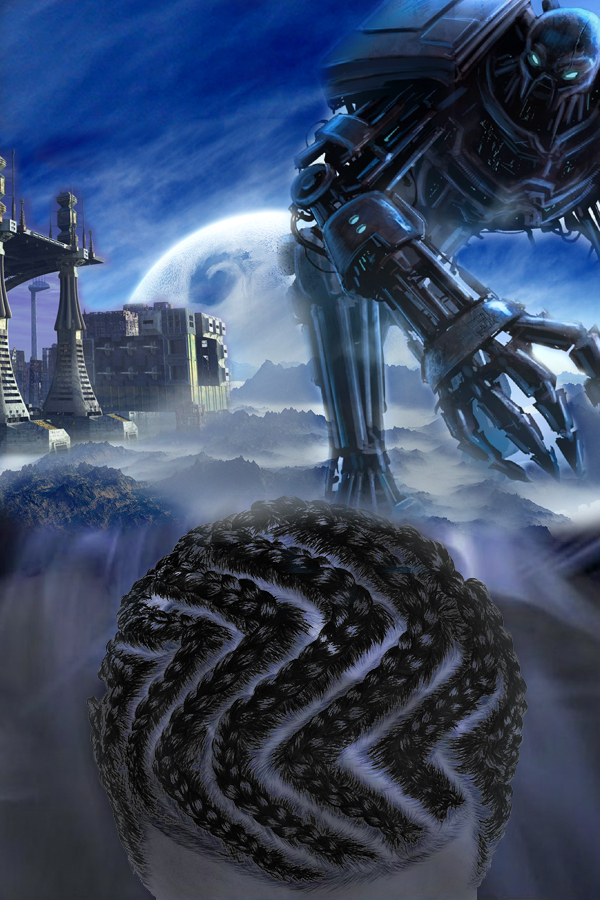
We met on the stoop of a private house, and with just a comb and hair grease, she went to work. Her fingers moved like a weaver’s, deftly interlocking strands of my wild hair into tight rows that hugged my scalp. The stoop became our sanctuary, an unassuming throne for two kids who sought to escape a world that, despite its vibrant diversity, sometimes felt stifling.
As Cynthia braided, we talked. Not just about the trivialities of school or the latest radio hits, but deeper things—the secrets kids only share when they’re wrapped in the certainty that no adults are listening. She told me about her father, a retired Army Ranger who had left the battlefield to play the saxophone in a jazz band. I told her about my dreams of becoming a comic book artist, the kinds of worlds I would create. But there was always something enigmatic about Cynthia’s stories, an undercurrent of magic in the mundane details, as if the truth of her life flickered like a distant streetlight, casting just enough shadow to obscure reality.
Every month, I returned to that stoop, and we resumed our ritual. As the braids grew tighter, so did our bond, and we began to braid stories too, building a shared world. It started simple—an imagined city somewhere between the Bronx and the stars, where children ruled in place of parents, and no one ever moved away without warning. We became monarchs of this world, shaping its laws and landscapes, populating it with impossible things—magical creatures, talking trees, entire islands that floated on the sea of our imagination.
In our fantasy realm, Cynthia’s father was no mere saxophonist; he was a wandering bard who could enchant dragons with a single note. The streets echoed with jazz that held real power, transforming ordinary lives with its melancholy spell. We added layers to our world with each session, each braid, until it felt more like home than the streets we walked every day.
Then, in the fifth month, Cynthia didn’t show up. I waited for hours, my hair a mess of hopeful tangles. Days later, I heard through the grapevine—a friend of a friend’s sister—that she and her mother had disappeared in the dead of night. No forwarding address, no phone number, just… gone. Like the characters in one of our stories, they had slipped into the shadows of a place that only existed at the edges of our understanding.
I imagined reasons for their sudden departure: debts, danger, a need for freedom. Had Cynthia’s tales been laced with truth in disguise, or had we woven so much magic into our world that it had started to seep into reality, drawing her away?
With no Cynthia to braid my hair, I had no choice but to sit in the barber’s chair. The clippers buzzed, and tufts of my Madd-ness fell to the floor, but in the end, I was still me—though a little more vulnerable, a little more hollow without my braids and without the girl who had spun stories with me.
Months passed, but our shared world lingered like a dream you almost remember. I’d sit on the stoop sometimes, alone, recounting imaginary conversations with an absent Cynthia, trying to keep the magic alive. I’d tell her about my life, and in return, I imagined the stories she might tell me—adventures on the road with her father, mystical places far beyond the Bronx where jazz could still conjure fire and flight.
Over time, our world began to fade, overtaken by real life, real changes. Yet, every now and then, I’d catch a faint echo of Cynthia’s stories in the strains of a saxophone on the radio, or in the pattern of the rain falling on the pavement. And I wondered if, somewhere out there, she was still weaving tales—perhaps even remembering our shared creation.
We built a world together, row by row. Even though I couldn’t see her anymore, even though the stoop was empty, the world we made still breathed, still existed somewhere beyond the boundaries of imagination and memory. And it would always be there, waiting, like an old friend ready to spin stories once more.
PS. Cyn, if through some bizarre happenstance you should come across this, hit me up real quick. There’s a world in some need of serious upkeep.






 MADD FICTIONAL