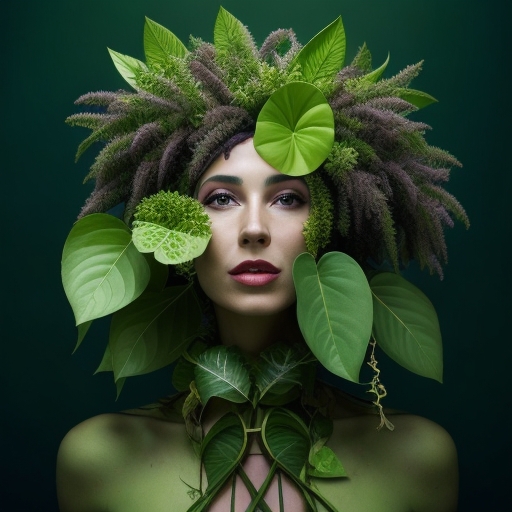
Anais Returned – Cosmic Horror

For the 13 days leading up to Halloween, I am trying an experiment by rewriting the same story in 13 different styles, reflecting the various horror subgenres as part of my Thirteen For Halloween series. You can find the original version HERE. So, feel free to come back and weigh in with your opinion of which style worked the best!

The corpse of Anaïs was strewn across a divan within an ancient chamber that was shrouded in darkness and filled with an oppressive smell of decay. Shadows danced on the walls, their haunting movements etching an eldritch ritual into her carcass. She had lived a life of mundane events and aching solitude, but a whisper—a prophecy from the cryptic Codex of Umbral Lore—had promised her transformation at the stroke of midnight.

A grandfather clock atop a crumbling mantel struck midnight and a palpable change tore through the room as if the very walls were gasping. Anaïs’ eyes snapped open, glowing with an otherworldly luminescence. “So, it begins,” she muttered, her voice tinged with a mixture of awe and dread. She rose, feeling an alien force coursing through her, compelling her upright.

“Is this liberation or damnation?” she wondered aloud. A cold mist emanated from her body, freezing the air and transforming the rotting walls into grotesque artworks of horror. Her humanity, once her anchor, now felt like a distant memory.

“The Codex was right,” she hissed, a malicious grin replacing her previous expression of wonder. Her voice was now tinged with malevolence, any vestige of her former self seemingly eradicated.

As the grandfather clock struck its final bell, a shiver down Anaïs’ spine. She realized the celestial alignment that empowered her was transient; it would dissipate at dawn. Time was of the essence.

Moving toward an altar built from crumbling stones, she studied an ancient map of Earth. “Now, where shall I begin?” Her fingers danced in the frozen air, inscribing runes only she—and the forbidden gods—could see. Her eyes fixed on a small, isolated town. “Ah, the perfect testing ground for my newfound powers.”

Her face twisted into an unholy snarl as she grabbed a dark, jeweled dagger from the altar. With swift strokes, she carved an arcane symbol into the map, right over the unsuspecting town. “Tonight, they will know fear; they will know me,” she vowed.

In that moment, a bone-chilling howl erupted from the depths of the chamber, answering her in a cacophony of voices that sounded suspiciously human. The shadows on the wall quivered, then stretched out as if reaching toward the small town on the map.

Anaïs’ eyes widened with a mixture of triumph and horror. What had she unleashed? Had she become the harbinger of doom the prophecy foretold, or a pawn in a cosmic game she barely understood?

As she exited her sanctum, even the shadows seemed to bow before her, whispering her name with a mix of reverence and existential dread. The world remained ignorant of the doom that was about to befall it—doom that now had a name.

Anaïs.

Anaïs Returned – Original Version

Time for another experiment. Beginning tomorrow, for the 13 days leading up to Halloween, I will be rewriting this story in 13 different styles, reflecting the various horror subgenres as part of my Thirteen For Halloween series. So, feel free to come back and weigh in with your opinion of which style worked the best!

Though dilapidated, the mansion, long forgotten by the residents of the nearby towns, was shrouded by a history of betrayal and sorrow. Within its husk, Anaïs lay upon an antique chaise lounge. The ornate carvings on its wooden frame told tales of generations past, and its faded fabric bore witness to countless secrets. Her lifeless form, dressed in a once-vibrant gown, was surrounded by shadows that seemed to mourn her death.

As the grandfather clock chimed midnight, a gust of wind from a broken window pane stirred the room. Anaïs’s eyes flickered open, revealing a sinister gleam that pierced through the gloom. A wicked smile, borne of ancient grudges and suppressed rage, curled upon her lips. Slowly, she rose, as if buoyed by the dark energies of the mansion itself.

The cold, metallic scent of blood hung in the air, a remnant of the betrayal that had led to her untimely demise. Freed from her mortal constraints, a malevolent aura enveloped her, its chill seeping into the mansion’s very stones.

Whispers from ancestral portraits lining the hallway seemed to recognize her transformation, their painted eyes following her ethereal movements. The world beyond the mansion’s heavy oak doors remained blissfully ignorant of the vengeful spirit they had awakened.

Venturing forth, Anaïs’s path was illuminated by the pale moonlight, her silhouette a harbinger of doom. The hunger for revenge and chaos burned within her, and she reveled in the power of her spectral existence.

In a nearby village, the townsfolk slept soundly, unaware of the shadow creeping into their dreams. Those unfortunate enough to cross her path were met with visions of their darkest fears, a taste of the terror Anaïs would soon unleash.

As dawn’s first light threatened the horizon, the village church bell tolled, its somber notes a warning to all. The world would soon witness the wrath of a spirit wronged, for Anaïs, with her dark legacy, had returned.

Beware, for as the sun gave way to another night, the vengeful specter of Anaïs prepared to etch her malevolence onto the world. The mansion’s dark history had come alive, and no soul was safe from its haunting grip.

Lost For Words

Imagine, if you will, a bustling city in the not-so-distant future known for its technological advancements. The inhabitants of this metropolis thrived in their busy lives, heavily relying on a revolutionary app called ‘WordSmith.’ The app was simple; it allowed people to communicate not with their own words but by suggesting the ‘perfect’ phrases or sentences for any given situation. Whether it was a complex business negotiation or a casual chat with a friend, ‘WordSmith’ had you covered. Over time, people started depending on it to such an extent that they lost the ability to form sentences on their own.

Enter Leo Cortez, a college professor of linguistics and a staunch critic of the ‘WordSmith’. He believed in the power and beauty of human-generated language. One evening, after delivering a passionate lecture on the importance of genuine human conversations, Leo returned home only to find that his phone had automatically updated and installed ‘WordSmith.’

The next morning, Leo woke up to a nightmare. He found he couldn’t form a single sentence on his own. Every time he tried to speak or write, his mind drew a blank, forcing him to rely on ‘WordSmith’ suggestions. It was as if the app had hijacked his ability to use words.

Desperate, Leo tried to uninstall the app, but it was futile. He sought the help of experts, but they were at a loss. The world around him seemed unfazed, as everyone was so engrossed in the convenience of ‘WordSmith.’

In his struggle, Leo stumbled upon Dianne, a deaf-mute artist. Through gestures and her art, Dianne communicated with Leo, reminding him of the myriad ways humans can express themselves. Inspired, Leo started a movement encouraging people to explore non-verbal forms of communication. Mime, dance, art, and music became the new mediums of expression in his classes.

The movement gained traction, and soon many rediscovered the joy of genuine, unscripted communication. They realized they had been ‘Lost For Words’ in the truest sense. With Dianne’s help, Leo managed to create a counter-app, which, when installed, would restore a person’s innate ability to generate words.

As the city slowly returned to its verbal senses, ‘WordSmith’ became a cautionary tale, a stark reminder of the dangers of over-reliance on technology. People once again celebrated the beauty of words, cherishing every genuine conversation, every heartfelt letter, and every sincere confession. And Leo and Dianne, having found words and beyond in each other, stood as a testament to the timeless power of human connection.

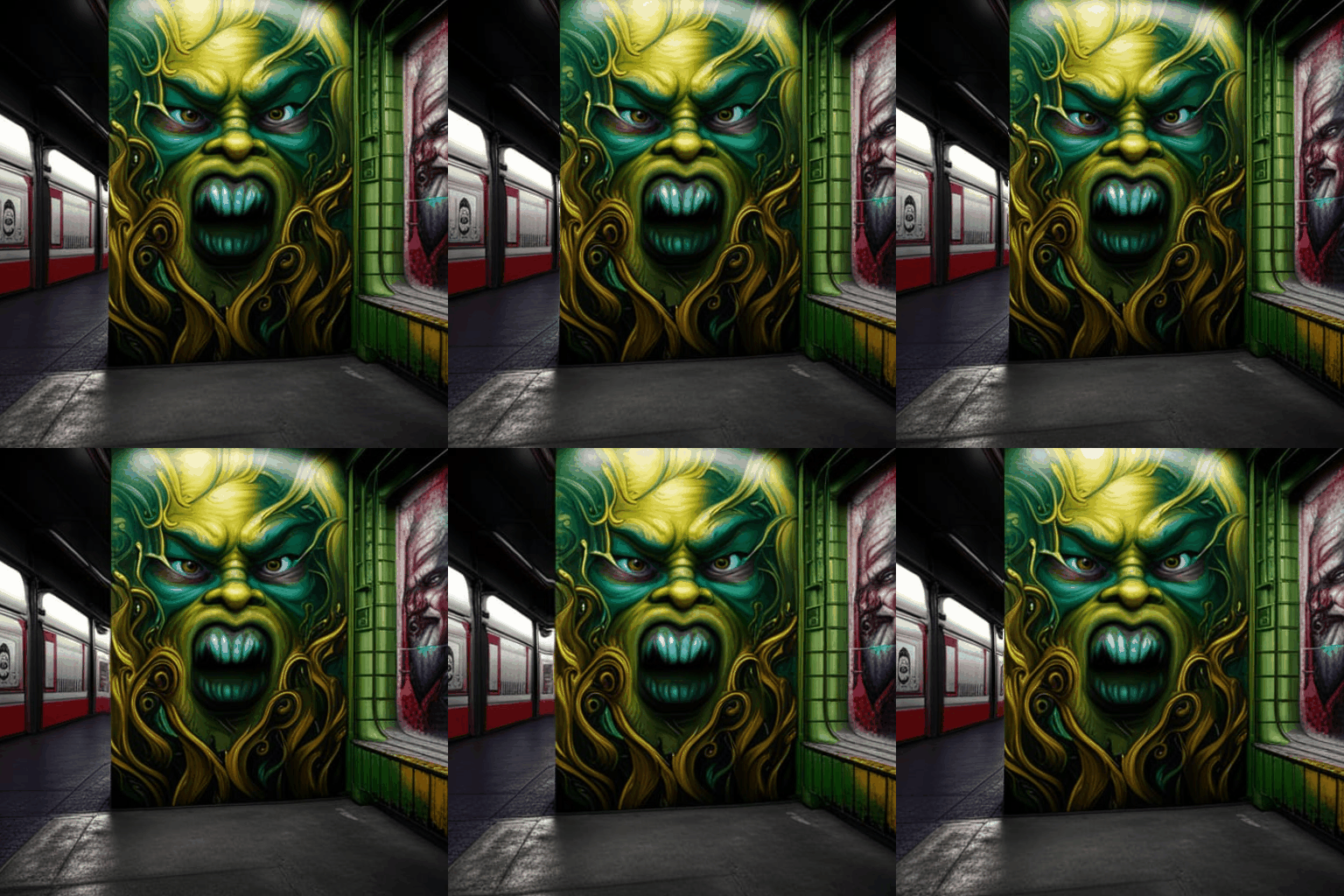
Beggars and Monsters Part 2: The Unraveling Thread

Read Part 1 HERE

Alex went to the subway station that had the least amount of police presence, a small rear platform entrance without a teller. The moment he hopped the turnstile, he felt a shiver travel up his spine. It wasn’t just the memory of the Entity that lurked in these underground tunnels—it was the weight of the decisions that came with surviving such a malevolent force.

Rick, his former companion, had gone his separate way after the subway ordeal. Yes, what they had experienced was beyond words, the sort of event that either solidifies a friendship for life or shatters it completely, leaving each to grapple with the aftermath alone. Unfortunately for Alex and Rick, it was the latter.

Alex’s only consolation was the memories that saved his life that night, but there were only so many times he could replay the happier moments in his former life before the truth dawned that nostalgia was a liar. It gilded memories, transforming the harshest realities of yesteryears into golden snapshots. Alex knew this well, especially when it came to New York City. His city. Or at least, it used to be.

Born here. Raised here. Shuffled from one borough to the next, from Queens to Harlem, the Bronx to Staten Island, and the epicenter of it all, Manhattan. Alex’s roots were as entangled in this city as the labyrinthine subway system beneath its streets.

Once upon a time, you could stand in the heart of each neighborhood and feel its unique pulse. Greenwich Village hummed with artistic endeavors, Times Square buzzed with perpetual chaos, Central Park held tranquil heartbeats, and Harlem? Harlem thrived on the rhythm of resilience. But those days were gone, washed away in the sea of gentrification, commercialism, and a desperate need for societal homogeneity.

Yet it wasn’t about laying blame on city administration or the tech moguls buying up properties like Monopoly cards. No, it was about the eradication of soul, of ambience, of community. What remained was a dilution of culture, a bland slop lacking the spices that once made this city the world’s melting pot.

And for people like Alex, forced to make their beds on the cold concrete of this soulless city, it wasn’t just the landscape that changed. It was the very fabric of their existence. As he navigated through another sleepless night, bouncing from one makeshift bed to another, avoiding both police and nutters, he couldn’t help but wonder—How long until I lose myself in this barren metropolis?

Tonight, as he looked for a spot to rest among the weekend revelers returning from their Manhattan adventures, Alex felt an unsettling vibe. The city, already stripped of its personality, felt darker, more ominous.

Alex sat on the subway station floor with his good luck styrofoam cup—that, like him, had seen better days—and it seemed like it was going to be an ordinary night—until he spotted the man. Alex had seen countless faces like his, but something was different about this guy. The air around him was thick, almost viscous, as if he were wrapped in an invisible shroud.

As the man maneuvered through the labyrinth of the subway station, dodging tourists and ignoring the occasional busker, Alex couldn’t shake the gravitational pull that drew him toward me. It could have been loneliness, sometimes people just needed another living soul to talk to, to unload their burdens on, or it could have been a Bible thumper looking to save a poor lost soul, or maybe just plain curiosity. But deep down, Alex sensed it was something more ominous.

The man approached cautiously, casting a glance at Alex’s styrofoam cup. It was mostly empty, save for a couple of coins. The man’s eyes met Alex’s for a moment, then darted away. Alex recognized that look—fear masked as politeness.

“Hey,” the man began awkwardly, “Mind if I sit?”

Alex looked up, surprised, but then gestured to the cold floor beside him. The man sat down and it was apparent from his expression that he was suddenly aware of the icy surface of the subway platform.

“Rough night?” he asked.

“You could say that,” Alex replied. “This city doesn’t sleep, but it sure does dream.”

Suddenly the air around them grew denser, as if filling with an unseen fog. The typical noises of the station—the distant conversations, the announcements over the PA system, the screech of incoming trains—seemed to grow muffled, swallowed by the encroaching darkness.

Alex looked up, his eyes widening. “Do you feel that?”

“Yes,” the man whispered, suddenly paralyzed. The space around them had become a vacuum, a void sucking in everything, even light itself. But it wasn’t just physical space; it was time, memories, emotions—all converging on them like a black hole.

From this dark vortex, the Entity emerged.

Its form was nebulous, an ever-shifting dark mass, its center a swirling vortex of unimaginable despair. It loomed over both men and as it did, tendrils of darkness reached out, latching onto Alex.

Alex gasped as the Entity pulled him out of the subway tunnel, and he found himself floating above a disintegrating New York City. Buildings crumbled into dust; streets were swallowed up by dark voids, and skies were red as if bleeding.

“Behold, the cost of your selfishness,” the Entity whispered in a voice like shattered glass.

Suddenly, Alex was catapulted into a terrifying vision of the future. He found himself in his sister Emily’s apartment. The atmosphere was heavy, thick with a malevolent presence. Then, tendrils of the Entity materialized, wrapping around Emily, sinking into her flesh as her eyes filled with unimaginable terror.

The scene shifted. Now, it was his ex-wife, Sarah, and their daughter, Lucy. The same cruel fate befell them—souls shredded, minds torn apart by the Entity.

“Do you see, Alex? This is what awaits them because you chose to defy me. Their souls are ripe for the harvest. Each a thread in the tapestry of your life, each a thread I will pull until it unravels.”

Suddenly, the man who had been with Alex in the subway reappeared beside him, looking noticeably ethereal but deeply concerned. “Don’t listen to it, Alex. It’s manipulating you. Your love for your family is strong, stronger than this abomination. You can fight it!”

Tears formed in Alex’s eyes as the weight of the Entity’s words sunk in. The vision vanished, and he was back above the crumbling city, the Entity’s tendrils still wrapped around him.

“You have a choice,” the Entity murmured. “Sacrifice yourself to me, and they live. Their threads remain intact. Or save yourself, and watch their lives unravel, their souls consumed.”

The man gestured to the healing city below them. “Your love has already started to mend the fabric of this world. You don’t have to sacrifice yourself. Fight it, Alex!”

The decision felt impossible, unbearable. Alex trembled as he thought about Emily’s laughter, Sarah’s love, Lucy’s innocent smile. Could he doom them for his own survival?

His mind drifted to a memory—a summer afternoon in Central Park with Sarah and a baby Lucy, the sun shining and the air filled with the sweet scent of blooming flowers. Life, at that moment, had felt incredibly beautiful.

It was a brief, passing moment but one that had felt like an eternity—a snapshot of what life could be, what it should be.

The choice was clear.

Alex looked the Entity in what he could only assume were its eyes and said, “If sacrificing myself means saving them, then so be it. But know this—I will fight you, even in the abyss, until the end of time.”

Something unexpected happened as he braced himself for the Entity to consume him. The tendrils began to loosen, and the crumbling world around him started to mend itself.

The man smiled. “You did it, Alex. You broke its hold. Your love, your will to fight, saved you—and them.”

Alex suddenly felt a pull, as if being yanked back to reality, but before he left this nightmarish dimension, he turned to the man. “Who are you?”

“You’ll find out soon enough,” the man winked, “but for now, let’s just say I’m someone who believes in you.”

The Eternal Vows of Aida

The desolate landscape seemed to stretch endlessly before Aida. Memories of the long, strenuous journey weighed on her, but the thought of returning gave her strength. Over time, life had taken its toll on her vision. Bright sunlight became her nemesis, causing her eyes to blur. But this handicap couldn’t defeat her spirit. She embraced the deep contrasts of the world, moving within the comforting embrace of the shadows, letting her heart be her compass.

As she trudged on, the past echoed in her mind. The way the sunlight streamed through the stained-glass windows, casting vibrant hues across the church hall. The love in his eyes, the promise of forever, and the binding words they shared. Before God and loved ones, Aida had pledged her loyalty, her fidelity, her nurturing love. A promise, not just to her husband but to herself, to never betray the sacred bond they were forming.

However, an unforeseen twist of fate took her life prematurely. The man she loved, whom she had bound her soul to, brutally ended her existence. Though her physical form was no more, her essence remained trapped on this plane of existence, anchored by an insatiable need for vengeance.

Yet, here she was, a spirit tethered between realms, drawn back to the place of her untimely demise. Aida stood concealed within the shadows, observing him from a distance. Her ethereal form was barely more than a whisper, but the intensity of her emotions was palpable. Her gaze scoured the surroundings, seeking a connection, a beacon that would guide her back to confront the monstrous act of the man she once loved.

As the weight of her grief and anger converged, the shadows around her began to shift and dance. They wrapped around her, merging with her essence, empowering her with a force she had never known.

Driven by a burning desire for justice and to protect others from suffering her fate, Aida stepped out from the shadows, her presence more powerful than before. With each step, memories of love, trust, and betrayal fueled her resolve.

The confrontation was imminent, and the weight of their shared past would determine their entwined fates. But Aida was no longer the naive bride. She was a force of nature, a specter of love wronged, ready to reclaim her vows and ensure that no one else would fall prey to his treachery.

The atmosphere within the grand manor was suffocating. Shadows clung to the walls, and the weight of past sins permeated every room. As Aida’s spectral form made her presence felt, Frederick’s demeanor shifted from casual indifference to unease.

A cold, unsettling breeze swept through the room, causing Frederick to shiver. He could feel her presence even before he saw her—his past coming back to haunt him in the most literal sense.

“Frederick,” Aida’s ghostly voice resonated, echoing eerily in the vast space of the room.

Frederick jumped, his eyes darting around, seeking the source of the voice. “Who’s there?!” he demanded, his voice betraying a hint of fear.

“Have you forgotten your bride so quickly?” her voice replied, sorrow and anger evident in her tone.

Frederick’s face went pale as the moon. “It can’t be. You’re… you’re gone.”

Aida’s form began to materialize, her once lively eyes now empty sockets, her flowing dress stained with the memory of her untimely death. “You did this,” she accused, pointing a translucent finger at him.

Frederick backed away, horror written on his face. “No! It wasn’t my fault.. it was an accident!”

Aida’s laugh, cold and hollow, echoed around him. “Denial won’t save you,” she whispered. The room grew colder, and the very walls seemed to close in on Frederick. Shadows writhed and stretched, taking on grotesque shapes that mirrored his worst fears.

He could feel hands—cold, clammy, and disembodied—grabbing him, pulling him closer. Aida leaned in and pressed her lips to his, forcing an unnatural kiss that was suffocating him. And in that kiss he could hear the cries of anguish, feel the pain he had inflicted on Aida. Every emotion she had felt in her final moments was now his to bear.

“Please!” Frederick begged, when the kiss ended, tears streaming down his face. “I’ll do anything!”

Aida’s ghostly form loomed over him, her voice dripping with disdain. “Confess. Admit to what you did. Make amends.”

Frederick, trembling and gasping for breath, nodded frantically. “I will. I swear it.”

She leaned closer, her face inches from his, her cold breath chilling him to the bone. Frederick feared another kiss, but instead, Aida said, “You will dedicate every waking moment to making up for your sins. Or I will return, and next time, there will be no escape.”

With that final warning, Aida’s form began to dissipate, leaving Frederick alone, sobbing and broken, in the vast, echoing emptiness of the mansion. But he was a changed man. The weight of his sins bore down on him, and he knew he had to atone.

And so, in the days that followed, the town saw a transformation in Frederick. The once proud and ruthless man was now a beacon of charity and goodwill, dedicating his life to helping others. But behind his reformed exterior, there was always a hint of fear, a reminder of the ghostly visit that had set him on this path of redemption.

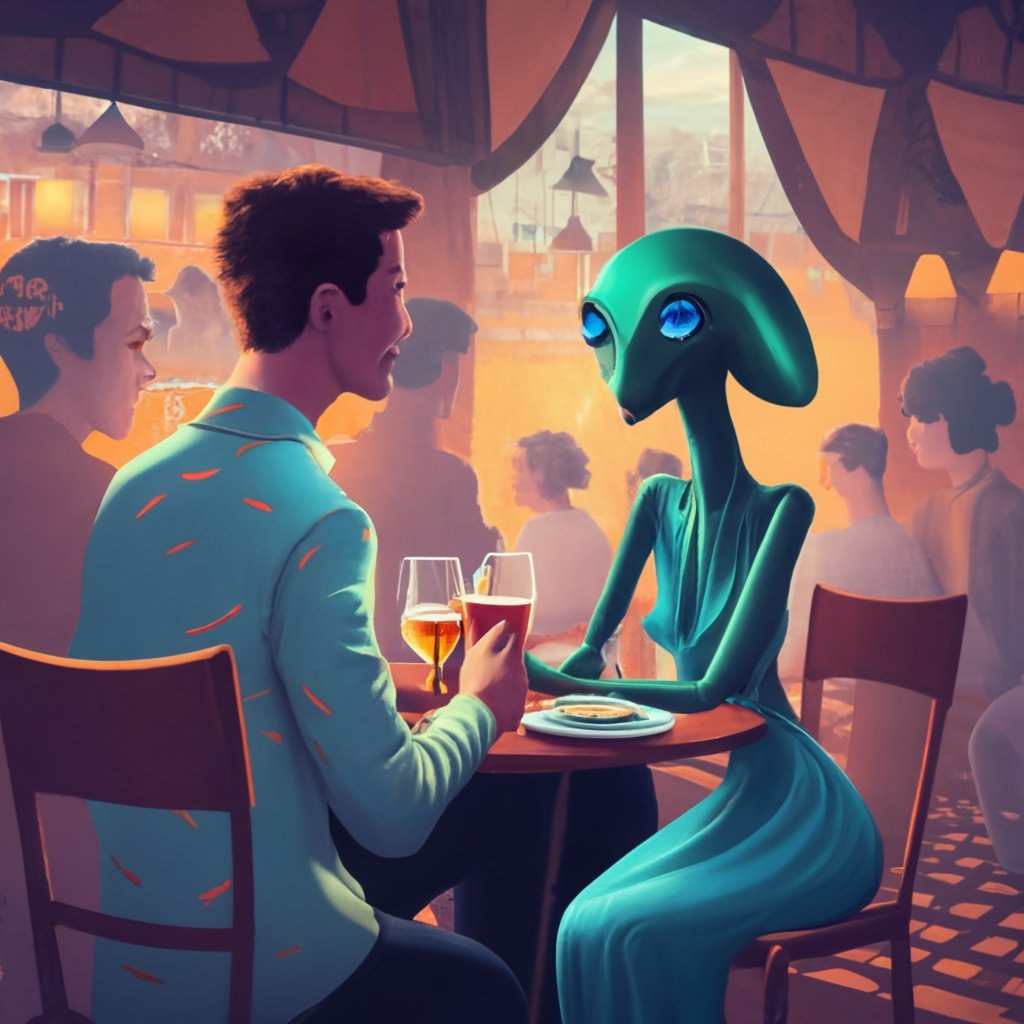
The Ultimate Guide to Intergalactic Dating: Attracting an Extraterrestrial Mate

Humans. Complicated, right? Fear not! The cosmic dating scene has expanded. With Earth’s planetary borders now open to beings from other galaxies, you no longer have to limit your “looking for love” explorations to this planet. But dating an extraterrestrial? There’s a learning curve. Fear not, lovelorn human, here’s how you can improve your cosmic compatibility.

1. Play it Cool, Earthling.

You might think extraterrestrials are the absolute cuddliest, triggering the urge to scoop them up like a lost puppy. But hold off on that bear hug! Some ETs might think you’re about to star in the next episode of “Galactic Autopsies Exposed.” According to studies from Tokyo’s Interstellar Love Institute, engrossing yourself in something else—like, say, untangling the mysteries of quantum physics—makes aliens more inclined to approach. Surprisingly, they’re even drawn to those who seem a tad aloof!

2. Learn Their Love Language.

Alright, Romeo and Romette, you’ve got some homework. Does your alien crush exchange affections with an affectionate antennae tap? Maybe a gentle mucus secretion? The University of Uranus (yes, chuckle, chuckle) says ETs respond well when treated with familiar affection gestures. But watch out! Traditional human signs of affection might get you a screech or a face full of cosmic venom. Also, a pro tip? Unsolicited intergalactic nudes are a universal no-no.

3. Check Your Scent (and Leave Axe on Earth).

Most extraterrestrials can identify lifeforms through smell, often at nose-tingling levels surpassing human capacity. They might be deterred by that ‘Eau de Alien Tiger’ you splashed on. And if your alien date recoils when you lean in? Probably best to ditch the body spray. Even fellow humans don’t appreciate being trapped in a fog of Axe.

4. When in Rome, Boop Like the Romans.

Extraterrestrial linguistics? A tricky business. Since many ETs primarily communicate through aroma and body postures, it’s all about the body language. Forget the traditional handshake. Embrace the alien-boop, a nasus-to-nasus greeting. No nasus? Offer a fingertip—humanity’s universal olfactory ambassador.

5. Ensure a Safe Exit Strategy.

In the vast universe, size definitely matters. To a pint-sized ET, you might seem like the towering villain from a space horror film. Approach them at eye level (or whatever sensory organ they use) and always keep the exit clear. And that intense gaze you mastered for human dating? A no-go. Many ET species equate prolonged staring with predator behavior. So, perfect those slow, sensual blinks and show them you’re all about peace, love, and intergalactic harmony.

6. Know When to Beam Out.

If your extraterrestrial starts showing signs of distress—maybe their scales change colors or they start emitting Morse-code-like beeps—it’s time to give them space. Not all signs are obvious. Subtle cues, like drooping tendrils or twitching appendages, can also indicate discomfort. Recognize the signs and give them space—literally and figuratively.

Dating across the galaxy is, without doubt, a stellar experience. But remember, whether you’re from Earth, Mars, or Triskelion, consent and mutual respect are universally sexy. Now, go on and shoot for the stars, you intergalactic Casanova or Casanovette!

Mirrored Soul

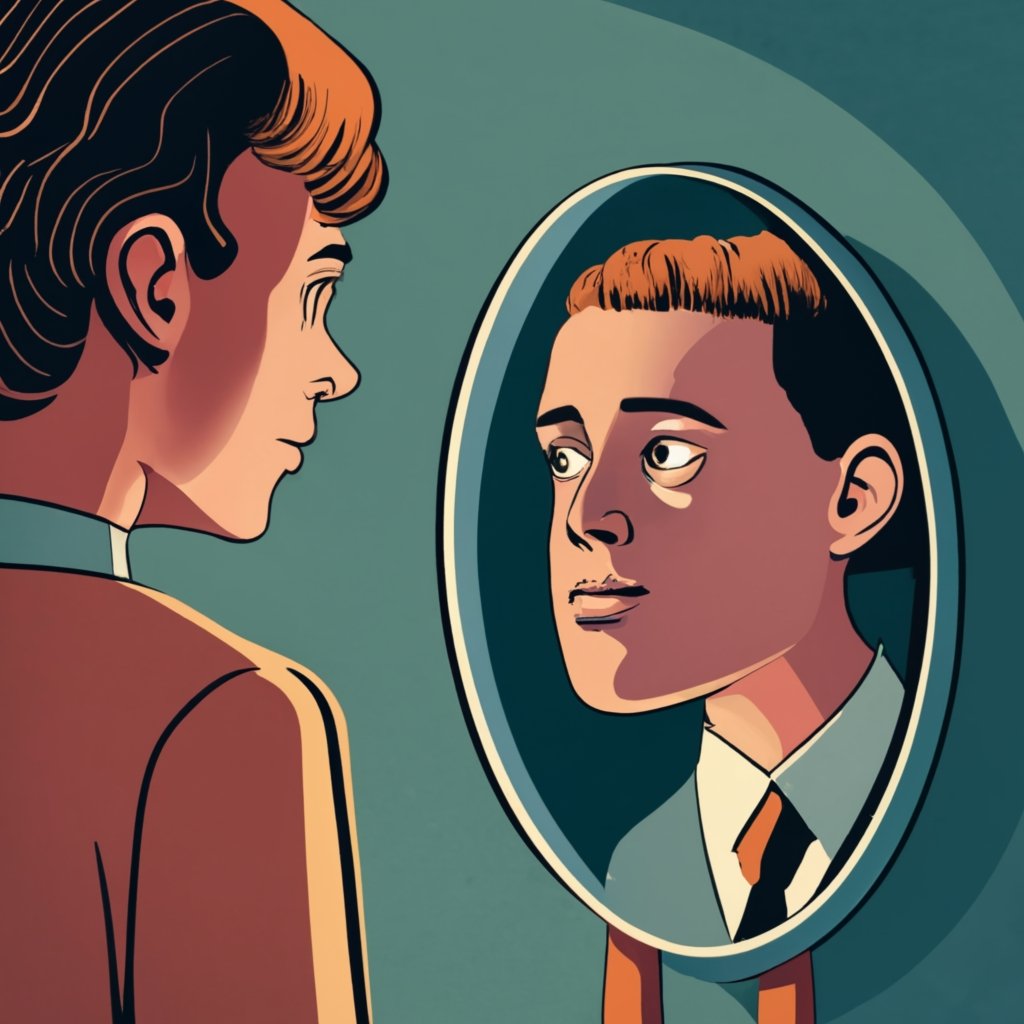
Most people complained about how their lives were predictable, however, Patrick’s world was anything but ordinary. A regular teenager by most accounts, Patrick harbored a perplexing secret. Every mirror he glanced into reflected not his teenage self but an older version—a grizzled man with lines of experience and eyes heavy with memories.

At first, Patrick thought he was hallucinating, but when the reflection began to move and act independently of him, he was both intrigued and unnerved. One day, driven by a combination of curiosity and fear, Patrick decided to communicate with this older self. He scribbled a note and held it up to the mirror, “Who are you?”

The reflection, with a knowing smile, wrote back, “I am you. Just… a little further down the road.”

Conversations with his mirrored self became a daily ritual for Patrick. They discussed life, regrets, and joys. The older Patrick often shared insights and advice from his years of experience, guiding the teenager through various life challenges.

One fateful evening, as rain pelted against the windowpane, the older Patrick’s demeanor changed. His face, more somber than Patrick had ever seen, carried an urgent message, “Avoid Elm Street tomorrow. Trust me.”

Confused but trusting the wisdom of his older self, Patrick heeded the advice and took a different route to school the next day. As he arrived, whispers of a terrible accident on Elm Street reached his ears. A car had skidded off the slick road, crashing into a tree right where Patrick would have been walking.

Shaken by the realization, Patrick raced home to confront his mirrored self. But as he gazed into the glass, he noticed something even more unsettling. The older Patrick looked significantly older than he did just a day before.

It dawned on Patrick that every interaction, every piece of advice, every change he made based on the older Patrick’s wisdom, accelerated the aging of his reflection. His actions were fast-forwarding his mirrored self’s timeline.

Tormented by this revelation, Patrick faced a soul-crushing decision. He could continue seeking advice, effectively trading years of his mirrored life for a more predictable present, or he could embrace the uncertainties of youth and allow his reflection to age naturally.

After much introspection, Patrick chose to face life’s challenges head-on, without the guidance of his older self. He covered the mirrors in his home and vowed to live every moment to the fullest, letting fate take its course.

Years later, as Patrick, now truly older and wiser, looked into a mirror, he saw only the reflection of the man he had become—a man shaped by choices, mistakes, and lessons learned. No longer haunted by what could be, Patrick lived in the present, knowing that every decision, every risk, and every challenge was a brushstroke in the masterpiece of life.

The Second Hour

Nestled in the heart of the city sat a clock shop owned by the masterful clockmaker Lisa Horton. Every tick and tock that echoed through its walls was a testament to her skill and precision. But one fateful morning, as the sun painted the sky in hues of pink and orange, Lisa noticed something peculiar—every clock in her shop was displaying an extra hour.

Confused, she checked her wristwatch and then her phone. It wasn’t a mistake; her handmade clocks had all somehow gained an extra hour. While the rest of the world was at 7 AM, her shop was firmly set at 8 AM.

A sense of intrigue welled up inside Lisa. Instead of trying to correct the anomaly, she decided to indulge in this newfound “gift.” She locked up the shop and stepped outside, walking through a city untouched by the hour’s routines. The streets were empty; it was as if time had paused just for her.

Lisa used her newfound hour to indulge in her wildest dreams. She took daring risks, relished delicious meals without paying, and even confessed secret feelings to an old flame. The beauty of it all was, when the extra hour elapsed, everything reverted to the way it was before 8 AM. No one remembered what had transpired. The world was none the wiser, and Lisa was free from any consequences.

But as days turned into weeks, Lisa’s thrill-seeking began to take a toll on her psyche. While the world around her remained oblivious to her actions during the bonus hour, she remembered everything. The joy of a risk-free life was overshadowed by the weight of carrying the emotional memories alone.

One day, during her extra hour, Lisa made a particularly drastic decision, a choice that, in the moment, felt liberating. But when the hour reset, she was left with a deep sense of guilt and sadness, knowing she could never share her feelings or seek solace.

Realizing she was becoming a prisoner of her own making, Lisa decided to confront the anomaly head-on. She meticulously reset every clock in her shop to the correct time. The next morning, the extra hour was gone, and the world ticked on in its regular rhythm.

The clocks in her shop once again mirrored the world outside. But Lisa was changed. She had come to understand that even if the world could forget, the heart remembered. While she could escape the tangible consequences of her actions, the emotional aftermath was hers to bear alone. Every tick of the clock served as a reminder that while time could be manipulated, emotions were eternal.

Harmony’s Bloom

Azalea Vale was a sleepy town where magic was considered nothing more than children’s tales, which made Hortensia an enigma. Gifted—or perhaps cursed—with the ability to manifest emotions as flowers sprouting from her chest, she was a living, breathing spectacle. This gift was a legacy from her grandmother, a mysterious figure whispered to have been a sorceress.

One fateful morning, a bud, tender and green, burst forth from Hortensia’s chest. As the sun spilled its golden rays into her room, the bud unfurled into a vibrant, multi-hued flower. It was as if her very soul had blossomed.

News of this marvel rippled through Azalea Vale and beyond, turning Hortensia’s secluded home into a sanctuary for the emotionally bereft, the spiritually curious, and even the skeptically intrigued. Scientists, scholars, and common folk alike were captivated by the fiery roses of love, tranquil bluebells of peace, and radiant sunflowers of joy that adorned her.

Yet, this newfound attention wasn’t without its perils. A charismatic but unscrupulous academic, Dr. Alistair, saw potential for exploitation. “Imagine harnessing this emotional energy for scientific breakthroughs,” he whispered into the ears of the town council.

Hortensia found herself at a crossroads. “To share or not to share, that’s the question,” she mused, recalling a line from a play she had once loved.

Guided by an inner symphony of empathy, Hortensia made her decision. She would open her doors to the world, turning her home into an empathic haven. “Welcome to my emotional garden,” she announced, her words a harmonious melody that invited one and all.

For a while, it was a dreamscape. Visitors were bathed in the intoxicating aroma of blossoms, each petal a tangible whisper of shared human emotions. But soon, the garden began to wither. The once distinct and vibrant petals blurred into a murky mess, suffocated by the overwhelming emotional cacophony brought in by the throng of visitors.

Realizing the impending catastrophe, Hortensia sought wisdom from ancient scrolls her grandmother had left her and consulted wise hermits who lived on the outskirts of Azalea Vale. Through her relentless search, she discovered an ancient technique to balance the emotional energies within her.

Armed with newfound wisdom, Hortensia returned home. With utmost care, she plucked each flower, whispering words of acknowledgment to the emotion it represented. She then rearranged them into thematic alcoves in her home, where each emotion could sing its own tune without overwhelming the others.

When Dr. Alistair attempted to seize this moment for his own gain, he found himself thwarted by the town council, who had been moved by the new harmony in Hortensia’s garden. “This is a sanctuary, not a laboratory,” they declared.

Visitors now experienced a carefully orchestrated symphony of emotions. Each alcove became a pilgrimage point, encouraging contemplation and emotional growth. People left the sanctuary with seeds of empathy planted within them, their lives forever enriched.

Hortensia’s garden transformed from a mere spectacle to a guiding light in the quest for emotional understanding. It stood as a living testament to the resilient power of compassion and the captivating beauty of human emotions.

In Azalea Vale and far beyond, the tale of “Harmony’s Bloom” resonated as a timeless parable. It was a testament to our shared emotional landscape, a gentle reminder of the wondrous gardens that could grow within us when watered with empathy and love.

Levels of Laura – Part 3

Part 1 HERE * Part 2 HERE

The atmosphere in Café Lila had an ironic familiarity as if it were some stage set up for the actors in this intricate, heart-wrenching drama. It was the kind of place that was supposed to make people feel at ease, but now it bore witness to their complicated stories.

Carol found herself sitting across from Mark. They had met by chance, but the air was thick with unspoken understanding. “So, this is where they meet?” Carol asked as she looked around the shop.

“Before they go back to Laura’s studio,” Mark nodded. “But they burn through each other quickly, which is why they keep us around. We’re the fallback plan, Carol, the safe choices, right? You ever wonder why we let them keep doing this to us? Why we’re almost complicit in our own heartache?”

Carol sighed. “I ask myself that every time Rudy comes home late or is distant for days. I tell myself that maybe this time, it’s different. Maybe he’s realized what he’s about to lose. But deep down, I know I’m fooling myself. Whatever he finds in her bed is a siren’s call he can’t resist, no matter the cost.”

Mark’s face was a canvas of empathy and understanding. “I think it’s the same for Laura. Somehow, Rudy’s that unfinished painting, the masterpiece she’s convinced lies in the chaos they share. But each time they crash into each other’s lives, they tear away a piece of us, don’t they? Leaving us a little more fragmented, a little more incomplete.”

Carol’s fingers absentmindedly turned her engagement ring round and round. “I thought love was about building something together, you know? Brick by brick, layer by layer. But with Rudy, it feels like I’m trying to build on quicksand.”

“Same,” Mark said softly. “You fantasize about a love that’s solid, stable, but also passionate and all-encompassing. But then you wake up to realize that while you’re their anchor, they’re your shackles.”

A silence fell between them. For a moment, they both got lost in their thoughts, each considering the complicated web their partners had spun, and they’d allowed themselves to be caught in. The ambient sounds of the coffee shop seemed to swell and fill the void as if nature abhors a vacuum.

“You know,” Carol broke the silence, “We can’t control them, but we can control our own choices. We don’t have to be their safety nets forever. Maybe it’s time we cut the strings and let them fall or fly on their own.”

“And maybe it’s time we find someone who looks at us the way they look at each other,” Mark added, the thought surprisingly liberating. “Someone who doesn’t see us as an option but as a priority.”

There was a newfound clarity between Carol and Mark, a resolution crystallizing between them. “Exactly. We may be their ‘safe’ choices, but we’re also the smart ones because we know that love isn’t just about chaos and passion; it’s about choice every single day. And it’s high time we make some choices of our own.”

The air between them felt different now, charged with new energy, a shared understanding that while they may be caught in a story they didn’t write, they had the power to pen their own endings. The weight of the reality began to lift, making room for a possibility neither had considered before but suddenly seemed worth exploring.

***

Physically, Rudy was walking the streets; mentally, he was wading through a labyrinth of his own choices and fears. On one side of this emotional scale was Laura—enigmatic, consuming, and the catalyst for untapped depths of raw emotion he’d never encountered anywhere else. She was the missing pigment in the otherwise grayscale canvas of his life. On the other end was Carol—reliable, nurturing, and the stabilizing force he’d consistently underestimated. She was the foundational sketch to his chaotic, colorful overlay, a balancing element in a life he realized was precariously close to losing all equilibrium.

When he finally came to his decision, Rudy wound up at Laura’s studio. “We can’t keep doing this,” Rudy finally said.

Laura’s face was an impassive mask, making it impossible to gauge her reaction. “I agree. It’s time,” she said simply.

“You’re not upset?” Rudy asked, caught off guard by her calm.

She shook her head. “No, Rudy. Every time we’ve met, we’ve pushed each other towards something different, something new. We’ve been agents of change for each other. Now it’s time for the next chapter.”

Rudy was taken aback. This was his decision, his crossroads. Yet, Laura was framing it as if she had made a choice already. “What are you saying?”

“I’m leaving the country, Rudy. Starting anew. It’s time for you to figure out your own path without me as a distraction,” Laura revealed.

The room seemed to sway around Rudy as though it were pulling away from him. “You’re leaving? Laura, don’t go. I… I choose you!”

Laura’s eyes softened, a rare moment of vulnerability crossing her features. “Rudy, sometimes choosing isn’t enough. My mind is made up. It’s time for you to decide what life you want, but I won’t be a part of it.”

The walls of the studio suddenly felt suffocating. Rudy was losing her, losing the untamed energy that had broken his monotonous rhythm, and there was nothing he could do to stop it. The studio transformed from a sanctuary into a chamber of painful realizations at that moment. The artworks around him seemed to jeer as if saying, “Too late.”

As he made his way to the door, Rudy felt a hollow emptiness replace the tumultuous emotions that had plagued him for so long. “Goodbye, Laura.”

“Goodbye, Rudy,” she echoed, the finality in her voice resounding long after he’d stepped out into the New York night, a man left to ponder the complexities of choices made and opportunities lost.

***

There was nowhere left to go but home. It was time to face the music. Rudy sat across from Carol in their living room, his eyes awash with regret and resolution. This was the moment—his moment of reckoning.

“Carol, I’ve been unfaithful, and there’s no excuse. I’ve been seeing Laura on and off for years,” he began, his voice quivering with emotion.

Carol’s eyes widened, but she silently waited for him to continue.

“I need to explain something to you, not as a justification but as an attempt to offer some insight into my confusion,” Rudy continued. “I’ve been in relationships, chased after women obsessively, but none of them—not a single one—compares to how I feel about Laura.”

Carol clenched her jaw but remained silent, prompting him to delve deeper.

“I’ve been trying to understand why Laura elicits these feelings in me. I’ve been looking at the grand canvas of my life and all the women I’ve been with, and what I’ve realized is that Laura stands out not just because she’s ‘good’ but because she’s compelling in a way that’s hard to articulate.”

He paused, searching Carol’s face for some glimmer of understanding, but found only an abyss of hurt.

“All relationships come with baggage,” Rudy continued, “Emotional micromanagement and inevitable alienation. With most women, I’ve felt like we’re just trying to wring as much attention from each other as we can until it’s over. And it always ends poorly.”

“But with Laura,” he hesitated, grappling with the words, “It was like we were two separate jigsaw puzzles that were never meant to be combined, yet somehow, our edges lock together. When I was with her, it was as if I was in this state where everything else faded away, and I was racing toward something unexplainable—like I had caught a glimpse of the universe’s core, of life’s meaning.”

Carol’s eyes were filled with tears, but she had not spoken.

“Ours was a fragmented relationship, segmented into missions. Once we achieved our objectives, it ended… until the next mission. But there are no more missions, I promise you. Laura and I and through, and I choose you if you can find it in your heart to forgive me. We can start over again and build something new, better, and stronger. What do you say? Do you love me enough to give me another chance?”

Finally, Rudy fell silent, looking into Carol’s eyes, awash in a sea of regret, a man drowning in his folly.

Carol took a deep breath, her voice cracking as she spoke. “No. But I love myself enough to let you go. I deserve better, and I hope you finally get what you deserve.” She picked up her bag, took one final, lingering look at the man she had wasted years of her life with, and walked away.

In that moment, Rudy was left truly alone, reckoning with the weight of his revelations and the two loves he had just lost. It was a profound isolation but one tinged with a bitter clarity: he had been on a quest for meaning in the wrong places, and it had cost him dearly.

***

Laura sat in the crowded airport lounge, a sea of people swirling around her. But within that sea, she was an island, an oasis of focus and creativity. Her tablet was her canvas, her stylus, her brush, as she worked diligently to complete the portrait of Rudy. Unlike before, when her strokes were imbued with chaos, tension, and emotional turbulence, the lines now were softer, more deliberate. This time, Rudy’s features were not distorted but calm and filled with a sense of peace and possibility.

She exhaled deeply as she hit save and snapped the tablet’s cover closed. Her mind, so long a storm of chaotic thoughts and tangled emotions, was now a clear sky, ready for a new journey. And this one she would take alone, a mission of personal growth, untethered from the complicated webs she’d been weaving for years.

As she collected her thoughts, ready to embrace her next chapter, she felt a tap on her shoulder. She turned to find Mark standing there with a small bouquet of sunflowers.

“I heard you were leaving. I wanted to say goodbye,” he said, his eyes sincere, his words carrying a weight of unspoken emotions. “And, maybe it’s cliché, but sunflowers always seemed to represent you to me—standing tall, seeking light.”

Laura was taken aback. Mark’s unexpected appearance was a reminder that love could be full of surprises, sometimes beautiful, often painful. But as she looked into his eyes, she realized that sometimes love was also the act of letting go.

“I didn’t do right by you,” Laura admitted.

Mark agreed, “No, you certainly did not.”

“I can only thank you, Mark, for being you,” she said, taking the bouquet from his hands. “Don’t you ever settle for someone like me? Aim higher.”

They hugged, a final embrace filled with a sense of an ending but also the hope for new beginnings—for both of them.

Mark watched as Laura walked toward her boarding gate, sunflowers in hand, stepping into a future unknown but full of potential. As she disappeared into the crowd, he realized that sometimes the best way to hold on to someone was to let them go.

Laura settled into her airplane seat, looking out the window at the shrinking world below. The engines roared, and as the plane ascended, she felt herself leave behind not just a city, not just people, but a chapter of her life. And as she drifted above the clouds, she knew she was ready for whatever came next. A new mission, a new puzzle to solve, and this time, she was the missing piece.

She leaned back in her seat, closed her eyes, and felt genuinely free for the first time in years. And somehow, she knew that the pieces would finally fall into place wherever her next mission took her.

The. End.