The Lollipop Man: The Lurking Shadows

Original Story HERE

This is a follow-up on a post done a while ago, more of a backstory for the Mister Jenkins character in the story found in the above link.

Decades ago, in the small town of Wraithmoor, Thomas Jenkins lived a humble and content life. He had always been fascinated by the intricate dance between light and shadows, and he possessed an uncanny ability to manipulate them. In his early years, he traveled the world, performing as an illusionist, using his talents to amaze audiences with dazzling displays of light and darkness. But eventually, he grew weary of the limelight and returned to Wraithmoor to live a quiet life.

Thomas found solace working as a lollipop man, guiding the town’s children safely across the busy streets near Oakwood Primary School. He had become an indispensable part of the community, a kindhearted and trustworthy figure who brought joy and laughter to everyone he encountered. The children adored him, and he cherished the role he played in their lives.

Unbeknownst to Thomas, his unique abilities were coveted by a secret society of occultists, The Order of the Umbra. The group believed that they could harness Thomas’s powers to unlock the hidden secrets of the universe, which would grant them unimaginable wealth and influence. When they approached Thomas with the proposition to join their ranks, he refused, disgusted by their twisted aspirations and fearing the potential harm his powers could cause in the wrong hands.

Enraged by his rejection, The Order of the Umbra devised a devious plan to ensure they could benefit from his abilities without his cooperation. They forged an enchanted artifact, a lollipop sign imbued with a potent curse, and planted it within Thomas’s belongings. Unaware of the item’s malicious properties, he unwittingly used it during his duties.

In time, the curse began to warp Thomas’s soul, corrupting his once-noble spirit and transforming him into a sinister vessel for the Order’s dark ambitions. The shadows that once danced and played at his command now whispered vile secrets and enticed him with the promise of unlimited power. Thomas struggled against the curse, but his resistance only fueled the transformation.

It was during this tumultuous period that tragedy struck. A terrible accident took place at the school crossing, claiming the lives of several children, and Thomas, being the unfortunate witness, was left heartbroken. Wracked with guilt, he became reclusive, seeking solace in the only place that brought him comfort – the playground. One fateful evening, Thomas succumbed to the curse entirely, and the shadows swallowed him whole, leaving behind an empty shell of the man he once was.

Now, as a vengeful spirit, Thomas Jenkins – once the kindly lollipop man – haunts the playground, his soul corrupted by the artifact’s curse, his powers twisted to serve the dark machinations of The Order of the Umbra. He exists in a constant state of torment, a prisoner of the shadows that have become his curse and his identity.

I Fell Through Hell – A Madd Fictional Imagination Playhouse Production

Because it was bored and had little else to do but support my head while my body shut down to replenish itself, my pillow took advantage of the moment by whispering my destiny in my ear in the dead of night during that flash second of waking from a nightmare, the moment where the line between illusion and reality blurred, when fear tangled around the heart like a sweat-soaked bed sheet. It said:

Heaven holds no place for you.

It spoke to me in English but with a tongue drenched in an accent I was unable to place. Some dead language known only to pillows, I supposed.

My own unique brand of pillow talk first happened when I was a child and in defiance of all the childhood messages that slipped away unremembered, this one had taken root. I had accepted my fate at a tender age and decided to play the hand I was dealt. And after a lifetime spent in disregard of my fellow man and the consequences of my selfish actions as I baby-stepped my way through my sinful prophecy—I slipped and fell…

Down through the frozen landscape of Niflheim, where the branches, bramble and roots of the World Tree, Yggdrasill, beat my face and tore at my skin. And where Hel, daughter of Loki, stood on the Shore of Corpses, petting the head of Nidhogg, the giant snake that fed on the dead

Carried along on the poisonous snake river, Tuoni, I was brought through Tuonela, a place not wholly unlike Earth under the gloomiest conditions, where the maid of Death, Tytti, cast me down further for bringing no provisions as a tribute.

Down further, I was injured whilst falling onto the Chinavat Bridge, which was thinner than a hair, yet sharper than a blade. The twin four-eyed guardian dogs snapped their jaws at me, judging me based on the deeds in my life.

The bridge turned on its side, for my bad deeds outweighed the good, and pitched me into the demon-filled pit below, where the demon Vizaresh dragged me into the House of Lies, a place of disgusting filth, where I was served spoiled food and tortured by demons, hundreds in number, each representing a specific sin, before Apaosha, the demon of drought and thirst, and Zairika, the demon that makes poisons, cast me further down.

Through a lake of fire and up against an iron wall where I passed through a series of gates guarded by half-animal, half-human creatures named The Blood-Drinker Who Comes From The Slaughterhouse, and The One Who Eats The Excrement Of His Hindquarters, into Duat where my heart was weighed against a feather and eaten by the demon Ammut. Although horrified at the sight of my heart being eaten, I was fascinated by the sight and wanted to watch but I could not stop myself from falling…

Down through Gehenna, a deep and desolate place in which noxious sulfuric gasses hung in the air and flames continuously burned and rained from the sky into rivers of molten metal and where the followers of Moloch sacrificed children in the great fires. My fingertips clutched for purchase on this foundation but I fell…

Down past the nine-headed hydra, into Tartaros, where I was whipped by Tisiphone as I tumbled deeper into the deep black dungeon full of torture and suffering.

Down through Maharaurava where the serpent demon Ruru tried to eat my flesh.

Through Kumbhipaka where I was nearly boiled in hot oil.

Through Diyu where Yama Loki of Naraka condensed the 96,816 hells into 10 sections the Chamber of Tongue Ripping, The Chamber of Scissors, The Chamber of Iron Cycads, the Chamber of Mirror, Chamber of Steamer, Forest of Copper Column, Mountain of Knives, the Hill of Ice, Cauldron of Boiling Oil, Chamber of Ox, Chamber of Rock, Chamber of Pounding, Pool of Blood, Town of Suicide, Chamber of Dismemberment, Mountain of Flames, Yard of Stone Mill, and Chamber of Saw.

Down through Xibalba, where the lords of the afterlife inflicted various odd forms of torture on me such as causing pus to gush from my body, squeezing me until blood filled my throat and I vomited my organs…

Before being cast even lower into rivers filled with blood, scorpions, and pus, where I cascaded over a waterfall to my final death, crashing into oblivion and shattering into millions of pieces…

Only to wake up and hear my pillow whisper in its thick accent:

Hell holds no place for you.

So, again I lost my footing and fell, through limbo this time, into…

The Last Bed on Earth

Courtney Brady lay unconscious in the fetal position on the last bed on Earth, her naked body caught up in the tangle of a sweat-soaked linen sheet. Her eyes moved beneath their lids and her breathing came in short pants. She was in REM sleep and had been for the past one hundred and sixty-eight hours straight.

Her husband, Jacob, entered the makeshift bedroom, carrying a tray with a bowl of hot broth and a glass of cool water. He set the tray down on a nearby table, sat on the bed beside his wife, and gently tried to shake her awake. Although her eyes stopped moving and her breathing slowed, Courtney remained asleep.

“Come on, Court, you have to wake up and eat,” he said in a soft yet firm voice.

Jacob’s silhouette cut a forlorn figure against the dim glow of the bedside lamp, his shadow dancing eerily on the peeling wallpaper. The room, a relic of a world now lost, was a shrine to normalcy in a landscape torn asunder. He watched Courtney, her chest rising and falling in a rhythm that belied the chaos outside their sanctuary. The room smelled faintly of antiseptics and despair, a stark contrast to the rich aroma of the broth he had prepared with dwindling supplies.

Outside, the remnants of humanity scurried like ghosts among the ruins, a testament to the resilience and fragility of life. The world had become a wasteland, its once vibrant pulse now a feeble echo in the vast emptiness. Yet here, in this small, decaying room, life clung stubbornly, embodied by the woman on the bed.

Courtney’s face, even in slumber, was etched with the toll of their reality. Lines of worry, like tiny tributaries, traced her forehead, and her lips, once quick to smile, now seemed locked in a perpetual frown. Jacob’s heart ached as he gazed upon her, remembering brighter days now overshadowed by the relentless march of despair.

He reached out, his fingers trembling slightly, and brushed a lock of hair from her forehead. His touch, though gentle, was laden with urgency. “Court,” he whispered, his voice barely rising above the sound of the world crumbling outside their fragile haven. “Please, you need to eat. You need to stay with me. I can’t do this without you, baby.”

But she lay motionless, her spirit wandering in realms he could not follow. Jacob’s mind raced with the implications of her prolonged slumber. In a world where every resource was precious, every moment a gift, Courtney’s condition was a luxury they could ill afford.

The broth’s steam rose in lazy swirls, a silent siren call to the living. Jacob’s own stomach gnawed at him, a constant reminder of their dire situation. But he pushed aside his hunger, his focus solely on the woman before him.

He leaned closer, his lips brushing her ear. “Courtney, it’s Jacob. I’m here. Please, come back to me.” His voice cracked, a mixture of fear and determination.

The bandage on Courtney’s arm stood out in the dim light, a stark reminder of the peril they faced. Jacob’s hands, once used for gentle caresses, had become instruments of survival, meticulously cleaning and dressing the wound where something — something unspeakable — had bitten her. He had scoured every inch of her skin, removing any trace of the vile infection, his actions driven by a desperate hope.

As he watched her, Jacob’s mind replayed the moment of the attack, the terror in Courtney’s eyes mirroring his own. The world outside was no longer just a barren wasteland; it was a hunting ground for horrors that defied understanding. But in this room, in this moment, he fought back the only way he knew how — by keeping Courtney from slipping into that dark transformation.

The air was heavy with the weight of unspoken fears. Jacob knew the signs to watch for, the subtle changes that would signal a loss too great to comprehend. But as he held her hand, feeling the warmth of her skin, he allowed himself to believe, just for a moment, that they could defy the odds.

His vigil by her side was more than a duty; it was a silent vow to protect the last vestige of their shared humanity. In a world that had forgotten kindness, Jacob’s care for Courtney was a quiet rebellion against the encroaching darkness.

With each passing hour, Jacob found himself embracing a terrifying possibility. If Courtney were to turn, to become one of the horrors they feared, he had resolved to offer himself willingly. In his heart, the idea of being the sustenance that kept her alive, in whatever form she might take, was a final act of love, a testament to their bond that transcended the nightmare their world had become.

Gently, he slid beside her on the bed, their bodies close in the chilling air. This bed, the last bastion of their shared past, now held not just memories but a solemn pact made in the face of an unthinkable future. As he lay there, his arm protectively around her, Jacob closed his eyes, his mind adrift in a sea of what-ifs and maybes.

In the silence of the room, with the shadow of fate looming over them, they lay together on the last bed on Earth, united in their final stand against a world gone mad.

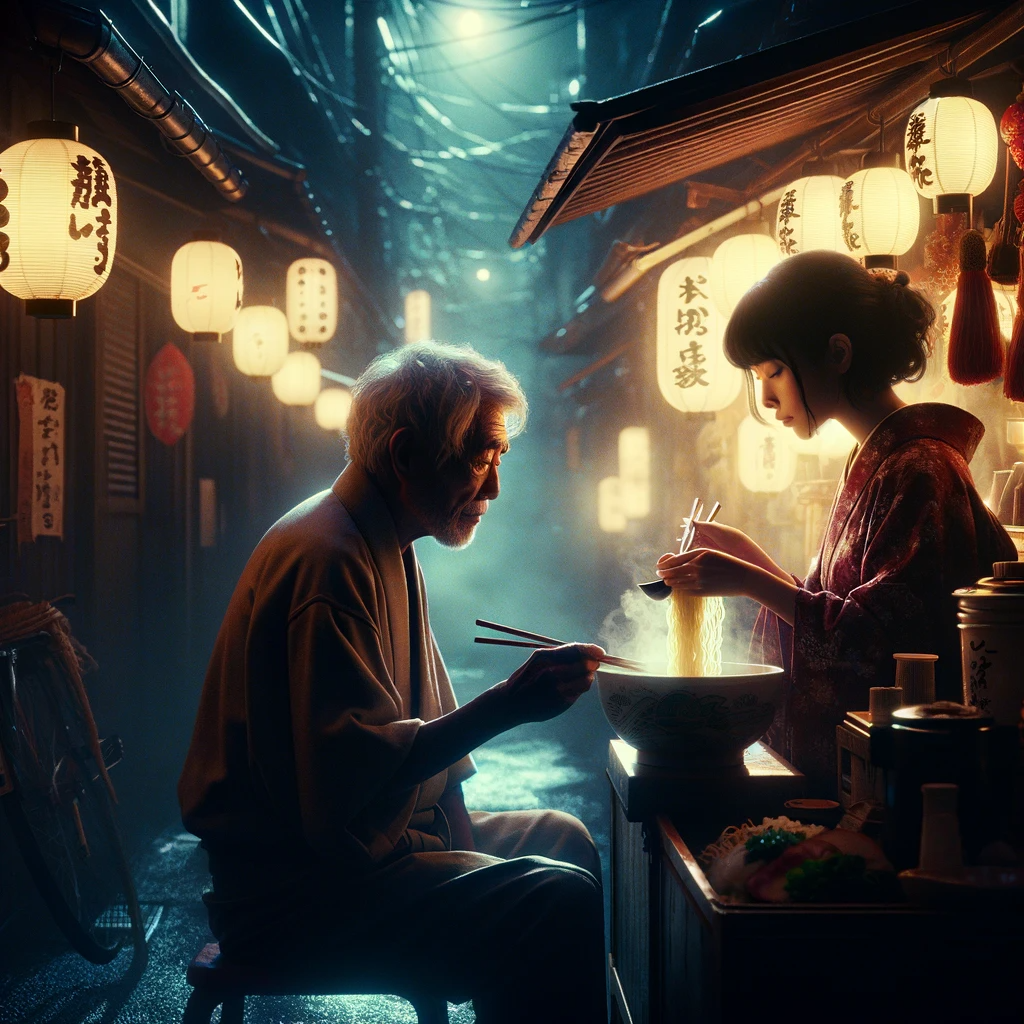
The Midnight Ramen Girl

Gather ’round and lend me an ear while I tell you of a phantom who brewed destiny in a cauldron of broth and steam. A true story? Urban folklore? That’s for you to decide. This particular story took place in a neon-drenched metropolis, where skyscrapers pierced the night sky like glass monoliths. It was here that a mystery simmered in the labyrinth of alleys. The Midnight Ramen Girl.

Hiroshi Takahashi was once a titan among Tokyo’s food critics, but now in the twilight of his career, he found himself adrift in a sea of modern culinary trends that, to his seasoned palate, tasted of artifice and pretense. Each new fusion restaurant, each experimental dish, seemed a mere shadow of the traditional flavors he had once celebrated. His pen, once sharp and eager, now hesitated over the pages of his review journal, burdened by a nostalgia for a past era of cuisine.

Hiroshi’s apartment was a high-rise sanctuary overlooking the neon heartbeat of the city. It was filled with the echoes of a life once shared with his late wife, Keiko. Her absence was a silent presence in every corner, from the kitchen where they had danced and cooked together, to the small balcony where they had shared whispered dreams under the starry sky. Since her passing, Hiroshi’s world had dimmed, his love for food and criticism becoming mere ghosts of their former vibrancy.

One evening, as Hiroshi sat at his oak desk, the glow of his lamp spilling over piles of unremarkable restaurant menus, a whisper of a legend found its way to him — the tale of the Midnight Ramen Girl. It was said that her cart appeared only on full moon nights and only to those whose hearts were shadowed by sorrow. Her ramen, a dish woven with the essence of old Tokyo, was a balm for the brokenhearted.

Intrigued and impulsively driven by a spark of curiosity that he hadn’t felt in years, Hiroshi decided he would seek out this Midnight Ramen Girl. It would be his final review, a swan song to a career that had once been his world. This pursuit, he felt, might just rekindle the passion he had lost in the wake of Keiko’s departure from this world.

The first full moon night found Hiroshi wandering the labyrinthine streets of the city, where the scent of street food hung thick in the humid air, mingling with the exhaust of passing cars. Neon signs buzzed overhead, casting vibrant hues onto the pavement, as people, like colorful specters, moved around him in a dance of city life.

He walked through familiar streets and alleys, past ramen shops where steam fogged up windows and laughter spilled into the night. But of the Midnight Ramen Girl, there was no sign. Hiroshi’s heart, heavy with a blend of anticipation and the bitter tang of memories, began to sink. The night, with its myriad sounds and smells, felt overwhelming, a sensory reminder of the life he and Keiko had once reveled in together.

As the moon climbed higher, casting its silver gaze over the city, Hiroshi’s search continued, driven by a yearning for something authentic and true, a yearning he hadn’t felt since Keiko’s laughter had filled their home. It was this longing that propelled his tired feet through the city’s heart, chasing after a legend that seemed as elusive as the joy he once knew.

The night waned, and with it, Hiroshi’s hopes. The Midnight Ramen Girl remained a mystery, her cart a phantom just beyond his reach. As he returned to his quiet apartment, the city’s symphony fading behind him, Hiroshi realized that this quest was more than just a pursuit for a story; it was a search for a piece of his soul he feared was lost forever.

The second full moon since Hiroshi bathed Tokyo in a luminescent glow, painting the city in a palette of ethereal silver. Hiroshi, emboldened by his newfound quest, ventured into the night once again, his heart a pendulum swinging between hope and despair.

As he navigated the serpentine alleys, Hiroshi’s keen eyes caught a fleeting vision — a line of people, a melting pot of souls, trailing into a narrow alley. His pulse quickened. Could this be the elusive cart? He quickened his pace, weaving through the crowd, the murmur of excited conversations filling his ears. The aroma of ramen, rich and inviting, teased his senses, pulling him forward.

But as Hiroshi reached the alley’s mouth, the vision that had ignited his hopes dissolved like mist. The cart, a spectral enigma, vanished before his eyes, leaving behind only the lingering scent of broth and a murmur of wonder and disappointment from the crowd. Hiroshi stood there, a solitary figure in the moonlight, his heart sinking in his chest. The elusive Midnight Ramen Girl remained just beyond his grasp.

Hiroshi was driven by an obsession that eclipsed all else. He scoured the city, interviewing anyone who claimed to have seen the Midnight Ramen Girl. Each tale was a thread in the tapestry of urban folklore surrounding her — a culinary phantom who appeared to the sorrowful, her ramen a balm for the aching soul.

He delved into the city’s history, seeking connections in the tapestry of old Tokyo’s culinary scene. Hiroshi revisited places he and Keiko had once loved — the old noodle shop where they had shared their first date, the riverside where they had watched countless sunsets. Each location was a time capsule, unlocking memories of laughter, love, and the inevitable shadow of loss.

As the third full moon approached, Hiroshi’s attempts to find the Midnight Ramen Girl had transformed him. No longer was he the jaded critic, detached and weary. The quest had rekindled a fire within him, a yearning for connection, for understanding the tapestry of his own life. Keiko’s memory, once a source of unending sorrow, began to weave itself into a narrative of love and the preciousness of fleeting moments. With a heart heavy yet hopeful, Hiroshi ventured into the night, the moon a silent companion in his search for the ephemeral cart and the memories it held.

The alleys of Tokyo led him once again on a path paved with anticipation and echoes of a past that clung to him like a second skin. And, near evening’s end, far from the hustle of where nightlife thrummed, Hiroshi found the elusive cart. It stood in a secluded alley, bathed in the soft glow of paper lanterns. The last customer, a young woman with eyes red from crying, nodded her thanks to the Midnight Ramen Girl and disappeared into the night.

The Ramen Girl, her hair a cascade of moonlight, her eyes pools of knowing, was about to close. She had just enough ingredients for one more bowl. As Hiroshi approached, the clatter of the city faded, replaced by the intimate sounds of the cart — the simmer of broth, the clink of a ladle against a pot.

“I am so sorry,” the Ramen Girl said, her voice a melody in the quiet alley. “I have no more ramen.”

Hiroshi eyed the bowl of ramen before her. The Ramen Girl answered his unspoken question, “My supper.”

Hiroshi’s heart, a vessel of unspoken grief and yearning, lay bare in his eyes. “I’m sorry,” he began, his voice a whisper lost in the night. “I’ve been searching for you, for your ramen. They say it’s not just food, but a memory, a moment…”

The Ramen Girl looked at him, a faint smile touching her lips. “You carry a heavy heart,” she said. “Sit. Share my meal.”

As they sat across from each other, the Ramen Girl divided her ramen into two bowls. The steam rose like spirits, carrying with it the scent of soy, garlic, and something ineffable, something that spoke of comfort and long-forgotten homes.

With each mouthful, Hiroshi’s world unraveled and rewove itself. He saw Keiko, her laughter ringing like bells, her eyes alight with love and mischief. He relived their moments — the quiet mornings, the shared meals, the tender embraces, and the crushing silence of her absence.

But there was something more in the broth, a flavor not his own. Memories that were not his began to surface — flashes of a young girl, Yumi Nakamura, learning to cook beside her grandmother, the heat of kitchen fires, the sting of a love lost, and the solitude of a life on the move. These were the Ramen Girl’s memories, her joys, and sorrows.

They ate in silence, two souls adrift in a sea of memory and emotion, their experiences mingling in the sacred space of shared grief and understanding. The Midnight Ramen was not just a dish; it was a bridge between hearts, a tapestry woven from the threads of their separate lives.

As the last of the ramen was savored, Hiroshi and the Midnight Ramen Girl looked at each other, no longer strangers, but companions in a journey that had transcended the boundaries of a simple meal. In that small cart, under the watchful eye of the moon, they had shared more than just food — they had shared pieces of their souls, finding solace in the shared language of loss and the unspoken understanding of those who have loved deeply and lost.

As the last strands of the Midnight Ramen lingered on their lips, an unspoken understanding passed between Hiroshi Takahashi and the enigmatic Ramen Girl. In that shared meal, they had traversed the landscapes of their hearts, finding common ground in their separate yet intertwined sorrows.

Hiroshi, sitting in the quiet aftermath, felt a catharsis washing over him. The ramen had been a vessel, carrying him through the tides of memory, revealing the depth of his love for Keiko. It had shown him that cherishing the past did not mean living in its shadows.

“You’ve given me more than just a meal,” Hiroshi said, his voice tinged with newfound clarity. “You’ve given me a journey through my own heart.”

The Ramen Girl, her eyes reflecting the moonlight, nodded. “We find healing in many ways,” she replied. “Sometimes, it’s in a bowl of ramen, or in the stories we share.”

That night, Hiroshi returned to his apartment, a place once filled with the echoing silence of loss, now imbued with a gentle peace. He sat at his desk, the city lights twinkling like distant stars, and began to write. His words flowed, not with the critical sharpness of a food critic, but with the poignant introspection of a man who had peered into the depths of his soul.

His final review was a tapestry of emotions — a tribute to the Midnight Ramen, a homage to Keiko, and a meditation on loss, love, and the healing journey of life. He wrote of the flavors that had unlocked his memories, of the shared experience with Yumi the Ramen Girl, and how it had guided him to embrace the light amidst the shadows.

With the publication of his final piece, Hiroshi’s career as a food critic came to a close. But his journey was far from over. He found solace in his memories, each a cherished chapter of a life lived with love and loss.

In his retirement, Hiroshi chose to honor the legacy of both Keiko and the Midnight Ramen Girl. He began teaching cooking classes, sharing the traditional flavors and techniques that he had always held dear. He wrote, too, not reviews, but stories of food and life, each recipe imbued with a memory, a piece of wisdom, a snippet of Tokyo’s culinary soul.

In these classes, in the words he penned, Hiroshi found a renewed purpose. He shared not just the techniques of cooking but the stories behind each dish, the way food could speak to the heart, heal the wounds of the past, and connect people across the boundaries of time and experience.

As Hiroshi’s students hung on his every word, as his readers found solace in his stories, he knew he had found his path. In the art of cooking and teaching, he kept alive the memories of Keiko, the lessons of the Midnight Ramen Girl, and the unending story of a city that, like him, was a mosaic of loss, love, and the indomitable spirit of moving forward.


All Sunshine Makes A Desert

A relentless sun blanketed what was once a verdant world, and amidst this vast, scorching desert lay the city of Solara, a gleaming oasis of technology. The people of Solara had long forgotten the cool embrace of a shadow, living under an ever-present sun that never set.

I. The Unwavering Sun

Amidst the metallic towers of Solara, young Eli, an apprentice in solar engineering, gazed skyward. “Why do we never have night?” he mused to his mentor, Dr. Cora.

Dr. Cora, her eyes reflecting the glint of the sun, replied, “Eli, our ancestors believed an eternal sun was a blessing, providing limitless energy. But they didn’t foresee the cost — the withering of our lands, the loss of our nights.”

II. The Discovery

One day, while working on the solar grids, Eli stumbled upon ancient archives detailing a world of diverse climates and a celestial balance of sun and moon. Fascinated, he shared his findings with his friend, Lina, a botanist.

“Imagine a world where nightfall brings cool breezes and the sky dances with stars,” Lina said, her voice tinged with longing. “Our plants would thrive not just survive.”

Eli nodded, “We must find a way to bring back the night.”

III. The Plan

Eli and Lina devised a bold plan to engineer a massive orbiting shield that could simulate night by blocking the sun for controlled periods. They presented their idea to the Council of Elders, hoping to restore the ecological balance.

Councilor Rahn, the head of the Council, scoffed. “You wish to plunge Solara into darkness? Our ancestors chose eternal daylight for prosperity. Why defy their wisdom?”

Eli countered passionately, “All sunshine makes a desert. Our world is dying. We need the night to heal.”

IV. The Experiment

Despite the Council’s refusal, Eli and Lina, with the help of Dr. Cora, embarked on their mission clandestinely. They built a prototype, a small-scale shield, and activated it. For the first time in centuries, a piece of Solara experienced night.

In the cool darkness, Lina’s plants flourished. “See, they need the night just as much as the day,” she whispered in awe.

V. The Revelation

The experiment, however, did not go unnoticed. The Council arrested them for endangering Solara. During the trial, Eli presented his results. “Our experiment brought life back to the desert. Imagine what a controlled cycle of day and night could do!”

Councilor Rahn, moved by the evidence and public support for Eli and Lina, declared, “Perhaps it’s time we reevaluate our ancestors’ decisions. Solara deserves a future where both sun and moon reign.”

VI. The Dawn of a New Era

The Council approved the construction of the orbital shield. When the first artificial night descended upon Solara, the city marveled at the starlit sky, feeling the cool night air for the first time.

Eli and Lina stood together, watching the stars. “We’ve brought back the balance,” Eli said, his eyes bright with tears of joy.

Lina smiled, “And with it, hope for our future.”

As the sun and moon took turns in the sky, the desert around Solara began to bloom, a testament to the restored harmony between day and night. The people of Solara learned that in the interplay of light and darkness, life finds its truest vitality.

Remember: The Tiki Room Is Under New Management

Nestled between skyscrapers and neon signs of a metropolis that paid no attention to the relics from its past, was the Tiki Room. Once a haven for dreamers and adventurers, its faded sign now read, “Under New Management.”

i. A Mysterious Invitation

It was a dreary Wednesday evening when Eloise received a strange, feather-adorned invitation. “Come see the new Tiki Room,” it beckoned. Intrigued and seeking an escape from her monotonous routine, she decided to venture out.

As she pushed through the creaking bamboo doors, the musty scent of old memories and spiced rum greeted her. The interior, once vibrant and alive with Polynesian flair, now held a different aura—darker, more enigmatic.

A voice cut through the dimly lit room, “Welcome, Eloise. We’ve been expecting you.” The speaker, a tall figure with piercing blue eyes and a sharp suit, stood by the bar.

“Who are you? And how do you know my name?” Eloise asked, her curiosity piqued.

“I’m Vincent, the new manager. And knowing names is part of my job,” he replied with a sly grin. “What brings you to the Tiki Room?”

“I guess I wanted to relive old memories. This place used to be… different,” Eloise said, looking around nostalgically.

Vincent’s eyes glinted, “Oh, it’s more than just a relic now. Care to explore?”

ii. Unveiling the Secrets

As Vincent led her through the revamped room, Eloise was struck by the peculiar artifacts adorning the walls—each seemed to hold a story, a piece of the world’s forgotten lore.

“Every item here is a relic from a lost civilization, imbued with its own tale and magic,” Vincent explained.

“Magic?” Eloise echoed, skepticism lacing her tone.

“Yes, magic,” Vincent insisted, stopping before a peculiar statue. “Take this, for instance. It’s said to be from an ancient temple, possessing the power to reveal truths.”

Eloise studied the statue, her rational mind battling her sense of wonder. “Reveal truths? How?”

Vincent’s eyes narrowed. “By showing you what you most need to see.”

iii. A Journey Within

Suddenly, the room spun, and Eloise found herself in a different place—a lush, moonlit jungle. The air was thick with the scent of unknown flowers, and distant drums echoed.

“Where am I?” she gasped, turning to Vincent who now wore traditional islander garb.

“You’re seeing the world through the eyes of the statue. This is your truth, Eloise.”

Eloise wandered the jungle, each step revealing fragments of her desires, fears, and untapped dreams. She saw visions of her younger self, full of aspirations now buried under life’s responsibilities.

Vincent’s voice echoed, “What you see is your essence, untouched by the world’s expectations.”

Eloise felt a surge of emotions—regret, hope, determination. As the vision faded, she found herself back in the Tiki Room, the statue staring back silently.

iv. New Beginnings

Returning to reality, Eloise felt different, as if a part of her had awakened. “I… I had forgotten so much,” she whispered.

Vincent nodded, “The Tiki Room under new management is more than a bar. It’s a gateway to rediscovery.”

As Eloise stepped out into the night, the city seemed less gray, its possibilities more vivid. The Tiki Room, under its enigmatic new management, had rekindled something within her—a spark of her former self, eager to explore the world anew.

And in the shadows of the Tiki Room, Vincent watched, a knowing smile playing on his lips. For him, this was just the beginning of reawakening lost souls, one visitor at a time.

Jogging Georgina’s Memory Pt. 6

Part 1 HERE * Part 2 HERE * Part 3 HERE * Part 4 HERE * Part 5 HERE

Emboldened by her visit to the hospital, Georgina’s next destination was her childhood home, the place where she had spent her last years with her mother. The journey there was a mix of apprehension and nostalgia, each street corner a reminder of a life once lived.

As she approached the house, she braced herself for more disorientation, but to her surprise, it looked just as she remembered. The familiar sight was a balm to her frayed nerves. Tentatively, she walked up to the front door and rang the bell.

A woman answered, unfamiliar yet kind-faced. “Can I help you?” she asked, eyeing Georgina curiously.

“I used to live here, a long time ago,” Georgina explained, her voice thick with emotion. “My mother passed away, and I… I just needed to see the house again.”

The woman’s expression softened with understanding. “Please, come in. I lost my father recently. I know how you feel.”

Stepping inside, Georgina was enveloped by a wave of memories. The house had changed – new furniture, different paint – but the essence remained. She was guided through the rooms, each step a journey back in time.

In her old bedroom, now a study, Georgina felt a connection to her younger self, to the dreams and fears of a girl who didn’t know the pain that was to come. Tears flowed freely as she shared stories of her mother with the kind stranger, who listened with empathetic ears.

Leaving the house, Georgina felt a sense of closure. The visit had reopened old wounds, but it also allowed her to remember the love and warmth that the house had once held.

Her final stop was the park where she and her mother had spent countless afternoons. Walking the familiar paths, Georgina felt her mother’s presence beside her, in the whisper of the wind and the rustle of leaves.

Sitting on their favorite bench, Georgina spoke to her mother, not in whispers of apology this time, but in a conversation of gratitude and love. She talked about the good times and the bad, about the lessons learned and the strength gained.

As the sun began to set, casting a golden glow over the park, Georgina felt a profound sense of peace. She realized that while her mother was gone, the love they shared was still alive, a part of her always.

Returning to the city streets, Georgina noticed a subtle shift in the world around her. The surreal edge that had blurred her reality was fading, the city slowly aligning with the world she knew.

But it was not just the city that had changed; Georgina had transformed as well. She had faced her past, embraced her pain, and found a way to carry her mother’s love forward.

As she walked, a familiar figure caught her eye. The mysterious man from her morning jog stood at the end of the street, a knowing smile on his face. Georgina approached him, a sense of gratitude filling her.

“You were right,” she said, her voice steady. “Facing the past, embracing it, that was the key.”

The man nodded, his eyes reflecting a deep wisdom. “Our external world is often a reflection of our internal struggles. You have found your peace, Georgina. Your reality is yours once again.”

With those words, the man turned and walked away, leaving Georgina to her reclaimed life. She looked around at the city – her city – and knew that while the journey had been harrowing, it had led her to a place of understanding and acceptance.

The End

Jogging Georgina’s Memory Pt. 5

Part 1 HERE * Part 2 HERE * Part 3 HERE * Part 4 HERE

Georgina took a deep breath to steady herself, the mysterious man’s words echoing in her mind, a riddle wrapped in an enigma. She knew the journey ahead was more than just physical; it was a voyage into the depths of her own psyche.

Aligning herself with the bizarreness of this new reality, Georgina began jogging backward, her steps aimless at first, as she tried to make sense of the surreal whirlwind her life had become. The city around her, once so familiar, now felt like a labyrinth of unknowns.

As she jogged, fragments of memories began to surface, like long-submerged debris rising to the surface of a still pond. She remembered her mother’s illness, the long, draining days and nights at the hospital, the creeping sense of helplessness and despair. It was during that time that her morning runs had become more than just exercise; they had become an escape, a way to outrun the pain and the fear.

Realizing she needed a quiet place to think, Georgina found herself drawn to a small, secluded park she often passed during her runs. The park was empty, the only sounds were the rustling of leaves and the distant hum of the city. Without fear of obstacles, pedestrians or pets, she closed her eyes, picked up her reverse pace, and let her mind drift back to those difficult days.

The memories were painful, filled with moments of hope followed by crushing despair. Her mother’s brave face, the doctors’ somber updates, the argument with her mother, the hurtful exchange of words that was to be their final conversation, and the sudden and tragic end that robbed both women of a reconciliation and a goodbye. Georgina had locked those memories away, buried them under layers of routine and denial. But now, they flooded back with aching clarity.

She opened her eyes, tears streaming down her face. It was clear now; she had been running from these memories, from the reality of her loss and her inability to save her mother. In her mind, she had constructed a world where everything was under control, where she was not haunted by her past.

Wiping her tears, Georgina stopped. She couldn’t run from her past anymore. It was time to face it, to accept it. She knew it wouldn’t be easy, but it was the only way to find her way back to reality.

As she left the park, Georgina felt a sense of purpose. She needed to revisit the places tied to her mother’s last days – the hospital, their old home, the places they had loved. She needed to confront the pain, the guilt, the love, and the loss. Only then could she hope to unravel the twisted reality she found herself in.

Her journey took her to the hospital first. It was a place she had avoided since her mother’s passing, but now she walked through its doors with a sense of resolve. The corridors were filled with the echoes of her past, each step a reminder of the days spent in anxious waiting.

She found her way to the small chapel where she had spent countless hours praying for a miracle that never came. Sitting in the quiet solitude of the chapel, Georgina allowed herself to fully feel the loss, the pain, and the love she held for her mother. She spoke to her, in whispers and tears, apologizing for the way she acted, for the things she said that she meant but really didn’t mean, for running, for hiding from the truth.

Hours passed, and when Georgina finally left the hospital, she felt a weight had been lifted. It was not a resolution, but a beginning. The world outside still looked the same, but something within her had shifted.

Not. The. End.

Jogging Georgina’s Memory Pt. 4

Part 1 HERE * Part 2 HERE * Part 3 HERE

With the name “Brightman & Reid Consultancy Group” glaring down at her, Georgina felt a pang of alienation. The familiar logo of Armstrong & Keller Legal Associates was nowhere to be seen, replaced by this unfamiliar brand that mocked her disorientation.

She stepped away from the building, her mind racing. The bustling city around her felt like a maze designed to confuse and dishearten. The people passing by were absorbed in their routines, oblivious to the existential crisis unraveling within her.

Georgina’s thoughts turned again to the mysterious man from her morning run. His cryptic warning, which she had dismissed as the rantings of a lunatic, now seemed like the missing piece of a puzzle she couldn’t solve. But where could she find a stranger in this vast, indifferent city?

She jogged through the streets, her eyes searching every face, hoping against logic to spot him. She retraced her steps, heading back toward the river avenue, the place where her day had taken its surreal turn.

The city’s noise faded into a dull roar in her ears, each step feeling more desperate than the last. She reached the river avenue, her eyes scanning the area, but the man was nowhere to be seen.

Georgina slumped onto a nearby bench. The river flowed steadily before her, indifferent to her plight. She felt tears welling up, her situation feeling increasingly hopeless.

Then, a flicker of movement caught her eye. A figure, solitary and familiar, stood at the far end of the river walk. Could that be him? The man from her morning run?

Heart pounding, Georgina sprang up and broke out in a flat-out run toward the man. As she got closer, she could see his features more clearly – the same intense gaze that had unsettled her that morning.

“Excuse me!” she called out, her voice laced with a mix of hope and desperation. “I need to talk to you!”

The man turned to face her, his expression unreadable. “You’ve come back,” he said, his voice low and steady.

“Yes, I – everything’s changed. My house, my job, no one knows me. What’s happening?” Georgina’s words tumbled out in a frantic stream.

The man looked at her, his eyes reflecting a depth of knowledge that unnerved her. “You crossed a threshold this morning, Georgina Armstrong. A threshold of reality and perception. What you see now is a reflection of what lies within.”

“Wait…how do you know my name? Have we met before?” Georgina asked, mind reeling. “And a reflection? I don’t understand. But more importantly, how do I get back? How do I fix all this?”

“The path back isn’t easy,” the man replied. “It requires you to face what you have been running from. Your morning runs, they’re not just physical, are they? They’re an escape, a way to avoid confronting something. What are you running from Georgina Armstrong?”

Georgina felt a chill run down her spine. His words struck a chord, resonating with a truth she had long buried. Memories, long suppressed, began to surface – painful, haunting memories she had locked away.

“You must confront your past, face the truths you’ve hidden from yourself. Only then can the world realign with your inner reality,” the man continued.

“But how?” Georgina asked, her voice barely a whisper.

“Look within, Georgina Armstrong. The answers lie in the memories you’ve been running from. Your journey has just begun.”

And with those final words, the man turned and walked away. Georgina tried to follow him but with each step she took, her vision blurred more and more until the man seemed to flicker out of existence.

She was alone again, with swirling thoughts that made no sense in a world that even made less sense. Apparently, the path to reclaiming her reality was an emotional and psychological one, but what the strange man didn’t know was Georgina didn’t know what she was running from. She had successfully, or so she thought, blocked out her past.

Now, the only way forward, it seemed, was going back. All she needed to do was confront her past, jog her memory to unravel the mysteries of her mind, and create a path to the world she knew.

Yeah, like it would be that easy.

Not. The. End.

Jogging Georgina’s Memory Pt. 3

Part 1 HERE * Part 2 HERE

Georgina’s steps faltered as she moved away from the house that was and wasn’t hers. The world around her felt like a jigsaw puzzle with mismatched pieces. She tried to think, to plan her next move, but her thoughts were a whirlwind of confusion and fear.

Wandering aimlessly down the street, she barely noticed the people beginning their day, casting curious glances at her disheveled appearance. Every step took her further away from the life she knew, yet she had no destination in mind.

As she turned the corner, she almost collided with a man walking his dog. “Sorry,” she mumbled, her voice hollow.

The man gave her a concerned look. “Are you alright, miss? You look a bit lost.”

Georgina opened her mouth to reply, but what could she say? That her house was no longer hers? That no one seemed to know who she was? “I’m fine,” she lied, forcing a weak smile. The man didn’t seem convinced but nodded and continued on his way.

Her mind raced with possibilities, each more far-fetched than the last. Had she somehow slipped into an alternate reality? Was this some kind of elaborate prank? Or was she simply losing her mind?

She decided to try her job, the law firm again, hoping against hope that something there would make sense. But as she approached the familiar building, her heart sank. The sign that should have bore the name Armstrong & Keller Legal Associates now displayed Brightman & Reid Consultancy Group.

Desperation clawed at her. She pushed open the door and stepped inside, only to be met with unfamiliar faces in a layout that seemed subtly wrong. Approaching the reception desk, she asked for her boss, Luis Litten.

“I’m sorry, I don’t know anyone by that name,” the receptionist said, eyeing her with a mix of curiosity and suspicion. “Are you sure you’re in the right place?”

Defeated, Georgina left the building, the door closing with a finality that echoed in her soul. She was truly alone, a stranger in a world that mirrored her own but was twisted into an unrecognizable form.

As she walked, her mind turned to the mysterious man from her morning jog. His words, once dismissed as the ramblings of a madman, now seemed like a dire prophecy. She had to find him, to demand answers. But where to start? He could be anywhere, or perhaps, like so much else, he didn’t exist in this version of reality either, where the path behind Georgina, inhabited by her life and her people, had crumbled into nothingness.

Not. The. End.