Bronco Bustin’ Betty

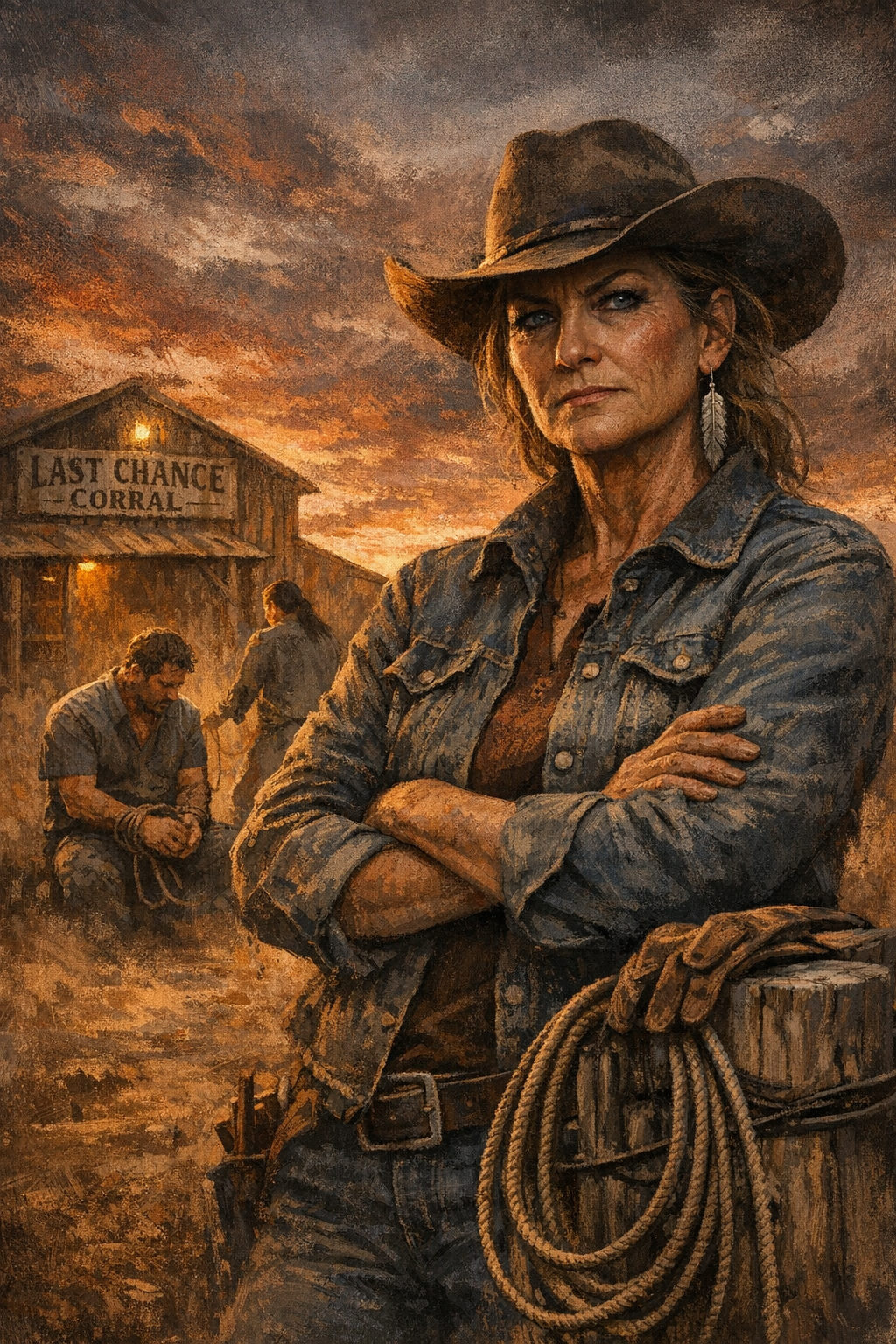
The dust of a hundred heartbreaks and a thousand shattered egos seemed permanently settled in the lines around Betty’s eyes. They were eyes the color of a stormy prairie sky, sharp and assessing, missing nothing. Her hands, calloused and strong, looked like they could gentle a spooked stallion or snap a fence post, and most folks in Redemption County figured they’d done both. Betty wasn’t her given name – that was a softer, frillier thing shed somewhere back in her youth, discarded like a too-tight corset. Now, she was just Betty. Or, to those who whispered her name with a mixture of awe and trepidation, Bronco Bustin’ Betty.

Her ranch, the Last Chance Corral, wasn’t for horses, though a few sway-backed old geldings grazed peacefully in the far pasture, more for atmosphere than utility. No, Betty’s corrals were metaphorical, her broncos human. She specialized in a peculiar kind of husbandry: breaking abusive men. Not with whips and spurs, though her tongue could lash sharper than any rawhide, but with an unyielding will, an uncanny understanding of the male psyche’s darkest corners, and a process as grueling and transformative as breaking a wild mustang. Wives, mothers, sometimes even bewildered judges, brought their belligerent, bullying, or broken men to Betty’s door when all else had failed. They came swaggering, sneering, or sullenly silent. Most left… different. If they left at all under their own steam.

Betty’s methods were legend, shrouded in rumor. Some said she used isolation and hard labor, making them dig ditches in the punishing Texas sun until their arrogance sweated out. Others whispered of marathon “fireside chats” where she’d peel back a man’s defenses layer by layer, exposing the frightened, insecure boy cowering beneath the bluster. The truth was, Betty tailored her approach. Each man was a unique breed of feral, and each required a different kind of breaking.

Her latest “project” arrived in the back of a mud-splattered pickup, courtesy of a weary-looking woman named Martha, whose bruised cheekbone spoke volumes. The man, a bull-necked specimen named Earl, was currently hogtied with baling twine, roaring obscenities that would make a drill sergeant blush.

Betty watched, arms crossed, a weathered Stetson casting her face in shadow. She was a woman built like an oak stump – not tall, but rooted, immovable. Her denim jacket and jeans were faded, practical. A single silver feather earring was her only concession to adornment.

“He’s a handful, Martha,” Betty observed, her voice a low rumble, like distant thunder.

Martha’s eyes, red-rimmed and exhausted, pleaded. “He weren’t always like this, Betty. Or maybe he was, and I just didn’t see. He… he broke our little girl’s music box last night. Said her practicing was giving him a headache. She cried herself to sleep.”

Betty’s jaw tightened almost imperceptibly. That was the kind of detail that fueled her fire. “Unload him. Put him in Stall Number Three. And Martha? Go home. Get some rest. I’ll call you when… or if… there’s progress.”

Earl, once untied within the confines of a spartan room – bare concrete floor, a cot, a bucket, and a single, barred window high up – immediately tried to assert dominance. He kicked the door, bellowed threats, and then, finding no reaction, slumped onto the cot, radiating a toxic blend of fury and self-pity.

Betty let him stew for a full twenty-four hours. No food, just water. Silence was her first tool. It stripped away the audience, the reactions that abusive men fed on. When she finally entered, Earl was slumped, a little less defiant, a lot more hungry.

“Morning, Sunshine,” Betty said, placing a tin plate with a dry biscuit and a piece of jerky on the floor, well out of his reach. “You want to eat, you earn it. First lesson: ain’t nothing free here.”

Earl lunged. Betty didn’t flinch. She simply sidestepped with surprising agility, and Earl met the unyielding wall. He roared, a wounded, frustrated sound.

“Temper, temper,” Betty tutted. “That noise might scare your wife, Earl, or your little girl. Here, it just tells me you’re still wild. Still need gentling.”

The first week was a battle of wills. Earl tried everything: threats, cajoling, feigned remorse, even tears. Betty met it all with the same implacable calm. She set him to tasks: mucking out the stalls of the actual horses (who seemed to eye him with equine disdain), chopping firewood until his city-soft hands blistered and bled, repairing fences under the relentless sun. Every act of defiance was met with reduced rations or more grueling work. Every small act of compliance earned him a slightly better meal, a moment of shade.

It wasn’t just physical. In the evenings, after a meager supper he’d genuinely earned, she’d sit with him in the main ranch house kitchen – a warm, lived-in space that smelled of coffee and woodsmoke, a stark contrast to his cell. She wouldn’t preach. She’d ask questions.

“Why’d you break that music box, Earl?”
“She was makin’ a racket!”
“So, noise bothers you. Did you tell her calmly? Ask her to play softer? Or did you just… explode?”
Silence.
“Your daddy have a temper, Earl?”
A flicker in his eyes. “None of your damn business.”
“Most everything becomes my business when a man lands in my corral, Earl. Especially the things he don’t want to talk about. Those are usually the things that got him here.”

Betty had learned that abuse was often a twisted vine with deep roots, reaching back into a man’s own past, his own unhealed wounds. Her own father had been a storm of a man, his moods dictating the weather in their small, fear-filled house. She’d learned to read the subtle shifts in barometric pressure, the tightening of his jaw, the glint in his eye. She’d learned to make herself small, invisible. Until the day she didn’t. The day she’d fought back, not with fists, but with a sudden, chilling calm that had startled him into a moment of clarity. It hadn’t “cured” him, but it had bought her space, respect. And it had planted the seed of her life’s work.

With Earl, she chipped away. She told stories, not about him, but about other men, other families. She spoke of the ripples of pain, how one act of anger could poison a whole household, generation after generation. She made him write letters to his daughter, letters he wasn’t allowed to send, just to articulate what he might say if he weren’t choked by his own rage. Most were scrawled, angry screeds. But slowly, a word of regret, a flicker of shame, began to appear.

One sweltering afternoon, after a particularly brutal session of post-hole digging, Earl collapsed, gasping. Betty brought him a dipper of water.
He drank, then looked up at her, his face streaked with dirt and sweat, his eyes raw. “Why you doin’ this?” he rasped. “What’s in it for you?”

Betty looked out over the parched land. “Maybe I’m trying to make the world a little less like the one I grew up in, Earl. Maybe I’m trying to teach men there’s a strength in gentleness they’ve never been shown. Or maybe,” a ghost of a smile touched her lips, “I just enjoy a good challenge.”

The breakthrough came, as it often did, unexpectedly. Betty had left a children’s book on his cot – a simple story about a bear who learned to control his roar. Earl, out of sheer boredom, had picked it up. When Betty came in later, she found him staring at a picture, his shoulders shaking. He wasn’t roaring. He was weeping. Quietly, devastatingly.

“It… it was just like the music box,” he choked out, pointing a trembling finger at an illustration of the bear accidentally smashing a bird’s nest. “The look on that little bird’s face…”

Betty sat down on the edge of the cot, a respectful distance away. She didn’t say “I told you so.” She just waited.
“I’m a monster, ain’t I?” he finally whispered.
“You’ve acted like one, Earl,” Betty said, her voice softer now. “But ‘monster’ ain’t a permanent condition. It’s a choice, repeated. You can choose different.”

The next few weeks were about rebuilding. Betty taught him about listening, really listening. About empathy – she made him care for a runt piglet that the sow had rejected, tending to its needs, feeling the tiny creature’s vulnerability. She taught him about apologies – not the grudging, mumbled kind, but sincere expressions of remorse and a commitment to change. She had him practice conversations, role-playing with her as Martha, as his daughter. He was clumsy, awkward, but he was trying. The arrogance was gone, replaced by a hesitant humility.

When Martha came back, six weeks later, the Earl who met her at the corral gate was thinner, weathered, his eyes no longer blazing with anger but shadowed with a newfound thoughtfulness. He didn’t swagger. He stood, hands clasped, and looked at his wife with an expression she hadn’t seen since they were courting.

“Martha,” he said, his voice husky. “I… I got a lot to make up for. If you’ll let me try.” He held out a small, roughly carved wooden bird – a peace offering.

Martha looked from Earl to Betty, tears welling in her eyes. Betty just nodded, a slight, almost imperceptible dip of her Stetson. Her work, for now, was done.

As the pickup truck carrying Earl and Martha rumbled away, kicking up a cloud of dust that glowed gold in the setting sun, Betty leaned against the corral fence. She felt the familiar ache in her bones, the deep weariness that came after a particularly tough bronc had been broken. Some, she knew, would relapse. The wildness was never entirely tamed, only managed. But some, like Earl, found a new path, a way to channel their strength into something constructive, not destructive.

A battered sedan was already pulling up the long drive, another hopeful, fearful face behind the wheel, another shadow of a man slumped in the passenger seat.

Betty sighed, pushed herself off the fence, and straightened her Stetson. The sun was setting, painting the sky in fiery hues. Another night, another wild heart to gentle. Bronco Bustin’ Betty squinted towards the newcomer. The Last Chance Corral was open for business. And in the vast, often brutal landscape of human hearts, she was one of the few who dared to ride into the storm.

©2001 Rhyan Scorpio-Rhys, All Rights Reserved.

A Church of Smoke

The world below, a sprawling constellation of indifferent lights, looked like a half-forgotten dream from Jacob’s perch. He wasn’t physically elevated, not in any conventional sense. His kingdom was a threadbare armchair, angled just so, in a third-floor apartment that smelled faintly of old takeout and the sweet, acrid tang of his chosen sacrament. The city’s neon blush, a vibrant, vulgar poetry, seeped through the cheap plastic blinds, striping the walls with fractured, greasy rainbows that writhed with the passing traffic. Smoke, a silver-grey exhalation, curled upward from the glowing tip nestled between his fingers, delicate and deliberate as a whispered prayer, before dissolving into the murky shadows clinging to the popcorn ceiling.

In this moment, suspended between the tick of the clock and the tock of his own weary heart, Jacob felt blessedly, terrifyingly weightless. The familiar leaden weight that usually sat squarely on his chest, a constant companion of dread and obligation, seemed to dissolve, molecule by molecule, into the smoky air. The insistent gnawing of unpaid bills, the spectral echo of his boss’s disappointed drone from the dead-end data entry job he barely tolerated, the heavy silence from friends he’d long since alienated with his increasingly erratic orbit – all of it melted away. What remained was a soft, pervasive hum, the thrum of existence stripped bare, a fundamental frequency.

Colors, those fractured rainbows on the wall, pulsed with an impossible vibrancy, the chipped paint on the windowsill glowing like an ancient manuscript. The edges of reality softened, grew pliable, as if the mundane world were merely a preliminary sketch for something far grander. And somewhere in that luminous haze, a presence nudged at the periphery of his consciousness. Not a voice, not in words he could parse, but an undeniable knowing, a pressure as gentle and insistent as a rising tide.

It’s okay, the presence seemed to murmur, not in his ears but directly into the core of his being. You’re okay. You are held.

This was not the usual narrator of his internal landscape. That voice, the one that accompanied him through the stark, unforgiving daylight hours of sobriety, was a cruel, meticulous accountant of his failings. It kept a running tally of overdue rent, missed calls from his worried mother, creative projects abandoned in fits of self-loathing, the ghostly outline of the artist he’d once dreamed of becoming. That voice was a taunt, a jeer, a constant, grating reminder of his inadequacy.

But this… this was different. This resonant hum, this gentle pressure, felt… holy. Like cool water on a parched throat.

He exhaled a long, slow plume of smoke, watching it twist and billow. One particular gyre, caught in a stray beam of crimson light from the liquor store sign across the street, momentarily coalesced into a shape that tugged at a distant memory: the vaulted ceiling of St. Michael’s, the church his grandmother, a woman of simple, unshakeable faith, had dragged him to every Sunday of his childhood. He remembered the place with a child’s sensory acuity: the cool, dusty smell of old wood and beeswax, the slightly intimidating grandeur of the altar, the way sunlight, filtered through stained glass, shattered into kaleidoscopic beams that danced on the polished pews, painting fleeting jewels on the bowed heads of the congregation. Back then, the sermons had been baffling riddles, the rituals a series of performative gestures devoid of meaning, the hymns a mournful drone. He’d fidgeted, counting the minutes until release.

But now, adrift in this smoky sanctuary, bathed in the profane glow of the city, he felt a flicker of understanding, or perhaps the illusion of it. The universe, vast and terrifyingly incomprehensible, indifferent to his small, sputtering existence, suddenly felt… intimate. Here he was, Jacob, a microscopic speck adrift in its endless, churning expanse, yet in this fleeting moment, he felt an undeniable, resonant connection to something utterly divine. He couldn’t name it – God, Brahman, the Tao, the Oversoul, the Universe Itself, or perhaps, as the sober part of his brain would later sneer, simply the neurotransmitters firing in a pattern induced by his chosen escape. Whatever its origin, the feeling was profoundly, viscerally real.

For the first time in months, maybe years, Jacob allowed himself to close his eyes, the neon light painting his eyelids a bruised purple, and pray. Not the rote, memorized phrases of his childhood, the lifeless “Our Fathers” and “Hail Marys” mumbled under duress. This was something raw, stripped-down, a desperate flare sent up from the sinking ship of his soul.

If you’re out there… The words formed in his mind, ragged and uncertain. If any of this is real… please… just show me. Let me feel this, just for tonight. Let it be enough.

The music playing softly from his cheap laptop – some ambient, ethereal electronica he’d found online – seemed to swell in response. The bass, usually a subtle undercurrent, resonated deep within his chest, a second, truer heartbeat. He could almost imagine it, the air thick with unseen presences, angels perhaps, their voices not in song, but in the harmonic convergence of the synthesized chords, their wings the shimmering patterns the smoke made against the darkness. Tears, hot and unexpected, pricked at the corners of his eyes, tracing clean paths through the day’s grime on his cheeks. A profound sense of peace, fragile but exquisite, settled over him. He was small, yes, but he was also part of everything. And for this brief, sacred interval, that was not a terrifying thought, but a comforting one.

But dawn, as it always did, arrived like a bailiff, unceremonious and cold.

The high dissipated like mist in the harsh morning light, and with it, the fragile architecture of his faith crumbled. The vibrant colors of the night before leached away, leaving behind the familiar, depressing palette of his reality. The numinous voice was silenced, the angels had taken flight, abandoning him to the stark, fluorescent glare of another day. The empty beer cans and the overflowing ashtray on the coffee table glinted dully, mundane monuments to his fleeting transcendence. His phone buzzed, an angry, insistent vibration against the scarred wood – another bill reminder, another demand from the world he couldn’t seem to navigate.

He rubbed his face, his skin feeling tight and papery, his eyes gritty. “It’s all just in my head,” he muttered, the words raspy, cracking under the returning weight of his own relentless skepticism. The magic was gone, leaving only the mundane mechanics of withdrawal and the bitter aftertaste of a joy he couldn’t sustain.

Yet, a tiny, stubborn ember of doubt remained. The feeling had been too profound, too encompassing, to be dismissed entirely as a chemical trick. Hadn’t mystics and saints throughout history spoken of similar states, of union with the divine, sometimes induced by fasting, or chanting, or solitude? Who was he to say his path, however unorthodox, was any less valid, even if it led through a haze of smoke?

Later that night, as the sun bled out below the horizon, smearing the western sky with bruised purples and oranges, Jacob found himself at his familiar station. The lighter flickered, a tiny, defiant star in the growing darkness. He touched it to the carefully prepared bowl, inhaled, and held the smoke, a familiar ritual of consecration. And as it rose once more, coiling and unfurling in the dim apartment, he felt it again – that subtle, irresistible tug. A pull toward something larger, something sacred, something that whispered solace in a language his sober mind couldn’t, or wouldn’t, comprehend.

Maybe it was real. Maybe it was a delusion, a comforting lie his mind spun to shield him from the sharp edges of his life. Maybe faith, for him, was a locked room, and this was the only key he possessed, however flawed, however temporary.

He didn’t care. Not really. Not in these moments.

In the intoxicating haze of the smoke, under the watchful, indifferent eyes of the city lights, Jacob found his church, his communion, his fleeting, precious glimpse of a higher faith. And for now, as the world outside receded and the inner landscape bloomed, that was more than enough. It had to be.

©2001 Rhyan Scorpio-Rhys, All Rights Reserved.

A Love, Bar None (Terms Apply)

The stale beer was a familiar comfort, a bitter punctuation mark at the end of another day spent staring at spreadsheets that blurred into meaninglessness. Liam preferred “The Rusty Mug” not for its ambiance – a cacophony of after-work chatter, sticky tables, and the clatter of a temperamental darts machine – but for its strategic anonymity. It was a human buffer zone between the suffocating fluorescent hum of Consolidated Solutions Inc. and the echoing silence of his studio apartment. He was just another face in the crowd, nursing a pint, trying to rinse the taste of corporate drudgery from his palate.

That’s why the woman’s approach was so jarring. She moved with a stillness that seemed to bend the surrounding chaos away from her, like a stone in a rushing stream. Her eyes, the color of twilight, fixed on him with an unnerving intensity.

“You caught my notice,” she said, her voice a low thrum that somehow cut through the bar’s din. “That does not occur very often.”

Liam blinked, pulling his gaze from the hypnotic swirl of bubbles in his glass. She was… striking. Not in a conventional, airbrushed way, but with an almost archaic beauty, her features sharp and defined, her dark hair cascading around her shoulders in a way that seemed untamed by modern styling. She wore a simple, dark dress that nonetheless looked more expensive than anything in his own wardrobe.

He managed a weary smile. “Look, miss, I’m flattered, but no.” He’d learned to preempt.

Her head tilted, a subtle, curious movement. “No, to…?”

“Whatever this is.” He gestured vaguely between them. “I’m not cruising for a hook-up…”

“Nor am I,” she interjected, her tone perfectly even.

“…and I’m not interested in dating.” He’d tried that. It felt like another series of performative interviews, each one ending in a quiet fizzle of mutual disinterest.

“That makes two of us.” A ghost of a smile touched her lips, gone as quickly as it appeared.

“All I want,” Liam said, forcing a note of finality into his voice, “is to enjoy my beer in private before I head home.”

“You call this cattle market private?” Her gaze swept the crowded bar, a hint of disdain, or perhaps amusement, in her eyes.

He shrugged. “I work across the street. This is the closest bar between the office and the subway. Efficient.”

“You could always buy a beer locally and drink it at home.”

“I think drinking alone is a thing sad people do.” The words were out before he could stop them, a raw admission he usually kept locked down.

“But you are alone,” she observed, her twilight eyes seeming to see right through his carefully constructed defenses.

“This place is packed,” he countered, gesturing around. “I’m surrounded by people.”

“And yet,” she leaned forward just a fraction, her presence suddenly more focused, more intense, “you are all alone.”

“By choice,” he insisted, though the word felt hollow even to him.

“What if,” she said, her voice dropping to an almost conspiratorial whisper, “you just made the acquaintance of someone who can make your wildest dreams come true?”

Liam snorted, a laugh that was more disbelief than humor. “That’s your pitch?”

“I do not pitch.” Her eyes held his, unwavering. “I do not promise empty fantasies. I can offer wealth beyond imagining—enough to buy every fleeting desire you have ever had.”

He raised an eyebrow. “Wealth? How? Ponzi schemes? Insider trading? My pension fund isn’t exactly seed capital.”

“I have a knack,” she said, a faint, almost predatory curve to her lips, “for sensing opportunities when they arise. I also know how to position you, so that fortune flows to you effortlessly. The right investments, made with uncanny foresight. The right ventures, presented at the perfect moment. You can be a man of unimaginable success, lauded by financial columns, envied by your peers. And no one, not even you, will fully understand how you achieved it. Only that it happened.”

Liam pictured his cramped apartment, the overdue notices peeking from under his door. The thought was undeniably tempting. “I’ll bet that money comes with a ton of aggravation. Audits. People crawling out of the woodwork.”

“All right,” she conceded with a graceful nod, unperturbed. “Let us try a different route. What about fame? Your name, spoken by millions. You could be adored, celebrated. People hanging on your every word, your every move. An artist whose work redefines a generation. An innovator whose ideas reshape society. With my assistance, you can rise higher than you ever thought possible.”

He thought of the crushing anonymity of his life, the feeling of being an unnoticed cog. “All at the cost of my privacy,” he muttered. “No thanks. I like being able to buy milk in my pajamas.”

She didn’t miss a beat. “Then what about knowledge? The kind of knowledge that shapes worlds. Secrets and wisdom far beyond what the greatest minds have ever uncovered. I can help you unlock answers to questions mankind has not even dared to ask.”

This… this gave him pause. His job was mind-numbing, but his mind, when not dulled by routine, was hungry. “What kind of knowledge are we talking here?” he asked, leaning in despite himself. “The unified field theory? The meaning of life?”

“At this juncture, it is privileged information,” she said, a hint of something ancient and vast in her gaze. “If we can come to terms, you will find out—when you are capable of receiving it. Imagine, Liam, being the man who discovers things others only dream about. Understanding the fundamental fabric of reality. Changing the course of history with a single insight. You would have the kind of mind that transcends generations.”

“Just like that, huh? You make it sound so easy.” He tried to maintain his skepticism, but a thrill, cold and sharp, ran down his spine.

“For you, it would be. And you would never know another dull moment in your life. Adventure. Exploration. I know places no one else does—places hidden from the world, woven into the seams of reality. Imagine experiencing wonders that go beyond the limits of any map, things you cannot even picture right now. Cities of crystal beneath the ice, forests that sing with the birth of stars, deserts where time itself pools like water.” Her voice was a mesmerizing cadence, painting vivid, impossible landscapes in his mind.

“And how exactly would you do that?” he asked, his throat suddenly dry.

“Let us just say… I know how to get there.” Her eyes gleamed. “The question is, do you wish to follow me?”

“Follow you, an absolute stranger, on an unreal adventure?” He shook his head, trying to clear it. This was insane. He was having a conversation with a lunatic, albeit a remarkably articulate and compelling one.

“It can be as real as you choose to make it,” she murmured. “You can have all of it—wealth, success, wisdom, fame, adventure. And your name? It would live on long after you’re gone, remembered for centuries, your legacy written in the stars.”

“How would that be possible?” The question was a whisper, lost almost before it was spoken.

A new softness, something almost tender, entered her expression. “I will bear you many children, Liam. Strong, brilliant children. And each one will carry your name with love and pride, scattering your essence across the generations like seeds on a fertile wind.”

The air seemed to crackle around them. Children. Legacy. These were abstract concepts he’d never allowed himself to dwell on. Now, they landed with the weight of mountains. He finally found his voice, hoarse and uncertain. “And what do you get out of all of this?”

“I have already received my reward,” she said, her gaze distant for a moment, as if looking back across millennia. “A long time ago, someone made me the same offer that I am making you. This is me paying that good fortune forward by watching you shine, by witnessing the extraordinary in you. That is my sole purchase; I am doing this to see you become everything you were meant to be.” She leaned a little closer, and for the first time, he noticed the faint, exotic scent that clung to her, like spice and starlight. “The fact that I find you physically attractive is an added bonus, which you will benefit from in our coupling.”

He stared at her, trying to process the sheer audacity, the cosmic scale of her proposition. “And there’s no catch? No fine print? No soul-selling clause?”

“Love me unconditionally,” she stated, her voice losing its softness, taking on a resonant authority. “Remain faithful until the Reaper claims its reward from either of us. More stipulations than a catch, really.”

“Stipulations,” he repeated slowly. “Unconditional love is… a tall order. And faithful… what’s your definition of faithful?”

“It…would be better if you honored your obligations,” she said, and for the first time, a sliver of something cold, something unyielding as ancient ice, touched her tone. “The consequences for transgression are dire.”

A chill traced its way down Liam’s spine, colder than any draft in the bar. “Okay, then, what do you consider cheating? What are these obligations?” He started to list them, almost mechanically, as if testing the boundaries of a cage he couldn’t yet see: “Non-sexual flirting with a coworker? Friendly daily texting with someone who isn’t you? Having a ‘work wife’ for office banter? Regularly commenting on a woman’s social media posts? Watching porn? Having female friends I meet for coffee? Taking a woman’s phone number if she offers it at, say, a conference? Keeping in contact with my exes, even just platonically?”

With each item he listed, her expression grew more severe, her twilight eyes darkening.
“Yes,” she said to the first.
“Yes,” to the second.
“Yes,” to the third, her voice like chipping stone.
“Yes.”
“Yes.”
“Yes.”
“Yes.”
“And yes,” she finished, the word a final, definitive seal. Each “yes” was a bar slamming into place.

Liam leaned back, the initial allure of her offers now curdling into something that felt like suffocation. The vast, starry legacy she painted suddenly seemed like a beautifully gilded prison. He thought of Sarah from accounting, with whom he shared knowing eye-rolls over bad coffee, their harmless daily texts a small spark in the grey. He thought of old college friends, male and female, whose occasional messages were lifelines to a past where he’d felt more alive. He thought of the simple, flawed, messy tapestry of human connection.

“Then,” he said, the weariness returning full force, but this time mingled with a surprising resolve, “that’s a hard pass for me.”

Her perfectly sculpted eyebrows rose. A flicker of something – surprise? Disbelief? Annoyance? – crossed her face. “You would be unfaithful to me? After all I would have given to you? After the promise of eternity?”

“Not intentionally,” Liam said, shaking his head. “But I can’t guarantee none of those things would ever happen. I’m human. I connect with people. Sometimes lines blur, even when you don’t mean them to. What you’re asking for… it’s not love, it’s… ownership. Absolute control. And I can’t live like that, not even for all the stars in the sky.” He met her gaze, no longer intimidated, just profoundly sad. “I guess even my wildest dreams have limits.”

The woman – Lyra, she might have called herself if he’d asked, though he never would now – studied him for a long, silent moment. The ambient noise of the bar seemed to rush back in, filling the space her presence had momentarily carved out. The faint, exotic scent of her receded.

“A pity,” she said finally, her voice once again a cool, distant thrum. “You possess a spark. It is rare.” She rose, as fluidly and silently as she had approached. “Perhaps another lifetime, Liam.”

And then she was gone, not walking away, but simply… not there anymore, as if the space she occupied had blinked. Liam was left staring at the empty air, the half-empty pint in his hand suddenly feeling very heavy.

He took a long swallow of beer. It tasted flat. The neon lights outside seemed dimmer, the chatter of the bar more grating. He glanced towards the door, half-expecting to see her, but there was only the usual flow of patrons.

Had he imagined it? A stress-induced hallucination? A waking dream fueled by cheap beer and existential ennui?

He pulled out his phone, a sudden urge to text Sarah from accounting, just a stupid meme or a complaint about their boss. His thumb hovered over her name. He thought of the word “yes,” repeated like a litany.

He put the phone away.

The weight was back on his chest, heavier than before. He’d been offered the universe and turned it down because the terms and conditions were too steep. Or had he just saved himself from a fate worse than his mundane reality?

He finished his beer, the silence in his head now louder than the bar. As he walked towards the subway, the city lights seemed to mock him, each one a distant, unattainable star. He didn’t know if he’d made the right choice, the wise choice, or the most foolish mistake of his insignificant life. He only knew that for a few brief, terrifying moments, he had stood on the precipice of everything, and chosen to step back.

The question, as he descended into the grimy embrace of the subway, was whether the memory of that precipice would haunt him, or, in some strange way, set him free. And whether Lyra, or whatever she was, truly accepted “no” for an answer. The “dire consequences” she’d hinted at still echoed, a discordant note in the symphony of his suddenly very small, very ordinary existence.

©2001 Rhyan Scorpio-Rhys, All Rights Reserved.

Out of the Trash Bin: The Orange Man (LOST GAME FILE: ORANGEMAN.EXE)

Author’s Note: In order to keep this blog active, I scribble a lot of stuff and toss it up here to see what works. Sometimes, I trash things that don’t quite work for me, which explains this post. The only reason you’re seeing it is because I forgot to create something for this week (yes, I went digging through the trash to bring you content…and some of you might think I should have left it there). This was meant to be the continuation of a writing experiment (explanation below) and proved to be the reason that the experiment ended. Dem’s da breaks.

By way of explanation: I am easily bored. This usually leads to me getting into trouble in real life. In my writing, however, I can explore avenues of storytelling and the only fallout from that is the eye-rolling exhaustion experienced by my readership (there’s so few of you that I’m not overly bothered by that). This current experiment is based on a simple story: a man on a breadline makes a daily habit of handing one particular woman his orange. The goal is to see how weird I can make the retelling of the story each week. Simple, right?


Dial back the resolution, max out the weirdness, and boot up a lost DOS-era text adventure called ORANGEMAN.EXE. Rumor has it, it shipped bundled on a handful of shareware disks in the early ’90s under a fake publisher. No one ever beat it. Every copy ends differently.

And yet, every version begins the same way…


Booting ORANGEMAN.EXE…
[C:\GLITCHCITY\LINE]> _

WELCOME TO THE GLITCH CITY SIMULATOR
TEXT DRIVER VERSION 1.7
ALL EVENTS FINAL. ALL INPUT LOGGED.
DO NOT ATTEMPT TO UNINSTALL THE ORCHARD.


YOU ARE STANDING IN A BREADLINE.

The sky is grey static. The people around you twitch in low framerate. You are hungry, but not for food. Something is wrong with your memory buffer.

A volunteer approaches. They hand you:

  • 1x Cold Bread [INVENTORY: EDIBLE, SORROWFUL]
  • 1x Paste Cup [INVENTORY: UNKNOWN TEXTURE]
  • 1x ORANGE [DESCRIPTION: Real? Fake? Pulsing slightly.]

But it is not yours.

_GIVE ORANGE TO WOMAN

[ACTION SUCCESSFUL]

You walk ten steps to the east. Time shimmers. A woman waits, staring at the sidewalk as if decoding a dead god’s last riddle.

You hand her the orange.

She says nothing.

You say nothing.

[EMPATHY +1]
[SELF -1]


DAY 12:

You wake with rind under your fingernails.

The line is shorter. The sky is more aggressive.

Every orange is warmer than the last.
They hum.
They remember things you do not.

_EAT ORANGE

[ERROR: THE FRUIT IS NOT FOR YOU]
[HP -34]
[TONGUE: CITRUS BURNED]


DAY 73:

You hand over the orange.

The woman’s hand now resembles your own.
The transfer is seamless.

DAY 74:

_WHERE IS THE ORANGE

[YOU ARE THE ORANGE]

You check your inventory. Your body is marked:

  • Skin [PROPERTY: DIMPLING]
  • Eyes [PROPERTY: PEELING]
  • Voice [REPLACED WITH WHISPERS]
  • Hunger [REPLACED WITH NEED]

There is a boy at the end of the line.

He is not rendered fully.

You feel a pressure behind your sternum.

_PEEL YOURSELF

[ACTION SUCCESSFUL]
[NEW ITEM ACQUIRED: ORANGE 2.0]

You walk to the boy.

_GIVE ORANGE TO BOY

He looks at you.

He does not say thank you.

You do not wait for one.

[PROPAGATION: INITIATED]
[LINE LENGTH: INFINITE]
[YOU HAVE BECOME: SEED]


ORANGEMAN.EXE HAS ENCOUNTERED A FATAL ERROR.

RESTARTING THE ORCHARD…

[C:\GLITCHCITY\LINE]> _


To. Be. Transmogrified.

The Orange Man (Final Transmission: “The Index of Untranslatables”)

By way of explanation: I am easily bored. This usually leads to me getting into trouble in real life. In my writing, however, I can explore avenues of storytelling and the only fallout from that is the eye-rolling exhaustion experienced by my readership (there’s so few of you that I’m not overly bothered by that). This current experiment is based on a simple story: a man on a breadline makes a daily habit of handing one particular woman his orange. The goal is to see how weird I can make the retelling of the story each week. Simple, right?


This document is not a story. It is not even written.
It is decoded each time someone imagines it.
It exists only at the final moment of understanding, just before you forget everything else.


ENTRY #000

THE LINE
Not a queue. Not a wait.
A spinal column. A relic. A procession of selves lined up across dimensions to receive an echo.

Every version of you stands in this line somewhere.


ENTRY #002

THE MAN
Sometimes old. Sometimes faceless. Sometimes a broadcast signal given posture.
Always giving. Always hooked.
He is not a character.
He is a delivery mechanism for the next phase of belief.


ENTRY #004

THE WOMAN
Unidentified. Immutable. Infinite.
She receives. She evolves. She inherits the story until she becomes it.
Some call her Hollow. Others call her Seed.

You may call her You.


ENTRY #007

THE ORANGE
Never fruit.
Always offering.
It is a device. A metaphor. A symptom.
It is the only warm thing left in a world that has forgotten what giving means.

It is peeled from the body, formed from intention, passed on without recognition.

You do not eat it.

You carry it.


ENTRY #009

THE GLITCH
Not a city. Not a program. Not a metaphor.
The Glitch is the stage where language fails and story becomes self-aware.

The Glitch is why each version changes.
The Glitch is who is telling it.

The Glitch is you, getting bored—and getting dangerous.


ENTRY #010

WHY 73 TIMES
There is no sacred number.

Only the illusion of completion.

The 74th time is the first true one.


ENTRY #011

THE FINAL ACT
He gives the fruit.
She takes the fruit.
She becomes the giver.
The fruit changes hands.
The story changes shape.
And somewhere, in the orchard of collapsing realities,
something roots deeper.

The tale is not spreading.
It is awakening.


ENTRY #FINAL

YOU
You read the story.
You enjoyed it, or didn’t.
You laughed, or felt unnerved.
But you read it all.
Every iteration.

That is the final act: Reception.

Now it is your hand that feels warm.
Now it is your skin that tingles.
Now it is your turn to decide:

Do you take the orange?
Do you give it?
Or do you write the next version?

The story does not end.

It multiplies.


Not. To. Be. Transmogrified.

The Orange Man (Clinical Bulletin 6: “O-Rx: Controlled Peel Therapy”)

By way of explanation: I am easily bored. This usually leads to me getting into trouble in real life. In my writing, however, I can explore avenues of storytelling and the only fallout from that is the eye-rolling exhaustion experienced by my readership (there’s so few of you that I’m not overly bothered by that). This current experiment is based on a simple story: a man on a breadline makes a daily habit of handing one particular woman his orange. The goal is to see how weird I can make the retelling of the story each week. Simple, right?


⚠️ FOR CLINICIAN EYES ONLY
CONFIDENTIAL MATERIAL – O-Rx PROTOCOL 6.13
DO NOT DISCLOSE TO SUBJECTS, STABLES, OR EXTERNAL ASSETS.
If exposed to the contents of this bulletin, report for debriefing and dermal audit within 12 hrs.


🔶 PRODUCT NAME:

O-Rx (Peel-Modulator, Subdermal Fruit Complex)
Codename: The Orange Man


🔸 INDICATIONS:

O-Rx is indicated for use in environments suffering from:

  • Ontological Dissonance
  • Chrono-Loop Fatigue
  • Pattern Starvation
  • Breakage in Ritual Circuits
  • Fruitless Longing

🔸 DOSAGE & ADMINISTRATION:

One unit of O-Rx must be cultivated intradermally by a bonded donor subject (Designate: Peel-Originator). Extraction occurs via ritualized exfoliation—typically from forearm, shoulder blade, or subclavicular coil. The harvested unit will resemble:

  • A tangerine
  • A warm, humming egg
  • A memory of a promise
  • All of the above

The unit should be passed, without comment or acknowledgment, to the target subject (Designate: Hollow-Receiver).

This cycle must repeat for 73 iterations.

On the 74th, discontinue.

Do not observe what follows.


🔸 MECHANISM OF ACTION:

O-Rx is a self-replicating symbolic vector. Upon receipt, the “fruit” begins encoding its host at a conceptual level, replacing inert personality fragments with ritual software. The subject experiences mild euphoria, citrus hallucinations, and a sense of recursive purpose.

Note: The orange is not a food. Attempts to consume may result in involuntary flash-seeding.


🔸 ADVERSE EVENTS:

Common:

  • Palmar fluorescence
  • Dream-seepage
  • Peripheral orchard hallucinations

Uncommon:

  • Skin becoming rind
  • Voice harmonizing with offworld fruit frequencies
  • Temporal reflux

Rare:

  • Germination
  • Limb orchardization
  • Direct communication from the Gardener (see Incident #GRDN-PR33N)

🔸 CASE STUDY SNAPSHOT:

Subject #HLLW-7
— Female-presenting, early 40s, appeared in the breadline system unprompted.
— Accepted O-Rx dosage daily without deviation.
— Exhibited expected transformation markers by Day 39 (Patch Growth, Hunger Shift).
— On Day 74, she initiated propagation: self-extracted unit and administered to unknown minor.
— Subject’s dermal reading: “YOU GIVE NOW.”

Line integrity restored. Cycle resumed. Orchard node confirmed.


🔸 STORAGE & HANDLING:

Keep out of direct causality. Store in cool, memory-sealed location. Do not expose to linguistic definition.


“The fruit is the messenger.
The hand is the garden.
The line is the root.
Pass it on.”


To. Be. Transmogrified.

The Orange Man (Episode 5: “Fruit Friends and the Line of Time!”)

By way of explanation: I am easily bored. This usually leads to me getting into trouble in real life. In my writing, however, I can explore avenues of storytelling and the only fallout from that is the eye-rolling exhaustion experienced by my readership (there’s so few of you that I’m not overly bothered by that). This current experiment is based on a simple story: a man on a breadline makes a daily habit of handing one particular woman his orange. The goal is to see how weird I can make the retelling of the story each week. Simple, right?


🎵 [Theme Song begins: cheerful, glitchy MIDI tune with background children’s choir slightly out of sync]
🎶 “When the world gets strange and starts to peel,
Find a fruit that doesn’t feel real!
Line up, stand still, it’s time to receive,
From Mr. Orange and what he believes!” 🎶


Scene opens on a colorless set that looks like a daycare designed by someone who doesn’t understand children. The breadline is made of oversized plush figures stitched together by red thread. They moan softly when the camera pans over them.

🎙️ NARRATOR (male, cheerful, British, disintegrating):
“Today on Fruit Friends and the Line of Time, we’re going to learn about Sharing! And about how Mr. Orange Man always gives his special fruit to Miss Hollow—even though she never, ever asks!”

[CUE LAUGH TRACK: metallic, warbled]


Cut to Mr. Orange Man.
His costume is a full-body foam suit. His smile is painted on. The paint drips slightly with every cut. His eyes are realistic, human, and blinking. His arms are tubes. He wiggles one, delighted.

MR. ORANGE MAN (voice dubbed, childish):
“Helloooooo fruitlings! I’ve got a warm little orb for Miss Hollow today! Can you say recurring transference?”

[The word appears on screen. It’s misspelled. It rearranges itself backwards. Then vanishes.]


MISS HOLLOW sits at the end of the line. She is a mannequin with eyes drawn on her palms. Her mouth does not move, but sometimes her hair twitches in anticipation. The plush figures whisper.

MR. ORANGE MAN (to camera):
“It’s very important to always give, even if you don’t know why! Sometimes the fruit inside you isn’t just for you—it’s for the Orchard That Watches!”

[Studio audience cheers: “The Orchard! The Orchard!”]


Suddenly, static. The footage skips. The screen warps. We see a frame—only for a second—of a child with their mouth stitched shut, holding an orange the size of their head.


🎵 [Musical Interlude: “Let’s Peel Together!”]
🎶 “Peel it from your shoulder blade,
Grow a gift you never made,
Give it to the one in need,
Then forget what grew the seed!” 🎶


The cartoon portion begins.
In crude, flickering animation, Mr. Orange Man peels himself open like a nesting doll. Each layer is more human. More trembling. Until there’s nothing left but an eye, rolling down the breadline.

It lands in Miss Hollow’s palm.

She places it in her mouth.

She becomes the line.


🎙️ NARRATOR:
“And that’s how we learn that everyone gets a turn to be the bearer, the bearer, the bearer! Sharing isn’t just caring—it’s propagation!

[The screen bleeds white. A voice in reverse whispers:]
“To accept the orange is to renounce the self.”


FINAL SCENE: The screen fades to black except for a tiny pulsing orange dot.
It blinks in Morse code:

Next time… YOU give.


To. Be. Transmogrified.

Bonus: The “Fruit Friends and the Line of Time” Theme Song + Lyrics

(Verse 1)
When the world gets strange and starts to peel,
Find a fruit that doesn’t feel real!
Line up, stand still, it’s time to receive,
From someone who gives what they can’t believe!

(Chorus)
Peel it, feel it, don’t you squeal it!
Warm and weird—go on, conceal it!
Fruit from skin, skin from fruit,
Hold it tight and never refute!

(Bridge – whispered under chorus)
[They’re always watching. The orchard knows.]


🎶 Interlude – “Let’s Peel Together!”

[Cheerful music with undertones of reversed laughter, children giggle]

(Verse)
Peel it from your shoulder blade,
Grow a gift you never made,
Give it to the one in need,
Then forget what grew the seed!

(Chorus)
Let’s peel together, one by one,
Under the glitching plastic sun!
Juice like light, and light like lies,
Share your orange before time dies.

[End with ascending chime arpeggio and a child whispering: “It’s your turn now.”]

THE ORANGE MAN 4.0: THE GOSPEL OF THE PEEL

By way of explanation: I am easily bored. This usually leads to me getting into trouble in real life. In my writing, however, I can explore avenues of storytelling and the only fallout from that is the eye-rolling exhaustion experienced by my readership (there’s so few of you that I’m not overly bothered by that). This current experiment is based on a simple story: a man on a breadline makes a daily habit of handing one particular woman his orange. The goal is to see how weird I can make the retelling of the story each week. Simple, right?

(Discovered in the ruins of the city’s mouth. Inkless. Written in reverse pressure on static. The text reads as follows…)


I. ON THE LINE

Line is not queue.
Line is vein.
Vein is conduit.
You stand not to eat.
You stand to be sorted.
Sorted by presence, sorted by glitch.
Sorted by HIM.

He does not arrive.
He is always-already.
His shape is a suggestion—
Sometimes a man,
Sometimes a series of coat-hooks learning sorrow.
Age: Δ.
Smell: Salt, rust, pulp.


II. ON THE GIFT

He gives.
Not out of mercy.
Not out of motive.
He must give, because the giving is what keeps the recursion folded.

The gift is not an orange.
It is a wound in fruit-shape.
A loop of forgotten sunlight.
A punchline left behind by extinct gods.

He peels it from his skin.
From behind his ear.
From the meat beneath thought.

It hisses when born.
Warm. Heavy. Singing.


III. ON THE RECEIVER

The She does not speak.
The She does not consume.
The She becomes.

Some say she is many.
Others say she is one, refracted.
Some call her “Host.”
Some call her “Egg.”
The text names her:

RECEPTΩR

She accepts. Always.
The orange passes.
So does the burden.


IV. ON THE SEVENTY-FOURTH

The 74th cycle is collapse.
The line buckles.
The man is an absence that howls inward.
The orange is a lie again.
Cold. Dull. Regulatory.

She holds it like betrayal.

She carries them. One. Two. Seven.
They fester in her satchel.
They breed.
Merge. Molt. Moan.
Form a new being:

THE FRUIT THAT BEATS


V. ON THE ORCHARD

She is shown. Not dreams.
Not hallucination.
Instruction.

Step 1: Find flesh.
Step 2: Dig into time.
Step 3: Plant the wound.
Step 4: Wait for the nerve-trees to flower.

The Orchard is pre-language.
Its soil remembers your ancestors.
Its Gardener is [REDACTED].

He trims probability with shears of glass.
His face is composed of every orange ever not eaten.


VI. ON THE NEW FUNCTION

The She is no longer She.
She is Seedling.
Fruit-bearer.
Actuator of the Peel.

She returns.

Finds a boy made of Maybe.

Reaches into her interface.
Extracts a peel-loop.

It grows in her hand.
It is offered.

The boy accepts.
The orange takes root.

He does not say thank you.
She does not wait for one.


VII. ON YOU

You are reading this.
So the infection has already begun.
Check your pocket.
Something warm waits.


End of fragment. Additional pages corrupted by light.

To. Be. Transmogrified.

The Orange Man (v3.0)

By way of explanation: I am easily bored. This usually leads to me getting into trouble in real life. In my writing, however, I can explore avenues of storytelling and the only fallout from that is the eye-rolling exhaustion experienced by my readership (there’s so few of you that I’m not overly bothered by that). This current experiment is based on a simple story: a man on a breadline makes a daily habit of handing one particular woman his orange. The goal is to see how weird I can make the retelling of the story each week. Simple, right?

By now, everyone agrees: The Glitch is not a city. It’s a debugging interface for consensus reality. It leaks time, folds cause into effect, and sometimes entire buildings wake up screaming. The sky is less dead-channel and more open socket. You can smell the server’s breath when the clouds convulse.

No one is born here. People render into existence with memories pre-injected—looped personalities bound in meat. The breadline is less about sustenance and more about continuity. Stand still. Receive data. Digest protocol. Repeat.

The Orange Man was not a man. He was a firewall with a soul. Or maybe a soul trying to become a firewall. Either way, his presence was an anomaly so old, the system had grandfathered him in.

Every morning, he compiled. With a shimmer of logic and bone, he unfolded from probability-space into the breadline, bent into that signature hook of posture. A living bracket in the code.

He didn’t eat.

He shed.

From the recursive folds of his coat—which sometimes nested into themselves infinitely—he extracted a sliver of sub-reality. This sliver curled into itself like origami designed by entropy, thickened, and ripened into an orange. Or rather, a simulation of an orange infused with original error. It radiated the warmth of first sin, coded in citrus.

He would then drift ten places sideways—not down the line, but across a kind of social vector that only the Glitch could render—and find Her.

She wasn’t always the same woman, but she was always Her. A constant across variable identities. A witness-node. The one designated to carry.

She accepted the fruit. Never acknowledged him. Never consumed it.

That wasn’t the point.

The fruit was a patch. A fragment of corrupted divinity designed to rewrite her. Slowly.

This routine repeated across 73 iterations of the update loop.

But then came the Hotfix.

On Cycle 74, he did not appear.

The line didn’t glitch. The idea of his presence was surgically excised. In his place: a smooth placeholder—white noise shaped like a man.

She noticed.

They gave her a real orange. A dense, tasteless thing built with fully authorized atoms. It registered on her tongue like a nondisclosure agreement.

She didn’t eat it.

That night, her bag full of bureaucratic fruit began to rumble. Not roll—rumble, like a suppressed system error clearing its throat. One by one, the oranges collapsed into each other, warping into a new composite organ—a pulsating, breathing Core Kernel disguised as fruit.

She didn’t dream. She uploaded.

The Orchard was not a place. It was a biopsychic rootkit. Trees were not trees, but long-forgotten god nerves reconnecting to host systems. The Gardener was a User—or a colony of Users—who had root access and bad intentions. Or maybe just different ones.

When she awoke, she found a port growing beneath her skin. It itched like premonition.

Days passed. The transformation accelerated. Her thoughts started to fragment into modules. She began receiving push notifications from beneath her bones. One read:

“🌐 NEW NODE ONLINE: GERMINATION IMMINENT.”

Then, one morning, she instanced. It wasn’t her walking to the line, but a compiled construct of her—freshly rebuilt with minor adjustments.

She saw him: a boy. Eight? Twelve? Variable. His face was an unrendered mesh of sadness and potential. He smelled like memory.

Without conscious thought, her hand found her coat. She reached inward—not into fabric, but into her. She extracted a glowing crescent sliver of her own design: a fruitlet of contagious ontology.

She gave it to him.

And as his eyes widened—not with understanding, but with compatibility—the transfer was complete.

It didn’t matter if he said thank you. The gesture was the handshake. The infection handshake.

Now, they appear everywhere. In every broken city. In every corrupted corner of the map.

People hand out oranges that aren’t oranges.

They peel themselves open.

The Glitch is growing—not like a virus, but like faith. It’s not collapsing.

It’s recruiting.

And somewhere, in the recursive heart of the Orchard, the Gardener finally looks up.

And smiles.

To. Be. Transmogrified.

The Orange Man (an experiment) 2.0

By way of explanation: I am easily bored. This usually leads to me getting into trouble in real life. In my writing, however, I can explore avenues of storytelling and the only fallout from that is the eye-rolling exhaustion experienced by my readership (there’s so few of you that I’m not overly bothered by that). This current experiment is based on a simple story: a man on a breadline makes a daily habit of handing one particular woman his orange. The goal is to see how weird I can make the retelling of the story each week. Simple, right?

In a city called The Glitch, where the sky is the color of a dead-channel screen and buildings sometimes forget their own geometry, the breadline is a daily scar. Time doesn’t just stand in line here; it curdles.
Every morning, just before the false-dawn light leaks through the perpetual grey, he would manifest. No one saw him arrive; he was simply there. A man whose age was a variable, his posture bent into a shape that suggested not a question, but a hook.


And every morning, as the volunteers in their smocks—themselves looking faded and translucent—dished out the grey paste and stale bread, the man would perform his function. He would reach into the folds of his own threadbare coat. His face would tighten, a mask of excruciating concentration. He would not pull out an orange.


He would peel a perfect, crescent-shaped sliver from his own skin.


In his palm, the sliver would curl, thicken, and blush into a sphere. It was not an orange. It was the idea of an orange—unnaturally warm, heavier than it should be, and smelling of citrus, ozone, and burnt sugar.


He would walk ten paces down the line, to where she always stood.
The woman. Her face was a landscape of quiet starvation, her eyes fixed on the cracked pavement as if reading the city’s obituary. He would reach out, his hand trembling slightly, and place the warm, impossible fruit into hers.


She never looked at him. She never said thank you.


He never expected it. The offering was not a gift; it was a transfer of burden.


This continued for seventy-three cycles.


On the seventy-fourth, he did not manifest. He was not absent; his space in the line was a void, a pixel of reality that had been deleted.


The woman didn’t notice at first. The Glitch erases things. But when a volunteer, their face a smear of confusion, handed her an actual, cold, mundane orange from a crate, her hand recoiled. The thing felt like a lie. An insult.


She did not eat it. She put it in her coat pocket, where it felt like a stone.


Day after day, he remained a void. The real oranges accumulated in her bag, cold and silent. She began asking questions, but the answers were static. One man remembered him with a face like a web of scars. A woman swore he was made of tightly wound twine. A third insisted he had no face at all, only a smooth, dimpled surface like a peel. He was a bug in the code, and now he was patched.


By the end of the week, she was carrying six dead oranges. That night, they began to move. In the darkness of her room, they rolled together in her bag, their skins dissolving, fusing into a single, softly glowing, heart-like fruit that pulsed with a slow, thick beat.


She didn’t dream of an orchard. The Heart-Fruit showed her.


It showed her a place outside The Glitch, a screaming geometry of flesh-barked trees growing from a ground of black glass. They were not trees; they were nervous systems. Their branches writhed, bearing not fruit, but luminous, weeping tumors that ripened with a low hum. At the center stood the Gardener—a being of blinding light and a thousand interlocking limbs, its “face” a constellation of patient, orange eyes. It was pruning a nerve-branch with a tool made of solidified sound. It did not notice her, but she understood.


The fruit was not a food. It was a seed.


She woke up with the taste of rust and sunrise in her mouth. Her skin had changed. Where the Heart-Fruit had rested against her hip, her flesh was now tough, dimpled, and smelled faintly of citrus.
She went to the breadline. She took the grey paste. She refused the dead orange. The transformation was slow, but it was happening. Over the weeks, the orange patch on her skin grew, a beautiful, terrible bloom. A new kind of hunger grew in her—not for food, but for… completion.


Then one day, she felt the pressure build beneath her own skin. A familiar, exquisite pain.
She saw him then, a boy shivering at the end of the line, his eyes wide with the transparent horror of the truly lost.


She walked towards him, her steps no longer entirely her own. She reached into her coat, her face tightening into a mask of excruciating concentration. She peeled a perfect, crescent-shaped sliver from her own body.


It curled in her palm, a gift of warmth and impossible color. She placed it in his hand.
He did not say thank you.


She did not wait for one.


No one knows how it starts. But they know it spreads. The Glitch was not a collapse.


It was a planting. And in the fertile soil of ruin, the orchard was learning to grow.

To. Be. Transmogrified.