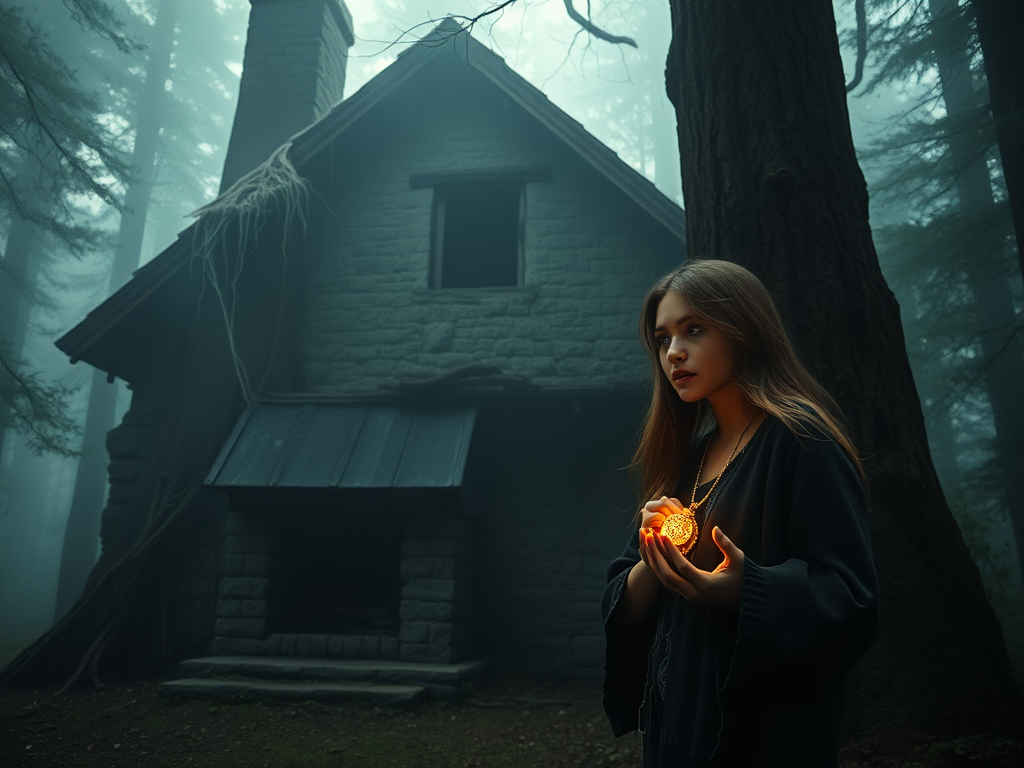
Melissa stood at the gates of eternity, the threshold where mortal ambition dared to collide with divine reckoning. Her pulse raced, each beat hammering against the fragile cage of her deceit. The price for admission to paradise was steep, and she had wagered all she had: half-truths, polished lies, and a confidence that bordered on reckless bravado.
Before her stood the celestial gatekeeper—a figure neither stern nor cruel, but impossibly serene, as if carved from the essence of judgment itself. His eyes, shimmering pools of light, seemed to pierce straight through Melissa’s carefully woven façade.
Her forged credentials, the fruit of painstaking manipulation, trembled in her outstretched hand. Crafted with the precision of a master con artist, the document was her ticket to eternity, a masterpiece of counterfeit faith. But as the gatekeeper regarded her, his gaze unraveled her lies like loose threads from an unraveling tapestry.
“You stand at the threshold of eternity,” he said, his voice soft but resonant, “cloaked in deception.”
Before Melissa could respond, a flick of the gatekeeper’s wrist sent a ripple through the air. Her garments dissolved into mist, exposing her body to the divine light that seemed to radiate from everywhere and nowhere.
Naked but unashamed, Melissa squared her shoulders. Years of devotion to vanity had crafted her into a vision of flawlessness. Her skin was smooth, her form statuesque. Even now, as she stood under the scrutinizing gaze of the divine, she allowed herself a fleeting moment of pride.
But the gatekeeper was not here to admire.
A quill, seemingly plucked from the wing of an angel, appeared in the gatekeeper’s hand. Its tip gleamed, not with ink but with liquid light. Before Melissa could question its purpose, the quill hovered above her bare skin and began its work.
It moved with a surgeon’s precision, tracing intricate patterns across her body. At first, the lines shimmered silver, their beauty mesmerizing, as though an artist had chosen her as the ultimate canvas. But as the designs settled, the silver began to darken, turning into a bruised, mottled purple.
Melissa gasped as the symbols revealed their meaning. These were no mere decorations—they were her sins, etched into her very flesh. Every omission, every manipulation, every betrayal was accounted for in the winding script that now marred her body.
“What is this?” she whispered, her voice trembling.
“These,” the gatekeeper replied, his tone unyielding but devoid of malice, “are the truths you tried to hide. A lifetime of sins, written so none may deny them—least of all you.”
The symbols coiled around her, wrapping her body in an inescapable narrative. From her feet to her neck, her skin became a map of shame. Her left arm bore the jagged symbols of lies told to loved ones; her right, the looping glyphs of promises broken. Across her chest sprawled the dark stain of greed, and around her throat twisted the spirals of betrayal, tightening like a noose.
Melissa clawed at her skin, desperate to erase the evidence. But the marks were no longer just surface—they had become a part of her, embedded in her essence.
“This isn’t fair,” she hissed, her voice rising in defiance. “You don’t understand what I’ve been through. What I had to do!”
The gatekeeper’s gaze did not waver. “Fairness has never been the measure of truth. Your actions, your choices, are written here. They are yours to bear.”
Melissa’s defiance faltered as the weight of his words sank in. The tattoos were not a punishment from the gatekeeper; they were her own creation, the inescapable ledger of her life.
“You may enter,” the gatekeeper said, stepping aside. “The gates will not deny you. But understand this: you are marked. Wherever you go, others will see what you are. And you, Melissa, will never escape the knowledge of what you have done.”
Tears stung her eyes, but she refused to let them fall. She squared her shoulders and stepped through the gates, her bare feet crossing the threshold into the divine realm.
The landscape that greeted her was breathtaking—a world of light and endless beauty. Yet as Melissa took her first steps into eternity, she felt no joy. The others, luminous beings who walked in the light, turned their heads to look at her. Their gazes lingered on the bruised glyphs that coiled across her body, their expressions a mix of pity and quiet judgment.
Her steps faltered, and for the first time, she felt the full weight of her sins pressing down on her, heavier than the lies that had carried her this far. The promised land stretched before her, but she realized now that it was no sanctuary. It was a mirror, reflecting every stain on her soul.
Melissa’s hands clenched into fists as she moved forward, each step a reminder that paradise was not an escape but a reckoning. The beauty of the world around her only deepened the ugliness she carried within, her sins a shadow she could never outrun.
And as she wandered the divine realm, the symbols on her skin whispered their story to all who looked upon her: the wages of sin, paid in full, but never forgotten.
Tag Archives: rhyan scorpio-rhys
The White Reaper (Version 2)
In the dark hours before dawn, when the world balanced on the edge of silence, they came. Not with the ominous flutter of wings or the toll of heavy bells, but with the faintest whisper of wind. It moved through the trees like a secret too fragile for mortal ears. The White Reaper emerged from the mist as if conjured by the breath of the world itself, a figure half-formed from dreams and yet fully real.
Unlike the deathly figures conjured by fearful imagination, the White Reaper bore no scythe, no skeletal grin beneath a shadowed hood. Their form was draped in robes of swirling white, woven from threads that seemed to shift and ripple as though the fabric was alive, part of the mist itself. They moved with the quiet inevitability of a tide rolling onto a shore—neither swift nor slow, neither kind nor cruel. Just there, as they always were, when the time called.
Their face remained hidden in shadow, an abyss no living eye could penetrate. And yet, those who glimpsed them long enough swore they saw something within—not horror, but peace, as though the veil that separated the living from the dead also concealed a truth too vast to comprehend.
The forest shivered at their passing. Bare branches stood still as sentinels, their spindly silhouettes sharp against the pale moonlight. Hoarfrost clung to the air like tiny shards of glass, glittering in the faint glow, and the great white steed beneath the Reaper stirred no sound, its hooves leaving no trace in the frostbitten earth.
Their destination was never far. It never was.
At the edge of the forest, a small village slept. Its cottages huddled together like travelers seeking warmth against the cold. In one of these homes, where the fire had burned down to a bed of glowing embers, an old man lay in a bed of roughspun sheets. His breaths were shallow, uneven—a rhythm that faltered like the last notes of a fading song.
The illness that had come for him was relentless, though kind enough to grant him time to reflect. Alone in his final days, he had thought often of the life he had lived. The nights when his wife’s laughter had filled their home like sunlight spilling through the cracks. The afternoons spent teaching his daughter to fish by the stream, her small hands gripping the line with a determination that mirrored his own. And the mornings when he had risen early to bake bread, the smell of it filling the house as his young son darted about, eager for the first bite.
But those moments had passed, carried away like leaves in an autumn wind. His wife had gone before him, and his children—grown, busy, and scattered—were too far away to see the embers of his life flicker out. He had prayed for the end to come swiftly, but death had not yet answered. Not until now.
The White Reaper entered the cottage without a sound. The door remained closed, yet the mist seeped in, curling around the room like a gentle embrace. The firelight flickered briefly, as if bowing to the presence that now filled the space.
The old man stirred. Though he could not see the Reaper, he felt their arrival in the shift of the air, in the way the ache in his chest seemed to ease, the weight on his heart lifting. His breathing slowed, each inhale lighter, each exhale longer, until it was no longer a struggle but a release.
The Reaper extended a hand, gloved in the same ethereal fabric as their robes. There was no scythe to sever his soul from its vessel, no violent rending of life and flesh. The gesture was simple, and yet it carried with it the promise of peace.
For a moment, the old man hesitated. The body below him—the frail shell he had inhabited for so many years—looked small, insignificant. But as his spirit began to rise, translucent and weightless, he understood. This was not an ending. It was merely a passage, a door he had always known he would one day walk through.
The Reaper’s shadowed gaze met his, and though no words were spoken, understanding passed between them. Death was not a thief, not a cruel hand tearing life away. Death was a guide, an usher at the threshold, patient and gentle.
The old man gave a small nod and placed his hand in theirs. Together, they stepped into the mist, leaving the cottage and the quiet embers behind. The frost-laden forest parted for them, its trees bowing slightly as if acknowledging the passage of something sacred. Beyond the woods, the veil shimmered faintly, and through it, the old man glimpsed a world he could not have imagined—a place of light and endless horizons, of quiet promises fulfilled.
In the village, life stirred but did not wake. A young mother turned in her sleep, her baby nestled close against her chest, while a candle flickered briefly in a nearby window. None knew of the passing that had just occurred, yet the air seemed lighter, as though the earth itself had exhaled in relief.
The White Reaper rode on through the mist, their figure fading into the whispering frost, ever patient, ever waiting. For another soul would soon call to them, as all must, when the time was right.
And when that moment came, the Reaper would be there—not with fear, but with grace. Not with darkness, but with light. A quiet promise whispered on the wind: peace, at last, awaits.
A Heist of Hearts
Crispin Blackthorne, a mastermind at pulling off complex capers and the architect of audacity, had stolen everything imaginable: priceless art, corporate secrets, and even a crown off a king’s very head. But none of it compared to the one thing he couldn’t steal back—the heart of one Miss Fern Wilder. She had left him months ago, walking out of his life with no more than a quiet “Goodbye,” and Crispin, who had the uncanny knack of spotting a set up or double cross at a thousand paces, hadn’t seen it coming.
Act 1: The Gathering
Crispin took his place at the head of the long, battered table in the back room of The Olivia Twist, a run-down dive bar owned and operated by Libby Twistell—the only ex whose good graces he had somehow managed to stay in.
The room smelled faintly of spilled bourbon and desperation—a fitting setting for his latest scheme. His crew sat around him, leaning back in their mismatched chairs, arms crossed or drinks in hand. They were his trusted accomplices, his tools of precision in countless capers. But tonight, they were also his greatest hurdle.
“Thank you all for coming on such short notice,” Crispin began, his voice smooth as silk. His smile was effortless, confident—the smile of a man who always had the upper hand.
Eddie the Nose snorted, running a hand over his balding head. “You said this was a job, Crispin. I dipped out of a high stakes poker game for this.”
“It is a job,” Crispin said, raising his hands in mock appeasement. “Perhaps the most important one we’ve ever undertaken.”
“More important than the Louvre Lift?” Mira Ball drawled, her painted lips curling into a smirk. “Because unless we’re stealing a spaceship, I have my doubts.”
Crispin turned to her with a conspiratorial grin. “Mira, this one’s more ambitious than all the rest combined. We’re not stealing something mundane like gold bullion or jewels or state secrets.”
He reached into his coat pocket, drawing out a folded blueprint and snapping it open on the table. “We’re stealing the Wilder Heart.”
The silence that followed was so absolute, the hum of the flickering neon light above sounded deafening. The crew exchanged glances. Finally, JunoScript, the perpetually unimpressed tech genius, leaned forward, squinting at the blueprints.
“Uh… I’m not seeing any vaults here, boss,” she said dryly. “No guards, no laser grids. Did you mix up your schematics?”
Crispin chuckled, unruffled. “This isn’t about breaking into a vault. It’s about breaking through emotional barriers. We’re going to steal back the heart of the woman I love.”
Eddie burst out laughing, slapping the table. “You’re kidding me. You’ve dragged us out here to play matchmaker? Come on, Crispin. We’re thieves, not therapists.”
Hold up a minute,” Mira’s smirk vanished. She leaned forward, her voice cutting. “You’re not talking about She Whose Name Must Not Be Spoke, are you? The one who left you high and dry six months ago?”
“She didn’t leave me high and dry,” Crispin corrected, though a faint flush crept up his neck. “She… departed. Stealthily.”
“Left you shook,” Mira added. “With us having to pick up the pieces of your shattered dignity.”
“An over exaggeration,” Crispin said breezily, though his eyes narrowed just slightly. “What matters now is that we’re going to bring her back.”
Juno raised an eyebrow. “You sure she wants to come back?”
Crispin shot her a look. “She just needs to remember what we had. What we still have. That’s where you all come in.”
Eddie groaned, throwing up his hands. “Boss, this is madness. We don’t do this kind of thing. Love isn’t something you can just—what? Steal? Con?”
“Why not?” Crispin countered, his voice sharp now. “You’ve conned your way into private estates, Mira’s stolen identities so good the real people still believe them, and Juno? You’ve hacked more hearts than anyone here would care to admit.”
“That’s different,” Juno said flatly. “I don’t think you can brute force romance.”
Mira leaned back in her chair, arms crossed. “This isn’t a heist, Crispin. This is a vanity project. You’re asking us to risk our necks for your broken heart?”
Crispin’s smile remained fixed, but there was a glint in his eye now—a dangerous edge. He paced around the table, his presence magnetic, pulling their attention to him like moths to a flame.
“This isn’t just about me,” he said, his voice lowering to a conspiratorial whisper. “Think about it: if we can pull this off, if we can prove that even love can be won through sheer brilliance, what does that say about us? About what we’re capable of?”
He stopped behind Mira, resting a hand lightly on her chair. “You, Mira. Imagine the costumes you’ll create for this. The characters you’ll bring to life. They’ll talk about your work for years.”
He moved to Eddie next, clapping a hand on his shoulder. “Eddie, you’ve tracked everyone from mob bosses to missing heirs. Finding where Fern’s hiding out? Child’s play for you.”
Juno sighed, rolling her eyes. “And me?”
“Ah, Juno.” Crispin leaned over her chair, his grin widening. “You’ll be the puppet master behind the scenes. If anyone can choreograph the digital dance of destiny, it’s you.”
Finally, he straightened, his gaze sweeping over the room. “And Sasha? My dear wordsmith? I’ll need the perfect lines to convince her that I’m still the man she fell in love with.”
SashaSpeare, who had been silent until now, tilted her head. “You’re banking a lot on words, Crispin. But if you need poetry, you’ll pay in cash.”
Crispin laughed. “I never touched a dime of my take from the Louvre Lift. It’s yours, split evenly.”
Eddie frowned, still unconvinced. “And what if this goes sideways? What if she slams the door in your face?”
Crispin’s smile dimmed, just for a moment. “You’ll still get paid, and I’ll make sure she never knows you were involved. You vanish like shadows, and she’ll be none the wiser.”
The room fell silent again. This time, though, the hesitation was tinged with intrigue. Crispin knew he had them—not because they believed in the plan, but because they couldn’t resist the challenge. He’d played them like a fiddle, weaving doubt, flattery, and ambition into a symphony of manipulation.
“All right,” Mira said finally, sighing. “I’ll play dress-up. But when this explodes in your face, don’t come crying to me.”
Juno shrugged. “I’ll set up the tech. But don’t say I didn’t warn you.”
Eddie grumbled something under his breath but nodded. “Fine. Let’s get this over with.”
Crispin’s smile returned in full force. “That’s the spirit. Now, let’s plan the greatest heist of our lives.”
As they leaned in to examine the blueprints, Crispin allowed himself a small, private smile. The crew might not see it yet, but they were all part of his masterpiece—a grand tapestry of love, deception, and redemption. And like any great artist, Crispin intended to leave his mark.
Act 2: The Set Up
The room was abuzz with nervous energy. Crispin leaned over the table, his fingers splayed across a map of the city. He tapped a spot circled in red—a forgotten warehouse at the edge of town, its windows boarded and its floorplan perfect for his purposes. Around him, the crew exchanged skeptical glances, their faith in the plan wavering.
“So,” Crispin said, his eyes glinting with mischief, “this is how we win her back.”
Mira crossed her arms, her dark eyeliner smudged from hours of prep work. “You mean this is how you win her back. The rest of us are just… collateral damage?”
“Collateral benefit,” Crispin corrected, flashing her his trademark grin. “Think of it as an investment. When this works, and I’m back in Fern’s good graces, our crew will be stronger than ever. She’ll remember why she fell for me—and why she trusted all of us.”
Juno snorted, leaning back in her chair. The glow of her laptop cast a faint green light across her face. “Bold assumption. What if she remembers why she left in the first place? Last I checked, people don’t usually swoon over being lured to creepy warehouses by fake kidnappers.”
“Details,” Crispin said with a dismissive wave. “It’s all about the execution. And nobody executes like we do.”
Eddie the Nose, forever the pessimist, jabbed a finger at the map. “This? This is your big plan? Smoke bombs and stage props? We’re not magicians, Crispin. And Fern Wilder’s no damsel waiting to be swept off her feet. She’ll see through this in five seconds flat.”
“She won’t,” Crispin said firmly. “Because she wants to believe in something bigger—she always has. That’s what drew her to me in the first place. The audacity, the spectacle. This isn’t just a heist. It’s a performance.”
“Or a suicide mission,” Mira muttered. “Either way, sounds fun.”
Crispin straightened, his grin fading as he looked each of them in the eye. “I’m not asking for your blind faith. I’m asking for your trust. You’ve seen what we can pull off together. This will work because it has to work. And because I’m Crispin Blackthorne.” His voice softened, his usual bravado giving way to something almost vulnerable. “This isn’t just a job. It’s personal.”
The room fell quiet. Even Mira, who lived to needle him, seemed caught off guard by the uncharacteristic sincerity in his tone.
“Fine,” Juno said at last, breaking the silence. “I’ll hack the warehouse cameras. But if this goes sideways, I’m out. Forever.”
Crispin gave her a mock salute. “Noted.”
One by one, the others grudgingly nodded their agreement. Even Eddie, though his scowl made it clear he thought this was a terrible idea, grunted his assent.
“Excellent!” Crispin clapped his hands together, the swagger returning to his voice. “Let’s get to work.”
Act 3: The Execution
On the night of the heist, the warehouse was shrouded in fog, the air thick with anticipation. Mira and Eddie arrived early to set the stage, arranging props and positioning smoke machines for maximum effect. Crispin stood at the edge of the scene, adjusting his coat and watching as the pieces fell into place.
“Are you sure about this?” Mira asked, checking the fake blood squibs strapped to her chest. “I mean, like really sure?”
“Have I ever let you down?” Crispin replied.
Mira arched a brow. “Do you want that list alphabetically or chronologically?”
Crispin smirked. “Just stick to the script. She’ll be here any minute.”
In a dark corner of the warehouse, Juno crouched over her laptop, monitoring the area’s security feeds. “Cameras are looped,” she said into her headset. “If she checks later, all she’ll see is an empty building.”
“Good,” Crispin replied. “And Eddie?”
“Ready and waiting,” came the gruff response from the shadows. Eddie’s voice carried a mix of irritation and grudging loyalty. “Just say the word.”
The sound of footsteps echoed from outside. Crispin’s heart leapt as he saw her silhouette through the broken glass of the warehouse door. Fern Wilder, as sharp and poised as ever, stepped inside, her movements cautious but confident. She wore a leather jacket that hugged her frame, her dark curls pulled back into a loose ponytail. Her eyes scanned the room, sharp and calculating.
“Fern,” Crispin whispered to himself, a mixture of longing and nerves twisting in his chest.
Juno’s voice crackled in his ear. “Target’s in the building.”
Crispin took a deep breath. Showtime.
The warehouse erupted into chaos.
Smoke billowed from hidden machines, filling the room with an eerie haze. Eddie and Mira, masked and armed with fake weapons, burst from the shadows, their voices booming.
“Hands in the air! Now!”
Fern didn’t scream. She didn’t even flinch. Instead, she tilted her head, her expression calm but wary. “Really? This is how we’re doing this?”
Crispin stepped forward, his coat billowing dramatically in the swirling smoke. “Fern! Don’t worry—I’ll handle this.”
He disarmed Eddie with a well-practiced flourish, then turned to Mira. She raised her prop gun, her movements deliberately exaggerated to sell the act. Crispin lunged, twisting the weapon from her grasp and tossing it aside.
“Go!” he shouted at Fern, his voice dripping with manufactured urgency. “I’ll hold them off!”
But Fern didn’t run. Instead, she bent down, picked up Mira’s fake gun, and inspected it with an amused smirk.
“This is plastic,” she said, her tone deadpan.
Crispin froze, his confident facade cracking. “Uh…”
Fern turned the gun over in her hands, then looked at him. “Did you really think I wouldn’t recognize your handiwork? You’re still as theatrical as ever, Crispin.”
From the shadows, Juno muttered into her headset, “Called it.”
Act 4: The Reveal
Smoke hung in the air, curling around the battered props and discarded fake weapons. Mira lay sprawled on the ground, nursing her pride more than her bruises. Eddie sat slumped against a pillar, one hand clutching his ribs, muttering curses under his breath. Even Juno, typically unflappable, peeked cautiously from behind her makeshift command center, her laptop glowing faintly in the dim light.
But all eyes were on Fern.
She stood in the center of the room, the fake gun still in her hand. Her sharp eyes flicked from one crew member to the next before settling on Crispin. He was frozen a few feet away, his confident swagger replaced by a stunned, almost sheepish expression.
“You didn’t think I’d recognize one of your stunts?” Fern asked, her voice cutting through the haze like a blade. She tossed the gun onto the ground with a clatter.
Crispin opened his mouth to respond, but no sound came out. For the first time in what felt like years, he was genuinely at a loss for words.
Fern tilted her head, her gaze narrowing. “Let me guess: you thought you could stage some grand, romantic rescue? Remind me of how charming and clever you are? Sweep me off my feet and straight back into your arms?”
“Well…” Crispin began, his trademark grin creeping back onto his face, “when you put it that way, it does sound rather brilliant, doesn’t it?”
Fern rolled her eyes. “Brilliant? This was sloppy, even by your standards. A warehouse with obvious staging? A bunch of mismatched ‘kidnappers’ who couldn’t intimidate a squirrel? And you,” she added, pointing at Eddie, “you couldn’t even keep your mask on straight.”
Eddie muttered something inaudible and adjusted the crooked ski mask still hanging around his neck.
Crispin spread his arms, as though presenting an elaborate gift. “You’re right—it wasn’t perfect. But it was bold. Audacious. Memorable.”
“Memorably stupid,” Fern shot back. “Did it ever occur to you that this might backfire? That I might walk out of here angrier than I was before?”
“Of course it occurred to me,” Crispin admitted, stepping closer. “But I had to try. You were always worth the risk, Fern.”
Her expression softened for a fraction of a second before hardening again. “Worth the risk? Or worth the gamble? Because that’s what this feels like, Crispin. Another one of your games. And I’m tired of being the prize.”
Act 5: The Confrontation
Fern’s words hung in the air, heavier than the smoke. The crew, sensing this was no longer their fight, began to slink away. Mira helped Eddie to his feet, and Juno tucked her laptop under her arm.
“Crispin,” Mira muttered as she passed him, “you’re on your own for this one.”
“I’ll call you if I survive,” he replied, his eyes never leaving Fern.
The sound of the crew’s retreating footsteps faded, leaving the two of them alone in the cavernous warehouse.
Fern crossed her arms and stared him down. “Well? What’s your next move, genius? Or did your master plan end with me seeing through your nonsense in under a minute?”
Crispin hesitated. This was the part he hadn’t planned for—the part where he had to be honest. Vulnerable.
“No next move,” he said quietly. “No backup plan. Just… me, standing here, telling you I screwed up.”
Fern blinked, surprised by his sudden candor.
“I don’t just mean tonight,” Crispin continued, his voice steady but uncharacteristically subdued. “I mean us. I screwed up us, Fern. I spent so much time playing the role of Crispin Blackthorne—mastermind, charmer, thief—that I forgot how to just be me. And when you left… I didn’t know how to fix it. So, I did what I always do. I tried to stage a comeback.”
She didn’t respond, her face unreadable.
“I know I’ve hurt you,” Crispin said, taking a cautious step closer. “And I know I don’t deserve another chance. But I couldn’t let you disappear without trying. Without showing you that I’m willing to fight for us, even if I have to do it the only way I know how.”
Fern studied him, her sharp eyes searching his face for signs of deception. For once, she found none.
“You really believe you can fix this with one big gesture?” she asked, her voice quieter now.
Crispin shook his head. “No. But I hoped it might be a start.”
Act 6: A Glimmer of Hope
Fern sighed and ran a hand through her hair. For a moment, the only sound was the distant patter of rain on the warehouse roof.
“You’re an idiot, Crispin,” she said finally.
He smiled, a small, hopeful thing. “I’ve been called worse.”
“And reckless. And infuriating. And completely incapable of thinking things through.”
“All fair points,” he admitted.
“But,” she added, her voice softening, “you’re also persistent. And honest, when it matters.”
Crispin’s heart lifted. “Does that mean…?”
Fern held up a hand, cutting him off. “It means I’m not walking out of here for good. But don’t think this means I’m coming back, either. You’ve got a lot to prove, Crispin. And not just to me.”
“I’ll prove it,” he said quickly. “No more games. No more heists. Just… me, trying to be better.”
Fern gave him a long, measured look before finally nodding. “We’ll see.”
The New Thanksgiving
The November wind howled through the shattered windows of the abandoned shopping mall, cutting to the bone. A small group of survivors huddled around a makeshift fire, their faces hollow with exhaustion, their gazes fixed on the flickering flames. Outside, the world lay in ruins, torn apart by a man-made virus that had turned most of humanity into mindless predators—“maulers,” as they were grimly called. For these few, every breath was an act of defiance against extinction.
Jack stood, his frame stooped but his presence commanding. The firelight etched deep lines into his weathered face as he surveyed the group: Irina, with her quiet resolve; Danny, sharp-jawed and skeptical; Sarah, pale and shivering under a moth-eaten blanket. They and all the rest were his family now, the last remnants of hope in a world gone dark.
“Today is Thanksgiving,” Jack began, his voice steady despite the weight in his chest. “And I know what you’re thinking—what’s left to be thankful for? But we’re alive. We have each other. That’s something. And as long as we have that, there’s a chance we can fight for more.”
His voice caught, the words a reminder of everything they’d lost. His gaze drifted to the shattered storefronts and the long-empty corridors of the mall. “I remember Thanksgivings when my mom’s house was so packed you couldn’t hear yourself think. Too much food, too much noise, too much everything. It was chaos. I thought it’d never end. Now I’d give anything for that kind of chaos again.”
The silence that followed was heavy, punctuated only by the crackle of the fire. Then, from the shadows of a long-abandoned storefront, came a voice.
“Hope is a powerful thing.”
Every head snapped toward the sound. A woman stepped into the light, her movements unnervingly fluid, her pale skin almost luminous in the dim glow. Her eyes, an unnatural green, shone like lanterns in the dark.
“Who the hell are you?” Danny barked, rising to his feet, a length of rebar clutched tightly in his hand. Around him, the others scrambled for their makeshift weapons, muscles tensed to fight or flee.
The woman raised her hands in a gesture of peace, her expression calm but urgent. “Wait. I’m not your enemy. My name is Yulia. I came to help.”
“Help?” Danny spat. “You look like one of them.”
“I’m not a mauler,” Yulia said firmly. “But I am…changed. And so are all of you, whether you realize it or not.”
Jack stepped forward, putting himself between Yulia and the others. “Changed how exactly?”
Yulia hesitated, her luminous eyes softening as she looked at him. “You’re special. Every one of you carries something in your blood—something we’ve been able to synthesize and augment in my time. It’s the key to saving what’s left of the world.”
“Your time?” Irina’s voice was sharp with disbelief. “What are you saying?”
“I’m from the future,” Yulia said simply. “I know it’s hard to believe, but I’m here because of you. My future, our future, depends on what you do now.”
As her words settled over the group, a distant, guttural howl echoed through the corridors, raising the hair on their necks. Irina clutched her crowbar tighter, her knuckles white.
Danny’s lip curled. “Right. And while we sit here listening to her fairy tale, they’re closing in.”
Yulia stepped closer, undeterred. “I’m telling the truth. Without you, humanity won’t survive the mutations to come. Your blood carries an immunity we’ve never been able to replicate—one we can use to create a vaccine. This serum…” She pulled a small vial of glowing liquid from her jacket. “It will make you stronger, faster, and resistant to new strains of the virus. It might even reverse early mauler transformations. It’s not an easy process, but it’s the best hope we have.”
Jack’s gaze narrowed. “And why risk coming back here? If your future survives, why not leave us to…whatever this is?”
Yulia’s composure faltered, her voice breaking. “Because we’re not going to survive in my time. Not like this. Your children won’t inherit your immunities, and when the virus mutates…” Her gaze flicked to Irina, her voice softening. “I won’t be able to give you the grandchildren you want. All our babies are stillborn.”
The group froze. Irina’s sharp intake of breath cut through the silence. “What?”
“It’s true,” Yulia said, stepping closer. Her voice trembled. “Mom, Dad—this could be the moment that changes everything. I know it’s hard to believe, but I’ve risked everything coming here. Believing you will save us all.”
Jack turned to Irina, his voice low and strained. “We have a daughter? How is that even possible?”
Irina shook her head, her face a mix of disbelief and hope. “I can figure out how it happens…I just never thought you and I would…you know. No offense.”
“None taken,” Jack said. “And, same.”
Danny stepped forward, his rebar tapping against the floor. “Her story’s insane. We don’t even have a clue what that stuff is, and you’re going to trust her just because she says she’s your kid…from the future?”
“She’s not lying,” Irina said quietly, her eyes fixed on Yulia. “Look at her. She’s…us.”
Jack stared at the vial in Yulia’s hand, the glow casting eerie shadows on her face. Every instinct told him to turn away, to reject this impossible story. But something in Yulia’s eyes—something familiar—pulled at him.
“If there’s even a chance she’s right,” he said finally, his voice heavy, “we have to try. Because if we don’t, what’s left?”
Irina stepped beside him, her hand brushing his. “We do it together.”
Jack and Irina took the vial, sharing a long, steady look. Then, as the others watched, they drank.
The transformation was immediate. Jack doubled over, a wave of searing heat coursing through his veins. Irina fell to her knees, her body convulsing. Around them, the survivors froze, too horrified to intervene. The pain was excruciating, every nerve aflame as the serum worked through them, tearing apart and rebuilding.
When it was over, they staggered to their feet, gasping. Their eyes glowed green, the world sharper and more vivid. They looked at each other, something unspoken passing between them—a shared pulse, a connection deeper than words.
Yulia stepped forward, her smile tinged with sadness. “This is just the beginning. Together, you’ll create a future where humanity thrives again.”
Danny muttered, “If this kills me, at least I won’t have to deal with the next Thanksgiving speech,” before finally drinking his dose.
Later, around the fire, the group shared what little they had, thankful for each other, for hope, and for the strange new path before them. For the first time in years, they allowed themselves to dream—not just of survival, but of something greater. Something worth fighting for.
On this New Thanksgiving, they were grateful not for what they’d lost, but for what might still be.
In this world of diverse traditions,
Where cultures blend and intertwine,
We pause to share a simple mission,
A heartfelt wish, a thought divine.
Whether you gather 'round the table,
With family, friends, or loved ones dear,
Or simply cherish moments stable,
In quiet solitude this year.
May gratitude fill every corner,
Of hearts and homes, both far and wide,
Let kindness be the reigning order,
And peace the guest that does abide.
For those who celebrate Thanksgiving,
We wish you joy, a feast to savor,
May blessings flow, forever living,
In memories you'll fondly favor.
And if this day holds no tradition,
Within your land or in your home,
Know that our wish is no partition,
But sent to all, wherever they roam.
So on this day, let's lift each other,
With words of thanks and acts of grace,
For in this world, we're all one another,
United in this human race.
Happy Thanksgiving, one and all, Whether near or far, let love call.
The Dragon’s Requiem
In the golden light of the royal court, Eldred knelt before the king. The ceremonial sword tapped his shoulder, each touch a reminder of the burden he now bore. A knight’s duty was honor. A knight’s heart was steel. Eldred had trained for this moment, but as the spurs were fastened to his boots, he felt not pride but a creeping weight in his chest.
“The realm calls upon you,” the king intoned, his voice a sonorous echo in the grand hall. “Rid us of the beast that haunts the forbidden forest. Do this, and your name will live forever.”
Eldred bowed, though the words felt hollow. The dragon was a legend, a specter of fear and awe. To slay such a creature would prove his worth—but to whom?
The forest swallowed him whole. For three moons, Eldred wandered its winding paths, his sword a cold comfort against the suffocating green. The trees whispered dark fates for foolish trespassers, and shadows danced menacingly just beyond the reach of his torchlight.
It was on the fourth day, when exhaustion gnawed at his resolve, that he found something unexpected.
A woman stood in a clearing, sunlight cascading through the canopy to gild her form. Her hair glinted like molten gold, and her eyes shone with an unnatural fire. She seemed a creature of dreams, too beautiful to belong to this world.
“Are you lost, knight?” she asked, her voice a melody that wove through the trees.
Eldred dismounted, his heart pounding. He should have questioned her presence, her purpose in this forbidden place. Instead, he found himself drawn forward, his sword slack in his grip.
“I seek the dragon,” he said, though the words felt distant, as if spoken by someone else.
She smiled, and the air between them shimmered like heat rising from a forge. “Then you have found her.”
The transformation was swift and terrible. The maiden fair's form twisted, golden hair replaced by gleaming scales, delicate hands by talons sharp enough to rend steel. She rose before him, a towering figure of power and frightening beauty, her emerald eyes now blazing with fire.
Eldred stumbled back, his breath catching. The dragon loomed over him, and yet he could not raise his blade. The creature was no monster, no mindless beast. She was exquisite. Terrible. Alive.
“Strike, knight,” she said, her voice still rich with melody, though it now carried an edge of mockery. “Is that not your purpose?”
He hesitated. This was his moment—his chance to prove his worth, to fulfill his oath. But the longer he stared into those piercing eyes, the more his resolve wavered. This creature was not what he had imagined. She was no mindless beast, but something ancient, intelligent, and impossibly beautiful.
“I... can’t,” he whispered, his voice breaking.
The dragon lowered her head, her gaze softening. “And why is that?”
“Because... you are not what I was taught to hate.”
For a moment, there was silence. Then the dragon shifted, her massive form shrinking back into that of the maiden. She stepped toward him, her movements slow and deliberate. “And yet you came to kill me.”
Eldred lowered his sword, the weight of his quest crushing him. “I didn’t understand,” he said, his voice barely audible.
“And now?” she asked, standing before him once more, her hand reaching out to brush the edge of his blade.
“I see you,” he said.
The sword slipped from his fingers, landing with a dull thud on the forest floor.
Eldred returned to the kingdom not as a hero but as a man changed. He spoke not of victory but of truth, of the folly of fearing what we do not understand. And though his name was not etched into the annals of legend, the tale of the knight who laid down his sword for the dragon who taught him to see lived on, whispered in the halls of power and the quiet of the woods.
The White Reaper (Version 1)
The first time I saw her, the White Reaper, I was sitting on the edge of my bed, trying to find sleep in a restless night. My old neighborhood creaked with life—distant traffic, the hum of streetlights, and the occasional bark of a stray dog echoed through the thin walls of my apartment. There was nothing particularly strange about that night, nothing to suggest the boundary between the living and the dead was about to fracture.
But then, she appeared.
Out of the mist that curled around the edges of my dim-lit window, she emerged, riding a horse as pale as bone, its hooves making no sound as they touched the pavement. Her robes weren’t black, like in all the stories—no, they were white, flowing like smoke, blending with the night mist until it seemed like she was part of it. She sat upright, her face concealed in shadows beneath her hood, yet there was a quiet dignity to her presence. She wasn’t fearsome, like death is supposed to be.
She was beautiful in a way I didn’t understand.
I rubbed my eyes, thinking I was still caught between dream and wakefulness. But when I looked again, she was still there, silent, waiting.
Most people imagine Death—when they think of it at all—as a final, terrifying moment. But what if death was nothing more than a guide? What if it wasn’t the end, but the start of a new journey, led by something, or someone, we weren’t supposed to fear?
My heart beat harder in my chest as I stood, drawn to the window. She seemed to watch me without looking directly at me, as if she was aware of my curiosity but had no interest in answering questions I wasn’t ready to ask.
Then, her hand—a hand more delicate than I had expected, pale and slender—rose from beneath her robes. She gestured toward me with an elegant wave, a motion more like an invitation than a command. And I understood. This wasn’t a demand for my soul or a sign that my time had come. This was an offer. A choice.
I shivered, but it wasn’t from fear. It was from something much deeper—a sense of possibility, of inevitability wrapped in grace.
“Who are you?” I whispered, my breath fogging the cold glass.
She didn’t answer, but I felt the word in the back of my mind, as if she had placed it there herself: “The White Reaper.”
She waited, and the mist swirled around her, carrying with it a silence so profound it swallowed the world outside. Cars passed by in the distance, but their headlights didn’t cut through the fog. Nothing touched her, this ghostly woman astride her spectral horse.
“Are you here for me?” My voice trembled slightly. I wasn’t afraid to ask, but the answer still felt like a thread connecting me to a truth I didn’t want to know.
She lowered her hand, the motion gentle but definitive. The air felt lighter, as if the tension between life and death had loosened. Her silence answered more than words ever could. She was not here to take, not tonight.
But she had come for someone.
I don’t know what possessed me to leave my apartment, but the pull was undeniable. I descended the stairs, stepping out into the cold night, my breath mingling with the mist. The street felt deserted, an unnatural quiet blanketing the city as if the world itself had paused for this moment.
I followed her. She guided me through narrow alleys and across forgotten streets, never looking back, her white robes fluttering like a ghostly flame. Her horse moved with the grace of a creature that had never known the constraints of flesh or bone. It was a being of pure spirit, as silent as its rider.
After what felt like an eternity, we stopped in front of a small house, modest and unremarkable. There was a light on in one window, flickering like a candle struggling to stay lit.
It was then I saw the man. He stood on the threshold of his own home, pale and gaunt, his body shaking with the weight of too many years and too many regrets. He looked up as she approached, and in that moment, I saw the recognition in his eyes—the acceptance.
He was ready.
The White Reaper said nothing, did nothing. She merely extended her hand once more, and he took it, his grip frail but steady. He was pulled effortlessly onto the horse behind her, and together, they rode into the mist, vanishing as though they had never existed.
I was left standing alone on the street, my breath hitching in my throat as I tried to comprehend what I had witnessed. This was death, not as an ending, but as a passage. A quiet guide in white, leading souls with dignity, not force.
As I turned to walk back to my apartment, I realized something. One day, she would return. Not just for the old man or the sick, but for all of us. She was inevitable, patient. But there was no need to fear her. Not now, not ever.
The White Reaper would come when it was time, and she would lead me, too—into the mist, into the unknown.
And for the first time in my life, I wasn’t afraid.
The Alchemy of Anger
The first sign of trouble is in her eyes. They harden, storm clouds gathering, and I know the thunder is coming. Her anger doesn’t roar; it simmers. Quiet. Controlled. It’s the kind that seeps through the cracks of silence, heating the air between us until it feels unbearable.
“What did you mean by that?” Her voice is low but sharp, a knife grazing the surface.
I pause, caught off-guard. My reply—half-hearted, careless—had been an attempt at humor. But now, in the reflection of her anger, it looks like cruelty.
“I didn’t mean it like that,” I say carefully, but her gaze sharpens. The explanation feels hollow even to me.
Her anger ignites. “You never mean it, do you?” she snaps, and the words pour out, each one like kindling tossed into the fire. “You don’t think. You don’t care how it makes me feel.”
The urge to fight back swells in me, hot and insistent. I could argue, could lay out all the times I’ve been careful, attentive. All the times I’ve held my tongue. The words press against my teeth, demanding release.
But I see the hurt behind her anger, the way it burns brightest not in her voice but in the quiver of her hands. I force myself to pause. To look.
“It’s not that I don’t care,” I say, softer now. “I just... didn’t think it would hurt you. I wasn’t trying to.”
Her expression falters, just slightly, but her anger holds. “That doesn’t make it better.”
No, it doesn’t. I know it doesn’t. Still, I want her to see me, not as the enemy but as someone trying—fumbling, failing, but trying. I take a slow breath, swallowing the instinct to defend myself.
“It was thoughtless,” I admit. “I’m sorry.”
The words hang in the air, a tentative bridge between us. For a moment, I think she won’t take it. That her anger will keep burning, too strong to douse. But then she exhales, long and shaky, like a storm rolling past. Her hands fall to her sides.
“You always say that,” she murmurs, but there’s no venom in her tone now. Just weariness.
Her anger has ebbed, but the tension still lingers. I step closer, careful not to push too far too fast. “I mean it,” I say. “I’ll try to do better.”
The space between us shrinks, and I reach for her hand. She doesn’t pull away, though her grip is hesitant, loose. “I know I mess up sometimes,” I say, “but I don’t want to hurt you. Ever.”
Her eyes meet mine, and something shifts—subtle, like a tide turning. The hurt is still there, but the anger has given way to something quieter. She squeezes my hand, just once, and it feels like permission.
I pull her gently into my arms, feeling the tension in her body slowly ease. My chin rests against her hair, and I whisper, “I love you.”
She doesn’t say it back right away, and that’s okay. The silence between us feels fragile but whole, like something delicate being mended. I hold her until the weight in the air lightens, until the warmth of her presence replaces the heat of her anger.
When she finally looks up, her expression is softer, her eyes clearer. “I’m tired,” she says.
“Me too.”
But we’re still here, together. And that’s enough for now.
The Mirror in the Glass
The First Breath
The maternity ward at St. Katherine’s was unusually quiet for a Thursday night. The spring rain pattered against the windows, and the world outside seemed to breathe in sync with the women laboring within. In a small, sterile room tucked away at the end of a long hallway, Mrs. Madeleine Ainsworth let out a strangled cry as she delivered her daughter into the world, her fingers clenched tight around her husband’s hand.
A minute later, in another room down the corridor, Heather Larken let her head fall back against the pillow with a sigh of relief. Her daughter, too, had arrived.
The nursery filled as the night wore on, small cradles lined in neat rows beneath soft fluorescents. Nurses in crisp uniforms bustled from bed to bed, cradling newborns, cooing to restless mothers, and finally lowering two identical infants side by side. It was in that moment, under the hum of tired machines and the distant sound of a lullaby playing somewhere down the hall, that Nurse Blackwell felt a prickling sense of unease.
She called over a colleague with a quick wave, her voice lowered, betraying her bewilderment. “Did you see these two?”
Nurse Harper squinted down, noticing the identical curve of the infants’ noses, the same small freckle beneath each right eye, and the identical dark tufts of hair peeking from under their caps. She glanced back at her chart, flipping between pages with a frown. “They’re not…related, are they?”
“It says here one’s a Larken. The other’s an Ainsworth,” Blackwell murmured. She leaned closer, as if the answer might lie somewhere in their tiny, clenched fists or rosebud mouths. “But look at them. They could be the same child.”
The two women exchanged a glance, tinged with an odd mix of excitement and worry. A medical resident joined them, and soon an attending doctor arrived, peering down with furrowed brows as the two identical babies blinked back at them.
“They couldn’t be identical twins born to separate mothers,” the doctor muttered, brushing a hand across his jaw in thought. “It’s scientifically improbable.”
A Mother’s Suspicion
Hours later, Mrs. Ainsworth leaned against her hospital bed, cradling her daughter. A nurse had discreetly advised her that another baby born nearby bore an uncanny resemblance to her own. And while she didn’t quite understand what they meant, curiosity tugged her out of bed, and she slowly made her way down the corridor to the door of Heather Larken’s room.
The two mothers’ eyes met across the sterile room, each holding their newborn as though some part of them instinctively recognized a strange bond between them. Heather, disheveled but radiant in the way only new mothers could be, held her baby close, but her gaze was drawn to the identical infant swaddled in Mrs. Ainsworth’s arms.
“They…mentioned to me…how alike they are,” Mrs. Ainsworth started, her words tentative but probing.
Heather offered a weary smile. “Yes, they’re nearly the same. It’s strange, isn’t it? Like something out of a novel.”
There was a brief, uncomfortable silence. Madeleine felt an urge to ask more—questions that hinted at the absurd: Had Heather known her husband? Could they, however remotely, share ancestry? But politeness held her back, so she merely studied the woman before her, trying to shake off the strange, insistent feeling that fate had twisted them together.
The Doppelgänger
Years passed in quiet oblivion. Lia Ainsworth and Kara Larken grew up in separate homes, miles apart, each a daughter cherished, a beloved center of her own small universe.
Until one day, at the age of sixteen, Lia stood in line at a small café on the east side of the city, drumming her fingers on the counter as she waited for her order. She was nearly scrolling through her phone when she caught sight of herself in the mirror—or so she thought. But her reflection was doing things she wasn’t: adjusting a strand of hair, squinting at a menu.
The girl turned, and Lia’s breath caught in her throat.
It was like looking at a reflection that had a mind of its own, or watching a film where reality flickers and skips, making the familiar suddenly strange. They blinked at each other, both going still as if their brains were recalibrating. The resemblance was undeniable—impossible.
“Um…are you…” Lia stammered, her voice barely above a whisper.
The girl laughed nervously. “I’m Kara. Do…do we know each other?”
They sat down with their coffees, testing each other with little questions that grew more probing and breathless as the minutes wore on. They discovered they had the same freckle beneath their right eye, the same cowlick that wouldn’t stay down. And more than anything, they felt the same: like they were staring down at a piece of themselves they never knew had existed.
By the time they exchanged phone numbers and parted ways, each girl felt as though a door had opened to a place they weren’t sure they were ready to enter.
Unearthing Secrets
Back at home, Lia lay awake that night, her mind whirring. She needed answers. After a week of sleepless nights and hushed conversations with Kara, she finally sat her mother down. Madeleine’s face grew tight, her mouth a thin line, but she took a steadying breath before recounting a story Lia had never heard.
“There was another baby, born just after you…looked just like you. We thought it was impossible. The doctors did, too.”
Lia listened in stunned silence as her mother spoke about that surreal night in the maternity ward, the hurried discussions, the lingering confusion. Her mother explained it clinically, scientifically, but her voice softened at the edges as though confessing something both wondrous and haunted.
She told her daughter about Mrs. Larken, about the brief, awkward conversation, and about how the doctors had eventually let both mothers go home with nothing more than the strangest of memories.
“It’s as if…they didn’t know what to do with the two of you,” Madeleine admitted, her voice barely a whisper. “So we just…went home.”
Unbreakable Bond
A week later, Lia and Kara met on a park bench overlooking the city skyline. The late afternoon light cast their identical profiles into silhouette, and for a moment they sat in silence, each gathering up the threads of the lives that had brought them to this improbable place.
“So…” Kara began. “I guess we’re… sisters?”
“Something like that.” Lia managed a shaky laugh, though tears brimmed in her eyes. “More than sisters. I don’t think we’ll ever fully understand.”
They sat together, sharing stories, memories, and quirks, filling in gaps in each other’s lives. It was as if a part of them that had been stretched across years and miles had finally snapped back into place, whole and unbroken.
And as they rose to leave, a shared look passed between them—one that promised that, no matter how strange the circumstances or how rare the connection, they were each other’s family now. A family that fate had bound together in a single, inexplicable breath.
Threads of Hunger
Brent Gordon’s fingers tremble as he holds the paper cup between them, the metal clinking of spare coins from indifferent passersby barely registering in his awareness anymore. The city churns around him, an incessant hum of engines, footsteps, and distant sirens. Sixty years of life, now distilled to this: a gray figure slumped on the pavement, waiting for what the world might toss his way, if anything.
He watches feet shuffle by. Expensive leather, worn-down sneakers, stilettos that tap out a rhythm he can no longer follow. His sign, written with a marker borrowed from a tired clerk weeks ago, hangs crookedly around his neck. Spare change? Anything helps. But the streets of this city, brutal in their indifference, have little left to give.
That is, until they stop.
Two women—one young, one older—stand in front of him, their presence breaking through the fog that has enveloped Brent’s senses. He blinks and squints, the sun casting a harsh glow behind their figures. One woman, slender, probably in her thirties, with dark hair that catches the light in jagged waves. The other, older, but not elderly, her presence more solid, her lined face unreadable. They do not move.
The younger one, her voice lilting in a language Brent does not immediately place, speaks first. Her words dance with the harsh edges of German, though he can’t understand them. But her tone is neither cruel nor dismissive. It holds something foreign to him now—care.
“We have no money to give you,” Mae says again, though Brent only recognizes the sounds much later. “But if you’re hungry, my mother is a decent cook.”
Before Brent can even try to respond, the older woman’s voice joins, softer but firm, the syllables rich with the cadence of French. She gazes at him with eyes that seem to pierce through the skin of his present misfortune. “She exaggerates,” Joan says. “I cook well enough to keep us alive, but you are welcome to dine with us.”
Brent stares up at them, processing the offer through layers of confusion and hunger. No one speaks English. No one should speak to him at all. Yet here they are, standing in front of him as though the world had not turned him invisible months ago.
He opens his mouth to speak, but his words are trapped somewhere deep, far beyond the reach of his parched throat. He glances down at his hand, cradling the cup, his lifeline, as if letting go would sever the last tether holding him to the city.
The younger woman holds out her hand. She waits, her arm outstretched for what seems like an eternity, unbothered by the scornful glances of passing strangers. Her fingers are thin, delicate, yet they seem to have more strength than his entire body could muster.
Brent’s own hand rises before his mind fully commits. His fingers brush hers, and she grips them lightly, pulling him to his feet. The world wavers as he stands, his legs weak from weeks of disuse. He stumbles but remains upright. It is as if they are tethered to something he cannot name.
They begin to walk. Slowly at first, through the crowded sidewalk and then into streets Brent never knew existed. He’s lived in this city for over twenty years, but it’s as if they’ve unlocked a hidden map he was never privy to. They move in strange, zigzagging patterns, doubling back, taking alleys Brent would have dismissed as dead-ends or spaces of no consequence. The rhythm is disorienting, almost dreamlike.
There’s a sense of being led somewhere that’s not part of the city Brent once knew. This place feels forgotten, a backwater of time, where glass towers and buzzing lights fade into cracked brick and iron fences overtaken by vines. No one seems to notice them. The women talk quietly to each other in their own languages, and occasionally Mae glances back at Brent, her eyes sharp, as if checking to make sure he’s still following. The older woman remains silent, her face closed.
Finally, they reach it.
A structure—not quite a home, but something that holds shelter. A shanty, precariously built near the city reservoir, where the water laps at its edges in dark, brackish waves. It is a place of contradictions: makeshift walls patched with materials Brent can’t identify, windows that are merely holes in the wood, but inside there is light—warm, flickering. It feels lived in, but also like it exists outside of time, as if it has always been here, hidden just beyond sight.
“Come in,” Mae says, her German once again breaking the air between them. She motions toward the door, and Brent hesitates before stepping inside.
The air is thick with the scent of something cooking, though not pleasant—more like the smell of sustenance, of things boiled until soft. Joan moves to the pot simmering on a rusty stove, stirring it with a large wooden spoon. Brent notices her movements are deliberate, steady. The steam rises from the pot in curling tendrils, like smoke signals to a part of him that has been dead for a long time.
He sits at the table, a rough slab of wood supported by mismatched legs. It wobbles when he rests his elbows on it, and he quickly withdraws, feeling out of place. Mae watches him from the corner, her arms crossed, her dark eyes unreadable.
The food arrives, ladled out into chipped bowls. It’s unrecognizable—something between a stew and porridge, thick and gray. Joan sets it before him with a nod, not offering words but a look that says everything. Eat, or don’t. It’s up to you now.
Brent lifts the spoon to his mouth, hesitating as the smell invades his senses. He eats, slowly at first, the warmth surprising him. The taste is strange, metallic almost, but his hunger overrides any hesitation. He eats, and they watch him.
As he swallows, the edges of his vision blur, just for a moment. He pauses, the spoon halfway to his lips, wondering if he’s imagining things. But no—the blurring intensifies. His body feels heavy, yet light at the same time, a weightlessness pulling at him from deep within. He puts the spoon down.
Mae speaks again, this time her words clear though he doesn’t understand them. There is a rhythm in her voice, an old chant, a melody that seems to hum in the very air around him. Joan’s voice joins hers, soft but deliberate, each word measured and weighted.
Brent tries to speak, but his tongue feels thick, his throat dry. His heart beats in his chest with increasing speed, a drum pounding louder than anything he’s felt in months.
The women’s voices intertwine, flowing like the reservoir’s dark water outside, pulling him deeper into their current. The city seems to dissolve around him, the streets, the noise, even the light itself fading. All that remains is the sound of their voices, the faint taste of metal on his tongue, and a deep, inescapable hunger clawing its way up from his stomach.
He tries to stand, but his legs won’t listen. Mae and Joan watch him as he struggles, their faces calm, impassive. The room grows darker, the walls seeming to stretch, to warp. Brent blinks rapidly, trying to focus, but the harder he tries, the more everything unravels.
In the silence between their words, Brent realizes something. This was never about the meal. This was about something much deeper, something hidden in the twisted paths they’d taken to reach this place. The hunger was never his alone.
When the darkness fully claims him, there is no ending, no resolution, only the sound of their voices, now a part of him forever.
The city continues to move outside. It does not notice Brent Gordon is gone. It never noticed him at all.
The Sacrifice of Attraction
Raymond Donnelly had always drifted through life like an observer, comfortably detached from the churn of causes and movements. He marveled at people who felt so deeply, who gave themselves to something larger, but none of it had ever seemed to tug at his own soul—until he saw her.
Frances Kelly stood at the epicenter of a protest, a beacon of passion and light. But it wasn’t her fiery words that stirred something in him. It was her hair. Long, glowing strands that moved as though alive, catching the air and the sun as if conspiring to mesmerize. It refracted the world around her, weaving through the space between them like a veil of divinity. From the moment Raymond laid eyes on her, he knew that something had shifted inside him. He was pulled into orbit by this radiance, not by her words.
Weeks passed, and the gravitational pull of Frances’s presence drew him into places he’d never imagined himself. Rallies, fundraisers, gatherings filled with zealots and believers. He stood on the edges, mouthing slogans, nodding at speeches he half-listened to, but in truth, he was always waiting for Frances. To see her hair fall across her face as she turned to greet someone. To catch the flash of golden strands in the fading light of late afternoon protests. He began to imagine her hair as some kind of force, a living thing, curling and reaching into his thoughts, pulling him deeper into this world that wasn’t his. He never questioned this attraction, this obsession, because it felt as inevitable as the moon pulling the tide.
They grew close. Too close, he sometimes thought. Frances, passionate and articulate, was everything Raymond knew he wasn’t, and she embraced him in a way that made him believe he could be. Their conversations moved from the movements in the streets to late-night talks about everything and nothing. But even as their bond deepened, he remained haunted by a silent truth: it wasn’t just Frances he was drawn to. It was her hair—the way it moved, the way it shimmered, the way it seemed to have a life all its own.
Then, one afternoon, it all changed.
Frances appeared at his door without warning, her usual warmth in her eyes, but there was something different about her. Her head, once crowned with that glorious mane, was now bare. Bald. Smooth and reflective, her scalp gleamed like an alien landscape under the overhead light. She stood in front of him, smiling, oblivious to the shift that had just occurred between them.
“I did it for charity,” she said, her voice full of joy. “We raised over ten thousand dollars. Can you believe that?”
He blinked, staring at the place where her hair should have been. The silence stretched uncomfortably between them.
“Isn’t it amazing?” she continued, stepping forward, oblivious to his discomfort. “I feel… free. Like I’ve shed something I didn’t need anymore.”
Raymond’s mouth went dry, the words he should say—I’m proud of you, you’re incredible—caught in the back of his throat. He could see her lips moving, but her words blurred as the absence of her hair became a presence of its own, overwhelming him with a sensation he couldn’t name. He nodded dumbly, muttering something that barely resembled agreement.
As the evening wore on, he struggled to feel the same connection that had once been effortless. Frances laughed and talked as if everything was normal, but to Raymond, nothing was. It was as if her hair had been some kind of tether between them, and now that it was gone, he was drifting. Every time he looked at her, he felt… nothing. The realization settled into his stomach like a cold stone.
Days passed, and Raymond found himself avoiding her calls, inventing excuses to be alone. Frances noticed, of course—she always noticed. But when she finally confronted him, it wasn’t with anger. It was with that same calm intensity that had once drawn him in.
“Ray, what’s going on? You’ve been distant.” Her voice was soft, as if she already knew the answer.
He struggled to find the words, his throat tightening. How could he tell her that it wasn’t her? That it was something so shallow, so absurd, that he could barely admit it to himself?
“I… I don’t know what to say.” He stared at his hands, unable to meet her gaze. “I thought… I thought I could handle it, but I can’t. When you had your hair, I was…” He paused, the weight of his confession growing heavier with each word. “I was so attracted to you, Frances. But now, it’s different. And I hate myself for it.”
Frances didn’t flinch. She remained still, her face expressionless as she absorbed his words. When she finally spoke, her voice was low, steady. “So, you were only ever attracted to my hair? Was that it?”
“No, it’s not just that,” he protested, though even as he said the words, he knew they rang hollow.
She shook her head slowly, more in resignation than anger. “You know, I thought you were different.”
The silence between them grew, expanding into something vast, unknowable. Raymond could feel the distance stretching, and yet he remained frozen, paralyzed by the weight of his own shallowness. He watched as Frances gathered her things, her movements deliberate and calm, like someone resigned to the inevitable. She didn’t slam the door when she left. There was no dramatic exit, no final words of fury. Only the soft click of the door latching shut, as if marking the quiet end of something fragile.
Raymond sat alone in the dim light of his apartment, the stillness around him suffocating. He had lost something. Not Frances. No, it was something deeper, something he couldn’t name. The feeling gnawed at him, hollowing him out from the inside, leaving behind a silence that echoed with questions he didn’t know how to answer.
Outside, the wind stirred. It tugged at the trees, sending leaves spiraling into the dark. It was a quiet reminder that everything, no matter how beautiful or seemingly eternal, could be swept away in an instant. And Raymond, sitting in the emptiness of his own making, could only watch as it slipped from his grasp.