12 Plays of Christmas: Mary Christmas

Luckily my favorite table was open at the bistro I frequented in Alphabet City, the one by the window where the midday sun filtered through shelves of antique colored milk bottles, mason jars, and assorted glassware.

I scanned through the menu feigning interest in all the food options available for some unknown reason though I knew what I was going to order because my order hadn’t changed in over three years. The food here wasn’t really great but it was one of the few places in the city that had a natural ambiance that suited my temperament.

I felt a presence looming over me that smelled of Christmas—actually, the smell was of apples and cinnamon, which always reminded me of Christmas—so I placed my order by rote without looking up from the menu, keeping up the pretense of struggling with the choices of so many delectable options which was silly but perhaps I wanted the staff to recognize how much I liked the place.

“Um, that sounds delicious,” a voice said in a register higher than I was accustomed to in the bistro, a woman’s voice. “But I don’t actually work here.”

I looked up and was nearly blinded by a rosy-cheeked, platinum blonde woman bundled in the whitest fur coat in existence—hopefully not a real fur coat because that would be cruel—topped with a fur hat.

“Is anyone sitting here?” she pointed at the empty chair across the table from me.

I answered, “No…” as I glanced around at all the vacant tables situated throughout the eatery and I was about to bring this to her attention when she daintily and skillfully seated herself.

“Hi, my name is Mary, Mary Christmas,” she beamed a smile and proffered her white-mittened hand to shake. “You have a kind face so you may call me Mary or Your Royal Majesty Queen-Empress of the Known Universe, absolutely your choice but under no circumstances are you to refer to me as Merry as in Merry Christmas. I grew up being teased by that and I’m not having anymore of it.”

I didn’t answer because I was too busy processing what was happening which she took an entirely different way, most likely because I hadn’t completed the handshake ritual.

“Oh, you’re one of those, are you?” she sighed, slipping the mitten off her hand and rummaging through a white handbag produced from a fold in her coat almost if by magic.

“One of those?”

“A non-believer. A person who has to be shown instead of accepting things at face value,” she said as she pulled something out of her purse and handed it to me. “Here, proof.” It was her driver’s license and I’ll be damned if it didn’t list her name as Mary Christmas.

“Look, miss…”

“Mary.”

“Mary, I wasn’t doubting your name, strange as it may be, no offense…”

“None taken.”

“It’s just that, you know…”

“Know what?”

“Come on, you have to admit it’s a bit unusual for an absolute stranger to sit at your table uninvited.”

“Oh, but you did invite me.”

“I did?”

“Well, not you verbally, but your loneliness called out to me. I’m sensitive to things of that nature, people’s loneliness and all that.”

“I appear lonely to you?”

“Most definitely. No offense.”

“None taken, I guess.”

“And well, it’s Christmas time and no one should feel lonely on Christmas.”

“Oh, I get it,” I blushed against my will and was suddenly unable to keep eye contact with her. “Um, I’m flattered, I guess but this really isn’t my sort of thing. I don’t pay for…”

“Wait a minute, you think I’m a…”

“You’re not?”

“Definitely not.”

“I-I am so sorry! It’s just beautiful women don’t make it a habit of approaching me and…”

“Let me stop you right there. I will allow the infraction because you called me beautiful and before you misread anything else into me sitting at your table, if you and I become anything it will simply be friends, not friends with benefits or any of this other modern-day nonsense. I’m far too old-fashioned for that. And yes, even as a friend I still expect you to be gentleman enough to open doors for me as well as pull out my chair when we dine, thank you very much.”

“Um, okay?”

“And quit acting like this is weird,” Mary said. “Tis the season and I have no gift to bring other than to say, I see you. This has grown to be an unintentional world where people are acknowledged more on the internet than in real life, so I intend to change that, right here, right now, starting with you by asking you a simple question.”

“And what question would that be?”

“How are you doing?” Mary asked, looking me in the eye and giving me her full attention and I was about to respond with the automatic faux “Fine,” but there was something in her expression that made me feel that she was interested in hearing my honest response, so I told her.

I told her how I thought I was at the end of my rope. As an older gentleman who was closer to the end of the race than the beginning, I felt absolutely lost. My life was empty. I had felt this way before but then I wore a younger man’s clothes and was far more resilient, able to pick myself up by the bootstraps and rebuild my life but the change was always temporary and things crumbled and I had to begin again. The problem was I didn’t think I had the strength or wherewithal to start over again. I had lost all interest in the things I was once passionate about and all motivation to find something new was gone.

“Sometimes,” Mary reached her hand across the table and held mine. “We just need to focus on things beyond our circumstances to maintain our sense of peace and allow our senses to lead us to our true path.”

“Like you did by sitting at my table?”

Mary smiled and nodded. “Something like that.”

Now, I wasn’t one to believe in Christmas miracles but this bizarre woman, bless her heart, offered to be a knot at the end of my rope, transforming her from a random stranger to a catalyst of joy. And as the conversation continued, we discussed making a greater impact on society by acknowledging strangers and becoming a source of compassion for those in need and in turn challenging them to make the world a better place, filled with upturned smiling faces, happy to make contact with a living being instead of blue-lit zombies scouring their phones for acceptance and approval.

I never gave much credence to the idea of living a life of service as I equated it to religion and I was not a spiritual man by any stretch of the imagination but there was no denying how constantly amazed I was that a spontaneous conversation or a meaningful smile were so rare that they could literally be the highlight of someone’s day. Now, my newfound purpose in life had become making these rare moments of love between complete strangers the norm.

Thank you, Mary Christmas, for starting a revolution.

12 Plays of Christmas: A Gift For Teacher

Some people were destined for a particular profession since birth, such was the case with Margaret Magnussen, never to be addressed as Maggie because it brought back the traumatizing years of elementary school teasing. Maggie Magnussen became MagMag the old hag which was later abbreviated to MagHag. The sole nickname she allowed was Magpie and the only people allowed to call her that were her parents and her best friend, Jane Campbell.

Out of respect, she will be referred to as Miss Magnussen for the duration of this tale.

Miss Magnussen only ever wanted to be one thing, a teacher, so she made it her profession, and she excelled at it. Even during her off hours, after preparing lesson plans and grading test papers and essays, she would spend time in teachers’ groups and forums on Facebook and WhatsApp and other platforms where the topic of conversation generally steered in the direction of the disadvantages of being a teacher:

  • It’s not being a profession where a person would become rich
  • Limited promotion options
  • Repetitive lessons
  • Difficult kids uninterested in what was being taught
  • Parents complaining about the style of teaching,

and the list went on. They rarely spoke of the benefits like job stability, the improvement of salary and benefits, the joy of getting to teach subjects that you loved, and influencing the next generation, among others.

But there was one thing on Miss Magnussen’s list that straddled the line between disadvantage and perk: the day before Christmas vacation. That was the day when each of her students presented her with a Christmas gift. To be clear, she appreciated the acknowledgment of being in someone’s thoughts enough for them to give her a present and the term bad gift didn’t apply, especially when it came from an elementary school student.

It was the parent-bought gifts, the expensive items that made her feel as if she was perhaps being bribed to hand out better grades to students who offered the more expensive gifts, that put her in an awkward position. If she rejected the gift, she risked insulting the parent, and if she accepted it, she stood to be reprimanded by the school board. To date, the only gift she absolutely refused was a sheer negligée from a fourth-grade student’s single father.

And here it was, the final day before Christmas break and Miss Magnussen was staring at a desk covered with numerous World’s Greatest Teacher mugs, scented candles, perfumes, lotions, bath products, and things shaped like apples or with apple motifs. Of the thirty-two items, only one stood out from the rest:

A handmade sculpture.

It was placed on her desk by Jan Nichols. The other students snickered at it and mocked the ten-year-old for being too poor to buy a proper gift, but our Miss Magnussen saw something in that sculpture, something which defied any description other than to say it was breathtaking.

Its shape was fluid geometry that somehow folded and twisted in upon itself like a design pulled from a section of arcane biological mathematics that would have made Fibonacci’s mouth water in its simple complexity.

Luckily the day’s lesson plan consisted of a quick review of the lessons covered so far followed by an open discussion of student plans for the holidays because Miss Magnussen’s attention kept being drawn back to Jan’s sculpture.

When the end of day school bell rang and the students hurriedly packed their belongings and raced for vacation freedom, Miss Magnussen asked Jan to remain behind. The young girl approached the teacher’s desk with apprehension, her eyes pointed down at her scuffed polyurethane leather shoes.

To the casual observer, Jan Nichols might have seemed a plain Jane mousy chameleon who blended into the background to remain unnoticed thereby avoiding the unwanted attention which led to endless insults and teasing. Miss Magnussen, however, spotted her beauty. It was as if the universe planted a seed of perfect caring in her soul.

“Yes, Miss Magnussen?” Jan said in a voice barely above a whisper.

“I wanted to talk to you about your gift.”

“I’m sorry.”

“Sorry?”

“That I couldn’t afford to buy you a gift like the other kids,” Jan said and struggled with the following bit. “We don’t have a lot of money.”

“You thought I was going to berate you because of your gift?”

Jan shrugged. “I don’t know. Maybe.”

Miss Magnussen took Jan gently by the chin and lifted her head until they were eye to eye. “Oh, honey, you couldn’t be further from the truth. I think your gift is beautiful.”

“Really and truly?”

“Really and truly,” Miss Magnussen nodded. “I think the best gifts are handmade gifts. In fact, of all the gifts I’ve ever received, the handwritten letters, homemade cards and crafts are the most valued and remembered ones and I have a special shelf for them in my home.”

“Are you putting my gift on that shelf?” Jan asked, eyes wide with hope.

“I’m going to find a special place where it can sit on its own. But before I do that, I wanted to ask you about the statue. Can you tell me what it is?”

Jan thought long and hard before answering. “My mom suggested that I make you something, since we couldn’t afford to…you know…”

Miss Magnussen waved off Jan’s need to finish that thought. “Go on.”

“Well, she told me to think long and hard about what I wanted to make and since I love to sculpt and my dad had some extra clay laying around that he said I could use—he helped me bake and glaze it, by the way—I just closed my eyes and sculpted you.”

Miss Magnussen picked up the sculpture and turned it end over end in her hands. “This is me?”

“This is love,” Jan corrected. “It’s what I feel when I think about you. I don’t like school much, the kids are really mean when you’re not around, but when I’m here in your class and I see your face, you make me smile and make me feel safe. You’re so smart and funny and you teach us in a way that makes learning fun, so this is how I see you, only not with my eyes but with my heart.”

Oh, the tears. It was hardly professional to cry in front of a student but Miss Magnussen found it impossible to hold them back.

“I’m so sorry,” Jan said, looking like a skittish fawn prepared to bolt.

“Never apologize for your talent. These are good tears, Jan, happy tears,” Miss Magnussen said. She placed the sculpture back on the desk and fished a tissue from one of her drawers to dab her eyes with.

When she composed herself, Miss Magnussen said, “I had no idea you were having such a tough time with your fellow classmates. Why didn’t you say something?”

“Because it’s not good to tattle.”

“Jan, there’s a difference between being a tattletale and letting an adult know when something is wrong and bullying is wrong and I won’t stand for it and neither should you. Over the break I’m going to work on some solutions so we can nip this problem in the bud, okay?”

“Yes, Miss Magnussen.”

“In the meantime, we need to get you suited up in some mental armor.”

“Mental armor, what’s that?”

“It’s a trick that successful people use that makes all the difference in the world. The first part is learning the ability to turn obstacles around. You’ve heard the saying every dark cloud has a silver lining, haven’t you?”

“My mom says it all the time,” Jan nodded.

“That’s great, and you should always try to find the silver lining in any bad situation. It won’t be easy a lot of the time but just like with everything else, the more you practice it, the better you’ll get and the best part is that it turns you into a problem solver, someone that’s good in a crisis.”

“The second part,” Miss Magnussen continued. “Is to focus on being positive. You said I make learning fun. Do you know why I do that? Because putting people in a positive mood while teaching them something new helps them absorb the knowledge better and when you make them happy before a test they get better grades. Our brains are these amazing machines designed to perform at their best when they experience positivity.”

“That makes sense,” said Jan.

“And you’re good at sculpting, I mean really good, so I want you to think about creating something for the school art fair so we can show off your talent, and maybe I’ll even let you borrow my beautiful sculpture to display, but only if you promise to take really good care of it.”

“I would, I promise,” Jan crossed her heart with her index finger.

“All right, Miss Nichols, I shan’t keep you from your precious holiday vacation one second longer, so wish your parents Merry Christmas for me, and have a happy, healthy and hearty holiday season!”

A smile spread so wide across Jan’s face that it nearly split her head in half. “Thank you, Miss Magnussen, for everything…and same to you!” she said and skip-sprinted out of the classroom in that special way known only to young girls.

What Miss Magnussen hadn’t told Jan, as not to get her hopes up, was that she intended to look into funding for some art programs for the young sculptress to enroll in, because talent like hers deserved to be acknowledged and cultivated.

This was going to be a busy Christmas break, but absolutely worth it.

12 Plays of Christmas: The Gift of the Cooki*

*with apologies to O. Henry

Absolutely skint. That was what she was. After smashing every piggybank and rooting between all the couch cushions, Perlie collected exactly zero dollars and zero cents. And Christmas was tomorrow.

She would have cried about her situation but that would have only ruined her complexion. She was made of gingerbread, after all. Also, she realized that things could have been worse. At least she was not homeless, the rent on the flat had been paid for the month and there was food in the pantry, which was more than could be said for a good many gingerbreadians.

But what she lacked in wealth, she was more than compensated for in love. She was married to the molasses man of her dreams, Mr. Gantry Cooki, a gingerly fellow who never complained about his lot in life even though he slaved away at a job that barely kept a roof over their heads and food in their bellies.

Although her husband asked for nothing for the holiday season, Perlie could not let the special day pass without giving her beloved a gift. In her mind’s eye, she pictured all the lavish things she would purchase, a mountain of presents that could not fit beneath even the tallest redwood tree, which would not begin to show the worth of her Gantry.

The fact of the matter was there would be no present under the tree, in fact, no Christmas tree at all because there was not one blessed thing in the house that could have been used as collateral for a loan to buy even the tiniest most inexpensive gift. There were only two things The Cookis were proud of owning, the first being Gantry’s icing eyes, made by a master craftsman baker who passed away several years ago, and the other was Perli’s limbs. She was a prototype gingerbread woman designed as a risqué novelty item for adventurous and hungry lovers.

When Perli walked the streets, she turned the ginger heads of men and women alike. When she was feeling particularly saucy, she would strut past the gaggle of gingergossips, proudly displaying her stunning legs and letting her arms swing wide, captivating the looky-loos with her enticing patterns. Her only competition was Gantry’s eyes, which held the power to mesmerize anyone foolish enough to gaze upon them for too long.

Perli looked herself over in the mirror a long while before sighing and fetching her coat. There was only one thing to do.

Her exquisite legs carried her to the storefront of Madame Dent Sucrée’s Salon des Délices Épicuriens, the one place in which no sane gingerbreadian would be caught dead, figuratively. The literal sense was an entirely different matter.

Upon entering the boutique, Perli’s senses were assaulted with treacly fragrances a human being would consider delectable, but to her, it smelled like a gingerbread abattoir. She was promptly greeted by the shoppe’s proprietor, Madame Dent Sucrée, who was known locally as simply Sweet Tooth.

Sweet Tooth was a big-boned woman with a pale complexion and juicy red lips that glistened to the point they appeared to be iced. She eyed Perli suspiciously.

“I—I need money,” Perli’s voice nearly caught in her throat. “To buy my husband a Christmas present.”

“You are in luck, for I have money,” said Sweet Tooth. “Are you aware of my conditions?”

Perli’s head dropped. “I am.”

“Then take off that ridiculous coat and let me get a good look at you.”

Perli did as instructed and Sweet Tooth’s cold gaze instantly turned ravenous. They bargained and haggled for the better part of a half-hour and eventually arrived at a price that Sweet Tooth was hesitant to agree to and Perli thought was still not enough. Mrs. Cooki did her level best to hold back the tears as sweet teeth dug into her gingerbread flesh.

The rest of the day dragged on as Perli visited shop after shop in search of the perfect gift for her husband. During her travels, she attracted the usual number of stares but this time for an entirely different reason.

As was the way of the world, Perli found a gift practically tailor-made for Gantry in the very last shop on the High Street, and even though it cost her all the money she received from Sweet Tooth, she paid to have the present wrapped in lavish gold leaf paper and tied with a crimson silk ribbon.

When Perli arrived home, she stared at herself in the looking-glass, inspecting the true cost of her husband’s Christmas gift.

“Will he understand?” she asked her reflection and waited for a response, some sort of reassurance that she had done the right thing. When none came, she began preparing supper.

Among Gantry’s many positive attributes was his punctuality, yet this day he arrived home forty-five minutes late. Perli spent that time nervously propped up against the table nearest the front door with the wrapped Christmas gift in hand.

When she finally heard his footsteps in the hall, she whispered a silent prayer, “Please let him understand.”

The door opened and Gantry stepped in, slowly, carefully. He was wearing a pair of dark sunglasses and looked very serious, not at all like his usual cheerful self. He stopped just inside the door and stood there quietly. With the dark glasses on Perli could not tell if he was looking at her but there was an expression on his face unlike any she had ever seen before and it made her afraid.

Was he so shocked by her appearance that he had no idea how to react, or was a fit of anger percolating inside him that had yet to reach the boiling point to register on his face?

“Oh, Gantry,” she cried, “Please don’t look at me like that. I had to do it. I could not bear spending the holiday together without giving you a gift. It is Christmas. Let us be happy. You have no idea what a beautiful nice gift I got for you.”

“What did you do?” asked Gantry slowly. He seemed to labor to understand what his wife was talking about. He seemed not to comprehend what was staring him in the face.

“I visited Sweet Tooth’s shoppe today and sold something valuable in order to buy you a present. Please tell me that you understand, that you are not angry, that you still see me as the same cookie you fell in love with.”

“What did you sell?”

Was he mocking her, or trying to humiliate her by making her speak her shame out loud? “I let her take my left arm and right leg.”

“Your arm and leg are gone?”

“Bitten off and consumed,” Perli said, balancing herself on a crutch. “Please do not look at me differently, I am the same woman without those limbs. It is the night before Christmas, my love, so be kind to me because I sold them for you.”

Gentry roared a hearty belly laugh from the depth of his soul.

“I visited Sweet Tooth as well in order to get you this,” Gantry said, digging a wrapped present from within his overcoat. “And all it cost me was…”

Gantry removed his dark glasses and the space on his face below his hairline and above his nose was icing free.

“Your eyes,” Perli gasped.

“Traded for your gift on this most special of days,” Gantry said, extending the gift in the direction of his wife’s voice.

Perli set her gift down, hobbled over to Gantry and put her arms around him. As her husband had no eyes, she cried for both of them, complexion be damned; tears of loss which eventually turned to tears of joy. And in that long embrace they consoled one another; a new arm and leg could be baked and a new pair of eyes iced and while they might not be crafted with the same skill as the originals, they would be made with love.

And for the reader curious to know what gifts were given, this author offers that the presents were personal in nature, objects of value only to the recipient. What was important was not what was contained within the wrapping but that the gifts were born of love and sacrifice, both of which were appreciated by the giftee.

Sally forth and be gift-from-the-heart-givingly merry this holiday season!

Peace be upon you.

12 Plays of Christmas: When The Snow Fell

When the snow fell, a man and woman became lost and wandered into the village where I was born. They were aware of just how fragile the planet was with too many people packed too close together. Human beings were hurting Earth and this village was one of those tiny and oh so very poor places in the world unknown to cartographers that was struggling with overpopulation.

The couple had been on an excursion to find their souls and instead found a half-frozen little orphan girl whom no one could afford to take in, and that day I found a family because even though the man and woman hadn’t planned on having children themselves, they believed in their hearts that it was the right thing to do.

They’d both been bitten by the wanderlust bug at early ages, so when I became old enough to truly appreciate presents, my adoptive parents gave me the two greatest gifts they could think of: a passport and an ear for languages.

From a young age, I trekked across the globe several times over, first with them, and then on my own when I became mature and worldly enough to claim the freedom to make my own pathway. And it was an exciting adventure for a while, but I eventually reached a point where the only place left to visit was home, or more precisely, the place where I was born.

Thanks to Google Earth, uncovering the location of the village, whose name was not translatable into English in written or verbal form, was easier for me than my folks but even in this age of digital information, the only reference I was able to pull up was a Christmas urban legend regarding a mysterious woman, a snow witch called, Dame Donatore, the giver of gifts.

According to myth, she was an eight-armed sorceress who had been tragically separated from her offspring during a snowstorm on the night before Christmas. Grief made her wander aimlessly into the mountains where she became a hermit. One of her many talents was that of a skilled craftswoman and in order to cope with her loss, she built knickknacks and toys by hand, things she would have made for her children. When these items began cluttering up her cave, she carried them down from the mountain and handed them out to the poor girls and boys, which happened to be on the anniversary of the loss of her children. And so began the tradition. It was said that she would spend the whole of Christmas Day with brooms in her many hands sweeping the snowcapped mountains clean, showering the village below in a blanket of white on that most special of days.

***

Reaching the village had proven more arduous than I thought, requiring passage on several modes of transportation over land and sea and air. I wound up having to travel farther than I initially planned and when I ultimately arrived at my destination, it was the twenty-fourth of December, a surprisingly mild weathered night, and to my great fortune, I bore witness to the arrival of the legend herself, Dame Donatore, who sat her gift-laden sack on the bench-like flat stone in the village square.

The snow witch appeared to be in her sixties, possibly older, and was cloaked in the infamous magical red robe that made six of her supposed extra arms invisible to mortal eyes. Beside her sack, she placed a pile of coal and as the children approached one by one, she asked,

“Have you remembered to be good?”

and upon hearing the child’s answer, she would sometimes fake reaching for a lump of coal, much to the child’s dismay, before pulling one of her bespoke presents from the sack. After the children had collected their gifts, she handed the coal lumps to the parents to be added to their home fires.

I spied all this from afar, hidden in the shadows, and only decided to approach the woman when everyone had retreated to their homes. Upon seeing me, Dame Donatore said,

“Oh, hel—beg pardon,” she caught herself. “I thought I knew you for a moment. You have a face like a forgotten memory, but clearly, we have never met.”

I had no idea what that meant but before I could question it, she continued, “I am afraid I have no gift for your little one.” Her tone was regretful as she held up her empty burlap sack. “They have all been given out.”

I waved away her concern, “I have no children.”

She sighed, and more to herself, said, “A pity that. I can think of no greater tragedy than to be childless, especially during the holidays, for children are the greatest gifts of all.”

From a distance, this mysterious giver of gifts seemed an almost ethereal being conjured by Christmas magic, but up close, with no children present, she was the saddest person I had ever laid eyes on and her magnificent cloak was nothing more than a ratty old blanket draped over her shoulders and held in place with a rusty pin.

“I don’t think being a mother suits me,” I said for no apparent reason. Why would this woman be interested in knowing that having children wasn’t part of my life plan?

“Well, what you think and what I know are two different things,” she offered a weak smile. “I could tell you.”

“Tell me what?”

“Girl or boy,” she answered. “Motherhood is indeed a part of your destiny. I have a sense of these things.”

“So, you’re a fortune-teller?”

“Everyone has a path which has been mapped out on their bodies from birth. I do not tell fortunes but I can see auras and have been known to trace the roads yet untraveled on a palm.”

Although a disbeliever in a great many things, I was standing in the presence of an urban legend, so how could I not extend my palm and accept the challenge? “Tell me.”

Donatore clasped my hand in a feeble handshake, closed her eyes and explained, “First, I must make your acquaintance.”

“Oh, of course, pardon me. My name is—” I started.

“Unnecessary,” she interrupted. “Your vibrations will tell me everything I need to know.”

Her hand began to tremble as if palsied but her grip grew tighter and tighter. Trance-like, she said, “I sense turmoil…a maelstrom…” and as she spoke the words, I caught flashes in my mind’s eye of a very heavy snowfall and I could actually feel icy winds cutting across my face.

And suddenly I am in a storm…

and the snow keeps coming…

it never stops…

until nothing exists except the snow…

and that isn’t right because I’m missing something…

something I lost in the snow…

was I holding a hand?

Was that real and if it was…

whose hand was it…

and where was it now?

Someone is calling to me…

“Keep up!”…

and as I try to push forward…

I realize that I have no shoes…

and the cold is everywhere…

even inside me…

hollowing me out…

and I am being buffeted by the wind…

turning around again and again…

I try to keep moving forward…

but I know I am going the wrong way…

I no longer know the right way…

because the entire world is killer frost white…

where am I now that I have turned the wrong way…

I can’t call out because the wind steals my voice…

I am lost and alone…

and the only thing I know is that I am going to die…

And just before I was about to cry out in pain, the witch of the snow allowed my hand to slip from her grasp. The all-encompassing whiteness that was so thick as to choke me…began to evaporate and time held its breath as reality reset itself around me.

“…a face like a forgotten memory…” Donatore muttered sotto voce, and a look of dawning recognition crossed her features. I was certain that I mirrored her expression.

“Are you…are you…my mother?”

“Ameliatta,” she whispered, and I lost my footing in the present, falling back through the calendar of my life to the misty days of forgotten memories when a younger version of myself that I barely recognized delighted in having my mother’s undivided attention.

“I go by Amelia now,” I said, unable to stop the spread of a smile for this woman whom I bore little resemblance to and who was and was not a stranger at the same time.

The giver of gifts struggled to find words and when she finally did, all she could muster was, “How did you find me?”

“I wanted to see where I was born.”

“I knew in my heart of hearts that you would return to me,” Donatore said as she turned away to hide the tears welling in her eyes. “In my quiet moments, I talked to the heavens to let you know that I was still alive and waiting for you at home.”

I hadn’t the heart to reveal that I hadn’t come in search of her, at least not consciously. Truth be known, I had never given much thought to finding my birth mother. I knew that sounded cruel but I wasn’t suffering from abandonment issues. I accepted that life happened the way it did, and I had a happy childhood surrounded and supported by people who loved me.

“You must think horrible things of me,” she said, her eyes unable to land on mine.

“I don’t, honestly.”

“It was my fault that I lost you, but you must understand I was doing what I thought was right.”

“I don’t blame you.”

She wasn’t acknowledging what I was saying and appeared to be lost in remembrance. “We owned nothing but poverty but that did not stop your father from scrounging around for materials to build us a home. If only his heart was as strong as his intention. He died before the house was finished. It was only you and I alone and a violent storm was on its way. I needed to find materials to patch the holes in the roof. It would have been faster if I went by myself but you were so terrified of being left alone after your father died, so against my better judgment, I took you with me. We collected bits of wood and tree bark and raced back home, but we were not faster than the storm. Trying to hold on to the wood that the wind was whipping out of my grip, I lost hold of you. If you believe nothing else I tell you, know that I searched for you day and night for how long I cannot tell, digging through the snow until I could no longer feel my hands, but you were gone.”

“I believe you.”

If she heard me, she gave no indication. “I wanted to curl up in that snow and die, but I kept pushing on. It was what my parents did and what they taught me to do, day after day, you just pushed on. In the same year, I had lost my husband and my precious daughter. There was nothing to keep me here but I stayed because I had a belief that if I left this place, I would never see you again, and I would not have been able to survive that. I needed to keep my mind and hands busy so I began building things, which turned out to be toys, probably because your return was always on my mind.”

At that moment I was able to see beyond myself and considered the stages of her life, of our lives, before and after the storm. There were paths each of us had taken that would fill in the gaps of our individual travels and maybe, just maybe, we could start walking a new path together.

“This might sound strange but can I hug you?” I asked.

“For as long as you like,” Donatore smiled and the years seemed to melt from her face.

We threw our arms around each other and it seemed so natural and so right, so much like a home I never knew existed. She whispered in my ear, “Life is filled with little miracles and I knew one day I would receive one.”

We stood there locked in an embrace, taking turns weeping. It was strange to discover just how much I missed this woman, my mother. When we eventually separated, she folded her empty sack and tucked it beneath one arm. “Would you like to see the house? It took me longer than I thought but I finally finished it.”

“That would be nice.”

“I must warn you that it is a little crowded in there.”

“You have a family?”

“Of sorts, I take in homeless children, especially this time of year, because this is a horrific place for young children to be isolated, and as I said before children are the best gifts one can have. In exchange for food and shelter, they help me build toys. You think I did all this by myself?”

Clearly, my work was cut out for me, separating my mother from the myth from the woman she became without me.

I wasn’t sure how long we had been standing out in the cold, which oddly enough hadn’t really affected me, but I had a sense that it was after midnight, Christmas Day, and as we held hands and walked the path to her home, the snow began to fall.

12 Plays of Christmas: In Service of Elves

I like to walk the park near my home at night, even in wintery weather. Some consider it a dangerous undertaking, I know, and there have been a few tragic incidents over the past several months, but I was born in this city and I take my chances because I am old enough to accept the risks associated with my nightly constitutional. That, and I refuse to live in fear.

Along the path I walk there is a stone bridge and each night I pass over it I see the same elderly woman squatting at the mouth of the underpass below with two wicker baskets sitting on either side of her.

Being city-bred, I generally tend to my own affairs and leave other people to their business, but this evening curiosity is my master, so instead of walking across the bridge, I take the path leading to the underpass.

As I get closer to the woman, I spot shapes moving in the shadow of the overpass. Too large to be rodentia or stray cats or dogs, these figures move about on their hindquarters but are too small to be dwarves. The first insane thought that comes to mind is leprechauns…but a niggling bit of ancient knowledge that must be buried deep within human mitochondria corrects me and states that they are…elves.

The baskets beside the woman are open and one is filled with fruits and finger sandwiches and the other with wet wipes and first aid materials. Three elves meander around the food basket nibbling on apple and orange slices, while the woman gingerly wipes the dirt and dried blood away from a wound on a fourth elf’s knee with an alcohol swab.

I clear my throat as to make my presence known and say, “Hello. I see you here at this same spot every evening. I hope you’ll pardon my nosiness, but I’m curious to know what you’re doing with these elves.” I cannot believe that I am openly discussing the existence of elves as if it is commonplace.

“I’m tending to them,” the woman smiles. “Sure, they can fend for themselves, but they happen to be Christmas elves which means they live a life of service to others…”

“I do not catch your meaning.”

“These little ones spend the better part of their days making useful items for the creatures that live in this park. They help them build functional homes and escape traps and things of that nature. They’re so busy doing these helpful deeds that they rarely have time to care for themselves, so I feed them and clean them and patch them up as best I can.”

“Awfully charitable of you.”

“A life of service,” she shrugs.

“But how did they come to be here?” I ask.

“Quite by accident. You see, on Christmas Eve when the mad rush is on to deliver presents to all the deserving people of the world, Mister Claus packs his magic sleigh with elves as well as presents and they aid in the delivery process, but sometimes an elf will accidentally fall from the sleigh in mid-flight or get left behind. When that happens, they are instructed to go to the nearest forest, which in the city is a park, and wait patiently until they can be collected. And while they wait, they help whom they can because it’s in their nature.”

“But would it not be better to move them to a place where they can be of service to people? I am sure there are plenty of underprivileged families who could benefit from having a helpful elf around, would you not agree?”

“Yes, I’m sure there are,” she replies. “But elves live in service of all living things. To them, there is no difference between humans and rodents and birds and fish and insects. They serve whom they serve. Who am I, or you for that matter, to direct the course of their service?”

I scratch my head. “I understand that but what about the difference they can make in society?”

The woman giggles aloud and looks down at the elf in her lap as she applies a bandage to its knee, and says, “Who says their actions aren’t making a difference in the world?”

I want to argue the point, I want mankind to benefit from these tiny miracle workers, but then the wiser part of me, the part that often remains hidden, points out that I am being selfish and specist, and thinking myself to be smarter and nobler than whoever or whatever is in charge of the natural order of things.

I regroup myself and exhale slowly as I kneel beside the elderly woman and ask, “How may I be of service?”

12 Plays of Christmas: Some Assembly Required

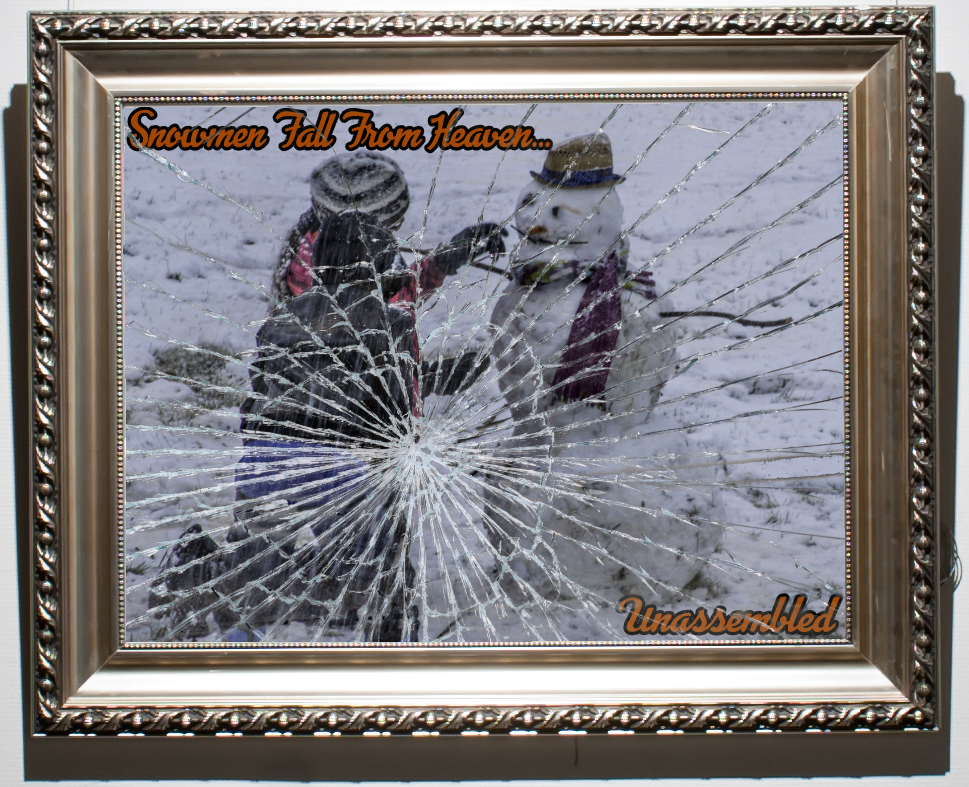
In the midst of a tantrum burst of emotions, Robson stomped into his room and slammed the door shut so hard the picture on the wall to the right came free of its hook and crashed to the floor. It was one of his favorites, a print of a painting depicting a young boy and girl building a snowman with the caption “Snowmen fall from heaven…unassembled” across the bottom. The glass and the frame were cracked and now it was ruined just like everything else in his life!

He kicked over his wastebasket, the plastic one with Captain America and all the other Marvel’s Avengers on it, and discarded candy wrappers and other bits of broken junk he no longer had a use for skittered across the floor which only made him angrier.

He threw his head back and screamed, “Why can’t you give me what I want? Why can’t I eat what I want to eat and watch what I want to watch on tv? I’m sick of this stupid house and I hate you both! I can’t wait until I get older and leave here forever!”

And the rage kept spilling out until he had expelled all the air from his lungs and the rant became a coughing fit, but he didn’t care. He pulled in a deep breath of new air and let out a frustrated and sustained, guttural bellow so loud it vibrated his eyeballs.

When the red mist of fury lifted from his vision and he was left with nothing more than the fatigue of ages pressing down upon him, he heard a soft rap on his door. He had no desire to respond, so he didn’t but the door handle turned slowly and his father pushed his head inside.

“Got it all out of your system?” his father asked with no trace of anything being out of the ordinary.

Robson didn’t answer, he couldn’t answer, the fatigue wouldn’t allow it. But as his father entered the room and surveyed the damage, the young boy stood firm, and let his breath out through his nostrils in a defiant hiss.

His father picked up the cracked picture frame and examined it as he walked past Robson to sit on the bed. He patted the full-size mattress, indicating for his son to have a seat but the boy didn’t move. “Come on, it’s not going to kill you to sit next to me. I just need you to listen to what I have to say and then I’ll leave you alone to continue being mad at us.”

Reluctantly, Robson dragged his feet as if the gravity inside the room had suddenly increased tenfold and plopped onto the bed as far away from his father as he could manage.

“A shame about this picture,” his father said. “Your mother and I bought this for you because it was the first thing you actually asked for. You pleaded with us and made your case so succinctly that we had no choice. At the time, we didn’t have the money to spare but sometimes the happiness of the people you love is worth more than any dollar amount.

“The reason I’m bringing this up is to talk to you about sacrifices. You’re too young to fully understand this but everybody in the world has to make them, no matter how young or old they are. And you may think the things we ask or tell you to do are unfair but that’s only because you don’t see the bigger picture and there’s no real reason you should at your age. Our job as parents is to take care of the big important stuff so that you can live the easiest life we can manage to give you. But it’s also our duty to prepare you for what’s to come and we planned to wait until you were a little older, but since you’re so eager to grow up, let me tell you what life holds in store for you.

“As you get older, you’re going to learn that even the people who were never supposed to let you down probably will and someone who has the same opinion about you…you will let them down, as well. That includes the three of us, champ. We’re eventually going to let each other down.

“You’re going to fall in love one day and your heart will get broken and it will probably happen more than once, and it will get harder to love with each passing break. And most likely you’ll break a few hearts yourself, even if you remember how it felt when yours was broken and try to avoid doing it to someone else, it’s still going to happen.

“Despite your best intentions, you’ll fight with your best friends, blame a new love for things an old one did, complain because time is passing too fast, wish you had your childhood to do over again to get things right, and you’ll eventually lose someone you love, which includes me and your mother.”

Robson sat motionless, staring at the cracked glass and broken frame, unable to meet his father’s gaze because he felt the sting of tears in his eyes. “What do I do?” he said in a small voice.

“What do you mean?”

“To stop all the bad things from happening. What do I do?”

“Well, you can start by not taking the good things and times for granted, but do take too many pictures, laugh too much, and love like you’ve never been hurt…because every sixty seconds you spend upset is a minute of happiness you’ll never get back. But before any of that, you should go apologize to your mother, she was really upset by some of the things you said.”

Robson hopped off the bed, turned his back to his father and wiped the tears from his eyes with his shirt sleeve. He walked to the door with a purpose, but stopped at the door jamb and said over his shoulder, “I don’t really hate you, you know.”

“I know, kiddo,” his father smiled. “Now, go give your mother a great big hug and kiss and shag your butt back in here so we can straighten this room up.”

The little boy took off like a shot out of the room yelling, “Mommy! Mommy! I’m sorry!”

His father stood up, righted the wastebasket and carefully tilted the broken glass into the little plastic bucket. He caught sight of the caption on the picture and thought, Snowmen aren’t the only things that require assembly, sometimes family bonds do too.

12 Plays of Christmas: A Tin of Snow

Tin of snow

There was a time many, many moons ago when I hadn’t yet become the noted curmudgeon that I am today, a time when I still believed in magic and Kris Kringle and I put a great deal of effort into crafting the perfect Christmas list, one that was sure to grab Gifty Nick’s attention. Many items on that list changed from year to year but there was one thing that always held the Number One position: A Pet.

And who could blame me? Nearly every book I read or tv show I watched at the time clued me in on the fact that no young boy’s adventure life was complete without an animal companion. Dick had Spot (oh, grow up!) the Cocker Spaniel, Timmy had Lassie the rough collie, Mark had Gentle Ben the American black bear, Sandy had Flipper the bottlenose dolphin, and Sonny had Skippy the bush kangaroo. Who did I have? N-o-b-o-d-y and I only had one person to blame. Somebody in the house was allergic to pet dander, and that somebody’s name was Trista, my middle sister.

Undaunted, I penned (okay, it was in crayon but same difference) many letters to Santa detailing my dilemma and making a request for a non-allergenic pet (don’t look at me like that! If anyone could have pulled off that miracle, surely it had to be the red-coated gent whose belly shook like a bowl of jelly) but year after year no little-boy-bestest-pal-in-the-whole-wide-world ever showed up beneath the family Christmas tree (don’t waste your time naming hairless pets in the comment section below. It was the ’60s and we didn’t know anything about that, or if my folks did, they kept it a closely guarded secret).

Since my pleas fell on deaf Clausian ears, I was forced to take matters into my own hands and come up with a different plan. To my credit (hey, if I don’t toot my own horn, who will? Again, get your mind out of the gutter!) it didn’t take long for me to devise a unique solution to my problem.

Tins were a wonderful thing to me. They were a depository where the things a boy kept precious could be secreted away and tucked into the backs of closets or under loose floorboards. Mostly the contents of tins included stamps, coins, marbles, smooth and colorful stones, and the bits of refuse that could be viewed as a treasure to the furtive imagination of a young mind.

I collected snow.

Not just any snow, mind you—I wasn’t some type of frozen vapor hoarding lunatic—I collected the flakes from the first snowfall of the year and packed little rectangular bricks in the back of the freezer. Why? Because of Frosty the Snowman, who came to life after being imbued with the magical properties of first-fall snow. But I wasn’t going to build some ratty old snowman, no sir, not me. My goals were slightly loftier than that.

I was going to build a griffin. Agrippa the Ice Griffin. I couldn’t see my parents objecting to that, unless Trista suddenly developed an allergic reaction to ice, which she might have done, just to spite me.

I’d be the envy of my neighborhood when Agrippa and I went for a walk, and since I read somewhere how griffins have the ability to sense and dig gold up from the earth, I knew we’d be financially sorted for life. And we would totally rule the airways. That went without saying.

Yup. I saw it all clear as day and my plan was foolproof. Since my childhood predated the internet, I had to go to the New York Public Library with sheets of onion skin and trace pictures from mythology books and experiment with PlayDoh so I’d know how to sculpt Agrippa accurately, and knowing he’d be curious about his heritage, I constructed a fascinating family history that would have made any newly birthed mythological creature proud.

As I collected tins of the first snow and carefully hid them in the freezer, I knew the world was finally mine and I was destined to live the most incredibly awesome life ever imagined, and nothing could have prevented it…

Until I discovered the hard way that refrigerators came equipped with a defrost feature. All my carefully stacked magically imbued briquettes had been reduced to not-so-magical freezer run-off that dripped impotently into a catch tray.

Needless to say, I have yet to bring Agrippa into existence. And life, well, it hasn’t quite reached that most incredibly awesome high watermark yet.

But this year’s snow hasn’t fallen yet in my neck of the woods, so here’s hoping I can still lay my hands on those old tracings…

12 Plays of Christmas: Memory Is The Liar That Whispers Fantastic Pasts In Our Ears (a true story…I think)

Calvin-and-Hobbes-esque-Tiny-litle-snowman-army

There’s a Christmas-adjacent story I’m fond of telling, that hand on heart I swear is true, about a girl I met in a park during a blizzard.

Before I go any further, I need to let you know that I’m probably older than a good many of you who will read this and there are miles and miles of memories between now and when the incident occurred, so the sad fact of the matter is I don’t remember what she looked like. Not exactly. In my fading memory’s defense, I only saw the bit of her frosty red face that was nestled within the fur ring of her hooded parka.

And I’ll admit that my recollection of events might be slightly dramatized and infused with more schmaltzy innocence and devil may care fun, as we built a snow fort to defend ourselves from the invading snow army, but it happened, the girl was real and not some imaginary snow playmate—I’ve had plenty of those and I know the difference—and a good time was had by all…or at least by me.

The memory gets more Michael Bayish with each retelling. It takes on mass and bulks up and challenges me to become a better liar in order to bear its additional weight. But am I actually a liar? If the current version records over the initial memory on the VHS tape in my mind and all I have left is the most recent telling, then I am relaying events as I recall them, no? And why shouldn’t I drape this memory with grace so that it might straighten its back and hold its head higher, as it strolls amongst my other remembrances? I am one of only two people who possess this memory and since I cannot verify that the other party is holding up their end, it’s my sworn duty to keep it alive, embellishments and all.

Just before Christmas vacation, it started out as one of my favorite kinds of schooldays, you know, where you wake up and the world outside is completely white and Alice Cooper’s voice is singing on a continuous loop in your head, “School’s out for-ever!” as you do your victory dance in front of the icy window.

What was that? Just me, then? All right. Good to know.

Anyhoo, after lying about leaving my books at school—thereby avoiding studying to get ahead of the class (perish the thought)—and breezing through my chores, I ventured forth into snowmageddon and discovered… no one else was outside. Oh, sure, people were attempting to dig their cars out, but none of my friends, hell, no one my age was visible in the dense thundersnow.

Cowards, the lot of them!

Undaunted—I wasn’t going back inside, not on a free day like this—I trekked to the local park and that was when I saw The Girl. Out on her lonesome, rolling the lower portion of a snowman-to-be with all the intensity of a Winterland Victoria Frankenstein.

When she eventually caught sight of me, she stopped and glared, trying to suss me out. Was I friend or foe? We stood there for ages, still as statues, locked in a silent Mexican Stare Off. She was determined, this one, to wait me out. She had staked claim to this park and I was the trespasser. If we were ever going to come to an accord, I’d have to make the first move. So, I did the only thing I could do in that situation…

I began rolling the middle portion for her snowman. That seemed to be good enough for her.

You ask me what her name was? Well, there are only two words that come to mind when I think about her: amber and hazel. So, either her name was Amber and she had hazel eyes, or she was an amber-eyed Hazel. Perhaps even something in between like Hazamberel or Amhazelber? I can’t rule any options out at this point.

The park was ours and ours alone, we two intrepid children of The Bronx. We laughed in the face of the snowpocalypse and frolicked—as much as our starfish overlayering would allow—and built an ominous snow army that we waged snow war against, plowed through the snow soldiers, and beat them down to the ground, before turning on each other in the snowball fight to end all snowball fights, tried to sled downhill on a ratty piece of cardboard, discovered how truly fast squirrels are when we tried to catch one, marveled at how far trees could bend under the weight of snow and made a pact to be friends forever.

I learned that day that pacts are not unbreakable—I never saw Hazamberel again—and just how like a delicate snowflake a memory was.

Not a terribly exciting story to hear, I realize, but I’m not telling it for your enjoyment. I tell it so that I don’t lose it and so that it doesn’t fade any more than it already has from the weathers of time or become trapped and freezes to death in the hedge maze like Jack Nicholson in The Shining.

That’s part of the duty we owe to our past, to not only remember it but become the architects and build up the bits of foundation that have crumbled away due to neglect.

So, please stop me if I’ve told you this one before, but once, when I was younger, I met a girl in a blizzard, at least I think it was snowing, maybe it was rain, and her name was some sort of color, Vermillion or Fuchsia, maybe…

Tiny Stories: Knight’s First Quest

Popular belief has it that the universe is comprised of atoms. In reality, the universe is actually made up of…

On the twenty-first year of his birth, after proving his bravery and skill at battle, Eldred the squire was called to the dubbing ceremony, where he knelt before the King, who tapped the squire on the shoulder with a ceremonial sword, making Eldred a knight.

Once he took the oath to honor and protect both his king and the church, he was presented with a pair of riding spurs and his very own weapon, the Sword Perilous, crafted by the king’s master armorer and enchanted by a powerful wizard for the sole purpose of slaying dragons. Many a knight wielded the mighty blade, yet the sword always returned to the king unused and ownerless.

The new knight, determined to make his mark and break the curse of the Sword Perilous, traveled the desolate road through the forbidden forest for three moons until he crossed paths with a maiden fair. Eldred’s eyes feasted upon her—the aureate waterfall of her hair, the glimmering emerald of her eyes, flawless diaphanous skin, and the elegant and fawn-like neck that supported the most pulchritudinous face he had ever seen.

The moment he laid the enchanted steel upon the mossy earth, he discovered that this delicate creature, whom he would have sworn his life to protect without question, was in fact the dragon he had been ordered to slay.

Can You Keep A Secret?

Walton had done the calculations. The building stood twenty-two stories tall which was approximately two hundred and forty feet and his freefall wouldn’t last longer than four seconds, reaching seventy-five miles per hour on impact.

That should do the trick, he thought as he closed his eyes, held his breath, and stepped off the building ledge.

A hand caught the crook of his arm in a vise-like grip and yanked Walton violently back onto the roof. He was confused when he opened his eyes and saw…

A ghost?

No. Although she was so pale she almost looked faded and thin to the point of anorexia, skin stretched over bones, the woman standing over him was definitely corporeal. Walton wasn’t one to judge a person’s appearance but she wasn’t attractive. Her hair was baby-fine and lifeless and it collapsed onto her shoulders. He was in midair when she grabbed him but there was no way this frail, bony woman could have yanked him back onto the roof.

“I didn’t mean to manhandle you like that. I just didn’t know your story,” the woman said. Her voice was mousy but her tone was strong.

“Are you insane? What are you talking about?”

“I wasn’t the one about to swan dive into concrete, so let’s not judge anyone’s sanity here, okay? And I’m talking about your story. Everybody’s got one and it would be a shame if you did what you were about to do and nobody knew your story.”

“Wait, you stopped me because you wanted to know my story? Not because I was going to kill myself?”

“Let’s be honest here, if you aim to top yourself, you’ll find a way to do it, and there’s nothing that I or anybody else can do to stop you. I’m just curious to know who you were.”

“You mean are.”

“I mean were. You’re going to kill yourself after all.”

“You really are crazy.”

“There you go again, with that label. Hello, pot, meet kettle.”

“What are you doing up here anyway?”

“I could ask you the same question.”

Walton pointed toward the building ledge. “Isn’t it obvious?”

“Oh yeah, right.”

“Look, I don’t have time to waste talking nonsense with a stranger,” Walton said, rising to his feet and dusting himself off.

“Vonda Darleen Honeycutt,” Vonda said, extending her hand.

“What?”

“My name. We’re not strangers anymore. And you are…?”

“Not interested.” Walton walked past her to the roof’s edge.

“I’m just going to go downstairs and rummage through your gunky remains until I find your ID, so why not save me the trouble?”

He let out a sigh of exasperation. “Walton.”

“Got a last name there, Walton?”

“Summers, all right? Walton Mayson Summers, are you happy now?”

“Hey, we got something in common, you’re a three-namer like me. Ever wonder why middle names went out of fashion?”

“No, now if you’ll excuse me…”

“Uh-uh, not so fast. I still don’t know your story. It must’ve wrapped up in a shitty day to bring you to this.”

“How about a lifetime of shitty days?”

“That would certainly do it. Wanna get it off your chest? You may not know it to look at me but I’m a helluva listener. Besides, I’m only gonna keep snatching you off the ledge until you tell me.”

“Then I’ll take you with me,” Walton said.

“Are you a murderer?”

He wasn’t. Walton sat on the ledge and asked, “If I tell you my story, will you let me do what I came here to do?”

Vonda made the sign of a cross over her left breast. “Cross my heart and hope to…well, you know.”

And with that, Walton told her the story of an unsuccessful author whose work failed to connect with an audience of any kind, who turned to alcohol, an addiction that chased away his wife, his family, and his friends, relationships he wasn’t able to repair even though he had been sober for almost five years.

“Not exactly a life worth living,” Walton concluded.

“What if I could show you something?” Vonda asked.

“Let me stop you right there, I’m not religious, never have been, never will be.”

“I’m not proselytizing, not trying to sell you on a cult, but what I have to show you will damn sure feel like you’re having a religious experience.”

“What have I got to lose? This will all be over in a minute, anyway, so go on, show me.”

Vonda began feeling the air. looking like a mime trapped in a box. Walton rolled his eyes and was about to swing his legs off the side of the building when the odd woman found what she was looking for. She traced her fingers down an invisible seam in the air and dug her fingers into it. With a bit of effort, the bony woman pulled back a piece of reality.

Walton’s eyes grew wide as saucers as he looked upon a sight that altered his perception of himself, his life, everything. It was similar to the overview effect reported by astronauts who viewed the Earth from outer space. What stared back at Walton from the rift in the space/time continuum allowed him to see, for the first time with his mere mortal eyes, the big picture: his life in relation to the universe at large.

Vonda closed the rift, making sure it was sealed tight. Walton walked to where the rift had opened and felt around. He had to see it again but his hand touched nothing except air.

“I never knew,” he said.

“And now you do,” Vonda said. “But there’s a catch.”

“What sort of catch?”

“What you just witnessed has to remain a secret.”

“I’ve just had a cognitive shift in awareness, how can I not scream this from the mountaintops?”

“Them’s the rules,” Vonda shrugged. “In exchange for this experience, you can never tell anyone about what you’ve seen. You can’t even write about it, not in a story, journal entry, email, or text. You are forbidden to utter or issue a single word referring to it.”

“Then why show it to me?”

“You’re about to kill yourself, who are you going to tell?”

“Well, I don’t want to kill myself now, do I?”

“I don’t know, do you?”

“You know damn well I don’t, which is why you showed it to me!”

Vonda shrugged again and held out her pinky. “So, do you promise to keep this a secret?”

“You want me to put it on a pinky swear?”

“It’s universally accepted as a binding contract,” she smiled.

Walton locked his pinky with hers and agreed to keep the secret.

Then something occurred to Walton. “Wait, if this is such a big secret, how were you able to tell me?”

“I have special dispensation, you should have been able to work that out on your own by my ability to peel back reality. Besides, I didn’t tell you anything, I showed you. Big difference.”

“Will I be able to do that, too?”

“Learn to crawl before you walk, pal.”

It turned out that Vonda had been sleeping on the roof since she had no place to live. How could Walton not allow her to crash at his rundown apartment? She was the keeper of the greatest secret unknown to mankind, after all.

Sheer proximity to one another and the sharing of a perception-altering experience led them to become involved in a serious relationship and through her encouragement, he sold his first short story. Vonda turned out to be his good luck charm because published short stories turned into published novellas and Walton’s life soon improved as his struggling writing career became wildly successful.

The couple eventually married and had two beautiful children. The years rolled by as years were wont to do and Walton’s career continued to blossom, however, he had written so many books that he exhausted all of his ideas. Yes, he had earned enough money and invested wisely enough for him and his family to live comfortably for the rest of their lives, and if he needed to work there was always the lecture circuit or he could have sculpted aspiring author minds by teaching a masterclass, but a writer in the pit of their soul wanted to write, wanted to be read, and if he was being honest with himself, fame was a difficult thing to let go of.

Walton had written forty novels at a rate of four books a year and on the tenth anniversary with his publisher, his agent thought it would be a spectacular idea to mark the occasion with a new release. He agreed, even though his new idea well had run dry, because he felt he owed it to his fans to attempt to put out at least one final book before announcing his retirement.

The road to hell was always paved with good intentions.

He wrote in secret, and Walton’s conscience should have plagued him to no end but he somehow convinced himself that what he was doing wasn’t a breach of his promise because he wasn’t detailing the wonders his wife showed him ten years ago. He wrote a fable in allegory and metaphor, craftily altering elements and tweaking details until they in no way resembled the precise details of the truth. But the moment he put the finishing touches on his manuscript, Vonda and the children appeared in the doorway of his study.

“All you had to do was keep one secret and the world would have been yours,” Vonda sighed heavily, letting her head drop. Her teardrops beat patterns on the hardwood floor.

Vonda held out her pinky, a reminder of the vow he made, and Walton watched her pinky fade into nothingness. She screamed and clutched her two daughters tight, who emitted a heartbreaking wail as they began to unravel corporeally and dispersed into so much stardust.

And after they were gone, his current reality followed suit. Films and television programs based on his books became unmade, audiobooks were unspoken, novels melted away from bookshelves, his words vanished from the minds of fans and his publishing company, deals were unsigned, his house unbought, all the positive things that paved the path to his success were undone and time reversed on itself, speeding faster and faster until he was back on the ledge of the building again taking that first big step off.

But this time there was no hand to pull him back onto the roof and gravity did what it was designed to do.