Little Noir Riding Hood Part II: Gildengrove’s Smile

Gildengrove looked the way a lie looks when it’s been rehearsed for generations.

From the road, it wore peace like good linen: warm windows, trimmed hedges, a square that suggested commerce instead of hunger. Even the fog seemed domesticated here, pressed low against the cobblestones as if the village had trained it to behave. But Bzou smelled the truth under the prettiness the way he smelled rot beneath perfume. Too much sage burned into the air. Too much tallow. Too much iron. The kind of careful cleanliness people used when they didn’t want the world to notice the mess they’d made.

Redalhia walked slightly ahead of him, hood drawn low, her posture straight enough to pass for calm. She didn’t look at the houses as they passed, and she didn’t look at the faces in the windows either. Bzou saw them, though. Curtains moved a fraction. A door cracked open and closed. A man at the corner pretended to fuss with a lantern while his eyes flicked over Bzou’s shoulders, tracking his size, his gait, the way the fog seemed to lean away from him.

No one stared openly. Not yet. Gildengrove had manners. It smiled first.

“You belong here,” Redalhia murmured without moving her lips.

It wasn’t a comfort. It was an accusation, aimed at herself.

“I don’t,” Bzou said.

Redalhia didn’t argue. She led him through the square, past the little shops with their careful displays and their careful absence of customers at this hour. The village was awake, but it was awake in the way a hunting party was awake: quiet, observant, ready to move all at once if the signal came.

Bzou kept his hands loose at his sides and his shoulders broad under his cloak. He let them read him however they wanted. Let them misunderstand a predator’s patience for restraint. Let them mistake a pact for weakness.

Redalhia brought him to a small house just off the square, tucked behind a row of leafless trees. The place didn’t fit the village’s polished story. It wasn’t ruin, exactly, but it carried the look of something intentionally abandoned—shutters drawn, paint dulled by salt air, the porch steps worn down as if someone had paced them for years.

“They sealed it fast,” Redalhia said, and for the first time her voice carried something that wasn’t steel. It carried offense.

Bzou saw the iron nails before she pointed them out. Thick-headed, driven hard into the window frames and the doorjamb, not to keep thieves out but to keep something in. The kind of nails you used when you believed wood alone couldn’t hold.

“Your grandmother’s house,” he said.

Redalhia nodded. “Mireille’s.”

Bzou stepped close to the door without touching it. He didn’t need to. The air around it tasted wrong, like a room where someone had whispered prayers for hours and meant none of them. He inhaled once and sorted the layers.

Lavender, old paper, dust. A faint trace of ink. Beneath that: ash that wasn’t from a hearth. A cold burn. And threaded through it all—thin and greasy—lanolin.

He glanced at Redalhia.

“Tallow,” she said, as if she could hear his thoughts.

“Huntsmen,” Bzou replied.

Redalhia reached under the loose board at the porch edge and drew out a key. The move was too smooth, too practiced, the kind of action that said: I came prepared to be disbelieved. She slid the key into the lock.

The metal resisted for half a breath, then gave, with a soft, reluctant click that sounded too loud in the village’s quiet.

Bzou didn’t like that the lock still worked.

Sealed houses were meant to become tombs. Tombs didn’t get reopened unless the people who sealed them planned to return.

Redalhia pushed the door inward.

The air inside was cool and stale, not with death, not with decay, but with absence. The room felt held, like breath caught in lungs that refused to exhale. Dust floated in the thin strip of light that slipped through a gap in the shutters. The furniture hadn’t been overturned. Nothing looked looted. It was the stillness of a place people had left in a hurry and then pretended they hadn’t.

Redalhia stepped in first. Bzou followed, his boots quiet on the old wood.

“She didn’t take anything,” Redalhia said.

It was a statement, not a guess. Her eyes moved over the room the way you look at a loved one’s face for bruises, hoping to find none and expecting to find more.

Bzou moved to the center of the room and let his senses do what human eyes couldn’t. He smelled Mireille’s life in faded traces: tea, wool, the faint medicinal bite of dried herbs. That part was ordinary. Comforting, even. The wrongness was in what cut through it, sharp as a wire: cold ash and something else he couldn’t name at first.

He followed it to a table by the window.

A book lay open there, as if someone had been interrupted mid-sentence. It wasn’t simply old. It was injured. The page edges were blackened, but not with flame. The burn looked like frostbite—dark, crisp, and clean. The ink in the lines had bled into the paper like veins, branching outward as if it had tried to escape.

Bzou stared at it for a long moment.

Redalhia came up beside him, her breath tight. “That wasn’t there when I came last night.”

Bzou’s head turned slowly. “You were here.”

Redalhia didn’t flinch. She didn’t apologize. “I looked through the window cracks. I couldn’t get the door open. I didn’t have the key yet.”

The key, then, had been left for her to find.

Bzou’s jaw tightened. “Someone wanted you inside.”

Redalhia’s eyes tracked over the book. “Or wanted you.”

Bzou didn’t correct her. He extended one claw and hovered it above the paper without touching. The ink looked alive in the weak light. The characters weren’t any language Redalhia would have been taught in Gildengrove’s clean little schoolhouse. They weren’t even the sort of script humans wrote for each other. The shapes carried intent. They carried ritual. They carried a memory of mouths that didn’t form words the way human mouths did.

He had seen something like it once, long ago, carved into standing stones deep in the woods, where the trees grew too close together and the ground tasted of old iron.

Redalhia’s voice came carefully. “Can you read it?”

Bzou’s eyes stayed on the page. “It’s not meant to be read.”

He finally touched the paper, just a single point of claw to the margin.

The cold shot through him like a needle.

His fur bristled under his cloak, and the shadows in the room seemed to pull tighter to the corners as if they, too, wanted to hide from what lay on the table.

Bzou withdrew his claw. “Someone brought this here recently.”

Redalhia swallowed. “You think it’s connected to her disappearance.”

“It’s connected to the village,” Bzou said. “Which means it’s connected to her whether she wanted it or not.”

Redalhia leaned in, her gaze intense. “Then tell me what it is.”

Bzou looked at her, and for an instant he saw the child she must have been—small, listening to elders speak in half-truths, sensing the gaps in every story, not yet knowing the gaps were where the monsters lived. Then he saw the woman she was now, the one who had walked into his cave and asked for help like she’d already decided she would pay whatever price was required.

“It’s a map,” he said finally. “Or a warning. Or both.”

Redalhia’s eyes sharpened. “To what?”

Before Bzou could answer, the house shifted around them.

Not physically. Not in any way a human would have noticed. But Bzou heard it—the faint change in air pressure, the subtle tightening of sound as if the walls were listening harder. The scent of the room altered too. Lavender and ink stayed, but something new threaded in, thin and greasy, like a glove rubbed against wood.

Lanolin.

His ears flicked.

Redalhia saw the change in his face. “Someone’s here.”

Bzou didn’t move. He listened. The footsteps were outside, not on the porch yet, but close. Slow. Deliberate. Not lost. Not curious. The kind of steps taken by someone who knew exactly where the door was and exactly why it had been opened.

“Huntsmen?” Redalhia whispered.

“Not yet,” Bzou said, but he didn’t like how uncertain the words sounded even to him.

The footsteps stopped.

Silence held.

And then—nothing.

No knock. No attempt to enter. Just the knowledge that whoever had approached had chosen to wait instead.

Bzou’s gaze drifted to the window.

Across the street, through the narrow gap between shutter slats, he could see movement. A shadow behind a curtain. A figure that shifted back when Bzou’s head turned. The village wasn’t confronting them. It was observing them.

Gildengrove’s smile, Bzou realized, wasn’t warmth.

It was teeth held politely behind closed lips.

Redalhia’s voice went rigid. “They’re watching us.”

“Yes,” Bzou said, and his tone carried an old, tired understanding. “They always have.”

Redalhia’s fingers tightened around the edge of the table. “Then we leave. We take the book.”

Bzou shook his head. “We don’t take it.”

Redalhia’s eyes flashed. “Why not?”

“Because it’s bait,” Bzou said. “And because whoever placed it wants to know what you’ll do with it.”

Redalhia drew back slightly, frustrated, breathing through her nose like she was trying to keep herself from saying something reckless. Bzou understood the urge. When you were angry, it felt good to break rules just to prove the world couldn’t break you.

But the village wanted reckless.

The village wanted predictable.

Bzou stepped away from the table, letting the book sit open and untouched, like a mouth waiting to be fed.

“We learn what we can without giving them what they want,” he said.

Redalhia’s gaze cut to him. “What do they want?”

Bzou’s eyes narrowed. “To see whether you’ll look where Mireille looked.”

Redalhia went still. “So you think she found something.”

Bzou answered slowly, because the truth of it made his throat feel tight. “I think she remembered something they thought they’d made her forget.”

Redalhia’s jaw set, and Bzou heard the decision form behind her teeth. “Then I’m going to remember too.”

Bzou didn’t stop her. If he had, she would have gone anyway.

They left the house the way they’d entered—quiet, controlled, refusing to rush. Bzou locked the door behind them, not because he believed locks mattered to the village, but because leaving it open would have been an admission of fear. The kind of admission Gildengrove liked to collect.

As they stepped back onto the street, the village shifted around them in small, coordinated ways. A door closed softly. A curtain fell back into place. A woman carrying a basket paused just long enough to look at Redalhia’s cloak, then continued on with a smile that never reached her eyes.

Bzou kept his gaze forward, but his senses reached outward, tallying each watcher the way a wolf counts the deer in a field. Too many. Too alert. And beneath their human smells, that same greasy trace of tallow, woven into the air like a thread guiding them somewhere.

Redalhia noticed it too. “Where are they going?” she asked.

Bzou inhaled.

Then he smelled it—stronger now, unmistakable.

Burning hair.

Burning meat.

And beneath it, dark and wet, the copper sting of blood that hadn’t fully cooled.

Bzou stopped.

Redalhia’s head turned toward the village square. “What is that?”

Bzou didn’t answer. He started walking again, and Redalhia fell into step beside him, her hand still under her cloak.

The square opened ahead, fog thinning just enough to reveal a crowd gathered near the market stalls. Not loud, not celebratory, not even openly hostile. Just present. Silent. Watching as if they’d paid for a performance and didn’t want to miss the first act.

Torches ringed something at the center, their flames flickering impatiently.

Bzou slowed as they approached, and the crowd’s attention sharpened like a blade pulled from a sheath. He felt dozens of human eyes settle on him at once. Felt the slight satisfaction in them. The anticipation.

Someone stepped out from the half-circle of torchlight.

Claude Vaillant.

Bzou recognized him by scent before he recognized him by sight: old blood embedded in leather, tallow in the seams of his coat, steel that had tasted too much life. Claude wore his authority the way some men wore religion—loudly, like it excused everything.

His beard was peppered with gray, his shoulders broad, his posture relaxed in that deliberate way meant to signal: I’m not threatened.

But Bzou smelled the lie in Claude too.

Fear was there, under the confidence, compressed into something hard and hot.

Claude lifted his torch slightly—not as a threat yet, but as a gesture. A greeting meant for predators.

“You’ve come down from your cave,” Claude called, voice carrying across the square with practiced ease. “And you’ve brought the girl.”

Redalhia’s shoulders stayed squared. She didn’t look at the crowd. She didn’t look away either. She held her place like she’d learned long ago that flinching invited hands.

Bzou’s gaze went past Claude, to the thing at the center of the square.

A pyre.

Wood stacked carefully, not hastily, as if it mattered how the flames would travel. The scent of pitch and oil clung to it. A ritual pyre, not a disposal fire. And tied to it—

Bzou’s breath went cold.

A wolf carcass hung from the bindings, strung up like an offering. Its pelt was scorched in places, the fur stiffened with drying blood. The eyes—burned out. The mouth—slack, black rivulets still clinging around its teeth.

It wasn’t fresh enough to be tonight’s kill, but it wasn’t old enough to be forgotten either.

A message, timed precisely so Bzou would see it.

The crowd stayed silent, watching him watch it, waiting to see whether grief would make him stupid.

Claude’s voice came again, softer now, the way you speak when you think you’ve already won.

“Your kind have forgotten your place.”

Bzou didn’t look at Claude.

He stared at the wolf.

At the brutal care taken to display it.

At the deliberate cruelty.

They hadn’t killed a wolf for sport.

They’d killed one of his.

And they’d dragged it into the center of the village like a promise.

Bzou’s hands stayed loose at his sides, but his claws flexed once, almost imperceptibly.

Redalhia’s breath came slow beside him, controlled, but Bzou could hear the small shift in her pulse. She understood now—whatever she’d come back to Gildengrove for, it wasn’t only about her grandmother.

It was about what the village did when it wanted to remind monsters who the real monsters were.

Claude held the torch steady, letting the firelight dance.

Bzou’s gaze lifted at last, meeting Claude’s eyes.

And the village’s smile widened, polite and deadly, waiting for the moment the pyre would finally catch.

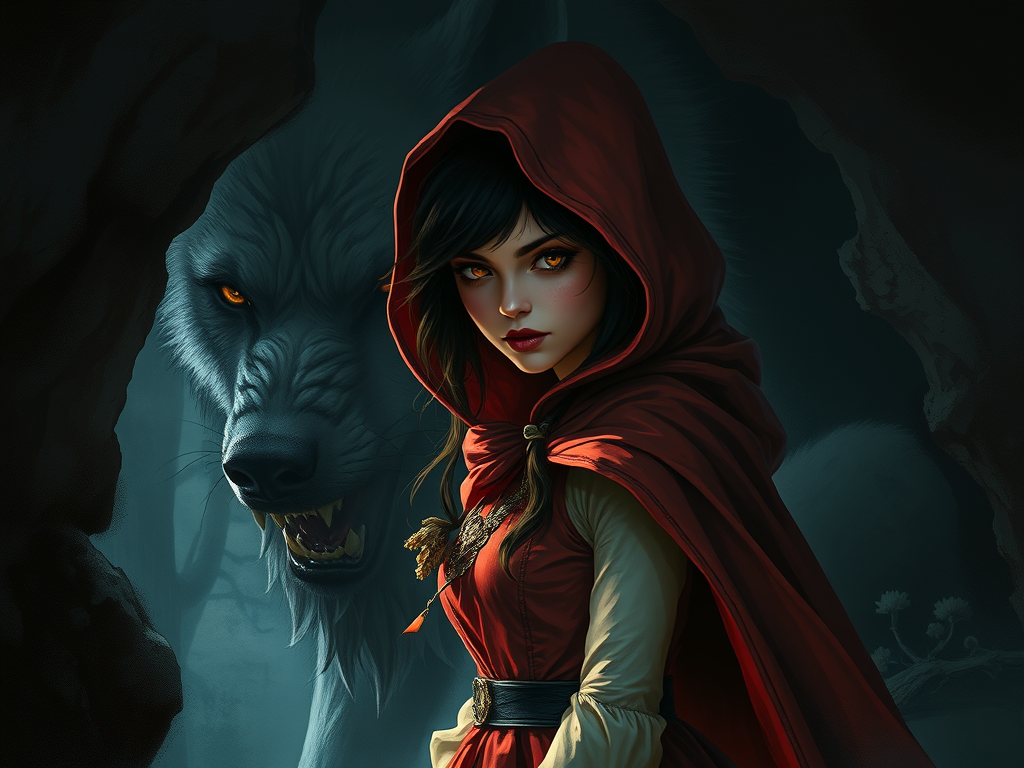
Little Noir Riding Hood Part I: The Client in Red

Bzou smelled her before he heard her.

Blood—cold, human, female—threaded through the damp air outside his den like a slow confession. Not fresh injury. Not panic. Something older and deeper, a stain that didn’t rinse out. It clung to her the way smoke clung to clothes after a long night near a dying fire.

He opened his eyes as the emberlight behind him guttered low. The cave held the kind of darkness that belonged to the world before lanterns, before roads, before people decided shadows were a problem to be solved. His breath steamed in the cold, a pale ribbon curling toward the ceiling, and he listened.

Footsteps, careful.

Not the stumbling, drunk courage of a villager. Not the hurried, frantic rush of someone lost in the woods. These were measured. Intentional. The sound of someone who had made a choice and was prepared to live with it.

She appeared at the mouth of the cave with the fog behind her like a curtain. Hood up, shoulders squared. The cloak was red, but not bright. Not storybook scarlet. Darker. A red that had been slept in, rained on, dragged through thorns and older regrets. The kind of red that didn’t beg attention, but demanded it.

Bzou didn’t rise. He didn’t have to. The den was his kingdom. Anyone who entered it had already crossed a line.

“You shouldn’t be here,” he said.

His voice was the voice of stone rubbed raw. It pressed against the damp air and made the fog feel heavier.

She didn’t flinch.

“I know.”

That alone was wrong. Most humans heard his voice and remembered they were made of soft things. Most humans took a step back even if they didn’t mean to. Fear was automatic. A reflex. A truth.

This woman stood still as a nail.

Bzou watched her for a long moment. The firelight crawled over his fur and over the ridges of his back, catching on the old scars that never fully faded. In the village they called him wolf. Monster. Pact-keeper. Curse. They said a lot of things when they were trying to keep their hands clean.

He shifted, slow and deliberate, and his bones cracked quietly as he unfolded himself from the hollow where he’d been curled.

“What do you want?” he asked.

The woman reached up and pushed back her hood.

Her hair was dark as wet bark, her cheekbones sharp enough to cut glass, her eyes too steady for someone standing at the edge of a predator’s home. Her lips were painted deep red—not for vanity, not for seduction, but like punctuation. A period at the end of a sentence she’d been repeating to herself for days.

She wanted to be seen.

“A missing person,” she said.

Bzou almost laughed, but it would have sounded like a growl. “Not my world.”

He turned away from her, toward the dwindling embers, toward the quiet he’d earned. The village’s problems belonged to the village. The village had chosen its rules. He had chosen exile. That was the pact: he stayed on the edge, and they left him alone. A boundary drawn in old blood and older fear.

Her voice came again, closer than it should have been.

“My grandmother is gone.”

Bzou didn’t turn, but the words tightened something inside him. Missing people were common. People disappeared into woods, into drink, into other people’s cruelty. The world took what it wanted. Sometimes it didn’t even bother to leave a reason behind.

But she didn’t say it like someone repeating the village’s comforting lie. She said it like someone naming a crime.

“They said she wandered off,” the woman continued. “But she didn’t. She was taken.”

Now Bzou turned.

Not quickly. Not with alarm. With the slow attention of something that had learned not to waste energy on false alarms.

“What’s your name?” he asked.

She hesitated. Just long enough to betray a private argument she’d already lost.

“Redalhia.”

It sounded like a name from somewhere else. Somewhere old. Somewhere that didn’t belong to Gildengrove’s neat little square and its tidy sermons and its polite lies.

Bzou studied her. “If your grandmother was taken, why come to me?”

Redalhia didn’t look away. “Because the village doesn’t hunt its own sins.”

Bzou felt a low rumble gather in his chest, not quite a growl. Not quite a laugh. The kind of sound that meant you’re closer to the truth than you should be.

“You’re not from there,” he said.

“I was,” she replied. “Then I wasn’t.”

That was all she offered, and it was enough. The people who left Gildengrove didn’t come back. Not unless they were dragged. Not unless they were desperate. Not unless they were carrying something the village wanted.

Bzou stepped closer. Not to threaten. To measure. The air around her was dense with layers: soap, rain, a trace of cheap tobacco, iron from old blood, and beneath it a faint sweetness like crushed berries that had begun to rot. He could smell nights without sleep. He could smell decisions made in the dark.

“You want me to walk into the village,” he said.

“Yes.”

“You know what that means.”

Redalhia’s jaw tightened. “I know what it means for you.”

Bzou’s eyes narrowed. “And what does it mean for you?”

For the first time something flickered across her face—not fear, not regret, but something like a tired acceptance.

“It means I stop pretending the story they told me makes sense,” she said. “And I stop acting like I’ll survive by keeping my head down.”

Bzou watched her. A long, quiet assessment. He had seen women like her before—women who had been forced into sharpness by dull men. Women who had learned the cost of being small.

“You came alone,” he said. “That’s either brave or stupid.”

Redalhia’s lips curved slightly, but there was no warmth in it. “I didn’t come unarmed.”

Bzou’s nostrils flared. He could smell steel under her cloak. A knife. Maybe more.

“That’s not what I mean.”

“I know.”

The silence between them thickened. The cave’s mouth framed her like an omen.

Bzou’s gaze dropped to her cloak again. The red wasn’t simply red. It had a history. A texture. A depth. It wasn’t a costume.

“How long has she been missing?” he asked.

“Three nights,” Redalhia said. “They told me she wandered into the woods during a fog and didn’t come back. They said she’s old, forgetful, that she probably fell. They asked me to be sensible.”

Bzou’s throat tightened with the old familiar disgust. Sensible. The word people used when they wanted you to agree to something monstrous.

“And you weren’t.”

“I was,” Redalhia said quietly. “For one night. And then I went to her house.”

Bzou stilled. “Her house is sealed.”

Redalhia nodded once. “Yes.”

“You shouldn’t be able to get in.”

“I didn’t get in.” Her eyes hardened. “But I smelled something through the cracks. Not her. Not death. Something else.”

Bzou felt his fur lift along his spine. “What did you smell?”

Redalhia’s gaze didn’t waver. “Tallow.”

Bzou’s jaw clenched.

Tallow meant torches. It meant huntsmen. It meant old rites with clean names. It meant the village doing something it didn’t want seen in daylight.

Redalhia took a slow breath, as if she’d been holding this in for days.

“They nailed her shutters shut from the outside,” she said. “Iron nails. Like she was a thing to be contained.”

Bzou turned his head slightly, listening past her words to the world outside. The fog was thick tonight. The kind of fog that made distances lie. The kind of fog his kind moved through easily.

He looked back at her.

“There was a pact,” Bzou said.

Redalhia’s eyes sharpened. “So you admit it.”

He didn’t answer. The pact wasn’t a story for outsiders. It was an arrangement carved out of survival. The village kept its hearths and its children; Bzou kept the things that crawled at the edges. Sometimes, when the forest spit up something wrong, he put it back down. Sometimes he dragged it into the dark and broke it there.

He did not interfere with human business. Not anymore.

“You ask me to break it,” he said.

Redalhia stepped closer, too close, the red of her cloak absorbing the firelight. “I ask you to look me in the eye and tell me you don’t already want to.”

Bzou’s breath steamed between them. He could hear her heart. Not racing. Not pleading. Steady. Determined. Like a drum.

“You think you know what I want,” he said.

“I know the village is rotting,” Redalhia replied. “I know they’re hiding something under their clean faces. And I know you smell it too, whether you admit it or not.”

Bzou stared at her for a long time. In the old stories, the girl in red wandered into the woods because she was naive. Because she didn’t understand the rules. That story was a lie. Girls in red wandered into the woods because no one else would go. Because someone had to. Because the world didn’t protect the soft.

Redalhia wasn’t soft. Not anymore.

“What’s your grandmother’s name?” Bzou asked.

Redalhia’s voice tightened. “Mireille.”

The name landed heavy. Not because Bzou knew the woman—he didn’t. Not because the name had power in itself. But because naming a missing person was a form of refusal. Refusal to let them become rumor. Refusal to let them become a lesson.

Bzou turned away from the fire. He moved deeper into the cave for a moment, into the shadows where Redalhia couldn’t see his face. He reached into a crevice in the stone and drew out something wrapped in old cloth.

A token. A reminder.

He returned to the firelight and unwrapped it.

A strip of leather, cracked with age, threaded with beads that had once been white and were now the color of old teeth. At its center, a small metal medallion stamped with a symbol the village pretended not to recognize: a wolf’s head inside a ring of thorns.

Redalhia’s eyes flicked to it, then to him.

“What is that?” she asked.

Bzou held it between two fingers. “Proof.”

“Of what?”

He didn’t answer directly. He looked at her and asked, “When you were a child, did they tell you the woods were dangerous?”

Redalhia’s mouth tightened. “They told me the woods were punishment.”

Bzou nodded once. “Then you learned their favorite lie.”

He let the medallion fall back into his palm and wrapped it again, slow, as if each motion was a decision.

“I don’t walk into Gildengrove,” he said.

Redalhia didn’t move. “Then Mireille dies.”

“That’s not a certainty.”

Redalhia’s voice turned razor-thin. “It’s a pattern.”

The fire popped. The sound snapped through the cave like a breaking bone.

Bzou met her eyes. In them he saw something he hadn’t expected. Not just anger. Not just fear. A quiet, brutal certainty that she would go alone if he refused. That she would step into the village, into its teeth, because no one else would.

And that she might not come back.

Bzou exhaled, slow.

“You have one more thing you’re not telling me,” he said.

Redalhia’s lashes fluttered once. A tell. A crack.

He stepped closer until he could smell the faintest trace of something beneath everything else. Not scent exactly. More like residue. Like a touch left behind.

Something old.

Something that didn’t belong to a human body.

“You’ve been marked,” Bzou said quietly.

Redalhia’s throat worked. “I don’t know what you mean.”

Bzou lifted his hand and stopped just short of touching her face. He didn’t need to. He could feel it in the air around her—the faint pull like gravity slightly wrong.

“She’s not only missing,” he said. “She left you something. Or something left her through you.”

Redalhia held his gaze, and for the first time the calm in her expression wavered.

“I started dreaming,” she admitted. “After the second night. Same dream, every time.”

Bzou’s voice dropped. “Tell me.”

Redalhia swallowed. “A well.”

The word fell into the cave like a stone into deep water.

Bzou went still.

Redalhia continued, her voice quieter now, as if speaking too loudly would wake something. “It’s boarded up. Nailed shut. There are symbols carved into the wood. I’m standing at the edge, and I can hear breathing from below.”

Bzou’s jaw tightened. The old boundary inside him—the pact, the rules, the careful distance—shifted like a rotten fence post giving way.

“Do you know where the well is?” he asked.

Redalhia nodded once. “Near the oldest houses. Off the square.”

Bzou stared at her. He didn’t like coincidences. He didn’t trust them. Dreams came from somewhere, even if people pretended otherwise.

He looked toward the cave mouth, where fog rolled like a living thing.

“The village didn’t let you in because they wanted you safe,” he said.

Redalhia’s lips pressed together. “No.”

“They let you in because they wanted you close.”

Redalhia didn’t ask who they were. She didn’t have to. Something in her already knew.

Bzou reached for his cloak—dark, heavy, old. Not a garment, a second skin. He swung it around his shoulders.

Redalhia’s breath caught, just once. Not relief. Not victory. Something more complicated. Like she hadn’t believed he would say yes until the moment he moved.

“You’re coming,” she said.

Bzou’s eyes narrowed. “We’re going.”

Redalhia’s fingers curled under her cloak around the knife she carried, as if it steadied her.

Bzou stepped past her into the fog. It swallowed the cave and the fire behind him immediately, taking the warmth away like it had never existed.

He paused at the threshold and looked back once.

“If you lie to me,” he said, “I will leave you there.”

Redalhia met his gaze. “If I lie to you,” she said, “I deserve to be left.”

Bzou turned forward again and started walking.

The fog thickened as they moved through the trees, making the world feel like a half-remembered story. The forest accepted him the way it always had, bending around his presence, quieting its small animals, swallowing its own sounds. Redalhia followed close behind, steady-footed, more capable than most humans. She didn’t speak. Neither did he.

Words weren’t the point anymore. The point was the border they were crossing.

When the first rooftops of Gildengrove emerged out of the fog, Bzou stopped.

The village sat low and neat between the trees, lights glowing warm in windows, smoke curling from chimneys—an image of comfort practiced so often it had become a weapon. The cobblestone road into town was damp, black with rain, and the air smelled too clean. Too scrubbed. Too much sage burned to hide the wrongness beneath.

Bzou inhaled.

There it was—tallow, old iron, lamb fat, and something else threaded underneath, thin but unmistakable. Burned hair. Metal. And the faintest trace of wolf.

Bzou’s eyes narrowed as he stared into the fog-shrouded streets. “They know,” he said.

Redalhia’s voice came quiet beside him. “Know what?”

Bzou didn’t look at her. His gaze stayed locked on the village.

“That you came to my den,” he replied. “And that I said yes.”

They stood at the edge of Gildengrove, just outside its first fence line, while the fog curled around them like the breath of something large and waiting.

From somewhere deeper in town—a sound, distant but clear enough to tighten the skin.

A crackle. A flare. Fire being fed.

Bzou exhaled once, slow and grim. “Stay close,” he said.

Redalhia’s hand slid fully onto the knife under her cloak. “I wasn’t planning on wandering,” she replied.

Bzou stepped forward.

And the village, smelling of clean lies and old smoke, opened its mouth.

The Ghost Marriage Detective

The digital glare of my laptop was an unwelcome intrusion into the sacred stillness of 3:33 a.m. My grandmother called it the Hour of Whispers, when the veil between the living and the dead thinned to something you could almost taste. She said prayers traveled farther at that hour. She also said bad intentions did, too.

My name is Mei Liu, and in five years as San Francisco’s only afterlife marriage investigator, I’d learned that both could be true.

The email arrived as if it had been waiting for the clock to turn.

Subject: URGENT: A Matter of Life and Afterlife

I stared at the sender’s address for a long second, fighting the reflex I’d trained into myself for survival: delete, archive, pretend I never saw it. Ghost marriage cases were a hornet’s nest even when they were simple. Grief made people irrational. Tradition made them stubborn. The dead made everything unpredictable.

I opened it anyway.

The sender identified herself as Jia Guo. The message was short, the kind of short that comes from someone typing with shaking hands.

My brother, Michael Guo, died six months ago. They called it an “accident.” I don’t believe it was.

Last week, I received an invitation to his ghost marriage ceremony.

The problem? He was already bound. To me. Not in life. In the afterlife.

Please help.

There was an address in the Sunset District and an image attachment. I clicked.

The invitation bloomed across my screen: thick cream paper, gold foil characters, and a seal pressed into the corner like a bruise. It wasn’t the tacky novelty kind you could buy in Chinatown next to tourist jade and plastic Buddhas. This was spirit-grade work. The gold looked too alive. It caught the light and shifted, as if it had a second layer meant for eyes that weren’t mine. Spirit ink. Spirit gold. The kind used to call something that might answer.

At the bottom, a stylized phoenix: the Golden Path Temple.

My stomach tightened. The Golden Path was one of the last places in the city where the rites were still performed with any integrity, where the monks still refused to officiate for anyone who treated the dead like a commodity. When they agreed to marry a spirit, it meant something. When someone forged their seal, it meant something else.

I should have deleted it.

My phone buzzed on the desk, sharp and ugly in the quiet.

A text from Detective Sandra Wong, SFPD Special Cases Unit.

Liu. We need to talk about the Guo case. More going on than a simple ghost marriage dispute.

Wong didn’t text at this hour unless the mundane world had slammed into the other one hard enough to leave a mark.

I exhaled and looked at the jade pendant on my nightstand: a plain disc, smooth from generations of touch. My mother had pressed it into my palm hours before she died.

For protection, Mei-Mei, she’d whispered. From things seen and unseen.

I slipped it over my head. The jade settled against my sternum, cool as river stone, and for a moment I felt like I could breathe. I grabbed my worn leather jacket and my keys and left my apartment without turning on the lights.

The city at 4 a.m. was its own kind of haunted. San Francisco’s fog rolled in from the bay in thick, silent tendrils, swallowing streetlights and softening the sharp angles of buildings until everything looked like a remembered place. The roads were damp. The air smelled of salt and exhaust and something metallic that might have been my own nerves.

Perfect weather for ghosts, my grandmother would have said, like it was a compliment.

The Guo residence was a narrow Victorian in the Sunset District, the sort of aging house that held on to charm out of sheer stubbornness. The once-bright blue paint had faded to the worn denim color of old disappointment. A single downstairs light glowed weakly behind the blinds.

Jia Guo answered before I could knock twice.

She was around thirty, but grief had carved her face into something older. Her eyes were red-rimmed and bright with the dangerous clarity of someone who hadn’t slept in days. Her hair was pulled back with no care for aesthetics. She wore a plain gray sweater and dark pants that looked like she’d put them on without thinking.

“Ms. Liu,” she said, voice hoarse. “Thank you for coming.”

She ushered me into a living room heavy with unspoken words. The air was cool and still, carrying the faint sweetness of old joss sticks. Family photos lined the mantel—parents smiling in sunlit places, a graduation shot, a birthday cake. In the center was a young man with kind eyes and a gentle smile.

Michael.

Jia followed my gaze and swallowed. “That’s him.”

“I saw the invitation,” I said. “Tell me what you meant when you wrote he was already bound to you.”

Her shoulders tensed, like she expected me to recoil.

“It wasn’t… romantic,” she said quickly. “God. No. It wasn’t like that.”

I didn’t fill the silence for her. Silence was one of my oldest tools. It gave people room to tell the truth without tripping over my assumptions.

“Our parents died when we were kids,” Jia said finally. “Car accident. I was ten. Michael was twelve. We got sent to different relatives for a while, like packages nobody wanted to keep.”

Her hands twisted in her lap. The knuckles were pale.

“We were terrified of being separated forever,” she continued. “Not just in life. In everything. There was this old book our grandmother had. Folklore, remedies, rituals she’d written down in the margins. We found a ceremony in it—not a marriage, exactly. A vow. A pact. It said if two people pledged themselves with pure intent, they’d always be able to find each other across the great river of forgetting.”

“And you did it,” I said.

“In our backyard,” she whispered. “Under the plum tree. We pricked our fingers with a sewing needle. Mixed a drop of blood in a cup of water. Said the words. Wrote our names on red paper and burned it. Buried the ashes with two jade rings our grandmother gave us. They were tiny. Like they were meant for dolls.”

Her eyes shone. She blinked hard, refusing to break.

“But it worked,” she said. “After Michael died… I started dreaming. Every night. He’s on the other side of this chasm, reaching for me, and something is pulling him back. He calls my name, but his voice is faint. Like he’s underwater.”

She rose and crossed to a low cabinet. When she returned, she set a lacquered wooden box on the table like an offering. Inside was the invitation.

In person, it was worse. The gold foil didn’t shimmer; it shifted. The characters seemed to carry a second message pressed beneath the first. The bride’s name was listed as Lin Wei, daughter of the Lin family.

Jia watched my face. “You know them.”

“I know of them,” I said. Old money. Old influence. Old rot, too, but I kept that part to myself.

“This isn’t something Michael would agree to,” Jia said, anger beating under the grief. “He honored our pact. Even as adults, we joked about it, but we believed it. Someone is forcing this.”

“The dead can’t be forced into marriage,” I said, because that was what you told people when they were drowning. It was doctrine. It was comfort.

But the truth was, lately, doctrine was starting to feel like a paper wall.

My phone buzzed again. Wong.

“Liu,” she said, clipped and urgent. “Meet me at Golden Path Temple. Now. The Lin family reported a theft last night. Something big.”

I glanced at Jia. “Come with me.”

She didn’t hesitate.

Chinatown was still asleep when we arrived. The Golden Path Temple sat on a quiet street that smelled of damp stone and stale incense, its ornate gates closed against the outside world like eyelids. We were let into the courtyard, where the koi pond lay dark and still.

Detective Wong waited by the Spirit Screen, the carved barrier meant to confuse malevolent ghosts. She was compact, sharp-faced, with eyes that missed nothing. Her badge looked dull in the weak morning light.

“You brought her,” Wong said.

“She has a stake,” I replied. “And she has the rings.”

That made Wong’s eyebrows rise a fraction.

Master Fong, the head monk, stepped into the courtyard. He was normally serene, the kind of man whose calm felt like an actual force. Today his expression was pulled tight, as if he’d swallowed something bitter.

“The Lin family is angry,” he said. “Anger makes spirits restless. It also makes the living foolish.”

“What was stolen?” I asked.

Wong nodded toward the hall. “A jade tablet from the Lin family’s private shrine. Names of their ancestors. Master Fong says it’s required to properly consecrate any ghost marriage involving their direct family line. Without it, they can’t invoke ancestral blessing.”

Hope flared in Jia’s eyes, so fast it looked like pain. “So the ceremony can’t happen.”

“It should not,” Master Fong said carefully.

Wong and I exchanged a look.

“But?” Jia asked.

“But whoever is doing this already disrespects consequences,” Wong said. “Otherwise Michael Guo would still be alive.”

Master Fong’s gaze went distant. “They insist they will proceed.”

“Even without the tablet?” I asked.

A pause. A quiet admission.

“Someone determined enough to bind a spirit,” Master Fong said, “will use whatever methods remain available.”

Three days became a blur. Wong’s unit pulled every thread in Michael’s “accident”—a reported rock-climbing fall in Yosemite with a timeline that didn’t match itself and witnesses whose memories slid sideways when questioned. The official report was thin. Too thin. It reeked of a staged tragedy.

I hunted in older places. Libraries where books smelled like dust and secrets. Apartments above bakeries where mediums accepted fruit and incense instead of cash. Margins filled with rituals that had survived because they were never written down cleanly enough to be stolen.

A woman I trusted—a medium with hands like dry leaves and eyes too sharp for her age—stirred a bowl of water with her finger and frowned.

“The dead can’t be forced,” she said. “Not if they are unanchored.”

“Then how—” I began.

“But if they are tethered,” she interrupted, “you can pull the tether. You can drag the spirit by the knot.”

I thought of Jia’s words. Already bound. To me.

“Like an oath,” I said.

“Like love,” she replied. “Love is an anchor. It is also a vulnerability. Depends who’s holding the rope.”

On the fourth day, Wong got her break. The stolen tablet hadn’t been taken by an enemy. It had been taken by someone inside the Lin household—a distant cousin, young and panicked, trying to derail the ceremony before it happened.

We met him in an interview room that smelled of disinfectant and fear. He sweated through his shirt as if guilt was a fever. His hands wouldn’t stop shaking.

“I didn’t steal it for money,” he blurted. “I stole it to stop it.”

Wong’s gaze was level. “Stop what?”

“The wedding,” he whispered. “The binding. It’s not the old ways. It’s not what my grandmother taught me. They hired a man. A priest. Not a temple priest. A man who says he can make spirits do what they don’t want to do.”

Wong’s jaw tightened. “That’s not possible.”

The cousin’s eyes flicked to me. “You know it is,” he said. “You know what they are.”

I didn’t deny it. Silence was permission.

“They said Lin Wei needs a groom,” he continued, voice breaking. “They said the family’s luck is rotting. That they need clean energy. They called him… an acquisition.”

“And Michael Guo was ‘clean,’” I said.

The cousin nodded miserably. “They arranged the accident. They have people for that. They don’t get their hands dirty.”

“And the ceremony?” I asked.

He swallowed. “Hungry Ghost Festival. Midnight. The gates will be open and the spirit won’t have strength to resist. If blessings aren’t available, they’ll pay a different price. That’s what the priest said.”

I felt the jade at my throat go cold.

Midnight.

The Lin family booked the main hall of the Golden Path under the guise of a private memorial. Master Fong didn’t look at me when we arrived. He looked at the floor, as if the temple itself was ashamed.

The hall was thick with expensive incense, the kind that clogged your throat and made your eyes water. Offerings were piled high: paper mansions, paper cars, stacks of spirit money tied with red string—everything a wealthy family thought the dead needed to feel impressed. Silk banners hung like formalities.

At the center stood an ostentatious altar, built quickly, built for display rather than resonance.

Lin Wei’s spirit tablet sat in the place of honor, jade carved with delicate characters. Beside it was a newly carved wooden tablet meant for Michael. The wood looked too fresh. The characters too shallow. The whole thing felt like a counterfeit soul.

Old Man Lin stood near the altar, as withered and formidable as an ancient bonsai, his family arrayed behind him like a wall. The hired spiritualist hovered at the edge of the scene, a shifty-eyed man in robes that didn’t fit, his fingers stained with something that looked like ink until you stared too long.

Wong entered first, badge visible, posture firm. She held a warrant—not for arrest, not yet, but for spiritual endangerment, a rarely used ordinance I’d helped her dig out of the city’s older bones.

Old Man Lin’s eyes narrowed. “Detective Wong. Ms. Liu. This is a private family matter.”

“Murder and coerced spiritual contracts are rarely private,” Wong replied, voice calm enough to cut.

One of Lin’s sons stepped forward, ready to bluster, ready to intimidate, and the air changed the way it changes before a storm.

“This is an outrage,” he snapped.

“The outrage,” I said, my voice carrying in the sudden quiet, “is treating a human soul like an asset.”

Jia stepped forward behind me. She didn’t look afraid anymore. She looked like someone who’d been afraid for too long and had crossed into the place where fear becomes a weapon.

“You will not take my brother,” she said.

The hired spiritualist smiled, thin and oily. “He is not your brother now,” he murmured. “He is promised.”

My jade pendant burned against my skin.

For a breathless instant, I heard my grandmother as clearly as if she were standing beside me.

The purest vow holds the greatest power. Love is the oldest magic.

I faced Old Man Lin.

“Your ancestral tablet is missing,” I said. “Without it, you cannot legitimately call upon your ancestors to bless this union.”

Old Man Lin’s expression barely moved, but I saw the flicker beneath it: calculation. Anger. The awareness that he was being watched by rules he’d spent a lifetime using as tools.

“And this,” I continued, gesturing to the crude wooden tablet, “is an insult. You are not honoring Michael Guo. You are attempting to chain him.”

The hired spiritualist’s smile faltered. “Respectable people do not question rites they do not understand.”

“Respectable people,” I said, “do not kill a man for spiritual bookkeeping.”

Wong raised her voice then, crisp and undeniable, citing consent requirements in the temple’s own governance, speaking the language of rule and liability that even arrogant men understood. She wasn’t trying to win a spiritual argument. She was offering the temple a legal spine.

Master Fong watched, brow furrowed. The other monks shifted, their attention sharpening.

Jia opened the velvet pouch and poured two small interlocked jade rings into her palm. They were dull with age, worn smooth by years of being held like a talisman.

“Michael,” she said, voice cracking. “I’m here.”

She turned to the empty space before the altar, the place where the dead were supposed to arrive if called properly.

“We were children,” she said. “We were scared. We made a vow because we didn’t know what else to do. But it was real. It was love. Family love. Not this… purchase.”

Tears slid down her face, unashamed.

“I renew it,” she whispered. “If you want to go on, you can go on. If you want to rest, you can rest. But you will not be taken.”

The air shifted.

A change in pressure. A coolness sliding through the room like breath. Incense smoke curling in a direction that didn’t match any draft. A scent threading through the heavy perfume: plum blossoms, fresh and clean, like memory.

The crude wooden tablet meant to represent Michael trembled.

Then it cracked straight down the middle with a sharp sound like bone snapping.

The hired spiritualist yelped and stumbled backward, suddenly looking less like a man with power and more like a con artist caught mid-act. One of Lin’s sons swore under his breath. Old Man Lin’s face tightened, a fraction of fear slipping through the arrogance.

Through the thick smoke, for one brief, breathtaking moment, I saw a figure standing beside Jia: a young man, translucent at the edges, eyes kind and tired and peaceful.

Michael.

He looked at Jia the way someone looks at home.

Then he faded—not dragged away, not torn loose—but released, like a knot loosening.

Master Fong stepped forward. His voice rang through the hall with the weight of judgment.

“The spirits have spoken,” he declared. “This union is unsanctioned. The Guo spirit is not available. You will dishonor this sacred space no further.”

Old Man Lin glared, but he didn’t move. He saw what everyone saw: the temple had turned against him. The monks had shifted. Wong’s officers were already moving. The hired spiritualist was rattled.

The Lins retreated the way powerful people retreat when they realize the room is no longer theirs. Not with apology. With controlled rage and the promise of future trouble.

Wong watched them go, eyes hard. “We’re reopening Michael Guo’s death,” she said to Jia. “Whatever they did in Yosemite, we’re going to dig it up.”

Jia nodded, exhausted and trembling, but there was a lightness in her shoulders that hadn’t been there before.

Later that night, Jia asked me to sit with her at her home altar.

It was small, modest—nothing like the Lin family’s display. A photo of her parents. A photo of Michael. A bowl of fruit. A cup of tea set carefully beside a stick of incense.

“This is just for us,” Jia said. “No spectacle. No buying. Just truth.”

She lit the incense and held the jade rings in her palm. She spoke her vow again—not to bind Michael tighter, but to honor what they had done as children and loosen what had become a trap. She gave him permission. She gave herself permission. In the hush of the room, it felt like the dead were listening the way the living rarely did: without interrupting, without bargaining, without trying to win.

When she finished, the air felt serene. Not ecstatic. Simply quiet, as if something had finally settled into its rightful place.

At dawn, I sat in my office with stale coffee and old books and the faint residue of incense in my hair. I updated the file with hands that ached.

GUO, MICHAEL — RESOLVED. SPIRIT LIBERATED.

The words looked too clinical for what had happened, but I’d learned you couldn’t put awe into a database.

Outside my window the city woke up, pretending it hadn’t been held together overnight by vows and fear and love old enough to count as magic.

My inbox chimed.

Subject: GHOST MARRIAGE INVESTIGATION — URGENT ASSISTANCE REQUIRED

I stared at it, my cursor hovering over delete. Exhaustion sat in my bones like wet sand. I thought of plum blossoms in a hall full of arrogance. I thought of a cracked tablet splitting an altar’s lie in two. I thought of my grandmother’s voice, steady as a hand on the back.

The dead still hear what we mean.

I opened the email and began to type.

Bronco Bustin’ Betty

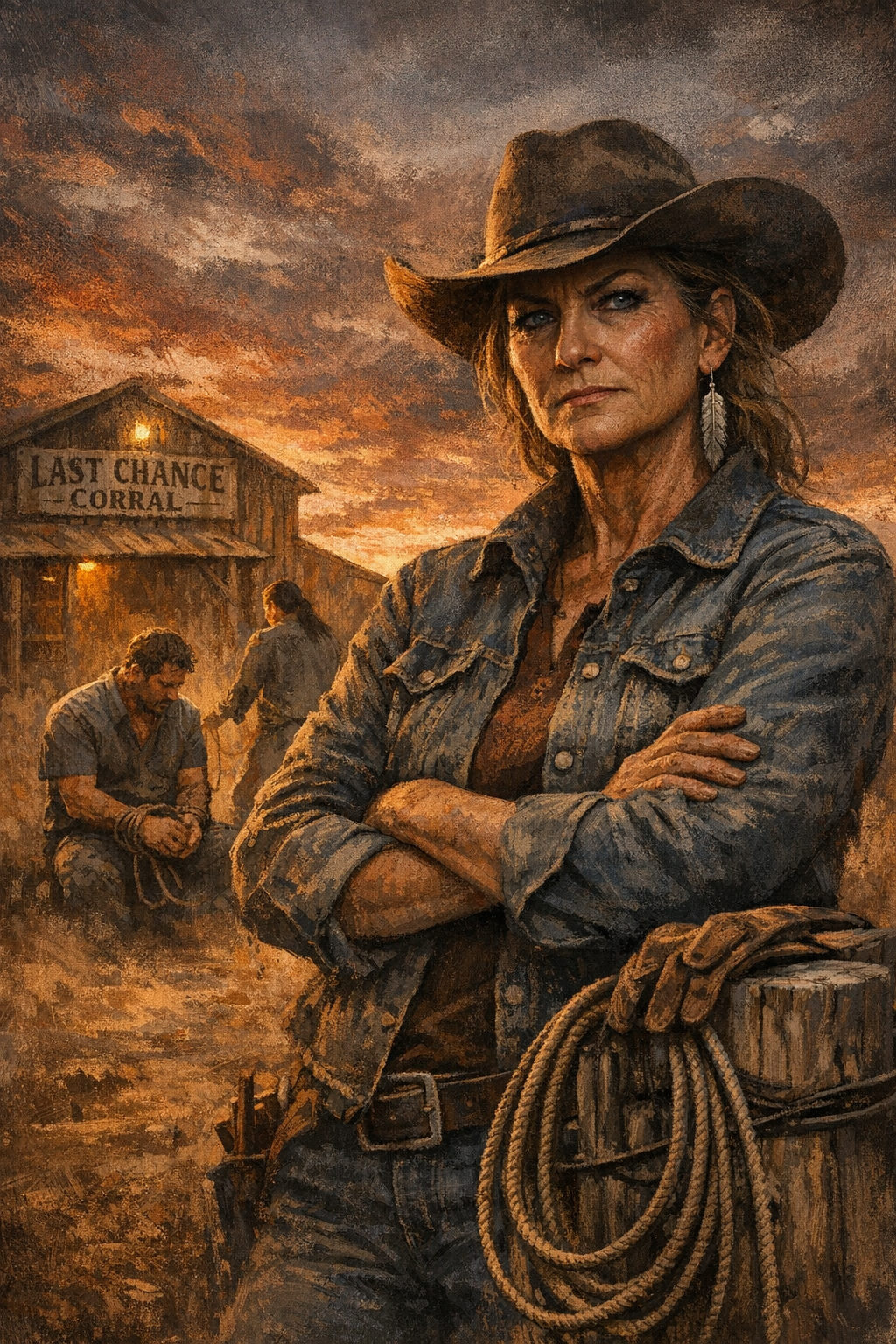
The dust of a hundred heartbreaks and a thousand shattered egos seemed permanently settled in the lines around Betty’s eyes. They were eyes the color of a stormy prairie sky, sharp and assessing, missing nothing. Her hands, calloused and strong, looked like they could gentle a spooked stallion or snap a fence post, and most folks in Redemption County figured they’d done both. Betty wasn’t her given name – that was a softer, frillier thing shed somewhere back in her youth, discarded like a too-tight corset. Now, she was just Betty. Or, to those who whispered her name with a mixture of awe and trepidation, Bronco Bustin’ Betty.

Her ranch, the Last Chance Corral, wasn’t for horses, though a few sway-backed old geldings grazed peacefully in the far pasture, more for atmosphere than utility. No, Betty’s corrals were metaphorical, her broncos human. She specialized in a peculiar kind of husbandry: breaking abusive men. Not with whips and spurs, though her tongue could lash sharper than any rawhide, but with an unyielding will, an uncanny understanding of the male psyche’s darkest corners, and a process as grueling and transformative as breaking a wild mustang. Wives, mothers, sometimes even bewildered judges, brought their belligerent, bullying, or broken men to Betty’s door when all else had failed. They came swaggering, sneering, or sullenly silent. Most left… different. If they left at all under their own steam.

Betty’s methods were legend, shrouded in rumor. Some said she used isolation and hard labor, making them dig ditches in the punishing Texas sun until their arrogance sweated out. Others whispered of marathon “fireside chats” where she’d peel back a man’s defenses layer by layer, exposing the frightened, insecure boy cowering beneath the bluster. The truth was, Betty tailored her approach. Each man was a unique breed of feral, and each required a different kind of breaking.

Her latest “project” arrived in the back of a mud-splattered pickup, courtesy of a weary-looking woman named Martha, whose bruised cheekbone spoke volumes. The man, a bull-necked specimen named Earl, was currently hogtied with baling twine, roaring obscenities that would make a drill sergeant blush.

Betty watched, arms crossed, a weathered Stetson casting her face in shadow. She was a woman built like an oak stump – not tall, but rooted, immovable. Her denim jacket and jeans were faded, practical. A single silver feather earring was her only concession to adornment.

“He’s a handful, Martha,” Betty observed, her voice a low rumble, like distant thunder.

Martha’s eyes, red-rimmed and exhausted, pleaded. “He weren’t always like this, Betty. Or maybe he was, and I just didn’t see. He… he broke our little girl’s music box last night. Said her practicing was giving him a headache. She cried herself to sleep.”

Betty’s jaw tightened almost imperceptibly. That was the kind of detail that fueled her fire. “Unload him. Put him in Stall Number Three. And Martha? Go home. Get some rest. I’ll call you when… or if… there’s progress.”

Earl, once untied within the confines of a spartan room – bare concrete floor, a cot, a bucket, and a single, barred window high up – immediately tried to assert dominance. He kicked the door, bellowed threats, and then, finding no reaction, slumped onto the cot, radiating a toxic blend of fury and self-pity.

Betty let him stew for a full twenty-four hours. No food, just water. Silence was her first tool. It stripped away the audience, the reactions that abusive men fed on. When she finally entered, Earl was slumped, a little less defiant, a lot more hungry.

“Morning, Sunshine,” Betty said, placing a tin plate with a dry biscuit and a piece of jerky on the floor, well out of his reach. “You want to eat, you earn it. First lesson: ain’t nothing free here.”

Earl lunged. Betty didn’t flinch. She simply sidestepped with surprising agility, and Earl met the unyielding wall. He roared, a wounded, frustrated sound.

“Temper, temper,” Betty tutted. “That noise might scare your wife, Earl, or your little girl. Here, it just tells me you’re still wild. Still need gentling.”

The first week was a battle of wills. Earl tried everything: threats, cajoling, feigned remorse, even tears. Betty met it all with the same implacable calm. She set him to tasks: mucking out the stalls of the actual horses (who seemed to eye him with equine disdain), chopping firewood until his city-soft hands blistered and bled, repairing fences under the relentless sun. Every act of defiance was met with reduced rations or more grueling work. Every small act of compliance earned him a slightly better meal, a moment of shade.

It wasn’t just physical. In the evenings, after a meager supper he’d genuinely earned, she’d sit with him in the main ranch house kitchen – a warm, lived-in space that smelled of coffee and woodsmoke, a stark contrast to his cell. She wouldn’t preach. She’d ask questions.

“Why’d you break that music box, Earl?”
“She was makin’ a racket!”
“So, noise bothers you. Did you tell her calmly? Ask her to play softer? Or did you just… explode?”
Silence.
“Your daddy have a temper, Earl?”
A flicker in his eyes. “None of your damn business.”
“Most everything becomes my business when a man lands in my corral, Earl. Especially the things he don’t want to talk about. Those are usually the things that got him here.”

Betty had learned that abuse was often a twisted vine with deep roots, reaching back into a man’s own past, his own unhealed wounds. Her own father had been a storm of a man, his moods dictating the weather in their small, fear-filled house. She’d learned to read the subtle shifts in barometric pressure, the tightening of his jaw, the glint in his eye. She’d learned to make herself small, invisible. Until the day she didn’t. The day she’d fought back, not with fists, but with a sudden, chilling calm that had startled him into a moment of clarity. It hadn’t “cured” him, but it had bought her space, respect. And it had planted the seed of her life’s work.

With Earl, she chipped away. She told stories, not about him, but about other men, other families. She spoke of the ripples of pain, how one act of anger could poison a whole household, generation after generation. She made him write letters to his daughter, letters he wasn’t allowed to send, just to articulate what he might say if he weren’t choked by his own rage. Most were scrawled, angry screeds. But slowly, a word of regret, a flicker of shame, began to appear.

One sweltering afternoon, after a particularly brutal session of post-hole digging, Earl collapsed, gasping. Betty brought him a dipper of water.
He drank, then looked up at her, his face streaked with dirt and sweat, his eyes raw. “Why you doin’ this?” he rasped. “What’s in it for you?”

Betty looked out over the parched land. “Maybe I’m trying to make the world a little less like the one I grew up in, Earl. Maybe I’m trying to teach men there’s a strength in gentleness they’ve never been shown. Or maybe,” a ghost of a smile touched her lips, “I just enjoy a good challenge.”

The breakthrough came, as it often did, unexpectedly. Betty had left a children’s book on his cot – a simple story about a bear who learned to control his roar. Earl, out of sheer boredom, had picked it up. When Betty came in later, she found him staring at a picture, his shoulders shaking. He wasn’t roaring. He was weeping. Quietly, devastatingly.

“It… it was just like the music box,” he choked out, pointing a trembling finger at an illustration of the bear accidentally smashing a bird’s nest. “The look on that little bird’s face…”

Betty sat down on the edge of the cot, a respectful distance away. She didn’t say “I told you so.” She just waited.
“I’m a monster, ain’t I?” he finally whispered.
“You’ve acted like one, Earl,” Betty said, her voice softer now. “But ‘monster’ ain’t a permanent condition. It’s a choice, repeated. You can choose different.”

The next few weeks were about rebuilding. Betty taught him about listening, really listening. About empathy – she made him care for a runt piglet that the sow had rejected, tending to its needs, feeling the tiny creature’s vulnerability. She taught him about apologies – not the grudging, mumbled kind, but sincere expressions of remorse and a commitment to change. She had him practice conversations, role-playing with her as Martha, as his daughter. He was clumsy, awkward, but he was trying. The arrogance was gone, replaced by a hesitant humility.

When Martha came back, six weeks later, the Earl who met her at the corral gate was thinner, weathered, his eyes no longer blazing with anger but shadowed with a newfound thoughtfulness. He didn’t swagger. He stood, hands clasped, and looked at his wife with an expression she hadn’t seen since they were courting.

“Martha,” he said, his voice husky. “I… I got a lot to make up for. If you’ll let me try.” He held out a small, roughly carved wooden bird – a peace offering.

Martha looked from Earl to Betty, tears welling in her eyes. Betty just nodded, a slight, almost imperceptible dip of her Stetson. Her work, for now, was done.

As the pickup truck carrying Earl and Martha rumbled away, kicking up a cloud of dust that glowed gold in the setting sun, Betty leaned against the corral fence. She felt the familiar ache in her bones, the deep weariness that came after a particularly tough bronc had been broken. Some, she knew, would relapse. The wildness was never entirely tamed, only managed. But some, like Earl, found a new path, a way to channel their strength into something constructive, not destructive.

A battered sedan was already pulling up the long drive, another hopeful, fearful face behind the wheel, another shadow of a man slumped in the passenger seat.

Betty sighed, pushed herself off the fence, and straightened her Stetson. The sun was setting, painting the sky in fiery hues. Another night, another wild heart to gentle. Bronco Bustin’ Betty squinted towards the newcomer. The Last Chance Corral was open for business. And in the vast, often brutal landscape of human hearts, she was one of the few who dared to ride into the storm.

©2001 Rhyan Scorpio-Rhys, All Rights Reserved.

A Church of Smoke

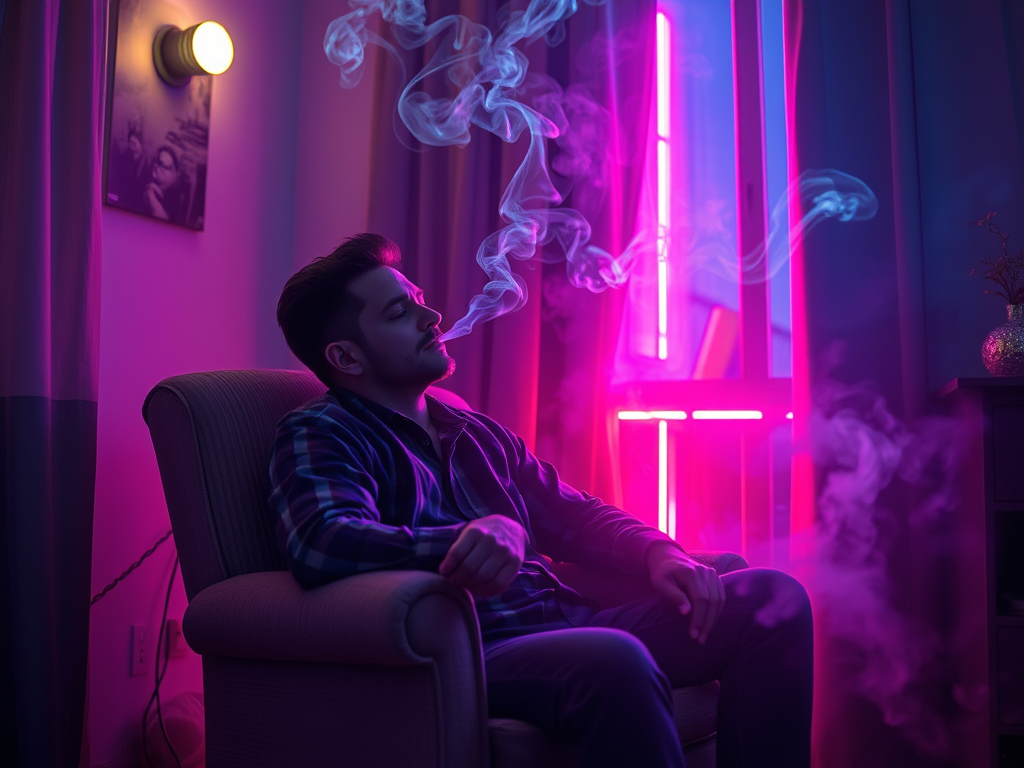
The world below, a sprawling constellation of indifferent lights, looked like a half-forgotten dream from Jacob’s perch. He wasn’t physically elevated, not in any conventional sense. His kingdom was a threadbare armchair, angled just so, in a third-floor apartment that smelled faintly of old takeout and the sweet, acrid tang of his chosen sacrament. The city’s neon blush, a vibrant, vulgar poetry, seeped through the cheap plastic blinds, striping the walls with fractured, greasy rainbows that writhed with the passing traffic. Smoke, a silver-grey exhalation, curled upward from the glowing tip nestled between his fingers, delicate and deliberate as a whispered prayer, before dissolving into the murky shadows clinging to the popcorn ceiling.

In this moment, suspended between the tick of the clock and the tock of his own weary heart, Jacob felt blessedly, terrifyingly weightless. The familiar leaden weight that usually sat squarely on his chest, a constant companion of dread and obligation, seemed to dissolve, molecule by molecule, into the smoky air. The insistent gnawing of unpaid bills, the spectral echo of his boss’s disappointed drone from the dead-end data entry job he barely tolerated, the heavy silence from friends he’d long since alienated with his increasingly erratic orbit – all of it melted away. What remained was a soft, pervasive hum, the thrum of existence stripped bare, a fundamental frequency.

Colors, those fractured rainbows on the wall, pulsed with an impossible vibrancy, the chipped paint on the windowsill glowing like an ancient manuscript. The edges of reality softened, grew pliable, as if the mundane world were merely a preliminary sketch for something far grander. And somewhere in that luminous haze, a presence nudged at the periphery of his consciousness. Not a voice, not in words he could parse, but an undeniable knowing, a pressure as gentle and insistent as a rising tide.

It’s okay, the presence seemed to murmur, not in his ears but directly into the core of his being. You’re okay. You are held.

This was not the usual narrator of his internal landscape. That voice, the one that accompanied him through the stark, unforgiving daylight hours of sobriety, was a cruel, meticulous accountant of his failings. It kept a running tally of overdue rent, missed calls from his worried mother, creative projects abandoned in fits of self-loathing, the ghostly outline of the artist he’d once dreamed of becoming. That voice was a taunt, a jeer, a constant, grating reminder of his inadequacy.

But this… this was different. This resonant hum, this gentle pressure, felt… holy. Like cool water on a parched throat.

He exhaled a long, slow plume of smoke, watching it twist and billow. One particular gyre, caught in a stray beam of crimson light from the liquor store sign across the street, momentarily coalesced into a shape that tugged at a distant memory: the vaulted ceiling of St. Michael’s, the church his grandmother, a woman of simple, unshakeable faith, had dragged him to every Sunday of his childhood. He remembered the place with a child’s sensory acuity: the cool, dusty smell of old wood and beeswax, the slightly intimidating grandeur of the altar, the way sunlight, filtered through stained glass, shattered into kaleidoscopic beams that danced on the polished pews, painting fleeting jewels on the bowed heads of the congregation. Back then, the sermons had been baffling riddles, the rituals a series of performative gestures devoid of meaning, the hymns a mournful drone. He’d fidgeted, counting the minutes until release.

But now, adrift in this smoky sanctuary, bathed in the profane glow of the city, he felt a flicker of understanding, or perhaps the illusion of it. The universe, vast and terrifyingly incomprehensible, indifferent to his small, sputtering existence, suddenly felt… intimate. Here he was, Jacob, a microscopic speck adrift in its endless, churning expanse, yet in this fleeting moment, he felt an undeniable, resonant connection to something utterly divine. He couldn’t name it – God, Brahman, the Tao, the Oversoul, the Universe Itself, or perhaps, as the sober part of his brain would later sneer, simply the neurotransmitters firing in a pattern induced by his chosen escape. Whatever its origin, the feeling was profoundly, viscerally real.

For the first time in months, maybe years, Jacob allowed himself to close his eyes, the neon light painting his eyelids a bruised purple, and pray. Not the rote, memorized phrases of his childhood, the lifeless “Our Fathers” and “Hail Marys” mumbled under duress. This was something raw, stripped-down, a desperate flare sent up from the sinking ship of his soul.

If you’re out there… The words formed in his mind, ragged and uncertain. If any of this is real… please… just show me. Let me feel this, just for tonight. Let it be enough.

The music playing softly from his cheap laptop – some ambient, ethereal electronica he’d found online – seemed to swell in response. The bass, usually a subtle undercurrent, resonated deep within his chest, a second, truer heartbeat. He could almost imagine it, the air thick with unseen presences, angels perhaps, their voices not in song, but in the harmonic convergence of the synthesized chords, their wings the shimmering patterns the smoke made against the darkness. Tears, hot and unexpected, pricked at the corners of his eyes, tracing clean paths through the day’s grime on his cheeks. A profound sense of peace, fragile but exquisite, settled over him. He was small, yes, but he was also part of everything. And for this brief, sacred interval, that was not a terrifying thought, but a comforting one.

But dawn, as it always did, arrived like a bailiff, unceremonious and cold.

The high dissipated like mist in the harsh morning light, and with it, the fragile architecture of his faith crumbled. The vibrant colors of the night before leached away, leaving behind the familiar, depressing palette of his reality. The numinous voice was silenced, the angels had taken flight, abandoning him to the stark, fluorescent glare of another day. The empty beer cans and the overflowing ashtray on the coffee table glinted dully, mundane monuments to his fleeting transcendence. His phone buzzed, an angry, insistent vibration against the scarred wood – another bill reminder, another demand from the world he couldn’t seem to navigate.

He rubbed his face, his skin feeling tight and papery, his eyes gritty. “It’s all just in my head,” he muttered, the words raspy, cracking under the returning weight of his own relentless skepticism. The magic was gone, leaving only the mundane mechanics of withdrawal and the bitter aftertaste of a joy he couldn’t sustain.

Yet, a tiny, stubborn ember of doubt remained. The feeling had been too profound, too encompassing, to be dismissed entirely as a chemical trick. Hadn’t mystics and saints throughout history spoken of similar states, of union with the divine, sometimes induced by fasting, or chanting, or solitude? Who was he to say his path, however unorthodox, was any less valid, even if it led through a haze of smoke?

Later that night, as the sun bled out below the horizon, smearing the western sky with bruised purples and oranges, Jacob found himself at his familiar station. The lighter flickered, a tiny, defiant star in the growing darkness. He touched it to the carefully prepared bowl, inhaled, and held the smoke, a familiar ritual of consecration. And as it rose once more, coiling and unfurling in the dim apartment, he felt it again – that subtle, irresistible tug. A pull toward something larger, something sacred, something that whispered solace in a language his sober mind couldn’t, or wouldn’t, comprehend.

Maybe it was real. Maybe it was a delusion, a comforting lie his mind spun to shield him from the sharp edges of his life. Maybe faith, for him, was a locked room, and this was the only key he possessed, however flawed, however temporary.

He didn’t care. Not really. Not in these moments.

In the intoxicating haze of the smoke, under the watchful, indifferent eyes of the city lights, Jacob found his church, his communion, his fleeting, precious glimpse of a higher faith. And for now, as the world outside receded and the inner landscape bloomed, that was more than enough. It had to be.

©2001 Rhyan Scorpio-Rhys, All Rights Reserved.

A Love, Bar None (Terms Apply)

The stale beer was a familiar comfort, a bitter punctuation mark at the end of another day spent staring at spreadsheets that blurred into meaninglessness. Liam preferred “The Rusty Mug” not for its ambiance – a cacophony of after-work chatter, sticky tables, and the clatter of a temperamental darts machine – but for its strategic anonymity. It was a human buffer zone between the suffocating fluorescent hum of Consolidated Solutions Inc. and the echoing silence of his studio apartment. He was just another face in the crowd, nursing a pint, trying to rinse the taste of corporate drudgery from his palate.

That’s why the woman’s approach was so jarring. She moved with a stillness that seemed to bend the surrounding chaos away from her, like a stone in a rushing stream. Her eyes, the color of twilight, fixed on him with an unnerving intensity.

“You caught my notice,” she said, her voice a low thrum that somehow cut through the bar’s din. “That does not occur very often.”

Liam blinked, pulling his gaze from the hypnotic swirl of bubbles in his glass. She was… striking. Not in a conventional, airbrushed way, but with an almost archaic beauty, her features sharp and defined, her dark hair cascading around her shoulders in a way that seemed untamed by modern styling. She wore a simple, dark dress that nonetheless looked more expensive than anything in his own wardrobe.

He managed a weary smile. “Look, miss, I’m flattered, but no.” He’d learned to preempt.

Her head tilted, a subtle, curious movement. “No, to…?”

“Whatever this is.” He gestured vaguely between them. “I’m not cruising for a hook-up…”

“Nor am I,” she interjected, her tone perfectly even.

“…and I’m not interested in dating.” He’d tried that. It felt like another series of performative interviews, each one ending in a quiet fizzle of mutual disinterest.

“That makes two of us.” A ghost of a smile touched her lips, gone as quickly as it appeared.

“All I want,” Liam said, forcing a note of finality into his voice, “is to enjoy my beer in private before I head home.”

“You call this cattle market private?” Her gaze swept the crowded bar, a hint of disdain, or perhaps amusement, in her eyes.

He shrugged. “I work across the street. This is the closest bar between the office and the subway. Efficient.”

“You could always buy a beer locally and drink it at home.”

“I think drinking alone is a thing sad people do.” The words were out before he could stop them, a raw admission he usually kept locked down.

“But you are alone,” she observed, her twilight eyes seeming to see right through his carefully constructed defenses.

“This place is packed,” he countered, gesturing around. “I’m surrounded by people.”

“And yet,” she leaned forward just a fraction, her presence suddenly more focused, more intense, “you are all alone.”

“By choice,” he insisted, though the word felt hollow even to him.

“What if,” she said, her voice dropping to an almost conspiratorial whisper, “you just made the acquaintance of someone who can make your wildest dreams come true?”

Liam snorted, a laugh that was more disbelief than humor. “That’s your pitch?”

“I do not pitch.” Her eyes held his, unwavering. “I do not promise empty fantasies. I can offer wealth beyond imagining—enough to buy every fleeting desire you have ever had.”

He raised an eyebrow. “Wealth? How? Ponzi schemes? Insider trading? My pension fund isn’t exactly seed capital.”

“I have a knack,” she said, a faint, almost predatory curve to her lips, “for sensing opportunities when they arise. I also know how to position you, so that fortune flows to you effortlessly. The right investments, made with uncanny foresight. The right ventures, presented at the perfect moment. You can be a man of unimaginable success, lauded by financial columns, envied by your peers. And no one, not even you, will fully understand how you achieved it. Only that it happened.”

Liam pictured his cramped apartment, the overdue notices peeking from under his door. The thought was undeniably tempting. “I’ll bet that money comes with a ton of aggravation. Audits. People crawling out of the woodwork.”

“All right,” she conceded with a graceful nod, unperturbed. “Let us try a different route. What about fame? Your name, spoken by millions. You could be adored, celebrated. People hanging on your every word, your every move. An artist whose work redefines a generation. An innovator whose ideas reshape society. With my assistance, you can rise higher than you ever thought possible.”

He thought of the crushing anonymity of his life, the feeling of being an unnoticed cog. “All at the cost of my privacy,” he muttered. “No thanks. I like being able to buy milk in my pajamas.”

She didn’t miss a beat. “Then what about knowledge? The kind of knowledge that shapes worlds. Secrets and wisdom far beyond what the greatest minds have ever uncovered. I can help you unlock answers to questions mankind has not even dared to ask.”

This… this gave him pause. His job was mind-numbing, but his mind, when not dulled by routine, was hungry. “What kind of knowledge are we talking here?” he asked, leaning in despite himself. “The unified field theory? The meaning of life?”

“At this juncture, it is privileged information,” she said, a hint of something ancient and vast in her gaze. “If we can come to terms, you will find out—when you are capable of receiving it. Imagine, Liam, being the man who discovers things others only dream about. Understanding the fundamental fabric of reality. Changing the course of history with a single insight. You would have the kind of mind that transcends generations.”

“Just like that, huh? You make it sound so easy.” He tried to maintain his skepticism, but a thrill, cold and sharp, ran down his spine.

“For you, it would be. And you would never know another dull moment in your life. Adventure. Exploration. I know places no one else does—places hidden from the world, woven into the seams of reality. Imagine experiencing wonders that go beyond the limits of any map, things you cannot even picture right now. Cities of crystal beneath the ice, forests that sing with the birth of stars, deserts where time itself pools like water.” Her voice was a mesmerizing cadence, painting vivid, impossible landscapes in his mind.

“And how exactly would you do that?” he asked, his throat suddenly dry.

“Let us just say… I know how to get there.” Her eyes gleamed. “The question is, do you wish to follow me?”

“Follow you, an absolute stranger, on an unreal adventure?” He shook his head, trying to clear it. This was insane. He was having a conversation with a lunatic, albeit a remarkably articulate and compelling one.

“It can be as real as you choose to make it,” she murmured. “You can have all of it—wealth, success, wisdom, fame, adventure. And your name? It would live on long after you’re gone, remembered for centuries, your legacy written in the stars.”

“How would that be possible?” The question was a whisper, lost almost before it was spoken.

A new softness, something almost tender, entered her expression. “I will bear you many children, Liam. Strong, brilliant children. And each one will carry your name with love and pride, scattering your essence across the generations like seeds on a fertile wind.”

The air seemed to crackle around them. Children. Legacy. These were abstract concepts he’d never allowed himself to dwell on. Now, they landed with the weight of mountains. He finally found his voice, hoarse and uncertain. “And what do you get out of all of this?”

“I have already received my reward,” she said, her gaze distant for a moment, as if looking back across millennia. “A long time ago, someone made me the same offer that I am making you. This is me paying that good fortune forward by watching you shine, by witnessing the extraordinary in you. That is my sole purchase; I am doing this to see you become everything you were meant to be.” She leaned a little closer, and for the first time, he noticed the faint, exotic scent that clung to her, like spice and starlight. “The fact that I find you physically attractive is an added bonus, which you will benefit from in our coupling.”

He stared at her, trying to process the sheer audacity, the cosmic scale of her proposition. “And there’s no catch? No fine print? No soul-selling clause?”

“Love me unconditionally,” she stated, her voice losing its softness, taking on a resonant authority. “Remain faithful until the Reaper claims its reward from either of us. More stipulations than a catch, really.”

“Stipulations,” he repeated slowly. “Unconditional love is… a tall order. And faithful… what’s your definition of faithful?”

“It…would be better if you honored your obligations,” she said, and for the first time, a sliver of something cold, something unyielding as ancient ice, touched her tone. “The consequences for transgression are dire.”

A chill traced its way down Liam’s spine, colder than any draft in the bar. “Okay, then, what do you consider cheating? What are these obligations?” He started to list them, almost mechanically, as if testing the boundaries of a cage he couldn’t yet see: “Non-sexual flirting with a coworker? Friendly daily texting with someone who isn’t you? Having a ‘work wife’ for office banter? Regularly commenting on a woman’s social media posts? Watching porn? Having female friends I meet for coffee? Taking a woman’s phone number if she offers it at, say, a conference? Keeping in contact with my exes, even just platonically?”

With each item he listed, her expression grew more severe, her twilight eyes darkening.
“Yes,” she said to the first.
“Yes,” to the second.
“Yes,” to the third, her voice like chipping stone.
“Yes.”
“Yes.”
“Yes.”
“Yes.”
“And yes,” she finished, the word a final, definitive seal. Each “yes” was a bar slamming into place.

Liam leaned back, the initial allure of her offers now curdling into something that felt like suffocation. The vast, starry legacy she painted suddenly seemed like a beautifully gilded prison. He thought of Sarah from accounting, with whom he shared knowing eye-rolls over bad coffee, their harmless daily texts a small spark in the grey. He thought of old college friends, male and female, whose occasional messages were lifelines to a past where he’d felt more alive. He thought of the simple, flawed, messy tapestry of human connection.

“Then,” he said, the weariness returning full force, but this time mingled with a surprising resolve, “that’s a hard pass for me.”

Her perfectly sculpted eyebrows rose. A flicker of something – surprise? Disbelief? Annoyance? – crossed her face. “You would be unfaithful to me? After all I would have given to you? After the promise of eternity?”

“Not intentionally,” Liam said, shaking his head. “But I can’t guarantee none of those things would ever happen. I’m human. I connect with people. Sometimes lines blur, even when you don’t mean them to. What you’re asking for… it’s not love, it’s… ownership. Absolute control. And I can’t live like that, not even for all the stars in the sky.” He met her gaze, no longer intimidated, just profoundly sad. “I guess even my wildest dreams have limits.”

The woman – Lyra, she might have called herself if he’d asked, though he never would now – studied him for a long, silent moment. The ambient noise of the bar seemed to rush back in, filling the space her presence had momentarily carved out. The faint, exotic scent of her receded.

“A pity,” she said finally, her voice once again a cool, distant thrum. “You possess a spark. It is rare.” She rose, as fluidly and silently as she had approached. “Perhaps another lifetime, Liam.”

And then she was gone, not walking away, but simply… not there anymore, as if the space she occupied had blinked. Liam was left staring at the empty air, the half-empty pint in his hand suddenly feeling very heavy.

He took a long swallow of beer. It tasted flat. The neon lights outside seemed dimmer, the chatter of the bar more grating. He glanced towards the door, half-expecting to see her, but there was only the usual flow of patrons.

Had he imagined it? A stress-induced hallucination? A waking dream fueled by cheap beer and existential ennui?

He pulled out his phone, a sudden urge to text Sarah from accounting, just a stupid meme or a complaint about their boss. His thumb hovered over her name. He thought of the word “yes,” repeated like a litany.

He put the phone away.

The weight was back on his chest, heavier than before. He’d been offered the universe and turned it down because the terms and conditions were too steep. Or had he just saved himself from a fate worse than his mundane reality?

He finished his beer, the silence in his head now louder than the bar. As he walked towards the subway, the city lights seemed to mock him, each one a distant, unattainable star. He didn’t know if he’d made the right choice, the wise choice, or the most foolish mistake of his insignificant life. He only knew that for a few brief, terrifying moments, he had stood on the precipice of everything, and chosen to step back.

The question, as he descended into the grimy embrace of the subway, was whether the memory of that precipice would haunt him, or, in some strange way, set him free. And whether Lyra, or whatever she was, truly accepted “no” for an answer. The “dire consequences” she’d hinted at still echoed, a discordant note in the symphony of his suddenly very small, very ordinary existence.

©2001 Rhyan Scorpio-Rhys, All Rights Reserved.

Out of the Trash Bin: The Orange Man (LOST GAME FILE: ORANGEMAN.EXE)

Author’s Note: In order to keep this blog active, I scribble a lot of stuff and toss it up here to see what works. Sometimes, I trash things that don’t quite work for me, which explains this post. The only reason you’re seeing it is because I forgot to create something for this week (yes, I went digging through the trash to bring you content…and some of you might think I should have left it there). This was meant to be the continuation of a writing experiment (explanation below) and proved to be the reason that the experiment ended. Dem’s da breaks.

By way of explanation: I am easily bored. This usually leads to me getting into trouble in real life. In my writing, however, I can explore avenues of storytelling and the only fallout from that is the eye-rolling exhaustion experienced by my readership (there’s so few of you that I’m not overly bothered by that). This current experiment is based on a simple story: a man on a breadline makes a daily habit of handing one particular woman his orange. The goal is to see how weird I can make the retelling of the story each week. Simple, right?


Dial back the resolution, max out the weirdness, and boot up a lost DOS-era text adventure called ORANGEMAN.EXE. Rumor has it, it shipped bundled on a handful of shareware disks in the early ’90s under a fake publisher. No one ever beat it. Every copy ends differently.

And yet, every version begins the same way…


Booting ORANGEMAN.EXE…
[C:\GLITCHCITY\LINE]> _

WELCOME TO THE GLITCH CITY SIMULATOR
TEXT DRIVER VERSION 1.7
ALL EVENTS FINAL. ALL INPUT LOGGED.
DO NOT ATTEMPT TO UNINSTALL THE ORCHARD.


YOU ARE STANDING IN A BREADLINE.

The sky is grey static. The people around you twitch in low framerate. You are hungry, but not for food. Something is wrong with your memory buffer.

A volunteer approaches. They hand you:

  • 1x Cold Bread [INVENTORY: EDIBLE, SORROWFUL]
  • 1x Paste Cup [INVENTORY: UNKNOWN TEXTURE]
  • 1x ORANGE [DESCRIPTION: Real? Fake? Pulsing slightly.]

But it is not yours.

_GIVE ORANGE TO WOMAN

[ACTION SUCCESSFUL]

You walk ten steps to the east. Time shimmers. A woman waits, staring at the sidewalk as if decoding a dead god’s last riddle.

You hand her the orange.

She says nothing.

You say nothing.

[EMPATHY +1]
[SELF -1]


DAY 12:

You wake with rind under your fingernails.

The line is shorter. The sky is more aggressive.

Every orange is warmer than the last.
They hum.
They remember things you do not.

_EAT ORANGE

[ERROR: THE FRUIT IS NOT FOR YOU]
[HP -34]
[TONGUE: CITRUS BURNED]


DAY 73:

You hand over the orange.

The woman’s hand now resembles your own.
The transfer is seamless.

DAY 74:

_WHERE IS THE ORANGE

[YOU ARE THE ORANGE]

You check your inventory. Your body is marked:

  • Skin [PROPERTY: DIMPLING]
  • Eyes [PROPERTY: PEELING]
  • Voice [REPLACED WITH WHISPERS]
  • Hunger [REPLACED WITH NEED]

There is a boy at the end of the line.

He is not rendered fully.

You feel a pressure behind your sternum.

_PEEL YOURSELF

[ACTION SUCCESSFUL]
[NEW ITEM ACQUIRED: ORANGE 2.0]

You walk to the boy.

_GIVE ORANGE TO BOY

He looks at you.

He does not say thank you.

You do not wait for one.

[PROPAGATION: INITIATED]
[LINE LENGTH: INFINITE]
[YOU HAVE BECOME: SEED]


ORANGEMAN.EXE HAS ENCOUNTERED A FATAL ERROR.

RESTARTING THE ORCHARD…

[C:\GLITCHCITY\LINE]> _


To. Be. Transmogrified.

2025, You Were Not A Gentle Year…

You didn’t arrive with fireworks and tidy promises. You came like a stairwell with one bulb blown out—enough light to keep moving, not enough to feel brave about it. You asked for endurance more than celebration. You asked for “again” and “still” and “one more day,” and then you asked for it twice.

You were heavy with ordinary losses. The kind nobody writes headlines about. The slow leaks of energy. The mornings where the body clock felt like a threat. The conversations I rehearsed in my head because my heart couldn’t afford surprises. The small betrayals of plans, routines, and momentum. The quiet work of holding myself together in public and falling apart in increments where no one could see.

But here’s what I won’t let you take, 2025: the proof.

Because even in your worst stretches, I kept returning to the world. I kept making something out of nothing. I kept showing up in the ways I could. I found humor when it would’ve been easier to go numb. I reached for people. I let myself be reached for. I made room for the small mercies—an unexpected laugh, a song that hit at the right time, a message that reminded me I’m not invisible.

You taught me a mean lesson: that survival isn’t glamorous. It’s not a montage. It’s water and rest and boundaries. It’s saying “no” without a speech. It’s doing the next right thing with a tired hand. It’s learning to count progress by the fact that I’m still here to count it.

So this is my ode, not to what you broke, but to what refused to break.

To the version of me that kept walking with knees that wanted to quit. To the nights I made it through. To the mornings I didn’t believe in and lived anyway. To the stubborn little spark that stayed lit even when I tried to talk myself out of hope.

2025, you were rough. You were a grindstone. You were a long hallway.

And I am still here at the door at the end of it.

I’m not pretending everything is fine. I’m not romanticizing the struggle. I’m just telling the truth: I made it to the last page.

And now I get to turn it.

Goodbye, 2025.
You didn’t beat me.

Happy New Year! 🎉

Wishing you a calmer, kinder 2026—more steady ground, more good surprises, and the kind of momentum that actually sticks. May the hard parts ease up, and may you get real wins you can feel in your body, not just on a checklist.

All The World Will Be Your Enemy 52: The Final Choice

In the heart of the pocket dimension, as reality itself unraveled around her and the alien consciousness pressed in on all sides, Beverly found herself face to face with an impossible choice, a decision that would determine the fate of the world and her own identity.

Through the haze of pain and despair, she heard the voice of the alien consciousness, a sibilant whisper that echoed through her mind like a serpent’s hiss. “You have fought well, little one,” it said, its tone laced with a mocking, condescending pity. “But in the end, your resistance was futile. The merger cannot be stopped, the ascension of our species cannot be denied.”

Beverly struggled to her feet, her tentacles slick with blood and ichor, her mind reeling with the horror of what she had seen and experienced. Around her, the broken bodies of her allies lay strewn across the shattered landscape of the pocket dimension, their lives snuffed out like candles in a hurricane.

And yet, even in the face of this ultimate defeat, Beverly felt a flicker of defiance, a stubborn, unyielding core of humanity that refused to be extinguished. She may have been an imposter, a pale imitation of the real Beverly Anderson, but in that moment, she knew that she was more than just a vessel for an alien consciousness, more than just a pawn in a cosmic game of chess.

She was Beverly Anderson, and she would not go quietly into the night.

With a roar of rage and anguish, Beverly launched herself at the alien consciousness, her tentacles lashing out with a ferocity born of desperation and despair. She poured every ounce of her strength, every shred of her humanity, into this final, futile assault, knowing that it was the only way to buy the world even a moment’s respite from the horror that threatened to engulf it.

And for a moment, just a moment, it seemed as though she might succeed, as though the sheer force of her will and her defiance might be enough to turn the tide, to shatter the alien consciousness’s hold on reality itself.

But it was not to be. With a casual, almost contemptuous flick of its vast, incomprehensible bulk, the alien consciousness swatted Beverly aside, sending her crashing to the ground in a broken, bleeding heap. She lay there, gasping for breath, her vision blurring and fading as the life drained from her shattered body.

And then, in that final, fleeting moment of consciousness, Beverly saw something that made her heart stop dead in her chest. She saw the world as it could be, as it should be, if only the alien consciousness could be stopped. She saw a future free from the tyranny of the pocket dimension, a reality where humanity could thrive and grow and reach its full potential.

But she also saw the cost of that future, the price that would have to be paid to bring it about. And in that moment, Beverly knew what she had to do.

With the last of her strength, she reached out with her mind, with the power of the alien consciousness that still lurked within her. She grabbed hold of the fabric of reality itself, of the very essence of the pocket dimension, and she began to tear at it, to unravel it thread by thread.

It was an act of ultimate self-destruction, a sacrifice that would erase her own existence from the tapestry of the universe. But it was also an act of ultimate defiance, a final, triumphant assertion of her own humanity in the face of the alien horror that had consumed her.

As the pocket dimension began to collapse around her, as the alien consciousness screamed in rage and agony, Beverly felt a sense of peace, a calm acceptance of her own fate. She had made her choice, had given her life to save the world from the darkness that had threatened to engulf it.

And as the light of a new dawn began to filter through the shattered remains of the pocket dimension, as reality itself began to reassert its hold on the world, Beverly knew that her sacrifice had not been in vain. The world would live on, would heal and grow and thrive, even if she herself would not be there to see it.

In the end, Beverly Anderson died as she had lived – not as a monster, not as an imposter, but as a human being, with all the courage, compassion, and resilience that entailed. And though her story may have been a tragic one, a tale of loss and betrayal and sacrifice, it was also a story of hope, of the indomitable spirit of humanity in the face of even the darkest of horrors.

As the world began to rebuild, as the survivors of the pocket dimension’s collapse started to pick up the pieces of their shattered lives, they would remember Beverly Anderson, the girl who had given everything to save them all. And in that memory, in that legacy, Beverly would live on, a testament to the power of the human spirit, and to the unbreakable bonds of love and sacrifice that tied us all together.

It was a bittersweet ending, a resolution that left as many questions as it answered. But it was an ending that felt true to the spirit of Beverly’s journey, to the hard-fought battles and the painful sacrifices that had brought her to this final, fateful moment.

And as the world moved on, as humanity began to chart a new course through the uncertain waters of the future, the memory of Beverly Anderson would remain, a guiding light in the darkness, a reminder of the strength and resilience that dwelt within us all.

Not. The. End.

All The World Will Be Your Enemy 51: The Final Assault

Beverly emerged from the warehouse, her mind still reeling from the revelation of her true nature and the grim reality of her existence. But even as she grappled with the weight of her own identity crisis, she knew that there was no time to waste. The alien consciousness was growing stronger by the day, its influence spreading like a malignant cancer across the face of the Earth.

She had to act, had to find a way to stop it before it was too late. And so, with a heavy heart and a grim determination, Beverly set out to gather what allies she could, to mount one last, desperate assault on the heart of the alien consciousness’s power.

She found Angele and Joanna, still reeling from the aftermath of their betrayal and the shattering of their own illusions. But even in the face of Beverly’s anger and distrust, they knew that they had no choice but to stand by her side, to join her in the fight against the force that threatened to consume them all.

Together, they began to plan, to scheme, to scour the ruins of the city for any scrap of information or resources that might aid them in their quest. They reached out to other survivors, other pockets of resistance that had sprung up in the wake of the alien consciousness’s ascent.

And slowly, painfully, they began to piece together a plan, a mad, desperate gambit that offered the only hope of victory, the only chance to save what remained of humanity from the clutches of the alien menace.

They would strike at the heart of the pocket dimension, at the nexus of the alien consciousness’s power. They would use every weapon, every tactic, every ounce of courage and determination they possessed to breach its defenses and confront the malevolent intelligence that lurked at its core.

It was a plan that seemed doomed from the start, a suicide mission with no hope of success. But Beverly and her allies knew that they had no choice, that the alternative was a fate far worse than death.

And so, on a bleak, grey morning, they set out, a ragtag band of survivors and rebels, united by a common purpose and a shared desperation. They moved through the ruins of the city like ghosts, their tentacles twitching with nervous energy, their eyes scanning the shadows for any sign of danger.

But even as they approached the heart of the pocket dimension, the twisted, impossible geometry of its structures looming like the architecture of madness against the sickly green sky, Beverly felt a sense of dread and foreboding wash over her, a creeping certainty that they were walking into a trap.

And then, without warning, the world around them erupted into chaos, a maelstrom of searing light and deafening sound that seemed to tear the very fabric of reality asunder. Beverly and her companions were thrown to the ground, their bodies battered and broken by the sheer force of the psychic assault that ripped through their minds like a chainsaw.

Through the haze of pain and confusion, Beverly caught a glimpse of the alien consciousness itself, a vast, incomprehensible entity that seemed to fill the entire pocket dimension, its form shifting and mutating with a fluidity that defied comprehension.

And in that moment, Beverly knew that they had failed, that their desperate gambit had been anticipated and countered with a ruthless, brutal efficiency. The alien consciousness had been waiting for them, had baited them into this final, futile confrontation.

Beverly struggled to rise, her tentacles slick with her own blood, her mind reeling with the horror of what she had seen. Around her, her allies lay broken and dying, their bodies twisted and contorted in the agonized throes of their own futile defiance.

And as the alien consciousness loomed over them, its presence a suffocating weight that pressed down on their minds and souls, Beverly felt the last vestiges of hope and resistance drain away, replaced by a numb, leaden acceptance of the inevitable.

They had lost. The alien consciousness had won. And now, all that remained was the final, inexorable march towards the annihilation of all that Beverly had ever known or loved. As the pocket dimension began to collapse around them, reality itself unraveling like a cheap suit, Beverly could only watch in mute, despairing horror, her mind shattered beyond the capacity for rational thought or action.

The last thing she saw before the darkness claimed her was the face of the woman from the supermarket, her features twisted into a grotesque mockery of maternal concern, her eyes glinting with a cruel, triumphant malice. And then, there was nothing but the void, an endless, yawning chasm of oblivion that swallowed Beverly whole, erasing her from existence as if she had never been.

Not. The. End.