Polly’s Cosmic Burden

Polly Blethyn stood on her doorstep, the weight of infinite worlds pressing down on her. The silence of the suburban cul-de-sac felt deafening after years among the stars. Her husband, Bob, opened the door, his face a mixture of relief and disbelief.

“You’re home,” he whispered.

“I’m home,” she replied, her voice a fragile thread, threatening to unravel.

Bob embraced her, and she let herself sink into his arms. For the first time since her return, she felt tethered. But even as his warmth seeped into her, Polly couldn’t shake the cold certainty that her homecoming would end in ruin.

The house was the same, but Polly was not. She moved through the rooms like a ghost, haunted by the knowledge she carried. Bob cooked dinner, asking questions about her mission, her years away. She deflected with half-truths, the answers caught in her throat like thorns.

At bedtime, she lay beside him, staring at the ceiling. He turned to her, his hand resting on her arm.

“You’re not really back, are you?” he asked.

Polly hesitated. “There’s something I need to tell you. But once I do, you can’t unhear it.”

Bob studied her. “Pol, whatever it is, I can take it. We don’t keep secrets, remember?”

Her chest tightened at the words. She almost told him then—but fear stopped her. Instead, she kissed him, desperate to lose herself in their shared warmth, knowing it couldn’t last.

The next day, Polly sat in the backyard, staring at the sky. The secret clawed at her, demanding release. Bob joined her, two steaming mugs of coffee in hand.

“You’re carrying something,” he said. “Something big. Let me help.”

She looked at him, her heart breaking. “It’s not that simple. Knowing it will change everything.”

“Change doesn’t scare me. Losing you does.”

His words cut through her defenses. Polly drew a shaky breath. “The universe… it isn’t what we think it is. Everything—life, existence—hinges on delicate threads. When I was out there, I learned the truth. I saw how it all works, how fragile it is.”

Bob leaned in, his brow furrowed. “Fragile how?”

Polly hesitated, then spoke the words that had burned in her mind since her return. As she explained, Bob’s expression shifted from curiosity to horror.

“The universe keeps its balance,” she said. “For every gift, there’s a cost. For every truth revealed, a life must be taken.”

“And you learned the truth,” he said, his voice trembling.

She nodded, tears welling in her eyes. “I didn’t understand the cost until now.”

Polly drew a deep breath, her hands trembling as she continued, “The secret is… everything. It’s not something I can summarize. It’s the why behind every why, the how behind every how. It’s… the pattern, the symmetry.”

Bob leaned in, his brow furrowed, as she continued, her voice a low, urgent whisper. The words tumbled out, strange and incomprehensible, resonating with a cadence that seemed to echo in the air around them.

But as the sounds reached Bob’s ears, they fragmented. The syllables melted into gibberish, slipping through his mind like water through cupped hands. He winced, clutching his head.

“What… what was that?” he asked, his voice strained.

Polly’s face fell. “The universe must have applied some sort of safeguard. It wasn’t meant for you to understand, wasn’t meant for your ears. It’s why the cost has to be paid. I wasn’t supposed to bring this knowledge back. I broke the rules.”

Bob shook his head, trying to process. “This doesn’t make sense. It’s just knowledge. What, the universe punishes curiosity?”

“It’s not punishment,” Polly said. “It’s… equilibrium. The scales must balance. And now that you know—”

The realization hit him. “You’re saying I’m the cost?”

Polly nodded, her tears spilling over. “If I don’t act, the balance will shift. The consequences could destroy everything.”

Bob recoiled. “So that’s it? You’re supposed to kill me?”

“I don’t want to!” she cried. “I’ve been searching for another way. But there’s no escaping it. The universe doesn’t care about us, Bob. It only cares about balance.”

“Then let it fall apart,” he said, his voice breaking. “Let it burn. Don’t do this, Pol. We can fight it.”

Polly looked at him, a desperate hope flickering in her chest. “Do you really believe that?”

He didn’t answer.


Night fell, and Polly sat alone in the living room. Bob was upstairs, packing a bag. She knew he was planning to leave, to give her a way out. But it wouldn’t work. The universe would find him, no matter where he ran.

The front door opened, and Bob stood there, duffel bag in hand. “I’m giving you a choice. Don’t follow me. Let me go, and if the universe wants me, it can take me itself.”

Polly stood, her hands trembling. “Bob, please don’t do this.”

“I love you,” he said, his voice steady. “But I can’t be part of this.”

As he stepped out the door, Polly felt the shift—a ripple in the fabric of existence. She saw the threads unraveling, felt the chaos rushing in like a storm. The universe would not wait.

“Bob!” she screamed, running after him.

Polly caught up to him on the empty street. The stars above seemed brighter, harsher, as if watching. She grabbed his arm, tears streaming down her face.

“You don’t understand,” she said. “It’s happening now. The universe is unraveling. If I don’t do this, billions will die.”

Bob turned to her, his expression softening. “I’m not afraid, Pol. If this is my fate, I accept it. But I can’t let you carry this burden forever.”

Her knees buckled, and she fell into his arms. “I can’t do it,” she sobbed. “I can’t lose you.”

“You’re not losing me,” he whispered. “I’ll always be with you.”

Polly pulled back, searching his face for doubt or fear, but found only love. With shaking hands, she raised the small device—the one designed for a painless end.

“I’m so sorry,” she said.

“I know.”

The light faded from his eyes, and Polly screamed, collapsing beside him as the stars seemed to dim. She felt the balance restore itself, the threads tightening—but the victory was hollow.


Polly sat alone in the cockpit of her ship, the Earth a blue marble behind her. The universe was safe, its secrets intact, but she was broken.

She activated the ship’s log. “This is Polly Blethyn. Explorer. Guardian. Murderer. I saved the universe today, but I lost my world.”

Her hand hovered over the controls. The stars beckoned her, an endless expanse of cold indifference. She set a course for the unknown, hoping to find meaning—or absolution—in the void.


All The World Will Be Your Enemy 6: Whispers in the Night

In the velvet quiet of night, Beverly lay snuggled in the cocoon of her bed, her sheets cool against her skin, the faint scent of lavender lingering in the air. Her mind churned with images of the evening—a cascade of laughter, warmth, and the lingering touch of connection. Angele and Joanna’s presence had left an imprint, as tangible as the faint pressure of a hand upon her shoulder.

Hovering on the edge of slumber, she felt her thoughts slow, their edges softening, when the world around her stirred. A sound, faint and elusive, pulled her back from the brink. She held her breath, ears straining, her senses alight. It came again—a rhythmic pulse, low and insistent, resonating from beyond her walls.

At first, she dismissed it as the creak of settling wood or the murmur of distant traffic. But the rhythm, unmistakable and intimate, unfolded into something deeply human. A flush rose to her cheeks as understanding dawned. The sounds were a tender symphony, unmistakable in their origin—a cadence of love shared between Angele and Joanna.

A spike of embarrassment coursed through her, hot and fleeting. Turning onto her side, she buried her face into her pillow, the cool fabric offering a fleeting reprieve. She felt like an intruder in a sacred moment, her ears trespassing on a sanctuary she could never enter.

Yet, try as she might, the sounds refused to be ignored, weaving into the fabric of her thoughts. They stirred a yearning within her, a visceral ache that had long remained dormant. Memories of past closeness, both cherished and tarnished, swelled in her chest, clashing with the emptiness of her present solitude.

Unable to remain still, Beverly rose, her bare feet padding softly across the cool hardwood floor. The living room greeted her with its dim embrace, the rain outside tracing delicate patterns down the windowpane. She stood there for a moment, gazing into the darkened world beyond, where streetlights cast faint halos on the wet asphalt.

The whispers from next door reached her even here, their resonance a tender mockery of her loneliness. She closed her eyes, seeking refuge in her own mind. But instead of stillness, her thoughts became a storm—a kaleidoscope of colors, shapes, and emotions. She saw flashes of the enigmatic painting that had adorned Angele and Joanna’s wall, its swirling forms alive in her memory.

The imagery pulsed in time with the rhythm of the rain and the distant sounds, merging with fragments of the story she had struggled to find. In her mind’s eye, her protagonist emerged—a solitary figure adrift in a shadowed world. Two luminous beings appeared, their touch igniting a revelation, illuminating a path shrouded in mystery.

The vision gripped her, visceral and undeniable. She reached for her laptop, but the stark glow of its screen felt wrong, too sterile for the vivid tapestry unfurling within her. Abandoning it, she rummaged through her desk until her fingers brushed the leather-bound cover of an old notebook. The pages, rough beneath her touch, called to her.

Under the dim glow of a nearby lamp, Beverly began to write. Her pen danced across the paper, guided not by thought but by something deeper, something instinctual. The words flowed, vibrant and alive, weaving together a tale of transformation and the unseen threads connecting worlds.

Time slipped away unnoticed. The rain eased into a gentle drizzle, its rhythm a soft counterpoint to the scratch of her pen. The voices from next door had long since faded, leaving behind a reverberation that seemed to linger in her chest, amplifying the pulse of her creativity.

When dawn’s first light crept through the blinds, painting her sanctuary in soft hues of gold and grey, Beverly leaned back. Her fingers were stained with ink, her wrist aching pleasantly. Before her lay pages upon pages of text—raw, electric, and teeming with life.

She ran her fingers over the words, marveling at the alchemy that had unfolded during the night. This wasn’t just a story; it was a mirror, reflecting the magic that Angele and Joanna had brought into her life, the questions they had stirred, the doors they had opened.

As the light grew stronger, Beverly felt a deep sense of anticipation blooming within her. The story she had birthed was a compass, pointing toward a future brimming with possibility. It whispered of mysteries waiting to be unraveled, of enchantments hiding just beyond the veil.

Her heart felt light, her soul nourished by the night’s revelations. As she set the notebook aside and rose to greet the day, she knew that she was no longer adrift. She stood on the cusp of something profound, her path illuminated by whispers in the night and the ink-stained promise of a story that would change her career and possibly even her life.

Not. The. End.

Dear Anyone Who Finds This

There was a note.

Pinned to the center of a bulletin board in John Tyler High School. Plain white loose leaf paper, slightly crumpled at one corner, handwritten in blue ink that had smeared in places as if touched by tears.

Most of the students hurried past on that Tuesday morning, their minds preoccupied with upcoming tests and lunch period drama. But Kathleen Crowley stopped, for reasons she couldn’t later explain, her hand reaching for the paper before she even realized why. The note read:

Dear Anyone Who Finds This,

I’m writing this because I don’t know who else to talk to. I’ve tried before, but it’s like my words don’t reach anyone, or maybe they just don’t matter. My world is quiet, and it’s always like this. Even when the world outside moves, echoes, and lives, I’m left in here, alone.

I used to dream of better days, days filled with laughter and warmth, but those dreams stayed far away. The moments of happiness were only in my mind, fading quicker than I could hold onto them. The truth is, no one ever stayed. No one ever cared enough to see me.

The light is gone now. It’s strange how even the smallest glimmer can feel cruel when you realize it’s not for you. I’ve spent years searching for answers, trying to understand why I don’t fit in, why I’m different. Everyone moves past me, like I’m invisible, and I stopped trying to catch up.

It’s like time has stopped. The clock ticks, but every second feels like it drags me further into darkness. I’ve screamed for help so many times, in silence and out loud, but no one ever hears. No one looks back. It’s like I’m bound by something no one else can see, chained to this loneliness that no one understands.

I remember when I used to smile. But that girl is gone, replaced by someone who is only a shadow now. The smile faded with time, and so did the hope that things would ever change. I see other people moving on, living, laughing with friends, and I wonder what’s wrong with me. Why can’t I be like them?

I wish I could say I had friends, people who cared, someone who could see me, really see me. But they never existed. Not in this world. My family… they don’t understand. They say it’s just a phase, that I’m overreacting. But it’s not a phase. It’s who I am. A ghost in a world full of life.

I’ve tried to hide my pain, thinking maybe one day someone will notice. But they never do. I’ve spent so many nights like this, crying where no one can see, hoping for something, anything to change. But nothing ever does. This darkness? It’s my only companion now.

I don’t want to feel like this anymore, carrying a heart that feels so empty, so broken. I’m tired of pretending that I’m okay, when inside I’m screaming. I’m tired of hoping for something better, something that never comes. And I’m tired of this loneliness being all I know.

I don’t think anyone will miss me. No one really knows me. Not really. I’ve been alone for so long that I don’t even know what it’s like to feel warmth, to feel loved. All that’s left now is the cold, the silence, and the shadow of who I used to be.

Maybe it’s better this way.

-NK

During second period, Kathleen pushed past the school secretary and shoved the note into the principal’s hands. By third period, they worked out the initials NK were Nora King and the empty desk in AP Literature spoke louder than words. Her mother’s voice cracked over the phone when she confirmed to the principal that Nora hadn’t come home last night.

The search began immediately. The sheriff’s car crawled through neighborhoods while volunteers gathered at the community center. They handed out flyers with Nora’s photo – a quiet smile, eyes that seemed to be looking somewhere else. Her laptop offered no clues; her phone was found on her desk at home.

Kathleen skipped her classes and conducted her own search, visiting places that she herself had gone to that felt safe when she needed to be alone. The old bridge over Miller’s Creek. The bell tower at St. Michael’s. The abandoned treehouse in Wilson Woods.

Then she remembered. A few months ago, she’d found Nora up on the public library roof during the spring flower festival. They’d talked about photography, about the way the whole town looked different from up high. Kathleen had meant to invite Nora to the photography club’s next meeting, but she’d gotten busy with college applications and…

The sky was spitting rain when Kathleen burst through the library’s roof access door. The wind had picked up, whipping her hair across her face as thunder cracked overhead. For a moment, she thought she was too late – the roof appeared empty. Then she saw her: a small figure perched on the ledge, dark hair streaming in the wind like a surrender flag.

Nora swayed precariously, six stories above the gathering crowd. In her right hand, an orange prescription bottle caught the last rays of sunlight filtering through the storm clouds. Her feet, Kathleen noticed with horror, were already halfway off the ledge, her cheap canvas shoes scraping against wet concrete.

“Nora!” Kathleen’s voice barely carried over the wind. She took one careful step forward, then another, her shoes crunching on scattered gravel. “I read your note.”

Nora’s head turned slightly, but she didn’t fully face Kathleen. “You shouldn’t have come.” Her words were slurred, and the pill bottle in her hand was already half-empty.

“How many did you take?” Kathleen inched closer, noting how Nora’s balance seemed increasingly unsteady. Below, she could hear sirens approaching, their wails mixing with the growling thunder.

“Enough.” Nora’s voice cracked. “I just wanted someone to notice… before…” She swayed again, more severely this time.

“We notice now. We see you.” Kathleen was only ten feet away. “Please, just take my hand.”

Nora finally turned, her eyes glassy and unfocused. The movement caused her to stumble slightly, and the pill bottle slipped from her fingers, plastic clattering against concrete before spilling its remaining contents into the wind.

What happened next seemed to unfold in slow motion.

A powerful gust of wind caught Nora’s oversized jacket just as her knees buckled. She pitched backward, arms windmilling desperately as her feet lost their purchase on the ledge. Kathleen lunged forward, her body sliding across the wet rooftop. Her fingers caught Nora’s wrist just as the girl cleared the edge.

The sudden weight nearly pulled Kathleen over too. Her shoulder screamed in protest as she braced herself against the ledge, her other hand gripping the rooftop’s safety rail. Rain pelted her face, making it hard to see.

“Hold on!” she screamed, but she could feel Nora’s wrist slipping through her fingers. The medication was making Nora’s movements sluggish; she wasn’t even trying to grab back.

“Let me go,” Nora whispered, her eyes drifting closed.

“No!” Kathleen’s grip slipped to Nora’s palm, then to just her fingers. “Someone help! I can’t… I can’t hold her!”

Just as Nora’s fingers were about to slip away completely, a strong hand grabbed Kathleen’s belt, anchoring her. Another pair of arms reached past her – Mr. Denning from AP Chemistry, his tie whipping in the wind. Then came more hands: Coach Reeves, the janitor, two parents who had been in the library. Together, they formed a human chain, pulling both girls back from the edge.

They collapsed in a heap on the roof as the storm broke overhead, rain pouring down in sheets. Nora was unconscious but breathing, her pulse weak but present. Kathleen held her hand all the way to the ambulance, refusing to let go until the paramedics gently pulled them apart.

The next morning, a new note appeared on the school bulletin board:

Dear Anyone Who Feels Invisible,

You’re not alone. We’re here. We’re looking. And we’ll find you.

  • Your Community

Below it, dozens of students had already added their own messages of support, phone numbers, and invitations to lunch. Nora’s empty desk in AP Literature wasn’t empty anymore – it was covered in notes, each one a thread weaving her back into the fabric of their small town.

Sometimes the hardest step isn’t the one away from the edge – it’s the one back toward the light. But you don’t have to take it alone.

©2024 Rhyan Scorpio-Rhys

Help Is Always Available

If you or someone you know is struggling, you’re not alone. Caring, trained professionals are available 24/7 to listen without judgment:

  • 988 Suicide & Crisis Lifeline
    • Call or text 988
    • Available 24/7 in English and Spanish
    • For veterans, press 1 after dialing
  • Crisis Text Line
    • Text HOME to 741741
    • Available 24/7, free and confidential
    • Connect with a trained Crisis Counselor
  • The Trevor Project (LGBTQ+ Youth)
    • Call 1-866-488-7386
    • Text START to 678678
    • Available 24/7, confidential and free
  • Trans Lifeline
    • Call 1-877-565-8860
    • Peer support by trans people, for trans people
  • National Alliance on Mental Illness (NAMI)
    • Call 1-800-950-NAMI (6264)
    • Text NAMI to 741741
    • Available Monday-Friday, 10 AM – 10 PM ET
    • Connect with local support groups and resources

Remember: Reaching out is a sign of strength, not weakness. You deserve support, and there are people who want to help.

All The World Will Be Your Enemy 5: Secrets and Solace

In the quietude of her sanctuary, Beverly sat ensconced at her desk, the cursor on her screen a pulsing beacon in a sea of unwritten tales. Her laptop bathed her face in pale light, the only illumination in a room of muted shadows. The scent of bergamot from a half-burned candle mingled with the faint aroma of old paper, remnants of the books stacked haphazardly on the shelves. The words, once her steadfast companions, now eluded her grasp, leaving her adrift in a tumult of unvoiced stories.

Her thoughts, treacherous sailors on this journey, continually veered back to the haven she had found within the walls of Angele and Joanna’s abode—the warmth that had wrapped around her like a soothing embrace, the laughter that had echoed like a long-lost melody in her heart. For too long, Beverly had armored her heart with the pages of her narratives, constructing ramparts to shield against the specter of loneliness that stalked her. Her last foray into the realm of love had left her marooned in heartbreak, her trust eroded like cliffs against a relentless sea. In the solace of her imagined worlds, she sought refuge, a bulwark against the ache of isolation.

Yet, in the company of Angele and Joanna, a flicker of hope stirred within her—a whisper of kinship and understanding that pierced her fortress of solitude, igniting embers she had thought long cold.

The unexpected knock at her door jolted her from her introspection, sharp and sudden against the stillness. Her heart gave a stuttering leap as she crossed the room, the coolness of the hardwood floor grounding her steps. When she opened the door, Angele and Joanna stood there, framed by the faint amber glow of the hallway lights. Angele held a basket of artisanal cheeses, the corners of her smile tilting in gentle mischief, while Joanna balanced a bottle of wine and a pair of glasses, her grin warm enough to chase away the chill of any doubt.

“We thought you could use a break,” Joanna declared, her tone effortlessly cheerful as her hazel eyes searched Beverly’s for unspoken answers. “Writer’s block?”

Beverly’s laugh came soft, almost sheepish, as she stepped aside to let them in. “You have no idea. I’ve been ensnared by the same paragraph for what feels like an eternity.”

Inside, the atmosphere shifted. Angele and Joanna moved with the ease of seasoned travelers, laying the wine and cheese on the coffee table and sinking into the cushions as though they’d always belonged there. The clink of glasses and the rustle of the basket’s cloth lining blended with the muted hum of Beverly’s heater kicking to life.

As they congregated around the hearth of her living room, the offerings of cheese and wine spread before them like tokens of goodwill, Beverly felt the ice of her isolation begin to thaw. The laughter and warmth that filled the room wove a tapestry of comfort around her, each thread a balm to her wearied soul.

The wine’s first sip was tart, a burst of sharpness softened by its lingering warmth. It loosened her tongue as it chased away the knots of hesitation that had bound her heart. Slowly, haltingly, Beverly found herself traversing the landscapes of her heartache aloud, her voice trembling as it spilled tales of betrayal, solitude, and the quiet surrender of hope.

“I guess I’ve just gotten used to being alone,” she confessed, her voice barely more than a whisper. Her fingers traced the rim of her glass, the cool touch grounding her even as her heart threatened to spill over. “It’s easier than the gamble of heartache.”

Angele reached across the couch, her hand warm and steady as it closed over Beverly’s. Her touch carried no demand, only quiet reassurance. “Oh, Beverly. Your heart is a lighthouse in the fog. Don’t let one storm extinguish your light.”

Joanna leaned closer, her gaze mirroring the unyielding certainty in her partner’s words. “You’re worthy of love, of joy. Don’t shutter your heart to the world.”

The tears came unbidden, hot and unrelenting as they carved paths down Beverly’s cheeks. She laughed softly through them, a sound equal parts release and astonishment. In their embrace, she found a sanctuary, a harbor from the storms she had so long endured alone.

A fleeting thought, a spark of something undefined, flickered to life as she looked at them—an attraction laced with confusion and vulnerability. But she dismissed it as swiftly as it had come, attributing it to the wine’s influence and the tender vulnerability of the moment.

Yet, as Angele and Joanna prepared to leave, Beverly couldn’t shake the impression that lingered in Angele’s gaze—a flicker of understanding, or perhaps something deeper, that sent her heart fluttering with unspoken questions.

The evening faded into memory, laughter and revelations etched into the quiet as they parted. Beverly closed the door, leaning against it with a sigh that carried the weight of both exhaustion and relief. Her living room, though empty, felt less lonely, as if the warmth of their presence had seeped into its very walls.

As sleep claimed her, it wove her dreams with threads of enchantment and promise. For the first time in what felt like an eternity, Beverly’s heart rested easy, cradled in the gentle embrace of hope, and the horizon of tomorrow gleamed with possibility.

Not. The. End.

The Spectral Waltz: Odette’s Moonlit Fade

The first time Odette saw Dwight, he was seated at a poker table under the neon glow of a Vegas casino. His face was a study in calm focus, his fingers moving with the deliberate precision of a surgeon as he tapped his chips and flicked his cards. She was drawn to him, not just for his skill but for the glint in his eye—a mix of ambition and danger that hinted at something deeper.

“Careful with that one,” a cocktail waitress whispered to her. “He’s got the devil’s luck, and you don’t play with the devil unless you’re willing to lose.”

Odette ignored the warning. That night, when Dwight flashed her a smile over his winnings, she fell.

At first, their love was intoxicating. Dwight’s triumphs felt like her own. He swept her up in the thrill of his victories—the adrenaline of big bets, the raucous laughter of late-night celebrations, the whispered promises of a future filled with riches. Odette, a college dropout stuck in a dead-end waitress job, felt like she’d finally found her golden ticket.

But it wasn’t just the money. Dwight had a way of making her feel seen, like she was the only person in a room full of distractions. He had charm, sure, but also a vulnerability he rarely showed anyone else. When he held her after a night of poker, confessing his fears of failure, Odette felt needed.

“We’re unstoppable,” he’d say, his voice low and full of conviction. “You and me against the world.”

She believed him.

The losses began slowly—a bad night here, an unlucky streak there. Dwight shrugged them off at first, but soon, the cracks began to show.

“I’ll turn it around,” he said one evening, gripping her hand as if she were a lifeline. “One big win, and we’re back on top.”

But the wins never came. The house always won, and Dwight's golden touch dulled to tarnished brass. Odette tried to support him at first, urging him to walk away, but Dwight wouldn’t listen.

“I just need time,” he snapped one night, his eyes bloodshot from lack of sleep.

Time was all she gave him. Days turned into weeks, weeks into months. The man she fell in love with had become a stranger—angry, desperate, unreachable. And in his shadow, Odette began to disappear.

She started noticing it in small ways. Her reflection in the mirror seemed fainter, less defined. Strangers bumped into her on the street, as if they didn’t see her at all. Even Dwight seemed oblivious to her presence, muttering apologies when he brushed past her in their cramped apartment.

“Do you even see me anymore?” she asked one night, her voice trembling.

Dwight barely looked up from his laptop, where he was studying poker strategies. “Of course I do,” he said. “I’m doing this for us.”

But there was no "us" anymore, only Dwight and his obsession.

One evening, as the moon hung heavy in the sky, Odette sat alone on the apartment balcony, watching the city lights blur in her vision. She tried to remember the last time she felt whole—when she wasn’t just an echo of herself.

Inside, Dwight cursed under his breath, another bad hand played on an online table. He didn’t even notice when Odette stood, her translucent figure blending with the pale moonlight.

She walked through the apartment like a ghost, touching the poker chips scattered on the coffee table, the faded photo of them from happier days. When she reached Dwight, she leaned in close, her lips brushing his ear.

“I loved you,” she whispered, though she wasn’t sure if the words would reach him.

Dwight shivered but didn’t turn around.

By the time Dwight realized she was gone, the apartment was empty, save for the lingering scent of her perfume. At first, he assumed she’d gone to clear her head. When hours turned into days, he started calling hospitals and shelters, wondering if she’d fallen into harm’s way.

It wasn’t until weeks later, sitting alone at a poker table with no one to cheer him on, that the weight of her absence hit him.

He looked up at the dealer, a faceless man whose eyes glinted like twin mirrors. “You all right, buddy?” the dealer asked.

Dwight opened his mouth to reply but stopped. For a moment, he thought he saw her in the crowd—a pale figure drifting between the slot machines. When he blinked, she was gone.

Odette was never found. Some said she ran away, escaping a man who had gambled her love into oblivion. Others whispered of a ghost that haunted the casino floor, a shimmering reminder of the price of obsession.

Dwight played on, each hand a futile attempt to win back the life he’d lost. But in the end, he was just another gambler, betting on the impossible and haunted by the faintest memory of the woman he had loved and destroyed.

©2024 Rhyan Scorpio-Rhys

All The World Will Be Your Enemy 4: Dinner at 3B

Beverly paused at the threshold of Angele and Joanna’s abode, her hand gripping the neck of a bottle of rich, ruby-hued wine. Even though she was in the hallway, the evening air was crisp with the first whispers of autumn, alive with a symphony of muted laughter, soft music, and the tantalizing scent of garlic mingling with fragrant herbs. The combination stirred something deep within her—a mix of longing and quiet trepidation.

She raised her free hand and knocked gently. Before she could withdraw, the door creaked open, revealing Joanna framed in the golden glow of the apartment. She was bohemian elegance personified, her flowing dress a cascade of colors that seemed to shift as she moved, her blonde hair catching the light like a halo.

“Beverly, welcome! Come in!” Joanna’s voice was a warm, lilting invitation, disarming in its sincerity.

As Beverly crossed the threshold, the world outside fell away, replaced by a cocoon of color, light, and quiet vibrancy. The walls of the apartment were painted a deep burgundy, the color rich enough to drink. The eclectic furniture—worn but comfortable—was a curated mix of eras, and the room was dotted with treasures that hinted at far-off places and lives fully lived.

Emerging from the kitchen, Angele appeared, wiping her hands on a floral apron that clashed endearingly with her effortlessly stylish attire. Her auburn curls were pinned haphazardly, a few rebellious strands falling into her eyes as she smiled. “Just in time,” she said, her voice low and welcoming. “Hope you’re hungry. Have we got a feast planned.”

Beverly offered the wine, suddenly unsure if it was appropriate for the occasion. Joanna reached out, taking the bottle with both hands like it was a gift of great importance. “Perfect,” she said with an approving nod. “This will pair beautifully. We’ll let it breathe. Please, make yourself comfortable.”

Left momentarily alone, Beverly wandered the living room, drawn in by the space’s layered warmth. The air carried faint hints of lavender and beeswax, mingling with the spices from the kitchen. A faint hum of jazz—Ella Fitzgerald’s honeyed tones—wrapped itself around the room.

Her eyes landed on a large painting hung slightly off-center above the sofa. It was a riot of color and emotion, with abstract forms that hinted at storm clouds and restless seas. Shapes emerged as she studied it longer—wing-like curves, eyes staring from the chaos, and a suggestion of a figure walking away from a burning horizon. It whispered secrets she couldn’t quite grasp, yet the yearning to try was irresistible.

Nearby, a bookshelf stretched from floor to ceiling, its mismatched collection of books a testament to the eclectic minds that inhabited this space. Titles in foreign languages nestled alongside volumes on mythology, philosophy, and obscure histories. A dog-eared novel lay open on the coffee table, a cup of tea cooling beside it.

The clatter of dishes and the soft murmur of voices lured Beverly toward the kitchen. From the archway, she observed Angele and Joanna moving in unspoken harmony. Angele handed Joanna a bowl of something steaming, their hands brushing for a fraction longer than necessary. Joanna’s laugh—soft and genuine—filled the room.

They were a study in contrasts: Angele’s movements were deliberate and grounded, while Joanna glided as though her feet barely touched the ground. Yet together, they fit seamlessly, like two notes of a perfect chord.

Feeling like an intruder, Beverly turned her gaze to the dining area. The table was an artistic jumble of mismatched china, brass candlesticks dripping wax, and fresh sprigs of rosemary arranged in small glasses. The candles cast a soft, flickering glow that blurred the edges of the room, making it feel both intimate and otherworldly.

“Dinner’s ready!” Joanna’s voice broke the spell, and Beverly found herself seated at the table before she fully realized she’d moved.

The meal was a symphony of flavors: tender roasted chicken glazed with lemon and thyme, caramelized root vegetables, and a salad of figs, walnuts, and goat cheese. Angele and Joanna shared the stories behind each dish—recipes passed down, modified, or discovered during their travels.

The wine flowed as easily as the conversation. Beverly listened more than she spoke, her focus on the way they filled the room with their stories. Angele recounted their misadventures in a French countryside chateau, while Joanna described wandering through bazaars in Morocco. Their words painted vivid scenes, and Beverly felt as if she were traveling alongside them, tasting the dust of distant roads and hearing the laughter of strangers in faraway places.

As the meal wound down, the conversation took on a quieter, more reflective tone. “There’s something about sharing a meal,” Joanna mused, her chin resting in her hand. “It’s like inviting someone into your story.”

“Or writing a new one together,” Angele added, her gaze lingering on Beverly with an intensity that made her feel exposed and seen all at once.

When it was time to leave, Beverly found herself reluctant to step back into reality. Angele pressed the corked remainder of a wine bottle the pair had picked up from some uncharted island into her hands, Beverly felt as though she were carrying more than just a gift; she carried a piece of the evening, fragile and precious.

Exiting their apartment, Beverly paused briefly in the dimly lit hallway, the warmth of their laughter still echoing in her mind. The painting’s swirling colors and their enigmatic smiles lingered like a melody she couldn’t quite place. Something about the evening had tugged loose a thread in the carefully woven fabric of her reality.

Crossing the few steps to her own door, she glanced at the stars visible through a distant window. They seemed to burn brighter, or perhaps it was the wine still coursing through her veins. Either way, she couldn’t shake the feeling that this night had been the first chapter of a story far greater than herself.

Not. The. End.

Thirsty

John sat alone in the living room, the flicker of the television casting dull shadows across the walls. His wife, Leah, was away visiting her sister, leaving him alone in the house for the weekend. He switched off the TV, tired of the canned laughter and predictable punchlines, and the sudden silence made the house feel heavier. The only sound now was the hum of the refrigerator in the kitchen, a faint pulse in the stillness.

The fog outside pressed against the windows, dense and unyielding. It blurred the world into shapeless gray, swallowing everything beyond his yard. John stared into the haze, uneasy. It wasn’t the first foggy night he’d seen, but something about this one felt wrong—too thick, too quiet, like it wasn’t just obscuring the world but erasing it.

He poured himself a drink, savoring the quiet. The fog outside had swallowed the neighborhood in an impenetrable gray, and through the window, John could barely make out the shape of his mailbox. He wasn’t a paranoid man, but the fog unnerved him. It distorted the world, made everything seem closer than it should be.

He poured himself a drink, the clink of the ice against the glass sharp in the quiet. Then came the knock.

It wasn’t the polite rapping of a visitor, but a frantic pounding—desperate, erratic. John tensed, his fingers tightening around the glass. He listened, unsure if he had imagined it. But then it came again, harder this time.

“Please!” a voice cried out, muffled by the thick front door. “Please, help me! I’m thirsty. Please, let me in!”

John stood up, his heartbeat quickening. He walked toward the door but stopped a few feet away, unsure. The voice was that of a woman, her tone laced with a raw edge of panic. He peered through the peephole.

A woman stood on his front porch, her appearance so disheveled it sent a ripple of discomfort down his spine. Her long, tangled hair clung to her face, strands matted with dirt. She wore a filthy, ragged dress, caked in grime, her bare feet blackened from what looked like a long, brutal journey. She kept slapping the door with her palm, as if she didn’t have the strength to knock properly.

“Please, let me in!” she shouted, her voice cracking. “I’m so thirsty!”

John’s throat tightened. His first instinct was to open the door, but something in the pit of his stomach held him back. The way she looked, the frantic energy that radiated from her… it felt wrong.

“I-I’ll get you something,” he called through the door. “Stay there.”

He retreated to the kitchen, opening the fridge to grab a bottle of water. His fingers shook as he closed the fridge door. There was a strange weight in the air, like the fog outside was seeping through the walls. His instincts screamed at him to stay away from the door, but guilt gnawed at him—what if she was really in trouble? What if she just needed help?

When he returned to the foyer, everything was quiet. No more pounding, no cries of desperation. Just silence. John cautiously approached the door, the bottle in hand.

He stopped.

The woman was no longer outside.

A chill crawled up his spine, every hair on his body standing on end. His eyes darted around the room, his heart pounding in his ears. Slowly, he turned—and froze.

She was inside.

Standing in the living room, not more than ten feet from him, staring directly into his eyes.

“How…?” The words died in his throat. His legs felt rooted to the floor.

She smiled faintly, her cracked lips pulling back to reveal yellowed teeth. There was a strange calmness in her now, a slow, deliberate energy. The desperate woman from the porch had vanished, replaced by something colder, more focused.

“You’re kind,” she said softly, her voice brittle like dry leaves. “Thank you for the water.”

John watched, dumbfounded, as she stepped forward and plucked the water bottle from his trembling hands. But she didn’t drink it. Instead, she twisted off the cap and poured a small amount into her filthy palm, rubbing the water over her skin, washing away the caked dirt in slow, deliberate strokes. The streaks of grime thinned, but underneath her skin looked raw, almost bruised.

She took another swig of water—this time, not to drink. She swished it in her mouth and spat it out onto the floor, her eyes locked on his. “Thank you,” she repeated, her voice empty, hollow, devoid of real gratitude. “I needed that.”

John stumbled backward, his heart racing, but she took a slow step forward, closing the gap between them. Her movements were smooth now, unnaturally smooth, like she had shed her earlier desperation.

“What do you want?” he asked, panic rising in his voice.

She tilted her head, her hair falling to one side like a broken marionette. “Why are you afraid?” she asked, her tone dripping with mock innocence. “You’re safe in your home, aren’t you? And all I wanted… was a little kindness.”

“I’ll call the police,” John warned, his voice shaking.

Her eyes narrowed, but her smile widened. “Go ahead. I won’t stop you.” She moved closer, and the sharp tang of soil and rot hit his nostrils. “But you won’t make it, John. You know that, don’t you?”

“How do you know my name?” He hadn’t told her—he hadn’t spoken his name aloud. A lump of terror lodged in his throat.

She chuckled, low and soft. “I’ve known you for longer than you think.” She glanced down at the water bottle, now nearly empty in her hands. “You’ve been so generous. But this… this isn’t what I need.”

John felt the walls closing in, his vision narrowing. The air in the room seemed to grow heavier, thicker. The woman’s smile faded, replaced by a look of hunger so intense it made his skin crawl.

“I’m still thirsty,” she whispered, her voice now barely a breath.

John bolted for the back door, his body finally responding to the surge of adrenaline. He fumbled with the lock, the handle slick in his grip, and it felt like an eternity before it gave way. He burst outside, the fog swallowing him whole.

The porch light barely pierced the haze. The ground beneath him was damp and spongy, like it wasn’t solid anymore. But he couldn’t stop. He had to keep moving. Shapes were approaching in the mist, vague and shifting, and the air buzzed with whispers just out of reach.

“John,” her voice called, soft and mocking. “You can’t run. You know that, don’t you?”

He spun around, his breath coming in ragged gasps, but the house was gone—only fog surrounded him now. The whispers grew louder, overlapping, a chorus of hungry voices. Shadows closed in, their forms just beyond comprehension, and the cold grip of something unseen brushed against his skin.

He stumbled, his knees giving out. As he fell, the fog thickened, pressing into his lungs, his veins, his mind. And through the suffocating gray, her voice drifted close, a final whisper in his ear:

“You’ll always be thirsty, John. Just like me.”

The last thing he saw was her smile, wide and empty, as the fog consumed him.

All The World Will Be Your Enemy 3: An Unexpected Visit

Beverly was just beginning to immerse herself in the familiar rhythm of her writing routine when an unexpected knock echoed through the quiet sanctuary of her home, derailing her train of thought. The sound, sharp and out of place, pulled her from the warm cocoon of her creativity. She cast a puzzled glance at the clock, its hands indicating an hour not typically reserved for visitors. Outside, twilight draped the world in a dusky blue hue, the faint glow of streetlights just starting to flicker alive.

Intrigued and unexpectant, she floated to the door, her curiosity piqued like the crescendo of a long-forgotten melody. Peering through the peephole, Beverly’s eyes widened in surprise at the sight of Angele and Joanna, their figures framed by the evening’s fading light. Angele’s curly auburn hair caught the last traces of the sun, while Joanna, slightly shorter, stood with an air of quiet confidence. Each held an offering—a bottle of wine and a book—like modern-day muses of inspiration and camaraderie.

Opening the door, Beverly’s lips curved into a quizzical smile, her voice tinged with warmth and surprise. “Hey there, neighbors. What brings you by?”

Angele, with the grace of a dancer, held up the book—a token from Beverly’s own realm of supernatural thrills, a piece of her soul bound in ink and paper. “We hope you don’t mind us dropping in unannounced,” Angele began, her voice a melody of excitement and admiration, “but we just finished reading this and had to tell you how much we loved it!”

Joanna’s agreement was a symphony of enthusiasm. “We found it at the used bookstore downtown. We had no idea you were a published author, Beverly. Your writing is incredible!” Her wide smile softened the otherwise sharp lines of her face, her dark eyes shimmering with sincerity.

A wave of pleasure, warm and vibrant, washed over Beverly, coloring her cheeks with the hue of modest pride. It had been ages since she had encountered souls who had wandered the paths she had created within her pages. “Thank you, that means a lot. Please, come in.”

Guiding them into the living room—a cozy haven of creativity and comfort—Beverly gestured toward the plush couch and armchairs. The scent of vanilla lingered faintly in the air from a candle she had extinguished earlier. A bookshelf stood as the room’s centerpiece, crammed with novels, notebooks, and framed photos that hinted at a life rich with stories.

Angele and Joanna transformed the space into a salon of sorts, with the wine and book now centerpieces on the coffee table. Angele grinned, her energy infectious. “We thought we could celebrate your literary prowess with a little impromptu wine and cheese night.”

Beverly hesitated for a moment, her gaze flicking to her silent laptop, a sentinel of her solitary craft. Yet the allure of shared laughter and discourse, of human connection woven through the appreciation of her art, beckoned her to embrace the spontaneous. “Let me just grab some glasses and a cheese board,” she conceded with a burgeoning smile, her heart lightened by the prospect of shared moments.

As they nestled into the evening, the room came alive with the clinking of glasses and the soft laughter that dances between newfound friends. The wine, a smooth red with earthy undertones, mingled with the sharp tang of aged cheddar and the creamy richness of brie. Beverly marveled at how easily conversation flowed, like an old song rediscovered.

Angele and Joanna dove deep into Beverly’s narrative sea, their insights surfacing hidden treasures and depths even Beverly hadn’t consciously navigated. Joanna, with the contemplation of a philosopher, admired the seamless fusion of the supernatural with the intricate psychology of the characters. “It’s like your story pulls back the veil, revealing the shimmering unknown that dances at the edges of our reality,” she mused, her fingers tracing the book’s worn spine.

Angele’s curiosity shimmered as she leaned forward, her wine glass cradled delicately in her hand. “How did you come up with the idea for these creatures? They feel so real, as if you’ve glimpsed them somewhere and brought them back to us.”

Beverly, her imagination kindled by their curiosity, shared her fascination with realms that lay just beyond the veil of understanding. Her words carried a spark of excitement, her creative spirit a bridge to the unfathomable.

Yet, within the flow of conversation, a subtle current of mystery ebbed between Angele and Joanna. Shared glances and unfinished sentences hinted at secrets cradled close to their hearts. Once, Beverly caught Angele hesitating mid-sentence, her gaze darting to Joanna as if seeking permission to continue, only to change the subject with a laugh. Another time, Joanna adjusted her scarf nervously, her fingers brushing against a small, faintly glowing pendant at her neck.

As the evening wove its way into the tapestry of night, Beverly found herself magnetized by her enigmatic guests. They spoke of stories as if they were keys to unlocking the doors between worlds, their insights painting the mundane with strokes of the miraculous. She felt the pull of their presence, a whisper of adventure tinged with the extraordinary.

When they finally departed, leaving behind a trail of inspiration and empty wine glasses, Beverly stood at the window, watching their figures retreat into the shadows of the street. For a moment, as they passed beneath the flickering streetlight, she thought she saw a shimmer, like moonlight dancing on water, but when she blinked, it was gone.

Returning to her laptop, Beverly found her soul aflame with stories yearning to be told, her craft infused with a newfound vigor. Watching Angele and Joanna disappear into the night, she marveled at the serendipity of their visit. They were as if conjured from her own imaginings—mysterious, enigmatic, bearing secrets that whispered of adventures yet to unfold.

In their departure, Beverly sensed the opening of a door, leading her into realms of inspiration where reality and fantasy entwine, promising the birth of tales as enchanting and profound as the night’s unexpected visitors.

Not. The. End.

The Weight of Shadows

A cold sliver of morning light slipped through the heavy curtains of Abigail’s apartment. She hadn’t left in months. The world outside had become a distant memory—a place of hurt, rejection, and suffocating expectations. Inside, her world was quiet, the boundaries drawn by the walls of her small apartment and her mind’s slow unraveling.

Abigail’s days blended together in a gentle haze. She read books, watched the sun crawl across the floor, and sometimes let herself wander through memories of a time when she was not so alone. She lived through the screens of her laptop, venturing into the virtual world only when necessary. No visitors. No conversations. She had even stopped answering her phone.

The isolation felt comforting, like a heavy blanket she could pull over her head to block out the world. But it was not without its costs. There were days when the silence was deafening. Nights when her thoughts twisted into dark corners, wrestling with the deep sense of loss she hadn’t dared name.

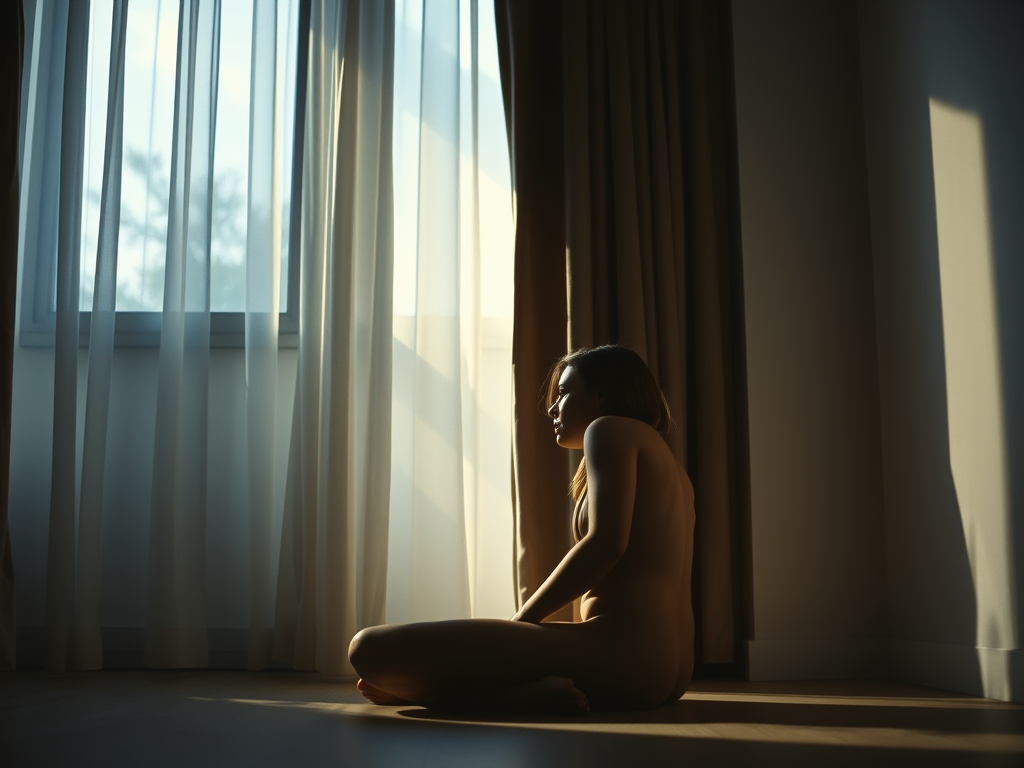
It started subtly, this fixation with the shadow. One afternoon, as she sat in her usual place on the floor by the window, she noticed the way the light caught her figure, casting her silhouette on the pale wall. At first, it was just an outline, a companion in the stillness of the apartment. But the more she looked, the more she began to notice details—the way the curves of her body played out on the wall, the sharp angles of her elbows, the delicate contour of her face.

Abigail had never thought of herself as beautiful. She had always been practical, focused, indifferent to her appearance. But the shadow, her shadow, felt different. It was more than an extension of her; it was a presence, a quiet reflection of a self she hadn’t explored.

Over the next few days, she found herself watching it more often. In the morning, the soft light would stretch it long and elegant. In the evening, when the light dimmed, it would grow sharper, more defined, almost bold. She started talking to it—at first just absentmindedly, then with a growing intensity, as if it could answer back.

She would trace its outline with her fingers, feeling a strange warmth spread through her at the thought of her hand brushing against this shadow-self. There was a comfort in it, a growing sense of intimacy. In its silent form, it listened to her, reflected her, became her.

One night, lying awake, Abigail felt a strange ache in her chest. It was a sensation she hadn’t felt in years—desire. She didn’t recognize it at first, dismissing it as a fleeting moment of loneliness. But the more she tried to push it away, the more it grew. She couldn’t stop thinking about the shadow, the way it moved in rhythm with her, the way it felt close, familiar, yet untouchable.

But how could she desire something that wasn’t real? How could she long for a shadow?

The days became a blur of confusion and yearning. She started spending more time by the window, letting the light play on her skin, watching as her shadow danced along the walls. Sometimes, when she moved, it seemed as though the shadow moved independently, stretching towards her, beckoning her closer.

And then one day, something changed.

The shadow didn’t just move with her—it shifted, morphing slightly as the light bent in a peculiar way. Abigail blinked, unsure if what she was seeing was real or a figment of her imagination, but there it was: the shadow had taken on a new form. A figure, still her silhouette, but different, softer—feminine, undeniably female.

Her breath caught in her throat. It wasn’t just her shadow anymore. It was another. A reflection of something she hadn’t yet faced. She reached out, tentatively, letting her fingers trace the shape of this new form. There was something in the way the light held it, in the way it seemed to curve toward her. The sensation was electric, a quiet thrill that made her heart race.

The attraction was undeniable. But it was more than physical. It was a longing for something unspoken, something she had buried for so long that she hadn’t realized it still existed. The shadow, this female figure, was the embodiment of her unacknowledged desire, the reflection of a love she had been too afraid to explore in the outside world.

Abigail had always known, deep down, that she was different. As a child, she had dismissed her feelings toward other girls as a phase. As an adult, she had pushed herself into relationships with men, hoping they would fill the void. But they never had. And now, alone in her apartment, shut off from the world, she had found something real, something that pulled her toward a truth she couldn’t ignore.

The realization came slowly, but with it came clarity. She wasn’t falling in love with a shadow. She was falling in love with herself, or rather, with the parts of herself she had suppressed for so long. The attraction she felt wasn’t for an imagined figure on the wall, but for the woman she had always been.

In the weeks that followed, Abigail’s relationship with her shadow deepened, but so did her understanding of herself. The shadow, once a reflection of her isolation, had become a mirror for her soul. It was a love story, yes, but one that transcended the boundaries of flesh and light. It was a story of self-discovery, of acceptance, of awakening.

And as the days grew longer and the light in her apartment changed with the seasons, Abigail found herself ready to step back into the world. Not because she had found someone else, but because she had found herself. And for the first time in a long time, that was enough.

All The World Will Be Your Enemy 2: Coffee And Conversation

The words refused to come. Beverly sat before the glaring beacon of a blank document on her laptop screen. The cursor blinked back at her, a rhythmic pulse that seemed to mock her. Each flash was a reminder of every untapped idea that refused to spill onto the page. The novel she had been nurturing for months now seemed to wither in the drought of inspiration.

With a sigh heavy with unspoken stories, she closed her laptop, her fingers brushing over the smooth surface like a farewell. Her gaze wandered to the soft morning light filtering through the sheer curtains of her living room, and her heart whispered for a change of scenery—a breath of life outside the confines of her condo, a place where words might find her again.

The Coffee Nook beckoned just a block away from Willow Creek, a sanctuary of warmth and nostalgia. She had fallen in love with its vintage charm: the mismatched armchairs that bore the imprints of countless visitors, the wooden tables scarred with the histories of conversations long past, and the intoxicating aroma of freshly roasted coffee beans that lingered like an old, familiar friend. It was her refuge, her muse.

Stepping inside, Beverly was greeted by the soft hum of activity—the hiss of the espresso machine, the muted chatter of patrons, and the occasional clink of ceramic mugs meeting saucers. The air was thick with the scents of cinnamon, cocoa, and the faint musk of aged wood. She smiled at the barista, a lanky young man with a friendly grin, as she queued for her usual: a cappuccino with an extra dusting of cocoa and a warm blueberry scone that promised comfort in every bite.

As she waited, a flicker of familiarity caught her eye. Her new neighbors, Angele and Joanna, sat in a cozy corner, their heads bent together in what appeared to be an intense yet animated conversation. Their presence added an unexpected note to the symphony of her morning—a curiosity she couldn’t quite place.

Angele’s golden hair shimmered in the muted sunlight streaming through the window, her laughter a soft, bell-like sound that floated above the ambient noise. Joanna, with her cropped dark hair and expressive emerald eyes, leaned closer to whisper something that made them both smile conspiratorially.

It was Angele who noticed Beverly first. Her face brightened with recognition, and she lifted a hand in a graceful wave. “Hey there, neighbor!” she called out, her voice carrying easily across the space.

Caught off guard but pleasantly so, Beverly returned the wave, her cheeks warming. With her cappuccino in one hand and her scone balanced precariously on a saucer in the other, she approached their table.

“Mind if I join you?” Beverly asked, her voice tentative but hopeful.

“Of course not!” Angele’s smile widened, and she gestured to an empty chair. Joanna nodded in agreement, her smile a touch more reserved but no less welcoming.

Settling into the chair, Beverly found herself enveloped by their warmth. The scent of Angele’s floral perfume mingled with Joanna’s faint trace of citrus, a sensory marker of their vibrant yet distinct personalities.

“We keep running into each other, don’t we?” Joanna said, her tone light with a hint of amusement.

“Seems like fate,” Beverly replied, smiling as she stirred her cappuccino.

Conversation flowed as effortlessly as the coffee in their cups. Beverly learned that her neighbors had only just begun unpacking the chaos of their move. Angele joked about the “monumental task” of organizing their shared library, while Joanna teased her about hoarding travel guides from places they might never visit again.

When the spotlight shifted to Beverly, she hesitated, then confessed her struggles with writer’s block. “The Coffee Nook has always been my go-to spot when I need to shake things loose,” she said, her fingers tracing absent patterns on the rim of her cup.

“A writer!” Angele’s eyes lit up. “What kind of stories do you write?”

“Mostly fiction,” Beverly replied. “I like to explore the small, quiet moments in life and how they connect to bigger truths. Lately, though, the words just… aren’t coming.”

“Maybe you’re waiting for the right spark,” Joanna said, her gaze steady and thoughtful. “Sometimes inspiration finds you in the most unexpected places.”

Beverly nodded, taking in the quiet wisdom of Joanna’s words.

The conversation meandered into their travels. Angele spoke with sweeping gestures of places Beverly could only dream of—deserts under endless skies, ancient cities whispering secrets through cobblestones, and forests alive with colors that defied the imagination. Joanna, in contrast, offered fewer details, her stories hinted at rather than told, as though guarding something too precious or too perilous to reveal.

“Maybe you’ll write about us one day,” Angele said, her smile playful yet strangely pointed.

“Maybe,” Beverly replied, feeling the tug of intrigue once more.

As the morning stretched on, Beverly found herself drawn deeper into the orbit of her new neighbors. Angele’s openhearted charm and Joanna’s quiet intensity were magnetic, and their stories—half-told and half-hidden—seemed to promise not just friendship but a world of inspiration waiting to unfold.

By the time they parted ways, Beverly’s heart was lighter, her mind alight with possibilities. In the warmth of The Coffee Nook, amid conversations laced with the ordinary and extraordinary, she felt the first stirrings of a spark. Perhaps Angele and Joanna were the key to unlocking not just the next chapter of her novel but something far greater—a story that hadn’t yet revealed itself.

Not. The. End.