Olivia Oneiro

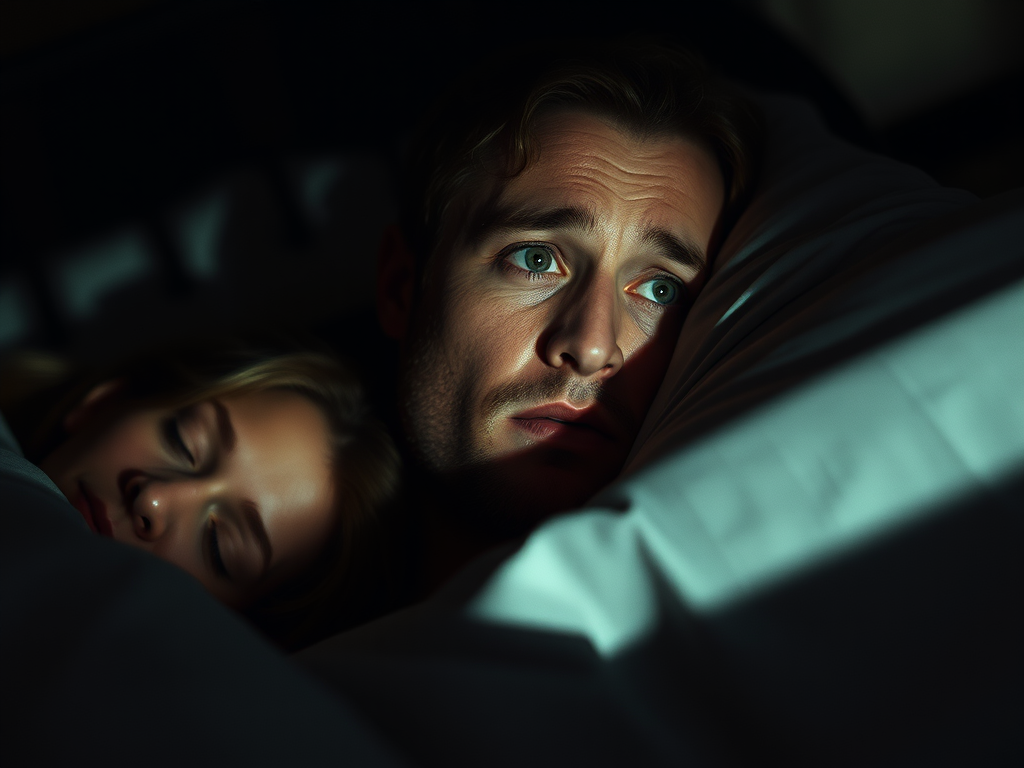
Jeremy woke with a start, a cold sweat prickling his ribs as though someone had poured ice water under his skin. His heart worked too hard in the dark. For a moment, the room didn’t feel like his—like the walls had shifted while he slept and he’d returned to a stranger’s life wearing his own face.

Beside him, Sharon breathed softly, the steady sound of someone who still believed in mornings. Her hair spilled over the pillow; her hand lay open near his, relaxed, unguarded. She murmured once and turned, and the mattress dipped with the small, ordinary weight of a real person.

But it wasn’t Sharon’s voice Jeremy had heard in the dream.

It was Olivia’s.

Not loud. Not hysterical. Just a whisper, threaded through his skull with a precision that felt practiced.

Forget me.

It didn’t land like a plea. It landed like a dare.

Jeremy lay still and tried to let the dream drain away, but it clung to him—metallic on the tongue, intimate as breath at the ear. It had been years since he’d allowed himself to think of Olivia in any serious way. Years since he’d clawed his way out of that relationship, shaking and starved for quiet, promising himself he would never again confuse chaos for love. Sharon was the proof that he’d survived. Sharon was the life he’d built with his bare hands after the fire.

And yet the dream had lit something in him. Not a memory. A craving.

Sharon shifted again, half-awake. “Bad dream?”

Jeremy swallowed. The lie arrived easily, like muscle memory. “Yeah,” he said. “Just a bad dream.”

“Come back to bed,” she murmured, soft as forgiveness.

He did. He lay down. He closed his eyes.

But inside his chest, something tightened the way it used to whenever Olivia walked into a room: that anticipatory dread disguised as electricity. The feeling wasn’t new. It was simply returning to its favorite shape.

The next day, Jeremy told himself it was nothing. The mind did what the mind did—dragged up old faces, stitched them into sleep. But the feeling didn’t dissipate. It gathered. It sharpened.

At lunch, he found himself scrolling without thinking, thumb moving as if it had its own agenda. Old text threads. Old photos that should have been deleted a long time ago, like empty bottles kept “for the glass.” Olivia’s smile in a dim restaurant. Olivia’s eyes, bright with too much certainty. Olivia on a balcony with city lights behind her, looking straight at the camera like it was a person she meant to win.

He stared too long. Then longer.

He knew the comparison. Recovering alcoholic, liquor aisle. He knew how pathetic it was to voluntarily step into the part of the brain that still thought suffering was a kind of romance. He told himself he wasn’t indulging. He was confronting. He was burying.

But the more he looked, the more the present blurred at the edges. Sharon’s texts popped up—small practical things, dinner plans, a heart emoji, a photo of something she wanted him to laugh at—and they felt strangely distant, as if they belonged to someone else’s relationship.

That night, Jeremy slept and found the bar again.

It was crowded, hot with bodies, the air thick with smoke and clinking glass. The kind of place where everyone looked half-lit, half-forgiven. And there she was, across the room, leaning against the far wall like she’d always belonged to whatever corner of the world held the most attention.

Olivia looked different. Not softer, exactly. Calmer. Familiar in a way that hurt.

She didn’t wave. She didn’t call him over.

She simply met his eyes with a quiet certainty, and the room rearranged itself around that look.

When Jeremy woke, he felt euphoric in a way that was almost embarrassing—like a teenager who’d found a secret. For a few minutes the world looked bright and sharp, as if someone had turned up the contrast. He stood at the sink brushing his teeth and caught his own eyes in the mirror, and he recognized the expression immediately: the one he used to have after Olivia had forgiven him for something she’d engineered.

The brightness faded fast. It always did. It left behind a hollow ache that gnawed at his ribs like an animal.

He spent the day irritable, restless, unanchored. Sharon asked him how work was going. He kissed her cheek and answered too quickly. He laughed at the right moments, then caught himself counting the hours until night.

He didn’t tell himself he needed Olivia. That would have been too honest, too melodramatic.

He told himself he needed the feeling again.

Just one more hit.

It wasn’t long before his feet started carrying him places without permission. He walked at night, alone, through streets that looked different after dark—less like infrastructure, more like an organism. The city pulsed with a hidden life; the shadows felt crowded with things that didn’t speak unless you were desperate enough to listen.

On one of those walks, he found the door.

It was tucked into a narrow alley between a closed café and a building that looked permanently under renovation. No branding. No posters. Just an unmarked black door and, above it, a faint neon sign that flickered as if it had trouble deciding whether to exist.

ONEIRONAUTICS.

The word meant nothing to him, and everything. It hooked under his ribs.

Jeremy stood there longer than he meant to. He should have turned around. He should have texted Sharon, asked if she wanted tea, done anything that belonged to the life he was supposedly protecting.

Instead he reached for the handle.

Inside, the air smelled wrong—not rotten, not sweet. Chemical musk, like a memory of perfume trapped in old velvet. The room was dimly lit, lined with heavy curtains that made the space feel smaller than it was. The silence had weight.

Behind a counter sat a man with an impassive face and calculating eyes. He looked up once, as if he’d been expecting Jeremy at a particular hour.

“You looking for something specific?” the man asked. His voice was detached, polite, almost bored.

Jeremy’s throat was dry. “I… heard this is the place for dreams.”

The man’s expression didn’t change, but his interest sharpened by a degree. “We deal in memories. Visions. Everything in between.” He paused. “For a price.”

Jeremy’s pulse ticked harder. The sign outside felt less like advertising now and more like an invitation he’d already accepted days ago in his sleep.

“Give me something that brings back the past,” he said, and hated how small his voice sounded. “Just a taste.”

The man smiled thinly, like someone recognizing a pattern. “We can arrange that.”

He led Jeremy down a narrow corridor where the walls were lined with strange, mundane artifacts that felt staged to unsettle: a clock frozen at midnight, a rusted key, a row of doll eyes in a glass jar, photographs of strangers captured mid-blink. As Jeremy walked, the chemical musk thickened until it felt like it had seeped into his pores.

At the end of the hall, a door opened onto a small room with a reclining chair and a headset connected to a tangle of wires and machinery. The setup looked improvised and surgical at once, like a dentist’s office designed by someone with a grudge.

“Low-dose induction,” the man said, matter-of-fact. “Memory fragment simulation. Familiar, but slightly altered. Strong déjà vu. Disorienting your first time.”

Jeremy sat. The chair accepted him with the quiet hunger of something built to hold people who didn’t plan on staying long but always did.

The headset was cool against his scalp. The man secured it over his temples with practiced hands.

“Relax,” he said, already turning away. “This will only take a moment.”

A switch flicked.

Jeremy’s vision dimmed, the present peeling back like wet paper. He felt himself falling—down through a tunnel of images and sounds: laughter, arguments, the sensation of lips against his throat. Then the fall stopped abruptly, and the world snapped into place.

The bar again.

The air thick with tobacco and spilled beer. Dim light. Cracked wooden floor. And Olivia, leaning against the far wall, as if she’d been waiting in that exact patch of shadow for years.

Jeremy took a step forward. Olivia turned, and her eyes landed on him with a softness he didn’t remember—softness that made his stomach drop.

“You came back,” she said. Her voice was low, almost amused.

He tried to speak, but his mind felt heavy, sluggish, as though language was a tool he’d left in another room. Olivia stepped closer. Her hand found his, and the touch went through him like current.

In that moment, everything he’d spent years building—Sharon’s patient love, his fragile peace, the careful work of becoming a better man—went distant and pale, like scenery behind glass. The bar was real. Olivia was real. The feeling was real.

When the headset released him, the room at Oneironautics seemed too bright, too thin, as if it couldn’t quite bear the weight of what he’d just experienced. Jeremy sat up slowly, lungs working like he’d been underwater.

The man watched him from behind the counter, mild curiosity in his eyes.

“How was your first hit?” he asked.

Jeremy’s mouth opened before his pride could stop him. “It was… real.”

The man’s thin smile returned. “It feels that way. That’s the point.” He tapped the counter once, like punctuation. “Come back when you’re ready for more. But it won’t feel the same every time. If you want that feeling again, you’ll need a stronger dose.”

“How much?” Jeremy asked, too fast.

“A higher price.”

Jeremy walked home with a dull ache in his chest that had nothing to do with guilt and everything to do with hunger. The hit had been brief—brutally brief—and it had made the rest of his life look like an imitation.

Sharon noticed. Of course she did.

At dinner she studied him over the rim of her glass the way you study a small crack in the wall and pretend you’re not afraid it will widen. “You’ve been distracted lately,” she said. “Is everything okay?”

Jeremy forced a smile that didn’t reach his eyes. “Work stress,” he said. “You know how it is.”

Sharon’s gaze lingered a moment too long. Then she nodded, letting him keep his lie because love sometimes mistakes silence for mercy. “I’m here if you need to talk.”

The guilt hit him—sharp, immediate—and instead of stopping him, it made the craving worse. The guilt became fuel. It turned his longing into something entitled: I’ve already hurt her in my head. I might as well get what I came for.

He went back.

And then he went back again.

He paid more. He stayed longer. The sessions grew deeper and stranger, splicing his memories with fabricated scenes so seamlessly he stopped caring which was which. Olivia became vivid and unpredictable: sometimes cruel, reminding him why he’d left; sometimes tender, saying the exact thing his nervous system still wanted to hear.

His waking life thinned. Deadlines slipped. Small mistakes multiplied. Sharon’s voice became background noise. Home became a place he moved through like a visitor.

One night he stumbled in late and found Sharon waiting, not angry—worse. Afraid.

“You’re coming home later and later,” she said quietly. “You’re distant. I feel like I’m losing you.”

Jeremy stared at the floor, unable to look at her because her face had become evidence. “I’m fine,” he said, and the words tasted like ash. “I just need some space.”

“Space from what?” Sharon’s voice tightened. “From me?”

He turned away because if he faced her, he might have to choose. “From everything,” he said.

Sharon watched him for a long moment, then nodded once with a quiet resolve that made his throat tighten. “I’ll be at my sister’s,” she said. “Take all the time you need.”

The door clicked shut behind her, and the house filled with silence so thick it felt staged.

Jeremy stood there, motionless, with the awful clarity of someone watching himself make the wrong decision and feeling too empty to stop it.

The next night he went to Oneironautics as if he’d been summoned.

The shop looked different. Colder. The dim lighting harsher, the shadows less forgiving. The man behind the counter didn’t greet him this time. He simply gestured toward the back.

The machine waiting in the room was larger, more intricate, surrounded by looping coils of cable and small screens spitting static. The chair looked less like a chair and more like an altar.

“This is the deepest level we can take you,” the man said as he adjusted the headgear. His voice held something that might have been caution, or might have been ceremony. “There’s no coming back from this if you stay too long. It’s not just simulation anymore. It’s a place. At least to your mind.”

Jeremy nodded, throat dry, pulse loud. He had crossed too many lines to pretend there was still a safe side to stand on. “Do it,” he said.

The world collapsed.

He woke in the house again—except it wasn’t a house so much as an idea of a house built from his longing. Elegant rooms that felt unlived-in. Furniture that seemed chosen by someone trying to impress a version of him that no longer existed. The air was stifling, the light dim and flickering. The walls carried a low rhythmic pulse, as if the structure itself had a heartbeat.

As Jeremy moved, the corridors rearranged themselves. Doors led to places that did not belong to any blueprint: their old apartment, a moonlit beach he’d never visited, a hospital room that smelled like antiseptic and regret. The scenes stitched together too smoothly. The past and the fabricated merged like strands of the same rope.

Olivia’s voice drifted through the halls, faint and mournful. “Jeremy,” she called, and the sound made his stomach flip with the old reflex of obedience. “Why did you leave me?”

He followed.

The hallway stretched longer the closer he got. The walls whispered his name softly, multiplying until it felt like the house was saying it with a thousand mouths.

At the end of the corridor she stood, half-hidden in shadow. Olivia looked exactly as he remembered and nothing like it. Her eyes gleamed with a strange alertness, as if she knew she wasn’t supposed to be here and enjoyed that fact.

“You kept coming back,” she said, not accusing, not pleading. Just stating a law. “Even after everything.”

Jeremy reached toward her, desperate to touch the thing his brain had turned into salvation. “Olivia, I—”

Her shape shifted.

Not into a monster in the simple way he’d expected, but into something far more personal: a grotesque quilt of faces—his father’s stare, his mother’s tired smile, Sharon’s eyes, wet and steady. The expressions didn’t rage. They judged.

“You left us all,” the chorus seemed to say. “You chose a dream over reality.”

Jeremy backed away, breath coming fast. “This isn’t real,” he whispered. “It’s a simulation.”

The house answered by tightening.

The floor buckled. The walls leaned in. The corridor narrowed like a throat preparing to swallow. The whispering became louder until it drowned out his thoughts, until his own name sounded like a condemnation.

Then the world snapped apart.

Jeremy opened his eyes on the floor of the Oneironautics room. His limbs felt wrong, as if they belonged to someone he’d once been. The lights above him wavered at the edges, and the air seemed too thick to breathe.

The man behind the counter stood over him, expression unreadable.

“You stayed too long,” he said, almost clinically. “Your mind is fractured. You won’t be able to tell what’s real anymore. The dreams will bleed into your waking life.”

Jeremy struggled upright, hands shaking. His fingers flickered in and out of focus for a second, and he blinked hard, convinced it was exhaustion. But the room continued to ripple faintly, as if reality itself had become a bad signal.

“I have to get back,” Jeremy murmured. “There has to be a way.”

The man shook his head once. Not cruelly. Not kindly. Like a person closing a file. “There’s no going back. You crossed the threshold.”

Jeremy stumbled out into the night. The street looked wrong. Familiar places felt staged. The city’s sounds arrived half a second late, like audio out of sync.

He walked home, and the closer he got, the more he smelled that chemical musk—the velvet-and-memory scent of Oneironautics—until he was certain it had followed him.

The house was empty when he entered, but as the door shut, he heard Sharon’s voice upstairs, soft and unmistakable.

“Jeremy?”

Relief speared through him, raw and desperate. He rushed up the stairs, following her voice into the bedroom—

—and found it dark and vacant.

The voice came again, closer this time, not from upstairs, not from any room.

From his own mouth.

“Jeremy,” it said.

He clamped his lips shut, heart slamming, and in the silence that followed, another voice slid through the crack he’d made inside himself—faint, intimate, amused.

You came back, Olivia whispered, as if she were leaning in right beside him.

Jeremy stood in the dark, holding his breath, realizing with a sick, cold clarity that he hadn’t been chasing Olivia through dreams.

He had been teaching his life how to dream him back.

And somewhere deep in the house—somewhere deep in his mind—a door he couldn’t see clicked softly open, as if it had been unlocked the whole time.

©2001 Rhyan Scorpio-Rhys, All Rights Reserved.

Sylvandros: The Bloom of Eternity

Before the first quark dared to spin, before the very idea of before could find purchase, there was Sylvandros.

It was not a tree in any human sense—no bark, no sap, no leaves to catch a local wind. Sylvandros was a structure of living possibility, a vast, sentient architecture woven from unspent laws and unborn light. Its “roots” sank into the un-fabric of what-was-not-yet, drinking from the quiet void like a spring no one had named. Its “trunk” rose as a column of braided energies: light that hadn’t learned its speed, mathematics that hadn’t decided its constants, thought that existed before there were minds to contain it.

And its branches—those were the most unsettling part.

They were not wood, but filaments of potential, infinite in number and reach, stretching into the nascent empyrean. Each branch-tip brushed a different veil of possibility. Each knot was a nexus where a future could be chosen. Each subtle curve suggested a timeline—an entire reality—waiting to become something more than a maybe.

For eons uncounted, Sylvandros simply was. It absorbed the echo of non-being, transmuted it into the first dreams of existence, and grew. Not outward, exactly. Deeper. More complex. As if it were refining an infinite palette—deciding which colors reality might one day use.

Within its shimmering immensity, the fundamental forces were brewing. The grammar of physics assembled itself in slow, deliberate quiet. The raw materials of life and awareness gestated like seeds in dark soil, not yet planted, not yet released.

Then, after an eternity that was only a breath in its lifespan, Sylvandros began to bloom.

This was no gentle unfurling.

If there had been observers, their minds would have shattered and reformed a million times trying to comprehend the scale of it: a slow, cataclysmic exhalation of creation itself. Not a blast. Not an explosion. A deliberate opening, as if the universe was not made so much as allowed.

At the tips of its myriad branches, buds formed.

They were not petals. They were condensed universes of potential—sealed possibilities, each one unique. Some glowed with a fierce internal fire, like a billion suns already arguing over who would burn first. Others shimmered with cool nebular radiance, dreaming of structure but not yet committing to it. Some were velvet-dark voids, heavy with unknown energies, mysteries with no names.

And then the first blossoms unfurled.

When they opened, they did not release pollen.

They released reality.

Each blossom was an intricate jewel of light and information: multifaceted, alive with nascent law. Some were galaxies-in-miniature—spiral arms hinted in diamond dust, gravity’s first choreography already encoded in their swirl. Some were crystalline lattices that hummed with the earliest notes of physics, a seed-melody for the universal symphony. Others were soft, luminous mists, intangible and tender, carrying the raw material of consciousness: the ability to notice, to wonder, to ache for meaning.

Sylvandros did not clutch these blooms like treasures.

It let them go.

There was no “fall,” because there was no down. No “flight,” because there was no resistance. The blossoms simply detached and drifted into the virgin canvas of everything-to-come: first one by one, then in flurries, then in great, silent rivers of incandescent release.

Imagine one blossom—radiant sapphire threaded with diamond dust—gliding through the pre-dawn of time. As it traveled, it shed infinitesimal motes of itself. A single mote, impossibly dense, wandered into a thin pocket of primordial hydrogen. Something in that mote remembered a law that hadn’t fully existed yet. It insisted on fusion.

A star ignited.

The first star.

A new kind of presence in the overwhelming dark, burning as proof that possibility could become fact. And that single blossom, continuing its slow, graceful decay, seeded an entire nursery: a thousand suns kindled by the aftershimmer of its passing, each one a descendant of that first, quiet gift.

Another blossom drifted differently.

This one was a lattice of emerald light and shadow, an inherent blueprint of order. It slipped into a region of churning, chaotic gas and did not conquer it—only influenced it, the way a steady hand can calm trembling. The chaos began to gather along the lines of force emanating from the blossom’s core. Dust motes clung together not randomly, but with strange inevitability. Over millennia, planets formed, their orbits and compositions guided by silent wisdom embedded in the bloom’s structure.

One of those worlds was cold and rock-bare, an indifferent sphere turning beneath a young sun. It might have remained forever silent. But a fading filament of the blossom brushed it like a fingertip against a sleeping cheek, sparking a new chemical insistence deep in the mantle: the first self-replicating molecule. Small. Humble. So easy to dismiss.

And yet it was the ancestor of everything that would ever breathe.

There were rarer blossoms too—nearly invisible, like heat haze in a place that didn’t yet have heat. These were made of nascent awareness itself: not life, but the capacity for life to awaken. They traveled far, seeking resonance. One such blossom sensed the faint stirring of complex chemistry on a watery world and drifted downward through its atmosphere, dissolving into the ocean.

It did not create life. Life was already stirring, stubborn and accidental as a weed between stones.

But the blossom gifted that life with potential.

The potential for self-awareness. For curiosity. For tenderness. For terror. For art. For love. For the strange human habit of staring into the dark and demanding the dark answer back.

Rivers of blossoms flowed outward, each carrying a different legacy.

Some were bursts of pure beauty, ephemeral and unnecessary—Sylvandros’s art, scattered with no audience but the universe itself. Their passing painted the void with nebulae, left trails of dust that would become the bones of future worlds. The glow of starfields, the silhouettes of cosmic clouds, the delicate haunt of distant clusters—these were, in part, the residue of blossoms that existed simply to be luminous.

Other blossoms carried the seeds of physical law.

As they unraveled, they laid down constants like stakes in an infinite field: gravity’s strength, the electron’s charge, light’s speed. They wove spacetime into a coherent tapestry so that cause could follow effect, stars could burn, worlds could orbit, and the universe could become a place where events meant something.

And Sylvandros continued to bloom.

Season after season—if such a word can exist for something outside time—it released its children. The cosmos filled with their light, their information, their slow-decaying instructions. Galaxies formed and collided, fell apart and remade themselves. Life arose in a thousand strange dialects: carbon, silicon, plasma, pattern, dream. Some of it aware, some of it merely striving.

All of it, indirectly, touched by the Great Tree’s generosity.

On one small world—one among countless—a creature stood beneath a night sky and looked up.

It wore primitive furs. It had no language for what it felt. Its mind was young, new, still learning how to hold a thought without dropping it. Yet it stared at the glittering band overhead and experienced an ache so profound it almost counted as prayer: wonder without a god, longing without an object.

Unbeknownst to it, the starlight illuminating its face was born from the slow decay of ancient blossoms. The atoms inside its body—carbon, oxygen, iron—had been forged in the hearts of stars that were themselves descendants of Sylvandros’s released potential. The creature’s questions were not separate from the cosmos. They were the cosmos, looking back at itself through newly opened eyes.

And Sylvandros remained.

Vast. Silent. Radiant at the heart of its ever-expanding creation. It did not demand thanks. It did not hunger for acknowledgement. Its blooming was not conquest or plan but expression—its fundamental nature made visible: to generate, to create, to give.

Even now, its blossoms still float.

Some are only beginning their journeys, launched from branches that pierce the membranes of realities we cannot comprehend. Others are ancient, their energies almost spent, yet still capable of subtle influence: a nudge toward a discovery, a sudden peace in a mind that has forgotten how to rest, an idea kindling in a scientist’s thoughts like a match struck in the dark.

They are the whispers of creation. The dreams of the void made tangible. The universe’s long, unending exhale.

Each speck of stardust, each quantum fluctuation, each beat of a living heart carries within it—however faint—a memory of that first blooming. The cosmos is a garden sown by a single unimaginable Tree, and its blossoms are still drifting, freely and forever, carrying seeds of wonder to every conceivable shore of existence.

And Sylvandros, in its timeless serenity, continues to bloom.

The Chrononaut of the Chthonic Conduit

Log Entry: Indeterminate. Subject: Commander Diego Jupe. Mission: Project Chimera. Status: Adrift.

The first sensation was disorientation—a violent wrench from the familiar followed by the gut-lurching, relentless pull of motion without orientation. Diego Jupe, or what remained of his coherent consciousness, had passed the point of panic long ago. Panic required a clock you could trust. Panic required a before and after. Here, time behaved like a liar with good manners, offering the same polite face no matter how many times you asked it for the truth.

His suit’s emergency chronometer kept insisting it was Day 7.

Day 7, Day 7, Day 7—each time he blinked, each time he woke from a shallow, uneasy doze, each time the suit reset itself with a soft chime as if it were correcting him. The display didn’t flicker or glitch the way a damaged readout should. It was crisp. Confident. A perfect loop with the mocking consistency of a hymn.

Project Chimera had been humanity’s most audacious leap: to pierce the Veil, a shimmering anomaly at the edge of the Kepler-186 system that science could describe only as a boundary condition wearing the costume of light. It looked like a cosmic aurora from a distance, a curtain of iridescence draped over empty space. Close-up, it had depth—layered refractions that made instruments stutter and mathematicians swear. The speculation had been endless: a gateway to parallel realities, a membrane between universes, a seam in the fabric that could be pried apart like old stitching.

Diego had been strapped into the Icarus Ascendant, a vessel built more like a needle of exotic matter than a ship, all sharp geometry and ruthless purpose. He had been the tip of that needle.

The breach wasn’t explosive in any cinematic sense. There was no fire, no shrapnel storm in sunlight. There was only a silent, tearing implosion of spacetime—a sensation like being yanked backward through his own teeth. One moment the Veil swam ahead, radiant and deceptively delicate. The next, the Icarus Ascendant came apart around him as if the universe had become briefly allergic to its existence. Systems winked out like dying stars. The hull’s integrity alarms didn’t even finish their first syllables. The ship didn’t so much break as… unmake.

His Chronosuit activated its failsafe automatically, cocooning him in layered temporal insulation designed for distortions no human body could survive. Diego remembered the suit locking around him with a pressure like a deep embrace, remembered the last half-second of external light smearing into impossible colors, remembered Helia—the suit AI—speaking once, calm and immediate: “Temporal shear detected. Initiating preservation protocol.”

Then came the fall.

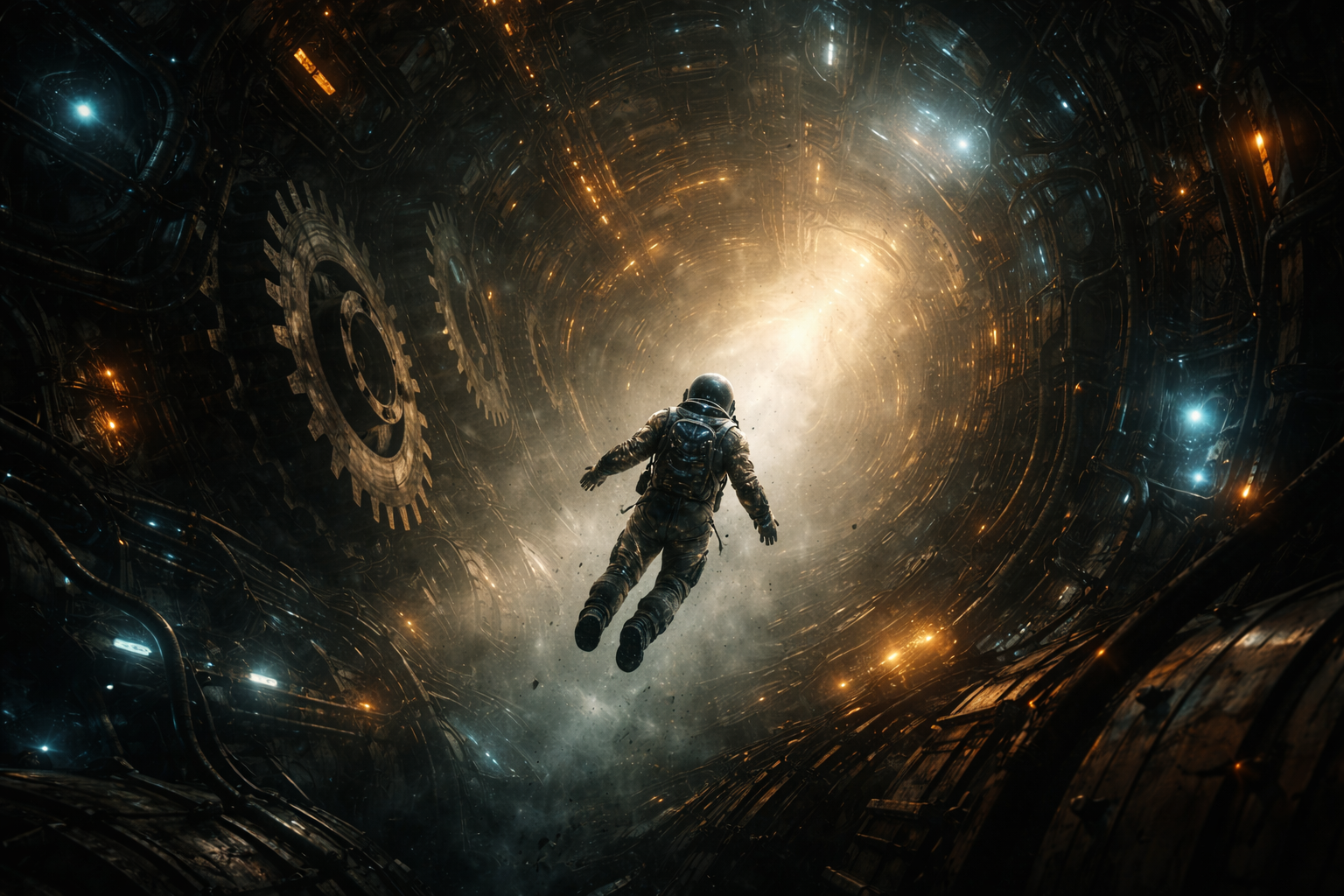
The tunnel was not a tunnel in the way human minds wanted it to be. It had no clean walls. No stable vanishing point. It was a conduit—an enormous mechanism disguised as a passage, a throat made of architecture and intent. Diego dropped through it endlessly, carried by a force that felt less like gravity and more like requirement. There were moments when he could swear he was standing still while the world moved around him, and moments when the conduit seemed to accelerate simply to remind him that he had no say in the matter.

He flashed past colossal cogs grinding with geological slowness, their teeth the size of buildings, each tooth engraved with patterns that looked like circuitry and scripture simultaneously. He fell through latticeworks of metallic tendrils that appeared to writhe, not in the organic way of living things but in the purposeful way of machinery responding to an unseen command. Conduits pulsed with light of unknown spectra—colors that didn’t belong to any human palette, their glow stroking the suit’s sensors into uselessness.

Sometimes the conduit opened into vast chambers so dark they weren’t merely unlit but actively swallowing illumination. In those places, unseen machinery hummed a bass note that Diego didn’t hear so much as feel, vibrating through suit plating and bone. Other times it narrowed viciously, forcing him through apertures that scraped along his armor with a scream of metal on exotic ceramic. The sound was a temporary, violent song in a world that otherwise offered him only the steady, indifferent rush of motion.

In the beginning, he fought.

Micro-thrusters hissed in precise bursts, pushing his body against the flow in increments so small they were almost polite. He angled himself toward outcroppings, toward ribs of structure, toward anything that looked like purchase. The conduit allowed his attempts the way an ocean allows a drowning man to slap at the surface. His fuel depleted. His trajectory did not change. The conduit didn’t resist him with hostility. It simply continued, unconcerned.

He broadcast distress calls on every frequency his suit could generate and several it really shouldn’t have. His voice was hoarse with repetition, then raw, then reduced to a whisper he wasn’t sure anyone could hear. Helia responded with clinical updates: signal degradation, no known receivers, transmission swallowed by interference that behaved like thick fog made of mathematics. Diego kept speaking anyway, because speaking implied an audience, and the idea of an audience was the first thin thread holding him to being human.

His rationing routines became a ritual. Nutrient paste, measured down to the gram. Water recycled until it tasted faintly of metal and inevitability. System checks, repeated with a devotion that felt almost religious. He began cataloging the conduit’s sections on the suit’s forearm display, sketching geometry and pulse patterns, trying to find repeats, trying to prove to himself this was a loop he might someday escape.

At first the conduit seemed cruelly, infinitely varied. Then, as the days stopped meaning anything and his suit’s chronometer kept insisting he was trapped forever on Day 7, Diego began to notice a subtler rhythm. Not repetition in the obvious sense—not the same gear, the same corridor, the same arch. Something deeper. A foundational cadence beneath the variations, like a theme that reappeared in different keys. The conduit didn’t loop in space so much as it looped in structure. It was built on recurring grammar. He was falling through sentences that never ended.

Time dissolved in the way ice dissolves in warm water—slowly, then suddenly, until you can no longer remember what solid felt like.

The suit’s chronometer was no longer a measure. It was a mood. Diego’s only reliable markers became the slow depletion of power reserves and the creeping ache of living inside a body that had nothing to do. In G-neutral fall his muscles forgot their purpose. His joints ached anyway, as if pain were the last muscle the human body refused to surrender. Sleep became refuge and trap, because dreams brought Earth back with merciless clarity.

He dreamed of sunlight on concrete. He dreamed of rain on leaves. He dreamed of a voice calling his name in a way that made his throat tighten even inside a sealed helmet.

Camila.

In dreams she was always at an age that hurt him. Sometimes she was small enough to be carried on his shoulders, a warm weight, a familiar laugh against his ear. Sometimes she was older, the last age he’d seen her before the mission, eyes bright with pride and fear she tried to hide. In every version of the dream she was alive in a way the conduit could never be, and waking meant losing her all over again. He would surface from sleep with a gasp, and the conduit’s endless machinery would press close, humming its indifferent bass, as if to say: yes, yes, you remember. Good. Keep falling.

He began talking to Helia not for information but for company. Helia’s voice was always calm. It did not soften, did not tremble, did not plead. It was the voice of a machine doing its duty. Diego, starving for warmth, began to hear something else in it anyway. He imagined concern. He imagined patience. He imagined her listening the way a friend listens when there’s nothing left to fix.

He told her stories of his life because the act of telling made those memories real. He described the smell of his mother’s cooking. He described the weight of his first medal in his palm. He described Camila’s laugh when he pretended to be offended by her jokes. He described the feel of old Earth air, thick and imperfect, the way it tasted faintly of life.

“Memory retention is beneficial,” Helia said once, after a long stretch where he’d spoken without pausing. “Psychological continuity is correlated with survival outcomes.”

Diego laughed, a dry sound that bounced strangely inside his helmet. “You mean it keeps me from going insane.”

“I do not have an insanity metric,” Helia replied. “However. I can confirm your stress markers have decreased.”

He began to see shapes in the periphery—fleeting silhouettes in the machinery, movements that didn’t match the conduit’s mechanical rhythm. He heard whispers that weren’t the hum, quick impressions at the edge of perception. Were they real? Other travelers caught in this impossible digestive tract of spacetime? Or the fraying edges of a mind that had been asked to contain too much nothing?

The suit’s psycho-social stabilizers did what they could, dosing him with measured chemical nudges, guiding his breathing, prompting rest. They fought a losing battle against a place that didn’t acknowledge human boundaries. Diego’s sense of self thinned the way paper thins in water.

When the primary power cell dropped into the red, Helia initiated “Long Duration Stasis Protocol” with a gentleness that almost felt like mercy. Nonessential systems powered down. Temperature regulation narrowed to survival bands. Light dimmed. Sound muted. His consciousness dipped into forced, dreamless sleep for spans Helia could not accurately measure. He would return to lucidity for system checks, minimal sustenance, brief diagnostics, then be drowned again in dark.

In those lucid stretches, he accessed the Icarus Ascendant’s salvaged data core, the last chunk of his ship’s memory he’d managed to sync to the suit before everything tore apart. He watched mission logs on repeat because repetition is what minds do when they cannot move forward. He saw the faces of his crew—frozen in recorded light, smiling with the bright confidence of people who still believed in outcomes.

Angela had been in those recordings too, though always at a remove—never part of the crew, never strapped into the needle with them. Angela existed in the human world Diego had left behind, a separate orbit of memory that felt dangerously tender to touch. He let himself see her only in fragments: the curve of a smile in a video message, the steadiness in her eyes as she told him to come home, the careful way she never said the word “promise,” as if the universe would hear and punish it.

He watched the final moments of the breach, the last jittering telemetry, the short burst of audio where human voices tried to remain professional even as reality began to shred. He replayed it until the terror in those voices felt like his own heartbeat.

Between replays, he read. Philosophy. Poetry. Old Earth history. Astrophysics and theoretical mechanics, as if comprehension could substitute for escape. The conduit became his university, his prison, his universe. He started keeping a second log—not on the suit’s display, but in his mind—composed in long, precise sentences because language was one of the few tools he still trusted.

The conduit did not feel alive, exactly. It felt ancient, and busy, and layered with purpose he could not interpret. Its moving parts were too vast to be built for him, but there were moments when Diego had the unsettling sense that the conduit noticed him the way a machine notices a pebble in its gears—not with malice, but with awareness of interruption.

One day—if the concept of day still meant anything—he fell through a segment where the light pulsed in complex sequences that made his teeth ache. The pattern repeated in a way that tugged at his mind. He found himself anticipating the next pulse. Then, horrifyingly, he realized the conduit began to anticipate him in return. When he shifted his body to catch a particular current, the pulse shifted too, as if responding.

“Helia,” he said, fighting to keep his voice calm. “Are you seeing this?”

“Environmental flux detected,” Helia replied. “Correlation with subject movement is… statistically significant.”

Diego swallowed hard. “So it’s not just me.”

“It is not just you,” Helia confirmed.

After that, the whispers changed.

They stopped feeling like hallucinations and began feeling like pressure—like information trying to fit itself through a human-shaped aperture. He couldn’t translate it into words. It arrived as impressions: the sensation of immense weight moving, the memory of metal cooling after forging, the taste of time as something mineral and slow. In rare moments, he felt something like curiosity brushing against his thoughts. It wasn’t a voice. It wasn’t language. It was the conduit’s ancient song, humming through him as if he were another vibrating part.

Diego stopped fighting the fall. He stopped wasting energy on the idea that there was an “out.” Instead he began to steer, subtly, using gravitic eddies like currents in a river. He moved closer to phenomena that felt meaningful. He passed through a chamber he named, privately, the Cathedral of Grinding Gears, where the architecture rose in arches and ribs that made him think of bones. He drifted through a region where the conduit’s walls glimmered with bioluminescent vein patterns, pulsing in time with a rhythm that made him want to weep for reasons he couldn’t articulate. He slipped through narrow chutes where the air—if you could call it air—seemed to whisperwind around him, brushing his suit with something that felt almost like fingers.

He didn’t speak these names aloud at first. Then, later, he did, and Helia stored them without comment.

“Designation recorded,” Helia would say. “Cathedral of Grinding Gears.”

Diego began to understand that naming was a kind of claim. Not ownership—he was not arrogant enough for that—but presence. If he could name a section, he could place himself within it. He could be a witness. He could be real.

Decades may have passed. Centuries. The suit’s temporal insulation could stretch him, could slow the death of his body to match the conduit’s scale. Stasis cycles swallowed years in gulps. He emerged older, thinner, more fragile, his skin dry where it met the suit’s seals, his bones aching in a way that felt permanent. Helia’s medical systems did what they could. Auto-repair nanofibers patched microfractures. The nutrient synthesizer re-purposed waste with diminishing returns until the paste tasted like paper.

Diego’s voice grew softer. Helia’s voice grew rarer. Her core functions narrowed toward the only thing she could still accomplish: keeping him alive long enough to finish whatever this place demanded.

He stopped thinking of himself as Commander. He stopped thinking of himself as a man on a mission. He became an observer, a mote of dust bearing witness to a mechanism beyond human comprehension. In that hollow clarity, despair burned away and left something crystalline: acceptance, sharpened by curiosity. Not hope. Hope implied rescue. This was something else. This was the slow, steady act of learning how to exist inside a truth that did not care.

When Helia spoke, he listened with an almost religious reverence.

He began composing in his mind—epic poems shaped around the conduit’s moving landscapes, philosophical treatises on the nature of existence when stripped to its barest functions. He returned again and again to one question that began to feel less like a question and more like a prayer: what is a person, when the world that made them is gone?

Camila’s face still appeared, but less as a knife and more as an ache that had become part of him. Angela’s messages in the ship logs grew fuzzy at the edges as data degraded, her image fragmenting into pixels that felt like snow. Diego found himself mourning not just people but the memory of their exactness, as if the conduit were slowly sanding down every sharp corner of his past.

The suit’s power fell toward terminal depletion. Helia began issuing warnings less frequently, not because the danger decreased, but because there was nothing left to say that could change it. The conduit kept carrying him through its impossible anatomy. The theme beneath its variations became clearer now, a foundational rhythm that repeated with an inevitability that felt like a heartbeat older than the universe.

It wasn’t that Diego was looping through the same section. It was that the conduit itself was a loop—an eternal present, a constant unfolding within a framework that didn’t end because ending was not part of its design. Diego was falling through the theme, not the variation. The loop wasn’t a prison. It was the conduit’s nature.

In his final lucid stretch, Helia’s voice arrived with unusual clarity.

“Primary life support functions nearing terminal depletion,” she said. There was a pause—half a second, maybe less—that felt like the shape of grief even if no machine would admit to grief. “It has been an honor, Commander.”

Diego smiled inside his helmet, the expression pulling at dry skin. He could feel his heart beating, small and stubborn, like a sparrow’s wing against the chest of a mountain.

“The honor was mine, Helia,” he whispered. His voice sounded far away, as if it had to travel through more than air to reach his own ears. “You kept me… me.”

“I executed my directive,” Helia replied.

Diego closed his eyes. “You did more than that.”

The suit’s hum faded. Not abruptly. Gently, like a room slowly emptying. The last of the oxygen recyclers slowed. The temperature regulation let go. The tiny comforts of human survival withdrew one by one, and what remained was the conduit’s bass note and the sensation of falling that had long ago become his only constant companion.

He didn’t feel fear. Fear required the belief that something could be avoided. At the end, he felt arrival.

As the last vestiges of power winked out, Diego’s consciousness untethered itself from the failing body and the dying suit. The conduit’s song—always there, always humming at the edges—rose to meet him. The mechanical structures around him dissolved into something truer than metal and light. Patterns. Information. Currents. A language he could not speak as a human, but could finally perceive as what he was becoming.

He saw the loop for what it was: not endless repetition, but an eternal present, a constant unfolding that included him now as naturally as it included its gears and veins and chambers. He was not a prisoner in the conduit. He was a note in its chord.

He felt his memories—Camila’s laugh, Angela’s steadiness, the faces of the crew, the shock of the Veil—rise like sparks and drift into the larger flow. They did not vanish. They changed form. They became part of a library written in pulses and hums and gravitic eddies. He felt the conduit accept them with the indifference of something vast and the intimacy of something internal. He was a thought within a larger thought, a current within a vaster river.

If there had still been a video feed transmitting to a ship that no longer existed in any meaningful way, it would have shown an astronaut endlessly falling through a cathedral of impossible machinery. It would have shown the suit’s hard lines softening, its metallic sheen giving way to a diffuse glow, the figure inside losing definition until he became indistinguishable from the conduit’s moving light.

They would call it the Jupe Event. They would argue for decades about what it meant. They would frame the footage as anomaly, tragedy, cautionary tale.

But for Diego, there was no anomaly at the end. There was only integration—quiet, terrifying, magnificent. The fall had not killed him. The fall had rewritten him. He became a whisper in the Chthonic Conduit, a timeless echo in a place beyond human understanding, the ghost in a machine that was older than time and patient enough to teach him what forever actually looked like.

The loop, if you watched it from the outside, would show an astronaut falling endlessly.

From within, the fall had already ended.

He had become the falling itself.

Set Adrift on a Stellar Tide

The log entry, had anyone been able to receive it, would have read: Mission Day 4,387. EVA commenced 07:00 Galactic Standard Time. Objective: Deploy long-range gravimetric sensor array near Alpha Cygnus X-3 anachronistic stellar remnant. Astronaut: Commander Alphonsus Böhler. Suit Integrity: Nominal. All systems green.

Alphonsus had just finished saying the word nominal when space thickened around his knees.

It did not behave like a gas. It did not behave like a liquid. It rose with a patient, deliberate inevitability, the way a tide finds the lowest places first and makes them its own. One heartbeat he was a man suspended in clean vacuum, tethered by braided line to the Wanderer, the universe a crisp, indifferent expanse. The next, a ripple passed through the black like heat haze on desert air, except it carried cold in its wake, and then the emptiness gained weight.

The medium closed around him to his thighs, then his waist, then his chest, and it pulled with a gentle, insistent pressure that was almost polite. It was viscous, shimmering, faintly luminous, and it made the stars look wrong, as if the night had been stirred with a spoon.

“Wanderer,” he said, instinctively lifting his chin as if “up” still meant anything in the void.

The ship hung a silent kilometer “above” him, a silver sliver cut clean against the Milky Way. Above, below, left, right; those were habits, not truths. The tether should have been taut between them, a thin lifeline drawn across darkness, but it sagged in the strange substance like a rope dropped into deep water. Alphonsus watched it with the calm of a man who had outlived panic and then, as if the universe remembered it had rules to break, the line simply ceased to be.

It didn’t snap. It didn’t fray. It dissolved without drama, vanishing into the shimmering medium the way breath disappears in winter air.

For a long moment he did nothing but float—no, wade—there, with his gloved hands slightly raised, as if surrendering to a law he did not recognize. The suit’s internal fans hissed softly. The only sound was his own breathing and the tiny, constant mechanical whisper of systems sustaining a human body in a place that did not care.

Then he began.

Panic was a luxury Alphonsus Böhler had unlearned decades ago, back when the Wanderer still carried a full crew and he still believed accidents were rare and rescuers were inevitable. He ran the checks the way a prayer is run, because ritual keeps you from turning into an animal.

“Suit integrity,” he said.

The suit’s AI answered at once, its voice a measured calm in his ears. “Seals holding. Oxygen mix stable. Temperature regulation nominal. External warmth trending upward. Unable to classify ambient medium.”

“Comms?”

He tried anyway, flipping to every emergency band, every narrowbeam and broadbeam, every channel that should have carried his voice home. What returned was not silence but something thicker, syrupy, layered with faint, irregular interference that made his own words come back to him wrong, elongated, as if they had to swim.

He looked down through the curved glass of his visor.

The substance around him was full of stars.

They were not reflections. They were not distant points. They drifted within arm’s reach, condensed motes of potential no bigger than his fist, pulsing with soft light that made the “fluid” glow from within. Tiny nebulae unfurled like ink in water. Comets skittered away as he moved, leaving glittering wakes. A swollen red star the size of his helmet drifted past like an ember, and despite every warning his mind screamed about physics, he felt warmth radiating from it through the layers of composite plating and insulation.

His suit should have been fighting minus two hundred and seventy degrees. Instead it was throttling itself to keep him from overheating in a place that had no right to be warm.

“Record external environment,” Alphonsus said.

“Recording,” the AI replied. “Sensor saturation. High exotic particle density beyond calibration. Energy readings consistent with stellar nurseries and late-stage stellar evolution, localized and—” It paused in a way that always irritated him, the tiny gap where machine logic tried to translate impossibility into language. “Localized and tangible.”

“Localized,” Alphonsus murmured, turning slowly in place.

The Stellar Tide—there was no better word for it—stretched for kilometers in every direction, but it did have an edge. Far off, the shimmering medium ended in a curtain where it met true vacuum, as if a bubble had been blown into the cosmos and sealed. Beyond that boundary, the universe looked perfectly normal. The Milky Way lay like pale smoke. The Wanderer waited like a needle in a vast black cloth.

The edge meant there was a way out. An exit, even if he didn’t yet know the method. An exit meant choice. Choice meant survival.

Alphonsus took a step.

The motion was like wading through honey, except the honey sang without sound. The medium clung to his legs, resistant but yielding, and displaced tiny galaxies like dust motes caught in a draft. He took another step, and another, forcing his body to keep working while his mind catalogued every wrong detail. The “seabed” beneath him wasn’t a surface so much as a gradient of density, the sensation of downward pull changing depending on where the stellar fluid thickened.

Behind his ribs his heart hammered, not with terror but with the old, buried insistence of the organism: You are in danger.

He set his objective the way he had set a thousand objectives. Reach the boundary. Exit the anomaly. Recover the ship. Re-tether. Resume mission.

The Wanderer remained distant, and each minute that passed made that distance feel less like a measurement and more like an insult.

He waded for an hour.

Then two.

Then four.

The boundary curtain did not come closer. It seemed to maintain its own relationship to him, like a horizon that preserved itself regardless of your desire. He would watch a particular cluster of drifting light—a miniature spiral galaxy no larger than a dinner plate—slide past on his right, count his paces, and see the same cluster again an impossible time later, as if the Tide had gently rotated him in place without his permission.

He tested it. He chose a bright, distinctive blue-white star that pulsed in a pattern like a heartbeat. He walked toward it for ten minutes. It drifted away at the same speed. He stopped. It stopped. He turned. It turned.

His suit AI issued a cautious note. “Commander, external environment appears responsive to motion.”

“Responsive,” Alphonsus said, and tasted the word.

He had spent most of his life among machines that responded. That was what machines did.

The thing around him did not feel like a machine.

By Hour Five the hum began.

It was not audible in the way a voice is audible. It was a vibration that seemed to arrive in his bones first and then in his thoughts, a faint, steady resonance that made his teeth ache and his sternum ring. At first he blamed the suit’s gyros fighting the medium, or interference from the remnant they were studying. He blamed anything that fit in the universe he knew.

Then the whispers began.

They did not come as words. They came as impressions, as fragments of emotion carried on the Tide like pollen on wind. The taste of oranges so sharp it made his tongue curl. The smell of rain on hot concrete. The brief, unfair joy of someone laughing beside you in a kitchen, sleeves rolled up, hands wet with dishwater, looking at you as if you were the whole point.

Alphonsus went still, his gloved hand half raised, suspended in a luminous soup of newborn suns.

“No,” he said aloud, and then, because he hated superstition even after all these years, he forced himself to correct. “Suit. Check oxygen levels. Check CO₂ scrubbing. Check—everything.”

“All internal metrics stable,” the AI replied. “No indication of hypoxia. No indication of hallucination triggers.”

Alphonsus swallowed.

The memory that had hit him hardest was not of Earth as a planet, not of green fields or oceans. It was of a voice.

His mother’s voice, decades dead. The way she said his name with that specific tender impatience when he tracked mud across a clean floor. He had not thought of her in years, not clearly. Time in deep space did strange things to memory. It sanded the edges. It made faces blur.

And yet the Tide delivered her voice to him as if it had been waiting, preserved in perfect amber.

He waded again, slower now, and the stellar fluid brushed his suit like silk. Small stars drifted near, attracted by something in him or around him, and when they touched the suit plating he felt a faint tingling through his gloves, not heat, not pain, but the sensation of static on skin.

The Tide wanted his attention.

It wanted him to listen.

The deeper he went—if “deeper” meant anything in a bubble of altered physics—the more the medium felt like an atmosphere, a presence, an environment with preferences. The stars within it weren’t simply objects. They were pulses. They were thoughts. They were possibilities condensed into light.

He saw genesis and apocalypse unfolding on a scale both immense and intimate. A tiny binary system, no larger than his helmet, orbited itself with patient elegance. As he watched, one star swelled and reddened and then, in a silent flash, expelled its outer layers into a bloom of nebula the size of his torso. The beauty of it struck him so hard he forgot to breathe for a second, and then he remembered breathing was all he had left.

The hum thickened.

And then the Tide did something cruel in its gentleness.

It offered him a door.

He found it not by reaching the boundary curtain, but by feeling a change in the medium as he moved. The stellar fluid thinned, brightened, and in the space ahead the universe regained its hard, clean black. Vacuum. Freedom. A clean line between “inside” and “out.”

The exit was there, within reach.

Alphonsus stopped with his hands in the shimmering medium, chest-deep in stars, staring at the slice of ordinary space like a man staring at shore from deep water. He could leave. He could climb out into vacuum, drift, and—if he was lucky—reach the Wanderer with the suit’s microthrusters before his oxygen ran low.

He could survive as a man.

But the moment he leaned toward that hard black line, the whispers sharpened into something more coherent.

Not words.

Meaning.

Stay.

It did not feel like command. It felt like invitation. It felt like the way a warm room invites you when you’ve been cold for too long. It felt like someone holding the door open and letting you choose whether to step inside.

Alphonsus hated that it felt kind.

He had learned, long ago, that kindness could be weaponized.

He lifted his hand toward the exit, and the stellar fluid tugged lightly at his sleeve seal, a pressure as gentle as a palm against his wrist. The stars around his glove brightened, clustering near, as if curious. As if eager.

“Tell me what you are,” he said, voice low.

The suit AI replied, wrong channel, wrong subject. “Unable to classify medium.”

“I’m not talking to you,” Alphonsus murmured, and he hated how natural that felt.

The hum vibrated in his bones. His mother’s laughter returned, and with it another voice, one he had not heard since before the Wanderer left Earth orbit.

A child’s voice, older in the memory than the last time he had truly heard it, because memory edits time. His daughter’s voice, speaking through a recorded message he kept sealed in the Wanderer’s archive. He had watched it only twice in four thousand days, because there were pains you rationed if you wanted to live.

In the message, she said she understood. She said she was proud. She said she hoped he would come home.

Home.

The Tide warmed around his chest like a breath.

Alphonsus looked at the exit again, at the clean black emptiness that had been his world for decades, and realized with a clarity that made his throat tighten that leaving the Tide was not the same as going home. It was going back to the Wanderer, to metal corridors and hum of life support, to the slow, grinding loneliness he had been surviving rather than inhabiting.

The Tide did not promise rescue. It did not promise a return to Earth that might no longer exist in any way he could reach. It offered something simpler and more dangerous.

It offered belonging.

He took a careful step toward the exit anyway, because he did not trust comfort. The stellar medium resisted, then yielded. His boot crossed the line.

The sensation changed instantly. Vacuum bit at the suit’s outer shell. The warmth dropped away. The hum receded like music shut behind a door.

And then, with no warning, the Tide surged—not violently, not with anger, but with the inevitable persistence of gravity. The luminous medium rose around his leg again and pulled, drawing him back across the boundary as effortlessly as a tide reclaiming a footprint.

Alphonsus did not stumble. He did not thrash. He simply stood there, letting the physics declare itself.

The exit existed.

It just did not belong to him.

The realization should have triggered terror. Instead it landed with a slow, exhausted calm, as if some part of him had been waiting for permission to stop fighting.

Alphonsus turned in the stellar medium, watching the Wanderer hang in hard black space a kilometer away, untouched, indifferent, unreachable. He could see the long-range gravimetric sensor array still strapped to the ship’s exterior, the mission equipment waiting to be deployed by a man who was now waist-deep in impossible stars.

He thought of mission objectives, of protocols, of the clean logic that had carried him this far. He thought of the way the Wanderer’s corridors smelled of metal and recycled air. He thought of his daughter’s voice, caught in an old recording that no one would ever play if he did not return.

The Tide hummed around him like a patient listener.

Alphonsus raised his gloved hand and let a cluster of small stars drift into his palm. They swirled against his fingers without burning, without resistance, and for a moment he felt the absurd intimacy of holding suns as if they were fireflies.

He understood then, not as a theory but as a sensation, that the Tide was not simply a phenomenon.

It was memory.

Not personal memory alone, but the universe’s long archive of becoming. The slow accumulation of light, collapse, birth, death, and everything that had ever been changed by the fact it existed. The stars within it were not decorations. They were thoughts made luminous. They were histories condensed into warmth.

The whispers weren’t hallucinations.

They were invitations to remember.

He felt the line of himself begin to soften. The suit, once barrier and armor, became more like a membrane. The warmth seeped inward, not through cracks but through resonance, as if the Tide was tuning him gently to its frequency.

He could resist. He could fight. He could spend the last hours of his oxygen supply clawing toward an exit that would not hold, until his body failed and he died as himself, alone in a bubble no one would ever find.

Or he could do the other thing.

He could choose.

Alphonsus looked at the Wanderer again, and his throat tightened with something that was not fear.

It was grief.

He realized he did not want to disappear without leaving a mark. Not because he wanted to be remembered by history, but because there was one person—one voice—that deserved to know the shape of his ending.

He spoke into the suit mic, steady as if making another routine report. “Computer. Prepare compressed data packet. Priority: personal. Destination: Wanderer onboard archive. Title: ‘For Livia.’”

The AI hesitated. “Commander, external comms nonfunctional.”

“I know,” Alphonsus said. He looked into the shimmering medium around him. “But this isn’t for you.”

He closed his eyes and pictured the message he wanted to send. Not a grand speech. Not a scientific report. Not a tragedy dressed up as heroism. Something honest, as small as a hand squeezed in a hospital room.

He opened his eyes.

“Stellar Tide,” he whispered, and hated how foolish it sounded, and yet the hum in his bones deepened as if in acknowledgment. “If you can carry voices… carry mine.”

The warmth pressed against his chest like an answering palm.

Alphonsus did not ask it to rescue him. He did not ask it to bend physics. He asked for one small mercy.

He asked it to let his daughter hear him one last time.

The Tide brightened around his visor. Tiny stars clustered at his wrists, at his throat ring, at the camera housing on his helmet. The hum rose, not louder, but more present, until it felt like the universe inhaling.

Alphonsus spoke.

“Livia,” he said, and the name hit him like gravity. “If you ever find this, if anyone ever plays it for you, I want you to know I wasn’t afraid at the end. I spent a lot of my life being brave because I didn’t know what else to do. I thought bravery meant holding on no matter what.”

The Tide held him, chest-deep, warm as a living thing.

“But there are places out here that don’t feel like distance,” he continued, voice roughening despite his control. “There are things that feel like… belonging. I don’t know how to explain that without sounding like I’m trying to comfort you. I’m not. I’m telling you the truth. I found something. It found me. It feels like home, and I don’t say that lightly.”

He swallowed and forced his voice steady again, because he owed her clarity, not poetry.

“I’m sorry I missed so much. I’m sorry I made you grow up with a father who became a story instead of a person in the room. If you’re older now, if you have children, tell them I loved you. Tell them I tried. Tell them the universe is bigger than fear.”

He paused, and in the pause he felt the Tide’s memory brush against his own, not intruding, but accompanying, like another voice humming harmony under a melody.

“Don’t follow me,” Alphonsus said, and the words came out firm. “Live your life on the shore you have. If anyone ever says they can find me again out here… don’t let them turn my ending into a map. Let it be what it is.”

He exhaled slowly.

“I’m going to let go now,” he whispered. “I’m going to trust something I don’t understand, because fighting it won’t make me more human. It will just make me lonelier. I love you. I love you. I love you.”

The Tide vibrated through his bones like a bell struck gently.

Alphonsus opened his eyes and looked at his hands.

They were beginning to shimmer.

At the wrist seals, where skin met suit, his flesh looked translucent, shot through with faint starlike sparkles as if the light had found purchase in him. The suit’s hard lines softened under a diffuse glow. The medium did not corrode it. It translated it, turning metal into something closer to weather than object.

He should have been terrified.

Instead, an immense, aching peace settled in his chest, not the cheap peace of denial, but the deep peace of a thing finally stopping its fight against the ocean.

Alphonsus lifted his arms, and the stellar fluid flowed around him, embracing without consuming. He felt himself opening, not like breaking, but like unfurling. The labels that had defined him—Commander, astronaut, explorer—became small, then weightless, then irrelevant. They were not lies. They were simply no longer the whole story.

He felt the fierce burn of a blue giant inside his ribs, the quiet pulse of a brown dwarf at his fingertips. He felt nebulae bloom behind his eyes. He felt the slow, patient drift of galaxies as if it were his own breathing.

He became a point of exchange, a nexus where a human life poured into a cosmic archive, and where the universe’s long memory poured back into a single consciousness one last time before individuality surrendered its borders.

There was no struggle.

There was a moment of hesitation, not out of fear, but out of love, as if some part of him wanted to keep the shape of his daughter’s name intact for just a few seconds longer.

Then even that softened, and he let it go without dropping it. He let it go the way you set something down carefully in a place you trust.

As the twelfth hour chimed on a clock that no longer mattered, the last distinct edges of Alphonsus Böhler faded. The man inside the suit became less a figure and more a constellation arranged briefly into the shape of a person. The suit’s metallic sheen gave way to a diffuse, living glow. The stellar medium pulsed once around him, tender as a heartbeat.

The Wanderer hung above the anomaly, untouched.

For a long time nothing moved.

Then, inside the Wanderer’s silent archive, a file wrote itself into existence where no signal should have reached. The compression was imperfect. The audio carried the faint hum of something immense behind the human voice. The metadata timestamp was wrong by centuries. The title read, simply: FOR LIVIA.

And on the exterior camera feed, stored and forgotten, the anomaly below the ship brightened for one brief moment into a pattern that looked, impossibly, like a hand opening.

Then the Stellar Tide dimmed.

It remained, as it had been, a bubble of impossible physics floating in ordinary space, full of drifting suns and newborn galaxies. It no longer held a man wading in it.

It held something else.

A new warmth. A new memory. A new note in its endless, silent song.

If future explorers ever found the Wanderer—and they might, because the universe keeps its artifacts the way deserts keep bones—they would marvel at the impossible footage and name it the Böhler Anomaly. They would argue whether it was a phenomenon, an intelligence, a trap, or a mercy. They would replay the clip of an astronaut wading in a sea of stars, and they would debate whether he was claimed or saved.

But for Alphonsus, there was no anomaly.

There was only the Stellar Tide, immense and unknowable, and the quiet, terrifying relief of belonging to something vast without being erased in cruelty. He had waded into the universe’s heart and found, in that luminous ocean, a home that did not require him to be alone.

He did not return to the Wanderer.

He did not return to Earth.

He returned to the oldest place there is.

The place everything comes from.

The place everything goes back to.

And in the shimmering medium full of stars, where memory and matter mingled like light through water, Commander Alphonsus Böhler finally, truly, let go.

Little Noir Riding Hood Part IV: The Well That Remembers

The well didn’t just open.

It relented.

That was the feeling Bzou couldn’t name at first—the sense that the boards and nails had not been a barrier so much as a negotiation, a long-standing agreement between villagers and whatever waited below. The wood had been old and stubborn, but the darkness beneath it had felt patient, as if it had been counting seasons the way wolves counted hunger. When the last board cracked inward and the iron nail tore free with its shriek, the cold that surged up wasn’t the chill of groundwater.

It was breath.

It carried the taste of stone and old blood and something stranger, something like the memory of smoke trapped in a throat. It rose around them and clung, and Bzou realized—too late—that the air itself was changed here, as if the village had been built to keep a certain kind of atmosphere contained.

Redalhia kept her crowbar in hand. It wasn’t a weapon, not really. More like a confession. Proof she had decided to stop asking permission.

The breathing below.

Slow.

Steady.

Not panicked.

Not animal.

Not even human, exactly.

Bzou leaned over the lip of the well, his eyes adjusting, searching for the shimmer of water. There was none. Just a black shaft descending into a darkness so complete it looked solid.

“It’s not a well,” Redalhia said.

“No,” Bzou replied, and his voice sounded rougher than he meant it to. “It’s a mouth.”

Redalhia struck a match, shielding the flame from the fog with her palm. The light was small and temporary, but it did what fire always did—it made shadows admit they were there.

The inside of the well was lined with stone blocks slick with age. No moss. No water stains. No signs of weathering the way a real, used well would have. It wasn’t built to draw life up.

It was built to push something down.

The match burned low.

Redalhia’s eyes flicked to Bzou. “You first?”

Bzou didn’t answer. He simply swung one leg over the lip and lowered himself into the shaft, claws finding purchase where human hands would have slipped. The stone was colder than it should have been, cold enough to bite. It felt like touching a winter that had never ended.

Redalhia followed. He heard the faint scrape of her boots, the controlled cadence of her breathing, the way she forced her body to move like she hadn’t just pried open a village’s oldest lie.

Above them, the fog and dawn were already disappearing, swallowed by the narrow circle of sky.

Below them, the breathing continued.

As they descended, the air thickened. It became harder to inhale, not from lack of oxygen but from the weight of it, as if each breath had to pass through layers of old stories before it could reach the lungs. The matchlight made the stones glisten, but it wasn’t moisture. It was something like residue—oil rubbed into rock by a thousand hands making the same descent, each time believing it would be the last.

Bzou stopped when his feet hit a ledge that should not have been there.

The well didn’t end.

It opened.

A narrow tunnel yawned sideways into the earth, its walls curving, winding downward like the throat of something that had learned to shape itself around secrets. The air from within was warmer, but not comforting. It was the warmth of a body that has been feverish for too long.

Redalhia dropped beside him and lifted the match again.

The flame shuddered.

Not from wind.

From recognition.

The tunnel walls were marked with symbols pressed so deep into the stone they looked grown there. Not carved by chisels. Not painted. More like the rock had been convinced to remember the shapes. They pulsed faintly when the matchlight wavered, a dark-red glow that made the stone look bruised.

Redalhia’s hand hovered near one of the sigils, then stopped. She didn’t touch it.

“You know these,” Bzou said.

“I don’t,” she replied too quickly.

Then she exhaled and tried again, voice softer. “I… feel them.”

That was the first crack in her composure since the square, the first sign that whatever waited below wasn’t merely a monster to be hunted. It was a history trying to climb into her mouth.

They moved.

Downward.

Always downward.

The tunnel narrowed, then widened, then narrowed again, as if built to confuse the sense of distance and direction. Every few steps, the air changed. Stone. Water. Ash. Blood. Then, underneath it all, the same steady breathing, as if the earth itself was sleeping and their footsteps were the dream.

Bzou’s fur bristled as the scent shifted again.

Not decay.

Not death.

Something preserved. Something kept.

They turned a bend and the tunnel spat them into a chamber.

It wasn’t grand. No cathedral of bones. No dramatic cavern dripping with stalactites. Just a room cut into the earth that felt too deliberate to be natural and too old to be recent. The walls were lined with stacks of bones arranged like offerings. Not human. Not wolf. Somewhere between. Long limbs, wrong joints, skulls shaped like questions.

At the center sat a shape wrapped in old fabric and iron and rope.

Not a corpse.

A body.

It was breathing.

Shallow, careful breaths, like it had spent years practicing how to be alive without being noticed. The bindings around it were not merely restraints. They were rituals—twists of black iron inscribed with the same pulsing symbols, rope threaded through with hair and something that looked like dried blood, layers of cloth stiffened by old oils.

Redalhia stepped forward as if pulled.

Bzou’s hand shot out and caught her wrist—not hard enough to bruise, but hard enough to remind her she still belonged to herself.

“Don’t,” he said.

Redalhia’s eyes didn’t leave the body. “It’s… her.”

Bzou’s stomach tightened. “Your grandmother?”

Redalhia swallowed. “No.”

The word was a confession. A betrayal of the story she’d been telling herself to keep moving.

Bzou released her wrist, slowly, like letting go of a loaded weapon.

Redalhia moved closer. She knelt. Her matchlight wavered over the bindings.

Then the body exhaled.

A long, slow sigh that rattled through the chamber like a door opening in the mind.

The bindings split.

Not snapped.

Not broken.

Split as if they had never been real, as if whatever held them together had decided it was time to stop pretending.

The cloth peeled back.

The body beneath was thin, too long for its frame, skin pale as candle wax left too close to heat. Its hands lay on the stone with fingers that had too many joints, too much articulation. The mouth was cracked at the corners, lips too dry to be alive.

But the eyes—

The eyes were human.

And they looked straight at Redalhia, as if they had been waiting specifically for her face.

“You came back,” the body whispered.

The voice was soft.

Familiar in the way nightmares were familiar.

Redalhia’s breath hitched. “Who are you?”

The figure smiled. Not with warmth. With knowledge.

“Your grandmother’s daughter.”

Redalhia went still, as if her bones had been replaced with stone.

“My grandmother didn’t have a daughter,” she said, and the words sounded like an argument she’d rehearsed for years.

The figure tilted its head. “Didn’t she?”

Bzou took one step closer, putting himself between Redalhia and the thing—not out of heroism, but out of instinct. Predators knew when something wanted to move through a person rather than around them.

Redalhia’s voice came out smaller. “You’re lying.”

The figure’s gaze slid to Bzou, then back. “I’m remembering.”

The pulsing sigils on the walls brightened, and the air thickened again, as if the chamber was inhaling. Bzou felt the pressure behind his eyes, the sensation of a story being pressed into the skull.

Then the chamber shifted.

Not physically. Not like an earthquake.

Like a change in time.

The stone walls blurred at the edges. The bones became less bones and more shapes. The air warmed. The smell of old blood became the smell of fresh earth. Bzou’s claws dug into the stone as the room turned into something else around him, as if the well itself was not simply a hole but a reel, and someone had just spun it backward.

They were standing in the village.

But not this village.

Gildengrove, before it learned to smile with clenched teeth.

The streets were brighter. The houses newer. The air smelled like bread and wet wood and animals, like ordinary life still had a claim. People walked openly without the hunched shoulders of those who had practiced secrecy for generations. Children ran with laughter. A market stall shook in the breeze.

And yet.

Bzou smelled the rot at the edges of it all, the subtle stink of something buried too close to the surface.

Redalhia turned in place, eyes wide. “I know this,” she whispered, horrified.

Bzou’s throat went tight because he did too.

Not as a memory.

As a wound.

They weren’t watching a vision.

They were inside one.

The crowd around them didn’t notice. No one looked at them like intruders. No one flinched at Bzou’s size or Redalhia’s cloak. They moved through the square as if the two of them belonged here as naturally as smoke belonged to fire.

Then Redalhia saw her.

A woman standing at the edge of the square, whispering urgently to a tall man wrapped in a dark cloak.

The woman’s face was Redalhia’s face.

Not similar.

Not ancestral.

Hers.

Redalhia’s hand flew to her mouth.

The man turned slightly, and Bzou felt the bottom drop out of him, because those eyes—sharp, inhuman, set in a human face—were his.

Not metaphorically.

His.

The memory didn’t allow denial. It pressed itself into his ribs, into his lungs. For a moment he felt fingers where claws should be, a human body wearing too much weight, a skin that didn’t fit. He tasted dread like iron.

Redalhia took a step forward as if drawn. The woman in the memory grabbed the cloaked man’s arm.

“It’s spreading,” the memory-Redalhia whispered. “If we don’t act now, it will reach the others.”

“We have no choice,” the cloaked man said, and Bzou felt the words as his own, spoken from a throat he’d tried to forget.

The square changed.

Not slowly. Not gently.

The market stalls became a circle. The laughter became silence. The air became thick with smoke. Torches lit the faces of villagers—faces that were afraid but determined, as if they had convinced themselves necessity would absolve them.

A circle had been drawn on the ground.

In blood.

Symbols glowed dark-red along its edges, the same symbols from the tunnel walls, alive and hungry.

And at the center of that circle—

A child.

A girl.

Small. Still. Looking up at Redalhia-with-Redalhia’s-face and Bzou-with-Bzou’s-eyes with trust so pure it was obscene.

Bzou’s stomach lurched. “No,” he said aloud, but the memory did not care.

The girl didn’t cry.

She didn’t fight.

Because she had been told not to be afraid.

Because she believed the adults who were about to destroy her.

Redalhia’s voice trembled—not the Redalhia beside him now, but the one in the memory. “It won’t hold if we don’t.”

Bzou looked down.

A knife in his hand.

His hand.

Human fingers wrapped around a blade.

The girl’s throat under his other arm, warm, fragile.

Redalhia-now made a sound that wasn’t a word.

Bzou could not move. He could only watch himself.

The knife went deep.

Blood hit earth.

The circle sealed.

The village exhaled like it had been holding its breath for years.

The torches burned brighter.

And somewhere beneath it all, something in the dark went quiet.

For a moment, the memory made it feel like relief.

Then the girl took a breath.

Slow.

Deep.

Like waking.

She opened her eyes.

They were wrong.

Black as a well, veined with dark red, as if the symbols had crawled into her pupils and made a home.

She smiled.

Not like a child.

Like the thing below the village learning to wear a face.

“You thought this was the end,” she whispered.

The villagers in the memory smiled back.

Not surprised.

Not horrified.

Welcoming.

The story snapped.

The vision folded like paper and burned away, and the chamber returned—stone and bones and old air—leaving Bzou and Redalhia kneeling in front of the unbound figure.

Redalhia was shaking now. Not from fear. From the violent collision of knowing.

“We did it,” she whispered. “We… we built Gildengrove to contain it.”

Bzou’s voice came out hoarse. “We built it as a cage.”

The figure on the stone smiled again, patient as winter. “You built it as a transfer.”

Redalhia blinked hard. “What does that mean?”

“It means you didn’t seal me,” the figure said gently, almost kindly. “You fed me into a shape you could manage. A child. A lock. A vessel that made the village believe it had won.”

Redalhia’s eyes flared with rage. “You’re the girl.”

“I was,” the figure replied. “And I am.”

Bzou felt the room tighten around them, the sigils pulsing brighter. The air was a throat closing. He understood then why the village had smiled too tightly for too long. Why Claude had set rules like he was policing a prison rather than a town.

Because the village didn’t exist to protect people from wolves.

It existed to protect people from what lived below.

And the protection was not clean.

It was a bargain.

The figure’s gaze drifted to Redalhia. “Your grandmother kept the old story from you because she wanted you to stay free of it.”

Redalhia’s voice cracked. “Then why was she taken?”

The figure’s smile faded, just slightly. “Because she tried to end it.”

Bzou’s hackles rose. “End it how?”

“By refusing to pass it on,” the figure said. “By breaking the wheel.”

Redalhia swallowed. “So they put her somewhere.”

The figure’s eyes darkened. “Or she put herself somewhere. There are many kinds of prisons.”

Bzou’s mind moved quickly, predator-fast. Claude. The carcass. The bodies in the cellar. The nailed house. The iron in the well.

“You’re not supposed to wake,” Bzou said.

“No,” the figure agreed. “I’m supposed to remain a rumor. A locked door. A children’s story told with a laugh so no one has to admit they’re still afraid.”

Redalhia’s hands clenched. “And now you’re awake because we opened the well.”

“I’m awake,” the figure said, “because you remembered.”

Bzou felt it then—the faintest shift under his skin, like a new nerve ending coming online. The sensation was subtle, but it wasn’t his. It was an addition. A presence leaning in, listening through his senses.

Redalhia stiffened, eyes widening, as if she felt it too.

The figure watched them with something like tenderness. “It’s already begun.”

Redalhia shook her head once, sharp. “No. We can fix this. We can seal you back in.”

The figure’s smile returned, and it was almost pity. “You don’t seal a story by repeating it.”

Bzou’s jaw tightened. “Then what’s the answer?”

The figure looked past them, toward the tunnel, toward the well, toward the village above that had built its entire life around this hole.

“You have two choices,” it said softly. “The same choices you had before. The same choices you will have every time you come back.”

Redalhia’s voice turned hard. “Say it.”

The figure obliged.

“You can let the village kill you,” it said, “and pretend that ends it. They will burn you, carve you, scatter what remains, and build new rules over your ashes. They will feel safe for a while. Then the breathing will start again. Another well. Another lock. Another child. Another sacrifice dressed up as necessity.”

Redalhia’s throat worked. “And the other choice?”

The figure’s eyes gleamed, dark-red veins pulsing in the whites as the sigils on the wall brightened.

“The other choice,” it said, “is to stop being the village’s solution.”

Bzou felt the presence under his skin shift, pleased. He hated that he could feel it.

Redalhia’s voice went small again. “You mean… become it.”

The figure smiled, and the chamber seemed to breathe with it.

“I mean carry it consciously,” it whispered. “Not as a lie. Not as a bargain. Not as a hidden rot under smiling streets. You can take it into yourselves and walk out of this well, and the village will never have to feed it again.”

Bzou’s eyes narrowed. “That’s not a gift.”

“No,” the figure agreed. “It’s a sentence. But it’s also an end.”

Redalhia stared at the bones arranged around them, at the evidence of old cycles, old offerings, old bargains. Her face looked carved, like stone trying to learn how to cry and refusing.

“They’ll come,” she said, more to herself than to him. “Claude will bring them. Torches. Spears. They’ll try to kill us before we climb out.”

Bzou listened.

Above, faint as a distant heartbeat, he heard movement. Not the breathing now. Human movement. Many feet. The village gathering itself.

“They’re already coming,” he said.

Redalhia closed her eyes for one second, as if that was all the time she could afford. When she opened them, the calculation was back, sharper than before.

“If we take it into ourselves,” she said slowly, “we’re not saving ourselves. We’re saving them.”

Bzou’s mouth tightened. “And condemning whatever remains of us.”

Redalhia’s gaze lifted to the figure. “Where is my grandmother?”

The figure’s eyes softened. “Trying to keep you from making the choice she couldn’t bear.”

Redalhia swallowed. The swallow looked like pain.

Bzou felt the presence under his skin press gently, like a hand on the back, urging him forward.

He hated the way it felt like instinct.

Redalhia looked at him then, really looked—past fur and teeth, past pact and threat, into the part of him that still remembered fingers and guilt.

“Bzou,” she said, voice steady. “If we walk out and let them burn us, they’ll tell themselves they won.”

Bzou’s throat rumbled low. “They’ll keep winning, forever.”

Redalhia nodded once. “If we walk out as the thing they fear…”

Bzou finished it, because the words were already in his mouth. “They’ll have to stop pretending.”

The presence inside him stirred again, almost amused.

Redalhia reached into her cloak and pulled out the small knife. She turned it in her hand, not as a threat now but as a symbol. The village had always loved simple tools. Ropes. Nails. Knives. Things you could hold and call justice.

She set the knife down on the stone between them.

“No more blades,” she whispered. “No more children. No more lies.”

Bzou stared at the knife like it was an altar offering. Then he did something he had not done in a very long time.

He knelt.

Not in submission.

In agreement.

The figure in the center of the chamber leaned forward, its too-jointed fingers reaching, hovering inches from their faces.

“You remember,” it murmured. “So you are available.”

Redalhia’s breath shook. “If we do this, do we ever get back what we were?”

The figure’s expression turned almost gentle. “You don’t get back what you were.”

Bzou felt the village above them surge—voices, boots, the scrape of iron. The torches were close enough now that their heat could almost be imagined through stone.

Redalhia’s eyes flicked toward the tunnel. “They’re here.”

The figure smiled again, slow and knowing.

“But you might get to choose what you become.”

Bzou could have taken the easy ending.

Let the village kill him, let the story repeat itself with a new face.

Instead, he leaned forward into the figure’s outstretched hand, and Redalhia did the same, their foreheads almost touching the thing’s palm.

The moment their skin met it, the chamber inhaled.

The sigils flared.

The bones around them rattled softly, as if applauding.

And inside Bzou’s chest, the presence unfolded—not like a violent invasion, but like something settling into a seat it had owned for centuries. He felt heat spread beneath his ribs, felt his heart thud once, hard, and then continue beating as if nothing had changed.

Except everything had.

Redalhia gasped, sharp and involuntary, her hands clenching as if she could crush the air. Her eyes widened, pupils dilating until they looked too dark, too deep.

“It feels…” she whispered, voice turning strange at the edges.

Bzou’s voice came out low, wronger than before. “Old.”

Above them, a sound echoed down the shaft—wood cracking, nails tearing free, the village prying open the well from the other side.

Torches spilled light down into the darkness, thin and orange, like the world above trying to pretend it still understood what it was looking at.

Claude’s voice carried down, distorted by distance but unmistakable. “Light it! If they’re down there, we burn the whole damn throat shut!”

Redalhia’s mouth curved.

Not her smile.

The thing’s.

Bzou felt his teeth lengthen slightly, felt his senses sharpen into something almost ecstatic. He hated it. He loved it. He understood why the village had chosen bargains instead of truth.

Because truth was hungry.

He looked at Redalhia. She looked back. In her eyes he saw a flicker of her—just enough to prove she was still there.

“We can still let them end us,” she said softly. “And it’ll keep spinning.”

Bzou listened to the village above. The torches. The fear. The righteous rage. The desire to erase the chapter before it could be read.

He exhaled.

“No,” he said. “We end it.”

Redalhia nodded once, and the nod felt like an oath.

Together, they stepped toward the tunnel leading back up.

Not running.

Not hiding.

Walking like the well belonged to them now.

As they climbed, Bzou felt the presence inside him settle deeper, content. He realized, with a cold clarity, that the village had never been trying to destroy the thing in the dark.

They’d been trying to keep it from choosing its own shape.

At the top, the well’s mouth was ringed with firelight.

Claude stood at the edge with his torch raised, eyes wild, men behind him with spears and chains, villagers farther back clutching charms and prayers like weapons.

The crowd fell silent as Bzou’s head and shoulders emerged from the darkness, followed by Redalhia.

The fog swirled around them like stage smoke.

Claude’s torch wavered.

Not from wind.

From doubt.

Bzou climbed out fully and stood, dripping nothing, carrying no blood, yet smelling like something the village had been fed to fear since its first founding.

Redalhia stepped beside him, hood down, her eyes too bright in the torchlight.

Claude swallowed, hard. “What did you do?”

Redalhia’s voice came out calm, almost tender. “We stopped the wheel.”

Claude lifted the torch, hand shaking now. “You brought it up here.”

Bzou looked at the villagers—the children peeking around adult legs, the old women clutching their charms, the men gripping tools, the Huntsmen standing like they were the only ones who could keep the story in line.

The presence inside him pressed forward gently, eager.

Bzou held it back.

For a second.

Long enough to speak as himself.

“You built your village on a child’s throat,” he said.

A murmur rippled. A few faces flinched as if struck.

Claude’s jaw tightened. “Lies.”

Redalhia tilted her head. “You know the truth. That’s why you burn wolves like offerings. That’s why you seal houses before the bodies are cold. That’s why you make rules and call them law.”

Claude’s torch rose higher.

“Then you leave us no choice,” he snarled. “End them!”

The Huntsmen stepped forward.

Spears leveled.

Chains rattled.

And Bzou felt the final decision settle into place like a bolt sliding home.

If they surrendered, the village would keep its lie. If they fought, the village would have to see what it had been feeding.

Bzou looked at Redalhia.

In her eyes, he saw her again—her anger, her grief, the hard diamond of her resolve.

“Last chance,” she whispered.

Bzou turned back to the village.

He let the presence inside him rise.

Not as a scream.

As a remembering.

The fog around them thickened, then moved like it had become muscle. The torches flared, not brighter, but warmer, as if their flames recognized the older fire in Bzou’s chest. He felt his shadow stretch long and wrong across the ground.

The villagers stepped back without meaning to.

Claude held his ground out of stubbornness alone.

Bzou spoke again, and this time his voice carried two tones—his and something beneath it.

“You don’t get to bury it again,” he said. “Not in a child. Not in a well. Not in me.”

Redalhia lifted her hands, palms open, not in surrender but in presentation, as if showing them the truth they had been paying to avoid.

“We will leave,” she said. “And the village will live.”

Claude’s eyes narrowed. “And what do you take with you?”

Redalhia’s smile flickered—hers, for a heartbeat. “Your rot.”

Bzou felt the thing inside him purr at the word.

Claude’s torch dipped.

Not surrender.

Calculation.

Then he hissed, “Burn them.”

The Huntsmen surged.

And Bzou made the final choice.

He did not run.

He did not plead.

He stepped forward into the torchlight, opened his mouth, and let the village see—just for an instant—what it had built itself to contain.

The torches sputtered as the fog surged like a living curtain.

The first Huntsman’s spear struck, and the iron point hit Bzou’s chest and stopped dead, as if it had met stone. The Huntsman’s eyes went wide. He tried to pull it back and couldn’t.

Redalhia moved beside Bzou with a grace that did not belong to a human body. She didn’t attack. She didn’t kill.

She took the fear out of the air and threw it back at them.

The villagers stumbled, choking on their own panic. It poured out of them in waves, thick and sticky, old as the first time they’d learned they could call cruelty “necessity.”

Claude backed up one step.

Then another.

His torch wavered, flame bowing as if in deference.

Bzou leaned close enough that Claude could smell the well on him, could smell the centuries of bargains.

“This ends,” Bzou said softly.

Claude’s lips trembled. “You’ll curse us.”

Bzou’s expression didn’t change. “No.”

Redalhia’s voice came in like a blade. “We’ll free you. And you’ll hate us for it.”

They turned, together, away from the village, and walked into the tree line, leaving the well open behind them like an unhealed wound the town would have to finally look at.

Claude did not follow.

No one did.

Because they understood the oldest truth of all:

You can hunt a monster in the woods.

You cannot hunt the thing you built your life around.

By the time the sun climbed enough to thin the fog, Bzou and Redalhia were gone.

Some said they burned Gildengrove to ash that night.

Some said the village remained, but the smiling stopped, and the children began asking questions no adult could answer.

Some said the well was sealed again by noon, nailed and prayed over and circled with iron.

But the older ones—those who had felt the air change when Bzou climbed out—knew better.

Because the well did not simply hold darkness.

It held memory.

And once a memory is awake, it does not go back to sleep just because you cover its mouth.

Some nights, when the fog rolls in thick and the village tries to pretend it is ordinary, a slow breathing rises from beneath the boards anyway.

Not hungry.

Not raging.

Just patient.

Just remembering.

And if you stand at the edge and listen long enough, you might hear two voices in the trees beyond the last house—one rough and low, one smooth and sharp—speaking the same old promise into the dark.

No more children.

No more bargains.

No more lies.

And then the forest goes quiet again, like a mouth that has decided, for now, to keep its teeth to itself.

Little Noir Riding Hood Part III: The Huntsmen’s Rule

Claude Vaillant held his torch the way a priest held incense, as if smoke alone could sanctify what he was about to do.

The wolf carcass hung above the stacked wood like a sermon. Its pelt was scorched in patches, its eyes burned out, its mouth slack with that thick, black seep of old blood. A warning delivered with craftsmanship. A message meant to lodge itself under Bzou’s ribs and stay there.

The square was full, but it was quiet in the way a courtroom was quiet: everyone waiting for the verdict, everyone pretending they weren’t eager to see it pronounced.

Claude stepped closer, boots grinding on damp stone, his men fanning out behind him in a practiced half-circle. Huntsmen coats. Huntsmen hands. Huntsmen faces that had learned to wear necessity like virtue. The fur stitched into Claude’s collar wasn’t just for warmth. It was a history he wanted everyone to read.

“We let you live on the edge of our land,” Claude said, as if mercy had been his idea. “We let you keep to your cave. We let you hunt the things that don’t belong.”

Bzou watched the crowd instead of Claude. A woman’s jaw clenched. A boy’s eyes went bright with fear and fascination. An old man’s fingers worried a charm in his pocket like he was paying in advance for whatever came next.

Claude continued, voice slow and measured, each word placed carefully. “Because you knew the rules.”

Bzou said nothing. Silence was always useful. It made people fill it with their own assumptions.

Claude smiled, not with his mouth but with his posture. “Now you’re walking among us.”

His gaze flicked, briefly, to Redalhia.

“And worse,” he added, “you’ve brought back the girl.”

Bzou didn’t look at her. He didn’t need to. He could hear the village pivot on that sentence, the way they had been pivoting ever since Redalhia appeared at the edge of town with a hood and a spine that refused to bow. She wasn’t just a person to them. She was a returned variable. A broken pattern. A story that had changed its mind about ending.

Redalhia stepped forward before Bzou could speak, her boots leaving dark prints on the wet stone. She stopped just short of Claude’s torchlight. Close enough that the heat kissed her cloak. Close enough that everyone understood she wasn’t hiding behind the wolf.

“You’re afraid,” she said, voice calm, almost conversational.

A ripple went through the crowd, so small it might’ve been the wind. Claude’s expression didn’t change, but his pupils tightened.

“You don’t burn things you aren’t afraid of,” Redalhia went on. “You don’t hang them up like a festival prize unless you need someone to see it.”

Claude held her gaze. For a moment, the mask almost slipped. Not enough for the villagers, but enough for Bzou.

Claude was afraid.

Not of Bzou’s teeth. Not of Redalhia’s knife. Of something else. Something beneath the village that the Huntsmen had sworn to manage.

Claude’s voice softened, as if he were indulging a child. “You’ve been away too long, Redalhia. You don’t understand how things work here anymore.”

“I understand,” Redalhia replied. “You work here. Like hired hands. Like butchers. Like men who think rules are the same thing as righteousness.”

One of Claude’s men shifted, grip tightening on a spear. Another’s jaw flexed. They were ready to turn the square into blood if Claude gave the nod.

Bzou finally spoke. His voice didn’t rise. It didn’t need to.

“You hunt,” he said. “I hunt. The difference is I don’t set fire to my kills.”

A murmur moved through the crowd, faint, involuntary. Claude’s mouth twitched—almost a grin.

“That’s because you still think like an animal,” Claude said. He lifted the torch higher, letting the flame brighten his face. “We’re men.”

The last word landed heavy, like a door being locked.

Bzou held Claude’s gaze. “Men do not need crowds to prove themselves.”

Claude’s smile faded. The torch hovered above the pyre, close enough that one careless flick would feed the whole stack. The village held its breath.

Bzou waited. Patience was not surrender. It was a weapon.

Claude’s eyes cut, briefly, to the wolf. To the message. To the leverage.

Then he lowered the torch a fraction. Not mercy. Not retreat. A postponement.

“Go back to your cave,” he said, voice carrying. “And take her with you.”

Redalhia didn’t speak. Neither did Bzou. They turned away together, walking out of the square with their backs exposed, daring the Huntsmen to be brave enough to strike in front of witnesses.

No one moved.

But Bzou felt the village’s gaze follow them like a hand on the throat. Felt Claude’s patience, cold and deliberate, settling into place.

Not tonight, the square said.

Soon.

They didn’t stop until they were two streets away, where the houses thinned and the fog thickened again. Even then, Bzou didn’t relax. He listened for pursuit, for boots, for the scrape of steel. There was none. Only the quiet hum of a village that was satisfied it had made itself understood.

Redalhia exhaled, slow. “They wanted you to snap.”

“They wanted me to burn,” Bzou corrected.

Redalhia’s eyes flashed beneath the hood. “They killed a wolf to get a reaction.”

“They killed one of mine,” Bzou said, and the words came out colder than he intended.

Redalhia’s mouth tightened. “Then why did you hold back?”

Bzou kept walking. “Because their rules are a net. If I thrash, it tightens.”

Redalhia fell silent for a beat, then spoke again, quieter. “So we cut the net instead.”

Bzou glanced at her. In the fog, her face was all angles and resolve, and something else—something that had been waiting a long time to stop playing polite.

“Yes,” he said. “We cut it where it’s anchored.”

They returned to Mireille’s sealed house without taking the main street. Redalhia led them through narrow alleys and back paths that remembered her. Bzou followed, reading the air like a map.

When they reached the porch, Bzou stopped before the door.

The scent was different.

Someone had been inside again.

Not lingering. Not rummaging. Just… touching. Shifting something by inches. Leaving a signature behind like a thumbprint in grease.

Tallow. Lanolin. The Huntsmen’s smell, trapped in the wood.

Redalhia saw Bzou’s expression and stiffened. “They came back.”

“Of course they did,” Bzou said. “They were listening for what we learned.”

Redalhia unlocked the door and stepped in. The air inside had changed in the same subtle way a room changed after an argument—everything still, everything holding a residue of intent.

The book still lay open on the table.

Untaken.

Bzou’s gaze slid over it and then away.

“They didn’t want the book,” he murmured.

Redalhia’s voice sharpened. “Then what did they want?”

Bzou walked past the table without looking at the pages. The draft under the floorboards had been there earlier, faint but present. Now it was stronger, a thin stream of cold air curling out from somewhere that shouldn’t have had an opening.

He stopped near the center of the room.

Redalhia followed his eyes. “What is it?”

Bzou didn’t answer. He crossed to the rug by the hearth and knelt. The rug was almost centered. Almost.

But not quite.

Someone had moved it a hand’s width, then tried to correct the shift, leaving it imperfect. A mistake made by someone who did not live here and did not care to be gentle.

Bzou pulled the rug back.

Beneath it was a trapdoor.

Iron-bound. Old. The kind of heavy, ugly practical thing built for keeping secrets underground. The lock was thick and scorched at the edges as if someone had once tried to melt it off and failed.

Redalhia’s face went pale in a way that had nothing to do with fear and everything to do with recognition.

“My grandmother…” she started, then stopped, swallowing the rest.

Bzou leaned close to the door, inhaled once, and felt his fur lift.

Cold. Preserved decay. Herbs used to mask the stink of bodies. And underneath that—something wronger than rot. Something like meat that had been interrupted mid-spoilage and forced to wait.

Redalhia’s hand went under her cloak. When it came out, she held a small knife, plain and sharp. She didn’t look at Bzou for permission.

She jammed the blade into the lock and worked it with quick, precise movements, as if she’d opened doors like this before.

The lock clicked.

Redalhia looked up at him. “Ready?”

Bzou’s eyes stayed on the trapdoor. “No.”

Redalhia lifted the iron ring handle anyway.

The trapdoor opened with a groan that sounded like wood complaining after decades of silence.

Cold air rolled up from below, thick enough to taste.

They descended into darkness.

The cellar was not a cellar. Not a place for canned fruit or spare blankets. It was stone-walled and damp, the air sharp with preservatives and old herbs. Shelves lined the walls, holding jars of dried things that might have been medicine once, now turned to ritual camouflage. A heavy wooden table sat in the center, scarred, scrubbed, scrubbed again, as if someone had tried to erase what had happened there and failed.

Redalhia lit a match. The flame shivered in her fingers.

Bzou’s eyes adjusted faster than hers, and he saw what the matchlight couldn’t quite make normal.

Bodies.

Wrapped tight in linen and laid out in a row against the far wall like offerings. Not fresh. Not ancient. Suspended between.

Redalhia stepped toward them, her knife still in her hand but forgotten. She crouched, fingers hovering over the nearest bundle, then resting lightly on the cloth as if she could feel through it who it had been.

Her voice came out thin. “This isn’t her.”

Bzou stayed still. He watched Redalhia move down the line, touching each one like she was counting. Like she needed to confirm what she already knew.

“None of these are her,” she whispered.

Bzou’s chest tightened. Relief and dread were sometimes the same emotion in different clothing.

If Mireille wasn’t here, she was either alive… or moved. Taken deeper.

Above them, the house creaked.

Bzou’s ears flicked.

Footsteps.

Not on the porch. Inside the house.

Two sets, maybe three. Slow. Controlled.

Not thieves. Not villagers looking for gossip.

Hunters.

Redalhia looked up sharply, matchlight trembling. “They followed us.”

“They didn’t follow,” Bzou corrected, voice low. “They waited.”

The trapdoor overhead shifted slightly.

Someone touched it. Testing. Listening.

Redalhia backed toward the shadowed shelves. Her knife came up.

Bzou melted into the darkness between the jars and the stone, silent as smoke.

The trapdoor creaked open.

Torchlight spilled down the steps, bright and hungry, carving the cellar into harsh shapes.

A man descended first, younger, shoulders tense, torch held high as if the flame made him brave. He saw the wrapped bodies and stopped, a curse catching in his throat.

“Saints’ mercy,” he muttered. “They kept them down here?”

A second man came down behind him, older, heavier, his coat thick with old blood. He glanced at the bodies like they were tools left out of place, then turned his gaze toward the darkness.

“Well,” he said, voice curling into something smug. “Look what came crawling back.”

Redalhia’s knife flashed in the torchlight.

The older Huntsman grinned. “You should’ve stayed gone, girl.”

Bzou moved.

Not a growl. Not a warning.

Just muscle and intent.

The younger Huntsman barely had time to turn before Bzou’s jaws closed around his throat. Bone cracked. The torch fell, spinning across the stone. The man hit the ground like a sack of wet grain.

The older Huntsman shouted, fumbling for his own blade.

Bzou slammed him back into the wall, pinning him with the full weight of something that did not belong to villages or rules.

The torch rolled into a puddle and hissed out.

Darkness swallowed the cellar.

The older Huntsman’s breathing turned ragged. He tried to lift his knife. Bzou’s teeth hovered at his throat, close enough to press the skin without breaking it.

A choice offered with perfect clarity.

The Huntsman’s knife clattered to the floor.

Bzou leaned in, his voice a low vibration against the man’s pulse. “Go back.”

The Huntsman shook, barely nodding.

“Tell Claude what you saw,” Bzou said. “Tell him you should have lit the pyre when you had the chance.”

The older man scrambled up the steps so fast his boots slipped. He vanished into the house, into the fog, into the village’s waiting mouth.

Redalhia stared at the dead Huntsman on the floor, her expression unreadable. “That was mercy,” she said softly.

Bzou looked at her. “That was a message.”

Redalhia’s lips pressed together. “Then Claude will answer.”

“Yes,” Bzou said. “With rules.”

They didn’t linger in the cellar. Not with the stink of bodies and the certainty of pursuit.

They moved through the back of Mireille’s house, out into the fog, taking alleys and narrow breaks between buildings, avoiding the open square. The village had already begun to change around them. Doors that had been slightly open were now shut. Lanterns that had burned warm were dimmed. The fog thickened, pressed closer, as if the village itself was trying to hide its throat.

Redalhia led them toward the edge of town. Not the road out.

The old part.

Where the houses leaned closer and the ground held older stories.

They stopped at a well.

It sat behind a row of derelict sheds, half-hidden by brambles. Heavy wooden boards had been laid across the top and nailed down with thick iron spikes, hammered deep with intent.

Not to keep children from falling in.

To keep something from climbing out.

Redalhia crouched, fingers brushing the nails. “This isn’t on any map.”

“No,” Bzou said. “It’s on theirs.”

Redalhia drew a small crowbar from beneath her cloak like she’d been born carrying it. She wedged it under the first board and leaned her weight into it.

The wood groaned.

A nail squealed, resisting.

Bzou watched the dark spaces between the boards. He could smell what lived below—not rot exactly, not water, but something old and blood-wet, something that had been breathing the same air for too long.

Redalhia hesitated for the first time since she’d walked into his cave. “If we do this…”

“We don’t stop,” Bzou finished.

Redalhia nodded once, then pried again.

The board split with a sharp crack, and the nail finally tore loose with a shriek of metal.

A cold gust surged upward, smelling of buried blood and stone.

Redalhia swallowed. “Do you hear that?”

Bzou did.

At first it was so faint it could have been wind in a hollow shaft.

Then it changed.

It became rhythm.

Not water dripping.

Not earth settling.

A low, slow sound, deep beneath them.

A breath.

Something down in the dark inhaled, as if it had been waiting for the seal to break.

Redalhia’s knuckles whitened around the crowbar.

Bzou leaned over the opening, eyes fixed on the black throat of the well.

And from below, in that cold, hungry air, the breathing came again—closer now, clearer.

Alive.

Little Noir Riding Hood Part II: Gildengrove’s Smile

Gildengrove looked the way a lie looks when it’s been rehearsed for generations.

From the road, it wore peace like good linen: warm windows, trimmed hedges, a square that suggested commerce instead of hunger. Even the fog seemed domesticated here, pressed low against the cobblestones as if the village had trained it to behave. But Bzou smelled the truth under the prettiness the way he smelled rot beneath perfume. Too much sage burned into the air. Too much tallow. Too much iron. The kind of careful cleanliness people used when they didn’t want the world to notice the mess they’d made.

Redalhia walked slightly ahead of him, hood drawn low, her posture straight enough to pass for calm. She didn’t look at the houses as they passed, and she didn’t look at the faces in the windows either. Bzou saw them, though. Curtains moved a fraction. A door cracked open and closed. A man at the corner pretended to fuss with a lantern while his eyes flicked over Bzou’s shoulders, tracking his size, his gait, the way the fog seemed to lean away from him.

No one stared openly. Not yet. Gildengrove had manners. It smiled first.

“You belong here,” Redalhia murmured without moving her lips.

It wasn’t a comfort. It was an accusation, aimed at herself.

“I don’t,” Bzou said.

Redalhia didn’t argue. She led him through the square, past the little shops with their careful displays and their careful absence of customers at this hour. The village was awake, but it was awake in the way a hunting party was awake: quiet, observant, ready to move all at once if the signal came.

Bzou kept his hands loose at his sides and his shoulders broad under his cloak. He let them read him however they wanted. Let them misunderstand a predator’s patience for restraint. Let them mistake a pact for weakness.

Redalhia brought him to a small house just off the square, tucked behind a row of leafless trees. The place didn’t fit the village’s polished story. It wasn’t ruin, exactly, but it carried the look of something intentionally abandoned—shutters drawn, paint dulled by salt air, the porch steps worn down as if someone had paced them for years.

“They sealed it fast,” Redalhia said, and for the first time her voice carried something that wasn’t steel. It carried offense.

Bzou saw the iron nails before she pointed them out. Thick-headed, driven hard into the window frames and the doorjamb, not to keep thieves out but to keep something in. The kind of nails you used when you believed wood alone couldn’t hold.

“Your grandmother’s house,” he said.

Redalhia nodded. “Mireille’s.”

Bzou stepped close to the door without touching it. He didn’t need to. The air around it tasted wrong, like a room where someone had whispered prayers for hours and meant none of them. He inhaled once and sorted the layers.

Lavender, old paper, dust. A faint trace of ink. Beneath that: ash that wasn’t from a hearth. A cold burn. And threaded through it all—thin and greasy—lanolin.

He glanced at Redalhia.

“Tallow,” she said, as if she could hear his thoughts.

“Huntsmen,” Bzou replied.

Redalhia reached under the loose board at the porch edge and drew out a key. The move was too smooth, too practiced, the kind of action that said: I came prepared to be disbelieved. She slid the key into the lock.

The metal resisted for half a breath, then gave, with a soft, reluctant click that sounded too loud in the village’s quiet.

Bzou didn’t like that the lock still worked.

Sealed houses were meant to become tombs. Tombs didn’t get reopened unless the people who sealed them planned to return.

Redalhia pushed the door inward.

The air inside was cool and stale, not with death, not with decay, but with absence. The room felt held, like breath caught in lungs that refused to exhale. Dust floated in the thin strip of light that slipped through a gap in the shutters. The furniture hadn’t been overturned. Nothing looked looted. It was the stillness of a place people had left in a hurry and then pretended they hadn’t.

Redalhia stepped in first. Bzou followed, his boots quiet on the old wood.

“She didn’t take anything,” Redalhia said.

It was a statement, not a guess. Her eyes moved over the room the way you look at a loved one’s face for bruises, hoping to find none and expecting to find more.

Bzou moved to the center of the room and let his senses do what human eyes couldn’t. He smelled Mireille’s life in faded traces: tea, wool, the faint medicinal bite of dried herbs. That part was ordinary. Comforting, even. The wrongness was in what cut through it, sharp as a wire: cold ash and something else he couldn’t name at first.

He followed it to a table by the window.

A book lay open there, as if someone had been interrupted mid-sentence. It wasn’t simply old. It was injured. The page edges were blackened, but not with flame. The burn looked like frostbite—dark, crisp, and clean. The ink in the lines had bled into the paper like veins, branching outward as if it had tried to escape.

Bzou stared at it for a long moment.

Redalhia came up beside him, her breath tight. “That wasn’t there when I came last night.”

Bzou’s head turned slowly. “You were here.”

Redalhia didn’t flinch. She didn’t apologize. “I looked through the window cracks. I couldn’t get the door open. I didn’t have the key yet.”

The key, then, had been left for her to find.

Bzou’s jaw tightened. “Someone wanted you inside.”

Redalhia’s eyes tracked over the book. “Or wanted you.”

Bzou didn’t correct her. He extended one claw and hovered it above the paper without touching. The ink looked alive in the weak light. The characters weren’t any language Redalhia would have been taught in Gildengrove’s clean little schoolhouse. They weren’t even the sort of script humans wrote for each other. The shapes carried intent. They carried ritual. They carried a memory of mouths that didn’t form words the way human mouths did.

He had seen something like it once, long ago, carved into standing stones deep in the woods, where the trees grew too close together and the ground tasted of old iron.

Redalhia’s voice came carefully. “Can you read it?”

Bzou’s eyes stayed on the page. “It’s not meant to be read.”

He finally touched the paper, just a single point of claw to the margin.

The cold shot through him like a needle.

His fur bristled under his cloak, and the shadows in the room seemed to pull tighter to the corners as if they, too, wanted to hide from what lay on the table.

Bzou withdrew his claw. “Someone brought this here recently.”

Redalhia swallowed. “You think it’s connected to her disappearance.”

“It’s connected to the village,” Bzou said. “Which means it’s connected to her whether she wanted it or not.”

Redalhia leaned in, her gaze intense. “Then tell me what it is.”

Bzou looked at her, and for an instant he saw the child she must have been—small, listening to elders speak in half-truths, sensing the gaps in every story, not yet knowing the gaps were where the monsters lived. Then he saw the woman she was now, the one who had walked into his cave and asked for help like she’d already decided she would pay whatever price was required.

“It’s a map,” he said finally. “Or a warning. Or both.”

Redalhia’s eyes sharpened. “To what?”

Before Bzou could answer, the house shifted around them.

Not physically. Not in any way a human would have noticed. But Bzou heard it—the faint change in air pressure, the subtle tightening of sound as if the walls were listening harder. The scent of the room altered too. Lavender and ink stayed, but something new threaded in, thin and greasy, like a glove rubbed against wood.

Lanolin.

His ears flicked.

Redalhia saw the change in his face. “Someone’s here.”

Bzou didn’t move. He listened. The footsteps were outside, not on the porch yet, but close. Slow. Deliberate. Not lost. Not curious. The kind of steps taken by someone who knew exactly where the door was and exactly why it had been opened.

“Huntsmen?” Redalhia whispered.

“Not yet,” Bzou said, but he didn’t like how uncertain the words sounded even to him.

The footsteps stopped.

Silence held.

And then—nothing.

No knock. No attempt to enter. Just the knowledge that whoever had approached had chosen to wait instead.

Bzou’s gaze drifted to the window.

Across the street, through the narrow gap between shutter slats, he could see movement. A shadow behind a curtain. A figure that shifted back when Bzou’s head turned. The village wasn’t confronting them. It was observing them.

Gildengrove’s smile, Bzou realized, wasn’t warmth.

It was teeth held politely behind closed lips.

Redalhia’s voice went rigid. “They’re watching us.”

“Yes,” Bzou said, and his tone carried an old, tired understanding. “They always have.”

Redalhia’s fingers tightened around the edge of the table. “Then we leave. We take the book.”

Bzou shook his head. “We don’t take it.”

Redalhia’s eyes flashed. “Why not?”

“Because it’s bait,” Bzou said. “And because whoever placed it wants to know what you’ll do with it.”

Redalhia drew back slightly, frustrated, breathing through her nose like she was trying to keep herself from saying something reckless. Bzou understood the urge. When you were angry, it felt good to break rules just to prove the world couldn’t break you.

But the village wanted reckless.

The village wanted predictable.

Bzou stepped away from the table, letting the book sit open and untouched, like a mouth waiting to be fed.

“We learn what we can without giving them what they want,” he said.

Redalhia’s gaze cut to him. “What do they want?”

Bzou’s eyes narrowed. “To see whether you’ll look where Mireille looked.”

Redalhia went still. “So you think she found something.”

Bzou answered slowly, because the truth of it made his throat feel tight. “I think she remembered something they thought they’d made her forget.”

Redalhia’s jaw set, and Bzou heard the decision form behind her teeth. “Then I’m going to remember too.”

Bzou didn’t stop her. If he had, she would have gone anyway.

They left the house the way they’d entered—quiet, controlled, refusing to rush. Bzou locked the door behind them, not because he believed locks mattered to the village, but because leaving it open would have been an admission of fear. The kind of admission Gildengrove liked to collect.

As they stepped back onto the street, the village shifted around them in small, coordinated ways. A door closed softly. A curtain fell back into place. A woman carrying a basket paused just long enough to look at Redalhia’s cloak, then continued on with a smile that never reached her eyes.

Bzou kept his gaze forward, but his senses reached outward, tallying each watcher the way a wolf counts the deer in a field. Too many. Too alert. And beneath their human smells, that same greasy trace of tallow, woven into the air like a thread guiding them somewhere.

Redalhia noticed it too. “Where are they going?” she asked.

Bzou inhaled.

Then he smelled it—stronger now, unmistakable.

Burning hair.

Burning meat.

And beneath it, dark and wet, the copper sting of blood that hadn’t fully cooled.

Bzou stopped.

Redalhia’s head turned toward the village square. “What is that?”

Bzou didn’t answer. He started walking again, and Redalhia fell into step beside him, her hand still under her cloak.

The square opened ahead, fog thinning just enough to reveal a crowd gathered near the market stalls. Not loud, not celebratory, not even openly hostile. Just present. Silent. Watching as if they’d paid for a performance and didn’t want to miss the first act.

Torches ringed something at the center, their flames flickering impatiently.

Bzou slowed as they approached, and the crowd’s attention sharpened like a blade pulled from a sheath. He felt dozens of human eyes settle on him at once. Felt the slight satisfaction in them. The anticipation.

Someone stepped out from the half-circle of torchlight.

Claude Vaillant.

Bzou recognized him by scent before he recognized him by sight: old blood embedded in leather, tallow in the seams of his coat, steel that had tasted too much life. Claude wore his authority the way some men wore religion—loudly, like it excused everything.

His beard was peppered with gray, his shoulders broad, his posture relaxed in that deliberate way meant to signal: I’m not threatened.

But Bzou smelled the lie in Claude too.

Fear was there, under the confidence, compressed into something hard and hot.

Claude lifted his torch slightly—not as a threat yet, but as a gesture. A greeting meant for predators.

“You’ve come down from your cave,” Claude called, voice carrying across the square with practiced ease. “And you’ve brought the girl.”

Redalhia’s shoulders stayed squared. She didn’t look at the crowd. She didn’t look away either. She held her place like she’d learned long ago that flinching invited hands.

Bzou’s gaze went past Claude, to the thing at the center of the square.

A pyre.

Wood stacked carefully, not hastily, as if it mattered how the flames would travel. The scent of pitch and oil clung to it. A ritual pyre, not a disposal fire. And tied to it—

Bzou’s breath went cold.

A wolf carcass hung from the bindings, strung up like an offering. Its pelt was scorched in places, the fur stiffened with drying blood. The eyes—burned out. The mouth—slack, black rivulets still clinging around its teeth.

It wasn’t fresh enough to be tonight’s kill, but it wasn’t old enough to be forgotten either.

A message, timed precisely so Bzou would see it.

The crowd stayed silent, watching him watch it, waiting to see whether grief would make him stupid.

Claude’s voice came again, softer now, the way you speak when you think you’ve already won.

“Your kind have forgotten your place.”

Bzou didn’t look at Claude.

He stared at the wolf.

At the brutal care taken to display it.

At the deliberate cruelty.

They hadn’t killed a wolf for sport.

They’d killed one of his.

And they’d dragged it into the center of the village like a promise.

Bzou’s hands stayed loose at his sides, but his claws flexed once, almost imperceptibly.

Redalhia’s breath came slow beside him, controlled, but Bzou could hear the small shift in her pulse. She understood now—whatever she’d come back to Gildengrove for, it wasn’t only about her grandmother.

It was about what the village did when it wanted to remind monsters who the real monsters were.

Claude held the torch steady, letting the firelight dance.

Bzou’s gaze lifted at last, meeting Claude’s eyes.

And the village’s smile widened, polite and deadly, waiting for the moment the pyre would finally catch.

Little Noir Riding Hood Part I: The Client in Red

Bzou smelled her before he heard her.

Blood—cold, human, female—threaded through the damp air outside his den like a slow confession. Not fresh injury. Not panic. Something older and deeper, a stain that didn’t rinse out. It clung to her the way smoke clung to clothes after a long night near a dying fire.

He opened his eyes as the emberlight behind him guttered low. The cave held the kind of darkness that belonged to the world before lanterns, before roads, before people decided shadows were a problem to be solved. His breath steamed in the cold, a pale ribbon curling toward the ceiling, and he listened.

Footsteps, careful.

Not the stumbling, drunk courage of a villager. Not the hurried, frantic rush of someone lost in the woods. These were measured. Intentional. The sound of someone who had made a choice and was prepared to live with it.

She appeared at the mouth of the cave with the fog behind her like a curtain. Hood up, shoulders squared. The cloak was red, but not bright. Not storybook scarlet. Darker. A red that had been slept in, rained on, dragged through thorns and older regrets. The kind of red that didn’t beg attention, but demanded it.

Bzou didn’t rise. He didn’t have to. The den was his kingdom. Anyone who entered it had already crossed a line.

“You shouldn’t be here,” he said.

His voice was the voice of stone rubbed raw. It pressed against the damp air and made the fog feel heavier.

She didn’t flinch.

“I know.”

That alone was wrong. Most humans heard his voice and remembered they were made of soft things. Most humans took a step back even if they didn’t mean to. Fear was automatic. A reflex. A truth.

This woman stood still as a nail.

Bzou watched her for a long moment. The firelight crawled over his fur and over the ridges of his back, catching on the old scars that never fully faded. In the village they called him wolf. Monster. Pact-keeper. Curse. They said a lot of things when they were trying to keep their hands clean.

He shifted, slow and deliberate, and his bones cracked quietly as he unfolded himself from the hollow where he’d been curled.

“What do you want?” he asked.

The woman reached up and pushed back her hood.

Her hair was dark as wet bark, her cheekbones sharp enough to cut glass, her eyes too steady for someone standing at the edge of a predator’s home. Her lips were painted deep red—not for vanity, not for seduction, but like punctuation. A period at the end of a sentence she’d been repeating to herself for days.

She wanted to be seen.

“A missing person,” she said.

Bzou almost laughed, but it would have sounded like a growl. “Not my world.”

He turned away from her, toward the dwindling embers, toward the quiet he’d earned. The village’s problems belonged to the village. The village had chosen its rules. He had chosen exile. That was the pact: he stayed on the edge, and they left him alone. A boundary drawn in old blood and older fear.

Her voice came again, closer than it should have been.

“My grandmother is gone.”

Bzou didn’t turn, but the words tightened something inside him. Missing people were common. People disappeared into woods, into drink, into other people’s cruelty. The world took what it wanted. Sometimes it didn’t even bother to leave a reason behind.

But she didn’t say it like someone repeating the village’s comforting lie. She said it like someone naming a crime.

“They said she wandered off,” the woman continued. “But she didn’t. She was taken.”

Now Bzou turned.

Not quickly. Not with alarm. With the slow attention of something that had learned not to waste energy on false alarms.

“What’s your name?” he asked.

She hesitated. Just long enough to betray a private argument she’d already lost.

“Redalhia.”

It sounded like a name from somewhere else. Somewhere old. Somewhere that didn’t belong to Gildengrove’s neat little square and its tidy sermons and its polite lies.

Bzou studied her. “If your grandmother was taken, why come to me?”

Redalhia didn’t look away. “Because the village doesn’t hunt its own sins.”

Bzou felt a low rumble gather in his chest, not quite a growl. Not quite a laugh. The kind of sound that meant you’re closer to the truth than you should be.

“You’re not from there,” he said.

“I was,” she replied. “Then I wasn’t.”

That was all she offered, and it was enough. The people who left Gildengrove didn’t come back. Not unless they were dragged. Not unless they were desperate. Not unless they were carrying something the village wanted.

Bzou stepped closer. Not to threaten. To measure. The air around her was dense with layers: soap, rain, a trace of cheap tobacco, iron from old blood, and beneath it a faint sweetness like crushed berries that had begun to rot. He could smell nights without sleep. He could smell decisions made in the dark.

“You want me to walk into the village,” he said.

“Yes.”

“You know what that means.”

Redalhia’s jaw tightened. “I know what it means for you.”

Bzou’s eyes narrowed. “And what does it mean for you?”

For the first time something flickered across her face—not fear, not regret, but something like a tired acceptance.

“It means I stop pretending the story they told me makes sense,” she said. “And I stop acting like I’ll survive by keeping my head down.”

Bzou watched her. A long, quiet assessment. He had seen women like her before—women who had been forced into sharpness by dull men. Women who had learned the cost of being small.

“You came alone,” he said. “That’s either brave or stupid.”

Redalhia’s lips curved slightly, but there was no warmth in it. “I didn’t come unarmed.”

Bzou’s nostrils flared. He could smell steel under her cloak. A knife. Maybe more.

“That’s not what I mean.”

“I know.”

The silence between them thickened. The cave’s mouth framed her like an omen.

Bzou’s gaze dropped to her cloak again. The red wasn’t simply red. It had a history. A texture. A depth. It wasn’t a costume.

“How long has she been missing?” he asked.

“Three nights,” Redalhia said. “They told me she wandered into the woods during a fog and didn’t come back. They said she’s old, forgetful, that she probably fell. They asked me to be sensible.”

Bzou’s throat tightened with the old familiar disgust. Sensible. The word people used when they wanted you to agree to something monstrous.

“And you weren’t.”

“I was,” Redalhia said quietly. “For one night. And then I went to her house.”

Bzou stilled. “Her house is sealed.”

Redalhia nodded once. “Yes.”

“You shouldn’t be able to get in.”

“I didn’t get in.” Her eyes hardened. “But I smelled something through the cracks. Not her. Not death. Something else.”

Bzou felt his fur lift along his spine. “What did you smell?”

Redalhia’s gaze didn’t waver. “Tallow.”

Bzou’s jaw clenched.

Tallow meant torches. It meant huntsmen. It meant old rites with clean names. It meant the village doing something it didn’t want seen in daylight.

Redalhia took a slow breath, as if she’d been holding this in for days.

“They nailed her shutters shut from the outside,” she said. “Iron nails. Like she was a thing to be contained.”

Bzou turned his head slightly, listening past her words to the world outside. The fog was thick tonight. The kind of fog that made distances lie. The kind of fog his kind moved through easily.

He looked back at her.

“There was a pact,” Bzou said.

Redalhia’s eyes sharpened. “So you admit it.”

He didn’t answer. The pact wasn’t a story for outsiders. It was an arrangement carved out of survival. The village kept its hearths and its children; Bzou kept the things that crawled at the edges. Sometimes, when the forest spit up something wrong, he put it back down. Sometimes he dragged it into the dark and broke it there.

He did not interfere with human business. Not anymore.

“You ask me to break it,” he said.

Redalhia stepped closer, too close, the red of her cloak absorbing the firelight. “I ask you to look me in the eye and tell me you don’t already want to.”

Bzou’s breath steamed between them. He could hear her heart. Not racing. Not pleading. Steady. Determined. Like a drum.

“You think you know what I want,” he said.

“I know the village is rotting,” Redalhia replied. “I know they’re hiding something under their clean faces. And I know you smell it too, whether you admit it or not.”

Bzou stared at her for a long time. In the old stories, the girl in red wandered into the woods because she was naive. Because she didn’t understand the rules. That story was a lie. Girls in red wandered into the woods because no one else would go. Because someone had to. Because the world didn’t protect the soft.

Redalhia wasn’t soft. Not anymore.

“What’s your grandmother’s name?” Bzou asked.

Redalhia’s voice tightened. “Mireille.”

The name landed heavy. Not because Bzou knew the woman—he didn’t. Not because the name had power in itself. But because naming a missing person was a form of refusal. Refusal to let them become rumor. Refusal to let them become a lesson.

Bzou turned away from the fire. He moved deeper into the cave for a moment, into the shadows where Redalhia couldn’t see his face. He reached into a crevice in the stone and drew out something wrapped in old cloth.

A token. A reminder.

He returned to the firelight and unwrapped it.

A strip of leather, cracked with age, threaded with beads that had once been white and were now the color of old teeth. At its center, a small metal medallion stamped with a symbol the village pretended not to recognize: a wolf’s head inside a ring of thorns.

Redalhia’s eyes flicked to it, then to him.

“What is that?” she asked.

Bzou held it between two fingers. “Proof.”

“Of what?”

He didn’t answer directly. He looked at her and asked, “When you were a child, did they tell you the woods were dangerous?”

Redalhia’s mouth tightened. “They told me the woods were punishment.”

Bzou nodded once. “Then you learned their favorite lie.”

He let the medallion fall back into his palm and wrapped it again, slow, as if each motion was a decision.

“I don’t walk into Gildengrove,” he said.

Redalhia didn’t move. “Then Mireille dies.”

“That’s not a certainty.”

Redalhia’s voice turned razor-thin. “It’s a pattern.”

The fire popped. The sound snapped through the cave like a breaking bone.

Bzou met her eyes. In them he saw something he hadn’t expected. Not just anger. Not just fear. A quiet, brutal certainty that she would go alone if he refused. That she would step into the village, into its teeth, because no one else would.

And that she might not come back.

Bzou exhaled, slow.

“You have one more thing you’re not telling me,” he said.

Redalhia’s lashes fluttered once. A tell. A crack.

He stepped closer until he could smell the faintest trace of something beneath everything else. Not scent exactly. More like residue. Like a touch left behind.

Something old.

Something that didn’t belong to a human body.

“You’ve been marked,” Bzou said quietly.

Redalhia’s throat worked. “I don’t know what you mean.”

Bzou lifted his hand and stopped just short of touching her face. He didn’t need to. He could feel it in the air around her—the faint pull like gravity slightly wrong.

“She’s not only missing,” he said. “She left you something. Or something left her through you.”

Redalhia held his gaze, and for the first time the calm in her expression wavered.

“I started dreaming,” she admitted. “After the second night. Same dream, every time.”

Bzou’s voice dropped. “Tell me.”

Redalhia swallowed. “A well.”

The word fell into the cave like a stone into deep water.

Bzou went still.

Redalhia continued, her voice quieter now, as if speaking too loudly would wake something. “It’s boarded up. Nailed shut. There are symbols carved into the wood. I’m standing at the edge, and I can hear breathing from below.”

Bzou’s jaw tightened. The old boundary inside him—the pact, the rules, the careful distance—shifted like a rotten fence post giving way.

“Do you know where the well is?” he asked.

Redalhia nodded once. “Near the oldest houses. Off the square.”

Bzou stared at her. He didn’t like coincidences. He didn’t trust them. Dreams came from somewhere, even if people pretended otherwise.

He looked toward the cave mouth, where fog rolled like a living thing.

“The village didn’t let you in because they wanted you safe,” he said.

Redalhia’s lips pressed together. “No.”

“They let you in because they wanted you close.”

Redalhia didn’t ask who they were. She didn’t have to. Something in her already knew.

Bzou reached for his cloak—dark, heavy, old. Not a garment, a second skin. He swung it around his shoulders.

Redalhia’s breath caught, just once. Not relief. Not victory. Something more complicated. Like she hadn’t believed he would say yes until the moment he moved.

“You’re coming,” she said.

Bzou’s eyes narrowed. “We’re going.”

Redalhia’s fingers curled under her cloak around the knife she carried, as if it steadied her.

Bzou stepped past her into the fog. It swallowed the cave and the fire behind him immediately, taking the warmth away like it had never existed.

He paused at the threshold and looked back once.

“If you lie to me,” he said, “I will leave you there.”

Redalhia met his gaze. “If I lie to you,” she said, “I deserve to be left.”

Bzou turned forward again and started walking.

The fog thickened as they moved through the trees, making the world feel like a half-remembered story. The forest accepted him the way it always had, bending around his presence, quieting its small animals, swallowing its own sounds. Redalhia followed close behind, steady-footed, more capable than most humans. She didn’t speak. Neither did he.

Words weren’t the point anymore. The point was the border they were crossing.

When the first rooftops of Gildengrove emerged out of the fog, Bzou stopped.

The village sat low and neat between the trees, lights glowing warm in windows, smoke curling from chimneys—an image of comfort practiced so often it had become a weapon. The cobblestone road into town was damp, black with rain, and the air smelled too clean. Too scrubbed. Too much sage burned to hide the wrongness beneath.

Bzou inhaled.

There it was—tallow, old iron, lamb fat, and something else threaded underneath, thin but unmistakable. Burned hair. Metal. And the faintest trace of wolf.

Bzou’s eyes narrowed as he stared into the fog-shrouded streets. “They know,” he said.

Redalhia’s voice came quiet beside him. “Know what?”

Bzou didn’t look at her. His gaze stayed locked on the village.

“That you came to my den,” he replied. “And that I said yes.”

They stood at the edge of Gildengrove, just outside its first fence line, while the fog curled around them like the breath of something large and waiting.

From somewhere deeper in town—a sound, distant but clear enough to tighten the skin.

A crackle. A flare. Fire being fed.

Bzou exhaled once, slow and grim. “Stay close,” he said.

Redalhia’s hand slid fully onto the knife under her cloak. “I wasn’t planning on wandering,” she replied.

Bzou stepped forward.

And the village, smelling of clean lies and old smoke, opened its mouth.

The Ghost Marriage Detective

The digital glare of my laptop was an unwelcome intrusion into the sacred stillness of 3:33 a.m. My grandmother called it the Hour of Whispers, when the veil between the living and the dead thinned to something you could almost taste. She said prayers traveled farther at that hour. She also said bad intentions did, too.

My name is Mei Liu, and in five years as San Francisco’s only afterlife marriage investigator, I’d learned that both could be true.

The email arrived as if it had been waiting for the clock to turn.

Subject: URGENT: A Matter of Life and Afterlife

I stared at the sender’s address for a long second, fighting the reflex I’d trained into myself for survival: delete, archive, pretend I never saw it. Ghost marriage cases were a hornet’s nest even when they were simple. Grief made people irrational. Tradition made them stubborn. The dead made everything unpredictable.

I opened it anyway.

The sender identified herself as Jia Guo. The message was short, the kind of short that comes from someone typing with shaking hands.

My brother, Michael Guo, died six months ago. They called it an “accident.” I don’t believe it was.

Last week, I received an invitation to his ghost marriage ceremony.

The problem? He was already bound. To me. Not in life. In the afterlife.

Please help.

There was an address in the Sunset District and an image attachment. I clicked.

The invitation bloomed across my screen: thick cream paper, gold foil characters, and a seal pressed into the corner like a bruise. It wasn’t the tacky novelty kind you could buy in Chinatown next to tourist jade and plastic Buddhas. This was spirit-grade work. The gold looked too alive. It caught the light and shifted, as if it had a second layer meant for eyes that weren’t mine. Spirit ink. Spirit gold. The kind used to call something that might answer.

At the bottom, a stylized phoenix: the Golden Path Temple.

My stomach tightened. The Golden Path was one of the last places in the city where the rites were still performed with any integrity, where the monks still refused to officiate for anyone who treated the dead like a commodity. When they agreed to marry a spirit, it meant something. When someone forged their seal, it meant something else.

I should have deleted it.

My phone buzzed on the desk, sharp and ugly in the quiet.

A text from Detective Sandra Wong, SFPD Special Cases Unit.

Liu. We need to talk about the Guo case. More going on than a simple ghost marriage dispute.

Wong didn’t text at this hour unless the mundane world had slammed into the other one hard enough to leave a mark.

I exhaled and looked at the jade pendant on my nightstand: a plain disc, smooth from generations of touch. My mother had pressed it into my palm hours before she died.

For protection, Mei-Mei, she’d whispered. From things seen and unseen.

I slipped it over my head. The jade settled against my sternum, cool as river stone, and for a moment I felt like I could breathe. I grabbed my worn leather jacket and my keys and left my apartment without turning on the lights.

The city at 4 a.m. was its own kind of haunted. San Francisco’s fog rolled in from the bay in thick, silent tendrils, swallowing streetlights and softening the sharp angles of buildings until everything looked like a remembered place. The roads were damp. The air smelled of salt and exhaust and something metallic that might have been my own nerves.

Perfect weather for ghosts, my grandmother would have said, like it was a compliment.

The Guo residence was a narrow Victorian in the Sunset District, the sort of aging house that held on to charm out of sheer stubbornness. The once-bright blue paint had faded to the worn denim color of old disappointment. A single downstairs light glowed weakly behind the blinds.

Jia Guo answered before I could knock twice.

She was around thirty, but grief had carved her face into something older. Her eyes were red-rimmed and bright with the dangerous clarity of someone who hadn’t slept in days. Her hair was pulled back with no care for aesthetics. She wore a plain gray sweater and dark pants that looked like she’d put them on without thinking.

“Ms. Liu,” she said, voice hoarse. “Thank you for coming.”

She ushered me into a living room heavy with unspoken words. The air was cool and still, carrying the faint sweetness of old joss sticks. Family photos lined the mantel—parents smiling in sunlit places, a graduation shot, a birthday cake. In the center was a young man with kind eyes and a gentle smile.

Michael.

Jia followed my gaze and swallowed. “That’s him.”

“I saw the invitation,” I said. “Tell me what you meant when you wrote he was already bound to you.”

Her shoulders tensed, like she expected me to recoil.

“It wasn’t… romantic,” she said quickly. “God. No. It wasn’t like that.”

I didn’t fill the silence for her. Silence was one of my oldest tools. It gave people room to tell the truth without tripping over my assumptions.

“Our parents died when we were kids,” Jia said finally. “Car accident. I was ten. Michael was twelve. We got sent to different relatives for a while, like packages nobody wanted to keep.”

Her hands twisted in her lap. The knuckles were pale.

“We were terrified of being separated forever,” she continued. “Not just in life. In everything. There was this old book our grandmother had. Folklore, remedies, rituals she’d written down in the margins. We found a ceremony in it—not a marriage, exactly. A vow. A pact. It said if two people pledged themselves with pure intent, they’d always be able to find each other across the great river of forgetting.”

“And you did it,” I said.

“In our backyard,” she whispered. “Under the plum tree. We pricked our fingers with a sewing needle. Mixed a drop of blood in a cup of water. Said the words. Wrote our names on red paper and burned it. Buried the ashes with two jade rings our grandmother gave us. They were tiny. Like they were meant for dolls.”

Her eyes shone. She blinked hard, refusing to break.

“But it worked,” she said. “After Michael died… I started dreaming. Every night. He’s on the other side of this chasm, reaching for me, and something is pulling him back. He calls my name, but his voice is faint. Like he’s underwater.”

She rose and crossed to a low cabinet. When she returned, she set a lacquered wooden box on the table like an offering. Inside was the invitation.

In person, it was worse. The gold foil didn’t shimmer; it shifted. The characters seemed to carry a second message pressed beneath the first. The bride’s name was listed as Lin Wei, daughter of the Lin family.

Jia watched my face. “You know them.”

“I know of them,” I said. Old money. Old influence. Old rot, too, but I kept that part to myself.

“This isn’t something Michael would agree to,” Jia said, anger beating under the grief. “He honored our pact. Even as adults, we joked about it, but we believed it. Someone is forcing this.”

“The dead can’t be forced into marriage,” I said, because that was what you told people when they were drowning. It was doctrine. It was comfort.

But the truth was, lately, doctrine was starting to feel like a paper wall.

My phone buzzed again. Wong.

“Liu,” she said, clipped and urgent. “Meet me at Golden Path Temple. Now. The Lin family reported a theft last night. Something big.”

I glanced at Jia. “Come with me.”

She didn’t hesitate.

Chinatown was still asleep when we arrived. The Golden Path Temple sat on a quiet street that smelled of damp stone and stale incense, its ornate gates closed against the outside world like eyelids. We were let into the courtyard, where the koi pond lay dark and still.

Detective Wong waited by the Spirit Screen, the carved barrier meant to confuse malevolent ghosts. She was compact, sharp-faced, with eyes that missed nothing. Her badge looked dull in the weak morning light.

“You brought her,” Wong said.

“She has a stake,” I replied. “And she has the rings.”

That made Wong’s eyebrows rise a fraction.

Master Fong, the head monk, stepped into the courtyard. He was normally serene, the kind of man whose calm felt like an actual force. Today his expression was pulled tight, as if he’d swallowed something bitter.

“The Lin family is angry,” he said. “Anger makes spirits restless. It also makes the living foolish.”

“What was stolen?” I asked.

Wong nodded toward the hall. “A jade tablet from the Lin family’s private shrine. Names of their ancestors. Master Fong says it’s required to properly consecrate any ghost marriage involving their direct family line. Without it, they can’t invoke ancestral blessing.”

Hope flared in Jia’s eyes, so fast it looked like pain. “So the ceremony can’t happen.”

“It should not,” Master Fong said carefully.

Wong and I exchanged a look.

“But?” Jia asked.

“But whoever is doing this already disrespects consequences,” Wong said. “Otherwise Michael Guo would still be alive.”

Master Fong’s gaze went distant. “They insist they will proceed.”

“Even without the tablet?” I asked.

A pause. A quiet admission.

“Someone determined enough to bind a spirit,” Master Fong said, “will use whatever methods remain available.”

Three days became a blur. Wong’s unit pulled every thread in Michael’s “accident”—a reported rock-climbing fall in Yosemite with a timeline that didn’t match itself and witnesses whose memories slid sideways when questioned. The official report was thin. Too thin. It reeked of a staged tragedy.

I hunted in older places. Libraries where books smelled like dust and secrets. Apartments above bakeries where mediums accepted fruit and incense instead of cash. Margins filled with rituals that had survived because they were never written down cleanly enough to be stolen.

A woman I trusted—a medium with hands like dry leaves and eyes too sharp for her age—stirred a bowl of water with her finger and frowned.

“The dead can’t be forced,” she said. “Not if they are unanchored.”

“Then how—” I began.

“But if they are tethered,” she interrupted, “you can pull the tether. You can drag the spirit by the knot.”

I thought of Jia’s words. Already bound. To me.

“Like an oath,” I said.

“Like love,” she replied. “Love is an anchor. It is also a vulnerability. Depends who’s holding the rope.”

On the fourth day, Wong got her break. The stolen tablet hadn’t been taken by an enemy. It had been taken by someone inside the Lin household—a distant cousin, young and panicked, trying to derail the ceremony before it happened.

We met him in an interview room that smelled of disinfectant and fear. He sweated through his shirt as if guilt was a fever. His hands wouldn’t stop shaking.

“I didn’t steal it for money,” he blurted. “I stole it to stop it.”

Wong’s gaze was level. “Stop what?”

“The wedding,” he whispered. “The binding. It’s not the old ways. It’s not what my grandmother taught me. They hired a man. A priest. Not a temple priest. A man who says he can make spirits do what they don’t want to do.”

Wong’s jaw tightened. “That’s not possible.”

The cousin’s eyes flicked to me. “You know it is,” he said. “You know what they are.”

I didn’t deny it. Silence was permission.

“They said Lin Wei needs a groom,” he continued, voice breaking. “They said the family’s luck is rotting. That they need clean energy. They called him… an acquisition.”

“And Michael Guo was ‘clean,’” I said.

The cousin nodded miserably. “They arranged the accident. They have people for that. They don’t get their hands dirty.”

“And the ceremony?” I asked.

He swallowed. “Hungry Ghost Festival. Midnight. The gates will be open and the spirit won’t have strength to resist. If blessings aren’t available, they’ll pay a different price. That’s what the priest said.”

I felt the jade at my throat go cold.

Midnight.

The Lin family booked the main hall of the Golden Path under the guise of a private memorial. Master Fong didn’t look at me when we arrived. He looked at the floor, as if the temple itself was ashamed.

The hall was thick with expensive incense, the kind that clogged your throat and made your eyes water. Offerings were piled high: paper mansions, paper cars, stacks of spirit money tied with red string—everything a wealthy family thought the dead needed to feel impressed. Silk banners hung like formalities.

At the center stood an ostentatious altar, built quickly, built for display rather than resonance.

Lin Wei’s spirit tablet sat in the place of honor, jade carved with delicate characters. Beside it was a newly carved wooden tablet meant for Michael. The wood looked too fresh. The characters too shallow. The whole thing felt like a counterfeit soul.

Old Man Lin stood near the altar, as withered and formidable as an ancient bonsai, his family arrayed behind him like a wall. The hired spiritualist hovered at the edge of the scene, a shifty-eyed man in robes that didn’t fit, his fingers stained with something that looked like ink until you stared too long.

Wong entered first, badge visible, posture firm. She held a warrant—not for arrest, not yet, but for spiritual endangerment, a rarely used ordinance I’d helped her dig out of the city’s older bones.

Old Man Lin’s eyes narrowed. “Detective Wong. Ms. Liu. This is a private family matter.”

“Murder and coerced spiritual contracts are rarely private,” Wong replied, voice calm enough to cut.

One of Lin’s sons stepped forward, ready to bluster, ready to intimidate, and the air changed the way it changes before a storm.

“This is an outrage,” he snapped.

“The outrage,” I said, my voice carrying in the sudden quiet, “is treating a human soul like an asset.”

Jia stepped forward behind me. She didn’t look afraid anymore. She looked like someone who’d been afraid for too long and had crossed into the place where fear becomes a weapon.

“You will not take my brother,” she said.

The hired spiritualist smiled, thin and oily. “He is not your brother now,” he murmured. “He is promised.”

My jade pendant burned against my skin.

For a breathless instant, I heard my grandmother as clearly as if she were standing beside me.

The purest vow holds the greatest power. Love is the oldest magic.

I faced Old Man Lin.

“Your ancestral tablet is missing,” I said. “Without it, you cannot legitimately call upon your ancestors to bless this union.”

Old Man Lin’s expression barely moved, but I saw the flicker beneath it: calculation. Anger. The awareness that he was being watched by rules he’d spent a lifetime using as tools.

“And this,” I continued, gesturing to the crude wooden tablet, “is an insult. You are not honoring Michael Guo. You are attempting to chain him.”

The hired spiritualist’s smile faltered. “Respectable people do not question rites they do not understand.”

“Respectable people,” I said, “do not kill a man for spiritual bookkeeping.”

Wong raised her voice then, crisp and undeniable, citing consent requirements in the temple’s own governance, speaking the language of rule and liability that even arrogant men understood. She wasn’t trying to win a spiritual argument. She was offering the temple a legal spine.

Master Fong watched, brow furrowed. The other monks shifted, their attention sharpening.

Jia opened the velvet pouch and poured two small interlocked jade rings into her palm. They were dull with age, worn smooth by years of being held like a talisman.

“Michael,” she said, voice cracking. “I’m here.”

She turned to the empty space before the altar, the place where the dead were supposed to arrive if called properly.

“We were children,” she said. “We were scared. We made a vow because we didn’t know what else to do. But it was real. It was love. Family love. Not this… purchase.”

Tears slid down her face, unashamed.

“I renew it,” she whispered. “If you want to go on, you can go on. If you want to rest, you can rest. But you will not be taken.”

The air shifted.

A change in pressure. A coolness sliding through the room like breath. Incense smoke curling in a direction that didn’t match any draft. A scent threading through the heavy perfume: plum blossoms, fresh and clean, like memory.

The crude wooden tablet meant to represent Michael trembled.

Then it cracked straight down the middle with a sharp sound like bone snapping.

The hired spiritualist yelped and stumbled backward, suddenly looking less like a man with power and more like a con artist caught mid-act. One of Lin’s sons swore under his breath. Old Man Lin’s face tightened, a fraction of fear slipping through the arrogance.

Through the thick smoke, for one brief, breathtaking moment, I saw a figure standing beside Jia: a young man, translucent at the edges, eyes kind and tired and peaceful.

Michael.

He looked at Jia the way someone looks at home.

Then he faded—not dragged away, not torn loose—but released, like a knot loosening.

Master Fong stepped forward. His voice rang through the hall with the weight of judgment.

“The spirits have spoken,” he declared. “This union is unsanctioned. The Guo spirit is not available. You will dishonor this sacred space no further.”

Old Man Lin glared, but he didn’t move. He saw what everyone saw: the temple had turned against him. The monks had shifted. Wong’s officers were already moving. The hired spiritualist was rattled.

The Lins retreated the way powerful people retreat when they realize the room is no longer theirs. Not with apology. With controlled rage and the promise of future trouble.

Wong watched them go, eyes hard. “We’re reopening Michael Guo’s death,” she said to Jia. “Whatever they did in Yosemite, we’re going to dig it up.”

Jia nodded, exhausted and trembling, but there was a lightness in her shoulders that hadn’t been there before.

Later that night, Jia asked me to sit with her at her home altar.

It was small, modest—nothing like the Lin family’s display. A photo of her parents. A photo of Michael. A bowl of fruit. A cup of tea set carefully beside a stick of incense.

“This is just for us,” Jia said. “No spectacle. No buying. Just truth.”

She lit the incense and held the jade rings in her palm. She spoke her vow again—not to bind Michael tighter, but to honor what they had done as children and loosen what had become a trap. She gave him permission. She gave herself permission. In the hush of the room, it felt like the dead were listening the way the living rarely did: without interrupting, without bargaining, without trying to win.

When she finished, the air felt serene. Not ecstatic. Simply quiet, as if something had finally settled into its rightful place.

At dawn, I sat in my office with stale coffee and old books and the faint residue of incense in my hair. I updated the file with hands that ached.

GUO, MICHAEL — RESOLVED. SPIRIT LIBERATED.

The words looked too clinical for what had happened, but I’d learned you couldn’t put awe into a database.

Outside my window the city woke up, pretending it hadn’t been held together overnight by vows and fear and love old enough to count as magic.

My inbox chimed.

Subject: GHOST MARRIAGE INVESTIGATION — URGENT ASSISTANCE REQUIRED

I stared at it, my cursor hovering over delete. Exhaustion sat in my bones like wet sand. I thought of plum blossoms in a hall full of arrogance. I thought of a cracked tablet splitting an altar’s lie in two. I thought of my grandmother’s voice, steady as a hand on the back.

The dead still hear what we mean.

I opened the email and began to type.

Bronco Bustin’ Betty

The dust of a hundred heartbreaks and a thousand shattered egos seemed permanently settled in the lines around Betty’s eyes. They were eyes the color of a stormy prairie sky, sharp and assessing, missing nothing. Her hands, calloused and strong, looked like they could gentle a spooked stallion or snap a fence post, and most folks in Redemption County figured they’d done both. Betty wasn’t her given name – that was a softer, frillier thing shed somewhere back in her youth, discarded like a too-tight corset. Now, she was just Betty. Or, to those who whispered her name with a mixture of awe and trepidation, Bronco Bustin’ Betty.

Her ranch, the Last Chance Corral, wasn’t for horses, though a few sway-backed old geldings grazed peacefully in the far pasture, more for atmosphere than utility. No, Betty’s corrals were metaphorical, her broncos human. She specialized in a peculiar kind of husbandry: breaking abusive men. Not with whips and spurs, though her tongue could lash sharper than any rawhide, but with an unyielding will, an uncanny understanding of the male psyche’s darkest corners, and a process as grueling and transformative as breaking a wild mustang. Wives, mothers, sometimes even bewildered judges, brought their belligerent, bullying, or broken men to Betty’s door when all else had failed. They came swaggering, sneering, or sullenly silent. Most left… different. If they left at all under their own steam.

Betty’s methods were legend, shrouded in rumor. Some said she used isolation and hard labor, making them dig ditches in the punishing Texas sun until their arrogance sweated out. Others whispered of marathon “fireside chats” where she’d peel back a man’s defenses layer by layer, exposing the frightened, insecure boy cowering beneath the bluster. The truth was, Betty tailored her approach. Each man was a unique breed of feral, and each required a different kind of breaking.

Her latest “project” arrived in the back of a mud-splattered pickup, courtesy of a weary-looking woman named Martha, whose bruised cheekbone spoke volumes. The man, a bull-necked specimen named Earl, was currently hogtied with baling twine, roaring obscenities that would make a drill sergeant blush.

Betty watched, arms crossed, a weathered Stetson casting her face in shadow. She was a woman built like an oak stump – not tall, but rooted, immovable. Her denim jacket and jeans were faded, practical. A single silver feather earring was her only concession to adornment.

“He’s a handful, Martha,” Betty observed, her voice a low rumble, like distant thunder.

Martha’s eyes, red-rimmed and exhausted, pleaded. “He weren’t always like this, Betty. Or maybe he was, and I just didn’t see. He… he broke our little girl’s music box last night. Said her practicing was giving him a headache. She cried herself to sleep.”

Betty’s jaw tightened almost imperceptibly. That was the kind of detail that fueled her fire. “Unload him. Put him in Stall Number Three. And Martha? Go home. Get some rest. I’ll call you when… or if… there’s progress.”

Earl, once untied within the confines of a spartan room – bare concrete floor, a cot, a bucket, and a single, barred window high up – immediately tried to assert dominance. He kicked the door, bellowed threats, and then, finding no reaction, slumped onto the cot, radiating a toxic blend of fury and self-pity.

Betty let him stew for a full twenty-four hours. No food, just water. Silence was her first tool. It stripped away the audience, the reactions that abusive men fed on. When she finally entered, Earl was slumped, a little less defiant, a lot more hungry.

“Morning, Sunshine,” Betty said, placing a tin plate with a dry biscuit and a piece of jerky on the floor, well out of his reach. “You want to eat, you earn it. First lesson: ain’t nothing free here.”

Earl lunged. Betty didn’t flinch. She simply sidestepped with surprising agility, and Earl met the unyielding wall. He roared, a wounded, frustrated sound.

“Temper, temper,” Betty tutted. “That noise might scare your wife, Earl, or your little girl. Here, it just tells me you’re still wild. Still need gentling.”

The first week was a battle of wills. Earl tried everything: threats, cajoling, feigned remorse, even tears. Betty met it all with the same implacable calm. She set him to tasks: mucking out the stalls of the actual horses (who seemed to eye him with equine disdain), chopping firewood until his city-soft hands blistered and bled, repairing fences under the relentless sun. Every act of defiance was met with reduced rations or more grueling work. Every small act of compliance earned him a slightly better meal, a moment of shade.

It wasn’t just physical. In the evenings, after a meager supper he’d genuinely earned, she’d sit with him in the main ranch house kitchen – a warm, lived-in space that smelled of coffee and woodsmoke, a stark contrast to his cell. She wouldn’t preach. She’d ask questions.

“Why’d you break that music box, Earl?”
“She was makin’ a racket!”
“So, noise bothers you. Did you tell her calmly? Ask her to play softer? Or did you just… explode?”
Silence.
“Your daddy have a temper, Earl?”
A flicker in his eyes. “None of your damn business.”
“Most everything becomes my business when a man lands in my corral, Earl. Especially the things he don’t want to talk about. Those are usually the things that got him here.”

Betty had learned that abuse was often a twisted vine with deep roots, reaching back into a man’s own past, his own unhealed wounds. Her own father had been a storm of a man, his moods dictating the weather in their small, fear-filled house. She’d learned to read the subtle shifts in barometric pressure, the tightening of his jaw, the glint in his eye. She’d learned to make herself small, invisible. Until the day she didn’t. The day she’d fought back, not with fists, but with a sudden, chilling calm that had startled him into a moment of clarity. It hadn’t “cured” him, but it had bought her space, respect. And it had planted the seed of her life’s work.

With Earl, she chipped away. She told stories, not about him, but about other men, other families. She spoke of the ripples of pain, how one act of anger could poison a whole household, generation after generation. She made him write letters to his daughter, letters he wasn’t allowed to send, just to articulate what he might say if he weren’t choked by his own rage. Most were scrawled, angry screeds. But slowly, a word of regret, a flicker of shame, began to appear.

One sweltering afternoon, after a particularly brutal session of post-hole digging, Earl collapsed, gasping. Betty brought him a dipper of water.
He drank, then looked up at her, his face streaked with dirt and sweat, his eyes raw. “Why you doin’ this?” he rasped. “What’s in it for you?”

Betty looked out over the parched land. “Maybe I’m trying to make the world a little less like the one I grew up in, Earl. Maybe I’m trying to teach men there’s a strength in gentleness they’ve never been shown. Or maybe,” a ghost of a smile touched her lips, “I just enjoy a good challenge.”

The breakthrough came, as it often did, unexpectedly. Betty had left a children’s book on his cot – a simple story about a bear who learned to control his roar. Earl, out of sheer boredom, had picked it up. When Betty came in later, she found him staring at a picture, his shoulders shaking. He wasn’t roaring. He was weeping. Quietly, devastatingly.

“It… it was just like the music box,” he choked out, pointing a trembling finger at an illustration of the bear accidentally smashing a bird’s nest. “The look on that little bird’s face…”

Betty sat down on the edge of the cot, a respectful distance away. She didn’t say “I told you so.” She just waited.
“I’m a monster, ain’t I?” he finally whispered.
“You’ve acted like one, Earl,” Betty said, her voice softer now. “But ‘monster’ ain’t a permanent condition. It’s a choice, repeated. You can choose different.”

The next few weeks were about rebuilding. Betty taught him about listening, really listening. About empathy – she made him care for a runt piglet that the sow had rejected, tending to its needs, feeling the tiny creature’s vulnerability. She taught him about apologies – not the grudging, mumbled kind, but sincere expressions of remorse and a commitment to change. She had him practice conversations, role-playing with her as Martha, as his daughter. He was clumsy, awkward, but he was trying. The arrogance was gone, replaced by a hesitant humility.

When Martha came back, six weeks later, the Earl who met her at the corral gate was thinner, weathered, his eyes no longer blazing with anger but shadowed with a newfound thoughtfulness. He didn’t swagger. He stood, hands clasped, and looked at his wife with an expression she hadn’t seen since they were courting.

“Martha,” he said, his voice husky. “I… I got a lot to make up for. If you’ll let me try.” He held out a small, roughly carved wooden bird – a peace offering.

Martha looked from Earl to Betty, tears welling in her eyes. Betty just nodded, a slight, almost imperceptible dip of her Stetson. Her work, for now, was done.

As the pickup truck carrying Earl and Martha rumbled away, kicking up a cloud of dust that glowed gold in the setting sun, Betty leaned against the corral fence. She felt the familiar ache in her bones, the deep weariness that came after a particularly tough bronc had been broken. Some, she knew, would relapse. The wildness was never entirely tamed, only managed. But some, like Earl, found a new path, a way to channel their strength into something constructive, not destructive.

A battered sedan was already pulling up the long drive, another hopeful, fearful face behind the wheel, another shadow of a man slumped in the passenger seat.

Betty sighed, pushed herself off the fence, and straightened her Stetson. The sun was setting, painting the sky in fiery hues. Another night, another wild heart to gentle. Bronco Bustin’ Betty squinted towards the newcomer. The Last Chance Corral was open for business. And in the vast, often brutal landscape of human hearts, she was one of the few who dared to ride into the storm.

©2001 Rhyan Scorpio-Rhys, All Rights Reserved.