
Marv Quinton knew the dimensions of his room. He’d measured them on the day he moved in, partly to determine where to put his few possessions, mostly because he disliked surprises. Seven steps from the entrance to the toilet alcove, four from the stove to the opposite wall, and a ceiling low enough that he could touch it by stretching his arm overhead. None of those measurements had changed in the three weeks he’d been hiding in the Forgotten Realm Hotel.
So why was his right shoulder brushing the wall when he stood beside the table?
He shifted his weight and reached sideways, feeling along the blistered plaster until his fingers encountered the corner. The table stood exactly where he’d left it, with his scratched cybermodem, an ashtray fashioned from aluminum foil, and an open can of Albanian beer arranged across its stained surface. A candle burned beside the can, sending a thin thread of soot toward the ceiling.
Marv took a cautious step backward. His heel struck the sleepmat, which appeared to extend several inches farther across the floor than he remembered. He glanced at the doorway, then at the wall behind him, trying to determine whether his exhaustion was making him misjudge distances.
The room seemed to contract again.
A sharp pain traveled through the chrome interface sockets drilled into his temples. He winced, putting his hand against the left shunt while a succession of electrical impulses fluttered beneath the skin. The sensation reminded him of a loose connection, although nothing was plugged into the sockets anymore.
He had disconnected from the Labyrinth forty minutes earlier.
Marv returned to the table and examined the cybermodem. Its indicator remained dark, and the cables lay in a tangled heap beside the ashtray. He inspected each connector, looking for damaged insulation, scorched contacts, anything that might explain the intermittent discharges.
Nothing.
He turned toward the wall, and the ceiling dropped another inch.
This time, he felt it.
A cold, unyielding surface pressed against the top of his head, forcing him to bend his knees. He recoiled, struck the table with his hip, and knocked the beer can onto the floor. Liquid spilled across the boards while he stared upward at a ceiling that remained several feet above him.
His scalp continued to register the pressure.
“What the fuck?”
The words sounded muffled, as though he were speaking through a thick blanket. Marv opened his mouth to repeat them, but his tongue felt swollen and his jaw resisted the movement. He pressed two fingers against his throat and swallowed, confirming that nothing was obstructing his airway.
His body was telling him otherwise.
For nearly two decades, Marv Quinton had made his living manipulating systems that were never designed to be manipulated. He had rewritten educational software at nine, cracked government databases before he could legally purchase liquor, and developed a working knowledge of neural interfaces that rivaled the people who manufactured them. At twelve, his mother had financed his first chrome sockets, a birthday present that opened the Labyrinth to him with an intimacy no external terminal could provide.
He understood what happened when an electrical signal reached the wrong part of the brain.
The implications of what was happening now frightened him more than the room itself.
He picked up the cybermodem and reconnected a single diagnostic lead to the socket in his right wrist. The machine’s display flickered to life, filling with rapidly changing strings of hexadecimal characters. For several seconds, its onboard processor struggled to identify the source of the activity.
Then a maintenance warning appeared.
NEURAL RESPONSE MODULATION: ACTIVE.
Marv stared at the message.
He accessed the underlying process, bypassed its identification header, and examined the operations running beneath the diagnostic routine. Someone had concealed a set of executable instructions inside the sensory-management functions of his implants. The code was cycling through several neurological pathways, measuring his reactions and modifying its output accordingly.
Fear subroutines.
His stomach contracted.
The program was feeding manufactured terror directly into his cerebral cortex through the head shunts, stimulating the same neural pathways responsible for recognizing danger. Every involuntary response supplied the program with information about what frightened him, allowing it to adjust the intensity and character of the next stimulus.
The result was a runaway neurological condition known among ‘Rinthjocks as cyberhysteria.
Marv had encountered references to it in black-market technical journals, usually buried among warnings about experimental wetware and unauthorized military-grade sensory applications. An affected person could experience debilitating panic, hallucinated injuries, paralysis, or violent defensive reactions without any external threat being present.
The subroutines were supposed to require an active connection.
He checked the communications port again.
Nothing was coming in.
The code had established itself inside the implant’s local processing buffer, a protected region designed to preserve neural-interface stability during unexpected disconnections. Pulling the cables had severed his connection to the Labyrinth, but the malicious instructions continued operating independently.
He could disconnect the diagnostic lead, shut down the cybermodem, smash the thing against the floor if he wanted. The program would continue running until its instructions expired, something interrupted its execution, or his nervous system failed.
Marv backed away from the table.
The room followed him.
What had been a cramped but serviceable hiding place became a narrow concrete passage. The wooden floor seemed to dip beneath his feet, and the walls acquired the wet, irregular texture of underground stonework. He blinked repeatedly, attempting to clear the distortion, but every time his eyes reopened, the corridor had grown smaller.
He was captive inside a simulated rathole prison, constructed from corrupted sensory information and operated by something that knew precisely how to hurt him.
The ceiling moved downward in slow increments, accompanied by a scraping noise that resembled a tremendous weight dragging across masonry. The opposing walls advanced with the measured precision of a medieval torture device, leaving him enough space to anticipate what would happen when they finally met.
Marv tried to turn sideways.
The corridor narrowed to accommodate the movement.
He lunged toward the doorway, expecting to reach the old pneumatic door and its three finger-ident locks. Instead, his outstretched hands encountered a surface that felt like coarse stone. He pressed harder, then slammed his palms against it, searching for an opening that his eyes insisted had never existed.
The impact sent a jolt up his arms.
He could hear the bones in his wrists grinding under pressure.
There was no corresponding obstacle in the actual room. When he staggered sideways, his shoulder struck the stove with enough force to send him sprawling. His cheek hit the wooden floor, and something sharp split the skin below his eye.
The pain was real.
He lay there for several seconds, tasting blood, while the simulated ceiling descended toward his face.
Somewhere beyond the distortion, a candle continued burning.
Marv caught sight of its flame through a narrow opening in the phantom stonework. He focused on the orange point, following the delicate movements of its blackened wick. The light remained steady while the surrounding surfaces shifted, its heat reaching him in faint pulses that suggested he was still lying near the table.
He reached toward it.
The simulated wall pressed against his shoulder, convincing his muscles that movement was impossible. His arm trembled, but he forced it forward until his fingers brushed a patch of warm floorboards.
The sensation changed immediately.
His hand was free.
Marv pushed himself upright, colliding with the actual table as the illusion fought to maintain its geometry. The candle toppled, spilling hot wax across the wood. He snatched it up before the flame reached the spilled beer, then planted it firmly on the stove.
The room returned to its original dimensions for several seconds.
He used the interval to catch his breath and examine the damage. His cheek was bleeding, his shoulder throbbed, and a spreading bruise darkened the side of his abdomen where he had struck the table.
Whatever the program couldn’t accomplish directly through manufactured pain, it could accomplish by manipulating his responses to imaginary obstacles.
It could make him break his own neck trying to escape a wall that wasn’t there.
Marv wiped his face with the sleeve of his shirt. He needed to interrupt the feedback process before the simulated confinement provoked a seizure, a cardiac event, or some equally permanent neurological failure.
The cybermodem remained on the table, diagnostic lead attached. He considered reconnecting his head shunts, then rejected the idea. Giving the program another open channel seemed an excellent way to make an already miserable situation considerably worse.
A familiar odor reached him.
Burned coffee.
There was no coffee in the room.
He turned toward the stove, but the appliance had disappeared. In its place stood a heavy wooden desk with an obsolete IBM terminal sitting on top. Its beige casing had yellowed with age, and the holoplate flickered with the pale green characters of an ancient operating system.
Marv recognized it.
His father had given him the machine for his third birthday, an enormous hand-me-down that weighed nearly as much as he did. He remembered the rough texture of his father’s hands when they passed the keyboard into his tiny fingers, the laughter when he nearly dropped it, and the warm smell of coffee filling their apartment.
The memory had always pleased him.
Now the keyboard was changing.
Its keys rose from their sockets, stretching into crooked white teeth. The terminal’s display filled with illegible characters, then cleared to reveal a single line of text.
POLYGENOM CORPORATION.
Marv’s chest tightened.
His father appeared behind the desk, dressed in the dark suit Marv remembered from the funeral. The man’s face carried the chalky brown coloring applied by an undertaker who had never known him alive. His expression remained fixed in the stiff, unnatural approximation of repose that had disturbed Marv for years afterward.
The ceiling began descending again.
His father opened his eyes.
Marv recoiled from the figure, knowing that it was an artificial reconstruction, a corrupted memory assembled from his own recollections. The knowledge offered little protection against the expression on the dead man’s face.
He could still hear his mother’s frightened voice explaining what had happened.
His father had belonged to the Midnight Raiders, a rebel organization that specialized in illegal incursions into the Labyrinth. During an attempted raid on Polygenom, the group had triggered an anti-intrusion defense that destroyed their neural activity and stopped their hearts.
The official report described his father’s death as a stroke.
Marv had believed it until his mother told him the truth.
The dead man’s mouth opened, and a high-frequency tone flooded the room. Marv clamped his hands over his ears, but the sound continued at the same intensity. It had entered his auditory processing pathways directly, bypassing the damaged eardrums he was half convinced he could feel rupturing.
His father’s face began to collapse inward.
The ceiling followed.
Marv scrambled backward, his heels sliding across the boards. The passage grew narrower, and the figure advanced through it without bending or making contact with the walls. He could see the man’s hands reaching for him, the same hands that had given him the keyboard.
For one irrational instant, he wanted to take them.
Then the figure dissolved, leaving behind the smell of funeral flowers and the chemical sweetness of embalming fluid.
The program had discovered something more effective than physical pain.
It could make him want what he feared.
Marv crouched beside the table, clutching its leg while the remnants of his father’s image faded from his vision. He tried concentrating on the feel of the wood, following a long splinter with his fingertips. Every few seconds, the surface seemed to become rough stone, but the splinter remained in the same place.
He counted the breaths between each distortion.
One. Two. Three.
On the fourth, he heard his mother screaming.
The sound dragged him out of the room and into the apartment where he’d lived before the police came. He was fourteen again, only hours from his fifteenth birthday, standing barefoot in the hallway while armed ‘Rinth officers hauled his mother from her bed.
Her nightgown was torn. Blood ran from a cut above her eyebrow, and one officer had twisted her arm behind her back so violently that she could barely remain upright.
Marv remembered fighting them.
He remembered the crack of a pistol butt against his mouth, the taste of his own blood, and the terrible sensation of being pinned beneath a man’s boot while his mother was dragged into the street.
The nightmare ordinarily ended when the van doors closed.
This time, they remained open.
The simulated corridor expanded into the interior of a police transport, its metal benches stained with rust and old bodily fluids. His mother sat across from him, shaking uncontrollably, her bound wrists resting in her lap.
Marv could see every detail of her face.
The swollen lips. The bruises. The narrow line of blood running along her jaw.
She raised her head and looked directly at him.
He wanted to speak, but the program had seized the muscles controlling his jaw. His throat tightened until he could produce only a thin, ragged sound.
His mother leaned forward.
Her mouth moved.
He couldn’t hear what she was saying, but he recognized the shape of the words.
Help me.
Marv shut his eyes.
He had never been inside that van.
He’d watched the officers force his mother into it before being handcuffed in the back of a squad car. The two policemen seated in front had discussed placing him in foster care with the indifference of men arranging a routine delivery.
He remembered kicking the wire partition until his legs gave out. He remembered them laughing at him.
But he had never seen what happened to his mother after the van doors closed.
The image was an invention.
Whether the program had constructed it from his memories or incorporated information from some outside source, it was showing him something he could not verify. It could make him remember an event that had never occurred, and the recollection might remain long after the program terminated.
That possibility frightened him in a way the shrinking walls had not.
What else had been altered?
The question opened a fresh surge of panic, and the prison responded.
The van’s interior narrowed around him. Its benches folded inward, bending at the joints like enormous metal fingers. Marv could feel the cold surfaces against his hips, the pressure spreading up his ribs as the vehicle compressed into a coffin.
He tried to brace himself.
His arms refused to move.
The program was suppressing his motor responses while maintaining the sensation of movement, trapping him within a body that no longer obeyed his intentions.
The pressure increased.
Something cracked.
Marv screamed, convinced that one of his ribs had fractured, and the sound emerged from his actual throat with enough force to leave it raw.
The van vanished.
He was back on the floor of the Forgotten Realm, curled beneath the table, both arms wrapped tightly around his chest. He could breathe, although the muscles between his ribs ached from the force of their contractions.
A thread of saliva hung from his lower lip.
He wiped it away and dragged himself upright.
The cybermodem’s diagnostic display was still functioning.
Across the screen, numerical values climbed in uneven increments, then dropped whenever he managed to regain control of his breathing. He watched long enough to recognize the relationship. His fear responses were being monitored and reinforced, turning every attempt to escape into another opportunity for the program to intensify the confinement.
The process had no apparent endpoint.
Someone had designed it to keep him frightened.
Someone had chosen him.
Marv felt a surge of anger strong enough to briefly displace his terror. He thought about the people who manufactured neural interfaces, the corporate laboratories that tested experimental wetware on welfare recipients, and the security divisions that treated human consciousness as another exploitable resource.
There were plenty of people who would enjoy watching him endure this.
He had spent years disrupting their operations, exposing their secrets, and eliminating the hired trackers they sent after him.
Thirty-five of them.
He remembered their faces.
The program remembered them, too.
The walls opened to reveal a line of people standing beyond the simulated doorway. Men and women of different ages, their expressions frozen at the instant he had last seen them alive. Some were bleeding. Others bore the injuries inflicted by his Browning, their clothing stiff with dark stains.
One man held a photograph.
Marv remembered him particularly well.
The slamtracker had approached him outside a transit depot, attempting to convince him to surrender before anyone got hurt. Marv had interpreted the warning as a delaying tactic while the man’s associates moved into position. He fired before they could close the distance.
The tracker had dropped the photograph when he fell.
Marv never learned whether the children pictured in it were his.
For years, he had defended the killing as necessary. Perhaps it was. The man had come to collect a bounty, and Marv had no reason to believe the authorities intended to take him alive.
Nevertheless, there had been children in that photograph.
The simulation brought them forward.
Their faces were indistinct, generated from the photograph as he remembered it. They advanced between the dead trackers, stepping over the bodies while the passage contracted around them.
Marv understood the manipulation.
Understanding it did little to diminish the effect.
He backed away until his calves struck the stool beside the table. Behind him, the wall seemed to bulge inward, closing the remaining space between his body and the approaching figures.
His breathing accelerated.
The diagnostic values rose.
He needed to break the cycle.
Marv grabbed the stool and lowered himself onto it, gripping its edges until his hands hurt. His eyes followed the figures advancing through the corridor, but he made no attempt to escape. He let the phantom wall press against his back, enduring the impossible sensation of his shoulder blades being forced together.
The program intensified the pressure.
He felt vertebrae grind beneath his skin.
A new warning flashed across the diagnostic display.
STRESS RESPONSE ABOVE ACCEPTABLE THRESHOLD.
Marv forced his attention toward the candle.
Its flame was still burning on the stove, a stubborn little point of orange light that the simulation had repeatedly failed to incorporate into its changing architecture. He stared at it until he could distinguish the darkened wick, the molten wax gathering in a shallow depression, and the occasional minute movement caused by the room’s poor ventilation.
He tried to remember how much wax remained when he’d lit it.
Not much.
The candle had been burning for more than an hour. Its slow consumption suggested a duration that the program’s rapidly changing environments could not easily erase.
He reached for another candle beneath the table.
The simulated passage narrowed until his face seemed inches from the opposing wall. He felt pressure against his nose and lips, followed by the sickening impression that his teeth were being driven backward into his skull.
His hand continued moving.
His fingers found the candle.
Marv struck a match against the floor and lit it, then set the candle beside his foot. He watched the flame grow, its heat faint against his knuckles.
Another light.
He found a third candle, then a fourth, arranging them around the room as the hallucination shifted through stone corridors, metal compartments, and cramped passages that seemed to extend endlessly into darkness.
Each movement cost him effort.
The subroutines continued stimulating his fear response, and he could feel his nervous system struggling to reconcile what his eyes saw with what his hands touched. Several times, he nearly overturned the candles while reacting to obstacles that weren’t there.
But he persisted.
The room acquired a scattering of small flames.
He knew they might be illusions, too. The program controlled enough of his sensory processing to reproduce a candle, its heat, and even the pain of touching molten wax if it wanted. Still, maintaining several ordinary objects in fixed positions required him to concentrate on details unrelated to the fear scenarios.
The simulation responded by increasing its aggression.
The ceiling slammed downward.
Marv ducked instinctively, then caught himself before his forehead struck the table. He remained crouched, shaking, while his scalp registered the crushing weight of a slab that did not exist.
A terrible pressure gathered inside his skull.
His vision flashed white.
For several seconds, he could see neither the room nor the prison.
Then the pressure began to recede.
The diagnostic display showed the fear response falling, slowly and unevenly, below its previous peaks. The subroutines were still active, but their attempts to provoke further panic were no longer producing the same immediate reactions.
Marv understood that he had not defeated the program.
He was exhausting himself resisting its instructions, and there was a limit to how long he could continue. Eventually, another sensation would catch him off guard, another memory would overwhelm his defenses, or his body would simply collapse.
But for the moment, he could move.
He could breathe.
And the walls were where they belonged.
Marv leaned forward, his elbows resting on his knees, and examined the room.
The spilled beer had seeped into the floorboards. Blood marked the edge of the table where he’d struck his face, and a fresh patch of skin had been scraped from his shoulder. The candles cast wavering shadows across the stained walls, revealing cracks, old water damage, and the scars left by previous tenants.
He tried standing.
His knees nearly buckled.
He caught the stool and lowered himself back onto it, furious at the weakness in his legs. The program had worn him down more thoroughly than any physical beating he’d endured while running from the authorities.
He reached for the cybermodem, intending to examine the diagnostic records before they were overwritten.
The display changed.
The scrolling numbers disappeared, replaced by a narrow rectangle resembling the doorway of his childhood bedroom.
Beyond it stood his mother.
Her appearance was different this time.
She wore the same torn nightgown, but the injuries were gone. Her hair was neatly arranged, and she smiled at him with the familiar expression he remembered from birthdays and mornings before school.
She lifted one hand.
Marv felt tears gather in his eyes.
He had spent years trying to remember his mother’s face without seeing her as she appeared on the night of her abduction. The program had found an earlier memory, one that carried tenderness rather than terror, and placed it within reach.
He wanted to go to her.
Every part of him wanted to cross the room, take her hand, and discover what she’d been trying to tell him all those years ago.
The diagnostic display flickered.
For an instant, he saw a series of new instructions pass through the neural interface.
COMPLIANCE RESPONSE: INSUFFICIENT.
His mother’s smile widened.
“Come here, Marvin.”
He rose halfway from the stool.
A fierce electrical impulse struck both temples, followed by a sensation of movement beneath the skin. He felt something crawling along the interior of his skull, a mechanical pressure traveling toward the base of his brain.
Marv froze.
His mother waited beside the doorway.
The expression on her face remained unchanged.
He slowly lowered himself back onto the stool.
“Whoever you are,” he said, his voice hoarse, “you don’t get to use her.”
The image vanished.
The room contracted once more, but the movement was less convincing now. Marv could see the actual wall beyond the simulated surface, its blistered paint visible through a translucent layer of moving stone.
He concentrated on the candles.
The program continued attacking his nervous system, generating phantom pressure against his chest and sending brief spasms through his arms. Marv endured the sensations without attempting to escape them, although sweat ran into his eyes and his hands trembled uncontrollably.
He counted the spaces between the flames.
One near the stove. Two on the table. Three along the floor beside the toilet alcove.
The numbers changed whenever his visual perception distorted, but he continued checking them against the positions he’d established.
Time became difficult to measure.
He could have been sitting there for ten minutes or an hour when a faint metallic noise interrupted the simulation.
Marv lifted his head.
Someone was moving through the hallway outside.
He listened carefully, distinguishing the sound of footsteps from the irregular knocking produced by pipes inside the walls. The steps were controlled and deliberate, approaching from the stairwell at the far end of the corridor.
The program reacted.
A fresh wave of fear swept through him, accompanied by an image of a heavily armored figure advancing through the simulated prison. The figure carried an indistinct weapon, its silhouette shifting with each pulse of pain from the head shunts.
Marv closed his eyes.
The footsteps continued.
He opened them again.
The figure disappeared.
This time, he could hear the tread of shoes on the actual floorboards beyond his door. Whoever was approaching had made it through the Forgotten Realm’s neglected security and up twenty-three flights of stairs.
That required determination.
Or a substantial bounty.
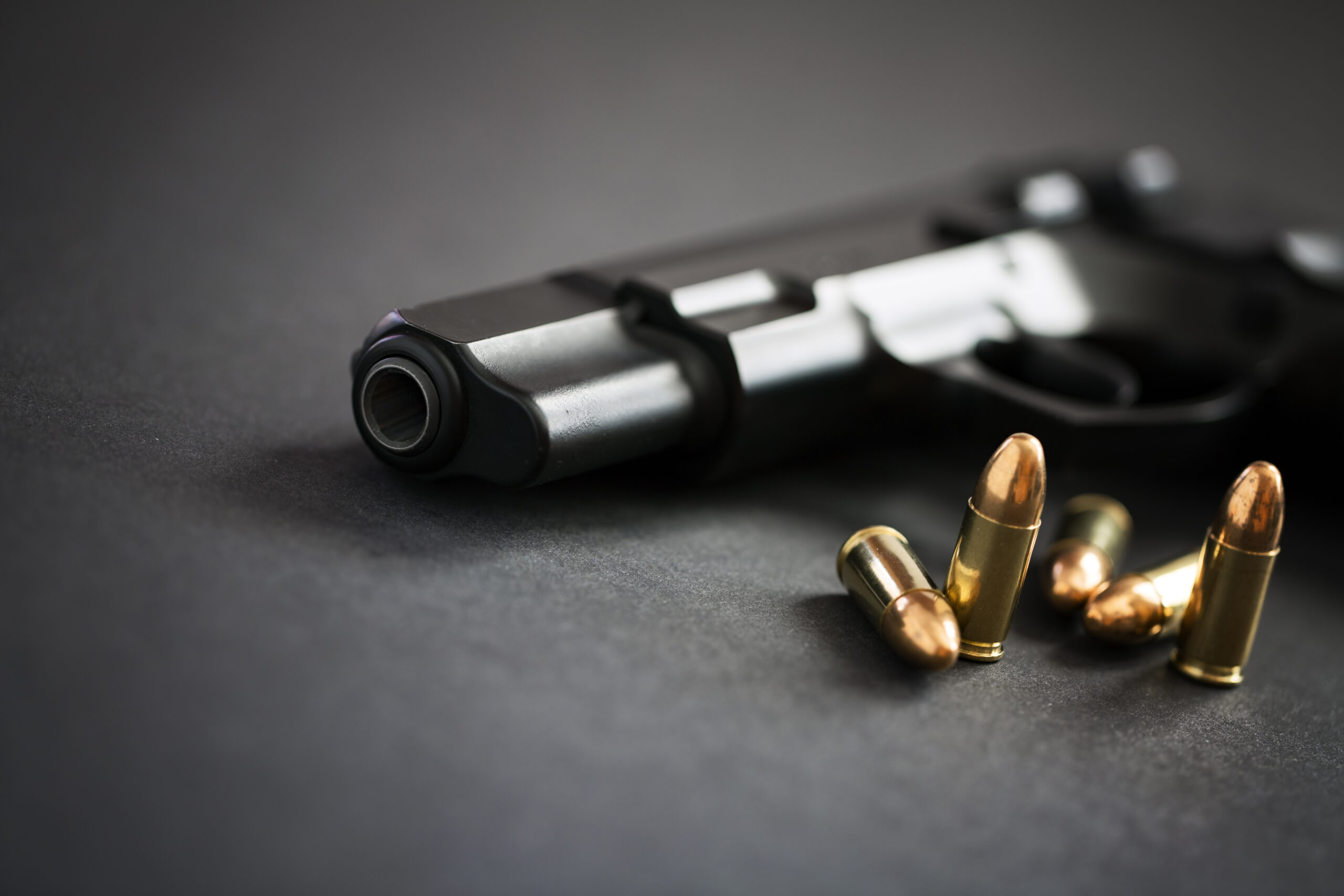
Marv reached beneath his pillow and retrieved the Browning Hi-Power. His hands were unsteady, but the familiar weight settled against his palm. He racked the slide, chambering a nine-millimeter round, and brought the pistol toward the door.
The hallucinated figure returned.
It stood inside the doorway now, its head nearly touching the simulated ceiling.
Marv’s finger moved toward the trigger.
He remembered the thirty-five faces.
He remembered the photograph that had fallen from the slamtracker’s hand.
And he considered how easily the program might persuade him to fire at an innocent person.
He lowered the pistol.
The approaching footsteps ceased.
A moment later, the doorbell sounded.
Marv stared at the door, trying to separate the physical object from the dark opening the program had superimposed upon it. He could make out the three finger-ident locks and the old pneumatic seals around the frame, although their positions wavered whenever the simulated walls advanced.
A woman’s voice came through the intercom.
“Marv Quinton?”
He remained silent.
She called again.
Marv considered answering, then decided against it. He had no reliable way of knowing whether the voice belonged to someone outside or was another stimulus introduced into his auditory cortex.
He disconnected the diagnostic lead from his wrist.
The cybermodem went dark.
The fear continued.
The woman outside moved closer to the lock panel, and Marv heard a faint electronic chirp as some device attempted to access the mechanism. He knew the sound. Someone was bypassing the finger-idents.
He could have stopped her.
The Browning was loaded, the doorway offered a narrow field of fire, and anyone crossing the threshold would be exposed before they could properly assess the room.
He’d survived more than thirty bounty hunters by exploiting advantages exactly like that.
But the simulated prison was still closing in, and a portion of his mind insisted that the person beyond the door was his mother.
Marv placed the Browning on the floor beside his right foot.
He extinguished the nearest candles, leaving the room in darkness.
Without the flames to distract him, the simulated walls pressed inward again. He felt the ceiling descending toward his shoulders, the invisible pressure increasing until his lungs struggled to expand.
He gripped the edges of the stool and concentrated on the chair beneath him, the wooden boards against his bare feet, and the small cigarette he removed from his crumpled pack.
The cigarette trembled between his fingers.
He put it between his lips.
Outside, the locks began to release.
Marv reached down for a match.
©2002 Rhyan Scorpio-Rhys
Leave a Reply