
Author’s Note: By way of explanation this piece began life as a short film script that was never filmed. The screenplay and initial prose conversion was much longer and it has taken three attempts of “killing my darlings” while preserving the core message to get it to this point. The thing I did not do was update the dialogue, so you will find certain terminology outdated. Best enjoyed if you consider it a period piece, and accept it as is.
Malcolm hits the church like a man chasing something he can’t catch and can’t drop.
Outside, the morning is all elbows and engines. Inside, the sound falls away so fast it feels like stepping underwater. A few parishioners glance up at the intrusion, then return to their prayers, calm in the way people get when they’ve decided God can handle whatever walks in.
A woman approaches Malcolm from the aisle, cautious but willing. “Can I help you, brother?”
“I’m looking for Irving,” Malcolm says. “Folks say he’s here this time of day.”
“Irving? Do you mean Deacon Jones?”
“Yeah. Deacon Jones.”
Her eyes travel over his face, the set of his jaw. “Whatever you have, remember where you are. This is the Lord’s house.”
“I’ll respect it,” he says, because he needs the door to open more than he needs to win.
She hesitates, then asks, “May I tell him who’s here?”
“Malcolm. His stepson.”
Her expression shifts. “Little Malcolm.”
“Not so little no more.”
She nods toward a side door. “Basement. He has an office.”
Malcolm starts down.
“And Malcolm,” she calls, softer now, “I hope you won’t be a stranger to Sunday service.”
“God willin’,” he says, and disappears.
The basement is all clutter and narrow paths, the church’s hidden storage pressed close like it wants to breathe on you. Someone carved a cramped office out of stacked boxes: a desk buried under papers, a dim lamp, an old chair.
Irving sits there writing on a notepad like time belongs to him. Mid-60s. Calm hands. Calm face. The kind of calm that makes you feel like you’re the problem for reacting.
Malcolm doesn’t slow. He reaches into his jacket, pulls a metal object, raises it, and drives it into the desk hard enough to bite the wood.
A crucifix stands upright, embedded like a stake. Christ faces Irving.
Malcolm steps back and waits for the flinch, the guilt, the panic—anything human.
Irving keeps writing.
He finishes his thought, sets the pen down gently, then looks at the cross with mild interest, as if Malcolm has brought him a prop from a play.
“Hello, Malcolm,” he says. “What’s this?”
“You know what it is.”
“Watch your language.”
“If God can forgive you,” Malcolm says, voice tight, “He can overlook a few words.”
Irving lifts his eyes. “Exactly what did God forgive me for?”
Malcolm feels something inside him snap into heat. “So it’s like that now. You don’t remember.”
“My memory’s fine,” Irving says. “I just don’t know what you’re talking about.”
Malcolm nods at the crucifix. “That cross you gave Kimberly.”
Irving’s mouth twitches. “Then keep it. You look like you could use a little Jesus.”
Malcolm’s hands clench. “Stay away from us. No visits. No calls. No letters. You don’t contact my sister. You don’t contact my niece. You don’t come near our house.”
Irving taps the desk once, thinking, then picks up his pen and goes right back to writing.
That casual dismissal is what makes Malcolm’s vision narrow.
Malcolm turns for the stairs.
“I’m not the man you used to know,” Irving says behind him. “I’ve been saved.”
Malcolm freezes. “Saved.”
“Yes.”
“The Lord works in mysterious ways.”
“That He does.”
“I ain’t never cared for that saying.”
“Why not?”
“Because it only seems to work for people like you.”
“People like me?”
“You know exactly what I mean.”
“I won’t,” Irving says, “until you tell me.”
Malcolm turns just enough to let the threat land. “Sooner or later you’re gonna answer to either God or me. And you best pray it’s God, because I won’t be lenient.”
Irving doesn’t rise. He doesn’t shout. He only says, steady as stone, “God knows my heart. And so does Kimberly.”
“Don’t say her name.”
“You don’t want me in your life,” Irving says. “Fine. But your sister is grown. If she wants me gone, let her tell me.”
Malcolm’s fists flex open and shut. “If I catch you around our house again, I’ll kill you. If you talk to my sister or my niece again, I’ll kill you. You even think about inserting yourself into their lives… I swear before God, these hands will take your life.”
He leaves.
At home, Malcolm sits in the dark on the couch with the phone in his hand. He dials, listens, says nothing. Whatever is on the other end doesn’t fix him, and whatever he needs can’t be said without bringing something ugly into the room.
The front door opens. Light floods in.
Kimberly walks in first, early 30s, tired and capable, carrying the day like she always does. Pamela bounces in behind her, backpack swinging. They both yelp when they see Malcolm on the couch.
He hangs up too fast.
Pamela runs at him. Malcolm lifts her with a grunt he tries to hide, then sets her down carefully.
“Uncle Malcolm!”
“Hey, Little Pam.”
“Hay is for horses, sometimes cows,” Pamela says, proud. “Pigs don’t eat it because they don’t know how.”
Malcolm forces a smile. Kimberly’s eyes go straight to the phone, then to him.
“What were you doing?”
“Making a phone call.”
“In the dark?”
“Since when do you need light to talk?”
Pamela digs in her backpack, eager to show him something. Kimberly’s patience snaps before she can stop it.
“Pamela, upstairs. Change into your play clothes.”
Pamela sags, sucks her teeth, drags her feet toward the stairs.
Kimberly catches it. “Pick your feet up.”
“Yes, Mama,” Pamela mutters, and disappears.
Kimberly waits until the creaking stops, then turns back to Malcolm.
“You hung up when we walked in,” she says. “Who was it?”
Malcolm stares past her. “Grown folks business.”
Kimberly’s jaw tightens. “And I’m not grown?”
“Not grown enough for this.”
“I don’t want trouble in this house,” she says, low and fierce. “Not with my daughter upstairs. If you’re making calls that bring heat, you make them somewhere else.”
Malcolm doesn’t answer. His mind is still in the basement, still watching Irving’s calm face, still hearing the word saved like a joke.
Instead he says, almost to himself, “Whatever I tell you in the dark, speak in the light…”
Kimberly blinks. “What?”
“Matthew,” he says. “Mama used to quote it.”
Kimberly exhales, annoyed at the memory it drags up. “Yeah. I remember.”
They try to talk around it. They can’t.
Kimberly brings up work, money, Malcolm’s pride, Malcolm’s exhaustion, and Malcolm jokes because joking is safer than admitting fear. Kimberly tells him the good news—her contract came through, attending physician, real money at last—and Malcolm is genuinely proud for one clean second.
Then she says she wants to help him, too. School. Training. Anything.
Malcolm refuses. Kimberly pushes. Malcolm digs in. The argument expands the way it always does: who sacrificed what, who gets to decide, who is allowed to have a life.
And then Malcolm says, like a match dropped into gasoline, “I saw Irving today.”
Kimberly freezes. “Where?”
“At the church,” he says. “I told him to stay away.”
“Why do you keep doing this?” she asks. “Why do you keep making decisions for me?”
“Because I know what he is.”
Kimberly’s face goes still in a way that means she’s gone somewhere else for a second. “You’re still sixteen,” she says quietly. “Still fighting that night.”
Malcolm’s voice cracks around the memory anyway.
He woke up and heard a sound from her room. He crept down the hall. The door was open a crack. Irving was inside. Irving was undressing. Irving was touching her. Malcolm burst in swinging, swinging, swinging, and it didn’t matter. Irving grabbed him, lifted him, and said, close enough to spit in his face, “Stay out of grown folks business.”
Kimberly whispers his name because Pamela is upstairs, because the house is small, because some words stain walls.
Malcolm can’t stop. “You were a kid,” he says, like saying it might undo it.
Kimberly’s control slips, and the truth she manages in daily doses comes out fast and blunt: the meds, the triggers, the nights she can’t breathe right, the private prayers she says just to stay stitched together.
Malcolm stares at her like he’s seeing the full cost for the first time.
“I don’t forgive him because he deserves it,” Kimberly says, voice shaking but steadying as she speaks. “I forgive because I deserve peace.”
Malcolm’s face hardens. “He should be dead.”
“And you should be free,” she says, and the sentence lands like a slap because it’s true and unfair.
They fight again, but now it’s not only about Irving. It’s about Malcolm’s whole identity—protector, guardian, gatekeeper—and how protection has curdled into control, into fear, into love held so tight it bruises.
“I need you to have a life,” Kimberly says.
“My life is you and Pam,” he says.
“And what if that isn’t enough?” Kimberly asks, and neither of them has an answer that doesn’t hurt.
Kimberly tries to calm him. She reaches for his jacket like she’s done a thousand times.
Malcolm flinches like a struck animal and accidentally hits her.
Kimberly recoils, shocked, hand rising to her face. “You hit me.”
“I didn’t mean—” Malcolm’s voice breaks. “I’m tired. I’m tired of making the wrong choices.”
“Then tell me what happened today,” she says. “Tell me what you did.”
Malcolm swallows. “I saw Irving.”
Kimberly’s shoulders drop, and she looks older than she is.
The argument rises one last time, sputtering, ugly, exhausted. Malcolm stands too fast.
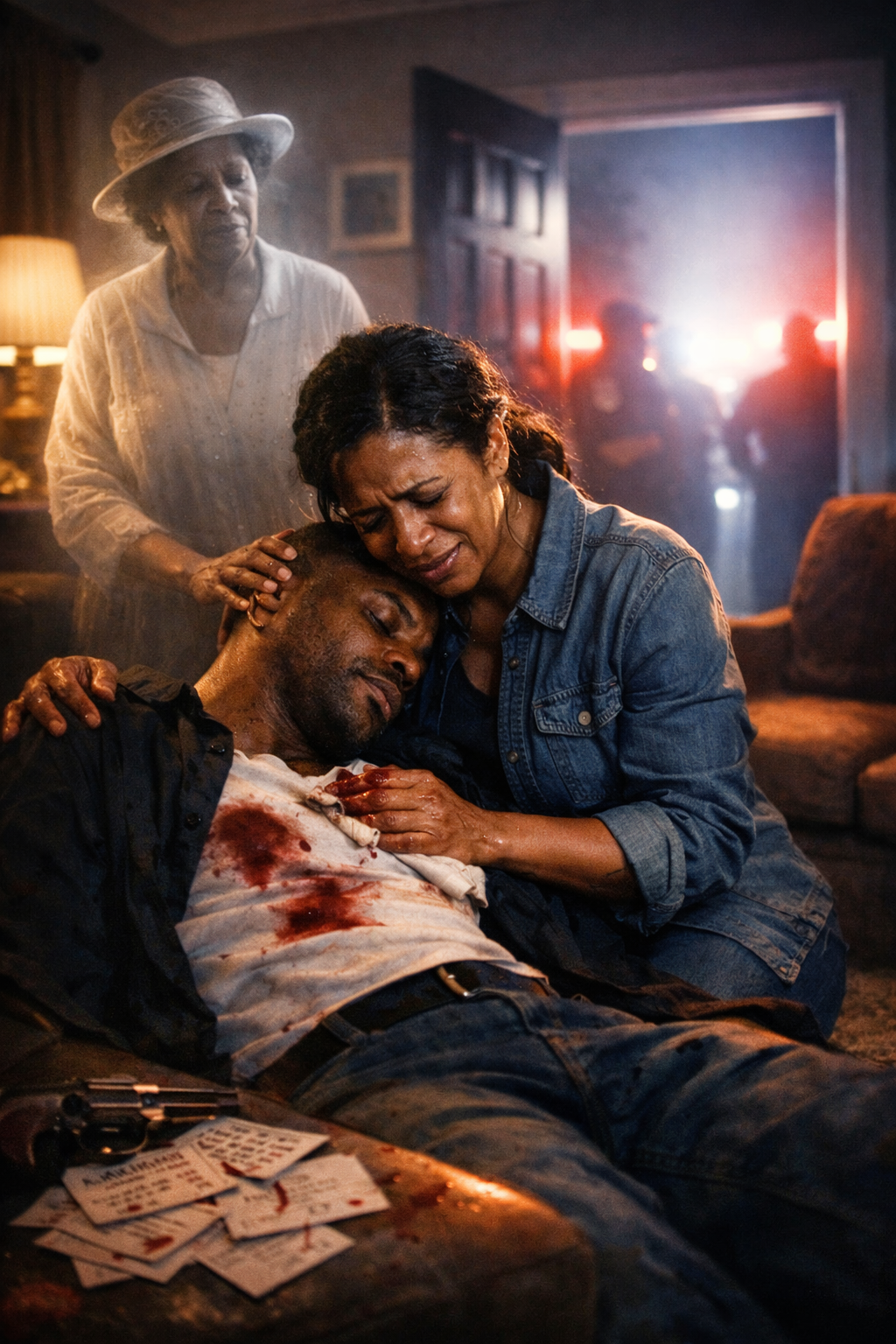
A stack of homemade postcards spills from inside his jacket and scatters across the floor.
Kimberly’s eyes snag on them. Recognition hits her face instantly.
Before she can speak, Malcolm folds and drops.
Kimberly rushes to him, yanking his jacket aside. Blood soaks his shirt and pants. A bullet hole.
Her training kicks in, but her hands shake anyway as she presses fabric to the wound. “We have to call an ambulance.”
Malcolm grabs her wrist in a grip that hurts. “Too late.”
“It’s not too late,” she snaps, fighting panic. “Let me—”
“Now it’s your turn,” Malcolm whispers, teeth clenched. “To listen.”
Outside, sirens swell closer. The windows begin to flicker with red and blue.
Malcolm went back.
In the church basement, with the gun in his hand and the past roaring in his skull, he demanded the truth. Irving denied. Irving minimized. Irving rewrote. Irving tried to turn a nightmare into a misunderstanding and a child into a liar.
Then Irving produced the postcards.
Kimberly’s handwriting. Cardboard cut down to size. Messages sent month after month while they were on the run. Proof, Irving claimed, that nothing happened—because why would she keep in touch if it did?
Malcolm stared at them, sick. In his hands was something that didn’t fit the life he built his fury around.
Then he remembered Pamela’s voice—the phrase that should never come out of a child.
Grown folks business.
And Malcolm snapped.
He pistol-whipped Irving until Irving was blood and pleading and repeating, “I’m not like that,” like saying it could make it true.
Malcolm turned away, horrified, and that’s when Irving came up behind him.
They struggled for the gun.
It fired twice.
Back in the living room, the sirens are close enough that the light crawls across the walls. Kimberly presses down on Malcolm’s wound and begs him to stay with her.
The air shifts.
Mama appears beside the couch, calm as a hymn. Kimberly doesn’t see her, but Malcolm does.
“Mama,” he whispers, as if he’s been waiting his whole life to say it again without anger attached.
Mama’s voice is soft. “Your stepfather isn’t dead.”
Malcolm blinks, confused. “But I—”
“You felt the gun go off,” Mama says. “And you pulled it toward yourself.”
Malcolm’s breathing catches, and he understands what she’s saying even if he hates it. Reflex. Instinct. Something deep in him refusing, at the last second, to become the thing he hunted.
“The second shot hit him,” Mama continues. “He’ll live.”
“And I won’t,” Malcolm says, and it isn’t a question.
Mama doesn’t lie. “No, baby.”
Kimberly looks at Malcolm’s face, terrified. “Who are you talking to?”
“Mama,” Malcolm says, and he sounds like a little boy again. “You don’t see her?”
Kimberly swallows and steadies her voice the way she does when she has to hold a room together. “If you say you see Mama, I believe you.”
Malcolm panics, not for himself, but for Kimberly and Pamela. “Without me, he’ll come back. He’ll do it again.”
Mama’s eyes hold his. “I don’t think that’s going to happen.”
“Why not?”
Mama’s voice stays even. “Because he won’t be capable of it again.”
Malcolm’s face shifts as he understands, and he tries to reach for ugly relief—some crude justice—but Mama stops him with a look that would’ve frozen him as a child.
“Mind your mouth around me, boy.”
Despite everything, Malcolm laughs once, and the laugh tears through him like broken glass.
“Man,” he whispers, “I guess God don’t like ugly, do He?”
Mama’s smile is small and sad and real.
Malcolm’s body tightens, then releases.
Kimberly breaks. She cradles him, rocking, crying the way people cry when the world stops being negotiable.
Malcolm rises—not his body, but him. Spirit-light and quiet. Mama takes his hand like she’s been waiting.
Kimberly rocks on the floor and whispers into his hair, “Why’d you do it, Mal? Why’d you do it?”
Malcolm kneels beside her ear, voice gentle now. “’Cause sometimes love makes promises you gotta keep.”
He kisses her cheek. For half a second she seems to feel it, like warmth passing through. Then she keeps rocking, holding what she can’t keep.
Malcolm looks at Mama, raw with worry even after death. “She gonna be alright?”
Mama watches Kimberly like she’s watching a storm pass through a house that still has to stand afterward. “Right now her heart’s shattered,” she says. “But she’s got God, her daughter, and help coming. She’ll be fine. It’ll take time. But she’ll be fine.”
The front door swings open on its own.
Police lights fill the room—red and blue—then bloom into a blinding white.
Mama and Malcolm walk into it together.
 MADD FICTIONAL