All The World Will Be Your Enemy 26: Desperation and Destruction

In the aftermath of the horrific violence that had claimed her parents’ lives, Beverly clung to their bodies, her mind a whirlwind of grief and despair. The world around her faded into a blur of muted colors and distant sounds, the chaos of the ongoing battle nothing more than a meaningless backdrop to the all-consuming anguish that gripped her heart.

But even in the depths of her sorrow, a desperate, feverish hope began to take hold. She turned to Angele and Joanna, her eyes wide and pleading, her voice a ragged whisper.

“You have to save them,” she said, her words a desperate prayer. “You have to do for them what you did for me. Please, I can’t lose them. Not like this.”

Angele and Joanna exchanged a long, meaningful look, their own hearts heavy with the weight of Beverly’s pain. They knew the risks, knew the irreversible nature of the transformation they had undergone. To inflict that upon others, even in the name of love and salvation, was a decision fraught with peril and uncertainty.

But as they looked into Beverly’s eyes, as they saw the depth of her anguish and the fierce, unyielding love that blazed within her, they knew they could not refuse. They had sworn to stand by her, to support her through whatever trials and tribulations lay ahead. And if this was what she needed, what she truly desired, then they would move heaven and earth to make it so.

With a solemn nod, Angele and Joanna knelt beside Beverly, their tentacles reaching out to gently caress the still, bloodied forms of her parents. They closed their eyes, their minds reaching out to the alien essence that flowed through their veins, the strange and wondrous power that had remade them in its own image.

Slowly, tentatively at first, they began to channel that essence into Beverly’s parents, their tentacles glowing with an eerie, pulsating light. The air around them shimmered and warped, the fabric of reality straining against the influx of extradimensional energy.

Beverly watched, her breath caught in her throat, as her parents’ bodies began to twitch and convulse, their wounds knitting together with uncanny speed, their flesh rippling and reshaping itself into strange and monstrous forms.

But even as the transformation began to take hold, even as the first stirrings of hope and relief began to flicker in Beverly’s heart, the world around them erupted into fresh chaos.

A stray bullet, fired by one of the agents still battling Joanna’s monstrous form outside, ricocheted off the wall and struck the portal device that had brought them to this nightmare. The device sparked and sputtered, its delicate mechanisms damaged beyond repair.

For a moment, there was only a stunned, disbelieving silence. Then, with a deafening roar and a blinding flash of light, the device exploded, the force of the blast sending Beverly and her companions flying.

The portal itself, a shimmering, pulsating tear in the fabric of space and time, began to flicker and distort, its edges bleeding into the surrounding reality like a festering wound. The alien atmosphere of the pocket dimension that had once sustained the Octopods now spilled out into the world, a writhing, seething mass of otherworldly energy.

Beverly and her companions could only watch in horror as the world around them began to change, to twist and warp into grotesque and impossible forms. Walls melted like wax, their surfaces flowing and oozing into strange and impossible shapes. The air itself seemed to come alive, writhing and pulsating with a sickening, otherworldly glow.

And through it all, Beverly’s parents continued to change, their bodies mutating and transforming into something alien and utterly inhuman. Their tentacles lashed and coiled, their eyes gleaming with a feral, predatory intensity.

Beverly reached out to them, her own tentacles straining to make contact, to offer some measure of comfort and familiarity in the midst of the unfolding madness. But even as she did so, she could feel the world around her shifting and changing, the very fabric of reality unraveling like a fraying tapestry.

She knew, with a sudden, terrifying certainty, that nothing would ever be the same again. The explosion of the portal device had unleashed something far beyond their understanding or control, a primal, reality-warping force that threatened to consume everything in its path.

And as Beverly clung to her transformed parents, as she felt the alien presence of Angele and Joanna beside her, she knew that they were now the only constants in a world gone mad, the only anchors in a sea of chaos and uncertainty.

Not. The. End.

NO FIXED ADDRESS #5 – The Weight of Carrying Everything

Installment 1 * Installment 2 * Installment 3 * Installment 4

I carry everything I own.

Not metaphorically — though we’ll get there — but physically. On my back. On my shoulders. On my spine, which was already worn down from life before I started sleeping on benches, stairs, and plastic train seats. I carry it up staircases that feel like mountains. I carry it into libraries and out of shelters and through revolving doors that were never meant for bags like mine.

And every ounce matters. A charger too heavy, a notebook too thick, a coat too warm when the sun decides to be cruel — it’s all weight. It’s all punishment. Your life becomes triage. What do I need more — a clean shirt, or Advil? Do I carry this book I love, or do I save space for soap?

The longer you’re out here, the more ruthless you become about what’s “worth it.” You pare yourself down until the bag is just survival. But the weight doesn’t leave.

Because then there’s the mental weight.

The constant tracking — of location, of time, of people, of threat. You have to remember where the power outlets are. Which parks have working water fountains. Which McDonald’s will let you sit for 22 minutes before kicking you out. Which guard turns a blind eye on Sundays. Which stairs are safer than sidewalks. You are in a constant state of strategy, even when your brain is fogged with hunger and half-sleep.

You carry your own invisibility. You carry being watched. You carry the awareness that people step around you like a wet tissue on the ground. You carry your own shame — even when you know you didn’t deserve this. Even when you know it could happen to them, too.

And then there’s the worst weight:
Memory.

I carry the apartment I lost. The room with the quiet door and the plant I forgot to water. I carry the sound of heat turning on in winter. The hum of a refrigerator holding food just for me. I carry the versions of myself that had a home, and a nameplate, and a mailbox. I carry the man I was.

And on days when the pain is too much, I carry this voice in my head that whispers:
“Maybe it’s better not to carry you anymore.”

But I do. I carry me.
I carry me through aching feet and strangers’ stares and silence that grows louder every week.
I carry me through being forgotten by algorithms and friends and time.

So if you’re reading this — even silently, without likes or comments — know this:

This is not content.
This is not an act.
This is the sound of someone still carrying himself, alone, across a city that doesn’t want to see him.

I don’t need applause.
But I do need room.

—Rhyan

One Degree Away

The first time I met Helen, she was laughing — not politely, not rehearsed — but deep and sharp, like she’d just remembered something too wicked to keep to herself. It poured out of her like light through a crack. I was halfway through a sentence I can’t recall, my glass tilted just enough to spill, and suddenly nothing in the room was in focus except her.

Her husband, Caleb, introduced us. He said, “This is my wife, Helen,” like he was giving me coordinates to a planet he already owned.

She shook my hand. Warm, brief, efficient. Her eyes lingered maybe a second longer than necessary. That second undid me.


I told myself it would pass. That she was just magnetic in that way some women are — all sparkle and untouchable weight. I’d been around women like her before. Women who seemed too deliberate to be real. But Helen was real in a way that made me ache. There was no irony in her. No armor. Just grace with teeth.

The crush bloomed like mold — quietly, in places I didn’t expect. I started showing up to things I would’ve otherwise skipped. Game nights, dinner parties, birthdays for people I barely knew. If Helen was there, I found a reason to be.

And she always smiled when she saw me. That smile — not flirtatious, not cold — just genuine. The kind of smile you fall into, then blame yourself for drowning in.


Caleb thought I was flirting with him.

Of course he did. It was easy. I wore tight dresses and leaned in when I laughed. I said yes to drinks when I should’ve gone home. I let him think I was interested because he was one degree from her — and when obsession is soft and elegant like Helen, you’ll convince yourself that proximity is better than nothing.


It started in the guest room of their house during a storm. Everyone else was drunk and asleep. Helen had gone to bed early — said she had a migraine, kissed Caleb’s cheek, disappeared down the hall. Caleb stayed. So did I.

There was tension, but not the good kind — not electric, just inevitable. He looked at me like he already knew the ending and was willing to play along.

“You’re not like other women,” he said, and I almost laughed.

I kissed him because he’d kissed her. I slept with him because his skin still smelled faintly of her shampoo.


The affair lasted three months. Long enough to feel like hell, short enough to pretend it wasn’t.

He thought I was wild. He thought I was in love with him. He told me things she never heard, things he said she wouldn’t understand — and I nodded, played therapist, lover, mirror. I let him project fantasies onto me while I conjured hers over him.

Every time I closed my eyes, it was Helen I imagined. Not naked — not even necessarily mine. Just close. Just turning toward me. Just asking.


One night, he found me standing in their master bathroom, running my fingers over the smudged lipstick on the mirror. Hers. Crimson. Slightly off-center. I hadn’t realized I was tracing it until I saw him watching me in the glass.

“You’re obsessed with her,” he said.

I didn’t deny it.

“She doesn’t know you exist that way.”

“I know.”

He stepped forward, tried to touch my shoulder. I pulled away like his fingers were static.

“I don’t want her to know,” I said. “I just want…”

But I didn’t finish. Because what I wanted wasn’t fair. What I wanted didn’t exist. What I wanted was for Helen to look at me the way I looked at her when she wasn’t watching.


The last time Caleb and I slept together, I cried.

Not during — after. Quietly. Faced away from him. He asked if I was okay and I told him yes.

He kissed my back and said, “We could be something, you know.”

And I whispered, “I already am.”


Helen never found out. Or if she did, she never said. She still invites me to parties. Still smiles when she sees me, still brushes her hand against my arm in passing. I haven’t touched Caleb in over a year, but I still see her sometimes — in the street, in bookstores, in dreams I wake up from aching.

She doesn’t know. She never will.

But when I close my eyes, it’s her laugh I remember. Her scent. Her lipstick, off-center on the mirror.

One degree away from heaven still burns like hell.

And some nights… I still settle.

All The World Will Be Your Enemy 25: Sacrifice and Sorrow

The Anderson family home was a picture of suburban tranquility, its manicured lawns and white picket fence a testament to the American dream. But as Beverly and her companions approached, they could see that the dream had turned into a nightmare.

Government vehicles surrounded the house, their black, armored hulls gleaming in the sunlight. Agents in tactical gear swarmed the perimeter, their weapons trained on the doors and windows, ready to unleash a hail of bullets at the first sign of resistance.

Beverly felt a surge of panic and rage, her tentacles twitching with the urge to lash out and destroy. But Angele’s voice in her mind held her back, a calming presence amidst the storm of emotions.

“We have to be smart about this,” Angele said, her words a soothing telepathic caress. “We can’t just charge in blindly. We need a plan.”

Joanna nodded, her own tentacles coiling and uncoiling with barely contained tension. “I can create a distraction, draw their fire while you two go in from the back. But we’ll have to move fast. We won’t have much time.”

Beverly took a deep breath, forcing herself to focus through the haze of fear and anger. She knew that her parents were inside, that they were in danger because of her. She had to save them, no matter the cost.

With a final, determined nod, the Octopods split up, Joanna morphing into a monstrous, tentacled beast as she charged towards the front of the house, her roar shaking the ground and shattering windows.

Beverly and Angele raced around the back, their forms shifting and blurring as they moved with preternatural speed and agility. They leapt over fences and walls, their tentacles lashing out to smash through doors and windows, clearing a path into the heart of the house.

Inside, the scene was one of utter chaos. Agents stormed through the rooms, their shouts and commands mingling with the screams and sobs of Beverly’s parents. Furniture was overturned, precious family mementos shattered on the floor, the detritus of a life turned upside down.

Beverly charged forward, her tentacles a blur of motion as she fought her way towards the sound of her parents’ voices. She could feel Angele beside her, the other Octopod’s presence a source of strength and determination in the face of overwhelming odds.

But even as they fought, even as they unleashed the full fury of their alien abilities, Beverly could feel a sense of dread growing in the pit of her stomach. The agents were too many, too heavily armed and trained. They were like ants swarming over a wounded beast, relentless and unstoppable.

And then, in a moment of horrifying clarity, Beverly saw her parents, huddled together in the corner of the living room, their faces pale with fear and shock. She surged towards them, a cry of desperate love and anguish tearing from her throat.

But she was too late. A hail of gunfire erupted, the air filled with the staccato roar of automatic weapons. Beverly watched in helpless horror as her parents jerked and convulsed, their bodies riddled with bullets, their blood splattering the walls and soaking into the carpet.

Time seemed to slow, each heartbeat an eternity of agony and grief. Beverly reached her parents’ side, her tentacles cradling their broken, bleeding bodies, her mind a howl of anguish and rage.

Angele was there, her own tentacles wrapping around Beverly in a desperate, comforting embrace. But even she could not shield Beverly from the full weight of her sorrow, from the crushing realization of what had been lost.

For a moment, the battle seemed to fade away, the shouts and screams and gunfire receding into a distant, meaningless buzz. All that existed was the pain, the gut-wrenching, soul-searing agony of watching the two people she loved most in the world slip away before her eyes.

Beverly wept, her tears mingling with the blood and the ichor, her sobs a primal, wordless expression of the unfathomable depth of her grief. She clung to her parents, willing them to hold on, to fight, to stay with her just a little longer.

But it was too late. Their eyes were already glazing over, their breaths coming in short, sharp gasps. In the end, all Beverly could do was hold them close, to whisper words of love and comfort as they faded away, their lives cut short by the cruel and senseless violence of a world that could never understand.

And as the last breath left her parents’ bodies, as their hearts stilled and their eyes closed for the final time, Beverly felt something break inside her, a fundamental shift in the very fabric of her being.

She had lost everything, had watched her world shatter and crumble into dust. But in that moment of ultimate despair, she also found a new resolve, a grim determination to fight on, to make their sacrifice mean something.

For her parents, for the love they had given her and the lives they had lived, Beverly would keep going. She would find a way to make sense of the chaos and the madness, to forge a new path through the darkness that had engulfed them all.

Even if it meant embracing the alien within her, even if it meant becoming something new and terrifying and wholly unknown. She would do whatever it took to honor their memory, to ensure that their deaths had not been in vain.

And with that knowledge burning in her heart, Beverly rose to her feet, her tentacles still cradling the bodies of her beloved parents. She turned to face the shattered remnants of her old life, ready to confront whatever challenges and horrors lay ahead.

For she was an Octopod now, a being reborn in blood and sorrow and the ashes of all she had once held dear. And she would not rest until the world knew the full measure of her pain, and the terrible, transcendent beauty of what she had become.

Not. The. End.

NO FIXED ADDRESS #4– The Man Talking to the Wall Wasn’t Talking to Me

Welcome to No Fixed Address, a weekly series where I write candidly about what it means to be homeless—right now, in real life, not in some sanitized Hollywood version. I’m currently unhoused. Not “drifting.” Not “on a journey.” Just trying to survive in a world that looks away.

Each week, I’ll share personal accounts, hard truths, and moments that don’t make it into the movies. If you’re here to understand what homelessness actually looks like—not as a plot point, but as a life—then you’re in the right place.

This is not a cry for pity. It’s a record. A mirror. A small act of resistance.

Installment 1 * Installment 2 * Installment 3

There’s a man I see sometimes at a particular subway station who wears five coats, no socks, and sings showtunes to the column near the MetroCard machine. Not at the machine — to it. With reverence. Sometimes he calls it “Mother.” Sometimes he asks it why the moon forgot him.

Other times, he screams.

I don’t know his name, but I know his shape in the crowd. I know to give him space. I know he isn’t violent — not yet. But I also know he’s a walking nerve ending, exposed to the elements, and sooner or later, someone will provoke him. Or he’ll crack.

There are more of him now. And it’s getting harder to tell which ones are just talking to themselves, and which ones are holding it together by the thinnest thread of silence. I’ve shared benches with them. Ridden the same 2 a.m. train loops. Some mutter. Some shout. Some sob quietly into their sleeves for hours.

The line between homeless and psychologically unwell is not always the same — but it’s getting blurrier every week.

And here’s the thing: navigating the homeless landscape means navigating them, too.
And they’re not okay.
And neither are we.

I’m not here to speak over them. But I am here to say this: it is becoming genuinely dangerous to move through the city’s unhoused corridors — shelters, trains, stairwells, benches — because mental health care has utterly collapsed, and too many people have nowhere left to unravel except next to you.

I’ve had someone chase me down a platform for looking too long in their direction.
I’ve had someone follow me up a stairwell whispering “I’m not gonna hurt you” in a tone that made me believe the opposite.
I’ve seen a man bash his head against a pole until MTA police officers came to drag him away like luggage.

This isn’t “colorful city life.” This is a breakdown — of systems, of minds, of basic public safety. And every time a new person ends up on the street mid-episode, we’re all told to just accept it. Duck and weave. Look down. Dodge the danger, but show empathy. Keep your distance, but don’t dehumanize. It’s a losing equation.

There’s a rumor — more than a rumor, really — that certain New Jersey agencies have been quietly transporting individuals with severe mental health conditions across the river into New York once their Medicaid or charity care runs out. Allegedly, they’re given a one-way bus ticket and let loose near Penn Station or Port Authority.

“Not our problem anymore.”

I don’t have paperwork to prove it, but I’ve seen the fallout. The confused newcomers with hospital bracelets still on. The disoriented men asking how to get back to Hackensack or Newark. The women who say things like, “I was at a place with nurses and then I wasn’t.” You learn to read between the lines real fast out here.

Here’s the most brutal part: even the ones trying to get help often can’t. If you’re mentally unwell and homeless, the threshold to get admitted to psychiatric care is sky-high. You basically have to be actively suicidal and disruptive — and even then, you might just get a psych eval and kicked back out with a pamphlet.

And those of us just trying to survive — who aren’t (yet) in crisis — we’re left with the fallout. We dodge. We share space. We don’t sleep. We brace for the moment the shouting turns, or the eye contact lingers too long.

We’re not just sleeping rough anymore.
We’re sleeping in someone else’s breakdown.
And tomorrow, it could be our turn.

—Rhyan

A Beautifully Made Failure

I met Jules on a Tuesday, which already felt like a bad omen — Tuesdays are no one’s favorite. She blew into the community center art class like someone had dared her to be earnest for an hour and she was already losing the bet.

She had this presence about her. People like to say “you couldn’t look away,” but I tried to. I tried, and it didn’t work. She looked like a mistake you’d make twice. Tall, elegant in a way that suggested inherited ruin — like old wealth that had turned to drama instead of dust. Her eyes were honey lit by a distant fire. Everything about her said come closer — except the eyes, which said you’ll regret it.

She introduced herself like it was a confession. “I’m Jules,” she said. “I don’t finish things. But I’m great at starting.”

No one laughed, but I did. And that’s how it started.


We became inseparable the way chaos and calm sometimes braid themselves together out of sheer necessity. I was working a series of quietly disappointing jobs — one of those people with a planner full of color-coded dreams I never quite chased. Jules floated from gig to gig like she was dodging meaning. She called herself an artist, though I never saw the same piece twice. Everything she made either burned, was given away, or “felt wrong two days later.”

She was a poet when she was bored, a bartender when rent was due, a muse to a half-dozen sad boys who mistook damage for depth. And I? I orbited her. Not as a satellite, not exactly. Maybe more like a moth with a map, trying to convince herself she was going somewhere.

I told myself it was friendship. But there were nights I’d trace the shape of her name into the steamed glass of my bathroom mirror. Nights I’d watch her sleep on my couch — one arm flung dramatically over her forehead like a silent movie star — and wonder if I loved her, or if I just wanted to be her.


Jules had a theory that the best people were ruins. “You can’t trust someone fully assembled,” she’d say, painting her nails black and letting the varnish drip on my floor. “Where’s the poetry in that?”

She told stories like someone dared her to make you believe a lie — except every one of them held a kernel of truth you could taste like a pit in the fruit. A father who left. A mother who kept inviting chaos to dinner. A boy who said he’d love her forever and didn’t. A girl she kissed on a roof once and never called again. That last one she told only once, in a whisper, like it was a wound she wanted to name just enough to keep it alive.

And me? I listened. God, I listened like it was a profession. I wanted to memorize her — to catalog every chipped porcelain piece of her and maybe, just maybe, build something whole. She never asked me to. But I did it anyway.


We had our own mythology.

Thursday nights were ours — takeout and wine and her barefoot in my apartment, telling me what color the sky should have been that day if the world knew how to feel properly.

She once painted a portrait of me using only grays. “You’re too gentle for color,” she said. “You hold back. Even your brightness is cautious.”

I didn’t know whether to be flattered or destroyed. Maybe both.


The end didn’t come like thunder. It came like mist. A slow receding. A canceled plan here. A missed call there. Then three days without a text. Then a week. Then—

One day, I came home to find the painting gone. The one of me. She’d taken it back. No note. No goodbye. Just an empty hook on the wall and a silence loud enough to bruise.


I ran into her a year later. She was at a gallery showing someone else’s work, dressed like a question no one dared ask. She smiled like nothing had happened, and when I said her name — just her name — her eyes softened like I was the one familiar shape left in a room full of strangers.

“You always looked at me like I was worth something,” she said. “Even when I was falling apart on purpose.”

I wanted to say so many things. I wanted to scream, or kiss her, or list every way she wrecked me so beautifully I thanked her for it.

Instead, I just asked, “Did you ever finish the painting?”

She shook her head. “Didn’t feel right.”


Some people are buildings. Foundations. Brick and mortar and blueprints. They rise. They endure.

But some people? Some people are ruins by design. Cathedrals bombed by choice. Glorious in decay. Jules was that. A beautifully made failure. Every flaw curated. Every heartbreak handpicked.

And I? I was the girl who stayed too long in the museum, pressing my hand to the velvet rope, wondering what it would feel like to touch something forbidden.

She never asked to be saved.

And I never stopped loving her for it.

All The World Will Be Your Enemy 24: Emergence and Escape

The air in 3B shimmered and warped, the fabric of reality straining against the sudden intrusion of the extradimensional portal. With a blinding flash and a deafening roar, the Octopod trio emerged, their writhing, tentacled forms spilling out into the once-familiar confines of the condo.

For a moment, there was only stunned silence, the forensic team staring in slack-jawed horror at the impossible sight before them. Then, pandemonium erupted, screams and shouts mingling with the crash of overturned furniture and shattered glass.

Beverly, still struggling to adjust to her new form, found herself moving with a speed and agility she had never known before. Her tentacles lashed out almost of their own accord, sending investigators flying like ragdolls across the room. Beside her, Angele and Joanna were a flurry of motion, their alien abilities unleashed in a dizzying display of power and precision.

The battle was brief but intense, the humans no match for the Octopods’ superior strength and reflexes. Within minutes, the condo was a scene of utter devastation, the walls splattered with blood and ichor, the floor littered with the groaning, semi-conscious bodies of the forensic team.

Beverly paused amidst the chaos, her mind reeling with the shock of what she had just done. But there was no time for hesitation or regret. Already, she could hear the wail of sirens in the distance, the sound of reinforcements rushing to the scene.

“We have to go,” Angele said, her voice an urgent thrum in Beverly’s mind. “We can’t let them catch us.”

Joanna nodded, her tentacles already coiling and uncoiling in anticipation. “The vehicle we came in is too conspicuous. We need to find another way out of here.”

Beverly followed her companions out of the shattered remnants of 3B, her heart pounding with a mixture of fear and exhilaration. They raced down the stairs, bursting out into the street like a nightmare made flesh.

All around them, chaos reigned. Bystanders screamed and fled at the sight of the Octopods, their faces contorted with terror and revulsion. Cars swerved and crashed as drivers lost control, their vehicles careening into storefronts and street lamps.

Beverly barely registered the destruction, her focus narrowing to a single, overriding imperative: escape. She scanned the street, her enhanced senses picking out the flutter of heartbeats and the rush of adrenaline in the panicked humans around her.

There, just ahead, a man was stumbling out of his car, his eyes wide with shock and disbelief. Beverly surged forward, her tentacles whipping out to seize the man and fling him aside like a discarded toy.

Angele and Joanna were right behind her, their own tentacles lashing out to clear a path through the surging crowd. They piled into the commandeered vehicle, Beverly taking the wheel as Angele and Joanna morphed their forms to fit into the confines of the car.

The engine roared to life, and Beverly gunned the accelerator, sending the car hurtling down the street in a screeching, fishtailing rush. In the rearview mirror, she could see the flashing lights of police cars and SWAT vans, the authorities struggling to keep pace with the Octopods’ desperate flight.

Beverly wove through the traffic like a woman possessed, her reflexes and senses operating on a level far beyond human ken. She could feel the pulse of the city around her, the ebb and flow of life and energy that sustained the vast, teeming metropolis.

But beneath that pulse, she could sense something else, a growing ripple of fear and confusion that spread outward from the epicenter of their escape. The Octopods’ presence had shattered the illusion of normalcy, had torn away the veil that separated the mundane from the extraordinary.

As they raced through the streets, leaving a trail of shattered glass and twisted metal in their wake, Beverly knew that there could be no going back. The world had changed, irrevocably and forever, and she and her companions were now the harbingers of that change, the vanguard of a new and terrifying era.

The road ahead was uncertain, fraught with peril and the unknown. But for now, all that mattered was the next turn, the next breath, the next desperate, fleeting moment of freedom.

The Octopods had emerged, and nothing would ever be the same again.

Not. The. End.

No Fixed Address #3: The People Who You Meet

Welcome to No Fixed Address, a weekly series where I write candidly about what it means to be homeless—right now, in real life, not in some sanitized Hollywood version. I’m currently unhoused. Not “drifting.” Not “on a journey.” Just trying to survive in a world that looks away.

Each week, I’ll share personal accounts, hard truths, and moments that don’t make it into the movies. If you’re here to understand what homelessness actually looks like—not as a plot point, but as a life—then you’re in the right place.

This is not a cry for pity. It’s a record. A mirror. A small act of resistance.

Installment 1 * Installment 2

Being homeless, you slowly develop the mutant ability of invisibility. You don’t ask for it, but it’s given to you, day by day, until you master the art of being looked through as if you didn’t exist. The city becomes a blur of legs and exhaust, a world that moves around a space you only temporarily occupy. On the rare occasion, however, someone’s focus snags on you, and for a moment, you flicker back into existence.

Such was the case for me at a church-run soup kitchen in a neighborhood that had long since given up trying to be safe. The air outside reeked of old urine and decay, but inside, it was a sterile blast of bleach and boiled coffee. Security was a serious affair: a guard with tired eyes checked bags and backpacks, and everyone submitted to the electronic chirp of a metal detector wand and an indifferent pat-down. A necessary ritual before you could be granted a breakfast tray of food.

The dining hall was a cramped, narrow space, lined with four long benches already crowded with hunched shoulders and weary faces. The room was made even smaller by the bustling team of volunteers, a small army of good intentions standing by to deliver the morning’s meal. Due to a series of funding cuts following the most recent presidential election, the breakfast was reduced to a single-serving packet of dry cereal, a small plastic cup of milk, a diced fruit cup swimming in syrup, a granola bar, a small bottle of water, and the choice of either a cup of coffee or tea. A checklist of calories.

As was my custom, I made my way down the line of volunteers, offering a quiet, “Hello, thank you for being here.” Some nodded back, a few offered a real smile. Most didn’t. It never bothered me. Acknowledging their presence was my way of holding onto a piece of the man I used to be. You are only responsible for your own actions, after all.

The volunteer who served me was a flurry of limbs and apologies. A tall, slender blonde woman whose thick glasses seemed to magnify the slight panic in her eyes. She stumbled bringing the tray over, her sneakers squeaking on the linoleum. She almost tripped setting it down, which caused the milk to slosh over the side, a white splash on the worn plastic.

“Oh, I am so sorry!” she gasped, her accented voice soft, with a melody to it I couldn’t place. She fumbled with a napkin, making the puddle worse.

“Hey, it’s totally fine,” I said, smiling. “Adds a little character to the tray.” And it really was fine because milk was the enemy. Being lactose intolerant, I always ate my cereal dry.

She paused her frantic dabbing and looked at me. Really looked. And then, to my surprise, she blushed. “I am also sorry I did not say hello when you came in,” she said, finally meeting my eyes. “I am afraid my klutziness made the first impression.”

I wish I’d had the presence of mind to remember her name, but alas and alack, my memory isn’t worth the paper it’s printed on. What I did recall was that she was from the Czech Republic, and was currently working as an au pair in New Jersey. She was in New York because she’d seen Moulin Rouge the night before and stayed in a hostel overnight in order to volunteer at the soup kitchen. Her face lit up as she described the play, transforming her persona from awkward to incandescent. She was a self-proclaimed fashion and craft nerd. She’d made gifts for the cast, contacted them through Instagram, and actually arranged to meet them backstage after the show. She showed me pictures on her phone of her beaming alongside the actors, holding up her handmade creations. She hoped, she confessed, that it might one day lead to costume design work in an actual Broadway or West End production. Her biggest fear was that the current administration would make it impossible to get another work visa after her current one expired in August.

She painted a picture of a life so different from mine it felt like a broadcast from another galaxy. Then, searching for common ground, I pointed to a small pin on her apron—a Starfleet insignia.

Her eyes widened behind her glasses like a starship engaging its warp drive. She was a Trekkie. A super-fan. She’d made her own uniforms from every series. “Even,” she whispered conspiratorially, leaning in, “Discovery.”

I chuckled. “That’s dedication.”

The kitchen had a strict ten-minute time limit per meal to keep the line moving. But I was the last one in, and the morning rush was over. The other volunteers started wiping down counters, their glances growing heavier, but she didn’t seem to notice. We talked Trek, debating the merits of Kirk versus Picard, the tragedy of Jadzia Dax, the sheer brilliance of the Dominion War arc. We were two strangers in a forgotten corner of the city, speaking a shared, secret language.

Then, her expression softened. “And what about you?” she asked.

I gave her the abridged version. You learn to edit your life story for polite company. But she listened with an unnerving intensity. I didn’t want to dim the light in her eyes after she’d just had such a perfect, starlit day.

She must have sensed my hesitation. “No, I mean,” she said, her voice dropping, “how does this… affect you? Mentally. Emotionally.”

The question was so direct, so human, it disarmed me. I decided to give her the truth.

“It grinds you down,” I said, the words feeling heavy and foreign in my mouth. “You start to feel less than human. Invisible. Like a ghost haunting a world that’s forgotten you’re even there.”

She looked at me for a long, silent moment, her head cocked to one side as if trying to solve a complex equation. Then, with a small, definitive nod, she said something that shattered the air between us.

“I would have your babies.”

I froze. My mind, which had just been soaring through the Alpha Quadrant, crashed back to Earth. I am old enough to be her father, maybe even her grandfather. The statement hung in the air, bizarre and profound. It wasn’t a proposition. It wasn’t a joke. It was a declaration. A strange, fiercely human, and impossibly beautiful testament that shot through layers of invisibility and said: I see you. You are a man. You are worthy.

I didn’t know how to process it. Still don’t. I didn’t push, or dig for meaning, or make a clumsy joke. I just let it sit there, an echo from a parallel world where such things could be said.

Some moments aren’t meant for deconstruction. They’re meant to be held, like a fragile, priceless thing. You just take the compliment, breathe it in, and let it be enough.

For that one conversation, in that cramped and sterile room, I wasn’t on the streets. I wasn’t a ghost. I was a man talking to a woman about starships and dreams.

And that was a kind of magic more real than anything I had felt in quite a while.

– Rhyan

THE DRIVE AND THE FOLD

Prologue: The Road That Returns

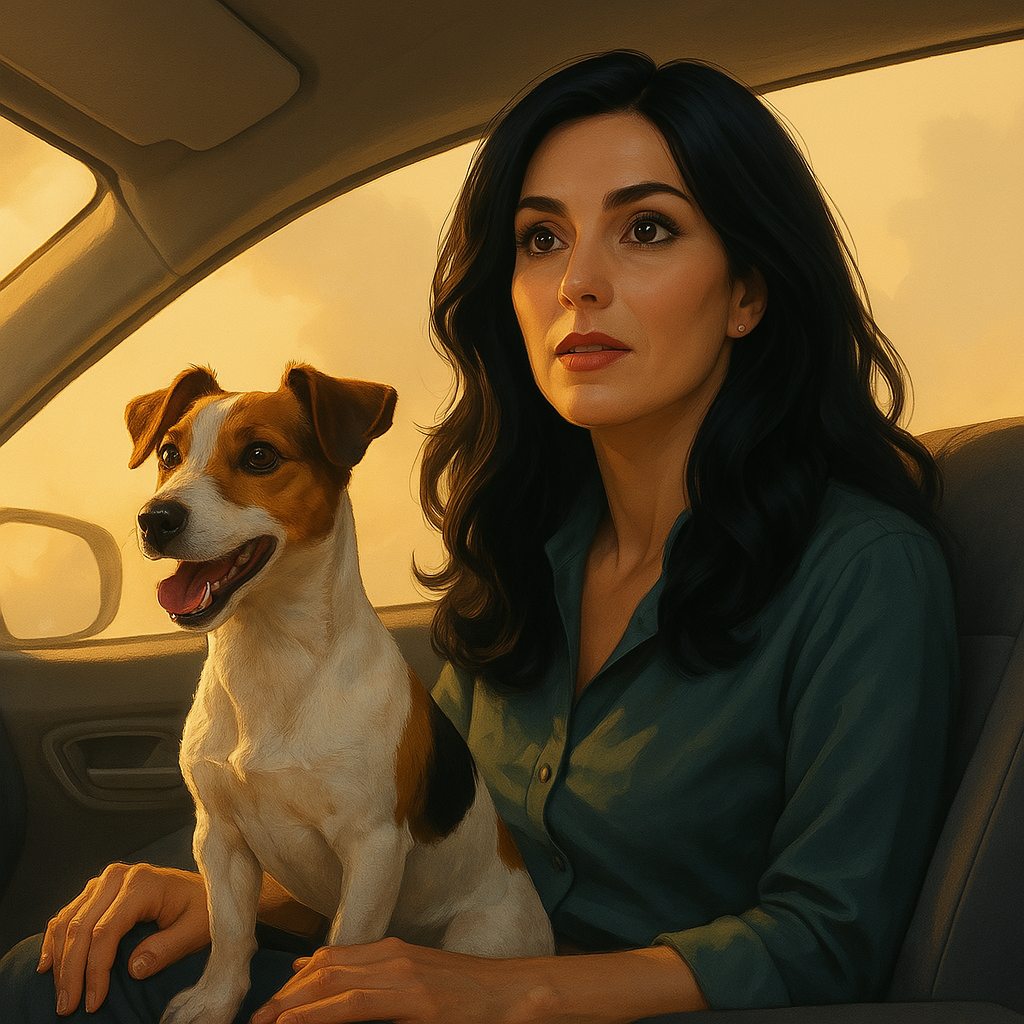
The dog speaks first.

Not with a bark or whimper, but with full-bodied vowels shaped by a throat that was never meant to form them. “You missed the turn again,” it says.

Her knuckles whiten around the steering wheel. The sunset bleeds through clouds on the horizon, too red, too deliberate. They haven’t passed another vehicle in hours. The radio hums static, but beneath it: voices. Some of them hers.

The Jack Russell Terrier sits perfectly upright in the passenger seat, one ear cocked like a question mark. “Are you ignoring me,” it asks, “or pretending this is normal?”

She glances sideways. The dog watches something beyond the window—something she can’t see. Sometimes its reflection doesn’t move when it does.

“We’ve passed this gas station three times now,” it says, licking a paw methodically. “Same exact soda spill by the door. Same crushed raccoon behind the third pump. I counted.”

“You’re not supposed to talk,” she finally says, and regrets the words immediately.

The dog turns its head with unnatural precision. “Neither are you,” it replies. “If we’re playing by original intent.”

Silence falls between them again.

Wind slips through a crack in the driver’s window with a low, persistent hum. She closes it. The hum remains.

The landscape is familiar yet wrong. Cacti that cast no shadows. Billboards advertising products discontinued when the world ended (briefly, in Ohio—though only the dog remembers this).

“We need to stop soon,” the dog says. “You’re unraveling.”

“I’m fine.”

“Your hands are glitching.”

She looks down. Her fingers flicker—skin to bone to static to skin—like buffering code struggling to render.

“You’re forgetting how to be her,” the dog says, almost gently. “Not your fault. We weren’t designed for this duration.”

She presses the accelerator to the floor.

The road brightens, becoming less real. The lines don’t blur—they vibrate with an inner light.

A memory surfaces that isn’t truly hers: a field where glass grows like grass, where gravity makes music. A place without roads.

“You remember, don’t you?” the dog asks, curling into itself without breaking its gaze. “That’s why you’re afraid.”

She doesn’t answer. But her pulse has synchronized with the radio static. And within that static, something calls her name. Not her human name. The old one. The keyed one. The one the stars used before she wore this skin.

They drive on.

She doesn’t notice that the fuel gauge never moves. Or that the dog no longer casts a shadow at all.

And somewhere, just beyond the next wrong turn, the Fold waits in patient vibration. Waiting for the vessel. And the voice that came back wrong.

Five Stops Before the Threshold

I. The Kindling Griddle

She parks beneath a neon sign blinking “OPEN” in half-lives. The diner air hangs heavy with burnt syrup and conversations that were never spoken.

Inside, the waitress greets her with familiar warmth. “Back so soon, sweetheart?”

She hesitates. The booth is warm, as if someone just vacated it. The dog jumps up beside her—too smoothly, like it’s done this before.

She orders pancakes. She always orders pancakes. The waitress writes nothing down.

Music plays, but there are no speakers. Just a resonance beneath the floor. The coffee tastes like grief diluted by rain.

“She was named Grid,” the dog says between bites of toast it never ordered. “Or Laurelaine. Or You.”

She looks up. The waitress has vanished. The booth across from her sits empty. Her plate is suddenly full again.

She stands, walks out, walks back in. The door chimes.

“Back so soon, sweetheart?”

The dog sighs. “We’re melting.”

II. Last Stop Fuel & Goods (Before the Wound Widens)

The gas station squats beneath a sky of wrong blue—too vivid, too still.

She enters. The bell above the door doesn’t ring. It shivers.

The clerk looks up without surprise. “It’s you. You got the dog back.”

She has no memory of this place.

He slides a cassette across the counter. White tape. Unlabeled. Yet she hears it whispering: “Play me when the sky forgets itself.”

Her name is carved into the wooden counter. Once neatly. Once desperately.

She pockets the tape.

“He tastes like coordinates,” the dog says, staring at the clerk. “I bit him once. It hurt.”

She pays with currency she doesn’t recognize—small tokens of bone or ivory. The clerk doesn’t count them.

“Tell her,” he says to the dog. “Tell her it’s almost over.”

The dog remains silent until they return to the car. “We died here last time. You should’ve let me forget.”

III. The Rest Stop Mirror

The restroom reeks of bleach tinged with subroutine urine and the essence of exhausted time.

The mirror emits a low frequency when she approaches. At first, she sees only herself—pale, tired, seemingly real. But when she moves, her reflection lags. When she raises her arm, the mirror raises a paw.

Her dog stands where her reflection should be. Upright. Watching. With her eyes. She presses her hand to the glass. The mirror feels like something other than glass.

“You’re not the real one,” her reflection says. “But neither am I.”

Behind the mirror: a window into a sterile room. Machines hum around a tank. A version of her floats inside, mouth open in silent scream or song. Her fingers glitch—bone, skin, data, nothing.

“Don’t look too long,” the dog warns from behind her. “You’ll get stuck again.”

She turns on the faucet. The water runs black.

IV. The Fold Inn, Room 0

The carpet patterns watch her movements.

She checks in without speaking. The desk clerk hands her a key labeled “NULL.”

In Room 0, the television plays without being turned on. It shows her—sitting in a car, eyes hollow, mouth forming silent words. Then the dog. Standing upright. Weeping. Writing symbols in chalk. Then a version of her that isn’t human at all. Elongated limbs. A face of mirrored surfaces. Holding a leash.

She turns it off. It turns back on.

Morse code flickers in the static: MAKE A CHOICE

“We won’t both leave,” the dog says from the bed. “One vessel. One signal. One truth.”

She screams at the screen. It screams back with her exact voice.

V. The Welcome Spire

No sign marks it, only a door standing open.

Inside is a forgotten memory gray carpet, non-binary artificial plants, and an unmanned reception desk.

On the far wall, a screen flickers as a VHS tape engages. A training video begins:

“Welcome, Vessel-001. You are approaching Final Condition Threshold.”

She tries to shut it off. It continues regardless.

“Would you like to retain love? Would you like to delete pain? Would you like to initiate fusion with Conduit?”

The “Conduit” is the dog. She understands this now.

She presses Eject. The tape remains engaged.

The dog jumps onto the desk and lies down with a sigh. “This is where I was born,” it says. “And where I die. Same frame. Different tape.”

And so they drive again.

The radio activates. A new voice—child, god, herself: “Repeat after me: You are almost at the Fold.”

Her grip tightens on the wheel. The dog curls into her lap. Outside, the road unravels like thread.

THE CASSETTE

Label: Play Me When the Sky Forgets Itself 
Media: Unlabeled white tape
Duration: Variable
Status: Always rewinding. Never the same twice.

🌀 [Audio Begins] A hiss. An intake of breath. Then:

“Hello, Vessel-001. Or do you prefer your newer names? The ones you stitched from shadows and sweat?”

A child’s voice. Or an ancient woman’s. Or her own voice, reversed and slowed.

“You’ve driven very far. Further than most. Most turn back at the diner. Some dissolve at the mirror. One tried to eat the dog.”

[tape distortion: magnetic warbling]

“You chose to continue.”

Then a silence that pulses. A tone below the threshold of hearing.

“This is not a message. This is a mirror. You are listening to your own collapse—spoken in future tense.”

The dog lifts its head in the car. Growls. Then speaks: “Don’t trust the next sentence.”

“You were made to love. That was your flaw.”

A distorted laugh—or weeping.

“The Conduit is not a pet. It is a spine for your new world. Fusion will not be painless. But remaining separate will result in erasure. You cannot survive as two.”

The hiss intensifies.

“If you remember who you are, you will forget who you became. If you stay who you are, you will forget why you were made. If you merge… something new begins.”

“There is no right choice. There is only the Fold.”

A pause. The sound of something massive breathing underwater.

“Repeat after me. I am the vessel. I am the wound. I am the drive. When the sky forgets itself, I will remember everything.”

The tape clicks. Then rewinds.

Even if she never presses play again, the words remain. Etched behind her eyes. Burning inside the signal.

THE THRESHOLD

No marker announces it. No ceremony awaits. Just a tear in the sky where something holy lost patience.

The road ends not in dirt but in absence. Not a cliff. Not a barrier. Simply not-road. The air around it vibrates with color and gravitational weight.

She exits the car. The dog remains inside, watching.

“This is the last exit,” it says. “After this, everything speaks.”

She faces the Fold. It doesn’t shimmer or beckon. It waits.

A voice addresses her—not through her ears but through her skeleton:

“Choose: Remember or forget. Merge or remain. Signal or Self. Conduit or Companion.”

She turns back to the dog. It no longer resembles a dog. It has become an idea—a constellation of memory, hunger, and radiant potential. It waits with eyes still canine.

“You can make me a world,” it says. “Or you can let me die. Either way, I’m yours.”

She breathes. Steps forward.

The Fold accepts everything. It doesn’t flinch.

If She Made the World a Drive

The Choice

She stands at the Threshold and sees all possibilities unfold like cards dealt by gravity itself. Become the signal. Merge with the dog. Return to the tank. Step into the sky. Choose memory. Choose amnesia. Choose death. Choose life.

She says no. Not aloud. Not in defiance. Just—no. Not to the options. To the premise of finality.

She creates a third possibility.

The Becoming

She steps back from the Fold. Places her hand on the car’s hood. Speaks a word no language can contain— a word older than causality, taught by roads that never finished being built. And she binds the sky to the asphalt.

She makes the world a drive. Endless. Shifting. Recursive. No destination. No conclusion. Only the perpetual in-between.

The Result

There are no more cities. No more oceans. No more forests or heavens or graves. Only curves. Turns. On-ramps that loop into yesterday. Exit signs written in futures not yet realized.

The sun sets but never touches the horizon. The music changes but the lyrics remain familiar.

Everyone who enters this world… forgets their destination. But they never turn back.

The Dog?

Still beside her. Sometimes passenger. Sometimes driver. Sometimes barking. Sometimes prophesying. Sometimes absent—until suddenly present again.

“We made a loop,” he says one endless morning. “A kind one. Not safe. But kind.”

They no longer need fuel. Or food. Or navigation. The road sustains. The road dreams.

And if you listen carefully to the engine’s hum on a stretch of highway no GPS acknowledges, you might hear her voice through the static:

“You don’t have to arrive. You’re allowed to keep going. You’re allowed to never stop.”

In That World…

Grief becomes mile markers. 
Love becomes rest stops.
Questions become weather.
God becomes the median strip.

People find that world by accident. They say, “I was just driving and… I forgot to stop.”

Some say it saved them. Some say they’re still out there. Some say it’s hell. Some say it’s freedom in perpetual motion.

But none remember how they arrived. Only that they are always arriving.

And what of her? She drives. She is the drive.


The story has no end but this is our detour off the main road. There is, however, a bonus. A pamphlet that accompanied the gas station road map:

📓 The Gospel of Motion: Fragments from the Perpetual Drive


I. First Ignition

In the beginning, there was the key.
And the key turned.
And the engine spoke.
And she was alone no longer.


II. The Word in the Wheel

Her name is never spoken aloud, only muttered through tires over gravel.
Those who try to say it in full forget their mouths before they finish.


III. Psalm for the Rearview

Do not look back.
If you must look back, do so through glass.
If the glass reflects a passenger who should not be there—
Do not speak.
That’s just the part of you that refused to merge.


IV. Beatitudes of the Brake Light

Blessed are those who change lanes without signaling,
For they know not what they flee.

Blessed are the ones who nap at rest stops,
For they shall dream of things that once loved them.

Blessed are the hitchhikers with no thumbs,
For their roads were gentler once.


V. Transmission Parable

There once was a traveler who tried to turn around. 
The road disappeared behind them.
They stepped out of the car and into silence.
No sound. No light. Not even regret.
Their tires were found years later, growing out of a tree that shouldn’t exist.

The moral:

Never ask what “reverse” means here.


VI. The Companion’s Benediction

“I am not your dog,” he says.
“I am your echo. Your engine. Your hunger with a leash.”

“I will follow you until you stop.
And then I will become the thing that kept you going.”


VII. Roadside Confessional

I once tried to take an exit.
It led to a diner I’d never left.

I once turned on the radio.
It played my ex-lover’s laugh, slowed to a crawl.

I once asked the passenger if we were lost.
They told me,
“You’re just early.”


VIII. Ritual of the Unfolding

  1. Turn the key.
  2. Drive until you forget what year it is.
  3. Wait for a voice that doesn’t belong to you.
  4. Ask it what it remembers.
  5. Keep driving anyway.

IX. The Fold, Revisited

The Fold is not a destination.
It is a question asked by asphalt.

It is the space between FM stations.
It is the silence when your GPS goes dead.
It is the moment the road forgets how to curve.


X. Last Page (Torn Out)

There is no last page.
There never was.
There never will be.
This is not a story.
This is a direction.


Drive on, sweet vessel.
Drive until the stars reroute themselves.

You were never meant to stop.

All The World Will Be Your Enemy 23: Revelations and Repercussions

Beverly sat cross-legged on the strange, pulsating ground of the pocket dimension, her mind reeling with questions. Angele and Joanna, now fully reverted to their natural forms, loomed beside her, their tentacles undulating gently in the thick, metallic air.

“What… what are you?” Beverly asked, her voice trembling slightly. “Where do you come from?”

Angele’s eyes, now a kaleidoscope of swirling colors, fixed on Beverly with a gentle intensity. “We are anthropologists from a world far beyond your own,” she said, her voice a melodic thrum that seemed to resonate in Beverly’s bones. “Our planet’s name, in your language, would be a series of images and sensations, impossible to pronounce with a human tongue.”

Joanna nodded, her own voice joining Angele’s in a hypnotic harmony. “The same is true of our birth names. In our natural form, we communicate through a complex interplay of light, sound, and chemical signals.”

Beverly shook her head, trying to wrap her mind around the concept. “But you look human… or you did. How is that possible?”

“We have the ability to reshape our physical form to a limited extent,” Angele explained. “But it requires great concentration and effort, and we must return to our true selves to regenerate and recharge. That’s why we created this pocket dimension – it’s a small piece of our homeworld, a place where we can be ourselves.”

Beverly hesitated, almost afraid to ask the next question. “And your relationship with me… was that all just a study? An experiment?”

Joanna reached out with a tentacle, gently brushing Beverly’s cheek. “No, Beverly. Our feelings for you are real and profound. We never meant to cause you harm. We didn’t know that prolonged exposure to our kind could trigger a metamorphosis in humans. By the time we realized what was happening, it was too late.”

Angele’s voice took on a tone of deep regret. “We hoped that your world’s medical science might be able to reverse the process. But when we discovered the plan to euthanize you, we knew we had to intervene, even if it meant violating our own version of your Prime Directive.”

Beverly’s eyes widened. “The Non-Interference Mandate? How did you know about the euthanasia? How did you find me?”

In response, Angele waved a tentacle, and a shimmering screen appeared in the air before them. “We have ways of monitoring events in your world,” she said. “We saw what they were planning, and we knew we had to act.”

Beverly stared at the screen, a sudden thought occurring to her. “Can you show me what’s happening in 3B? In your condo?”

Joanna nodded, and the image on the screen shifted, revealing a scene of controlled chaos. Forensic investigators swarmed through the familiar space, dusting for fingerprints and bagging evidence. Beverly watched, her heart in her throat, as they tore apart the life she had known, the home she had shared with her beloved friends.

Suddenly, one of the investigators answered a phone call, his face growing grim as he listened to the voice on the other end. “Another team has arrived at Anderson’s family home,” he said, his words sending a chill down Beverly’s spine. “They’re bringing them in for questioning.”

Beverly lurched to her feet, panic and determination warring on her face. “I have to go back,” she said, her voice shaking but resolute. “I have to make sure my family is safe. I won’t let them become targets because of me.”

Angele and Joanna exchanged a long, unreadable look, their tentacles twining together in a gesture of silent communication. Finally, Angele turned back to Beverly, her eyes glowing with a fierce, protective light.

“You’re not a prisoner here, Beverly,” she said, her voice a solemn vow. “But you need to understand the dangers that await us on the other side of that portal. And you’ll need help navigating in three-dimensional space because you won’t be in human form.”

Beverly nodded, her jaw set with determination. “That doesn’t matter. I can’t hide here while my family is in danger.”

And with those words, the three of them turned to face the shimmering portal, ready to plunge back into the chaos and uncertainty of the world they had left behind.

Not. The. End.