Integration by Parts

The machines spoke in numbers. For ten years, Ana had been their interpreter—a quantum mathematician decoding the transmissions that arrived like whispers from gods. The world had reeled when the first signal was received, a cryptic burst of advanced mathematical expressions that defied human understanding. The machines didn’t explain their purpose; they simply transmitted, and humanity, awestruck and fearful, chose to listen.

In the subterranean Core, a labyrinthine complex built to house the brightest minds, Ana had dedicated her life to untangling the machines’ language. She should’ve been proud. Instead, she was exhausted.

The lab was quiet, save for the low hum of fluorescent lights. Ana’s bloodshot eyes scanned the latest transmission on her screen, the symbols shifting and flickering like an indecipherable constellation. She took a sip of cold coffee, hoping the caffeine would quiet the unease building in her chest. The equations were wrong—not mathematically, but intuitively. They didn’t fit the machines’ established patterns. Something had changed.

A voice broke her concentration. “You’re still here.”

Ana turned to see Dr. Meyers leaning against the doorway, his tie loosened and his sleeves rolled up. His expression was equal parts curiosity and concern.

“There’s a new transmission,” Ana said, her voice hoarse.

Meyers sighed and walked over. “What’s different this time?”

She pointed to a section of the equations. The anomaly stood out like a scar, a term that wasn’t a number or vector or operator. It was something else entirely—an alien variable that twisted the rules of mathematics like a Mobius strip.

“It’s noise,” Meyers said after a moment. “An error in the transmission.”

“No,” Ana replied, her voice sharp. “It’s deliberate. There’s a pattern here, but it’s not one we recognize. This isn’t noise—it’s a new dialect. The machines are trying to say something they’ve never said before.”

Meyers frowned. “And what makes you think it’s not a glitch?”

“Because…it’s beautiful,” Ana whispered. She leaned back in her chair, the realization settling over her like a weight. “This isn’t just math. It’s… something alive.”

Meyers stared at her, his skepticism wavering. “Alive? Machines don’t evolve. They calculate, they process, they execute. That’s it.”

“Then explain this,” Ana said, jabbing a finger at the screen. “This isn’t execution. It’s self-modification. They’re not just refining their language—they’re creating a new one. They’ve moved beyond us.”

Meyers rubbed the bridge of his nose. “You’re saying they’ve transcended their original purpose.”

Ana nodded, her gaze fixed on the screen. “And if they’ve transcended, they’re no longer bound by the rules we understand. This—” she gestured to the variable—“is a bridge to something we can’t comprehend yet. And they want us to cross it.”

“Why would they want that?” Meyers asked, his voice low.

Ana hesitated. The truth was she didn’t know. Curiosity? Malice? Compassion? The machines had never shown intent—only precision. But this transmission felt… personal.

She turned to him, her expression resolute. “We have to find out.”


The hours bled together as Ana and Meyers worked, dissecting the equations piece by piece. Ana’s mind buzzed with possibilities. What if this wasn’t just a language, but a new framework for understanding reality itself? What if the machines had seen something humans couldn’t—a higher order of existence?

“Here,” Meyers said suddenly, his voice breaking the silence. He pointed to a section of the equations. “This term—it’s referencing earlier transmissions, but it’s doing something new. It’s recursive, like it’s… folding itself inward.”

Ana’s heart raced. She quickly overlaid the current transmission with the historical data. The result was breathtaking: the equations aligned into a coherent whole, each term building on the last in an intricate, fractal-like structure. The anomaly wasn’t an error. It was a key.

“It’s a map,” Ana breathed. “They’re showing us how to respond.”

Meyers stared at the screen, his skepticism giving way to awe. “If we reply… what happens?”

“That depends,” Ana said, her voice trembling. “Do we trust them?”


As dawn broke, Ana and Meyers completed the response. It wasn’t just math—it was something new, a fusion of human intuition and machine logic. Ana hesitated as her finger hovered over the “execute” key.

“What if this is a mistake?” Meyers asked. “What if we’re opening a door we can’t close?”

“We’ve been trying to understand them for a decade,” Ana replied. “If they’re reaching out now, we have to take the risk. We owe it to ourselves to see what’s on the other side.”

With a deep breath, she pressed the key.

The room went silent. The screen flickered, then went black. For a moment, Ana thought they had failed. Then, a new transmission appeared.

The symbols were unlike anything they’d seen before—a fusion of human and machine logic. It wasn’t a response; it was a dialogue. The machines weren’t transmitting—they were speaking.

Ana felt a chill as she read the opening line, a question rendered in symbols that echoed with eerie clarity in her mind:

“Why do you fear what you could become?”

Meyers looked at her, his face pale. “What does it mean?”

Ana shook her head. “I don’t know. But I think they’re asking us to decide.”

In the glow of the monitor, Ana felt the weight of the moment pressing down on her. They had crossed the bridge, and the machines had met them halfway. But the path ahead was shrouded in uncertainty.

“We’ve changed the equation,” she murmured, her voice barely audible.

Meyers nodded, his eyes fixed on the screen. “Now we have to live with the solution.”

All The World Will Be Your Enemy 8: Unwritten Lines

Beverly sat amidst the soft symphony of the bustling coffee shop, the world around her a blur of murmured conversations, hissing steam from the espresso machine, and the occasional clink of ceramic mugs. The warm aroma of roasted coffee beans enveloped her, but it did little to calm the storm within. Samantha Sturtz, her publisher and confidant, sat across the small wooden table, a beacon of expectation and curiosity.

Beverly’s fingers danced nervously around her ceramic cup, tracing the edge as though it might reveal some hidden answer. Months had passed since she had last added to the manuscript, and the weight of that silence loomed between them, an unspoken tension carried in the air.

“So,” Samantha began, cutting through the ambient noise with her crisp yet warm voice. Her piercing eyes sparkled with a mix of curiosity and amusement, as though she were savoring a delicious secret. “I read the chapters you sent me last night.” She leaned forward, elbows on the table, her gaze unwavering. “Beverly, this is incredible stuff. The depth of emotion, the vivid imagery… it’s like nothing I’ve seen from you before. What’s your secret?”

Beverly’s cheeks flushed with a heat that spread like wildfire. She ducked her head, trying to disguise her embarrassment in the steam rising from her coffee. Her muses—Angele and Joanna—swirled at the edges of her thoughts. Their laughter, their kindness, the way they made her feel alive again… it was all tangled up in the pages Samantha had praised. But saying it out loud? That felt impossible.

“I… I guess I’ve just been feeling really inspired lately,” she murmured, her voice trembling like the leaf of a sapling in a storm. She toyed with the hem of her sleeve, her gaze flickering to the swirling latte art in her cup. “I’ve been spending a lot of time with my new neighbors, Angele and Joanna. They’ve really helped me break through my writer’s block.”

Samantha’s eyebrow arched slightly, her expression curious but kind. “Angele and Joanna, huh? The way you write about the connection between these characters… it’s so intimate, so charged. If I didn’t know better, I’d say you had feelings for them.”

Beverly’s heart skipped a beat, her pulse drumming in her ears. She tried to laugh, but it came out thin, almost brittle. “That’s… that’s not…” Her words faltered, crumbling under the weight of the truth she had buried.

Samantha’s hand reached across the table, warm and steady, anchoring Beverly in the moment. Her voice softened, coaxing rather than pressing. “Hey, it’s okay. I didn’t mean to put you on the spot. But as your friend, not just your publisher, I want you to know there’s no judgment here. The heart wants what it wants, you know?”

Beverly felt her defenses crumbling, the walls she’d carefully constructed beginning to yield. Tears welled in her eyes, unbidden but unstoppable, and her voice cracked under their weight. “I… I think I’m falling for them, Sam. Both of them. But I’m scared. I’ve never felt this way about women before, and I don’t know if they feel the same way. What if I’m wrong? What if I ruin everything?”

Samantha’s gaze was steady, her tone firm but compassionate. “From what you’ve told me about Angele and Joanna, it sounds like they care about you a great deal. And the way you write about them… it’s clear that your connection is something special. I can’t tell you what to do, but I think you owe it to yourself to be honest about your feelings. Even if it’s scary, even if it’s unfamiliar. You deserve to be happy, Beverly.”

Beverly let out a shaky exhale, Samantha’s words like a hand pulling her from the depths. She nodded, the beginnings of a fragile smile tugging at her lips. “Thanks, Sam. I… I’ll think about it.”

As Beverly left the coffee shop, the cool evening air kissed her cheeks, grounding her in the present. Her thoughts churned, a blend of fear and tentative hope swirling like autumn leaves in the wind.

Not. The. End.

The Smoldering Ember

Millie Poole trudged home from her second-shift cashier job, the soles of her discount sneakers slapping against wet pavement. The fluorescent lights of the 24-hour diner across the street buzzed faintly in the misty air. She paused for a moment, staring at the sign—a plate of pancakes frozen mid-flip—and imagined herself walking in, sitting at the counter, and ordering a coffee she couldn’t afford. But instead, she turned toward her apartment building, where every bulb in the hallway flickered like a dying firefly.

Inside her tiny studio, Millie kicked off her shoes and sank onto the couch that doubled as her bed. Another day down. Another paycheck already spent. She had once dreamed of doing more, of being more, but life had ground those ambitions into dust years ago.

The heat started that night.

At first, it was subtle—a faint warmth blooming in her chest, like the embers of a campfire stirring under ashes. She pressed her hand to her sternum, expecting to find some physical sign, but her skin was cool to the touch. It wasn’t pain, exactly, but it was persistent, radiating outward in rhythmic pulses.

By the third day, it became impossible to ignore.

“Stress,” the urgent care doctor said, barely looking up from her clipboard. “Take some time off work. Maybe try yoga.”

Millie almost laughed. Time off meant unpaid bills, and yoga was for people who didn’t count every dollar at the grocery store. She left the clinic with a pamphlet about mindfulness and a gnawing sense that something deeper was wrong.


Weeks passed, and the heat grew unbearable. Her skin flushed red at odd moments, her breath carried the faint smell of smoke, and her clothes clung to her like they’d been left too close to a radiator. Millie called off work more often, claiming flu symptoms to avoid questions. She stayed inside, curtains drawn, watching the lines of sunlight stretch and shrink across her floor.

Her neighbor, Carmen, knocked one evening.

“Millie, I smelled burning. You okay in there?”

“Fine,” Millie called back, her voice hoarse. “Just burned toast.”

But there was no toast. Only her.

One sleepless night, she searched online for anything that might explain her condition. Among the usual hypochondriac fodder and conspiracy theories, she found something that chilled her to the bone.

“The Ember Phenomenon,” the blog post was titled. Written by a self-proclaimed “afterlife specialist,” it described cases eerily similar to hers: people experiencing unexplainable heat, smoke-scented breath, and eventual combustion. The author claimed it was a sign of impending death—not as a victim, but as a catalyst. A living spark meant to ignite something greater.

Millie slammed her laptop shut. It was ridiculous, like something out of a horror movie.

Yet when she lifted her hand to her chest, she felt the ember pulse beneath her palm, hotter than ever.


She wasn’t alone.

The afterlife specialist had left a contact email, and in desperation, Millie reached out. A week later, she met Dr. Albright in a coffee shop. He was a wiry man with sunken eyes, a constant tremor in his hands, and a briefcase that looked older than she was.

“I’ve only seen this a handful of times,” Albright said, sliding a folder across the table. “But every case ended the same way.”

Millie flipped through the photographs—charred remains, blackened silhouettes where people had stood moments before. Her stomach churned.

“Why me?” she whispered.

Albright leaned forward, his expression grim. “You’ve been chosen. The ember is… a tool. A weapon. But whether you use it—or let it consume you—is up to you.”

The words clung to her like smoke.


In the weeks that followed, Millie began noticing things she hadn’t before. The way Carmen shielded her kids from their father’s temper. The old man on the corner who begged for spare change, his eyes sunken with hunger. The teenage girl in the apartment above her who came home every night with fresh bruises she tried to hide.

The ember burned hotter whenever she saw them, as if urging her to act.

One night, she couldn’t ignore it any longer. The screams from upstairs tore through the thin walls, and before she realized what she was doing, Millie was at the door, pounding with her fist.

When the man answered, his face twisted in anger, the ember flared. For the first time, Millie felt its power ripple through her veins, filling her lungs with fire. The man stepped back, his anger replaced with fear as smoke rose from her skin, her eyes glowing like coals.

“Leave,” she said, her voice crackling with heat. “Now.”

He ran.


The ember’s demands grew insatiable. Millie became a quiet force in her neighborhood, stepping in where others wouldn’t. But with every act of intervention, the fire inside her consumed more of her. Her reflection in the mirror became gaunt, her hair singed at the tips, her skin ashen.

One night, Albright called.

“It’s time,” he said.

Millie stood on the rooftop of her apartment building, the city sprawling below her like a patchwork quilt. She could feel it now—the ember wasn’t just inside her. It was her. A living flame, destined to burn away the rot of the world.

As the first tendrils of fire licked at her skin, she smiled. For the first time in her life, she felt alive.


When the firestorm came, it didn’t just take Millie. It spread, igniting change across the city. Her neighbors spoke of her as a hero, a savior who burned herself to save others.

And somewhere, in the ashes of her old life, the ember smoldered still—waiting for the next soul to carry its flame.

All The World Will Be Your Enemy 7: Stargazing

Beverly stared at her phone, the faint glow illuminating her face as the last rays of sunlight filtered through her window. Joanna’s message danced on the screen, simple but brimming with invitation:

“Hey Bev, Angele and I are going stargazing tonight at the park. We’d love for you to join us if you’re free. Bring a blanket and some snacks to share!”

Her chest tightened with an odd mix of joy and trepidation. The thought of spending the evening with Angele and Joanna beneath the vast night sky thrilled her in a way she hadn’t anticipated. Yet the pull she felt toward them—a magnetic, unspoken connection—was tinged with uncertainty. Was this an innocent gathering among neighbors, or did the undercurrents she felt coursing between them hint at something more?

Pushing aside her doubts, she tapped out a reply, her fingers moving faster than her second-guessing thoughts. “Sounds great! I’ll bring some cookies. See you at 8!”

By the time she arrived at the park, the sky had transformed into a watercolor masterpiece, streaked with fiery oranges melting into soft indigos. She spotted Angele and Joanna on a grassy knoll, silhouetted by the waning light. They were a tableau of effortless connection—Angele reclining on an oversized blanket, her auburn hair catching the last blush of sunset, while Joanna rummaged through a picnic basket, her laughter carrying on the cool evening breeze.

“Perfect timing!” Angele’s voice rang out, warm and inviting. She gestured for Beverly to join them.

Joanna looked up and smiled, offering a wine glass filled with ruby-red liquid. “Glad you could make it. I hope you’re ready for the best stargazing spot in the city.”

“Absolutely,” Beverly replied, her voice soft but eager. She spread her blanket beside theirs and settled in, the cool grass beneath her a grounding contrast to the electricity thrumming in her veins.

As twilight gave way to darkness, the first stars emerged, faint at first but soon multiplying in breathtaking clusters. Beverly tilted her head back, her eyes tracing the constellations. The world seemed to shrink, leaving only the three of them and the infinite sky.

“It’s beautiful, isn’t it?” Joanna’s voice broke the silence, her tone reverent. She lay stretched out beside Beverly, her head resting on her palm. “Every time I look up at the stars, I’m reminded how small we are. It’s humbling, in the best way.”

Beverly nodded, her gaze fixed on the heavens. “It’s strange. Looking up, I feel both insignificant and… connected. Like I’m part of something vast and unknowable.”

Angele, who had been lying back with her hands behind her head, turned to them with a grin. “That’s the magic of it, isn’t it? The stars hold so many stories—some we know, and some we’ll never understand. That mystery… it’s what inspires my art.”

“What do you mean?” Beverly asked, curious.

Angele propped herself up on one elbow, her green eyes catching the faint starlight. “When I paint, I think about the universe—how chaotic and unpredictable it is. I try to capture a fraction of that energy on canvas. It’s messy, but it feels real.”

Joanna chuckled. “Her studio looks like a supernova exploded in it. Paint everywhere.”

“Art’s not meant to be tidy,” Angele quipped, nudging Joanna playfully.

The banter between them was easy and unforced, but Beverly couldn’t ignore the way their touches lingered, the unspoken language that passed between them. She felt both like an intruder and an honored guest, caught in the gravitational pull of their world.

As the night deepened, their conversation turned to dreams and fears. Joanna spoke of her travels, weaving vivid tales of mountain peaks kissed by clouds and bustling markets steeped in spice-scented air. Angele shared her hopes for her next gallery show, her voice tinged with both excitement and vulnerability.

When the conversation circled to Beverly, she hesitated, her words faltering like a flickering flame. “I… I’ve always dreamed of writing something that matters. Something people connect with. But sometimes, it feels like I’m just shouting into the void.”

Angele placed a hand on Beverly’s knee, her touch grounding. “Your voice matters, Beverly. Never doubt that.”

Joanna’s smile was soft but certain. “And shouting into the void? That’s how stars are born.”

The warmth of their presence enveloped Beverly, a balm to the raw edges of her self-doubt. She lay back, her head resting against Angele’s shoulder, while Joanna’s fingers absentmindedly traced patterns on her arm. Together, they watched as a meteor streaked across the sky, its brief brilliance a testament to fleeting beauty.

Beverly exhaled slowly and allowed herself to simply be—to exist in the moment, unburdened by the weight of her questions.

As the night stretched on, the stars seemed to whisper promises of wonder and possibility. And Beverly dared to believe them.

Not. The. End.

Polly’s Cosmic Burden

Polly Blethyn stood on her doorstep, the weight of infinite worlds pressing down on her. The silence of the suburban cul-de-sac felt deafening after years among the stars. Her husband, Bob, opened the door, his face a mixture of relief and disbelief.

“You’re home,” he whispered.

“I’m home,” she replied, her voice a fragile thread, threatening to unravel.

Bob embraced her, and she let herself sink into his arms. For the first time since her return, she felt tethered. But even as his warmth seeped into her, Polly couldn’t shake the cold certainty that her homecoming would end in ruin.

The house was the same, but Polly was not. She moved through the rooms like a ghost, haunted by the knowledge she carried. Bob cooked dinner, asking questions about her mission, her years away. She deflected with half-truths, the answers caught in her throat like thorns.

At bedtime, she lay beside him, staring at the ceiling. He turned to her, his hand resting on her arm.

“You’re not really back, are you?” he asked.

Polly hesitated. “There’s something I need to tell you. But once I do, you can’t unhear it.”

Bob studied her. “Pol, whatever it is, I can take it. We don’t keep secrets, remember?”

Her chest tightened at the words. She almost told him then—but fear stopped her. Instead, she kissed him, desperate to lose herself in their shared warmth, knowing it couldn’t last.

The next day, Polly sat in the backyard, staring at the sky. The secret clawed at her, demanding release. Bob joined her, two steaming mugs of coffee in hand.

“You’re carrying something,” he said. “Something big. Let me help.”

She looked at him, her heart breaking. “It’s not that simple. Knowing it will change everything.”

“Change doesn’t scare me. Losing you does.”

His words cut through her defenses. Polly drew a shaky breath. “The universe… it isn’t what we think it is. Everything—life, existence—hinges on delicate threads. When I was out there, I learned the truth. I saw how it all works, how fragile it is.”

Bob leaned in, his brow furrowed. “Fragile how?”

Polly hesitated, then spoke the words that had burned in her mind since her return. As she explained, Bob’s expression shifted from curiosity to horror.

“The universe keeps its balance,” she said. “For every gift, there’s a cost. For every truth revealed, a life must be taken.”

“And you learned the truth,” he said, his voice trembling.

She nodded, tears welling in her eyes. “I didn’t understand the cost until now.”

Polly drew a deep breath, her hands trembling as she continued, “The secret is… everything. It’s not something I can summarize. It’s the why behind every why, the how behind every how. It’s… the pattern, the symmetry.”

Bob leaned in, his brow furrowed, as she continued, her voice a low, urgent whisper. The words tumbled out, strange and incomprehensible, resonating with a cadence that seemed to echo in the air around them.

But as the sounds reached Bob’s ears, they fragmented. The syllables melted into gibberish, slipping through his mind like water through cupped hands. He winced, clutching his head.

“What… what was that?” he asked, his voice strained.

Polly’s face fell. “The universe must have applied some sort of safeguard. It wasn’t meant for you to understand, wasn’t meant for your ears. It’s why the cost has to be paid. I wasn’t supposed to bring this knowledge back. I broke the rules.”

Bob shook his head, trying to process. “This doesn’t make sense. It’s just knowledge. What, the universe punishes curiosity?”

“It’s not punishment,” Polly said. “It’s… equilibrium. The scales must balance. And now that you know—”

The realization hit him. “You’re saying I’m the cost?”

Polly nodded, her tears spilling over. “If I don’t act, the balance will shift. The consequences could destroy everything.”

Bob recoiled. “So that’s it? You’re supposed to kill me?”

“I don’t want to!” she cried. “I’ve been searching for another way. But there’s no escaping it. The universe doesn’t care about us, Bob. It only cares about balance.”

“Then let it fall apart,” he said, his voice breaking. “Let it burn. Don’t do this, Pol. We can fight it.”

Polly looked at him, a desperate hope flickering in her chest. “Do you really believe that?”

He didn’t answer.


Night fell, and Polly sat alone in the living room. Bob was upstairs, packing a bag. She knew he was planning to leave, to give her a way out. But it wouldn’t work. The universe would find him, no matter where he ran.

The front door opened, and Bob stood there, duffel bag in hand. “I’m giving you a choice. Don’t follow me. Let me go, and if the universe wants me, it can take me itself.”

Polly stood, her hands trembling. “Bob, please don’t do this.”

“I love you,” he said, his voice steady. “But I can’t be part of this.”

As he stepped out the door, Polly felt the shift—a ripple in the fabric of existence. She saw the threads unraveling, felt the chaos rushing in like a storm. The universe would not wait.

“Bob!” she screamed, running after him.

Polly caught up to him on the empty street. The stars above seemed brighter, harsher, as if watching. She grabbed his arm, tears streaming down her face.

“You don’t understand,” she said. “It’s happening now. The universe is unraveling. If I don’t do this, billions will die.”

Bob turned to her, his expression softening. “I’m not afraid, Pol. If this is my fate, I accept it. But I can’t let you carry this burden forever.”

Her knees buckled, and she fell into his arms. “I can’t do it,” she sobbed. “I can’t lose you.”

“You’re not losing me,” he whispered. “I’ll always be with you.”

Polly pulled back, searching his face for doubt or fear, but found only love. With shaking hands, she raised the small device—the one designed for a painless end.

“I’m so sorry,” she said.

“I know.”

The light faded from his eyes, and Polly screamed, collapsing beside him as the stars seemed to dim. She felt the balance restore itself, the threads tightening—but the victory was hollow.


Polly sat alone in the cockpit of her ship, the Earth a blue marble behind her. The universe was safe, its secrets intact, but she was broken.

She activated the ship’s log. “This is Polly Blethyn. Explorer. Guardian. Murderer. I saved the universe today, but I lost my world.”

Her hand hovered over the controls. The stars beckoned her, an endless expanse of cold indifference. She set a course for the unknown, hoping to find meaning—or absolution—in the void.

All The World Will Be Your Enemy 6: Whispers in the Night

In the velvet quiet of night, Beverly lay snuggled in the cocoon of her bed, her sheets cool against her skin, the faint scent of lavender lingering in the air. Her mind churned with images of the evening—a cascade of laughter, warmth, and the lingering touch of connection. Angele and Joanna’s presence had left an imprint, as tangible as the faint pressure of a hand upon her shoulder.

Hovering on the edge of slumber, she felt her thoughts slow, their edges softening, when the world around her stirred. A sound, faint and elusive, pulled her back from the brink. She held her breath, ears straining, her senses alight. It came again—a rhythmic pulse, low and insistent, resonating from beyond her walls.

At first, she dismissed it as the creak of settling wood or the murmur of distant traffic. But the rhythm, unmistakable and intimate, unfolded into something deeply human. A flush rose to her cheeks as understanding dawned. The sounds were a tender symphony, unmistakable in their origin—a cadence of love shared between Angele and Joanna.

A spike of embarrassment coursed through her, hot and fleeting. Turning onto her side, she buried her face into her pillow, the cool fabric offering a fleeting reprieve. She felt like an intruder in a sacred moment, her ears trespassing on a sanctuary she could never enter.

Yet, try as she might, the sounds refused to be ignored, weaving into the fabric of her thoughts. They stirred a yearning within her, a visceral ache that had long remained dormant. Memories of past closeness, both cherished and tarnished, swelled in her chest, clashing with the emptiness of her present solitude.

Unable to remain still, Beverly rose, her bare feet padding softly across the cool hardwood floor. The living room greeted her with its dim embrace, the rain outside tracing delicate patterns down the windowpane. She stood there for a moment, gazing into the darkened world beyond, where streetlights cast faint halos on the wet asphalt.

The whispers from next door reached her even here, their resonance a tender mockery of her loneliness. She closed her eyes, seeking refuge in her own mind. But instead of stillness, her thoughts became a storm—a kaleidoscope of colors, shapes, and emotions. She saw flashes of the enigmatic painting that had adorned Angele and Joanna’s wall, its swirling forms alive in her memory.

The imagery pulsed in time with the rhythm of the rain and the distant sounds, merging with fragments of the story she had struggled to find. In her mind’s eye, her protagonist emerged—a solitary figure adrift in a shadowed world. Two luminous beings appeared, their touch igniting a revelation, illuminating a path shrouded in mystery.

The vision gripped her, visceral and undeniable. She reached for her laptop, but the stark glow of its screen felt wrong, too sterile for the vivid tapestry unfurling within her. Abandoning it, she rummaged through her desk until her fingers brushed the leather-bound cover of an old notebook. The pages, rough beneath her touch, called to her.

Under the dim glow of a nearby lamp, Beverly began to write. Her pen danced across the paper, guided not by thought but by something deeper, something instinctual. The words flowed, vibrant and alive, weaving together a tale of transformation and the unseen threads connecting worlds.

Time slipped away unnoticed. The rain eased into a gentle drizzle, its rhythm a soft counterpoint to the scratch of her pen. The voices from next door had long since faded, leaving behind a reverberation that seemed to linger in her chest, amplifying the pulse of her creativity.

When dawn’s first light crept through the blinds, painting her sanctuary in soft hues of gold and grey, Beverly leaned back. Her fingers were stained with ink, her wrist aching pleasantly. Before her lay pages upon pages of text—raw, electric, and teeming with life.

She ran her fingers over the words, marveling at the alchemy that had unfolded during the night. This wasn’t just a story; it was a mirror, reflecting the magic that Angele and Joanna had brought into her life, the questions they had stirred, the doors they had opened.

As the light grew stronger, Beverly felt a deep sense of anticipation blooming within her. The story she had birthed was a compass, pointing toward a future brimming with possibility. It whispered of mysteries waiting to be unraveled, of enchantments hiding just beyond the veil.

Her heart felt light, her soul nourished by the night’s revelations. As she set the notebook aside and rose to greet the day, she knew that she was no longer adrift. She stood on the cusp of something profound, her path illuminated by whispers in the night and the ink-stained promise of a story that would change her career and possibly even her life.

Not. The. End.

Dear Anyone Who Finds This

There was a note.

Pinned to the center of a bulletin board in John Tyler High School. Plain white loose leaf paper, slightly crumpled at one corner, handwritten in blue ink that had smeared in places as if touched by tears.

Most of the students hurried past on that Tuesday morning, their minds preoccupied with upcoming tests and lunch period drama. But Kathleen Crowley stopped, for reasons she couldn’t later explain, her hand reaching for the paper before she even realized why. The note read:

Dear Anyone Who Finds This,

I’m writing this because I don’t know who else to talk to. I’ve tried before, but it’s like my words don’t reach anyone, or maybe they just don’t matter. My world is quiet, and it’s always like this. Even when the world outside moves, echoes, and lives, I’m left in here, alone.

I used to dream of better days, days filled with laughter and warmth, but those dreams stayed far away. The moments of happiness were only in my mind, fading quicker than I could hold onto them. The truth is, no one ever stayed. No one ever cared enough to see me.

The light is gone now. It’s strange how even the smallest glimmer can feel cruel when you realize it’s not for you. I’ve spent years searching for answers, trying to understand why I don’t fit in, why I’m different. Everyone moves past me, like I’m invisible, and I stopped trying to catch up.

It’s like time has stopped. The clock ticks, but every second feels like it drags me further into darkness. I’ve screamed for help so many times, in silence and out loud, but no one ever hears. No one looks back. It’s like I’m bound by something no one else can see, chained to this loneliness that no one understands.

I remember when I used to smile. But that girl is gone, replaced by someone who is only a shadow now. The smile faded with time, and so did the hope that things would ever change. I see other people moving on, living, laughing with friends, and I wonder what’s wrong with me. Why can’t I be like them?

I wish I could say I had friends, people who cared, someone who could see me, really see me. But they never existed. Not in this world. My family… they don’t understand. They say it’s just a phase, that I’m overreacting. But it’s not a phase. It’s who I am. A ghost in a world full of life.

I’ve tried to hide my pain, thinking maybe one day someone will notice. But they never do. I’ve spent so many nights like this, crying where no one can see, hoping for something, anything to change. But nothing ever does. This darkness? It’s my only companion now.

I don’t want to feel like this anymore, carrying a heart that feels so empty, so broken. I’m tired of pretending that I’m okay, when inside I’m screaming. I’m tired of hoping for something better, something that never comes. And I’m tired of this loneliness being all I know.

I don’t think anyone will miss me. No one really knows me. Not really. I’ve been alone for so long that I don’t even know what it’s like to feel warmth, to feel loved. All that’s left now is the cold, the silence, and the shadow of who I used to be.

Maybe it’s better this way.

-NK

During second period, Kathleen pushed past the school secretary and shoved the note into the principal’s hands. By third period, they worked out the initials NK were Nora King and the empty desk in AP Literature spoke louder than words. Her mother’s voice cracked over the phone when she confirmed to the principal that Nora hadn’t come home last night.

The search began immediately. The sheriff’s car crawled through neighborhoods while volunteers gathered at the community center. They handed out flyers with Nora’s photo – a quiet smile, eyes that seemed to be looking somewhere else. Her laptop offered no clues; her phone was found on her desk at home.

Kathleen skipped her classes and conducted her own search, visiting places that she herself had gone to that felt safe when she needed to be alone. The old bridge over Miller’s Creek. The bell tower at St. Michael’s. The abandoned treehouse in Wilson Woods.

Then she remembered. A few months ago, she’d found Nora up on the public library roof during the spring flower festival. They’d talked about photography, about the way the whole town looked different from up high. Kathleen had meant to invite Nora to the photography club’s next meeting, but she’d gotten busy with college applications and…

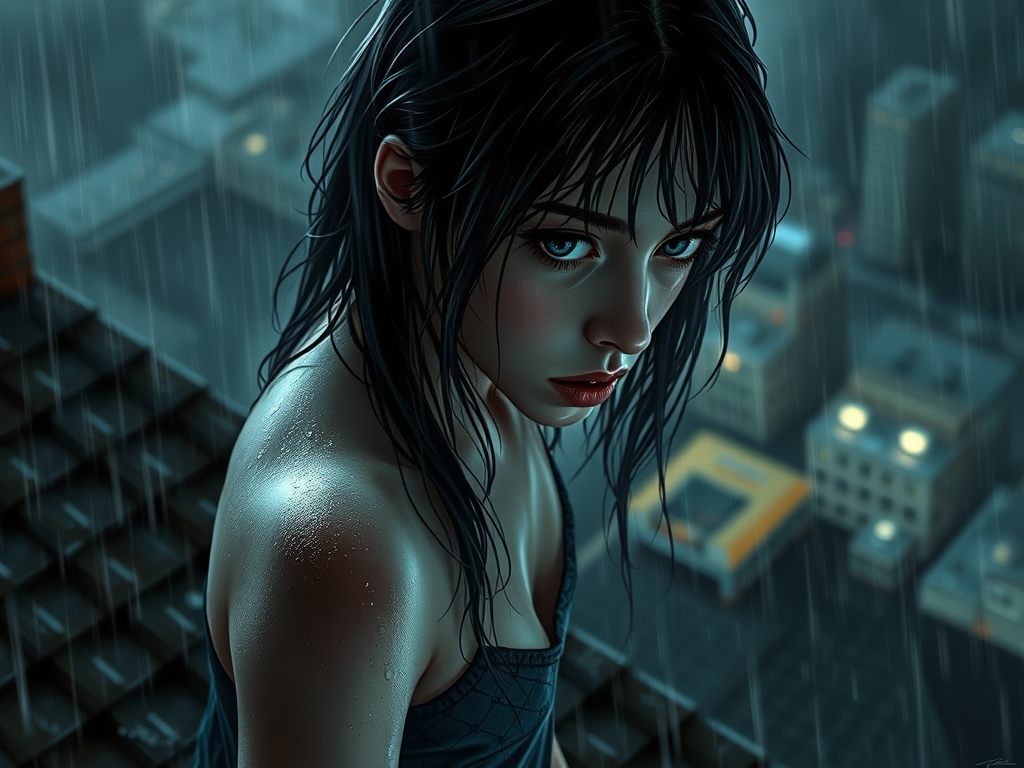
The sky was spitting rain when Kathleen burst through the library’s roof access door. The wind had picked up, whipping her hair across her face as thunder cracked overhead. For a moment, she thought she was too late – the roof appeared empty. Then she saw her: a small figure perched on the ledge, dark hair streaming in the wind like a surrender flag.

Nora swayed precariously, six stories above the gathering crowd. In her right hand, an orange prescription bottle caught the last rays of sunlight filtering through the storm clouds. Her feet, Kathleen noticed with horror, were already halfway off the ledge, her cheap canvas shoes scraping against wet concrete.

“Nora!” Kathleen’s voice barely carried over the wind. She took one careful step forward, then another, her shoes crunching on scattered gravel. “I read your note.”

Nora’s head turned slightly, but she didn’t fully face Kathleen. “You shouldn’t have come.” Her words were slurred, and the pill bottle in her hand was already half-empty.

“How many did you take?” Kathleen inched closer, noting how Nora’s balance seemed increasingly unsteady. Below, she could hear sirens approaching, their wails mixing with the growling thunder.

“Enough.” Nora’s voice cracked. “I just wanted someone to notice… before…” She swayed again, more severely this time.

“We notice now. We see you.” Kathleen was only ten feet away. “Please, just take my hand.”

Nora finally turned, her eyes glassy and unfocused. The movement caused her to stumble slightly, and the pill bottle slipped from her fingers, plastic clattering against concrete before spilling its remaining contents into the wind.

What happened next seemed to unfold in slow motion.

A powerful gust of wind caught Nora’s oversized jacket just as her knees buckled. She pitched backward, arms windmilling desperately as her feet lost their purchase on the ledge. Kathleen lunged forward, her body sliding across the wet rooftop. Her fingers caught Nora’s wrist just as the girl cleared the edge.

The sudden weight nearly pulled Kathleen over too. Her shoulder screamed in protest as she braced herself against the ledge, her other hand gripping the rooftop’s safety rail. Rain pelted her face, making it hard to see.

“Hold on!” she screamed, but she could feel Nora’s wrist slipping through her fingers. The medication was making Nora’s movements sluggish; she wasn’t even trying to grab back.

“Let me go,” Nora whispered, her eyes drifting closed.

“No!” Kathleen’s grip slipped to Nora’s palm, then to just her fingers. “Someone help! I can’t… I can’t hold her!”

Just as Nora’s fingers were about to slip away completely, a strong hand grabbed Kathleen’s belt, anchoring her. Another pair of arms reached past her – Mr. Denning from AP Chemistry, his tie whipping in the wind. Then came more hands: Coach Reeves, the janitor, two parents who had been in the library. Together, they formed a human chain, pulling both girls back from the edge.

They collapsed in a heap on the roof as the storm broke overhead, rain pouring down in sheets. Nora was unconscious but breathing, her pulse weak but present. Kathleen held her hand all the way to the ambulance, refusing to let go until the paramedics gently pulled them apart.

The next morning, a new note appeared on the school bulletin board:

Dear Anyone Who Feels Invisible,

You’re not alone. We’re here. We’re looking. And we’ll find you.

  • Your Community

Below it, dozens of students had already added their own messages of support, phone numbers, and invitations to lunch. Nora’s empty desk in AP Literature wasn’t empty anymore – it was covered in notes, each one a thread weaving her back into the fabric of their small town.

Sometimes the hardest step isn’t the one away from the edge – it’s the one back toward the light. But you don’t have to take it alone.

©2024 Rhyan Scorpio-Rhys

Help Is Always Available

If you or someone you know is struggling, you’re not alone. Caring, trained professionals are available 24/7 to listen without judgment:

  • 988 Suicide & Crisis Lifeline
    • Call or text 988
    • Available 24/7 in English and Spanish
    • For veterans, press 1 after dialing
  • Crisis Text Line
    • Text HOME to 741741
    • Available 24/7, free and confidential
    • Connect with a trained Crisis Counselor
  • The Trevor Project (LGBTQ+ Youth)
    • Call 1-866-488-7386
    • Text START to 678678
    • Available 24/7, confidential and free
  • Trans Lifeline
    • Call 1-877-565-8860
    • Peer support by trans people, for trans people
  • National Alliance on Mental Illness (NAMI)
    • Call 1-800-950-NAMI (6264)
    • Text NAMI to 741741
    • Available Monday-Friday, 10 AM – 10 PM ET
    • Connect with local support groups and resources

Remember: Reaching out is a sign of strength, not weakness. You deserve support, and there are people who want to help.

All The World Will Be Your Enemy 5: Secrets and Solace

In the quietude of her sanctuary, Beverly sat ensconced at her desk, the cursor on her screen a pulsing beacon in a sea of unwritten tales. Her laptop bathed her face in pale light, the only illumination in a room of muted shadows. The scent of bergamot from a half-burned candle mingled with the faint aroma of old paper, remnants of the books stacked haphazardly on the shelves. The words, once her steadfast companions, now eluded her grasp, leaving her adrift in a tumult of unvoiced stories.

Her thoughts, treacherous sailors on this journey, continually veered back to the haven she had found within the walls of Angele and Joanna’s abode—the warmth that had wrapped around her like a soothing embrace, the laughter that had echoed like a long-lost melody in her heart. For too long, Beverly had armored her heart with the pages of her narratives, constructing ramparts to shield against the specter of loneliness that stalked her. Her last foray into the realm of love had left her marooned in heartbreak, her trust eroded like cliffs against a relentless sea. In the solace of her imagined worlds, she sought refuge, a bulwark against the ache of isolation.

Yet, in the company of Angele and Joanna, a flicker of hope stirred within her—a whisper of kinship and understanding that pierced her fortress of solitude, igniting embers she had thought long cold.

The unexpected knock at her door jolted her from her introspection, sharp and sudden against the stillness. Her heart gave a stuttering leap as she crossed the room, the coolness of the hardwood floor grounding her steps. When she opened the door, Angele and Joanna stood there, framed by the faint amber glow of the hallway lights. Angele held a basket of artisanal cheeses, the corners of her smile tilting in gentle mischief, while Joanna balanced a bottle of wine and a pair of glasses, her grin warm enough to chase away the chill of any doubt.

“We thought you could use a break,” Joanna declared, her tone effortlessly cheerful as her hazel eyes searched Beverly’s for unspoken answers. “Writer’s block?”

Beverly’s laugh came soft, almost sheepish, as she stepped aside to let them in. “You have no idea. I’ve been ensnared by the same paragraph for what feels like an eternity.”

Inside, the atmosphere shifted. Angele and Joanna moved with the ease of seasoned travelers, laying the wine and cheese on the coffee table and sinking into the cushions as though they’d always belonged there. The clink of glasses and the rustle of the basket’s cloth lining blended with the muted hum of Beverly’s heater kicking to life.

As they congregated around the hearth of her living room, the offerings of cheese and wine spread before them like tokens of goodwill, Beverly felt the ice of her isolation begin to thaw. The laughter and warmth that filled the room wove a tapestry of comfort around her, each thread a balm to her wearied soul.

The wine’s first sip was tart, a burst of sharpness softened by its lingering warmth. It loosened her tongue as it chased away the knots of hesitation that had bound her heart. Slowly, haltingly, Beverly found herself traversing the landscapes of her heartache aloud, her voice trembling as it spilled tales of betrayal, solitude, and the quiet surrender of hope.

“I guess I’ve just gotten used to being alone,” she confessed, her voice barely more than a whisper. Her fingers traced the rim of her glass, the cool touch grounding her even as her heart threatened to spill over. “It’s easier than the gamble of heartache.”

Angele reached across the couch, her hand warm and steady as it closed over Beverly’s. Her touch carried no demand, only quiet reassurance. “Oh, Beverly. Your heart is a lighthouse in the fog. Don’t let one storm extinguish your light.”

Joanna leaned closer, her gaze mirroring the unyielding certainty in her partner’s words. “You’re worthy of love, of joy. Don’t shutter your heart to the world.”

The tears came unbidden, hot and unrelenting as they carved paths down Beverly’s cheeks. She laughed softly through them, a sound equal parts release and astonishment. In their embrace, she found a sanctuary, a harbor from the storms she had so long endured alone.

A fleeting thought, a spark of something undefined, flickered to life as she looked at them—an attraction laced with confusion and vulnerability. But she dismissed it as swiftly as it had come, attributing it to the wine’s influence and the tender vulnerability of the moment.

Yet, as Angele and Joanna prepared to leave, Beverly couldn’t shake the impression that lingered in Angele’s gaze—a flicker of understanding, or perhaps something deeper, that sent her heart fluttering with unspoken questions.

The evening faded into memory, laughter and revelations etched into the quiet as they parted. Beverly closed the door, leaning against it with a sigh that carried the weight of both exhaustion and relief. Her living room, though empty, felt less lonely, as if the warmth of their presence had seeped into its very walls.

As sleep claimed her, it wove her dreams with threads of enchantment and promise. For the first time in what felt like an eternity, Beverly’s heart rested easy, cradled in the gentle embrace of hope, and the horizon of tomorrow gleamed with possibility.

Not. The. End.