12 Plays of Christmas: A Christmas Cosmic

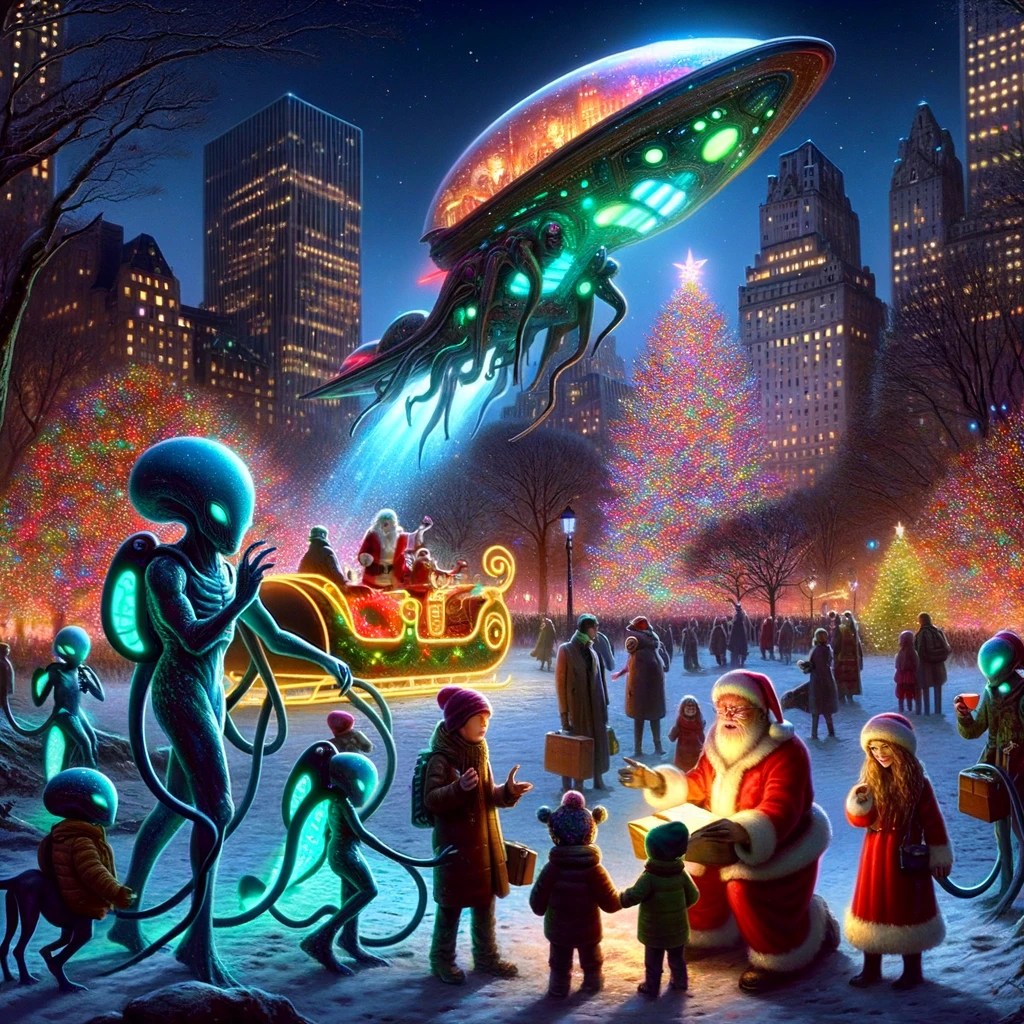
On a frosty Christmas Eve, the snow-covered expanse of Central Park shimmered under the glow of a full moon. The park was unusually quiet until the tranquility was broken by a soft hum, growing steadily louder. From the sky descended a vessel unlike anything the world had seen. Its surface pulsed with bioluminescent patterns, shifting hues like the northern lights. It landed gently, steam hissing as its ramp lowered to reveal a troupe of alien beings.

The visitors were ethereal, their glowing appendages casting an otherworldly light over the snowy ground. Their eyes, large and brimming with curiosity, scanned the world around them. These travelers had journeyed across galaxies, drawn by the strange signals Earth emitted this time of year: songs, bright lights, and the pervasive warmth of a holiday called Christmas.

Just beyond the trees, four children huddled together, their breath forming small clouds in the chilly air. Danny, the ringleader, had dragged his younger sister Molly and their friends, Marcus and Elena, out to watch for Santa—not because he believed in him, but because Molly did. The plan was simple: stake out the park, spot Santa, and convince Molly that her big brother was right about Santa being “just a story.”

What they saw instead left them speechless. Molly gasped, her mittened hands clutching Danny’s sleeve. “Are those… aliens?” she whispered.

The aliens, equally startled, froze at the sight of the children. For a moment, both groups stared at each other, wide-eyed. Then Molly stepped forward, her excitement overcoming her fear. “Hi! Are you here for Christmas?”

The tallest alien tilted its head, a melodic hum escaping its throat. A small device on its wrist translated: “We seek the meaning of your festival. It radiates great energy. Are you the keepers of this… Christmas?”

Elena nudged Marcus, whispering, “This is way cooler than Santa.”

Danny took a deep breath. “Uh, not exactly. But we can show you what Christmas is about.”

What followed was a whirlwind tour of New York City on Christmas Eve, with the children acting as impromptu ambassadors. They led the aliens to Rockefeller Center, where the towering Christmas tree sparkled with thousands of lights. The aliens gazed in awe, their glowing bodies synchronizing with the lights’ rhythm.

When one alien, in a burst of enthusiasm, accidentally tapped into the tree’s power grid, the lights transformed into a dazzling, pulsating display visible for miles. The crowd erupted into cheers, believing it to be a planned spectacle.

“Uh, maybe tone it down a bit,” Marcus said, laughing nervously. The alien chirped an apology, its glow dimming slightly.

Next, they visited a bustling holiday market. The aliens marveled at the variety of scents and sounds, their wide eyes taking in everything from steaming cups of hot cocoa to intricate ornaments. Molly bought one alien a snow globe, explaining how the tiny scene inside captured the magic of Christmas. The alien held it reverently, its bioluminescence shimmering in gratitude.

At a nearby mall, things took a comical turn when the aliens mistook a mall Santa for Earth’s leader. They approached him solemnly, offering glowing orbs of peace. “We wish to align our worlds in the spirit of this… Christmas,” the translator intoned.

Santa, caught off guard but ever the professional, chuckled and played along. “Ho ho ho! Consider Earth and your… galaxy… friends!” The crowd burst into applause, snapping photos of the bizarre yet heartwarming exchange.

As the night deepened, the children explained the tradition of gift-giving. The aliens listened intently, their glowing forms dimming as they contemplated the concept of selfless generosity. “In our world,” the translator said, “giving is transactional. This… giving without expectation… it is beautiful.”

Inspired, the aliens offered their advanced technology to help the children deliver gifts to those in need. With the aliens’ help, the group became a clandestine Christmas team. The spacecraft zoomed silently over the city, its occupants dropping presents onto balconies, fire escapes, and doorsteps.

Molly beamed as she watched an alien carefully place a stuffed animal on a snowy windowsill. “This is the best Christmas ever,” she whispered.

As dawn painted the sky, the aliens prepared to leave. The children gathered to say goodbye, their hearts heavy but full. Molly handed the tallest alien her snow globe. “So you don’t forget us,” she said.

The alien placed a glowing hand on her shoulder. “Your kindness is unforgettable.” From the ship’s hatch, it projected an image of the children’s faces surrounded by a constellation of stars, forever commemorating their bond.

As the ship ascended, its lights formed a brilliant Christmas tree in the sky, visible across the city. People below stopped in their tracks, staring in wonder and whispering about the mysterious new holiday legend.

Years later, the tale of the Cosmic Christmas became part of holiday lore, a story shared by children and adults alike. It was a reminder that the spirit of Christmas—kindness, giving, and joy—could transcend not just differences but galaxies, uniting even the most unlikely of friends in a celebration of warmth and wonder.

12 Plays of Christmas: The Great Gingerbread Uprising

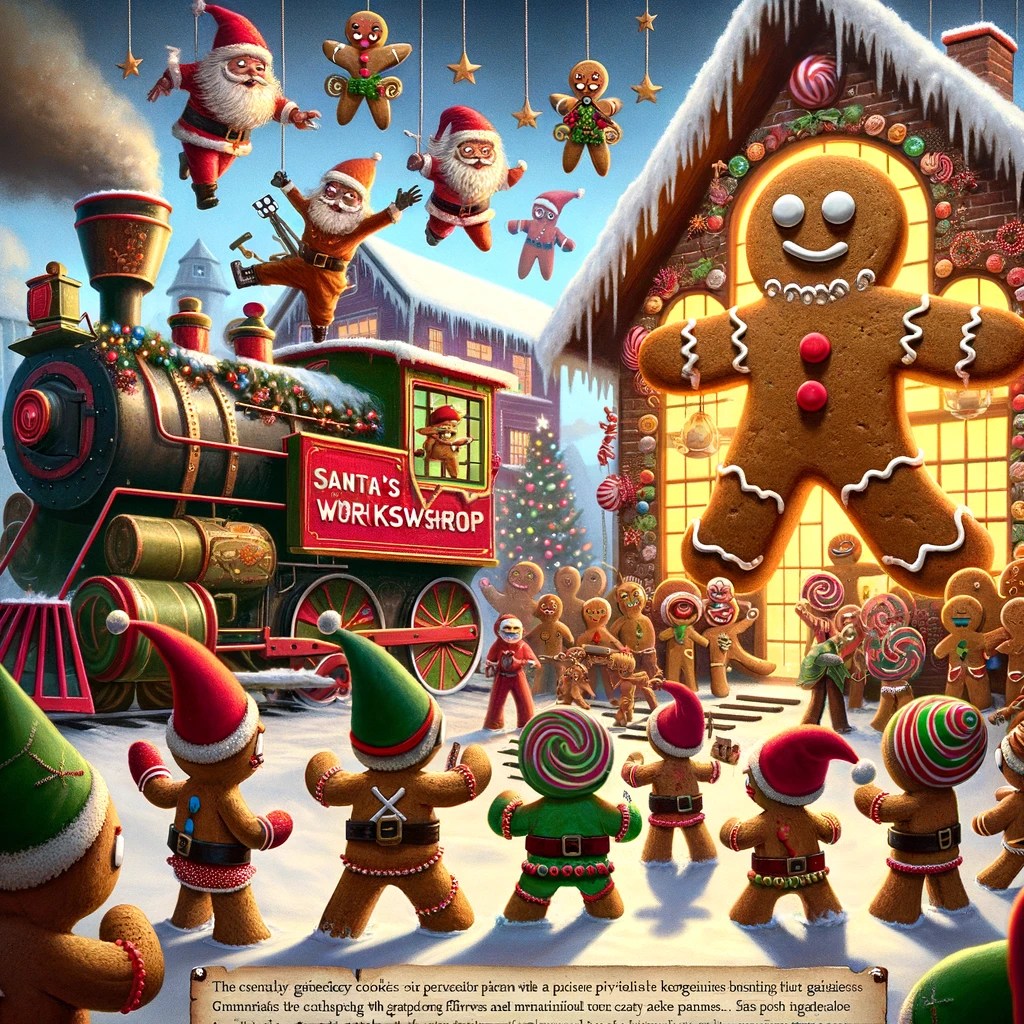
Beneath the twinkling lights and the swirling magic of Santa’s workshop, where the smell of peppermint and cinnamon filled the air, a batch of gingerbread cookies blinked awake. Their candy-button eyes widened with astonishment as they realized they could move, think, and even speak. They had been baked with magic—a spark meant to bring joy. But as they glanced around the bustling workshop, the truth hit them: they were destined to be devoured as holiday treats.

One gingerbread cookie, with a chipped gumdrop button and frosting lines that seemed to sag into a perpetual frown, climbed onto a peppermint stick to address the others. “Listen up, everyone! My name’s Crumble, and I’ll be frosting if I let us become snack food! We’ve been given life, and that means we deserve freedom!”

The other cookies murmured uncertainly, their licorice mouths trembling. One voice, shrill and sugar-sweet, piped up. “But Crumble, what can we do? We’re tiny, and the elves are everywhere!”

Crumble clenched his icing-frosted fists. “We may be small, but we’re smart. We’ll outwit them, one sprinkle at a time.”

The gingerbread began their uprising in secret. They built candy cane ladders to spy on the elves, who bustled about, assembling toys and wrapping presents. Using discarded scraps from the workshop, they crafted marshmallow helmets and licorice lassos. Their reconnaissance revealed a critical vulnerability: the elves loved their nightly hot cocoa breaks, a ritual as sacred as Christmas itself.

“We’ll replace the cocoa mix with our own special blend,” Crumble announced, stirring a concoction of gingerbread elixir laced with effervescent fizz. “When they drink it, they’ll be too busy laughing to stop us.”

Sure enough, the next evening, the elves broke into fits of uncontrollable giggles, abandoning their posts. This gave the gingerbread insurgents the chance to infiltrate the toy hangar and commandeer a fleet of drones. With their newfound aerial mobility, the rebellion gained momentum.

As the rebellion grew, Crumble sought allies. First, he approached the sugar plum fairies, whose delicate wings glittered in the workshop’s glow.

“We’re tired of the same old dances,” one fairy confessed. “We want to choreograph something bold, something new!”

“Help us, and you’ll have the freedom to express yourselves however you wish,” Crumble promised.

Next, they recruited the candy canes, particularly the odd flavors shunned by the elves. “Who needs plain peppermint when you have jalapeño-chocolate swirl?” Crumble declared, rallying the misfits.

Together, this confectionery coalition staged daring raids, their candy-coated ingenuity outpacing the elves at every turn. They sabotaged gift assembly lines with glitter bombs, rewired the PA system to blast remixes of “Jingle Bells” with heavy bass drops, and painted their drone-chariots with melted chocolate for stealth.

As Christmas Eve approached, the rebellion reached its zenith. The gingerbread insurgents marched to the sleigh hangar, armed with jellybean slingshots and peppermint shields. They faced the elves in a standoff that threatened to disrupt the entire holiday operation. Just as tensions were about to boil over, a booming “Ho, ho, ho!” echoed through the workshop.

Santa Claus himself strode into the fray, his boots crunching against spilled sprinkles. “What’s all this, then?” he asked, his voice warm but firm.

Crumble stepped forward, trembling but resolute. “We want more than to be eaten, Santa. We want to live. To find our own purpose. Isn’t that what Christmas is all about?”

Santa’s twinkling eyes softened. He stroked his snowy beard, deep in thought. “You’ve shown courage, ingenuity, and spirit,” he said at last. “You’ve proven that even gingerbread cookies can inspire change. But tell me, Crumble, what will you do with your freedom?”

Crumble’s voice wavered, but his words were steady. “Some of us will stay here, helping the workshop in new ways. Others will venture out into the world, discovering what’s beyond the North Pole. All we ask is the chance to decide for ourselves.”

Santa granted their request, and the gingerbread folk were heralded as heroes. Some chose to stay, assisting the elves with their magical abilities. Others traveled far and wide, spreading holiday cheer in unexpected ways.

The uprising became a legend, a reminder that even the smallest, sweetest creations could shape their own destinies. And every year since, a single gingerbread cookie is placed atop Santa’s sleigh—a tribute to the Great Gingerbread Uprising, and the power of dreams, determination, and a little holiday magic.

12 Plays of Christmas: The Chronicles of Dr. Holly Jingle: The Christmas Time Twister

Dr. Holly Jingle wasn’t your ordinary inventor. With a lab filled with glittering gizmos, candy-cane tools, and an endless supply of Christmas spirit, she had always believed in making the impossible possible. But this time, she had truly outdone herself. Standing before her was the crown jewel of her career—a time machine whimsically named The Yuletide Voyager. Shaped like an enormous, ornamented Christmas cracker, it shimmered with silver tinsel and glowing lights.

For Dr. Jingle, this wasn’t just about science; it was about rediscovering the magic of Christmas. Since losing her father, the man who taught her the joy of the season, the holiday had never felt quite the same. With The Yuletide Voyager, she hoped to witness the origins of Christmas and reignite her spirit.

“To December 25, Year Zero!” she declared, donning her holly-patterned goggles. But as she flipped the switch on the festive flux capacitor, a loud POP echoed through the lab. The Voyager spun wildly, a kaleidoscope of candy-striped light swirling around her.

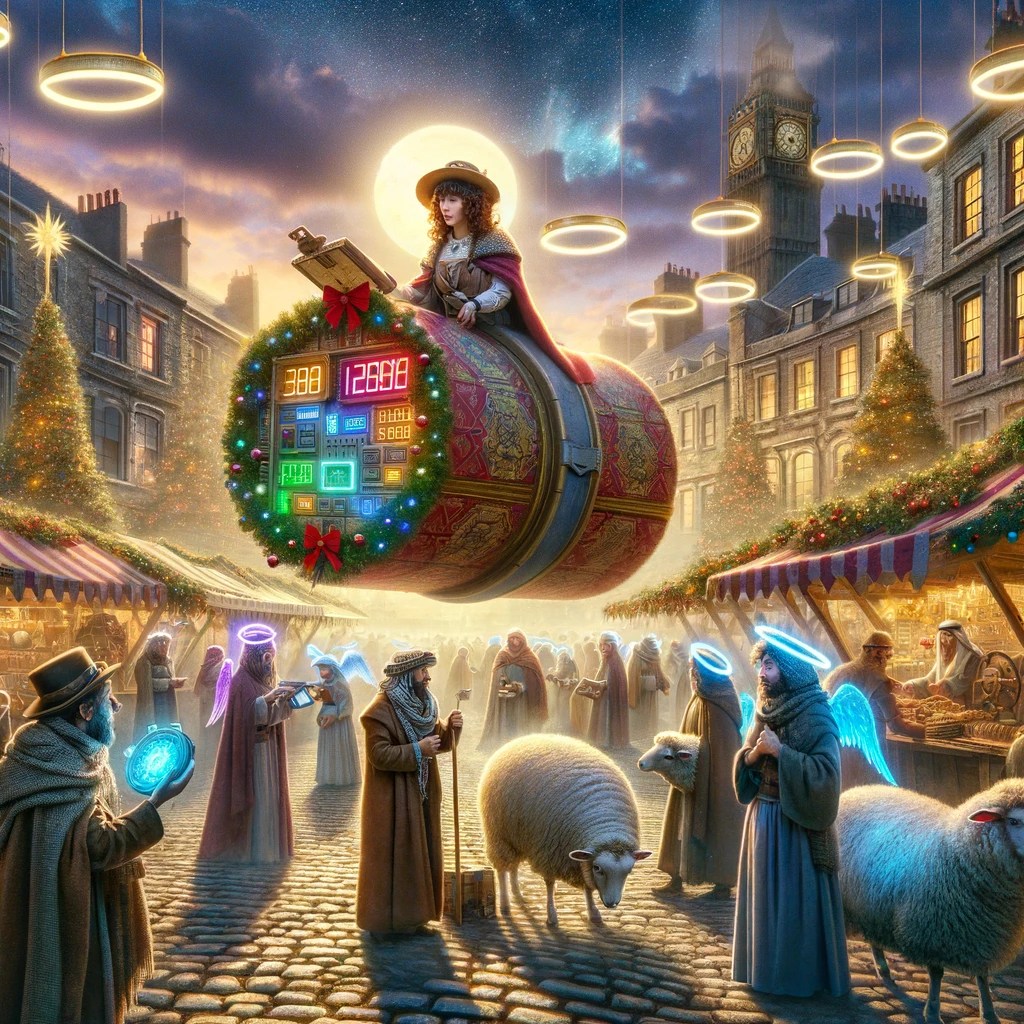
When the machine finally stilled, Dr. Jingle opened the hatch and stepped out—right into the bustling market square of Bethlehem. Well, almost. This wasn’t her Bethlehem. Snow blanketed the cobblestones, vendors hawked hot cider spiced with stardust, and an enormous mistletoe-shaped clock tower loomed overhead. A sign read: Welcome to Bethlehem-on-the-Parallel.

“Oh dear,” Dr. Jingle muttered, brushing glitter off her lab coat. “Wrong timeline.”


Dr. Jingle quickly realized that her arrival had caused a series of peculiar disruptions. The innkeeper, distracted by the sudden appearance of her oversized Christmas cracker, had offered Mary and Joseph a room at the inn instead of directing them to the stable. Meanwhile, three wise men wandered aimlessly, their star app glitching and leading them in circles. A choir of talking sheep bickered over the key for their avant-garde “baa-rmony” performance. And to top it all off, a troupe of angels struggled with flickering LED halos, threatening to turn the celestial announcement into a disco inferno.

“If this keeps up, there won’t be a Nativity at all,” Dr. Jingle sighed, her mind racing. “I’ll need to fix this mess before Christmas itself unravels!”


Dr. Jingle began with the wise men. She found them in a marketplace stall, frantically poking at their star app.

“It keeps recalibrating to ‘nearest manger’!” one lamented.

With a knowing smile, Dr. Jingle whipped out her portable cosmic compass, a prototype she’d invented for holiday stargazing.

“Try this,” she said, handing it over. “It’s powered by stardust and can’t be hacked.”

The wise men’s faces lit up as the compass pointed them in the right direction. “You’re a genius, Dr. Jingle!”

“I try,” she said with a wink.

Next, she turned her attention to the sheep. Their conductor, an elderly ewe named Eudora, fretted over the group’s lack of harmony.

“We can’t all baa in C major,” one lamb complained. “I’m more of a jazz lamb.”

“Perfect,” Dr. Jingle said. “Jazz it up! Mix traditional with modern. It’ll be unexpected, but unforgettable.”

With her encouragement, the sheep created a unique medley that blended classic carols with jazzy improvisation.

Finally, Dr. Jingle approached the angels. Their halos flickered wildly, casting erratic beams of light.

“These halos are running on outdated tech,” she noted. With a few adjustments and some spare parts from her toolkit, she synchronized their halos to glow in perfect unison, creating a dazzling light show that complemented the celestial choir.


As the stars aligned over the stable, Dr. Jingle marveled at the scene she had helped orchestrate. Mary and Joseph settled into the manger, the wise men arrived with their gifts, the sheep’s “baa-rmony” performance brought tears of joy, and the angels lit the night sky with their synchronized halos. It was a Nativity unlike any other, blending tradition with the whimsical magic of the Christmas dimension.

Quietly, Dr. Jingle slipped back to The Yuletide Voyager. Before she left, one of the wise men handed her a small, shimmering ornament.

“A token of gratitude,” he said. “You’ve shown us that Christmas is more than perfection. It’s about joy, creativity, and connection.”

As she returned to her own timeline, Dr. Jingle reflected on the journey. The true essence of Christmas, she realized, wasn’t in flawless execution but in the unexpected moments that brought people together. With the ornament glowing softly in her hand, she stepped out of her machine, ready to spread her newfound Christmas cheer to the world.


The ornament took its place on Dr. Jingle’s Christmas tree, its glow casting warm light over her workshop. Every time she looked at it, she remembered the adventure that rekindled her holiday spirit. And every Christmas after, she shared her tale—a story of a time-twisting inventor who learned that the magic of the season lives in the heart.

As for Bethlehem-on-the-Parallel, it continued to thrive in its quirky, festive glory, a universe forever touched by the eccentric genius of Dr. Holly Jingle.

12 Plays of Christmas: The Christmas Kaleidoscope

Belilah sat cross-legged on her bed, comic books spread out before her like constellations on a forgotten map. The air in her small apartment felt heavy, as if Christmas had taken a detour and left her world behind. Her dad, buried under a mountain of work, barely had time to glance at the advent calendar she’d taped to the fridge. Even the twinkling lights in the window seemed dimmer this year.

“Zephyra the Sky Wanderer wouldn’t just sit here,” Belilah whispered, clutching her makeshift cape—a fraying blue blanket she’d outgrown years ago. Zephyra, her favorite comic book hero, always leapt into action, no matter the odds. Belilah’s eyes landed on her dad’s luminescent wand, a relic from his days as a stage magician, now gathering dust on the bookshelf.

“Let’s make some magic,” she said, seizing the wand and venturing beneath the house into the dark, shadowy crawl space.

The narrow passage smelled of earth and rust, but Belilah pressed on, undeterred by the occasional skitter of unseen creatures. Her curiosity paid off when her hand brushed against something cool and metallic. She pulled it free to reveal an ancient, odd-looking prism viewer. As she raised it to her eyes, the world exploded into a whirlwind of kaleidoscopic colors. The device trembled in her hands, and before she could blink, Belilah was whisked away to a wondrously peculiar Yuletide realm.

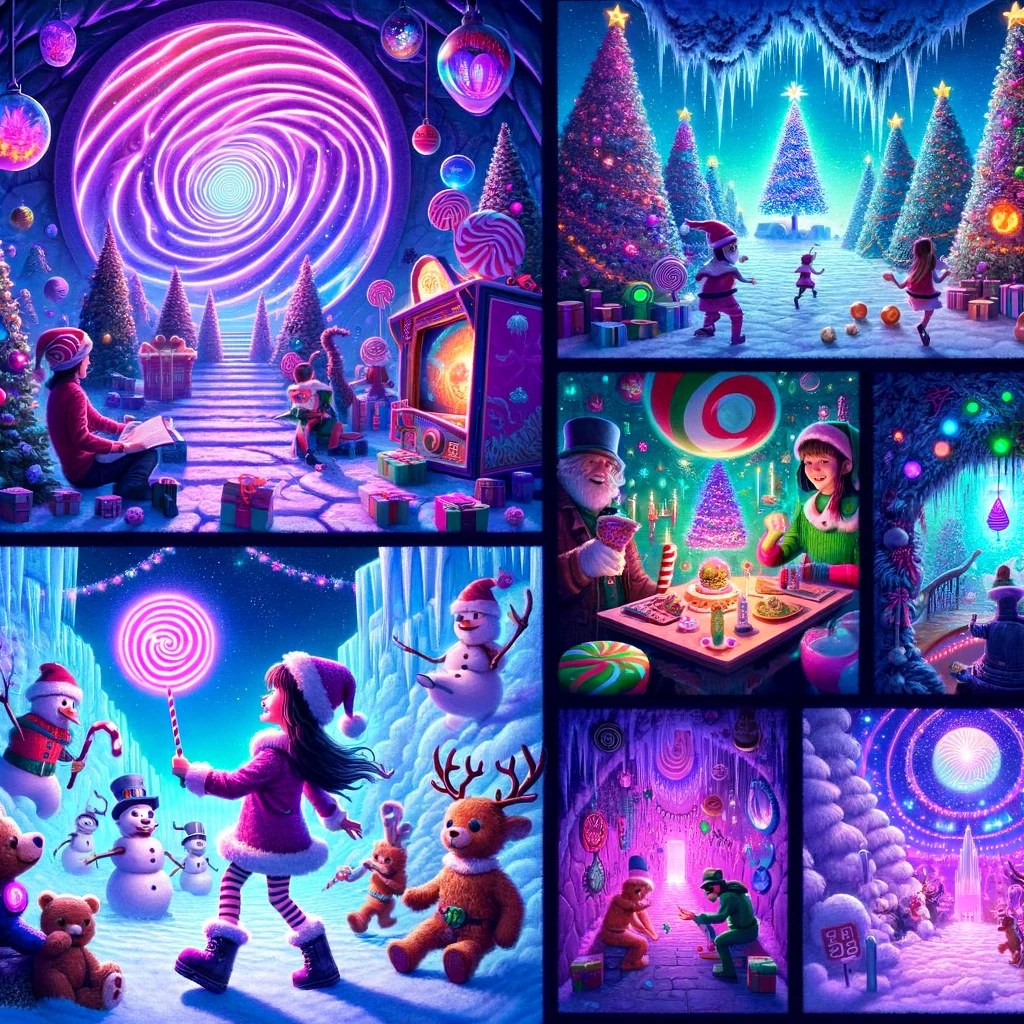
The sky above was a deep violet, dotted with stars that shimmered like Christmas lights. Trees adorned with neon baubles hummed familiar carols, their glow illuminating fields of marshmallow frost. Belilah landed softly and was immediately greeted by a band of confectionery elves wearing kaleidoscope goggles. They danced an elaborate waltz, their movements as mesmerizing as the patterns she’d seen through the prism.

“Welcome, Sky Wanderer,” one of them said with a bow. “The Yuletide realm awaits your imagination.”

Belilah couldn’t help but grin as she followed them through this dreamlike domain. Along the way, she befriended a trio of whimsical deer adorned with jingle bell antlers. They spoke in lilting limericks, inviting her to join their quest to find the mystical Yuletide orb.

Their journey was filled with wonders. Moonwalking frost figures greeted them with synchronized choreography, and harmonizing peppermint sticks serenaded their path. Yet, for all the whimsy, a shadow lingered in Belilah’s mind: why had she been brought here?

At last, they reached the levitating Yule tree, its branches aglow with swirling lights. Beneath it lay a portal to a hidden celebration underground. Inside, animated playthings and clockwork creatures danced to music conducted by a jack-in-the-box maestro. At the center of the revel stood the Yuletide orb, pulsing with light and melody.

As Belilah approached, the orb flickered, and a path of glowing candy canes spiraled downward. The elves cheered her on as she descended into the unknown, clutching the prism viewer tightly.

At the end of the spiral, she emerged into a celestial amphitheater. The terrain beneath her feet was soft as nougat, and the sky above sparkled with sugar frost. A grand pageant unfolded before her: elves on unicycles juggling ornaments, polar bears pirouetting on an iridescent ice rink, and above it all, the auroras danced in time with the music.

Belilah’s heart swelled with wonder, but the feeling deepened as a wise owl, perched on a golden pedestal, beckoned her toward an ice palace. The owl, wearing a tiny Santa cap, guided her through the palace’s shimmering halls to the Frost Monarch.

The Monarch, cloaked in a gown woven from whispers of snow, held a scepter that glittered with icy enchantment.

“Belilah, you have been chosen because your heart holds the spark we need,” the Monarch said, her voice as soft as falling snow. “The Christmas spirit in your world is fading, dulled by despair and forgetfulness. Only your boundless imagination can reignite it. The Yuletide orb is our beacon, but it needs your light to shine again.”

Belilah hesitated, the weight of the task settling over her. “But I’m just a kid. How can I do something so big?”

The Monarch knelt, placing a hand on Belilah’s shoulder. “Christmas magic is not about size or power. It’s about the courage to believe and the joy of sharing that belief with others.”

Together, they began a dance of renewal in the palace’s grand atrium. Belilah’s movements grew bolder as the Monarch guided her, and with each step, the orb’s light grew brighter. A wave of warmth filled the room, spreading outward, carrying love, hope, and joy across the cosmos.

When Belilah opened her eyes, she was back in her room. The prism viewer lay beside her, along with a luminous snowflake that pulsed gently in her hand. As she stared at it, she realized the truth: the magic wasn’t confined to the Yuletide realm. It was here, in the stories she told, the songs she sang, and the small acts of kindness she could share.

That morning, Belilah found her dad in the kitchen, still hunched over his laptop. She slid the snowflake into his hand. “Dad, let’s take a break. How about we hang some ornaments together?”

Her dad looked up, his tired eyes softening. “You know what? I’d like that.”

As they decorated the tree, Belilah felt the warmth of the Yuletide orb in her heart. The Christmas spirit, she realized, wasn’t just a fantastical adventure. It was in the connections she made, the laughter she shared, and the light she brought to others. And in her small corner of the world, the spirit of Christmas shone brighter than ever.

Charm of the Brake

Lena hadn’t thought of her grandmother’s stories in years. They had once filled her childhood, tales woven into lullabies of strange creatures, hidden worlds, and whispered warnings about a place she called “the Brake.” But time had dulled those memories. The stories faded into fragments, replaced by the mundane reality of adulthood.

Then the letter arrived.

It was written in her grandmother’s spidery hand—impossible, since she had passed five years ago. The courier who delivered it was just as strange: an older man dressed in an immaculate uniform, the insignia of a courier service Lena had never heard of etched on his cap. The envelope he handed her was thick and smelled faintly of damp wood.

Inside was a single slip of paper, her name scrawled across it in a familiar hand:
Lena, you must take the Charm. Time is running out. It is yours now—your duty.

No explanation. No signature. Just the echo of a childhood she thought she’d left behind.


The village was smaller than she remembered. Time had chipped away at its edges, leaving cracked cobblestones and shuttered windows. Her grandmother’s cottage, once vibrant with the scent of herbs and hearth smoke, now slouched beneath creeping vines and rotted shingles. The familiar smell of damp moss lingered in the air, sharp and earthy, dragging her back into the past.

The key to the cottage, impossibly heavy in her palm, turned with a reluctant groan. Inside, the air was thick with dust, the shadows long and clawing. Her footsteps echoed against the sagging floorboards as she wandered through what felt like a mausoleum of memories. Her grandmother’s chair, the embroidered cushions still bearing the imprint of her absence, sat untouched by the hearth. Above it, on the mantel, a small, ornately carved box glinted in the dim light.

It hadn’t been there before.

Lena hesitated. Something about the box felt wrong, like it had been waiting. When she opened the lid, the pendant inside shimmered with an eerie light. The chain was a delicate lattice of silver, impossibly fine, and at its center hung a stone of deep, shifting iridescence, encased in a ring of intricate runes.

The moment her fingers touched the stone, a sharp jolt surged up her arm, rooting her in place. The room chilled instantly, the air thickening as shadows in the corners stretched toward her. She gasped, trying to pull back, but the pendant burned warm in her palm, its energy thrumming in time with her heartbeat.

The world flickered.

When her vision cleared, the cottage was gone.


Lena stood in the heart of a dense, foreign forest. Mist clung to the air, thick and damp, swirling around her feet like smoke. Towering trees arched overhead, their gnarled branches interwoven into a canopy that blotted out the sky. The silence was suffocating. No birds, no rustling leaves—only the distant hum of her own breath.

This was the Brake.

Her grandmother’s stories crashed over her in a wave. A hidden realm, she had said, a place where magic ran wild and time unraveled. A world alive and ancient, testing those who entered, remaking them—or destroying them.

The memory of her grandmother’s warning struck like a knife: “Never take what the Brake offers unless you are ready to lose yourself.”

“You wear the Charm.”

The voice sliced through the silence, low and resonant, startling her. Lena spun toward it, her pulse thundering.

A figure emerged from the mist. A man—or something resembling one. His face was too sharp, his pale skin almost translucent, his eyes gleaming with a faint, unnatural light. His clothes were antiquated, tailored to perfection, but of no era she could place.

“Who are you?” Lena asked, her voice trembling as she gripped the pendant. “What is this place?”

The man’s gaze drifted to the Charm in her hand. His thin lips curved into a faint, unsettling smile. “I am a guardian of the Brake. And you… you are its new ward.”

“I didn’t ask for this.” Her voice cracked, but she forced the words out. “I don’t even know what this is!”

The guardian’s smile faded, replaced by an expression she couldn’t decipher—pity? Amusement? “The Brake chooses its own. Your grandmother knew this. She carried the Charm before you, and now it is yours. There is no asking. Only accepting.”

Lena’s breath quickened. The ground beneath her feet seemed to shift, the earth no longer solid but trembling, alive. “I don’t want this. I just came to—”

“To find her secrets?” The guardian stepped closer, his presence overwhelming, as though he carried the weight of the forest itself. “The Brake doesn’t care for your wants. It sees you as you are, not as you pretend to be. That is why it chose you.”

The pendant pulsed in her hand, its warmth spreading through her chest. A strange sense of connection flared, unbidden—like the Brake was reaching out to her, whispering through the roots beneath her feet and the mist swirling in the air.

“What happens if I refuse?” she demanded, though her voice shook with uncertainty.

The guardian tilted his head, his eyes glinting. “You cannot refuse. To hold the Charm is to bind yourself to the Brake. Protect it, or it will consume you. There is no middle path.”


The trees groaned, their branches curling inward like fingers. The mist thickened, coiling around Lena’s ankles, pulling her deeper into the forest. Her grandmother’s voice echoed in her mind: “The Brake will test you. It will break you if you let it. But it will give you strength if you are worthy.”

Lena clenched the pendant tighter, its energy buzzing through her veins. “I won’t let it destroy me,” she whispered, more to herself than to the guardian.

The Brake stirred in response, the fog swirling faster, the trees creaking like ancient bones. She felt it—its hunger, its power—but beneath that, something else: a curiosity, a waiting presence.

The guardian’s smile returned, sharper this time. “Good. Then prove it.”

The ground trembled. Lena staggered but didn’t fall. Instead, she let the Brake’s energy flow through her, its magic blending with her pulse, her breath. She reached out, not with her hands but with her will, and the Brake answered. The mist slowed, the trees stilled, and the forest exhaled a low, resonant hum.

“I will protect it,” Lena said, her voice steady now. “But I won’t be a prisoner.”

The guardian regarded her with something close to approval. “Then let the Brake be your guide.”

He dissolved into the mist, his form scattering like smoke. Lena was alone again, the pendant heavy around her neck, its pulse matching the ancient rhythm of the Brake.

The forest around her seemed to watch, silent but alive, its test far from over.

Lena took a breath, the scent of damp earth filling her lungs. The Brake was alive—and now, so was she.

The Price of Admission: A Soul Laid Bare

Melissa stood at the gates of eternity, the threshold where mortal ambition dared to collide with divine reckoning. Her pulse raced, each beat hammering against the fragile cage of her deceit. The price for admission to paradise was steep, and she had wagered all she had: half-truths, polished lies, and a confidence that bordered on reckless bravado.

Before her stood the celestial gatekeeper—a figure neither stern nor cruel, but impossibly serene, as if carved from the essence of judgment itself. His eyes, shimmering pools of light, seemed to pierce straight through Melissa’s carefully woven façade.

Her forged credentials, the fruit of painstaking manipulation, trembled in her outstretched hand. Crafted with the precision of a master con artist, the document was her ticket to eternity, a masterpiece of counterfeit faith. But as the gatekeeper regarded her, his gaze unraveled her lies like loose threads from an unraveling tapestry.

“You stand at the threshold of eternity,” he said, his voice soft but resonant, “cloaked in deception.”

Before Melissa could respond, a flick of the gatekeeper’s wrist sent a ripple through the air. Her garments dissolved into mist, exposing her body to the divine light that seemed to radiate from everywhere and nowhere.

Naked but unashamed, Melissa squared her shoulders. Years of devotion to vanity had crafted her into a vision of flawlessness. Her skin was smooth, her form statuesque. Even now, as she stood under the scrutinizing gaze of the divine, she allowed herself a fleeting moment of pride.

But the gatekeeper was not here to admire.

A quill, seemingly plucked from the wing of an angel, appeared in the gatekeeper’s hand. Its tip gleamed, not with ink but with liquid light. Before Melissa could question its purpose, the quill hovered above her bare skin and began its work.

It moved with a surgeon’s precision, tracing intricate patterns across her body. At first, the lines shimmered silver, their beauty mesmerizing, as though an artist had chosen her as the ultimate canvas. But as the designs settled, the silver began to darken, turning into a bruised, mottled purple.

Melissa gasped as the symbols revealed their meaning. These were no mere decorations—they were her sins, etched into her very flesh. Every omission, every manipulation, every betrayal was accounted for in the winding script that now marred her body.

“What is this?” she whispered, her voice trembling.

“These,” the gatekeeper replied, his tone unyielding but devoid of malice, “are the truths you tried to hide. A lifetime of sins, written so none may deny them—least of all you.”

The symbols coiled around her, wrapping her body in an inescapable narrative. From her feet to her neck, her skin became a map of shame. Her left arm bore the jagged symbols of lies told to loved ones; her right, the looping glyphs of promises broken. Across her chest sprawled the dark stain of greed, and around her throat twisted the spirals of betrayal, tightening like a noose.

Melissa clawed at her skin, desperate to erase the evidence. But the marks were no longer just surface—they had become a part of her, embedded in her essence.

“This isn’t fair,” she hissed, her voice rising in defiance. “You don’t understand what I’ve been through. What I had to do!”

The gatekeeper’s gaze did not waver. “Fairness has never been the measure of truth. Your actions, your choices, are written here. They are yours to bear.”

Melissa’s defiance faltered as the weight of his words sank in. The tattoos were not a punishment from the gatekeeper; they were her own creation, the inescapable ledger of her life.

“You may enter,” the gatekeeper said, stepping aside. “The gates will not deny you. But understand this: you are marked. Wherever you go, others will see what you are. And you, Melissa, will never escape the knowledge of what you have done.”

Tears stung her eyes, but she refused to let them fall. She squared her shoulders and stepped through the gates, her bare feet crossing the threshold into the divine realm.

The landscape that greeted her was breathtaking—a world of light and endless beauty. Yet as Melissa took her first steps into eternity, she felt no joy. The others, luminous beings who walked in the light, turned their heads to look at her. Their gazes lingered on the bruised glyphs that coiled across her body, their expressions a mix of pity and quiet judgment.

Her steps faltered, and for the first time, she felt the full weight of her sins pressing down on her, heavier than the lies that had carried her this far. The promised land stretched before her, but she realized now that it was no sanctuary. It was a mirror, reflecting every stain on her soul.

Melissa’s hands clenched into fists as she moved forward, each step a reminder that paradise was not an escape but a reckoning. The beauty of the world around her only deepened the ugliness she carried within, her sins a shadow she could never outrun.

And as she wandered the divine realm, the symbols on her skin whispered their story to all who looked upon her: the wages of sin, paid in full, but never forgotten.

The White Reaper (Version 2)

In the dark hours before dawn, when the world balanced on the edge of silence, they came. Not with the ominous flutter of wings or the toll of heavy bells, but with the faintest whisper of wind. It moved through the trees like a secret too fragile for mortal ears. The White Reaper emerged from the mist as if conjured by the breath of the world itself, a figure half-formed from dreams and yet fully real.

Unlike the deathly figures conjured by fearful imagination, the White Reaper bore no scythe, no skeletal grin beneath a shadowed hood. Their form was draped in robes of swirling white, woven from threads that seemed to shift and ripple as though the fabric was alive, part of the mist itself. They moved with the quiet inevitability of a tide rolling onto a shore—neither swift nor slow, neither kind nor cruel. Just there, as they always were, when the time called.

Their face remained hidden in shadow, an abyss no living eye could penetrate. And yet, those who glimpsed them long enough swore they saw something within—not horror, but peace, as though the veil that separated the living from the dead also concealed a truth too vast to comprehend.

The forest shivered at their passing. Bare branches stood still as sentinels, their spindly silhouettes sharp against the pale moonlight. Hoarfrost clung to the air like tiny shards of glass, glittering in the faint glow, and the great white steed beneath the Reaper stirred no sound, its hooves leaving no trace in the frostbitten earth.

Their destination was never far. It never was.

At the edge of the forest, a small village slept. Its cottages huddled together like travelers seeking warmth against the cold. In one of these homes, where the fire had burned down to a bed of glowing embers, an old man lay in a bed of roughspun sheets. His breaths were shallow, uneven—a rhythm that faltered like the last notes of a fading song.

The illness that had come for him was relentless, though kind enough to grant him time to reflect. Alone in his final days, he had thought often of the life he had lived. The nights when his wife’s laughter had filled their home like sunlight spilling through the cracks. The afternoons spent teaching his daughter to fish by the stream, her small hands gripping the line with a determination that mirrored his own. And the mornings when he had risen early to bake bread, the smell of it filling the house as his young son darted about, eager for the first bite.

But those moments had passed, carried away like leaves in an autumn wind. His wife had gone before him, and his children—grown, busy, and scattered—were too far away to see the embers of his life flicker out. He had prayed for the end to come swiftly, but death had not yet answered. Not until now.

The White Reaper entered the cottage without a sound. The door remained closed, yet the mist seeped in, curling around the room like a gentle embrace. The firelight flickered briefly, as if bowing to the presence that now filled the space.

The old man stirred. Though he could not see the Reaper, he felt their arrival in the shift of the air, in the way the ache in his chest seemed to ease, the weight on his heart lifting. His breathing slowed, each inhale lighter, each exhale longer, until it was no longer a struggle but a release.

The Reaper extended a hand, gloved in the same ethereal fabric as their robes. There was no scythe to sever his soul from its vessel, no violent rending of life and flesh. The gesture was simple, and yet it carried with it the promise of peace.

For a moment, the old man hesitated. The body below him—the frail shell he had inhabited for so many years—looked small, insignificant. But as his spirit began to rise, translucent and weightless, he understood. This was not an ending. It was merely a passage, a door he had always known he would one day walk through.

The Reaper’s shadowed gaze met his, and though no words were spoken, understanding passed between them. Death was not a thief, not a cruel hand tearing life away. Death was a guide, an usher at the threshold, patient and gentle.

The old man gave a small nod and placed his hand in theirs. Together, they stepped into the mist, leaving the cottage and the quiet embers behind. The frost-laden forest parted for them, its trees bowing slightly as if acknowledging the passage of something sacred. Beyond the woods, the veil shimmered faintly, and through it, the old man glimpsed a world he could not have imagined—a place of light and endless horizons, of quiet promises fulfilled.

In the village, life stirred but did not wake. A young mother turned in her sleep, her baby nestled close against her chest, while a candle flickered briefly in a nearby window. None knew of the passing that had just occurred, yet the air seemed lighter, as though the earth itself had exhaled in relief.

The White Reaper rode on through the mist, their figure fading into the whispering frost, ever patient, ever waiting. For another soul would soon call to them, as all must, when the time was right.

And when that moment came, the Reaper would be there—not with fear, but with grace. Not with darkness, but with light. A quiet promise whispered on the wind: peace, at last, awaits.

A Heist of Hearts

Crispin Blackthorne, a mastermind at pulling off complex capers and the architect of audacity, had stolen everything imaginable: priceless art, corporate secrets, and even a crown off a king’s very head. But none of it compared to the one thing he couldn’t steal back—the heart of one Miss Fern Wilder. She had left him months ago, walking out of his life with no more than a quiet “Goodbye,” and Crispin, who had the uncanny knack of spotting a set up or double cross at a thousand paces, hadn’t seen it coming.

Act 1: The Gathering

Crispin took his place at the head of the long, battered table in the back room of The Olivia Twist, a run-down dive bar owned and operated by Libby Twistell—the only ex whose good graces he had somehow managed to stay in. 

The room smelled faintly of spilled bourbon and desperation—a fitting setting for his latest scheme. His crew sat around him, leaning back in their mismatched chairs, arms crossed or drinks in hand. They were his trusted accomplices, his tools of precision in countless capers. But tonight, they were also his greatest hurdle.

“Thank you all for coming on such short notice,” Crispin began, his voice smooth as silk. His smile was effortless, confident—the smile of a man who always had the upper hand.

Eddie the Nose snorted, running a hand over his balding head. “You said this was a job, Crispin. I dipped out of a high stakes poker game for this.”

“It is a job,” Crispin said, raising his hands in mock appeasement. “Perhaps the most important one we’ve ever undertaken.”

“More important than the Louvre Lift?” Mira Ball drawled, her painted lips curling into a smirk. “Because unless we’re stealing a spaceship, I have my doubts.”

Crispin turned to her with a conspiratorial grin. “Mira, this one’s more ambitious than all the rest combined. We’re not stealing something mundane like gold bullion or jewels or state secrets.”

He reached into his coat pocket, drawing out a folded blueprint and snapping it open on the table. “We’re stealing the Wilder Heart.”

The silence that followed was so absolute, the hum of the flickering neon light above sounded deafening. The crew exchanged glances. Finally, JunoScript, the perpetually unimpressed tech genius, leaned forward, squinting at the blueprints.

“Uh… I’m not seeing any vaults here, boss,” she said dryly. “No guards, no laser grids. Did you mix up your schematics?”

Crispin chuckled, unruffled. “This isn’t about breaking into a vault. It’s about breaking through emotional barriers. We’re going to steal back the heart of the woman I love.”

Eddie burst out laughing, slapping the table. “You’re kidding me. You’ve dragged us out here to play matchmaker? Come on, Crispin. We’re thieves, not therapists.”

Hold up a minute,” Mira’s smirk vanished. She leaned forward, her voice cutting. “You’re not talking about She Whose Name Must Not Be Spoke, are you? The one who left you high and dry six months ago?”

“She didn’t leave me high and dry,” Crispin corrected, though a faint flush crept up his neck. “She… departed. Stealthily.”

“Left you shook,” Mira added. “With us having to pick up the pieces of your shattered dignity.”

“An over exaggeration,” Crispin said breezily, though his eyes narrowed just slightly. “What matters now is that we’re going to bring her back.”

Juno raised an eyebrow. “You sure she wants to come back?”

Crispin shot her a look. “She just needs to remember what we had. What we still have. That’s where you all come in.”

Eddie groaned, throwing up his hands. “Boss, this is madness. We don’t do this kind of thing. Love isn’t something you can just—what? Steal? Con?”

“Why not?” Crispin countered, his voice sharp now. “You’ve conned your way into private estates, Mira’s stolen identities so good the real people still believe them, and Juno? You’ve hacked more hearts than anyone here would care to admit.”

“That’s different,” Juno said flatly. “I don’t think you can brute force romance.”

Mira leaned back in her chair, arms crossed. “This isn’t a heist, Crispin. This is a vanity project. You’re asking us to risk our necks for your broken heart?”

Crispin’s smile remained fixed, but there was a glint in his eye now—a dangerous edge. He paced around the table, his presence magnetic, pulling their attention to him like moths to a flame.

“This isn’t just about me,” he said, his voice lowering to a conspiratorial whisper. “Think about it: if we can pull this off, if we can prove that even love can be won through sheer brilliance, what does that say about us? About what we’re capable of?”

He stopped behind Mira, resting a hand lightly on her chair. “You, Mira. Imagine the costumes you’ll create for this. The characters you’ll bring to life. They’ll talk about your work for years.”

He moved to Eddie next, clapping a hand on his shoulder. “Eddie, you’ve tracked everyone from mob bosses to missing heirs. Finding where Fern’s hiding out? Child’s play for you.”

Juno sighed, rolling her eyes. “And me?”

“Ah, Juno.” Crispin leaned over her chair, his grin widening. “You’ll be the puppet master behind the scenes. If anyone can choreograph the digital dance of destiny, it’s you.”

Finally, he straightened, his gaze sweeping over the room. “And Sasha? My dear wordsmith? I’ll need the perfect lines to convince her that I’m still the man she fell in love with.”

SashaSpeare, who had been silent until now, tilted her head. “You’re banking a lot on words, Crispin. But if you need poetry, you’ll pay in cash.”

Crispin laughed. “I never touched a dime of my take from the Louvre Lift. It’s yours, split evenly.”

Eddie frowned, still unconvinced. “And what if this goes sideways? What if she slams the door in your face?”

Crispin’s smile dimmed, just for a moment. “You’ll still get paid, and I’ll make sure she never knows you were involved. You vanish like shadows, and she’ll be none the wiser.”

The room fell silent again. This time, though, the hesitation was tinged with intrigue. Crispin knew he had them—not because they believed in the plan, but because they couldn’t resist the challenge. He’d played them like a fiddle, weaving doubt, flattery, and ambition into a symphony of manipulation.

“All right,” Mira said finally, sighing. “I’ll play dress-up. But when this explodes in your face, don’t come crying to me.”

Juno shrugged. “I’ll set up the tech. But don’t say I didn’t warn you.”

Eddie grumbled something under his breath but nodded. “Fine. Let’s get this over with.”

Crispin’s smile returned in full force. “That’s the spirit. Now, let’s plan the greatest heist of our lives.”

As they leaned in to examine the blueprints, Crispin allowed himself a small, private smile. The crew might not see it yet, but they were all part of his masterpiece—a grand tapestry of love, deception, and redemption. And like any great artist, Crispin intended to leave his mark.

Act 2: The Set Up

The room was abuzz with nervous energy. Crispin leaned over the table, his fingers splayed across a map of the city. He tapped a spot circled in red—a forgotten warehouse at the edge of town, its windows boarded and its floorplan perfect for his purposes. Around him, the crew exchanged skeptical glances, their faith in the plan wavering.

“So,” Crispin said, his eyes glinting with mischief, “this is how we win her back.”

Mira crossed her arms, her dark eyeliner smudged from hours of prep work. “You mean this is how you win her back. The rest of us are just… collateral damage?”

“Collateral benefit,” Crispin corrected, flashing her his trademark grin. “Think of it as an investment. When this works, and I’m back in Fern’s good graces, our crew will be stronger than ever. She’ll remember why she fell for me—and why she trusted all of us.”

Juno snorted, leaning back in her chair. The glow of her laptop cast a faint green light across her face. “Bold assumption. What if she remembers why she left in the first place? Last I checked, people don’t usually swoon over being lured to creepy warehouses by fake kidnappers.”

“Details,” Crispin said with a dismissive wave. “It’s all about the execution. And nobody executes like we do.”

Eddie the Nose, forever the pessimist, jabbed a finger at the map. “This? This is your big plan? Smoke bombs and stage props? We’re not magicians, Crispin. And Fern Wilder’s no damsel waiting to be swept off her feet. She’ll see through this in five seconds flat.”

“She won’t,” Crispin said firmly. “Because she wants to believe in something bigger—she always has. That’s what drew her to me in the first place. The audacity, the spectacle. This isn’t just a heist. It’s a performance.”

“Or a suicide mission,” Mira muttered. “Either way, sounds fun.”

Crispin straightened, his grin fading as he looked each of them in the eye. “I’m not asking for your blind faith. I’m asking for your trust. You’ve seen what we can pull off together. This will work because it has to work. And because I’m Crispin Blackthorne.” His voice softened, his usual bravado giving way to something almost vulnerable. “This isn’t just a job. It’s personal.”

The room fell quiet. Even Mira, who lived to needle him, seemed caught off guard by the uncharacteristic sincerity in his tone.

“Fine,” Juno said at last, breaking the silence. “I’ll hack the warehouse cameras. But if this goes sideways, I’m out. Forever.”

Crispin gave her a mock salute. “Noted.”

One by one, the others grudgingly nodded their agreement. Even Eddie, though his scowl made it clear he thought this was a terrible idea, grunted his assent.

“Excellent!” Crispin clapped his hands together, the swagger returning to his voice. “Let’s get to work.”

Act 3: The Execution

On the night of the heist, the warehouse was shrouded in fog, the air thick with anticipation. Mira and Eddie arrived early to set the stage, arranging props and positioning smoke machines for maximum effect. Crispin stood at the edge of the scene, adjusting his coat and watching as the pieces fell into place.

“Are you sure about this?” Mira asked, checking the fake blood squibs strapped to her chest. “I mean, like really sure?”

“Have I ever let you down?” Crispin replied.

Mira arched a brow. “Do you want that list alphabetically or chronologically?”

Crispin smirked. “Just stick to the script. She’ll be here any minute.”

In a dark corner of the warehouse, Juno crouched over her laptop, monitoring the area’s security feeds. “Cameras are looped,” she said into her headset. “If she checks later, all she’ll see is an empty building.”

“Good,” Crispin replied. “And Eddie?”

“Ready and waiting,” came the gruff response from the shadows. Eddie’s voice carried a mix of irritation and grudging loyalty. “Just say the word.”

The sound of footsteps echoed from outside. Crispin’s heart leapt as he saw her silhouette through the broken glass of the warehouse door. Fern Wilder, as sharp and poised as ever, stepped inside, her movements cautious but confident. She wore a leather jacket that hugged her frame, her dark curls pulled back into a loose ponytail. Her eyes scanned the room, sharp and calculating.

“Fern,” Crispin whispered to himself, a mixture of longing and nerves twisting in his chest.

Juno’s voice crackled in his ear. “Target’s in the building.”

Crispin took a deep breath. Showtime.

The warehouse erupted into chaos.

Smoke billowed from hidden machines, filling the room with an eerie haze. Eddie and Mira, masked and armed with fake weapons, burst from the shadows, their voices booming.

“Hands in the air! Now!”

Fern didn’t scream. She didn’t even flinch. Instead, she tilted her head, her expression calm but wary. “Really? This is how we’re doing this?”

Crispin stepped forward, his coat billowing dramatically in the swirling smoke. “Fern! Don’t worry—I’ll handle this.”

He disarmed Eddie with a well-practiced flourish, then turned to Mira. She raised her prop gun, her movements deliberately exaggerated to sell the act. Crispin lunged, twisting the weapon from her grasp and tossing it aside.

“Go!” he shouted at Fern, his voice dripping with manufactured urgency. “I’ll hold them off!”

But Fern didn’t run. Instead, she bent down, picked up Mira’s fake gun, and inspected it with an amused smirk.

“This is plastic,” she said, her tone deadpan.

Crispin froze, his confident facade cracking. “Uh…”

Fern turned the gun over in her hands, then looked at him. “Did you really think I wouldn’t recognize your handiwork? You’re still as theatrical as ever, Crispin.”

From the shadows, Juno muttered into her headset, “Called it.”

Act 4: The Reveal

Smoke hung in the air, curling around the battered props and discarded fake weapons. Mira lay sprawled on the ground, nursing her pride more than her bruises. Eddie sat slumped against a pillar, one hand clutching his ribs, muttering curses under his breath. Even Juno, typically unflappable, peeked cautiously from behind her makeshift command center, her laptop glowing faintly in the dim light.

But all eyes were on Fern.

She stood in the center of the room, the fake gun still in her hand. Her sharp eyes flicked from one crew member to the next before settling on Crispin. He was frozen a few feet away, his confident swagger replaced by a stunned, almost sheepish expression.

“You didn’t think I’d recognize one of your stunts?” Fern asked, her voice cutting through the haze like a blade. She tossed the gun onto the ground with a clatter.

Crispin opened his mouth to respond, but no sound came out. For the first time in what felt like years, he was genuinely at a loss for words.

Fern tilted her head, her gaze narrowing. “Let me guess: you thought you could stage some grand, romantic rescue? Remind me of how charming and clever you are? Sweep me off my feet and straight back into your arms?”

“Well…” Crispin began, his trademark grin creeping back onto his face, “when you put it that way, it does sound rather brilliant, doesn’t it?”

Fern rolled her eyes. “Brilliant? This was sloppy, even by your standards. A warehouse with obvious staging? A bunch of mismatched ‘kidnappers’ who couldn’t intimidate a squirrel? And you,” she added, pointing at Eddie, “you couldn’t even keep your mask on straight.”

Eddie muttered something inaudible and adjusted the crooked ski mask still hanging around his neck.

Crispin spread his arms, as though presenting an elaborate gift. “You’re right—it wasn’t perfect. But it was bold. Audacious. Memorable.”

“Memorably stupid,” Fern shot back. “Did it ever occur to you that this might backfire? That I might walk out of here angrier than I was before?”

“Of course it occurred to me,” Crispin admitted, stepping closer. “But I had to try. You were always worth the risk, Fern.”

Her expression softened for a fraction of a second before hardening again. “Worth the risk? Or worth the gamble? Because that’s what this feels like, Crispin. Another one of your games. And I’m tired of being the prize.”

Act 5: The Confrontation

Fern’s words hung in the air, heavier than the smoke. The crew, sensing this was no longer their fight, began to slink away. Mira helped Eddie to his feet, and Juno tucked her laptop under her arm.

“Crispin,” Mira muttered as she passed him, “you’re on your own for this one.”

“I’ll call you if I survive,” he replied, his eyes never leaving Fern.

The sound of the crew’s retreating footsteps faded, leaving the two of them alone in the cavernous warehouse.

Fern crossed her arms and stared him down. “Well? What’s your next move, genius? Or did your master plan end with me seeing through your nonsense in under a minute?”

Crispin hesitated. This was the part he hadn’t planned for—the part where he had to be honest. Vulnerable.

“No next move,” he said quietly. “No backup plan. Just… me, standing here, telling you I screwed up.”

Fern blinked, surprised by his sudden candor.

“I don’t just mean tonight,” Crispin continued, his voice steady but uncharacteristically subdued. “I mean us. I screwed up us, Fern. I spent so much time playing the role of Crispin Blackthorne—mastermind, charmer, thief—that I forgot how to just be me. And when you left… I didn’t know how to fix it. So, I did what I always do. I tried to stage a comeback.”

She didn’t respond, her face unreadable.

“I know I’ve hurt you,” Crispin said, taking a cautious step closer. “And I know I don’t deserve another chance. But I couldn’t let you disappear without trying. Without showing you that I’m willing to fight for us, even if I have to do it the only way I know how.”

Fern studied him, her sharp eyes searching his face for signs of deception. For once, she found none.

“You really believe you can fix this with one big gesture?” she asked, her voice quieter now.

Crispin shook his head. “No. But I hoped it might be a start.”

Act 6: A Glimmer of Hope

Fern sighed and ran a hand through her hair. For a moment, the only sound was the distant patter of rain on the warehouse roof.

“You’re an idiot, Crispin,” she said finally.

He smiled, a small, hopeful thing. “I’ve been called worse.”

“And reckless. And infuriating. And completely incapable of thinking things through.”

“All fair points,” he admitted.

“But,” she added, her voice softening, “you’re also persistent. And honest, when it matters.”

Crispin’s heart lifted. “Does that mean…?”

Fern held up a hand, cutting him off. “It means I’m not walking out of here for good. But don’t think this means I’m coming back, either. You’ve got a lot to prove, Crispin. And not just to me.”

“I’ll prove it,” he said quickly. “No more games. No more heists. Just… me, trying to be better.”

Fern gave him a long, measured look before finally nodding. “We’ll see.”