
Heat clung to the air, a suffocating mantle of humidity that pressed down upon the monastery walls. The stone, cold and resolute in winter, seemed to weep in the oppressive warmth, beads of moisture trickling down its ancient surface like the sweat of some great, troubled beast. Somewhere in the courtyard, birds sang, their carefree notes dancing against the unease that permeated the earth, a mocking celebration of life amidst what felt like the stirring of something wrong.
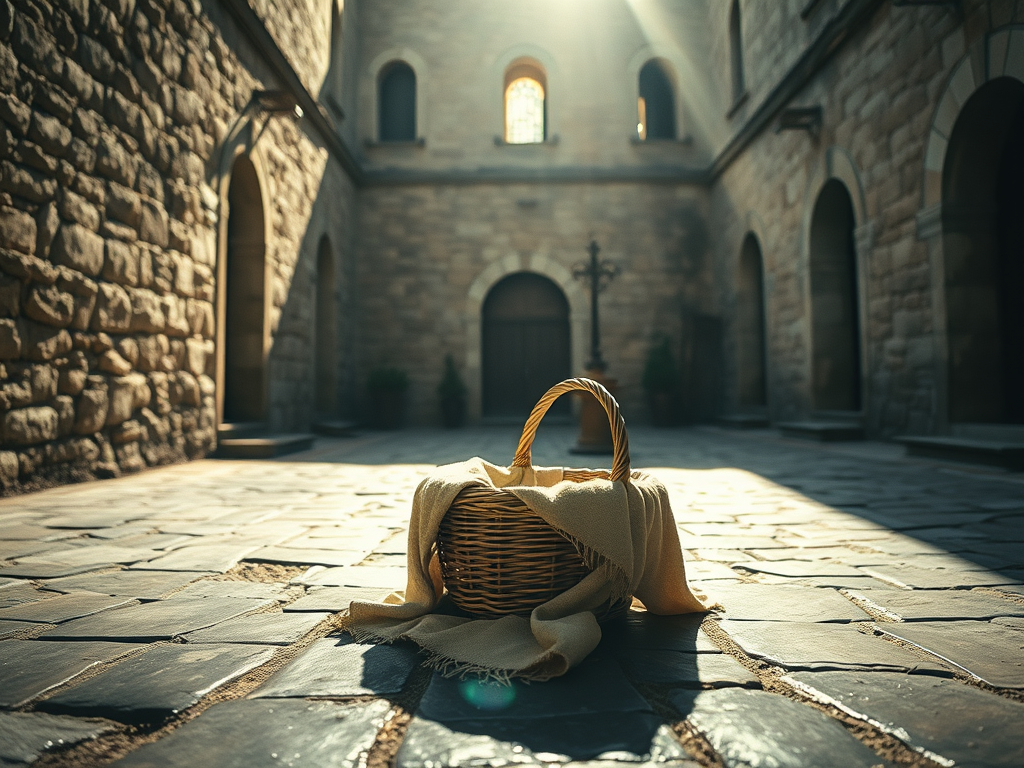
At the door, a wicker basket sat, alone in the glaring sun, a foul-smelling blanket draped over its edges. The abbot stood before it, hands trembling, unable to reconcile the weight of what lay hidden beneath the coarse weave. The note—crumpled, ink smeared by an unsteady hand—spoke of failure and dread.
“Evil exists
Untimely wrenched
Unholy mark
I fail in faith
You must not”
His throat tightened. The words clawed at him with the desperation of someone who had glimpsed something far beyond human understanding. But there were no instructions, no guidance, only the certainty of horror. Slowly, almost unwillingly, the abbot bent down and touched the blanket. His hands shook as he peeled back the layers, each fold heavy with dread, each moment stretching into a timeless horror.
And then, there it was. Tiny. Innocent, wrapped in the fragile guise of a newborn. Yet nothing felt innocent here.
The mark—impossibly intricate, disturbingly alive—glowed faintly on the infant’s palm. It throbbed with a dark pulse, a sickening rhythm out of sync with the world around it. He had never seen such a thing before, but something in the deepest recesses of his mind whispered that it was old, far older than this monastery, older than humankind.
The baby lay motionless, unnaturally still, its breaths shallow, its form too quiet, too delicate for the vast, unknowable malice that seemed to coil beneath its skin.
His hand hovered above the child, caught between fear and a twisted compulsion. He knew this was no ordinary infant—no mere child of sin or sorrow. Something monstrous, something grotesque in its scale, slumbered here, waiting.
The baby’s fingers twitched.
A small, simple motion, almost too minute to notice. Yet it drew his gaze, ensnaring him in its quiet malevolence. The abbot’s breath caught in his throat.
Tiny digits danced, curling and uncurling as though grasping at invisible strings.
Twitch. Twitch.
Fingers in cadence.
An unseen puppeteer.
A silent mockery.
The baby’s eyes snapped open, black as the void. They weren’t eyes—they were holes, abysses that sucked the light from the room, leaving only an emptiness, a gnawing hunger that peered into him and beyond him, into places he did not know existed. He staggered back, his mind reeling, trying to comprehend the sheer vastness of what he was staring into.
His mouth opened in a silent scream. A cold sweat slicked his body, and the world around him seemed to warp and stretch, bending to the will of the creature that gazed out from behind that infant’s face.
Faith faltered.
Truth unraveled.
All he had ever known lay bare,
Stripped of its illusions.
Somehow, he forced his trembling hand to the vial of holy water hanging at his side. His fingers closed around it with the same desperation of a man holding onto the last thread of sanity. But as he moved to douse the child in its purifying touch, the baby’s mouth opened—a soundless cry, a void that swallowed everything. The world itself seemed to collapse inward.
He was falling.
Darkness surrounded him, a torrent of nightmares spilling into his mind. He was no longer in the monastery; he was nowhere. All around him, there were voices—whispers in languages he could not comprehend, hissing promises of suffering, of truths that would tear at the seams of the universe itself.
Beyond the veil
Truth awaits
But at what cost?
The darkness spiraled deeper, infinite, maddening. He tried to hold onto something, anything—his faith, his training, the name of his God—but the whispers drowned them all. Everything he had ever known seemed absurd, feeble, in the face of this terrible, cosmic truth.
He landed hard, back in the monastery, but the air was different now—thicker, saturated with an unseen malice. The wicker basket remained before him, but it was no longer just an innocent object. It radiated a terrible power, the baby inside a grotesque contradiction, too human and too inhuman all at once.
A lingering dread hung in the air, like smoke that could not be dispelled. The mark on the baby’s hand glowed once more, faint but relentless, and for the first time, he noticed something chillingly familiar.
His own hand, where it had grazed the infant, now bore the same mark, its lines burning themselves into his flesh, pulsing with the same unholy light.
The child stirred, its inky eyes half-lidded but watchful, as if it were no longer just the helpless thing in the basket but something far more ancient, far more deliberate. The abbot recoiled.
There was no redemption. No exorcism. No prayer that could unravel this evil.
The mark was spreading. It crawled over his skin, twisting up his arm, searing into his bones. He could feel it now—its influence burrowing into his mind, into his soul, and with it, the gnawing certainty that he had become something else.
The wicker basket.
The cursed child.
The abbot.
A vessel, now shared.
In the silence that followed, there was no salvation. Only the quiet certainty of what had begun. The tiniest evil, but not confined. Never confined.
And it would grow.
 MADD FICTIONAL