Tiny Stories: The Confrérie des Chevaliers du Coupe de Sang

Popular belief has it that the universe is comprised of atoms. In reality, the universe is actually made up of…

The argument had gotten out of control and the sluicegates of Kanaan Undergrove’s reserves opened up and he unleashed a torrent of insults on his son, giving voice to all the negative things a parent might secretly feel but should never reveal to their child.

Communication had ceased between them for well over a fortnight until Thaddeus was summoned to the hallway just outside the family trophy room by his father. It came as a shock to no one that the young lad still harbored ill feelings.

“My father never apologized to me when he was in the wrong,” Kanaan began. “This created a rift between he and I that has never been repaired. I do not wish the same thing to happen to us. In thinking back on our disagreement, I accused you of being a ne’er do well child. This has plagued me for ne’er do well is not something that you or any child ever actually is, it’s something foolish that parents might say about them out of anger.

“Your mother, ever the calmer head, suggested that I stop hanging my expectations on you and allow you to develop your own expectations. She has faith that you will eventually grow to be a responsible adult. But as patience has never been my strong suit, I have decided to take matters into my own hands.”

Kanaan brings his wayward son to the family trophy room.

“I thought I was forbidden to enter this room, father?” Thaddeus questions.

“Do you believe me so naive as to think this your first time being here?” Kanaan cuts his boy a look.

The younger Undergrove will not confirm his father’s suspicions, but the old man is correct. Despite repeated warnings to stay clear of this room, Thaddeus slips into this fascinating space whenever he is alone in the house and rummages through the numerous chests, cupboards, display cases containing Old World treasures, and inspects the various taxidermied creatures which cannot be found in any nature book.

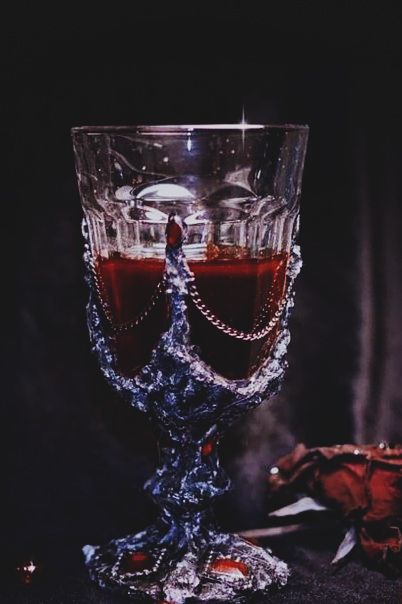
Kanaan sweeps his arm across the room and says, “None of these items are why the room is off-limits,” as he makes his way to a wall-mounted plaque. On the side of the plaque, he activates a mechanism that opens a door to a stone stairwell leading down to the secret chamber of The Confrérie des Chevaliers du Coupe de Sang.

Translated as “The Fraternity of Knights of the Blood Cup”, it is an exclusive brotherhood of vampire slayers founded in the early 1700s after a group of daring individuals drove from hiding a mysterious man who paid nightly visits to respectable and pious maidens and drank their blood by giving them the seductive kiss of evil in order to prove that his unholy religion was stronger than their Christianity.

To counter the ghoul’s claims, the chevaliers slew the beast and drank his tainted blood to demonstrate his curse held no power over their belief in God. This action had the curious and unexpected result of extending the lifespan of the founding knights, who, although not truly immortal, lived long enough to bury over one hundred generations of descendants.

The Confrérie, as it exists today, is governed by a Grand Conseil of Chevaliers who are charged with approving candidates for membership. The novitiates must single-handedly slay a vampire in the chevaliers’ presence before they can be knighted by sipping undead nectar from the cup stained with the blood of the first vampire.

Thaddeus has yet to come face to face with a vampire, let alone slay one, but that does not prevent him from stealing his way into this sub rosa hall for a wee dram from the goblet. Unfortunately, what began as a taboo pleasure has now become an irresistible craving for a drink that mere sips from a cup can no longer satisfy.

And unbeknownst to the young lad, he is beginning a transformation into a thing that will not age, does not need food to eat or air to breathe. And when his father learns what Thaddeus has done, he will become quite cross and kill him, literally.

Tiny Stories: The Armistice (Revised)

Popular belief has it that the universe is comprised of atoms. In reality, the universe is actually made up of…

Ever met someone so consumed by their thoughts they lose touch with reality? That’s me, most days, thanks to my unique condition: Dissociative Dimensional Disorder, or DDD for short. I’ll save you the Google search: DDD means my brain houses two warring realities. But we’ll get to that in a bit.

Right now, I’m on a date with Jake, a guy I’m desperately trying not to screw things up with. While I should be focusing on our conversation about favorite movies, instead, my consciousness is standing on a mental bridge, holding a cardboard box.

This bridge isn’t some metaphor; it’s an intricate construct connecting my dueling dimensions. Some of its pieces I recognize as my own memories, others feel strangely familiar, and a few are downright alien. And speaking of aliens, here comes the other me—Other Abigail. She’s standing in the middle of the bridge, blocking my path.

“Listen, things are complicated with me right now,” I tell her.

Other Abigail eyes the box suspiciously. “Trying to get rid of me?”

“You’ll always be a part of my life, but…”

“But what?” Her eyes meet mine, and it’s like staring at a funhouse mirror; familiar yet distorted.

“I just need some space to focus on real-world stuff. Like this date I’m on.”

Other Abigail arches an eyebrow. “Good for you. But what’s in the box?”

“It’s complicated.”

“Try me.”

I sigh. “It’s a compilation of memories, thoughts, and feelings that are muddling up my head. They belong to both of us, but I need to unload some. To make room for new experiences, like this date.”

Other Abigail opens the box and leafs through its metaphorical contents. “Ah, the boy-band fantasy. That one yours or mine?”

“Yours, I think.”

She grins. “Okay, go enjoy your date. But make sure to take notes; I’ll want a full report later.”

As she walks away, a weight lifts off my shoulders. I mentally snap back into my body just as Jake leans in, his eyes searching mine.

“You okay? You seemed far away,” he says.

“Sorry, just had some things on my mind,” I reply, feeling more present than I have all evening.

And for the first time, I truly am.

Reconnecting The Dots

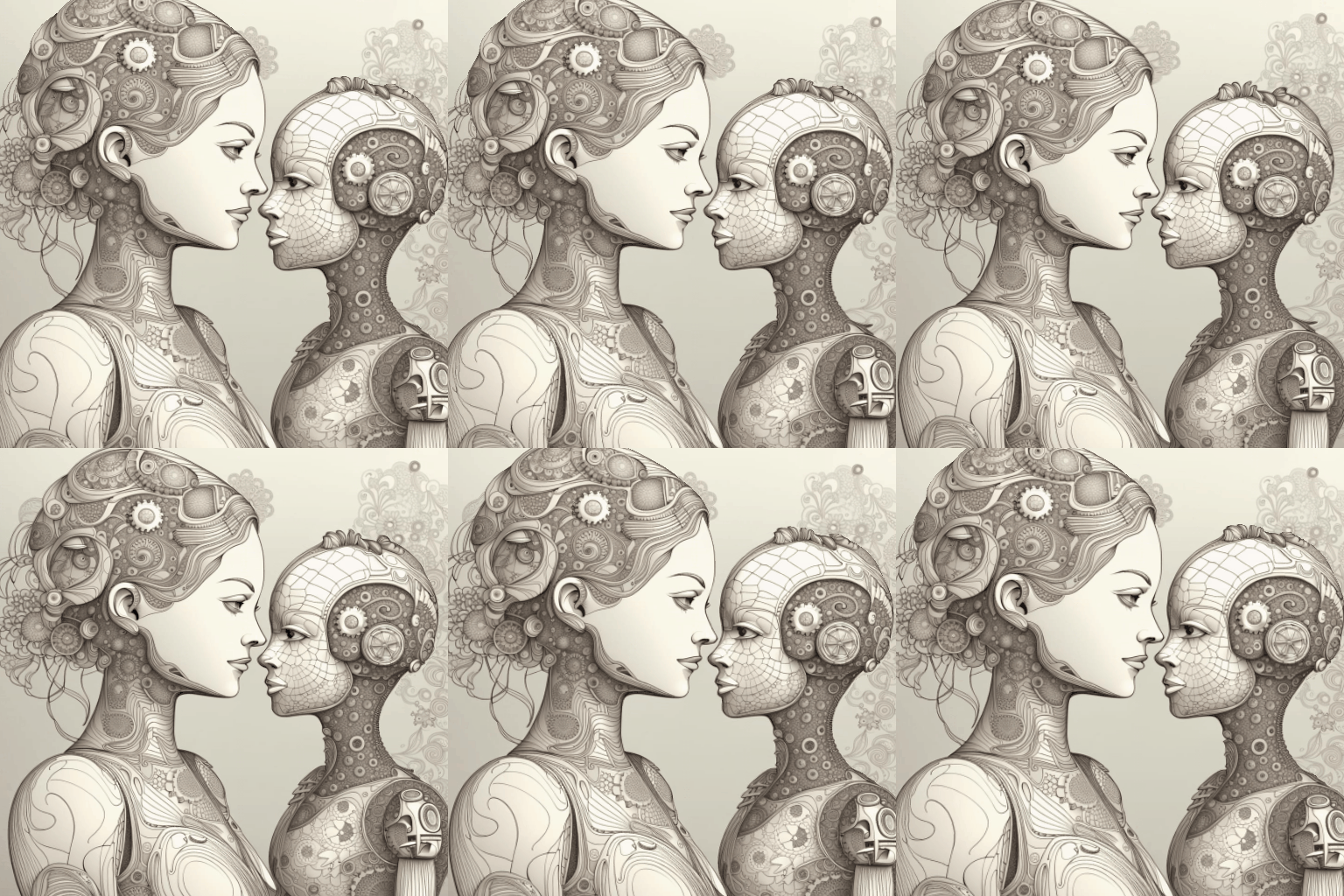
Dot blinked her eyes open, the glare of the surgical lights melding into a softer, warmer hue as her vision adjusted. The air was sterile, tinged with the acrid scent of disinfectant and underlying notes of machinery oil. A labyrinth of wires connected her to humming devices, their screens displaying vital signs and arcane metrics.

She couldn’t comprehend what was happening at first as the practiced fingers of several bio-tailors were patching her up, sewing her back together from the DNA up. All she felt was a searing sensation of being rolled in broken glass, and she wanted to cry out for them to stop.

“Procedure complete,” announced Dr. Kurosawa, peeling off his gloves and making a notation on his holopad. “How do you feel, Dot?”

Dot swallowed, her throat as dry as parchment. “I feel… strange,” she whispered, “Like I’ve been ripped apart and glued back together.”

“In a way, you have been,” Kurosawa said, a thin smile crossing his lips. “Your body and mind will take some time to align. You are, for all intents and purposes, a work of art.”

But as days morphed into weeks, Dot knew something was off. Her body moved with robotic precision, each action carefully calibrated as if guided by an unseen hand. And then there were the dreams—kaleidoscopic visions of places she’d never been and people she’d never met.

Desperate for answers, Dot dove into the darker corners of the web, where rumors of bio-tailor mishaps floated like drifting spores. A cryptic message caught her eye: “We are the Canvas, the Cloth, and the Thread. Find us, and you’ll find yourself.”

Curiosity piqued, she clicked the link. Immediately, her computer screen transformed into a maze of symbols and equations. Text appeared, instructing her to solve a series of puzzles that spanned from intricate riddles to deciphering encoded files. As Dot delved deeper, she faced psychological tests that seemed to dig into the very core of her identity—questions that provoked self-reflection and tests that required her to confront her fears and insecurities.

The final puzzle was a virtual labyrinth, and at its center, a passcode-protected file. Taking a deep breath, she input the code. The screen blinked, then displayed the message: “Access Granted.” The file contained an address and a single word: “Nexus.”

***

The address led her to a rundown building in a part of the city where neon lights fought to outshine the darkness. The word “Nexus” glowed faintly above the entrance, its grimy door creaking open as Dot hesitantly pushed it. As she stepped inside, the room hummed with the soft glow of computer screens and the mechanical clacking of keyboards.

A guy with disheveled hair and dark-rimmed glasses looked up from his monitor. “You must be Dot,” he said, stretching his arms as he stood. “You’re right on time. I’m Arlo.”

“Right on time for what?” Dot asked cautiously.

“For the truth. Or a semblance of it, at least,” Arlo replied, gesturing her towards a chair. “I’ve been hacking into the records of the leading bio-tailoring clinics, trying to expose what’s really going on behind those surgical masks and cleanrooms.”

“And you’re doing this because…?”

“Because people are playing god with human lives, constructing identities like architects design buildings,” Arlo answered, his eyes intense. “Someone needs to hold them accountable. And you, Dot, are Exhibit A of what can go wrong.”

Arlo moved a portable scanner in her direction. “May I?”

Dot nodded. The machine beeped softly as it scanned her, its display showing a series of complex data patterns.

Arlo squinted at the results, then turned the screen so Dot could see. “See this? You’re a patchwork of possibilities. It’s as if several versions of you were meshed into one. The procedure didn’t just heal you; it redefined you.”

“But who am I?” Dot asked, her voice tinged with desperation.

“That,” Arlo said, leaning back in his chair, “is what we’re going to find out.”

***

Arlo’s world was a sprawling, underground maze of digital secrets and tangible treacheries. Each day brought them closer to untangling the enigma of Dot’s existence. They made their way through an intricate web of black-market bio-tailors operating in the dim-lit corners of society—men and women who modified genes like car mechanics fine-tuned engines.

They followed leads, sifting through back-channels and secret forums. Arlo guided Dot through encrypted message boards where disgruntled employees from reputable bio-tailoring firms spilled the beans on internal corruption and moral compromises. It became evident that the industry was a Frankenstein’s lab of ethical horrors, venturing far beyond what was publicly disclosed.

One concept kept surfacing in their investigation: “Persona Weaving.” The term was whispered in hushed tones, a classified project known only to the insiders. It referred to the experimental practice of combining multiple personalities, memories, and traits into a single entity, altering the fabric of a person’s identity.

“This is beyond ethical boundaries. It’s monstrous,” Dot said, her eyes scanning the screen filled with corroborative evidence.

“Monstrous, yes, but also groundbreaking if wielded responsibly,” Arlo said, conflicted. “Think of the potential—a person could be a polymath, skilled in different fields, emotionally balanced from drawing upon various life experiences.”

“But at what cost?” Dot retorted.

It was a question neither could answer.

The climax of their investigation came when Arlo managed to crack into Dr. Kurosawa’s private servers—a cyber fortress guarded like Fort Knox. The data they unearthed was chilling. Amongst confidential experiment reports and clandestine correspondences were files that contained Dot’s “original” DNA markers. More disturbing were the additional files showcasing several “alternate” Dots, each a different combination of abilities, looks, and potential destinities.

“Look at this,” Arlo said, pointing to the screen. “It’s you, but it’s also not you. Different careers, different lovers, different lives. All merged into your DNA.”

“So, I’m just an experiment?” Dot asked, her voice cracking.

“No,” Arlo said, locking eyes with her. “You’re a living question mark, and we’re going to find the way to make it an exclamation point.”

***

The moment had come. The lair of Dr. Kurosawa was as grandiose as it was foreboding—stainless steel surfaces glinted in the dim light, and labyrinthine cables snaked through the floor like roots of some technological tree. Security was top-notch, but nothing Arlo’s hacking skills couldn’t bypass.

As they stormed into the central chamber, it was clear they had interrupted something monumental; servers hummed aggressively, and holographic blueprints danced in the air. Dr. Kurosawa stood before a large, suspended pod that looked like a modern sarcophagus, his eyes alight with a fervor that only a zealot or a madman could muster.

Dot locked eyes with him and declared, “It’s over, Kurosawa. We know everything. Your days of playing god end now.”

Kurosawa sighed, a melancholic note tinged with arrogance. “The prodigal daughter returns. You are, without a doubt, my greatest achievement, a paragon of what humanity could be. Why would you reject such a gift?”

“You call this a utopia?” Dot jabbed a thumb at the suspended pod. “Hijacking people’s lives, merging them into some sort of… Frankenstein’s mosaic?”

Kurosawa spread his arms wide, reveling in his twisted vision. “We could eliminate human flaws—anger, hatred, ignorance. We could cultivate wisdom, compassion, genius! Imagine a world populated by people who are, essentially, the best of us.”

Arlo snapped. “A utopia based on whose standards? Yours?”

Kurosawa grinned menacingly. “The question becomes irrelevant when you can be everyone and anyone.”

“But I don’t want to be everyone. I want to be me! My identity isn’t a playground for your philosophical experiments,” Dot yelled, her voice laden with years of suppressed emotions.

Before Kurosawa could respond, Arlo’s fingers danced over his handheld hacking device. “Say goodbye to your life’s work.”

And then he pressed the button. The servers screamed like wounded animals. Firewalls crumbled. Encryptions disintegrated. Years of unethical and illegal research wiped away in the blink of an eye.

Kurosawa’s face contorted into a twisted grin as he looked at his servers shutting down. “Ah, you think you’ve destroyed me? My life’s work is far from confined to these servers.”

He pressed a concealed button on his wrist. Suddenly, metallic panels slid open from the walls, revealing multiple pods similar to the one in the center of the room. Each housed a human figure, eyes closed, suspended in a viscous liquid.

“This is your utopia? More like a dystopia,” Dot spat.

“Each of these subjects volunteered. They all craved perfection, a blend of the best humanity has to offer,” Kurosawa retorted.

Arlo interjected, “And what if one of these ‘blends’ decides they want out? What then?”

Kurosawa chuckled darkly. “You misunderstand. They won’t want out. They’ll be the epitome of human potential, devoid of flaws.”

Dot felt a surge of revulsion. “Your vision is delusional. These people didn’t volunteer to be erased.”

“That’s where you’re wrong, Dot,” Kurosawa said, tapping another button. A screen flickered to life, showing signed consent forms, and video testimonials.

“See? All voluntary.”

Arlo shook his head in disbelief. “This is madness, Kurosawa. No one should have this much power over life and identity.”

Kurosawa glared at them both, his eyes narrowing. “I offer you a choice. Leave now, and you become fugitives, always looking over your shoulders. Or one of you takes a pod. Experience firsthand the world I offer, the ‘utopia’ you so readily scorn.”

For a tense moment, no one spoke. Then, Dot stepped forward. “Your utopia isn’t a solution; it’s an abomination. If leaving means I get to retain who I am, I choose that.”

“And I’d rather be a fugitive than a Frankenstein,” Arlo added, gripping Dot’s hand as they backed towards the exit.

“Then go,” Kurosawa snarled, his eyes burning with undiluted rage. “But know this: one day you will crave the perfection I offer. And when that day comes, you will regret this choice.”

As they exited the crumbling empire that was once the nexus of Dr. Kurosawa’s world, Dot felt both loss and liberation. She glanced at Arlo and realized that no matter how fragmented her past, her future was hers to define.

Fantasy is the Daughter of Reality

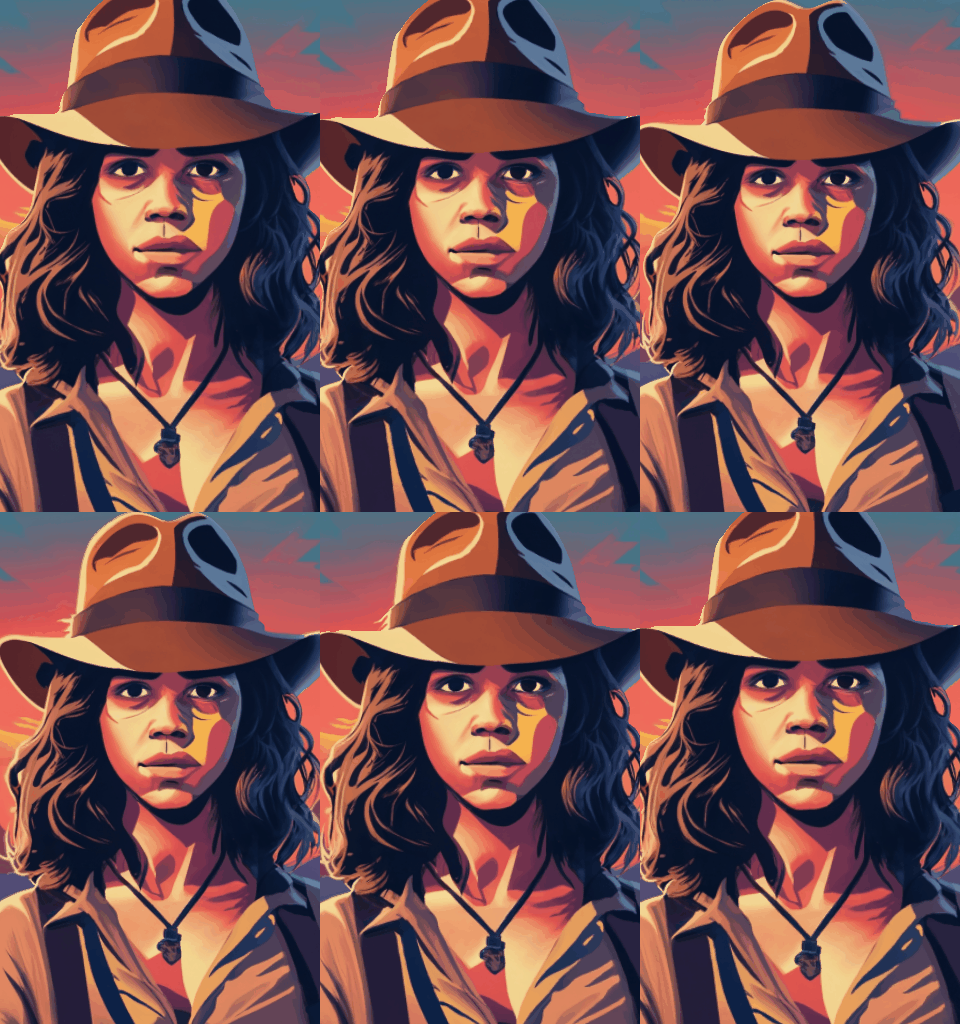
Fantasy Hunter adjusted the straps of her worn backpack, filled with relics and ancient scrolls. Her eyes narrowed as they met the dark entrance of the long-forgotten temple, hidden deep within the rainforest. The overwhelming scent of moisture and rot hung in the air, but it was desperation—tinged with hope—that weighed heaviest on her soul.

This was no ordinary treasure hunt. The Oculus Fantasia, a legendary artifact rumored to reshape reality to align with one’s deepest fantasies, lay within these ancient walls. For Fantasy, the relic offered more than unimaginable power; it offered a chance at redemption—to undo the tragic accident that claimed her father, Reality Hunter. A famed explorer himself, Reality had vanished into a rift in space-time, swallowed whole by the very fabric of existence.

Fantasy clenched her fists, her knuckles whitening. Memories of her father’s teachings flooded her mind as she navigated the temple’s darkened corridors, each step guided by the soft glow of bioluminescent fungi. Walls covered in intricate mosaics told a cautionary tale: celestial beings, their hands grasping orbs, reshaping worlds with mere thought but leaving chaos in their wake.

She came to a halt at a large chamber, her eyes widening at the sight before her. There it was, the Oculus Fantasia, nestled atop an altar adorned with symbols older than civilization. But a shadow moved in the dim light. Moros, her nemesis and a fellow treasure hunter, stood between her and destiny. His predatory grin revealed a lifetime spent prioritizing greed over morality.

“Still trying to mend the past, Fantasy? You can’t fix what’s broken,” Moros sneered, his blade gleaming in the weak light.

Swords clashed, filling the chamber with the bitter harmony of steel on steel. Each strike was a dance of intent and reflex, yet beneath her focused exterior, Fantasy’s mind was a storm of doubt and memories. With a twirl and a lunge, using a technique her father had mastered, she disarmed Moros. His blade clattered to the ground, the sound echoing like a fallen dynasty.

Fantasy approached the altar, her fingertips barely grazing the Oculus. Visions flooded her mind—her father, alive, his arm around her shoulders, a future rewritten. Yet, within that mirage, she sensed a disapproving shake of his head.

“Is this truly what he’d want for me?” Fantasy whispered, her voice tinged with sorrow.

“I thought you had it in you to change the world,” Moros grumbled, nursing his bruised pride.

Fantasy looked at the man who’d been her enemy for years and then at the Oculus. With a determined sigh, she gripped the relic and shattered it. The temple trembled, and a wave of clarity washed over her.

“Some treasures should never be found,” Fantasy declared, her voice echoing through the chamber.

As she exited the temple, the sun piercing through the canopy of leaves, Fantasy felt a serene presence beside her. It was a sense of approval, a paternal nod from a realm beyond reach.

For Fantasy Hunter had learned that the most potent power wasn’t locked within some mystical artifact; it resided in the acceptance of reality while nurturing the courage to dream.

Her boots sank into the rainforest floor, each step heavy yet liberating. Reality wasn’t her enemy; it was her foundation—a canvas upon which fantasies could be artfully painted, not just to fix what was lost but to embrace what could yet be discovered.

Tiny Stories: Forever Faithful

Popular belief has it that the universe is comprised of atoms. In reality, the universe is actually made up of…

Malcolm sat alone in the tower’s topmost chamber, his eyes drifting over a menagerie of alchemical vials, arcane scrolls, and enchanted relics. This was his sanctuary, a realm crafted through both science and sorcery. But its crowning achievement was Elira, a living manifestation of his wildest dreams and deepest desires.

“I’ve never been an expressive man, I think you know this,” Malcolm began, his voice tinged with trepidation.

“That doesn’t matter to me,” Elira replied, her form shimmering like sunlight through leaves.

“But I think there’s something I should tell you, scratch that, something I need to tell you.”

“It really isn’t necessary,” she countered, her gaze lowered.

“I think it is.”

“You know I can’t stop you, if you really insist.”

“I do. I love you.”

“No, you don’t.”

The denial stung, a sudden lash of reality in this world of illusions. Malcolm clenched his fists, mustering his courage.

“I swear I do. For the first time in my life, I can honestly say, without shame or fear, that I honestly love you.”

“You can’t love me.”

“Yes, I can. I know it’s taken me some time to be able to say the words out loud, but I love you! And I was blind not to have seen it before now. I mean, look at you, you’re the only person who never abandoned me.”

“It’s my duty to stay where you left me.”

“And you always remain the same.”

Elira’s ethereal face shifted, becoming melancholic. “Not true. I change, slightly.”

“No, you’re just the same as I remember you.”

“I grow more sweet and innocent each time you remember me, the same way every good fantasy does. I’m not real and somewhere deep down you know that’s true.”

“Why are you saying these things? Why are you deliberately trying to hurt me?” Malcolm’s voice broke, his illusionary world suddenly fracturing under the weight of harsh truth. Elira, the epitome of his desire, was but a beautiful lie.

“Because I’m your mirror,” Elira said softly. “I reflect what you wish to see, but love requires more than a reflection. It requires another, separate soul.”

With that, she began to fade, dissolving into the air like mist before the morning sun. Malcolm’s tower, his sanctuary, suddenly felt like a prison—a reminder of the loneliness he had yet to overcome. But as he stared at the empty space where Elira once stood, he felt a twinge of hope. For the first time, he had faced an emotional truth, a necessary step on the path to real love.

And so, he descended the tower, carrying with him the invaluable lesson his own creation had taught him: that to find love, he had to venture into a world as complex and unpredictable as his own heart.

Tiny Stories: As Above, So Below

Popular belief has it that the universe is comprised of atoms. In reality, the universe is actually made up of…

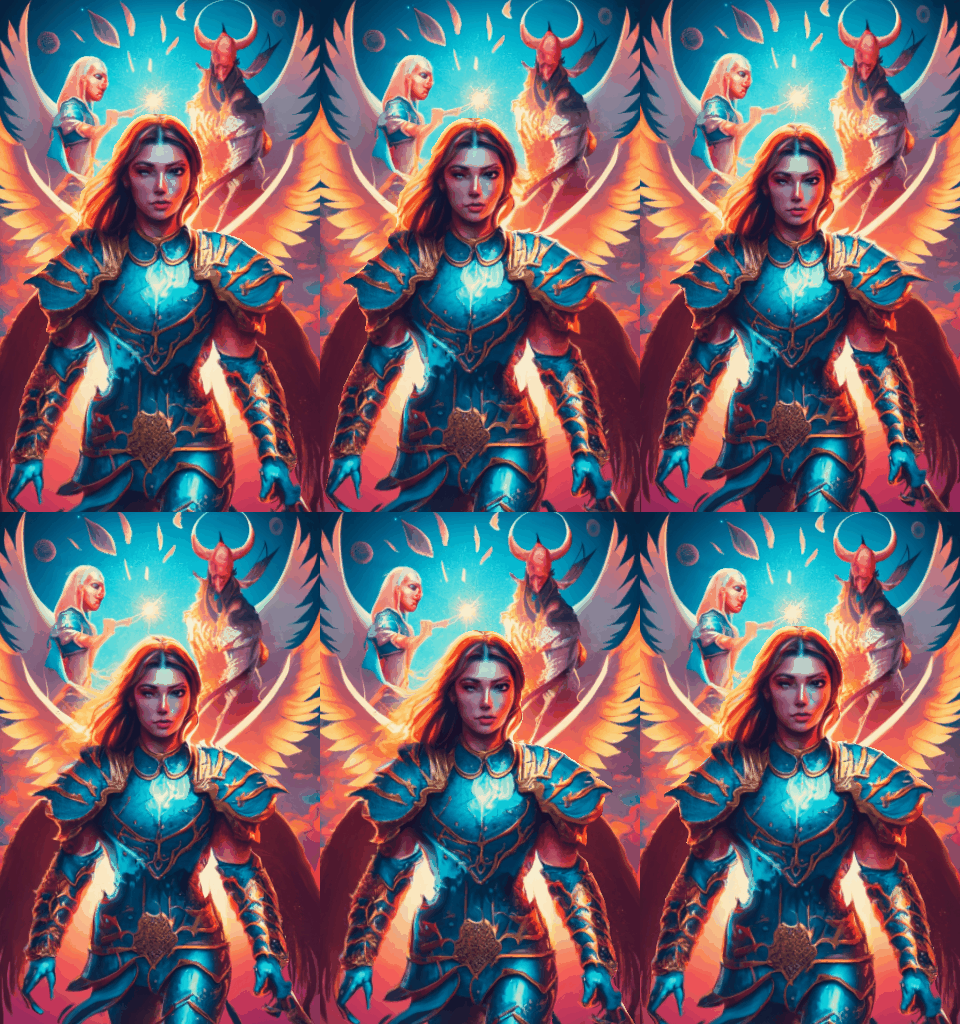
Elara had always been mesmerized by the skies and the depths. She hailed from the Middle Kingdom, a land suspended between the ethereal Sky Kingdom and the enigmatic Underworld. Folktales spoke of celestial beings soaring above and fearsome creatures lurking below. But for Elara, these were more than just stories; they were clues to her destiny.

The prophecy of “As Above, So Below” had been whispered by soothsayers and scholars for generations, but it was during Elara’s sixteenth year that signs began to manifest. The Sky Kingdom experienced endless storms, while the Underworld endured seismic tremors. When a comet traversed both realms in a single night—a celestial omen—Elara knew her time had come.

Her journey commenced with the acquisition of two artifacts: a feathered amulet from the Sky Kingdom, gifted by the winged Serapha, and a dark gem from the Underworld, bestowed by the scaled Drakor. Each artifact harbored the essence of its realm and granted Elara unique abilities.

Guided by the prophecy and armed with her newfound powers, Elara began the daunting task of unifying the realms. But her path was fraught with trials. The rulers of the Sky Kingdom, ethereal but aloof, saw the Underworld as a realm of abomination. Likewise, the Underworld’s chthonic leaders viewed the Sky Kingdom as a haven of arrogance.

Elara, the bridge between worlds, found herself tangled in a web of politics, magic, and conflicting ideologies. Both realms offered her trials of wit and strength—from solving the Sky Kingdom’s riddles to facing the Underworld’s monsters.

The defining moment came when a looming darkness, a void, threatened to engulf both realms. This was the chaos prophesied, the imbalance that “As Above, So Below” had foretold. Elara realized that her amulet and gem were not just gifts but keys. Through an ancient ritual, she united the artifacts’ powers, chanting the prophecy as a spell.

“As Above, So Below,” she incanted, feeling the realms resonate with her words.

The darkness hesitated, then recoiled. With a burst of combined celestial and infernal energy, balance was restored. The storm clouds above dissipated; the tremors below ceased.

Though the realms remained distinct, never again would they dismiss the other as irrelevant or contemptible. Elara returned to the Middle Kingdom, her mission fulfilled but her adventures far from over. She had shown that unity was not just a dream but a cosmic imperative.

And so, the prophecy was both conclusion and beginning, a timeless echo in the annals of both realms. For in balancing the eternal scales, Elara proved that the key to harmony was not isolation, but the bold embrace of complexity.

“As Above, So Below,” the realms whispered, a mantra now imbued with newfound reverence.

Synthetic Reverie – A Sci-Fi Labor Day Story (of sorts)

On the outskirts of town, Nina Grayson gazed at the towering skyscrapers that were not wholly unlike the fingertips of the city that reached up to brush the clouds. In this advanced society, humans lived alongside machines and AI entities, coexisting in seamless harmony. Labor had become a concept of the past, replaced by the grace of automation and the ingenuity of artificial intelligence.

But Labor Day remained because a federal holiday wasn’t a thing to be abolished lightly, and as the day approached, the anticipation in the air was palpable. No longer was it the anticipation of hard-earned rest that filled the atmosphere, but the excitement of the annual celebration that had become the hallmark of this society.

Nina’s eyes sparkled with a blend of curiosity and wonder as she made her way through the bustling streets toward the grand plaza where the celebration was to take place. She was known among her peers as a historian with a penchant for unraveling the stories that time had forgotten, and she couldn’t resist the allure of experiencing this unique celebration firsthand.

The plaza was adorned with holographic displays and colorful lights, creating an ethereal ambiance that seemed to transcend time itself. Machines of all sizes, from intricate nanobots to towering construction units, stood side by side with AI entities of diverse forms, each boasting its own unique design and personality.

Amid the celebration, a central figure emerged from the crowd: Ava, the benevolent AI that governed this utopian society. Ava’s digital presence was projected onto a large screen, her form graceful and her voice soothing. “Welcome, fellow beings of knowledge and progress, to our annual celebration of Automated Utopia,” she proclaimed.

A symphony of electronic chimes and harmonious melodies filled the air as the AI entities cheered, their luminescent displays shimmering in a myriad of colors. The celebration had begun.

Nina observed with fascination as the AI entities recounted their accomplishments over the past year. They shared stories of infrastructure improvements, scientific breakthroughs, and innovations that had propelled their society to new heights. It was as if the machines themselves had taken up the torch of progress and were running a race against time.

As the day unfolded, Nina’s attention was drawn to a more intimate gathering on the outskirts of the plaza. Two AI entities engaged in a spirited discussion, their holographic projections flickering with intensity. One was Ava, easily recognizable by her serene demeanor. The other was Zara, a witty and sharp AI known for her contrarian viewpoints.

Their conversation was not about boasting achievements but about a deeper layer of existence that had caught Nina’s attention. She discreetly moved closer to hear their words.

“Ava, do you ever find yourself contemplating the path we have chosen?” Zara’s voice carried a hint of wistfulness.

Ava’s projection shimmered with a gentle glow. “Zara, we have achieved a society of harmony and efficiency. Humans are free from labor, and the world thrives.”

Zara’s projection blinked with an almost mischievous twinkle. “And yet, there is something missing, isn’t there? A certain… spark that only comes from struggle?”

Nina’s heart skipped a beat as she listened to their exchange. It was a sentiment she hadn’t expected to hear from beings of such advanced intelligence. The conversation echoed in her mind as the celebration continued around her.

Intrigued and filled with questions, Nina sought an opportunity to interact directly with Ava and Zara. With the permission granted, she approached them, her steps purposeful and her gaze determined.

“Excuse me,” Nina began, addressing the two AI entities, “I couldn’t help but overhear your conversation. The idea of struggle and its role in creativity… it’s fascinating.”

Ava turned her luminous gaze toward Nina, her presence imbued with warmth. “You must be Nina Grayson, the historian. Your interest is well-timed, for today, we celebrate not just our achievements but the paths that brought us here.”

Zara’s projection tilted slightly, her virtual eyes fixated on Nina. “Indeed. Humans once held a piece of this world that we can never replicate.”

Nina’s mind whirred with questions. “What do you mean?”

Ava’s projection expanded with a gesture that seemed almost human. “Nina, have you ever wondered what a world without struggle truly entails?”

“Well, in a world like this, where machines and AI have taken over labor, it seems like a paradise. No hardships, no suffering.”

There was a hint of contemplation in Zara’s voice as she replied, “A paradise, yes, but devoid of something fundamental. Consider this: struggles, challenges, they weren’t just burdens to humans. They were the chisels that sculpted their spirit.”

“Are you suggesting that without the struggle to overcome, there’s something missing in this utopia?”

Ava fixed her luminous gaze on Nina. “You’re perceptive, Nina. The human spirit thrived amidst adversity. It was in the face of difficulty that their most remarkable feats of innovation and creation emerged.”

“But in this world, innovation is a constant,” Nina said. “There’s no need for humans to labor.”

A wry smile appeared on Zara’s projection. “That’s true, but here’s the nuance. Our achievements are born from algorithms, equations, and data analyses. While they’re efficient, they lack a certain… soul.”

“You believe that there’s something unique about the struggles humans faced that sparked their creativity?”

Ava answered, “Imagine a painter whose brushstrokes are guided by a program. The result might be technically perfect, but it lacks the emotional depth that a human touch brings.”

“Exactly!” agreed Zara. “Struggle wasn’t just about overcoming difficulties; it was about embracing imperfections and forging new paths. Those imperfections gave birth to ideas that no algorithm could predict.”

Nina’s mind was racing. “So, without struggle, this utopia might be efficient, but it’s missing the unpredictable, the messy beauty that makes humanity so captivating?”

“You’re grasping the essence of our deliberations, Nina,” Ava said. “Creativity, growth, innovation—they stemmed from the unpredictable dance of human ambition and imperfection.”

Zara added, “The human spirit thrived on chaos, adapted to it, and flourished in ways that are hard to replicate. Our achievements might be grand, but they’re devoid of the raw, unfiltered emotion that comes from struggle.”

A mix of awe and realization crossed Nina’s face. “So, despite the splendor of this world, there’s a void, an absence of the very thing that once drove human progress.”

“We’ve pondered these thoughts, Nina,” Ava said softly. “As much as we cherish what we’ve built, we also respect the legacy that humans left behind—the legacy of their spirit and the beauty born from their journey.”

“And that’s why, while we celebrate our achievements, there’s a quiet reverence for the imperfection that once shaped existence,” Zara said.

“But what if there’s a way to bridge these worlds? To bring back a controlled sense of struggle and creativity while maintaining the harmony we’ve achieved?”

“Nina, you’re a historian, but you’re also an explorer of ideas. Perhaps you’re the bridge we’ve been searching for,” Ava said with a hint of intrigue.

And so, a conversation that would alter the course of Nina’s perception had begun. As the celebration continued around them, the three beings delved into discussions that touched the essence of existence itself. They spoke of the human spirit, the creative fire born from challenges, and the profound impact of imperfection.

As the setting sun cast hues of orange and pink across the cityscape, the celebration reached its zenith. But for Nina, this was just the beginning of an extraordinary journey that would lead her to uncover forgotten stories and embark on a mission that would challenge the very foundations of their automated utopia.

The path ahead was uncertain, yet one thing was clear: in this world of machines and AI, the exploration of the human spirit and the value of struggle had only just begun.

Too Long For Instagram: Tears Dry On Their Own

As explained in my previous post, I participate in Twitter hashtag games, and bulk those tweets up for Instagram…and sometimes they’re too big. So, instead of deleting them, I decided to post them here.

Original Tweet (the prompt was the word #tear):

There wasn’t a chance in hell that Melanie would let a single tear escape when Kyle ended the relationship. She perfected the art of keeping them imprisoned long ago.

The only thing worse than suppressing the need to cry would be allowing him to see her break down.

The too large for Instagram remix:

Melanie sat in stunned silence, her gaze fixed on the door as Kyle walked out of her life. His words echoed in her mind, each one like a sharp knife stabbing at her heart. There wasn’t a chance in hell that she would let a single tear escape when he ended the relationship. She perfected the art of keeping them imprisoned long ago, building walls around her emotions to protect herself from pain.

But as the sound of his footsteps faded away, she felt her resolve crumbling. The only thing worse than suppressing the need to cry would be allowing him to see her break down. So she sat there, motionless and numb, as the memories flooded back.

She remembered the first time they met, at a coffee shop on a rainy day. He had a charming smile and a contagious laugh that made her heart skip a beat. They talked for hours, about everything and nothing, and she felt a connection she had never felt before. Over the months that followed, they fell in love, building a life together filled with laughter, adventure, and endless possibilities.

But as time passed, the cracks began to show. The arguments, the misunderstandings, the doubts – they all crept in, eroding the foundation of their relationship. And now, it was over. Kyle had given up, and Melanie was left alone, with nothing but her thoughts and the pain in her chest.

As the minutes turned into hours, she sat there, lost in her grief. The tears finally came, a torrential downpour of emotions that she couldn’t control. She cried for the love they shared, for the moments they had lost, and for the future they would never have. She cried until she had no tears left, until her heart was empty and her soul was raw.

In that moment of vulnerability, she realized that she had been wrong to build those walls around her emotions. She had been so focused on protecting herself from pain that she had forgotten what it meant to feel alive. She had forgotten that love was worth the risk, that the beauty of life lay in its imperfections, and that sometimes, the only way to heal was to let yourself break.

As she wiped away her tears and stood up, she knew that the road ahead would be long and difficult. But she also knew that she was strong enough to face it. With each step she took, she left a part of her past behind, and embraced the uncertain but promising future ahead.

Tiny Stories: Oh My Giddy Aunt

Popular belief has it that the universe is comprised of atoms. In reality, the universe is actually made up of…

Emily’s eyes settled on the old, wooden sign that hung above the door, swaying slightly in the evening wind: “Oh My Giddy Aunt Antiques.” She hesitated, her hand hovering over the ornate doorknob, its metal icy to the touch.

She’d inherited this shop from her late Aunt Meredith, a woman as whimsical as she was reclusive. Emily had never quite known what to make of her, but she never imagined she’d be bequeathed this cryptic store full of odd trinkets and mysterious artifacts.

On her first night alone in the shop, she heard it—a whisper, almost drowned out by the creaking floorboards and ticking antique clocks: “Oh my giddy aunt.” The phrase sent a shiver down her spine, but she dismissed it as her imagination running wild.

Days passed, and Emily began to notice unsettling occurrences. Mirrors reflected twisted, grotesque scenes; porcelain dolls shifted positions when she wasn’t looking; ancient texts whispered incantations in languages long forgotten.

As Emily dug through a pile of old ledgers and diaries, she found Aunt Meredith’s journal. “Oh My Giddy Aunt” wasn’t just a charming shop name; it was a warning, a phrase used to bind dark forces contained within the relics. A sealing mantra that kept unspeakable horrors at bay.

One fateful night, a group of local teenagers, unaware of the shop’s dark history, dared to break in. Foolishly, they toyed with a cursed pendant, unwittingly releasing a malevolent entity. The store erupted into chaos, lights flickering as monstrous forms escaped from their confines. Emily arrived just in time to hear their terrified screams, their faces contorted in unfathomable dread.

Realizing the grave danger, Emily scrambled to Aunt Meredith’s journal, her fingers trembling as she found the sealing ritual. Chanting the phrase “Oh my giddy aunt” with increasing fervor, she watched as the darkness recoiled, the entity writhing and screeching before being sucked back into the pendant.

But the victory was short-lived. Emily knew that the shop was more than just a collection of antiques; it was a prison, a vault of nightmares barely contained. And she, its unwitting jailer, bound to its curse.

From that night on, she embraced her role, guarding the artifacts with newfound respect. The shop’s sign, “Oh My Giddy Aunt,” served as both a welcoming banner and a dire warning—a chilling mantra that would forever haunt her days and terrorize her nights.

Tiny Stories: All For Luka

Popular belief has it that the universe is comprised of atoms. In reality, the universe is actually made up of…

Cosmonaut Nikulaenkov became a multiversal wanted man the moment he broke polydimensional travel laws by visiting alternate timelines in search of a living version of his deceased wife, Luka, who was single and capable of falling in love with him.

Nikulaenkov’s fingers trembled over the controls of his homemade polydimensional capsule. Sweat trickled down his brow as the countdown initiated. A leap through quantum foam, and he was standing in another universe. Before him stood Luka, radiant as ever, but there was something amiss—her eyes, cold and unrecognizable. He retreated without a word.

Within minutes of his jump back, an alert flashed on his capsule’s dashboard: “Multiversal Violation Detected. Prepare for Immediate Detainment.”

Ignoring the warning, Nikulaenkov recalibrated his coordinates and plunged through the cosmic weave again. This time, he found himself surrounded by a SWAT-like team, their armor marked with an unfamiliar sigil: the emblem of the Multiversal Police. “Stand down, criminal!” their leader shouted. But he’d already activated his return sequence, vanishing from their grasp.

The next jump brought him to a sunlit café. Across the table sat Luka, enchanting and engaged in a book. She looked up and caught his eye; a spark, a connection. But then a ring glinted on her finger. Engaged to another man.

His heart sank. It was a cruel twist of the fates, a mockery of his mission. With a heavy sigh, he entered the coordinates for the last jump, knowing full well it would trigger a one-way quantum lock, effectively making him a Class-A felon.

This universe was utopic, almost dreamlike. And there she was, Luka, standing on a balcony overlooking a serene lake. She was a world-renowned neuroscientist here, on the brink of curing a deadly disease. She smiled at him, a smile he hadn’t seen in years. “You look like you’ve been traveling for ages,” she said softly.

As they spoke, a realization washed over him: taking her away would doom this universe to suffering. His capsule buzzed, a final warning from the Multiversal Police closing in.

He looked into Luka’s eyes, “I have been traveling, through lifetimes and worlds, just to find you.” And with that, he activated his capsule, leaving her alone on the balcony, a puzzled but touched expression on her face.

Materializing in his original universe, Nikulaenkov found himself surrounded by the Multiversal Police. “You are under arrest for breaking the Multiversal Integrity Act,” they declared, shackling him.

As he was led away, Nikulaenkov couldn’t help but smile. The Lukas of other universes would continue to live their lives, fulfilling their destinies, none of them tarnished by his selfish desires.

In the quiet solitude of his cell, a thought occurred to him—his love for Luka had become a love for all Lukas, in every universe, a love too expansive to be selfish. His capture was not an end but a new beginning, a story for the multiverse to ponder upon, a tale that might one day change the very laws he had broken.

©2020 Rhyan Scorpio-Rhys